

Take a breath before you start this chapter. A lot of students open it, see words like trade flows, indentured labour and Bretton Woods, and quietly decide that history has turned into economics overnight. It has not. Underneath every difficult-sounding term in this chapter is a very simple human story: people wanted things they could not grow or make at home, so they travelled, traded, borrowed money, carried disease, moved for work, got rich, got ruined, and slowly stitched the world together. That is all globalisation means here. We are going to build the whole chapter from that one idea, slowly, with nothing assumed.
There is one more thing you deserve to know honestly, right at the start, because it changes how you should spend your time. For the 2026-27 session, CBSE has split this chapter into two parts. The first part is examined in your written board paper. The second part is taught and assessed differently, as an interdisciplinary project worth five marks under multiple assessments. Both parts are yours to learn. Only the route to marks is different, and knowing which is which lets you plan sensibly instead of panicking evenly across everything.
In the CBSE Class X Social Science (087) curriculum for 2026-27, only subtopics 1 to 1.3 of this chapter are part of the written board examination. That is: The Pre-Modern World, Silk Routes and Cultural Links, Food Travels, and Conquest, Disease and Trade.
Subtopics 2 to 4.4 — the nineteenth century, the inter-war economy, the Great Depression, and the rebuilding of the world economy after 1945 — are prescribed as an interdisciplinary project as part of multiple assessments, internally assessed for 5 marks. They are not questions on the written board paper this year.
So what should you do? Learn the board portion until you could teach it to a younger cousin, because those marks come to you in the three-hour paper. Learn the project portion properly too, because five internal marks are still five marks, and because those sections are genuinely the most interesting history in the book. Nothing here is wasted, and nothing here should be skipped.
One honest caution: syllabus documents get revised, and schools sometimes issue their own reading of them. Please cross-check this split against the syllabus copy your own school has given you for this session before you finalise your revision plan.
Throughout the notes below, every section is labelled so you always know where you stand. Board-examined sections carry the word Board. Project sections carry the word Project. Take them in order — the nineteenth century makes far more sense once you have understood the silk routes, and the Great Depression makes far more sense once you have understood the nineteenth century.
What You Will Learn
Part A — Board examination portion (subtopics 1 to 1.3)
- The Pre-Modern World: What Globalisation Actually Means (Board)
- Silk Routes: The First Threads Of A Global Web (Board)
- Food Travels: Spaghetti, Potato And The Columbian Exchange (Board)
- Conquest, Disease And Trade: The Americas Change Everything (Board)
Part B — Interdisciplinary project portion (subtopics 2 to 4.4)
- The Nineteenth Century: Trade, Labour And Capital (Project)
- The Corn Laws And Britain’s Hunger For Cheap Food (Project)
- Technology: Railways, Steamships And Refrigerated Ships (Project)
- Late Nineteenth-Century Colonialism (Project)
- Rinderpest: The Cattle Plague That Redrew Africa (Project)
- Indentured Labour Migration From India (Project)
- Indian Entrepreneurs Abroad (Project)
- Indian Trade And The Colonial Global System (Project)
- The Inter-War Economy: The First Modern Industrial War (Project)
- Post-War Recovery, Mass Production And Consumption (Project)
- The Great Depression And India’s Experience Of It (Project)
- Rebuilding A World Economy: Bretton Woods, IMF And World Bank (Project)
- Decolonisation, The Group Of 77 And The Era After Bretton Woods (Project)
Revision tools
Your Game Plan
- Read the four board sections first, slowly, in one sitting if you can. Do not memorise anything yet — just follow the story.
- Come back the next day and work through the worked examples in those four sections with a pen. Write the model answers out yourself.
- Now read the project sections. Read them like a story, not like a syllabus. Mark two or three topics that genuinely interest you — those are your project material.
- Learn the dated timeline. Ten dates, learnt properly, will carry you through more questions than fifty pages of vague reading.
- Do the worksheet without looking. Then check. Any question you got wrong points you straight back to the section you need to reread.
The Pre-Modern World: What Globalisation Actually Means (Board Portion)
Start with the word itself. Globalisation is usually described as an economic system, and it is — but that description is too cold to remember. Think of it instead as the process by which distant places stop being irrelevant to each other. Once what happens in one part of the world changes prices, harvests, jobs or health in another part, those two places have become globally connected. That is the whole test.
Here is an everyday way in. Think of your neighbourhood twenty years ago and today. Once, the vegetables in your kitchen came from farms a few hours away, and if those farms had a bad season, your family paid more. Today an edible oil shortage in another continent can change the price of the packet your mother buys. Nothing about your street has changed; the web your street sits inside has changed. Historians ask exactly this question about the past: when did the world’s separate webs join into one web?
Why the ancient world traded at all. No region has everything. The Indus valley grew cotton but had limited access to certain metals. West Asia had a hunger for that cotton. Coastal peoples had salt and fish; inland peoples had grain and timber. Trade is what happens when two places have surpluses of different things and a route between them. Add a coin system, a language traders can share, and some rulers who protect roads because taxing trade makes them rich, and you have a functioning long-distance economy — around three thousand years before anyone said the word globalisation.
Why this matters for your paper. Examiners love this section because it is where students either understand the chapter or do not. If you can explain that pre-modern trade already moved goods, people and germs together, every later section — the Columbian exchange, smallpox in the Americas, rinderpest in Africa, indentured labour — becomes an obvious continuation instead of a new list to memorise.
Model answer. Globalisation, in the historical sense, refers to the process by which different parts of the world became economically and culturally linked through the exchange of goods, the movement of people and the spread of ideas, crops and diseases. (1 mark — definition covering all three exchanges.) It is not a purely modern development; such links existed in the pre-modern world through overland and maritime trade routes, and later centuries widened and reorganised them rather than creating them for the first time. (1 mark — the historical depth point.)
Where the marks live: mark one is the definition; mark two is the “not modern” claim. Students who only define lose half the question.
Model answer — one mark per developed point.
(i) Long-distance trade in goods. Textiles, spices, precious metals and pottery moved thousands of kilometres between Asia, West Asia, Africa and Europe, showing that producers in one region were already supplying consumers they would never meet.
(ii) Movement of people. Traders, pilgrims, soldiers, scholars and enslaved people travelled the same routes as the goods, carrying skills, languages and beliefs with them.
(iii) Travel of crops and diseases. Plants and germs crossed regions along with human beings, which is why food habits and epidemics in distant societies came to share a common history.
Silk Routes: The First Threads Of A Global Web (Board Portion)
The silk routes are the best example of pre-modern globalisation, and the name is slightly misleading in a way worth clearing up immediately. There was no single paved road called the Silk Route. The term describes a whole network of overland and sea routes stretching from China across Central Asia to West Asia, and onward to the Mediterranean and Europe, with branches running down into India and across to North Africa. Silk was the most famous cargo travelling westward, which is where the name comes from, but silk was never the only cargo.
Picture it as a relay race rather than a marathon. Very few traders travelled the whole distance. A merchant carried goods to the next major market town, sold them, and a different merchant carried them further. Each handover added a profit margin, which is exactly why Chinese silk cost a fortune by the time it reached Rome. Understanding the relay explains the price, and the price explains why so many kingdoms fought to control stretches of the route.
Westward from Asia: silk, spices, pottery, textiles.
Eastward towards Asia: precious metals, especially gold and silver.
In every direction: religions and ideas. Buddhism spread out of India along these routes into Central Asia, China and beyond. Christianity and later Islam also travelled trade paths. Traders carried faith as reliably as they carried cloth, because a person who walks a thousand kilometres carries their beliefs with them.
Why it matters. The silk routes prove the chapter’s central claim in a single image. If a Buddhist idea born in India could reach a monastery in China because merchants walked the same road, then culture and commerce were never separate systems. That is the point examiners want you to make.
(i) They were not one road but a network of overland and sea routes linking China, Central Asia, India, West Asia, Africa and Europe, so distant economies were joined by a single trading system. (1)
(ii) Goods moved in both directions — Asian silk, spices and textiles travelled west, while gold and silver flowed east — showing genuine two-way exchange rather than one-sided raiding. (1)
(iii) Beliefs travelled with the traders. Buddhism spread from India along these routes, and Christianity and Islam later moved through the same channels, so the routes carried culture as well as cargo. (1)
Question. The silk routes are best described as: (a) a single highway built by Chinese emperors, (b) a sea route around Africa, (c) a network of overland and maritime routes connecting Asia with Europe and North Africa, (d) a canal system in Central Asia.
Answer. (c). Reasoning to hold on to: the word “network” is the marker. One-mark questions in this chapter frequently test whether you know it was many routes, not one road — so the option containing a single road or a single builder is almost always the distractor.
Before you attempt the worksheet, it helps to have Sectors of the Indian Economy fresh in your mind — several practice questions borrow from it.
Food Travels: Spaghetti, Potato And The Columbian Exchange (Board Portion)
This is the friendliest section in the chapter and, handled well, one of the most reliable sources of marks. The argument is simple and delightful: food is evidence. If a dish that feels utterly native to a country contains an ingredient that did not exist there a few centuries ago, then that country was connected to somewhere far away, and the food is the proof.
Take two examples that historians enjoy. Noodles are widely believed to have travelled from China westwards, where they may have become the ancestor of pasta. Historians debate the exact route and are careful with the claim, and you should be too — but the debate itself makes the point that even a national dish can have a foreign parent. Similarly, some scholars suggest that Arab traders carried forms of pasta to Sicily, which was then under Arab influence. The honest classroom position is this: the routes are argued over, the connectedness is not.
Now the case that is beyond argument, and the one your paper will actually reward.
Many foods that Europe, Asia and Africa now treat as ancient staples were completely unknown outside the Americas before Christopher Columbus reached the Caribbean in 1492. They include the potato, tomato, maize (corn), chillies, groundnut, sweet potato, soya and squash.
The two-way movement of crops, animals, people and diseases between the Americas and the rest of the world after 1492 is called the Columbian exchange. It is the single largest reorganisation of what humans eat in recorded history.
Follow the potato, because the potato tells the whole story. It arrived in Europe from the Andes. It was distrusted at first — Europeans were suspicious of a food that grew underground and belonged to no scripture they knew. But it produced far more calories per acre than grain, it grew in poor soil, and it could be left in the ground until needed. Poor Europeans who adopted it became better fed, and populations grew. Ireland became dependent on it to an extreme degree.
Then came the warning. When potato crops in Ireland were destroyed by disease in the mid-1840s, the resulting famine killed enormous numbers of people and drove mass emigration. The same plant that had fed a population had, by becoming the only thing that fed it, made that population fragile. This is one of the most useful lessons in the entire chapter, and it repeats later with rinderpest and again with the Great Depression.
(i) Ready foodstuffs and cooking techniques travelled with traders and migrants, so dishes now considered national often have foreign origins; noodles, for instance, are believed by many historians to have moved westward from China and influenced pasta. (1)
(ii) Crops themselves were transplanted between continents. Potatoes, tomatoes, maize, chillies, groundnuts and sweet potatoes were unknown outside the Americas before 1492 and became staples elsewhere afterwards. (1)
(iii) These transfers changed everyday life permanently, altering diets, nutrition and even population sizes far from where the crops originated, which shows the connection was deep and not merely decorative. (1)
Structure your answer in five clear points, one mark each.
(i) Origin and arrival. The potato came to Europe from the Americas after 1492 and was initially treated with suspicion by people unfamiliar with it.
(ii) Nutritional gain. Once accepted, it improved the diet of Europe’s poor, who had previously depended heavily on grain-based food.
(iii) Agricultural advantage. It yielded more food per unit of land than traditional cereals and grew in soils where grain did poorly, so the same fields fed more people.
(iv) Demographic effect. Better and more reliable nutrition contributed to longer lives and rising population in several European regions.
(v) The danger of dependence. Where communities relied on it almost exclusively, notably in Ireland, the destruction of the crop by disease in the 1840s produced a devastating famine and mass emigration — showing that a single imported crop could both sustain and endanger a society. Finish with this line; it converts a list into an argument.
Source (written for this worksheet). “Before the voyages across the Atlantic, no cook in Europe, Asia or Africa had ever seen a tomato or a chilli. Within two hundred years, neither continent could imagine its kitchen without them.”
Q1 (1 mark). Name the exchange the passage describes. Answer: The Columbian exchange, the transfer of crops, animals, people and diseases between the Americas and the rest of the world after 1492.
Q2 (1 mark). Name any two crops that fit the passage. Answer: Any two of tomato, chilli, potato, maize, groundnut, sweet potato.
Q3 (2 marks). What does this tell us about cultural identity? Answer: It shows that traditions people regard as timeless and purely local are often the result of long-distance exchange (1), so cultural identity itself is partly a product of globalisation rather than something untouched by it (1).
Conquest, Disease And Trade: The Americas Change Everything (Board Portion)
This is the last board-examined section and the most important one. It carries the chapter’s hardest and most memorable idea: the deadliest weapon of European conquest in the Americas was not the sword or the gun — it was disease. Read that sentence twice, because a large share of the questions from this chapter turn on it.
Set the scene first. Until the late fifteenth century, the Americas were cut off from regular contact with Asia, Africa and Europe. Their societies had cities, agriculture, astronomy and enormous wealth in gold and silver. When European sailors reached the Caribbean in 1492, that isolation ended, and the consequences ran in every direction at once.
The pull: precious metals. Reports of gold and silver drew waves of Europeans across the Atlantic. Silver mined in South America, above all from the great mountain workings of Peru and Bolivia, flowed to Europe and onward to Asia, where it was used to buy Asian goods. This is a detail worth noticing: American silver was what allowed Europeans to trade profitably with Asia at all, because Asia wanted metal more than it wanted European manufactures.
The conquest: Portugal and Spain. Portuguese and Spanish forces led the mid-sixteenth-century conquest of the Americas. They were vastly outnumbered. On paper they should not have been able to overwhelm large, organised societies. Understanding why they did is the heart of this section.
Because the Americas had been isolated for thousands of years, their populations had no exposure and therefore no acquired immunity to Old World diseases, especially smallpox. Europeans, by contrast, had lived with these diseases for generations and many carried resistance.
Smallpox spread ahead of the invading forces themselves — carried by contact, moving faster than armies could march — killing communities before a single European soldier arrived. Whole regions were depopulated. Leadership, farming, defence and morale collapsed together.
Guns and horses could be captured, copied or resisted. A germ could not be. That asymmetry, not military genius, is the historical explanation for the speed of the conquest.
The consequence: trade shifts to the Atlantic. For centuries, the wealth of Europe had been concentrated on the Mediterranean and the old overland routes to Asia. After the Atlantic crossings, the centre of gravity moved. Ports on Europe’s Atlantic coast rose. European trade, and later European slave trading between Africa and the Americas, made the Atlantic the world’s busiest commercial ocean, and the older Mediterranean centres declined in relative importance.
Meanwhile, China turns inward. Here is the contrast students most often miss. Through the fifteenth century China had been a formidable maritime power. From about that period onward, Chinese policy restricted overseas engagement, and China withdrew from long-distance sea trade and reduced its contact with the outside world. This retreat removed the strongest possible competitor from the oceans at exactly the moment Europeans were expanding into them, and it helped shift the centre of world trade westwards towards Europe.
(i) No immunity. The Americas had been isolated for centuries, so their people had never been exposed to smallpox and carried no resistance to it, while Europeans had long lived with the disease. (1)
(ii) It travelled ahead of the armies. The infection spread through contact faster than soldiers could advance, destroying communities before any battle took place. (1)
(iii) It could not be resisted or copied. Weapons could be seized, imitated or defended against; a disease offered no such response, so entire societies lost their populations, leaders and capacity to fight. (1)
(i) Flow of precious metals. Silver and gold from mines in South America poured into Europe and onward to Asia, financing European purchases of Asian goods on a scale not previously possible.
(ii) Conquest and colonisation. Portuguese and Spanish expeditions established control over large territories from the mid-sixteenth century, turning American land and labour into sources of European wealth.
(iii) Catastrophic loss of American population. Diseases such as smallpox, to which local populations had no immunity, destroyed communities and removed effective resistance to European occupation.
(iv) The Atlantic replaces the Mediterranean. The busiest and most profitable trade routes moved to the Atlantic Ocean, raising the ports of western Europe and reducing the relative importance of older Mediterranean centres.
(v) China’s withdrawal. From roughly the same era China restricted overseas trade and turned inward, removing the most capable rival from the seas and helping the centre of world commerce settle in Europe.
Case (written for this worksheet). A small European force lands on an unfamiliar coast in the sixteenth century. Within two years, the region has lost a large part of its population, its rulers are dead, its fields are untended, and the survivors submit with little organised resistance. Almost none of these deaths were caused in battle.
Q1 (1 mark). What most likely caused this collapse? Answer: An epidemic disease such as smallpox, carried unknowingly by the newcomers.
Q2 (2 marks). Why were the local people so severely affected? Answer: Long isolation from Asia, Africa and Europe meant they had never encountered the disease (1), so they had no acquired immunity and infection spread through entire communities with extreme mortality (1).
Q3 (2 marks). What broader historical lesson does the case illustrate? Answer: That connection between regions carries costs as well as gains — the same routes that moved goods, crops and ideas also moved germs (1) — and that the outcome of conquest can be decided by biological factors rather than by military strength alone (1).
The Nineteenth Century: Trade, Labour And Capital (Project Portion)
Between roughly 1815 and 1914, the world knitted itself together faster than in any previous century. Economists describe this using three international flows. Learn them as three questions: what moved, who moved, and whose money moved?
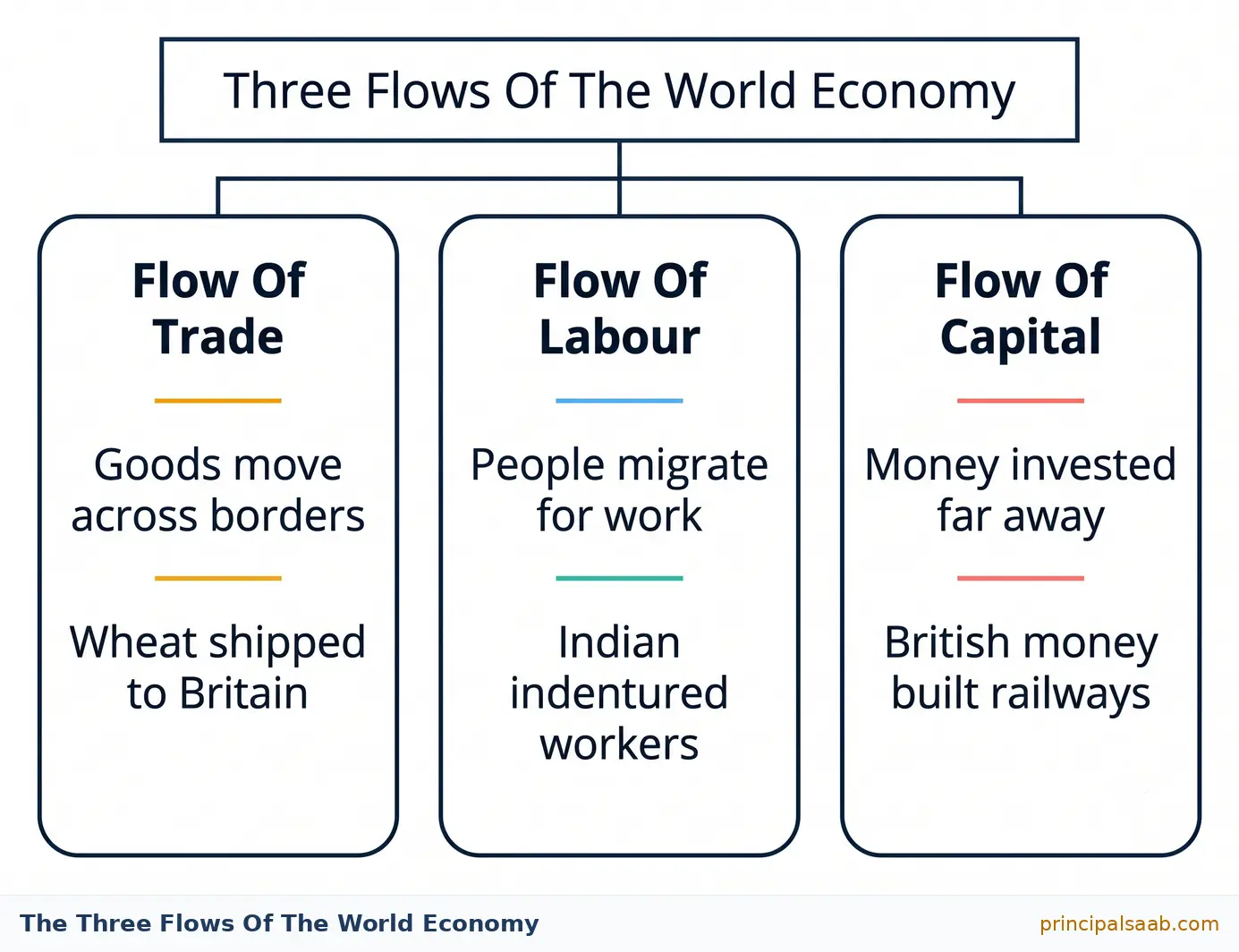
| Flow | What it means | A concrete example |
|---|---|---|
| 1. Flow of trade | Movement of goods across borders — largely cloth, wheat and other commodities. | Wheat from America and Eastern Europe shipped to feed British cities. |
| 2. Flow of labour | Migration of people looking for work or land, sometimes freely and sometimes under harsh contracts. | Indian indentured workers taken to Caribbean and Indian Ocean plantations. |
| 3. Flow of capital | Investment of money over long distances, for short or long periods, expecting a return. | British money financing railways and mines in distant colonies. |
Task. Your interdisciplinary project asks you to show how nineteenth-century globalisation worked. You have one page.
Structure that scores well. (1) Open with a single sentence stating the three flows. (2) Draw or paste a simple three-box diagram with arrows joining them. (3) Give one real example under each box — wheat, indentured migration, railway investment. (4) Close with two sentences on who gained and who lost, naming at least one group of each.
Why this scores: internal assessment rewards clarity of understanding and evidence of independent thinking. A diagram plus a balanced closing judgement demonstrates both, and it takes less space than an essay.
The Corn Laws And Britain’s Hunger For Cheap Food (Project Portion)
In Britain, “corn” was a general word for grain, including wheat. The Corn Laws were laws restricting the import of foreign grain, kept in place under pressure from British landowners who benefited from high food prices at home. Industrialists and urban workers hated them, for an obvious reason: expensive bread meant hungry workers and higher wages.
These laws were repealed in 1846. What followed is a textbook chain reaction, and it is worth tracing slowly because it explains a surprising amount of the nineteenth-century world.
1. Cheap foreign grain entered Britain freely.
2. British farming could not compete at those prices; land went out of cultivation.
3. Rural people lost work and moved to cities, or emigrated overseas.
4. British incomes rose and people ate more, so Britain imported still more food.
5. To supply it, distant regions expanded farmland, built railways to move grain to ports, expanded harbours, and needed labour and capital to do all of it — pulling in migrants and investment from far away.
(i) Food could be imported into Britain at prices below the cost of home production, so cheap grain flowed in after the repeal of 1846.
(ii) Large areas of British farmland became unprofitable and were left uncultivated.
(iii) Thousands of agricultural workers were thrown out of employment and migrated to towns or overseas.
(iv) As British incomes and consumption grew, imports of food increased further, encouraging distant countries to expand grain production for the British market.
(v) That expansion required new land, railways, ports, capital and migrant labour, so a change in one country’s trade law accelerated global movements of money and people. This final linking point is what lifts the answer from descriptive to analytical.
Technology: Railways, Steamships And Refrigerated Ships (Project Portion)
Technology in this chapter is not a background detail — it is a cause. But be careful with the direction of the argument, because examiners and project assessors both look for it: technology was made possible by money, politics and empire, and in turn it made possible a new scale of trade. It works both ways.
Railways connected inland farms and mines to ports, which meant land far from the sea could suddenly grow crops for a foreign market. Steamships made ocean crossings faster, more reliable and less dependent on wind, cutting the time and risk of long voyages. The telegraph allowed prices, orders and instructions to travel faster than any ship.
Refrigerated ships deserve their own paragraph because they changed what food was, in trade terms. Before refrigeration, live animals had to be shipped to Europe. Many died on the way, many lost weight, and the meat was expensive. Once ships could carry frozen meat, animals could be slaughtered where they were raised — in America, Australia or New Zealand — and only the meat travelled. Costs fell sharply, and meat, once a luxury for Europe’s poor, entered ordinary diets. Better-fed workers, in turn, meant a healthier workforce.
(i) Before this technology, live animals were shipped over long distances; many died or lost weight, making transport costly and wasteful. (1)
(ii) Refrigeration allowed animals to be slaughtered at the point of production and the meat alone to be carried, which sharply reduced shipping costs. (1)
(iii) Cheaper meat entered the diets of ordinary European working people, improving nutrition and widening the market for producers in distant countries. (1)
Late Nineteenth-Century Colonialism (Project Portion)
It would be dishonest to describe nineteenth-century globalisation only as trade, ships and cheaper bread. The same decades saw European powers take direct political control over most of Africa and large parts of Asia. Trade expansion and colonial conquest were not parallel events; they were the same event seen from two sides.
The pattern is consistent. European powers divided African territory among themselves in the closing decades of the century, drawing borders on maps in European conference rooms with almost no reference to the peoples who lived there. Many of the strange straight-line borders on the map of Africa today are the surviving marks of that process. Colonies then supplied raw materials — cotton, rubber, minerals, palm oil — and bought manufactured goods from the colonising country, an arrangement designed to benefit the metropolis.
Rinderpest: The Cattle Plague That Redrew Africa (Project Portion)
Rinderpest was a devastating disease of cattle. It reached Africa in the late 1880s, apparently arriving with infected animals imported from Asia to feed troops in East Africa, and swept across the continent through the 1890s, reaching the far south by the end of that decade. It killed a very large share of Africa’s cattle.
Now think about what cattle meant. In many African societies, cattle were not merely food. They were wealth, savings, status, bride-price, ploughing power and independence. A family with a herd did not need to work for anyone. Destroy the herds and you destroy that independence in a single season.
European colonisers in Africa faced a persistent problem: they had mines and plantations but could not find workers, because Africans with land and cattle had no need to sell their labour cheaply.
Colonial governments had already been trying to force the issue — through heavy taxes payable only in cash, through restricting African access to land, and through rules limiting where people could work.
Rinderpest completed what those measures had begun. With their herds gone, families lost their means of independent survival and were pushed into wage labour in European mines and farms. Surviving cattle became so valuable that colonial powers and wealthy landowners monopolised them, strengthening their grip further.
(i) The disease reached Africa in the late 1880s with imported infected animals and spread across the continent during the 1890s, killing a huge proportion of cattle.
(ii) Cattle were the basis of African wealth, food security and social standing, so their loss destroyed livelihoods rather than merely reducing incomes.
(iii) Families who had lived independently from their herds were left with no alternative but to seek paid work.
(iv) This solved the labour shortage that European mine owners and planters had been struggling with, giving them a cheap and dependent workforce.
(v) Control of the surviving cattle was concentrated in colonial and settler hands, which strengthened European economic and political power over African societies for decades.
Indentured Labour Migration From India (Project Portion)
This is the section where nineteenth-century globalisation stops being an abstraction and becomes a person standing on a dock with a bundle. Please read it slowly. It concerns real families, many of whose descendants live across the world today.
What indenture was. An indentured labourer was a worker bound by a contract to work for an employer in a distant place for a fixed number of years — usually around five — in return for passage, wages and, in principle, a return fare at the end. It was legally distinct from slavery. In practice, historians often describe it as a new system of bondage, and understanding why is the point of this section.
Where they came from. Most Indian indentured workers came from the eastern regions of the country — present-day eastern Uttar Pradesh, Bihar, central India and the dry districts of Tamil Nadu. These regions had been hit by a combination of pressures: cottage industries declining under competition, land rents rising, common lands being cleared for mines and plantations, and debt accumulating in bad years. People did not leave because they wanted adventure. They left because staying had become impossible.
Where they went. Caribbean islands including Trinidad, Guyana and Surinam; Mauritius; Fiji; the tea plantations of Assam within India itself; and other plantation economies.
Recruiting agents frequently gave false information about the destination, the type of work, the length of the journey and the conditions on arrival. Some workers were taken without being told properly where they were going.
Living and working conditions on plantations were harsh, legal rights were minimal, and punishments for leaving or failing to meet quotas were severe.
The contract made it lawful, but deception at the point of recruitment and coercion at the point of work meant the worker had very little real freedom. Legally a contract; in practice, bondage.
The part that deserves respect: what they built. Faced with a world that was not theirs, indentured communities created new cultures. In Trinidad, the annual Muharram procession developed into a large multi-religious carnival known locally as Hosay. In the Caribbean, the protest music of Chutney developed among the descendants of Indian workers. These are not footnotes. They are evidence that people stripped of almost everything still made something new, and any project on this topic that ends only in victimhood has missed half the history.
How it ended. The system was abolished in the 1920s, after sustained criticism from Indian nationalist leaders who condemned it as abusive and degrading.
Reasons for leaving (any three, one mark each). Decline of traditional cottage industries reduced rural earnings; rising land rents made cultivation unviable for small holders; common lands were cleared for mines and plantations, removing grazing and gathering rights; recurring debt and poverty in the eastern districts left families without alternatives.
Why a new system of slavery (two marks). Recruiting agents supplied false information about destinations and conditions, and some workers were taken without genuine informed consent (1); on arrival, harsh conditions, minimal legal protection and severe punishment for leaving meant the labourer had almost no practical freedom despite holding a legal contract (1).
Task. Present indentured migration in a way that shows independent thinking rather than summary.
A strong approach. Write a short imagined interview between a student today and a labourer boarding a ship in the 1880s. Give the labourer four answers: why they are leaving, what they were told, what they suspect, and what they hope for their children. Then add a factual box beside it listing verified details — main source regions, main destinations, contract length of about five years, abolition in the 1920s.
Why this scores: the creative half shows engagement and empathy, the factual box proves accuracy, and clearly separating the two shows you understand the difference between imagination and evidence — which is exactly the historical skill being assessed.
Indian Entrepreneurs Abroad (Project Portion)
Not every Indian who crossed an ocean in this period went as a labourer. Indian bankers and traders followed European empires across Asia and Africa, financing agriculture and running businesses far from home. Communities such as the Shikaripuri Shroffs and Nattukottai Chettiars were among the bankers and traders who funded export agriculture in Central and Southeast Asia, using both their own funds and money borrowed from European banks.
They also developed sophisticated financial instruments and systems of trust that allowed money to move across long distances long before modern banking reached those regions. Indian traders and moneylenders established themselves in Africa as well, and Indian cloth merchants — for example in Hyderabad Sind — built businesses selling to travellers along the busiest sea routes, opening shops at ports far from India.
Indian Trade And The Colonial Global System (Project Portion)
Here is the section that explains what globalisation did to India, and it needs to be told plainly. Before the nineteenth century, fine Indian cotton textiles were among the most sought-after manufactured goods in the world. By the end of that century, the position had reversed.
How the reversal happened. British manufacturers pressed their government to protect their own industry, and tariffs were imposed on cloth imports into Britain, which reduced Indian textile exports there. At the same time, British manufactured cloth entered Indian markets, often at prices Indian handloom weavers could not match. Indian textile exports declined sharply as a share of the country’s trade, and India increasingly exported raw materials — raw cotton, indigo, opium, later wheat — while importing finished manufactures.
The opium detail worth knowing. Britain had an enormous appetite for Chinese tea but struggled to find goods China would accept in payment. Opium grown in India was used to close that gap. The income Britain earned from selling Indian opium in China helped pay for tea, and the arrangement damaged China severely while draining India.
(i) India shifted from being a leading exporter of fine manufactured textiles to being primarily an exporter of raw materials such as cotton, indigo, opium and later wheat. (1)
(ii) Tariffs in Britain restricted Indian cloth, while cheaper British manufactured cloth entered Indian markets and undercut handloom weavers, causing widespread loss of livelihood. (1)
(iii) India’s trade surplus with other countries was used to settle Britain’s deficits and to meet home charges, so the gains from India’s exports largely accrued to Britain rather than to India. (1)
Students who found this section tricky usually go back to Nationalism in India, where the same idea is built up from scratch.
The Inter-War Economy: The First Modern Industrial War (Project Portion)
The First World War, fought between 1914 and 1918, broke the world economy that the nineteenth century had built. Historians call it the first modern industrial war, and each word in that phrase is doing work.
Industrial weapons. Machine guns, tanks, aircraft, chemical weapons and long-range artillery were produced in factories on a scale never seen before, so killing itself became a manufacturing process.
Industrial societies at war. Whole economies were reorganised for war production, with civilians, including large numbers of women entering industrial work, sustaining the front from home.
Industrial-scale losses. Casualties ran into many millions, and most of the dead and injured were working-age men, which reduced the workforce and household incomes across Europe for a generation.
The economic consequences. Countries borrowed enormously to fight, especially from the United States, and the war turned the United States from a debtor into an international creditor. European economies emerged burdened by debt and struggling to regain markets. Britain, which had financed the war heavily through borrowing, faced particular difficulty. Meanwhile industries in India and Japan had expanded during the war to fill gaps left by European producers, permanently altering the industrial map.
Post-War Recovery, Mass Production And Consumption (Project Portion)
The 1920s in the United States looked like the opposite of the war years: confident, fast and full of new things to buy. Behind that mood was a change in how things were made.
The assembly line. Henry Ford applied to car manufacturing an idea he is said to have taken from observing meat processing: instead of workers moving around a stationary product, move the product past stationary workers, each performing one repetitive task. The result was a dramatic fall in the time and cost of producing a car.
The bargain that made it work. The pace of the line was punishing, and workers left in large numbers. Ford responded by raising wages substantially. That decision looked like generosity and was in fact strategy: it reduced the cost of constant retraining, and — critically — it created workers who could afford to buy the very cars they were building. Mass production only pays if mass consumption exists to absorb it.
Buy now, pay later. Alongside higher wages came hire purchase, which allowed ordinary households to buy expensive goods — cars, refrigerators, radios, washing machines — on credit, paying in instalments. Consumption boomed. Housing and construction boomed with it, supported by loans. The economy of the 1920s ran, in large part, on borrowed money.
(i) The assembly line. Products moved along a line past workers who each repeated a single specialised task, sharply reducing production time and unit cost.
(ii) Higher wages. Because the work was monotonous and workers frequently quit, manufacturers such as Ford raised pay to retain them, which also turned employees into customers.
(iii) Cheaper goods. Falling costs made cars and household appliances affordable to a far wider section of society than before.
(iv) Credit-driven consumption. Hire purchase let households buy expensive goods in instalments, and construction was similarly financed by loans, so demand grew faster than incomes.
(v) A fragile foundation. Prosperity therefore rested on continued borrowing and continued confidence, which left the economy badly exposed when both weakened at the end of the decade.
The Great Depression And India’s Experience Of It (Project Portion)
The Great Depression began around 1929 and lasted through much of the 1930s. Incomes, output, employment and trade fell together across much of the world. This is the hardest section to hold in your head, so we will build it in the order the events actually occurred.
Step one: too much food, too little money. Through the 1920s, farmers around the world expanded production. More land and better transport meant more grain reaching market than buyers wanted. Agricultural prices fell. Farmers responded in the only way that seemed sensible to each of them individually — they grew even more, hoping volume would replace lost price — which pushed prices down further. Rural incomes collapsed.
Step two: American loans dry up. During the 1920s, the United States had lent large sums abroad, and much of the world’s prosperity depended on that flow continuing. When conditions in America worsened, American lenders pulled money back and cut new lending sharply. Countries that depended on those loans faced immediate crises.
Step three: the machine reverses. Banks that had lent freely now called in loans. Households that had bought on credit could not pay. Banks failed, taking savings with them. Businesses closed. Unemployment rose, so spending fell, so more businesses closed. Governments raised tariffs to protect home industry, which cut world trade further and made everyone worse off.
| Causes of the Great Depression | Effects of the Great Depression |
|---|---|
| Overproduction in agriculture and falling farm prices worldwide. | Rural incomes collapsed; farmers fell deep into debt. |
| Heavy dependence of many countries on loans from the United States. | Withdrawal of those loans triggered banking and currency crises abroad. |
| Consumption in the 1920s sustained by credit and hire purchase. | Households could not repay; banks failed and savings were wiped out. |
| Banks lending beyond what falling asset values could support. | Business closures and mass unemployment, deepening the fall in demand. |
| Governments raising tariffs to shield domestic producers. | World trade contracted sharply, spreading the slump between countries. |
India In The Great Depression
By the 1930s India was deeply integrated into world trade, so the Depression reached it immediately. Indian exports and imports both fell roughly by half between 1928 and 1934, and agricultural prices — the prices that decided whether an Indian peasant family ate — fell steeply. Wheat prices in India fell dramatically over that period.
And here is the cruelty of it. The colonial government did not reduce revenue demands in step with falling prices. A peasant whose crop now fetched half as much still owed the same tax and the same rent. Peasants producing for the world market, such as jute growers in Bengal, were hit hardest, because raw jute prices crashed and growers who had borrowed in better years sank further into debt.
Who suffered and who did not. Peasants and tenants suffered severely. To meet tax and debt obligations, rural households sold jewellery and precious metals. India became an exporter of gold in these years, which helped Britain’s economic recovery and did nothing for the Indian villager who had parted with a family ornament. Meanwhile, urban dwellers on fixed salaries found life somewhat easier, because prices had fallen while their pay had not, and industrial investment in India grew as tariff protection made local production more attractive.
(i) India’s foreign trade shrank sharply, with exports and imports falling by roughly half between 1928 and 1934, because India was closely tied to the world market.
(ii) Agricultural prices, including wheat, fell steeply, so cultivators earned far less for the same output.
(iii) The colonial government did not lower land revenue in proportion, so peasants faced unchanged tax and rent obligations on halved incomes and fell deeper into debt.
(iv) Producers for export markets, such as Bengal jute growers, were worst affected as raw jute prices collapsed and earlier borrowing became unpayable.
(v) Households sold gold and jewellery to survive, making India a significant exporter of gold in these years, which aided Britain’s recovery while rural distress in India intensified.
(i) Peasant incomes depended directly on crop prices, which collapsed, whereas salaries of urban employees were fixed and continued to be paid. (1)
(ii) Falling prices actually reduced the cost of living for town dwellers on unchanged salaries, effectively improving their real position. (1)
(iii) Peasants meanwhile still owed the same revenue, rent and interest as before, so their debts and obligations rose relative to their shrunken earnings, forcing distress sales of assets. (1)
Rebuilding A World Economy: Bretton Woods, IMF And World Bank (Project Portion)
The Second World War ended in 1945, leaving destruction on an even greater scale than the first. But this time the victorious powers had learnt something. They had watched the 1930s produce mass unemployment, collapsing trade and political extremism, and they had concluded that economic chaos and war feed each other.
Lesson one. An industrial society needs mass consumption, and mass consumption needs stable, high employment. That in turn needs governments willing to act rather than wait for markets to correct themselves.
Lesson two. A country’s economic stability cannot be secured by that country alone. Because economies are linked, the world needs shared institutions and agreed rules to keep the flow of goods, money and capital steady.
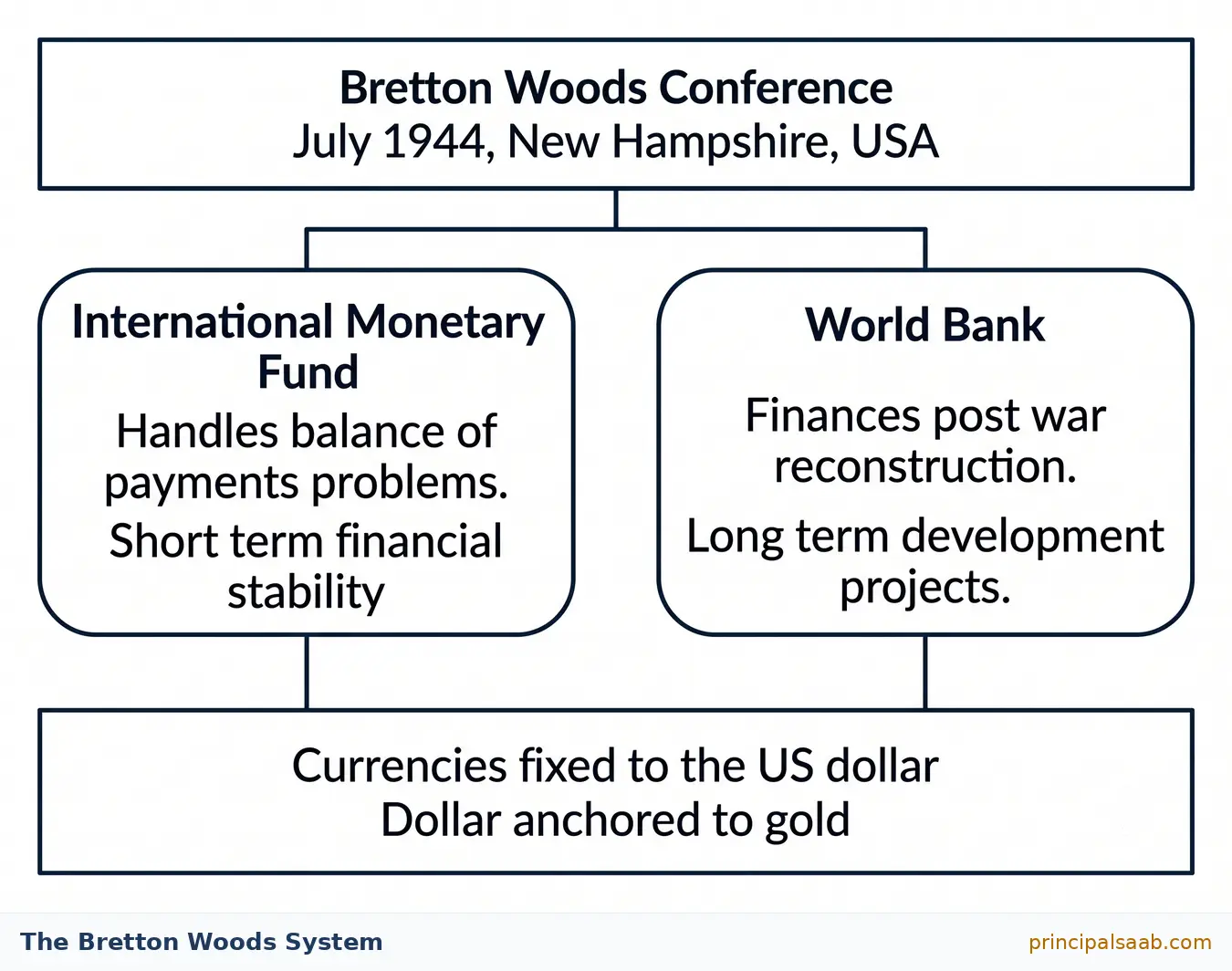
The conference. In July 1944, delegates from the Allied nations met at Bretton Woods in New Hampshire, in the United States, at what is formally called the United Nations Monetary and Financial Conference. They designed the framework for the post-war international economy.
| Institution | Purpose as designed | Point to remember |
|---|---|---|
| International Monetary Fund (IMF) | To deal with external surpluses and deficits of member nations and help countries facing balance of payments difficulties. | Think of it as short-term financial stability. |
| International Bank for Reconstruction and Development (World Bank) | To finance post-war reconstruction and, later, long-term development projects. | Think of it as long-term rebuilding and development. |
| The system itself | Currencies fixed in relation to the US dollar, which was itself anchored to gold at a fixed price. | Stability was the whole objective after the currency chaos of the 1930s. |
The IMF and the World Bank are together known as the Bretton Woods twins. They commenced financial operations in 1947. Decision-making in both was — and largely remains — weighted towards the wealthiest member states, and the United States held effective veto power over key decisions. That is not a complaint tucked into a footnote; it is a fact you should state plainly, because the design of these institutions explains the criticism they later attracted from newly independent countries.
What followed was remarkable. The two decades after the settlement saw the strongest sustained growth in trade and incomes that the industrial world had known, with low unemployment and widely shared gains. The system worked, for the countries it was built around.
(i) It was the framework for the post-war international economy agreed at a conference of Allied nations held at Bretton Woods, New Hampshire, in July 1944.
(ii) It established the International Monetary Fund to help member countries manage external deficits and balance of payments problems.
(iii) It established the International Bank for Reconstruction and Development, known as the World Bank, to finance post-war reconstruction and later development.
(iv) It fixed national currencies in relation to the US dollar, which was in turn tied to gold at a fixed price, in order to prevent the currency instability of the inter-war years. The two institutions began financial operations in 1947.
(v) Its aim was to preserve full employment and stable growth in the industrial world, and the following two decades did see exceptional growth in trade and incomes — though voting power in both institutions rested largely with the wealthiest members.
Decolonisation, The Group Of 77 And The Era After Bretton Woods (Project Portion)
While Europe and the United States enjoyed their post-war boom, most of Asia and Africa was becoming independent. Political freedom, however, arrived without economic freedom. Newly independent countries inherited economies shaped for the benefit of their former rulers: railways built to carry raw materials to ports, agriculture geared to export crops, and very little industry of their own.
They found, too, that the international institutions built in 1944 had been designed before most of them existed as sovereign states, and were oriented towards the needs of the industrial West. Developing countries had little say in decisions that shaped their economies.
Developing countries organised themselves into the Group of 77, established on 15 June 1964 by seventy-seven developing nations that signed a joint declaration at the first session of the United Nations Conference on Trade and Development in Geneva.
Their demand became known as the call for a New International Economic Order: genuine control over their own natural resources, fairer and more stable prices for the raw materials they exported, better access to developed-country markets for their manufactured goods, and a real voice in international economic decisions. The name is a reminder that the seventy-seven were not asking to leave the world economy — they were asking for different terms inside it.
The end of the Bretton Woods system. By the late 1960s the arrangement was under strain. The United States faced growing costs abroad and a weakening position relative to other economies, and its currency could no longer comfortably support the fixed link to gold. In the early 1970s the dollar was cut loose from gold, and the world moved from fixed exchange rates to a system of floating rates, where currencies find their value against each other in the market.
What came next. From the 1970s onward, industrial firms increasingly shifted production to countries with lower wages, particularly in Asia. China, after decades of relative isolation, re-entered the world economy from the late 1970s with low-cost production drawing enormous foreign investment. By the closing decades of the twentieth century, a genuinely new phase of globalisation was under way — one that ordinary students in India live inside every day.
Task. Assess whether the post-war institutions served the whole world or only part of it.
Balanced structure. (1) State what they were designed to do and when they began operating, in 1947. (2) Give the success: two decades of exceptional growth, high employment and expanding trade in the industrial world. (3) Give the limitation: they were designed before most Asian and African nations were independent, and voting power favoured the wealthiest members. (4) Give the response: the Group of 77, formed in 1964, and its demand for a New International Economic Order. (5) Conclude with a judgement of your own, in one sentence, that follows from the evidence you have laid out.
Why this scores: internal assessment values reasoned judgement. Steps two and three together prove you are weighing evidence rather than taking a side, and step five shows you can then commit to a conclusion.
Dated Timeline You Should Be Able To Place
Ten dates. Learn these properly and you will never again be the student who writes “in the nineteenth century” when a marker wanted a year. The Board column tells you which dates belong to the written examination portion.
| Date | Event | Portion |
|---|---|---|
| 1492 | Columbus reaches the Caribbean; the Americas are drawn into world contact and the Columbian exchange begins. | Board |
| Mid-16th century | Portuguese and Spanish conquest of the Americas; smallpox devastates local populations. | Board |
| 1815 to 1914 | The long nineteenth century of trade, labour and capital flows. | Project |
| 1846 | Repeal of the Corn Laws in Britain; cheap grain imports transform British and world agriculture. | Project |
| 1890s | Rinderpest sweeps across Africa after arriving in the late 1880s, destroying cattle and African economic independence. | Project |
| 1914 to 1918 | The First World War, the first modern industrial war; the United States becomes an international creditor. | Project |
| 1920s | Indentured labour migration from India abolished; mass production and credit-fuelled consumption boom in the United States. | Project |
| From 1929 | The Great Depression; Indian exports and imports halve between 1928 and 1934. | Project |
| July 1944 | Bretton Woods conference; IMF and World Bank created, commencing financial operations in 1947. | Project |
| 15 June 1964 | The Group of 77 is formed at the first UNCTAD session in Geneva; the fixed exchange rate system ends in the early 1970s. | Project |
Revising the full unit? Read our chapter notes on The Age of Industrialisation next — the two chapters are regularly linked in board questions.
Practice Worksheet With Full Answers
Ten original questions, written for this page. Six are drawn from the board examination portion and four from the project portion, and each is labelled. Cover the answers, write yours out fully, and only then open the box. Reading an answer feels like learning; writing one actually is.
Q1 (Board, 1 mark) — Which of these crops was NOT native to the Americas: potato, tomato, wheat, maize?
Q2 (Board, 2 marks) — Give two reasons why the silk routes are described as a network rather than a single road.
(i) They consisted of several overland and maritime routes running in different directions and linking China, Central Asia, India, West Asia, Africa and Europe, rather than one continuous highway. (1)
(ii) Goods were carried in stages by many different traders, each covering only part of the distance and handing cargo on at market towns, so no single road or single journey defined the system. (1)
Q3 (Board, 3 marks) — Explain three ways in which the discovery of the Americas benefited Europe.
(i) Precious metals. Silver and gold from South American mines flowed into Europe and were used to purchase goods from Asia, greatly strengthening Europe’s trading position. (1)
(ii) New crops. Potatoes, maize, tomatoes and other American crops improved European nutrition and, in the case of the potato, allowed populations to grow. (1)
(iii) New trade routes and territory. The rise of Atlantic trade and the establishment of colonies made western European ports the centre of world commerce, displacing older Mediterranean centres. (1)
Q4 (Board, 2 marks) — Why did China’s withdrawal from overseas trade matter for the rest of the world?
(i) China had been a major maritime and commercial power, so its restriction of overseas engagement removed the strongest potential competitor from the sea routes. (1)
(ii) This happened just as European powers were expanding across the Atlantic and into Asia, which helped the centre of world trade shift westwards towards Europe. (1)
Q5 (Board, 3 marks) — “Trade routes carried more than goods.” Justify this statement with three examples.
(i) Religion and ideas. Buddhism spread from India along the silk routes into Central Asia and China, and Christianity and Islam also travelled established trade paths. (1)
(ii) Crops and food habits. Potatoes, tomatoes, maize and chillies moved out of the Americas and permanently changed diets in Europe, Asia and Africa. (1)
(iii) Disease. Smallpox travelled with Europeans into the Americas and destroyed populations who had no immunity to it, showing that connection carried lethal costs alongside benefits. (1)
Q6 (Board, 5 marks, source-based) — Read and answer.
Source, written for this worksheet: “The soldiers who landed carried steel and gunpowder, and these were fearsome enough. But the thing that emptied the valleys arrived invisibly, needed no ship of its own after the first crossing, and could not be surrendered to.”
(a) 1 mark — What is “the thing that emptied the valleys”? Epidemic disease, particularly smallpox, brought unknowingly by Europeans.
(b) 2 marks — Why could it not be “surrendered to”? Surrender ends a military conflict because an enemy can choose to stop (1); a disease has no intention and accepts no submission, so it continued to kill regardless of what the affected communities did (1).
(c) 2 marks — What does the source suggest about the causes of European success in the Americas? That it rested less on military superiority than on the biological vulnerability of populations who had been isolated for centuries and had no immunity (1); the resulting collapse of population, leadership and food production removed the capacity for organised resistance (1).
Q7 (Project portion, 3 marks) — What were the three flows of the nineteenth-century world economy? Give one example of each.
(i) Flow of trade — movement of goods, largely commodities such as cloth and wheat; for example, American and Eastern European wheat shipped to feed British cities. (1)
(ii) Flow of labour — migration of people seeking work or land; for example, Indian indentured workers taken to plantations in the Caribbean, Mauritius and Fiji. (1)
(iii) Flow of capital — long-distance movement of investment; for example, British money financing railways and mines in distant colonies. (1)
Q8 (Project portion, 3 marks) — Why is indentured labour called “a new system of slavery”? Give one way in which it nevertheless differed from slavery.
(i) Recruiters routinely gave false information about the destination, the nature of the work and conditions on arrival, so consent was not genuinely informed. (1)
(ii) On the plantations, conditions were harsh, legal rights were minimal and leaving was punished severely, so the worker had almost no practical freedom. (1)
The difference: indenture rested on a contract for a fixed term, usually about five years, after which the worker was in principle free and entitled to a return passage — a legal limit that did not exist under slavery. (1)
Q9 (Project portion, 5 marks) — “The Great Depression hurt Indian peasants but not all Indians equally.” Discuss.
(i) Agricultural prices fell steeply from 1929, so peasants earned far less for the same crop.
(ii) Land revenue, rents and interest payments were not reduced in proportion, so obligations grew heavier relative to income and rural debt deepened.
(iii) Peasants producing for export markets, such as Bengal jute growers, suffered most as raw jute prices collapsed and earlier loans became unpayable.
(iv) Rural households sold gold and jewellery to meet these demands, making India an exporter of gold in the early 1930s.
(v) By contrast, town dwellers on fixed salaries gained in real terms because prices fell while their pay did not, and industrial investment in India expanded under tariff protection — so the burden fell very unevenly across Indian society.
Q10 (Project portion, 3 marks) — Why did developing countries form the Group of 77, and what did they demand?
(i) Newly independent nations of Asia and Africa found that political freedom had not brought economic freedom, since their economies had been shaped to serve their former colonial rulers. (1)
(ii) The Bretton Woods institutions had been designed in 1944, before most of these countries were independent, and voting power within them favoured the wealthiest members, leaving developing nations with little influence. (1)
(iii) Formed on 15 June 1964 at the first UNCTAD session in Geneva, the Group demanded a New International Economic Order: real control over their own natural resources, fairer and more stable prices for their raw material exports, better access to developed-country markets for their manufactures, and a genuine voice in international economic decision-making. (1)
One last thought, in the spirit of kaizen. This chapter is really the story of a world that improved itself one small connection at a time — a route extended, a crop carried, a ship made colder, a rule rewritten — and where each of those small changes turned out to matter enormously in combination. Your revision works the same way. You are not going to master this chapter in one heroic night. You are going to master it by returning to it in small, steady, unremarkable sessions, each one leaving you slightly clearer than the last. Pick one section today. Do it properly. Come back tomorrow. That is how worlds, and students, get built.