
Namaste, and welcome. Sit down, take a breath, and let me start with something that should genuinely cheer you up: this is one of the highest-value chapters in your whole Class 10 Social Science course. In the CBSE 2026-27 syllabus, History carries 20 marks inclusive of map pointing. Section I, “Events and Processes”, contains two chapters — The Rise of Nationalism in Europe and Nationalism in India — and together they are worth 18 marks plus 2 marks of map pointing. So every part of this chapter is fully examinable in the Board Examination. The hours you spend here pay you back more generously than almost anywhere else in the paper.
Now let me tell you where most students go wrong. They try to memorise this chapter — a long grey list of dates, Acts, committees and names. Then in the exam hall the names swap places, the years slide around, and the answer collapses. But history is not a list. History is a story, and a story has a shape: something happens, people feel something about it, they do something, and that changes what happens next. Once you can tell the story of India between 1914 and 1934 to a friend over chai, the dates stick to it the way iron filings stick to a magnet.
So that is exactly what we will do. I will tell you the story slowly, from zero, assuming you know nothing at all. We will stop often. We will work through model answers together — real board-style questions with the marks marked in, so you can literally see where each point is earned. And where something is genuinely confusing, I will say so out loud instead of pretending it is obvious. Take your time. There is no prize for rushing.
What You Will Learn
- The First World War and Its Impact on India
- The Idea of Satyagraha and Gandhi’s Early Campaigns
- The Rowlatt Act and Jallianwala Bagh
- Khilafat, Non-Cooperation and the Congress Debate
- Non-Cooperation in the Towns
- Rebellion in the Countryside: Awadh and Baba Ramchandra
- The Tribal Peasants of the Gudem Hills
- Swaraj in the Plantations of Assam
- Chauri Chaura and the Withdrawal of Non-Cooperation
- The Simon Commission and the Demand for Purna Swaraj
- Civil Disobedience and the Salt March to Dandi
- How Different Groups Saw the Movement
- The Limits of Civil Disobedience: Dalits, Ambedkar and the League
- The Sense of Collective Belonging
- Master Timeline, 1914 to 1934
- Map Work for the Board Exam
- Practice Worksheet with Answers
Your Game Plan
- Read the story once, end to end, without stopping to memorise. Just follow it like a film. You are only building the shape.
- Come back and take the sections one at a time. After each one, close the page and say the story of that section aloud in your own words.
- Work every model answer with a pen in hand. Cover the answer, attempt it, then compare. This is where the marks actually come from.
- Learn the timeline last, not first. Dates hook onto a story you already know; they slide off a story you do not.
- Practise the map with an actual blank outline map. Two marks, five minutes, and almost nobody loses them if they have practised even twice.
- Finish with the worksheet. Write full answers before opening any “Show Answer” box.
The First World War and Its Impact on India
Our story begins not in India but in Europe, in 1914, when the First World War broke out. India was then ruled by Britain, and when Britain went to war, India was simply taken into the war along with it. Nobody in India was asked.
Wars are enormously expensive. Think of it like a household where one member suddenly starts spending far beyond what the family earns — everyone else has to tighten their belt, whether they agreed to the spending or not. That is precisely what happened to India between 1914 and 1918.
Here is how the pain reached ordinary people, step by step:
- Defence spending exploded. The colonial government had to pay for soldiers, ships, weapons and supplies.
- The money was raised from Indians. The government took war loans, introduced income tax, and raised customs duties. In other words, Indians paid for a war they had not chosen.
- Prices roughly doubled between 1913 and 1918. Now imagine your family’s grocery bill doubling while your income stays the same. That is not an inconvenience — that is hunger.
- Villages were made to supply soldiers. In 1918 and 1919, forced recruitment in rural areas caused deep anger. Young men were taken away, and families resented it bitterly.
- Nature made it worse. Crops failed in 1918-19 and again in 1920-21. On top of that came the influenza epidemic of 1918-19. According to the census of 1921, around 12 to 13 million people perished from famine and the epidemic together.
Why this matters for your answer: when a question asks why the national movement suddenly became a mass movement after 1918, the war is your opening point. Before the war, nationalism belonged largely to educated professionals in the cities. After the war, it had a hungry countryside behind it.
Model answer: Prices approximately doubled between 1913 and 1918, causing extreme hardship for ordinary people.
How the mark is earned: One clear, specific economic effect = 1 mark. Notice the word specific. “People became poor” would probably get nothing, because it names no mechanism. “Prices doubled between 1913 and 1918” names a fact with a figure and a date range. In one-mark questions, one precise fact beats three vague sentences.
Model answer, written in three scoring points:
(i) A huge increase in defence expenditure was financed through war loans, a newly introduced income tax and higher customs duties, so the cost of the war fell on Indians. [1 mark]
(ii) Prices roughly doubled between 1913 and 1918, causing extreme hardship for the common people, while forced recruitment in the villages in 1918-19 caused widespread anger. [1 mark]
(iii) Crop failures in 1918-19 and 1920-21, together with the influenza epidemic, led to the death of some 12 to 13 million people as recorded in the 1921 census; people had expected relief after the war and received none, which created deep political discontent. [1 mark]
How the mark is earned: A 3-mark question in History almost always means three developed points. Do not write one long paragraph and hope the examiner finds three ideas inside it. Number them, or start each on a new line. Each point needs a fact plus a consequence — “prices doubled” is the fact, “extreme hardship” is the consequence. Fact alone often earns half; fact plus consequence earns the mark.
The Idea of Satyagraha and Gandhi’s Early Campaigns
Into this angry, hungry India walked a lawyer who had spent twenty years in South Africa. Mahatma Gandhi returned to India in January 1915, and he brought with him a method of struggle that most Indians had never seen before. He called it satyagraha.
The word is worth unpacking slowly, because students often translate it badly. Satya means truth; agraha means insistence or holding firmly. So satyagraha is “insistence on truth” — sometimes translated as truth-force or soul-force. It is not passive. It is not weakness. Gandhi’s argument was this: if your cause is genuinely just, you do not need to injure your opponent to win. You need to appeal to his conscience. Suffering willingly, without striking back, forces the oppressor to see what he is doing. Violence, by contrast, lets him tell himself that you are simply the enemy.
Here is an everyday way to feel the idea. Imagine a bully in your class who takes someone’s tiffin. If the class fights him, the argument becomes a fight, and whoever is stronger wins. If instead the whole class quietly refuses to share anything with him, sits with the victim every day, and calmly keeps saying “this is wrong” — the bully is left alone with his own behaviour. Nobody was hit, and yet he loses. That is the logic, scaled up to an empire.
Gandhi did not begin with an all-India movement. He began small, local and practical, which is exactly what a good teacher does. Three early campaigns matter, and they are almost always asked together.
| Year | Place | Who Was Suffering | What Gandhi Did |
|---|---|---|---|
| 1917 | Champaran, Bihar | Peasants forced by European planters to grow indigo under an oppressive system | Travelled there, gathered evidence, inspired the peasants to resist; the oppressive plantation system was ended |
| 1917 | Kheda, Gujarat | Peasants hit by crop failure and a plague epidemic, yet still asked to pay full revenue | Organised a satyagraha to demand relaxation of revenue collection |
| 1918 | Ahmedabad, Gujarat | Cotton mill workers in a dispute with mill owners | Organised a satyagraha among the workers, and undertook a fast himself to hold the movement to non-violence |
Why these three matter so much: they were rehearsals. In Champaran Gandhi learned to work with a peasantry, in Kheda to challenge revenue policy, in Ahmedabad to handle industrial workers. Each success also built his reputation, so that by 1919 when he called for an all-India protest, people already knew who he was and believed he could deliver.
Model answer: Satyagraha means insistence on truth, or truth-force. [half] It was a method of struggle developed by Mahatma Gandhi in which a person fighting for a just cause did not use physical force or retaliate against the oppressor, but instead appealed to the oppressor’s conscience by willingly bearing suffering. [1] Gandhi held that this was not the weapon of the weak; it required courage, and truth was bound to win in the end. [half]
How the mark is earned: For a “what is meant by” question, give (a) the literal meaning, (b) the working definition, (c) one distinguishing feature. Three short moves fill two marks comfortably. The distinguishing feature — “not the weapon of the weak” — is what separates a full-mark answer from a half answer.
Model answer:
(i) Champaran, Bihar, 1917. Gandhi travelled to Champaran to support the peasants who were being compelled by European planters to cultivate indigo. His intervention helped end the oppressive plantation system there. [1 mark]
(ii) Kheda, Gujarat, 1917. The district had suffered crop failure and a plague epidemic, yet the peasants were still required to pay the full land revenue. Gandhi organised a satyagraha to demand relaxation of revenue collection. [1 mark]
(iii) Ahmedabad, Gujarat, 1918. Gandhi organised a satyagraha among the cotton mill workers who were in dispute with the mill owners, and he went on a fast himself to keep the movement non-violent. [1 mark]
How the mark is earned: Place plus year plus grievance plus action = one full mark, every time. If you write only “Champaran satyagraha, Kheda satyagraha, Ahmedabad satyagraha”, you have named three things and explained nothing, and you will lose most of the marks. The verb “describe” means tell me what happened.
The Rowlatt Act and Jallianwala Bagh
Now the story turns dark, and I want you to slow down here, because this is the moment when a generation of Indians stopped believing in British justice.
In 1919 the colonial government passed the Rowlatt Act through the Imperial Legislative Council. Every single Indian member of the council opposed it. It was passed anyway — which tells you exactly how much Indian opinion counted. The Act gave the government enormous powers to crush political activity: it allowed political prisoners to be detained without trial for two years.
Think about what “detention without trial” really means. Normally, if the state accuses you of something, it must prove it in front of a judge, and you may defend yourself. The Rowlatt Act removed that. The state could simply lock a person up for two years and never explain why. For educated Indians who had spent their lives being told that British rule brought the rule of law, this was a betrayal in plain daylight.
Gandhi called for a nationwide hartal — a general strike — beginning 6 April 1919. Rallies were held, shops shut, workers in railway workshops went on strike. The government moved to crush it, and the Punjab became the centre of repression. Martial law was imposed there and General Dyer took command.
On 13 April 1919, Baisakhi day, a large crowd gathered in an enclosed ground in Amritsar called Jallianwala Bagh. Many were villagers who had come into the city for the fair and had no idea that martial law had been declared. Others had gathered to protest peacefully against the government’s repressive measures. Dyer entered the ground with his troops, blocked the only exit, and ordered his men to fire on the crowd without warning. Hundreds were killed. Dyer later stated that his purpose was to “produce a moral effect” — that is, to terrorise satyagrahis into submission.
It did the exact opposite. As news of the massacre spread, crowds took to the streets across northern India, attacking government buildings and clashing with police. The government responded with brutality — people were humiliated, forced to crawl on the streets, made to salute all sahibs, flogged in public. Gandhi, seeing violence spreading, called off the Rowlatt satyagraha.
Model answer:
(i) Why he launched it. The Rowlatt Act of 1919 was passed by the Imperial Legislative Council despite the united opposition of all its Indian members. It gave the government enormous powers to suppress political activities and allowed detention of political prisoners without trial for two years. Gandhi saw this as unjust law that had to be resisted. [1 mark]
(ii) The form of the protest. He called for a nationwide hartal starting on 6 April 1919. Rallies were organised, shops closed, and workers in railway workshops went on strike. [1 mark]
(iii) The government’s reaction and its result. Alarmed by the popular response, the administration cracked down, especially in Punjab, where martial law was imposed; this led directly to the Jallianwala Bagh massacre on 13 April 1919, after which crowds attacked government buildings across north India. [1 mark]
How the mark is earned: Two-part questions (“why” plus “describe”) need both parts visibly answered. Many students write beautifully on the first half and forget the second, then wonder where the mark went. Underline the two command words in the question before you start writing.
Model answer, five scoring points:
(i) The setting. On 13 April 1919, a crowd gathered in the enclosed ground of Jallianwala Bagh in Amritsar. Some had come to attend the Baisakhi fair and were unaware that martial law had been imposed; others had come to protest peacefully against the government’s repressive measures. [1]
(ii) The massacre. General Dyer entered the ground, blocked the only exit and ordered firing on the unarmed crowd without warning, killing hundreds. He later said his object was to “produce a moral effect”, that is, to create terror in the minds of satyagrahis. [1]
(iii) The immediate public reaction. As the news spread, crowds in the towns of north India came out on the streets, attacked government buildings and clashed with the police. [1]
(iv) The government’s response deepened the anger. The repression that followed was humiliating as well as violent: people were made to crawl on the streets, forced to salute all sahibs, and flogged in public. [1]
(v) The long-term significance. The massacre destroyed Indian faith in British justice and turned nationalism into a mass emotion; it prepared the ground for Gandhi to launch the Non-Cooperation Movement, and it convinced many that reform within the system was no longer enough. However, seeing the spread of violence, Gandhi called off the Rowlatt satyagraha. [1]
How the mark is earned: A 5-mark “examine the statement” answer is not an essay — it is five clean points, roughly two to three sentences each. Notice the structure: setting, event, immediate reaction, government response, long-term significance. That five-step spine works for almost any “turning point” question in History.
Khilafat, Non-Cooperation and the Congress Debate
Gandhi understood something that many leaders miss: a movement against an empire cannot be built by one community alone. He wanted a struggle that Hindus and Muslims would join together. The Khilafat issue gave him that opportunity.
Let me explain the Khilafat issue carefully, because it involves a country far from India. Turkey — the Ottoman Empire — had fought on the losing side in the First World War. Its ruler, the Ottoman Sultan, was also the Khalifa, regarded as the spiritual head of the world’s Muslims. After the war, rumours spread that the victorious Allies were going to impose a harsh peace treaty on Turkey and strip the Khalifa of his position. Muslims across India were deeply disturbed by this.
A Khilafat Committee was formed in Bombay in March 1919. Among its young leaders were the brothers Muhammad Ali and Shaukat Ali. They began discussing with Gandhi the possibility of a united mass action. Gandhi saw the opening at once: here was a cause on which Muslims felt passionately, and if Congress supported it, Hindus and Muslims could stand on one platform.
At the Calcutta session of the Congress in September 1920, Gandhi persuaded other leaders to launch a Non-Cooperation Movement in support of the Khilafat cause as well as for swaraj.
What did non-cooperation actually look like? Gandhi proposed it should unfold in stages:
- Surrender the titles the government had awarded.
- Boycott civil services, the army, the police, the courts, legislative councils, schools and foreign goods.
- If the government used repression, launch a full civil disobedience campaign.
Through the summer of 1920 Gandhi and Shaukat Ali toured India, campaigning for popular support.
Now the debate — and this is an under-prepared part of the chapter, so read it twice. Not everyone in the Congress was convinced. Many members were nervous about boycotting the November 1920 council elections, and they feared that the movement might turn violent. Between September and December 1920 there was a fierce tussle inside the Congress. Finally, at the Nagpur session in December 1920, a compromise was worked out and the Non-Cooperation programme was formally adopted.
Model answer:
(i) He needed a broader base. Gandhi believed that a movement against British rule could succeed only if Hindus and Muslims came together, and no purely Congress issue had yet united them. [1]
(ii) The issue itself was urgent for Indian Muslims. The Ottoman Sultan, who was the spiritual head of Muslims as the Khalifa, faced a harsh peace treaty after Turkey’s defeat in the First World War, and Indian Muslims were deeply angered by this. [1]
(iii) A ready organisation and ready allies existed. A Khilafat Committee had been formed in Bombay in March 1919, and its young leaders Muhammad Ali and Shaukat Ali were themselves seeking a united mass action; supporting them allowed Gandhi to bring the two communities onto a single national platform. [1]
How the mark is earned: Notice how each point contains a name, a date or a specific fact. “Hindu-Muslim unity” as a bare phrase is worth very little. “Hindu-Muslim unity, achieved by supporting the Khilafat Committee formed in Bombay in March 1919 under Muhammad Ali and Shaukat Ali” is worth a full mark.
Model answer:
(i) The central idea. In Hind Swaraj (1909) Gandhi argued that British rule had been established in India with the cooperation of Indians and had survived only because of that cooperation. [1]
(ii) The conclusion he drew. If Indians refused to cooperate, British rule in India would collapse within a year and swaraj would come. [1]
(iii) The proposed programme. The movement should begin with the surrender of titles awarded by the government, followed by a boycott of civil services, the army, the police, the courts, legislative councils, schools and foreign goods; if the government responded with repression, a full civil disobedience campaign would be launched. [1]
(iv) The disagreement inside the Congress. Many Congress members were reluctant. They were unwilling to boycott the council elections scheduled for November 1920, and they feared that the movement might become violent. A serious tussle continued between September and December 1920. [1]
(v) The resolution. A compromise was reached, and at the Nagpur session of the Congress in December 1920 the Non-Cooperation programme was formally adopted. [1]
How the mark is earned: The fourth point is the one most students omit entirely, and it is often the difference between 4 and 5. Whenever a chapter shows leaders arguing, that argument is examinable — the syllabus explicitly asks you to know the differing strands within the movement.
Non-Cooperation in the Towns
The movement began in the towns in January 1921, and at first it was thrilling.
Middle-class students left government-controlled schools and colleges. Teachers resigned. Lawyers gave up their practices. In many provinces the council elections were boycotted, with the significant exception of Madras, where the Justice Party — a party of non-Brahmans — contested, because for them entering the council was itself a way of gaining power that Brahmans had long monopolised. Remember that exception; it shows that “the nation” did not look the same to everybody.
The economic side of the boycott was even more dramatic. Foreign goods were boycotted, liquor shops were picketed, and foreign cloth was burnt in huge bonfires. The figures tell the story: the import of foreign cloth halved between 1921 and 1922, its value dropping from Rs 102 crore to Rs 57 crore. Merchants and traders refused to trade in foreign goods or to finance foreign trade. As people discarded imported cloth and wore only Indian ones, the production of Indian textile mills and handlooms went up.
And then it slowed down. Why? This is the honest, important part.
- Khadi was expensive. Hand-spun, hand-woven cloth cost more than mass-produced mill cloth. Poor people simply could not afford to buy it, so they could not boycott mill cloth for long.
- There were no alternative institutions. Boycotting British courts and schools only works if Indian courts and schools exist to replace them. They were slow to come up. So students drifted back to government schools and lawyers returned to government courts.
Model answer:
(i) Khadi was costly. Hand-spun and hand-woven khadi was more expensive than mass-produced mill cloth, so poorer people could not afford to buy it and could not sustain the boycott of foreign cloth. [1]
(ii) Alternative institutions were lacking. The boycott of British courts and schools could succeed only if Indian institutions were set up in their place, and these were slow to come up. [1]
(iii) People returned to their livelihoods. As a result, students and teachers began going back to government schools and lawyers resumed work in government courts. [1]
How the mark is earned: Points (ii) and (iii) are cause and effect, and it is perfectly acceptable to split them into two scoring points as long as each is developed. What earns nothing is “people lost interest” — that is a restatement of the question, not a reason.
Rebellion in the Countryside: Awadh and Baba Ramchandra
Here is where the chapter becomes genuinely fascinating, and where the strongest board answers come from. When Non-Cooperation spread from the towns into the villages, something unexpected happened: peasants joined the movement, but they joined it for their own reasons.
Related reading: To see how agriculture and rural livelihoods fit into today’s economy, read our Sectors of the Indian Economy — Class 10 Economics notes.
In Awadh (in present-day Uttar Pradesh), the peasants were led by Baba Ramchandra, a sanyasi who had earlier been an indentured labourer in Fiji. The peasants’ struggle was not against the British directly; it was against the talukdars and landlords, who demanded from the peasants extremely high rents and a variety of other cesses. Peasants had to do begar — that is, work at the landlords’ farms without any payment. As tenants they had no security of tenure: they were regularly evicted so that they could acquire no right over the leased land.
The peasant movement demanded three things: reduction of revenue, abolition of begar, and the social boycott of oppressive landlords. In many places, panchayats organised nai-dhobi bandhs — barbers and washermen were persuaded to deny their services to the landlords, which was a socially powerful weapon in a village.
In June 1920, Jawaharlal Nehru began going around the villages of Awadh, talking to the villagers and trying to understand their grievances. By October 1920, the Oudh Kisan Sabha was set up, headed by Jawaharlal Nehru, Baba Ramchandra and a few others. Within a month, over 300 branches had been established in the villages around the region.
Now the crucial complication. When the Non-Cooperation Movement began the following year, the Congress tried to bring the Awadh peasant struggle into the wider movement. But the peasant movement developed in forms that Congress leadership was uncomfortable with. In many places the houses of talukdars and merchants were attacked, bazaars were looted, and grain hoards were taken over. Local leaders told peasants that Gandhiji had declared that no taxes were to be paid and land was to be redistributed among the poor — and the name of the Mahatma was being invoked to sanction actions and aspirations that had little to do with his own ideas.
Model answer:
(i) Extremely high rents and cesses. The talukdars and landlords of Awadh demanded from the peasants exorbitantly high rents along with a range of additional levies. [1]
(ii) Begar, or unpaid forced labour. Peasants were compelled to work at the landlords’ farms without any payment. [1]
(iii) No security of tenure. As tenants they were regularly evicted so that they could never acquire any right over the land they leased and cultivated. [1]
How the mark is earned: Three grievances, each in one sentence, each named with its technical term where one exists. Using the correct word — begar, security of tenure, talukdar — signals subject vocabulary and reliably earns full credit.
Model answer:
(i) Its own leadership and its own enemy. The Awadh peasants were led by Baba Ramchandra, a sanyasi who had earlier been an indentured labourer in Fiji, and their immediate struggle was against talukdars and landlords rather than against the British. [1]
(ii) Its own demands. The movement demanded reduction of revenue, abolition of begar, and the social boycott of oppressive landlords; panchayats organised nai-dhobi bandhs so that barbers and washermen would refuse services to landlords. [1]
(iii) The Congress connection was real. Jawaharlal Nehru toured the villages of Awadh from June 1920, and in October 1920 the Oudh Kisan Sabha was set up under Nehru, Baba Ramchandra and others, with over 300 branches within a month. [1]
(iv) But the methods diverged. When Non-Cooperation began, the peasant movement took forms the Congress leadership disapproved of: houses of talukdars and merchants were attacked, bazaars were looted and grain hoards seized. [1]
(v) The Mahatma’s name was used freely. Local leaders told peasants that Gandhiji had declared that no taxes should be paid and land should be redistributed among the poor, so his name was invoked to sanction actions and aspirations quite different from his own ideas. [1]
How the mark is earned: “Examine” invites you to show both sides. Points (i) to (iii) show the movement inside the national struggle; (iv) and (v) show it pulling away. An answer that only praises the movement, or only criticises it, has not examined anything.
The Tribal Peasants of the Gudem Hills
Now travel south, to the Gudem Hills of Andhra Pradesh, in the early 1920s. Here the story turns militant, and it teaches you something important about how ideas travel.
The colonial government had closed large forest areas, preventing people from entering the forests to graze their cattle, or to collect fuelwood and fruits. This enraged the hill people. It was not merely inconvenient — it took away their livelihood and their traditional rights. They also felt that their traditional way of life was being threatened, and they were being forced to contribute begar for road building.
Their leader was Alluri Sitaram Raju. He was a striking figure. He claimed that he had a variety of special powers — that he could make astrological predictions, heal people, and survive even bullet shots. People in the region were persuaded that he was an incarnation of God. Raju talked of the greatness of Mahatma Gandhi, said he was inspired by the Non-Cooperation Movement, and persuaded people to wear khadi and give up drinking.
But — and this is the point of the story — he asserted that India could be liberated only by the use of force, not non-violence. The Gudem rebels attacked police stations, attempted to kill British officials, and carried on guerrilla warfare for achieving swaraj. Raju was captured and executed in 1924, and over time he became a folk hero.
Model answer:
(i) Their grievance was local. The colonial government had closed large forest areas, stopping the hill people from grazing cattle and collecting fuelwood and fruits, and they were also being forced to do begar for road building. [1]
(ii) They accepted parts of Gandhi’s message. Their leader Alluri Sitaram Raju spoke of the greatness of Mahatma Gandhi, said he was inspired by the Non-Cooperation Movement, and persuaded people to wear khadi and give up drinking. [1]
(iii) They rejected non-violence. Raju asserted that India could be liberated only by the use of force; the rebels attacked police stations, attempted to kill British officials and carried on guerrilla warfare for swaraj. Raju was captured and executed in 1924 and became a folk hero. [1]
How the mark is earned: The examiner is looking for the word interpret. The answer must show what they took and what they left. Simply narrating the rebellion, without the contrast, misses the actual question.
Swaraj in the Plantations of Assam
The third strand is the shortest and, to my mind, the most moving.
For plantation workers in Assam, freedom meant something very simple and very physical: the right to move freely in and out of the confined space in which they were enclosed, and to retain a link with the village from which they had come. Under the Inland Emigration Act of 1859, plantation workers were not permitted to leave the tea gardens without permission — and permission was rarely given.
When they heard of the Non-Cooperation Movement, thousands of workers defied the authorities, left the plantations and headed home. They believed that Gandhi Raj was coming and that everyone would be given land in their own villages.
They never got there. They were caught by the police on the way — a railway and steamer strike had stranded them at Chandpur — and were brutally beaten up.
Model answer:
(i) The meaning of freedom for them. For plantation workers, freedom meant the right to move freely in and out of the confined space in which they were enclosed, and to retain a link with the village from which they had come. [1]
(ii) The law that denied it. Under the Inland Emigration Act of 1859, plantation workers were not permitted to leave the tea gardens without permission, and such permission was seldom granted. [1]
(iii) Their reaction and its outcome. On hearing of the Non-Cooperation Movement, thousands defied the authorities, left the plantations and headed home, believing that Gandhi Raj was coming and that everyone would be given land in their own villages. They were stranded by a railway and steamer strike, caught by the police at Chandpur and brutally beaten. [1]
How the mark is earned: The Act with its year is the single most quotable fact in this section. If you remember nothing else here, remember “Inland Emigration Act of 1859”.
Chauri Chaura and the Withdrawal of Non-Cooperation
In February 1922, at a place called Chauri Chaura in the Gorakhpur district of what is now Uttar Pradesh, a peaceful procession of volunteers turned violent after a clash with the police. The crowd set fire to a police station, and policemen inside were killed.
Gandhi’s response was immediate and, to many of his colleagues, devastating. He called off the Non-Cooperation Movement. He felt the movement was turning violent in many places and that satyagrahis needed to be properly trained before they would be ready for mass struggles.
Many leaders were dismayed. Some — including C. R. Das and Motilal Nehru — argued that mass struggle could not be endlessly suspended, and they formed the Swaraj Party within the Congress to argue for a return to council politics, so that the party could oppose British policies from inside the councils. Younger leaders such as Jawaharlal Nehru and Subhas Chandra Bose pressed instead for more radical mass agitation and for full independence.
Model answer:
(i) The immediate trigger. In February 1922 at Chauri Chaura in Gorakhpur district, a peaceful procession clashed with the police, the crowd set a police station on fire and policemen inside were killed. [1]
(ii) Gandhi’s judgement of the movement. He felt the movement was turning violent in many places, which struck at the very foundation of satyagraha. [1]
(iii) His judgement of the participants. He believed satyagrahis needed to be properly trained before they would be ready for mass struggles, and so he decided to stop the movement. [1]
(iv) Disagreement inside the Congress. Some leaders were tired of mass struggles and wished to participate in elections to the provincial councils, arguing that it was important to oppose British policies from within the councils; C. R. Das and Motilal Nehru formed the Swaraj Party for this purpose. [1]
(v) The younger leaders took the other view. Jawaharlal Nehru and Subhas Chandra Bose pressed for more radical mass agitation and for full independence, keeping alive the demand that would later become Purna Swaraj. [1]
How the mark is earned: Points (iv) and (v) turn a routine 3-mark answer into a 5-mark one. When a question adds “and what were its consequences”, roughly half the marks live in the second half of the question.
The Simon Commission and the Demand for Purna Swaraj
The late 1920s brought two pressures that pushed India towards a second great movement.
First, the world economy collapsed. The Great Depression began around 1929. Agricultural prices fell sharply from 1930, and in India exports declined. Peasants found it impossible to sell their harvests and pay their revenue, and the countryside was in turmoil by 1930.
Second, the British made a political blunder. The Tory government in Britain constituted a Statutory Commission under Sir John Simon in 1927. Its job was to look into the working of the constitutional system in India and suggest changes. The problem was simple and glaring: the Commission did not have a single Indian member. A commission to decide India’s future, with no Indians on it.
When the Simon Commission arrived in India in 1928, it was greeted with the slogan “Simon Go Back”. All parties, including the Congress and the Muslim League, participated in the demonstrations. In an effort to win them over, the Viceroy, Lord Irwin, announced in October 1929 a vague offer of “dominion status” for India at an unspecified future date, and a Round Table Conference to discuss a future constitution.
It did not satisfy anybody. At the Lahore session of the Congress in December 1929, presided over by Jawaharlal Nehru, the Congress formalised the demand of “Purna Swaraj”, or full independence for India. It was declared that 26 January 1930 would be celebrated as Independence Day, when people were to take a pledge to struggle for complete independence.
Model answer:
(i) It excluded Indians completely. The Statutory Commission set up under Sir John Simon in 1927 to look into the working of the constitutional system in India did not have a single Indian member. [1]
(ii) It denied Indians a say in their own future. Indians objected that a body deciding India’s constitutional future without Indian representation was unacceptable, and when it arrived in India in 1928 it was greeted everywhere with the slogan “Simon Go Back”. [1]
(iii) The opposition was united. All parties, including the Congress and the Muslim League, participated in the demonstrations against it, showing the depth of national feeling. [1]
How the mark is earned: Point (iii) is the one students forget. Whenever a chapter mentions that both the Congress and the League did something together, that unity is itself worth a mark, because it is rare in this period.
“By the end of 1929 the mood in the Congress had changed. A commission had come and gone without a single Indian on it. The Viceroy’s offer of dominion status carried no date and no guarantee. At Lahore in December that year, under a young president, the Congress stopped bargaining and stated its aim plainly: nothing less than complete independence would now do. A date was fixed on which the whole country would take a pledge together.”
(a) Name the commission referred to and the year it reached India. (1 mark)
Answer: The Simon Commission, which reached India in 1928.
(b) Who was the “young president” at Lahore? (1 mark)
Answer: Jawaharlal Nehru.
(c) What was the aim stated at Lahore, and what date was fixed? (2 marks)
Answer: The Congress formalised the demand for Purna Swaraj, that is, complete independence for India. [1] It was declared that 26 January 1930 would be celebrated as Independence Day, when people would take a pledge to struggle for complete independence. [1]
How the mark is earned: Source-based questions look frightening and are usually the easiest marks in the paper. Two rules. First, the answer is almost always partly in the passage and partly in your memory — the passage gives the situation, you supply the names and dates. Second, answer only what is asked; extra material earns nothing and costs you time.
Civil Disobedience and the Salt March to Dandi
The Purna Swaraj declaration was a fine sentence, but a sentence does not move a country. Gandhi needed an issue — and the issue he chose is, I think, the most brilliant political choice in modern Indian history.
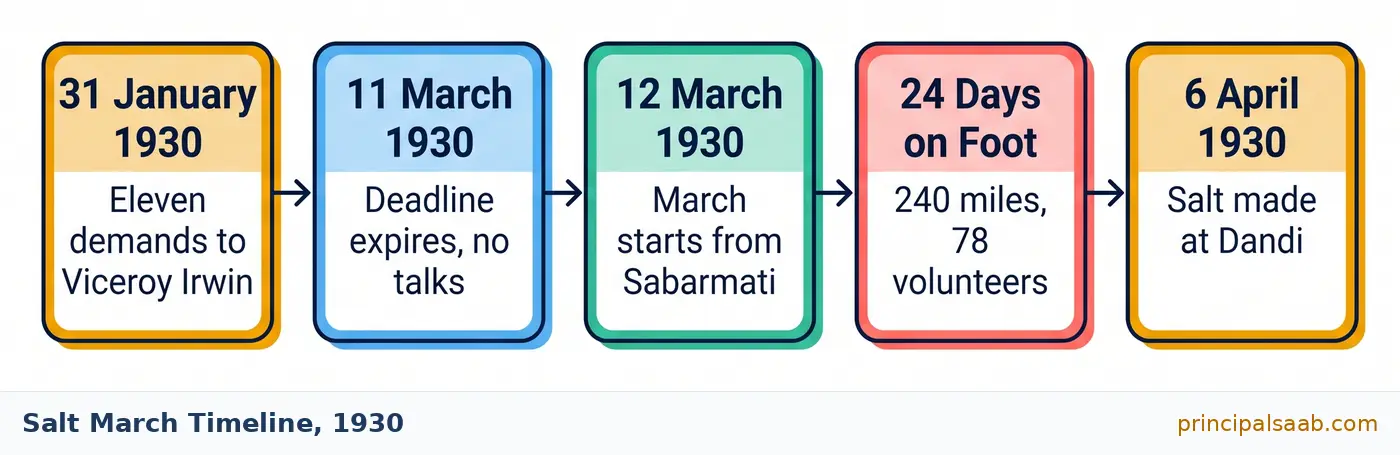
On 31 January 1930, Gandhi sent a letter to Viceroy Irwin stating eleven demands. Some were general, some specific, and some spoke for particular groups from industrialists to peasants. The idea was to make the demands wide-ranging, so that all classes within Indian society could identify with them and everyone could be brought together in a united campaign. The most stirring of all was the demand to abolish the salt tax.
Now think about salt for a moment. Salt is consumed by the rich and the poor alike, and it is one of the most essential items of food. The British government held a monopoly over its production and taxed it. Gandhi called the tax on salt and the government monopoly over its production the most oppressive face of British rule — a tax on a substance nobody can live without, levied on the poorest peasant exactly as on the wealthiest merchant.
Gandhi’s ultimatum stated that if the demands were not fulfilled by 11 March, the Congress would launch a civil disobedience campaign. Irwin was unwilling to negotiate.
So Gandhi walked. He began his famous Salt March on 12 March 1930, accompanied by 78 trusted volunteers. The march covered over 240 miles, from Gandhi’s ashram at Sabarmati to the Gujarati coastal town of Dandi. The volunteers walked for 24 days, about 10 miles a day. Thousands came to hear Gandhi wherever he stopped, and he told them what he meant by swaraj and urged them peacefully to defy the British.
On 6 April 1930, he reached Dandi and ceremonially violated the law, manufacturing salt by boiling sea water. This marked the beginning of the Civil Disobedience Movement.
What Civil Disobedience looked like on the ground: Salt was manufactured all along the coast in defiance of the law. Foreign cloth was boycotted and liquor shops were picketed. Peasants refused to pay revenue and chaukidari taxes. Village officials resigned. In many places forest people violated forest laws, going into reserved forests to collect wood and graze cattle.
The government struck back hard. Congress leaders were arrested one by one. When Abdul Ghaffar Khan, a devout disciple of Gandhi, was arrested in April 1930, angry crowds demonstrated in the streets of Peshawar, facing armoured cars and police firing, and many were killed. A month later, when Gandhi himself was arrested, industrial workers in Sholapur attacked police posts, municipal buildings, law courts and railway stations — all structures that symbolised British rule. Frightened, the government responded with a policy of brutal repression: peaceful satyagrahis were attacked, women and children were beaten, and about 100,000 people were arrested.
How it ended, restarted and finally faded: Gandhi called off the movement and entered into a pact with Irwin on 5 March 1931 — the Gandhi-Irwin Pact. By this pact he consented to participate in a Round Table Conference in London, and the government agreed to release the political prisoners. In December 1931 Gandhi went to London for the conference, but the negotiations broke down and he returned disappointed. Back in India he discovered that the government had begun a new cycle of repression: Ghaffar Khan and Jawaharlal Nehru were both in jail, the Congress had been declared illegal, and a series of measures had been imposed to prevent meetings, demonstrations and boycotts. With great apprehension, Gandhi relaunched the Civil Disobedience Movement. For over a year the movement continued, but by 1934 it lost its momentum.
Model answer:
(i) Salt united every Indian. Salt is consumed by the rich and the poor alike and is one of the most essential items of food, so a protest about salt could bring all classes into one campaign. [1]
(ii) The tax was uniquely unjust. Gandhi described the tax on salt and the government monopoly over its production as the most oppressive face of British rule, since it burdened even the poorest household. [1]
(iii) The demand and the ultimatum. On 31 January 1930 Gandhi sent a letter to Viceroy Irwin stating eleven demands, of which the abolition of the salt tax was the most stirring, and warned that if they were not fulfilled by 11 March the Congress would launch civil disobedience. Irwin was unwilling to negotiate. [1]
(iv) The march itself. Gandhi began the Salt March on 12 March 1930 with 78 trusted volunteers, walking over 240 miles from Sabarmati to Dandi, about 10 miles a day for 24 days; crowds gathered wherever he stopped, and he explained his meaning of swaraj and urged peaceful defiance. [1]
(v) The act of defiance. On 6 April 1930 he reached Dandi and ceremonially violated the law by manufacturing salt from sea water, which marked the beginning of the Civil Disobedience Movement. [1]
How the mark is earned: This is a two-command question again — “why” plus “describe”. Points (i) to (iii) answer “why”; (iv) and (v) answer “describe”. The numbers (78 volunteers, 240 miles, 24 days) are what make (iv) unmistakably worth a full mark.
Model answer:
(i) Different central method. In Non-Cooperation, Indians were asked to refuse to cooperate with the colonial government; in Civil Disobedience they were asked to break colonial laws openly. [1]
(ii) Different programmes. Non-Cooperation involved surrendering government titles and boycotting civil services, the army, the police, courts, legislative councils, schools and foreign goods. Civil Disobedience involved manufacturing salt in defiance of the law, refusing to pay revenue and chaukidari taxes, resigning village offices and violating forest laws. [1]
(iii) Different stated goal. Non-Cooperation was launched partly in support of the Khilafat cause and for swaraj; Civil Disobedience followed the Lahore declaration of December 1929 and aimed openly at Purna Swaraj, complete independence. [1]
(iv) Different scale of participation by women. Large numbers of women participated actively in Civil Disobedience, joining protest marches, manufacturing salt and picketing foreign cloth and liquor shops, on a scale not seen in Non-Cooperation. [1]
(v) Different scale of repression. Civil Disobedience met with far heavier repression, with about 100,000 people arrested, firing on demonstrators in Peshawar and violent attacks on peaceful satyagrahis. [1]
How the mark is earned: For “how was A different from B”, each point must contain both sides of the contrast in the same sentence. If you write one paragraph about A and then one about B, you are relying on the examiner to make the comparison for you, and marking schemes rarely reward that.
How Different Groups Saw the Movement
This section is the heart of the chapter as far as the board examiner is concerned, so settle in. The question behind it is beautifully simple: if everybody joined the Civil Disobedience Movement, did everybody want the same thing? The answer, as you will see, is no.
| Group | Why They Joined | What Swaraj Meant to Them | Why They Later Cooled |
|---|---|---|---|
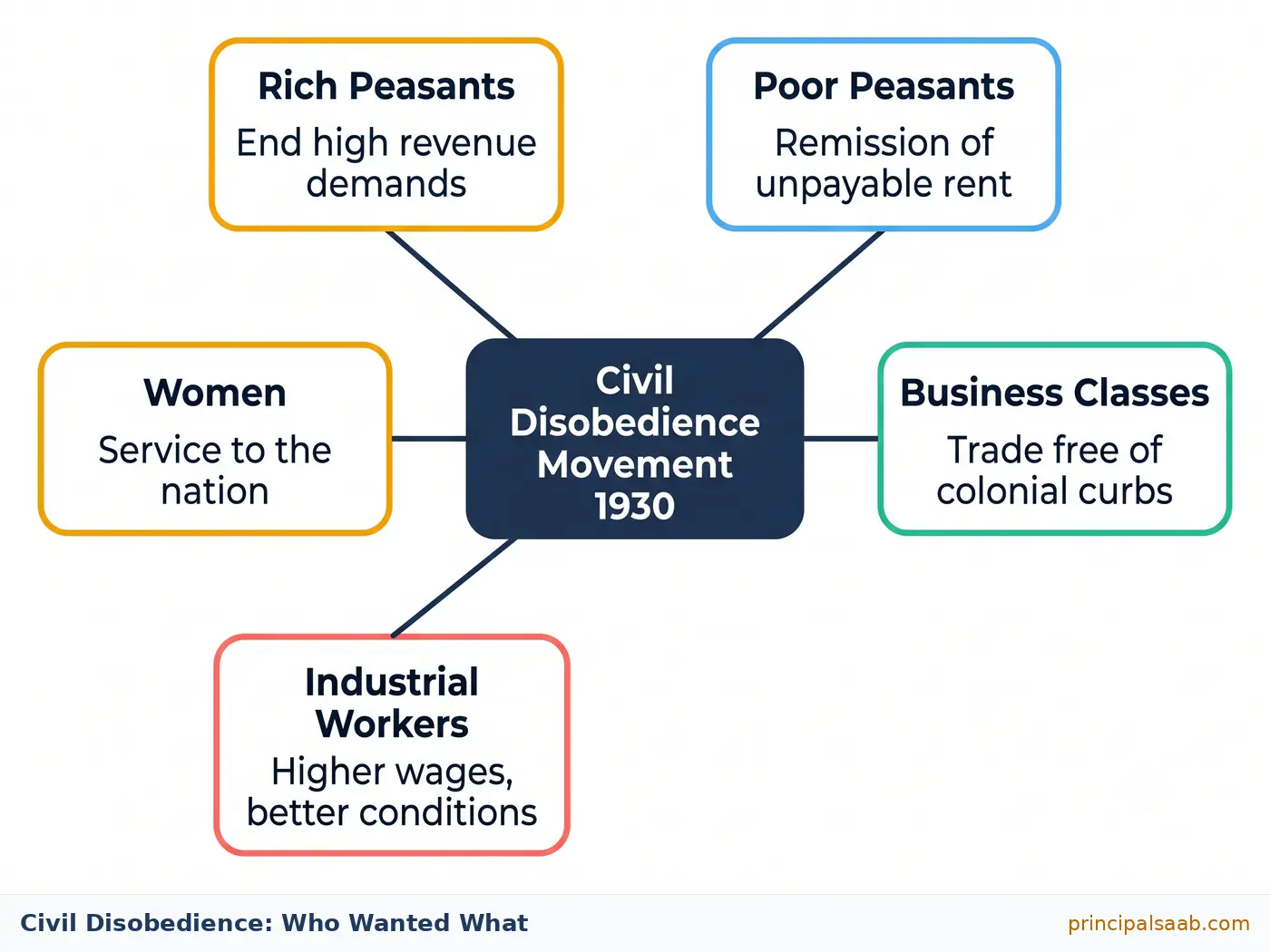
| Rich peasants (Patidars of Gujarat, Jats of Uttar Pradesh) | Commercial producers hit hard by the fall in agricultural prices during the Depression; their cash income disappeared but the government refused to reduce revenue | A struggle against high revenue demand | Deeply disappointed when the movement was called off in 1931 without the revenue rates being revised; many refused to participate when it was relaunched |
| Poor peasants (small tenants and sharecroppers) | Could not pay rent to landlords as the Depression bit; wanted the unpaid rent remitted | Freedom from having to pay rent they could not afford | The Congress was unwilling to support “no rent” campaigns, fearing it would upset the rich peasants and landlords; so the relationship stayed uncertain |
| Business classes | Wanted protection against imports and a rupee-sterling exchange ratio that would discourage imports; organised through bodies such as the Indian Industrial and Commercial Congress (1920) and FICCI (1927) | A time when colonial restrictions on business would no longer exist and trade and industry could flourish | After the failure of the Round Table Conference, enthusiasm faded; they also feared the spread of militant activity and prolonged disruption of business |
| Industrial workers | Participated selectively, mainly where industrialists were close to the Congress; some adopted Gandhian ideas such as boycott of foreign goods | Low wages raised, poor working conditions improved | The Congress largely kept its distance from workers’ demands, fearing it would alienate industrialists and split the movement |
| Women | Responded in very large numbers to Gandhi’s call, joining protest marches, manufacturing salt and picketing foreign cloth and liquor shops; many went to jail | Service to the nation as a sacred duty | For a long time the Congress was reluctant to allow women any position of authority within the organisation, and was keen only on their symbolic presence |
Two details are worth pausing on because they are easy to state carelessly.
On rich peasants. For them, the fight for swaraj was a struggle against high revenues. When the movement was called off in 1931 without the revenue rates being revised, they were deeply disappointed. That is why many of them refused to participate when the movement was relaunched — not because they had stopped disliking the British, but because the specific thing they wanted had not been delivered.
On women. Most of the women who participated came from high-caste families in the cities and from rich peasant households in the countryside. They saw service to the nation as a sacred duty. Yet this increased public role did not immediately mean any radical change in the way the position of women was visualised. Gandhi was convinced that it was the duty of women to look after home and hearth, be good mothers and good wives. Be careful and fair when you write this: the participation was real and courageous, and the limits on it were also real.
Model answer:
(i) Who the rich peasants were and why they joined. Communities such as the Patidars of Gujarat and the Jats of Uttar Pradesh were commercial crop producers who were very hard hit by the trade depression and falling prices; as their cash income disappeared, they found it impossible to pay the government’s revenue demand, which the government refused to reduce. [1]
(ii) What swaraj meant to them. For these rich peasants, the fight for swaraj was essentially a struggle against high revenues, and they were enthusiastic organisers of the movement in their areas. [1]
(iii) Why they were dissatisfied. When the movement was called off in 1931 without the revenue rates being revised, they were deeply disappointed, and many refused to participate when it was relaunched. [1]
(iv) The poorer peasants’ problem was different. Small tenants and sharecroppers found it difficult to pay rent to the landlords during the Depression; what they wanted was the unpaid rent to the landlord to be remitted, and they joined a variety of radical movements. [1]
(v) Why they too were dissatisfied. The Congress was unwilling to support “no rent” campaigns because it feared upsetting the rich peasants and landlords, so the relationship between the poor peasants and the Congress remained uncertain. [1]
How the mark is earned: The examiner is testing whether you can see that a single movement contained conflicting class interests. The magic sentence to remember is that the Congress could not support the poor peasants without losing the rich ones. If you write that sentence, you have understood the section.
Model answer:
(i) Their economic grievance. Indian merchants and industrialists wanted protection against imports of foreign goods and a rupee-sterling foreign exchange ratio that would discourage imports, and they reacted against colonial policies that restricted their business activities. [1]
(ii) How they organised and what they hoped for. They formed bodies such as the Indian Industrial and Commercial Congress in 1920 and the Federation of the Indian Chamber of Commerce and Industries in 1927, gave financial assistance and refused to buy or sell imported goods; for them swaraj meant a time when colonial restrictions on business would no longer exist and trade and industry would flourish without constraints. [1]
(iii) Why the enthusiasm cooled. After the failure of the Round Table Conference their enthusiasm declined; they were also apprehensive about the spread of militant activities and worried about prolonged disruption of business, as well as about the growing influence of socialism among the younger Congress members. [1]
How the mark is earned: Two organisation names with their years turn a general answer into a specific one. FICCI 1927 and the Indian Industrial and Commercial Congress 1920 are cheap to learn and expensive to omit.
The Limits of Civil Disobedience: Dalits, Ambedkar and the League
Now we come to the part of the chapter that requires care, honesty and a calm voice. Some Indians did not join the movement, and their reasons deserve to be understood rather than dismissed.
Related reading: How independent India later built institutions to share power among its communities is covered in our Power Sharing — Class 10 Civics notes.
The Dalits. Large sections of Dalits — then referred to as “untouchables” — did not participate actively for a long time. The Congress had for a long time ignored the Dalits, for fear of offending the sanatanis, the conservative high-caste Hindus. Gandhi himself declared that swaraj would not come for a hundred years if untouchability was not eliminated. He called them harijan, or the children of God, organised satyagraha to secure them entry into temples and access to public wells, tanks, roads and schools, and he himself cleaned toilets to dignify the work of the sweepers, whom he called bhangi. He persuaded upper castes to change their heart and give up “the sin of untouchability”.
But many Dalit leaders wanted a different solution. They were keen on a political solution to the problems of the community, demanding reserved seats in educational institutions and a separate electorate that would choose Dalit members for the legislative councils. Political empowerment, they argued, would resolve the problems of their social disabilities — a change of law rather than a change of heart.
Dr B. R. Ambedkar, who organised the Dalits into the Depressed Classes Association in 1930, clashed with Gandhi at the second Round Table Conference in 1931 by demanding separate electorates for Dalits. When the British government conceded Ambedkar’s demand, Gandhi began a fast unto death. He believed that separate electorates for Dalits would slow down the process of their integration into society. Ambedkar ultimately accepted Gandhi’s position, and the result was the Poona Pact of September 1932. It gave the Depressed Classes (later to be known as the Scheduled Castes) reserved seats in provincial and central legislative councils, but they were to be voted in by the general electorate. The Dalit movement, however, continued to be apprehensive of the Congress-led national movement.
The Muslim League and the question of representation. After the decline of the Non-Cooperation-Khilafat movement, a large section of Muslims felt alienated from the Congress. From the mid-1920s the Congress came to be more visibly associated with openly Hindu religious nationalist groups, and relations between the communities worsened. Each community organised religious processions with militant fervour, provoking Hindu-Muslim communal clashes and riots in various cities. Every riot deepened the distance between the two communities.
Serious efforts at compromise were made. Muhammad Ali Jinnah of the Muslim League was willing to give up the demand for separate electorates if Muslims were assured reserved seats in the Central Assembly and representation in proportion to population in the Muslim-dominated provinces of Bengal and Punjab. Negotiations over the question of representation continued at the All Parties Conference in 1928, but all hope of resolving the issue disappeared when M. R. Jayakar of the Hindu Mahasabha strongly opposed efforts at compromise.
So when Civil Disobedience began in 1930, a large section of Muslims stood apart. Alienated from the Congress, they could not respond to the call for a united struggle. Many Muslim leaders and intellectuals expressed their concern about the status of Muslims as a minority within India, and feared that the culture and identity of minorities would be submerged under the domination of a Hindu majority.
Model answer:
(i) Gandhi’s diagnosis. Gandhi declared that swaraj would not come for a hundred years if untouchability was not eliminated, and he called the untouchables harijan, or the children of God. [1]
(ii) Gandhi’s method. He organised satyagraha to secure them entry into temples and access to public wells, tanks, roads and schools; he himself cleaned toilets to dignify the work of the sweepers, and persuaded upper castes to change their heart and give up the sin of untouchability. [1]
(iii) Ambedkar’s alternative. Many Dalit leaders sought a political rather than a moral solution, demanding reserved seats in educational institutions and separate electorates to choose Dalit members for the legislative councils; Ambedkar organised the Dalits into the Depressed Classes Association in 1930. [1]
(iv) The clash. At the second Round Table Conference in 1931 Ambedkar demanded separate electorates for Dalits. When the British government conceded the demand, Gandhi began a fast unto death, believing that separate electorates would slow down the integration of Dalits into society. [1]
(v) The settlement. Ambedkar ultimately accepted Gandhi’s position, and the Poona Pact of September 1932 gave the Depressed Classes reserved seats in provincial and central legislative councils, but they were to be voted in by the general electorate. [1]
How the mark is earned: Marking schemes for this question look for the pairing change of heart versus political guarantee, and then for the Poona Pact with its year and its precise term — reserved seats, but a general electorate. That final clause is the whole compromise; do not drop it.
Model answer:
(i) Growing alienation from the Congress. After the decline of the Non-Cooperation-Khilafat movement, many Muslims felt alienated from the Congress, which from the mid-1920s appeared more visibly associated with openly Hindu religious nationalist groups. [1]
(ii) Communal tension on the ground. Relations between the communities worsened as each organised religious processions with militant fervour, provoking Hindu-Muslim clashes and riots in various cities, and each riot deepened the distance between them. [1]
(iii) The failure of the representation talks. Jinnah was willing to give up separate electorates if Muslims were assured reserved seats in the Central Assembly and representation in proportion to population in Bengal and Punjab, but negotiations at the All Parties Conference in 1928 collapsed when M. R. Jayakar of the Hindu Mahasabha strongly opposed the compromise; Muslim leaders also feared that minority culture and identity would be submerged under a Hindu majority. [1]
How the mark is earned: Write this answer in a measured, factual tone. Questions on communal division reward precision and restraint. Give the concrete facts — the 1928 conference, Jinnah’s offer, Jayakar’s opposition — and let them do the work.
The Sense of Collective Belonging
One last question, and it is the deepest one in the chapter. How does a person come to feel that they belong to a nation?
Related reading: The role of images, print and shared symbols in spreading ideas is explored in our Print Culture and the Modern World — Class 10 History notes.
You cannot see a nation. You cannot touch it. India in 1920 contained hundreds of languages, dozens of religions, and people who would never meet each other in a lifetime. So how did a farmer in Awadh and a lawyer in Madras come to feel they were part of the same “we”?
Nationalism spreads partly through struggles — the movements we have just studied, where people joined together and shared experiences. But it also spreads through culture: through images, songs, stories and symbols that let people picture the nation and feel something about it.
The image of Bharat Mata. The identity of the nation is most often symbolised in a figure or image, which helps create an image with which people can identify. In the twentieth century, with the growth of nationalism, the identity of India came to be visually associated with the image of Bharat Mata. The image was first created by Bankim Chandra Chattopadhyay, who in the 1870s wrote “Vande Mataram” as a hymn to the motherland; it was later included in his novel Anandamath and widely sung during the Swadeshi movement in Bengal. Moved by the Swadeshi movement, Abanindranath Tagore painted his famous image of Bharat Mata, portraying her as an ascetic figure — calm, composed, divine and spiritual. In later years the image acquired many different forms as it circulated in popular prints and was painted by different artists. Devotion to this mother figure came to be seen as evidence of one’s nationalism.
Indian folklore. Nationalists also began recording folk tales sung by bards, and they toured villages gathering folk songs and legends. They believed that these tales gave a true picture of traditional culture that had been corrupted and damaged by outside forces, and that it was essential to preserve this folk tradition in order to discover one’s national identity and restore a sense of pride in one’s past. In Bengal, Rabindranath Tagore himself began collecting ballads, nursery rhymes and myths, and led the movement for folk revival. In Madras, Natesa Sastri published a massive four-volume collection of Tamil folk tales, The Folklore of Southern India, and he believed that folklore was national literature and the most trustworthy manifestation of people’s real thoughts and characteristics.
Icons and symbols — the flag. During the Swadeshi movement in Bengal, a tricolour flag (red, green and yellow) was designed. It had eight lotuses representing eight provinces of British India, and a crescent moon representing Hindus and Muslims. By 1921, Gandhi had designed the swaraj flag. It was again a tricolour — red, green and white — and had a spinning wheel in the centre, representing the Gandhian ideal of self-help. Carrying the flag and holding it aloft during marches became a sign of defiance.
Reinterpretation of history. Another means of creating a feeling of nationalism was through the reinterpretation of history. By the end of the nineteenth century many Indians felt that to instil a sense of pride in the nation, Indian history had to be thought about differently. The British saw Indians as backward and primitive, incapable of governing themselves. In response, Indians began looking into the past to discover India’s great achievements — writing about the glorious developments in ancient times in art and architecture, science and mathematics, religion and culture, law and philosophy, crafts and trade. This glorious time, in their view, was followed by a history of decline, when India was colonised. These nationalist histories urged readers to take pride in India’s great achievements in the past and to struggle to change the miserable conditions of life under British rule.
Model answer:
(i) Why symbols were needed. Nationalism spreads not only through struggles but also when people begin to believe they are part of the same nation, and a sense of collective belonging is created through shared images, songs, tales and symbols. [1]
(ii) The figure of Bharat Mata. Bankim Chandra Chattopadhyay wrote “Vande Mataram” in the 1870s as a hymn to the motherland, later included in his novel Anandamath and sung widely during the Swadeshi movement; Abanindranath Tagore then painted Bharat Mata as a calm, composed, divine and spiritual ascetic figure, and devotion to her became evidence of nationalism. [1]
(iii) Indian folklore. Nationalists recorded folk tales and toured villages collecting folk songs and legends, believing folk tradition gave a true picture of a culture damaged by outside forces; Rabindranath Tagore collected ballads, nursery rhymes and myths in Bengal, and Natesa Sastri published the four-volume Folklore of Southern India in Madras. [1]
(iv) Flags as icons. During the Swadeshi movement a tricolour flag of red, green and yellow was designed, with eight lotuses for eight provinces and a crescent moon for Hindus and Muslims; by 1921 Gandhi had designed the swaraj flag in red, green and white with a spinning wheel at the centre, representing self-help, and carrying it during marches became an act of defiance. [1]
(v) Reinterpreting the past. Nationalist historians wrote about India’s glorious achievements in ancient times in art and architecture, science and mathematics, religion, law, philosophy, crafts and trade, followed by decline under colonisation, urging readers to take pride in the past and to struggle to change the present. [1]
How the mark is earned: Five sources of belonging, five marks: image, folklore, flag, history — and the framing point at the start. In each, name at least one person and one work. Names are the currency of this section.
Model answer: By 1921 Gandhi had designed the swaraj flag. It was a tricolour of red, green and white [1] and had a spinning wheel in the centre, representing the Gandhian ideal of self-help; carrying the flag and holding it aloft during marches became a sign of defiance. [1]
How the mark is earned: Colours in the right order, then the symbol and its meaning. Note carefully that the earlier Swadeshi flag was red, green and yellow with eight lotuses and a crescent moon. Two flags, two descriptions, and swapping them is a classic slip.
Master Timeline, 1914 to 1934
Now that you know the story, the dates have somewhere to live. Read down this table and, at each row, say the story out loud in one sentence before you look at the right-hand column.
| Date | Event | Why It Mattered |
|---|---|---|
| 1914-1918 | First World War | War loans, income tax, higher customs duties, prices doubled, forced recruitment; the economic ground of mass nationalism |
| January 1915 | Gandhi returns to India from South Africa | Brings the method of satyagraha into Indian politics |
| 1917 | Champaran satyagraha (Bihar) and Kheda satyagraha (Gujarat) | Indigo peasants freed from an oppressive system; revenue relief demanded after crop failure and plague |
| 1918 | Ahmedabad mill workers’ satyagraha | Gandhi’s first major action among industrial workers; he fasted to keep it non-violent |
| March 1919 | Rowlatt Act passed; Khilafat Committee formed in Bombay | Detention without trial for two years; and the seed of Hindu-Muslim joint action |
| 6 April 1919 | Nationwide hartal against the Rowlatt Act begins | First all-India protest led by Gandhi |
| 13 April 1919 | Jallianwala Bagh massacre, Amritsar | Destroyed Indian faith in British justice; the emotional turning point of the chapter |
| June-October 1920 | Nehru tours Awadh; Oudh Kisan Sabha formed (October) | The peasant movement links up with the national movement; 300+ branches within a month |
| September 1920 | Calcutta session of the Congress | Gandhi convinces leaders to launch Non-Cooperation in support of Khilafat and swaraj |
| December 1920 | Nagpur session of the Congress | After months of debate, a compromise is reached and the Non-Cooperation programme is adopted |
| January 1921 | Non-Cooperation Movement begins | Boycotts in towns; foreign cloth imports halve from Rs 102 crore to Rs 57 crore by 1922 |
| 1921 | Gandhi designs the swaraj flag | Red, green and white with a spinning wheel; a portable symbol of the nation |
| Early 1920s | Gudem Hills rebellion under Alluri Sitaram Raju | Gandhi’s message reinterpreted through armed guerrilla struggle; Raju executed in 1924 |
| February 1922 | Chauri Chaura incident; Non-Cooperation withdrawn | Gandhi halts the movement; Swaraj Party formed by C. R. Das and Motilal Nehru |
| 1927 | Simon Commission constituted; FICCI founded; Madras Congress session | A commission with no Indian member; and organised Indian business enters national politics |
| 1928 | Simon Commission arrives in India; All Parties Conference | “Simon Go Back” protests; representation talks collapse after Jayakar’s opposition |
| October 1929 | Lord Irwin’s vague offer of dominion status | No date, no guarantee; satisfied nobody |
| December 1929 | Lahore session under Jawaharlal Nehru; Purna Swaraj declared | 26 January 1930 fixed as Independence Day; the demand shifts from dominion status to full independence |
| 31 January 1930 | Gandhi’s letter of eleven demands to Irwin | Wide-ranging demands so all classes could identify with them; salt tax the most stirring |
| 12 March – 6 April 1930 | Salt March from Sabarmati to Dandi | 78 volunteers, over 240 miles, 24 days; salt made from sea water launches Civil Disobedience |
| April-May 1930 | Arrest of Abdul Ghaffar Khan; arrest of Gandhi | Firing in Peshawar; attacks on symbols of British rule in Sholapur; about 100,000 arrests follow |
| 5 March 1931 | Gandhi-Irwin Pact | Gandhi agrees to attend the Round Table Conference; government agrees to release political prisoners |
| December 1931 | Second Round Table Conference, London | Negotiations break down; Gandhi returns disappointed; Ambedkar presses for separate electorates |
| September 1932 | Poona Pact | Reserved seats for the Depressed Classes in provincial and central legislative councils, voted by the general electorate |
| 1934 | Civil Disobedience loses momentum | The relaunched movement fades after more than a year of struggle |
Map Work for the Board Exam
Two marks. Five minutes of work. And almost nobody who practises even twice ever loses them. History map pointing is live in the 2026-27 scheme, and it sits inside the 20 marks allotted to History. Please do not treat it as optional.
For Nationalism in India, the items you must be able to locate and label on an outline map of India fall into two families.
Family 1 — Indian National Congress sessions. Three sessions, three places, three dates.
| Session | Present-day State | Remember It By |
|---|---|---|
| Calcutta, September 1920 | West Bengal (east coast) | Where the Congress accepted Non-Cooperation |
| Nagpur, December 1920 | Maharashtra (centre of the map) | Where the Congress adopted the Non-Cooperation programme |
| Madras, 1927 | Tamil Nadu (south-east coast) | The southern session of the later 1920s |
Family 2 — Important centres of the Indian National Movement. Six places, each tied to one event. Learn them as pairs, never as a bare list.
| Place | State | What Happened There |
|---|---|---|
| Champaran | Bihar | Movement of the indigo planters, 1917 |
| Kheda | Gujarat | Peasant satyagraha, 1917 |
| Ahmedabad | Gujarat | Cotton mill workers’ satyagraha, 1918 |
| Amritsar | Punjab | Jallianwala Bagh incident, 13 April 1919 |
| Chauri Chaura | Uttar Pradesh | Calling off of the Non-Cooperation Movement, February 1922 |
| Dandi | Gujarat | Civil Disobedience Movement began here, 6 April 1930 |
Model answer:
(a) Mark and label NAGPUR, in Maharashtra, roughly in the centre of the map. This was the session at which the Non-Cooperation programme was formally adopted. [1]
(b) Mark and label DANDI, on the coast of Gujarat in western India. Gandhi reached here on 6 April 1930 and manufactured salt from sea water, launching the Civil Disobedience Movement. [1]
How the mark is earned: Read the clue, not the name. The paper often describes the place by what happened there rather than naming it — “the session where the Non-Cooperation programme was adopted” instead of “Nagpur”. That is why the place-plus-event pairs in the tables above matter so much. Learn the pair, and any phrasing of the question becomes readable.
Practice Worksheet with Answers
Right — pen, notebook, and no peeking. Write each answer out fully before you open the “Show Answer” box. Reading an answer and thinking “yes, I knew that” is the most reliable way to fool yourself. Writing it out is the only honest test.
Q1. Explain any three effects of the First World War on the economic and political situation in India. (3 marks) — Show Answer
Q2. What was the Rowlatt Act, and why did Indians oppose it so strongly? (3 marks) — Show Answer
Q3. Why did Mahatma Gandhi decide to launch the Non-Cooperation Movement, and what programme did he propose? (5 marks) — Show Answer
Q4. How did the meaning of swaraj differ for the peasants of Awadh, the tribal peasants of the Gudem Hills and the plantation workers of Assam? (5 marks) — Show Answer
Q5. Why did Mahatma Gandhi withdraw the Non-Cooperation Movement in February 1922? (3 marks) — Show Answer
Q6. Source-based question. Read the passage and answer the three questions that follow. (4 marks) — Show Answer
(a) Name the substance and the leader referred to. (1 mark)
The substance is salt, and the leader is Mahatma Gandhi.
(b) Give the date the letter was written, the deadline set, and the name of the Viceroy. (1.5 marks)
The letter of eleven demands was sent on 31 January 1930; the deadline was 11 March; the Viceroy was Lord Irwin.
(c) Describe the march that followed and explain why this particular substance was chosen. (1.5 marks)
Gandhi began the Salt March on 12 March 1930 with 78 trusted volunteers, covering over 240 miles from his ashram at Sabarmati to the coastal town of Dandi in Gujarat, walking about ten miles a day for 24 days, and reached Dandi on 6 April 1930, where he manufactured salt by boiling sea water. Salt was chosen because it is consumed by rich and poor alike and is one of the most essential items of food, so the demand could unite all classes; Gandhi described the salt tax and the government monopoly over its production as the most oppressive face of British rule.
Q7. Compare the participation of the rich peasants, the business classes and the industrial workers in the Civil Disobedience Movement. (5 marks) — Show Answer
Q8. Describe the role of women in the Civil Disobedience Movement, and state its limitations. (3 marks) — Show Answer
Q9. What was the Poona Pact? Explain the disagreement that led to it. (3 marks) — Show Answer
Q10. Map question. On an outline political map of India, locate and label the following: (a) the place where the indigo planters’ movement took place; (b) the place associated with the Jallianwala Bagh incident; (c) the session of the Indian National Congress held in September 1920. (3 marks) — Show Answer
Marking note: For each item you need a dot placed accurately, a line drawn out to clear space, and the name written legibly, preferably in capitals. A name without a dot, or a dot without a name, is treated as incomplete.
Q11. How did the image of Bharat Mata and the collection of folklore help create a sense of collective belonging? (3 marks) — Show Answer
Q12. Assertion-Reason. Assertion (A): The Non-Cooperation Movement gradually slowed down in the cities. Reason (R): Khadi cloth was often more expensive than mass-produced mill cloth and poor people could not afford it. Choose the correct option. (1 mark) — Show Answer
Reasoning: The movement did slow down in the cities, so A is true. One genuine reason was the cost of khadi: being hand-spun and hand-woven it was more expensive than mill cloth, so the poor could not sustain the boycott of foreign cloth. R is therefore true and explains A. A complete answer would add the second reason as well: the boycott of British institutions could only work if Indian alternatives were set up in their place, and these were slow to come up, so students returned to government schools and lawyers to government courts.
A Closing Word
You have just walked through twenty years of history — through a war, a massacre, two enormous movements, a march to the sea, and a long argument about who the nation belonged to. If it feels like a lot, that is because it is a lot. Do not expect to hold it all after one reading.
Here is the idea I would like you to carry away, and it is the Japanese principle of kaizen — improvement by small, steady steps. You do not master this chapter in one heroic all-night sitting. You master it by returning to it: one section today, two model answers tomorrow, the timeline on Thursday, the map on Sunday. Each pass is small. Each pass is a little easier than the last. And one morning you will read a board question and find that the answer is simply there, in order, waiting.
The people in this chapter changed a country the same way — not in a single dramatic stroke, but by walking ten miles a day for twenty-four days. Small steps, taken faithfully, in the same direction. That works for freedom struggles, and it works for Class 10 History. Go gently, and go often. You are doing better than you think.