

Take a slow breath before we start. If you have just opened Democratic Politics-II and the words “power sharing” look like something only politicians shout about on television, you are exactly where you are supposed to be. Nobody is born knowing this. By the time you finish this page you will not only understand what power sharing means, you will be able to explain it to a friend, argue about it in class, and — the part that actually decides your marks — write it in an answer sheet in the shape the examiner is looking for.
Here is something I want you to know right at the beginning, because it should make you sit up: this is one of the most scoring chapters in the whole Social Science paper. There is no map work to memorise, no long list of dates, no diagram you can draw crookedly and lose a mark. There are two countries, one idea, a handful of reasons and four forms. That is it. Students who understand this chapter properly almost never lose marks in it. Students who only skim it lose marks everywhere, because power sharing is the foundation on which Federalism, Political Parties and Outcomes of Democracy are all built. Get this chapter right and the next four become easier. That is a genuinely good deal.
We are going to go slowly. I will explain every idea in ordinary language first, then in textbook language, then show you exactly how it turns into an answer. If something does not click, read that paragraph again before moving on. There is no prize for finishing fast.
What You’ll Learn
- Why Power Sharing Matters: The Big Idea
- The Story of Belgium: Diversity in a Small Country
- The Story of Sri Lanka: Majoritarianism and Its Cost
- Belgium and Sri Lanka Compared
- What Is Majoritarianism?
- Accommodation: How Belgium Solved It
- Why Is Power Sharing Desirable?
- Forms of Power Sharing in Modern Democracies
- Power Sharing in India: A Quick Tour
- Exam Strategy for This Chapter
- Practice Worksheet
Your Game Plan
- Read the two country stories first — Belgium and Sri Lanka. They are stories, not theory. Enjoy them.
- Only then read the theory sections. The theory will feel obvious once the stories are in your head, and that is deliberate.
- Learn the two big lists by heart: the reasons power sharing is desirable, and the four forms of power sharing. These two lists supply the answer to most questions in this chapter.
- Do every worked example on this page with a pen. Cover the answer, attempt it, then compare. Reading answers is not practice; writing them is.
- Finish with the Practice Worksheet at the bottom. Ten questions, full answers hidden until you click.
Why Power Sharing Matters: The Big Idea
Start with something completely non-political: your own house. Imagine a family of five where one person — say, the eldest brother — decides everything. What is cooked, which channel plays, who sits where, what time the lights go off. He may even be a fair person. But how long before the house becomes tense? The others will feel invisible. They will stop offering ideas. Some will simply stop talking to him. Eventually somebody explodes over something small, like the remote control, when the real grievance was never about the remote at all.
Now imagine the same family after a small change. Meals are decided by whoever cooks that day. The younger sister handles the music. Homework hours are agreed together. Nothing about the family has changed except one thing: responsibility has been spread out. Suddenly everyone has a stake. Everyone defends the arrangement, because everyone is inside it.
That, in one household, is the whole chapter. Power sharing means that the authority to take decisions is not kept in one pair of hands but is distributed among different organs of government, different levels of government, different social groups and different political parties. A country is only a very large household with a much more complicated kitchen.
Power sharing is the distribution of political power among different organs of government, different levels of government, different social groups, and different political parties, so that no single authority can decide everything alone. It is not a weakness of democracy. It is what makes a democracy stable enough to survive disagreement.
Now, an honest objection that a sharp student always raises at this point: is democracy not supposed to mean majority rule? If the majority wants something, why should power be shared with anyone else? Hold that thought carefully, because it is the exact question the chapter is built to answer. The short reply is that a majority in a democracy is not a permanent king. It is a temporary decision-maker, and it stays legitimate only as long as everyone else in the country still believes the system belongs to them too. The moment a minority concludes that the government will never listen, that minority stops behaving like a citizen and starts behaving like an opponent. That is when countries begin to break.
So the deeper claim of this chapter is this: in a diverse society, sharing power is not a favour done to minorities. It is self-protection for the whole country. You will see this proved twice over — once in a country that shared power and stayed together, and once in a country that refused and paid for it in blood.
Model answer. Power sharing is the arrangement by which political power is distributed among different organs of government, different levels of government and different social groups, so that no single body holds all authority.
Why this scores: a 1-mark answer needs one clean sentence, not a paragraph. Notice that the sentence contains the operative word “distributed” and at least two of the places power is distributed to. The examiner is scanning for the idea, not for length. Writing five sentences here wastes the two minutes you will need later for a 5-marker.
Every definition in this chapter should be written as one sentence that could stand alone if the rest of your answer vanished. Practise saying each definition out loud in a single breath. If you run out of air, your sentence is too long for a 1-mark answer.
Model answer.
(i) When one authority holds all power, there is nobody left to check its mistakes, so a wrong decision can be enforced on the whole country without correction.
(ii) Groups who are permanently left out of decision-making lose faith in the system and may turn to protest or violence, which threatens the unity of the country.
Why this scores: two marks means two distinct points, each worth one mark, each written as its own numbered line. Do not merge them into a paragraph — an examiner marking hundreds of scripts should be able to see your two points in two seconds. Also notice the points are genuinely different: one is about bad decisions, the other about unity. Two versions of the same point earn one mark, not two.
Comfortable so far? Do not move on until the household analogy feels natural to you, because every abstract idea ahead will be hooked onto it.
The Story of Belgium: Diversity in a Small Country
Belgium is a small country in western Europe, tucked between France, Germany, the Netherlands and Luxembourg. It is smaller in area than several Indian states and its population is around eleven to twelve million — roughly the size of a single large Indian city. You would expect a country that small to be simple. It is not. Belgium is one of the most linguistically complicated countries in Europe, and for decades it looked like it might tear itself apart.
Here is the make-up of the country. About 59 per cent of Belgians live in the northern region called Flanders and speak Dutch. About 40 per cent live in the southern region called Wallonia and speak French. Roughly 1 per cent speak German. So far this sounds like an ordinary majority-minority situation. The complication is the capital city.
Brussels, the capital, sits geographically inside the Dutch-speaking north, but its population is roughly 80 per cent French-speaking and 20 per cent Dutch-speaking. Read that again, because the whole Belgian problem is hidden in that one sentence. The Dutch speakers are the majority in the country but the minority in their own capital. The French speakers are the minority in the country but the overwhelming majority in the capital. Neither group can comfortably say “we are the majority, so we decide” — because the answer depends entirely on where you draw the boundary of the question.
The Belgian tangle in one line: the Dutch-speaking community is the national majority but a local minority in the capital, while the French-speaking community is the national minority but the local majority in the capital. This is why simple majority rule could never have worked in Belgium.
There was a second layer of resentment, and it is worth understanding because it explains the timing of the conflict. The French-speaking community had historically been the wealthier and more influential group, and French had long been the dominant language of government, the courts and higher education. Then, over the twentieth century, the economic balance shifted. The Dutch-speaking north modernised and prospered, and the Dutch speakers — who were the numerical majority all along — began to ask why they carried less social and economic weight than a smaller group. Numbers said one thing, privilege said another, and the gap between the two turned into anger.
Think of it as two brothers in a joint family business. One brother has always signed the cheques because that was the old arrangement. The other brother now brings in most of the income. Sooner or later he asks for the cheque book. If the family handles that conversation badly, the business splits.
Through the 1950s and 1960s tension between the two communities grew sharply, spilling into bitter disputes over schools, universities and administrative boundaries. Belgium genuinely faced the possibility of breaking into two countries. What it did instead — patiently, over more than twenty years, amending its constitution four times between 1970 and 1993 — is the reason this small country appears in your textbook at all. We will come to those solutions in the accommodation section. For now, just hold the problem clearly in your mind.
Model answer.
(i) Belgium’s population is divided mainly by language: about 59 per cent live in the Flanders region and speak Dutch, about 40 per cent live in Wallonia and speak French, and roughly 1 per cent speak German.
(ii) The capital city Brussels is a special case, because it lies within the Dutch-speaking area but around 80 per cent of its residents are French-speaking and about 20 per cent Dutch-speaking.
(iii) This created difficulty because the Dutch speakers are the majority in the country but a minority in the capital, while the French-speaking minority had historically enjoyed greater wealth and influence; neither community could accept simple majority rule, and tension between them grew sharply during the 1950s and 1960s.
Why this scores: the examiner wants three distinct points and, crucially, the third one must actually answer the “why it was difficult” half of the question. Many students write only the percentages and stop — that caps them at two marks however neat the handwriting. Whenever a question carries two verbs (“describe” and “explain”), spread your points across both.
Students often write that Belgium was divided between “Dutch and French people” or between “Belgians and French”. Wrong. Every one of them is Belgian. The division is between Dutch-speaking Belgians and French-speaking Belgians. Say “Dutch-speaking community” and “French-speaking community” and you will never lose a mark for sloppiness here.
If a percentage will not come to you under pressure, do not invent one. Write “a clear majority of about three-fifths” or “roughly four out of ten”. Approximate language costs you nothing; a confidently wrong number can cost the mark and makes the rest of your answer look unreliable.
The Story of Sri Lanka: Majoritarianism and Its Cost
Now cross the world to an island you can almost see from Rameswaram. Sri Lanka became independent in 1948, at almost the same moment as India, with roughly similar hopes. It had a literate population, a working economy and a functioning parliament. On paper it should have been one of Asia’s success stories. Instead it spent about a quarter of a century in a civil war. Understanding how that happened is the emotional centre of this chapter, so read this section slowly.
Sri Lanka’s population is divided mainly along lines of language and religion. Around 74 per cent are Sinhala-speaking, and most of them are Buddhist. Around 18 per cent are Tamil-speaking, and most of them are Hindu or Muslim. The Tamil-speaking population itself has two parts: the Sri Lankan Tamils, whose families have lived on the island for many generations and who are concentrated in the north and east, and the so-called Indian Tamils, whose ancestors were brought over from India during the colonial period to work on plantations. There is also a Christian minority of roughly seven per cent, and this detail is worth noticing — it includes both Tamils and Sinhalas, which shows that the island’s identities cut across each other rather than lining up neatly.
So the Sinhala community was a clear and permanent majority. In a democracy, a permanent majority carries a permanent temptation: the temptation to treat “we won the election” as “we own the country”. Sri Lanka gave in to that temptation, and it did so through a series of decisions that each seemed perfectly reasonable to the people making them.
Step one, 1956. An Act was passed recognising Sinhala as the only official language, effectively pushing Tamil aside in government, administration and public life. Imagine sitting for a government job interview, or filing a case in court, or reading an official notice about your own land, in a language your family does not speak. That was the daily reality this law created for a fifth of the population.
Step two. Government policies gave preference to Sinhala applicants for university places and government jobs. A young Tamil student could now work hard, score well, and still find the door narrower than it was for a classmate — not because of anything he had done, but because of the language he was born into.
Step three, 1972. A new constitution laid down that the state would give Buddhism the foremost place and would protect and foster it. The country had now told its non-Buddhist citizens, in its own founding document, that their faith stood a step lower.
Notice the pattern. Not one of these was a military coup. Every one of them was passed by an elected government with a genuine majority behind it. That is precisely what makes Sri Lanka such a frightening example: democracy was working exactly as majority rule is supposed to, and it was destroying the country.
The Tamil community’s response moved through predictable stages. First came alienation — the sense that this government was not theirs. Then they organised political parties and struggled peacefully for recognition of Tamil as an official language, for equality in jobs and education, and for regional autonomy in the areas where they were concentrated. Those demands were repeatedly refused. And when peaceful demands are refused for long enough, the argument does not disappear; it only changes weapons. By the 1980s the demand had hardened into a call for a separate Tamil state, and the island slid into a civil war that ran from 1983 until it ended in 2009.
Sri Lanka’s tragedy did not come from a dictator. It came from an elected majority using its numbers to shut a minority out of language, jobs, education and religious equality. Democracy without power sharing can be just as exclusionary as no democracy at all.
Model answer.
(i) In 1956 an Act was passed recognising Sinhala as the only official language, thereby disregarding Tamil.
(ii) The government followed preferential policies that favoured Sinhala applicants for university places and government jobs.
(iii) A new constitution adopted in 1972 provided that the state would give Buddhism the foremost place and would protect and foster it.
Why this scores: the word “mention” tells you the examiner wants three crisp facts, not an essay. One line each, one mark each. The three measures also happen to cover three different areas of life — language, employment and religion — which is exactly why they are the standard three. If a question asks for four, add the refusal of regional autonomy to the Tamil-majority areas.
Q1. Identify the policy referred to in the first two sentences. (1 mark)
Q2. How did such policies affect the sense of belonging of the community described? (2 marks)
Model answers.
A1. The policy of recognising Sinhala as the only official language, adopted in 1956, which removed Tamil from official use.
A2. Such policies made the Tamil-speaking community feel alienated, because they were shut out of government employment, education and administration in their own country. Over time this alienation destroyed their trust in the state and pushed them from constitutional demands towards a struggle for a separate state.
How to read a source like this: first, underline the year and any concrete action — 1958 and “correspondence in a language he had never learned” point straight to the official language policy. Second, underline the emotional sentence at the end; case-based questions almost always hide the “effect” answer in the last line. Third, never re-tell the passage. The examiner has read it. Your job is to name the textbook concept it illustrates and state its consequence.
Do not write that the Sri Lankan government “banned” the Tamil language or “threw the Tamils out of the country”. It did not. It made Sinhala the only official language and gave preference to Sinhala applicants. Exaggerating a fact is marked as getting it wrong. Precision is safer, and it is also shorter, which saves you time.
Belgium and Sri Lanka Compared
Here is why your textbook puts these two countries side by side, and it is a genuinely clever piece of teaching. Both are small. Both are democracies. Both have a linguistic majority and a linguistic minority. Both faced the same basic question after independence: what do we owe the people who did not vote for us? Belgium answered “a real share”. Sri Lanka answered “nothing that costs us anything”. Twenty years later one country was intact and the other was at war. Same problem, opposite choice, opposite outcome. That is as close to a controlled experiment as history ever gives us.
| Point of comparison | Belgium | Sri Lanka |
|---|---|---|
| Nature of the division | Mainly linguistic: Dutch-speaking, French-speaking and a small German-speaking community | Linguistic and religious: Sinhala-speaking Buddhists and Tamil-speaking Hindus, Muslims and Christians |
| Position of the majority community | Dutch speakers form the national majority but are a minority in the capital, so their advantage is limited | Sinhala speakers form an overwhelming and permanent majority everywhere that matters politically |
| Approach adopted by leaders | Accommodation: they recognised the differences and redesigned the state around them | Majoritarianism: they assumed the majority alone could run the country as it wished |
| Key measures taken | Equal number of ministers from both language groups, powers moved to state and community governments, a special arrangement for Brussels | Sinhala made the sole official language, preference for Sinhala applicants in jobs and education, Buddhism given the foremost place |
| Result | The country stayed united, and Brussels went on to host the headquarters of the European Union | Alienation, a demand for a separate state, and a civil war lasting from 1983 to 2009 |
Model answer.
(i) Both Belgium and Sri Lanka are small democracies with a linguistic majority and a linguistic minority, but they responded to that diversity in opposite ways.
(ii) Belgian leaders followed a policy of accommodation. They recognised the existence of regional and cultural differences and altered the constitution four times between 1970 and 1993 to build a system in which no community could be ignored.
(iii) Under this arrangement Belgium provided for an equal number of Dutch- and French-speaking ministers in the central government, gave substantial powers to the state governments, created a community government for cultural, educational and language matters, and set up a separate government for Brussels in which both communities have equal representation.
(iv) Sri Lanka, in contrast, followed majoritarianism. Its elected governments made Sinhala the only official language in 1956, gave preference to Sinhala applicants in university admissions and government jobs, and adopted a constitution in 1972 stating that the state would protect and foster Buddhism.
(v) The consequences were sharply different. Belgium avoided division and its capital became the headquarters of the European Union, whereas Sri Lanka’s Tamil-speaking community grew alienated, demanded a separate state, and the country suffered a civil war from 1983 to 2009.
Why this scores: a 5-mark answer needs five clear points, and the safest structure for a “compare” question is: one framing line, two on the first country, one on the second, one on the outcomes. Notice that each point is a complete sentence carrying a fact — no filler. Also note that the question says “compare”, so an answer that describes Belgium alone can never cross half marks no matter how detailed it is.
For any “compare” or “distinguish” question, quietly draw a two-column table in your rough space before you write. Then convert it into sentences on the answer sheet. You may also present the final answer as a table if you like — boards accept it — but make sure every row compares the same feature on both sides, which is where most tables lose marks.
What Is Majoritarianism?
This word looks intimidating but it is built from a word you already know. Majority plus “-ism”. The “-ism” turns a fact into a belief system. So majoritarianism is the belief that the majority community should be able to rule the country in whatever way it wishes, disregarding the wishes and needs of the minority.
Let me separate two things that students constantly confuse, because the exam loves this distinction. Majority rule is normal and necessary: in any group, when opinions differ, the side with more support decides. Your class does it when choosing a picnic spot. That is not majoritarianism. Majoritarianism begins the moment the majority stops treating its win as a decision about one issue and starts treating it as ownership of the whole system — the language, the jobs, the religion, the rules themselves.
Think of a school where students elect a cultural secretary. Suppose the winning group then declares that only its own house may perform at every event, that the annual day will be conducted only in its members’ preferred language, and that its house song will be sung as the school anthem. The election was fair. The result is still poisonous. That is majoritarianism in miniature, and you can feel exactly why the other houses would stop participating.
Majority rule = the side with more votes takes a particular decision. Majoritarianism = the majority community claims a permanent right to impose its language, religion and interests on everyone. The first is democracy at work; the second is democracy being misused.
Why is majoritarianism so dangerous? Three reasons, and it is worth learning them as a chain because one leads to the next. First, it destroys the minority’s sense of belonging — they no longer feel the country is theirs. Second, it removes the peaceful route for their grievances, because the ballot box will never give them a majority. Third, once the peaceful route is closed, the demands do not vanish but shift towards agitation, separatism and sometimes armed conflict. The majority ends up destroying the very country it thought it owned.
Model answer.
(i) Majoritarianism is the belief that the majority community should be able to rule a country in whatever way it wishes, disregarding the wishes and needs of the minority.
(ii) An example is the Act of 1956 in Sri Lanka, which recognised Sinhala as the only official language and thereby ignored the Tamil-speaking population.
Why this scores: the question has two commands — define and illustrate — so it has two marks and needs two lines. A definition without the example gets one mark. Get into the habit of counting the commands in a question before you count the marks; they almost always match.
Model answer.
(i) When the majority community imposes its language and religion on everyone, the minority begins to feel alienated and stops regarding the state as its own.
(ii) Because the minority can never win a majority in elections, the constitutional route to redress is effectively closed to it, and peaceful political demands are repeatedly defeated.
(iii) Blocked demands then turn into agitation and, in extreme cases, into a demand for a separate state, as happened in Sri Lanka where the conflict grew into a civil war lasting from 1983 to 2009.
Why this scores: the three points form a chain of cause and effect rather than three unrelated statements, which is what “justify” invites. The concrete Sri Lankan reference in the third point is what lifts the answer from a general opinion to a supported argument. In “justify” or “examine” questions, always land at least one real example.
Writing “majoritarianism means the rule of the majority” is the single most common error in this chapter, and it earns zero. Rule by the majority is ordinary democracy. Your definition must contain the idea of disregarding or suppressing the minority. Keep the word “disregarding” in your sentence and you are safe.
Accommodation: How Belgium Solved It
Accommodation is the opposite instinct to majoritarianism. Instead of pretending differences do not exist, or trying to crush them, accommodation means recognising the differences openly and then redesigning the rules so that every major group has a genuine share of power. Belgian leaders did not solve their problem with one dramatic law. They did it the slow way, amending their constitution four times between 1970 and 1993 until the machinery fitted the society.
Here are the arrangements they arrived at. Read each one and ask yourself which specific fear it was designed to calm — that is how you will remember them.
- Equal ministers in the central government. The constitution provides for an equal number of Dutch-speaking and French-speaking ministers. So although the Dutch speakers are around 59 per cent of the population, they cannot fill the cabinet with their own people. This calms the French-speaking fear of being outnumbered at the top.
- No unilateral decisions. Certain important laws need the support of a majority within each language group, not just an overall majority in parliament. A law that one community solidly opposes simply cannot pass. This is the single most important safeguard in the Belgian system.
- Powers moved downwards. Many powers of the central government were given to the state governments of the two regions, and these state governments are not subordinate to the central government. Each community therefore runs its own regional affairs.
- A separate government for Brussels. The capital has its own government in which both communities have equal representation. Since Brussels is French-majority but sits inside Dutch territory, this was the arrangement that defused the most dangerous flashpoint of all.
- The community government. The most original invention in the chapter, and it deserves its own paragraph below.
The community government works on a principle that will feel strange at first: it is elected not by the people of a territory but by the people of a language community, wherever in the country they happen to live. So a French-speaking family living in the Dutch-speaking north still votes for and is governed by the French community government on matters of culture, education and language. Every community — Dutch, French and German — has one.
Why is this so clever? Because it separates two questions that usually get tangled. “Who repairs the roads in my area?” is a question about place, and territory-based governments answer it well. “In which language will my child be taught?” is a question about identity, and it should not depend on which street you live on. The community government lets a person carry their cultural rights with them like a passport rather than leaving them behind when they move house.
A community government is a government elected by the people belonging to one language community, no matter where they live in the country, and it takes decisions on cultural, educational and language-related issues. It is power sharing based on identity rather than on geography.
Model answer.
(i) A community government in Belgium is a government elected by the people belonging to one language community — Dutch, French or German — regardless of the region in which they live.
(ii) It has the power to take decisions relating to cultural, educational and language matters for that community.
(iii) It was needed because members of a language community live scattered across Belgium’s regions, and a territory-based government alone could not protect the cultural and linguistic rights of a family living outside its own language region; the community government guarantees those rights wherever a person lives.
Why this scores: the two-part question again fixes the structure — define, state the powers, then justify. Point (iii) is the one most students leave out, and it is the one that carries the reasoning mark.
Model answer.
(i) The constitution provides that the central government must have an equal number of Dutch-speaking and French-speaking ministers, so that no single community can dominate the cabinet.
(ii) Certain important laws require the support of a majority of members from each language group, which means no community can impose a decision on the other unilaterally.
(iii) Many powers of the central government were transferred to the state governments of the two regions, and these state governments are not subordinate to the central government.
(iv) Brussels has a separate government in which both communities have equal representation, an arrangement made necessary because the capital has a French-speaking majority although it lies within Dutch-speaking territory.
(v) A third kind of government, the community government, is elected by people of one language community wherever they live, and it decides cultural, educational and language-related matters.
Why this scores: exactly five features, each one sentence, each including a short clause explaining its purpose (“so that…”, “which means…”, “an arrangement made necessary because…”). That explanatory clause is what converts a list into an “explain” answer. If you only list the five features without the reasons, expect three or four marks, not five.
Brussels today hosts the headquarters of the European Union. There is a quiet lesson in that: the city that was once the most explosive point in Belgium became the meeting place of a continent. Accommodation does not merely prevent damage — it can turn a weakness into an asset. This makes a strong closing line in a 5-mark answer.
Do not mix up the three Belgian government types. Central government = equal ministers from both language groups. State governments = territory-based, not subordinate to the centre. Community government = elected by a language community regardless of territory, handles culture, education and language. Write these three lines on a card and revise them the night before the exam.
Why Is Power Sharing Desirable?
This is the section examiners love most, so slow right down. The reasons for power sharing fall into two families, and knowing which family a reason belongs to is often worth the mark by itself.
Prudential reasons are about results. “Prudent” means sensible or careful, so a prudential reason says: do this because it produces better outcomes for everyone, including you. It is the language of practical benefit.
Moral reasons are about principle. A moral reason says: do this because it is right, regardless of whether it profits anyone. It is the language of justice.
An everyday example will fix this permanently. Suppose you are deciding whether to let your younger sister use the study table for an hour each evening. A prudential argument: if I share, she will stop complaining to our parents and the house will be peaceful, so my own studying improves. A moral argument: she has as much right to a study table as I do, and it would be unfair to keep it to myself even if nobody complained. Same action, two entirely different kinds of justification. Prudential reasons look at the consequences; moral reasons look at the act itself.
| Basis | Prudential reasons | Moral reasons |
|---|---|---|
| What they are based on | Practical benefit and better outcomes for the country | Principle, justice and the very meaning of democracy |
| Core claim | Power sharing works better, so it is the sensible thing to do | Power sharing is right in itself, so it is the just thing to do |
| Main arguments | It reduces conflict between social groups; it prevents the tyranny of the majority; it ensures political stability and keeps the country united | People have a right to be consulted about how they are governed; a legitimate government is one in which citizens have a stake through participation |
| Time horizon | Concerned with results in the short and long run | Concerned with what is right, independent of results |
| Everyday parallel | Share the study table so the house stays peaceful and I study better | Share the study table because my sister has an equal right to it |
Prudential = it works. Moral = it is right. If the sentence in front of you talks about conflict, stability, unity or violence, it is prudential. If it talks about rights, justice, legitimacy or the spirit of democracy, it is moral. Those two four-word triggers will get you through every question on this distinction.
Model answer.
(i) Prudential reasons are based on practical benefit: power sharing is recommended because it produces better outcomes for the country as a whole. Moral reasons are based on principle: power sharing is recommended because it is the right and just way to govern, whatever the outcome.
(ii) A prudential example is that sharing power reduces the possibility of conflict between social groups and thus ensures the stability of the political order, as the contrast between Belgium and Sri Lanka demonstrates.
(iii) A moral example is that people have a right to be consulted about how they are to be governed, and a legitimate government is one in which citizens acquire a stake through participation.
Why this scores: the marking scheme here is transparent — one mark for the distinction, one for each example. Weak answers write two paragraphs of general praise for power sharing and never actually distinguish the two categories. State the difference in your very first sentence, then illustrate.
Model answer.
(i) Power sharing is desirable for two kinds of reasons: prudential reasons, which rest on the good results it produces, and moral reasons, which rest on the principle that it is right in itself.
(ii) Prudentially, power sharing reduces the possibility of conflict between social groups, because every major group feels it has a voice and does not need to fight for one.
(iii) Prudentially, it also prevents the tyranny of the majority, which can ruin not only the minority but the unity of the country itself, as Sri Lanka’s descent into civil war showed.
(iv) Morally, power sharing is valuable because people have a right to be consulted about how they are governed; a democracy that silences a section of its citizens contradicts its own foundation.
(v) Morally, it also makes a government legitimate, since citizens who take part in decision-making acquire a stake in the system and willingly accept its authority.
Why this scores: the question names both categories, so a balanced answer must give roughly equal weight to each — here two prudential points and two moral points, with an opening sentence that sets up the framework. Examiners are instructed to look for both halves. An answer with four excellent prudential points and no moral point typically caps at three marks.
Many students memorise the four reasons but not which family each belongs to, then guess in the exam. Fix it now with a one-second test: does the reason mention conflict, stability or unity? Prudential. Does it mention rights, justice or legitimacy? Moral. Say it aloud three times and it will stay.
Forms of Power Sharing in Modern Democracies
Now we come to the list that carries the largest number of marks in this chapter. There are four forms. Learn them as four answers to four different questions about who shares power with whom.
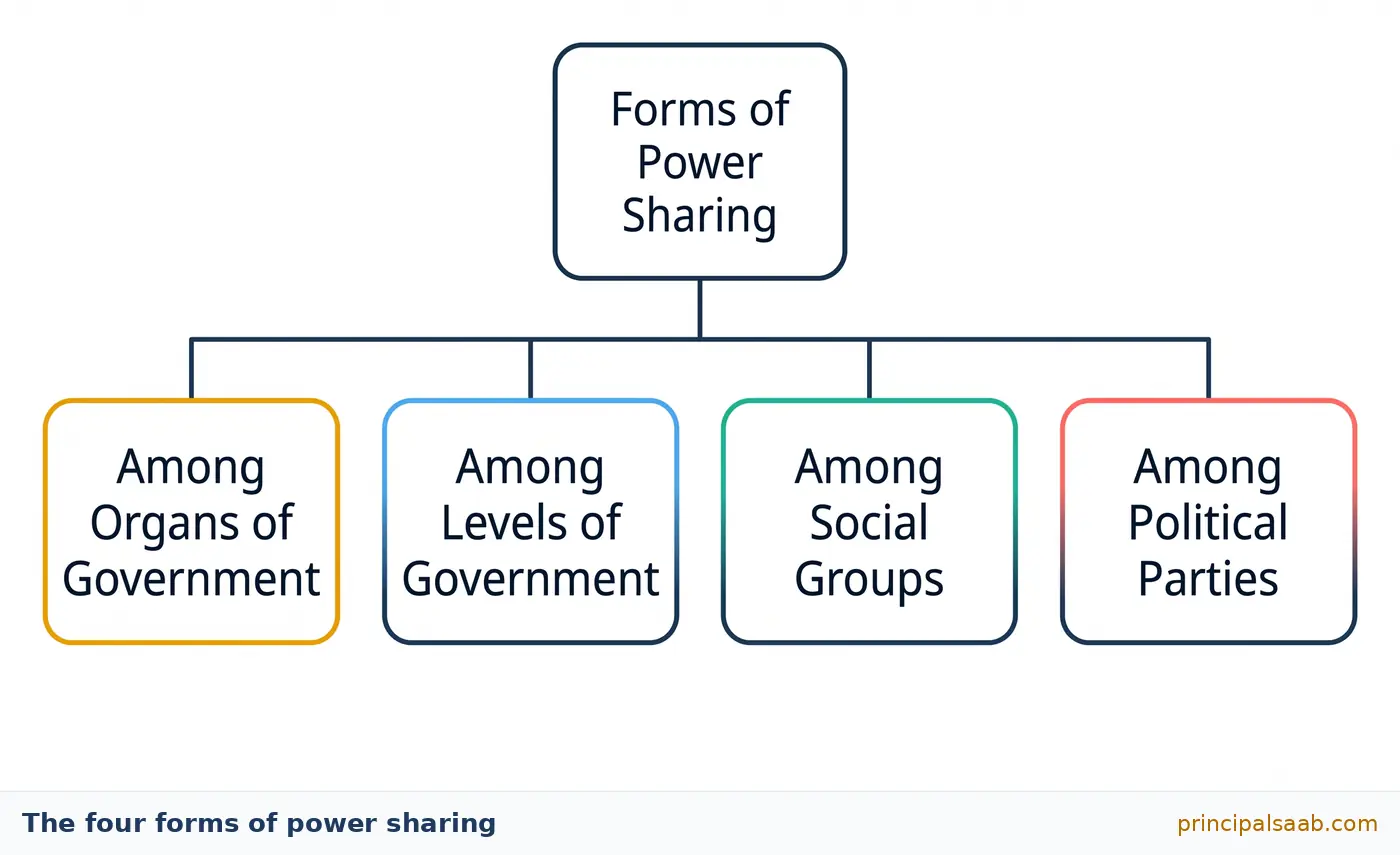
1. Horizontal distribution — among different organs of government. Power is shared among the legislature, the executive and the judiciary. They sit at the same level, which is why this is called horizontal: nobody is above anybody. Each organ has its own powers, and each can check the others. The legislature makes laws, the executive implements them, and the judiciary decides disputes and can strike down a law or an action that violates the constitution. This mutual checking is called a system of checks and balances.
Picture a school where the same person frames the rules, punishes offenders and hears appeals against the punishment. No student would ever get justice, however decent that person is, because there is nowhere to appeal to. Separate the three roles and the whole system becomes trustworthy. A ministry cannot make itself immune from the courts; a court cannot pass a budget; parliament cannot convict a person of a crime.
2. Vertical distribution — among governments at different levels. Power is shared between a general government for the entire country and governments at the provincial or regional level, and further down at the local level. In India this means the Union government, the State governments, and local self-government bodies such as panchayats and municipalities. It is called vertical because these levels are stacked, with the higher level having authority over larger units. This is known as the federal division of power.
Why does it work? Because a decision about the drainage of one village should not be taken a thousand kilometres away by people who have never seen the village, and a decision about national defence should not be taken separately by each village. Match the size of the decision to the size of the government and both quality and accountability improve.
3. Among different social groups. Power is shared among religious, linguistic and social groups so that minorities are not shut out. Belgium’s community government is one method. India uses another: reserved constituencies in legislatures for Scheduled Castes and Scheduled Tribes, and reservation of seats for women in local bodies. The purpose is to make sure that communities which would otherwise be permanently outvoted still have a real presence in the places where decisions are taken.
4. Among political parties, pressure groups and movements. This is the form students most often forget, so give it extra attention. In a democracy, power is never captured permanently. Parties compete in elections, and the possibility of losing keeps the ruling party honest. When no single party wins a majority, parties form a coalition and share power among themselves. Beyond parties, interest groups such as trade unions, farmers’ organisations and business associations, along with social movements, also influence decision-making — either by taking part in governmental committees or by pressing their demands from outside. So power is shared even between elections, and even with people who hold no office at all.
| Basis | Horizontal power sharing | Vertical power sharing |
|---|---|---|
| Between whom | Among different organs of government: legislature, executive and judiciary | Among governments at different levels: Union, State and local |
| Relationship | All organs are placed at the same level; none is superior to the others | The levels are ranked, the higher level having authority over larger units |
| Also known as | Separation of powers, working through checks and balances | Federal division of power |
| Main purpose | To ensure each organ checks the others and no organ becomes unlimited | To bring government closer to the people and match decisions to the right level |
| Indian example | The judiciary can declare a law passed by Parliament unconstitutional | Powers divided between the Union government, State governments and panchayats |
Model answer.
(i) Horizontal distribution of power is the sharing of power among the different organs of government — the legislature, the executive and the judiciary — all of which are placed at the same level of authority.
(ii) Each organ is given its own distinct powers, so that no single organ can exercise unlimited power in the state.
(iii) Because each organ can check the others — for example, the judiciary can declare a law passed by the legislature or an action of the executive unconstitutional — a balance of power is maintained among them, and this arrangement is called a system of checks and balances.
Why this scores: the phrase “at the same level” in point (i) is what proves you understand why it is called horizontal, and examiners look for it. Point (iii) supplies a concrete instance of one organ checking another, which is the difference between defining the term and explaining it.
Q1. Which form of power sharing is illustrated by the formation of the government described? (1 mark)
Q2. Which form of power sharing is illustrated by the role of the farmers’ association? (1 mark)
Q3. Identify and explain the form of power sharing shown by the action of the high court. (2 marks)
Model answers.
A1. Power sharing among political parties, in the form of a coalition government, where two or more parties share power by forming an alliance to run the government.
A2. Power sharing with pressure groups and movements, since an interest group of farmers is influencing government decision-making through consultation.
A3. It illustrates horizontal power sharing among the organs of government. The judiciary, which stands at the same level as the executive, checked the education department by striking down an order that went beyond its lawful authority; this mutual checking is the system of checks and balances.
How to attack a case-based set: read the questions first, then the passage, and mark each sentence with the form it matches. Case-based questions in this chapter are almost always a hidden test of the four forms. The 2-mark part always needs identification plus one explanatory sentence — never just a label.
Memorise the four forms as four short phrases: organs, levels, social groups, parties. In the exam write those four words in the margin first, then expand each into a sentence. You will never freeze, and you will never accidentally give only three.
Power Sharing in India: A Quick Tour
Every idea in this chapter is already living around you. Take a quick tour of your own country and watch the four forms appear one by one.
Horizontally, India separates Parliament, the Council of Ministers and the courts. Parliament passes a law; the government implements it; the Supreme Court can examine whether it violates the Constitution and set it aside. No organ has the last word on everything.
Vertically, India has a Union government, State governments, and below them panchayats in villages and municipalities in towns. Your local roads, water supply and primary schools are handled far closer to home than the capital, and the people taking those decisions are your neighbours.
Among social groups, India uses reserved constituencies in the Lok Sabha and in State legislatures for Scheduled Castes and Scheduled Tribes, and reserves seats for women in local bodies. The reasoning is the same as Belgium’s, even though the method is different: a group that would otherwise be permanently outnumbered is given a guaranteed presence where decisions are taken.
Among parties and groups, India has seen many coalition governments in which several parties share ministries and agree a common programme. Alongside them, trade unions, farmers’ organisations, student bodies and social movements constantly press their demands and shape what governments do.
India shares power in all four ways at once: horizontally among organs, vertically among levels, among social groups through reservation, and among parties, pressure groups and movements. This is why India is often used as the standard illustration when a question asks you to show the forms of power sharing in practice.
Model answer.
(i) Horizontal sharing among organs of government: Parliament makes the laws, the Council of Ministers implements them, and the Supreme Court can declare a law unconstitutional, so each organ checks the others.
(ii) Vertical sharing among levels of government: powers are divided between the Union government, the State governments and local bodies such as panchayats and municipalities.
(iii) Sharing among social groups: seats are reserved in legislatures for the Scheduled Castes and the Scheduled Tribes, and in local bodies for women, so that these groups have a guaranteed voice in decision-making.
Why this scores: the question says “with one Indian example each”, so a form named without an Indian instance earns nothing. Notice each point names the form first and the example second — that ordering makes it effortless for the examiner to award the mark.
Exam Strategy for This Chapter
Knowing the content is half the job. Knowing how the paper turns that content into questions is the other half, and almost nobody teaches it. Here is the map.
1-mark questions in this chapter are nearly always definitions or single facts: define power sharing, define majoritarianism, name the capital of Belgium, state the year Sinhala was made the only official language, name the two main language communities of Belgium. Answer in one sentence and move on. Multiple-choice and assertion-reason items also draw on the same short facts.
2-mark questions usually ask for two points, or a definition plus an example. Count the commands in the question; the number of commands matches the number of marks with surprising reliability.
3-mark questions are the workhorses here: three majoritarian measures in Sri Lanka, three features of the Belgian arrangement, the difference between prudential and moral reasons, what a community government is and why it was needed, three forms of power sharing with examples. Always write exactly three numbered points, one to two sentences each. Do not write four hoping one lands — you lose time you will want later.
5-mark questions are extended versions of the same material: compare Belgium and Sri Lanka, explain five features of Belgian power sharing, examine why power sharing is desirable, explain the forms of power sharing with examples. Structure is everything. Write one framing sentence, then five numbered points, each a complete sentence with a fact and a short reason. Resist the urge to write flowing paragraphs; numbered points are easier to mark and therefore easier to reward.
Case-based or source-based questions give you a short passage — often an unfamiliar imaginary country or a small news-style extract — followed by two or three sub-questions. The passage is never really about the country named in it. It is about the four forms of power sharing, or about majoritarianism versus accommodation. Read the sub-questions first, then hunt the passage for the sentence that answers each one.
Rough plan (write this in the margin first, 30 seconds): 1 framing, 2 Belgium measures, 1 Sri Lanka approach, 1 outcomes.
Model answer.
(i) Belgium and Sri Lanka faced comparable problems of linguistic diversity, but Belgium chose accommodation while Sri Lanka chose majoritarianism, and their outcomes reflect those choices.
(ii) Belgium recognised its differences and rebuilt its institutions accordingly, providing for an equal number of Dutch- and French-speaking ministers at the centre and requiring the support of both language groups for certain important laws.
(iii) It went further by transferring powers to state governments, creating a separate government for Brussels with equal representation for both communities, and setting up a community government elected by each language community for cultural, educational and language matters.
(iv) Sri Lanka instead used its Sinhala majority to make Sinhala the only official language in 1956, to favour Sinhala applicants in universities and government jobs, and to declare in its 1972 constitution that the state would protect and foster Buddhism.
(v) As a result Belgium held together and Brussels became the headquarters of the European Union, while Sri Lanka’s Tamil-speaking community was alienated, demanded a separate state, and the island endured a civil war from 1983 until 2009.
Why this scores: the word “analyse” demands cause and effect, not description, so the final point must connect choices to consequences. The 30-second plan is not a luxury; it is what stops you writing three paragraphs on Belgium and running out of time before you reach Sri Lanka, which is the commonest way students lose marks on this exact question.
Underline or bold four or five keywords across your whole answer sheet for this chapter — accommodation, majoritarianism, prudential, moral, checks and balances. Examiners scan for terminology. Using the exact word is often the difference between a full mark and a half one, and it costs you nothing.
Writing everything you know regardless of what was asked. A 3-mark question answered with eight points still gets three marks, and you have just spent the minutes you needed for the 5-marker at the end of the paper. Answer the question asked, at the length it was asked for, and then stop.
Practice Worksheet
Ten questions, arranged roughly from easy to hard. Write each answer out fully before you click to reveal — reading the answer without attempting it teaches you almost nothing. Keep a pen and a sheet beside you.
Q1. Name the two main language communities of Belgium and state the region in which each is concentrated. (1 mark)
Q2. Define majoritarianism in one sentence. (1 mark)
Q3. Why is Brussels considered a special case in Belgium’s power-sharing arrangement? (2 marks)
(ii) Because neither community could accept being governed by the other in the capital, Brussels was given a separate government in which both communities have equal representation.
Q4. Distinguish between vertical and horizontal distribution of power. (3 marks)
(ii) In horizontal distribution no organ is superior to another and each checks the others, which is called a system of checks and balances; in vertical distribution the higher level of government has authority over larger units while lower levels handle local matters.
(iii) Horizontal distribution is also called separation of powers, while vertical distribution is known as the federal division of power.
Q5. Explain any three consequences of the majoritarian policies followed in Sri Lanka. (3 marks)
(ii) Their relations with the Sinhala community deteriorated steadily, as the Tamils found their opportunities in education and government employment restricted.
(iii) Their repeated peaceful demands for recognition of Tamil as an official language and for regional autonomy were denied, so the struggle eventually turned into a demand for a separate state and the country descended into a civil war that lasted from 1983 to 2009.
Q6. What is a community government? Mention any two subjects on which it takes decisions. (3 marks)
(ii) It takes decisions on cultural matters and on educational matters for its own community.
(iii) It also decides language-related issues, which allows a family living outside its own language region to retain its cultural and linguistic rights.
Q7. “Prudential reasons for power sharing are different from moral reasons.” Explain with one example of each. (3 marks)
(ii) A prudential example: sharing power reduces the possibility of conflict between social groups and therefore ensures the stability of the political order, which is exactly what Belgium achieved and Sri Lanka failed to achieve.
(iii) A moral example: people have a right to be consulted about how they are to be governed, and a government becomes legitimate when citizens acquire a stake in the system through participation.
Q8. Describe any five features of the power-sharing arrangement adopted in Belgium. (5 marks)
(ii) Certain important laws require the support of a majority of members from each language group, which prevents either community from imposing a decision on the other.
(iii) Many powers of the central government were transferred to the state governments of the two regions, and these state governments are not subordinate to the central government.
(iv) Brussels has a separate government in which both communities have equal representation, because the capital has a French-speaking majority although it lies within Dutch-speaking territory.
(v) A third kind of government, the community government, is elected by the people of each language community wherever they live, and decides matters of culture, education and language.
Q9. “Power sharing is desirable both because it works well and because it is right.” Examine this statement with five arguments. (5 marks)
(ii) Prudentially, power sharing reduces the possibility of conflict between social groups, because each major group feels it has a genuine voice in decisions.
(iii) Prudentially, it also guards against the tyranny of the majority, which can ruin not only the minority but the unity and stability of the country itself.
(iv) Morally, power sharing recognises that people have a right to be consulted about how they are governed, so a democracy that excludes a section of its citizens contradicts its own foundation.
(v) Morally, it also strengthens the legitimacy of government, since citizens who participate in decision-making develop a stake in the system and willingly accept its authority.
Q10. Case-based. Read the passage and answer the questions that follow. (4 marks) — “The island republic of Meridia has two language groups: the Kalari, who form about seventy per cent of the population, and the Vetsi, who form most of the remaining thirty per cent and live mainly along the eastern coast. After independence the elected parliament declared Kalari the sole language of the courts and the administration, and reserved most government scholarships for Kalari-speaking students. Vetsi leaders formed a party and petitioned parliament for twelve years. In the thirteenth year a group of young Vetsi announced that they would no longer accept the authority of the state.”
Meridia has adopted majoritarianism, which is the belief that the majority community should be able to rule a country in whatever way it wishes, disregarding the wishes and needs of the minority. This is shown by its decision to make Kalari the sole language of the courts and administration and to reserve most scholarships for Kalari-speaking students.
Q10 (b). Explain, with reference to the passage, why the Vetsi turned away from constitutional methods. (2 marks)
The Vetsi first used peaceful and constitutional means, forming a political party and petitioning parliament for twelve years, but as a permanent minority of about thirty per cent they could never win a majority and their demands were never met. When the constitutional route repeatedly failed to deliver justice, a section of the community concluded that the state would never listen and withdrew its acceptance of the state’s authority — the same sequence of alienation, denial and rejection that occurred in Sri Lanka.
Note on method: the passage is imaginary, but every fact you need is a textbook concept in disguise. Sole official language plus preferential scholarships equals majoritarian measures; twelve years of petitions equals repeated denial of constitutional demands; the thirteenth year equals the turn towards separatism.
Power sharing means distributing power so no one authority decides everything. Belgium accommodated its differences and stayed united; Sri Lanka practised majoritarianism and fell into civil war. Power sharing is desirable for prudential reasons, because it works, and for moral reasons, because it is right. It takes four forms: among organs of government, among levels of government, among social groups, and among political parties, pressure groups and movements. India uses all four.
One last word before you close this page. Nobody masters a chapter in a single sitting, and you are not supposed to. The Japanese have a word for the way real improvement actually happens — kaizen, meaning small continuous betterment, day after day, in steps so small they feel almost unimpressive while you are taking them. So do not aim to “finish Civics” tonight. Aim for one more correct question than yesterday. One extra 3-marker written properly. One definition that finally comes out clean without looking. Do that for three weeks and you will not recognise your own answer sheet.
You have got this. Go and write Q1 right now, before the tab closes.