

Take a breath. This chapter looks intimidating because it is full of dates, unfamiliar words and places you have never been to. But underneath all of that, The Age of Industrialisation is telling one simple human story: how the way people made things changed, who won from that change, who lost, and what happened to India in the middle of it. If you can tell that story to a friend in your own words, you have understood the chapter. Everything else is detail that hangs off the story.
We are going to build this from zero. No prior knowledge assumed. I will explain every term the first time it appears, give you everyday comparisons, and show you exactly how to turn your understanding into marks. Go slowly. This is not a chapter to rush.
Please read that as information, not permission to skip. Periodic assessment marks are real marks that go into your final result. Your school will test this chapter. And the ideas here — how factories replaced handwork, how colonial trade policy crushed Indian weavers, how markets are created by advertising — are the foundation of the Economics and Contemporary India topics you will meet later. So learn it properly; just budget your revision time sensibly, giving the board-examined chapters the heavier share of your last few weeks.
One honest caution: assessment routes do get revised, and schools sometimes receive updated circulars. Please confirm this against your own school’s current-year syllabus copy or ask your Social Science teacher directly before you plan your revision around it.
What You’ll Learn
- Before the Industrial Revolution — What Proto-Industrialisation Means
- The Putting-Out System And Why Merchants Moved To The Countryside
- Urban Guilds And Why They Stood In The Merchants’ Way
- The Coming Of The Factory — Cotton And The Early Mills
- The Pace Of Industrial Change — What Actually Changed Slowly, And Why
- Hand Labour And Steam Power — Britain’s Labour Surplus And Seasonal Demand
- The Life Of Workers And The Fear Of Machines
- Industrialisation In The Colonies — The Age Of Indian Textiles
- What Happened To The Weavers And The Decline Of Indian Exports
- Manufacturing Comes Up In India — The Early Entrepreneurs
- Where Did The Workers Come From?
- The Peculiarities Of Indian Industrial Growth
- Why Small-Scale Industries Still Dominated
- The Market For Goods — Advertisements, Calendars And Labels
- The Dated Timeline You Should Be Able To Recite
- Practice Worksheet With Full Answers
Your Game Plan
- Read the whole chapter once quickly, just for the story. Do not memorise anything on this pass.
- Come back and work through the sections below one at a time, doing the worked answers with a pen before you read my version.
- Build your own one-page timeline of dates and names. Writing it yourself is what makes it stick.
- Learn the four big comparison tables — they answer most 3 and 5 mark questions on their own.
- Do the practice worksheet at the end without looking. Then mark yourself honestly.
- Revise weekly in ten-minute bursts. Spaced repetition beats one long night every single time.
Before The Industrial Revolution — What Proto-Industrialisation Means
Most people hear “Industrial Revolution” and picture chimneys, machines and factory sheds appearing suddenly around 1800. That picture is wrong, and getting it right is the single most useful thing this chapter teaches you.
Long before the first factory existed, Europe already had large-scale industrial production. It simply did not happen in factories. It happened in villages, in people’s own homes, on hand-operated equipment, and it was organised by merchants who lived in towns. Historians gave this earlier phase a name: proto-industrialisation. Break the word up and it explains itself — “proto” means early or first, so proto-industrialisation is the early phase of industrialisation that came before factories.
Think of it like this. Imagine a clothing brand today that has no factory of its own. It designs the product, buys the raw material, gives that material to hundreds of tailors working from their own homes across many villages, collects the finished garments, and sells them in cities and abroad. The brand is running a huge production operation without owning a single production building. That is exactly what European merchants were doing in the seventeenth and eighteenth centuries.
Why it happened: world trade was expanding rapidly and European powers were acquiring colonies. Demand for goods — especially cloth — shot up far beyond what town workshops could supply. Merchants needed more producers, and they needed them fast. The countryside had the people.
Model answer: Proto-industrialisation refers to the early phase of industrialisation in Europe, before the coming of factories, when large-scale production for an international market was carried out in the countryside in the homes of peasants and artisans.
Where the mark is earned: the examiner is looking for two things in one sentence — (i) it came before factories, and (ii) it was large-scale production for an international market. A one-mark answer needs both halves. Writing only “production before factories” usually earns a half mark at best.
Model answer — write three separate numbered points:
1. Scale of output. The volume of goods produced under this system was enormous. Merchant clothiers in England were handling the output of hundreds of households at a time, which no town workshop could match. (1 mark)
2. It served an international market. The cloth produced in English and European villages was not for local use — it was exported across Europe and to the colonies, meaning these villages were plugged directly into world trade. (1 mark)
3. It was a sophisticated organised network. The system involved a controlled chain of specialised stages — stapler, spinner, weaver, fuller, dyer — each done by different people in different villages, coordinated by the merchant. This is complex industrial organisation, not casual handicraft. (1 mark)
Presentation tip: in a 3-mark question, three clearly separated points with a bolded lead phrase each is far easier for an examiner to mark than one long paragraph. Make their job easy and you will not lose stray marks.
The Putting-Out System And Why Merchants Moved To The Countryside
The specific arrangement merchants used has a name you must know: the putting-out system. The merchant “put out” raw material to a household, the household worked on it at home using their own simple tools, and the merchant collected the finished or semi-finished product and paid them for the work.
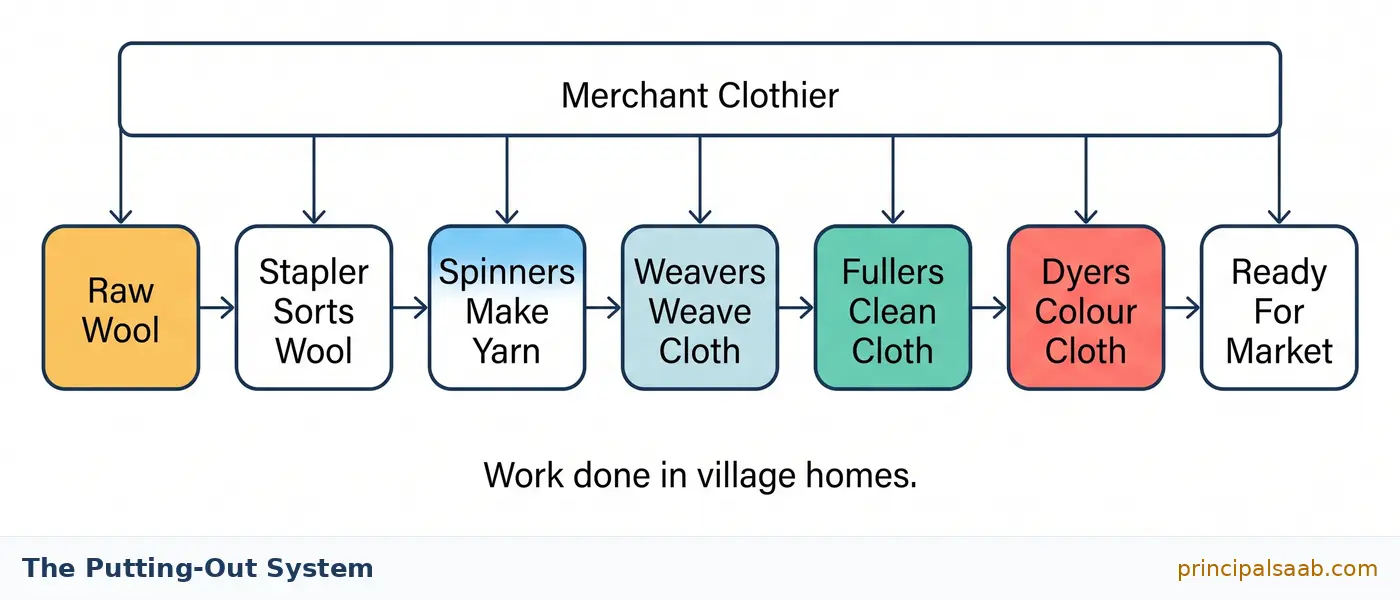
Here is how a single piece of cloth actually travelled through the system in England. A merchant clothier in a town bought raw wool. He gave it to a stapler, who sorted the wool fibres by quality. The sorted wool went to spinners — usually women and children working in cottages — who spun it into yarn. The yarn went to weavers, who wove it into cloth on handlooms in their own homes. The woven cloth then went to fullers, who cleaned and thickened it, and finally to dyers, who coloured it. Only then was it ready to sell. One piece of cloth, five or more separate households, spread across several villages, all coordinated by one merchant.
So why the countryside? Two reasons, and they are connected. The first is a push factor: merchants could not expand production inside the towns, because town production was locked down by guilds (the next section explains this in full). The second is a pull factor: the countryside was genuinely attractive.
Rural England at this time was full of poor peasants who had a serious problem. Open fields were being enclosed and common lands were being fenced off and taken into private hands. For a small cottager, those commons were survival — a place to graze a cow, gather firewood, collect berries, hunt small game. Once the commons were gone, these families had no cushion at all. They desperately needed another source of income.
So when a merchant arrived offering advances of raw material and payment for work done at home, it was a lifeline. The family could keep farming their tiny plot and earn from spinning and weaving in the same year. Historians call this having more than one income source. It suited the peasants, and it suited the merchant beautifully, because he got a huge, cheap, willing workforce that he did not have to house, supervise or build a factory for.
Model answer:
1. Guild and trade restrictions in towns. Urban crafts and trade were tightly controlled by guilds and by rulers who had granted monopoly rights to particular groups. A merchant could not simply expand output or hire whoever he liked inside a town. (1 mark)
2. Availability of willing rural labour. Poor peasants and cottagers, hit by the enclosure of open fields and commons, had lost their supplementary means of survival and badly needed extra income. They readily accepted work from merchants. (1 mark)
3. Cheap and flexible production. Because peasants worked in their own homes with their own tools and combined this work with cultivation, the merchant avoided the cost of buildings and supervision and could expand or reduce output as demand changed. (1 mark)
Note the pattern: one push reason, one pull reason, one economic-advantage reason. If you structure it that way you will never blank out on the third point.
Model answer:
1. It gave them a much-needed additional source of income at a time when the enclosure of common lands had destroyed their traditional means of supplementing farming. (1 mark)
2. Because the work was done at home on their own simple equipment, the whole family — including women and children — could contribute, and they could still cultivate their small plots alongside it. (1 mark)
Common trap: the question asks about benefit to the peasant, not to the merchant. Read the subject of the question carefully before you start writing. Half the marks lost in History are lost this way.
Colonial economic policy links directly to the freedom struggle, so pair this with our Class 10 History notes on Nationalism in India.
Urban Guilds And Why They Stood In The Merchants’ Way
To understand why merchants fled to the villages, you need to understand what they were fleeing from. In European towns, production was controlled by guilds. A guild was an association of craftspeople in a particular trade — the weavers’ guild, the goldsmiths’ guild, the bakers’ guild, and so on.
The easiest modern comparison is a very strict professional body combined with a closed shop. To make and sell cloth in a town, you generally had to be a member of the relevant guild. The guild decided who could join, trained new entrants through a long apprenticeship, fixed standards of quality, controlled prices, and — crucially — restricted how many people could enter the trade and how much each member could produce. Rulers often reinforced this by granting particular guilds the exclusive right to produce and trade specific goods in specific areas. That exclusive right is called a monopoly.
From a craftsman’s point of view this was protection: it stopped cheap competitors flooding the market and driving his family into poverty. From a merchant’s point of view it was a wall. He could not increase output, could not hire extra hands freely, could not undercut prices, and in many cases could not even enter the trade. The countryside, where guilds had no authority, was the obvious way around the wall.
Model answer:
1. Control over entry. Guilds were associations of producers that trained new craftspeople and decided who was allowed to practise a trade in the town. Outsiders and unapproved producers were kept out. (1 mark)
2. Control over output and prices. Guilds maintained control over production, fixed standards and regulated prices, so an individual merchant could not simply raise production or lower prices to capture a larger market. (1 mark)
3. Monopoly rights from rulers. Rulers granted certain guilds the exclusive right to produce and trade specific products in particular areas, legally blocking new producers from entering that trade. (1 mark)
Linking sentence worth adding at the end: “Because of these restrictions, merchants who wanted to expand output turned to the countryside, where guild authority did not reach.” A closing link like this shows the examiner you understand cause and effect, not just isolated facts.
The Coming Of The Factory — Cotton And The Early Mills
Now the factories arrive. The earliest factories in England came up in the 1730s, but they remained rare for decades. The real explosion came at the end of the eighteenth century, and it came in one industry above all: cotton.
The numbers tell the story starkly. In 1760 Britain was importing roughly 2.5 million pounds of raw cotton to feed its cotton industry. By 1787 that import figure had climbed to about 22 million pounds. That is close to a ninefold increase in under thirty years. Something had clearly changed in how cotton could be processed.
What changed was a series of inventions that transformed each step of production — carding, twisting, spinning and rolling. Each new machine raised output per worker dramatically and made stronger, better thread. Two names and dates you must have absolutely secure:
- 1764 — the spinning jenny, invented by James Hargreaves. The traditional spinning wheel turned one spindle at a time. The jenny let a single wheel drive several spindles at once, so one worker could spin many threads simultaneously. It sped up spinning enormously and reduced the demand for spinning labour.
- 1771 — Richard Arkwright’s cotton mill at Cromford. Arkwright had patented his water frame, a spinning machine driven by water power. Because it needed a water wheel and a purpose-built site, production could no longer happen in scattered cottages. It had to be brought together under one roof, near a river, with the workers coming to the machines. That building was a mill — a factory. This is the moment production physically moves out of the home.
Model answer: The spinning jenny was invented by James Hargreaves in 1764. (1 mark) It enabled a single worker to turn several spindles at the same time by moving one wheel, instead of spinning a single thread on one spindle. This greatly increased the quantity of yarn one person could produce and therefore reduced the number of spinners needed for the same output. (1 mark)
Why the last clause matters: mentioning that it reduced labour demand sets you up perfectly for the “fear of machines” section later. Examiners reward students who connect the invention to its social consequence.
Model answer — five developed points:
1. Production shifted from home to a single site. Under the earlier putting-out system, work was scattered across hundreds of peasant homes in many villages. With machines such as Arkwright’s water frame requiring a fixed power source, all processes were brought together in one building. (1 mark)
2. Supervision became possible. Once workers came to the machines rather than the material going to the workers, the owner could watch the process directly, check quality at every stage and prevent waste or theft of materials. (1 mark)
3. The pace of work was now set by the employer. A cottage weaver decided his own hours around farming and family. A factory worker worked to the rhythm of the machine and the clock, under fixed shifts and discipline. (1 mark)
4. Output rose dramatically. New machines for carding, twisting, spinning and rolling raised output per worker and improved thread strength. Raw cotton imports into Britain rose from about 2.5 million pounds in 1760 to about 22 million pounds by 1787, reflecting this surge. (1 mark)
5. Cotton became the symbol of the new age. The first symbol of the new era was cotton, whose production boomed in the late eighteenth century, and by 1840 cotton was the heaviest sector of British industry in terms of value. (1 mark)
Structure advice for 5-markers: five points, each with a bold lead phrase and one or two supporting sentences. Do not write four brilliant points and hope — the mark scheme almost always awards one mark per distinct valid point.
The Pace Of Industrial Change — What Actually Changed Slowly, And Why
This is the section students find most surprising, and it is the one examiners love, because it separates students who memorised from students who understood. The phrase “Industrial Revolution” makes you imagine everything transforming at once. The reality is that industrial change in Britain was slow, uneven and partial. Let me show you exactly how.
First point: the new industries could not simply displace the old ones. Cotton and metals were the fastest-growing sectors. Cotton led the boom in the late eighteenth century, and by 1840 cotton was the heaviest sector of British industry in terms of value. After the 1840s, as the railway network spread in England and railway construction extended into the colonies, the iron and steel industry grew rapidly, and by 1873 Britain was exporting iron and steel worth about double the value of its cotton exports. So the “new” sectors did grow impressively.
But — and here is the twist — even at the end of the nineteenth century, less than twenty per cent of the total workforce in Britain was employed in technologically advanced industrial sectors. Read that again. More than four workers in five were still working outside the modern mechanised industries. Textiles was a dynamic sector, but a huge portion of its output was still being produced not inside factories but in small workshops and homes.
Second point: ordinary “traditional” industries did not stand still, and they were not trivial. Food processing, building, pottery, glass work, tanning, furniture making and the production of implements all continued and expanded. Growth in these ordinary sectors came not from steam-powered factory technology but from small, gradual innovations — better hand tools, small improvements in technique, better organisation. That is real industrial change too, just not the dramatic kind.
Third point: new technology spread painfully slowly. Why would a businessman hesitate to buy a machine that clearly works better? Put yourself in his shoes and the answer is obvious:
- New machines were expensive to buy.
- They broke down often, and repair was costly.
- They were not as effective in practice as their inventors and manufacturers claimed.
- Existing hand labour was cheap and available, so the machine had to prove it was worth the risk.
The steam engine makes the point perfectly. James Watt improved the steam engine produced by Newcomen and patented the new engine in 1781. His industrialist friend Matthew Boulton manufactured it. Yet for years there were very few takers. Through the whole of the nineteenth century up to 1840, Britain — the leading industrial nation in the world — had built only about 321 steam engines in total: roughly 80 in cotton industries, nine in wool industries, and the remainder scattered across mining, canal works and iron works. For decades, steam engines were found in no other industries at all. That is the true pace of the revolution.
| Point of comparison | Proto-industrial production | Factory production |
|---|---|---|
| Place of work | The worker’s own home or cottage, in villages | A single purpose-built mill or factory building |
| Who controls the pace | The worker, who fits work around farming and family | The owner, through fixed hours, shifts and machine speed |
| Equipment used | Simple hand tools owned by the worker | Costly powered machinery owned by the capitalist |
| Supervision | Almost none; the merchant only collected the output | Direct and constant, allowing quality and pace control |
| Relationship | Merchant and semi-independent household producer | Employer and wage-earning employee |
Model answer:
1. The new machines were expensive to purchase and industrialists were cautious about committing large sums of capital to them. (1 mark)
2. The machines broke down frequently, their repair was costly, and in actual use they often did not perform as well as their inventors and manufacturers had claimed. (1 mark)
Bonus point if the question is worth more: hand labour was cheap and plentiful in Britain, so there was little pressure to mechanise.
Model answer:
1. The steam engine spread very slowly. Although James Watt patented his improved steam engine in 1781, there were few buyers for many years. Up to 1840, Britain had built only around 321 steam engines in all. (1 mark)
2. Its use was confined to a handful of industries. Of those engines, roughly 80 were in cotton industries and nine in wool industries, with the rest in mining, canal works and iron works. For decades, no other industry used steam engines at all. (1 mark)
3. The bulk of the workforce was outside modern industry. At the end of the nineteenth century, less than twenty per cent of Britain’s total workforce was employed in technologically advanced industrial sectors, showing that traditional production still dominated employment. (1 mark)
Why this answer scores well: every point carries a specific number. In History, precise figures are the difference between a good answer and a top answer. Learn 1781, 321, 80, nine, and twenty per cent.
Model answer:
1. They drove the sectors that employed most people. Industries such as food processing, building, pottery, glass work, tanning, furniture making and implement production continued to grow, and together they accounted for far more workers than the mechanised sectors did. (1 mark)
2. They did not depend on costly steam technology. Growth in these sectors came from gradual improvements in hand tools, techniques and work organisation, which were affordable and low-risk for small producers. (1 mark)
3. They show the true nature of industrialisation. Their continued importance proves that industrialisation was not a sudden replacement of the old by the new, but a slow process in which traditional and modern methods grew side by side. (1 mark)
Hand Labour And Steam Power — Britain’s Labour Surplus And Seasonal Demand
Here is a puzzle worth sitting with. If machines were more productive, why did British industrialists keep using hand labour for so long? The answer is not stubbornness or backwardness. It was cold economic logic, and once you see it, this section becomes easy.
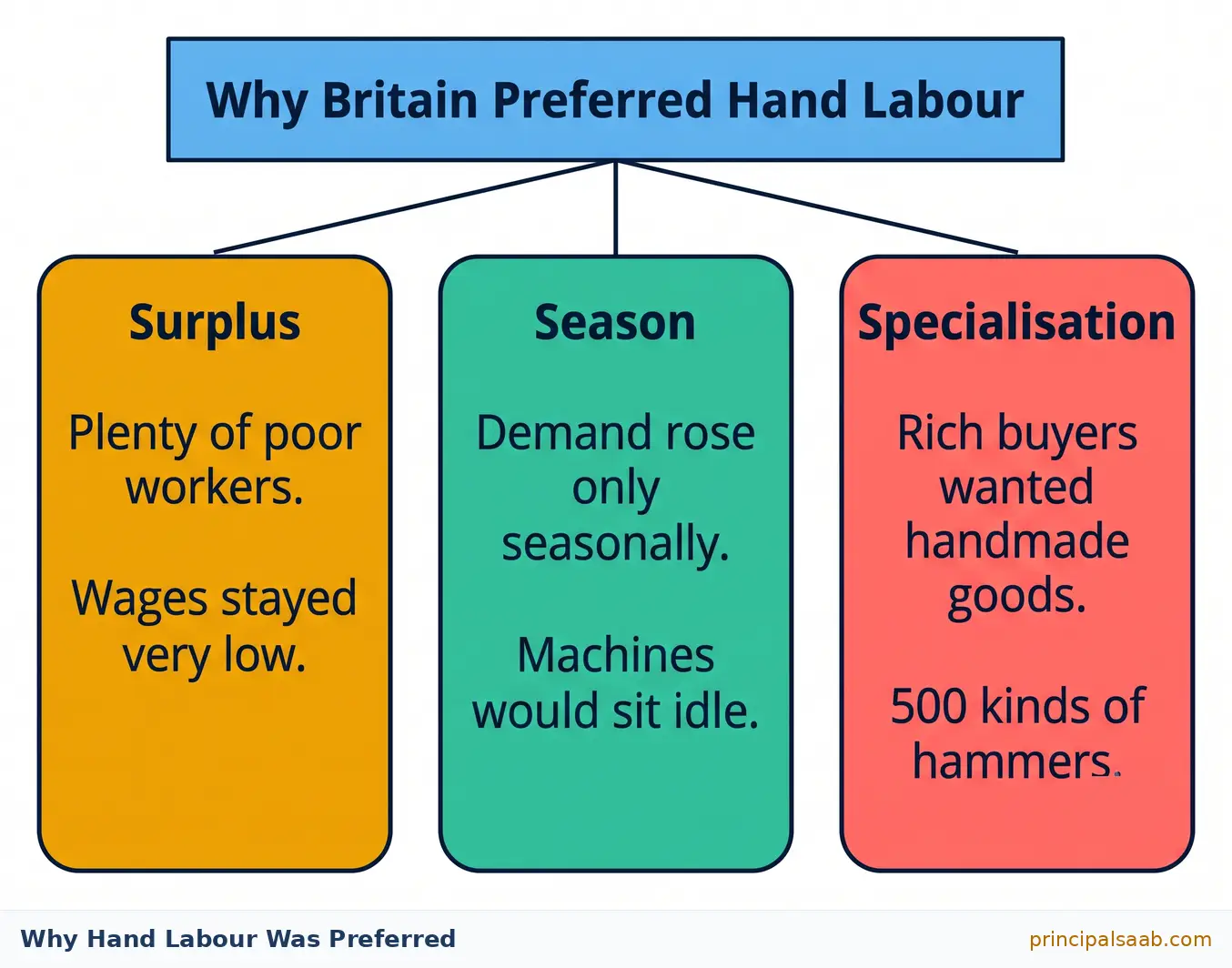
Reason one — Britain had too many workers, not too few. In Victorian Britain there was no shortage of human labour. Poverty was widespread and unemployed people poured into the cities looking for work. When labour is abundant, wages are low. When wages are low, an industrialist has no reason to spend a fortune on a machine that saves labour, because labour is the cheap input. Machines make sense when workers are scarce and expensive; in Britain the opposite was true.
Think of it as a household decision. If a dishwasher costs a huge amount and someone will wash your dishes for a very small sum, you delay buying the dishwasher. That is precisely the calculation British industrialists were making, at scale.
Reason two — a great deal of demand was seasonal. Many industries did not need the same output all year round. Gas works and breweries were especially busy during the cold months. Bookbinders and printers had to work extra hard around Christmas, so needed more hands only then. Ship repair and building work rose in winter. If your busy period is three months long, buying a permanent machine that sits idle for nine months is wasteful. It is far cheaper to hire extra hands for the season and let them go afterwards. So seasonal industries deliberately preferred hand labour.
Reason three — machines could not do what the market wanted. Machines were superb at producing uniform, standardised goods in huge quantities. But a great many products in Britain required variety and finish. The upper classes — aristocrats and the wealthy bourgeoisie — wanted things made by hand: handmade goods signified refinement and class, they were better finished, individually produced, and carefully designed. In the 1820s, the number of different kinds of hammers being produced in Britain ran to around 500, and screwdrivers to around 45. That variety came from human skill, not from a machine.
| Aspect | Hand labour | Machine production |
|---|---|---|
| Initial cost to owner | Very low; workers hired and released as needed | Very high; large capital investment required upfront |
| Flexibility of output | Ideal for seasonal peaks and fluctuating demand | Runs uneconomically when demand falls or is seasonal |
| Type of product | Variety, intricate designs, individual finish | Uniform, standardised goods in very large quantities |
| Who preferred it | Upper-class buyers valuing refinement and quality | Mass markets needing cheap goods in bulk |
| Reliability | Dependable, skill-based, no breakdown cost | Frequent breakdowns; repair was expensive |
Model answer:
1. Abundant cheap labour. There was no shortage of human labour in Victorian Britain. Large numbers of poor and unemployed people came to the cities in search of work, which kept wages low and made hand labour the cheaper option. (1 mark)
2. Seasonal demand in many industries. Gas works and breweries were busy chiefly in the cold months, and bookbinders and printers needed extra hands before Christmas. In such trades it made sense to hire workers only for the season rather than invest in machines that would lie idle. (1 mark)
3. Fluctuating and product-specific demand. Where demand for a product varied or where a wide range of designs was needed, machines geared to uniform mass output were unsuitable, and only human skill could deliver the required variety. (1 mark)
4. Elite preference for handmade goods. The aristocracy and the wealthy middle classes preferred goods produced by hand, since these were better finished, individually made and carefully designed, and were seen as a mark of refinement and class. (1 mark)
5. High cost and unreliability of machines. Machines were expensive to buy, broke down frequently, needed costly repair, and often did not perform as well as their makers claimed, so cautious industrialists avoided the risk. (1 mark)
Model answer: Breweries experienced their heaviest demand during the cold months, so the owner’s need for extra production was seasonal rather than continuous. (1 mark) Machinery would require a large permanent investment yet would remain idle for much of the year, whereas seasonal workers could be engaged only for the busy months and released afterwards, keeping his costs low and flexible. (1 mark)
How to handle “apply the concept” questions: name the concept from the chapter first (seasonal demand), then apply it to the specific case. Never just describe the case.
The Life Of Workers And The Fear Of Machines
We have looked at this from the owner’s side. Now look at it from the worker’s side, because this is where the chapter becomes genuinely moving.
An abundance of labour sounds good for employers, but for workers it was miserable. When hundreds of people chase every job, the person hiring holds all the power. Getting work depended heavily on existing networks of friendship and kinship — if you had a relative or a friend already working in a factory, you had a real chance of being taken on. If you had no such connection, you could wait for a very long time.
Many job-seekers had to wait weeks, sleeping under bridges or in night shelters, or in the casual wards run by Poor Law authorities. Seasonality of work in many industries meant long periods without earnings between busy seasons. After a spell of hard work, many workers were simply back on the streets. Some returned to the countryside in the off season; others stayed and endured.
Wages did rise somewhat in the early nineteenth century, but you must handle this fact carefully in an answer. Average wage figures conceal enormous variation between trades, and they hide the fluctuations from year to year. More importantly, a wage rise means nothing on its own — what matters is the price of goods and, crucially, how many days of the year a worker actually found employment. A higher daily wage with far fewer working days can leave a family poorer than before. In periods of economic slump, such as the 1830s, unemployment rose sharply.
Now the fear of machines. Understand this properly and you will never dismiss it as ignorance. Workers did not hate technology for its own sake. They feared unemployment, because machines genuinely destroyed their livelihoods. The clearest case is the Spinning Jenny in the woollen industry. Women who had survived on hand spinning saw a single machine do the work of many hands. Since spinning was largely women’s work, they had most to lose and they fought back — attacking the new machines in what became a bitter conflict that continued for a long time.
Two later developments finally changed the mood. From the middle of the nineteenth century, expanded building activity in the cities opened up greater employment — road widening, new railway lines, railway stations, tunnels, drainage and sewers. That created work for the very people machines had displaced.
Model answer:
1. Fear of losing their livelihood. Workers opposed machines primarily because the machines carried out in a short time work that had previously supported many households, threatening them with unemployment. (1 mark)
2. The example of the Spinning Jenny. In the woollen industry, the introduction of the Spinning Jenny meant that one machine could do the work of many hand spinners. Since hand spinning was largely done by women, they stood to lose their only source of income. (1 mark)
3. Open conflict followed. Women who survived on hand spinning began attacking the new machines, and this resistance continued over a long period before it eventually subsided. (1 mark)
Tone matters here: present the workers’ resistance as a rational economic response, not as foolishness. Answers that show that understanding read far more maturely.
Model answer:
1. Averages hide wide variation. Reported average wages conceal large differences between different trades and sharp fluctuations from year to year, so an overall rise may not have reached most workers. (1 mark)
2. Prices matter as much as wages. The real value of a wage depends on the prices of the goods a worker must buy. If prices rose alongside wages, the worker’s actual purchasing power did not improve. (1 mark)
3. Days of employment are decisive. Because work in many industries was seasonal and unemployment was severe during slumps such as those of the 1830s, the number of days a worker was actually employed in the year determined the family’s income far more than the daily rate did. (1 mark)
The same shift from handwork to machine production shaped publishing too — see our Print Culture and the Modern World chapter notes.
Industrialisation In The Colonies — The Age Of Indian Textiles
We now cross to India, and the mood of the chapter changes completely. Before machine industries came up in England, India was already a giant in world textile production. This is not patriotic exaggeration — it is documented economic history, and the vocabulary of the trade proves it.
Silk and cotton goods from India dominated the international market in textiles. Coarse cottons were woven in many countries, but the finer varieties often came from India. Armenian and Persian merchants took goods from Punjab to Afghanistan, eastern Persia and Central Asia, carrying them on camels through mountain passes and deserts. Meanwhile a vibrant sea trade ran from the ports on the western and eastern coasts.
Surat on the Gujarat coast connected India to the Gulf and Red Sea ports. Masulipatam on the Coromandel coast and Hooghly in Bengal had trading links with Southeast Asian ports. This trade was run by a network of Indian merchants and bankers who financed production, carried goods and supplied exporters. Supply merchants linked the port towns to inland regions, gave advances to weavers, procured the woven cloth from the villages and carried it to the ports.
Then the balance of power shifted. From the 1750s, the network of Indian merchants that had controlled this trade began to break down, as European companies gradually gained power — first securing concessions from local courts, then monopoly rights to trade. The old ports of Surat and Hooghly declined and exports through them collapsed; the new colonial ports of Bombay and Calcutta rose in their place. Trade through the new ports came to be controlled by European companies and carried in European ships. Many of the old trading houses collapsed. Those who wanted to survive now had to operate within a network shaped by the European trading companies.
Model answer: European traders first saw fine cotton cloth being carried by Arab merchants in Mosul, in present-day Iraq, and began using the word “muslin” for all finely woven textiles. (1 mark) When the Portuguese landed at Calicut on the Kerala coast and carried back cotton textiles, they called the cloth “calico”, and this became the general European name for all cotton textiles. The fact that European languages took their names for cloth from Indian places and Indian trade routes shows how thoroughly Indian textiles dominated the international market. (1 mark)
Model answer:
1. The old ports were the heart of a thriving Indian trade network. Surat on the Gujarat coast linked India to the Gulf and Red Sea ports, while Hooghly in Bengal traded with Southeast Asian ports, and both were run by Indian merchants and bankers. (1 mark)
2. European companies gradually gained power. From the 1750s these companies secured concessions from local courts and then obtained monopoly rights to trade, which broke the control of the older Indian commercial network. (1 mark)
3. Exports from the old ports collapsed. Trade through Surat and Hooghly declined sharply, the credit that had financed it dried up, and local bankers and trading houses went bankrupt. (1 mark)
4. The new colonial ports rose. Bombay and Calcutta grew in their place, and trade through them was controlled by European companies and carried in European ships. (1 mark)
5. Indian merchants were pushed into a subordinate role. Those who wished to continue in business could no longer operate independently and had to function within a network organised and dominated by the European trading companies. (1 mark)
What Happened To The Weavers And The Decline Of Indian Exports
This section explains how a world-leading industry was systematically dismantled. Take it in two stages, because the East India Company’s treatment of weavers changed once it had political power.
Stage one — establishing control over the weavers. After the East India Company established political power, it moved to eliminate competition, control costs and secure a regular supply of cotton and silk goods. It did this through a system of management and control:
- The Company appointed a paid servant called the gomastha to supervise weavers, collect supplies and examine the quality of cloth. The gomastha was an outsider with no long-term social link to the village.
- It prevented Company weavers from dealing with other buyers. This was done through a system of advances: weavers were given loans to purchase raw material, and once they took the advance they were bound to hand over the cloth they produced to the gomastha and could sell to no one else.
Why did weavers accept the advances? Because it looked attractive at first. Eager for the loans, many weavers accepted them and even leased out their small plots of land to devote all their time to weaving. But the trap closed quickly. The price the weavers received from the Company was low, and the loans tied them so tightly that they could not refuse it. They had lost the space to bargain and to sell to the highest bidder — the very thing that had protected them before.
The conflicts that followed. Reports of clashes between weavers and gomasthas became common. Earlier supply merchants had often lived within the weaving villages and had a close relationship with the weavers, helping them in times of crisis. The new gomasthas were outsiders with no such bond. They acted arrogantly, marched into villages with sepoys and peons, and punished weavers for delays in supply — commonly by beatings and floggings. In many places in Carnatic and Bengal, weavers deserted villages and migrated to other villages, set up looms elsewhere, or in some cases revolted along with village traders. Some weavers abandoned the trade entirely, closed their workshops and took up agricultural labour.
Stage two — the collapse of exports. By the beginning of the nineteenth century a second, larger blow landed. Britain’s own cotton industry had expanded, and industrialists there pressured their government to restrict the entry of Indian cloth so that Manchester goods could sell freely at home. Imported Indian cloth into Britain faced heavy import duties. At the same time, British manufactured cotton goods began flooding into India itself.
Then came the crushing detail. By the 1860s weavers faced a new problem: they could not get enough supply of good quality raw cotton. When the American Civil War broke out and cotton supplies from the United States were cut off, Britain turned to India for raw cotton. As raw cotton exports from India increased, the price of raw cotton shot up. Indian weavers were starved of supplies and were forced to buy raw cotton at painfully high prices. By the end of the nineteenth century, factories in India began producing cloth in large quantities as well, flooding the market with machine goods and completing the weavers’ difficulties.
| Cause of decline | How it hurt the Indian weaver |
|---|---|
| The system of advances and the gomastha | Tied weavers to one buyer at a low fixed price, removing their freedom to bargain or sell to others |
| Heavy import duties in Britain | Shut Indian cloth out of the British market, destroying the export demand that supported weavers |
| Flood of cheap Manchester imports | Machine-made cloth undercut handloom prices in the weavers’ own home market |
| Raw cotton shortage after the 1860s | Raw cotton was exported to Britain, prices soared, and weavers could not afford their own raw material |
| Rise of Indian factories | By the century’s end, domestic mills also flooded the market with cheap machine-made cloth |
Model answer: A gomastha was a paid servant appointed by the East India Company to supervise weavers, collect supplies of cloth and examine the quality of the cloth produced. (1 mark) Unlike the earlier supply merchants who lived within the weaving villages and had close ties with the weavers, gomasthas were outsiders with no social link to the community, and they frequently acted harshly, arriving with sepoys and peons and punishing weavers for delays in supply. (1 mark)
Model answer:
1. Loss of bargaining power through advances. Weavers who took loans from the Company were bound to sell only to the gomastha at a low price fixed by the Company, and could no longer sell to the highest bidder. (1 mark)
2. Harsh treatment by gomasthas. These outsiders marched into villages with sepoys and peons and punished weavers with beatings and floggings for delays in supply, leading to frequent clashes. (1 mark)
3. Collapse of the export market. British industrialists pressured their government to impose heavy import duties on Indian cloth entering Britain, so that Manchester goods could sell without competition, and Indian exports fell sharply. (1 mark)
4. Competition from cheap machine-made imports. British manufactured cotton goods flooded the Indian market at prices handloom weavers could not match. (1 mark)
5. Shortage and high price of raw cotton. After the American Civil War cut off American supplies, Britain sourced raw cotton from India, exports rose and prices shot up, leaving Indian weavers unable to obtain good quality raw cotton at an affordable price. (1 mark)
Model answer:
1. Why they welcomed it. The advances were loans that allowed weavers to buy raw material without needing their own capital, and they seemed to guarantee a buyer for the finished cloth. Many were so eager for these loans that they even leased out their small plots of land to devote all their time to weaving. (1 mark)
2. Why it turned against them. Once they had taken the advance, weavers were legally and practically bound to hand over their cloth to the gomastha alone, at a price fixed low by the Company, and could not sell to any other buyer offering more. (1 mark)
3. The deeper loss. Having leased out their land and become dependent on the loans, they lost both their fallback in agriculture and their freedom to bargain, so a debt they had accepted voluntarily became a trap they could not leave. (1 mark)
Why examiners like this answer: it shows change over time. Whenever a question contains “initially” and “later”, your answer must clearly show the turning point.
Manufacturing Comes Up In India — The Early Entrepreneurs
Amid all that decline, Indian factories did come up. Two dates anchor this section and you must know both cold:
- 1854 — the first cotton mill in Bombay. It was set up in 1854 and went into production two years later, in 1856.
- 1855 — the first jute mill in Bengal, followed by another in 1862.
Other early developments followed. In north India, the Elgin Mill was started in Kanpur in the 1860s, and a year later the first cotton mill of Ahmedabad was set up. By 1874 the first spinning and weaving mill of Madras began production.
1855 = the first jute mill in Bengal (set up in the colonial period, at Rishra on the Hooghly).
1917 = the first jute mill set up by an Indian businessman, Seth Hukumchand, a Marwari trader, in Calcutta.
The key word that tells you which one the question wants is “Indian”. Underline it when you see it.
Now the crucial question: where did the capital come from? The answer is genuinely interesting — much of it came from trade, and a lot of that trade was with China.
From the late eighteenth century the British in India began exporting opium to China and taking tea from China to England. Many Indians became junior players in this trade, providing finance, procuring supplies and shipping consignments. Having earned through trade, they hoped to develop industrial enterprises in India.
The individuals you should be able to name:
- Dwarkanath Tagore — in Bengal, he made his fortune in the China trade before turning to industrial investment, setting up six joint-stock companies in the 1830s and 1840s. His enterprises sank in the business crises of the 1840s, but later Bengali entrepreneurs also had trade links with Burma, the Middle East and East Africa.
- Dinshaw Petit and Jamsetjee Nusserwanjee Tata — Parsi businessmen in Bombay who built huge industrial empires in India. They accumulated their initial wealth partly from exports to China and partly from raw cotton shipments to England.
- Seth Hukumchand — the Marwari businessman who set up the first Indian jute mill in Calcutta in 1917, and who also traded with China.
- Capital was also accumulated through other trade networks. Some merchants from Madras traded with Burma, while others had links with the Middle East and East Africa. There were also commercial groups which were not directly involved in external trade but operated within India, carrying goods, banking, transferring funds between cities and financing traders.
But — and this is the point of the section — colonial control squeezed Indian businessmen at every turn. As colonial control tightened, the space available to Indian merchants shrank steadily. They were barred from trading with Europe in manufactured goods, and had to export mainly raw materials and food grains — raw cotton, opium, wheat and indigo — required by the British. They were also gradually edged out of the shipping business. Even the recruitment of workers was taken over by European agents. So Indian entrepreneurs were pushed to the margins: allowed to supply raw materials, blocked from the profitable manufacturing trade.
Model answer: Seth Hukumchand, a Marwari businessman, set up the first Indian jute mill in Calcutta in 1917.
Full marks requires all three: the name, the city, and the year. One-mark questions are all-or-nothing, so train yourself to answer them in a complete single sentence rather than a fragment.
Model answer:
1. They accumulated capital through overseas trade. From the late eighteenth century, many Indians became junior players in the British trade that exported opium to China and carried tea back to England, providing finance, procuring supplies and shipping consignments. (1 mark)
2. Dwarkanath Tagore in Bengal. He made his fortune in the China trade and then turned to industrial investment, setting up six joint-stock companies in the 1830s and 1840s, though these sank in the business crises of the 1840s. (1 mark)
3. Parsi entrepreneurs in Bombay. Dinshaw Petit and Jamsetjee Nusserwanjee Tata built large industrial empires in India, having accumulated wealth partly from exports to China and partly from raw cotton shipments to England. (1 mark)
4. Marwari enterprise. Seth Hukumchand, who also traded with China, set up the first Indian jute mill in Calcutta in 1917, showing that Indian capital could establish modern industry. (1 mark)
5. Wider commercial networks contributed too. Merchants from Madras traded with Burma, others with the Middle East and East Africa, while groups operating within India carried goods, banked, transferred funds between cities and financed traders — all of which built the capital base for industry. (1 mark)
Memory hook for the names: think T-P-T-H — Tagore (Bengal), Petit and Tata (Bombay), Hukumchand (Calcutta jute). Region plus name is what earns the mark.
Model answer:
1. They were barred from trading with Europe in manufactured goods. Indian merchants were confined to exporting raw materials and food grains such as raw cotton, opium, wheat and indigo, which were the goods the British required, and were kept out of the profitable manufactured goods trade. (1 mark)
2. They were edged out of shipping. Indian merchants were gradually pushed out of the shipping business, which came to be dominated by European firms, so they lost control over the carriage of their own goods. (1 mark)
3. European Managing Agencies controlled industry and investment. Firms such as Bird Heiglers and Company, Andrew Yule, and Jardine Skinner and Company mobilised capital, set up and managed joint-stock companies, and decided what would be produced and where money would be invested, concentrating on export products such as tea, coffee, mining, indigo and jute. (1 mark)
Add if asked for a fourth point: even the recruitment of workers was increasingly controlled by European agents, further reducing Indian control over enterprise.
Where Did The Workers Come From?
Factories need people. Where did those people come from, and how did they get in? The picture here is close to the British one, with one strongly Indian feature.
In most industrial regions, workers came from the districts around. Peasants and artisans who found no work in the village went to the industrial centres in search of work. Over 50 per cent of workers in the Bombay cotton industries in 1911 came from the neighbouring district of Ratnagiri, while the mills of Kanpur got most of their textile hands from the villages within the district of Kanpur.
Crucially, most workers did not cut their ties with the village. They continued to live in the villages and travelled to the town, and they went back to their villages during harvests and festivals. Over time, as news of employment spread, workers travelled greater distances — for instance from the United Provinces to work in the textile mills of Bombay and in the jute mills of Calcutta.
But getting a job was not simply a matter of turning up. Numbers seeking work were always more than the jobs available, so entry into the mills was restricted. Industrialists usually employed a jobber to get new recruits. Very often the jobber was an old and trusted worker. He got people from his own village, ensured them jobs, helped them settle in the city and provided them money in times of crisis. In return, the jobber became a person with some authority and power — and he began demanding money and gifts for the favour he did, and controlling the lives of workers.
Model answer:
1. Who he was. A jobber was a person employed by industrialists to recruit new workers for the mills. He was very often an old and trusted worker of the factory himself. (1 mark)
2. What he did for workers. He brought people from his own village, secured them jobs in the mill, helped them settle in the city and provided them money in times of crisis, which made him indispensable to migrants who had no other support. (1 mark)
3. How his power grew. Because the number of job seekers always exceeded the jobs available, the jobber became a person of authority and power, and he began to demand money and gifts in return for the favour and to control the lives of the workers. (1 mark)
Model answer: In 1911, over 50 per cent of workers in the Bombay cotton industries came from the neighbouring district of Ratnagiri, and the mills of Kanpur drew most of their textile hands from villages within the district of Kanpur itself. (1 mark) Most of these workers did not sever their village ties: they continued to live in their villages and travel to the town for work, returning home during harvests and festivals, although as news of employment spread some later travelled greater distances, such as from the United Provinces to the mills of Bombay and Calcutta. (1 mark)
The Peculiarities Of Indian Industrial Growth
The word “peculiarities” simply means the special or distinctive features. Indian industrialisation did not follow the British pattern, and this section explains the three ways it was different.
First peculiarity — European and Indian capital went into different sectors. European Managing Agencies, which dominated industrial production in India, were interested in certain kinds of products only. They established tea and coffee plantations, acquiring land at cheap rates from the colonial government, and they invested in mining, indigo and jute. These were products required primarily for export out of India, not goods meant for sale in the Indian market.
Indian businessmen went the other way. When Indian businessmen began setting up industries in the late nineteenth century, they avoided competing with Manchester goods in the Indian market. Since yarn was not a major part of British imports into India, the early cotton mills in India produced coarse cotton yarn rather than fabric. Indian yarn was exported to China and was also used by handloom weavers within India. Choosing yarn was a smart strategic move: it sidestepped direct competition with British cloth.
Second peculiarity — the First World War changed everything. Until then, industrial growth was slow. Then the war created a sudden and enormous opportunity. With British mills busy with war production to meet the needs of the army, Manchester imports into India declined. Suddenly Indian mills had a vast home market to supply. Moreover, as the war continued, Indian factories were called upon to supply war needs: jute bags, cloth for army uniforms, tents and leather boots, horse and mule saddles and a host of other items.
The consequences were dramatic. New factories were set up, old ones ran multiple shifts, many new workers were employed and everyone was made to work longer hours. Over the war years industrial production boomed.
After the war, the change proved permanent. Manchester could never recapture its old position in the Indian market. Unable to modernise and compete with the United States, Germany and Japan, the economy of Britain crumbled after the war. Cotton production in Britain collapsed and cotton cloth exports from Britain fell dramatically. Within the colonies, local industrialists gradually consolidated their position, substituting foreign manufactures and capturing the home market.
Model answer:
1. British imports declined sharply. British mills became busy with production to meet the needs of the army, so Manchester imports into India fell steeply, leaving a large gap in the Indian market. (1 mark)
2. Indian mills gained a vast home market. With foreign cloth no longer flooding in, Indian mills suddenly had a huge domestic market of their own to supply. (1 mark)
3. War supply orders flowed in. As the war continued, Indian factories were called upon to supply war needs such as jute bags, cloth for army uniforms, tents and leather boots, and horse and mule saddles, among many other items. (1 mark)
4. Production expanded and employment rose. New factories were set up, existing factories ran multiple shifts, many new workers were employed and everyone was made to work longer hours, so industrial production boomed over the war years. (1 mark)
5. The gains lasted beyond the war. After the war Manchester could never recapture its old position in India, as Britain failed to modernise against competition from the United States, Germany and Japan, and Indian industrialists consolidated their position by capturing the home market. (1 mark)
Model answer:
1. To avoid direct competition with Manchester. Indian businessmen setting up industries in the late nineteenth century deliberately avoided competing with British cloth in the Indian market, where Manchester goods were dominant. (1 mark)
2. Yarn was not a major British import. Since yarn did not form a significant part of British imports into India, producing yarn meant Indian mills faced very little competition in that segment. (1 mark)
3. There were ready markets for yarn. Indian coarse yarn was exported to China and was also bought by handloom weavers within India, so mills had both an external and an internal market secured. (1 mark)
Think of it as business strategy, not accident. Presenting it as a deliberate commercial decision reads far better than “they could not make cloth”.
Why Small-Scale Industries Still Dominated
Here comes the surprise that mirrors what we found in Britain. Despite all the mills, factory industries in India remained a small part of the economy. Large industries formed only a small segment of the economy. A most significant portion of them were located in Bengal and Bombay, while over the rest of the country small-scale production continued to predominate.
The numbers: only a small proportion of the total industrial labour force worked in registered factories — 5 per cent in 1911 and 10 per cent in 1931. The rest worked in small workshops and household units.
And handloom cloth production actually grew. This is the fact students find hardest to believe. Handicrafts production expanded in the twentieth century, and handloom cloth production expanded steadily — almost trebling between 1900 and 1940. How, when machine cloth was flooding in?
Two reasons:
- Technological upgrading among weavers. By the second decade of the twentieth century, weavers and other craftspeople who continued to expand production adopted new technology if it helped them improve production without excessively pushing up costs. Handloom weavers began using looms with a fly shuttle. This is a mechanical device used for weaving, moved by means of ropes and pulleys; it enabled weavers to operate large looms and to weave wide pieces of cloth. It increased productivity per worker, speeded up production and reduced labour demand. By 1941, over 35 per cent of handlooms in India were fitted with fly shuttles, and in regions such as Travancore, Madras, Mysore, Cochin and Bengal the proportion was between 70 and 80 per cent.
- Specialisation in what mills could not make. Certain groups of weavers survived competition from mill industries better than others because they produced goods mills could not easily imitate. Mills could not imitate specialised weaves. Saris with woven borders, or the famous lungis and handkerchiefs of Madras, could not be easily displaced by mill production.
But do not romanticise this survival. Weavers and other craftspeople did not necessarily prosper. They lived hard lives and worked long hours. Very often the entire household — including all the women and children — had to work at various stages of the production process. They survived; they did not thrive. An honest answer says both things.
Model answer:
1. They upgraded their technology. By the second decade of the twentieth century, weavers adopted new technology where it improved production without excessively raising costs, most importantly the fly shuttle loom. (1 mark)
2. The fly shuttle raised productivity. The fly shuttle is a mechanical device moved by ropes and pulleys that allowed weavers to operate large looms and weave wide pieces of cloth, speeding up production and increasing output per worker. (1 mark)
3. Its adoption was widespread. By 1941 over 35 per cent of handlooms in India were fitted with fly shuttles, and in regions such as Travancore, Madras, Mysore, Cochin and Bengal the figure was between 70 and 80 per cent. (1 mark)
4. They specialised in weaves mills could not copy. Mills could not imitate specialised weaves, so products such as saris with woven borders and the famous lungis and handkerchiefs of Madras could not easily be displaced by mill production. (1 mark)
5. They survived through extremely hard labour. Survival came at a heavy human cost: weavers lived hard lives and worked very long hours, and very often the entire household, including women and children, had to work at different stages of production. (1 mark)
Model answer: Only a very small proportion of the total industrial labour force worked in registered factories — just 5 per cent in 1911, rising to only 10 per cent in 1931. (1 mark) Large industries were concentrated mainly in Bengal and Bombay, while across the rest of the country small-scale and household production continued to predominate; indeed handloom cloth production almost trebled between 1900 and 1940. (1 mark)
The Market For Goods — Advertisements, Calendars And Labels
This final section answers a question you may not have thought to ask. Producing more goods is one thing — but who buys them? A market does not appear on its own. It has to be created. And the tool used to create it was advertising.
Advertisements make products appear desirable and necessary. They try to shape the minds of people and create new needs. Today we live surrounded by them and barely notice; in the nineteenth century this was a new and powerful force.
How British manufacturers used labels. When Manchester industrialists began selling cloth in India, they put labels on the cloth bundles. The label was needed to make the place of manufacture and the name of the company familiar to the buyer, and it was also a mark of quality. When buyers saw “MADE IN MANCHESTER” printed in bold on a label, they were expected to feel confident about buying the cloth.
But labels did more than carry words. They carried images, and the images were chosen with great care. Images of Indian gods and goddesses regularly appeared on these labels. Figures such as Krishna or Saraswati on a label were intended to make a foreign manufacture appear somehow familiar and acceptable to Indian buyers — as if the god were approving the goods being sold. Printed images of important personages, of emperors and nawabs, carried a similar message: if the emperor or a great figure was associated with the product, then the quality of the product was not to be questioned.
Calendars were the masterstroke. By the late nineteenth century, manufacturers were printing calendars to popularise their products. Unlike newspapers and magazines, calendars were used even by people who could not read. They were hung in tea shops and in poor people’s homes just as much as in offices and middle-class apartments. A person who hung up a calendar looked at the advertisement every single day, all through the year. That is astonishingly effective advertising for a low cost, and it reached exactly the mass market manufacturers wanted.
Then Indian manufacturers turned the same weapon around. When Indian manufacturers advertised, the message was nationalist: if you care for the nation, then buy products that Indians produce. Advertisements became a vehicle of the nationalist message of swadeshi. The same technique of image and persuasion that had sold Manchester cloth was now used to sell Indian cloth in the name of the nation.
Model answer:
1. To identify the producer. The label made the place of manufacture and the name of the company familiar to the buyer, so that the product could be recognised and asked for again. (1 mark)
2. To signal quality. The label was a mark of quality; when buyers saw “MADE IN MANCHESTER” written in bold letters they were expected to feel confident about buying the cloth. (1 mark)
3. To make foreign goods feel familiar. Labels carried beautifully illustrated images, often of Indian gods and goddesses such as Krishna or Saraswati, which were meant to give divine approval to the goods and make a foreign manufacture seem acceptable to Indian buyers. (1 mark)
Model answer:
1. British manufacturers sought familiarity and trust. They used labels showing the name of the company and the place of manufacture, together with images of Indian gods and goddesses and of emperors and nawabs, to make imported goods appear familiar, divinely approved and beyond question in quality. (1 mark)
2. Indian manufacturers appealed to patriotism. Their advertisements carried a nationalist message — that if a person cared for the nation, they should buy products that Indians produced — making advertising a vehicle of the swadeshi message. (1 mark)
3. The technique was shared, the purpose opposed. Both used printed images, labels and calendars to shape consumer desire and create new needs, but the British aimed to capture the Indian market for foreign goods while Indians aimed to reclaim that same market for domestic production. (1 mark)
How to write comparisons: one point per side, then a third point that states the underlying similarity or contrast. That third point is what lifts a comparison answer to full marks.
A cloth merchant in a small district town in the 1890s hangs a printed calendar on the wall of his shop. The calendar has been supplied free by a large textile company. It shows a well-known deity in bright colours, and along the bottom edge runs the company’s name and the words announcing where its cloth is made. Customers who cannot read the words still stop to look at the picture. The calendar stays on that wall for the whole year.
(a) Why did manufacturers prefer calendars to newspaper advertisements for reaching such customers? (2 marks)
Model answer: Unlike newspapers and magazines, calendars could be used and understood by people who could not read, so they reached a far wider population including the poor and the illiterate. (1 mark) They were hung in tea shops, in poor people’s homes, in offices and in middle-class apartments alike, and because they remained on the wall for the entire year, anyone who hung one looked at the advertisement every day throughout the year. (1 mark)
(b) Why was the image of a deity chosen for the calendar? (2 marks)
Model answer: Images of gods and goddesses were used to give a sense of divine approval to the goods being sold, suggesting that the product carried a religious blessing. (1 mark) This helped make a product manufactured far away, often in a foreign country, appear familiar, respectable and acceptable to Indian buyers who might otherwise have distrusted an unknown foreign manufacture. (1 mark)
How to attack case-based questions: read the case twice, underline the concrete details (calendar, picture, cannot read, whole year), and make sure every one of those details is used somewhere in your answer. The details are placed there deliberately — they are the mark scheme in disguise.
The Dated Timeline You Should Be Able To Recite
Copy this out by hand once, then cover it and rebuild it from memory. Dates are the cheapest marks in History and the easiest to lose.
| Date | Event | Why it matters |
|---|---|---|
| 1730s | The earliest factories appear in England | Factories existed well before the boom, but remained rare for decades |
| 1750s | The old Indian merchant network begins to break down | European companies gain concessions and then monopoly trading rights |
| 1760 | Britain imports about 2.5 million pounds of raw cotton | The baseline figure before the cotton boom |
| 1764 | James Hargreaves invents the spinning jenny | One wheel drives many spindles; spinners fear for their jobs |
| 1771 | Richard Arkwright sets up his cotton mill at Cromford | Production moves out of homes and under one roof — the factory arrives |
| 1781 | James Watt patents his improved steam engine | Manufactured by Matthew Boulton; adoption was famously slow |
| 1787 | Raw cotton imports into Britain reach about 22 million pounds | Roughly a ninefold rise since 1760 — the scale of the cotton boom |
| 1840 | Cotton is the heaviest sector of British industry by value | Also the year by which only about 321 steam engines existed in Britain |
| 1854 | The first cotton mill is set up in Bombay | It went into production two years later, in 1856 |
| 1855 | The first jute mill is set up in Bengal | Another followed in 1862 — note this is not the first Indian jute mill |
| 1860s | Elgin Mill starts in Kanpur; first Ahmedabad cotton mill a year later | Industry spreads beyond Bombay and Bengal; also the raw cotton crisis decade |
| 1873 | British iron and steel exports worth about double its cotton exports | The railway age shifts Britain’s industrial centre of gravity |
| 1874 | The first spinning and weaving mill of Madras begins production | Mill industry reaches the south |
| 1911 | 5 per cent of industrial workers are in registered factories | Over 50 per cent of Bombay cotton workers come from Ratnagiri |
| 1914-1918 | The First World War | Manchester imports fall, war orders pour in, Indian production booms |
| 1917 | Seth Hukumchand sets up the first Indian jute mill in Calcutta | Indian capital enters an industry long dominated by Europeans |
| 1931 | Still only 10 per cent of industrial workers in registered factories | Small-scale production continued to dominate India |
| 1941 | Over 35 per cent of Indian handlooms fitted with fly shuttles | 70 to 80 per cent in Travancore, Madras, Mysore, Cochin and Bengal |
To connect this history to today’s economy, work through our Sectors of the Indian Economy notes.
Practice Worksheet With Full Answers
Ten original questions. Write your answer on paper first, then open the accordion. Marking yourself honestly is the whole point — a question you got wrong and understood is worth more than five you got right.
Q1 (1 mark). What does the term “proto-industrialisation” describe? — Show Answer
Q2 (1 mark). Arrange the following stages of English woollen cloth production in the correct order: dyer, spinner, stapler, fuller, weaver. — Show Answer
Q3 (2 marks). Distinguish between a gomastha and a jobber. — Show Answer
Jobber: a person employed by Indian industrialists to recruit workers for the mills. He was usually an old and trusted worker himself, brought recruits from his own village, helped them settle in the city and lent them money in a crisis, but over time used his position to demand money and gifts and to control workers’ lives. (1 mark)
Q4 (3 marks). Why was the pace of industrial change in Britain slower than the phrase “Industrial Revolution” suggests? Give three reasons. — Show Answer
2. Ordinary industries continued to grow through small innovations. Food processing, building, pottery, glass work, tanning, furniture making and implement production expanded through gradual improvements in tools and technique rather than through steam-powered machinery. (1 mark)
3. New technology spread very slowly. Machines were expensive, broke down frequently, were costly to repair and often did not perform as well as their makers claimed, so industrialists were cautious. Although Watt patented his improved steam engine in 1781, only around 321 steam engines had been built in Britain by 1840. (1 mark)
Q5 (3 marks). “The abundance of labour in Victorian Britain affected the lives of workers deeply.” Explain. — Show Answer
2. Many endured destitution while waiting. Job seekers frequently had to wait weeks for work, spending nights under bridges, in night shelters, or in the casual wards maintained by Poor Law authorities. (1 mark)
3. Seasonality meant long spells without income. Because work in many industries was seasonal, workers faced prolonged periods of unemployment between busy seasons, and after a spell of hard work many were simply back on the streets, with unemployment rising sharply during slumps such as those of the 1830s. (1 mark)
Q6 (3 marks). Explain how the East India Company established control over Indian weavers after it gained political power. — Show Answer
2. It introduced a system of advances. Weavers were given loans to purchase raw material, and having taken the advance they were bound to hand over the cloth they produced to the gomastha alone. (1 mark)
3. It eliminated competition and fixed low prices. The system prevented Company weavers from dealing with other buyers, so weavers lost the freedom to bargain or sell to the highest bidder and had to accept the low price the Company offered. Many had even leased out their small plots of land to weave full time, leaving them with no alternative income. (1 mark)
Q7 (5 marks). Why did Indian textile exports decline in the nineteenth century? Explain any five reasons. — Show Answer
2. The old ports collapsed. Exports through Surat and Hooghly declined sharply, credit dried up and local bankers went bankrupt, while trade shifted to Bombay and Calcutta where it was controlled by European companies and carried in European ships. (1 mark)
3. Britain imposed heavy import duties. As Britain’s own cotton industry expanded, industrialists pressured the government to restrict the entry of Indian cloth so that Manchester goods could sell freely at home, and Indian cloth entering Britain faced heavy import duties. (1 mark)
4. Cheap British cloth flooded the Indian market. Machine-made cotton goods from Britain poured into India at prices Indian handloom producers could not match, capturing the weavers’ home market as well. (1 mark)
5. Raw cotton became scarce and dear. By the 1860s, when the American Civil War cut off American cotton, Britain turned to India for raw cotton; exports rose, prices shot up, and Indian weavers were starved of good quality raw material they could afford. (1 mark)
Q8 (5 marks). Explain the peculiarities of industrial growth in colonial India. — Show Answer
2. Indian industrialists deliberately avoided competition. When Indian businessmen set up industries in the late nineteenth century they avoided competing with Manchester goods in the Indian market. (1 mark)
3. They produced yarn rather than cloth. Since yarn was not a significant part of British imports into India, early Indian mills produced coarse cotton yarn, which was exported to China and also bought by handloom weavers within India. (1 mark)
4. Growth was slow until the First World War. Industrial expansion remained limited until the war, when Manchester imports fell as British mills turned to army production and Indian factories received large orders for jute bags, army uniform cloth, tents, leather boots and saddles. (1 mark)
5. Factory industry remained a small share of the economy. Large industries were concentrated in Bengal and Bombay, and only 5 per cent of the industrial labour force worked in registered factories in 1911, rising to just 10 per cent in 1931, while small-scale production predominated elsewhere. (1 mark)
Q9 (4 marks, source-based). Read the passage and answer the questions. — Show Answer
(a) Why could the first weaver not accept the higher offer? (2 marks)
Answer: Under the Company’s system of advances, a weaver who accepted a loan to buy raw material was bound to hand over the cloth he produced only to the Company’s gomastha. (1 mark) The advance therefore removed his freedom to sell to the highest bidder or to bargain over price, and he was compelled to accept the low price fixed by the Company even when a private trader offered more. (1 mark)
(b) What does the second weaver’s decision tell us about conditions in the weaving villages? (2 marks)
Answer: It shows that conditions had become so difficult that many weavers found abandoning their hereditary craft preferable to continuing in it — in many villages weavers deserted their homes, migrated elsewhere and set up looms in other villages, while some closed their workshops altogether. (1 mark) Taking up agricultural labour meant a skilled artisan community was being reduced to unskilled wage work, reflecting the loss of both income and independence caused by the advances system, the harshness of the gomasthas and the collapse of the export market. (1 mark)
Q10 (5 marks). How were new consumers created for industrial goods in colonial India? — Show Answer
2. Labels identified and reassured. Manchester manufacturers put labels on cloth bundles so that the place of manufacture and the company name became familiar to buyers; the label also served as a mark of quality, with “MADE IN MANCHESTER” in bold letters intended to give buyers confidence. (1 mark)
3. Religious images made foreign goods familiar. Images of Indian gods and goddesses such as Krishna and Saraswati appeared on labels, suggesting divine approval for the goods and making a foreign manufacture appear acceptable to Indian buyers. (1 mark)
4. Calendars reached the illiterate mass market. From the late nineteenth century manufacturers printed calendars, which unlike newspapers and magazines could be used by people who could not read. They hung in tea shops, poor homes, offices and middle-class apartments, and were seen every day through the year. (1 mark)
5. Indian manufacturers used a nationalist appeal. Advertisements by Indian producers carried the message that a person who cared for the nation should buy products made by Indians, turning advertising into a vehicle of the swadeshi message. (1 mark)
One Last Thing
You have just worked through a chapter that covers two continents, two hundred years and the livelihoods of millions of people. That is not a small thing, and if parts of it still feel hazy, that is completely normal. Do not move on until the core story feels comfortable in your own words — merchants going to the villages, factories pulling work under one roof, machines arriving slowly rather than suddenly, Indian weavers squeezed from every side, and markets being manufactured through pictures on a calendar.
Here is the idea I want to leave you with. The Japanese word kaizen means improvement that happens little by little, every day, rather than all at once. That is exactly what this chapter is about at the level of history: Britain did not transform overnight, it changed in small uneven steps over decades. And it is exactly how you will master this subject too. Ten honest minutes today, ten tomorrow, one date recalled correctly that you got wrong last week. You will not feel the change on any single day. You will absolutely see it by the time you sit the test.
Go slowly, go steadily, and come back to this page whenever you need to. You are doing better than you think.