
Take a breath before you start. If the words “the French Revolution” make you picture a wall of dates that refuse to stay in your head, you are in exactly the right place, and you are nowhere near the only one who feels that. Here is the honest truth about this chapter: it is not really a list of dates at all. It is one long story about a country that ran out of bread and ran out of patience at roughly the same moment. Once the story makes sense, the dates stop being things you memorise and start being things you simply remember, the way you remember what happened in a film you enjoyed. We are going to build that story slowly, one piece at a time, and I will stop with you at every step to check that it has actually landed. Nothing here is too hard for you. It is only unfamiliar, and unfamiliar wears off.
- France in the Late 1700s: Setting the Scene
- French Society During the Late Eighteenth Century
- The Struggle to Survive: Bread, Babies and a Subsistence Crisis
- A Growing Middle Class Envisages an End to Privileges
- The Outbreak of the Revolution
- France Becomes a Constitutional Monarchy
- France Abolishes Monarchy and Becomes a Republic
- The Reign of Terror
- A Directory Rules France
- Did Women Have a Revolution?
- The Abolition of Slavery
- The Revolution and Everyday Life
- Napoleon, the Fall, and the Legacy of the Revolution
- Timeline, Comparison Tables and Glossary
- Practice Worksheet
Where this chapter sits in 2026-27. CBSE has moved Class 9 Social Science to the new NCF-SE 2023 course, and The French Revolution is not part of that new Class 9 book — CBSE has placed it in the Class 10 course, which adopts its new book from 2027-28. These notes are kept here in full because the chapter is still taught from the earlier NCERT book in many schools, still appears in several state board syllabuses, and remains the essential background for the Class 10 chapter on the rise of nationalism in Europe. Check your own school’s current book before you plan revision.
Your Game Plan
- Read the story first, ignore the dates. Go through the sections once just following what happens and why. Do not stop to memorise anything.
- Go back and learn the causes. The three estates, the taxes, the bread prices, the new ideas. Almost every long-answer question grows out of these four things.
- Now attach the dates to events you already understand. Dates are labels, and labels only stick to things that already exist in your head.
- Work through every Example box with a pen. Write your own answer first, then compare. This is the part most students skip and it is the part that actually moves marks.
- Finish with the worksheet. Answer, then reveal. Be honest with yourself about what you missed.
France in the Late 1700s: Setting the Scene
Picture France in the 1780s. It is one of the richest, most admired countries in Europe. Paris sets the fashion, French is the language educated Europeans learn, and the royal palace at Versailles is so grand that other kings copy it. And yet the state itself is close to bankrupt, and in the poorer streets of Paris people queue for hours for a loaf of bread they can barely afford. Hold those two pictures side by side, because the whole chapter lives in the gap between them.
The king at the centre of it was Louis XVI, who came to the throne in 1774 as a young man in his early twenties. He was not a cruel ruler by the standards of his time, but he inherited a treasury already drained by long wars, and he added to the problem by helping the American colonies in their war of independence against Britain. Helping America was popular; paying for it was not. To keep going, the French state borrowed, and then borrowed again to pay the interest on what it had borrowed. If you have ever seen someone pay off one loan by taking another, you already understand the shape of the problem.
The date everyone knows is 14 July 1789, the day a Paris crowd stormed a royal fortress and prison called the Bastille. We will get there properly in a few sections. For now, just park it: 14 July 1789 is the moment the crisis stopped being an argument inside palaces and became something happening in the streets.
Model answer: Louis XVI, of the Bourbon dynasty, who had ascended the throne in 1774.
Why this answer scores: a one-mark question wants one clean fact, but naming the dynasty and the year of accession costs you four extra words and shows the examiner you actually know the period rather than having guessed a famous name. Never pad a one-mark answer into a paragraph, though — that wastes time you will want later.
Model answer:
(i) France had fought long and expensive wars, and Louis XVI further drained the treasury by supporting the American colonies against Britain, so the state was left with enormous debts. (1)
(ii) A large share of the money the government did collect had to be spent simply on paying interest to lenders, and a further large share went on maintaining the court at Versailles and the army, leaving very little for anything else. (1)
(iii) To meet the shortfall the state could only raise taxes, but the clergy and the nobility were exempt, so the burden fell again on the third estate, which was already struggling. This made the unfairness of the system impossible to ignore and pushed people towards demanding change. (1)
Why this answer scores: notice the shape. Three marks, three separate points, each one a complete idea rather than a fragment. Notice also that point (iii) does the most important job: it connects money to anger. An answer that only lists debts describes a problem; an answer that explains who was made to pay for it answers the question.
French Society During the Late Eighteenth Century
French society before the revolution was formally divided into three groups called estates. Not classes you could drift between, but fixed legal categories you were born into, each with its own rights and duties. The first estate was the clergy, the second estate was the nobility, and the third estate was everybody else.
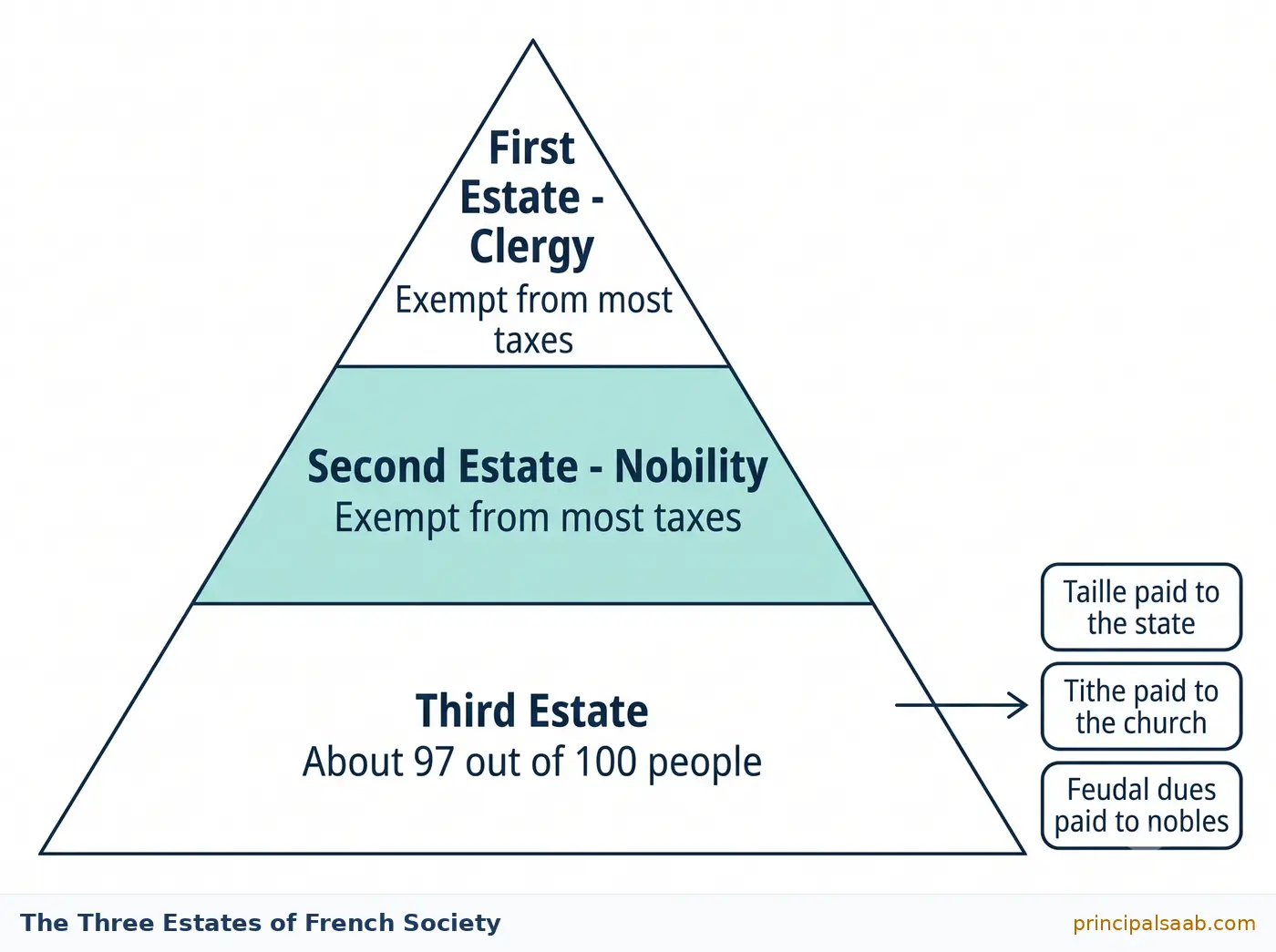
Here is the analogy I want you to carry for the rest of the chapter. Imagine a household of three people. Two of them sit at the table and eat. The third person cooks the meal, serves it, cleans up afterwards, and then goes out and earns the money to buy next week’s groceries. Nobody in the household thinks this is strange, because it has always been done this way. That third person is the third estate, and they were roughly ninety-seven out of every hundred people in France.
Now be careful, because this is where students lose easy marks. The third estate was not simply “the poor”. It contained enormously wealthy merchants, ship owners, lawyers, doctors and court officials as well as small peasants, landless labourers and servants. What united them was not poverty. It was the absence of privilege. A rich Paris merchant and a starving farm labourer had almost nothing in common except this: neither of them was exempt from tax, and neither of them could rise to the top of the army, the church or the state, no matter how able they were.
What exactly did the third estate pay? Several things, and it helps to keep them separate in your mind. There was the taille, a direct tax paid to the state. There were a number of indirect taxes on everyday goods, including salt and tobacco. There was the tithe, a religious tax collected by the church, amounting to roughly one-tenth of agricultural produce. And peasants who lived on a noble’s land owed him feudal dues as well — unpaid labour in his fields and in his house, and obligations to use his mill or his winepress. Nobles also collected rents from tenants on their estates.
Model answer: The tithe was a tax collected by the church from peasants, equal to about one-tenth of their agricultural produce.
Why this answer scores: a definition needs three elements — who collected it, from whom, and how much. Miss any one and an examiner can fairly cut the mark. “A tax paid to the church” alone is incomplete.
Model answer:
(i) French society was divided into three estates, of which the clergy and the nobility enjoyed privileges by birth, the most important being exemption from paying taxes to the state. (1)
(ii) The third estate, which formed the overwhelming majority of the population, therefore carried the state’s tax burden. Its members paid the taille, a direct tax, along with a number of indirect taxes on articles of daily use such as salt and tobacco. (1)
(iii) In addition, peasants of the third estate paid the tithe to the church and were obliged to render feudal dues and unpaid labour to the nobles on whose estates they lived, so that they were paying three separate masters out of one harvest. (1)
Why this answer scores: the question quotes a statement, so the answer must justify that statement rather than simply describe society. Each point moves the argument forward: who was exempt, what the third estate paid the state, and what it paid on top of that. The closing image — three masters, one harvest — is the kind of sentence an examiner remembers.
Q1 (1 mark). Whom does the bent figure represent?
A. The third estate, particularly the peasantry.
Q2 (1 mark). What do the two men riding on his back stand for?
A. The first estate, the clergy, and the second estate, the nobility.
Q3 (2 marks). What message is the artist conveying?
A. The artist is showing that the privileged estates lived off the labour of the third estate without contributing to it. The peasant is bent and aged, which suggests exhaustion, while the two riders are comfortable and well fed, which suggests they bear no share of the effort. The animals damaging the crop reinforce the point that even what little the peasant produced was eaten away by others through dues and taxes.
How to handle any picture question: work in this order — first say plainly what you can see, then say what each thing stands for, and only then say what the artist wants you to feel. Students who jump straight to the message lose marks because they never showed they read the image. And always use at least two details from the picture as evidence.
The Struggle to Survive: Bread, Babies and a Subsistence Crisis
Now we add the second pressure, and this one is simpler than it sounds. France’s population grew substantially over the eighteenth century. More people means more mouths, and more mouths means more demand for grain. But the amount of grain being produced did not rise at anything like the same speed, because farming methods had barely changed. When demand climbs and supply stays flat, the price goes up. That is the whole mechanism.
Why does grain matter so much? Because bread was not one item in a varied diet. For most working families it was the diet. A labourer might spend an enormous share of his daily wage on bread alone. So when the price of a loaf doubled, it was not an inconvenience. It was the difference between eating and not eating.
Meanwhile wages did not keep pace. Employers raised pay far more slowly than prices rose, so the gap between what a worker earned and what a worker needed widened year after year. Then add bad harvests, caused by drought or hail wrecking the crop, and the gap becomes a chasm. This situation — when the basic means of survival is beyond ordinary people’s reach — is what historians call a subsistence crisis, and France went through several of them in these decades.
Model answer: A subsistence crisis is a situation in which the basic means of livelihood, especially food, becomes so scarce or so expensive that a large part of the population is unable to meet its minimum needs for survival.
Why this answer scores: the phrase “basic means of livelihood” and the idea of “minimum needs” together define the term precisely. Simply saying “when there is no food” would be too loose — food existed, but it had moved out of reach.
Model answer:
(i) Rising population. The population of France increased considerably during the eighteenth century, which sharply raised the demand for foodgrains. (1)
(ii) Stagnant production. Grain production did not increase at the same rate, since agricultural methods remained largely unchanged, so supply could not match demand. (1)
(iii) Rising bread prices. As a result the price of bread, the staple food of the majority, rose rapidly and stayed high. (1)
(iv) Wages lagging behind. Wages paid to workers by employers did not rise in proportion to prices, so the real purchasing power of ordinary families steadily fell. (1)
(v) Bad harvests. Whenever drought or hail damaged the harvest, the shortage became acute, prices soared further, and the poorest sections faced hunger, weakness and disease. Such crises occurred repeatedly and created deep and lasting anger among the common people. (1)
Why this answer scores: five marks, five clearly separated causes, each with a bold heading so the examiner can find them instantly. The last point does double duty by adding the consequence — anger — which links this section to the revolution itself. When a five-mark question says “describe the circumstances”, it is asking for a sequence, so keep your points in the order in which they actually happened.
A Growing Middle Class Envisages an End to Privileges
Hunger alone produces riots. Riots on their own do not produce revolutions, because a hungry crowd wants bread today, not a new constitution. What turns anger into a revolution is an idea about what should replace the old arrangement. In France, that idea came from a group that had been quietly growing in size and confidence: the middle class.
Eighteenth-century France saw the rise of merchants, manufacturers, ship owners, lawyers, teachers, administrators and doctors. They earned their wealth and their position through trade and education rather than through birth, and precisely because of that they found the whole logic of privilege absurd. Why should a man’s rights depend on the family he happened to be born into rather than on what he could do?
Three thinkers matter most for your exam, and you should be able to attach each name to a single core idea and a single famous work.
| Thinker | Key work | Core idea in one line |
|---|---|---|
| John Locke | Two Treatises of Government | Rejected the notion that a king rules by a divine and absolute right; government exists by the consent of the governed. |
| Jean-Jacques Rousseau | The Social Contract | Government should rest on a contract freely entered into between the people and their representatives. |
| Montesquieu | The Spirit of the Laws | Power should be divided among the legislative, executive and judicial branches so that no one holder of power can dominate. |
These ideas did not stay inside expensive books. They were discussed in salons and coffee houses, printed in pamphlets, and read aloud to groups that included people who could not read for themselves. And there was a live example everyone could point to: the United States had just formed itself as a republic with a written constitution guaranteeing individual rights. Educated French people who had seen this happen could no longer be told that monarchy was the only possible arrangement.
Model answer:
(i) John Locke, in Two Treatises of Government, argued against the theory of the divine and absolute right of monarchs, holding that political authority rests on the consent of the people. (1)
(ii) Jean-Jacques Rousseau, in The Social Contract, proposed a form of government founded on an agreement between the people and their representatives rather than on inherited authority. (1)
(iii) Montesquieu, in The Spirit of the Laws, argued for the division of power within government between the legislative, executive and judicial organs, so that authority would be restrained. (1)
Why this answer scores: each point carries name, work and idea. Many students name the thinkers and stop, which cannot earn full marks because the question asks about their contribution. Underline or bold the names; it takes a second and makes the structure unmissable.
Model answer: I agree with this statement, for the following reasons.
(i) The immediate pressures on French society were material rather than intellectual: an empty treasury, heavy taxation of the third estate, rising bread prices and repeated subsistence crises. These created widespread distress and anger. (1)
(ii) However, distress by itself usually produces riots that die down once food becomes available again. Earlier food riots in France had not overturned the political order. (1)
(iii) The writings of thinkers such as Locke, Rousseau and Montesquieu supplied something distress could not: a clear alternative vision of society founded on natural rights, consent and the division of power. (1)
(iv) These ideas circulated widely through books, pamphlets, salons and coffee houses, and were read aloud to those who could not read, so they reached far beyond the educated elite. The example of the American republic showed that such a vision was practicable. (1)
(v) Therefore the material crisis provided the anger and the urgency, while the new ideas provided the direction and the justification. Both were necessary; neither on its own would have been sufficient. (1)
Why this answer scores: this is an evaluation question, and evaluation questions want a position, evidence for both halves of the claim, and a conclusion that resolves them. Point (ii) is the one that lifts this from good to excellent, because it shows you understand why ideas were necessary rather than merely asserting that they were.
The Outbreak of the Revolution
Everything we have built so far now collides in a single year. Take it slowly, because the sequence of 1789 is the single most examined stretch of this chapter, and the events happen in a strict order that makes sense once you see the logic.
Step one: the king needs money and has run out of options. Louis XVI could not simply impose a new tax by decree. To raise new taxes he had to summon an ancient assembly of representatives of the three estates called the Estates General. It had not been called for well over a century. In May 1789 he convened it at Versailles.
Step two: an argument about voting. Traditionally each estate voted as a single block, one vote per estate. Work out what that means: the first and second estates could always outvote the third, two to one, no matter how many people the third estate actually represented. Representatives of the third estate demanded that voting be conducted by head, with every member having one vote — an idea drawn straight from the principle that authority rests on the people. The king refused.
Step three: the Tennis Court Oath, 20 June 1789. Refused their demand, third-estate representatives walked out and declared themselves a National Assembly, claiming to speak for the nation rather than for one estate. Finding their usual hall closed to them, they assembled in an indoor tennis court and swore not to disperse until they had drafted a constitution for France that would limit the powers of the monarch. Some sympathetic members of the clergy and nobility joined them.
Step four: the storming of the Bastille, 14 July 1789. While the representatives argued at Versailles, Paris was tense. Bread prices were high, bakeries were mobbed, and rumours spread that the king was gathering troops to crush the Assembly by force. Crowds gathered, searching for weapons and gunpowder. They turned to the Bastille, a fortress-prison that stood as a visible symbol of the king’s arbitrary authority. They stormed it, killed its commander, released the handful of prisoners inside, and began pulling the building down.
Step five: the Great Fear in the countryside. News of Paris spread to the villages, where peasants had their own grievances and their own rumours — that bands of armed men were coming to destroy the ripening crops. In many regions peasants attacked the chateaux, the country houses of the nobles. They looted stored grain and, most tellingly, burned the manuscripts recording feudal dues. Think about that choice for a moment: they destroyed the paperwork. They were not simply stealing; they were erasing the legal record of their obligations.
Step six: privileges abolished, August 1789. Faced with revolt in the countryside and unable to rely on the army, the nobility gave way. On the night of 4 August 1789 the Assembly passed a decree abolishing the feudal system of obligations and dues. Members of the clergy were obliged to surrender their privileges, tithes were abolished, and lands owned by the church were confiscated by the state. In a single night, the legal structure of the old order was dismantled.
Model answer: He summoned it because the French state was deep in debt and he needed its approval to impose new taxes, which he could not levy on his own authority.
Why this answer scores: the question is “why”, so the answer must give a reason, not a description. The crucial half of the sentence is the second one — that he lacked the power to tax without consent. That is what forced his hand.
Model answer:
(i) Louis XVI convened the Estates General at Versailles in May 1789 in order to obtain approval for new taxes, and representatives of all three estates assembled there. (1)
(ii) A dispute arose over the method of voting. By established practice each estate cast a single collective vote, which allowed the first two estates to outvote the third. Representatives of the third estate demanded voting by head, giving one vote to each member, but the king rejected this demand. (1)
(iii) The representatives of the third estate thereupon walked out in protest and, on 20 June 1789, assembled in an indoor tennis court at Versailles. Declaring themselves a National Assembly, they took an oath not to disband until they had drafted a constitution that would limit the powers of the monarch. (1)
Why this answer scores: a “describe the events that led to” question is asking for a chain of cause and effect, so each point must be caused by the one before it. Notice the linking words — “A dispute arose”, “thereupon” — which make the causation visible rather than leaving the examiner to infer it.
Model answer:
(i) The Estates General and the voting dispute. Summoned in May 1789 to approve new taxes, the assembly divided over whether voting should be by estate or by head, and the king’s refusal of the third estate’s demand made compromise impossible. (1)
(ii) The Tennis Court Oath. On 20 June 1789 the third-estate representatives declared themselves a National Assembly and swore not to disperse until they had framed a constitution limiting royal power. This was an open challenge to the king’s authority. (1)
(iii) The storming of the Bastille. On 14 July 1789, amid high bread prices and rumours that troops would be used against the Assembly, an agitated Paris crowd searching for arms attacked and demolished the Bastille, a fortress-prison that symbolised the king’s arbitrary power. (1)
(iv) The Great Fear. Rumours reached the countryside that hired men were being sent to destroy the crops. Peasants attacked chateaux, seized stored grain and burned the documents recording feudal dues, so that revolt spread far beyond Paris. (1)
(v) The abolition of privileges. Unable to control the situation, the Assembly on the night of 4 August 1789 abolished feudal obligations and dues. The clergy surrendered their privileges, tithes were abolished and church lands were confiscated, dismantling the legal basis of the old order. (1)
Why this answer scores: five events, five marks, in strict chronological order, and every point names its date or month. The final sentence of each point explains why the event mattered, which is what separates a five-mark answer from a list. If you are short of time in an exam, write the five bold headings first — you will secure the structure even if you cannot finish every explanation.
France Becomes a Constitutional Monarchy
Notice what has and has not happened. The king is still king. What has changed is that he is no longer the source of all authority. The National Assembly completed a constitution in 1791 whose central purpose was to limit the powers of the monarch. Instead of being concentrated in one pair of hands, power was separated and distributed among the legislature, the executive and the judiciary — which is Montesquieu’s idea taken directly off the page and built into a state.
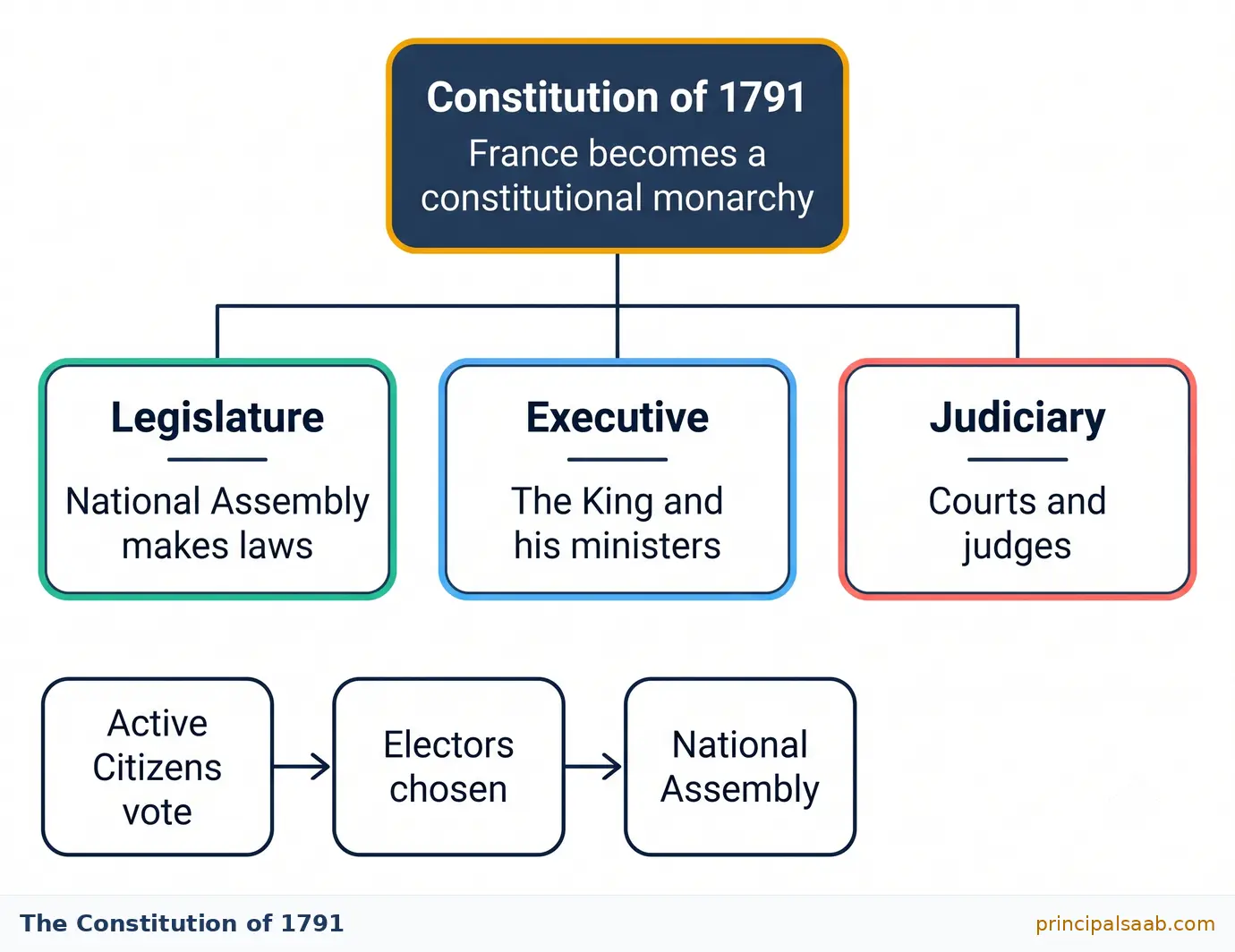
France was now a constitutional monarchy: a monarchy in which the ruler’s powers are defined and restricted by a constitution. Laws were to be made by a National Assembly, which was chosen indirectly. Citizens voted for a group of electors, who in turn chose the members of the Assembly.
And here comes the twist that makes this section genuinely interesting rather than merely procedural. Not every citizen could vote. The constitution divided citizens into two categories. Active citizens were men above a certain age who paid taxes equal to at least three days of a labourer’s wage; these men were entitled to vote. Everyone else — men who paid less, and all women regardless of what they paid or owned — were classed as passive citizens, entitled to the protection of the law but not to a vote. To qualify as an elector, or to stand for the Assembly, a man had to belong to the highest bracket of taxpayers.
The constitution began with a Declaration of the Rights of Man and Citizen. This is the document that carries the revolution’s philosophy in its clearest form. Certain rights were established as natural and inalienable — belonging to every human being by birth and incapable of being taken away. These included the right to life, freedom of speech, freedom of opinion, and equality before the law. It was the duty of the state to protect each citizen’s natural rights.
Model answer: Passive citizens were those who did not meet the property and tax qualification laid down by the constitution, together with all women. They were entitled to the protection of the law but were denied the right to vote.
Why this answer scores: it names the criterion, explicitly includes women, and states the consequence. A bare “those who could not vote” is circular and earns little.
Model answer:
(i) The constitution ended the monarch’s position as the sole source of authority by separating powers and vesting them in the legislature, the executive and the judiciary, so that no single organ could exercise unchecked control. (1)
(ii) The power to make laws was transferred to a National Assembly, which was chosen indirectly by an electorate rather than appointed by the king. (1)
(iii) The constitution opened with a Declaration of the Rights of Man and Citizen, which established rights such as equality before the law and freedom of speech as natural and inalienable, and made their protection a duty of the state, thereby placing the king himself under the law. (1)
Why this answer scores: point (iii) is the one most students omit, and it is the strongest. Any answer can say power was divided; a strong answer explains that the king became subject to a law he had not made.
Q1 (1 mark). Identify the document shown on the tablet.
A. The Declaration of the Rights of Man and Citizen.
Q2 (2 marks). Explain the meaning of any two symbols in the image.
A. The broken chain stands for the ending of enslavement and of arbitrary bondage, since chains were used to restrain people who had no freedom. The red cap on a staff was worn by freed enslaved persons in the ancient world and here signifies the attainment of liberty.
Q3 (1 mark). What does the radiating eye within a triangle suggest?
A. It suggests the light of reason and knowledge dispelling ignorance, reason being the guiding principle claimed by the revolutionaries.
How to score on symbol questions: never just name the symbol. Use the formula “X stands for Y, because Z” — the “because” is where the mark usually sits. And read the mark allocation: two marks for two symbols means one mark each, so give exactly two, fully explained, rather than four in a rush.
France Abolishes Monarchy and Becomes a Republic
The constitutional monarchy lasted a very short time. Louis XVI had signed the constitution, but in secret he was negotiating with the King of Prussia and with other rulers who were alarmed at events in France and anxious that the contagion should not spread to their own countries. In April 1792 the National Assembly voted to declare war against Prussia and Austria.
War changed the mood completely. Thousands of volunteers marched from the provinces to join the army, seeing this as a struggle of the people against kings everywhere. It was in this atmosphere that a patriotic song later adopted as the national anthem of France was composed by the poet Roget de L’Isle, and sung by volunteers from Marseilles as they marched into Paris.
Meanwhile, at home, the war brought hardship. Men had left for the front, so women in the towns were left to run households and earn wages, mostly through work as seamstresses, laundresses, and sellers in markets. Political clubs multiplied, and the most successful of them was the Jacobin club, named after the former convent of St Jacob in Paris where it met.
The Jacobins drew their strength from the less prosperous sections of society — small shopkeepers, artisans, shoemakers, pastry cooks, watchmakers, printers, servants and daily-wage workers. Their leader was Maximilian Robespierre. A large number of Jacobin men adopted long striped trousers of the kind worn by dock workers, in place of the knee breeches worn by fashionable society. This was a way of announcing the end of the breeches-wearing world of privilege, and these men came to be known as the sans-culottes, meaning literally “without knee breeches”.
In the summer of 1792 the Jacobins planned an insurrection of Parisians angered by shortages and high prices. On the morning of 10 August they stormed the Palace of the Tuileries, killed the king’s guards and held the king himself hostage for several hours. The Assembly then voted to imprison the royal family. Elections were held, and this time all men of twenty-one years and above, regardless of wealth, were given the right to vote. The newly elected assembly was called the Convention. On 21 September 1792 it abolished the monarchy and declared France a republic — a state in which the government is elected by the people and there is no hereditary monarch.
Louis XVI was tried by the Convention, found guilty of treason, and executed publicly on 21 January 1793. His queen, Marie Antoinette, was executed later the same year.
Model answer: The sans-culottes were the more radical supporters of the revolution, drawn largely from the poorer sections of urban society such as artisans, small shopkeepers, servants and daily-wage workers, and associated closely with the Jacobin club. (1) They were so called because they wore long striped trousers of the kind used by dock workers instead of the knee breeches worn by fashionable and privileged society; the term means “without knee breeches”, and the choice of dress was a deliberate rejection of aristocratic distinction. (1)
Why this answer scores: the question has two parts and two marks, so it needs two clearly separate halves. The final clause — that the dress was a deliberate rejection — shows understanding rather than mere translation of the word.
Model answer:
(i) The constitution proved fragile. Although Louis XVI had accepted the Constitution of 1791, he entered into secret negotiations with the King of Prussia and other European rulers, who feared that revolutionary ideas would spread to their own kingdoms. (1)
(ii) War was declared. In April 1792 the National Assembly voted to go to war against Prussia and Austria. Volunteers streamed in from the provinces, viewing the conflict as a struggle of the people against monarchs everywhere. (1)
(iii) Hardship and radicalisation at home. The war caused severe economic distress, and political clubs, above all the Jacobin club led by Maximilian Robespierre, grew rapidly among artisans, shopkeepers and wage earners who were suffering shortages and high prices. (1)
(iv) The insurrection of 10 August 1792. Jacobins led Parisians in storming the Palace of the Tuileries, killing the king’s guards and holding him hostage. The Assembly thereupon voted to imprison the royal family. (1)
(v) The Convention and the republic. Fresh elections were held in which all men of twenty-one and above could vote irrespective of property. The new assembly, the Convention, abolished the monarchy on 21 September 1792 and declared France a republic; Louis XVI was tried for treason and executed on 21 January 1793. (1)
Why this answer scores: the word “trace” demands a sequence, and this answer never breaks the chain. Point (v) also slips in the widening of the franchise, which is easy to forget and is itself a favourite one-mark question.
The Reign of Terror
This is the part of the chapter that unsettles students, and it should. A movement that began by declaring the natural rights of every human being ended up executing people in large numbers. Do not look away from that. Understanding how it happened is more valuable than any date in this chapter.
The period from 1793 to 1794 is referred to as the Reign of Terror. Robespierre followed a policy of severe control and punishment. Anyone he saw as an enemy of the republic — ex-nobles and clergy, members of other political parties, and even members of his own party who disagreed with his methods — was arrested, tried by a revolutionary tribunal, and if found guilty, guillotined. The guillotine was a device with two poles and a blade used to behead a person, named after Dr Guillotin who invented it.
Robespierre’s government also issued laws placing a maximum ceiling on wages and on prices. Meat and bread were rationed. Peasants were forced to transport their grain to the cities and to sell it at prices fixed by the government. The use of more expensive white flour was forbidden; all citizens were required to eat a coarser wholewheat loaf, styled the loaf of equality. Even forms of address changed: the older polite terms were replaced by the words for citizen, addressed to everyone. Churches were shut down and their buildings converted into barracks or offices.
Robespierre pursued his policies so relentlessly that even his own supporters began to demand moderation. He was convicted by a court in July 1794, arrested, and on the following day sent to the guillotine.
Model answer:
(i) Robespierre’s government followed a policy of severe control and punishment in which all those regarded as enemies of the republic — former nobles and clergy, members of rival political groups, and even fellow Jacobins who questioned his methods — were arrested and imprisoned. (1)
(ii) Those tried by a revolutionary tribunal and found guilty were sentenced to death by the guillotine, and large numbers were executed in this way. (1)
(iii) The government also imposed harsh controls on daily life, fixing maximum wages and prices, rationing meat and bread, compelling peasants to sell grain in the cities at fixed rates, and closing churches, so that fear and compulsion pervaded ordinary existence. (1)
Why this answer scores: the answer explains the name. Point (i) covers who was targeted, (ii) covers what happened to them, and (iii) shows that terror extended past executions into everyday life. Many students write only about the guillotine and cap themselves at two marks.
Model answer:
(i) Robespierre justified his measures as necessary to defend the republic against internal and external enemies at a time when France was at war and faced severe shortages. (1)
(ii) However, he defined enmity so broadly that former nobles, clergy, rival political groups and finally members of his own Jacobin party were all treated as traitors, which meant that no one felt secure. (1)
(iii) His economic controls, including maximum prices, rationing and compulsory sale of grain at fixed rates, caused resentment among peasants and traders whose livelihoods were restricted. (1)
(iv) Restrictions on religion and on customary forms of social life alienated many ordinary people who had earlier supported the revolution. (1)
(v) Because opposition could not be expressed safely, it accumulated silently until even his supporters concluded that only his removal would restore moderation. He was convicted by a court in July 1794 and guillotined, and the phase of Jacobin rule ended with him. The statement is therefore justified. (1)
Why this answer scores: “Examine this statement” asks you to test a claim, so the answer opens fairly by giving Robespierre’s own justification before showing why it failed. Examiners reward that fairness. The closing sentence returns explicitly to the statement and delivers a verdict — never leave an evaluation question without one.
A Directory Rules France
With Robespierre gone, the wealthier middle classes took control again. A new constitution was introduced which denied the vote to property-less sections of society. It provided for two elected legislative councils, which then appointed an executive made up of five members, called the Directory. The intention was sensible: after the experience of one man wielding enormous power, the framers deliberately spread executive authority across five people so that no individual could dominate as Robespierre had.
The intention was sensible; the result was not. The directors frequently quarrelled with the legislative councils, who then sought to dismiss them. Political instability became chronic. And instability of that kind creates an opening — because a country exhausted by chaos will often welcome anyone who promises order, even at the cost of liberty. That opening was filled by a military commander, and his name closes this chapter.
Model answer:
(i) Executive authority was divided among five directors, an arrangement adopted deliberately to prevent the concentration of power that had occurred under Robespierre, but which made decisive and united action difficult. (1)
(ii) The directors were appointed by two elected legislative councils, and the two branches frequently came into conflict, with the councils attempting to dismiss directors who opposed them. (1)
(iii) The resulting political instability left the government weak and discredited, and created conditions in which people were prepared to accept the authority of a strong military leader, opening the way for Napoleon Bonaparte. (1)
Why this answer scores: point (iii) does something the question did not literally ask for but every good answer supplies — it says what the failure led to. Linking a section to what follows it shows the examiner you understand the period as a story rather than as separate topics.
Did Women Have a Revolution?
The title of this section is a question, and that is deliberate. It is one of the best questions in the whole of Class 9 history, because the honest answer is “partly, and then it was taken away again”.
Start with the everyday reality. Women of the third estate had to work for a living. They sold flowers, fruit and vegetables in markets, worked as domestic servants in the houses of prosperous people, or worked as laundresses and seamstresses. Most girls of working families had no access to education, and only daughters of richer households could study at a convent, after which their families arranged their marriages. Working women had to look after their families as well — cooking, fetching water, queuing for bread, caring for children — and their wages were lower than those of men.
To voice their interests, women started their own political clubs and newspapers. A large number of such clubs came up in French cities, and one of the best known was the Society of Revolutionary and Republican Women. Their central demand was that women should enjoy the same political rights as men. They were deeply disappointed that the Constitution of 1791 reduced them to passive citizens, and they demanded the right to vote, to be elected to the Assembly, and to hold political office.
The most famous individual voice was Olympe de Gouges, who objected to the Declaration of the Rights of Man and Citizen on the ground that it left women out of the very rights it declared universal. In 1791 she wrote a Declaration of the Rights of Woman and Female Citizen, addressed to the queen and to the members of the National Assembly, demanding that women be recognised as equal in rights. She later criticised the Jacobin government, was accused of treason, and was executed.
What they did not gain: political rights. During the Terror the government ordered women’s clubs closed and their political activities banned, and a number of prominent women were arrested and executed.
Both halves of this box belong in any five-mark answer on women and the revolution. An answer that gives only the gains is incomplete; an answer that gives only the losses is equally incomplete.
Model answer:
(i) Olympe de Gouges was a politically active woman in revolutionary France who campaigned for the recognition of women as full citizens. (1)
(ii) She objected to the Constitution of 1791 and to the Declaration of the Rights of Man and Citizen because they excluded women from the rights they proclaimed to be natural and universal, and in 1791 she wrote a Declaration of the Rights of Woman and Female Citizen demanding equal rights for women. (1)
(iii) She subsequently criticised the Jacobin government for forcibly closing women’s clubs, was accused of treason, and was executed. She is remembered as one of the earliest and clearest voices for women’s political equality. (1)
Why this answer scores: the question has two limbs — who she was and why she is remembered — and the answer addresses both. Notice that (ii) explains the reasoning behind her objection rather than merely naming her document. That reasoning is the mark.
Model answer: The statement is largely accurate, as the following points show.
(i) Real social gains were made. Schooling was made compulsory for girls, so that education ceased to be the privilege of daughters of wealthy families alone. (1)
(ii) Gains within the family. Fathers were no longer permitted to compel their daughters into marriage. Marriage was made a civil contract registered under civil law, and divorce was legalised and could be sought by either the wife or the husband. (1)
(iii) Gains in work. Women could now train for jobs, work as artists, and run small businesses, which widened their economic independence. (1)
(iv) Political rights withheld. The Constitution of 1791 classified women as passive citizens, denying them the vote and the right to hold office, despite the Declaration proclaiming rights to be natural and universal. Women’s clubs demanded political equality but did not obtain it. (1)
(v) Active repression followed. During the Reign of Terror the government ordered women’s clubs closed and banned their political activities, and prominent women including Olympe de Gouges were arrested and executed. Political equality for women in France came only in the twentieth century. Therefore the revolution improved women’s social and legal position while leaving them politically unequal. (1)
Why this answer scores: the structure mirrors the statement itself — three points for “changed the lives”, two for “did not make them equal”, and a closing sentence that resolves the tension. When a question contains the word “but”, let that “but” organise your answer, and the examiner will find every mark without hunting.
The Abolition of Slavery
Here is the second place where the revolution’s promise ran into its own limits, and it is a harder story still.
French colonies in the Caribbean supplied Europe with tobacco, indigo, sugar and coffee. There was a shortage of labour on the plantations, and this was met through what is called the triangular slave trade. Understand it as a triangle with three legs. French merchants sailed from ports such as Bordeaux or Nantes to the African coast, where they bought enslaved men and women from local dealers. The enslaved people were branded, shackled, and packed tightly into ships for a voyage across the Atlantic lasting several months. In the Caribbean they were sold to plantation owners. The ships then returned to France carrying sugar, coffee and other produce. The exploitation of enslaved labour made it possible for European cities to meet a growing demand for these goods, and port towns in France grew prosperous on this trade.
Now the uncomfortable part. Throughout the eighteenth century there was little criticism of slavery in France. The National Assembly held long debates about whether the rights of man should be extended to all French subjects including those in the colonies, but it did not pass any laws abolishing slavery, fearing opposition from businessmen whose income depended on the trade. It was the Convention, in 1794, that legislated to free all enslaved people in French overseas possessions. This lasted only a short time. Ten years later, Napoleon reintroduced slavery. Plantation owners understood their freedom as including the freedom to enslave others in pursuit of profit. Slavery was finally abolished in French colonies in 1848.
Model answer:
(i) The trade began in French ports such as Bordeaux and Nantes, from which ships sailed to the coast of Africa carrying goods, where merchants bought enslaved men and women from local dealers. (1)
(ii) The enslaved people were branded, shackled and packed into ships for the Atlantic crossing to the Caribbean, a voyage of several months made in extremely harsh conditions, at the end of which they were sold to plantation owners. (1)
(iii) The ships then returned to France carrying sugar, coffee, indigo and tobacco produced on the plantations, thus completing a triangle between Europe, Africa and the Caribbean and bringing prosperity to French port towns. (1)
Why this answer scores: three legs, three marks. The word “triangular” is in the question, so the answer must make the triangle explicit — naming all three continents in the final point does exactly that.
Model answer:
(i) The starting position. Slave labour sustained the plantation economy of the French Caribbean colonies, which supplied Europe with sugar, coffee, indigo and tobacco, and French port towns prospered from the triangular trade. (1)
(ii) Little criticism at first. Through most of the eighteenth century there was hardly any organised criticism of slavery in France, and the practice was widely accepted as ordinary commerce. (1)
(iii) Debate without action. The National Assembly debated at length whether the rights of man extended to all French subjects, including those in the colonies, but passed no abolition law, since it feared opposition from businessmen whose wealth rested on the trade. (1)
(iv) Abolition by the Convention. In 1794 the Convention legislated to free all enslaved people in French overseas possessions, which represented the revolutionary principle of equality being applied beyond Europe. (1)
(v) Reversal and final abolition. The measure was short-lived, since Napoleon reintroduced slavery, plantation owners regarding their own liberty as including the freedom to enslave others for profit. Slavery was finally abolished in the French colonies in 1848. The revolution’s record was therefore one of a principle proclaimed, briefly applied, and then abandoned for more than four decades. (1)
Why this answer scores: “examine the record” invites judgement, and the last sentence delivers one in a single balanced line. Point (iii) is the sophisticated one, because it explains why the Assembly hesitated. Whenever you can explain a hesitation or a delay rather than simply reporting it, you are writing at the top band.
The Revolution and Everyday Life
Revolutions are usually described through parliaments and battles, but they are felt in ordinary habits. This short section is easy to overlook and it produces a very reliable three-mark question, so give it five honest minutes.
Before 1789, all written material and cultural activity — books, newspapers, plays — could be published or performed only after approval by the censors of the king. Once the Declaration of the Rights of Man and Citizen established freedom of speech and expression as a natural right, censorship was abolished. The effect was immediate and visible on the streets.
Newspapers, pamphlets, books and printed pictures flooded the towns, travelled quickly into the countryside, and described and discussed the events of the day. Because many people could not read, printed images mattered enormously; and plays, songs and festive processions carried the ideas further still, to those who could not read at all. Freedom of the press also meant that opposing views could circulate, so people became used to reading two accounts of the same event and judging between them.
Model answer:
(i) Before 1789 all books, newspapers and plays required the approval of the king’s censors before they could be published or performed; the Declaration of the Rights of Man and Citizen made freedom of speech and expression a natural right, and censorship was therefore abolished. (1)
(ii) Newspapers, pamphlets, books and printed pictures appeared in large numbers in the towns and spread rapidly into the countryside, describing and debating the events of the day, so that public affairs became a matter of common discussion. (1)
(iii) Since many people could not read, printed images, plays, songs and festive processions carried revolutionary ideas to them as well, and because opposing views could now be printed freely, people grew accustomed to weighing conflicting accounts and forming their own judgement. (1)
Why this answer scores: the question says “everyday life”, so the answer must reach beyond law into how people actually spent their days. Point (iii) covers those who could not read, which is the detail most answers miss and the one that best shows you understood the section.
Napoleon, the Fall, and the Legacy of the Revolution
The instability of the Directory created a political vacuum, and Napoleon Bonaparte filled it. In 1804 he crowned himself Emperor of France. He set out to conquer neighbouring European countries, dispossessing dynasties and creating kingdoms in which he placed members of his family.
Napoleon presented himself as a moderniser of Europe, and in important respects he was. He introduced many laws, of which the best known is the civil code of 1804, usually called the Napoleonic Code. It did away with privileges based on birth, established equality before the law and secured the right to property. He simplified administrative divisions, abolished the feudal system, freed peasants from serfdom and manorial dues, removed guild restrictions in the towns, improved transport and communication systems, and introduced a uniform system of weights and measures and a common national currency — measures which merchants and small producers in particular welcomed.
But armies that arrive as liberators do not always remain popular. In many places initial enthusiasm turned to hostility as it became clear that the new administrative arrangements did not come with political freedom, and as increased taxation, censorship and forced conscription into the French armies were imposed to fight the rest of Europe. Napoleon was finally defeated at Waterloo in 1815.
So what actually survived all of this? The governments came and went, but the ideas did not. The most enduring legacy of the French Revolution was the set of ideas of liberty and democratic rights. These spread from France to the rest of Europe during the nineteenth century, where feudal systems were abolished, and they travelled far beyond Europe as well. Colonised peoples reworked the idea of freedom from bondage into movements to create sovereign nation states of their own.
India was part of this story. Ideas of liberty and democratic rights were carried into India by many, including Tipu Sultan and Raja Rammohan Roy, who were among those strongly attracted by the ideas coming out of revolutionary France. That single sentence is the bridge between this chapter and the rest of your history course, and it is worth remembering that the bridge exists.
Model answer:
(i) Legal equality. Napoleon’s civil code of 1804 removed privileges based on birth, established equality before the law and secured the right to property, which was welcomed in territories long governed by aristocratic privilege. (1)
(ii) Relief in the countryside. He abolished the feudal system and freed peasants from serfdom and manorial dues, ending obligations that had bound rural populations for centuries. (1)
(iii) Benefits to trade. In the towns he removed guild restrictions, improved transport and communications, and introduced uniform weights and measures and a common national currency, all of which assisted merchants and small producers. (1)
(iv) The disappointment. It became apparent, however, that administrative reform did not bring political liberty, and that the new system replaced old masters with a foreign one. (1)
(v) Grievances that turned opinion. Increased taxation, censorship of the press and forced conscription into the French armies to fight campaigns across Europe made his rule burdensome, so that early enthusiasm gave way to hostility. He was defeated at Waterloo in 1815. (1)
Why this answer scores: the statement has two halves and the answer gives three marks to the first and two to the second, tracking the marks available. Point (iv) is the hinge sentence that explains the change in perception rather than merely listing good things and then bad things.
Model answer:
(i) The central legacy was a set of ideas. The most enduring contribution of the revolution was the idea of liberty and of democratic rights belonging to people by nature rather than by grant of a ruler. (1)
(ii) The end of privilege as a principle. The revolution established that political authority should rest on the consent of the people and that legal equality should replace privilege based on birth, and these principles spread through Europe during the nineteenth century, where feudal systems were abolished. (1)
(iii) A vocabulary for later movements. The Declaration of the Rights of Man and Citizen provided a language of natural and inalienable rights which reformers and revolutionaries in many countries afterwards used to frame their own demands. (1)
(iv) Influence on colonised peoples. Colonised societies reworked the idea of freedom from bondage into movements to create sovereign nation states of their own, so the revolution’s significance extended well beyond Europe. (1)
(v) Influence in India. Ideas of liberty and democratic rights reached India through figures such as Tipu Sultan and Raja Rammohan Roy, who were strongly attracted by them. At the same time the revolution’s limits must be acknowledged, since women were denied political rights and slavery was restored after a brief abolition, so its promise was realised only gradually. (1)
Why this answer scores: the word “assess” requires you to weigh, not just celebrate. Four points establish the legacy and the final clause introduces the qualification. That last honest sentence is what pushes an answer from good into excellent, and it costs you one line.
Timeline, Comparison Tables and Glossary
Use this section for revision, not for first learning. Come here after you have read the story once, and you will find these tables act as hooks rather than as a fresh pile of information.
| Date | Event | Why it matters in one line |
|---|---|---|
| 1774 | Louis XVI ascends the throne | He inherits an empty treasury and adds to the debt. |
| May 1789 | Estates General convened at Versailles | The king needs consent to tax; the voting dispute begins. |
| 20 June 1789 | Tennis Court Oath | The third estate declares itself a National Assembly and vows to write a constitution. |
| 14 July 1789 | Storming of the Bastille | The symbol of arbitrary royal power falls; the crisis reaches the streets. |
| Summer 1789 | The Great Fear | Peasants attack chateaux and burn the records of feudal dues. |
| 4 August 1789 | Feudal privileges abolished | Tithes end and church lands are confiscated; the old legal order collapses. |
| August 1789 | Declaration of the Rights of Man and Citizen | Rights are declared natural and inalienable. |
| 1791 | Constitution completed | France becomes a constitutional monarchy; active and passive citizens are created. |
| April 1792 | War declared on Prussia and Austria | The revolution radicalises; hardship deepens at home. |
| 10 August 1792 | Storming of the Tuileries | The royal family is imprisoned; universal male suffrage follows. |
| 21 September 1792 | Monarchy abolished; France declared a republic | The Convention ends hereditary rule. |
| 21 January 1793 | Execution of Louis XVI | A reigning king is tried and executed by his own people. |
| 1793–1794 | The Reign of Terror | Severe control and punishment under Robespierre. |
| 1794 | Convention abolishes slavery in French colonies | Equality is extended overseas, but only briefly. |
| July 1794 | Robespierre convicted and guillotined | The Terror ends; the wealthier middle classes regain control. |
| After 1794 | The Directory rules France | Five-member executive; chronic instability. |
| 1804 | Napoleon crowned Emperor; the civil code | Legal equality spreads; political liberty does not. |
| 1815 | Napoleon defeated at Waterloo | The revolutionary era closes; its ideas outlive it. |
| 1848 | Slavery finally abolished in French colonies | The 1794 promise is at last made permanent. |
| Feature | First Estate | Second Estate | Third Estate |
|---|---|---|---|
| Who they were | The clergy | The nobility | Everyone else: big merchants, lawyers, officials, artisans, peasants, servants, labourers |
| Share of population | A very small minority | A very small minority | The overwhelming majority, roughly ninety-seven in every hundred |
| Taxes to the state | Exempt from most taxes, including the taille | Exempt from most taxes, including the taille | Paid the taille and numerous indirect taxes on goods such as salt and tobacco |
| Other obligations | Collected the tithe | Collected feudal dues and rents; extracted unpaid labour | Paid the tithe to the church and feudal dues and unpaid labour to the nobles |
| Access to high office | Reserved positions by birth | Reserved positions by birth | Effectively closed, however able or wealthy the individual |
| Point of contrast | Active citizens (1791 Constitution) | Passive citizens (1791 Constitution) |
|---|---|---|
| Who qualified | Men above a fixed age paying taxes equal to at least three days of a labourer’s wage | Men paying less than that amount, and all women without exception |
| Right to vote | Yes, though indirectly, by choosing electors | No |
| Eligible to be an elector or member of the Assembly | Only those in the highest bracket of taxpayers | No |
| Protection of the law | Yes | Yes — this is the key point; they were citizens, but without political voice |
| Point of contrast | Jacobin rule (1793–94) | The Directory (after 1794) |
|---|---|---|
| Social base | Less prosperous sections: artisans, shopkeepers, servants, wage earners — the sans-culottes | The wealthier middle classes |
| Who could vote | All men aged twenty-one and above, regardless of property | The vote was again denied to property-less sections |
| Structure of the executive | Power concentrated around Robespierre | Five directors appointed by two elected legislative councils |
| Economic policy | Maximum wages and prices, rationing, forced sale of grain at fixed rates | Retreat from controls, favouring propertied interests |
| Chief weakness | Repression so severe that it consumed its own supporters | Constant conflict between directors and councils, producing paralysis |
| How it ended | Robespierre convicted and guillotined, July 1794 | Instability opened the way for Napoleon Bonaparte |
| Term | Meaning |
|---|---|
| Livres | The unit of currency in France, discontinued in 1794. |
| Taille | A direct tax paid to the state by members of the third estate; the first two estates were exempt. |
| Tithe | A tax levied by the church, amounting to about one-tenth of agricultural produce. |
| Chateau | A castle or stately country residence belonging to a king or a nobleman. |
| Subsistence crisis | An extreme situation in which the basic means of livelihood are endangered and large numbers cannot meet minimum needs. |
| Clergy | The group of persons invested with special functions in the church; they formed the first estate. |
| Sans-culottes | Literally “without knee breeches”; radical revolutionaries from poorer urban groups who wore long striped trousers to reject aristocratic dress. |
| Guillotine | A device consisting of two poles and a blade, used for beheading, named after its inventor Dr Guillotin. |
| Anonymity | The condition of being unknown or unnamed — the experience of living among crowds of strangers rather than in a community where everyone is known. |
| Convention | The assembly elected in 1792 by all men aged twenty-one and above, which abolished the monarchy and declared France a republic. |
| Directory | The five-member executive appointed by two elected legislative councils which governed France after the fall of Robespierre. |
Practice Worksheet
Ten questions. Please do this properly: read the question, close your eyes for a moment, write your answer on paper, and only then click to reveal. Reading a model answer without attempting one first feels productive and is almost entirely useless. You have my word that the attempt is where the learning happens, even when the attempt is bad.
Q1 (1 mark, MCQ). The Bastille was stormed by an agitated crowd in Paris on:
(a) 20 June 1789 (b) 14 July 1789 (c) 4 August 1789 (d) 21 September 1792
Show Answer
Option (a) is the Tennis Court Oath, option (c) is the night on which feudal privileges were abolished, and option (d) is the day France was declared a republic. All four are real dates from this chapter, which is exactly how a good MCQ is built — the wrong options are never nonsense, they are other correct facts placed where they do not belong. In an MCQ, always check whether the distractors are things you recognise from elsewhere in the chapter.
Q2 (1 mark). Name the tax that the third estate paid directly to the state.
Show Answer
Take one second to check you have not written “tithe”, which is the church’s levy of about one-tenth of agricultural produce. Taille to the state, tithe to the church.
Q3 (1 mark). What is a republic?
Show Answer
The two essential elements are elected and no hereditary ruler. If your answer contains only the first, it also describes a constitutional monarchy, so it cannot be full marks.
Q4 (3 marks). Why did the third estate demand voting by head rather than voting by estate at the Estates General?
Show Answer
(ii) This meant that the third estate, although it represented the overwhelming majority of the French population, had no effective say in decisions, particularly on taxation, which fell on it alone. (1)
(iii) The demand for voting by head, giving one vote to each member of the assembly, followed directly from the principle put forward by philosophers such as Rousseau that authority rests on the people, and it would have given the third estate influence in proportion to the numbers it represented. (1)
Why this scores: the third point converts a procedural complaint into a principle. Answers that only explain the arithmetic of two against one usually reach two marks and stop there.
Q5 (3 marks). Distinguish between active citizens and passive citizens under the Constitution of 1791.
Show Answer
(ii) Passive citizens were those who did not meet this property and tax qualification, together with all women irrespective of their wealth; they were entitled to the protection of the law but had no right to vote. (1)
(iii) Further, only men belonging to the highest bracket of taxpayers could serve as electors or become members of the Assembly, so political power was concentrated among the wealthiest, despite the Declaration proclaiming that rights were natural and belonged to all. (1)
Why this scores: a “distinguish between” question needs the two categories set against each other on the same criterion, which points (i) and (ii) do. Point (iii) adds the contradiction with the Declaration and lifts the answer above a mechanical comparison.
Q6 (3 marks). How did the outbreak of war in 1792 push the revolution in a more radical direction?
Show Answer
(ii) The war caused severe economic hardship, since men left for the front while shortages and high prices continued, so women were left to support households and popular anger grew sharper. (1)
(iii) In these conditions political clubs, above all the Jacobin club under Robespierre, drew large support from artisans, shopkeepers and wage earners, and it was this radicalised movement that stormed the Tuileries in August 1792 and brought about the abolition of the monarchy. (1)
Why this scores: the question asks how war radicalised the revolution, so each point must be a step in that process rather than a fact about the war.
Q7 (3 marks, source-based). Read the following and answer the questions below.
“On the night of 4 August 1789, the Assembly passed a decree abolishing the feudal system of obligations and taxes. Members of the clergy too were forced to give up their privileges. Tithes were abolished and lands owned by the Church were confiscated.”
(a) Why was the Assembly compelled to pass this decree at that particular moment? (1)
(b) Which two groups lost most by this decree? (1)
(c) What did the confiscation of church lands allow the state to do? (1)
Show Answer
(b) The nobility, who lost feudal dues, rents and unpaid labour, and the clergy, who lost their privileges and the tithe.
(c) It gave the state possession of extensive properties, providing it with assets and revenue at a time when the treasury was empty, which had been the original cause of the whole crisis.
How to handle source questions: use the words of the extract as your anchor but bring in knowledge from outside it. Part (a) is not answerable from the passage alone — it needs the Great Fear, which the source does not mention. Examiners set source questions precisely to see whether you can join the extract to the chapter.
Q8 (5 marks). Explain any five causes of the French Revolution.
Show Answer
(ii) An unjust social order. Society was divided into three estates in which the clergy and nobility enjoyed privileges by birth, including exemption from most taxes, while the third estate bore the burden. (1)
(iii) Heavy and multiple exactions. The third estate paid the taille and indirect taxes to the state, the tithe to the church, and feudal dues and unpaid labour to the nobility, leaving peasants with very little from their own produce. (1)
(iv) Subsistence crises. A rising population increased demand for grain while production stagnated, so bread prices rose faster than wages, and bad harvests repeatedly pushed the poorest into hunger and disease. (1)
(v) New ideas and a growing middle class. Merchants, lawyers and professionals who had gained wealth and education through their own effort rejected privilege by birth, and the writings of Locke, Rousseau and Montesquieu, spread through books, pamphlets, salons and coffee houses, offered an alternative based on natural rights, consent and the separation of powers. (1)
Why this scores: five distinct causes covering political, social, economic and intellectual ground. Examiners look for that spread. Five points all about money would not score five marks even if every one were accurate.
Q9 (5 marks). “The French Revolution promised more than it delivered.” Examine this statement with reference to women and to enslaved people.
Show Answer
(ii) What women did gain. Schooling was made compulsory for girls, fathers could no longer compel daughters into marriage, marriage became a civil contract, divorce was legalised for both partners, and women could train for jobs and run businesses. (1)
(iii) What women were denied. The Constitution of 1791 classed them as passive citizens without the vote or the right to hold office. Women’s clubs, and Olympe de Gouges in her Declaration of the Rights of Woman and Female Citizen, demanded political equality; during the Terror their clubs were closed, their political activity banned, and prominent women including de Gouges were executed. (1)
(iv) What enslaved people gained, briefly. After years in which the National Assembly debated but declined to act, fearing opposition from merchants who profited from the trade, the Convention in 1794 freed all enslaved people in French overseas possessions. (1)
(v) How that was reversed. Napoleon reintroduced slavery, plantation owners treating their own liberty as including the freedom to enslave others for profit, and slavery was finally abolished in French colonies only in 1848. Both cases therefore show a universal principle proclaimed but applied selectively, so the statement is justified; yet the principle itself survived and was used later to claim the rights that had been withheld. (1)
Why this scores: the answer establishes the promise first, then tests it against two separate groups, and closes with a judgement that is fair rather than dismissive. That final clause — that the principle outlived its own failures — is the difference between a competent answer and a memorable one.
Q10 (5 marks). Trace the changes in the form of government in France between 1789 and 1815, and state briefly what remained of the revolution at the end.
Show Answer
(ii) Constitutional monarchy to republic. After war with Prussia and Austria and the storming of the Tuileries in August 1792, elections were held under universal male suffrage, and the Convention abolished the monarchy on 21 September 1792 and declared France a republic; Louis XVI was executed in January 1793. (1)
(iii) Republic to Jacobin rule. From 1793 to 1794 Robespierre’s government exercised severe control, executing those deemed enemies of the republic and imposing maximum prices, rationing and other restrictions, until he was convicted and guillotined in July 1794. (1)
(iv) Jacobin rule to the Directory and then to empire. A new constitution denied the vote to property-less sections and created a five-member Directory appointed by two legislative councils. Its conflicts with those councils produced chronic instability, which opened the way for Napoleon Bonaparte, who crowned himself Emperor in 1804 and was defeated at Waterloo in 1815. (1)
(v) What remained. Although France had returned to rule by one man, the enduring legacy was the body of ideas of liberty and democratic rights. These spread across nineteenth-century Europe, where feudal systems were abolished, and reached colonised peoples who reworked the idea of freedom from bondage into movements for sovereign nation states; in India they attracted figures such as Tipu Sultan and Raja Rammohan Roy. (1)
Why this scores: the question has two commands — “trace” and “state briefly what remained” — and a full-mark answer must obey both. Students who narrate all five governments and never answer the second half routinely lose the final mark. Read every command word in the question and tick them off as you write.
That is the chapter, from an empty treasury in the 1780s to a set of ideas that outlived every government that tried to own them. If parts of it still feel loose, that is completely normal and it is not a sign of anything except that you have read it once. Go back to the section that felt shakiest and read only that one again tomorrow. Then try the two worksheet questions attached to it without looking.
And please do not try to master all of this tonight. The students who do well in history are almost never the ones who study in long panicked bursts; they are the ones who come back to it in small, steady visits. So here is the only target I want you to keep: aim for one more correct question than you managed yesterday. One. That is a rate of improvement that compounds quietly, and by the time the exam arrives you will wonder why you were ever nervous about this chapter at all.