
Take a breath before you start this one. A lot of students open this chapter, see a wall of European names — Metternich, Mazzini, Bismarck, Garibaldi — and quietly decide that history is not for them. It is not a memory test. This chapter tells one simple story stretched over about a hundred years: how ordinary people in Europe stopped thinking of themselves as the subjects of a king and started thinking of themselves as members of a nation. Once you hold on to that single thread, every name and date in the chapter becomes a bead on it, and the whole thing becomes surprisingly easy to remember. Sit with me and we will walk through it slowly, in order, from zero.
By the time you reach the end of these notes you will be able to explain what nationalism actually meant to people in the nineteenth century, describe how the French Revolution planted the idea, follow the tug-of-war between liberals and conservatives, tell the stories of German and Italian unification without mixing them up, read the female allegories such as Marianne and Germania like a code, and see clearly how a hopeful idea turned dangerous in the Balkans. You will also have twelve worked board answers and a practice worksheet with full solutions, so you can check yourself rather than just hope for the best.
- The French Revolution and the Idea of the Nation
- Liberal Nationalism and What It Meant
- Conservatism and the Treaty of Vienna, 1815
- The Revolutionaries and Their Secret Societies
- The Age of Revolutions, 1830–1848
- 1848: The Revolution of the Liberals
- The Unification of Germany
- The Unification of Italy
- The Strange Case of Britain
- Visualising the Nation: Marianne and Germania
- Nationalism and Imperialism: The Balkans
- Practice Worksheet with Answers
Your Game Plan for This Chapter
- Read the story once, quickly, without stopping to memorise. Treat it like a film. You are only trying to feel the shape of the century: revolution, crackdown, revolt, unification, and finally rivalry.
- Build a dated timeline on one sheet of paper. Fold an A4 page lengthwise, put the years down the left and the events on the right. Ten or twelve entries are enough. This single sheet does more for your marks than re-reading the chapter three times.
- Learn the key terms properly. Nationalism, liberalism, conservatism, absolutist, plebiscite, suffrage, allegory, utopian, ideology, Zollverein, feminist and Junker. Write each in one line of your own words. Board papers love a clean one-mark definition.
- Separate the two unifications in your head. Make a two-column comparison of Germany and Italy. Students lose marks every year by putting Cavour in Prussia or Bismarck in Piedmont, and a table fixes that permanently.
- Practise reading the pictures. This chapter is examined heavily through visual sources and symbols. Learn what the broken chains, the oak crown, the red cap and the tricolour each stand for.
- Answer questions from memory, then check. Use the worksheet at the end. Write your answer first, then open the solution. The gap you find is exactly what you still need to study.
Study Notes
Before the details, here is the whole century on one page. Copy this table onto a single sheet and keep it in front of you while you read the sections below. Every section that follows is simply one row of this table opened up.
| Year | Event | Why it matters |
|---|---|---|
| 1789 | The French Revolution begins | Sovereignty shifts from the monarch to the body of citizens; the modern idea of the nation is born |
| 1792–1799 | French armies move into Holland, Belgium, Switzerland and much of Italy | The revolutionary idea travels outward, sometimes as liberation and sometimes as occupation |
| 1804 | Napoleon’s Civil Code | Equality before the law and secure property rights are written down and exported across Europe |
| 1815 | Napoleon is defeated; the Vienna settlement | Conservative monarchies restore the old order and try to undo the revolution |
| 1821–1832 | Greek war of independence | The first successful nationalist revolt of the century; independence recognised in 1832 |
| 1830 | July Revolution in France; Belgian revolt | The conservative order cracks for the first time since 1815 |
| 1834 | The Zollverein customs union | Economic unity among German states runs ahead of political unity |
| 1848 | Revolutions across Europe; the Frankfurt Parliament | Liberals demand a constitution and a nation-state, and are defeated — but not erased |
| 1859–1861 | Wars and campaigns in Italy; Victor Emmanuel II proclaimed king | Italy is unified under Sardinia-Piedmont |
| 1864–1871 | Prussia’s wars with Denmark, Austria and France | Germany is unified; the German Empire is proclaimed in January 1871 |
| 1871 onwards | Nationalism narrows into aggressive rivalry | The Balkans become the flashpoint that helps trigger the First World War |
The French Revolution and the Idea of the Nation
Start by picturing France before 1789. If you had asked a farmer in the countryside who he was, he would probably have named his village, his trade or his parish. He would not have said “I am French” in the way you would say “I am Indian”. He was a subject — somebody who belonged to a king, rather like a tenant belongs to a landlord. The king was the state. Everything flowed downward from him.
The French Revolution of 1789 turned that upside down. Power was declared to belong not to one man in a palace but to the whole body of citizens taken together. That single shift — from subjects of a ruler to citizens of a nation — is the seed from which this entire chapter grows. And because an idea that big cannot survive on words alone, the revolutionaries deliberately built a set of everyday practices to make people feel French.
Think of it like a new school that has just opened. It needs a name, a uniform, a badge, a song and a common language of instruction before students start feeling that they belong to it. Revolutionary France did exactly that, on a national scale:
- New ideas of the fatherland and the citizen were put at the centre of public life, stressing that all people belonged to one community with equal rights.
- A new tricolour flag replaced the old royal banner.
- The elected assembly was renamed the National Assembly, chosen by citizens rather than granted by a king.
- Fresh hymns were written, public oaths were sworn and those who had died for the revolution were publicly honoured — ceremonies that made an abstract idea emotionally real.
- Administration was centralised so that the same rules applied everywhere, replacing a patchwork of local privileges.
- Internal customs barriers and local dues were abolished, and one uniform system of weights and measures was adopted.
- Regional dialects were discouraged, and the French of Paris was promoted as the national language.
Notice how practical most of that list is. A common currency of measurement, a single flag, one language of government: nationalism was not only felt in the heart, it was built into the plumbing of daily life.
The idea then travelled. Through the 1790s French armies moved into Holland, Belgium, Switzerland and much of Italy, and in cities across Europe educated young men from the middle classes began forming political clubs to discuss the new ideas. Napoleon Bonaparte, who came to power at the end of the 1790s, was no democrat — he ruled as an emperor and destroyed representative government in France itself. Yet in the territories he controlled he introduced reforms that were genuinely revolutionary in their effect.
His Civil Code of 1804, usually called the Napoleonic Code, did away with privileges based on birth, established equality before the law and made property rights secure. Alongside it came a whole package: simplified administrative divisions, the abolition of the feudal system, the freeing of peasants from serfdom and manorial dues, the removal of guild restrictions in the towns, and improved roads and transport. For a merchant or a small businessman, this was liberation. Standardised laws and weights meant you could trade beyond your own town without being taxed at every bridge.
So why did people in these regions eventually turn against the French? Because administrative efficiency is not the same as freedom. Increased taxation, censorship, forced conscription into French armies to fight campaigns elsewhere, and the plain fact of being ruled by foreigners outweighed the benefits. This is the honest, two-sided answer the board wants: the reforms were welcomed at first, and the occupation was resented soon after.
Question: Describe any three measures introduced by the French revolutionaries to create a sense of collective identity among the people of France.
Model answer: (i) A new tricolour flag was adopted in place of the former royal standard, giving all citizens a single visible symbol of belonging. (ii) The elected body was renamed the National Assembly and was chosen by citizens, which established the principle that authority came from the people rather than from the monarch. (iii) A uniform system of weights and measures was adopted and internal customs barriers were removed, so that the same rules of trade and measurement applied throughout the country. Fresh hymns, public oaths and the honouring of martyrs further strengthened this common feeling.
Why it earns full marks: Three distinct measures, one mark each, each stated in a full sentence with a short line explaining its effect. Do not list seven measures in seven words — three well-explained points score higher than a bare list.
Question: “Napoleon destroyed democracy in France but introduced revolutionary changes in the territories he conquered.” Examine this statement.
Model answer: The statement is largely correct, and both halves need to be examined. Napoleon ended representative government in France and set up a monarchical form of rule with himself as emperor, so in that sense democracy was destroyed. In the administrative field, however, his measures carried the revolution forward. The Civil Code of 1804 abolished all privileges based on birth, established equality before the law and secured the right to property. In the regions under French control he simplified administrative divisions, abolished the feudal system and freed peasants from serfdom and manorial dues. In the towns, restrictive guild controls were removed, transport and communication were improved, and standard laws helped businessmen and small producers. Yet the changes were not accepted for long. Higher taxes, censorship, compulsory service in the French army and the humiliation of being governed by a foreign power turned initial welcome into resistance.
Why it earns full marks: Five marks usually means about five developed points. Here you have: the loss of democracy in France, the Civil Code, the abolition of feudal obligations, the practical benefits for trade and towns, and the reasons for later resentment. Ending with the resistance shows balance, which examiners reward on “examine” questions.
Liberal Nationalism and What It Meant
Now let us slow right down, because this is the section students find slippery. The word “liberal” comes from a Latin root meaning free. But free in what sense? In the nineteenth century it carried three related meanings, and a good answer separates them cleanly.
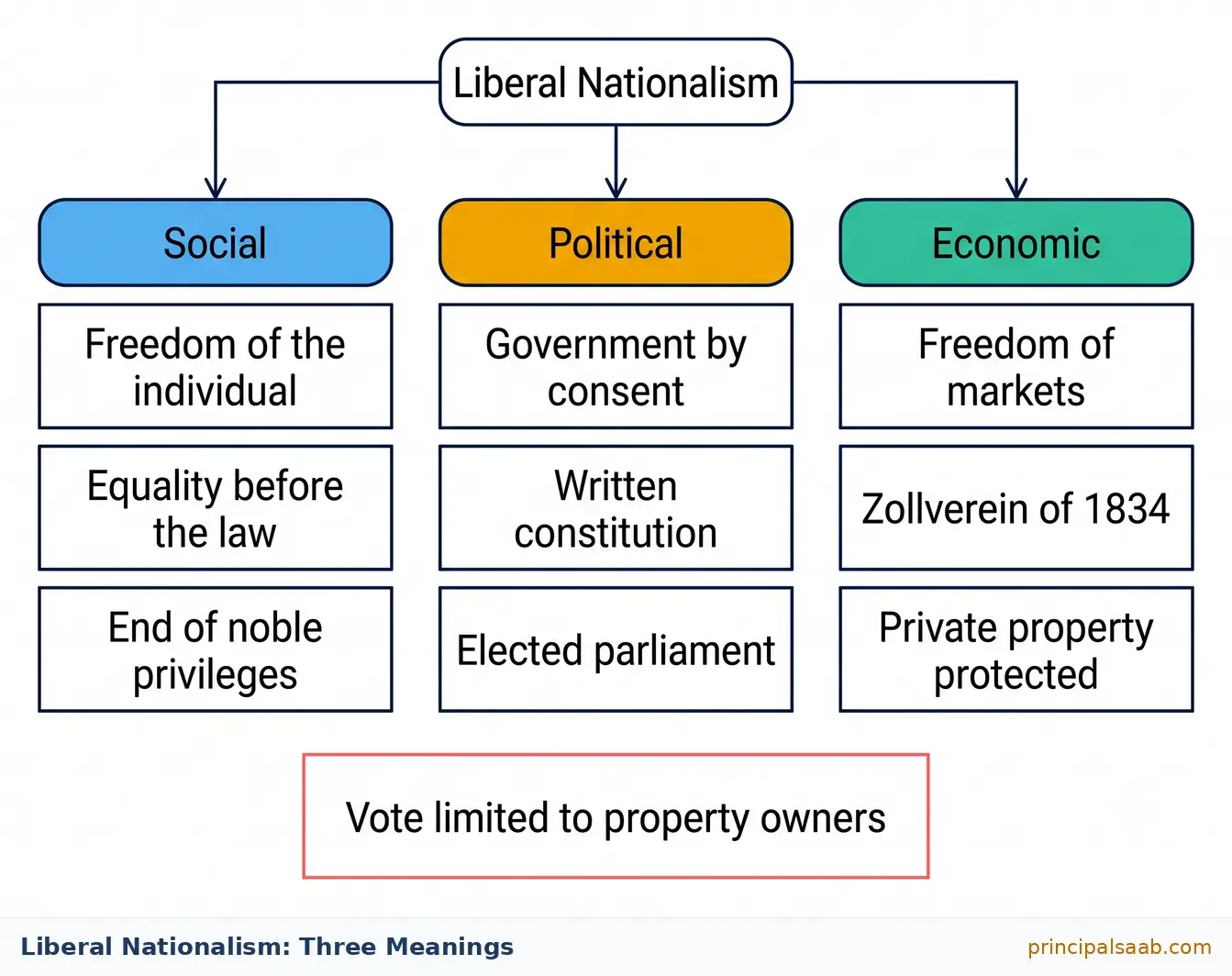
Socially, liberalism meant freedom for the individual and equality of all before the law. No more special courts or tax exemptions because your grandfather happened to be a duke.
Politically, it meant government by consent. Liberals wanted an end to autocracy and to the special privileges of the clergy, and they wanted a written constitution and a representative government working through a parliament. Note the careful wording: they wanted government by consent, not government by everybody.
Economically, it meant freedom of markets — removing the restrictions that states placed on the movement of goods and capital. Liberals also insisted strongly on the inviolability of private property, which tells you a lot about whose interests they were protecting.
Here is the point that separates a good answer from an average one. Liberal nationalism did not mean universal adult franchise. In revolutionary France the vote was limited to men who owned property. Women and men without property were excluded. Only for a brief period under the Jacobins did all adult males vote, and Napoleon’s Code went back to restricted voting rights while placing women legally under the authority of fathers and husbands. Throughout the nineteenth century and into the twentieth, women and non-propertied men had to organise their own movements to win equal political rights.
The economic side deserves a story, because it explains German unification later. Imagine sending a cart of cloth across the German lands in the 1820s. You would pass through dozens of separate states, each with its own customs post, its own tariff, its own currency and its own idea of what a pound weighed. A merchant complained, quite reasonably, that this was like being asked to pay a toll every few kilometres on the same highway.
The answer was the Zollverein, a customs union formed in 1834 on Prussia’s initiative and joined by most of the German states. It abolished tariff barriers between members and cut the number of currencies in circulation from more than thirty down to two. A growing railway network then stitched the region together physically. So decades before Germany existed as a political nation, it was already becoming one economic space. Trade created the habit of unity; politics caught up afterwards.
Question: Explain what liberal nationalism stood for in nineteenth-century Europe.
Model answer: Liberal nationalism stood for freedom of the individual and equality of all citizens before the law. In political terms it demanded an end to autocratic rule and to clerical privileges, and called for a written constitution and representative government through an elected parliament. In economic terms it demanded freedom of markets, the removal of state restrictions on the movement of goods and capital, and protection of the right to private property. It should be noted that this liberalism did not include universal adult franchise; the right to vote was generally restricted to men who owned property.
Why it earns full marks: One mark for the social meaning, one for the political meaning and one for the economic meaning. The final sentence about restricted franchise is the kind of precise qualification that lifts an answer from average to strong.
Question: What was the Zollverein?
Model answer: The Zollverein was a customs union formed in 1834 at Prussia’s initiative and joined by most German states. It abolished tariff barriers among its members and reduced the number of currencies from over thirty to two, creating a single economic zone within the German lands.
Why it earns full marks: A one-mark answer still needs three things — what it was, when and where, and what it achieved. Two clean sentences are plenty; do not write a paragraph for one mark.
Conservatism and the Treaty of Vienna, 1815
Napoleon was finally defeated in 1815. The powers that had beaten him — Britain, Russia, Prussia and Austria — met at Vienna to decide what Europe should look like next. The meeting was hosted by the Austrian Chancellor, Duke Metternich, and the arrangement it produced is usually called the Treaty of Vienna of 1815.
The mood of the victors was conservative. Conservatism here does not mean the same thing as being old-fashioned in taste. It was a serious political outlook: that the traditional institutions of state and society — monarchy, the Church, established social hierarchies, property and the family — had proved their worth over centuries and should be preserved. Most conservatives were not blindly against all change. Many of them had watched Napoleon and concluded that careful modernisation, such as an efficient bureaucracy, a modern army and a clear legal code, could actually make a monarchy stronger. What they refused to accept was the revolutionary claim that ordinary people should hold sovereign power.
The main provisions of the 1815 settlement are worth learning as a short list, because they come up again and again:
- The Bourbon dynasty, removed during the revolution, was restored to the throne of France.
- France lost the territories it had annexed under Napoleon.
- A series of states was set up along France’s borders to block any future French expansion. In the north, the Kingdom of the Netherlands was created, including Belgium; in the south, Genoa was added to Piedmont.
- Prussia was given important new territory on its western frontier, and also a part of Saxony.
- Austria was given control of northern Italy.
- Russia was given a part of Poland.
- The loose confederation of thirty-nine German states was left in place rather than being reorganised.
Read that list again with one question in mind: who gained? Prussia and Austria did, and both would matter enormously later. Prussia’s new western lands gave it the industrial heartland it would use to unify Germany. Austria’s hold on northern Italy gave Italian nationalists the enemy they would spend fifty years fighting.
Having redrawn the map, the conservative regimes then had to defend it. They were autocratic: they did not tolerate criticism or dissent, and they used censorship laws to control what appeared in newspapers, books, plays and songs. Anything that recalled the ideas of liberty and the French Revolution was suspect. This matters for the next section, because when open politics is shut down, politics does not disappear — it goes underground.
Question: Describe the main features of the Treaty of Vienna of 1815 and explain its purpose.
Model answer: After Napoleon’s defeat, representatives of Britain, Russia, Prussia and Austria met at Vienna in 1815 under the chairmanship of the Austrian Chancellor Duke Metternich to settle the affairs of Europe. Its main features were as follows. The Bourbon dynasty was restored to the throne of France and France lost the territories it had annexed under Napoleon. A ring of states was created along France’s boundaries to prevent future French expansion: the Kingdom of the Netherlands, which included Belgium, was set up in the north, and Genoa was added to Piedmont in the south. Prussia received important new territory on its western frontier as well as part of Saxony, Austria was given control of northern Italy, and Russia received a part of Poland. The loose confederation of thirty-nine German states was left undisturbed. The purpose of the settlement was to undo most of the changes brought about by the revolutionary and Napoleonic years, to restore the monarchies that had been removed, and to build a new conservative order in which no single power could dominate Europe again.
Why it earns full marks: Four marks come from four clearly separated territorial provisions, and the fifth from the concluding sentence on purpose. Whenever a question says “describe and explain”, treat it as two tasks and make sure the “explain” part gets its own sentences.
The Revolutionaries and Their Secret Societies
If you cannot hold a meeting, print a pamphlet or sing a certain song without being arrested, what do you do? You meet in cellars. That is the plain human explanation for the secret societies that spread across Europe after 1815. Many liberal-nationalists went underground, and their societies had two linked aims: to train members in revolutionary methods, and to spread the idea that every people should govern itself.
The most important of these revolutionaries for your syllabus is Giuseppe Mazzini, born in Genoa in 1807. As a young man he joined the Carbonari, a secret society active in Italy, and at the age of twenty-four he was sent into exile for taking part in an attempted rising in Liguria. He then founded two underground organisations: Young Italy, set up at Marseilles, and Young Europe, based at Berne, whose members were like-minded young people from Italy, Poland, the German states, France and Switzerland.
Mazzini’s central belief is worth stating carefully because it explains why conservative rulers found him so alarming. He argued that nations were natural units of humanity, and that Italy therefore could not stay a patchwork of small kingdoms and principalities. It had to be forged into a single unified republic. And this republic could not be the gift of a king; it had to be created by the people themselves. Since the whole conservative order of 1815 rested on small dynastic states, a movement dedicated to sweeping them away was a direct threat to it. Metternich regarded Mazzini as one of the most dangerous opponents of the social order he had built.
Question: Who was Giuseppe Mazzini? Explain his contribution to the growth of nationalism in Europe.
Model answer: Giuseppe Mazzini was an Italian revolutionary, born in Genoa in 1807, who became one of the leading figures of European nationalism. As a young man he joined the secret society of the Carbonari and was exiled at the age of twenty-four for attempting a revolution in Liguria. He founded two underground societies, Young Italy at Marseilles and Young Europe at Berne, whose members were young nationalists from several European countries. He believed that nations were the natural units of mankind, that Italy must be united into a single republic rather than remain divided into small states, and that this unity must be achieved by the people themselves and not granted by monarchs. His ideas inspired the formation of similar nationalist societies in Germany, France, Switzerland and Poland, and conservative rulers such as Metternich regarded him as a serious threat to their order.
Why it earns full marks: One mark for identifying him, one for the societies he founded, one for his ideas and their influence. Note that the question has two parts, “who” and “contribution”, and both must be answered.
The Age of Revolutions, 1830–1848
The conservative order held for about fifteen years, and then it began to crack. The first big break came in France in July 1830. The Bourbon king Charles X, restored by the Vienna settlement, was overthrown by liberal revolutionaries who installed Louis Philippe as a constitutional monarch instead. Metternich himself is said to have observed that when France sneezes, the rest of Europe catches cold — and that is more or less what happened. The July Revolution set off a rising in Brussels, and Belgium broke away from the United Kingdom of the Netherlands. Its independence was worked out and guaranteed by the European powers over the following years.
The event that most stirred educated opinion, though, was the Greek struggle. Greece had been part of the Ottoman Empire since the fifteenth century. The growth of revolutionary nationalism in Europe encouraged a war of independence which began in 1821. Greeks living in exile organised support, and something unusual happened: sympathisers across Western Europe rallied to the Greek cause. Educated Europeans admired ancient Greece as the cradle of European civilisation, and poets and artists made the struggle a romantic cause. The English poet Lord Byron went so far as to travel to Greece to help, and died there of fever in 1824. After years of fighting, the Treaty of Constantinople of 1832 recognised Greece as an independent nation.
Nationalism did not spread only through wars and parliaments. It also spread through culture, and this is where the Romantic movement comes in. Romantic artists and poets were suspicious of cold reason and science as the only guides to life. They looked instead to emotion, intuition and shared feeling, and argued that a nation is held together by a common cultural inheritance — its language, its folk tales, its songs and dances.
The German philosopher Johann Gottfried Herder argued that true German culture was to be found not in the polished world of the elite but among the common people, in their folk songs, folk poetry and folk dances. Collecting and celebrating this popular culture became a nationalist activity. Think of it this way: if the nation lives in the songs your grandmother sings, then no foreign king can confiscate it.
Poland shows what happens when this is done under occupation. Poland had been partitioned in the late eighteenth century by Russia, Prussia and Austria and had ceased to exist as an independent state. Music became a form of resistance, and the composer Karol Kurpinski turned traditional dances such as the polonaise and the mazurka into nationalist symbols. Language mattered even more. After an armed rebellion against Russian rule was crushed in 1831, Russian was imposed everywhere in the Russian-controlled area, and the Polish language was pushed out of schools and public life. Members of the clergy responded by using Polish in church services and in religious instruction. Many were punished with imprisonment or deportation to Siberia. Their language had become their weapon.
Now add the third ingredient: hunger. Ideas alone rarely bring people onto the streets; empty stomachs help. The 1830s were years of severe economic hardship across Europe. Population grew faster than employment. Job-seekers from the countryside crowded into towns where there was not enough work. Small producers of goods faced stiff competition from cheap machine-made imports, especially textiles from England. In regions where the aristocracy still held power, peasants groaned under feudal dues and obligations. Rising food prices or a bad harvest could push whole populations into poverty in a single season.
One episode captures it. In 1845, weavers in Silesia rose against the contractors who supplied them with raw material, gave them orders and paid miserably low prices for the finished cloth. A crowd of weavers marched to a contractor’s house, demanded better rates, were refused, and then forced their way in and destroyed his property. The army was called and the rising was put down with loss of life. A journalist named Wilhelm Wolff recorded the events.
Hold on to this pairing, because it is the key to 1848: educated liberals wanted constitutions, while workers and peasants wanted bread and land. When those two currents flowed together, governments trembled. When they came apart, the revolutions failed.
Question: Explain how the Greek war of independence mobilised nationalist feelings among the educated elite across Europe.
Model answer: Greece had been part of the Ottoman Empire since the fifteenth century, and the spread of revolutionary nationalism in Europe encouraged the Greeks to begin a war of independence in 1821. Greeks living in exile organised support for the struggle, and it also attracted wide sympathy in Western Europe because educated Europeans regarded ancient Greece as the birthplace of European civilisation and found the idea of a Christian people struggling against a Muslim empire emotionally compelling. Poets and artists turned the war into a romantic cause; the English poet Lord Byron organised support, went to Greece himself and died there of fever in 1824. The struggle ended when the Treaty of Constantinople of 1832 recognised Greece as an independent nation.
Why it earns full marks: One mark for the background and the 1821 start, one for the reasons why European opinion supported it, one for the outcome in 1832. Naming Byron adds a concrete detail, and examiners reward specific evidence over general statements.
Question: “Culture played an important role in creating the idea of the nation in Europe.” Support this statement with examples.
Model answer: Culture shaped nationalist feeling as powerfully as wars and treaties did. First, Romantic artists and poets rejected the view that reason and science alone should guide human life and emphasised emotions, intuition and shared sentiment as the basis of national unity. Second, the German philosopher Johann Gottfried Herder held that genuine German culture was preserved among the common people, in their folk songs, folk poetry and folk dances, so collecting popular culture became a way of building national consciousness. Third, this mattered most where people were poor and unlettered, because folk traditions could carry the national message to those who could not read. Fourth, music served the same purpose in partitioned Poland, where the composer Karol Kurpinski used dances such as the polonaise and the mazurka as nationalist symbols. Fifth, language became a weapon of resistance: after the Polish rebellion of 1831 was crushed, Russian was imposed and Polish was removed from public use, upon which members of the clergy continued to use Polish in church services and religious instruction, many of them suffering imprisonment or deportation to Siberia as a result.
Why it earns full marks: Five clearly numbered points for five marks, each with a named example. When a question says “support with examples”, a general answer without names such as Herder, Kurpinski or Poland cannot reach the top band.
Question: Why did the weavers of Silesia revolt in 1845?
Model answer: The weavers of Silesia revolted in 1845 against the contractors who supplied them with raw material and gave them orders for finished textiles, because these contractors drastically reduced the payments made to the weavers, leaving them in severe poverty.
Why it earns full marks: One sentence naming the target of the revolt and the cause. For one-mark questions, answer exactly what is asked and stop.
1848: The Revolution of the Liberals
1848 is the hinge of the chapter. Two revolutions happened at once, side by side, and it helps enormously to keep them separate in your notes.
The revolt of the poor. Food shortages and widespread unemployment brought crowds onto the streets of Paris in February 1848. Barricades went up, Louis Philippe was forced to flee, and a National Assembly proclaimed a Republic. It granted the vote to all adult males above twenty-one, and guaranteed the right to work by setting up national workshops to provide employment.
The revolution of the liberals. Running parallel to this was a movement of the educated middle classes across the German lands, Italy, the Habsburg empire and Poland. Here men and women of the liberal middle classes combined a demand for constitutional government with a demand for national unification. They wanted a nation-state with a written constitution, freedom of the press and freedom of association. In March 1848 the pressure was severe enough that Metternich was forced to flee Vienna — a startling moment, since he had personified the conservative order for over thirty years.
The German liberals went furthest. Political associations of middle-class professionals, businessmen and prosperous artisans came together in various German cities and voted for an all-German National Assembly. On 18 May 1848, 831 elected representatives took their places in the Frankfurt parliament, which met in the Church of St Paul. They drafted a constitution for a German nation to be headed by a monarchy who would be subject to a parliament. The crown was offered to Friedrich Wilhelm IV, King of Prussia.
He refused it. He would not accept a crown offered by an elected assembly of commoners, and he joined the other monarchs in opposing the Assembly. From there the parliament unravelled. Opposition from the aristocracy and the military grew stronger, while the social base of the parliament shrank. It was dominated by middle-class members who resisted the demands of workers and artisans for social and economic reform, and so lost their support. In the end troops were called in and the assembly was forced to disband.
There is a further point that deserves your attention. Women were active participants throughout. They had formed their own political associations, founded newspapers and taken part in political meetings and demonstrations. Yet they were denied the right to vote in the elections to the Assembly, and when the Frankfurt parliament met in the Church of St Paul, women were admitted only as observers in the visitors’ gallery. A movement that spoke the language of universal rights had not yet extended those rights to half the population.
So did 1848 fail? On the surface, yes: conservative forces put down the liberal movements almost everywhere. But look again. The old order could not simply be put back together. Monarchs began to understand that the cycle of revolution and repression would only end if they conceded something to the liberal-nationalists. In the years that followed, serfdom and bonded labour were abolished in the Habsburg dominions and in Russia, and the Habsburg rulers granted the Hungarians greater autonomy in 1867. Defeat, in history, is often a slow kind of progress.
Question: Describe the events connected with the Frankfurt Parliament and explain why it failed to achieve its aim.
Model answer: In 1848, political associations of middle-class professionals, businessmen and prosperous artisans in the German states came together and voted for an all-German National Assembly. On 18 May 1848, 831 elected representatives took their seats in the Frankfurt parliament, which met in the Church of St Paul. The Assembly drafted a constitution for a German nation that was to be headed by a monarchy subject to a parliament, and the crown was offered to Friedrich Wilhelm IV, the King of Prussia. He rejected the offer because he was unwilling to accept a crown from an elected body of commoners, and he joined the other monarchs in opposing the Assembly. The parliament failed for several reasons. The opposition of the aristocracy and the military grew steadily stronger. The Assembly was dominated by the middle classes, who resisted the demands of workers and artisans for social and economic reform and therefore lost their support, so its social base narrowed. Women, who had actively participated in the political movement, were denied the right to vote and were admitted to the parliament only as observers, which further limited its popular character. Finally, troops were called in and the Assembly was forced to disband.
Why it earns full marks: The answer covers the composition and date, the constitution drafted, the rejection of the crown, the loss of working-class support, and the final dissolution — five separable points. A good closing line would add that the liberal demands were nevertheless not forgotten, since monarchs later granted concessions.
The Unification of Germany
After 1848 the question in Germany was no longer whether there should be a nation, but who would build it. The liberals had tried and failed at Frankfurt. The initiative now passed to the Prussian monarchy and its army — that is, to exactly the conservative forces the liberals had opposed. This is the central irony of German unification, and examiners like students who notice it.
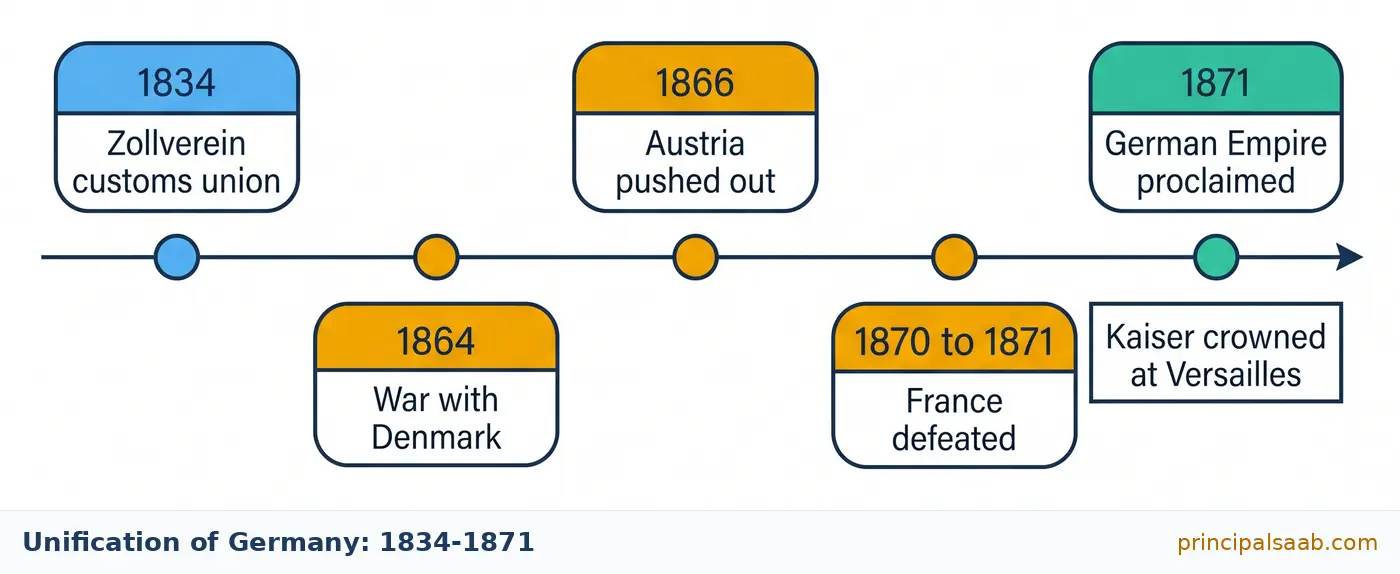
Prussia had three enormous advantages. Economically, the Zollverein of 1834 and the spreading railway network had already made the German lands a single market under Prussian leadership. Militarily, Prussia possessed a disciplined and modernised army. Politically, it had a determined chief minister in Otto von Bismarck, who took charge of the unification effort with the support of the Prussian army and bureaucracy.
Bismarck’s method was war, carried out with cold calculation. Over a period of seven years Prussia fought three wars, each of which removed one obstacle:
- Denmark, 1864. A short war over the border duchies, which established Prussia as the champion of German interests.
- Austria, 1866. Prussia’s victory pushed Austria out of German affairs altogether, settling the long argument over who would lead the German lands.
- France, 1870–71. The defeat of France completed the process and brought the southern German states into the new nation.
The unification was formally sealed in January 1871, when the Prussian king William I was proclaimed German Emperor at a ceremony held at Versailles, in the palace of the defeated French. The place was chosen deliberately: a nation was being announced in the humiliation of its rival, and that choice would poison French and German relations for the next seventy years.
What followed inside Germany matters too. The new state placed strong emphasis on modernising its currency, its banking system, its legal arrangements and its judicial procedures. Prussian measures and practices often became a model for the rest of Germany. Unification, in other words, was not only a matter of flags and frontiers; it reorganised everyday economic life.
Question: Explain the process of the unification of Germany. What role did Prussia play in it?
Model answer: The nationalist feelings that had been widespread among the middle classes in Germany were expressed in 1848 through the Frankfurt Parliament, which attempted to unite the German lands into a nation-state governed by an elected parliament. This liberal attempt was repressed by the combined forces of the monarchy and the military, supported by the large landowners of Prussia. From that point Prussia took the leadership of the unification movement. Its chief minister, Otto von Bismarck, was the architect of the process and carried it out with the help of the Prussian army and bureaucracy. Prussia’s position was strengthened by the Zollverein customs union of 1834, which had already created a single economic zone among the German states, and by an expanding railway network. Three wars were then fought over seven years, with Denmark in 1864, with Austria in 1866 and with France in 1870–71, and all three ended in Prussian victory, completing the process of unification. In January 1871 the Prussian king William I was proclaimed German Emperor at a ceremony held at Versailles. The new German state then laid great stress on modernising the currency, banking, legal and judicial systems, and Prussian practices frequently became the model for the whole of Germany.
Why it earns full marks: The five points are the failure of the liberal attempt in 1848, Prussia taking the lead under Bismarck, the economic preparation through the Zollverein, the three wars with correct dates, and the proclamation of the empire in 1871. Notice that the answer explains why Prussia could lead, not just that it did.
The Unification of Italy
Italy in the middle of the nineteenth century was, in political terms, a collection of seven states rather than a country. The north was under Austrian Habsburg rule. The centre was governed by the Pope. The south, the Kingdom of the Two Sicilies, was ruled by the Bourbon kings of Spain. Only one state, Sardinia-Piedmont, was ruled by an Italian princely house. Even the language was not one language: most people spoke regional varieties, and only a small educated minority used the Italian of the literary tradition.
The first phase was revolutionary and it failed. During the 1830s Giuseppe Mazzini worked to build a unified Italian republic through his secret society Young Italy. Uprisings inspired by these ideas took place in 1831 and again in 1848, and both were defeated. After these failures, the leadership of the movement passed from Mazzini’s republican vision to Sardinia-Piedmont’s ruling house, headed by King Victor Emmanuel II. Many Italians now concluded that unification through a monarchy was better than no unification at all.
The second phase was diplomatic, and its architect was Count Camillo de Cavour, the chief minister of Sardinia-Piedmont. Cavour was not a democrat or a revolutionary; like many wealthy Italians of his class he spoke French better than he spoke Italian. What he possessed was a superb sense of timing. Through a carefully constructed diplomatic alliance with France, he enabled Sardinia-Piedmont to defeat the Austrian forces in 1859 and free the north from Austrian control.
The third phase was popular and armed, and it belongs to Giuseppe Garibaldi. In 1860 he led a force of armed volunteers, known from their uniform as the Red Shirts, into southern Italy and the Kingdom of the Two Sicilies. With the support of the local peasantry, who rose in revolt against their rulers, he succeeded in driving out the Bourbon rulers of the south. Garibaldi then handed his conquests over to Victor Emmanuel II rather than keeping them for himself — a decision that made unification possible.
In 1861 Victor Emmanuel II was proclaimed king of a united Italy. The process was not quite complete: Venetia was added in 1866 and Rome only in 1870. It is worth remembering that much of the rural population, for whom this had all been done, was illiterate, and many peasants had never even heard of Italy as a nation. They had followed Garibaldi because they wanted relief from their landlords.
Here is the comparison table promised in your game plan. Learn it row by row and the two unifications will never blur into each other again.
| Point of comparison | Germany | Italy |
|---|---|---|
| Leading state | Prussia | Sardinia-Piedmont |
| Chief architect | Otto von Bismarck, chief minister of Prussia | Count Camillo de Cavour, chief minister of Sardinia-Piedmont |
| Ruler who became head of the new nation | William I, proclaimed German Emperor | Victor Emmanuel II, proclaimed King of Italy |
| Main obstacle | Austria’s claim to lead the German lands, and French opposition | Austrian rule in the north, papal rule in the centre, Bourbon rule in the south |
| Chief method | Three planned wars, against Denmark, Austria and France | Diplomacy with France, war against Austria, and a popular armed campaign in the south |
| Popular military leader | No comparable figure; the army was the regular Prussian army | Giuseppe Garibaldi and his volunteer Red Shirts |
| Economic preparation | The Zollverein of 1834 and an expanding railway network | No comparable customs union; the states remained economically separate |
| Key dates | Wars in 1864, 1866 and 1870–71; empire proclaimed January 1871 | Austrian forces defeated in 1859; Garibaldi’s campaign in 1860; kingdom proclaimed 1861 |
| Completion | Southern German states joined after the defeat of France in 1871 | Venetia added in 1866 and Rome in 1870 |
Question: Describe the roles played by Count Cavour and Giuseppe Garibaldi in the unification of Italy.
Model answer: Count Camillo de Cavour, the chief minister of Sardinia-Piedmont, led the movement to unify the Italian regions. He was neither a revolutionary nor a democrat, and like many wealthy Italians of his time he spoke French better than Italian, but he was a skilful diplomat. Through a carefully worked out alliance with France he enabled Sardinia-Piedmont to defeat the Austrian forces in 1859 and free northern Italy from Austrian control. Giuseppe Garibaldi contributed the popular and military element. In 1860 he led a band of armed volunteers, called the Red Shirts, into southern Italy and the Kingdom of the Two Sicilies, where the local peasants rose in support of him, and he succeeded in driving out the Bourbon rulers. He then handed the territories he had won to Victor Emmanuel II, and in 1861 the latter was proclaimed king of a united Italy.
Why it earns full marks: One and a half marks for each figure: Cavour’s diplomacy and the 1859 victory, Garibaldi’s campaign of 1860 and the handover that led to 1861. Keeping the two men in separate sentences makes the division of marks obvious to the examiner.
The Strange Case of Britain
Britain is called a strange case for a good reason. In Germany and Italy, a nation was created out of a sudden upheaval. In Britain, there was no such moment. The British nation was formed slowly, over a long period, and it was formed as much by conquest as by consent.
Before the eighteenth century there was no British nation. The people of the islands identified themselves primarily as English, Welsh, Scot or Irish, each with its own cultural and political tradition. The English were the wealthiest and most powerful of these, and as the English state grew it steadily extended its influence over the others.
The turning point in England itself came in 1688, when after a long conflict the English Parliament took power from the monarchy. From then on Parliament, not the crown, was the centre of the state that would go on to build a nation.
Then came expansion:
- Scotland. The Act of Union of 1707 between England and Scotland created the United Kingdom of Great Britain. In practice this allowed England to dominate Scotland. Scotland’s distinctive culture and political institutions were systematically suppressed. The Catholic clans of the Scottish Highlands, who revolted against this arrangement, were brutally put down; the Gaelic language was forbidden and many Highlanders were driven from their homeland.
- Ireland. Ireland was deeply divided between Catholics and Protestants, and the English supported the Protestant minority in establishing dominance over the Catholic majority. A revolt led by Wolfe Tone and his United Irishmen in 1798 was suppressed, and in 1801 Ireland was forcibly incorporated into the United Kingdom.
Finally, the new nation was given the outward signs of unity: a British flag, the Union Jack; a national anthem; and the English language. In each case the older nations survived only as subordinate partners in the union, their symbols folded into a larger British identity.
Question: Explain how the British nation was formed, and state why it is described as a result of a long-drawn-out process rather than a sudden upheaval.
Model answer: There was no British nation before the eighteenth century, and the people of the British Isles identified themselves as English, Welsh, Scot or Irish, each group having its own cultural and political tradition. The English, being the most powerful, gradually extended their influence, and after a long conflict the English Parliament seized power from the monarchy in 1688, becoming the instrument through which a nation-state was built. The Act of Union of 1707 between England and Scotland created the United Kingdom of Great Britain, after which Scottish culture and political institutions were systematically suppressed, the Catholic clans of the Highlands who resisted were crushed, and the Gaelic language was forbidden. In Ireland, the English supported the Protestant minority against the Catholic majority; the revolt of Wolfe Tone and his United Irishmen in 1798 was put down and Ireland was forcibly incorporated into the United Kingdom in 1801. Symbols of the new British nation, such as the Union Jack, the national anthem and the English language, were then promoted, while the older nations continued only as subordinate partners. The process is therefore described as long-drawn-out because it stretched across more than a century and was achieved through gradual conquest and union rather than through a single revolution.
Why it earns full marks: One mark for the situation before the union, one for Scotland and Ireland with their dates, and one for the symbols and the concluding explanation. The dates 1688, 1707, 1798 and 1801 are what separate a strong answer from a vague one.
Visualising the Nation: Marianne and Germania
Here is a problem the nationalists faced. A king can be painted. A nation cannot — it has no face, no body, no single location. So how do you make people feel loyalty towards something they cannot see?
Artists in the eighteenth and nineteenth centuries solved this by personification: they represented the nation as a person, and specifically as a woman. This female figure did not stand for any particular woman in real life. She was an allegory, a figure that gives visible form to an abstract idea. You already understand this instinctively — when a cartoonist draws Justice as a blindfolded woman holding scales, nobody thinks a real woman is meant. Abstract ideas such as liberty, justice and the republic had long been personified in this way, and their meaning was carried by attributes: the blindfold for impartiality, the scales for fair judgement.
During the French Revolution, artists used female figures to represent ideas such as Liberty, Justice and the Republic. Liberty was shown with the red cap, or with a broken chain. Justice carried a pair of weighing scales. Later, the French nation itself came to be personified as Marianne, a name drawn from a common Christian first name, which underlined the idea that this was a people’s nation and not a dynasty. Her attributes were taken from those of Liberty and the Republic: the red cap, the tricolour and the cockade. Statues of Marianne were put up in public squares to remind citizens of the national symbol of unity and to encourage them to identify with it, and her image appeared on coins and stamps, entering ordinary pockets and letters.
In the German lands the equivalent figure was Germania. She became the allegory of the German nation and was shown wearing a crown of oak leaves, because the German oak stood for heroism. The best-known painting of her was made by Philipp Veit in 1848, and a version of it was hung from the ceiling of the Church of St Paul where the Frankfurt parliament met — a way of telling the delegates below that the nation itself was watching over them.
Learn the symbols as a code. Visual-source questions in the board paper almost always ask you to explain one or two of these attributes.
| Symbol | What it stands for |
|---|---|
| Broken chains | Being set free from bondage or foreign rule |
| Breastplate with an eagle | The strength of the German empire |
| Crown of oak leaves | Heroism, since the German oak was the emblem of heroic courage |
| Sword | Readiness to fight for the nation |
| Olive branch around the sword | Willingness to make peace, held together with the readiness to fight |
| Black, red and gold tricolour | The flag of the liberal-nationalists of 1848, which the rulers of the German states had banned |
| Rays of the rising sun | The beginning of a new era |
| Red cap, or cap of liberty | Freedom, taken from the imagery of Liberty during the French Revolution |
| Broken chain with a cockade and tricolour (Marianne) | The French Republic as a nation of free and equal citizens |
Question: What is an allegory? Explain how Germania was represented and what any two of her attributes signified.
Model answer: An allegory is a figure or an image used to give visible form to an abstract idea, so that a quality such as liberty or a concept such as the nation can be represented as a person. Since a nation cannot be seen or touched, artists of the nineteenth century personified nations as female figures, and Germania became the allegory of the German nation. She was usually shown wearing a crown of oak leaves, because the German oak was a symbol of heroism, and holding a sword, which signified the readiness of the nation to fight for its freedom. The most famous painting of Germania was made by Philipp Veit in 1848, and it was hung from the ceiling of the Church of St Paul where the Frankfurt parliament met.
Why it earns full marks: One mark for defining allegory, one for identifying Germania as the personification of the German nation, and one for correctly explaining two attributes. If the question shows a picture, always name the specific attribute you can see rather than describing it loosely.
Nationalism and Imperialism: The Balkans
The last section of the chapter has a change of mood, and you should let your answer reflect that. Until now, nationalism has looked like a generous idea — people claiming the right to govern themselves. By the last quarter of the nineteenth century it had changed character. After 1871 it became a narrow creed with limited ends. European powers grew intolerant of one another and ready to go to war over their claims. Governments learned to use nationalist feeling to justify expansion abroad, and the same idea that had once opposed empires now helped to build them.
The place where this became most dangerous was the Balkans. The Balkans is a region of great geographical and ethnic variety, comprising in modern terms Romania, Bulgaria, Albania, Greece, Macedonia, Croatia, Bosnia-Herzegovina, Slovenia, Serbia and Montenegro. Its inhabitants were broadly known as Slavs. A large part of the region had been under the control of the Ottoman Empire.
Two processes then collided:
- The spread of romantic nationalism inside the Balkans. As the Ottoman Empire weakened — it was often described at the time as the sick man of Europe — the different Slavic nationalities within it struggled to define their own identity and independence. Each of them claimed that its right to be independent rested on having once been part of an ancient nation, and each therefore laid claim to territory that its neighbours also claimed. The rebellious nationalities were, in their own eyes, recovering a long-lost freedom.
- The rivalry of the great powers outside. Russia, Germany, England and Austria-Hungary were competing over trade, colonies, and naval and military strength. Each wanted to extend its own influence over the Balkans and to check the influence of the others. The region became the arena in which these rivalries were played out.
The result was a series of wars in the region and finally the First World War. It is worth pausing on that sentence. The chapter opens with people claiming the right to be free and closes with those claims feeding into the deadliest war the world had then seen. Nationalism is presented here not as a hero or a villain, but as a force whose consequences depend entirely on how it is used.
Question: Why did the Balkan region become the most serious source of nationalist tension in Europe after 1871? Explain.
Model answer: The Balkans became the most serious source of tension for a combination of internal and external reasons. First, the region was one of great geographical and ethnic variation, comprising the modern territories of Romania, Bulgaria, Albania, Greece, Macedonia, Croatia, Bosnia-Herzegovina, Slovenia, Serbia and Montenegro, whose inhabitants were broadly known as Slavs. Second, a large part of the Balkans was under the control of the Ottoman Empire, and the gradual weakening of that empire made the region unstable. Third, the spread of romantic nationalism among the Balkan peoples led each nationality to struggle for independence and to justify its claims by reference to a long-lost ancient nationhood. Fourth, these claims overlapped, because the different groups laid claim to the same territories, so that the Balkan states became intensely jealous of one another and each hoped to expand at the expense of the others. Fifth, the great powers of Europe — Russia, Germany, England and Austria-Hungary — were at the same time competing over trade, colonies and naval and military strength, and each wished to extend its own influence in the region while limiting that of its rivals. These conditions produced a series of wars in the Balkans and contributed directly to the outbreak of the First World War.
Why it earns full marks: Five distinct causes, clearly separated, with the internal nationalist rivalries and the external great-power rivalries both covered. Students who write only about the Ottoman decline usually stop at two or three marks.
Practice Worksheet
Ten questions, mixed exactly the way a board paper mixes them. Write your answer first, in full sentences, before you open the solution. The gap between what you wrote and what is below is your revision list — nothing else in this article will show you that as honestly.
Show Answer
Show Answer
Show Answer
Show Answer
Show Answer
Show Answer
Show Answer
Show Answer
Show Answer
Show Answer
One last thing before you close this page. You will not master this chapter today, and you are not supposed to. History rewards the student who returns to it. Read the timeline tomorrow morning while you drink your tea. Redo question seven on Thursday without looking. Explain German unification out loud to a friend on Sunday, and notice which sentence you stumble on — that stumble is the gift, because it tells you exactly what to fix. Progress in this subject is not a dramatic breakthrough; it is the quiet business of getting one more correct question than yesterday, repeated until the exam arrives and you find, almost with surprise, that the wall of European names has become a story you can simply tell.