

Take a breath. If the word Solutions makes you think of a wall of formulas with subscripts crawling everywhere, you are in good company — almost every student feels that on day one. Here is the secret this chapter hides: it is not really about formulas at all. It is about one very human idea — what happens when you stir something into something else. Sugar into tea. Salt onto an icy road. Carbon dioxide into a cold fizzy drink. Every single formula in this chapter is just a tidy way of writing down something you have already watched happen in a kitchen.
We are going to walk through this together, slowly, from absolute zero knowledge. I will not assume you remember anything from Class 11. Every symbol gets introduced before it is used. Every formula gets built up in front of you rather than dropped on you. And after each idea, there is a worked example with the units written at every single step, because units are where marks quietly disappear in the board exam.
This is also one of the most rewarding chapters in Class 12 Chemistry, because it is heavily numerical. Numericals are scoring. Once a method clicks, it keeps giving you marks paper after paper. So go gently, and do not rush.
What You’ll Learn
- Types of Solutions
- Expressing the Concentration of a Solution
- Which Concentration Terms Change With Temperature
- Solubility of Solids in Liquids
- Solubility of Gases in Liquids and Henry’s Law
- Vapour Pressure of Liquid Solutions
- Raoult’s Law for Two Volatile Liquids
- Raoult’s Law for a Non-Volatile Solute
- Ideal and Non-Ideal Solutions
- Positive and Negative Deviation, and Azeotropes
- What Makes a Property Colligative
- Relative Lowering of Vapour Pressure
- Elevation of Boiling Point
- Depression of Freezing Point
- Osmosis, Osmotic Pressure and Reverse Osmosis
- Determining Molar Mass From Colligative Properties
- Abnormal Molar Mass and the van’t Hoff Factor
- The Complete Formula Sheet
- Practice Worksheet With Full Solutions
Your Game Plan
Do not try to swallow this chapter in one sitting. Here is the order that works:
- Get the concentration terms rock solid first. Molarity, molality and mole fraction show up inside every later formula. If these are shaky, everything downstream feels impossible. Spend a full day here if you need to.
- Then do Henry’s law and Raoult’s law. Two short laws, two easy formulas. Quick confidence win.
- Then ideal versus non-ideal solutions. This part is theory-heavy and graph-heavy — learn to sketch the graphs, because sketches are asked directly.
- Then the four colligative properties, one per day. They all follow the same shape. Notice the pattern instead of memorising four unrelated things.
- Finish with the van’t Hoff factor. It is simply a correction applied on top of what you already know. Leave it for last and it will feel easy.
- Then the worksheet at the bottom — with the answers covered. Reveal only after you have genuinely attempted each one.
Adding a non-volatile solute to a liquid always makes it harder for that liquid to escape. Harder to escape as vapour, harder to freeze into a solid, easier to pull more solvent in. Almost every result in this chapter is a consequence of that one sentence.
Types of Solutions
Let us begin with the vocabulary, because two words get confused constantly and that confusion costs marks.
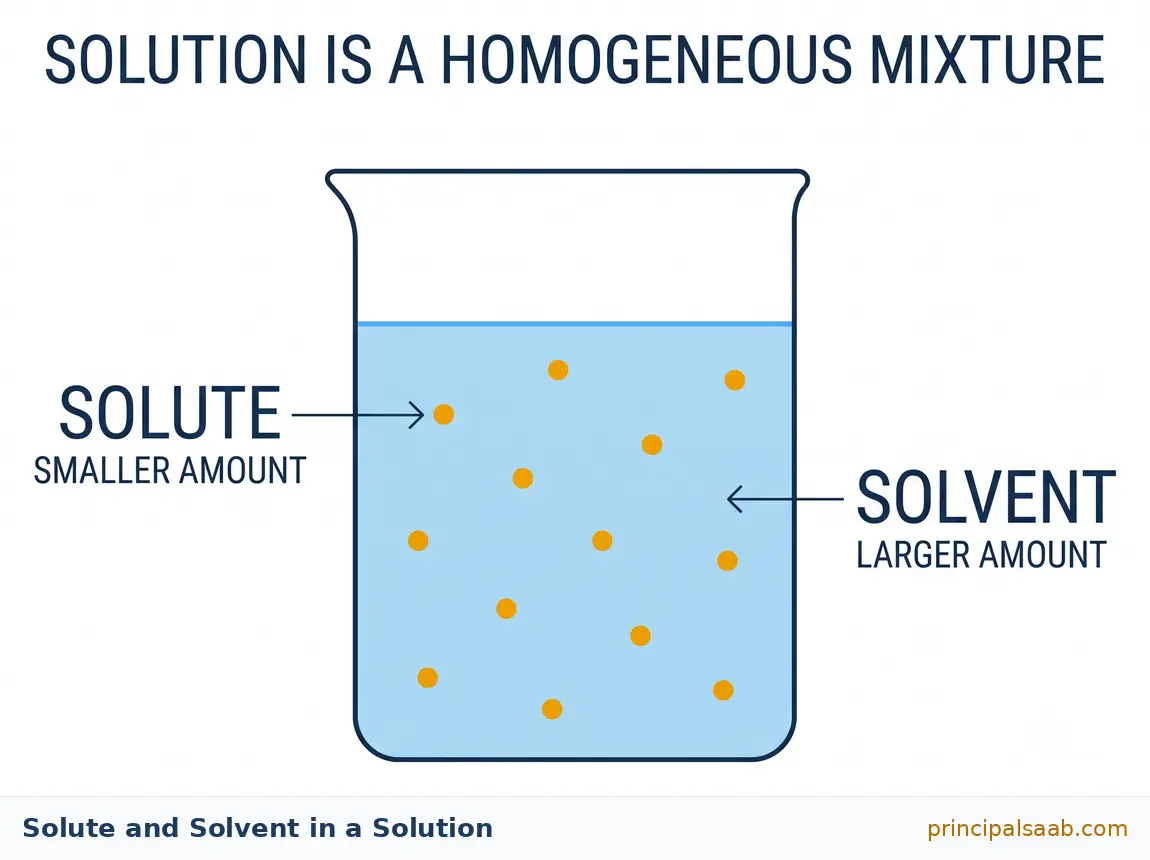
A solution is a homogeneous mixture of two or more substances. “Homogeneous” means that if you took a sample from the top of the beaker and another from the bottom, they would be identical — the mixing has happened right down at the level of individual particles, so there is nothing left to see with your eyes.
Inside a solution we name two roles:
- The solvent is the component present in the larger amount. It sets the physical state of the solution.
- The solute is the component present in the smaller amount. It is the thing that got dissolved.
In a cup of sweet tea, the water is the solvent and the sugar is the solute. The solution is a liquid, because the solvent (water) is a liquid. That is the general rule — the solvent decides the state of the solution.
A solution with exactly two components is called a binary solution, and that is the only kind we handle in this chapter. Now, since both the solute and the solvent can each be a solid, a liquid or a gas, there are nine possible combinations. Here they all are:
| Solute | Solvent | State of solution | Everyday example |
|---|---|---|---|
| Gas | Gas | Gaseous | The air you are breathing right now |
| Liquid | Gas | Gaseous | Water vapour floating in humid air |
| Solid | Gas | Gaseous | Camphor slowly vanishing into air |
| Gas | Liquid | Liquid | The fizz dissolved in a cold soft drink |
| Liquid | Liquid | Liquid | Vinegar — acetic acid mixed into water |
| Solid | Liquid | Liquid | Salt stirred into water — the star of this chapter |
| Gas | Solid | Solid | Hydrogen absorbed into palladium metal |
| Liquid | Solid | Solid | Mercury dissolved in silver (a dental amalgam) |
| Solid | Solid | Solid | Brass — zinc dissolved in copper |
The last three rows are the solid solutions, and yes, they are examinable — a one-mark question asking for an example of a solid-in-solid solution is very common. Brass and bronze are the safe answers.
When a question gives you a mixture and asks “which is the solvent?”, do not look for water automatically. Look for whichever component is present in the greater amount. In a mixture of 80 g ethanol and 20 g water, ethanol is the solvent.
Expressing the Concentration of a Solution
Saying “this tea is sweet” is not chemistry. Chemistry needs a number. Concentration is that number — it tells us how much solute is packed into a given amount of solution or solvent.
There are seven ways of expressing it in your syllabus. If the mole concept underneath them feels shaky, spend ten minutes on Chemical Reactions and Equations first — every formula below runs on moles. They all look similar, and that is exactly the trap. So let us build each one honestly, and I will keep pointing out the one thing that separates them: what sits in the denominator.
1. Mass Percentage (% w/w)
Mass % of a component = (mass of that component ÷ total mass of solution) × 100.
Notice: total mass of solution, which means solute mass plus solvent mass. If you dissolve 8 g of potassium chloride in 92 g of water, the solution weighs 100 g, so the solution is 8% w/w.
2. Volume Percentage (% v/v)
Volume % = (volume of component ÷ total volume of solution) × 100. This is what the label on a bottle of antiseptic means when it says 70% v/v — every 100 mL of that liquid contains 70 mL of alcohol.
3. Mass by Volume Percentage (% w/v)
Mass by volume % = (mass of solute in g ÷ volume of solution in mL) × 100. This mixed unit is the favourite of the medical world — a saline drip labelled 0.9% w/v holds 0.9 g of sodium chloride in every 100 mL.
4. Parts Per Million (ppm)
When a solute is present in a truly tiny amount — a pollutant in a river, fluoride in drinking water — percentages give awkward numbers like 0.0002%. So we scale up by a million instead of a hundred:
ppm = (mass of solute ÷ total mass of solution) × 106
5. Mole Fraction (x)
Now we stop counting grams and start counting particles. Suppose a binary solution contains nA moles of A and nB moles of B. Then
xA = nA ÷ (nA + nB) and xB = nB ÷ (nA + nB)
Because you are dividing a part by the whole, mole fraction has no unit, and the mole fractions of all components must add up to exactly 1. That last fact is a free checking tool — use it on every mole fraction question you ever attempt.
6. Molarity (M)
Molarity = moles of solute ÷ volume of solution in litres
Unit: mol L−1, written as M. The denominator is the volume of the whole solution, not the volume of solvent you started with.
7. Molality (m)
Molality = moles of solute ÷ mass of solvent in kilograms
Unit: mol kg−1, written as m. The denominator is the mass of solvent only. This is the single most confused pair in the whole chapter, so let me put it starkly:
Molarity uses volume of solution (remember: molarity → litres of solution). Molality uses mass of solvent in kg. Students routinely divide by the mass of the solution when calculating molality. If a question says “5 g of urea dissolved in 95 g of water”, the molality denominator is 0.095 kg, not 0.100 kg. You first met molarity back in Acids, Bases and Salts — the definition has not changed, only the questions have.
Question: 4.0 g of sodium hydroxide is dissolved in water and the solution is made up to 250 mL. Find the molarity. (Atomic masses: Na = 23, O = 16, H = 1)
Step 1 — molar mass of NaOH.
M = 23 + 16 + 1 = 40 g mol−1
Step 2 — moles of solute.
n = mass ÷ molar mass = 4.0 g ÷ 40 g mol−1 = 0.10 mol
Step 3 — volume in litres.
250 mL = 250 ÷ 1000 = 0.250 L
Step 4 — apply the definition.
Molarity = 0.10 mol ÷ 0.250 L = 0.40 mol L−1
Answer: 0.40 M (2 significant figures, matching the data given).
Question: 9.0 g of glucose (C6H12O6) is dissolved in 500 g of water. Calculate the molality. (C = 12, H = 1, O = 16)
Step 1 — molar mass of glucose.
(6 × 12) + (12 × 1) + (6 × 16) = 72 + 12 + 96 = 180 g mol−1
Step 2 — moles of glucose.
n = 9.0 ÷ 180 = 0.050 mol
Step 3 — mass of solvent in kg.
500 g of water = 0.500 kg (the water only — do not add the glucose)
Step 4 — apply the definition.
m = 0.050 mol ÷ 0.500 kg = 0.10 mol kg−1
Answer: 0.10 m
Question: A mixture is made from 46 g of ethanol (C2H5OH) and 54 g of water. Find the mole fraction of each.
Step 1 — molar masses.
Ethanol = (2 × 12) + (6 × 1) + 16 = 24 + 6 + 16 = 46 g mol−1
Water = (2 × 1) + 16 = 18 g mol−1
Step 2 — moles of each.
n(ethanol) = 46 ÷ 46 = 1.0 mol
n(water) = 54 ÷ 18 = 3.0 mol
Total = 1.0 + 3.0 = 4.0 mol
Step 3 — mole fractions.
x(ethanol) = 1.0 ÷ 4.0 = 0.25
x(water) = 3.0 ÷ 4.0 = 0.75
Check: 0.25 + 0.75 = 1.00 ✓ — always do this check.
Question: Find the mole fraction of the solute in a 2.0 molal aqueous solution.
The trick: “2.0 molal” literally means 2.0 mol of solute in 1 kg of water. So just pick that convenient sample size — 1000 g of water.
Step 1 — moles of solute. = 2.0 mol (given by the definition)
Step 2 — moles of water.
n = 1000 g ÷ 18 g mol−1 = 55.56 mol
Step 3 — mole fraction of solute.
xsolute = 2.0 ÷ (2.0 + 55.56) = 2.0 ÷ 57.56 = 0.0347
Answer: xsolute = 0.0347, and xwater = 1 − 0.0347 = 0.9653. Notice how small the solute fraction is — that is why dilute-solution approximations later in this chapter work so well.
Question: A water sample of mass 1.5 kg is found to contain 3.0 mg of fluoride ions. Express this concentration in ppm.
Step 1 — put both masses in the same unit.
3.0 mg = 3.0 × 10⁻³ g
1.5 kg = 1.5 × 10³ g
Step 2 — apply the formula.
ppm = (3.0 × 10⁻³ ÷ 1.5 × 103) × 106
= (2.0 × 10−6) × 106
Answer: 2.0 ppm. Since the solution is overwhelmingly water, we take the mass of solution as effectively the mass of water.
Which Concentration Terms Change With Temperature
This is a small idea that carries a whole exam question, and it is beautifully easy once you see the logic. Ask yourself a single question about each concentration term:
“Does this formula contain a volume anywhere?”
Here is why that question decides everything. When you heat a liquid, it expands. Its mass does not change — you have not added or removed a single molecule — but the same molecules now occupy a bigger volume. So any concentration term that has a volume in it will drift as the temperature changes, while any term built purely from mass and moles will stay locked in place forever.
| Concentration term | Formula | Unit | Depends on temperature? |
|---|---|---|---|
| Mass percentage | (wsolute ÷ wsolution) × 100 | % | No — mass only |
| Mole fraction | nA ÷ (nA + nB) | no unit | No — moles only |
| Molality | nsolute ÷ kg of solvent | mol kg−1 | No — moles and mass |
| ppm (by mass) | (wsolute ÷ wsolution) × 106 | no unit | No — mass only |
| Molarity | nsolute ÷ L of solution | mol L−1 | Yes — volume in it |
| Volume % and % w/v | contains volume of solution | % | Yes — volume in it |
Molality, mole fraction and mass percentage are temperature independent. Molarity is temperature dependent. That is why every colligative-property formula later in this chapter is built on molality and not molarity — those experiments involve heating and cooling, so a temperature-proof unit is essential. This is not an accident; it is deliberate design.
If a question asks “why is molality preferred over molarity in the study of colligative properties?”, that box is your full-marks answer.
Solubility of Solids in Liquids
Solubility is the maximum amount of a solute that dissolves in a specified amount of solvent at a given temperature and pressure. Notice how careful that definition is — solubility is a ceiling, not just any amount.
Picture stirring sugar into a cup of tea. The first spoon vanishes instantly. So does the second. By the fifth or sixth, you begin to see grains sitting at the bottom that simply refuse to go. You have hit the ceiling. That state — where undissolved solid sits in contact with the solution and no more will dissolve — is called a saturated solution. Below that ceiling the solution is unsaturated.
What Decides Whether Something Dissolves At All
The guiding principle is short and worth memorising: like dissolves like. A polar solute dissolves in a polar solvent; a non-polar solute dissolves in a non-polar solvent. The polarity ideas behind this are the same ones you used in Carbon and its Compounds. Common salt (ionic, strongly polar) dissolves happily in water (polar) but not at all in petrol. Wax and oil (non-polar) refuse water but dissolve readily in benzene.
The reason is about the tug-of-war between particles. For a solute to dissolve, the solvent must pull the solute particles apart from each other. Water molecules, being polar, can surround an Na+ ion and a Cl− ion and hold them apart. Petrol molecules have no such pull, so the crystal simply stays intact.
The Effect of Temperature — and Why It Cuts Both Ways
At saturation, an equilibrium is running:
Solute (solid) ⇌ Solute (in solution)
Now apply Le Chatelier’s principle, which you met in Class 11. Heating pushes an equilibrium in whichever direction absorbs heat. So:
- If dissolving is endothermic (ΔsolH is positive — dissolving absorbs heat), then raising the temperature increases solubility. Most solids behave this way, which is why sugar dissolves so much more easily in hot tea than in iced tea.
- If dissolving is exothermic (ΔsolH is negative — dissolving releases heat), then raising the temperature decreases solubility.
The Le Chatelier argument only applies to a saturated solution, because only there is a genuine solid–solution equilibrium in place. Mention that condition and examiners tend to be generous.
The Effect of Pressure
Pressure has essentially no effect on the solubility of a solid in a liquid. Both solids and liquids are almost incompressible — squeezing them does not meaningfully change their volume, so the equilibrium does not shift. Keep that answer short and confident.
Solubility of Gases in Liquids and Henry’s Law
Gases behave completely differently from solids, and there is a household object that teaches the whole topic: a bottle of cold fizzy drink.
While the cap is on, the bottle is sealed under high pressure, and a large amount of carbon dioxide sits quietly dissolved in the liquid — you cannot even see it. The instant you twist the cap, the pressure above the liquid drops to ordinary atmospheric pressure, and the drink erupts into bubbles. The dissolved gas is escaping because less pressure means less dissolved gas.
Leave that open bottle on a table and by evening it is flat — and if you left it somewhere warm, it went flat even faster. That gives us the second rule: gases become less soluble as temperature rises. (Dissolving a gas is an exothermic process, so heating drives it back out.) This is exactly why fish struggle in warm water — warm water holds less dissolved oxygen.
Building Henry’s Law
Henry turned the first observation into a precise statement. The amount of gas dissolved is directly proportional to the pressure of that gas above the liquid. Writing solubility as the mole fraction x of the gas in solution, and p as its partial pressure:
x &proportional; p → p = KH × x
p = KH x
where KH is the Henry’s law constant. Read the formula carefully and three things fall out:
- Since x has no unit, KH carries the unit of pressure — bar, or torr, or atm.
- KH is different for every gas–solvent pair. It is a property of the pair, not of the gas alone.
- A higher KH means a lower solubility. Look at the rearranged form x = p ÷ KH — KH sits in the denominator, so a big KH squashes x down.
Students often assume that a large KH means the gas dissolves a lot, because “bigger constant sounds like more”. It is the opposite. KH ↑ means solubility ↓. Also note that KH increases with temperature, which is another way of saying gases dissolve less when hot.
Real Applications You Should Be Able to Explain
- Fizzy drinks are sealed under high CO2 pressure so that a large mass of carbon dioxide stays dissolved until you open them.
- Scuba divers and the “bends”. Deep underwater the pressure is high, so extra nitrogen from the breathing tank dissolves into the diver’s blood. If the diver surfaces too quickly, the pressure falls suddenly and that nitrogen bubbles out inside the blood vessels — painful and dangerous. The fix: divers use tanks diluted with helium, which is far less soluble in blood.
- Climbers and low oxygen at altitude. High in the mountains the partial pressure of oxygen is low, so less oxygen dissolves in the blood. The result is weakness and difficulty thinking clearly — a condition called anoxia.
- Aquatic life in summer. Warm river water holds less dissolved oxygen, which is why fish deaths rise during heat waves.
Question: The partial pressure of carbon dioxide above a sealed soft drink is 2.5 bar at 298 K. If KH for CO2 in water at this temperature is 1.67 × 10³ bar, calculate the mole fraction of CO2 dissolved in the drink.
Step 1 — write the law and rearrange for what is asked.
p = KH x → x = p ÷ KH
Step 2 — substitute, keeping units aligned.
x = 2.5 bar ÷ (1.67 × 10³ bar)
Notice that bar cancels bar, leaving a pure number — exactly what a mole fraction should be.
Step 3 — compute.
x = 2.5 ÷ 1670 = 1.50 × 10⁻³
Answer: x(CO2) = 1.50 × 10⁻³ (3 significant figures). Such a tiny fraction, yet it is enough to make the whole drink fizz.
Question: Using the result above (x = 1.50 × 10⁻³), find the mass of CO2 dissolved in 1000 g of water. (C = 12, O = 16, H = 1)
Step 1 — moles of water in the sample.
n(H2O) = 1000 g ÷ 18 g mol−1 = 55.56 mol
Step 2 — use the dilute approximation.
x = n(CO2) ÷ [n(CO2) + n(H2O)]. Because n(CO2) is minute compared with 55.56, the denominator is essentially 55.56, so
n(CO2) ≈ x × 55.56 = 1.50 × 10−3 × 55.56 = 0.0833 mol
Step 3 — molar mass of CO2.
12 + (2 × 16) = 44 g mol−1
Step 4 — mass.
mass = 0.0833 mol × 44 g mol−1 = 3.67 g
Answer: about 3.7 g of CO2 per kilogram of water. (Solving without the approximation gives 0.0835 mol — the difference is negligible, which is exactly why the approximation is allowed.)
Question: At a fixed temperature, 0.050 mol of a gas dissolves in a sample of water when the partial pressure of the gas is 2.0 bar. How many moles will dissolve in the same sample if the pressure is raised to 5.0 bar?
Step 1 — recognise the shortcut. Temperature is constant, so KH is constant, so solubility is directly proportional to pressure. No need for KH at all.
Step 2 — set up the ratio.
n1 ÷ p1 = n2 ÷ p2
0.050 mol ÷ 2.0 bar = n2 ÷ 5.0 bar
Step 3 — solve.
n2 = 0.050 × (5.0 ÷ 2.0) = 0.050 × 2.5 = 0.125 mol
Answer: 0.125 mol. Pressure went up 2.5 times, so dissolved gas went up 2.5 times. Sanity check passed.
Do not move on until Henry’s law feels comfortable. It is only one formula, and it will reappear in a moment when we meet Raoult’s law — the two are closer relatives than they first appear.
Vapour Pressure of Liquid Solutions
Before Raoult’s law can make sense, you need to be at ease with the phrase vapour pressure. Let us build it from a picture.
Put some water in a sealed bottle with empty space above it. The water molecules are in constant motion, and the fastest ones near the surface break free into the space above — they evaporate. But molecules in that space also crash back into the liquid — they condense. Very soon the rate of escaping exactly equals the rate of returning, and the amount of vapour above the liquid stops changing. The pressure that this settled vapour exerts is the vapour pressure of the liquid at that temperature.
Two facts to keep:
- Vapour pressure rises with temperature — hotter molecules escape more easily.
- A liquid boils at the temperature where its vapour pressure equals the external atmospheric pressure. Boiling is not a mystery; it is simply vapour pressure catching up with the air pushing down.
Now the central question of this chapter: what happens to vapour pressure when you dissolve something in the liquid?
Imagine the surface of pure water as a crowded doorway with only water molecules queuing to escape. Now dissolve sugar in it. Some positions at that surface are now occupied by sugar molecules, which are non-volatile — they cannot evaporate, and they are not going anywhere. Fewer water molecules reach the surface per second, so fewer escape per second, so the vapour pressure falls.
A non-volatile solute lowers the vapour pressure of the solvent purely by occupying surface area. It does not matter chemically what the solute is — only how many particles of it are blocking the surface. Hold on to that phrase “how many, not which”. It is the entire definition of a colligative property, arriving early.
Raoult’s Law for Two Volatile Liquids
Now take a solution in which both components can evaporate — benzene and toluene, say, or ethanol and water. Both contribute vapour to the space above.
Raoult’s law states: for a solution of volatile liquids, the partial vapour pressure of each component is directly proportional to its mole fraction in the solution.
pA = pA° xA and pB = pB° xB
Here pA° is the vapour pressure of pure A (the little circle always means “pure”), and xA is A’s mole fraction in the liquid.
The logic is the doorway picture again. If A makes up 40% of the molecules in the liquid, then roughly 40% of the surface positions are A, so A can only manage 40% of the escaping it would do if it were pure. Hence pA = 0.40 × pA°.
By Dalton’s law of partial pressures, the total pressure above the solution is the sum:
ptotal = pA + pB = pA° xA + pB° xB
And since xB = 1 − xA, we can substitute to get a form that is very revealing:
ptotal = pA° xA + pB° (1 − xA)
ptotal = pB° + (pA° − pB°) xA
Compare that with y = c + mx. It is the equation of a straight line when ptotal is plotted against xA, with intercept pB° and slope (pA° − pB°). That straight line is the signature of an ideal solution, and you should be able to sketch it.
Composition of the Vapour Above the Solution
A favourite board question. The vapour has its own composition, written yA and yB, and it is generally different from the liquid’s. By Dalton’s law, the mole fraction of A in the vapour is its share of the total pressure:
yA = pA ÷ ptotal
The vapour is always richer in the more volatile component — the one with the higher p°. That single sentence is the whole basis of fractional distillation.
Question: Two volatile liquids A and B form an ideal solution. At 300 K, pA° = 450 mm Hg and pB° = 700 mm Hg. A solution is prepared from 2.0 mol of A and 3.0 mol of B. Calculate (i) the partial pressures, (ii) the total vapour pressure, and (iii) the composition of the vapour phase.
Step 1 — mole fractions in the liquid.
Total moles = 2.0 + 3.0 = 5.0 mol
xA = 2.0 ÷ 5.0 = 0.40 xB = 3.0 ÷ 5.0 = 0.60
Check: 0.40 + 0.60 = 1.00 ✓
Step 2 — partial pressures by Raoult’s law.
pA = 450 mm Hg × 0.40 = 180 mm Hg
pB = 700 mm Hg × 0.60 = 420 mm Hg
Step 3 — total pressure by Dalton’s law.
ptotal = 180 + 420 = 600 mm Hg
Step 4 — vapour phase composition.
yA = 180 ÷ 600 = 0.30
yB = 420 ÷ 600 = 0.70
Check: 0.30 + 0.70 = 1.00 ✓
Read the result: in the liquid B was 0.60, but in the vapour B has climbed to 0.70. B is the more volatile liquid (700 > 450), so the vapour is enriched in B — exactly as predicted.
Raoult’s Law as a Special Case of Henry’s Law
Look at the two laws side by side:
Henry: p = KH x Raoult: p = p° x
Structurally identical — pressure equals a constant times mole fraction. The only difference is what the constant happens to be. So we say Raoult’s law is a special case of Henry’s law in which KH becomes equal to p°, the vapour pressure of the pure component. That comparison is a standard 2-mark answer.
Raoult’s Law for a Non-Volatile Solute
Now the case that matters most for exams: a solid, non-volatile solute (say urea) dissolved in a volatile solvent (say water).
The solute contributes zero vapour, because it cannot evaporate. So the entire vapour pressure comes from the solvent alone. Let subscript 1 mean solvent and subscript 2 mean solute — this is the standard convention and you must keep it straight.
psolution = p1° x1
Since x1 is always less than 1 in a solution, psolution is always less than p1°. The vapour pressure has been lowered — exactly what the doorway picture promised.
Now let us extract the form used in numericals. Substituting x1 = 1 − x2:
psolution = p1° (1 − x2) = p1° − p1° x2
Bring psolution across and divide both sides by p1°:
(p1° − psolution) ÷ p1° = x2
The left side is called the relative lowering of vapour pressure, and we have just proved it equals the mole fraction of the solute. We will use this properly in a moment.
Ideal and Non-Ideal Solutions
Raoult’s law is a beautiful prediction, but real liquids do not always cooperate. Whether they do comes down to one thing: how the two kinds of molecules feel about each other compared with how they feel about their own kind.
Call the two components A and B. There are three types of attraction in the mixture: A–A, B–B, and A–B.
An ideal solution is one where A–B attraction is essentially the same strength as A–A and B–B. A molecule cannot tell whether its neighbour is A or B, so mixing changes nothing about escaping tendency, and Raoult’s law holds exactly at every composition.
| Feature | Ideal solution | Non-ideal solution |
|---|---|---|
| Raoult’s law | Obeyed at all compositions | Not obeyed |
| Forces | A–B ≈ A–A ≈ B–B | A–B is weaker or stronger than A–A and B–B |
| ΔmixH (heat of mixing) | = 0 | ≠ 0 (heat absorbed or released) |
| ΔmixV (volume change) | = 0 | ≠ 0 (volume shrinks or expands) |
| p–x graph | Straight line | Curved, above or below the line |
| Azeotrope formed? | No | Yes |
| Examples | Benzene + toluene; n-hexane + n-heptane | Ethanol + water; chloroform + acetone |
For an ideal solution, ΔmixH = 0 and ΔmixV = 0. Almost every question on ideal solutions wants those two conditions stated. Memorise them as a pair.
Positive and Negative Deviation, and Azeotropes
Non-ideal solutions come in exactly two flavours, and the reasoning is symmetric — learn one and the other is its mirror image.
Positive Deviation From Raoult’s Law
Here the A–B attraction is weaker than the A–A and B–B attractions. The molecules dislike their new neighbours. Being held less tightly, they escape into the vapour more easily than Raoult predicted, so the observed vapour pressure is higher than the ideal straight line.
Take ethanol and water. Pure ethanol molecules hold each other with strong hydrogen bonds; so do water molecules. When you mix them, the ethanol–water hydrogen bonding is less effective, some of the original bonds are broken, and the escaping tendency of both goes up.
Consequences: breaking bonds costs energy, so ΔmixH is positive (endothermic, mixture feels cool), and molecules held less tightly spread apart, so ΔmixV is positive (volume expands).
Negative Deviation From Raoult’s Law
Here the A–B attraction is stronger than A–A and B–B. The molecules cling to their new partners, escape less readily, and the observed vapour pressure is lower than the ideal line.
The classic case is chloroform and acetone. On their own, neither forms strong hydrogen bonds with itself. Mixed together, the hydrogen of chloroform forms a new hydrogen bond with the oxygen of acetone — a bond that did not exist in either pure liquid. The molecules are now held down harder.
Consequences: forming bonds releases energy, so ΔmixH is negative (exothermic, mixture warms up), and tighter packing means ΔmixV is negative (volume contracts).
| Point of comparison | Positive deviation | Negative deviation |
|---|---|---|
| A–B force vs A–A, B–B | Weaker | Stronger |
| Observed vapour pressure | Higher than Raoult predicts | Lower than Raoult predicts |
| ΔmixH | Positive (endothermic) | Negative (exothermic) |
| ΔmixV | Positive (expands) | Negative (contracts) |
| Boiling point of mixture | Lower than either component | Higher than either component |
| Azeotrope formed | Minimum boiling | Maximum boiling |
| Standard example | Ethanol + water; acetone + carbon disulphide | Chloroform + acetone; nitric acid + water |
High vapour pressure means easy boiling means low boiling point. So positive deviation (vapour pressure raised) gives a minimum boiling azeotrope, and negative deviation (vapour pressure lowered) gives a maximum boiling azeotrope. If you can recall that vapour pressure and boiling point move in opposite directions, you never have to memorise which azeotrope goes with which deviation.
What an Azeotrope Actually Is
An azeotrope is a mixture of two liquids that boils at a constant temperature and, while boiling, produces vapour with exactly the same composition as the liquid.
Why does that matter so much? Because distillation works only when the vapour is richer in one component than the liquid — that difference is what lets you separate them. At the azeotropic composition the difference vanishes. Boil it, condense it, and you get back the identical mixture. Azeotropes cannot be separated by fractional distillation.
- Minimum boiling azeotrope (from positive deviation): ethanol and water at roughly 95% ethanol by volume, boiling near 351 K. This is precisely why you cannot obtain 100% pure ethanol by ordinary distillation, no matter how tall your column.
- Maximum boiling azeotrope (from negative deviation): nitric acid and water at roughly 68% nitric acid by mass, boiling near 393 K.
Writing that an azeotrope is “a solution that cannot be distilled”. It distils perfectly well — it simply cannot be separated by distillation, because the vapour and liquid have identical composition. Say it that way and the mark is yours.
What Makes a Property Colligative
We now reach the heart of the chapter. The word colligative comes from a Latin root meaning “bound together” or “collected”, and it points at counting.
A colligative property is a property of a solution that depends only on the number of solute particles present, and not at all on what those particles chemically are.
Sit with that. It means one mole of glucose particles and one mole of urea particles, dissolved in the same amount of water, lower the freezing point by exactly the same amount — even though glucose and urea are completely different substances with different molar masses. Nature is only counting heads.
There are four colligative properties in your syllabus:
- Relative lowering of vapour pressure
- Elevation of boiling point
- Depression of freezing point
- Osmotic pressure
And here is the payoff that makes them so useful. If a property depends on the number of particles, and you can measure that property, then you can work backwards to find how many particles there were. Combine that with the mass you dissolved, and you have found the molar mass of an unknown substance. That is the whole point of this section — colligative properties are a weighing machine for molecules.
Relative Lowering of Vapour Pressure
We already derived this one while doing Raoult’s law, so let us collect it properly. With subscript 1 for solvent and 2 for solute:
(p1° − p) ÷ p1° = x2 = n2 ÷ (n1 + n2)
where p is the vapour pressure of the solution. Notice the left side is a ratio of two pressures, so it has no unit — hence the word “relative”.
For a dilute solution, n2 is very small compared with n1, so the denominator (n1 + n2) is barely different from n1. That gives the working form:
(p1° − p) ÷ p1° ≈ n2 ÷ n1 = (w2 ÷ M2) ÷ (w1 ÷ M1)
Rearranged to give molar mass of the solute:
M2 = (w2 × M1 × p1°) ÷ (w1 × (p1° − p))
Here w2 and w1 are the masses of solute and solvent, and M1 is the molar mass of the solvent (18 g mol−1 for water).
Question: 10 g of a non-volatile, non-electrolyte solute is dissolved in 90 g of water. At the experimental temperature the vapour pressure of pure water is 20.0 mm Hg and that of the solution is 19.8 mm Hg. Calculate the molar mass of the solute. (M1 for water = 18 g mol−1)
Step 1 — find the lowering.
p1° − p = 20.0 − 19.8 = 0.20 mm Hg
Step 2 — relative lowering.
(p1° − p) ÷ p1° = 0.20 ÷ 20.0 = 0.010 (no unit — mm Hg cancels)
Step 3 — moles of solvent.
n1 = 90 g ÷ 18 g mol−1 = 5.0 mol
Step 4 — moles of solute using the dilute approximation.
n2 = 0.010 × n1 = 0.010 × 5.0 = 0.050 mol
Step 5 — molar mass.
M2 = w2 ÷ n2 = 10 g ÷ 0.050 mol = 200 g mol−1
Answer: M2 = 200 g mol−1. A note on honesty: if you solve the exact equation n2/(n1 + n2) = 0.010 instead, you get n2 = 0.0505 mol and M2 = 198 g mol−1. The two answers differ by only 1%, which is why the approximation is standard practice for dilute solutions. Either is accepted; the approximate route is faster under exam pressure.
Elevation of Boiling Point
Recall that a liquid boils when its vapour pressure equals atmospheric pressure. Now dissolve a non-volatile solute in it. The vapour pressure drops. So at the old boiling temperature the liquid can no longer match atmospheric pressure — it refuses to boil. You must heat it further to push the vapour pressure back up to atmospheric.
That extra heating is the elevation of boiling point. This is why salted water for pasta boils a little above 100 °C.
ΔTb = Tb − Tb°
where Tb° is the boiling point of the pure solvent and Tb that of the solution. Experiment shows ΔTb is proportional to molality:
ΔTb = Kb m
Kb is the molal elevation constant (or ebullioscopic constant). Setting m = 1 shows its meaning: Kb is the rise in boiling point produced by a 1 molal solution. Its unit is K kg mol−1. For water, Kb = 0.52 K kg mol−1; for benzene, 2.53 K kg mol−1.
To get molar mass, expand m = (w2 ÷ M2) ÷ (w1 in kg):
M2 = (1000 × Kb × w2) ÷ (ΔTb × w1)
with w1 and w2 in grams. The 1000 is simply the gram-to-kilogram conversion, sitting in the formula so you do not have to think about it.
Kb and Kf are properties of the solvent alone. They have nothing to do with which solute you dissolved. If a question changes the solute but keeps water as solvent, Kb is still 0.52.
Question: 3.0 g of a non-volatile, non-electrolyte solute dissolved in 100 g of water raises the boiling point by 0.156 K. Find the molar mass of the solute. (Kb for water = 0.52 K kg mol−1)
Step 1 — find the molality from ΔTb = Kb m.
m = ΔTb ÷ Kb = 0.156 K ÷ 0.52 K kg mol−1 = 0.30 mol kg−1
Watch the units: K ÷ (K kg mol−1) = mol kg−1 ✓
Step 2 — moles of solute in 100 g (= 0.100 kg) of water.
n2 = m × kg of solvent = 0.30 mol kg−1 × 0.100 kg = 0.030 mol
Step 3 — molar mass.
M2 = 3.0 g ÷ 0.030 mol = 100 g mol−1
Answer: 100 g mol−1 (2 significant figures). Check with the one-shot formula: (1000 × 0.52 × 3.0) ÷ (0.156 × 100) = 1560 ÷ 15.6 = 100 ✓
Depression of Freezing Point
The freezing point is the temperature at which the liquid and the solid have the same vapour pressure — the point where molecules settle into a solid as fast as they leave it.
Dissolving a solute lowers the vapour pressure of the liquid, but the solid that forms is pure solvent — the ice crystals push the solute out. So the solid’s vapour pressure is unchanged while the liquid’s has dropped. They no longer match at the old temperature. To make them match again you must cool further.
That is why salt is scattered on icy roads in cold countries. The salt dissolves into the thin film of water and drags the freezing point below the air temperature, so ice melts instead of forming.
ΔTf = Tf° − Tf
Note the order — pure solvent minus solution, so that ΔTf comes out positive.
ΔTf = Kf m and M2 = (1000 × Kf × w2) ÷ (ΔTf × w1)
Kf is the molal depression constant (cryoscopic constant), unit K kg mol−1. For water Kf = 1.86; for benzene Kf = 5.12 K kg mol−1.
ΔTb = Kbm and ΔTf = Kfm are the same equation wearing different subscripts. Boiling point goes up, freezing point goes down, and the liquid range of the solvent widens on both ends. You are not learning two formulas — you are learning one, twice.
Question: 4.5 g of glucose (C6H12O6, M = 180 g mol−1) is dissolved in 125 g of water. Calculate the depression in freezing point and the freezing point of the solution. (Kf for water = 1.86 K kg mol−1; freezing point of pure water = 273.15 K)
Step 1 — moles of glucose.
n2 = 4.5 g ÷ 180 g mol−1 = 0.025 mol
Step 2 — molality.
Mass of solvent = 125 g = 0.125 kg
m = 0.025 mol ÷ 0.125 kg = 0.20 mol kg−1
Step 3 — apply ΔTf = Kf m.
ΔTf = 1.86 K kg mol−1 × 0.20 mol kg−1 = 0.372 K
Step 4 — freezing point of the solution.
Tf = 273.15 − 0.372 = 272.78 K (about −0.37 °C)
Answer: ΔTf = 0.372 K, freezing point = 272.78 K. Glucose is a non-electrolyte, so it does not split into ions — no van’t Hoff correction needed here.
Question: Calculate the mass of ethylene glycol (C2H6O2) that must be added to 4.0 kg of water to lower its freezing point to −6.0 °C. (Kf for water = 1.86 K kg mol−1; C = 12, H = 1, O = 16)
Step 1 — molar mass of ethylene glycol.
(2 × 12) + (6 × 1) + (2 × 16) = 24 + 6 + 32 = 62 g mol−1
Step 2 — the required depression.
Pure water freezes at 0 °C; we want −6.0 °C.
ΔTf = 0 − (−6.0) = 6.0 K (a difference in °C equals the same difference in K)
Step 3 — required molality.
m = ΔTf ÷ Kf = 6.0 ÷ 1.86 = 3.226 mol kg−1
Step 4 — moles needed for 4.0 kg of water.
n2 = 3.226 mol kg−1 × 4.0 kg = 12.90 mol
Step 5 — convert to mass.
w2 = 12.90 mol × 62 g mol−1 = 800 g
Answer: 800 g (0.80 kg) of ethylene glycol. This is genuinely how car radiator coolant works in cold climates — a large dose of glycol keeps the water from freezing and cracking the engine block.
Converting a temperature difference by adding 273. If the freezing point falls by 6.0 °C, then ΔTf = 6.0 K — not 279 K. A gap of 6 degrees is a gap of 6 kelvin on either scale. Only convert absolute temperatures, never differences.
Osmosis, Osmotic Pressure and Reverse Osmosis
Drop a dried raisin into a bowl of water and leave it. Hours later it is plump and swollen. Water has walked into the raisin through its skin. That is osmosis, and it is the last of our four colligative properties.
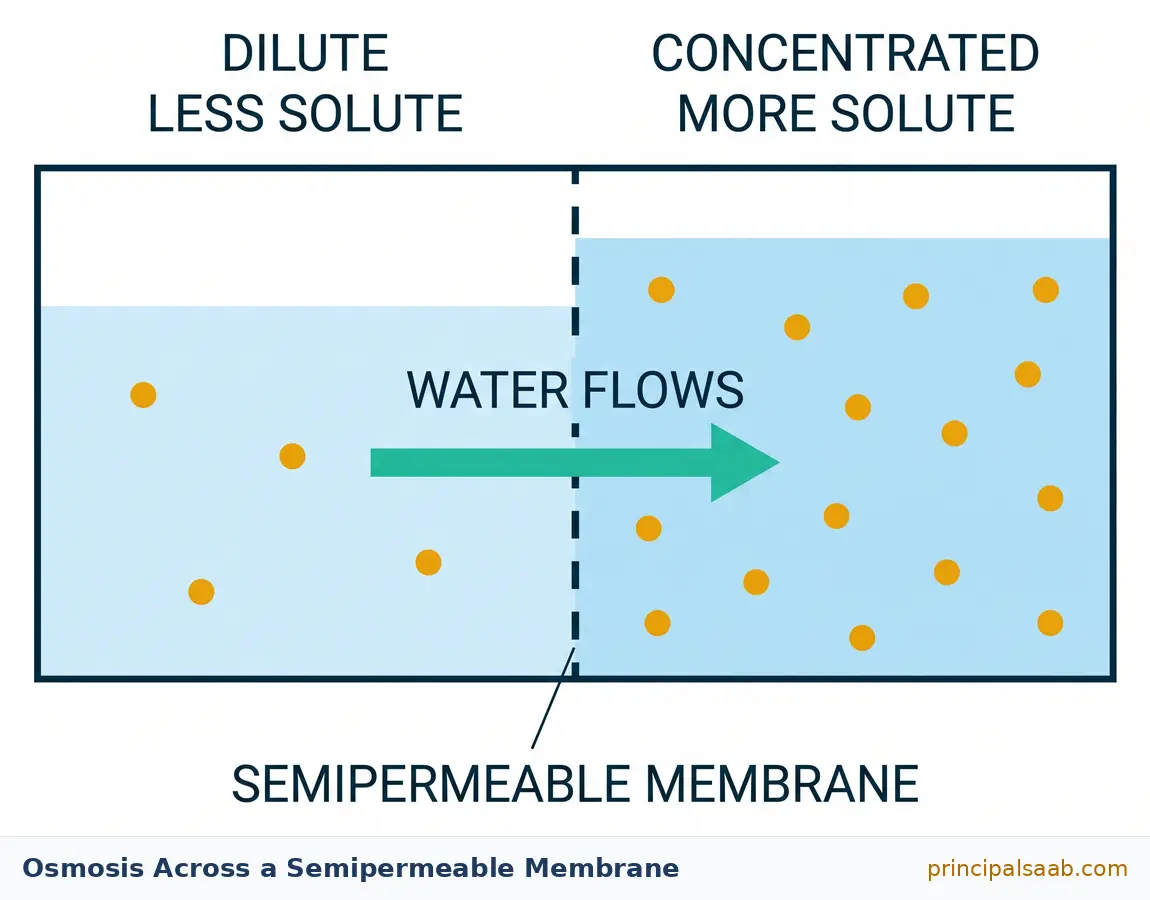
A semipermeable membrane is a barrier with holes large enough to let solvent molecules through but too small for the bigger solute particles. The raisin’s skin is one; so is cellophane, and so is the membrane around every cell in your body.
Osmosis is the net flow of solvent molecules through a semipermeable membrane, from the side of lower solute concentration to the side of higher solute concentration.
Why does it happen? On the dilute side there are more solvent molecules per unit area at the membrane, so more of them cross per second in that direction. It is not that water is being pulled — it is simply that more water is available to wander across from the dilute side. Nature drifts towards evening out the concentrations.
Osmotic Pressure
As solvent piles into the concentrated side, the liquid level there rises, and that column of liquid pushes back. Eventually the push balances the inflow and the flow stops.
Osmotic pressure (π) is the excess pressure that must be applied to the solution to just stop osmosis from happening. For dilute solutions it follows a strikingly familiar equation:
π = C R T
where C is molar concentration (mol L−1), R the gas constant and T the absolute temperature in kelvin. Since C = n ÷ V:
π V = n R T and, with n = w2 ÷ M2, M2 = (w2 R T) ÷ (π V)
Use R = 0.0821 L atm K−1 mol−1 when π is wanted in atm and V is in litres. Use R = 8.314 J K−1 mol−1 when working in pascals and cubic metres. Pick one, state it in your answer, and never mix the two inside a single calculation. Every worked example below uses R = 0.0821 L atm K−1 mol−1.
Isotonic, Hypertonic and Hypotonic
- Isotonic: two solutions with the same osmotic pressure. No net osmosis occurs between them. The saline used in an intravenous drip (0.9% w/v NaCl) is isotonic with blood, which is precisely why it can be given safely.
- Hypertonic: the solution with the higher osmotic pressure (more concentrated). Put a cell in a hypertonic solution and water rushes out — the cell shrinks and shrivels.
- Hypotonic: the solution with the lower osmotic pressure (more dilute). Put a cell in a hypotonic solution and water floods in — the cell swells and may burst.
These explain everyday things beautifully. Salted meat and sugared jam do not spoil, because the surroundings are strongly hypertonic to bacteria — water is pulled out of the microbes and they cannot survive. Wilted vegetables crisp up in plain water, which is hypotonic to their cells.
Reverse Osmosis
Apply a pressure to the concentrated side that is greater than its osmotic pressure, and you overpower the natural flow. Solvent is now forced backwards — from the concentrated solution to the dilute side, leaving the solute behind. That is reverse osmosis.
Its great application is the desalination of sea water. Sea water is pushed against a tough membrane at high pressure; pure water passes through and the salt is held back. The same principle sits inside the RO water purifier in millions of homes.
Question: Calculate the osmotic pressure of a 0.050 M aqueous glucose solution at 300 K. (R = 0.0821 L atm K−1 mol−1)
Step 1 — write the formula.
π = C R T
Step 2 — substitute with units.
π = (0.050 mol L−1) × (0.0821 L atm K−1 mol−1) × (300 K)
Step 3 — check the units cancel.
mol L−1 × L atm K−1 mol−1 × K leaves atm ✓
Step 4 — compute.
π = 0.050 × 0.0821 × 300 = 1.23 atm
Answer: π = 1.23 atm (3 significant figures). Glucose is a non-electrolyte, so no van’t Hoff factor is required.
Question: 1.2 g of a protein is dissolved in water to make 100 mL of solution. The osmotic pressure of this solution at 300 K is found to be 5.0 × 10⁻³ atm. Calculate the molar mass of the protein. (R = 0.0821 L atm K−1 mol−1)
Step 1 — write the rearranged formula.
M2 = (w2 R T) ÷ (π V)
Step 2 — convert the volume to litres.
V = 100 mL = 0.100 L
Step 3 — substitute.
M2 = (1.2 g × 0.0821 L atm K−1 mol−1 × 300 K) ÷ (5.0 × 10−3 atm × 0.100 L)
Step 4 — numerator and denominator separately.
Numerator = 1.2 × 0.0821 × 300 = 29.556
Denominator = 5.0 × 10−3 × 0.100 = 5.0 × 10⁻⁴
Step 5 — divide.
M2 = 29.556 ÷ (5.0 × 10⁻⁴) = 59112 g mol−1
Answer: M2 ≈ 5.9 × 10⁴ g mol−1 (2 significant figures, limited by the data). A huge molar mass — entirely normal for a protein.
Determining Molar Mass From Colligative Properties
You have now met four routes to the same destination. Let us gather them in one place, because a question will simply say “find the molar mass” and expect you to pick the right door.
| Colligative property | Basic relation | Molar mass formula |
|---|---|---|
| Relative lowering of vapour pressure | (p1° − p) ÷ p1° = x2 | M2 = (w2 M1 p1°) ÷ (w1 (p1° − p)) |
| Elevation of boiling point | ΔTb = Kb m | M2 = (1000 Kb w2) ÷ (ΔTb w1) |
| Depression of freezing point | ΔTf = Kf m | M2 = (1000 Kf w2) ÷ (ΔTf w1) |
| Osmotic pressure | π = C R T | M2 = (w2 R T) ÷ (π V) |
For a protein of molar mass 60000 g mol−1, the freezing point depression would be a few ten-thousandths of a kelvin — far too small for any thermometer to read reliably. But its osmotic pressure is easily measurable. Osmotic pressure is also measured at room temperature, so delicate biological molecules are not destroyed by heating. Those two reasons together are a standard exam answer.
Abnormal Molar Mass and the van’t Hoff Factor
Everything so far assumed a quiet, well-behaved solute: dissolve one particle, get one particle. For glucose and urea that is true. But some solutes cheat.
Dissolve sodium chloride in water and each formula unit splits into two particles, Na+ and Cl−. Colligative properties count particles — so NaCl produces roughly double the effect you would predict. When you then run that inflated measurement backwards through a molar mass formula, you get a molar mass that is about half the true value.
The opposite also happens. Benzoic acid dissolved in benzene pairs up — two molecules join through hydrogen bonding to form a single dimer. Now there are only half as many particles as expected, the colligative effect is halved, and the calculated molar mass comes out roughly double the true value.
A molar mass determined by a colligative property that disagrees with the true formula mass is called an abnormal molar mass. Two causes:
- Dissociation — particles increase, colligative effect increases, observed molar mass comes out lower than normal. (Electrolytes in water.)
- Association — particles decrease, colligative effect decreases, observed molar mass comes out higher than normal. (Carboxylic acids in benzene.)
The van’t Hoff Factor
Rather than abandon our formulas, van’t Hoff introduced a single correction factor, i:
i = (actual number of particles in solution) ÷ (number of particles dissolved)
Three equivalent ways to write it, all worth knowing because different questions phrase it differently:
- i = observed (experimental) colligative property ÷ calculated (theoretical) colligative property
- i = normal (theoretical) molar mass ÷ observed (abnormal) molar mass
- i = total moles of particles after dissociation or association ÷ total moles before
i > 1 → the solute has dissociated (NaCl gives i ≈ 2, CaCl2 and K2SO4 give i ≈ 3)
i < 1 → the solute has associated (benzoic acid in benzene approaches i = 0.5)
i = 1 → normal solute, neither happening (glucose, urea, sucrose)
Every colligative formula now simply gains an i:
ΔTb = i Kb m ΔTf = i Kf m π = i C R T (p1° − p) ÷ p1° = i x2
Degree of Dissociation (α)
Let us derive the link between i and α rather than memorise it. Suppose one molecule of AxBy dissociates into n particles, and a fraction α of the molecules actually do so. Start with 1 mole:
- Moles that dissociated = α. These produce nα moles of particles.
- Moles left undissociated = 1 − α.
- Total moles of particles now = (1 − α) + nα = 1 + (n − 1)α
Since we began with 1 mole, i is that total divided by 1:
i = 1 + (n − 1)α → α = (i − 1) ÷ (n − 1)
Degree of Association (α)
Now n molecules join into one. Start with 1 mole, fraction α associates:
- Moles that associated = α. These collapse into α/n moles of aggregate.
- Moles left free = 1 − α.
- Total = (1 − α) + α/n = 1 − α(1 − 1/n)
i = 1 − α(1 − 1/n) → α = (1 − i) ÷ (1 − 1/n)
For the common case of dimerisation (n = 2) this simplifies neatly to α = 2(1 − i).
Using the dissociation formula for an association problem. If the question mentions a dimer, a carboxylic acid in benzene, or an i less than 1, you need α = (1 − i) ÷ (1 − 1/n). Blindly applying (i − 1)/(n − 1) to i = 0.54 gives a negative α, which is impossible — if you ever get a negative degree of dissociation, you have grabbed the wrong formula.
Question: Calculate the depression in freezing point of a 0.010 molal aqueous solution of potassium sulphate (K2SO4), assuming complete dissociation. (Kf for water = 1.86 K kg mol−1)
Step 1 — write the dissociation.
K2SO4 → 2K+ + SO42−
One formula unit gives 2 + 1 = 3 particles, so n = 3.
Step 2 — find i.
Complete dissociation means α = 1, so i = 1 + (3 − 1)(1) = 3
Step 3 — apply the corrected formula.
ΔTf = i Kf m = 3 × 1.86 K kg mol−1 × 0.010 mol kg−1
ΔTf = 0.0558 K
Answer: 0.0558 K. Without the van’t Hoff correction you would have said 0.0186 K — three times too small. That is the whole reason this section exists.
Question: A 0.10 molal aqueous solution of a weak monobasic acid HX shows a freezing point depression of 0.20 K. Calculate the van’t Hoff factor and the degree of dissociation of the acid. (Kf for water = 1.86 K kg mol−1)
Step 1 — theoretical depression if no dissociation occurred.
ΔTf(calculated) = Kf m = 1.86 × 0.10 = 0.186 K
Step 2 — van’t Hoff factor.
i = observed ÷ calculated = 0.20 K ÷ 0.186 K = 1.075
Since i > 1, the acid has partially dissociated — consistent with it being a weak acid.
Step 3 — identify n.
HX → H+ + X−, so n = 2
Step 4 — degree of dissociation.
α = (i − 1) ÷ (n − 1) = (1.075 − 1) ÷ (2 − 1) = 0.075 ÷ 1 = 0.075
Answer: i = 1.075 and α = 0.075, that is about 7.5% dissociated. A small percentage, exactly as expected for a weak acid.
Question: 2.0 g of benzoic acid (C7H6O2) dissolved in 50 g of benzene lowers the freezing point by 0.90 K. Calculate the van’t Hoff factor, the observed molar mass, and the degree of association. (Kf for benzene = 5.12 K kg mol−1; C = 12, H = 1, O = 16)
Step 1 — normal molar mass of benzoic acid.
(7 × 12) + (6 × 1) + (2 × 16) = 84 + 6 + 32 = 122 g mol−1
Step 2 — theoretical molality (assuming no association).
n2 = 2.0 ÷ 122 = 0.01639 mol
m = 0.01639 mol ÷ 0.050 kg = 0.3279 mol kg−1
Step 3 — theoretical depression.
ΔTf(calculated) = 5.12 × 0.3279 = 1.679 K
Step 4 — van’t Hoff factor.
i = 0.90 K ÷ 1.679 K = 0.536
i < 1, confirming association.
Step 5 — observed molar mass.
Mobserved = Mnormal ÷ i = 122 ÷ 0.536 = 228 g mol−1 — nearly double the true value, just as dimerisation predicts.
Step 6 — degree of association (dimer, so n = 2).
α = 2(1 − i) = 2(1 − 0.536) = 2 × 0.464 = 0.928
Answer: i = 0.536, observed molar mass ≈ 228 g mol−1, and about 92.8% of the benzoic acid exists as dimers. Benzene cannot hydrogen bond with the –COOH group, so the acid molecules pair with each other instead.
The Complete Formula Sheet
Everything in one place for the night before the exam.
| Quantity | Formula | Symbols | Unit |
|---|---|---|---|
| Molarity | M = n2 ÷ V | V = volume of solution in L | mol L−1 |
| Molality | m = n2 ÷ w1 | w1 = mass of solvent in kg | mol kg−1 |
| Mole fraction | x2 = n2 ÷ (n1 + n2) | n = number of moles | none |
| Henry’s law | p = KH x | p = partial pressure of gas | KH in bar |
| Raoult (volatile) | pA = pA° xA | p° = vapour pressure of pure liquid | mm Hg or bar |
| Total pressure | ptotal = pB° + (pA° − pB°)xA | straight line in xA | mm Hg or bar |
| Vapour composition | yA = pA ÷ ptotal | y = mole fraction in vapour | none |
| Relative lowering of VP | (p1° − p) ÷ p1° = i x2 | p = VP of solution | none |
| Elevation of boiling point | ΔTb = i Kb m | Kb(water) = 0.52 | K; Kb in K kg mol−1 |
| Depression of freezing point | ΔTf = i Kf m | Kf(water) = 1.86, Kf(benzene) = 5.12 | K; Kf in K kg mol−1 |
| Osmotic pressure | π = i C R T | R = 0.0821 L atm K−1 mol−1 | atm |
| van’t Hoff (dissociation) | i = 1 + (n − 1)α | n = particles per formula unit | none |
| van’t Hoff (association) | i = 1 − α(1 − 1/n) | n = molecules per aggregate | none |
Practice Worksheet With Full Solutions
Twelve questions, arranged from gentle to board level. Attempt each one properly on paper before you click it open — reading a solution feels like learning, but it is not. Struggling first is what makes it stick.
Use these constants where needed: Kb(water) = 0.52 K kg mol−1, Kf(water) = 1.86 K kg mol−1, Kf(benzene) = 5.12 K kg mol−1, R = 0.0821 L atm K−1 mol−1. Atomic masses: H = 1, C = 12, N = 14, O = 16, Na = 23, Cl = 35.5, K = 39, Ca = 40.
Q1. Calculate the molarity of a solution made by dissolving 0.85 g of sodium nitrate (NaNO3) in enough water to make 100 mL of solution.
Molar mass of NaNO3 = 23 + 14 + (3 × 16) = 23 + 14 + 48 = 85 g mol−1
Moles = 0.85 g ÷ 85 g mol−1 = 0.010 mol
Volume = 100 mL = 0.100 L
Molarity = 0.010 mol ÷ 0.100 L = 0.10 mol L−1
Answer: 0.10 M
Q2. 5.85 g of sodium chloride is dissolved in 250 g of water. Calculate the molality of the solution.
Molar mass of NaCl = 23 + 35.5 = 58.5 g mol−1
Moles of NaCl = 5.85 ÷ 58.5 = 0.10 mol
Mass of solvent = 250 g = 0.250 kg (the water only)
Molality = 0.10 mol ÷ 0.250 kg = 0.40 mol kg−1
Answer: 0.40 m
Q3. Calculate the mole fraction of the solute in a 1.5 molal aqueous solution.
A 1.5 molal solution contains 1.5 mol of solute in 1000 g of water — use that as the sample.
Moles of water = 1000 g ÷ 18 g mol−1 = 55.56 mol
Total moles = 1.5 + 55.56 = 57.06 mol
xsolute = 1.5 ÷ 57.06 = 0.0263
Answer: xsolute = 0.0263 (and xwater = 0.9737; the two add to 1.0000 ✓)
Q4. An aqueous solution of glucose (C6H12O6) is 10% by mass. Calculate its molality.
Interpret the percentage. 10% by mass means 10 g of glucose in 100 g of solution, so the water is 100 − 10 = 90 g.
Molar mass of glucose = (6 × 12) + (12 × 1) + (6 × 16) = 180 g mol−1
Moles of glucose = 10 ÷ 180 = 0.05556 mol
Molality = 0.05556 mol ÷ 0.090 kg = 0.617 mol kg−1
Answer: 0.617 m. The classic trap here is dividing by 0.100 kg instead of 0.090 kg — molality needs the mass of solvent, not solution.
Q5. The partial pressure of oxygen in air at sea level is about 0.20 bar. If KH for oxygen in water at 298 K is 4.6 × 10⁴ bar, calculate the mole fraction of oxygen dissolved in water.
Henry’s law: p = KH x, so x = p ÷ KH
x = 0.20 bar ÷ (4.6 × 10⁴ bar) = 0.20 ÷ 46000
x = 4.35 × 10⁻⁶
Answer: x(O2) = 4.35 × 10⁻⁶. Extremely small — which is exactly why fish need continuously flowing, well-aerated water to survive.
Q6. Liquids A and B form an ideal solution. At a certain temperature pA° = 200 mm Hg and pB° = 400 mm Hg. An equimolar mixture of A and B is prepared. Find the total vapour pressure and the mole fraction of A in the vapour.
Equimolar means xA = xB = 0.50
Partial pressures (Raoult):
pA = 200 × 0.50 = 100 mm Hg
pB = 400 × 0.50 = 200 mm Hg
Total pressure (Dalton): 100 + 200 = 300 mm Hg
Vapour composition:
yA = 100 ÷ 300 = 0.33
yB = 200 ÷ 300 = 0.67
Answer: ptotal = 300 mm Hg, yA = 0.33. In the liquid A was 0.50 but in the vapour it has fallen to 0.33, because B is the more volatile component and dominates the vapour.
Q7. 1.8 g of glucose is dissolved in 100 g of water. Calculate the elevation in boiling point and the boiling point of the solution.
Moles of glucose = 1.8 ÷ 180 = 0.010 mol
Molality = 0.010 mol ÷ 0.100 kg = 0.10 mol kg−1
ΔTb = Kb m = 0.52 × 0.10 = 0.052 K
Boiling point = 100 + 0.052 = 100.052 °C (or 373.20 K)
Answer: ΔTb = 0.052 K, boiling point = 100.052 °C. Glucose is a non-electrolyte, so i = 1.
Q8. 2.5 g of a non-volatile, non-electrolyte solute is dissolved in 100 g of benzene. The freezing point of benzene falls by 1.28 K. Calculate the molar mass of the solute.
Step 1 — molality from ΔTf = Kf m.
m = 1.28 K ÷ 5.12 K kg mol−1 = 0.25 mol kg−1
Step 2 — moles of solute in 0.100 kg of benzene.
n2 = 0.25 × 0.100 = 0.025 mol
Step 3 — molar mass.
M2 = 2.5 g ÷ 0.025 mol = 100 g mol−1
Answer: 100 g mol−1. Cross-check with the direct formula: (1000 × 5.12 × 2.5) ÷ (1.28 × 100) = 12800 ÷ 128 = 100 ✓
Q9. Calculate the osmotic pressure at 300 K of a solution containing 3.42 g of sucrose (C12H22O11) in 1.00 L of solution.
Molar mass of sucrose = (12 × 12) + (22 × 1) + (11 × 16) = 144 + 22 + 176 = 342 g mol−1
Moles = 3.42 ÷ 342 = 0.010 mol
Concentration = 0.010 mol ÷ 1.00 L = 0.010 mol L−1
π = C R T = 0.010 × 0.0821 × 300 = 0.246 atm
Answer: π = 0.246 atm (3 significant figures). Sucrose does not dissociate, so i = 1.
Q10. Calculate the depression in freezing point of a 0.10 molal aqueous solution of calcium chloride, assuming it dissociates completely.
Step 1 — the dissociation.
CaCl2 → Ca2+ + 2Cl−
One formula unit gives 1 + 2 = 3 particles, so n = 3.
Step 2 — van’t Hoff factor.
Complete dissociation means α = 1, so i = 1 + (3 − 1)(1) = 3
Step 3 — apply ΔTf = i Kf m.
ΔTf = 3 × 1.86 × 0.10 = 0.558 K
Answer: ΔTf = 0.558 K, so the solution freezes at about −0.558 °C.
Q11. A 0.50 molal aqueous solution of potassium chloride shows an observed freezing point depression of 1.72 K. Calculate the van’t Hoff factor and the degree of dissociation of KCl.
Step 1 — theoretical depression (if KCl did not dissociate).
ΔTf(calculated) = Kf m = 1.86 × 0.50 = 0.93 K
Step 2 — van’t Hoff factor.
i = observed ÷ calculated = 1.72 ÷ 0.93 = 1.85
Step 3 — identify n.
KCl → K+ + Cl−, so n = 2
Step 4 — degree of dissociation.
α = (i − 1) ÷ (n − 1) = (1.85 − 1) ÷ 1 = 0.85
Answer: i = 1.85 and α = 0.85, i.e. about 85% dissociated. Not quite 100% — in a moderately concentrated solution, oppositely charged ions attract one another and behave partly as pairs, so i falls a little short of 2.
Q12. (a) Distinguish between positive and negative deviation from Raoult’s law, giving one example of each. (b) Why can an azeotropic mixture not be separated by fractional distillation? (c) State two reasons why osmotic pressure is preferred for finding the molar mass of a protein.
(a) Positive deviation: the A–B interaction is weaker than A–A and B–B, so molecules escape more easily and the observed vapour pressure is higher than Raoult predicts. Here ΔmixH > 0 and ΔmixV > 0. Example: ethanol and water.
Negative deviation: the A–B interaction is stronger than A–A and B–B (a new hydrogen bond forms), so molecules escape less easily and the observed vapour pressure is lower than predicted. Here ΔmixH < 0 and ΔmixV < 0. Example: chloroform and acetone.
(b) Fractional distillation works only because the vapour has a different composition from the liquid, so each cycle of boiling and condensing enriches one component. At the azeotropic composition the vapour and the liquid have identical composition, and the mixture boils at a constant temperature. Boiling and condensing therefore returns the same mixture, and no separation is possible.
(c) (i) Proteins have very large molar masses, so the freezing point or boiling point change they produce is far too small to measure accurately, whereas their osmotic pressure is appreciable and easily measured. (ii) Osmotic pressure is measured at ordinary room temperature, so the protein is not denatured or decomposed by heating.
One Last Word Before You Close This Page
If some of this still feels blurry, that is completely normal and it is not a verdict on your ability. Solutions is a chapter that arrives in layers — the concentration terms make more sense once you have used them inside a colligative formula, and the colligative formulas make more sense once you have seen the van’t Hoff factor. Coming back for a second reading is not failure. It is how this chapter is meant to be learned.
So do not try to master everything tonight. Pick one section. Work three numericals from it until you can do them without peeking. Tomorrow, pick the next one.
You do not need a dramatic breakthrough. You need a small, honest improvement every single day. Aim for one more correct question than yesterday. Twelve weeks of that quietly adds up to a student who is simply not worried about this paper any more.