
Carbon and its Compounds is one of the biggest scoring chapters in Class 10 Science — carbon is the element of life, and its chemistry runs from cooking gas to vinegar to soap. This page teaches the whole chapter in plain language, with a plan and an original practice set (with answers you can reveal) at the end.
What This Chapter Covers
- Covalent bonding and the versatile nature of carbon
- Hydrocarbons: saturated and unsaturated
- Functional groups and homologous series
- Chemical reactions; ethanol and ethanoic acid; soaps
Your Game Plan for This Chapter
- First — Understand covalent bonding and why carbon forms so many compounds.
- Next — Learn hydrocarbons, functional groups and homologous series.
- Last — Cover the reactions, ethanol and ethanoic acid, and soaps — then attempt the practice set.
Study Notes
1. Covalent Bonding and the Versatile Nature of Carbon
Carbon has four electrons in its outer shell, so instead of gaining or losing electrons it shares them, forming covalent bonds. Two properties make carbon extraordinarily versatile: tetravalency (it can form four strong bonds) and catenation (carbon atoms link to one another in long chains, branches and rings). Together, these let carbon form millions of stable compounds.
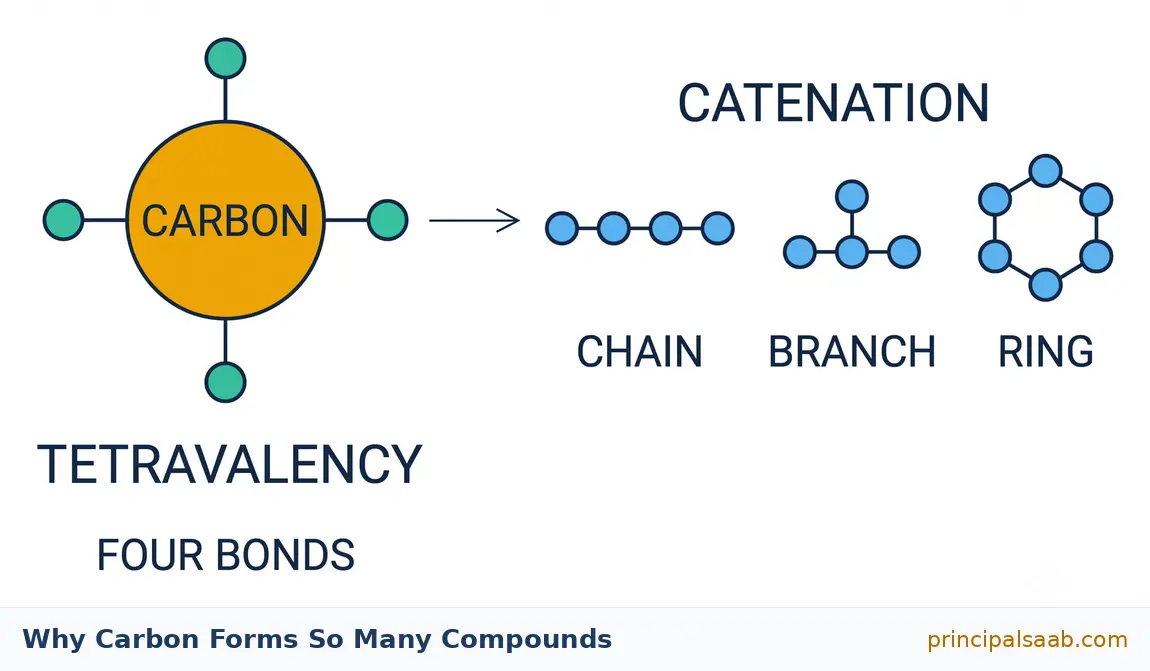
Tetravalency + catenation = the two reasons carbon forms more compounds than every other element combined. If a question asks “why so many carbon compounds,” these are the two words to write.
2. Hydrocarbons: Saturated and Unsaturated
Hydrocarbons contain only carbon and hydrogen. Saturated hydrocarbons (alkanes) have only single bonds; unsaturated ones have double bonds (alkenes) or triple bonds (alkynes).
3. Functional Groups and Homologous Series
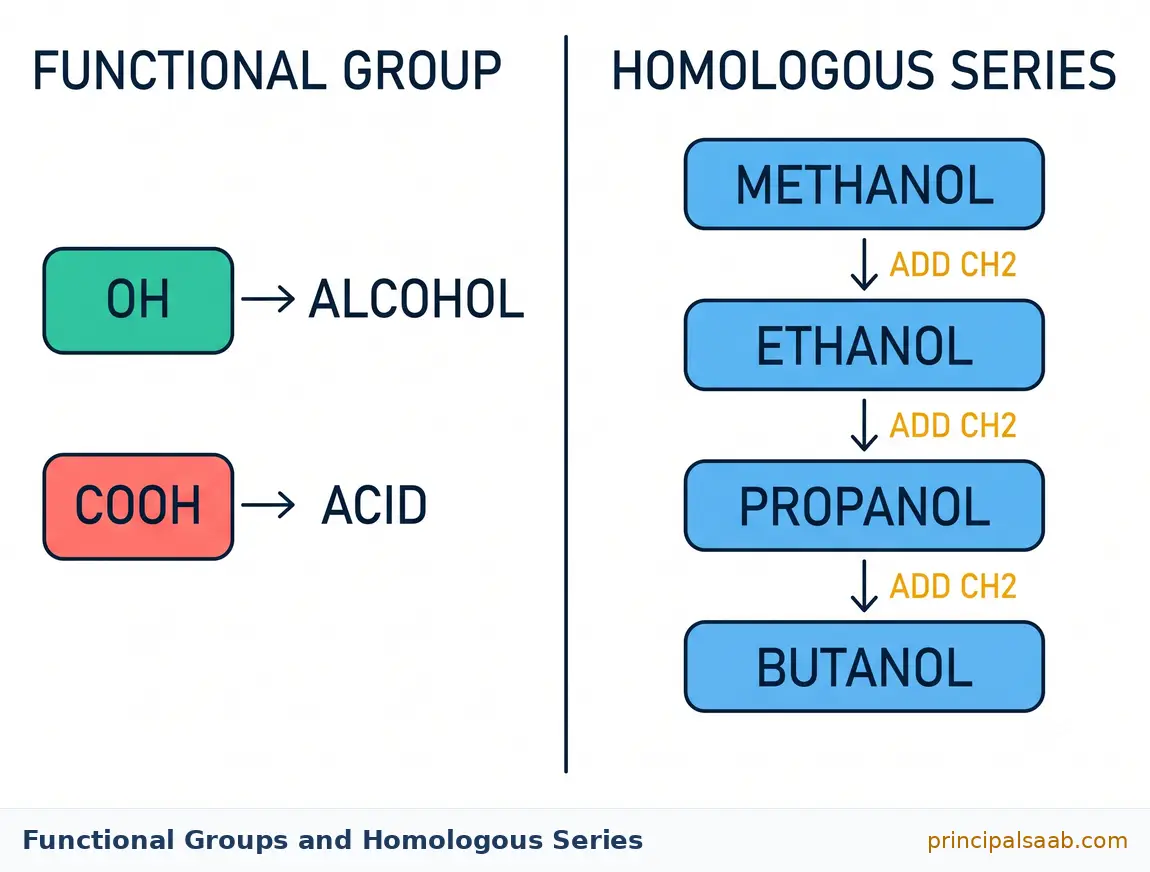
A functional group is an atom or group of atoms that gives a compound its characteristic properties — for example, –OH (alcohol) and –COOH (carboxylic acid). A homologous series is a family of compounds with the same functional group in which each member differs from the next by a –CH2– unit. Members of a series show similar chemical properties and a gradual change in physical properties.
4. Chemical Reactions; Ethanol and Ethanoic Acid; Soaps
- Combustion: carbon compounds burn in air to give carbon dioxide, water, heat and light.
- Addition: unsaturated hydrocarbons add hydrogen (with a nickel catalyst) to become saturated.
- Substitution: saturated hydrocarbons (alkanes) react with chlorine in sunlight, where hydrogen atoms are replaced by chlorine.
Ethanol reacts with sodium to give hydrogen gas, and on oxidation it becomes ethanoic acid (acetic acid, the acid in vinegar). Ethanoic acid reacts with carbonates to release CO2, and with an alcohol to form a sweet-smelling ester. Soap cleans because each molecule has a water-hating tail and a water-loving head: in water the tails surround the oily dirt while the heads face outward, forming clusters called micelles that carry the dirt away.
Addition reactions belong to unsaturated hydrocarbons; substitution reactions belong to saturated ones. Swapping these is a frequent slip.
Practice Worksheet
Try each question fully on your own first, then click Show Answer to check yourself.
Q1. Why does carbon form a very large number of compounds? Give two reasons.
Show Answer
Q2. What is a homologous series? Give one example.
Show Answer
Q3. Distinguish between an addition reaction and a substitution reaction.
Show Answer
Q4. How does ethanol react with (a) sodium and (b) on oxidation?
Show Answer
Q5. Explain the cleansing action of soap and the role of micelles.
Show Answer
Once these feel easy, you have genuinely finished this chapter. Do not aim for perfect on the first try — aim for one more correct question than yesterday.