
Acids, Bases and Salts is one of the most practical chapters in Class 10 Science — it is all around you, from the tang of a lemon to the antacid you take after a heavy meal. This page teaches the whole chapter in plain language, with examples, a plan, and an original practice set (with answers you can reveal) at the end.
What This Chapter Covers
- Acids, bases and indicators
- Chemical properties of acids and bases
- Strength and the pH scale
- Salts and important chemicals
Your Game Plan for This Chapter
- First — Learn what acids and bases are, and how indicators tell them apart.
- Next — Master the reactions and the pH scale — these carry the most marks.
- Last — Memorise the important salts (name, formula, use), then attempt the practice set.
Study Notes
1. Acids, Bases and Indicators
Acids taste sour and turn blue litmus red (e.g. HCl, H2SO4, citric acid). Bases taste bitter, feel soapy, and turn red litmus blue (e.g. NaOH, Ca(OH)2). Indicators are substances that show whether something is acidic or basic by a change in colour or smell — litmus, phenolphthalein and methyl orange are common ones, and onion and clove act as olfactory (smell) indicators.
An acid shows acidic behaviour only in water, because it produces hydrogen ions (H+) in solution. A base produces hydroxide ions (OH−). No water, no free ions, no acidic/basic behaviour.
2. Chemical Properties of Acids and Bases
- Acid + metal → salt + hydrogen gas. Example: Zn + 2HCl → ZnCl2 + H2.
- Acid + metal carbonate / hydrogencarbonate → salt + water + carbon dioxide.
- Acid + metal oxide → salt + water (metal oxides are basic).
- Base + non-metal oxide → salt + water (non-metal oxides are acidic).
- Neutralisation: acid + base → salt + water.
3. Strength and the pH Scale
The strength of an acid or base depends on how many H+ or OH− ions it produces. The pH scale (0 to 14) measures this: pH 7 is neutral, below 7 is acidic, above 7 is basic. The lower the pH, the more acidic; the higher, the more basic. pH matters in daily life — our body works in a narrow pH range, tooth decay starts when the mouth’s pH falls below about 5.5, and plants grow best in soil of the right pH.
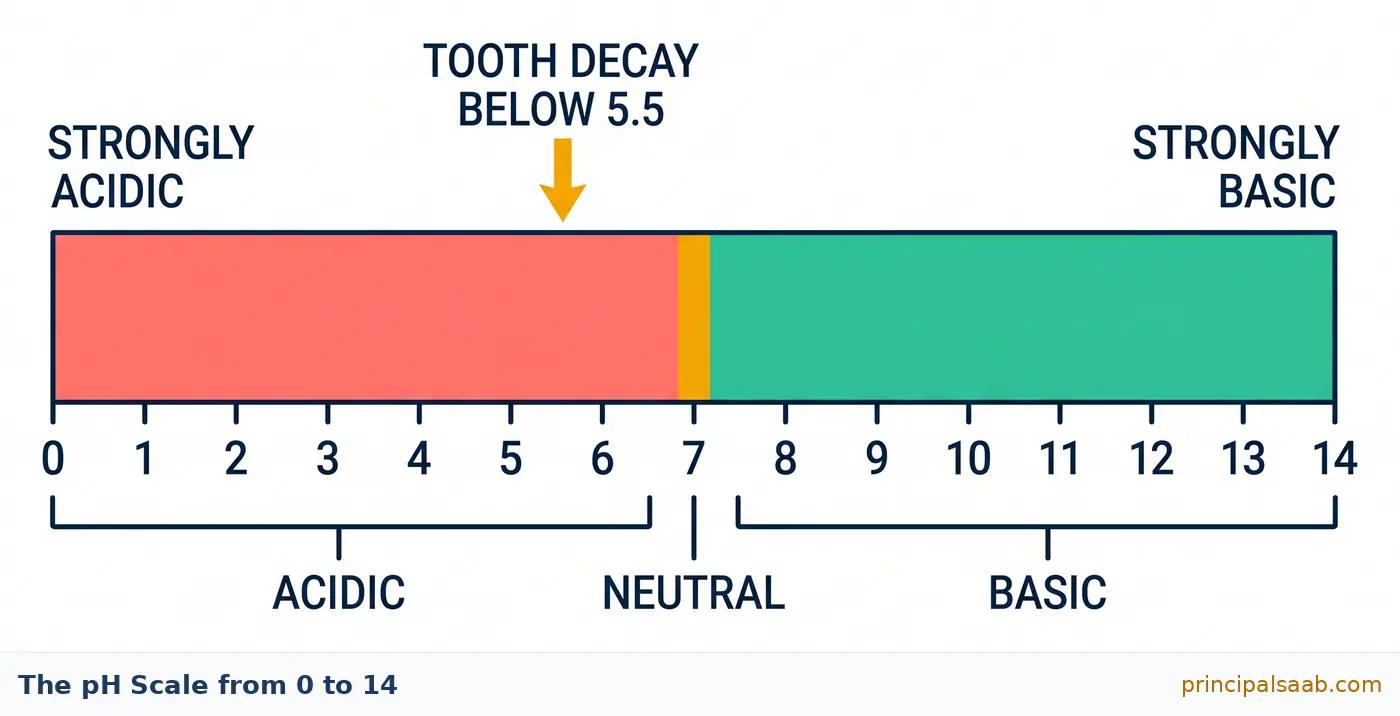
A lower pH means more acidic, not less. pH 2 is far more acidic than pH 6. Do not read the scale backwards.
4. Salts and Important Chemicals
Salts are formed when an acid reacts with a base. From common salt (sodium chloride) we get several important chemicals. Water of crystallisation is the fixed number of water molecules chemically joined in one formula unit of a salt — for example, washing soda is Na2CO3·10H2O.
The chemical name, formula and one use of baking soda, washing soda, bleaching powder and plaster of Paris are asked almost every year. Learn the table above cold.
Practice Worksheet
Try each question fully on your own first, then click Show Answer to check yourself.
Q1. What happens when zinc reacts with dilute hydrochloric acid? Write the equation.
Show Answer
Q2. Why does dry HCl gas not turn blue litmus red, but its water solution does?
Show Answer
Q3. A solution has a pH of 2. Is it acidic or basic? What happens to its pH when diluted with water?
Show Answer
Q4. Give the chemical name, formula and one use each of baking soda and washing soda.
Show Answer
Q5. What is water of crystallisation? Give one example.
Show Answer
Once these feel easy, you have genuinely finished this chapter. Do not aim for perfect on the first try — aim for one more correct question than yesterday.