

Take a breath. If you have been putting off this chapter because it looks like a wall of party names and percentages, I want to promise you something right at the start: Political Parties is one of the friendliest chapters in the whole Civics book. There is almost no date to memorise, no map to draw, no formula to apply. It is a chapter about something you already understand in your bones, because you have lived a small version of it every time your class held an election for monitor or your school picked a head boy and head girl.
Here is the whole chapter in one sentence, and I want you to read it twice: a political party is a group of people who agree on how the country should be run, who join together to win elections, and who then either form the government or hold the government to account. That is it. Everything else in this chapter is just detail hanging off that sentence — what parties do, how many a country should have, how they are recognised, what goes wrong with them, and how they might be fixed.
Why is it easy to score in? Because the questions are predictable. Year after year the board asks about the functions of parties, the three kinds of party systems, the challenges parties face, and the reforms suggested. Those four blocks are worth the bulk of the marks. If you learn them properly — not by rote, but so you can explain them to a friend — you can walk into the exam expecting to get almost everything right. Let us build that understanding slowly, together, starting from absolute zero. Nothing here assumes you remember anything from earlier chapters.
What You’ll Learn
- Why Do We Need Political Parties? The Big Idea
- What Is a Political Party? Its Three Components
- Functions of Political Parties
- Why Parties Are Necessary in a Democracy
- How Many Parties Should a Country Have?
- National and State Parties in India
- Challenges to Political Parties
- How Can Parties Be Reformed?
- Exam Strategy for This Chapter
- Practice Worksheet
Your Game Plan
- Read the first two sections slowly and make sure you can define a political party in your own words without looking.
- Learn the functions of parties as a numbered list — this single list feeds several different questions.
- Draw the three party-system types as a small table in your notebook. Tables stick in memory better than paragraphs.
- Learn the recognition rules for National and State parties as rules, not as a list of party names, because names change but rules do not.
- Pair each challenge with its remedy. The board loves asking them together.
- Finish with the worksheet at the bottom, writing full answers on paper before you open the reveal.
Why Do We Need Political Parties? The Big Idea
Let us start with a thought experiment, and I want you to actually picture it rather than skim past it. Imagine your school announces a student council election, but with one strange rule: no groups allowed. Every single candidate must stand entirely alone, with no shared plan, no shared name, no shared symbol. Four hundred students stand for forty seats.
Now put yourself in the voter’s chair. How would you choose? You would have to individually research four hundred people. And suppose you did, and the forty winners took their seats — what then? Each of them arrived with a private wish list. One wants longer lunch breaks, another wants a new basketball court, a third wants the library open on Sundays. There is no shared programme, so nothing gets a majority, so nothing gets done. The council would argue for a year and deliver nothing.
Now change one thing. Allow candidates to form panels. A panel picks a name, agrees on a written list of five things it will do if it wins, and puts up candidates across the school. Suddenly voting is easy: you read five short manifestos instead of four hundred biographies. And governing is easy too, because the winning panel already agreed on what it wants before the election even began.
That panel is a political party in miniature. Parties exist because large-scale representative democracy is simply not workable without them. They compress thousands of individual opinions into a handful of clear choices, and they turn a crowd of individual winners into a working government. This is the deepest point in the chapter, and if you understand it properly, half the later questions answer themselves.
Political parties are not an unfortunate side effect of democracy — they are the machinery that makes representative democracy actually function. Parties are so central that democracy is often described as being, in practice, government by parties.
Model answer: A political party is an organised group of people who share a common set of ideas about how society should be governed, who contest elections in order to gain political power, and who use that power to put their policies into practice.
Why this scores: A one-mark definition needs three things packed in — a group with shared ideas, contesting elections, and seeking power to implement policies. Miss any one and the examiner may not award the mark. Note how short it is; do not waste time writing a paragraph for one mark.
Whenever a question begins with “Why do we need…” or “Justify the need for…”, the examiner is looking for reasons, not descriptions. Structure your answer as: without parties, X would happen; with parties, Y happens instead. That contrast earns marks fast.
Don’t move on until this feels comfortable. Close your eyes and try to explain the panel example to an imaginary younger sibling. If you can do that, you have understood the foundation of the chapter.
What Is a Political Party? Its Three Components
We have a working definition. Now let us look inside a party, the way you might open the back of a clock to see the gears. A political party is not one lump of people. It has three components, and the exam asks about these often enough that you should be able to name them instantly.
1. The leaders. These are the people at the top who take the big decisions — who will be the candidate in each seat, what the party’s position will be on a new law, who will become Chief Minister or Prime Minister if the party wins. They are the visible face of the party. Think of them as the captain and vice-captain of a cricket team: few in number, high in responsibility.
2. The active members. These are the workers. They are formally enrolled, they attend meetings, they organise rallies, they campaign door to door, they run the party office in a district. They are fewer than the followers but far more numerous than the leaders. Without them a party would be a handful of famous names with no machine underneath. In our cricket analogy, these are the rest of the playing eleven plus the support staff.
3. The followers (or supporters). These are the ordinary citizens who believe in the party’s ideas and vote for it, but who do not do organisational work. They are by far the largest group. In the cricket analogy, they are the crowd in the stadium — they do not bowl or bat, but without them there is no match worth playing.
Remember the three components in order of size: leaders (fewest), active members (more), followers (most). A useful memory hook is the shape of a pyramid — narrow at the top, wide at the base.
There is one more idea you must attach to the definition, and it is the one students most often skip. A party is held together by an ideology — a shared set of beliefs about what a good society looks like and how the country should be run. Some parties emphasise rapid industrial growth, some emphasise the interests of farmers or workers, some emphasise regional identity and state autonomy, some emphasise social justice for particular communities. The specific content varies enormously. What matters for your exam is the general point: parties are not random collections of ambitious people, they are groups organised around ideas.
Attached to the ideology is the manifesto — the written document a party publishes before an election, listing the policies and programmes it promises to carry out if voted in. Your school panel’s list of five promises was a manifesto. A real party’s manifesto might run to a hundred pages, but the idea is identical.
Students write that a party’s aim is “to serve the people”. That is far too vague and often earns nothing. The technically correct phrasing is that a party seeks to contest elections and hold political power in order to implement its policies. Power is not a dirty word here — it is the accurate academic term, and examiners expect it.
Model answer:
(i) The leaders — a small group at the top who take major decisions such as selecting candidates, deciding the party’s stand on issues, and choosing who will head the government if the party wins.
(ii) The active members — enrolled workers who form the party’s organisational machinery. They attend meetings, run local units and carry out the election campaign.
(iii) The followers or supporters — the large body of ordinary citizens who believe in the party’s ideas and vote for it, without taking part in organisational work.
Why this scores: One mark per component, and each mark is earned by the explanation, not merely the name. Notice the pattern: name the component in bold, then one sentence of what it actually does. Copy that pattern for every three-mark “describe” question in this chapter.
Reason (R): A party openly takes the side of a particular section of society and a particular set of policies, rather than claiming to be neutral.
Choose: (a) both A and R true, R explains A; (b) both true, R does not explain A; (c) A true, R false; (d) A false, R true.
Model answer: (a) — both statements are true and the reason correctly explains the assertion. A partisan is a person or group committed to one side. Parties are openly partisan by design; that is not a flaw but their defining feature, since democracy needs organised alternatives to choose between.
Why this scores: Assertion-reason items are pure comprehension. The trick is to test each statement separately for truth first, and only then ask whether R actually explains A. Do it in that order every time and you will rarely be caught out.
Functions of Political Parties
This is the single highest-value section in the chapter. If you learn nothing else properly, learn this. Examiners ask it as a 3-mark question (“any three functions”), as a 5-mark question (“explain any five”), and hidden inside case-based questions. There are seven functions in the syllabus. I will explain each one with a picture in your head so you never have to cram them.
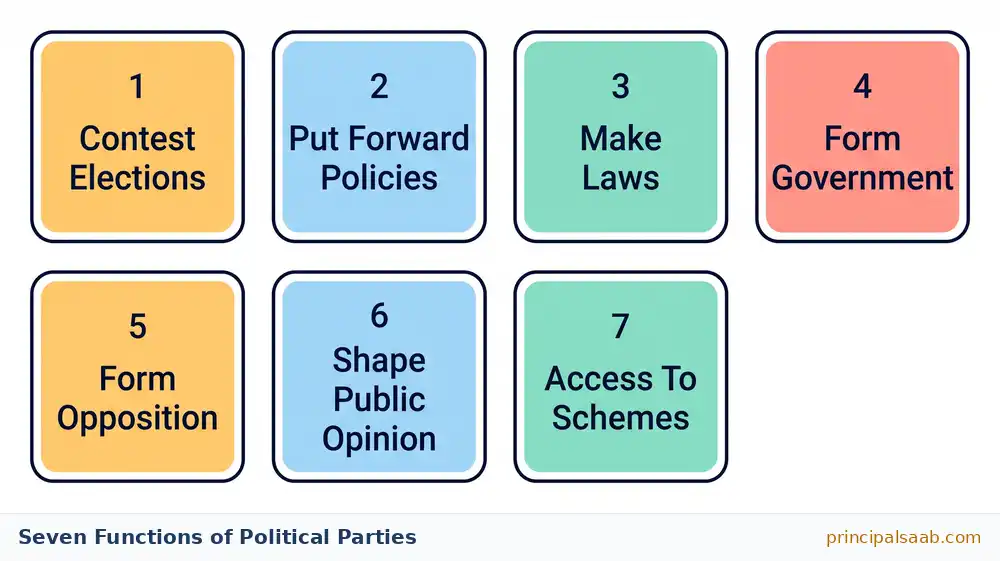
1. Parties contest elections. This is the most obvious one. In most democracies elections are fought mainly between candidates put up by parties. The party selects its candidates for each seat. In some countries members choose candidates through internal voting; in India, candidates are usually chosen by the party’s top leaders. Without this filtering step, ballots would be chaos.
2. Parties put forward different policies and programmes. Voters cannot each design their own economic plan. Parties do the hard work of turning a mass of scattered opinions into a small number of coherent packages. Over time, parties also tend to group similar opinions together, so that a voter who cares about, say, farmers’ incomes can find a party already carrying that concern. This function is what gives the voter a meaningful choice rather than a choice between faces.
3. Parties play a decisive role in making laws. Laws are formally debated and passed in the legislature. But members almost always vote along the line their party has decided. So the real decision is taken inside the party first, and the legislature then records it. Understanding this explains a lot about how Indian politics actually works.
4. Parties form and run governments. Big policy decisions are taken by the party that wins. The party recruits and trains its leaders, then makes them ministers who run the government. Notice the word recruit — a party is also a training ground for future leaders, which is a point worth adding for an extra mark.
5. Parties that lose form the opposition. Losing an election does not make a party useless. Opposition parties criticise the government for its wrong policies and failures, and mobilise opposition to it. Crucially, they also present an alternative — a different government-in-waiting. A democracy without a real opposition is only half a democracy.
6. Parties shape public opinion. Parties raise and highlight issues. With their many workers and their connections to pressure groups and movements, they carry ideas out into society, launch campaigns, and turn a scattered grievance into a public debate. Sometimes an issue that begins as a small local complaint becomes a national conversation because a party picked it up.
7. Parties provide people access to government machinery and welfare schemes. This one is easy to under-appreciate. For an ordinary citizen, a government office can feel distant and intimidating. A local party worker is someone you can actually reach. Because the party worker is close at hand and wants your vote, they are more likely to listen to your demand and help you get your entitlement — a ration card, a pension, a scheme benefit. This is the function that makes parties matter in daily life, not just at election time.
A memory hook for the seven functions: C-P-L-G-O-S-A — Contest, Policies, Laws, Government, Opposition, Shape opinion, Access. Write the seven letters in the margin of your answer sheet the moment you open the paper, and you will never blank out.
Model answer:
(i) Contesting elections: Parties select candidates and fight elections, so that voters choose between organised alternatives rather than hundreds of unconnected individuals.
(ii) Putting forward policies and programmes: Parties reduce a huge diversity of opinion into a few coherent policy packages, giving voters a meaningful choice through their manifestos.
(iii) Making laws: Although laws are passed in the legislature, members generally vote as their party decides, so parties effectively shape legislation.
(iv) Forming and running the government: The winning party recruits and trains leaders, makes them ministers, and takes the major decisions of government.
(v) Providing access to government machinery: Local party workers are easier for ordinary citizens to approach than officials, and help people obtain welfare benefits and get their grievances heard.
Why this scores: Five clearly separated points, each with a heading word and one explanatory sentence, is exactly a five-mark structure. The examiner can find each mark in under two seconds. Do not write five functions as a single flowing paragraph — the marks are there, but the examiner has to hunt for them, and hunting costs you.
Writing “parties form the government” and “parties run the government” as two separate points to pad out a five-mark answer. Examiners treat them as one function. Choose five genuinely different functions from the list of seven.
Parties are how power actually gets shared in practice, so revise this with our Class 10 Civics notes on Power Sharing.
Why Parties Are Necessary in a Democracy
You may be wondering why this gets its own section when we already discussed the big idea. The difference is subtle but worth ten marks over a whole paper: the earlier section explained how parties came about, while this section answers the exam question “Why are parties necessary?” — which needs the argument stated as a chain of consequences.
Let us build that chain slowly. Suppose we abolished all parties tomorrow. Candidates could still stand for election as independents. What would go wrong?
First, no candidate would be accountable for the country as a whole. Every candidate would campaign only on local issues — a road here, a bridge there. Nobody would be responsible for national questions such as how the economy is run or how the country deals with poverty, because no individual candidate could deliver on those alone.
Second, no one could form a stable government. The legislature would be full of independents who owe nothing to each other. Governments would be assembled and collapse constantly, because there would be no organised block committed in advance to a common programme.
Third, there would be no way to judge the government’s performance. When a party is in power, you know exactly who to blame or reward at the next election — it is written on the ballot. With only independents, responsibility would dissolve into a fog, and the voter’s single most powerful tool, the ability to throw out a government, would be useless.
Put those three together and you reach the conclusion the syllabus wants: the rise of political parties is directly linked to the rise of representative democracy. Large societies need representation; representation needs a way to gather people’s views into a few options and hold the powerful accountable; parties are that way. This is why even countries that once banned parties usually end up with them again in some form.
The three-word summary for this section is accountability, stability, responsibility. Without parties: no accountability for national issues, no stable government, no way to fix responsibility for performance.
Model answer:
(i) If there were no parties, every candidate would be an independent and would campaign only on local concerns. No one would be answerable for major national questions such as economic policy.
(ii) No group would be able to form a stable government, because the elected members would share no common programme and no commitment to one another.
(iii) Voters would have no way to fix responsibility for how the country has been run, since there would be no single body that could be rewarded or removed at the next election.
Why this scores: The question says “give three reasons”, so give exactly three, numbered. Each reason here describes a consequence of the absence of parties — that is the correct logical shape for a question phrased this way. Answers that simply list the functions of parties usually lose marks, because listing is not reasoning.
How Many Parties Should a Country Have?
Every democracy has many parties in the sense that many are registered and free to contest. The real question is different: how many parties have a genuine chance of coming to power? That is what decides which kind of party system a country has. Hold that phrase in your mind — genuine chance of coming to power — because it is the pivot the whole classification turns on.
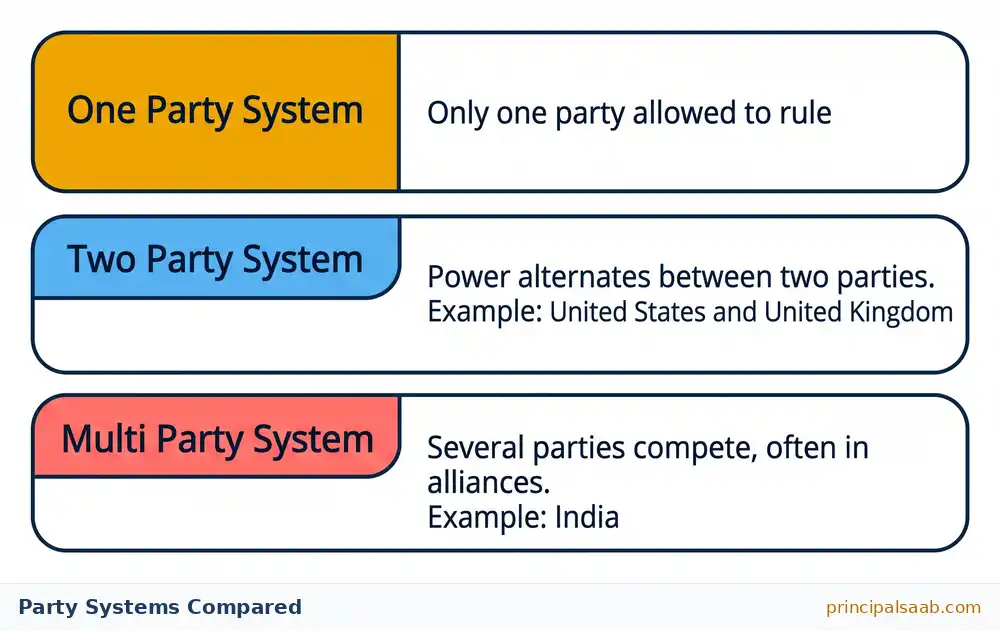
One-party system. Only one party is allowed to control and run the government. Other parties are either banned outright or not permitted to compete for power. It is important to be clear-eyed here for the exam: this is not considered a good option, because a democratic system must offer people at least two meaningful choices and must allow the ruling group to be voted out. A system with only one permitted party fails that test.
Two-party system. Power usually changes between two main parties. Several other parties may exist, may contest, and may even win a few seats — but only the two big ones have a realistic chance of winning a majority and forming the government on their own. The United States and the United Kingdom are the standard textbook illustrations.
Multi-party system. Several parties compete for power, and more than two have a reasonable chance of coming to power either on their own or in alliance with others. India is the classic example. Very often no single party wins a majority, so parties group together into an alliance or front and contest the election jointly. If such an alliance wins, it forms a coalition government — a government made up of several parties sharing power on the basis of an agreed common programme.
Think of it as three restaurants. A one-party system is a canteen with one dish and no alternative. A two-party system is a place with two set meals. A multi-party system is a large buffet — more choice, but you may need to combine several dishes to make a full plate, and combining takes negotiation.
| Basis | One-Party System | Two-Party System | Multi-Party System |
|---|---|---|---|
| Parties with a real chance of power | Only one | Two main parties | Several parties |
| Competition permitted | No genuine competition | Free competition, but power alternates between two | Free and wide competition |
| Usual type of government | Single-party government | Usually a single-party majority government | Frequently a coalition or alliance government |
| Main advantage | Decisions can be taken quickly | Clear choice for voters and a stable government | Represents a wide range of interests and regions |
| Main drawback | Not a democratic option; people cannot change the rulers | Smaller groups and viewpoints may go unrepresented | Can appear untidy and may lead to political instability |
| Example | Systems where only one party is legally permitted to rule | United States, United Kingdom | India |
So why does the multi-party system suit India? This is a favourite five-mark question, so let us reason it out rather than memorise it. India is enormous and extraordinarily varied — many languages, many regions, many communities, many kinds of economic life. A system with only two parties would force all of that variety into two boxes, and huge numbers of people would find that neither box represented them. A multi-party system, by contrast, lets regional and social diversity find political expression. It is undoubtedly messier. Governments are often coalitions and coalitions require constant negotiation. But the syllabus makes the judgement clearly: this system has evolved because it suits the social and geographical diversity of a country as large as India, and no system can be judged good or bad in the abstract — it must fit the society it serves.
A party system is not chosen by a country the way you choose a subject. It evolves over a long time, depending on the society’s nature, its social and regional divisions, its history and its system of elections. Write this sentence in any answer about party systems — it is very often a mark on its own.
Model answer:
(i) Social diversity: India is a vast country with many languages, religions, castes and communities. A two-party system could not absorb this diversity, and many groups would feel unrepresented.
(ii) Geographical diversity: Different regions have very different concerns. Regional parties allow the specific interests of a state or region to be voiced in national politics.
(iii) Wider representation: Several parties competing means a larger number of interests and opinions have a genuine chance of gaining a share in power.
(iv) Room for alliances: When no single party wins a majority, parties form alliances and run coalition governments, so power is shared rather than concentrated.
(v) Disadvantage: The system can appear disorderly and may lead to political instability, since coalition governments depend on continued agreement between partners.
Why this scores: Notice the question has two parts — reasons plus one disadvantage. Students routinely answer only the first part and lose a full mark. Always underline the number of separate demands in a question before you begin writing. Here, four reasons plus one disadvantage is a clean five.
Model answer: A two-party system. The number of registered parties is not the test; what matters is how many parties have a realistic chance of winning power. Here only two do.
Why this scores: This is exactly the trap the examiner sets in objective questions. Train yourself to ignore the total count of parties and look only for the phrase “chance of coming to power”.
An alliance or front is formed before the election, when parties agree to contest together and divide seats among themselves. A coalition government is what results after the election if that alliance wins. Keeping the before and after clear is an easy way to sound precise.
National and State Parties in India
This section makes students nervous because it contains numbers and party names. I am going to make it easy by separating two things that are often mixed together: the rules, which barely change, and the list of parties, which changes every few years. Learn the rules properly and you can never be wrong. Treat the list as current information that you should check before your exam.
Start with the basics. In India, any group of people can form a political party, but it must register with the Election Commission of India (ECI). The Commission treats all parties equally in principle, but it gives some special privileges to large and established parties. These parties are called recognised political parties. Recognition is what gets a party a reserved election symbol — a symbol that only its own candidates may use across the area of recognition. That symbol matters enormously in a country where many voters identify a party visually.
Recognition comes in two levels: State party and National party. The criteria are laid down by the Election Commission in its order on election symbols, and they are based purely on electoral performance — votes polled and seats won. They are not based on a party’s age, its wealth, or how famous its leaders are. That is a fair and important point to make in an answer.
| Level of recognition | Main conditions (any one is enough) | Chief privilege |
|---|---|---|
| State party | Broadly, a party qualifies in a state if it secures about six per cent of the valid votes polled in that state in an Assembly or Lok Sabha election and also wins a minimum number of seats; or if it wins a set share of the Assembly seats of that state (about three per cent, or at least three seats, whichever is higher); or if it wins one Lok Sabha seat for every twenty-five seats allotted to that state; or, under a further route, if it secures about eight per cent of the valid votes polled in the state. | A symbol reserved for its candidates within that state. |
| National party | Broadly, a party qualifies if it is recognised as a State party in at least four states; or if it secures about six per cent of the valid votes in four or more states in a Lok Sabha or Assembly election and wins at least four Lok Sabha seats; or if it wins at least two per cent of the total Lok Sabha seats, with those members elected from at least three different states. | A symbol reserved for its candidates across the whole country. |
Read that table twice, then notice the underlying logic, because the logic is what you should actually remember. A State party has to prove real support inside one state. A National party has to prove real support spread across several states. Every one of the detailed conditions is just a different way of measuring “spread”. If a number slips out of your head in the exam, state the logic — you will usually still earn the mark.
Recognition is not permanent. The Election Commission reviews the performance of recognised parties after general elections to the Lok Sabha and to State Assemblies. A party that no longer meets the criteria can lose its status, and a party that newly meets them can gain it. This single sentence explains why any printed list goes out of date.
Now the part that trips up almost every student, and the reason I asked you to separate rules from lists. The list of National parties printed in older textbooks is no longer the current list. Your textbook was written some years ago, and since then the Election Commission has carried out reviews that changed the position.
What older textbook editions typically list: a set of National parties that included the Bharatiya Janata Party, the Indian National Congress, the Bahujan Samaj Party, the Communist Party of India (Marxist), the Communist Party of India, the Nationalist Congress Party and the All India Trinamool Congress.
The current position, as of 2026: in April 2023 the Election Commission reviewed party performance and made two kinds of change at once. It granted National party status to the Aam Aadmi Party, on the strength of its performance across several states. At the same time it withdrew National party status from the Communist Party of India, the Nationalist Congress Party and the All India Trinamool Congress, because their electoral performance no longer met the criteria. Those three continue as recognised State parties in the states where they qualify — losing National status does not mean a party ceases to exist or cannot contest.
The result is that the recognised National parties as of 2026 are commonly listed as six: the Bharatiya Janata Party, the Indian National Congress, the Bahujan Samaj Party, the Communist Party of India (Marxist), the National People’s Party and the Aam Aadmi Party. I am stating this as the verified current position, and I am stating it purely as a fact about recognition status, with no comment of any kind on the merits of any party.
This list is accurate as of 2026, but recognition is reviewed after every general election to the Lok Sabha and to State Assemblies, so it can change again. Before your exam, take two minutes to check the current list of recognised National and State parties on the Election Commission of India’s own website. If a question asks you to name National parties and you are unsure whether a particular party still qualifies, name the ones you are confident about and add the phrase “as recognised by the Election Commission at present” — that phrasing protects you.
Assuming a “National party” is simply a big or famous party, and a “State party” is a small one. That is not the definition. The terms are precise legal categories awarded by the Election Commission on the basis of measured electoral performance. A State party can be very large within its own state and still, correctly, be a State party.
Model answer:
(i) Meaning: Every political party in India must register with the Election Commission. The Commission gives special status, called recognition, to some large and established parties, and a recognised party is allotted a reserved election symbol that only its own candidates may use.
(ii) Criterion based on spread of state recognition: A party is recognised as a National party if it is recognised as a State party in at least four states.
(iii) Criteria based on votes and seats: Alternatively, it qualifies if it secures about six per cent of the valid votes in four or more states along with at least four Lok Sabha seats, or if it wins at least two per cent of Lok Sabha seats with members elected from at least three different states.
Why this scores: The question has two demands — a meaning and the criteria — so the answer gives both. Because the exact figures can be hard to recall, the answer names the type of criterion in each point, so even a wobbly number does not sink the whole mark.
The Election Commission periodically reviews how recognised parties have performed in elections. After one such review, a party that had held National status for many years was moved down to State party status, while another party that had recently done well across four different states was raised to National status. Both parties continued to contest elections as before.
(a) On what basis does the Election Commission take such decisions? (1 mark)
Purely on the basis of electoral performance — the share of valid votes polled and the number of seats won in Lok Sabha and State Assembly elections — measured against the criteria laid down in its order on election symbols.
(b) What does the party that was moved down actually lose? (1 mark)
It loses the privilege of a symbol reserved for it throughout the country. As a recognised State party it keeps a reserved symbol only within the state or states where it still qualifies.
(c) “Recognition is a moving target rather than a permanent title.” Explain this statement with reference to the passage. (2 marks)
Recognition depends on continuing electoral performance, and performance changes from election to election. Because the Commission reviews parties after general elections, a party that stops meeting the criteria can be moved down, while a party that begins meeting them can be moved up. The passage shows both movements happening after a single review, which proves that the status reflects current performance rather than past reputation.
Why this scores: In case-based questions, never answer from memory alone — anchor each answer to a phrase in the passage. Notice that part (c) is worth two marks and therefore needs two distinct ideas: that the criteria are performance-based, and that reviews happen periodically.
To judge how well parties deliver, read our Outcomes of Democracy chapter notes.
Challenges to Political Parties
We have spent the chapter arguing that parties are necessary. Now comes the honest other half. Parties are necessary and they face serious problems. The syllabus identifies four challenges, and they are examined constantly, often as a five-mark question. Learn them as four, in order, and you will always have a full answer ready.
Before we begin, a word about tone. These are described as challenges to parties in general, as a category — not as accusations against any particular party. Write your answers the same way. An answer that names and attacks a specific party is both academically weak and unnecessary; the marks are for understanding the problem, not for taking a side.
Challenge 1: Lack of internal democracy. A party asks voters for democracy in the country, but often does not practise it inside its own organisation. What does that look like in practice? Power concentrates in the hands of one or a few top leaders. Ordinary members do not get regular information about what happens inside the party. Membership registers are not properly maintained. Internal organisational elections are not held regularly, or are held only as a formality. Ordinary members have no real way to influence decisions. The result is that leaders take decisions in the name of the party without genuinely consulting it, and members who disagree have little choice but to fall in line or leave.
Here is a way to feel this rather than just read it. Imagine your school panel from the opening example. It won the election on a manifesto. But the head of the panel now decides everything alone, never calls a meeting, never tells members what was decided or why, and picks next year’s candidates personally. The panel is still democratic on the outside — it faced an election — but it is not democratic on the inside. That gap is exactly challenge one.
Challenge 2: Dynastic succession. This flows directly from the first. Because there is no open and transparent internal functioning, those already at the top are in a position to favour people close to them, very often their own family members. In many parties the top positions are held by members of one family. This is unfair to other members who have worked for years, and it is bad for democracy as a whole, because people without the right connections may never rise, and the country may be led by people who did not have to earn their position through experience or public support.
Notice the logical link: challenge two is a consequence of challenge one. If you write that sentence in an exam, it shows the examiner you have understood the material rather than memorised a list. That is exactly the kind of line that lifts a good answer to a full-marks answer.
Challenge 3: Growing role of money and muscle power. Elections are about winning, and the pressure to win pushes parties towards whatever works. That can mean raising and spending very large sums of money. It can mean preferring candidates who can fund their own campaign or bring money into the party, over candidates who have more public support but less money. In some cases it can mean tolerating candidates with criminal connections because they can influence the outcome. The deeper danger here is not just unfairness at one election. It is that rich people and large companies who fund campaigns gain influence over the policies and decisions of the party they funded — which quietly shifts power away from ordinary voters.
Challenge 4: No meaningful choice for voters. This is the most abstract of the four, so take it slowly. Democracy requires a meaningful choice, which means the main parties should differ in some significant way. In practice, in many countries, the major parties have come closer together on fundamental questions, particularly on economic policy. There are still differences in detail, but the range of real alternatives has narrowed. A related problem is that even the choice of leaders narrows, because candidates who move between parties often present voters with the same set of faces regardless of which party wins. When that happens, the voter’s choice becomes a choice of label rather than a choice of direction.
Four challenges, in a chain you can remember: no internal democracy makes room for dynastic succession; the pressure to win brings in money and muscle power; and as parties converge, voters are left with no meaningful choice. Learn it as a story, not as four unrelated bullets.
Model answer:
(i) Lack of internal democracy: Power tends to be concentrated in a few leaders at the top. Membership registers are not properly maintained, organisational elections are not held regularly, and ordinary members have no real say in decisions.
(ii) Dynastic succession: Because internal functioning is not transparent, leaders are able to favour people close to them, often their own relatives. Top posts in many parties are held by members of one family, which is unfair to other members and harmful to democracy.
(iii) Money and muscle power: The pressure to win elections leads parties to raise very large funds and sometimes to prefer candidates who can finance their own campaigns. Those who provide the money can then gain influence over the party’s decisions.
(iv) No meaningful choice: The major parties have come closer together on fundamental questions, especially economic policy, so voters find the differences between them narrowing. Candidates also move between parties, so the choice of leaders narrows too.
(v) Overall effect: Together these challenges weaken people’s trust in parties, even though parties remain essential to the working of a democracy.
Why this scores: The question asks for four challenges but carries five marks, which is a signal that the examiner wants a fifth element — usually a short concluding evaluation. The closing line supplies it. Whenever the number of points asked for is smaller than the number of marks, add a conclusion.
| Challenge | What it looks like in practice | Remedy suggested |
|---|---|---|
| Lack of internal democracy | Power concentrated at the top; no proper membership registers; organisational elections not held regularly; members have no say in decisions. | A law to regulate the internal affairs of parties, requiring them to maintain a register of members, follow their own constitution, hold internal elections and use an independent authority to settle disputes; the Election Commission’s order that parties must hold organisational elections and file income tax returns. |
| Dynastic succession | Top posts held by members of one family; long-serving ordinary members unable to rise. | The same regulation of internal affairs, since transparent internal elections and open candidate selection make favouritism harder; also greater pressure from public opinion and the media. |
| Money and muscle power | Very large campaign spending; preference for candidates who can fund themselves; influence of donors over policy; candidates with criminal cases. | The Supreme Court’s order requiring every candidate to file an affidavit disclosing assets, pending criminal cases and educational qualifications; and the proposal that the state should fund elections. |
| No meaningful choice | Major parties converging on fundamental policy; the same candidates appearing under different party labels. | Stronger internal democracy and wider participation, so that parties develop distinct programmes; and the anti-defection law, which limits members switching sides after being elected. |
Learn this table by rows, not by columns. If you can recite one full row — the challenge, what it looks like, and its remedy — you have simultaneously prepared for a question on challenges, a question on reforms, and a question that combines both. Three questions for the price of one row.
Model answer:
(i) In many parties there is no transparent internal functioning: membership records are incomplete, internal elections are rare, and decisions are taken by a small group at the top.
(ii) In such conditions there is no fair and open process for choosing who rises within the party. Those already holding power are therefore able to favour people close to them, and family members are the most obvious beneficiaries.
(iii) The consequence is unfair to ordinary members who have worked for the party for years, and it is harmful to democracy, because leadership passes to people who have not had to earn it through experience or demonstrated public support.
Why this scores: This is a cause-and-effect question, so the answer is built as cause, mechanism, consequence. The word “closely connected” in the question is your instruction to show the link. An answer that describes the two problems separately, without connecting them, typically loses a mark.
How Can Parties Be Reformed?
Having named the problems, the syllabus turns to the remedies. Split them into two boxes in your mind, because the exam does: measures already taken (these are law or official orders, and they exist right now) and reforms that have been suggested (these are proposals, not yet law). Mixing the two up is one of the commonest errors in this chapter.
Measures Already In Place
1. The anti-defection law. “Defection” means an elected representative leaving the party on whose ticket they were elected, in order to join another. In the years before this law, governments were repeatedly made and unmade by members changing sides, often in exchange for money or a ministerial post. To stop this, Parliament passed the 52nd Constitutional Amendment in 1985, which added the Tenth Schedule to the Constitution.
How does it work? An elected member of Parliament or of a State Legislature can be disqualified from the House on the ground of defection if they voluntarily give up membership of the party on whose ticket they were elected, or if they vote (or abstain from voting) in the House against the direction issued by their party without obtaining prior permission. An independent member who joins a party after being elected can also be disqualified. The decision on such a disqualification is taken by the Chairman or the Speaker of the House concerned.
Now the balanced view, because the syllabus insists on it. The law has undoubtedly reduced defection and made governments more stable. But it has had a side effect: because members risk disqualification if they vote against their party’s direction, they have very little freedom to disagree with their own leadership even when they believe their leaders are wrong. So the law has, in a sense, increased the power of party leaders over ordinary members. Writing both sides of this earns you the higher band of marks.
Anti-defection law = 52nd Constitutional Amendment, 1985, Tenth Schedule. If you remember only one number-plus-year pair from this chapter, make it this one. It appears in objective questions almost every year.
2. The Supreme Court’s affidavit order. To reduce the influence of money and of candidates with criminal records, the Supreme Court passed an order making it mandatory for every candidate contesting an election to file an affidavit giving details of their assets and liabilities, any criminal cases pending against them, and their educational qualifications. This affidavit has to be submitted to the Election Commission and is made public, so any voter can look it up.
Again, the honest assessment. This has provided a great deal of new information to citizens, which is a genuine gain. But there is no system that independently verifies whether what a candidate declares is actually true, so the affidavit tells you what the candidate has stated rather than what has been checked. The measure is a real step forward, and it is incomplete. Say both.
3. The Election Commission’s order on internal functioning. The Election Commission passed an order making it compulsory for political parties to hold their organisational elections and to file their income tax returns. The reasoning is straightforward: internal elections attack the lack of internal democracy, and income tax returns attack the opacity of party finances. The candid observation the syllabus makes is that parties have largely complied with this as a formality — they do it because it is required, not because it has transformed how they work internally.
Reforms That Have Been Suggested
These are proposals. Be careful to present them as suggestions, not as existing law.
- A law to regulate the internal affairs of political parties. Such a law would require every party to maintain a proper register of its members, to follow its own constitution, to have an independent authority act as a judge in case of internal disputes, and to hold open elections to its highest posts.
- Reserving seats for women. It has been suggested that parties should be required to give a minimum share of their tickets — about one-third — to women candidates, and that there should similarly be a quota for women in the party’s decision-making bodies. The aim is to bring women into positions where decisions are actually taken, not merely onto the candidate list.
- State funding of elections. The proposal is that the government should give parties money to meet their election expenses, so that they depend less on private donors. The support could be given in kind — for example, providing paper for ballots, petrol for vehicles, or space and time for campaigning — or, in some versions of the proposal, as cash based on the votes a party secured in the previous election.
Now the point I most want you to carry out of this chapter, because it is the mature line that separates a good answer from an excellent one. Laws alone are not enough. There are two honest cautions. First, laws that seek to ban things usually have negative side effects — the anti-defection law is the example we already discussed, where a law meant to curb defection ended up reducing ordinary members’ freedom to disagree. Second, political reform cannot depend on legislation alone, because those who would have to pass the reform are the very people whose behaviour is to be reformed, and they are unlikely to be enthusiastic about it.
So what else is needed? Two things. Pressure from ordinary citizens, exercised through petitions, publicity, agitations, and above all through the media — parties are sensitive to public opinion because their survival depends on votes. And the quality of people who join politics: parties improve if good people take part in them, rather than standing outside and complaining about them. That last idea is genuinely worth thinking about beyond the exam.
Writing that “one-third of seats are reserved for women in political parties” as though it were existing law. It is a suggested reform, not a law that has been passed. Similarly, state funding of elections is a proposal, not a current arrangement. Use the words “it has been suggested that” for these, and keep “the law provides” for the anti-defection law and the affidavit and Election Commission orders.
Model answer:
(i) A law to regulate internal affairs: Parties should be required by law to maintain a register of members, follow their own constitution, hold open elections to their highest posts, and refer internal disputes to an independent authority.
(ii) Reservation of tickets for women: Parties should be required to give about one-third of their tickets to women candidates, and to reserve a share of posts in their decision-making bodies for women.
(iii) State funding of elections: The government should meet part of parties’ election expenses, in kind or in cash, so that parties depend less on private donors and the influence of money is reduced.
(iv) Pressure from citizens and the media: Ordinary people should use petitions, publicity and public campaigns to press parties to change, since parties respond to public opinion when their votes are at stake.
(v) Better participation in politics: Parties can improve only if capable and honest people join them and take part, rather than staying away and criticising from outside.
Why this scores: The command word is “suggest”, so the answer must offer proposals rather than describe existing law. The last two points are the ones most students forget, and they are also the points that show you understood the chapter’s conclusion that laws alone are not enough.
Model answer:
(i) Meaning: The anti-defection law was introduced by the 52nd Constitutional Amendment of 1985, which added the Tenth Schedule to the Constitution. It provides that an elected member of Parliament or of a State Legislature may be disqualified from the House if they voluntarily give up membership of the party on whose ticket they were elected, or vote against their party’s direction in the House without prior permission.
(ii) Benefit: It has substantially reduced defection by elected members and has therefore made governments more stable, since a government can no longer be brought down by members changing sides for personal gain.
(iii) Drawback: It has reduced the independence of individual members, who can no longer express disagreement with their own party’s decision in the House without risking disqualification. This has increased the power of party leaders over ordinary members.
Why this scores: Three demands, three marks, three paragraphs — the structure mirrors the question exactly. Also note the precise use of the amendment number and the year; in a question about a named law, getting those right is often worth the difference between full and partial credit.
Before nomination, every candidate must now submit a sworn statement listing their property and debts, any criminal cases pending against them, and the qualifications they hold. These statements are made public. A voter in a small town looked up the statements filed by the four candidates in her constituency and found that they differed sharply. She remarked afterwards that she had learned more in ten minutes than in a month of listening to speeches.
(a) What is the sworn statement described in the passage called, and who ordered that it must be filed? (1 mark)
It is called an affidavit, and the requirement to file it was laid down by an order of the Supreme Court.
(b) Which challenge to political parties is this measure mainly intended to address? (1 mark)
It is mainly aimed at the growing role of money and muscle power in politics, by making a candidate’s wealth and criminal record visible to voters before they vote.
(c) The voter felt better informed. Does this mean the problem is solved? Give reasons. (2 marks)
No. The measure is a genuine improvement because it has placed a large amount of previously unavailable information in the hands of citizens, and voters can now compare candidates on facts rather than on speeches alone. However, there is no independent machinery to verify whether the details a candidate declares are accurate. The affidavit therefore records what the candidate has claimed rather than what has been checked, so the measure reduces the problem without removing it.
Why this scores: Part (c) is the discriminating question. A one-sided answer, whether entirely positive or entirely negative, would earn one mark at most. The two marks are for balance: state the gain, then state the limitation, and use a connecting word such as “however” so the examiner sees the two halves clearly.
Exam Strategy for This Chapter
You have the content. Now let us make sure it converts into marks, because those are two different skills and only one of them is taught in most classrooms.
Know where the marks live. Four blocks carry most of the weight in this chapter: the functions of parties, the three party systems, the four challenges, and the reforms. If you are short of time, revise those four and the recognition rules, in that order. Everything else in the chapter supports these.
Match your length to the marks. A rough guide that serves most students well: one mark means one or two precise sentences; three marks means three separate numbered points, each a sentence or two; five marks means five separate points, each with a bolded lead word and an explanation. Never write a five-mark answer as one unbroken paragraph. The content might be perfect and you will still lose marks simply because the examiner cannot locate them quickly.
Read the command word. This chapter uses several and they are not interchangeable. Describe or explain means give the point and then develop it. State or list means give the point briefly without development. Suggest means propose measures, not describe existing ones. Evaluate or “do you agree” means give both sides and then a short judgement. Underline the command word before you write a single line.
Count the demands. Many questions in this chapter contain two or three separate demands hidden in one sentence — “explain the meaning and state the criteria”, “give reasons and state one disadvantage”. Circle each demand on the question paper. Students lose more marks in Civics from answering only part of a question than from not knowing the content.
Handle case-based questions in a fixed order. Read the passage once for sense, then read each question, then reread the passage hunting specifically for the answer. Anchor every answer to something in the passage, even in questions that also need outside knowledge. And check the marks on each sub-part: a two-mark sub-part needs two distinct ideas, not one idea expressed twice.
Stay neutral. This chapter names real parties. Your answers should treat them exactly as the syllabus does — as factual examples. Do not praise or criticise any party in an answer. Examiners are marking your understanding of how party systems work, and a neutral, academic tone reads as more confident, not less.
Be careful with numbers and dates. There are only a few in this chapter, so learn them properly: the 52nd Amendment of 1985 for the anti-defection law, the approximate percentages in the recognition criteria, and the three components and seven functions as counts. If a percentage genuinely will not stick, describe the criterion in words instead of guessing a figure — a wrong number can cost you more than a vaguer but correct description.
In the last five minutes before your paper begins, write these four counts in the margin of your rough sheet: 3 components, 7 functions, 3 party systems, 4 challenges. Under exam stress the most common failure is not forgetting the content but forgetting how many items you were supposed to produce. The counts are a safety net.
Model answer:
Why parties are essential:
(i) They allow voters to choose between organised alternatives with clear programmes, instead of between hundreds of unconnected individuals.
(ii) They form and run governments, and the parties that lose form the opposition, which criticises the government and presents an alternative.
(iii) They give ordinary citizens access to government machinery and welfare schemes through local party workers, and they fix responsibility so that voters can reward or remove a government.
Why they are criticised:
(iv) They often lack internal democracy, which allows power to concentrate in a few hands and opens the way to dynastic succession; and the pressure to win elections has increased the role of money and muscle power.
(v) Voters sometimes find little meaningful difference between the major parties on fundamental questions, which narrows real choice.
Conclusion: Both parts of the statement are correct. Parties remain indispensable to the working of a large democracy, and the response to their shortcomings is therefore to reform them through better internal regulation, transparency and public pressure, rather than to do away with them.
Why this scores: The command word is “examine”, which demands both sides and a judgement. Notice the layout — two clearly labelled halves and a short conclusion. This structure works for every “examine”, “evaluate” or “do you agree” question in Civics, so make it a habit. The conclusion is doing real work here: it resolves the apparent contradiction in the quotation rather than just repeating the points.
The Congress story here begins in our Nationalism in India History notes.
Practice Worksheet
Here is the part that actually builds marks. Take a sheet of paper and write a full answer to each question before you open the reveal. Reading a model answer feels productive and teaches you very little; writing one and then comparing is what changes your score. Give yourself the number of minutes the marks suggest — roughly one and a half minutes per mark — so you also practise working at exam speed.
Q1. What is meant by a coalition government? (1 mark)
Q2. Why is a reserved election symbol important to a political party? (1 mark)
Q3. Distinguish between a two-party system and a multi-party system. (3 marks)
(ii) Type of government usually formed: A two-party system usually produces a single-party majority government. A multi-party system frequently produces alliance or coalition governments, because no single party wins a majority.
(iii) Representation and stability: A two-party system gives a clear choice and generally stable government, but smaller groups may go unrepresented. A multi-party system represents a wider range of interests and regions, but can appear disorderly and may lead to political instability.
Q4. Explain any three functions performed by political parties in a democracy. (3 marks)
(ii) Forming the opposition: Parties that lose the election form the opposition. They criticise the government for its failures and wrong policies, mobilise opposition to it, and offer voters an alternative government.
(iii) Shaping public opinion: Parties raise and highlight issues, launch campaigns through their many workers, and often work alongside pressure groups and movements, so that scattered concerns become subjects of public debate.
(Any three of the seven functions are acceptable, provided each is explained rather than merely named.)
Q5. What is the difference between a National party and a State party in India? (3 marks)
(ii) Spread of support required: A State party has to demonstrate substantial support within a single state, through a required share of the valid votes polled together with a minimum number of seats in that state. A National party has to demonstrate support spread across several states, for example by being recognised as a State party in at least four states, or by winning a required share of votes and seats across four or more states.
(iii) Privilege attached: A State party is allotted a symbol reserved for its candidates within that state, whereas a National party is allotted a symbol reserved for its candidates throughout the country.
Q6. “The recognition granted to a political party is not permanent.” Explain with reasons. (3 marks)
(ii) The Election Commission reviews the performance of recognised parties after general elections to the Lok Sabha and to State Assemblies, measuring them again against the criteria.
(iii) Consequently a party whose performance falls below the criteria can lose its status, while a party that begins to meet the criteria can gain it. For this reason any printed list of National parties should be checked against the Election Commission’s current list.
Q7. Describe the four major challenges faced by political parties. (5 marks)
(ii) Dynastic succession: Because internal functioning lacks transparency, those already in power can favour people close to them, very often their own family members. Top posts in many parties are held by members of a single family, which is unfair to long-serving members and harmful to democracy.
(iii) Money and muscle power: The pressure to win elections leads parties to raise and spend very large sums and sometimes to prefer candidates who can fund their own campaigns or who can otherwise influence the result. Those who supply the money can then gain influence over the party’s policies.
(iv) No meaningful choice for voters: The major parties have converged on fundamental questions, particularly economic policy, so the real differences between them have narrowed. Candidates also move between parties, which narrows the choice of leaders as well.
(v) Overall effect: Taken together, these challenges reduce public trust in parties, even though parties remain indispensable to the working of a democracy.
Q8. Describe the measures already taken to reform political parties in India, and assess how effective they have been. (5 marks)
(ii) Assessment of that law: It has clearly reduced defection and made governments more stable. However, it has also reduced the freedom of individual members to disagree with their own leadership, and has therefore increased the power of party leaders.
(iii) The Supreme Court’s affidavit order: Every candidate must file an affidavit giving details of assets and liabilities, criminal cases pending against them, and educational qualifications, and these are made public.
(iv) Assessment of that order: It has placed a great deal of useful information before voters. But there is no independent machinery to verify the accuracy of what a candidate declares, so it records claims rather than verified facts.
(v) The Election Commission’s order: Parties must hold their organisational elections and file their income tax returns. In practice most parties have complied with this as a formality, so it has not by itself transformed how parties function internally.
Q9. “Laws by themselves cannot reform political parties.” Do you agree? Give reasons for your answer. (5 marks)
(i) Laws that ban things often have unintended effects: The anti-defection law was intended to stop members switching sides, and it did, but it also left ordinary members unable to disagree openly with their own party, which strengthened the leadership rather than the membership.
(ii) Compliance can be merely formal: Parties have complied with the requirement to hold organisational elections and file income tax returns, but largely as a formality, without a real change in how decisions are taken internally.
(iii) Those who must pass the reform are those to be reformed: Reforms have to be enacted by legislatures made up of party members, and they are unlikely to be enthusiastic about laws that restrict their own freedom of action.
(iv) Pressure from citizens is needed: Parties respond to public opinion because their survival depends on votes. Petitions, publicity, agitations and the work of the media can push parties to change in ways that a law cannot compel.
(v) The quality of participants matters: Ultimately parties improve if capable and honest people take part in them. If good people stay away from politics and criticise only from outside, no law will improve the parties that remain.
Conclusion: Laws are necessary and have achieved real gains, but they work only alongside public pressure and wider participation.
Q10. Case-based. Read the passage and answer the questions that follow. (4 marks)
(a) What is the pre-election arrangement made by the three parties called? (1 mark)
It is called an alliance or a front — an agreement made before the election under which parties contest jointly and divide the seats between themselves.
(b) What kind of government has been formed, and why was it necessary to form one of this kind? (1 mark)
A coalition government. It was necessary because no single party won a majority of seats, so several parties had to come together on an agreed common programme in order to command a majority.
(c) Under which law could the members of the fourth party lose their seats, and on what ground? (1 mark)
Under the anti-defection law, contained in the Tenth Schedule of the Constitution and introduced by the 52nd Constitutional Amendment of 1985. They could be disqualified on the ground that they had voluntarily given up membership of the party on whose ticket they were elected.
(d) What does this situation tell you about the party system of this state? (1 mark)
It indicates a multi-party system, since several parties competed with a genuine chance of sharing power and the government had to be formed by an alliance rather than by a single party winning on its own.
One last thing before you close this page. You do not have to master this chapter today. Progress in Civics is quiet and cumulative — it comes from small, honest sessions rather than one heroic night. So set the bar somewhere you can actually clear: aim for one more correct question than yesterday. Ten days of that and you will look back at this chapter and wonder why it ever worried you. You have got this.