

Before you read another line, look up and count the manufactured things within arm’s reach of you. The pen. The notebook with its machine-cut pages. The fan turning above your head, the switch on the wall, the fabric of the shirt you are wearing, the phone or laptop you are reading this on, even the cement in the wall behind you. Not one of those things was dug out of the ground in that shape. Somebody took a raw material — cotton fibre, iron ore, limestone, crude oil — and put it through a process that turned it into something more useful and more valuable. That process is what this whole chapter is about, and you are already surrounded by the evidence.
Now, the honest bit. When most students open Manufacturing Industries for the first time, it feels like a shopping list of names: this industry, that city, this plant, that mineral. It looks like pure memorising, and that is exactly why people find it heavy. But here is the secret that changes everything — this chapter is not a list, it is a set of reasons. Why does a sugar mill sit right next to the cane fields instead of in a big city? Why do jute mills line up along one narrow strip of the Hugli river? Why is the Chota Nagpur plateau crowded with steel plants while software parks cluster in Bengaluru and Hyderabad? Once you can answer the why, the names stop being random and start sticking on their own. We are going to build every single fact on top of a reason.
So take this slowly. Read one section, close the page, and try to explain that section out loud to an empty chair as if you were the teacher. If you stumble, come back and read it again — that is not failure, that is exactly how the method is supposed to work. There is no prize for finishing this page in one sitting, and there is a very big prize for finishing it properly. Don’t move on from a section until it feels comfortable. Ready? Let’s begin.
- Your Game Plan
- What Manufacturing Is And Why It Matters
- Sectors Of The Economy And The Industry-Agriculture Link
- Contribution To National Income And The Role Of The NMCC
- Industrial Location And Agglomeration Economies
- Classification Of Industries: The Five Ways To Sort Them
- Agro-Based Industries: Cotton Textiles
- Agro-Based Industries: Jute Textiles
- Agro-Based Industries: The Sugar Industry
- Mineral-Based Industries: Iron And Steel
- Mineral-Based Industries: Aluminium Smelting
- Mineral-Based Industries: Chemical And Fertiliser Industries
- Mineral-Based Industries: The Cement Industry
- The Automobile Industry
- Information Technology And Electronics Industries
- Industrial Pollution And Environmental Degradation
- Control Of Environmental Degradation And Sustainable Practice
- Map Skill Section For The Board Exam
- Practice Worksheet With Answers
- Kaizen: One More Than Yesterday
Your Game Plan
A chapter this size needs an order of attack. If you wander through it randomly you will feel busy and learn very little. Here is the sequence I would use if I were sitting beside you with a cup of tea and a highlighter.
- Get the definition rock solid first. Spend ten minutes only on what manufacturing means and why it matters. Everything else in the chapter hangs off this hook.
- Learn the location logic before any individual industry. The factors that decide where a factory goes are the engine of this chapter. Learn them once, apply them fifteen times.
- Master the classification table. Five different ways of sorting industries. Write the table out from memory until you can do it in under three minutes.
- Take the industries one at a time. Agro-based first (cotton, jute, sugar), then mineral-based (iron and steel, aluminium, chemicals, fertiliser, cement), then automobile and IT. For each one, ask the same four questions: what is the raw material, where is it located, why there, and what problems does it face.
- Do the pollution section as a paired set. Never learn a type of pollution without immediately learning its control measure. Board questions almost always ask for both.
- Practise the map with a pencil, not with your eyes. Print or draw an outline map and physically mark the places. Reading a map list does not transfer to your hand in the exam hall.
- Finish with the worksheet at the bottom of this page. Write full answers on paper before you open the reveals. Comparing your answer to a model answer is where the real learning happens.
In the Social Science paper, Contemporary India-II carries 20 marks in total, of which 3 marks are for map pointing. Manufacturing Industries is one of the most reliably question-heavy chapters in that unit, and it feeds both the written section and the map. Treat it as high-value territory, not as optional reading.
What Manufacturing Is And Why It Matters
Start with the plainest possible definition. Manufacturing is the production of goods in large quantities by processing raw materials into more valuable finished products. Read that again and notice the three parts hidden inside it: large quantities, processing, and more valuable. All three have to be present. Your grandmother rolling out a single chapati is processing wheat flour, but it is not manufacturing. A bakery turning out ten thousand loaves an hour on a moving belt is.
The word itself is a small clue. It comes from roots meaning made by hand, which is where it began — weavers, potters, blacksmiths. Today the hands have largely been replaced by machines, but the core idea has not changed at all: something cheap and rough goes in at one end, something dearer and more useful comes out at the other.
Let me make the value-addition idea concrete, because it is the heart of the definition and examiners love it. Take a bale of raw cotton lying in a field in Gujarat. On its own it is worth a certain amount. Spin it into yarn and it is worth more. Weave the yarn into cloth and it is worth more still. Dye that cloth, print a pattern on it, cut it and stitch it into a shirt, and the same original fibre is now worth many times what the farmer received. At every stage a human process has added value. That climb in value is the entire economic point of manufacturing, and it is why countries chase it.
Raw cotton to yarn to cloth to a finished garment. Iron ore to pig iron to steel to a car body. Limestone to clinker to cement to a bridge. Manufacturing is simply the act of climbing that ladder, and every rung climbed inside your own country keeps that extra value inside your own country.
Now the question the board actually asks: why does manufacturing matter so much to a country like India? There are five answers, and I want you to be able to produce them in order without hesitating.
First, it modernises agriculture. This one surprises students, because at first glance a factory and a farm seem to have nothing to do with each other. But think about what a modern farmer actually uses: a tractor, a diesel pump set, PVC pipes for irrigation, chemical fertilisers, pesticides, hybrid seed packets, threshing machines, cold storage. Every single one of those is a manufactured good. Without factories, farming stays at the level of the wooden plough. Manufacturing is what allows agriculture to become productive.
Second, it reduces the heavy dependence of people on farm income. India has an enormous number of people trying to make a living from a limited amount of land. When too many hands work the same field, most of them are barely needed — economists call that disguised unemployment. Factories give those extra hands somewhere else to go. Manufacturing creates jobs in the secondary sector, and those factory workers then need shops, transport, schools and hospitals, which creates a further wave of jobs in the tertiary sector.
Third, it is the main weapon against unemployment and poverty. A factory does not employ one kind of person. A single textile mill needs unskilled loaders, semi-skilled machine operators, skilled technicians, engineers, accountants, managers and drivers. That spread is precisely why industrialisation is used deliberately as a poverty-reduction strategy, and why the government has pushed industrial estates and manufacturing clusters into tribal and backward districts rather than letting all industry pile up in the same four cities.
Fourth, it earns and saves foreign exchange. When India exports engineering goods, garments, software services and pharmaceuticals, foreign currency flows in. When India manufactures at home the things it once bought from abroad, foreign currency stops flowing out. Both directions strengthen the economy.
Fifth, and most importantly, it brings prosperity. A country that only sells raw materials stays poor, because raw materials are cheap and their prices swing wildly. A country that turns its own raw materials into finished goods captures the whole value ladder. That is the reason no country in history has become rich purely by exporting ore and grain.
Model answer. Manufacturing is the production of goods in large quantities by processing raw materials into more valuable finished products.
How the mark is earned. A one-mark definition needs one clean sentence, not a paragraph. The examiner is looking for two ideas: large quantities and raw material converted into a more valuable product. Miss either and the sentence looks incomplete. Adding a one-line example such as converting sugarcane into sugar costs you nothing and often secures a borderline mark.
Model answer.
(i) It reduces dependence on agriculture. Manufacturing absorbs surplus workers who are underemployed on farms and shifts them into the secondary sector, which reduces the pressure of population on land.
(ii) It modernises farming itself. Tractors, pump sets, fertilisers, pesticides and irrigation pipes are all manufactured goods, and without them agricultural productivity cannot rise.
(iii) It earns valuable foreign exchange. Export of manufactured goods such as garments, engineering products and pharmaceuticals brings in foreign currency, while producing goods at home reduces the need to import them.
How the marks are earned. Three marks means three distinct points, one mark each. Notice the shape of every point: a short label in italics, then one explaining sentence. That structure makes the examiner’s job easy, and an examiner who can find your points quickly awards them quickly. Never write three sentences that are secretly the same point reworded.
Walk-through. Step one, identify the value ladder. Fresh tomatoes are a low-value, highly perishable primary product. Puree and ketchup are processed goods that sell for more and keep for months, so the value added stays in the district.
Step two, identify the agriculture-industry link. The unit guarantees the farmer a buyer, which reduces distress selling and stabilises his income, and the farmer in turn is now able to buy better seed and irrigation equipment.
Step three, identify employment effects. The unit needs workers on the line, plus transport, packaging, accounting and sales staff, creating secondary and tertiary sector jobs in a place where earlier the only work was farming.
Step four, identify the wastage effect. Processing rescues the crop that would otherwise rot, so the same land now yields more usable output without any extra farming.
Why it works. This is exactly the reasoning behind the entire agro-based industry section of the chapter. If you can run this argument for tomatoes, you can run it for sugarcane, cotton and jute without memorising anything extra.
Students often write that manufacturing includes mining and electricity generation. It does not. Mining is a primary activity because it extracts material straight from nature. Electricity and gas are utilities. Manufacturing is specifically the processing stage that sits between them. When a question says industry, read carefully whether it means manufacturing alone or the wider industrial group.
Sectors Of The Economy And The Industry-Agriculture Link
Economists split all the work done in a country into three sectors. You have probably met these before, but let us tie them down properly, because the rest of the chapter keeps referring to them.
The primary sector takes things directly from nature. Farming, animal rearing, fishing, forestry, mining and quarrying all belong here. Nothing is transformed; things are simply gathered or extracted.
The secondary sector transforms what the primary sector supplies. This is manufacturing, and it is the sector this entire chapter lives in. Raw cotton becomes cloth here. Iron ore becomes steel here.
The tertiary sector produces services rather than physical goods. Transport, banking, insurance, trade, communication, education, health care, tourism, software services and administration all sit here. Nothing physical is produced, but the work is essential — a factory with no bank, no truck and no telephone is a factory that cannot run.
A cotton boll is picked (primary), spun and woven into a shirt (secondary), and then transported, advertised, financed and sold in a shop (tertiary). The same rupee of value passes through all three. When one link weakens, the whole chain suffers.
Now the part the board loves: the two-way relationship between agriculture and industry. Students usually manage one direction and forget the other, and that is where marks leak away. Let us do both directions carefully.
Direction one: agriculture feeds industry. Agro-based industries would simply not exist without farms. Cotton mills need raw cotton. Jute mills need raw jute. Sugar mills need sugarcane. Vegetable oil units need oilseeds. Tea and coffee processing units need plantations. In each case the farm is the supplier and the factory is the customer.
Direction two: industry feeds agriculture. This is the direction people forget. Factories supply the farmer with irrigation pumps, tractors, threshers, PVC pipes, chemical fertilisers, pesticides, tarpaulins and packaging material. They also supply the cold stores and food processing units that stop the harvest from rotting. Without those manufactured inputs, farm productivity stalls.
There is a third link that is subtler and worth a mark on its own: industry gives the farmer a market and a better price. A farmer selling loose vegetables in a weekly market is at the mercy of that day’s demand. A farmer with a contract to supply a processing unit has a predictable buyer. Development in a country therefore depends on both sectors growing together; industry cannot race ahead while agriculture is left behind, because the two are each other’s suppliers and each other’s customers.
Model answer.
(i) Industries depend on agriculture for raw materials. Cotton textile, jute, sugar and edible oil industries all draw their basic raw material from farms, so a poor harvest directly reduces industrial output.
(ii) Agriculture depends on industry for inputs. Tractors, pump sets, threshers, PVC irrigation pipes, chemical fertilisers and pesticides are manufactured goods, and modern farming is impossible without them.
(iii) Industry provides agriculture with a stable market and better returns. Processing units buy farm produce in bulk, reduce wastage of perishable crops and give the cultivator a more assured price than an open weekly market can.
How the marks are earned. Notice that points (i) and (ii) are deliberately opposite directions. If both of your points face the same way, the examiner sees repetition and awards one mark instead of two. Whenever a question uses the words not exclusive of each other or interdependent, your answer must physically show both arrows.
State or list means short bullet points. Explain or describe means a point plus a supporting sentence. Justify, support the statement or analyse means you must argue, giving evidence for a claim already made in the question. Answering an explain question with bare bullets is one of the most common ways strong students lose easy marks.
Contribution To National Income And The Role Of The NMCC
How much of India’s income actually comes from making things? The share of manufacturing in India’s gross domestic product has sat stubbornly at roughly one-sixth — around 17 per cent — for a long stretch of the past two decades. If you widen the lens to the whole industrial group, adding mining, quarrying, electricity and gas to manufacturing, the share rises to somewhere in the region of a quarter to a little over a quarter of GDP.
Now, is 17 per cent good or bad? On its own the number means nothing. It becomes meaningful the moment you compare it with the fast-growing economies of East and South East Asia, where manufacturing has typically taken a far larger share of national income during their growth years. That gap is the whole reason policymakers in India keep talking about raising the manufacturing share. The stated ambition has been to push manufacturing growth up into double digits — a sustained annual growth rate of roughly 12 per cent has long been the target figure quoted in policy discussion — and to hold it there long enough for the share of manufacturing in GDP to climb.
Percentage shares of GDP are revised every year and different sources quote slightly different figures. In an answer it is far safer to write about 17 per cent or roughly one-sixth of GDP than to invent a decimal you are not sure of. Examiners never penalise a correctly hedged approximation; they do notice a confidently wrong number.
So what has been done about it? This is where the National Manufacturing Competitiveness Council, usually shortened to NMCC, enters the chapter. It was set up by the Government of India in the mid-2000s as a high-level advisory body with a single mission: to make Indian manufacturing genuinely competitive.
Understand the word competitive properly, because it is doing a lot of work in that sentence. A factory is competitive when it can make a product of acceptable quality at a cost low enough that buyers choose it over a foreign alternative. Competitiveness therefore depends on productivity — how much output you get from each worker, each machine, each unit of power. The NMCC’s job is to diagnose why Indian productivity lags and to advise on fixing it.
Its main functions, as you should be able to reproduce them:
- To suggest ways of improving the productivity and competitiveness of the manufacturing sector.
- To act as a continuing forum for policy dialogue between the government, industry and academic or research institutions, so that policy is made with the people who actually run factories in the room.
- To advise the government on the strategy and the specific measures needed to energise manufacturing, including technology upgradation and skill development.
- To help the country make the most of the opportunities created by liberalisation and globalisation, while helping domestic industry cope with the competition those same forces bring.
It is an advisory and coordinating body, not a company and not a regulator. It owns no factories and issues no licences. Its product is advice, dialogue and strategy. Writing that the NMCC produces goods or controls industries is a straightforward error.
Model answer. The NMCC was set up because the share of manufacturing in India’s national income had remained roughly stagnant at about one-sixth of GDP, well below the level achieved by other fast-growing Asian economies, and Indian industry needed help to compete after liberalisation.
(i) To suggest measures for improving the productivity and competitiveness of Indian manufacturing.
(ii) To provide a continuing forum for dialogue between government, industry and academia so that industrial policy reflects ground realities.
(iii) To advise the government on the strategy needed to raise manufacturing growth, including technology upgradation and the development of skills.
How the marks are earned. The question has two halves — a why and a three objectives. Answer the why in one opening sentence and then number the objectives. Students who dive straight into the list lose the framing sentence that often carries the first mark.
Before you attempt the worksheet, it helps to have Resources and Development fresh in your mind — several practice questions borrow from it.
Industrial Location And Agglomeration Economies
This is the engine room of the chapter. Get this section right and half the remaining sections will explain themselves.
Here is the question a factory owner is really asking: where can I make this product at the lowest total cost and still reach my buyers? Every location factor below is just one component of that total cost. Industries are not scattered randomly across India; they settle where the sum of these costs is smallest.
Raw material. If the raw material is bulky, heavy or perishable, the factory must go to the raw material rather than the other way round. Sugarcane loses sucrose the longer it waits after cutting, so sugar mills sit inside the cane belt. Limestone is heavy and cheap, so cement plants sit on limestone deposits. But if the raw material is light and valuable — diamonds, electronic components, software code — transport hardly matters and the factory is free to go elsewhere.
Power. Some processes are electricity-hungry to an extreme degree. Aluminium smelting is the classic case: separating aluminium from its ore consumes enormous quantities of electricity, so smelters go where power is cheap and reliable, even if that means a remote location.
Labour. Not just how many workers, but what kind. A garment unit wants a large supply of workers willing to work at modest wages. A software park wants a small number of highly educated engineers. That single difference explains why one industry goes to a densely populated district and the other goes to a city with good universities.
Market. Products that are fragile, perishable or costly to move want to be born close to their buyers. Bread, bricks, soft drinks and newspapers are made near where they are consumed. Products that are compact and durable can be made far away and shipped.
Transport. Railways, roads, waterways, ports and airports decide whether inputs can reach you cheaply and whether your output can reach the customer. Notice that transport is a multiplier: it can rescue a location that is short of raw material, and its absence can kill a location that has everything else.
Water. Many industries are enormous water users — textiles for washing and dyeing, paper, chemicals, iron and steel for cooling. A perennial river or a reliable groundwater source is often a silent deciding factor.
Capital, banking and insurance. Factories are built on borrowed money and run on credit. A place with strong banks, insurers and financial advisers is a cheaper place to raise and manage capital. This is a large part of why big cities keep attracting industry even when their land is expensive.
Government policy. Tax concessions, subsidised land in industrial estates, easier clearances and special economic zones can pull an industry into a district that market forces alone would never have chosen. This is deliberately used to spread industry into backward and tribal areas so that the benefits of industrialisation do not pile up in the same handful of regions.
If the process throws away a lot of weight — sugarcane to sugar, iron ore to iron, bauxite to aluminium — the industry moves close to the raw material, because it is cheaper to move the small finished product than the huge raw input. If the process adds weight or bulk — bottling soft drinks, assembling furniture — the industry moves close to the market. This single test explains most location questions in the chapter.
Now for the idea that ties the whole section together: agglomeration economies. The word looks intimidating; the idea is simple and you already understand it from everyday life.
Think of the street in your town where every shop sells mobile phones, or the lane where all the tailors sit side by side. Why would a tailor deliberately open next to five other tailors instead of finding a lane to himself? Because that is where customers come looking. Because the cloth supplier already delivers to that lane. Because if his machine breaks, the repairman is fifty metres away. Because a trained assistant who leaves one shop can be hired by the next. The cluster makes every member of the cluster cheaper and more efficient than any of them would be alone.
Factories behave exactly the same way. When many industries locate together in and around an urban centre, they share the same benefits: the same power grid, the same rail siding and port, the same pool of skilled workers, the same banks and insurers, the same repair workshops and component suppliers, the same consultants and testing laboratories. Each newcomer finds the ground already prepared, which makes joining the cluster cheaper than starting fresh somewhere empty. Those shared savings are what geographers call agglomeration economies, and they are why a small industrial cluster tends to snowball into a large industrial region over time.
Model answer. Agglomeration economies are the cost savings and other advantages that industries gain by locating close to one another in and around an urban centre, instead of standing in isolation.
When several factories cluster together they can share the same transport network, power supply, banking and insurance services, repair workshops, component suppliers and pool of trained labour. Because these facilities are already in place, each new unit that joins the cluster saves the expense of creating them from scratch.
For example, a large number of engineering and electronic units have grown around Bengaluru because the city already offered trained technical manpower, research institutions, financial services and good air and rail connections; each new firm that arrived could use what was already there, which in turn attracted still more firms.
How the marks are earned. One mark for the definition, one for naming the shared facilities, one for a real example. The trap here is stopping after the definition. The words explain with the help of an example are an instruction, not a suggestion, and an answer without an example cannot get full marks however elegant the definition is.
Model answer.
(i) Availability of raw material. Industries using bulky, heavy or perishable raw materials must be located close to the source, because transporting the raw material would cost more than transporting the finished product. Sugar mills in the cane belt illustrate this.
(ii) Supply of power. Processes such as aluminium smelting consume very large amounts of electricity, so such plants are located where cheap and continuous power is assured.
(iii) Availability of labour. Industries need workers of the right kind — large numbers of low-cost workers for garment making, or a small number of highly qualified engineers for electronics — and they settle where that kind of labour is available.
(iv) Nearness to market. Goods that are fragile, perishable or expensive to transport are produced close to their consumers, which is why so much industry gathers near large cities.
(v) Transport and communication. Roads, railways, waterways and ports decide how cheaply inputs arrive and products leave; poor connectivity can make an otherwise ideal site unusable.
Why it works. Five marks, five factors, each with a named factor and one explaining sentence carrying a concrete instance. If you have time, a sixth factor such as government policy or availability of water can be added, but never at the cost of leaving one of the five under-explained. Depth on five beats a shallow list of eight.
Writing raw material, labour, capital, power, market, transport as a bare list scores a fraction of the marks in an explain question. The mark lives in the sentence that follows the factor. Always answer the silent follow-up question: and why does that matter?
Classification Of Industries: The Five Ways To Sort Them
Here is something that trips up almost everybody the first time, so let us clear it up before we start. Industries are not sorted into one list. They are sorted five different times, on five different questions. The same factory therefore has five different labels at the same time, and none of them contradict the others.
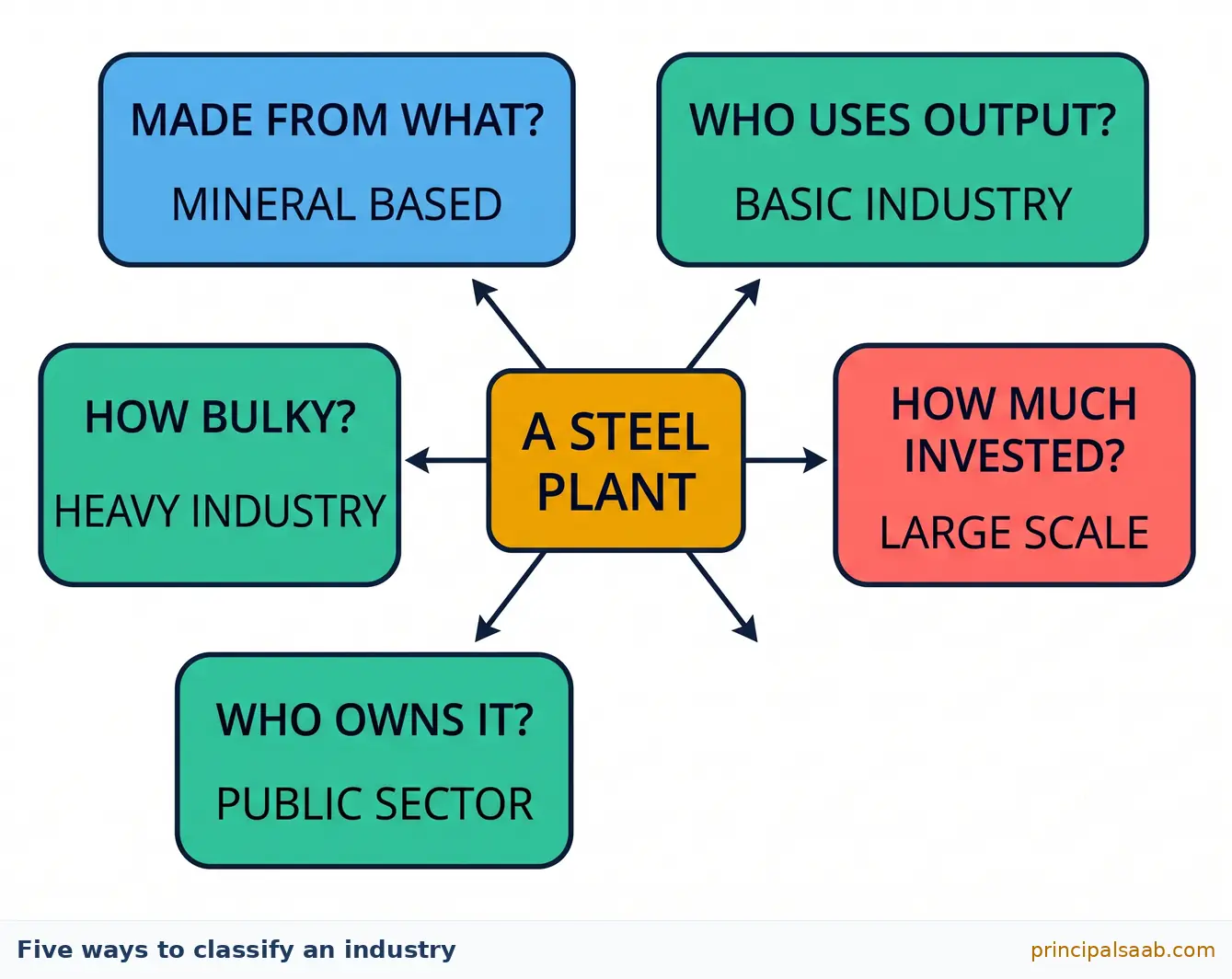
Think of how you would classify a person. By age they are a teenager. By occupation they are a student. By state they are a Maharashtrian. By height they are tall. All four are true at once, because each answers a different question. Industries work exactly the same way. A steel plant is mineral-based (raw material), basic (role), large scale (investment), public sector (ownership) and heavy (bulk) — all five labels, all true, all at once.
1. What is it made from? 2. Who uses the output? 3. How much money is invested? 4. Who owns it? 5. How heavy is what goes in and comes out? Memorise the five questions and the five classifications reconstruct themselves. Memorise the answers without the questions and they blur together within a week.
| Basis of classification | Types | What decides the type | Examples |
|---|---|---|---|
| Source of raw material | Agro-based Mineral-based |
Whether the basic input comes from a farm or plantation, or from beneath the ground | Agro-based: cotton, woollen, silk and jute textiles, sugar, edible oil, rubber, tea and coffee processing. Mineral-based: iron and steel, cement, aluminium, machine tools, petrochemicals |
| Main role | Basic or key industries Consumer industries |
Whether the product is fed into other industries as their raw material, or bought directly by the public | Basic: iron and steel, copper smelting, aluminium smelting. Consumer: sugar, toothpaste, paper, sewing machines, electric fans |
| Capital investment | Small scale Large scale |
Whether the money invested is below or above the ceiling fixed by the government, which is revised from time to time | Small scale: handloom weaving, khadi, food processing units, toy making. Large scale: steel plants, oil refineries, automobile assembly |
| Ownership | Public sector Private sector Joint sector Cooperative sector |
Who owns and runs the unit — the government, private individuals, both together, or the producers and workers themselves | Public: BHEL, SAIL. Private: TISCO, Bajaj Auto, Dabur. Joint: Oil India Limited. Cooperative: sugar mills of Maharashtra, coir industry of Kerala, AMUL |
| Bulk and weight of raw material and finished goods | Heavy industries Light industries |
Whether the inputs and outputs are massive and costly to move, or light and easy to move | Heavy: iron and steel, shipbuilding, cement. Light: electrical goods, watches, electronics |
A few of these need unpacking, because the table is compact by design.
Basic versus consumer. The test is simple: who is the customer? If the customer is another factory, the industry is basic or key. Steel is bought by car makers, bridge builders and machine tool makers, so steel is basic. If the customer is you and me walking into a shop, the industry is a consumer industry. Toothpaste, paper and fans are bought by households, so they are consumer industries. Basic industries are called key for a reason — if they fail, everything downstream fails with them.
Small versus large scale. The dividing line is the amount of capital invested, and that ceiling is a policy decision that the government revises as prices and the economy change. Because the number moves, do not stake your answer on a specific figure unless the question demands one. What matters conceptually is that small scale units use less capital and are usually more labour-intensive, which makes them extremely important for employment, while large scale units use more capital and machinery and produce on a far bigger scale.
The four ownership types deserve their own table, because the joint and cooperative sectors are where marks are most often lost.
| Sector | Who owns and runs it | Main aim | Examples |
|---|---|---|---|
| Public sector | Owned and managed by government agencies | Public welfare and national priorities; profit is not the only goal, so these units often go into heavy industry and backward regions that private capital avoids | BHEL, SAIL |
| Private sector | Owned and operated by an individual or a group of individuals or a company | Profit, efficiency and market share | TISCO, Bajaj Auto, Dabur Industries |
| Joint sector | Jointly owned and run by the state together with individuals or a group of individuals | Combines government capital and oversight with private efficiency and initiative | Oil India Limited |
| Cooperative sector | Owned and operated by the producers or suppliers of the raw material, the workers, or both together; resources are pooled and profits or losses shared proportionately | Fair returns to the small producer who would be powerless bargaining alone | Sugar industry in Maharashtra, coir industry in Kerala, AMUL dairy cooperative in Gujarat |
Spend an extra minute on the cooperative sector, because it is genuinely different from the other three and genuinely important in India. In a cooperative, the people who supply the raw material are also the owners. A cane farmer who belongs to a sugar cooperative is not merely selling cane to a mill — he part-owns the mill. That changes everything: he cannot be squeezed on price by an outside buyer, and any profit the mill makes comes back to him as a member. This is exactly why the cooperative model took such deep root in the sugar mills of Maharashtra, the coir industry of Kerala and the dairy movement in Gujarat.
Model answer.
Basic or key industries are those whose products are used as the raw material by other industries. They form the foundation on which other industries are built, and a failure here disrupts the entire industrial structure. Example: the iron and steel industry, whose output is used by the automobile, construction and machine tool industries.
Consumer industries are those that produce goods meant for direct use by consumers rather than by other industries. Example: the sugar industry, whose output is bought and consumed by households.
How the marks are earned. A distinguish question needs the two definitions written along the same axis — here, who buys the product. If you define one by its customer and the other by its size, you have not distinguished them, you have described them, and the comparison mark disappears. Naming an example each is usually worth the third mark on its own.
Walk-through — the steel plant. Raw material: mineral-based, since it uses iron ore, coking coal and limestone. Role: basic or key, since its steel is used by other industries. Capital: large scale, since the investment runs far above any small scale ceiling. Ownership: public sector, as stated. Bulk: heavy, since both raw materials and finished steel are massive and costly to transport.
Walk-through — the handmade paper unit. Raw material: agro-based, since it uses cotton rags and agricultural waste. Role: consumer, since the paper is bought by users directly. Capital: small scale. Ownership: could be private or, very commonly in India, cooperative. Bulk: light.
Why it works. Running the same five questions over two completely different units proves to you that the five classifications are independent of each other. Once you have done this drill twice, no classification question in an exam can confuse you, because you will always know which of the five questions is being asked.
Joint sector means government plus private individuals. Cooperative sector means the producers or workers themselves, with no government partner required. AMUL is a cooperative, not a joint sector unit. Getting these two the wrong way round is one of the most frequent one-mark losses in this chapter.
Agro-Based Industries: Cotton Textiles
Agro-based industries are the ones whose raw material walks in from a field. Cotton, jute, silk, wool, sugarcane, oilseeds, rubber, tea and coffee all feed factories. We will take the three that the syllabus dwells on — cotton, jute and sugar — and give each the attention it deserves. Cotton textiles first, because it is the largest and the one examiners return to most often.
India has been making cotton cloth for a very long time. Long before mills existed, the work was done entirely by hand with the spinning wheel and the handloom, and Indian muslins and printed cottons travelled to markets far beyond the subcontinent. That craft tradition matters, because it explains why the skill was already everywhere in the country when machines arrived.
The mechanised story begins in the middle of the nineteenth century. The first successful mechanised cotton textile mill was set up in Mumbai in 1854, and the industry grew outward from there. Ask yourself why Mumbai, and every location factor from the previous section lines up in a neat row:
- Raw cotton was grown in the black soil belt of Maharashtra and Gujarat, right in the mill’s backyard.
- A humid coastal climate mattered enormously, because cotton thread snaps in dry air; moisture keeps the yarn supple during spinning.
- The port allowed machinery to be imported and finished goods to be exported cheaply.
- Capital was available from the merchant and trading community already established in the city.
- Labour flowed in from the densely populated districts of the surrounding region.
- Transport by rail and road connected the mills to the cotton fields and to inland markets.
Almost everybody remembers raw cotton and the port. The moist climate of the western coast is the detail that separates a good answer from an average one, because it shows you understand the process and not just the geography. Cotton yarn needs humidity; that is why the early mills hugged the coast.
Today the picture is more spread out, and it is spread out in a particular pattern that is worth understanding. Spinning — turning fibre into yarn — is capital-intensive, needs continuous power and works best at large scale, so it remains concentrated, above all in Maharashtra, Gujarat and Tamil Nadu. Weaving, by contrast, is highly decentralised. It is carried out on handlooms, on powerlooms and in mills spread across the whole country, which allows the industry to combine the strength of the traditional weaver with the output of modern machinery. This split is why India is strong in yarn production and exports a good deal of yarn, while the finishing end of the chain has historically lagged.
Major centres to know include Mumbai, Surat, Ahmedabad, Indore, Kanpur, Coimbatore, Madurai, Sholapur and Nagpur. Five of these — Mumbai, Indore, Surat, Kanpur and Coimbatore — are on your official map list, so mark them now in your mind and again on paper later.
Why this industry matters so much. Cotton textiles is not just another industry; it is one of the largest employers in the country and it supports an unusually long chain of livelihoods. Follow one shirt backwards and you pass the tailor, the garment unit, the packer, the designer, the dyer, the weaver, the spinner, the worker at the ginning mill, the truck driver, the cotton picker and finally the farmer. It also contributes significantly to industrial production and to export earnings, and because it uses a home-grown raw material, a large share of the value it creates stays inside India.
The problems. This is standard three-mark and five-mark territory, so learn them properly.
- Erratic power supply. Interrupted electricity means idle machines and broken production runs.
- Outdated machinery, especially in weaving and processing. The spinning sector modernised faster than the weaving and finishing sectors, leaving a weak link in the middle of the chain.
- Low output per worker compared with competing countries, which raises the cost of each metre of cloth.
- Stiff competition from synthetic fibres and from cheaper cloth produced abroad.
- Fluctuating supply and price of raw cotton, since the crop depends on the monsoon like any other.
Model answer.
(i) Availability of raw material. The black soil belt of Maharashtra and Gujarat is the country’s main cotton-growing region, so mills had their raw material close at hand and paid very little to transport it.
(ii) Moist climate. The humid air of the western coastal region prevents cotton yarn from breaking during spinning, which made the region naturally suited to the process.
(iii) Port facilities. The ports allowed machinery to be imported easily in the early years and finished cloth and yarn to be exported later.
(iv) Capital and enterprise. A well-established trading and merchant community in the region had the money and the willingness to invest in mills.
(v) Labour and transport. A large supply of workers was available from the densely populated surrounding districts, and a good rail and road network linked the mills to both the cotton fields and the inland markets.
Why it works. Every one of the five points is a named location factor from the earlier section, applied to a specific place. That is the whole method of this chapter. If you learned the location factors properly, you did not have to memorise this answer at all — you generated it.
Model answer.
(i) Irregular power supply. Frequent interruptions in electricity keep machines idle, break production runs and raise the cost of every metre of cloth produced.
(ii) Obsolete machinery in the weaving and processing sectors. While spinning has been modernised, weaving and finishing still use outdated equipment, so the quality of finished cloth suffers and the industry cannot compete at the higher end of the market.
(iii) Low labour productivity and stiff competition. Output per worker is lower than in competing countries, while cheaper imported cloth and synthetic substitutes compete hard for the same buyers.
How the marks are earned. Each point is a problem plus its consequence. Writing only old machinery earns a fraction of a mark; writing old machinery, therefore poor finished quality, therefore lost markets earns the whole mark. The chain of consequence is what makes it an explanation.
Spinning is concentrated in a few states. Weaving is decentralised across the country. A very common exam question asks precisely this contrast, and reversing the two words turns a correct answer into a wrong one.
Agro-Based Industries: Jute Textiles
Jute is the coarse, golden fibre that gunny bags, ropes, mats and carpet backing are made from. Because it grows well in the hot, humid delta country of the lower Ganga-Brahmaputra basin, its industry is one of the most geographically concentrated in India — and that concentration is exactly what makes it such a satisfying case study.
India is the world’s largest producer of raw jute and jute goods, and stands among the leading exporters of jute products. The first jute mill was set up in 1859 at Rishra, near Kolkata, on the bank of the Hugli. The industry expanded rapidly after that, and to this day most of the mills are strung along a narrow belt on both banks of the Hugli river in West Bengal — a ribbon of factories only a few kilometres wide and several dozen kilometres long.
Why that exact ribbon? Six reasons, and each one is a location factor doing its job.
- Proximity to the jute-producing areas of West Bengal and the neighbouring plains, so the bulky raw fibre travels a very short distance.
- Cheap water transport on the Hugli and the network of distributaries, which is the least expensive way to move a bulky low-value material.
- A dense network of railways and roads feeding the river route.
- Abundant water from the river for processing and retting the raw jute, which is a very water-hungry stage.
- Cheap and plentiful labour drawn from West Bengal itself and from the neighbouring states of Bihar, Odisha and Uttar Pradesh.
- Kolkata as a large urban centre, supplying banking, insurance, port facilities for export, and a ready market.
Raw jute is bulky, heavy and of low value per tonne. Moving it far would cost more than the fibre is worth. So the mills went to the fibre, the river gave them the cheapest possible transport, and the whole industry ended up squeezed into one narrow belt. If you understand the jute belt, you understand industrial location.
The challenges. The jute industry has had a difficult few decades. Its biggest problem is competition from synthetic substitutes — plastic and polypropylene sacks that are lighter, cheaper and waterproof. On top of that it faces stiff competition in the international market from other jute-producing countries such as Bangladesh, Brazil, the Philippines, Egypt and Thailand. Old machinery and irregular supply of good quality raw jute add to the difficulty.
What has been done, and why the future is hopeful. The single most important support has been the government’s policy of mandatory use of jute packaging for certain commodities, which guaranteed the industry a floor of domestic demand when exports were falling. The National Jute Policy of 2005 was framed with clear aims: to increase productivity, improve the quality of the fibre, ensure good prices to jute farmers and raise the yield per hectare.
And then there is the argument that may well decide the industry’s future. Jute is natural, biodegradable and eco-friendly. As the world turns against single-use plastic, a fibre that rots harmlessly back into the soil stops looking old-fashioned and starts looking modern. Growing environmental awareness in Europe, the United States and elsewhere is opening markets for jute bags, carpets, geotextiles and handicrafts that plastic had taken away.
Model answer.
(i) Nearness to the jute-producing areas. The mills lie next to the jute-growing districts of the lower Ganga delta, so the bulky raw fibre travels the shortest possible distance and transport cost is minimised.
(ii) Inexpensive water transport. The Hugli and its network of distributaries provide the cheapest means of moving both raw jute to the mills and finished goods to the port.
(iii) Abundant water supply. Processing and retting raw jute needs very large quantities of water, which the river supplies throughout the year.
(iv) Cheap and abundant labour. Workers are available from West Bengal itself and from the neighbouring states of Bihar, Odisha and Uttar Pradesh.
(v) Kolkata as a supporting urban centre. The city provides banking, insurance, a large market and port facilities for exporting jute goods, along with a good network of railways and roads.
Why it works. Look at the structure: raw material, transport, water, labour, urban support. That is the location checklist again, applied to one place. Whenever a question asks why is industry X located at place Y, run the checklist down in your head and pick the five that genuinely apply.
Model answer. The challenges are real. Jute faces stiff competition from cheap synthetic substitutes such as plastic and polypropylene sacks, and from other jute-producing countries including Bangladesh, Brazil, the Philippines, Egypt and Thailand.
However, the internal demand for jute has been protected by the government policy of making jute packaging compulsory for certain goods, which assures the mills a steady domestic market.
Above all, jute is a natural, biodegradable and eco-friendly fibre, and rising environmental concern about plastic waste across the world is creating fresh demand for jute bags, carpets, geotextiles and handicrafts. The very quality that once made jute seem old-fashioned is now its strongest advantage.
How the marks are earned. A justify question with the word yet in it is asking for a balanced answer. One mark for the difficulty, one for the policy support, one for the environmental opportunity. An answer that only lists problems has answered a different question.
| Point of comparison | Cotton textile industry | Jute textile industry |
|---|---|---|
| Raw material | Raw cotton, grown mainly on the black soil of the Deccan and Gujarat | Raw jute, grown in the hot humid delta of the lower Ganga-Brahmaputra basin |
| First mill | Mumbai, 1854 | Rishra near Kolkata, 1859 |
| Pattern of location | Spread over many states; spinning concentrated in Maharashtra, Gujarat and Tamil Nadu, weaving highly decentralised across the country | Extremely concentrated in a narrow belt along both banks of the Hugli river in West Bengal |
| Key location advantage | Raw cotton, humid climate, port facilities, capital and skilled labour | Nearness to jute fields, cheap water transport on the river, abundant water, cheap labour, Kolkata as an urban and port centre |
| Main products | Yarn, cloth, made-up garments and household textiles | Gunny bags, ropes, mats, yarn, carpet backing, geotextiles and handicrafts |
| Main challenge | Erratic power, obsolete weaving and processing machinery, low labour productivity, competition from synthetic fibre | Competition from synthetic packaging substitutes and from rival producing countries |
| Main support measure | Modernisation of machinery and technology upgradation programmes | Compulsory use of jute packaging for certain goods, and the National Jute Policy of 2005 |
Agro-Based Industries: The Sugar Industry
The sugar industry is the shortest section in this chapter and, if you learn it properly, one of the easiest places to pick up full marks. Almost every question about it comes back to one central fact about sugarcane, so let us start there.
Sugarcane is bulky, and it loses its sweetness the longer it waits. Once a cane is cut, the sucrose inside it begins to break down. A cane that reaches the crusher within a day gives good sugar; a cane that spends three days on a bullock cart gives noticeably less. On top of that, cane is heavy and awkward to transport, and only a fraction of its weight ends up as sugar — most of it is water and fibre that gets thrown away as bagasse.
Put those two facts together and the location rule writes itself: sugar mills must be located inside the cane-growing area itself. This is the classic weight-losing, perishable raw material case from the location section, and it is why you will never find a sugar mill in a city far from any cane field.
Sugar mills sit in the cane belt for two separate reasons: cane is bulky (transport cost) and cane is perishable in sucrose terms (quality loss). Most students write only the first. Writing both is often the difference between two marks and three.
India is among the world’s largest producers of sugar, and it holds first place in the production of the traditional unrefined sweeteners gur and khandsari. The industry supports a very large number of farmers and workers, and it is seasonal, which is central to understanding its problems.
Where the mills are. Historically the industry has been concentrated in the northern cane belt, with roughly three-fifths of the mills in Uttar Pradesh and Bihar. The remainder are spread over Maharashtra, Karnataka, Tamil Nadu, Andhra Pradesh, Telangana, Gujarat, Punjab, Haryana and Madhya Pradesh.
The southward and westward shift. This is a favourite exam topic. Over time the industry has been steadily shifting towards the southern and western states, especially Maharashtra, and there are four clear reasons:
- Higher sucrose content. The cane grown in the peninsular states has a higher sugar content, so each tonne of cane yields more sugar.
- A longer crushing season. The cooler and more even climate of the peninsular region allows mills to run for more months in the year, which spreads the fixed cost of the factory over more output.
- The cooperative model works better there. Sugar cooperatives in Maharashtra and the neighbouring states have been notably more successful and better managed, giving farmers a share in the mill and a fair price.
- Better organisation and reinvestment. Because cooperatives return profits to members, mills have been more willing to modernise.
The problems of the industry. Learn these as a set of four:
- Seasonal nature. The mills can only run during the crushing season, so machinery and workers stand idle for months, which pushes up the cost per tonne of sugar.
- Old and inefficient methods of production. Outdated machinery gives poorer recovery of sugar from the same cane.
- Transport delays. Slow movement of cane from field to factory reduces sucrose content before crushing even begins.
- Under-use of by-products. Bagasse, molasses and press mud are valuable if used properly — bagasse can generate power or make paper, molasses can make alcohol and ethanol — but they are often wasted.
Model answer.
(i) Sugarcane is a bulky raw material. A large weight of cane yields only a small weight of sugar, so it is far cheaper to move the finished sugar than to move the cane.
(ii) Sucrose content falls after harvesting. The sugar inside the cane begins to break down as soon as it is cut, so the cane must reach the crusher quickly; a long journey means a lower sugar recovery.
(iii) Transport cost and delay would raise the price of sugar. Carrying cane over long distances on slow transport would add heavily to cost while simultaneously lowering the quality of the output, making the mill uncompetitive.
How the marks are earned. Notice that (i) and (ii) are genuinely different reasons — one is about cost, the other is about chemistry. This is the standard three-mark answer and the examiner expects both angles. A candidate who writes bulkiness three different ways gets one mark.
Model answer.
(i) Higher sucrose content in the cane. Cane grown in the peninsular states contains more sugar per tonne, so mills there obtain a better recovery from the same quantity of cane.
(ii) Longer crushing season. The cooler and more even climate of the region allows the mills to operate for a greater number of months each year, which reduces the idle period and lowers the cost of production.
(iii) Successful cooperatives. Sugar cooperatives in Maharashtra and neighbouring states have been better organised and managed, giving cane growers a share in the mill and a fair price, which has encouraged both cane cultivation and investment in modern plant.
Why it works. Three marks, three reasons, and each one is causal — it explains an economic advantage rather than simply asserting a fact. The phrase which reduces the idle period in point (ii) is doing real work; without it the point is only half made.
India is among the top producers of sugar, but it is first in the production of gur and khandsari. That single sentence has appeared as a one-mark question more than once. It is free marks if you have it, and impossible to guess if you do not.
Mineral-Based Industries: Iron And Steel
If this chapter had a centrepiece, this would be it. Iron and steel is the industry that every other industry leans on, and the section carries more exam weight than any other single industry here. Take your time with it.
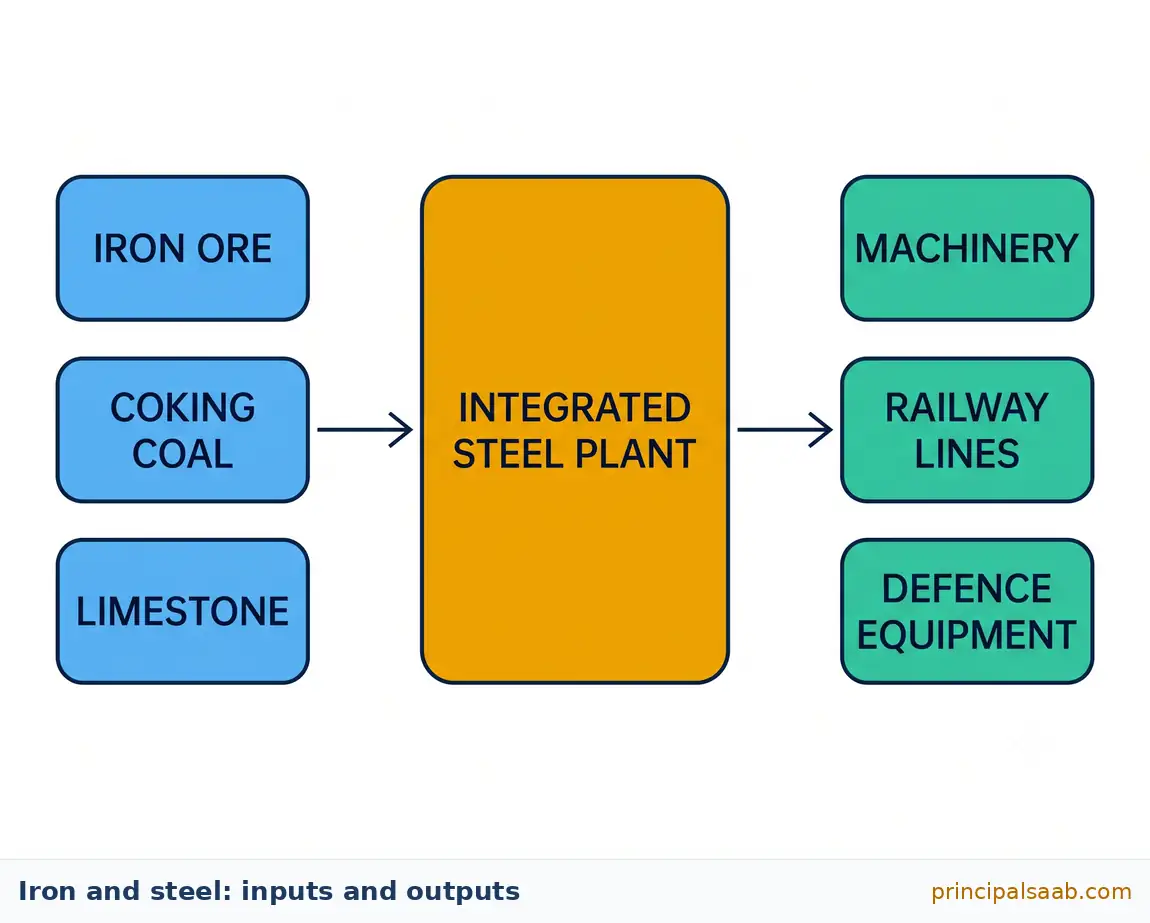
Why it is called a basic or key industry. Look at what steel becomes. It becomes the machinery inside every other factory. It becomes railway lines, bridges, ships, cranes and the reinforcing bars in every concrete building. It becomes defence equipment, surgical instruments, scientific apparatus, telephone cables, farm implements, pressure cookers and safety pins. Heavy industry, medium industry and light industry all depend on it. If steel stops, everything stops. That dependence is exactly what the word basic means.
It is also why the production and consumption of steel is treated as an index of a country’s development. A country building roads, factories, railways and housing is a country using a lot of steel. India’s per capita consumption of steel is still low compared with the world average, and that gap is itself a statement about how much building remains to be done.
An integrated steel plant needs iron ore, coking coal and limestone in a ratio of roughly 4:2:1, together with manganese and very large quantities of water and power. Learn that ratio — it is a favourite one-mark question, and it also explains the location pattern, because it tells you the plant must sit where all three bulky inputs can be gathered cheaply.
Why iron and steel is a heavy industry. Everything about it is massive. The iron ore going in is heavy. The coking coal is heavy. The limestone is heavy. The steel coming out is heavy. When both your inputs and your outputs are bulky, transport becomes one of your biggest costs, and the only way to control it is to sit as close as possible to the raw materials. That is the whole logic of the map you are about to learn.
The Chota Nagpur plateau story. Look at where India’s steel plants cluster and you will notice something striking: a large concentration in and around the Chota Nagpur plateau region, spread over Jharkhand, Odisha, Chhattisgarh and West Bengal. This is not an accident of history, it is geology plus economics:
- High grade iron ore is available locally and at low cost, because the plateau and the adjoining belt hold some of the country’s richest deposits.
- Coking coal is close by in the Damodar valley coalfields, which is decisive because coking coal is the input that is hardest to move economically.
- Limestone, dolomite and manganese are all found within a manageable distance.
- Cheap labour is available from the densely populated surrounding districts.
- Water from the Damodar and other rivers is available in the quantities a steel plant demands.
- Transport links and port access through the eastern rail network and the ports of the eastern coast allow both movement within India and export.
- A vast home market with enormous growth potential lies within reach.
That is the answer to one of the most frequently asked questions in the entire chapter, so read the list twice.
Integrated plants versus mini steel plants. These two terms are often confused, so let us pin them down.
An integrated steel plant is large and does everything in one place. It brings the raw materials together, prepares them, smelts the ore, converts the iron into steel, and then rolls and shapes the steel into the forms customers want. Everything from ore to finished product happens on one site, which is why these plants are so enormous.
A mini steel plant is smaller and works differently. It uses electric furnaces and its raw material is steel scrap and sponge iron rather than fresh ore. It also has re-rollers that use steel ingots. Mini plants produce mild steel and alloy steel of specified quality, and because they are small and flexible they can be located far more freely — they are not chained to the ore fields.
The plants you must know. Six of these are on your official map list, and they are marked below.
| Plant | State | Sector and notes | On the official map list? |
|---|---|---|---|
| Jamshedpur | Jharkhand | Private sector; India’s oldest major integrated steel works, on the Chota Nagpur plateau | Yes |
| Bokaro | Jharkhand | Public sector; built with Russian collaboration; close to the Damodar valley coalfields | Yes |
| Durgapur | West Bengal | Public sector; built with British collaboration; in the Damodar valley industrial belt | Yes |
| Bhilai | Chhattisgarh | Public sector; built with Russian collaboration; draws on the rich iron ore of the region | Yes |
| Vijayanagar | Karnataka | Located in the peninsular iron ore belt of northern Karnataka | Yes |
| Salem | Tamil Nadu | Public sector; known for stainless and alloy steels; the southernmost plant on the list | Yes |
| Rourkela | Odisha | Public sector; built with German collaboration | Not on the list, but know it |
| Bhadravati | Karnataka | Visvesvaraya Iron and Steel Works | Not on the list, but know it |
| Visakhapatnam | Andhra Pradesh | Coastal plant with direct port access | Not on the list, but know it |
India’s position and its problems. India today ranks among the largest producers of crude steel in the world and is the world’s leading producer of sponge iron. Yet the industry has never grown quite as fast as its raw material base would suggest it should. Four reasons are standard:
- High cost and limited availability of coking coal. India has plenty of coal, but relatively little of the good coking coal that blast furnaces need, so a significant part has to be imported at high cost.
- Lower productivity of labour compared with competing steel producers, which raises the cost per tonne.
- Irregular supply of energy. Steel making demands enormous and uninterrupted power; interruptions are extremely expensive in a process that cannot simply be switched off and on.
- Poor infrastructure. Congested rail routes and inadequate ports and roads slow the movement of bulky inputs and outputs.
What has improved things. Liberalisation and the entry of foreign direct investment brought in new technology and fresh capital, and the energy of private entrepreneurs has driven a great deal of the recent expansion in capacity. The industry is one of the clearest examples in the chapter of how a change in policy can change an industry’s trajectory.
Model answer.
(i) Local availability of high grade iron ore. The plateau and the adjoining belt contain some of the richest iron ore deposits in the country, so ore reaches the plants at very low transport cost.
(ii) Nearness to coking coal. The Damodar valley coalfields lie close by, which is decisive because coking coal is bulky, essential and expensive to bring from far away.
(iii) Availability of the other inputs. Limestone, dolomite and manganese, all needed in the smelting process, are found within a short distance of the plants.
(iv) Cheap and abundant labour. The densely populated districts of Jharkhand, Odisha, Chhattisgarh, West Bengal and Bihar supply workers at low cost.
(v) Water, transport and market. The Damodar and other rivers supply the large quantities of water the process demands, the eastern railway network and the eastern ports allow movement of heavy goods, and a vast domestic market with great growth potential lies within reach.
Why it works. Every raw material named in the 4:2:1 ratio appears in the first three points, so the examiner can see immediately that you understand the process and not just the map. Points (iv) and (v) then bring in labour, water, transport and market. This is the location checklist again — the same tool, a different industry.
Model answer.
(i) High cost and limited availability of coking coal. Although India has large coal reserves, good quality coking coal suitable for blast furnaces is scarce, so it has to be imported at considerable expense, raising the cost of every tonne of steel.
(ii) Irregular supply of energy. Steel making needs vast and continuous power; frequent interruptions damage the process and force costly restarts, so output falls below capacity.
(iii) Lower labour productivity and weak infrastructure. Output per worker is lower than in competing countries, while congested railways, roads and ports slow the movement of bulky raw materials and finished steel.
How the marks are earned. The question contains a hidden instruction in the words and yet. The examiner wants you to identify the constraints that are not about iron ore. An answer that talks about ore reserves has missed the point of the question entirely, however accurate it is.
India has very large coal reserves. What it is short of is good quality coking coal, the specific grade needed in blast furnaces. Writing shortage of coal instead of shortage of coking coal is factually wrong and costs the mark. One word, one mark.
Mineral-Based Industries: Aluminium Smelting
Aluminium smelting is the second most important metallurgical industry in India after iron and steel, and it earns its place in the syllabus because it demonstrates a location rule that no other industry shows quite so clearly.
First, why aluminium is so useful. It is light, which matters enormously in aircraft and vehicles where every kilogram costs fuel. It is resistant to corrosion, so it survives weather that would rust steel. It is a good conductor of heat and electricity. It is malleable, meaning it can be beaten and rolled into sheet and foil. And although pure aluminium is soft, it becomes strong when alloyed with other metals. That combination of lightness plus strength plus corrosion resistance is rare, and it is why aluminium has steadily replaced steel, copper, zinc and lead in a whole range of uses — aircraft bodies, utensils, electrical wires and cables, window frames, packaging foil and construction fittings.
The raw material is bauxite — a bulky, dark reddish rock. And here is the crucial fact about the process: separating aluminium from bauxite requires an extraordinary amount of electricity. Smelting is one of the most power-hungry industrial processes in existence. Electricity is effectively a raw material for an aluminium plant, not merely a utility.
For aluminium smelting the deciding factors are (1) a regular and cheap supply of electricity and (2) an assured supply of raw material, that is bauxite, at minimum cost. If a question asks for the factors influencing the location of aluminium smelting, those two must appear first. Everything else is secondary.
Where the plants are. The smelters are spread across a handful of states — Odisha, West Bengal, Kerala, Uttar Pradesh, Chhattisgarh, Maharashtra and Tamil Nadu. Odisha is the largest producer of aluminium in the country, and if you think about it for a moment, you already know why: the state has both extensive bauxite deposits in its plateau region and access to coal-based power. Raw material and electricity in the same place is precisely the combination the process demands.
Model answer.
(i) It is light in weight yet strong when alloyed. Pure aluminium is soft, but mixed with other metals it becomes strong while remaining far lighter than steel, which makes it ideal for aircraft, vehicles and portable equipment.
(ii) It resists corrosion. Unlike iron and steel, aluminium does not rust, so it lasts far longer in the open air and in damp conditions, which suits it to window frames, roofing and outdoor fittings.
(iii) It conducts heat and electricity well and is malleable. This allows it to replace copper in electrical cables and to be rolled into thin sheet and foil for utensils and packaging.
Why it works. Each point pairs a property with a use that follows from it. A property on its own is half an answer. The examiner is checking whether you understand why the property matters, so always finish the sentence with a real application.
Odisha is the largest producer of aluminium, and it is also part of the eastern iron and steel belt. When a question mentions Odisha, pause and check which industry is being asked about before you start writing.
Mineral-Based Industries: Chemical And Fertiliser Industries
The chemical industry is one of the fastest growing and most diversified industries in India, and it has one curious feature that students find memorable: the chemical industry is its own largest consumer. A great deal of what chemical plants produce is bought by other chemical plants as their input. It contributes in the region of three per cent of India’s GDP and includes both very large plants and a great many small scale units.
The industry splits into two halves, and you need to be able to place any given chemical in the right half.
Inorganic chemicals include sulphuric acid, nitric acid, alkalies, soda ash and caustic soda. Sulphuric acid alone is used to make fertilisers, synthetic fibres, plastics, adhesives, paints and dyestuffs, which is why it is sometimes called the workhorse of the chemical industry. Soda ash goes into glass, soaps and detergents, and paper. Because their raw materials are widely available and their products are needed everywhere, inorganic chemical plants are widely spread across the country.
Organic chemicals include petrochemicals, which are used for manufacturing synthetic fibres, synthetic rubber, plastics, dyestuffs, drugs and pharmaceuticals. Their raw material comes from crude oil, and that dictates their location precisely: organic chemical plants are located near oil refineries or petrochemical complexes. This is the raw material pull rule again, applied to a liquid instead of a rock.
That one sentence answers most location questions about the chemical industry. Inorganic chemicals use widely available minerals and serve everyone, so they scatter. Organic chemicals depend on crude oil derivatives, so they gather where the refineries are.
The fertiliser industry is a specialised branch that deserves its own treatment, because it connects straight back to the agriculture-industry link we studied earlier. It produces three broad kinds of product:
- Nitrogenous fertilisers, mainly urea.
- Phosphatic fertilisers, and ammonium phosphate, usually known as DAP.
- Complex fertilisers, which combine nitrogen, phosphate and potash — the three elements written as N, P and K.
Now a fact that is asked surprisingly often: India has to import the entire quantity of potash it uses, because the country does not possess commercially usable reserves of potash or potassium compounds. Nitrogen and phosphate can be produced domestically; potassium cannot. That single dependency is a genuine vulnerability for Indian agriculture and it makes a neat one-mark answer.
Where fertiliser plants are. The industry expanded dramatically after the Green Revolution, when demand for chemical fertiliser rose sharply along with the new high-yielding varieties. Gujarat, Tamil Nadu, Uttar Pradesh, Punjab and Kerala together account for around half of the country’s fertiliser production, with significant output also coming from Andhra Pradesh, Odisha, Rajasthan, Bihar, Maharashtra, Assam, West Bengal, Goa, Delhi, Madhya Pradesh and Karnataka.
Model answer.
Inorganic chemical industries produce sulphuric acid, nitric acid, alkalies, soda ash and caustic soda, which are used to make fertilisers, synthetic fibres, plastics, adhesives, paints, glass, soaps, detergents and paper. Because their raw materials are widely available and their products are required all over the country, these plants are widely spread across India.
Organic chemical industries produce petrochemicals, which are used to make synthetic fibres, synthetic rubber, plastics, dyestuffs, drugs and pharmaceuticals. Since their raw material is derived from crude oil, these plants are located close to oil refineries and petrochemical complexes.
How the marks are earned. The question names two axes of comparison — products and location — so your answer must address both for both types. Four boxes to fill. Students who write only about products get half the answer right and half the marks.
Model answer. The fertiliser industry supplies nitrogenous fertilisers such as urea, phosphatic fertilisers such as DAP, and complex fertilisers containing nitrogen, phosphate and potash. These nutrients replace what repeated cropping removes from the soil, and they were essential to the success of the high-yielding varieties introduced during the Green Revolution; without them, yields per hectare would fall sharply and food security would be threatened.
The major difficulty is that India possesses no commercially usable reserves of potash or potassium compounds, so the entire requirement of potash has to be imported. This makes an essential agricultural input dependent on foreign supply and on international prices.
Why it works. The answer connects the fertiliser industry back to the agriculture-industry link from earlier in the chapter, which shows the examiner that you are reading the chapter as a whole rather than as isolated sections. That kind of cross-linking is what lifts an answer from good to excellent.
Mineral-Based Industries: The Cement Industry
Cement is the industry you can see the results of everywhere: houses, factories, bridges, roads, airports, dams and every commercial building around you. Nothing gets constructed without it, which makes cement a quiet but essential foundation of the whole economy.
The raw materials are bulky and heavy — limestone above all, plus silica, alumina and gypsum. The plants also need coal and electric power, and rail transport to move both the inputs and the finished cement. Look at that list and the location rule falls out immediately: cement plants go where limestone deposits are, because limestone is the heaviest and cheapest input and moving it far would be absurd. Peninsular India and the limestone belts of Rajasthan, Madhya Pradesh, Chhattisgarh, Gujarat, Andhra Pradesh, Tamil Nadu and Karnataka carry the bulk of the industry.
The Gujarat story is worth knowing, because it shows a second factor at work. Cement plants in Gujarat have been located with an eye to the market in the Gulf countries, using the state’s coastal position and port access for export. So here you have both forces on display in one industry: raw material pull inland, market pull on the coast.
A little history. The first cement plant in India was set up in Chennai in 1904. The industry expanded steadily after Independence, but the real transformation came with decontrol of price and distribution from 1989 and the policy reforms that followed. Freed from controls, the industry made rapid strides in capacity, process technology and production. India now produces a wide range of cements, and the improvement in quality has found ready markets in East Asia, the Middle East, Africa and South Asia, on top of very large demand at home. There are well over a hundred large plants and several hundred mini cement plants operating in the country.
Model answer. Cement requires bulky and heavy raw materials, chiefly limestone, along with silica, alumina and gypsum. Since limestone is consumed in very large quantities and is of low value per tonne, transporting it over long distances would cost more than the cement is worth. Plants therefore locate directly on the limestone deposits, which is why so much of the industry lies in peninsular India and the limestone belts of the west and centre.
Several plants in Gujarat, however, have been located near the coast in order to serve the export market in the Gulf countries. The port access allows finished cement to be shipped out cheaply, so here the pull of the market has worked alongside the pull of the raw material.
Why it works. The question has two halves and they illustrate opposite forces. Answering only the limestone half would be technically correct but incomplete. Read every question twice and count the number of things it is actually asking for — it is very often more than one.
Because nothing gets built without it, cement consumption rises and falls with construction activity across the whole economy. Economists watch cement output the way doctors watch a pulse. It is a useful line to add to a longer answer on the importance of the industry.
The Automobile Industry
The automobile industry provides the vehicles that move goods, services and people quickly across the country. India manufactures trucks, buses, cars, motorcycles, scooters, three-wheelers and multi-utility vehicles, and it does so at a scale that would have been unimaginable a generation ago.
The turning point was liberalisation. Before it, the choice available to an Indian buyer was extremely narrow and the models on offer were often decades old. After the opening up of the economy, new and contemporary models entered the market, and that fresh choice stimulated demand sharply. Rising incomes and the availability of vehicle finance did the rest. The industry has experienced a genuine quantum jump in a relatively short span of time.
Foreign direct investment played a decisive role. It brought in new technology, modern manufacturing practice and global quality standards, and it aligned the Indian industry with international developments instead of leaving it to evolve in isolation. India is now a significant producer of two-wheelers and small cars and exports a meaningful share of what it makes.
Where the industry is. Automobile manufacturing is spread across the country but concentrates in identifiable clusters: around Delhi and Gurugram in the north, Mumbai and Pune in the west, Chennai in the south, Kolkata and Jamshedpur in the east, and further units at Lucknow, Indore, Hyderabad and Bengaluru.
Why those places? Because an automobile plant is an assembly industry, and assembly industries have a very particular location logic. A car is made of thousands of components produced by hundreds of separate suppliers. The assembly plant therefore wants to sit inside a dense web of component makers, near good road and rail links, close to a large urban market, and where skilled engineering labour is available. Every one of the cities listed above offers exactly that. This is agglomeration economies in their purest form — once one large plant arrives, the component suppliers follow, and once the suppliers are there the next assembly plant wants to be there too.
Unlike steel or cement, an automobile plant is not tied to a mine. Its raw material is other people’s finished components. So it locates where the component ecosystem, the transport network, the skilled labour and the market all overlap — which in practice means large metropolitan regions.
Model answer.
(i) Wider choice stimulated demand. After liberalisation, new and contemporary models entered the Indian market in place of a very limited older range, and this fresh choice, combined with rising incomes and the availability of vehicle finance, sharply increased demand for passenger cars and two and three-wheelers.
(ii) FDI brought technology and standards. Foreign investment introduced modern production technology, quality control methods and global manufacturing practice, which raised the standard of vehicles made in India.
(iii) The industry became globally aligned. Indian plants began producing to international specifications, which allowed the country to become a significant exporter of two-wheelers and small cars rather than producing only for the home market.
How the marks are earned. The three points form a chain: demand grew, capability grew, and then exports followed. Examiners reward answers that show a sequence, because a sequence proves understanding while a list only proves recall.
Students who found this section tricky usually go back to Agriculture, where the same idea is built up from scratch.
Information Technology And Electronics Industries
This is the youngest industry in the chapter and in many ways the most interesting, because it breaks almost every location rule you have learned so far. That is not a problem — it is the point.
The electronics industry covers an enormous range of products: transistor sets, televisions, telephones, cellular telecom equipment, telephone exchanges, radars, computers and the many other kinds of equipment required by the telecommunication industry. Bengaluru has emerged as the electronic capital of India, with other important centres at Mumbai, Delhi, Hyderabad, Pune, Chennai, Kolkata, Lucknow and Coimbatore.
Software technology parks are the physical expression of the IT industry, and they exist for a specific practical reason. They provide single window service — meaning a firm can get all its clearances and approvals in one place instead of running between departments — along with high speed data communication facilities, reliable power and ready-built premises. For an industry whose product travels down a cable rather than on a truck, a guaranteed data link is the equivalent of a railway siding.
The eight software technology park locations on your official map list are Noida, Gandhinagar, Mumbai, Pune, Hyderabad, Bengaluru, Chennai and Thiruvananthapuram. Notice how they are distributed — north, west, south and along both coasts. That spread is itself worth commenting on in an answer.
Because software has no bulky raw material and no heavy finished product to move, the industry is not tied to a mine, a field or a river. It is pulled instead by skilled manpower, educational and research institutions, reliable power and data connectivity, a pleasant living environment and good air links. That is precisely why Bengaluru, with its universities, research laboratories, temperate climate and connectivity, became the country’s electronic capital rather than some city sitting on a mineral belt.
Why this industry matters so much. Three reasons, and you should be able to give all three.
- Employment generation on a large scale. The IT and IT-enabled services sector employs several million people in India, and it is notable that a substantial proportion of the workforce is women, which has had real social consequences alongside the economic ones.
- Foreign exchange earnings. Software exports and business process outsourcing, usually shortened to BPO, are among India’s most important sources of foreign exchange. The country sells services abroad in the way other countries sell goods.
- It supports every other sector. Banking, railways, hospitals, schools, retail and government administration all now run on software. The IT industry is quietly a basic industry for the service economy in the way that steel is for manufacturing.
The continuing growth of both hardware and software is the key to the sector’s long-term success. India has been far stronger in software and services than in hardware manufacturing, and closing that gap is one of the central goals of current industrial policy.
Model answer.
(i) Raw material. Iron and steel needs iron ore, coking coal and limestone in roughly a 4:2:1 ratio, all of them bulky and heavy, so plants must sit close to the deposits. The IT industry has no bulky raw material at all; its input is human skill.
(ii) Transport. Steel depends on railways, roads and ports to move enormous tonnages. IT depends on high speed data communication links, since its product is transmitted electronically rather than carried.
(iii) Labour. Steel needs large numbers of workers, including many doing heavy manual work. IT needs a smaller number of highly educated technical professionals, so it settles near universities and research institutions.
(iv) Power and water. Steel consumes vast quantities of both. IT needs reliable rather than enormous power, and very little water.
(v) Resulting pattern. Steel plants therefore cluster on the mineral belt of the Chota Nagpur plateau and its surroundings, while IT is footloose and has grown in cities such as Bengaluru and Hyderabad that offer skilled manpower, research institutions, connectivity and a pleasant living environment.
Why it works. An examine this statement question is asking you to test a claim, not simply describe two industries. The answer above tests it factor by factor and then states a conclusion in point (v). That final synthesising point is what turns a comparison into an examination.
Q2. What is the main purpose of a software technology park? Answer. To provide single window service and high speed data communication facilities to software firms and professionals.
Q3. Expand BPO and state why it matters to India. Answer. Business process outsourcing; it is a major earner of foreign exchange and a large generator of employment.
How the marks are earned. One-mark questions want one precise thing. Do not pad them. An examiner marking hundreds of scripts will find your answer faster if it is short, and a fast-found answer is a marked answer. Save your ink for the five-markers.
Footloose does not mean random. IT still has powerful location factors — skilled manpower, institutions, connectivity, power and living environment. Writing that the IT industry can be set up anywhere is too loose and will not earn the mark. Say instead that it is not tied to raw materials, and then name what it is tied to.
Industrial Pollution And Environmental Degradation
Everything we have studied so far has been about the benefits of manufacturing. Now comes the bill. Industry has increased India’s wealth, but it has also polluted the air, poisoned rivers, degraded soil and filled towns with noise. This section is where the chapter turns honest, and the board asks about it every single year.
There are four main types of industrial pollution, and I want you to learn them as four separate stories with four separate villains.
1. Air pollution. Air pollution is caused by an undesirably high proportion of gases such as sulphur dioxide, carbon monoxide and oxides of nitrogen in the atmosphere, together with airborne particulate matter. That particulate matter contains both solid and liquid particles — dust, sprays, mist and smoke. The sources are chemical and paper factories, brick kilns, oil refineries and smelting plants, and the burning of fossil fuels in factories large and small that ignore pollution norms. Beyond routine emissions, a toxic gas leak can be catastrophic, with effects that persist for decades in the bodies of survivors and in the soil of the surrounding area. Air pollution damages human health, animals, plants, buildings and the atmosphere as a whole.
2. Water pollution. This is caused by organic and inorganic industrial wastes and effluents discharged into rivers and other water bodies. The main offenders are the paper and pulp, chemical, textile and dyeing, petroleum refining, tannery and electroplating industries, which release dyes, detergents, acids, salts, heavy metals such as lead and mercury, pesticides, fertilisers, synthetic chemicals containing carbon, plastics and rubber. The heavy metals are particularly dangerous because they accumulate in living tissue and do not break down. In solid form, the major industrial wastes in India are fly ash, phosphogypsum, and iron and steel slag.
3. Thermal pollution. This one is easy to overlook because the water looks perfectly clean. Thermal pollution of water occurs when hot water from factories and thermal power plants is drained into rivers and ponds before it has been allowed to cool. Warmer water holds less dissolved oxygen, and aquatic organisms that are adapted to a particular temperature range simply cannot survive the change. Fish die, breeding cycles are disrupted, and the ecology of the stretch below the outfall is altered. Add to this the wastes from nuclear power plants and nuclear and weapons production facilities, whose radiation causes cancers, birth defects and miscarriages.
4. Noise pollution. Noise is pollution too, even though it leaves no residue. It comes from industrial and construction activity, factory machinery and equipment, generators, saws, and pneumatic and electric drills. Its effects are real and medical: irritation and anger, hearing impairment, raised heart rate and blood pressure, and other physiological effects that accumulate with years of exposure.
And land pollution ties them all together. Soil and water pollution are closely related. When wastes are dumped — glass, harmful chemicals, industrial effluents, packaging material, salts and garbage — the land itself is rendered useless. Then rain water percolates through that contaminated soil and carries the pollutants down into the groundwater, so a problem that began on the surface ends up in the drinking water of an entire district.
Many students fold thermal pollution into water pollution and lose a mark. They are related but distinct: water pollution is about what is added to the water, thermal pollution is about the temperature of the water. If a question asks you to name the types of industrial pollution, list air, water, land or soil, thermal and noise as separate items.
Model answer.
(i) Air pollution. Industries release excessive sulphur dioxide, carbon monoxide and oxides of nitrogen along with particulate matter such as dust, mist, sprays and smoke, chiefly from chemical and paper factories, brick kilns, refineries and smelting plants. This harms human health, animals, plants and buildings.
(ii) Water pollution. Organic and inorganic effluents from paper, pulp, chemical, textile and dyeing, petroleum, tannery and electroplating units discharge dyes, acids, salts, pesticides and heavy metals such as lead and mercury into rivers, making the water unfit for use and harming aquatic life.
(iii) Land or soil pollution. Dumping of solid wastes such as fly ash, phosphogypsum, iron and steel slag, glass, packaging and chemical waste renders the land unusable, and rain water carries these pollutants down into the groundwater.
(iv) Thermal pollution. Hot water discharged from factories and thermal power stations into rivers and ponds without cooling raises the water temperature and reduces dissolved oxygen, which seriously harms aquatic life.
(v) Noise pollution. Factory machinery, generators, saws, drills and construction equipment create noise that causes irritation, hearing impairment, raised blood pressure and increased heart rate.
Why it works. Five marks, five types, each with the source and the effect. That source-and-effect pairing is the structure the marking scheme rewards. Naming five types without effects would score roughly half.
Control Of Environmental Degradation And Sustainable Practice
Here is my strongest piece of advice for this whole chapter: never learn a pollution type without immediately learning its cure. Board questions overwhelmingly ask for control measures rather than for the problems, and a student who has learned the problems alone is only half prepared.
Controlling water pollution and water use. Four measures, in order of how much they achieve:
- Minimise the use of water for processing by reusing and recycling it in two or more successive stages. Water that has done one job can often do a second before it is discharged.
- Harvest rainwater to meet the factory’s water requirement, so that less has to be drawn from rivers and aquifers.
- Treat hot water and effluents before releasing them into rivers and ponds. Cooling the water solves the thermal problem, treating it solves the chemical one.
- Regulate the overdrawing of groundwater by industry through law wherever groundwater reserves are under threat.
The three phases of effluent treatment. This is precise, technical and very commonly asked, so learn the three stages in order.
- Primary treatment — by mechanical means. This includes screening, grinding, flocculation and sedimentation. It physically removes the solids that can be caught, settled or filtered out.
- Secondary treatment — by biological process. Micro-organisms are used to break down the dissolved organic matter that mechanical methods cannot remove.
- Tertiary treatment — by biological, chemical and physical processes. This is the final polishing stage, which includes the recycling of waste water so that it can be used again rather than discharged.
Controlling air pollution. Particulate matter in the air can be reduced by fitting factory smoke stacks with electrostatic precipitators, fabric filters, scrubbers and inertial separators. Smoke itself can be reduced by using oil or gas in place of coal in factories, since these burn far more cleanly.
Controlling noise pollution. Generators should be fitted with silencers. Machinery and equipment can be redesigned to increase energy efficiency and reduce noise at the source, which is always better than muffling it afterwards. Noise-absorbing material can be used in the building, and workers should be given earplugs and earphones for personal protection.
| Type of pollution | Main industrial sources | Main effects | Control measures |
|---|---|---|---|
| Air | Chemical and paper factories, brick kilns, oil refineries, smelting plants, burning of fossil fuels; releases sulphur dioxide, carbon monoxide, oxides of nitrogen and particulate matter | Damages human and animal health, harms plants, corrodes buildings and degrades the atmosphere; toxic gas leaks can be disastrous | Fit smoke stacks with electrostatic precipitators, fabric filters, scrubbers and inertial separators; use oil or gas instead of coal |
| Water | Paper and pulp, chemical, textile and dyeing, petroleum refining, tannery and electroplating units discharging dyes, acids, salts, pesticides and heavy metals such as lead and mercury | Makes river water unfit for drinking and irrigation, kills aquatic life, and heavy metals accumulate in the food chain | Reuse and recycle water in successive stages; treat effluents in primary, secondary and tertiary phases before discharge; harvest rainwater |
| Land or soil | Dumping of fly ash, phosphogypsum, iron and steel slag, glass, packaging, chemical waste and garbage | Renders land unusable; rain water carries pollutants downward and contaminates groundwater | Maximise utilisation of ash and other solid waste, for example in brick and cement making; manage ash ponds properly; treat and contain hazardous waste |
| Thermal | Hot water drained from factories and thermal power plants into rivers and ponds without cooling | Raises water temperature, lowers dissolved oxygen and kills or drives away aquatic organisms | Cool hot water in cooling towers or ponds before release; recycle cooling water within the plant |
| Noise | Factory machinery, generators, saws, pneumatic and electric drills, construction activity | Irritation and anger, hearing impairment, raised heart rate and blood pressure | Fit silencers to generators, redesign machinery for lower noise and higher energy efficiency, use noise-absorbing material, provide earplugs and earphones |
A real example of doing it right. The syllabus asks you to know one company that treats the environment as part of its planning rather than as an afterthought, and the standard example is the National Thermal Power Corporation, NTPC — a major power producer that holds ISO certification for its Environment Management System under the 14001 standard. Its proactive approach includes:
- Optimum utilisation of equipment by adopting the latest techniques and upgrading existing equipment, so that the same output is produced with less fuel and less waste.
- Minimising waste generation by maximising ash utilisation — turning fly ash from a disposal problem into a raw material for bricks, cement and road building.
- Providing green belts around its stations for nurturing ecological balance and abating pollution, since trees trap dust and absorb gases.
- Reducing environmental pollution through ash pond management, an ash water recycling system and liquid waste management, so that water and ash are contained and reused rather than released.
- Ecological monitoring, reviews and online database management for all its power stations, which means the environmental performance of every plant is measured continuously rather than checked occasionally.
Anyone can plant trees for a photograph. What makes the NTPC example genuinely sustainable is continuous monitoring with an online database, because a thing that is measured every day is a thing that can be improved every day. That is worth writing in an answer, and it is a good principle for your own study too.
Model answer.
(i) Minimise water use by reusing and recycling. Water should be used in two or more successive stages before discharge, which reduces both the quantity drawn from rivers and the quantity of effluent released.
(ii) Treat effluents before discharge. Industrial waste water should pass through primary treatment by mechanical means such as screening, grinding, flocculation and sedimentation, secondary treatment by biological processes, and tertiary treatment by biological, chemical and physical processes including recycling.
(iii) Cool hot water before releasing it. Water discharged from factories and thermal plants should be cooled before it enters rivers and ponds so that aquatic life is not harmed by thermal pollution.
(iv) Control air emissions. Smoke stacks should be fitted with electrostatic precipitators, fabric filters, scrubbers and inertial separators, and oil or gas should be used in place of coal wherever possible.
(v) Control noise and use waste productively. Generators should be fitted with silencers and machinery redesigned for lower noise, while solid wastes such as fly ash should be utilised in brick and cement manufacture instead of being dumped.
Why it works. The five points cover water, effluent, thermal, air and noise plus solid waste — every category from the table. Whenever a question asks for five steps, run down the types of pollution and take one control measure from each. You will never run out of points and you will never repeat yourself.
Primary is mechanical, secondary is biological, tertiary is biological plus chemical plus physical with recycling. Examiners love this because it is precise and easy to mark. It is one of the very few places in a Geography paper where a technical sequence earns marks almost automatically.
Map Skill Section For The Board Exam
Three marks of the Geography portion come from map work, and this chapter contributes to them. Map marks are the most reliable marks in the entire paper — there is no interpretation, no marking scheme to guess at, no risk of writing a good answer to the wrong question. Either the place is in the right spot with the right label, or it is not. Treat these as marks you have already earned and simply need to collect.
Read this carefully, because it changes how you must prepare. Some map items in the syllabus are marked identify only, where the place is already dotted on the map and you simply name it. The items from Manufacturing Industries are locating and labelling only. That means you have to find the correct position on a blank outline map of India and you have to write the name. Recognising a name on a page is not enough. Your hand has to know where to go.
Here is the complete official list for this chapter, with the state each place is in. The state is not asked for in the exam, but knowing it is the single best way to make sure you put the dot in the right region.
| Category | Place | State | Where to look on the outline map |
|---|---|---|---|
| Cotton textile industries | Mumbai | Maharashtra | On the western coast, at the northern end of the Konkan coastline |
| Indore | Madhya Pradesh | Western Madhya Pradesh, inland and well north-east of Mumbai | |
| Surat | Gujarat | Southern Gujarat, on the coast north of Mumbai | |
| Kanpur | Uttar Pradesh | Central Uttar Pradesh, on the Ganga plain | |
| Coimbatore | Tamil Nadu | Western Tamil Nadu, inland near the Kerala border | |
| Iron and steel plants | Durgapur | West Bengal | Western West Bengal, in the Damodar valley belt west of Kolkata |
| Bokaro | Jharkhand | Northern Jharkhand, on the Chota Nagpur plateau near the coalfields | |
| Jamshedpur | Jharkhand | Southern Jharkhand, on the Chota Nagpur plateau, south of Bokaro | |
| Bhilai | Chhattisgarh | Central Chhattisgarh, well to the west of the Jharkhand plants | |
| Vijayanagar | Karnataka | Northern interior Karnataka, in the peninsular iron ore belt | |
| Salem | Tamil Nadu | Northern Tamil Nadu, inland; the southernmost plant on the list | |
| Software technology parks | Noida | Uttar Pradesh | Immediately adjoining Delhi on its south-eastern side |
| Gandhinagar | Gujarat | Eastern Gujarat, the state capital, just north of Ahmedabad | |
| Mumbai | Maharashtra | Western coast; the same city as the cotton textile centre | |
| Pune | Maharashtra | Inland from Mumbai, east of the Western Ghats | |
| Hyderabad | Telangana | Interior of the Deccan plateau, in the centre-south of the country | |
| Bengaluru | Karnataka | Southern interior Karnataka, south of Hyderabad | |
| Chennai | Tamil Nadu | On the eastern coast, east of Bengaluru | |
| Thiruvananthapuram | Kerala | The far south-western tip of the peninsula, on the Kerala coast |
How to actually practise this — a method, not a wish. Reading a list of nineteen place names does nothing for your hand. Do this instead:
- Get five blank outline maps of India. Print them or trace them. You will need all five.
- Map one: copy. Mark all nineteen items with an atlas or this table open beside you. Take your time and be accurate. This is not a test, it is calibration.
- Map two: category by category. Do only the five cotton textile centres from memory. Check. Then only the six steel plants. Check. Then only the eight software parks. Check. Small batches stick better than one big attempt.
- Map three: all nineteen from memory. Mark everything you can, then check against the table and circle every error in red.
- Map four: the next day. Repeat the full attempt without looking at map three first. You will be surprised how much has survived and how much has not.
- Map five: a week later. This is the one that tells you whether it has actually gone in. If you can do map five cleanly, you will do it in the exam hall.
Anchors beat rote learning every time. Bhilai is in Chhattisgarh, and Chhattisgarh is the state shaped like a seahorse in the middle of the country. Bokaro and Jamshedpur are both in Jharkhand, one north and one south, on the same plateau. Thiruvananthapuram is at the very toe of India. Coimbatore and Salem are both in Tamil Nadu but Coimbatore is nearer Kerala and Salem is further north-east. Anchor first, then place the dot.
Model answer.
(a) Bhilai — marked in central Chhattisgarh.
(b) Coimbatore — marked in western Tamil Nadu, inland near the Kerala border.
(c) Thiruvananthapuram — marked at the southern end of the Kerala coast.
How the marks are earned. Each item carries one mark, awarded only if the location is correct and the label is legible and correctly spelled. Notice the form of the question: it does not name the city, it names the state and the type of industry, and expects you to supply the city. That is why knowing the state alongside each place matters so much.
Technique in the hall. Use a sharp pencil, mark a small clear dot, and write the name in capital letters beside the dot with a short leader line if the space is tight. Do not shade whole regions. Do not write the name on top of the dot where it obscures the position. If your handwriting is large, write outside the state boundary and draw a thin line to the dot.
A dot in roughly the right half of the country does not earn the mark. Bokaro and Jamshedpur are both in Jharkhand but they are not the same place. Durgapur is in West Bengal, not Jharkhand. Vijayanagar is in Karnataka, not Andhra Pradesh. The examiner is checking a position, so practise with a real outline map until your placements are genuinely accurate rather than vaguely regional.
Revising the full unit? Read our chapter notes on Minerals and Energy Resources next — the two chapters are regularly linked in board questions.
Practice Worksheet With Answers
Ten questions, mixed marks, one of them a map question. Here is how to use them properly: write your full answer on paper first, then open the reveal. If you read the answer before attempting it, your brain will nod along and learn almost nothing. The struggle before the answer is what makes the answer stick. Give each question the time you would give it in the exam — roughly one minute per mark plus a little thinking time.
Q1 (1 mark). Define manufacturing and give one example of an agro-based industry.
Marking note. One clean definition sentence plus one correctly named agro-based industry. Cotton textiles, jute textiles, edible oil or tea processing would be equally acceptable examples.
Q2 (1 mark). Name the two prime factors that decide the location of an aluminium smelting plant.
Marking note. Both factors are needed for the single mark. Aluminium smelting is one of the most power-hungry industrial processes there is, which is why electricity behaves like a raw material for this industry rather than a mere utility.
Q3 (3 marks). Explain the four bases on which industries are classified by ownership, giving one example of each.
(ii) Private sector industries are owned and operated by an individual or a group of individuals or a company, and are run primarily for profit. Example: TISCO, Bajaj Auto or Dabur Industries.
(iii) Joint sector industries are jointly owned and run by the state together with individuals or a group of individuals, combining public capital and oversight with private initiative. Example: Oil India Limited.
(iv) Cooperative sector industries are owned and operated by the producers or suppliers of the raw material, the workers, or both together; resources are pooled and profits or losses are shared proportionately. Example: the sugar industry in Maharashtra, the coir industry in Kerala, or AMUL in Gujarat.
Marking note. The examiner is checking whether you can separate joint from cooperative. Joint means government plus private individuals. Cooperative means the producers or workers themselves, with no government partner required.
Q4 (3 marks). Why is the iron and steel industry called a basic industry? Explain with reference to the raw materials it uses.
The industry uses iron ore, coking coal and limestone in a ratio of approximately 4:2:1, along with manganese, and it requires very large quantities of water and power. Because all these inputs and the finished steel are bulky and heavy, it is also classified as a heavy industry.
Marking note. One mark for the definition of a basic industry, one for the dependence of other industries with examples, one for the 4:2:1 ratio of raw materials. The ratio is a precise piece of knowledge that examiners like to see.
Q5 (3 marks). What are agglomeration economies? Explain how they influence the growth of industrial regions.
When several industries cluster together they share the same transport network, power supply, banking and insurance services, repair workshops, component suppliers, consultants and pool of trained labour. Because these facilities already exist, every new firm that joins the cluster avoids the cost of creating them from scratch.
This produces a self-reinforcing effect on industrial regions: a small cluster attracts more firms, the arrival of those firms improves the shared facilities still further, and the improved facilities attract yet more firms. Over time a modest industrial concentration therefore grows into a large industrial region, which is why industry in India is concentrated in a limited number of belts and metropolitan areas rather than spread evenly.
Marking note. Definition, shared facilities, and the snowball effect on industrial regions. The third element is what the words influence the growth of industrial regions are asking for, and it is the one most candidates leave out.
Q6 (3 marks). A businessman wants to set up a fruit juice processing unit. Suggest, with reasons, three factors he should consider before choosing a location.
(ii) Availability of water and power. Washing, pulping, pasteurising and cleaning all consume large quantities of water, and the process needs continuous electricity for chilling and packaging; an interrupted supply would spoil the product mid-process.
(iii) Transport links and nearness to the market. Good roads and cold chain connections are needed to move the finished juice quickly to consumers, since even processed juice has a limited shelf life and is sold in large urban markets.
Marking note. This is an application question, so a memorised list will not do. Each factor must be linked specifically to fruit and juice. A candidate who writes raw material, labour, capital without connecting them to perishability and cold chain has answered a general question, not this one. Availability of labour, capital or government subsidy would also be acceptable third points if properly explained.
Q7 (5 marks). Explain the meaning of industrial pollution and describe any four types of pollution caused by industries.
(i) Air pollution. Industries release an undesirably high proportion of sulphur dioxide, carbon monoxide and oxides of nitrogen, together with particulate matter such as dust, mist, sprays and smoke, chiefly from chemical and paper factories, brick kilns, oil refineries and smelting plants. It harms human and animal health, damages plants and buildings and degrades the atmosphere.
(ii) Water pollution. Organic and inorganic effluents from paper and pulp, chemical, textile and dyeing, petroleum, tannery and electroplating units discharge dyes, detergents, acids, salts, pesticides and heavy metals such as lead and mercury into rivers, making the water unfit for drinking and irrigation and killing aquatic life.
(iii) Thermal pollution. Hot water drained from factories and thermal power plants into rivers and ponds without being cooled raises the water temperature and reduces dissolved oxygen, which is seriously harmful to aquatic organisms.
(iv) Noise pollution. Factory machinery, generators, saws, pneumatic and electric drills and construction activity generate noise that causes irritation and anger, hearing impairment, increased heart rate and raised blood pressure.
Marking note. One mark for the meaning and one for each type described with its source and effect. Land or soil pollution, caused by the dumping of fly ash, slag, glass, chemicals and packaging which then contaminates groundwater, is an equally valid fourth type.
Q8 (5 marks). Describe the steps that can be taken to control the pollution of water by industries, including the phases of effluent treatment.
(ii) Harvest rainwater. Collecting and storing rainwater to meet part of the factory’s requirement reduces the pressure on rivers and groundwater.
(iii) Treat hot water and effluents before release. Water must be cooled and effluents treated before being discharged into rivers and ponds, so that neither chemical nor thermal pollution occurs.
(iv) Follow the three phases of effluent treatment. Primary treatment is carried out by mechanical means, including screening, grinding, flocculation and sedimentation. Secondary treatment is carried out by a biological process, in which micro-organisms break down dissolved organic matter. Tertiary treatment uses biological, chemical and physical processes and includes the recycling of waste water for reuse.
(v) Regulate the overdrawing of groundwater. Where industrial use threatens groundwater reserves, the extraction of groundwater should be legally regulated so that the aquifer is not exhausted.
Marking note. The three treatment phases are worth naming precisely and in order, because they are technical and easy for an examiner to award. Primary is mechanical, secondary is biological, tertiary is biological plus chemical plus physical with recycling.
Q9 (5 marks). Compare the cotton textile industry and the jute textile industry under the headings raw material, location, products and challenges.
Location. Cotton textiles are spread over many states; spinning is concentrated in Maharashtra, Gujarat and Tamil Nadu, while weaving is highly decentralised across the country on handlooms, powerlooms and in mills. The jute industry is far more concentrated, with most mills strung along a narrow belt on both banks of the Hugli river in West Bengal, close to the jute fields, with cheap water transport, abundant water for processing, cheap labour from West Bengal, Bihar, Odisha and Uttar Pradesh, and Kolkata providing banking, insurance and port facilities.
Products. Cotton mills produce yarn, cloth, garments and household textiles. Jute mills produce gunny bags, ropes, mats, yarn, carpet backing, geotextiles and handicrafts.
Challenges. The cotton industry suffers from erratic power supply, obsolete machinery in the weaving and processing sectors, low labour productivity and competition from synthetic fibre. The jute industry faces stiff competition from cheap synthetic packaging substitutes and from rival producing countries such as Bangladesh, Brazil, the Philippines, Egypt and Thailand, though the compulsory use of jute packaging for certain goods and rising environmental concern about plastic have helped it.
Marking note. Four headings, each worth roughly one and a quarter marks, with a mark available for overall organisation. Keep the two industries side by side under each heading rather than writing everything about cotton and then everything about jute; a genuine comparison reads better and is marked more generously.
Q10 (5 marks, map based). On an outline map of India, locate and label the following, and then state in one line why each is located where it is: (a) an iron and steel plant in Jharkhand, (b) an iron and steel plant in Karnataka, (c) a cotton textile centre in Uttar Pradesh, (d) a software technology park in Telangana, (e) a software technology park in Gujarat.
(b) Vijayanagar, marked in northern interior Karnataka. It lies in the peninsular iron ore belt, close to its ore supply and to the southern market.
(c) Kanpur, marked in central Uttar Pradesh on the Ganga plain. It grew as a textile centre because of a large supply of labour, a very large regional market and good rail connections.
(d) Hyderabad, marked in the interior of the Deccan plateau in Telangana. As a footloose industry, IT was drawn there by skilled technical manpower, research and educational institutions, reliable data connectivity and good air links rather than by any raw material.
(e) Gandhinagar, marked in eastern Gujarat just north of Ahmedabad. Being the state capital, it offers administrative support, single window clearance, infrastructure and a skilled workforce.
Marking note. Remember that for this chapter the map work is locating and labelling, not identifying. You must find the position yourself on a blank map and write the name clearly. Marks are awarded only when the position is correct and the label is legible and correctly spelled, so practise the spelling of Thiruvananthapuram and Vijayanagar in particular.
After you open each reveal, do not just read the model answer. Score yourself against it point by point and write the score in the margin. Add up the total. That number, taken honestly, tells you exactly where you stand better than any amount of re-reading, and it tells you which two sections to revisit tomorrow.
Kaizen: One More Than Yesterday
There is a Japanese word that industries themselves use, and it belongs at the end of a chapter about manufacturing more than almost anywhere else. The word is kaizen, and it means continuous improvement in very small steps. It came out of Japanese factories in the decades after the Second World War, and the idea behind it was almost embarrassingly simple: do not wait for one enormous breakthrough, just make today’s process one per cent better than yesterday’s, and then do that again tomorrow.
The factories that adopted it did not transform overnight. They transformed over years, invisibly, one small correction at a time, until one day people looked up and noticed that the quality was world class. Nobody could point to the single day it happened, because there was no single day. There was only the accumulation.
Your revision works exactly the same way, and I want you to take that seriously rather than treating it as a nice line to end on. You are not going to learn this entire chapter in one heroic night. Nobody does, and the students who try usually wake up the next morning having retained the first two sections and nothing else. What actually works is much less dramatic. Today you get the definition of manufacturing perfectly right. Tomorrow you add the location factors. The day after, you finally stop confusing joint sector with cooperative sector. Next week you mark all nineteen map locations from memory and get seventeen of them right, then eighteen, then nineteen.
Notice too that the chapter itself has been quietly teaching you this. The NTPC example that you learned a few sections ago is kaizen in industrial form — upgrade the existing equipment, use a little more of the ash, plant another strip of green belt, monitor the numbers every single day. Not one grand gesture, but a system that gets slightly better every week because somebody is measuring it. Be that somebody for your own preparation.
So here is the whole method, and it fits in one sentence. Take one section, understand it properly rather than skimming it, write one full answer by hand, check it honestly against the model, and correct what was wrong. That is one loop. Do a loop today. Do a loop tomorrow. The chapter will fall, not because you attacked it, but because you kept showing up.
On any given day, revision feels like nothing is happening. That feeling is unreliable and you should ignore it. What is reliable is the number in the margin of your practice sheet. Write it down every time. When that number moves, you have proof, and proof is what keeps a student going through the weeks when motivation does not.
You do not need to be brilliant at this chapter tomorrow. You do not need to finish it in one sitting. You need only one thing, and it is small enough that you cannot reasonably refuse it: aim for one more correct question than you got yesterday.