

Let us begin gently. Agriculture is the one chapter in Class 10 Geography where you already know far more than you think you do. Every plate of rice, every roti, every spoonful of sugar in your tea has travelled from a field somewhere in India to your table. This chapter simply gives names, seasons, soils and states to a story your family has been living inside for generations. So put down the fear that this is a chapter of endless lists to be crammed. It is not. It is a chapter of patterns — and once you see the patterns, the lists remember themselves.
Here is the honest reason students find Agriculture hard: they try to memorise before they understand. They sit with a page of crop names and try to force twenty state names into their heads in one sitting. That never works. What works is asking one small question again and again — why does this crop grow here and not there? Rice needs standing water and heat, so it goes where the monsoon is generous and the land is flat. Cotton needs black soil that holds moisture and long bright days, so it goes to the Deccan. Jute needs fresh silt renewed by floods every single year, so it goes to the delta. Once the reason is in place, the state list is just the reason wearing a map.
We are going to walk through this chapter slowly and completely — the types of farming, the three cropping seasons, every food crop and cash crop the syllabus names, the reforms that changed Indian farming after Independence, agriculture in the national economy, and the map work the board actually asks for. Along the way there are twenty-eight worked model answers, showing you not just the content but exactly how examiners hand out marks. Take it one section at a time. There is no prize for rushing.
- Your Game Plan
- Why Agriculture Sits At The Heart Of India
- Primitive Subsistence Farming And Slash-And-Burn
- Intensive Subsistence Farming
- Commercial Farming And Plantation Agriculture
- Cropping Seasons: Rabi, Kharif And Zaid
- Rice: The Staple Of Monsoon India
- Wheat: The Rabi Grain Of The North-West
- Millets: Jowar, Bajra And Ragi
- Maize And Pulses
- Sugarcane: From Field To Sugar Mill
- Oilseeds: India Cooking-Oil Basket
- Tea And Coffee: The Beverage Plantations
- Horticulture: Fruits And Vegetables
- Non-Food Fibre Crops: Rubber, Cotton And Jute
- Technological And Institutional Reforms
- Agriculture And The National Economy
- Food Security, Globalisation And The Way Forward
- Map Skill: The Official Identify List
- Practice Worksheet With Answers
- Kaizen: One More Than Yesterday
Your Game Plan
Before you read a single line about crops, agree with yourself on a route. Students who wander through this chapter randomly end up confusing bajra with ragi and rabi with kharif on exam day. Students who follow an order never do. Here is the order that works.
- Start with the three types of farming. They are the skeleton. Everything else in the chapter hangs off them.
- Lock in the three cropping seasons next. If you know rabi, kharif and zaid cold, then every crop you meet afterwards immediately has a slot to sit in.
- Learn crops in family groups, never alphabetically. Food grains together, then the millet family together, then the plantation beverages, then the fibres. Related crops share conditions, so they reinforce each other.
- For every single crop, write one line in this shape: temperature, rainfall, soil, season, three leading states. One line. That is the whole answer template for a 3-mark question.
- Do the reforms section on a separate day. It is history-flavoured and it will blur into the crop sections if you read them back to back.
- Practise the map identification last, once the crop states are already familiar, using a blank political outline map of India.
- Finish with the worksheet at the bottom. Write your answer on paper first, then open the reveal. Reading an answer is not the same as producing one.
Examiners here reward exact nouns. Writing that a crop needs a hot climate earns little. Writing that it needs temperatures above 25 degrees Celsius, over 100 cm of rainfall, alluvial soil and that it is a kharif crop earns the mark every time. Specificity is the whole game in Geography.
Why Agriculture Sits At The Heart Of India
Two-thirds of India lives in villages, and in those villages the calendar is not printed by a company — it is set by the monsoon. When the rain arrives on time, weddings are planned, motorcycles are bought and school fees are paid. When it fails, all of that quietly stops. That single sentence explains why a chapter on farming sits inside a Social Science course rather than an agriculture manual. Agriculture in India is not only an economic activity; it is the thing that decides how most Indian households live.
Let us define the word properly, because definitions earn marks. Agriculture is a primary activity — that is, an activity in which humans take resources directly from nature rather than processing something that has already been extracted. Growing paddy is primary. Milling that paddy into polished rice in a factory is secondary. Selling the packet of rice in a shop is tertiary. Keep those three words straight, because a favourite one-mark question is simply asking which sector agriculture belongs to.
Now here is the tension that runs like a thread through the entire chapter, and if you grasp it early, half the long-answer questions become easy. India feeds well over a billion people and exports rice, tea, cotton and spices — and yet the average Indian farmer is not wealthy. Farms are tiny, often under two hectares. Many farmers depend on the rain rather than on assured irrigation. Prices swing violently between a good harvest and a bad one. So the chapter keeps circling back to one question: how do we keep production high and make farming worth doing for the person who actually holds the plough? Hold that question in your head. Every reform, every scheme, every paragraph about globalisation is an attempted answer to it.
One more piece of vocabulary before we move. India practises many different farming systems at the same time. A family on a hill slope in Nagaland, a family with three acres in eastern Uttar Pradesh, and a company running a thousand-hectare tea estate in Assam are all doing agriculture, but they are doing completely different things — different tools, different aims, different relationships with the market. That variety is exactly what the next three sections classify.
Farming systems in India differ mainly according to three things: the physical environment (relief, soil, rainfall), the technology available to the farmer, and whether the produce is meant for the family to eat or for the market to buy. Every classification in this chapter is really a way of sorting farms along those three lines.
Why it works: A one-mark question wants one precise idea, not a paragraph. The examiner is looking for the phrase directly from nature or directly from natural resources. Notice the answer also sneaks in the contrast implied by the word directly, which protects you if the marker is strict. Do not pad a one-mark answer with extra sentences — you cannot earn more than one mark, and a wrong extra sentence can cost you.
Primitive Subsistence Farming And Slash-And-Burn
Picture a forested hill slope. A family clears a small patch by cutting the vegetation and burning it. The ash that falls on the ground acts as a natural fertiliser. They dig with a hoe or a simple digging stick, scatter seed, and wait for the rain and the natural fertility of the soil to do the rest. They eat what grows. After two or three years the patch is tired, so they abandon it, let the forest reclaim it, and clear a fresh patch somewhere nearby. That, in one paragraph, is primitive subsistence farming, also called shifting cultivation or slash-and-burn agriculture.
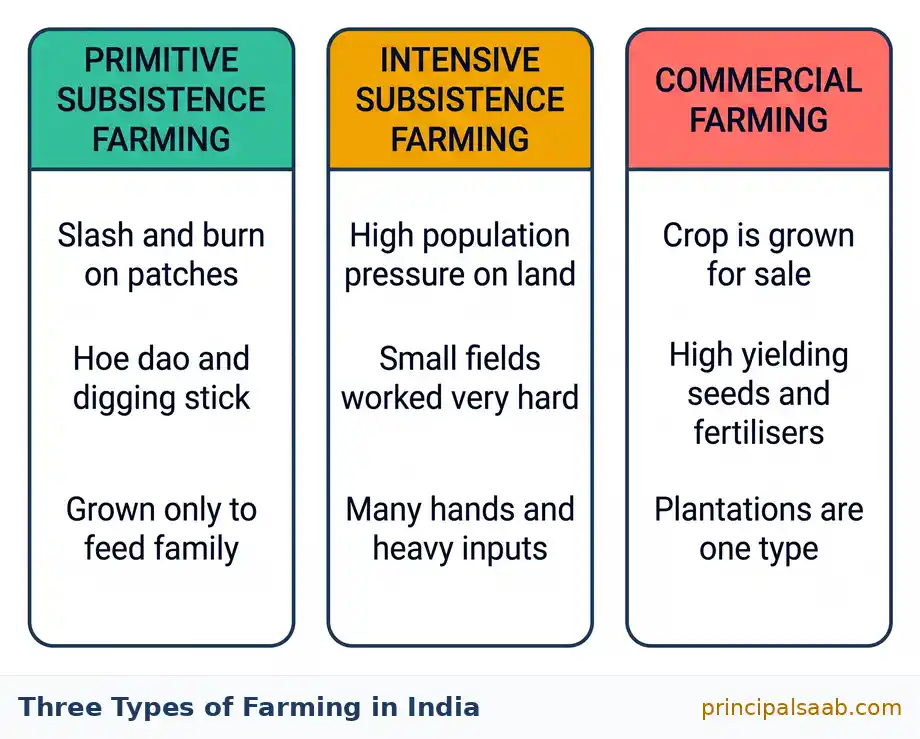
Break the name apart and it teaches itself. Primitive points to the tools — hoe, dao, digging stick, family labour, no machinery. Subsistence points to the purpose — the family grows to feed itself, not to sell. And shifting points to the movement — the plot moves, the farmer does not stay put. Land productivity here is low, because there are no chemical fertilisers, no irrigation and no high-yielding seeds. The system depends entirely on the natural fertility of soil, the monsoon, and the heat and humidity of the tropics.
Where does it survive in India? On land that is difficult to plough and difficult to irrigate — the forested hills of the north-east, parts of the Western Ghats, tribal belts of central and eastern India. It is not primitive in the insulting sense. It is a sensible adaptation to thin hill soils and steep slopes where a tractor would be useless and a canal impossible. The problem is that when population pressure rises, the fallow period shortens, the soil never gets to recover, and the practice starts causing genuine deforestation and soil erosion. That balance — a rational adaptation that becomes unsustainable under pressure — is the mature point to make in a long answer.
Now, the regional names. This is where students panic, so let us make it easy. You do not need all of them. You need three or four you can spell confidently, and you should always lead with jhumming, the north-eastern name, because it is the one examiners expect. Here are the ones worth knowing.
- Jhumming — the north-eastern states, including Assam, Meghalaya, Mizoram and Nagaland. This is your default answer.
- Bewar or Dahiya — Madhya Pradesh.
- Podu or Penda — Andhra Pradesh.
- Pama Dabi, Koman or Bringa — Odisha.
- Kumari — the Western Ghats of Kerala.
- Valre or Waltre — south-eastern Rajasthan.
- Khil — the Himalayan belt.
- Kuruwa — Jharkhand.
The practice is not uniquely Indian either, and a well-placed international name lifts an answer. Shifting cultivation is called milpa in Mexico and Central America, conuco in Venezuela, roca in Brazil, masole in central Africa, ladang in Indonesia and ray in Vietnam. Mentioning even one of these in a five-mark answer signals that you have read beyond the minimum.
In shifting cultivation the plot of land shifts while the family stays in the same general area and grows crops. In nomadic herding the people and their animals move, and no crops are grown at all. If a question mentions grazing animals over long distances, it is not asking about slash-and-burn.
Why it works: Count the ideas, not the sentences. This answer delivers exactly three distinct scoreable points — tools and labour, the slash-and-burn cycle, and low productivity with one regional name attached. That structure of one idea per mark is the safest habit you can build for the whole paper.
Why it works: Notice the shape. A five-mark question almost never wants five random facts — it wants a chain of cause and effect. Here the chain runs: long fallow, population rise, shorter fallow, degraded soil, more clearing. Each link is a mark. Finishing with a constructive suggestion is what turns a good answer into a full-marks answer.
Intensive Subsistence Farming
Now move from the hill slope down to the plains — to eastern Uttar Pradesh, Bihar, West Bengal, coastal Odisha, the deltas of the peninsula. Here the land is flat and fertile, but there is a different constraint: there are simply an enormous number of people relative to the amount of farmland. A family may own one or two hectares, sometimes less, and that land has to feed everyone. So what do they do? They cannot make the field bigger, so they make it work harder.
That is the whole logic of intensive subsistence farming. It is practised in areas of high population pressure on land. It is labour-intensive — many hands working the same small field, transplanting paddy seedling by seedling, weeding by hand. It uses high doses of biochemical inputs — fertilisers and pesticides — and irrigation to squeeze the maximum yield out of every square metre. And because the field is small and worked so hard, farmers often take more than one crop a year from it, a practice called multiple cropping.
Here is a subtlety worth understanding, because it separates a top answer from an average one. The word subsistence can mislead you into thinking this is backward farming. It is not. Yields per hectare in intensive subsistence areas can be very high. The problem is not productivity per hectare — it is productivity per person. When ten people work a field that two people could manage, the output has to be divided ten ways, and each person ends up with very little. Economists call the surplus workers disguised unemployment: they appear to be employed, but removing them would not reduce output at all.
And there is a painful cycle built into the system. The right of inheritance means a farm is divided among sons in each generation. A four-hectare farm becomes two farms of two hectares, then four farms of one hectare. This is called the fragmentation of landholdings, and it makes farms progressively less viable — too small to justify a tractor, too small to generate a real surplus, too small to escape from. Even so, the farmer has no alternative source of livelihood, so the land continues to be worked ever more intensively. Say that sentence in an answer about the problems of Indian agriculture and you will earn your mark.
Extensive farming raises output by farming a larger area. Intensive farming raises output by pouring more labour, water, fertiliser and care into the same area. India, with limited land and abundant people, has historically had to be intensive.
Why it works: The question asks why it persists, so a description of what intensive farming is would score nothing. Answer the actual verb in the question. Three causes, three marks: population pressure, inheritance and fragmentation, and absence of alternatives.
Commercial Farming And Plantation Agriculture
The third system is defined not by tools or by population, but by purpose. In commercial farming, the crop is grown to be sold. The farmer is producing for a market, so the whole calculation changes: it becomes worth investing money in modern inputs because you expect to earn money back. The main characteristic of commercial farming is the use of higher doses of modern inputs — high-yielding variety seeds, chemical fertilisers, insecticides and pesticides — in order to obtain higher productivity.
Here comes one of the most beautiful ideas in the whole chapter, and examiners love it. The degree of commercialisation of a crop varies from region to region. The very same crop can be commercial in one state and subsistence in another. Rice is a commercial crop in Punjab and Haryana, where farmers grow it deliberately for sale to the market and to government procurement. In Odisha, rice is a subsistence crop — the family grows it primarily to eat. So do not label crops as commercial or subsistence. Label the relationship between the farmer and the market. Once you understand that, you will never be caught by this question.
Plantation agriculture is a special, extreme form of commercial farming. On a plantation, a single crop is grown on a large area. It is capital-intensive, needs migrant labourers in large numbers, and — this is the defining line — all of the produce is used as raw material in the respective industries. Tea leaves go to tea processing, sugarcane to sugar mills, rubber latex to rubber factories. Because a plantation is really a factory whose first floor happens to be a field, it depends absolutely on a well-developed network of transport and communication linking the estate, the processing unit and the market. Tea in Assam and North Bengal, coffee in Karnataka, rubber in Kerala, and sugarcane, banana and spices elsewhere are the standard Indian examples.
Sit with the table below until each row feels obvious. If you can reconstruct it from memory on a rough sheet, this entire portion of the chapter is done.
| Basis | Primitive Subsistence | Intensive Subsistence | Commercial (incl. Plantation) |
|---|---|---|---|
| Purpose | Family consumption only | Mainly family consumption, small surplus | Sale in the market or supply to industry |
| Size of plot | Small forest patches, shifted every few years | Very small, fragmented holdings | Large; plantations cover very large estates |
| Tools and inputs | Hoe, dao, digging stick; no fertiliser or irrigation | Simple tools plus heavy irrigation and biochemical inputs | HYV seeds, chemical fertilisers, pesticides, machinery |
| Labour | Family and community labour | Very labour-intensive; family labour | Hired and migrant labour; capital-intensive |
| Productivity | Low per hectare and per person | High per hectare, low per person | High per hectare and per person |
| Where in India | North-eastern hills, Western Ghats, central tribal belt | Densely settled plains and deltas of north and east India | Punjab, Haryana, western UP, Maharashtra; tea in Assam, coffee in Karnataka, rubber in Kerala |
| Typical crops | Coarse cereals, pulses, vegetables for the household | Rice, wheat, pulses, oilseeds | Wheat and rice for market; tea, coffee, rubber, sugarcane, cotton |
If a question says explain plantation agriculture, deliver five crisp features and you cannot lose a mark: single crop, large area, capital-intensive, migrant and abundant labour, produce used as industrial raw material — plus a dependence on good transport and communication. Then attach one example with its state.
Why it works: The trap in this question is to describe Punjab and Odisha without stating the principle. The first sentence states the principle explicitly, then each region illustrates it. Always answer the concept first and the example second.
Why it works: The question gives you a scenario and asks you to classify it. Always name the category in your first line so the examiner knows immediately that you have identified it, then use the numbered features as evidence. Note how each feature is tied back to the details in the scenario rather than being recited abstractly.
Cropping Seasons: Rabi, Kharif And Zaid
This is the section that makes the rest of the chapter click, so slow down here. India has three cropping seasons, and they exist because India has a monsoon climate — a sharply wet season followed by a cool dry season followed by a hot dry season. The crops follow the weather. That is all a cropping season is: a window of climate that suits a particular family of crops.
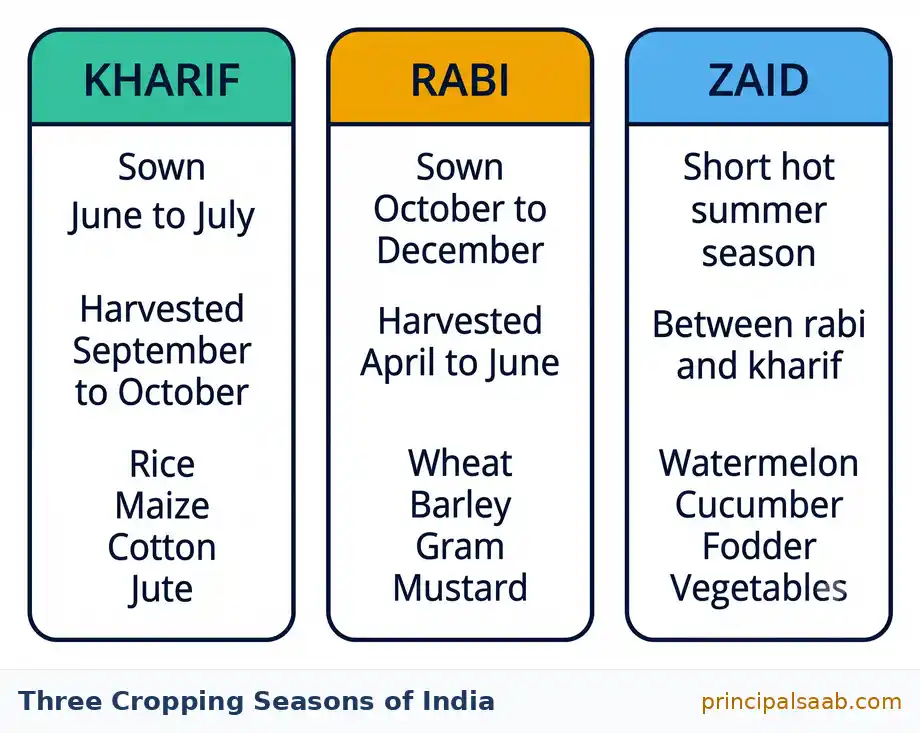
Kharif is the monsoon season crop. It is sown with the onset of the south-west monsoon, roughly in June and July, and harvested in September and October. These crops need heat and lots of water while they grow, which is exactly what the monsoon supplies. Paddy, maize, jowar, bajra, tur (arhar), moong, urad, cotton, jute, groundnut and soyabean are all kharif crops. Rice is the star of the season, and in Assam, West Bengal and Odisha farmers even manage three paddy crops in a year, known as aus, aman and boro.
Rabi is the winter crop. It is sown in October to December and harvested in April to June. These crops want a cool growing season and bright sunshine at the time of ripening — cold nights to build the grain, warm sunny days at the end to fill and dry it. Wheat, barley, peas, gram and mustard are the standard rabi crops. The rabi belt is north and north-western India: Punjab, Haryana, Himachal Pradesh, Jammu and Kashmir, Uttarakhand, Uttar Pradesh, Rajasthan and parts of Madhya Pradesh. Two things made this belt so productive — precipitation from the western temperate cyclones, which bring a little winter rain to the north-west and are crucial for wheat, and the Green Revolution, which concentrated its irrigation and seed technology in exactly these states.
Zaid is the short season squeezed in between the rabi harvest and the kharif sowing — the hot summer months. It is a small season, and students often skip it, which is a mistake because a one-mark question on zaid is very easy to set. Zaid crops are watermelon, muskmelon, cucumber, other vegetables and fodder crops. They thrive on summer heat provided there is irrigation. One special note the syllabus makes here: sugarcane takes almost a year to grow, so it does not sit neatly inside any one season.
Here is a trick that stops the two main seasons from ever swapping in your head. Kharif rhymes with relief — the relief the monsoon rain brings. Rabi begins with R, and so does Rain-free winter. Or simpler still: if a crop drinks a lot and grows in the rains, it is kharif; if it likes cool weather and needs irrigation because there is no rain, it is rabi. Rice drinks. Wheat does not. That single pair will anchor the rest.
| Feature | Rabi | Kharif | Zaid |
|---|---|---|---|
| Sowing time | October to December (winter) | June to July, with onset of the south-west monsoon | Between the rabi harvest and the kharif sowing (summer) |
| Harvesting time | April to June (summer) | September to October | Short cycle within the summer months |
| Climatic need | Cool growing season, bright sunshine while ripening | High temperature and heavy rainfall while growing | Hot dry weather with assured irrigation |
| Water source | Irrigation plus winter rain from western temperate cyclones | The south-west monsoon itself | Entirely irrigation |
| Main crops | Wheat, barley, peas, gram, mustard | Paddy, maize, jowar, bajra, tur, moong, urad, cotton, jute, groundnut, soyabean | Watermelon, muskmelon, cucumber, vegetables, fodder crops |
| Key states | Punjab, Haryana, Himachal Pradesh, Jammu and Kashmir, Uttarakhand, Uttar Pradesh, Rajasthan, Madhya Pradesh | Assam, West Bengal, coastal Odisha, Andhra Pradesh, Telangana, Tamil Nadu, Kerala, Maharashtra | Irrigated pockets across northern and western India |
Rabi crops need plenty of water; what they do not get is monsoon rain. That is precisely why the rabi belt of Punjab, Haryana and western Uttar Pradesh depends so heavily on canal and tubewell irrigation, and why a weak set of western temperate cyclones hurts the wheat crop. Never write that a rabi crop is a dry crop.
Why it works: A distinguish question must compare on the same basis in each sentence — time, then climate and water, then crops. Never write three lines about rabi followed by three lines about kharif; that is a description, not a distinction, and strict markers cut it.
Why it works: This is an application question, and applications need three moves: name the answer, explain the timing, explain the physical conditions that make it possible. The mention of irrigation is what earns the third mark — without it the answer would be incomplete, because zaid crops cannot grow on rainfall alone.
Rice: The Staple Of Monsoon India
Rice is the staple food crop of a majority of Indians, and India is one of the two largest producers of rice in the world alongside China. Let us build its profile the way you should build every crop profile — climate, water, soil, season, regions.
Rice is a kharif crop. It requires high temperature, above 25 degrees Celsius, and high humidity, with annual rainfall above 100 cm. Think about why. Paddy is a semi-aquatic plant; it is transplanted into a flooded field and spends much of its life standing in a few centimetres of water. That standing water suppresses weeds and keeps the roots warm. So rice needs three things at once: heat, humidity and water that will not drain away. And that last point tells you the soil and the relief — rice needs flat land that can hold water and clayey or alluvial soil that does not let it seep through.
Now the geography follows automatically. Rice is grown in the plains of north and north-eastern India, the coastal areas and the deltaic regions. The Ganga plain, the Brahmaputra valley, the eastern and western coastal plains, and the deltas of the Mahanadi, Godavari, Krishna and Kaveri are all heavy rice country. Every one of them is flat, hot, humid and either well-watered by the monsoon or served by rivers.
But here is the crucial extra sentence, and it is worth a mark on its own: in areas of less rainfall, rice grows with the help of irrigation. Punjab, Haryana, western Uttar Pradesh and parts of Rajasthan receive nowhere near 100 cm of rain, yet they are major rice producers. Why? Because the development of a dense network of canal irrigation and tubewells made rice cultivation possible there. This is one of the finest examples in the whole book of technology overcoming a physical limitation — and examiners ask it often.
Rice belongs naturally to the humid east and south. Canals and tubewells carried it into the dry north-west. Whenever a question asks how a crop is grown in an apparently unsuitable region, the answer is almost always irrigation, high-yielding seeds and fertilisers.
Why it works: The examiner is ticking three boxes: temperature with a figure, rainfall with a figure plus the irrigation exception, and soil or relief with regions. Numbers matter here — writing hot and wet instead of above 25 degrees and above 100 cm is the single most common reason students lose marks in crop questions.
Why it works: Five marks needs five distinct causes, and notice they are deliberately drawn from different families: water technology, seed technology, physical soil and relief, and economic policy. Students who write five sentences all about irrigation earn one mark, not five. Spread your reasons across categories.
Wheat: The Rabi Grain Of The North-West
Wheat is the second most important cereal crop in India and the main food crop of the north and north-western parts of the country. If rice is the grain of the humid east, wheat is the grain of the drier, cooler north-west. Everything about it is the mirror image of rice, which makes it easy to learn if you learn the two together.
Wheat is a rabi crop. It requires a cool growing season and bright sunshine at the time of ripening. It needs 50 to 75 cm of annual rainfall, evenly distributed over the growing season. Notice how modest that rainfall requirement is compared with rice — under half. Notice also the phrase evenly distributed: wheat does not want a deluge, it wants steady moisture. And notice the ripening condition, because it is the detail most students forget. In the final weeks the grain needs warm, dry, sunny days to fill out and harden. Rain at harvest time flattens the crop and ruins it, which is why unseasonal March rain makes the news in Punjab every few years.
There are two important wheat-growing zones in India, and this is a favourite short question. The first is the Ganga-Satluj plains in the north-west. The second is the black soil region of the Deccan. Learn that pair as a unit. The leading producing states are Uttar Pradesh, Punjab, Haryana, Madhya Pradesh, Rajasthan and Bihar. The north-western belt dominates because it combines three advantages that rarely occur together: deep fertile alluvial soil, a genuinely cool winter, and assured irrigation from canals and tubewells.
One more link worth carrying in your head: wheat is the crop that benefited most dramatically from the Green Revolution. The high-yielding dwarf varieties introduced from the mid-1960s were wheat varieties first, and Punjab, Haryana and western Uttar Pradesh were where they were planted. That is why the map of wheat production and the map of the Green Revolution look almost identical, and why the same region also carries the environmental costs of that revolution — falling water tables and declining soil fertility. Mention that link and a five-mark answer immediately looks mature.
Rice: kharif, above 25 degrees, above 100 cm rain, humid, plains and deltas of the east and south. Wheat: rabi, cool season with bright ripening sunshine, 50 to 75 cm evenly distributed rain, Ganga-Satluj plains and Deccan black soil. Recite them together and neither will ever slip.
Why it works: The question has two halves — conditions and zones — so the answer must clearly serve both. Many students give a beautiful list of conditions and forget the two zones entirely, throwing away a whole mark. Underline both halves of a question before you start writing.
Millets: Jowar, Bajra And Ragi
Millets are the quiet heroes of this chapter, and the syllabus makes a point that you must not miss. Jowar, bajra and ragi are the important millets grown in India. Though these are called coarse grains, they have very high nutritional value. That sentence, almost word for word, is worth writing in any millet answer. Ragi in particular is very rich in iron, calcium, other micronutrients and roughage. In a country that struggles with anaemia, that is not a small footnote.
What unites all three millets is toughness. They grow where rice and wheat would fail — on poorer soils, with less water, in hotter and drier conditions. That single property explains their entire distribution map, and it is also why they are increasingly promoted today as climate-resilient crops that need far less irrigation than paddy. Let us take them one at a time.
Jowar is the third most important food crop with respect to area and production in India — remember the word third, after rice and wheat. It is a rain-fed crop mostly grown in the moist areas which hardly needs irrigation. Its leading producers are Maharashtra, Karnataka, Telangana, Andhra Pradesh and Madhya Pradesh — essentially the Deccan plateau.
Bajra is the desert-edge millet. It grows well on sandy soils and shallow black soil. Think of Rajasthan sand and you have the crop. Major producing states are Rajasthan, Uttar Pradesh, Maharashtra, Gujarat and Haryana. If a question mentions sandy soil, low rainfall and a semi-arid west, the answer is bajra.
Ragi is a crop of dry regions and grows well on red, black, sandy, loamy and shallow black soils. Notice how broad that soil list is — ragi is the least fussy of the three. Major producing states are Karnataka, Tamil Nadu, Himachal Pradesh, Uttarakhand, Sikkim, Jharkhand and Arunachal Pradesh. Karnataka is the one to name first.
| Millet | Soil And Conditions | Special Point To Remember | Leading States |
|---|---|---|---|
| Jowar | Rain-fed, grown in moist areas, hardly needs irrigation | Third most important food crop by area and production | Maharashtra, Karnataka, Telangana, Andhra Pradesh, Madhya Pradesh |
| Bajra | Sandy soils and shallow black soil; hot, semi-arid areas | The crop of the dry north-west and desert margins | Rajasthan, Uttar Pradesh, Maharashtra, Gujarat, Haryana |
| Ragi | Dry regions; red, black, sandy, loamy and shallow black soils | Very rich in iron, calcium, micronutrients and roughage | Karnataka, Tamil Nadu, Himachal Pradesh, Uttarakhand, Sikkim, Jharkhand, Arunachal Pradesh |
Coarse refers only to the texture of the grain, never to its nutrition. If you write that millets are inferior grains, you contradict the very point the syllabus wants you to make. Write that they are called coarse grains but are highly nutritious, and name ragi as being rich in iron and calcium.
Why it works: The question asks two things: why nutritious, and give examples. The answer clears the coarse-grain misunderstanding first, then gives the strongest single example (ragi), then adds a second dimension the examiner will happily reward — nutrition plus reliability in dry regions.
Why it works: Application questions reward comparison. The middle sentence earns its mark by explicitly ruling out the alternatives with figures, which proves you understand rather than guessed. The pulse suggestion adds genuine value by linking to soil fertility — always look for a chance to connect two parts of the chapter.
Maize And Pulses
Maize is a crop which is used both as food and as fodder. Start every maize answer with that phrase, because it is the distinguishing feature the syllabus emphasises. Maize is a kharif crop which requires temperature between 21 degrees Celsius and 27 degrees Celsius and grows well in old alluvial soil. However, in some states such as Bihar, maize is grown in the rabi season also — a small exception that makes a very neat one-mark question.
Maize production has risen sharply in recent decades, and the reason is given plainly in the syllabus: the use of modern inputs such as high-yielding variety seeds, fertilisers and irrigation has contributed to the increasing production of maize. Major producing states include Karnataka, Madhya Pradesh, Bihar, Tamil Nadu, Telangana, Maharashtra and Uttar Pradesh. Its dual role matters economically too: as poultry and cattle feed, and increasingly as an industrial raw material for starch and other products.
Now pulses, and this is a section where a few precise sentences carry enormous weight. India is the largest producer as well as the largest consumer of pulses in the world. Pulses are the major source of protein in a vegetarian diet. The major pulses grown in India are tur (arhar), urad, moong, masur, peas and gram.
Here is the fact that carries a mark almost every year, so read it twice. Pulses are leguminous crops, and all of them except arhar help in restoring soil fertility by fixing nitrogen from the air. That is why pulses are mostly grown in rotation with other crops. A farmer who plants gram after wheat is not only earning from the gram; he is quietly recharging his field with nitrogen so that the next cereal crop does better. It is free fertiliser produced by bacteria living in the root nodules of the plant. Note the exception carefully — except arhar. Students who write that all pulses fix nitrogen lose the mark that the exception was designed to test.
Pulses need less moisture than cereals and survive in dry conditions, which is why they are grown largely on rain-fed land. Major producing states are Madhya Pradesh, Rajasthan, Maharashtra, Uttar Pradesh and Karnataka.
Cereals take nitrogen out of the soil. Leguminous pulses put it back. Rotating them means the farmer needs less chemical fertiliser, spends less money and damages the soil less. When a question asks how Indian agriculture can become more sustainable, growing pulses in rotation is a strong, syllabus-grounded point.
Why it works: The exception except arhar appears in the very first line, which is the safest place to put a detail you are afraid of forgetting. The answer then gives the agronomic reason and the economic reason, which is exactly the two-sided thinking that Geography rewards.
Sugarcane: From Field To Sugar Mill
Sugarcane is a tropical as well as a subtropical crop — and that little phrase matters, because it explains why sugarcane is grown both in the far north in Uttar Pradesh and in the peninsula in Maharashtra and Tamil Nadu. Very few crops in the chapter span that range.
Its conditions are precise: it grows well in a hot and humid climate with a temperature of 21 degrees Celsius to 27 degrees Celsius and an annual rainfall between 75 cm and 100 cm. Irrigation is required in regions of low rainfall. It can be grown on a variety of soils — it is not fussy — and it needs manual labour from sowing to harvesting. That last point tells you why sugarcane belts are also areas of high rural employment, and why labour costs matter so much to the industry.
India is the second largest producer of sugarcane in the world, after Brazil. It is the main source of sugar, gur (jaggery), khandsari and molasses. Learn that list of four products as a unit; it appears in questions regularly, and molasses is the one people forget. Major producing states are Uttar Pradesh, Maharashtra, Karnataka, Tamil Nadu, Andhra Pradesh, Telangana, Bihar, Punjab and Haryana.
Two extra insights that lift an answer. First, remember from the cropping seasons section that sugarcane takes almost a year to grow, so it does not belong to a single season — it occupies the field across seasons, which is why farmers need substantial capital to wait for the return. Second, sugarcane is a bulky, heavy crop whose sucrose content begins falling as soon as it is cut, so it must be crushed quickly. That is the reason sugar mills are located in the cane fields themselves rather than in distant cities — a wonderful link to the Manufacturing Industries chapter, and examiners notice when students make it.
Sugarcane connects to sugar mills, cotton connects to the textile industry, jute connects to the jute industry of the Hugli basin, and rubber connects to tyre manufacturing. A single sentence of cross-chapter linkage in a five-mark answer shows synthesis and often nudges a borderline answer upward.
Why it works: Every sentence contains a specific, tickable fact — a temperature range, a rainfall range, a soil note, a labour note, a product list. There is no filler. That is what a five-mark Geography answer should look like: five facts, five sentences, no decoration.
Oilseeds: India Cooking-Oil Basket
India is among the largest producers of oilseeds in the world, and oilseeds occupy a large share of the total cropped area of the country. This is a section students rush past, but it contains three or four highly examinable details. Take them slowly.
The main oilseeds produced in India are groundnut, mustard, coconut, sesamum (til), soyabean, castor seeds, cotton seeds, linseed and sunflower. Most of these are edible and used as cooking mediums. However — and here is the detail worth a mark — some of them are also used as raw material in the production of soap, cosmetics and ointments. So oilseeds are simultaneously a food crop and an industrial crop.
Now the seasonal details, which are the trickiest part of the chapter and therefore the most likely to be tested:
- Groundnut is a kharif crop and accounts for about half of the major oilseeds produced in the country. Gujarat and Rajasthan are among the leading producers, along with Tamil Nadu, Andhra Pradesh and Karnataka.
- Linseed and mustard are rabi crops.
- Sesamum is a kharif crop in north India and a rabi crop in south India — a genuinely odd fact, and precisely the kind examiners enjoy.
- Castor seed is grown as both a rabi and a kharif crop.
Read that list once more. Groundnut kharif, linseed and mustard rabi, sesamum both depending on region, castor both. If you can say that in one breath, you have secured a mark that most of your classmates will drop.
They are not. The correct statement is that most oilseeds are edible and used as cooking mediums, while some are used as raw material in soap, cosmetics and ointments. Castor and linseed in particular have strong industrial uses. Use the word most, not all.
Why it works: The word importance in a question is an invitation to give food value, industrial value and economic value. Cover all three angles and the mark scheme has nowhere to hide. Naming several oilseeds in the opening line also demonstrates range at no extra cost.
Tea And Coffee: The Beverage Plantations
Tea and coffee belong together because both are beverage crops, both are grown on plantations, and both came to India through colonial commerce. But their physical requirements are quite different, so keep the profiles separate in your notes.
Tea is described in the syllabus as an example of plantation agriculture, and it is also an important beverage crop introduced in India initially by the British. Today a large portion of the tea plantations are owned by Indians. Now the conditions, and notice how tightly each one connects to the plant biology.
- The tea plant grows well in tropical and sub-tropical climates.
- It needs deep and fertile well-drained soil, rich in humus and organic matter. Note the phrase well-drained — tea is the opposite of rice. Water must move through the soil, not stand in it, because waterlogging rots the roots. This is exactly why tea is grown on hill slopes, where gravity does the draining.
- Tea bushes require a warm and moist frost-free climate all through the year. Frost kills the tender leaf.
- Frequent showers evenly distributed over the year ensure continuous growth of tender leaves. This is the key to the whole crop: you do not harvest tea once a year, you pluck it again and again, so the plant must keep producing new shoots continuously.
- Tea is a labour-intensive industry. It requires abundant, cheap and skilled labour. Skilled matters — plucking only the top two leaves and a bud is a trained skill, not brute work.
- Tea is processed within the tea garden to restore its freshness. That is why every estate has its own factory.
Major tea-producing regions are Assam and the hills of Darjeeling and Jalpaiguri districts of West Bengal, along with Tamil Nadu and Kerala in the south. Tea is also grown in Himachal Pradesh, Uttarakhand, Meghalaya, Andhra Pradesh and Tripura. India is a leading producer and exporter of tea in the world. Assam alone accounts for a very large share of Indian production.
Coffee has a much narrower story, which is good news — it is quick to learn. Indian coffee is known in the world for its good quality. The Arabica variety, initially brought from Yemen, is produced in the country, and this variety is in great demand all over the world. Its cultivation was initially introduced on the Baba Budan Hills in Karnataka, and even today cultivation is confined to the Nilgiri hills in Karnataka, Kerala and Tamil Nadu. Three states, one variety, one origin story. Learn those four facts and coffee is finished.
Both tea and coffee need warmth, high rainfall and soil that drains freely. Hill slopes deliver all three at once: tropical latitude gives the warmth, orographic rain gives the moisture, and the gradient carries surplus water away so roots never sit in standing water. That is why India tea and coffee maps are hill maps, not plain maps.
Why it works: Look at how each condition is followed by a short reason — frost-free because frost kills tender leaves, well-drained because roots must not waterlog. Those clauses cost you four words each and they convert a memorised list into demonstrated understanding, which is what separates a 4 from a 5.
Why it works: Three marks, three distinct facts: variety and reputation, historical origin, present distribution with a physical reason attached. Coffee is a small topic, so the examiner expects precision rather than length. Do not pad it.
Horticulture: Fruits And Vegetables
Horticulture means the cultivation of fruits, vegetables and flowers. It gets a short treatment in the textbook but it deserves your attention for two reasons: it produces easy, high-scoring one-mark questions about which fruit comes from where, and it is central to the way-forward argument at the end of the chapter about diversification into high-value crops.
India is the second largest producer of fruits and vegetables in the world after China. What makes India special is not just quantity but variety: because the country stretches from the tropics to the temperate Himalaya, India produces both tropical and temperate fruits. Mangoes and bananas from the hot plains, apples and walnuts from the cold mountains, all inside one country. Very few nations can say that.
Here is the geography of India fruit basket, worth learning as a quick recall list:
- Mangoes — Maharashtra, Andhra Pradesh, Telangana, Uttar Pradesh and West Bengal.
- Oranges — Nagpur in Maharashtra, and Cherrapunjee in Meghalaya.
- Bananas — Kerala, Mizoram, Maharashtra and Tamil Nadu.
- Lichi and guava — Uttar Pradesh and Bihar.
- Pineapples — Meghalaya.
- Grapes — Andhra Pradesh, Telangana and Maharashtra.
- Apples, pears, apricots and walnuts — Jammu and Kashmir and Himachal Pradesh.
India is also an important producer of vegetables — pea, cauliflower, onion, cabbage, tomato, brinjal and potato. Horticultural produce is exported as well, and the sector supports large numbers of small farmers because fruits and vegetables give a much higher income per hectare than cereals do.
That last sentence is the one to remember for long answers. When the chapter later argues that Indian farmers should diversify their cropping pattern from cereals to high-value crops, horticulture is precisely what it means. High-value crops raise incomes and, because fruit trees hold soil and need less water than paddy, they can also reduce environmental degradation. The catch is that fruits and vegetables are perishable, so the sector depends on cold storage, quick transport and food processing — and where these are missing, a great deal of produce is wasted.
Oranges to Nagpur and Cherrapunjee. Pineapples to Meghalaya. Apples, pears, apricots and walnuts to the cold north — Jammu and Kashmir and Himachal Pradesh. These three anchors cover the most commonly asked items, and the rest follow the simple rule that tropical fruits come from hot states.
Why it works: Notice the answer never simply lists fruits. The question asked about improving farmers conditions, so every sentence is about income, markets or employment. Reciting the fruit list here would earn nothing. Always let the verb of the question steer the content.
Non-Food Fibre Crops: Rubber, Cotton And Jute
The syllabus groups four fibre crops together — cotton, jute, hemp and natural silk. Cotton and jute are grown in the soil, hemp is also a plant fibre, while silk is obtained from the cocoons of silkworms fed on green leaves, especially mulberry. Rearing silkworms for the production of silk fibre is known as sericulture. That one word is a reliable one-mark question, so write it down now. Rubber is not a fibre at all — it is an industrial raw material — but the board groups it with these crops in the map list, so we will study it here.
Rubber is an equatorial crop, but under special conditions it is also grown in tropical and sub-tropical areas. It requires a moist and humid climate with rainfall of more than 200 cm and temperature above 25 degrees Celsius. That 200 cm figure is the highest rainfall requirement of any crop in the chapter, so it is easy to remember by being the extreme. Rubber is an important industrial raw material, used for tyres, tubes, footwear and countless components. It is mainly grown in Kerala, Tamil Nadu, Karnataka, the Andaman and Nicobar Islands and the Garo Hills of Meghalaya. Kerala is the dominant producer by a wide margin, and the reason is straightforward — the Malabar coast catches the full force of the south-west monsoon against the Western Ghats.
Cotton comes with a lovely opening line: India is believed to be the original home of the cotton plant. Cotton is one of the main raw materials for the cotton textile industry. India is among the largest producers of cotton in the world, alongside China. Now the conditions, and every one of them is specific.
- Cotton grows well in the drier parts of the black cotton soil of the Deccan plateau. Black soil, also called regur, retains moisture superbly, which suits a crop that needs steady moisture but little rain.
- It requires high temperature, light rainfall or irrigation, 210 frost-free days and bright sunshine for its growth.
- It is a kharif crop and requires 6 to 8 months to mature.
The figure 210 frost-free days is the single most distinctive number in the entire chapter. If you write it, the examiner knows instantly that you have studied properly. Major producing states are Maharashtra, Gujarat, Madhya Pradesh, Karnataka, Andhra Pradesh, Telangana, Tamil Nadu, Punjab and Haryana.
Jute is known as the golden fibre — golden because of the colour of the retted fibre and because of the wealth it once brought to Bengal. Jute grows well on well-drained fertile soils in the flood plains where soils are renewed every year. Pause on that phrase. Jute is an extremely hungry crop that strips nutrients from the soil, so it can only be grown sustainably where the river deposits a fresh layer of fertile silt annually. That is exactly what the Ganga-Brahmaputra delta does every monsoon. This is the finest example in the chapter of a crop whose location is dictated by a single physical process. High temperature is required during the time of growth.
Major jute-producing states are West Bengal, Bihar, Assam, Odisha and Meghalaya. Jute is used in making gunny bags, mats, ropes, yarn, carpets and other artefacts. And the crop has a problem you must know: due to its high cost, jute is losing market to synthetic fibres and packing materials, particularly nylon. Say that in an answer about the decline of the jute industry and you have the key mark.
| Crop | Season | Temperature And Rainfall | Soil | Leading States |
|---|---|---|---|---|
| Rice | Kharif | Above 25 degrees C; above 100 cm rain, or irrigation | Alluvial and clayey, level land holding water | West Bengal, Uttar Pradesh, Punjab, Bihar, Andhra Pradesh, Tamil Nadu, Odisha |
| Wheat | Rabi | Cool growing season, sunshine at ripening; 50 to 75 cm evenly distributed | Alluvial of Ganga-Satluj plain; black soil of the Deccan | Uttar Pradesh, Punjab, Haryana, Madhya Pradesh, Rajasthan, Bihar |
| Sugarcane | Takes almost a year | 21 to 27 degrees C; 75 to 100 cm, irrigation if less | Variety of soils | Uttar Pradesh, Maharashtra, Karnataka, Tamil Nadu, Andhra Pradesh, Bihar |
| Tea | Plucked through the year | Warm, moist, frost-free all year; frequent evenly distributed showers | Deep, fertile, well-drained, rich in humus; hill slopes | Assam, West Bengal (Darjeeling, Jalpaiguri), Tamil Nadu, Kerala |
| Coffee | Plantation crop | Warm humid highland climate with good rainfall | Well-drained hill soils | Karnataka, Kerala, Tamil Nadu (Nilgiri and Baba Budan Hills) |
| Rubber | Equatorial plantation crop | Above 25 degrees C; more than 200 cm rain | Moist, humid, well-drained laterite soils | Kerala, Tamil Nadu, Karnataka, Andaman and Nicobar, Garo Hills of Meghalaya |
| Cotton | Kharif; 6 to 8 months to mature | High temperature, light rainfall or irrigation, 210 frost-free days, bright sunshine | Black cotton soil (regur) of the drier Deccan plateau | Maharashtra, Gujarat, Madhya Pradesh, Karnataka, Telangana, Punjab, Haryana |
| Jute | Kharif | High temperature during growth; heavy monsoon rainfall | Well-drained fertile flood-plain soils renewed by silt every year | West Bengal, Bihar, Assam, Odisha, Meghalaya |
Cotton belongs to the black soil of the dry Deccan plateau. Jute belongs to the alluvial flood-plain soil of the wet Ganga-Brahmaputra delta. A memory hook: cotton is white and grows on black soil in a dry place; jute is golden and grows on golden silt in a wet place. Getting these two the wrong way round is the single most frequent error in this chapter.
Why it works: The second sentence is the one that earns real credit. Anyone can copy the phrase about renewed soil; explaining why renewal matters — because jute exhausts the soil — shows the examiner you understand the mechanism. Adding water for retting is an authentic detail that costs nothing and impresses.
Why it works: A compare question must run parallel comparisons, one basis per sentence — rainfall, then soil, then growing period, then distribution. The final sentence deliberately notes a similarity, because a good comparison acknowledges both difference and common ground. That final line often earns the fifth mark on its own.
Technological And Institutional Reforms
Take a breath, because this section has a different flavour from everything before it. Up to now we have been reading physical geography — soils, rainfall, temperature. Now we read policy. The organising idea is simple and it is worth writing at the top of your notes: agriculture has been practised in India for thousands of years, and it will not grow further on the strength of tradition alone. It needs technological and institutional reform. Technological reform changes the tools — seeds, fertilisers, irrigation, machines. Institutional reform changes the rules — who owns the land, who lends the money, who guarantees the price. India needed both, and it tried both.
Institutional reform came first. After Independence, collectivisation, consolidation of holdings, cooperation and abolition of zamindari were given priority to bring about institutional reforms in the country. Understand what each means. Abolition of zamindari removed the intermediary landlord so the tiller could own the soil he worked. Consolidation of holdings gathered a farmer scattered strips into one workable block, attacking the fragmentation problem we met earlier. Cooperation pooled small farmers so they could jointly buy inputs and sell produce. Land reform was the main focus of our First Five Year Plan.
And now the honest sentence that the syllabus itself makes, which you should never omit: laws of land reform were enacted but the implementation was lacking. Good laws, weak execution. That single line is often worth a mark, and it is the seed of the whole critique of Indian agricultural policy.
Technological reform came in the 1960s and 1970s. The Government of India embarked upon introducing agricultural reforms to improve Indian agriculture. The Green Revolution, based on the use of package technology, and the White Revolution, also called Operation Flood, were some of the strategies initiated. The phrase package technology deserves attention. The Green Revolution did not succeed because of one magic seed; it succeeded because high-yielding variety seeds, chemical fertilisers, pesticides and assured irrigation were delivered together. Any one of them without the others would have failed — HYV seeds without water simply die. Remember that and you will never write a shallow answer about the Green Revolution.
But this too led to the concentration of development in a few selected areas. Punjab, Haryana and western Uttar Pradesh raced ahead, while rain-fed eastern and central India were largely left behind. Regional inequality was the price. This is why, in the 1980s and 1990s, a comprehensive land development programme was initiated, which included both institutional and technical reforms. The measures under it are highly examinable, so learn them as a list:
- Provision for crop insurance against drought, flood, cyclone, fire and disease — so that one bad season does not destroy a family.
- Establishment of Grameen banks, cooperative societies and banks to provide loan facilities to farmers at lower rates of interest, freeing them from the moneylender.
- Kissan Credit Card (KCC) — a simple credit instrument letting a farmer borrow for seeds and fertiliser when he needs them, not when a lender permits.
- Personal Accident Insurance Scheme (PAIS) for the farmer himself.
- Special weather bulletins and agricultural programmes for farmers on radio and television, so that scientific advice reaches the village.
- Minimum support price, remunerative and procurement prices announced by the government for important crops to check the exploitation of farmers by speculators and middlemen.
That final point about the minimum support price is the most important economic idea in the section. Farmers are price-takers: a bumper harvest crashes the price, so a farmer can work harder, grow more and earn less. The MSP is a floor announced before sowing, so the farmer knows the worst price he can receive and can plan and invest with some confidence. Explain it in those terms and you will always be right.
The government has also worked to modernise agriculture through the establishment of the Indian Council of Agricultural Research (ICAR), agricultural universities, veterinary services and animal breeding centres, horticulture development, and research and development in meteorology and weather forecasting. Improving rural infrastructure was considered essential to the same purpose.
| Basis | Green Revolution | White Revolution (Operation Flood) |
|---|---|---|
| Concerned with | Food grain production, chiefly wheat and rice | Milk and dairy production |
| Core method | Package technology: high-yielding variety seeds, chemical fertilisers, pesticides and assured irrigation used together | Cooperative organisation of milk producers, collection and chilling networks, improved cattle breeds and veterinary care |
| Period | From the mid-1960s onwards | From the 1970s onwards |
| Main achievement | India moved from food shortage to self-sufficiency in food grains and could build buffer stocks | India became one of the world largest milk producers, giving landless and small farmers a daily income |
| Main limitation | Concentrated development in a few selected areas such as Punjab, Haryana and western Uttar Pradesh, widening regional inequality; heavy chemical and groundwater use degraded soil and depleted water tables | Benefits spread unevenly across regions, and returns depend on fodder costs and continuing access to organised cooperative markets |
One more story belongs here, and it is the human heart of the section. Bhoodan-Gramdan. After Mahatma Gandhi death, his follower Vinoba Bhave undertook a padyatra across the country to spread Gandhiji message. While he was delivering a lecture at Pochampalli in Andhra Pradesh, some poor landless villagers asked him for land for their economic well-being. Bhave could not promise it immediately, but assured them he would speak to the Government of India about providing land if they undertook cooperative farming. At that moment, a landowner named Shri Ram Chandra Reddy stood up and offered 80 acres of land to be distributed among 80 landless villagers. This came to be known as Bhoodan, the gift of land. Later, some zamindars offered to donate whole villages, and this was called Gramdan. Because it redistributed land through voluntary donation rather than force, the Bhoodan-Gramdan movement is also known as the Blood-less Revolution.
The Green Revolution proved India could produce enough food. It did not, by itself, ensure that small and landless farmers shared in the gain. That is why every technological reform in this chapter is paired with an institutional one — credit, insurance, cooperatives, price support and land redistribution. In your long answers, always mention both halves.
Why it works: Five reforms, five marks, and each one is followed by a short clause explaining the purpose it serves. Naming a scheme earns you the tick; explaining its purpose protects you if the marker wants explanation rather than a list. That small extra clause is cheap insurance.
Why it works: The word evaluate demands both sides and a judgement. This answer gives two marks to achievements, two to costs, and uses the fifth to state a way forward, which functions as the judgement. That two-two-one structure works for almost every evaluate question in the paper.
Agriculture And The National Economy
This short section contains one of the most important ideas in your whole Social Science course, and it can be stated as an apparent contradiction: agriculture employs the most people but contributes the least proportionately to national income. Let us unpack that carefully, because the numbers here are commonly misquoted and you should be able to state the trend confidently even if you do not recall a precise figure.
At the time of Independence, agriculture contributed roughly half of India national income. Since then, the share of agriculture in the gross domestic product has been declining steadily, and today it accounts for only about a sixth to a fifth of GDP. Meanwhile, the share of the workforce dependent on agriculture has fallen far more slowly, and agriculture and allied activities still support well over half of India workers. Two lines moving apart at very different speeds — that is the picture to carry in your head.
Now, is the falling GDP share a bad thing? Not in itself. In every country that has developed, the share of agriculture in national income falls as industry and services grow faster. That is a normal, healthy sign of structural change. The problem is not the falling share of output; the problem is that the share of employment has not fallen alongside it. When half the workforce produces a fifth of the output, it means average income per worker in farming is much lower than in industry or services — and that arithmetic is precisely why rural poverty persists in a country with record food production.
Understand the consequence, because it is the most sophisticated point you can make in this chapter. The real solution is not only to make farms more productive. It is to create employment outside agriculture so that fewer people have to share the farm income — through rural industry, food processing, agro-based manufacturing, services and education that opens other doors. When a long-answer question asks how the condition of Indian farmers can be improved, that point, together with diversification and better prices, is what turns a good answer into an excellent one.
Agriculture also feeds the rest of the economy in ways students often forget to mention. It supplies raw materials to industry — cotton to textiles, sugarcane to sugar mills, jute to the jute industry, oilseeds to edible-oil processing. It supplies the food that keeps industrial wages affordable. It provides a vast domestic market for manufactured goods such as fertiliser, tractors, pumps and consumer items, because when the harvest is good the village buys. And agricultural products are a significant source of export earnings — India is a notable exporter of rice, tea, coffee, spices and cotton.
Writing that the share of agriculture in GDP has declined steadily since Independence while the share of population dependent on it remains very high earns full credit and can never be marked wrong. Writing a precise percentage you half-remember can be. Trends are safe; invented decimals are not.
Why it works: This answer refuses the easy trap. A weaker answer would simply say the decline is bad. This one explains that the decline is normal, identifies the real problem as the mismatch between output share and employment share, traces the consequence, and proposes the remedy. That analytical honesty is exactly what a five-mark evaluate-style question is testing.
Food Security, Globalisation And The Way Forward
We close the content with the three ideas the chapter itself ends on. Read this section slowly; it produces the most thoughtful long-answer questions in the paper.
Food security. The definition is precise, so learn its three conditions. Food security exists when: food is available to all persons; all persons have the capacity to buy food of acceptable quality; and there is no barrier to access to food. Notice how much more that demands than simply growing enough. A country can have overflowing granaries and still fail on food security if the poor cannot afford to buy, or if food cannot physically reach a remote or flood-hit village. Availability, affordability, accessibility — three words, three conditions.
To deliver this, the government has designed a national food security system consisting of the Public Distribution System (PDS) and buffer stock. The government procures grain from farmers at the minimum support price, stores it as buffer stock against drought and shortage, and distributes it through ration shops at subsidised prices to those who need it. Notice the elegance: the same procurement operation protects the farmer from a price crash and feeds the consumer in a bad year. When you write about MSP and PDS together, make that link explicit.
Globalisation. The chapter makes a point that surprises most students: globalisation is not a new phenomenon. It was there at the time of colonisation. In the nineteenth century, when European traders came to India, Indian spices were exported to different countries of the world and farmers of south India were encouraged to grow these crops. Even today spices remain one of the important items exported from India. But colonial globalisation had a darker face too. In 1917, Indian farmers revolted in Champaran against being forced to grow indigo in place of food grains, in order to supply dye to Britain flourishing textile industry. That is the Champaran satyagraha you met in History — the same event seen from the field rather than from the freedom movement.
After the economic reforms of 1991, Indian agriculture faced a new competitive world, and here the chapter is blunt about the difficulty. Despite being an important producer of rice, cotton, rubber, tea, coffee, jute and spices, our agricultural products are not able to compete with those of the developed countries because of the highly subsidised agriculture in those countries. Read that again. The problem is not that Indian farmers are inefficient. It is that they compete against farmers who receive enormous state support, so world prices are pushed below what an unsubsidised Indian farmer can match. This is a fairness argument, and it is the correct one to make.
The way forward. The chapter offers a clear and hopeful programme, and these are the points to deploy in any question about improving Indian agriculture.
- Diversify the cropping pattern from cereals to high-value crops. The syllabus states the reason beautifully: this will increase incomes and reduce environmental degradation simultaneously. Fruits, medicinal herbs, flowers, vegetables and bio-diesel crops such as jatropha and jojoba need to be encouraged.
- Organic farming is much in vogue today because it is practised without factory-made chemicals such as fertilisers and pesticides, and hence it does not affect the environment in a negative manner.
- Improve competitiveness through better quality, grading, packaging, branding, food processing and reliable cold-chain infrastructure, so Indian produce earns a higher price rather than competing only on being cheap.
- Extend modern inputs to neglected rain-fed regions — eastern and central India — so that the gains of technology are not confined to a few states.
- Strengthen credit, insurance and price support, and expand non-farm rural employment to reduce the pressure of population on land.
The chapter also notes the arrival of the gene revolution — genetically engineered seeds — as the newest technological frontier, following the Green Revolution and the White Revolution. Mention it as a development to be assessed carefully rather than embraced or rejected outright, and your answer will read as balanced.
Every proposal in the way-forward list is trying to satisfy all three at once. Diversification raises income and cuts water use. Organic farming protects soil and earns a premium price. Food processing adds value without adding a single hectare. Whenever you are asked for suggestions, choose measures that serve more than one of these three goals and say so.
Why it works: The definition is delivered with all three conditions intact in the first line, which secures the opening mark instantly. The final sentence draws the link between farmer protection and consumer protection, which very few students spot and which markers reward.
Why it works: Every measure carries its justification in the same sentence, so each point is self-defending. Notice also that the measures are drawn from five different domains — cropping choice, chemical use, soil science, value addition and policy — rather than five versions of the same idea. Range earns marks; repetition does not.
Map Skill: The Official Identify List
Now for free marks — and I mean that literally. Contemporary India II carries 20 marks in your paper, of which 3 marks are for map pointing. Those three marks require no essay writing, no analysis and no interpretation. They require you to look at a marked location on an outline map of India and know what it is. Students who spend twenty minutes practising the map every week never lose a single one of these marks. Students who ignore it lose all three.
Read this next sentence very carefully, because it changes how you should practise. For Agriculture, the official 2026-27 map work is Identify only. The exact requirement is: Major areas of Rice and Wheat, and the Largest or Major producer states of Sugarcane, Tea, Coffee, Rubber, Cotton and Jute.
What does identify mean in practice? It means the examiner marks a state or region on the map with a letter such as A or B, and you write down what it is on the lines provided next to the map. You are not being asked to locate and label these yourself, and you are not being asked to shade them. Your job is recognition, and recognition depends entirely on one thing: knowing the shape and position of Indian states well enough to name them from an outline.
So the real skill to practise is not crops at all. It is state recognition. Get a blank political outline map of India, and practise until you can name every state from its silhouette — especially the ones students routinely confuse: Gujarat and Rajasthan, Odisha and Chhattisgarh, Telangana and Andhra Pradesh, Assam and its neighbouring north-eastern states, and Kerala versus Karnataka along the west coast. Once state recognition is automatic, the crop list below takes about fifteen minutes to learn.
| Item On The Official List | What To Recognise On The Map | The Physical Reason Behind It |
|---|---|---|
| Major areas of Rice | West Bengal, coastal Odisha, Andhra Pradesh, Tamil Nadu, Bihar, eastern Uttar Pradesh, Assam, and also Punjab and Haryana | Hot, humid, flat, well-watered plains and deltas; Punjab and Haryana qualify because of canal and tubewell irrigation |
| Major areas of Wheat | Uttar Pradesh, Punjab, Haryana, Madhya Pradesh, Rajasthan, Bihar | The Ganga-Satluj plains in the north-west and the black soil region of the Deccan: cool winter plus irrigation |
| Sugarcane | Uttar Pradesh and Maharashtra above all; also Karnataka and Tamil Nadu | A tropical and subtropical crop, so it succeeds in both the northern plain and the peninsula |
| Tea | Assam first; then the Darjeeling and Jalpaiguri hills of West Bengal, and Tamil Nadu and Kerala in the south | Warm, frost-free hill slopes with heavy evenly distributed rain and deep well-drained humus-rich soil |
| Coffee | Karnataka first; then Kerala and Tamil Nadu | Confined to the Nilgiri and Baba Budan highlands of the Western Ghats |
| Rubber | Kerala overwhelmingly; also Tamil Nadu, Karnataka, Andaman and Nicobar, Garo Hills of Meghalaya | Needs over 200 cm of rain and above 25 degrees C, which the Malabar coast receives from the south-west monsoon |
| Cotton | Maharashtra and Gujarat above all; also Madhya Pradesh, Telangana, Karnataka, Punjab, Haryana | The drier parts of the black cotton soil belt of the Deccan plateau, with 210 frost-free days |
| Jute | West Bengal overwhelmingly; also Bihar, Assam, Odisha, Meghalaya | Flood plains of the Ganga-Brahmaputra delta where fertile silt is renewed every single year |
Here is the fastest way to fix this list permanently. Notice that the map is really divided into four zones, and each zone owns a small group of crops. The north-west — Punjab, Haryana, western Uttar Pradesh — is wheat, irrigated rice and sugarcane. The east and north-east — West Bengal, Bihar, Assam, Odisha — is rice, jute and tea. The Deccan plateau — Maharashtra, Gujarat, Madhya Pradesh, Telangana — is cotton, jowar and sugarcane in the irrigated pockets. The far south-west hills — Kerala, Karnataka, Tamil Nadu — is rubber, coffee, tea and spices. Four zones. Learn the zones and the individual states drop into place on their own.
Kerala is the single most map-tested state in this chapter because it is the answer for rubber and appears again for coffee and tea. West Bengal is the second, because it answers both jute and rice and also carries the Darjeeling tea district. If you know only two silhouettes perfectly, make it these two.
In an identify question the examiner has usually marked a state and told you it is the leading producer of some crop. Read the instruction line above the map carefully. If it says the state marked A is the largest producer of jute, the answer is West Bengal, not jute. Every year a number of students answer the wrong half of the question and lose an easy mark.
Why it works: Nothing more is required — no explanation, no conditions, no sentences. Write the state name clearly on the correct line and move on. Two practical warnings. First, write the answers on the lines provided beside the map, not scattered on the map itself, because unlabelled writing on the map is often not credited. Second, spell the state name in full and legibly; abbreviations like WB are risky. Do not waste a single extra second on a map question that is already correct.
Why it works: This is a hybrid question, part map and part theory, and such questions are increasingly common. Identify first in a single short sentence so the mark is banked, then give the reasons. Note that the reasons are the same conditions you learned in the tea section, simply pointed at one region — which is exactly why understanding conditions beats memorising state lists.
Practice Worksheet With Answers
Ten questions, mixed across 1, 3 and 5 marks, plus one map-based question — exactly the spread you will meet in the paper. Here is how to use this worksheet properly, and please do it this way even though it is slower. Write your answer on paper first. Then open the reveal. Reading a model answer and nodding along creates a comfortable illusion of knowing. Producing an answer from an empty page is the only thing that proves it. If your answer differs from the model, do not simply cross yours out — work out which specific mark you missed and why. That diagnosis is where the learning lives.
Q1 (1 mark). Name the type of farming in which a single crop is grown on a large area, and state its most distinctive feature.
Q2 (1 mark). Which pulse crop is the exception to the rule that leguminous crops fix nitrogen in the soil?
Q3 (1 mark). In which season is sesamum a kharif crop and in which is it a rabi crop?
Q4 (3 marks). Two farmers own one hectare each. One is in the Brahmaputra valley of Assam and grows paddy for his family. The other is in Ludhiana in Punjab and grows paddy for sale to a government procurement centre. Are they practising the same type of farming? Justify.
Q5 (3 marks). Give three reasons why shifting cultivation is discouraged today, and suggest one alternative for hill farmers.
Q6 (3 marks). A district has black soil, receives light rainfall, has more than 210 frost-free days and enjoys bright sunshine. Which fibre crop suits it best? Give two reasons and name two leading producing states of that crop.
Q7 (3 marks). Explain the Bhoodan-Gramdan movement and state why it is called the Blood-less Revolution.
Q8 (5 marks). Indian farmers find it difficult to compete in the global market despite India being a major producer of many crops. Explain the reasons and suggest measures to improve competitiveness.
Q9 (5 marks). Distinguish between the three cropping seasons of India on the basis of time, climate, water source and crops, and explain why sugarcane does not fit neatly into any of them.
Q10 (3 marks, map-based). On an outline map of India, states are marked A, B and C. A is the largest producer of sugarcane, B is the largest producer of tea and C is the largest producer of cotton. Identify each and give one physical reason for each.
Kaizen: One More Than Yesterday
If you have read this far, stop for a moment and notice what has happened. At the start of this chapter, a list of crops and states probably looked like a wall of names to be memorised. Now, hopefully, it looks like a map with reasons written on it. Rice sits in the hot wet plains because it needs standing water. Cotton sits on the black soil of the Deccan because that soil holds moisture through a light monsoon. Jute sits in the delta because only the river can renew a soil that jute exhausts. Nothing on the map is arbitrary. That shift, from memorising to understanding, is the whole point of the chapter.
Kaizen is a Japanese word meaning continuous improvement in very small steps. It was built for exactly this situation — a large chapter, a nervous student and limited time. Kaizen says do not attempt to conquer Agriculture in one heroic evening. Nobody can, and trying only produces the discouragement that makes students abandon a subject. Instead, take one small, definite bite each day and let the bites accumulate.
Here is what that looks like in practice for this chapter. Monday: the three farming types, until you can write the comparison table from memory. Tuesday: the three cropping seasons, sown and harvested months included. Wednesday: rice, wheat and the millets as one family of food grains. Thursday: sugarcane, oilseeds, tea and coffee. Friday: the fibre crops and the crop-conditions table. Saturday: the reforms and the national economy. Sunday: the map identify list and two worksheet questions. That is one week, roughly twenty-five focused minutes a day, and the chapter is genuinely yours — not skimmed, not crammed, but understood.
A few honest words about the days when it does not go well, because there will be some. You will sit down and find that bajra and ragi have swapped places in your head again, or that you cannot remember whether wheat needs 50 to 75 cm or 75 to 100 cm of rainfall. This is not evidence that you are bad at Geography. It is evidence that you are at the exact stage where memory needs one more pass. Forgetting is part of how remembering is built. Go back to the table, read the row aloud, close the page, and write it from memory. Then move on without any drama about it.
And do not chase perfection. A student who understands eighty per cent of this chapter thoroughly and can write it clearly will out-score a student who has anxiously half-read one hundred per cent of it. Depth beats coverage in the exam hall, every single time. If a particular detail refuses to stick after three attempts, note it on a small card, keep the card in your book, and glance at it on the way to school. Let the difficult five per cent be handled by repetition rather than by worry.
So close the tab, take a blank sheet, and write down everything you can recall about the three cropping seasons without looking. Whatever comes out, that is your real starting point today. Tomorrow it will be a little more, and the day after a little more again. You are not trying to become perfect by the exam. You are only trying to get one more question correct than you did yesterday.