

Circles feel friendly until someone asks you for “the area of the shaded segment”, and suddenly the page looks like a pizza that has been argued over. Take a breath — this chapter is genuinely one of the most forgiving in Class 10 Maths. There are only two facts you must already own (circumference and area of a circle), and everything else in the chapter is the same simple move repeated: take a fraction of the whole circle. That is it. If a slice is 90° wide, it is a quarter of the circle, so it gets a quarter of the area. Once that clicks, the formulas stop being things to memorise and start being things you can rebuild on the spot.
We are going to go slowly. You will learn what a sector is, what a segment is, how to tell them apart in a hurry, and how to handle the three central angles used for segment-area calculations in the current CBSE scope (60°, 90° and 120°). Along the way you get a complete sector and segment area formula list, thirty fully worked areas related to circles solved examples, clear diagrams so you can actually see what is being asked, and a worksheet of areas related to circles class 10 important questions with full answers. Every idea gets worked examples before you are asked to do anything alone. Work through it in two or three sittings. There is no prize for rushing.
Your Game Plan for This Chapter
- Make circumference and area of a circle completely automatic first. Everything downstream is a fraction of these two numbers.
- Learn the single sentence that runs the whole chapter: a θ° slice gets θ/360 of the whole circle. Say it out loud until it is boring.
- Do sectors fully — arc length, area, perimeter — before you touch segments. Segments are built from sectors, so a shaky sector means a wrong segment.
- Then learn segment-area calculations for 60°, 90° and 120°, the three angles specified in the current CBSE scope. Each has a useful triangle shortcut.
- Practise the “is this a length or an area?” check on every question. This prevents a common mix-up between arc length and sector area.
- Finish with the worksheet at the bottom, on paper, and mark yourself honestly.
Study Notes: Areas Related to Circles Solved Examples, Step by Step
1. Circumference and Area: The Two Facts Everything Rests On
Picture a circular rangoli on the floor. There are exactly two questions you can ask about it. “How much chalk powder do I need to draw the outline?” — that is the circumference, a length, measured in cm or m. “How much floor does it cover?” — that is the area, measured in cm² or m². Two different questions, two different formulas, two different units. Keep them in separate drawers in your head.
If the radius is r, then:
Area of a circle = πr² (a space).
If you are told the diameter d, remember r = d/2 before you do anything else.
Why does the ² appear in the area formula and not in the circumference? Because area is built from two directions at once — length times breadth — so a radius has to appear twice. Circumference walks along one direction only, so the radius appears once. That single observation will save you every time you cannot remember which formula is which: the one with r² is the area.
Almost every question in this chapter starts by asking you to find one of these two numbers for the full circle, and then take a slice of it. So let us get comfortable working forwards and backwards.
Circumference = 2πr = 2 × (22/7) × 21. The 7 divides into 21 three times, so this is 2 × 22 × 3 = 132 cm.
Area = πr² = (22/7) × 21 × 21 = 22 × 3 × 21 = 1386 cm².
Notice how the 7 cancelled cleanly. That is not luck — whenever a question hands you 7, 14, 21, 28 or 3.5, it is quietly telling you to use 22/7.
First get r. 2πr = 88, so 2 × (22/7) × r = 88, i.e. (44/7)r = 88.
r = 88 × 7 / 44 = 14 m.
Now area = (22/7) × 14 × 14 = 22 × 2 × 14 = 616 m².
The habit to build: whatever you are given, get back to r first. The radius is the key that opens every other door in this chapter.
πr² = 154 ⇒ (22/7)r² = 154 ⇒ r² = 154 × 7 / 22 = 49, so r = 7 cm.
Ribbon needed = circumference = 2 × (22/7) × 7 = 44 cm.
Two things to note. First, r² = 49 gives r = 7 and not −7, because a radius cannot be negative. Second, the ribbon is a length, so the answer is in cm, not cm².
2. Choosing π: When to Use 22/7 and When to Use 3.14
π is not a formula, it is a number: the number you get when you divide any circle’s circumference by its diameter. It comes out the same for every circle in the universe, roughly 3.14159…, and its decimals never stop and never repeat. Since we cannot write it exactly, school maths uses one of two friendly stand-ins.
22/7 is a fraction, and fractions are lovely when the radius is a multiple of 7 or contains a 7 underneath (7, 14, 21, 28, 35, 3.5, 10.5). The 7 cancels and you get whole numbers.
3.14 is a decimal, and it is the easier choice when the radius is a round decimal number (5, 6, 10, 12, 20) where a 7 would never cancel.
(a) Area = (22/7) × 35 × 35 = 22 × 5 × 35 = 3850 cm².
(b) Area = 3.14 × 1225 = 3846.5 cm².
The two answers differ by 3.5 cm² — about one part in a thousand. Neither is “wrong”; they are two different approximations. This is exactly why you must state which one you used.
3. What a Sector Is (Minor and Major)
Cut a slice from a round pizza. The cut goes from the centre out to the crust, you turn a bit, and you cut back to the centre. What you lift out has two straight edges (both radii) and one curved edge (a piece of the crust). That shape is a sector. Nothing more mysterious than that.
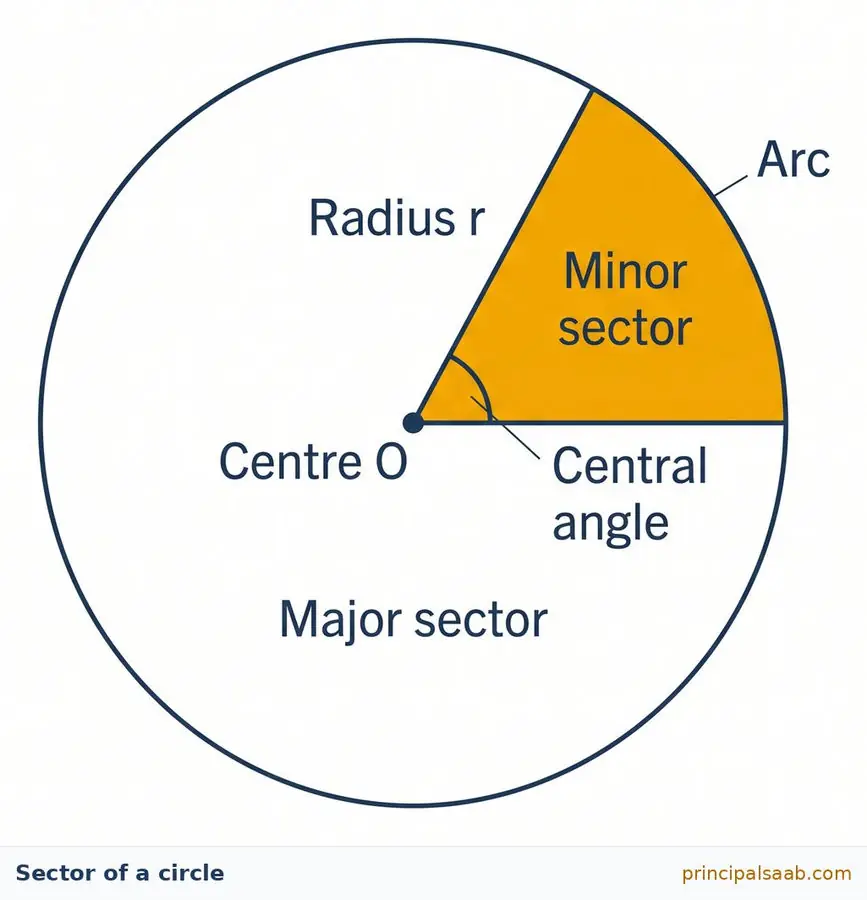
The angle between the two straight edges, measured at the centre, is called the central angle, and we write it θ. It is the only thing that decides how big your slice is. A 90° slice is a quarter of the pizza. A 180° slice is a semicircle. A 36° slice is one tenth. In every case the slice is θ/360 of the whole circle, because a full turn is 360°.
Now, when you cut one slice, you actually create two sectors: the piece you lifted out and the big piece left behind on the tray. The smaller one is the minor sector, the bigger one is the major sector. Their central angles add up to 360°, and their areas add up to the area of the whole circle. If a question says “sector” without saying which, it means the minor one.
Whole circle first: area = (22/7) × 21 × 21 = 1386 cm².
Minor sector = (100/360) × 1386 = 1386 ÷ 360 × 100 = 3.85 × 100 = 385 cm².
Major sector = (260/360) × 1386 = 1001 cm².
Check: 385 + 1001 = 1386, the whole circle. That check takes three seconds and catches almost every arithmetic slip. Do it every single time.
Note the angle here is 100° — a perfectly ordinary number. Sector questions are not restricted to special angles. That restriction, as you will see later, applies only to segments.
4. Length of an Arc
The curved edge of a sector is called an arc. If you walked around the whole circle you would cover 2πr. If you only walk round a θ° slice, you cover θ/360 of that walk. That is the entire derivation.
Sanity checks you should carry in your head: θ = 360° must give the full 2πr; θ = 180° must give half of it; θ = 90° must give a quarter. If your formula ever fails one of those, you have written it down wrong.
Whole circumference = 2 × (22/7) × 21 = 132 cm.
60° is 60/360 = 1/6 of a full turn.
l = (1/6) × 132 = 22 cm.
Doing the fraction first (1/6) instead of dragging 60/360 through the whole line keeps the arithmetic tiny. Build that habit now.
Circumference = 132 cm, so the arc is 11/132 = 1/12 of the circle.
θ = (1/12) × 360° = 30°.
Same formula, just rearranged. Whenever you are given the arc and asked for the angle, find “what fraction of the circumference is this?” and multiply that fraction by 360.
10.5 = 21/2, so 2πr = 2 × (22/7) × (21/2) = (22/7) × 21 = 66 cm.
120° is one third of a turn.
l = 66 ÷ 3 = 22 cm.
Turning 10.5 into 21/2 before you multiply is much safer than decimal multiplication. Fractions cancel; decimals only accumulate.
5. Area of a Sector
Exactly the same story, with area instead of circumference. The whole circle covers πr²; a θ° slice covers θ/360 of that.
There is also a second form worth knowing: area of a sector = ½ × l × r, where l is the arc length.
Where does that second form come from? Substitute l = (θ/360) × 2πr into ½lr and you get ½ × (θ/360) × 2πr × r = (θ/360) × πr². Same thing. It is genuinely useful when a question gives you the arc length but never mentions the angle — you can skip finding θ altogether. And if you have met the triangle area formula ½ × base × height, notice the pleasing resemblance: a very thin sector really is almost a triangle with base l and height r.
Whole circle = 3.14 × 36 = 113.04 cm².
60° is 1/6 of the circle.
Sector area = 113.04 ÷ 6 = 18.84 cm².
The radius is 6, not a multiple of 7, so 3.14 is the sensible choice here.
A quadrant is simply a 90° sector — one quarter.
Whole circle = (22/7) × 196 = 616 cm².
Quadrant = 616 ÷ 4 = 154 cm².
“Quadrant” = 90°. “Semicircle” = 180°. Both terms may appear without an angle being stated, so learn them as angles.
Whole circle = (22/7) × 441 = 1386 cm².
Fraction of the circle = 231/1386 = 1/6.
θ = (1/6) × 360° = 60°.
Cancelling 231/1386 down to 1/6 before multiplying by 360 is much kinder than doing 231 × 360 first. Simplify early, always.
Area = ½ × l × r = ½ × 22 × 21 = 11 × 21 = 231 cm².
Compare with Examples 6 and 11: that is the very same sector, arrived at from a completely different starting point. Two roads, one destination — a good sign that you understand the object and not just the formula.
6. Perimeter of a Sector (Don’t Forget the Two Radii)
Here is a very common source of confusion, and it is easy to avoid. The perimeter of a sector is the distance all the way around its boundary. Put your finger on the centre of the pizza slice, trace out along one straight edge, round the curved crust, and back down the other straight edge to where you started. You travelled along three pieces: a radius, an arc, and another radius.
The arc alone is not the perimeter. The perimeter of a semicircular region is πr + 2r, and the perimeter of a quadrant is (πr/2) + 2r.
Watch out for the wording too. “Length of the arc” means just the curve. “Perimeter of the sector” means the whole boundary. “Wire needed to fence the sector” means the whole boundary. “Cost of fencing the curved edge only” means just the arc. Read slowly and match the wording to the boundary being measured.
Circumference of the full circle = 2 × (22/7) × 7 = 44 cm.
Arc of the quadrant = 44 ÷ 4 = 11 cm.
Perimeter = 11 + 2 × 7 = 11 + 14 = 25 cm.
Stopping at 11 cm would give only the curved part, not the full boundary of the quadrant.
“All around its edge” means the perimeter.
Circumference of the full circle = 2 × (22/7) × 21 = 132 cm.
120° is one third, so arc = 132 ÷ 3 = 44 cm.
Perimeter = 44 + 2 × 21 = 44 + 42 = 86 cm.
Hold on to this sector — radius 21 cm, angle 120°. We will return to it twice more in this chapter and ask it different questions each time.
A segment is built on a chord, so if chords and their properties still feel shaky, spend ten minutes on our Class 10 notes on Circles, tangents and chord properties before you carry on. It makes this section much easier.
7. What a Segment Is (Minor and Major)
Now cut the pizza differently. Instead of two cuts from the centre, make one straight cut right across, not through the middle. The smaller piece you slice off has one straight edge and one curved edge. That is a segment.
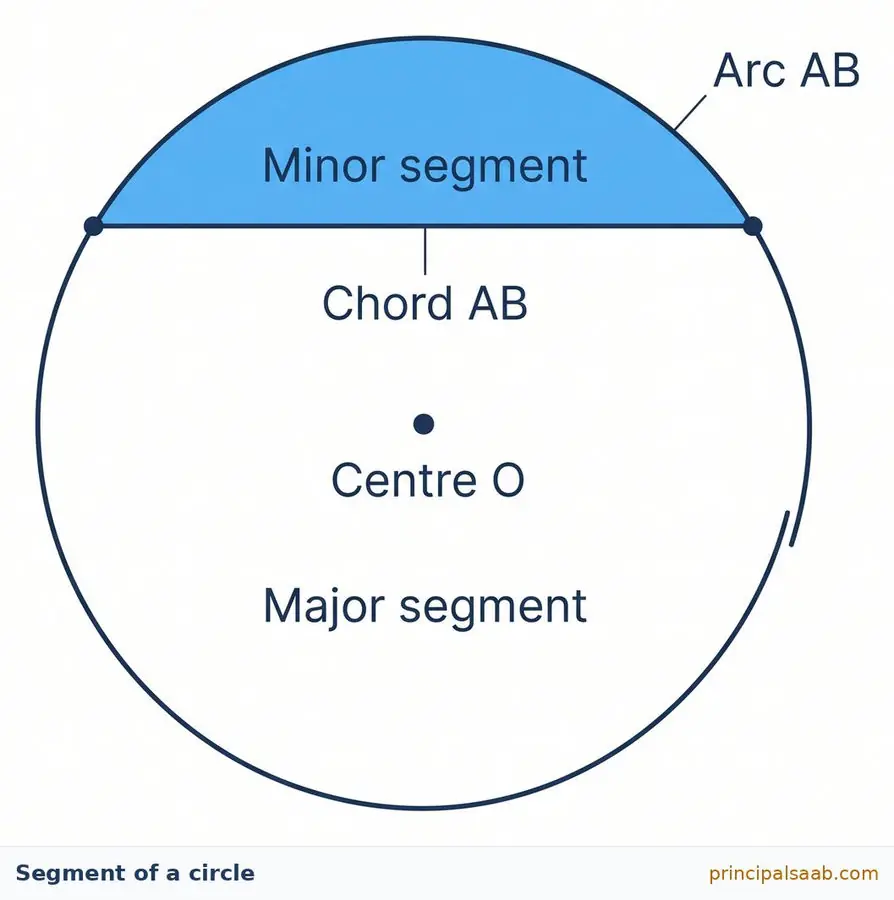
The straight edge is a chord — a line joining two points on the circle without passing through the centre. So:
A segment is bounded by one chord and an arc (it does not touch the centre).
Sector = pizza slice. Segment = the bit you slice off the side of a chapati.
Just like sectors, one chord creates two segments: the minor segment (the smaller piece, on the same side as the minor arc) and the major segment (the larger leftover). They add up to the whole circle, which gives you a lovely shortcut: major segment = area of circle − minor segment. You almost never compute a major segment directly.
One more piece of vocabulary that helps enormously. Even though the segment does not contain the centre, we still describe it by the angle its chord subtends at the centre. So “the segment of a circle of radius 10 cm made by a chord subtending 90° at the centre” tells you exactly which chord we mean. That central angle is the number that drives every calculation.
(a) At 60° the two radii and the chord form an equilateral triangle, so the chord equals the radius: 10 cm.
(b) At 90° we have a right-angled isosceles triangle with legs 10 and 10, so the chord is √(100 + 100) = 10√2 ≈ 14.1 cm.
(c) At 120°, drop a perpendicular from the centre to the chord. It bisects both the chord and the angle, leaving two 30°–60°–90° triangles with hypotenuse 10. Half the chord = 10 × (√3/2) = 5√3, so the chord is 10√3 ≈ 17.3 cm.
Notice the pattern: at 60°, 90° and 120° the chord is r√1, r√2 and r√3. It is one of the neatest little facts in the chapter and worth writing on a sticky note.
Step 2 below always asks for the area of a triangle made from two radii and a chord. If ½ × base × height or the (√3/4)a² formula for an equilateral triangle is not automatic yet, revise it quickly in our Class 10 chapter notes on Triangles.
8. Area of a Segment = Sector − Triangle
This is the heart of the chapter, and it is a subtraction, nothing cleverer. Draw the two radii to the ends of the chord. You now have a sector. Inside that sector sits a triangle (the two radii and the chord). The segment is what is left when you take the triangle away.
Area of the major segment = area of the whole circle − area of the minor segment.
So every segment question is really three small questions stacked on top of each other:
- Find the sector area: (θ/360) × πr².
- Find the triangle area — and this is the only part that changes with the angle.
- Subtract. Sector minus triangle. In that order, never the other way.
Now, the triangle. It always has two sides equal to r with the angle θ squeezed between them, so it is always isosceles. What its area works out to depends on θ, and the current scope keeps the segment cases manageable.
The CBSE 2026–27 Class 10 Maths syllabus states, in this unit, that in calculating the area of a segment of a circle, problems should be restricted to central angles of 60°, 90° and 120° only.
For the current 2026–27 scope, practise segment-area calculations at those three central angles. Ordinary sector and arc questions can still use other angles. (Ordinary sector and arc questions are not restricted in this way — those can use any angle, as Example 5 showed.)
Here are the three permitted cases side by side. Learn this table properly and segments become mechanical.
| Central angle θ | Shape of the triangle | Sector area | Triangle area | Minor segment area | Chord |
|---|---|---|---|---|---|
| 60° | Equilateral, side r | πr²/6 | (√3/4)r² | πr²/6 − (√3/4)r² | r |
| 90° | Right-angled isosceles, legs r and r | πr²/4 | r²/2 | πr²/4 − r²/2 | r√2 |
| 120° | Isosceles, equal sides r, apex 120° | πr²/3 | (√3/4)r² | πr²/3 − (√3/4)r² | r√3 |
9. The 60° Segment and the Equilateral Shortcut
Start here, because 60° is the prettiest case. Draw the two radii to the ends of the chord. Both are length r, and the angle between them is 60°. Since the triangle is isosceles, the other two angles are equal and must share the remaining 120° — so they are 60° each as well. All three angles are 60°, which makes the triangle equilateral, with every side equal to r.
That is the shortcut: at 60° you do not need any trigonometry, any perpendicular, any Pythagoras. You just use the equilateral triangle area formula you already know from Class 9.
Minor segment = (πr²/6) − (√3/4)r². Take √3 = 1.73 unless the question says otherwise.
Step 1 — sector. Whole circle = (22/7) × 196 = 616 cm². Sector = 616 ÷ 6 = 102.67 cm².
Step 2 — triangle. Equilateral of side 14, area = (√3/4) × 196 = 49√3 = 49 × 1.73 = 84.77 cm².
Step 3 — subtract. Segment = 102.67 − 84.77 = 17.90 cm² (to 2 d.p.).
Does that feel right? The segment is a thin sliver between a short chord and a gently curving arc, so a small number is exactly what we should expect. Sanity-checking the size of your answer is a real skill.
Sector = (1/6) × (22/7) × 441 = 1386 ÷ 6 = 231 cm².
Triangle = (√3/4) × 441 = 110.25 × 1.73 = 190.73 cm².
Segment = 231 − 190.73 = 40.27 cm².
If your teacher asks for √3 = 1.732 instead, the triangle becomes 190.95 cm² and the segment 40.05 cm². Different rounding instruction, slightly different answer — which is why you always write down the value of √3 you were told to use.
Sector = (1/6) × 3.14 × 144 = 452.16 ÷ 6 = 75.36 cm².
Triangle = (1.73/4) × 144 = 1.73 × 36 = 62.28 cm².
Segment = 75.36 − 62.28 = 13.08 cm².
Radius 12 has no 7 in it, so 3.14 keeps the arithmetic clean. Same three steps as always — the value of π never changes the method.
10. The 90° Segment
At 90° the triangle is even easier, because the two radii are perpendicular to each other. That means one radius is the base and the other is the height — no perpendicular to construct, no √3 anywhere. This is the friendliest of the three cases and the one you should be able to do in your head.
Minor segment = (πr²/4) − (r²/2). No surds are involved at all.
Sector: whole circle = (22/7) × 196 = 616 cm²; quadrant = 616 ÷ 4 = 154 cm².
Triangle: ½ × 14 × 14 = 98 cm².
Minor segment: 154 − 98 = 56 cm².
Major segment: 616 − 56 = 560 cm².
Beautifully clean numbers, and notice the shortcut for the major segment — whole circle minus minor segment. Never try to build a major segment out of a 270° sector plus a triangle; it works, but it is slower and far easier to get wrong.
Sector = ¼ × 3.14 × 100 = 314 ÷ 4 = 78.5 cm².
Triangle = ½ × 10 × 10 = 50 cm².
Segment = 78.5 − 50 = 28.5 cm².
Compare with Example 16: a 60° segment of a radius-14 circle was only 17.90 cm², while this 90° segment of a smaller circle is 28.5 cm². Widening the angle fattens the segment very quickly.
Whole circle = (22/7) × 441 = 1386 cm².
Sector (quadrant) = 1386 ÷ 4 = 346.5 cm².
Triangle = ½ × 21 × 21 = 220.5 cm².
Frosted (minor segment) = 346.5 − 220.5 = 126 cm².
Clear (major segment) = 1386 − 126 = 1260 cm².
Check: 126 + 1260 = 1386. The two pieces rebuild the circle, so the answer is consistent.
The √3/2 that keeps appearing at 60° and 120° is simply sin 60°. If you want to see where these standard values come from rather than just memorising them, read our Introduction to Trigonometry notes for Class 10.
11. The 120° Segment
This is the one students fear, and it is genuinely the only case where you have to build something. But you only have to build it once, and then you can just remember the result.
You have an isosceles triangle: two sides of length r, and a fat 120° angle at the centre between them. Drop a perpendicular from the centre O straight down onto the chord AB, meeting it at M. That perpendicular does three helpful things at once: it bisects the chord, it bisects the 120° angle into two 60° halves, and it splits the triangle into two identical right-angled triangles.
Look at one of them, triangle OMA. It has a right angle at M, an angle of 60° at O, and therefore 30° at A. Its hypotenuse is the radius r. So it is the familiar 30°–60°–90° triangle, and its sides are in the ratio 1 : √3 : 2. The side opposite the 30° angle is OM = r/2, and the side opposite the 60° angle is AM = (√3/2)r.
Now put it back together. The full chord AB = 2 × AM = √3 r, and the height of the triangle is OM = r/2. So:
triangle area = ½ × √3 r × (r/2) = (√3/4)r².
Minor segment = (πr²/3) − (√3/4)r².
Step 1 — sector. Whole circle = (22/7) × 441 = 1386 cm². Sector = 1386 ÷ 3 = 462 cm².
Step 2 — triangle. (√3/4) × 441 = 110.25 × 1.73 = 190.73 cm².
Step 3 — subtract. Segment = 462 − 190.73 = 271.27 cm².
This is the same sector we met in Example 14, where its perimeter was 86 cm. One sector, three completely different questions — arc, perimeter, segment. Always check which one is actually being asked.
Whole circle = (22/7) × 49 = 154 cm².
Sector = 154 ÷ 3 = 51.33 cm².
Triangle = (1.73/4) × 49 = 0.4325 × 49 = 21.19 cm².
Segment = 51.33 − 21.19 = 30.14 cm² (to 2 d.p.).
Here the sector is not a whole number (154 ÷ 3 recurs), so keep an extra decimal place in the middle of the working and round only at the very end. Rounding early can shift the final answer, so keep extra digits until the last line.
12. Arc Length or Sector Area? Telling Them Apart
Both formulas start with θ/360, so they can blur together. Here is a check that never fails: look at the units of the answer you are being asked for. A length answer is in cm or m. An area answer is in cm² or m². Then look at your formula — the one with a single r gives a length, the one with r² gives an area.
Translating common question language:
- “Length of the arc”, “distance travelled by the tip”, “wire along the curved edge”, “how far does it move” → arc length, uses 2πr.
- “Area of the sector”, “region swept”, “grass grazed”, “how much paper” → sector area, uses πr².
- “Perimeter”, “fenced all around”, “border stitched” → arc + 2r.
(a) Circumference = 2 × (22/7) × 21 = 132 cm; arc = 132 ÷ 3 = 44 cm.
(b) Circle area = (22/7) × 441 = 1386 cm²; sector = 1386 ÷ 3 = 462 cm².
44 and 462 — wildly different numbers from the same sector, because they measure completely different things. If you ever write “arc = 462 cm”, the size of the number alone should make you stop and look again.
13. Clock Hands, Wipers and Other Real Sectors
Everyday contexts often hide an ordinary sector. The dressing changes; the maths does not. In every one of these, your only real job is to work out θ, and then it is an ordinary sector question.
Clock hands. A minute hand goes right round in 60 minutes, so it turns 360° ÷ 60 = 6° per minute. Five minutes is 30°, ten minutes is 60°, twenty minutes is 120°, half an hour is 180°. The hand itself is the radius. The region it sweeps is a sector; the path its tip traces is an arc.
Windscreen wipers. In an idealised question, the arm pivots and its tip traces an arc. When the length from the pivot to the tip is treated as the radius, the region swept is a sector. Read the given model carefully and use only the measurements stated.
Grazing animals. A goat tied by a rope of length r to a post grazes a sector; the rope is the radius and the angle depends on what is blocking it (a full circle in open ground, a quadrant in the corner of a rectangular field).
Angle: 20 minutes × 6° per minute = 120°.
Whole circle: r = 10.5 = 21/2, so area = (22/7) × (21/2) × (21/2) = (22 × 3 × 21)/4 = 346.5 cm².
Swept area = 346.5 ÷ 3 = 115.5 cm².
Angle: 35 × 6° = 210°.
(a) A distance, so use the circumference. 2πr = 2 × (22/7) × 14 = 88 cm. Arc = (210/360) × 88 = (7/12) × 88 = 51.33 cm (to 2 d.p.).
(b) An area, so use πr². Circle = (22/7) × 196 = 616 cm². Sector = (7/12) × 616 = 359.33 cm² (to 2 d.p.).
Same clock, same 210°, same fraction 7/12 — but one answer is cm and the other cm². This is Section 12 in action.
The angle is 90°, so the sector is one quarter of a circle.
(a) Area = ¼ × (22/7) × 28² = ¼ × 2464 = 616 m².
(b) Arc length = ¼ × 2 × (22/7) × 28 = ¼ × 176 = 44 m.
The same fraction appears in both calculations, but area uses r² and square metres while arc length uses r and metres.
14. Reverse Problems and Two-Way Checks
Some questions give you the result of a sector calculation and ask you to work backwards. This is still the same fraction-of-a-circle idea. Write the full-circle quantity, compare the given part with it, and recover either the angle or the radius. A second formula can then check your answer.
The most useful bridge is sector area = ½ × arc length × radius. It follows because both arc length and sector area contain the same fraction θ/360. If a problem gives any two of sector area, arc length and radius, the third can be found directly. Then use the ordinary sector formula as an independent check.
The full circumference is 2 × (22/7) × 14 = 88 cm. Since 135/360 = 3/8, the arc length is (3/8) × 88 = 33 cm.
The sector perimeter is 33 + 14 + 14 = 61 cm.
The full circle area is (22/7) × 14² = 616 cm², so the sector area is (3/8) × 616 = 231 cm².
Now check with A = ½lr: ½ × 33 × 14 = 231 cm². Both routes agree.
Use A = ½lr first: 154 = ½ × 22 × r, so 154 = 11r and r = 14 cm.
The full circumference is 2 × (22/7) × 14 = 88 cm. The arc is 22/88 = 1/4 of the circumference, so the central angle is 1/4 of 360°: 90°.
Check the area as a quadrant: ¼ × (22/7) × 14² = ¼ × 616 = 154 cm². The reverse calculation returns the given value.
A reverse problem is not a new topic. Keep the units visible, identify which circle quantity is whole and which is a part, and use the fraction to move in the needed direction. If you can check the result with a different formula, do it before moving on.
The same unit discipline matters in the next chapter too, where cm² and cm³ sit side by side. See how it plays out in our Class 10 notes on Surface Areas and Volumes.
15. Units, Rounding and Presenting Your Answer
Four presentation habits make these solutions clearer and easier to check.
- Convert before you calculate. If one measurement is in metres and another in centimetres, fix that on line one. Never halfway through.
- Remember area conversions are squared. 1 m = 100 cm, but 1 m² = 10 000 cm². Likewise 1 hectare = 10 000 m². Dividing an area by 100 here would use a length conversion instead of an area conversion.
- Round only at the end. Carry recurring decimals like 51.333… through the working and round the final answer, normally to two decimal places unless told otherwise.
- State your assumptions. Write “Taking π = 22/7 and √3 = 1.73” at the top when those approximations are used, so your decimal work is transparent.
Whole circle = (22/7) × 3.5 × 3.5 = (22/7) × 12.25 = 38.5 m².
72° is 72/360 = 1/5 of a turn.
Watered area = 38.5 ÷ 5 = 7.7 m².
In cm²: 7.7 × 10 000 = 77 000 cm².
Multiply by 10 000, not by 100 — that is the whole point of habit number 2.
16. Formula Summary at a Glance
Copy this table onto one side of a card. If you can rebuild it from memory in under two minutes, you are ready to test yourself with mixed practice.
| Quantity | Formula | Unit |
|---|---|---|
| Circumference of a circle | 2πr | cm, m |
| Area of a circle | πr² | cm², m² |
| Length of an arc | (θ/360) × 2πr | cm, m |
| Area of a sector | (θ/360) × πr² = ½ × l × r | cm², m² |
| Perimeter of a sector | (θ/360) × 2πr + 2r | cm, m |
| Area of the minor segment | sector area − triangle area | cm², m² |
| Area of the major segment | πr² − minor segment | cm², m² |
| Triangle inside a 60° or 120° sector | (√3/4)r² | cm², m² |
| Triangle inside a 90° sector | r²/2 | cm², m² |
| Angle turned by a minute hand | 6° per minute | degrees |
Practice Worksheet: Areas Related to Circles Class 10 Important Questions
Ten questions, roughly in increasing order of difficulty. Do them on paper first — reading an answer feels like learning, but it is not. Unless a question says otherwise, take π = 22/7 and √3 = 1.73.
Show Answer
Area = (22/7) × 28 × 28 = 22 × 4 × 28 = 2464 m².
Check the units: one is m, the other m².
Show Answer
40/360 = 1/9 of the circle.
Arc = 113.04 ÷ 9 = 12.56 cm.
Show Answer
240/360 = 2/3.
Sector area = (2/3) × 346.5 = 231 cm².
Since 240° is more than half a turn, this is the major sector — and 231 is indeed more than half of 346.5, so the answer is consistent.
Show Answer
45/360 = 1/8, so the arc = 88 ÷ 8 = 11 cm.
Perimeter = arc + 2r = 11 + 28 = 39 cm.
The two radii are what turn 11 into 39. Never leave them out.
Show Answer
Fraction = 77/616 = 1/8, so θ = (1/8) × 360° = 45°.
Arc = (1/8) × 88 = 11 cm.
Cross-check with area = ½lr: ½ × 11 × 14 = 77 cm². It matches.
Show Answer
Triangle = ½ × 7 × 7 = 24.5 cm².
Segment = 38.5 − 24.5 = 14 cm².
A rare segment answer that comes out as a whole number — enjoy it.
Show Answer
The triangle is equilateral of side 12, so its area = (1.73/4) × 144 = 1.73 × 36 = 62.28 cm².
Segment = 75.36 − 62.28 = 13.08 cm².
Show Answer
Sector = 616 ÷ 3 = 205.3333… cm².
Triangle = (√3/4) × 196 = 49 × 1.73 = 84.77 cm².
Segment = 205.3333 − 84.77 = 120.56 cm².
Notice that 616 ÷ 3 recurs — keep the extra digits until the final subtraction, then round.
Show Answer
Quadrant = 1386 ÷ 4 = 346.5 cm²; triangle = ½ × 21 × 21 = 220.5 cm².
Minor segment = 346.5 − 220.5 = 126 cm².
Major segment = 1386 − 126 = 1260 cm².
Check: 126 + 1260 = 1386.
Show Answer
The full circumference is 2 × (22/7) × 14 = 88 cm. The arc is 44/88 = 1/2 of the circle, so the central angle is 180°.
Area = ½lr = ½ × 44 × 14 = 308 cm².
Check: a 180° sector is a semicircle, and half of 616 cm² is 308 cm².
Five-Question Self-Check
Answer these without looking back. Each one checks a decision rather than a long calculation.
- A 72° sector is what fraction of a circle?
- Which formula gives the full boundary of a sector?
- For a segment, which area is subtracted from the sector area?
- What are the three central angles used for segment-area calculations in the current CBSE Class 10 scope?
- If a result measures a region of a drawing, should its unit be cm or cm²?
Show Self-Check Answers
- 72/360 = 1/5.
- Arc length + 2r.
- The area of the triangle formed by the two radii and the chord.
- 60°, 90° and 120°.
- cm², because a region has area.
If a question fought back, do not tick it wrong and move on — redo it tomorrow morning from a blank page, with the answer covered. This chapter rewards patient repetition far more than cleverness, and you only ever need to be one more correct question than yesterday. That is the whole method.
Kaizen (काइज़ेन) means getting one per cent better every day, not perfect in one night. Solve two questions from this page tomorrow, two the day after, and by the weekend this chapter will belong to you.