
Triangles is the chapter where geometry stops being about measuring and starts being about reasoning. The whole chapter rests on one idea — two triangles can have exactly the same shape but different sizes — and once you can spot that, a surprising number of questions become one line of working. This page teaches it in plain language, with a study plan and an original practice set (with answers you can reveal) at the end.
What This Chapter Covers
- What similar figures and similar triangles are
- The Basic Proportionality Theorem (Thales Theorem)
- Criteria for similarity: AA, SSS and SAS
- Areas of similar triangles
- Pythagoras Theorem and its converse
- Choosing the right tool in an exam question
Your Game Plan for This Chapter
- Get the definition of similarity exactly right first — equal angles and proportional sides. Most lost marks start here.
- Learn the Basic Proportionality Theorem and its converse. It appears in almost every set of parallel-line questions.
- Practise identifying which similarity criterion (AA, SSS, SAS) a question is handing you. Write the criterion name in your answer.
- Do ratio-of-areas questions until the squaring step is automatic.
- Finish with Pythagoras and its converse, including height-and-distance style word problems.
- Revise by re-drawing each figure from memory and writing the correspondence of vertices in the correct order.
In the 2026-27 CBSE Class 10 Maths syllabus, the proofs of several theorems in this chapter are no longer required, but you are still expected to use the results. So invest your time in applying the theorems, not in memorising their proofs — with the one exception noted below.
Study Notes
1. What Similar Figures and Similar Triangles Are
Two figures are similar if they have the same shape but not necessarily the same size. Every pair of circles is similar. Every pair of squares is similar. Triangles are the interesting case, because a triangle can be stretched in one direction and stop being similar.
Two triangles are similar when both conditions hold: their corresponding angles are equal, and their corresponding sides are in the same ratio. For triangles — and only for triangles — either condition on its own is enough to force the other.
Notation matters. Writing ▵ABC ~ ▵PQR means A corresponds to P, B to Q and C to R. That order tells the examiner which sides pair up: AB/PQ = BC/QR = CA/RP.
Writing the vertices in the wrong order. If you write ▵ABC ~ ▵QPR when you meant ▵ABC ~ ▵PQR, every ratio you form afterwards is wrong, even if your arithmetic is perfect.
Worked Example 1. ▵ABC ~ ▵DEF with AB = 6 cm, BC = 9 cm and DE = 8 cm. Find EF.
From the correspondence, AB/DE = BC/EF, so 6/8 = 9/EF, giving EF = 9 × 8 ÷ 6 = 12 cm.
Worked Example 2. In ▵ABC ~ ▵PQR, ∠A = 48° and ∠Q = 62°. Find ∠C.
∠P = ∠A = 48° and ∠B = ∠Q = 62°. So ∠C = 180° − 48° − 62° = 70°.
2. The Basic Proportionality Theorem (Thales Theorem)
This is the workhorse of the chapter, and it is the one theorem in Triangles whose proof you are still expected to be able to write.
Basic Proportionality Theorem (BPT). If a line is drawn parallel to one side of a triangle to intersect the other two sides in distinct points, the other two sides are divided in the same ratio.
In ▵ABC with D on AB, E on AC and DE ∥ BC: AD/DB = AE/EC.
Converse. If a line divides two sides of a triangle in the same ratio, the line is parallel to the third side.
A useful second form: since AB = AD + DB, you can also write AD/AB = AE/AC. Choose whichever form matches the lengths the question gives you.
Worked Example 1. In ▵ABC, D lies on AB and E on AC with DE ∥ BC. AD = 3 cm, DB = 5 cm and AE = 4.5 cm. Find EC.
By BPT, AD/DB = AE/EC, so 3/5 = 4.5/EC, giving EC = 4.5 × 5 ÷ 3 = 7.5 cm.
Worked Example 2. In ▵PQR, S lies on PQ and T on PR with PS = 2 cm, SQ = 3 cm, PT = 3.2 cm and TR = 4.8 cm. Is ST ∥ QR?
PS/SQ = 2/3. PT/TR = 3.2/4.8 = 2/3. The ratios are equal, so by the converse of BPT, ST ∥ QR.
Mixing the two forms. AD/DB = AE/EC uses the parts; AD/AB = AE/AC uses part over whole. Setting AD/DB equal to AE/AC is a guaranteed loss of marks.
3. Criteria for Similarity: AA, SSS and SAS
You do not need to check every angle and every side. Three shortcuts do the job, and naming the one you used earns marks.
In SAS similarity the equal angle must be the one between the two proportional sides. An equal angle somewhere else does not prove similarity.
Worked Example 1. In ▵ABC and ▵PQR, ∠A = ∠P = 55° and ∠B = ∠Q = 65°. Also AB = 6 cm, PQ = 9 cm and BC = 8 cm. Find QR.
Two pairs of angles are equal, so ▵ABC ~ ▵PQR by AA. Then AB/PQ = BC/QR, so 6/9 = 8/QR, giving QR = 8 × 9 ÷ 6 = 12 cm.
Worked Example 2. ▵ABC has AB = 4 cm, AC = 6 cm and ∠A = 70°. ▵DEF has DE = 6 cm, DF = 9 cm and ∠D = 70°. Are they similar?
AB/DE = 4/6 = 2/3 and AC/DF = 6/9 = 2/3. The equal angles ∠A and ∠D are included between these sides, so ▵ABC ~ ▵DEF by SAS similarity.
Always write the similarity statement with the vertices in matching order and name the criterion, for example “▵ABC ~ ▵DEF (SAS similarity)”. Examiners award a mark for the reason, not just the ratio.
4. Areas of Similar Triangles
If ▵ABC ~ ▵PQR, then
ar(▵ABC) / ar(▵PQR) = (AB/PQ)² = (BC/QR)² = (CA/RP)².
The ratio of areas is the square of the ratio of any pair of corresponding sides — and that includes corresponding medians, altitudes and angle bisectors.
Under the 2026-27 CBSE Class 10 Maths syllabus the proof of this area theorem is not required. Sources differ on how far the result itself is examined, so we have kept the full explanation here rather than dropping it. Please confirm against your school’s current syllabus copy before deciding how much time to give it.
Worked Example 1. Two similar triangles have corresponding sides in the ratio 3 : 5. The area of the smaller triangle is 54 cm². Find the area of the larger.
Ratio of areas $3^2 : 5^2 = 9 : 25$. So 54/A = 9/25, giving A = 54 × 25 ÷ 9 = 150 cm².
Worked Example 2. The areas of two similar triangles are 64 cm² and 121 cm². A side of the smaller triangle is 24 cm. Find the corresponding side of the larger.
Ratio of sides $\sqrt{\frac{64}{121}} = \frac{8}{11}$. So 24/x = 8/11, giving x = 24 × 11 ÷ 8 = 33 cm.
Forgetting to square (or forgetting to square-root). If the question gives you areas and asks for a side, you must take the square root first. Students routinely answer 24 × 121/64 here and lose the whole question.
5. Pythagoras Theorem and Its Converse
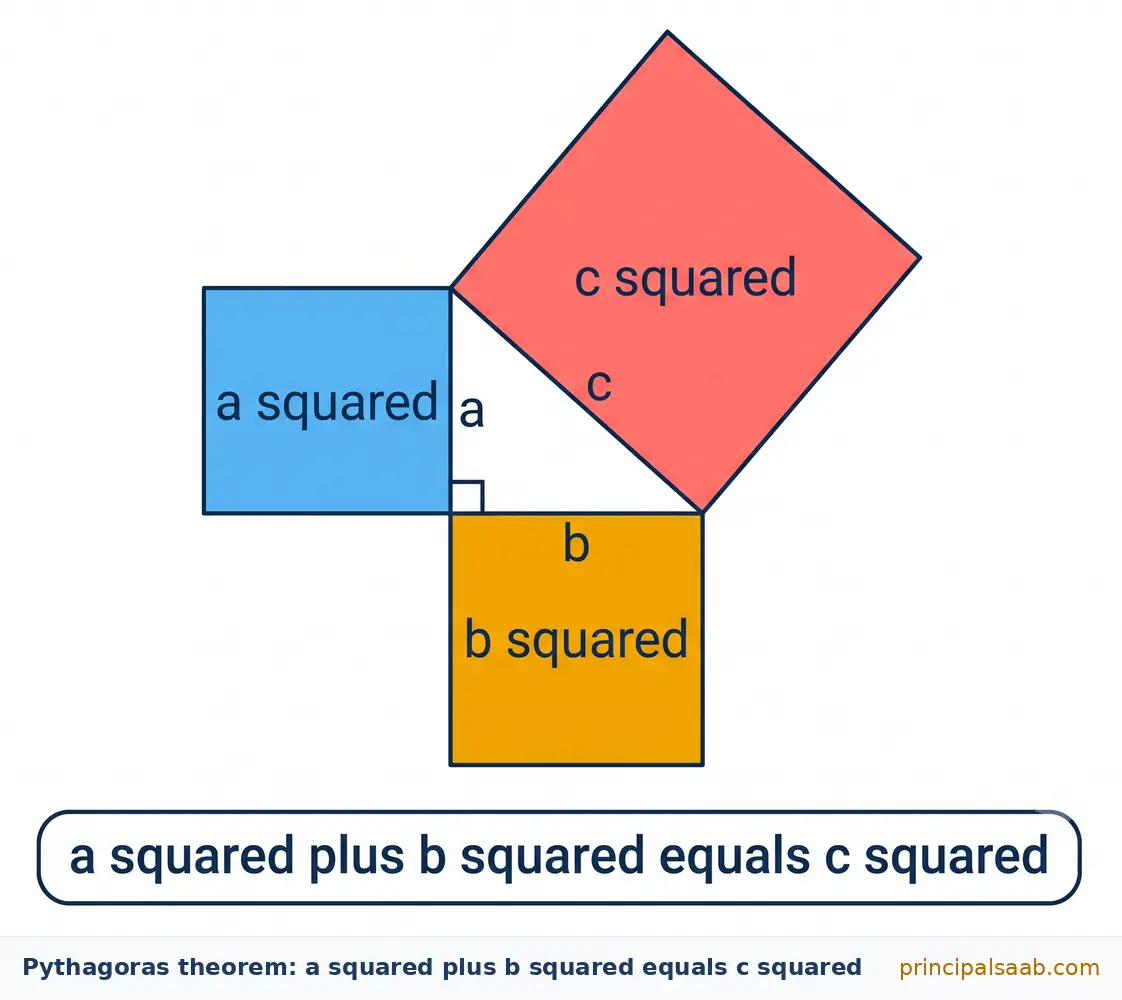
Pythagoras Theorem. In a right triangle, the square on the hypotenuse equals the sum of the squares on the other two sides.
Converse. If in a triangle the square on one side equals the sum of the squares on the other two sides, the angle opposite that first side is a right angle.
The 2026-27 syllabus removes the requirement to prove Pythagoras Theorem and its converse, along with the theorem about the perpendicular from the right angle to the hypotenuse. The results remain in constant use across Class 10 — in trigonometry, coordinate geometry and mensuration — so learn to apply them fluently. Confirm the exact proof requirement with your teacher.
One consequence worth keeping: in right ▵ABC, right-angled at B, if BD is the perpendicular from B to the hypotenuse AC, then $BD^2 = AD \times DC$. You can also get BD quickly from areas, which is often faster.
Worked Example 1. A ladder 13 m long rests against a vertical wall with its foot 5 m from the wall. How high up the wall does it reach?
height $\sqrt{13^2-5^2} = \sqrt{169-25} = \sqrt{144}$ 12 m.
Worked Example 2. Is a triangle with sides 9 cm, 40 cm and 41 cm right-angled?
$9^2 + 40^2 = 81 + 1600 = 1681$ and $41^2 = 1681$. They are equal, so by the converse the triangle is right-angled, with the right angle opposite the 41 cm side.
Learn the common triples — 3-4-5, 5-12-13, 8-15-17, 7-24-25, 9-40-41 — and their multiples. Recognising 15-36-39 as 3 × (5-12-13) saves a minute of arithmetic under exam pressure.
6. Choosing the Right Tool in an Exam Question
Most marks in this chapter are lost by picking the wrong starting point, not by bad arithmetic. Use this as a decision table.
Worked Example 1. A vertical pole 6 m high casts a shadow 4 m long. At the same moment a tower casts a shadow 28 m long. Find the height of the tower.
The sun’s rays make equal angles, so the two triangles are similar by AA. Then 6/4 = h/28, giving h = 42 m.
Worked Example 2. In ▵ABC, DE ∥ BC with D on AB and E on AC. AD = 2 cm, DB = 3 cm. Find ar(▵ADE) : ar(▵ABC).
DE ∥ BC gives ▵ADE ~ ▵ABC (AA). AD/AB = 2/5, so the ratio of areas $(\frac{2}{5})^2$ 4 : 25.
Practice Worksheet
Try each question fully on your own first, then click Show Answer to check yourself.
Q1. In ▵ABC, D lies on AB and E on AC with DE ∥ BC. If AD = 4 cm, AB = 10 cm and AE = 6 cm, find AC.
Show Answer
Q2. In ▵PQR, S lies on PQ and T on PR with PS = 1.5 cm, SQ = 4.5 cm, PT = 2 cm and TR = 6 cm. Is ST ∥ QR? Give a reason.
Show Answer
Q3. Two similar triangles have areas 81 cm² and 144 cm². The shortest side of the smaller triangle is 6 cm. Find the corresponding side of the larger triangle.
Show Answer
Q4. In ▵ABC and ▵DEF, ∠B = ∠E, AB = 5 cm, BC = 7.5 cm, DE = 8 cm and EF = 12 cm. Are the triangles similar? Name the criterion.
Show Answer
Q5. A vertical pole 6 m high casts a shadow 4 m long on the ground. At the same time a tower casts a shadow 28 m long. Find the height of the tower.
Show Answer
Q6. The sides of a triangle are 7 cm, 24 cm and 25 cm. Is it right-angled? If so, which angle measures 90°?
Show Answer
Q7. In ▵ABC, right-angled at B, AB = 9 cm and BC = 12 cm. D is the foot of the perpendicular from B to AC. Find AC and BD.
Show Answer
For BD, compare two expressions for the area of ▵ABC: ½ × 9 × 12 = ½ × 15 × BD, so 54 = 7.5 × BD and BD = 7.2 cm.
Q8. In ▵ABC, DE ∥ BC with D on AB and E on AC. If AD = 3 cm and DB = 6 cm, find ar(▵ADE) : ar(▵ABC).
Show Answer
Once these feel easy, you have genuinely finished this chapter. Do not aim for perfect on the first try — aim for one more correct question than yesterday.