

Pick up a bangle, a coin or the rim of a cup, put it flat on the table, and slide a ruler towards it. When the ruler is far away it misses the circle completely. Push it nearer and it slices straight through, cutting the edge at two points. Keep pushing gently and there is one perfect moment — one single position — where the ruler is just touching the circle, kissing it at exactly one point, before it slides off the other side. That touching moment is the whole of this chapter.
That is all a tangent is: a line that touches a circle at exactly one point. CBSE Class 10 Chapter 10 takes that one picture and squeezes two beautiful theorems out of it, and then almost every question you will ever be asked is one of those two theorems plus Pythagoras. If a chapter ever deserved the word “short”, it is this one.
So please do not be nervous. Students panic at geometry because the diagrams look busy and the word “prove” appears — but here the diagrams are small, there are only two theorems, and the board tells you in advance which two proofs you must be able to write. We will build the whole thing slowly, with every figure described in words so you can sketch along. Keep a pencil, a ruler and a compass beside you; you will learn this far faster by drawing than by reading.
- What a Tangent Really Is: Secant, Tangent and the Limiting Idea
- The Point of Contact and Why It Is Special
- How Many Tangents Can a Circle Have?
- Theorem 1: The Tangent Is Perpendicular to the Radius (Full Proof)
- The Length of a Tangent Segment
- Theorem 2: Tangents From an External Point Are Equal (Full Proof)
- What Theorem 2 Gives You Free: Angles, the Kite and Symmetry
- Tangents From a Point Inside, On, or Outside the Circle
- Two Concentric Circles: The Chord That Touches
- Tangents to Two Circles and Common Tangents
- A Quadrilateral Circumscribing a Circle
- Typical Board-Exam Setups and How to Spot the Right Theorem
- Practice Worksheet With Answers
Your Game Plan for This Chapter
- Draw one circle and one line, and physically move the line until you can see the three cases — missing, cutting, touching. Do not read on until you can see it.
- Learn Theorem 1 (tangent is perpendicular to the radius) properly, proof and all. It is the parent of everything else.
- Practise turning every tangent picture into a right-angled triangle, then let Pythagoras do the arithmetic.
- Learn Theorem 2 (two tangents from an outside point are equal) and its proof. Then collect the free gifts it hands you about angles.
- Do the applications: concentric circles, two circles, and quadrilaterals wrapped around a circle.
- Finish with the worksheet at the bottom. Write the proofs out by hand at least twice — the board asks you to reproduce them.
Study Notes
1. What a Tangent Really Is: Secant, Tangent and the Limiting Idea
Let us go back to the ruler and the bangle. A circle sits on the page. Its centre is O and its radius is r. Now bring a straight line anywhere near it. Ask one question and one question only: how far is the line from the centre? Call that distance d, measured the honest way — along the perpendicular from O down to the line, because that is the shortest route from a point to a line.
Everything now depends on the tug-of-war between d and r.
Draw this: Sketch a circle with centre O. Now draw three horizontal lines: one that passes well below the circle without touching it, one that cuts straight across the middle of the circle, and one that rests exactly on the bottom of the circle like a shelf. Drop a perpendicular from O to each line and mark those three distances. You have just drawn the entire idea of this section.
- d > r — the line is further away than the circle reaches. It misses. Zero points in common. This line is called a non-intersecting line.
- d < r — the line comes closer to O than the boundary does, so it must break in and break out again. Exactly two points in common. This line is called a secant, and the bit of it trapped inside the circle is a chord.
- d = r — the perfect balance. The line reaches the circle and stops. Exactly one point in common. This line is a tangent, and that single shared point is the point of contact.
Notice how tidy that is. One number decides everything. If you are ever handed a circle and a line in a question, your very first move should be to compare the distance from the centre with the radius.
A tangent to a circle is a line that meets the circle at exactly one point. That point is called the point of contact. A line meeting the circle at two points is a secant.
Now the part that most notes skip, and the part that makes the definition feel right instead of just sounding right: the limiting idea.
Draw this: Draw a circle and fix one point A on it. Now draw a secant through A that also cuts the circle at a second point B, somewhere far around the rim. Draw another secant through A cutting at $B_1$ bit closer to A. Then another through A cutting at $B_2$ closer still. Keep sliding that second point towards A.
Watch the line as B creeps towards A. It tilts, slowly and smoothly, and settles into a final position. At the instant B lands on top of A the two cutting points have merged into one, and the line no longer cuts — it touches. That final line is the tangent at A.
So: a tangent is the limiting position of a secant when its two points of intersection come together. It is not a different species of line at all; it is a secant that has run out of room. The word itself comes from the Latin tangere, “to touch” — the same root as “tangible”. Whenever you forget what a tangent does, remember it touches.
| Feature | Secant | Tangent |
|---|---|---|
| Points shared with the circle | Two | Exactly one |
| Distance d of the line from the centre | d < r | d = r |
| What it does to the circle | Cuts through it | Grazes it and leaves |
| Part inside the circle | A chord | Nothing — it never goes inside |
| Angle it makes with the radius drawn to a shared point | Any angle at all | Always exactly 90° |
| How many exist through one point on the circle | Infinitely many | Exactly one |
Working. Compare d and r. Here d = 3 and r = 5, so d < r. The line comes closer to the centre than the rim does, so it must cut the circle — it is a secant.
For the chord: drop the perpendicular OM from O to the line, meeting the chord AB at M. That perpendicular bisects the chord, so AM = MB. Triangle OMA is right-angled at M with OA = 5 (a radius) and OM = 3.
$AM^2 = OA^2-OM^2 = 25-9 = 16$ so AM = 4 cm.
Chord AB = 2 × 4 = 8 cm.
Measuring the distance from the centre to the line in a slanted direction. It must be the perpendicular distance. Any slanted segment from O to the line is longer than the perpendicular, so using it will make you think a tangent is a non-intersecting line.
2. The Point of Contact and Why It Is Special
The single point where a tangent meets a circle has a name — the point of contact — and it deserves a whole section, because almost every question in this chapter is secretly about it.
Draw this: Circle with centre O. Mark a point P on the circle. Draw the line XY through P so that it just grazes the circle, going off to the left as X and to the right as Y. Now join O to P with a straight segment and put a small square symbol in the corner where OP meets XY. That little square is the whole chapter in one mark, and we will prove it properly in Section 4.
Here is what makes P special. Think about all the points that sit on the tangent line XY. Point P is on the circle. But take any other point on that line — call it Q — and ask where Q is. It cannot be on the circle, because the tangent meets the circle only at P. It cannot be inside the circle either, because if any part of the line got inside, the line would have to come back out again and would cut the circle a second time. So every point of a tangent, except the point of contact, lies outside the circle.
Read that again slowly, because it is the engine of the first proof. A tangent line hugs the outside of the circle. It touches at P and everywhere else it is strictly outside.
And “outside the circle” has a distance meaning: a point Q is outside exactly when OQ > r. Since OP = r, we get OQ > OP for every other point Q on the tangent. In plain English: of all the points on a tangent, the point of contact is the one closest to the centre.
1. It is the only point the tangent and the circle share.
2. Every other point of the tangent lies outside the circle.
3. It is the nearest point of the tangent to the centre, so OP is the shortest segment from O to that line.
Working. OP is a radius, so OP = 6 cm, and OP is perpendicular to the tangent, so triangle OPQ is right-angled at P.
$OQ^2 = OP^2 + PQ^2 = 6^2 + 8^2 = 36 + 64 = 100$.
OQ = 10 cm.
Since 10 > 6, the point Q is further from the centre than the radius, so Q lies outside the circle — exactly as the theory promised. The only point of that tangent that is not outside is P itself.
The moment you see the words “tangent at P”, draw OP and mark the right angle before you do anything else. Nine out of ten questions in this chapter unlock the second that right angle appears on your figure.
3. How Many Tangents Can a Circle Have?
This is one of those questions that sounds like a trick and is actually just careful counting. Let us do it properly.
First question: how many tangents pass through one given point ON the circle?
Draw this: Circle, centre O, point P on the rim. Join OP. Now try to draw a tangent through P. The tangent must be perpendicular to OP at P. But through a given point on a given line there is only one perpendicular. So there is exactly one tangent at P — no more, no fewer. Try to draw a second one and it will lie on top of the first.
Second question: how many tangents does the whole circle have? Every point of the circle gives its own tangent, and a circle has infinitely many points, so a circle has infinitely many tangents. That is the answer to the classic one-mark question, and students often say “two” because they are half-remembering the next result. Do not fall for it.
Third question: how many tangents can be drawn from a point outside the circle?
Draw this: Circle with centre O. Mark a point P well outside it, say to the right. From P draw two lines that each just graze the circle — one touching the upper part at A, one touching the lower part at B. You will find you can draw exactly two such lines and no more. Every other line through P either cuts the circle at two points or misses it completely.
So: from an external point, exactly two tangents. That pair of tangents is going to occupy us for most of the rest of this chapter, because Theorem 2 says something lovely about them.
Through a point inside the circle: no tangent.
Through a point on the circle: exactly one tangent.
Through a point outside the circle: exactly two tangents.
To the circle as a whole: infinitely many tangents.
Counting. Since OP = 13 and r = 5, we have OP > r, so P is outside the circle. Therefore exactly two tangents can be drawn from P.
Measuring. Let one of them touch at A. Then OA = 5 (radius) and ∠OAP = 90° (tangent is perpendicular to the radius), so triangle OAP is right-angled at A with OP as hypotenuse.
$PA^2 = OP^2-OA^2 = 13^2-5^2 = 169-25 = 144$.
PA = 12 cm, and by Theorem 2 the other tangent PB is also 12 cm.
Quick sanity check on the triangle: $5^2 + 12^2 = 25 + 144 = 169 = 13^2$. The triangle closes perfectly.
Answering “two” when asked how many tangents a circle has. Two is the number of tangents from an external point. The circle itself has infinitely many. Read the question wording very carefully — “to a circle” and “from a point outside a circle” have different answers.
4. Theorem 1: The Tangent Is Perpendicular to the Radius (Full Proof)
Here is the first of the two theorems the syllabus explicitly asks you to prove. Learn it properly. Write it out by hand. It appears in board papers again and again, and it is worth easy marks if your steps are clean.
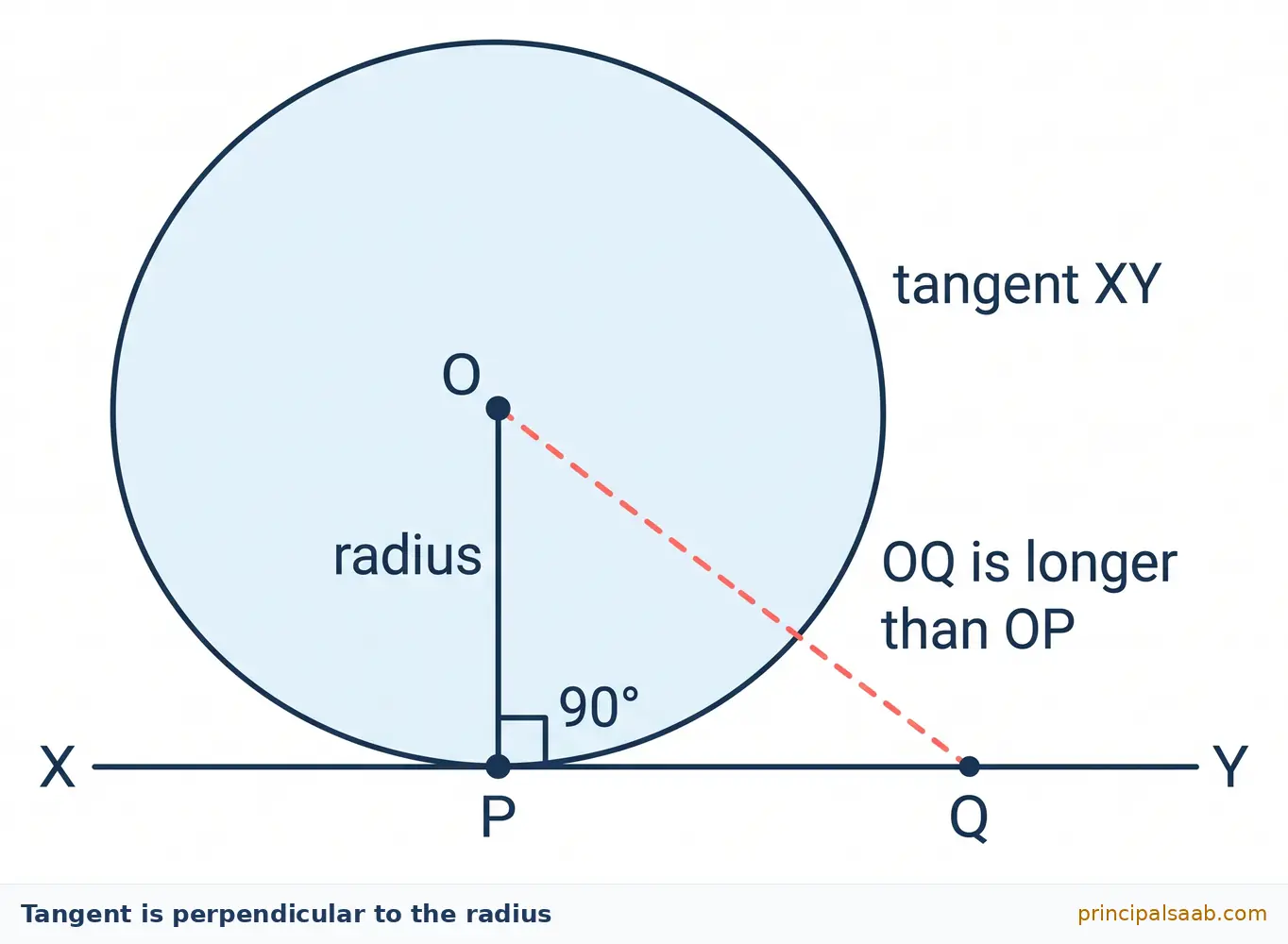
The tangent at any point of a circle is perpendicular to the radius through the point of contact.
The figure you must draw. Draw a circle with centre O. Mark a point P on the circle. Through P draw a straight line and label its two ends X and Y, so XY is the tangent touching the circle at P. Join O to P. Now mark a second point Q on the tangent, some way to the right of P, and join O to Q as well — that dashed helper segment OQ is what does the actual work. Label OP as the radius r.
Given: A circle with centre O. XY is a tangent to the circle, touching it at the point P.
To prove: OP ⊥ XY.
Construction: Take any point Q on XY other than P, and join OQ.
Proof (this is a proof by contradiction, so we begin by supposing the opposite of what we want):
- Suppose, if possible, that OP is not perpendicular to XY. (Assumption we intend to destroy.)
- Q is any point of XY other than P, so Q does not lie on the circle. (A tangent meets the circle only at P.)
- Q does not lie inside the circle either, so Q lies outside it. (If part of XY went inside, the line would have to cross the circle a second time on its way out.)
- Therefore OQ > r, that is, OQ > OP. (A point is outside exactly when its distance from the centre exceeds the radius, and OP = r.)
- This holds for every point Q of XY except P. (Q was chosen arbitrarily.)
- Hence OP is the shortest segment from O to the line XY. (From step 5.)
- But the shortest segment from a point to a line is the perpendicular from that point to the line. (Standard result.)
- So OP is the perpendicular from O to XY, contradicting step 1. (Steps 6 and 7.)
- Therefore OP ⊥ XY. Proved.
Strip away the formal language and the proof says something you already believe. A tangent stays outside the circle, so every point of it is at least a radius away from the centre, and the point of contact is the one place where it gets as close as it possibly can — exactly one radius. Being the closest point to O means OP is the shortest link from O to that line, and the shortest link from a point to a line is always the perpendicular. So OP must be that perpendicular. The contradiction is just the tidy way of writing “there is nowhere else for the perpendicular to be”.
When you write this proof in the exam, three things earn the marks: (1) a labelled figure with O, P, Q and the tangent XY; (2) the sentence “every point of XY other than P lies outside the circle, so OQ > OP”; (3) the sentence “the shortest distance from a point to a line is the perpendicular”. Miss any of the three and you lose marks even if the conclusion is right.
If a line through a point P on a circle is perpendicular to the radius OP, then that line is a tangent. Reason: OP is then the perpendicular distance from O to the line, and OP = r, so d = r, which is exactly the tangent condition. Examiners sometimes phrase a question as “prove that the line is a tangent” — that is your cue to show the perpendicular distance from the centre equals the radius.
Working. T is the point of contact, so OT is a radius and ∠OTQ = 90°. Triangle OTQ is right-angled at T with hypotenuse OQ.
$OT^2 = OQ^2-QT^2 = 26^2-24^2 = 676-576 = 100$.
Radius OT = 10 cm.
Watch the hypotenuse. The longest side is always the one joining the centre to the outside point, because it faces the right angle. Students who subtract the wrong way round get $26^2 + 24^2$ and a nonsense answer. Ask yourself every time: which side is opposite the 90°?
Working. Triangle OQP is right-angled at P, with ∠OQP = 30° and the side OP = 5 cm opposite that angle.
sin 30° = OP / OQ, so 1/2 = 5 / OQ, giving OQ = 10 cm.
Then $PQ^2 = OQ^2-OP^2 = 100-25 = 75$ so $PQ = 5\sqrt{3}$ ≈ 8.66 cm.
Cross-check with cosine: PQ = OQ cos $30^\circ = 10 \times (\sqrt{3}/2) = 5\sqrt{3}$. The two routes agree, and $5^2 + (5\sqrt{3})^2 = 25 + 75 = 100 = 10^2$.
Also worth noticing: the third angle ∠POQ = 180° − 90° − 30° = 60°.
5. The Length of a Tangent Segment
A tangent line goes on forever in both directions, so asking for “the length of a tangent” sounds odd. What we always mean is the length of the piece between the external point and the point of contact.
If P is a point outside a circle with centre O and radius r, and the tangent from P touches the circle at A, then the length of the tangent from P is the segment PA, and
$PA = \sqrt{OP^2-r^2}$.
This is just Pythagoras in the right triangle OAP, right-angled at A.
Draw this: Circle centre O, radius r. External point P to the right. Tangent from P touching at A on the upper side. Join OA (mark the right angle at A), join OP (the hypotenuse), and join PA. You now have a right triangle with legs r and PA and hypotenuse OP. Memorise this triangle — it is the workhorse of the entire chapter.
Three things worth noticing about that formula.
- It only makes sense when OP > r, that is, when P is genuinely outside. If OP < r you would be square-rooting a negative number — the algebra refusing to draw a tangent from an interior point.
- If OP = r, then PA = 0. The point P is on the circle and the “tangent segment” has shrunk to nothing, because P is already the point of contact.
- The further P travels from the circle, the longer the tangent gets. That matches your intuition perfectly.
Working. Length $\sqrt{OP^2-r^2} = \sqrt{17^2-8^2} = \sqrt{289-64} = \sqrt{225}$ 15 cm.
Check the triangle closes: $8^2 + 15^2 = 64 + 225 = 289 = 17^2$. Good.
Working. We need PA = r = 6, so
$OP^2 = r^2 + PA^2 = 6^2 + 6^2 = 36 + 36 = 72$
$OP = \sqrt{72} = 6\sqrt{2}$ ≈ 8.49 cm.
What this tells you. The triangle OAP now has two equal legs, so it is a right isosceles triangle and ∠AOP = ∠APO = 45°. In general the tangent length equals the radius exactly when the point is $r\sqrt{2}$ from the centre — the diagonal of a square of side r. A neat picture to keep.
Treating the distance from the external point to the nearest point of the circle as if it were OP. If P is 17 cm from the centre of a circle of radius 8 cm, then P is only 17 − 8 = 9 cm from the circle itself — but the formula wants the 17, not the 9. Always ask: distance from the centre, or from the curve?
6. Theorem 2: Tangents From an External Point Are Equal (Full Proof)
This is the second theorem the syllabus asks you to prove, and it is the one that turns up inside almost every long-answer question in the chapter. The good news: once Theorem 1 is in your pocket, this proof is four lines of congruence.
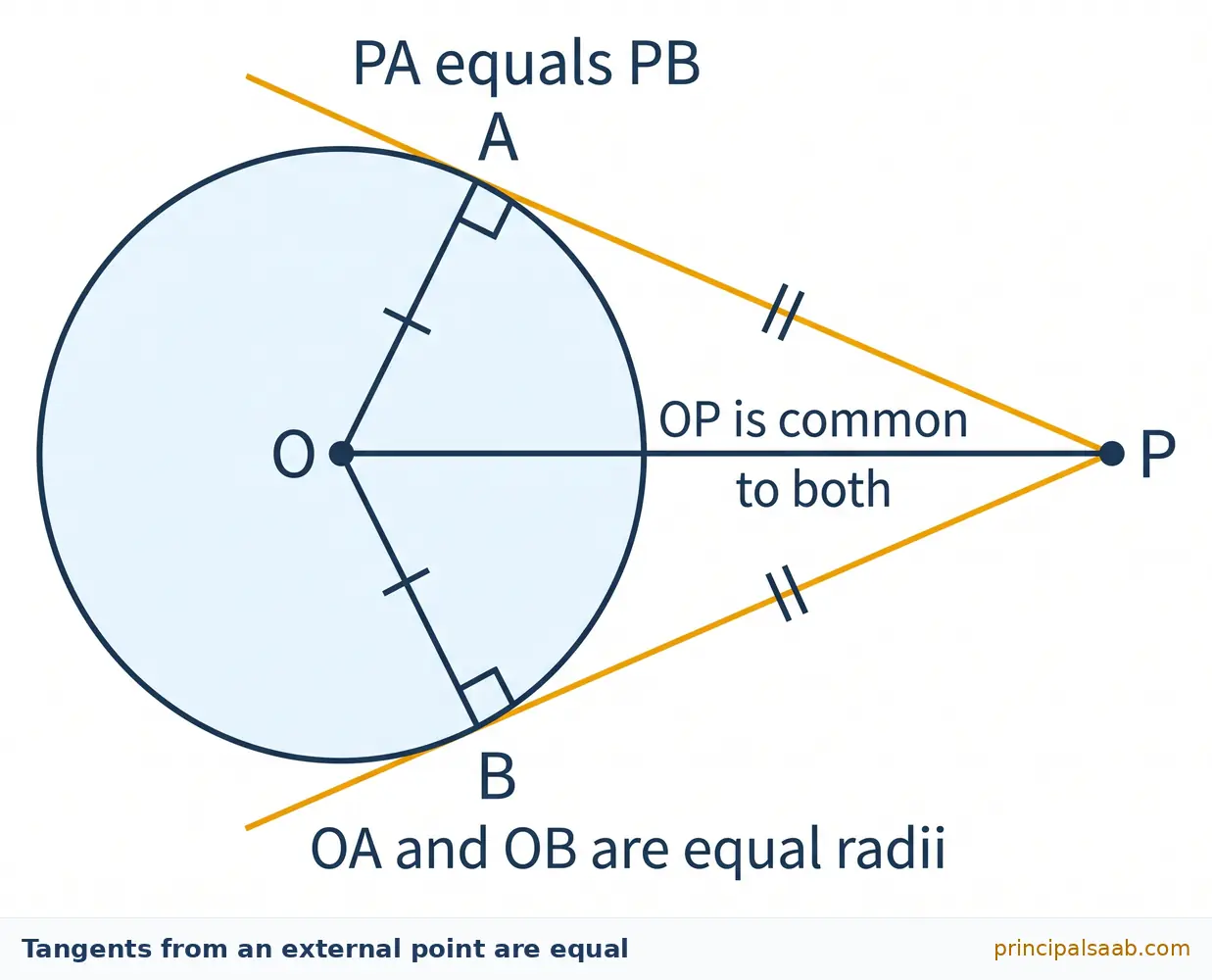
The lengths of tangents drawn from an external point to a circle are equal.
The figure you must draw. Draw a circle with centre O. Mark a point P outside it, to the right. From P draw the two tangents: one touching the circle at A (upper) and one touching at B (lower). Now join OA, OB and OP. Mark the right angle at A and the right angle at B. Mark OA and OB with a single tick each to show they are equal radii, and mark OP as shared by both triangles. Your picture should look like a symmetric arrowhead, with OP as the axis of symmetry.
Given: A circle with centre O and an external point P. PA and PB are tangents to the circle, touching it at A and B respectively.
To prove: PA = PB.
Construction: Join OA, OB and OP.
- ∠OAP = 90° (PA is a tangent and OA the radius through the point of contact, so Theorem 1 applies.)
- ∠OBP = 90° (Same reason, for tangent PB and radius OB.)
- So triangles OAP and OBP are right-angled triangles. (Steps 1 and 2.)
- OA = OB (Radii of the same circle.)
- OP = OP (Common side, and it is the hypotenuse of both triangles.)
- △OAP ≅ △OBP (RHS congruence rule, from steps 3, 5 and 4.)
- Therefore PA = PB. Proved. (CPCT.)
- Also ∠OPA = ∠OPB and ∠AOP = ∠BOP (CPCT again — free bonus results from the same congruence.)
Look at the figure and cover the right half with your hand, then the left half. The two halves are mirror images in the line OP. That is really all the theorem says: the picture is symmetric about the line joining the external point to the centre, so whatever is true on one side is true on the other. The congruence proof is simply the formal way of saying “fold the diagram along OP and the two tangents land on top of each other”. If you want an algebraic version: $PA = \sqrt{OP^2-r^2}$ and $PB = \sqrt{OP^2-r^2}$ and the two right-hand sides are the same expression, so the lengths must be equal.
RHS is the congruence rule you need here, not SAS or SSS. Write the letters R, H, S and say which side plays each role: right angles from Theorem 1, common hypotenuse OP, equal sides OA and OB. Examiners look specifically for the phrase “RHS congruence” and for “CPCT” in the last line.
Working. By Theorem 2, PA = PB, so
3x − 2 = x + 8
3x − x = 8 + 2
2x = 10, so x = 5.
Then PA = 3(5) − 2 = 13 cm and PB = 5 + 8 = 13 cm.
Each tangent is 13 cm long, and the two expressions agree, which is your check that x is right.
Working. By step 8 of the proof, OP bisects ∠APB, so ∠OPA = 30°.
In right triangle OAP, sin(∠OPA) = OA / OP, so sin 30° = 5 / OP, giving 1/2 = 5 / OP and OP = 10 cm.
$PA^2 = OP^2-OA^2 = 100-25 = 75$ so $PA = PB = 5\sqrt{3}$ ≈ 8.66 cm.
Check: $5^2 + (5\sqrt{3})^2 = 25 + 75 = 100 = 10^2$. The triangle closes.
7. What Theorem 2 Gives You Free: Angles, the Kite and Symmetry
The congruence we used in Theorem 2 hands over more than just PA = PB. Since the two triangles are congruent, every pair of matching parts is equal. Let us collect the gifts, because board questions live on them.
Gift 1: OP bisects the angle between the tangents. From CPCT, ∠OPA = ∠OPB. So the line from the external point to the centre cuts ∠APB neatly in half.
Gift 2: OP bisects the angle at the centre. Also from CPCT, ∠AOP = ∠BOP, so OP cuts ∠AOB in half as well.
Gift 3: the two angles add to a straight angle. Look at the quadrilateral OAPB. Its four angles are ∠OAP = 90°, ∠OBP = 90°, ∠AOB and ∠APB. Angles of a quadrilateral add to 360°, so
90° + 90° + ∠AOB + ∠APB = 360°, giving ∠AOB + ∠APB = 180°.
The angle between the tangents and the angle they subtend at the centre are supplementary. This one appears constantly.
Gift 4: OAPB is a kite. Two adjacent sides OA = OB (radii) and the other two adjacent sides PA = PB (Theorem 2). That is exactly a kite, with OP as its axis of symmetry. Recognising the kite makes the whole figure feel obvious rather than fiddly.
Gift 5: triangle PAB is isosceles. Since PA = PB, the triangle formed by the two points of contact and the external point has two equal sides, so the base angles are equal: ∠PAB = ∠PBA. And because those two are equal,
∠PAB = ∠PBA = (180° − ∠APB) ÷ 2 = 90° − ½∠APB.
Gift 6: OP is the perpendicular bisector of AB. The kite’s axis of symmetry cuts the other diagonal at right angles and in half. So OP ⊥ AB and OP passes through the midpoint of AB.
Draw this: Take your Theorem 2 figure and add the segment AB joining the two points of contact. Mark where AB crosses OP as M. Put a right angle at M and equal ticks on AM and MB. You now have the full picture that board questions use.
With PA, PB tangents from external P, touching at A, B, centre O:
1. PA = PB
2. ∠OPA = ∠OPB = ½∠APB
3. ∠AOP = ∠BOP = ½∠AOB
4. ∠APB + ∠AOB = 180°
5. ∠OAB = ∠OBA = ½∠APB
Working.
∠AOB = 180° − ∠APB = 180° − 80° = 100° (relation 4).
∠OPA = ½ × 80° = 40° (OP bisects the angle between the tangents).
In right triangle OAP the angles must total 180°, so ∠AOP = 180° − 90° − 40° = 50°.
Cross-check: ∠AOP should be half of ∠AOB, and ½ × 100° = 50°. It matches.
Working. Triangle PAB has PA = PB, so it is isosceles and the base angles are equal.
∠PAB = ∠PBA = (180° − 50°) ÷ 2 = 130° ÷ 2 = 65°.
Now ∠OAP = 90° because OA is a radius and PA a tangent. The angle ∠OAB sits inside ∠OAP, so
∠OAB = ∠OAP − ∠PAB = 90° − 65° = 25°.
Notice the shortcut. 25° is exactly half of 50°. That is relation 5 in the box above: ∠OAB = ½∠APB, always. You can use the shortcut in a one-mark question, but show the two-line reasoning when marks are on offer.
Given. Circle with centre O, external point P, tangents PA and PB touching at A and B.
To prove. ∠APB + ∠AOB = 180°.
Proof.
1. ∠OAP = 90° — tangent PA is perpendicular to radius OA (Theorem 1).
2. ∠OBP = 90° — tangent PB is perpendicular to radius OB (Theorem 1).
3. OAPB is a quadrilateral, so ∠OAP + ∠APB + ∠OBP + ∠BOA = 360° — angle sum of a quadrilateral.
4. Substituting, 90° + ∠APB + 90° + ∠AOB = 360°.
5. Therefore ∠APB + ∠AOB = 360° − 180° = 180°. Proved.
Notice this proof did not even need Theorem 2 — only Theorem 1 twice and the angle sum of a quadrilateral. Short, clean, full marks.
Writing ∠AOB = ∠APB because the figure “looks symmetric”. They are supplementary, not equal — they are only equal in the single special case where both are 90°. Whenever you are given one of these two angles, subtract from 180° to get the other.
8. Tangents From a Point Inside, On, or Outside the Circle
Let us pull the counting from Section 3 together with the measuring from Section 5, because the two ideas answer the same question from different directions. Everything again depends on comparing OP with r.
| Where P is | Condition | Number of tangents from P | Tangent length $\sqrt{OP^2-r^2}$ |
|---|---|---|---|
| Inside the circle | OP < r | None | Not defined — the square root would be of a negative number |
| On the circle | OP = r | Exactly one | Zero — P is itself the point of contact |
| Outside the circle | OP > r | Exactly two, and they are equal | A positive length, the same for both |
Why no tangent from inside? Any line through an interior point must enter and leave the circle, so it always cuts at two points. It is physically impossible for such a line to touch at only one. Nothing subtle here — a line drawn through a point inside a disc has to come out somewhere.
Why only one from a point on the circle? The tangent there must be perpendicular to OP at P, and there is only one line perpendicular to OP at P.
X: OX = 4 < 5, so X is inside. No tangent can be drawn from X.
Y: OY = 5 = r, so Y lies on the circle. Exactly one tangent, namely the line through Y perpendicular to OY. Tangent length from Y is 0.
Z: OZ = 13 > 5, so Z is outside. Two tangents, each of length $\sqrt{169-25} = \sqrt{144}$ 12 cm.
9. Two Concentric Circles: The Chord That Touches
Concentric circles are circles that share the same centre — think of the rings on a dartboard, or a bangle drawn with two edges. The board loves one particular set-up with them, so learn it as a single picture.
Draw this: One centre O. A small circle of radius r and a big circle of radius R around it. Now draw a chord AB of the big circle that just grazes the small circle, touching it at a point P. Join OP (mark the right angle at P, since AB is a tangent to the small circle). Join OA and OB — both are radii of the big circle, so both equal R. Your figure is a fat isosceles triangle OAB with a perpendicular OP dropped onto its base.
Two facts now fall out at once:
- OP ⊥ AB, because AB is a tangent to the small circle at P (Theorem 1).
- A perpendicular from the centre to a chord bisects that chord, so AP = PB, and P is the midpoint of AB.
So triangle OPA is right-angled at P with hypotenuse OA = R and leg OP = r. Pythagoras gives $AP = \sqrt{R^2-r^2}$ and the full chord is twice that.
If a chord of the larger circle (radius R) is tangent to the smaller circle (radius r), then the chord has length
$2\sqrt{R^2-r^2}$
and its point of contact is its own midpoint.
Working. Half-chord $AP = \sqrt{R^2-r^2} = \sqrt{25-9} = \sqrt{16} = 4$ cm.
Chord AB = 2 × 4 = 8 cm.
Check the right triangle: $3^2 + 4^2 = 9 + 16 = 25 = 5^2$. Closes perfectly.
Working. The point of contact bisects the chord, so half-chord = 8 cm. Let the inner radius be r. In the right triangle formed,
$r^2 = 10^2-8^2 = 100-64 = 36$ so r = 6 cm.
Check forwards: $2\sqrt{100-36} = 2\sqrt{64} = 2 \times 8 = 16$ cm, the chord we started with.
In concentric-circle questions, the perpendicular from the centre serves double duty: it is the radius of the small circle and the perpendicular bisector of the chord. Say both facts out loud as you draw the figure and the calculation writes itself.
10. Tangents to Two Circles and Common Tangents
A common tangent is a single straight line that is tangent to two circles at the same time. How many exist depends entirely on how the two circles are sitting relative to each other, which in turn depends on the distance d between their centres compared with the radii $r_1$ and $r_2$.
Draw this: Two circles side by side, well apart, with centres $O_1$ and $O_2$. Draw a line resting on top of both like a plank across two barrels — that is a direct (or external) common tangent. Draw the mirror image underneath — a second direct tangent. Now draw a line that crosses between the two circles in a long X shape, touching the top of one and the bottom of the other — that is a transverse (or internal) common tangent, and there are two of those as well. Four altogether.
| Position of the two circles | Condition on d | Number of common tangents |
|---|---|---|
| Completely apart, one outside the other | d > $r_1 + r_2$ | 4 (two direct, two transverse) |
| Touching each other externally | $d = r_1 + r_2$ | 3 (the two transverse ones have merged into one at the point of contact) |
| Overlapping, cutting at two points | $|r_1-r_2|$ < d < $r_1 + r_2$ | 2 (only the direct ones survive) |
| Touching internally, one inside the other | $d = |r_1-r_2|$ | 1 |
| One entirely inside the other, not touching | d < $|r_1-r_2|$ | 0 |
| Concentric (same centre, different radii) | d = 0 | 0 |
Direct (external) common tangent: length $\sqrt{d^2-(r_1-r_2)^2}$
Transverse (internal) common tangent: length $\sqrt{d^2-(r_1 + r_2)^2}$
For two circles that touch externally, the direct common tangent has the tidy length $2\sqrt{r_1r_2}$.
The two length formulas above are a useful extension rather than a named Class 10 theorem. Every one of them still comes straight from Theorem 1 plus Pythagoras, so you are never memorising anything you could not rebuild from the figure. If a question asks for a proof, build it from the right angles rather than quoting the formula.
Working. Length $\sqrt{d^2-(r_1-r_2)^2} = \sqrt{13^2-(8-3)^2} = \sqrt{169-25} = \sqrt{144}$ 12 cm.
How many tangents in total? $r_1 + r_2 = 11$ and d = 13, so d > $r_1 + r_2$: the circles lie completely outside each other and there are 4 common tangents.
Check: $5^2 + 12^2 = 25 + 144 = 169 = 13^2$.
Working. Length $\sqrt{d^2-(r_1 + r_2)^2} = \sqrt{10^2-6^2} = \sqrt{100-36} = \sqrt{64}$ 8 cm.
Since d = 10 > $r_1 + r_2 = 6$ the circles are fully separate and all 4 common tangents exist.
Check: $6^2 + 8^2 = 36 + 64 = 100 = 10^2$.
Working. Touching externally means $d = r_1 + r_2 = 9 + 4 = 13$ cm. From the table, there are 3 common tangents.
Direct common tangent $\sqrt{13^2-(9-4)^2} = \sqrt{169-25} = \sqrt{144}$ 12 cm.
Shortcut check with the touching formula: $2\sqrt{r_1r_2} = 2\sqrt{9 \times 4} = 2\sqrt{36} = 2 \times 6 = 12$ cm. The two methods agree.
11. A Quadrilateral Circumscribing a Circle
This is the classic application of Theorem 2 and it is worth every minute you spend on it, because it converts a scary-looking figure into one line of arithmetic.
Draw this: Draw a circle. Now draw a four-sided figure ABCD wrapped around it so that all four sides touch the circle — imagine a rubber band pulled around a coin at four points. Label the points where the circle touches: P on AB, Q on BC, R on CD and S on DA. That is a quadrilateral circumscribing the circle, and the circle is its incircle.
Now look at each vertex in turn. Vertex A is an external point from which two tangents leave: one touching at P and one touching at S. By Theorem 2, AP = AS. Do the same at each corner:
- From A: AP = AS
- From B: BP = BQ
- From C: CQ = CR
- From D: DR = DS
Now add the four equations, but line them up cleverly — keep AP and BP together (they make up AB) and keep CR and DR together (they make up CD):
AP + BP + CR + DR = AS + BQ + CQ + DS
Read each side as whole sides of the quadrilateral. On the left, AP + BP = AB and CR + DR = CD. On the right, BQ + CQ = BC and AS + DS = AD. So
AB + CD = BC + AD
In words: in any quadrilateral that circumscribes a circle, the sum of one pair of opposite sides equals the sum of the other pair. Beautiful, and very easy to use.
If a quadrilateral ABCD has an incircle touching all four sides, then
AB + CD = BC + AD.
Opposite sides, added in pairs, give the same total.
The same trick for a triangle. If a circle is inscribed in triangle ABC, touching BC, CA and AB, the tangent lengths from the three vertices are s − a, s − b and s − c, where a, b, c are the sides opposite A, B, C and s is the semi-perimeter (a + b + c) ÷ 2. You do not have to memorise that for the board, but it is a lovely shortcut and it comes straight from Theorem 2 in exactly the same way.
Working. AB + CD = BC + AD
7 + 11 = 9 + AD
18 = 9 + AD, so AD = 9 cm.
Check: AB + CD = 7 + 11 = 18 and BC + AD = 9 + 9 = 18. The two pair-sums match.
Given. Parallelogram ABCD circumscribes a circle.
To prove. ABCD is a rhombus, that is, all four sides are equal.
Proof.
1. Since ABCD circumscribes a circle, AB + CD = BC + AD — the circumscribing-quadrilateral result proved above.
2. Since ABCD is a parallelogram, AB = CD and BC = AD — opposite sides of a parallelogram are equal.
3. Substituting step 2 into step 1: AB + AB = BC + BC, that is, 2AB = 2BC.
4. Hence AB = BC.
5. Combining with step 2: AB = BC = CD = AD.
6. A parallelogram with all four sides equal is a rhombus. Proved.
Working. Let AF = AE = x, BF = BD = y and CD = CE = z, using Theorem 2 at each vertex. Then
AB = x + y = 8, BC = y + z = 12, CA = z + x = 10.
Adding all three: 2(x + y + z) = 30, so x + y + z = 15.
x = 15 − 12 = 3 cm (so AF = AE = 3 cm)
y = 15 − 10 = 5 cm (so BD = BF = 5 cm)
z = 15 − 8 = 7 cm (so CE = CD = 7 cm)
Check every side: AB = 3 + 5 = 8, BC = 5 + 7 = 12, CA = 7 + 3 = 10. All three match the data.
Notice that x + y + z = 15 is the semi-perimeter, and each tangent length is the semi-perimeter minus the opposite side.
Working. The hypotenuse is $\sqrt{36 + 64} = \sqrt{100} = 10$ cm.
Let the incircle touch the two legs at points near the right-angle vertex C. Since OD ⊥ BC and OE ⊥ CA (Theorem 1) and OD = OE = r, the little figure ODCE is a square of side r. So the tangent length from C is exactly r.
Tangent length from C = s − c where s = (6 + 8 + 10) ÷ 2 = 12 and c = 10 (the hypotenuse).
So r = 12 − 10 = 2 cm.
Check a different way: area = ½ × 6 × 8 = 24, and area also equals r × s = 12r, so 12r = 24 and r = 2 cm. The two methods agree.
12. Typical Board-Exam Setups and How to Spot the Right Theorem
By now you own two theorems and a fistful of consequences. The only remaining skill is recognition — reading a question and knowing within five seconds which tool to reach for. Here is the decision table I would want taped inside my notebook.
| What the question shows you | Reach for this | First thing to write down |
|---|---|---|
| One tangent, a radius, and two lengths | Theorem 1 then Pythagoras | The right angle at the point of contact |
| Two tangents from one outside point | Theorem 2 | PA = PB, and OP bisects both angles |
| An angle at the external point, or at the centre | ∠APB + ∠AOB = 180° | The two 90° angles in quadrilateral OAPB |
| Two circles, same centre, a chord touching the inner one | Chord $2\sqrt{R^2-r^2}$ | The perpendicular from O bisects the chord |
| A four-sided figure wrapped around a circle | AB + CD = BC + AD | Equal tangents from each of the four vertices |
| A triangle with an inscribed circle | Equal tangents from each vertex | Name the three tangent lengths x, y, z and write three equations |
| Two separate circles and a line touching both | Common tangent count and length | Compare d with $r_1 + r_2$ and with $|r_1-r_2|$ |
| The words “prove that…” | Given / To prove / Construction / Proof | A labelled figure — marks are awarded for it |
Whatever the figure, do these three things before you think: (1) draw the radius to every point of contact, (2) mark 90° at every point of contact, (3) tick equal tangents from every external point. Most of the time the answer is visible by the end of step 3.
Part 1. $AP = \sqrt{10^2-6^2} = \sqrt{100-36} = \sqrt{64} = 8$ cm, so AB = 16 cm.
Part 2. OP ⊥ the line at P and OP = 6, so triangle OPQ is right-angled at P.
$OQ^2 = 6^2 + 15^2 = 36 + 225 = 261$ so $OQ = \sqrt{261} = 3\sqrt{29}$ ≈ 16.16 cm.
Sanity check: Q is 15 cm from P, which is beyond B (only 8 cm from P), so Q sits outside the big circle. Indeed OQ ≈ 16.16 > 10. Consistent.
Spotting it. “Touches all four sides” means each vertex is an external point with two tangents, so this is Theorem 2 applied four times.
Proof. Let the circle touch AB, BC, CD, DA at P, Q, R, S. By Theorem 2, AP = AS, BP = BQ, CR = CQ and DR = DS. Adding these four equalities,
AP + BP + CR + DR = AS + BQ + CQ + DS
(AP + BP) + (CR + DR) = (BQ + CQ) + (AS + DS)
AB + CD = BC + AD. Proved.
Calculation. 5.4 + CD = 7.1 + 6.3 = 13.4, so CD = 13.4 − 5.4 = 8 cm.
Check: 5.4 + 8 = 13.4 and 7.1 + 6.3 = 13.4. They match.
You may see other circle facts floating around online: properties of chords, angles in the same segment, cyclic quadrilaterals, alternate segment theorem. Those are background reading only for Class 10 — they are not part of this chapter and will not be examined here. The one chord fact we did use, that the perpendicular from the centre bisects a chord, comes from your earlier classes and is safe to quote. Areas of sectors and segments belong to the separate chapter on Areas Related to Circles, so save those formulas for there.
Practice Worksheet
Ten questions, arranged from gentle to board level. Attempt each one on paper with a proper labelled figure before you open the answer — the figure is where most of the thinking happens. Two of these are full proof questions, because the board can and does ask you to reproduce both theorems.
Show Answer
$PA^2 = OP^2-OA^2 = 25^2-7^2 = 625-49 = 576$.
PA = 24 cm.
Check: $7^2 + 24^2 = 49 + 576 = 625 = 25^2$.
Show Answer
$OT^2 = OQ^2-QT^2 = 17^2-8^2 = 289-64 = 225$.
Radius = 15 cm.
Check: $8^2 + 15^2 = 64 + 225 = 289 = 17^2$.
Show Answer
(b) OP bisects ∠APB, so ∠OPA = 70° ÷ 2 = 35°.
(c) Triangle PAB is isosceles because PA = PB, so ∠PAB = (180° − 70°) ÷ 2 = 55°. Then ∠OAB = ∠OAP − ∠PAB = 90° − 55° = 35°.
Consistent with the shortcut ∠OAB = ½∠APB = 35°.
Show Answer
$AP = \sqrt{17^2-8^2} = \sqrt{289-64} = \sqrt{225} = 15$ cm.
AB = 2 × 15 = 30 cm.
Check: $8^2 + 15^2 = 64 + 225 = 289 = 17^2$.
Show Answer
6.5 + 9.1 = 8.4 + AD
15.6 = 8.4 + AD
AD = 7.2 cm.
Check: AB + CD = 15.6 and BC + AD = 8.4 + 7.2 = 15.6. They match.
Show Answer
To prove. OP ⊥ XY.
Construction. Take any point Q on XY other than P, and join OQ.
Proof.
1. Suppose, if possible, that OP is not perpendicular to XY.
2. Since XY is a tangent it meets the circle only at P, so Q does not lie on the circle.
3. Q cannot lie inside the circle either, because a line entering the circle would have to leave it again and would meet the circle a second time.
4. So Q lies outside the circle, which means OQ is greater than the radius, that is, OQ > OP.
5. Q was any point of XY other than P, so OP is shorter than every other segment from O to XY. Hence OP is the shortest segment from O to the line XY.
6. But the shortest segment from a point to a line is the perpendicular from that point to the line.
7. So OP is the perpendicular from O to XY, contradicting step 1.
8. Therefore OP ⊥ XY. Proved.
Show Answer
Direct common tangent $\sqrt{d^2-(r_1-r_2)^2} = \sqrt{15^2-9^2} = \sqrt{225-81} = \sqrt{144}$ 12 cm.
Cross-check with the touching-circles shortcut: $2\sqrt{r_1r_2} = 2\sqrt{3 \times 12} = 2\sqrt{36} = 12$ cm. Both routes agree.
Show Answer
x + y = AB = 9
y + z = BC = 14
z + x = CA = 11
Adding: 2(x + y + z) = 34, so x + y + z = 17.
x = 17 − 14 = 3 cm (AF = 3 cm)
y = 17 − 11 = 6 cm (BD = 6 cm)
z = 17 − 9 = 8 cm (CE = 8 cm)
Check all three sides: 3 + 6 = 9, 6 + 8 = 14, 8 + 3 = 11. Every side matches the data.
Show Answer
To prove. PA = PB.
Construction. Join OA, OB and OP.
Proof.
1. ∠OAP = 90°, since the tangent PA is perpendicular to the radius OA at the point of contact (Theorem 1).
2. ∠OBP = 90°, for the same reason applied to PB and OB.
3. So triangles OAP and OBP are right-angled triangles with OP as their common hypotenuse.
4. OA = OB, being radii of the same circle.
5. OP = OP, common.
6. Hence △OAP ≅ △OBP by the RHS congruence rule.
7. Therefore PA = PB by CPCT. Proved.
Two further equal pairs. From the same congruence, ∠OPA = ∠OPB (so OP bisects the angle between the tangents) and ∠AOP = ∠BOP (so OP bisects the angle at the centre).
Show Answer
$(b) OP^2 = OA^2 + PA^2 = 36 + 36 = 72$ so $OP = 6\sqrt{2}$ ≈ 8.49 cm.
(c) In quadrilateral OAPB we have ∠OAP = ∠OBP = 90° and ∠APB = 90°, so the fourth angle ∠AOB = 360° − 270° = 90°. All four angles are right angles, and OA = OB = PA = PB = 6 cm, so OAPB is a square.
Check: $6^2 + 6^2 = 72$ and $(6\sqrt{2})^2 = 72$. Consistent.
Cover the answers and rewrite the two proofs from memory, on blank paper, figure and all. If you can do that twice without peeking, this chapter is genuinely done. And if you cannot yet — that is completely fine, it just means one more attempt tomorrow. Aim for one more correct question than yesterday, every single day, and the marks look after themselves.