
Sit down, take a slow breath, and let us do this one together. If the words gender, religion and caste sitting inside a Civics chapter make you a little nervous, that is completely normal. These are big words about real life, and most students quietly worry about saying the wrong thing in an answer sheet. So let me remove that fear right at the start: your syllabus is not asking you to take sides about anybody. It is asking you to understand one clean idea, and then apply that same idea three times.
The one idea is this. Every society on earth has differences between people. A democracy has to decide what to do with those differences. Sometimes politics handles them well, and the country stays together and even grows stronger because more voices are heard. Sometimes politics handles them badly, and the country gets pulled apart. Your chapter picks three kinds of difference that matter a great deal in India — gender, religion and caste — and studies how each one enters politics, what goes wrong when it enters badly, and what our Constitution does to keep things fair.
I am going to go slowly. We will build every term from zero, in ordinary language, with examples from ordinary life. We will do worked examples in exactly the format the board expects, so you learn not just the content but the shape of a full-mark answer. And at the end there is a practice worksheet with complete model answers you can check yourself against. Quietly, this is one of the highest-scoring chapters in Democratic Politics, because the questions repeat year after year: define communalism, explain secularism, distinguish caste in politics from politics in caste, describe women’s representation. Learn them properly once and you will collect those marks every single time.
What You’ll Learn
- Social Differences and Politics: The Big Idea
- The Public and Private Division
- Gender Division: What It Is and Why It Is Not Natural
- Sexual Division of Labour and the Unpaid Work Question
- Feminist Movements and What They Achieved
- Women’s Political Representation in India
- Patriarchy and Everyday Inequality
- Religion, Communalism and Politics
- Forms Communalism Takes in Politics
- Secularism in the Indian Constitution
- Caste and Politics
- Politics in Caste and Caste in Politics
- Exam Strategy for This Chapter
- Practice Worksheet
Your Game Plan
- Read the whole chapter once, slowly, without a pen. Just meet the ideas.
- Go back and write down only the definitions: gender division, sexual division of labour, patriarchy, feminist, communalism, secular state, caste hierarchy, casteism, occupational mobility. Nine words. That is your spine.
- Learn the three comparison tables by drawing them from memory on a blank page.
- Do the worked examples with the answers covered, then compare line by line.
- Finish with the practice worksheet and mark yourself honestly against the model answers.
- The night before the exam, revise only the tables and the nine definitions. Nothing else.
Social Differences and Politics: The Big Idea
Let us start with the simplest possible picture. Imagine a large school with two thousand students. Those students differ in many ways — the language they speak at home, whether they are boys or girls, how much their families earn, which town they came from. Some of those differences are completely harmless. Two friends supporting different cricket teams does not split a school. But suppose the head boy is always chosen from one particular group, the good classrooms always go to one section, and a certain set of students is never listened to. Now the difference has hardened into a division. People begin to see themselves as “us” against “them”.
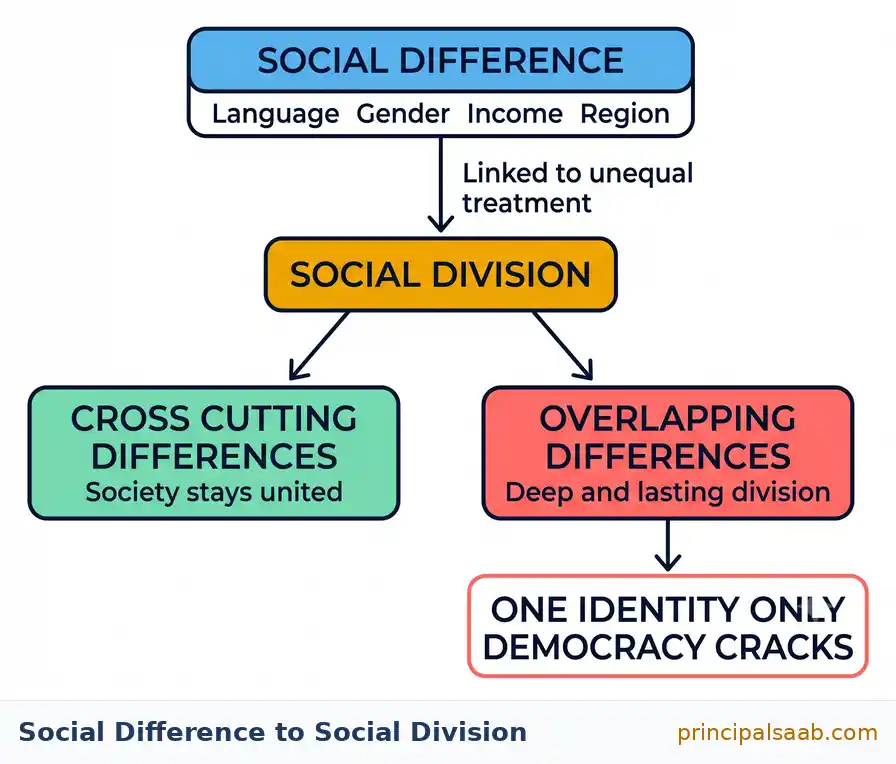
That is exactly the move your chapter tracks, but at the level of a country. A social difference becomes a social division when it gets linked to unequal treatment over a long time, and especially when several differences pile up on top of each other. If in some region one group happens to be poor and speaks a minority language and follows a minority faith, all those lines lie on top of one another and the division becomes deep. But when the lines cut across each other — when poor families are found in every religion, and every caste contains both rich and struggling households — society holds together far better, because no single group can honestly claim that all its interests are opposed to everyone else’s.
Now, why bring politics into it at all? This is where students get confused, so read this part twice. Many people say social differences should simply be kept out of politics. Your chapter gently disagrees, and the reasoning is worth understanding. In a democracy, if a group is being treated unfairly, the only peaceful route open to it is to organise, to demand, to vote, and to send representatives. If politics refuses to listen, the grievance does not disappear — it goes underground and returns in uglier forms. So expressing a social division through politics is normal, and often healthy. The real danger is something else: it is when politics insists that one identity is the only identity a person may have, that this group’s interests are totally opposed to everyone else’s, and that the country belongs to it alone. That is where democracy begins to crack.
Social differences are not the problem. Politics expressing them is not the problem either. The problem begins when politics turns one identity into the only identity a person is allowed to have, and treats every other group as an opponent. Democracy can live with differences; it struggles with absolutes.
Model answer: A social difference is simply a way in which people are not the same — language, gender, religion, occupation or region — and by itself it need not create conflict. A social division arises when such a difference becomes linked to unequal treatment and when several differences overlap in the same group of people, so that they begin to feel their interests are entirely separate from everyone else’s.
Why this scores: Two marks means two clean halves. One sentence defines difference, one defines division, and the word “overlap” is the marker the examiner is scanning for. Do not add stories here — a 2-mark answer that runs eight lines is spending minutes you will need later.
Sit with that for a moment. Do not move on until the sentence “a difference becomes a division when it overlaps with inequality” feels comfortable in your own words. Everything else in this chapter is that single sentence, applied first to gender, then to religion, then to caste.
The Public and Private Division
Before we talk about gender properly, we need one small tool, and it is easier than it sounds. Human life gets loosely sorted into two spheres. The private sphere is home and family — cooking, cleaning, caring for children and elders, the everyday work that keeps a household running. The public sphere is everything outside it — paid jobs, offices, factories, shops, courts, colleges, and above all politics and government.
Here is why this matters. For a very long time, in India and in most of the world, women’s lives were pushed almost entirely into the private sphere, while men occupied the public one. The consequence was not just unfairness in housework. It was that the decisions which shape a whole society — laws, budgets, wages, schools, policing — were being taken in rooms where half the population was simply not present. So when your textbook says the public and private division works against women, it is making a political claim, not a domestic one. Work done at home is not counted, not paid and not valued, and the people doing it end up outside the rooms where power sits.
Notice, too, that the boundary is not fixed by nature. It shifts. When a state builds anganwadis, or when childcare and cooking become paid jobs, work that was invisible inside a home becomes visible in the economy. That is precisely how reformers have chipped away at this division.
| Point of comparison | Private sphere | Public sphere |
|---|---|---|
| What it covers | Home, family, household chores, care of children and the elderly | Paid employment, business, offices, courts, government and politics |
| Who has traditionally dominated it | Women, by social expectation rather than by choice | Men, in most societies including India |
| Is the work paid? | Usually unpaid and left out of national income accounting | Paid, recorded, and counted in the economy |
| Is it visible? | Largely invisible; noticed only when it is not done | Highly visible, and it carries status |
| Effect on political power | Confinement here keeps a person away from decision-making | Presence here converts into laws, budgets and representation |
If a question asks how the public and private division disadvantages women, do not only write “women do housework”. Add the political consequence in your last line: because their work is unpaid and invisible, women stay outside the spaces where public decisions are made. That final sentence is usually worth a mark on its own.
Gender Division: What It Is and Why It Is Not Natural
Now the definition, and I want you to write this one in your notebook exactly. Gender division is a form of hierarchical social division seen everywhere, but it is rarely recognised as a division at all. It is based on social expectations and stereotypes about what men and women should do, rather than on any biological necessity.
Read that last clause again, because it carries the whole argument: rather than on any biological necessity. There is a genuine biological difference between men and women — that is not in dispute and your syllabus does not deny it. What the chapter denies is that this biological difference explains the enormous social gap in who cooks, who earns, who inherits, who studies further and who governs. Those are decided by expectation, custom and upbringing.
How can we be sure? Because of a simple test that historians and social scientists use all the time: if something were truly fixed by biology, it would look the same everywhere and in every century. It does not. Nursing and teaching are treated as women’s work in one country and were largely men’s professions in another era. In some Indian communities women have long worked in the fields, run markets and handled money; in others they were kept indoors. Within one family, one generation sends daughters to college and the next takes it for granted. Nothing biological changed in those decades. Social expectation changed. Therefore the division was social all along.
Two more useful words. Patriarchy means a system that values men more than women and gives men greater authority in the family and in society. A feminist is a person — of any gender — who believes in and works for equal rights and opportunities for women and men. That second definition surprises students, so let me be plain: a boy can be a feminist. It is a belief about equality, not a category of person.
Students often write that gender division is “natural” because men and women are biologically different. That is the exact opposite of what the chapter argues, and it costs the full mark. The safe sentence is: gender division is based on social expectations and stereotypes, not on biology, which is why it varies from society to society and changes over time.
Model answer: (i) The roles assigned to men and women differ from one society to another and have changed over time; a division fixed by nature could not vary in this way. (ii) Tasks such as teaching, nursing, farming or trading have been considered men’s work in some places and women’s work in others, showing that the allocation follows custom, not biology. (iii) Where societies have deliberately changed their expectations — by educating girls, opening jobs and reserving seats — women have entered work and politics successfully, proving that earlier exclusion came from social barriers rather than from natural inability.
Why this scores: The examiner wants three distinct arguments, so number them. Notice that each point independently attacks the word “natural” — variation across societies, variation across occupations, and change after reform. Three separate reasons, three marks.
Model answer: A feminist is a person, man or woman, who believes in equal rights and opportunities for women and men and works to achieve them.
Why this scores: One mark, one sentence. The phrase “man or woman” is what shows the examiner you have not misunderstood the term as applying only to women. Resist the urge to write a paragraph.
Sexual Division of Labour and the Unpaid Work Question
The sexual division of labour is the arrangement in which all the work inside the home is treated as the responsibility of women, or is done by workers whom women arrange and supervise, while men are expected to work outside for money. It is a mouthful of a phrase; the idea underneath it is very simple, and you have probably watched it operate in a hundred homes.
Let us reason through why this small arrangement has such large effects. Housework and care work take real hours — cooking, cleaning, fetching water, minding a toddler, sitting with an ill grandparent. Those hours are genuine labour. But because no money changes hands, the work never appears in any wage record and historically has not been counted in measures of national income. Since nobody is paid for it, nobody treats it as a qualification. Since it is not a qualification, it buys no status. And since it consumes the whole day, it leaves no time for schooling, for a paid job, for a union, for a political party, or for standing in an election.
Do you see the chain? Unpaid work leads to invisibility, invisibility leads to low status, low status and lack of time lead to absence from public life, and absence from public life means the laws and budgets get written by people who have never done that work. This chain is the reason a Civics textbook — not a Home Science textbook — is discussing who washes the dishes. It is a political question.
One honest addition, so you understand the present and not only the past. This is changing, and in visible ways. Girls’ school enrolment in India has risen sharply, and girls now often outperform boys in board examinations. Women work as doctors, engineers, scientists, pilots, judges, soldiers and administrators. Time-use surveys conducted by the government confirm both parts of the picture at once: women’s participation in paid work has been rising, and women still spend far more time on unpaid domestic and care work than men do. Both sentences are true together, and a good answer says so.
The sexual division of labour is not just about chores. Because domestic work is unpaid, it is uncounted; because it is uncounted, it carries no status; and because it fills the day, it keeps people out of public and political life. Unpaid work is therefore a political fact, not merely a household arrangement.
Model answer: (i) Domestic and care work is unpaid, so it generates no wage record and has traditionally been left out of measures of national income, making it statistically invisible. (ii) Society treats such work as a natural duty of women rather than as a skill or a profession, so it earns no recognition or status. (iii) Because this work occupies most of the day and is never counted as experience, it does not lead to promotion, savings or independence, and so it is treated as less important than paid employment outside the home.
Why this scores: Three reasons, three marks, one idea each — invisible in accounting, not seen as a skill, brings no economic return. Keeping the reasons non-overlapping is the whole trick in this kind of question.
Feminist Movements and What They Achieved
Nothing in this area improved on its own. It improved because people organised and asked for it, sometimes for a very long time. Those efforts are called feminist movements, and your chapter groups their demands into two stages that are easy to remember.
The first stage was about basic legal and political rights: the right to vote, the right to be educated, the right to own property, the right to work for wages. In several Western countries women had to campaign for decades before they were allowed to vote at all — a fact worth pausing on, because it shows that even in old democracies, universal adult franchise was fought for and not granted from the start. India took a different and rather remarkable route here. When our Constitution came into force, every adult citizen received the vote at once, regardless of gender, caste, religion, property or education. Indian women never had to run a suffrage campaign of that kind, because the Constitution settled it on day one.
The second stage, from roughly the middle of the twentieth century, went further. Having the vote turned out not to be enough. Movements began to demand personal equality as well — equality inside the family, in inheritance, in wages, in decisions about one’s own life and body, in freedom from violence at home and at work. These are called radical demands not because they are extreme but because they go to the root, to the private sphere that law had earlier treated as none of its business.
What did all this actually achieve in India? A great deal, and it is worth listing so you can use it in an answer. Universal adult franchise from the beginning. Legal equality guaranteed by Fundamental Rights, with Article 15 forbidding discrimination on the ground of sex. Laws on equal remuneration, on inheritance, on protection from domestic violence and from harassment at the workplace. A vast expansion of girls’ education. And the change your chapter cares about most: the reservation of one-third of seats for women in local government, which we will look at next.
A very common short question asks how women’s political expression differs from other social divisions. The one-line answer to memorise: women’s issues were raised through movements and agitations demanding equality, and this is what produced legal change — political mobilisation, not merely voting.
Model answer: In its first stage the movement concentrated on legal and political rights — chiefly the right to vote, to be educated and to hold property — and its major achievement was the extension of the franchise to women, which in India came automatically through universal adult franchise under the Constitution. In its later, more radical stage the movement demanded equality in personal and family life as well, including equal wages, inheritance rights and freedom from violence; its achievements include laws on equal remuneration and on protection from domestic violence and workplace harassment. Together the two stages moved the demand from equality before the law to equality inside the home.
Why this scores: The question has three components — stage one, stage two, and achievements. Structure your answer in that order and finish with a one-line synthesis. That closing sentence often lifts a borderline answer to full marks.
Women’s Political Representation in India
Here is the puzzle this section sets up. Indian women have had the vote from the very beginning. Women turn out to vote in enormous numbers — in recent general elections the turnout of women voters has been roughly equal to, and in several states higher than, that of men. And yet the number of women who actually sit in our legislatures has stayed small. Voting power and holding power are two different things, and the gap between them is what this section is about.
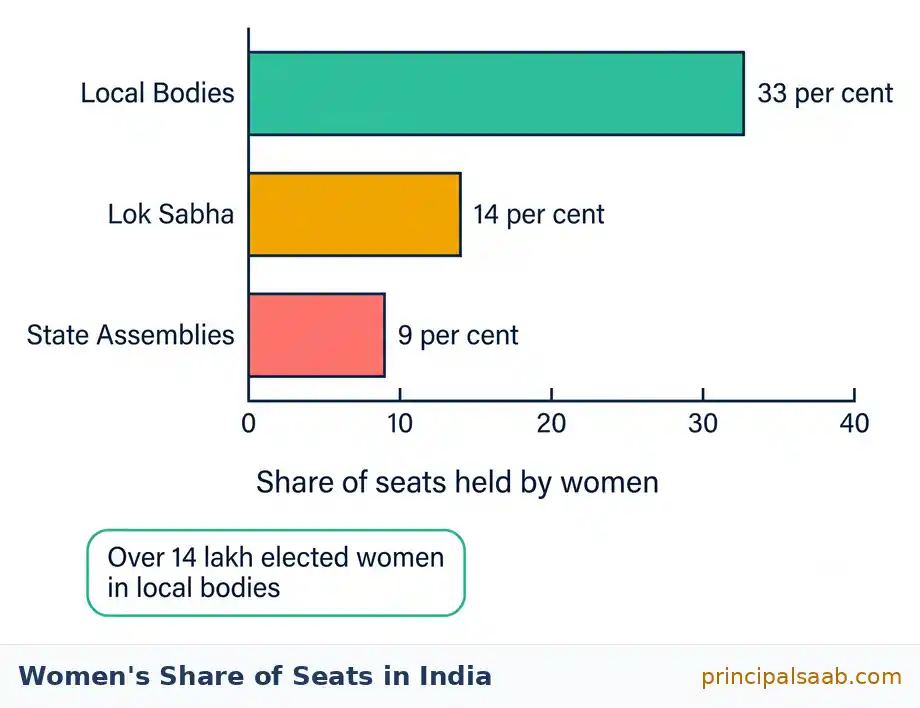
Take the Lok Sabha. Women’s share of its 543 seats has risen very slowly across the decades and has remained under one in six. After the general election of 2024 there were about 74 women members, which is close to 14 per cent of the House. That is the highest range India has reached, and it is still far below the share of women in the population. In the State Legislative Assemblies the picture is weaker still: the national average has hovered around 9 per cent, and in many states the figure is below 10 per cent. Measured against other democracies, India’s share of women legislators sits in the lower half of the world table.
So what has actually worked? One reform, and it worked dramatically. Through the 73rd and 74th Constitutional Amendments of 1993, it became mandatory to reserve at least one-third of the seats in panchayats and in urban local bodies for women, along with one-third of the posts of chairperson. The result was not a small nudge. India now has well over fourteen lakh elected women representatives in rural and urban local government — one of the largest bodies of elected women anywhere in the world.
Why did reservation succeed where good intentions had not? Because political parties choose candidates, and a party weighing up who is “winnable” tends to fall back on habit. Reserving seats removes that decision from habit. Once the seat must go to a woman, parties find capable women candidates, voters get used to women in office, and the next generation of leaders emerges from that pool. This is the argument for extending the same device upwards to Parliament and the Assemblies — an argument your textbook has carried for many years.
Older editions of the textbook say that a bill to reserve one-third of seats for women in the Lok Sabha and the State Assemblies had been introduced but remained pending. That was accurate when those editions were written, and you may still write the textbook position. The update is this: Parliament passed the Constitution (106th Amendment) Act in 2023, also called the Nari Shakti Vandan Adhiniyam, which provides for reserving one-third of seats for women in the Lok Sabha, the State Legislative Assemblies and the Assembly of the National Capital Territory of Delhi, including within the seats already reserved for Scheduled Castes and Scheduled Tribes, for a period of fifteen years. Important qualification: the Act itself ties the actual reservation of seats to a census followed by a delimitation exercise, so the quota had not yet applied to any general election at the time of writing. The safest exam sentence is therefore: the one-third reservation for women in the Lok Sabha and State Assemblies has been enacted by a constitutional amendment, but its operation depends on a census and delimitation and it has not yet been applied in an election.
Do not write that one-third of Lok Sabha seats “are reserved” for women today, and do not write that women have no reservation anywhere. Both are wrong. The reservation that is in operation is the one-third in panchayats and municipalities under the 73rd and 74th Amendments. The reservation for the Lok Sabha and Assemblies has been enacted but is not yet in force in elections. Keep those two facts in separate sentences.
Model answer: (i) Although Indian women received the right to vote at the very outset through universal adult franchise and now vote in numbers comparable to men, their share of seats in the Lok Sabha has remained under one in six, standing at roughly 14 per cent after the 2024 election. (ii) In the State Legislative Assemblies representation is lower still, with the national average around 9 per cent and many states below 10 per cent. (iii) The main reason is that political parties, which control the selection of candidates, have nominated few women, so equality in voting has not automatically produced equality in office.
Why this scores: The examiner wants evidence, not opinion. Notice the structure — a fact about the Lok Sabha, a fact about the Assemblies, and then a cause. Attaching a year to a number (“after the 2024 election”) shows you know figures change, which is exactly what a careful answer looks like.
Model answer: The 73rd and 74th Constitutional Amendments, passed in 1993, made it compulsory for every state to reserve at least one-third of the seats in panchayats at all three levels and in urban local bodies for women, and to reserve one-third of the posts of chairperson for them as well. The provision applies within the seats already reserved for Scheduled Castes and Scheduled Tribes, so that women from these communities are included and not left out.
The impact has been substantial. First, India today has over fourteen lakh elected women representatives in rural and urban local government, among the largest such groups in the world. Second, the reform created a route into public life for women who would otherwise never have been nominated, since parties tend to repeat familiar choices when selecting candidates. Third, it has widened the agenda of local government, with elected women often pressing issues such as drinking water, sanitation, school attendance and health services. Fourth, it has normalised the sight of women in authority, which slowly changes what the next generation believes is possible.
The reform is not perfect. In some places relatives of elected women have tried to exercise power on their behalf, and social pressure can limit how freely a representative acts. Even so, evidence from successive elections shows women contesting again on their own strength and general seats too, which suggests the constraint is weakening. On balance the provision has been one of the most effective equality measures in Indian democracy.
Why this scores: Five marks needs a shape, not a stream. Here it is: what the law says, then four impacts, then an honest limitation, then a verdict. Examiners reward the limitation because it shows judgement — but only if you finish with a clear overall conclusion.
Patriarchy and Everyday Inequality
We have the word already: patriarchy is a system that values men more than women and hands men greater authority in the family and in society. Definitions alone do not convince anyone, though, so this section gives you the evidence in four areas. Learn one or two figures from each — that is plenty for any answer.
Education. The Census of 2011 recorded India’s literacy rate at about 74 per cent overall, made up of roughly 82 per cent for men and about 65 per cent for women — a gap of some 17 percentage points. That gap has been closing since, and later official surveys show both figures higher and the distance between them smaller, largely because girls’ enrolment has expanded so fast. But a gap inherited over generations does not vanish quickly, and it shows up most among older women. A second point worth making: girls’ performance in school is strong, yet a smaller proportion of girls has historically continued into higher study, because families weighing limited money have tended to invest in a son’s education first.
Work and wages. The law here is clear — the principle of equal pay for equal work is recognised in Indian law and equal remuneration legislation has been on the statute book for decades. Practice lags behind it. Women are more often found in low-paid, informal and insecure work, and across many kinds of employment women earn less on average than men. Add the unpaid hours at home that we discussed earlier and the picture becomes plain: many women effectively work a longer day for a smaller income.
The sex ratio. Sex ratio means the number of females per thousand males. In the Census of 2011 India’s overall sex ratio stood at 943 females per 1000 males. More troubling was the child sex ratio for the age group 0 to 6, which was about 914 — lower than the ratio for the population as a whole. That combination is what alarmed demographers, because it suggests a preference for sons expressing itself before or shortly after birth rather than a natural imbalance. India has responded in law: determining the sex of a foetus for this purpose is a criminal offence, and campaigns for the survival and education of girls have been run at national scale. Later rounds of official health surveys have shown some improvement, and you should say so.
Safety. Your textbook notes plainly that women face harassment, exploitation and violence, including within the home, and that this restricts their freedom of movement and their participation in public life. Laws exist on domestic violence and on sexual harassment at the workplace. The point for a Civics answer is the connection, not the catalogue: a person who does not feel safe travelling, working late or speaking up in public cannot participate equally in a democracy. Safety is a precondition of citizenship.
Use numbers, but tie each one to its source and year — “according to the Census of 2011” or “as recorded in the 2011 Census”. If you cannot recall a figure precisely, write it approximately and honestly: “the female literacy rate was roughly two-thirds” or “the child sex ratio was below the overall sex ratio”. An approximate statement with the right direction earns the mark. An invented precise figure does not.
Model answer: Inequality persists in education. The Census of 2011 put male literacy at about 82 per cent against roughly 65 per cent for women, a gap of some 17 percentage points, and although this gap has narrowed considerably since, fewer girls have historically continued into higher education because families with limited resources have tended to prioritise a son’s schooling.
It persists in employment. Even though Indian law recognises equal pay for equal work, women are concentrated in low-paid and informal jobs and on average earn less than men. Because they also carry the larger share of unpaid domestic and care work, many women effectively work longer hours for lower earnings.
It appears in the sex ratio. The 2011 Census recorded 943 females per 1000 males, and the child sex ratio for ages 0 to 6 was lower still at about 914, indicating a preference for sons. India has responded by prohibiting sex determination of a foetus for such purposes and by running campaigns for the survival and education of girls, and later surveys show some improvement.
Finally it appears in questions of safety, since harassment and violence, including within the home, restrict women’s freedom of movement and their willingness to take part in public life; laws on domestic violence and on workplace harassment address this.
Taken together these show that legal equality, though guaranteed, has not yet been converted into equality in daily life, and that this is why gender remains a political question and not merely a social one.
Why this scores: Four spheres, one paragraph each, then a conclusion that answers the actual question. Notice that every paragraph also mentions a remedy or a sign of improvement — that balance is what separates a top answer from a list of complaints.
Religion, Communalism and Politics
We now move to the second social division, and I want to set the tone carefully, because this is the part students worry about most. Nothing here is an attack on any religion or on any community. Your syllabus treats religion as a fact about Indian society and studies a specific political problem that can arise around it. We are studying a concept, the way you would study inflation in Economics. Keep your language neutral and descriptive and you will be perfectly safe.
Start with something that may surprise you: your textbook does not say religion must be kept out of politics. It says the opposite is often valuable. People’s ideas of right and wrong are frequently shaped by their faith, and leaders in Indian history have drawn openly on religious ideals while arguing for justice, for the abolition of untouchability, for non-violence and for the dignity of the poor. Believers have every right to bring their moral convictions into public debate, and a democracy where they could not do so would be a poorer one. Religious groups also have a legitimate right to raise their concerns as citizens, and to be protected against discrimination.
So where is the line? It is crossed at a specific idea, and this idea has a name. Communalism is the belief that the followers of one religion form a single community whose fundamental interests are the same as each other’s and are opposed to the interests of the followers of other religions. Break that sentence into its two moving parts, because both are needed and both are questionable. First, it assumes every person of a faith shares one set of interests — which cannot be true, since a wealthy person and a poor person of the same faith plainly do not share economic interests. Second, it assumes those interests must clash with everyone else’s — which flattens a whole society into permanent opposing camps.
Once you accept those two assumptions, a further step follows easily and dangerously: that one community’s beliefs should be superior, that the state should belong to it, and that other communities live there on sufferance. That is the point at which the ordinary presence of religion in public life turns into something a democracy cannot absorb — because democracy rests on the equal standing of every citizen, and communalism denies exactly that.
Religion in politics is not automatically communalism. Communalism is a precise thing: treating one religion’s followers as a single bloc with identical interests that are fundamentally opposed to other religions’ followers, and then claiming superiority or exclusive ownership of the state on that basis. In an exam, define it in those terms and you cannot go wrong.
Forms Communalism Takes in Politics
Communalism is not one single act. It appears in stages, from the very ordinary to the very serious, and your syllabus asks you to recognise four of them. Think of it as a ladder: the lower rungs look harmless to most people, which is exactly why the higher ones become possible.
First, in everyday beliefs. This is the most common form and the least noticed — casual prejudice, stereotypes about the followers of a faith, jokes that assume the worst about a whole group, and the quiet assumption that one’s own religion is superior to others. Nothing is organised here, and no law is broken. But this is the soil in which everything else grows.
Second, as a political programme. Communalism becomes political when someone tries to unite the followers of one religion into a single voting bloc, treating them as one interest group with one will. Where the group is a majority this can take the shape of a demand for dominance over the whole country; where it is a minority it can take the shape of a demand for a separate political arrangement. Both rest on the same mistaken premise — that everybody of a faith wants the same thing.
Third, as political mobilisation. Here religion is used as an instrument of campaigning: sacred symbols deployed for electoral effect, emotional appeals made on the basis of faith, and appeals to fear of another community used to consolidate votes. Note the distinction carefully. A leader may speak from religious conviction about honesty or compassion, and that is not communal mobilisation. Using fear of a community to gather votes is.
Fourth, and worst, as violence. In its ugliest form communalism produces riots and killings. This is where an idea stops being an argument and starts destroying lives, and it is the reason democracies treat the earlier rungs seriously instead of dismissing them as talk.
Write about communalism as a concept, in general terms. Do not name a party, a community or a particular incident, and do not use angry language. Board answers on this topic are marked for accuracy and balance, and a neutral, analytical tone is both safer and better history.
Model answer: (i) In everyday attitudes, through religious prejudices, stereotypes about the followers of other faiths and a belief in the superiority of one’s own religion. (ii) In the search for political dominance, where the followers of a religion are treated as one political community, leading a majority group to seek dominance over the state or a minority group to demand a separate political arrangement. (iii) In political mobilisation on religious lines, through the use of sacred symbols, appeals by religious leaders and appeals to the emotions or fears of one community in order to gather its votes. In its most extreme form communalism results in communal violence and riots.
Why this scores: Three forms were asked for, so three are numbered. The fourth is added as a closing line without a number, which shows completeness without disobeying the question. Note that no community and no incident is named anywhere — that is deliberate and correct.
Secularism in the Indian Constitution
Now the answer our Constitution gives. The framers had watched communal division at close quarters, and they built the response directly into the fundamental law rather than leaving it to the goodwill of whoever happened to be in power. That response is secularism, and the Indian version of it has four pillars. Learn these four and you have a full-mark answer to one of the most frequently asked questions in the paper.
One: there is no official religion. The Indian state does not adopt any religion as its own. This is a genuine choice, not an obvious one — several countries do have an official or established religion, and India’s neighbours and older democracies alike offer examples. India deliberately did not.
Two: freedom of religion is a Fundamental Right. Every person is free to profess, practise and propagate a religion, and equally free to follow none at all. That last part matters. Indian secularism protects the believer and the non-believer with the same hand.
Three: discrimination on the ground of religion is prohibited. The state may not treat a citizen differently because of religion, whether in the enjoyment of rights or in public employment.
Four — and this is the one students forget — the state may intervene in religious matters to ensure equality. Indian secularism is not a wall of total non-interference. Where a religious practice produces inequality or cruelty, the state is permitted to step in. The clearest example is the abolition of untouchability, which the Constitution outlaws outright. So Indian secularism means equal respect and equal distance from all religions, combined with a power to act against inequality practised in the name of religion.
| Pillar of Indian secularism | What the Constitution provides | Why it matters |
|---|---|---|
| No state religion | India does not adopt any religion as the official religion of the state | No citizen is an outsider in their own country on account of faith |
| Freedom of religion | A Fundamental Right to profess, practise and propagate any religion, or to follow none (Articles 25 to 28) | Belief becomes a matter of individual conscience, protected from state pressure |
| No discrimination on grounds of religion | Articles 15 and 16 forbid discrimination in rights and in public employment on the ground of religion | Equal citizenship is enforceable in a court, not merely promised |
| Power to intervene for equality | The state may act in religious matters to secure equality, as with the abolition of untouchability | Prevents inequality from sheltering behind religious custom |
Writing that “secularism means the state has nothing to do with religion” loses marks in the Indian context. Indian secularism is not indifference. It is equal respect for all religions, no official religion, no discrimination — and a power to intervene where religious practice creates inequality. Leave out that fourth element and your answer is incomplete.
Model answer: (i) The Constitution does not give the status of an official religion to any faith, so the Indian state has no religion of its own. (ii) It guarantees to all persons the freedom to profess, practise and propagate any religion, or to follow no religion at all, as a Fundamental Right. (iii) It prohibits discrimination against any citizen on the ground of religion, both in the enjoyment of rights and in matters of public employment. In addition, the Constitution permits the state to intervene in religious affairs in order to establish equality, as in its abolition of untouchability.
Why this scores: Three provisions were asked for, so three are numbered and each is a separate legal fact. The fourth is offered as a bonus line. Examiners look for the words “no official religion”, “freedom to profess, practise and propagate” and “prohibits discrimination” — those are the marking keys.
Model answer: Communalism is the belief that the followers of a particular religion form one community whose fundamental interests are identical to one another and opposed to the interests of the followers of other religions. It rests on two assumptions that do not survive examination: that everyone of a faith shares the same interests, which is untrue since people of the same religion differ in class, region, language and opinion; and that these interests must conflict with those of other communities, which turns a diverse society into permanent opposing camps. From these assumptions can follow the further claim that one community’s beliefs should be superior and that the state belongs to it alone.
Communalism expresses itself in everyday prejudice and stereotypes, in attempts to unite the followers of a religion into a single political bloc, in political mobilisation using sacred symbols and appeals to fear, and at its worst in communal violence.
The Constitution responds by making India a secular state. It adopts no official religion. It guarantees the freedom to profess, practise and propagate any religion or none as a Fundamental Right. It prohibits discrimination on the ground of religion in rights and in public employment. And it empowers the state to intervene in religious matters to secure equality, as it did in abolishing untouchability.
Taken together these provisions ensure that citizenship in India does not depend on faith, which is precisely the claim communalism makes and the Constitution denies.
Why this scores: This is a two-part question, so it needs two clearly separated parts and a sentence that joins them. The closing line does the joining, and that is where the fifth mark usually lives.
Caste and Politics
The third division. Again, we are describing a social system and the constitutional response to it, calmly and without insulting anyone.
Historically, the caste system was a hereditary division of society in which occupation passed from parent to child and was given religious sanction. Members of a caste group typically followed the same or similar occupations, married within the group, and did not eat with members of other groups. The system was arranged as a hierarchy, and some groups were placed outside it altogether and subjected to exclusion and untouchability — the harshest injustice in the whole arrangement.
Now the part that gives balance to your answer: this has changed a great deal, and for identifiable reasons. Reformers and leaders across the country worked to end caste inequality. Economic development, urbanisation and the growth of literacy and education loosened the old links. Occupational mobility — people taking up work quite different from their parents’ — became normal, particularly in cities, where a large population living close together makes it impractical to observe rules about who may sit or eat with whom. The old dominance of landlords in village life weakened. And the Constitution outlawed caste-based discrimination and untouchability, and provided for measures to correct historical injustice.
And yet caste has not disappeared, and your answer should say so honestly. Most marriages in India still take place within the caste group. Untouchability, though prohibited by law, has not been fully eliminated in practice. Groups that had early access to education and land have often stayed ahead, and those denied education for generations have often stayed behind, so caste and economic position still overlap for many families. That overlap is exactly the “difference plus inequality” pattern from our very first section.
Model answer: (i) The efforts of social reformers and political leaders, who campaigned against caste inequality and untouchability and helped change public opinion. (ii) Economic development, urbanisation and the spread of education, which created occupational mobility so that people no longer follow their parents’ occupations, and which made it impractical in crowded cities to observe traditional rules of separation. (iii) Constitutional and legal measures, since the Constitution prohibits caste-based discrimination, abolishes untouchability and provides for measures to redress past injustice.
Why this scores: Social effort, economic change, legal change — three different types of cause. Grouping your points by type is the fastest way to guarantee they do not overlap.
Politics in Caste and Caste in Politics
This is the classic exam question of the chapter, and it trips students because the two phrases use the same two words. Slow down here with me. The trick is to ask one question: which one is doing the changing, and which one is being changed?
Caste in politics means caste entering the political arena and influencing it. The arrow points from caste towards politics. In practice this shows up in three ways. Parties usually consider the caste composition of a constituency when choosing a candidate, and try to distribute tickets so that different groups feel represented. Parties and candidates appeal to caste sentiment when campaigning for support. And universal adult franchise, by giving every adult one equal vote, forced political leaders to reach out to groups that had earlier been treated as inferior — which in turn awakened a new political consciousness among those groups.
Politics in caste means the opposite direction: politics entering caste and changing caste itself. The arrow points from politics towards caste. Here too there are three standard illustrations. Caste groups try to become larger by drawing in neighbouring castes and sub-castes that were once kept out, because size means votes. Caste groups enter into coalitions with other castes and communities, which requires dialogue, bargaining and compromise with people they might once have kept at a distance. And entirely new and much broader categories have emerged in political life, such as groupings described as backward and forward, which did not exist in the older order.
Read those two paragraphs again and notice the direction of travel. In the first, caste shapes who gets a ticket and who wins. In the second, the pursuit of votes reshapes what a caste group even is — its boundaries, its alliances, its name.
| Basis | Caste in Politics | Politics in Caste |
|---|---|---|
| Direction of influence | Caste influences politics | Politics influences and changes caste |
| What changes | Candidate selection, campaigning and voting behaviour | The boundaries, alliances and identity of caste groups themselves |
| Illustration 1 | Parties consider the caste composition of a constituency while giving tickets | Caste groups expand by including neighbouring castes and sub-castes to gain numbers |
| Illustration 2 | Parties and candidates appeal to caste sentiment to gather support | Caste groups form coalitions with other castes and communities, requiring dialogue and bargaining |
| Illustration 3 | Universal adult franchise compels leaders to mobilise groups earlier treated as inferior | New and wider categories such as backward and forward groupings emerge in political life |
| Overall effect | Politics becomes more representative, but risks division if caste is the only appeal | Caste becomes more flexible and negotiable, and rigid hierarchy weakens |
One more balancing point, and examiners love it. Caste does not, by itself, decide Indian elections. No parliamentary constituency has a single caste forming a clear majority of voters. No party ever wins the votes of all the members of one caste, because people of the same caste differ in income, region and opinion. And candidates from ruling parties, including sitting members, are regularly defeated — which simply could not happen if every voter voted purely by caste. Caste is one factor among several, alongside government performance, party programmes, leadership and local issues.
Two errors cost marks here every year. The first is swapping the two phrases — remember, “caste in politics” puts caste inside the political arena, so caste is the thing entering. The second is writing that elections in India are decided by caste. They are not; caste is one influence among many, and your answer should say so.
Model answer: Caste in politics refers to the influence that caste exercises upon political life. Political parties take account of the caste composition of a constituency when selecting candidates and distributing tickets; parties and candidates appeal to caste sentiment while campaigning; and universal adult franchise, by giving every adult an equal vote, has obliged leaders to mobilise groups that were earlier treated as inferior, awakening a new political consciousness among them.
Politics in caste refers to the reverse influence, in which political competition changes caste itself. Caste groups enlarge themselves by drawing in neighbouring castes and sub-castes that were formerly excluded, since larger numbers mean greater bargaining power. They enter into coalitions with other castes and communities, which compels dialogue and compromise. And broader new categories, such as groupings described as backward and forward, have emerged which did not exist in the traditional order.
Caste alone does not determine election outcomes. No parliamentary constituency contains a single caste with a clear majority of voters; no party secures the votes of every member of a caste, since people of the same caste differ in wealth, region and opinion; and candidates of ruling parties are frequently defeated, which would be impossible if voting followed caste strictly. Caste therefore operates alongside government performance, party programmes, leadership and local issues.
Why this scores: Three blocks for five marks — direction one, direction two, and the qualification. The qualification is not optional decoration; when the question asks whether caste alone determines results, the marks for that part are released only by the three specific reasons given above.
Exam Strategy for This Chapter
Let me hand you the practical part now — the things I would tell you the evening before the paper.
Know which questions repeat. Four come back again and again: define communalism and describe its forms; list the constitutional provisions that make India secular; distinguish caste in politics from politics in caste; and describe women’s political representation along with the reservation in local bodies. If you can write those four cleanly, you have covered the bulk of what this chapter is ever asked.
Match length to marks. One mark is one sentence. Three marks is three numbered points, each a separate idea, about a line and a half each. Five marks is three or four short paragraphs with a concluding sentence that answers the question actually asked. Writing a five-mark essay for a one-mark definition is the commonest way students run out of time in this paper.
Number your points. Examiners mark quickly. Numbered points announce where each mark sits. An unnumbered paragraph containing exactly the same content will often score less, simply because a point gets missed in the reading.
Handle case-based questions in order. Read the passage twice. Underline the sentence the question is pointing at. Answer from the passage first, then add one line of chapter knowledge. Do not empty your memory onto the page — case-based marking rewards relevance, not volume.
Keep your tone neutral. On gender, religion and caste, describe and analyse. Do not praise or condemn any community, party or faith. Neutral academic language is not only safer, it is the language the marking scheme itself is written in.
Learn the definitions word-perfect. In this chapter, definitions are not warm-up marks — they are the load-bearing walls. Communalism, secularism, patriarchy, gender division, sexual division of labour, occupational mobility. If the definition is right, the rest of the answer usually writes itself.
Keep a single revision page for this chapter: the nine definitions on one side, the three comparison tables on the other. If you can reproduce that page from memory in ten minutes, you are ready. Everything else here is explanation that helps you understand that page.
The whole chapter answers one question three times: how should a democracy handle a social difference? The answer each time has the same shape — allow the difference to be expressed politically, refuse to let any one identity claim ownership of the state, and use the Constitution to guarantee equality where society has not delivered it.
Q(a): Which constitutional provision made the reservation described here possible? (1 mark)
Answer: The 73rd Constitutional Amendment of 1993, which requires that at least one-third of the seats in panchayats be reserved for women.
Q(b): What does her re-election from an unreserved seat suggest about the effect of reservation? (1 mark)
Answer: It suggests that reservation acted as an entry point rather than a permanent support, since once she had demonstrated her ability she was able to win an open contest on her own record.
Q(c): Using the passage, explain why such reservation was needed at all. (2 marks)
Answer: The passage notes that she had never attended a public meeting before, which shows how far women had been kept out of public life and how unlikely it was that she would ordinarily have been chosen as a candidate. Reservation removed that barrier by requiring the seat to be filled by a woman, and the issues she then raised — water supply and school attendance — show that her presence also widened the agenda of the panchayat itself.
Why this scores: Notice that every answer points back to a specific line of the passage. In case-based questions the examiner is checking whether you used the source. A factually correct answer that never touches the passage will still lose marks.
Practice Worksheet
Nine questions, all original, in the mark pattern the board actually uses. Write your answer on paper first, then click to open the model answer and compare line by line. Do not read the answers first — the comparison is where the learning happens.
Q1. What is meant by patriarchy? (1 mark)
Q2. Define occupational mobility and state why it weakens the caste system. (1 mark)
Q3. Explain three ways in which the sexual division of labour restricts women’s participation in public life. (3 marks)
(ii) Because the work is unpaid, it produces no income of one’s own and no recorded work experience, so it brings neither economic independence nor the standing that a paid career confers.
(iii) Because the work is not counted in national income statistics and is treated as a natural duty rather than a skill, it remains socially invisible, and those who do it are not regarded as contributors to the economy whose opinions must be heard in public decisions.
Q4. “The presence of religion in politics is not the same thing as communalism.” Explain this statement with three points. (3 marks)
(ii) Religious communities also have legitimate interests as citizens, such as protection from discrimination, and raising these demands in politics is a normal democratic activity.
(iii) Communalism is something narrower and different: it is the belief that the followers of one religion form a single community whose fundamental interests are identical and are opposed to those of other religions, leading to claims of superiority or of exclusive ownership of the state. It is this claim, and not the presence of religion in public life, that democracy cannot accept.
Q5. Describe three ways in which caste influences politics in India. (3 marks)
(ii) During campaigns, parties and candidates often appeal to caste sentiment in order to gather support from particular groups.
(iii) Universal adult franchise, by giving every adult an equal vote, has obliged political leaders to mobilise groups that were earlier treated as inferior, which has produced a new political consciousness and confidence among those groups.
Q6. What is a secular state? Describe four features of the Indian Constitution that make India secular. (5 marks)
The Indian Constitution secures this in four ways. First, it gives no religion the status of an official state religion, so India, unlike some other countries, has no established faith. Second, it guarantees to every person the freedom to profess, practise and propagate a religion, and equally the freedom to follow no religion at all, as a Fundamental Right under Articles 25 to 28. Third, it prohibits discrimination against any citizen on the ground of religion, both in the enjoyment of rights under Article 15 and in matters of public employment under Article 16. Fourth, it permits the state to intervene in religious affairs in order to establish equality, the clearest instance being the constitutional abolition of untouchability.
Indian secularism therefore means equal respect and equal distance from all faiths, combined with the power to act against inequality practised in the name of religion. It is not indifference to religion, and this is what distinguishes the Indian version from a purely separationist model.
Q7. “Reservation of seats for women in local bodies has been one of the most effective equality measures in Indian democracy.” Evaluate this statement. (5 marks)
The statement is largely supported by evidence. First, the scale of the change is very large: India now has well over fourteen lakh elected women representatives in rural and urban local government. Second, it addressed the real bottleneck, which was candidate selection — parties tend to repeat familiar choices, and reservation removed that decision from habit. Third, it broadened the working agenda of local bodies, since elected women have frequently pressed issues such as drinking water, sanitation, school attendance and health. Fourth, it has normalised the presence of women in positions of authority, which changes what the next generation of girls believes is available to them.
The measure has limits. In some places relatives have attempted to exercise authority on behalf of an elected woman, and social pressure can restrict how independently a representative acts. The reservation also applies only to local bodies; at the level of the Lok Sabha and the State Assemblies, women’s representation has stayed far lower.
On balance the statement is justified. No other single measure has brought so many women into elected office so quickly, and the evidence of women subsequently contesting and winning unreserved seats suggests the effect is real and not merely formal.
Q8. Explain the public and private division, and analyse why it has political consequences for women. (5 marks)
The political consequences follow in a chain. Work done in the private sphere is unpaid, so it creates no wage record and has historically been excluded from measures of national income; being uncounted, it is treated as no qualification and carries no status; and because it occupies the whole day, it leaves no time for education, employment, organisation or election campaigns. The result is that women have remained largely outside the spaces in which public decisions are taken, so laws, budgets and policies have been framed by people who have never performed that work.
This division is not fixed by nature, and that is the encouraging part. As girls’ education expanded, as women entered paid professions, and as care work such as childcare became a recognised paid service, the boundary shifted. The reservation of one-third of seats for women in panchayats and municipalities is a deliberate attempt to shift it further by placing women directly in the public sphere of decision-making.
Therefore the public and private division is not merely a domestic arrangement. It is a mechanism that converts unpaid work into political exclusion, which is why a Civics course examines it.
Q9. Case-based. Read the passage and answer the questions that follow. (4 marks)
(a) What does the first sentence of the passage tell us about the relationship between social differences in that town? (1 mark)
Answer: It tells us that the social differences cut across one another rather than overlapping, because both wealth and poverty are found within every religious and caste group. Cross-cutting differences of this kind make a society less likely to split into permanently opposed camps.
(b) Identify the form of communalism the losing candidate attempted, and define communalism. (2 marks)
Answer: The candidate attempted political mobilisation on communal lines, using an appeal to fear of another community in order to consolidate votes. Communalism is the belief that the followers of a particular religion form one community whose fundamental interests are the same as one another’s and are opposed to the interests of the followers of other religions.
(c) What does the election result suggest about whether social division alone decides elections? (1 mark)
Answer: It suggests that it does not. Voters in this case responded to issues of governance such as drainage, street lighting and schooling rather than to an appeal based on community, which shows that social identity is only one factor among several that shape electoral outcomes.
You have reached the end, and I hope the chapter feels smaller now than it did at the start. It really is one idea seen three times: a difference becomes a division when inequality attaches to it, democracy must let that division speak, and the Constitution must stop any one identity from claiming the whole country. Gender, religion, caste. Same shape, three subjects.
Do not try to master all of this today. Kaizen means small, steady, unglamorous improvement — so tomorrow, just aim for one more correct question than yesterday. Nine questions today, ten tomorrow, one clean definition added each morning. That is how this chapter turns from the one you were nervous about into the one you quietly hope they ask.