

Take a breath. Sit down properly, put the phone face down, and let us do this chapter together, slowly, from zero. Federalism sounds like one of those heavy political-science words that only adults in television studios use. It is not. By the time you finish this page you will be able to explain it to a younger cousin using nothing but the example of your own family. And here is the cheerful part: in the Class 10 Social Science paper, Federalism is one of the most reliable scoring chapters in the entire book.
Why so reliable? Because the chapter is built out of a small number of very clear ideas: a division of powers, more than one level of government, a written Constitution that both levels must obey, courts that settle quarrels, and the story of how India has actually made all of this work since 1947. Once those ideas are straight in your head, almost every question the board can ask is simply a rearrangement of the same material. There is very little to cram here and a great deal to understand. Chapters like this are where calm students quietly collect full marks while everyone else is still panicking about the map work.
So here is my promise to you. I am not going to throw definitions at you and walk away. For every idea we will do three things in order: first an everyday example you already understand, then the exam vocabulary attached to that example, then practice at writing the answer the way an examiner actually wants to read it. Go at your own pace. Do not move on from a section until it genuinely feels comfortable, and if something slips, scroll back. Nobody is timing you today.
- What Is Federalism? The Big Idea
- Key Features of a Federal System
- Unitary Versus Federal Governments
- Two Routes to Federalism: Coming Together and Holding Together
- What Makes India a Federal Country
- The Three Lists: Union, State and Concurrent
- How Indian Federalism Has Worked in Practice
- Decentralisation in India: Power to the Village and the Town
- Exam Strategy for This Chapter
- Practice Worksheet
Your Game Plan
- Read the first four sections in one sitting. They are the conceptual base and they are short.
- Learn the three lists properly, with two or three example subjects for each. This single table appears in the paper year after year.
- Understand the practice sections as stories, not as bullet points. Linguistic states, language policy and centre-state relations are easiest to remember as a narrative.
- Give decentralisation extra time. Students under-prepare it and then lose a full five-mark question.
- Attempt the worksheet at the bottom with the answers hidden. Only then open them.
- Revisit the tables and the coloured callout boxes the night before the exam. That is your revision layer.
What Is Federalism? The Big Idea
Let us begin with a family, because you already live inside one. Imagine a joint family in a big old house. There are three married brothers, their families, and the grandparents. Some decisions are taken by the whole family sitting together in the front room: whether to repair the roof, how much to spend on a wedding, whether to sell the ancestral land. Nobody would dream of taking those decisions alone. But other decisions belong to each individual household on its own floor: what to cook for dinner, what time the children sleep, which tuition class to join. Nobody else interferes there.
Notice what has quietly happened in that house. There are two levels of authority. Each level has its own area of decisions. Neither level is a servant of the other. The whole family cannot suddenly decide what one household eats for dinner, and one household cannot sell the ancestral land by itself. That arrangement, scaled up to the size of a country, is federalism.
Now put it in the language of the textbook. Federalism is a system of government in which power is divided between a central authority and various constituent units of the country. In India we call the central authority the Union Government or Central Government, and the constituent units are the State Governments. Usually there are two levels of government: a government for the entire country responsible for subjects of common national interest, and governments at the level of provinces or states that look after the day-to-day administration of their own area. Both levels enjoy their power independently of the other, and both are answerable directly to the people who elected them.
That last line is the one students skip, so let me slow down on it. In a federation, the state government is not a branch office of the central government. The Chief Minister does not work for the Prime Minister the way a clerk works for a manager. Each has been elected separately by the people and each draws its authority from the same source, the Constitution. This is exactly why the family analogy works: your uncle on the second floor is not your father’s employee. He is an adult with his own jurisdiction inside the same house.
Federalism is not merely having a central government and some state governments. It is having two levels of government that are each supreme in their own sphere, whose powers are written down in a Constitution, and neither of which can casually abolish or overrule the other.
Why does a country choose such a complicated arrangement at all? Two honest reasons. First, size and diversity. A country as large and as varied as India cannot possibly be run sensibly by one office in New Delhi deciding the school timings in a village in Nagaland and the fishing rules on the Kerala coast. Local problems need local decision-makers who actually know the place. Second, unity with accommodation. Different regions with their own languages, food, festivals and histories will only stay willingly inside one country if they are confident that their distinctness is protected. Federalism is the constitutional promise that says: you may keep who you are, and still be fully Indian.
Hold on to that phrase, because it is the heart of the chapter. Federalism tries to achieve two objectives at the same time: safeguarding and promoting the unity of the country, and simultaneously accommodating regional diversity. Almost every long answer in this chapter can be rounded off with that sentence, and it will earn you a mark.
Model answer. Federalism is a system of government in which power is divided between a central authority and the various constituent units of the country, with each level of government having its own sphere of authority.
Why this scores. A one-mark definition needs exactly one clean sentence containing the two load-bearing ideas: division of power, and constituent units or states. Do not write a paragraph. Examiners are reading hundreds of scripts and they are looking for the key phrase, so give it to them in the very first line.
Model answer. (i) A large country contains many regions with different languages, cultures and problems, and a single central government sitting far away cannot understand or solve all of them, whereas state governments that are closer to the people can respond much better. (ii) Federalism protects regional diversity, because each region gets a government of its own to look after matters of local importance, which reduces the fear that a distinct culture will be swallowed up. (iii) By accommodating diversity in this way federalism actually strengthens national unity, since regions that feel respected have far less reason to demand separation.
Why this scores. Three marks means three separate, clearly numbered points, each of one or two sentences. Notice the shape of every point: a claim followed by a because. That because is where the mark hides. A list of bare phrases such as size, diversity, unity would probably fetch only one mark out of three.
Key Features of a Federal System
Now we take the family idea and turn it into a checklist. These features come up constantly, so learn them as a set of six and always attach a one-line explanation to each. Bare headings do not earn full marks.
- Two or more levels of government. In India there are actually three: the Union Government, the State Governments, and the local self-government bodies below them.
- Different tiers govern the same citizens, but each tier has its own jurisdiction. You are simultaneously governed by the Union, by your state, and by your panchayat or municipality, but each of them decides different things about your life.
- The jurisdiction of each level is specified in the Constitution. The division of powers is not a favour or an informal understanding. It is written down, and it is legally guaranteed.
- The Constitution cannot be changed by one level alone. The fundamental provisions dealing with the division of power cannot be altered by one level of government acting on its own. Such changes need the consent of both levels.
- Courts settle disputes between levels. The judiciary, with the Supreme Court at its head, interprets the Constitution and decides quarrels about who has the power to do what. Its decision binds both the Union and the states.
- Sources of revenue are clearly specified. Each level of government has its own defined sources of taxation and income, so that each can actually run its own administration instead of begging the other for money.
Let me convince you that the last two features are not decoration. Suppose the Constitution divided powers beautifully but gave the states no money of their own. Every road, every school, every hospital would then depend on a cheque arriving from Delhi. On paper the state would be independent; in practice it would be a permanent applicant. Financial independence is what turns a written promise into a real one. Similarly, if there were no neutral umpire, every disagreement about who may make a particular law would become a raw political fight and the stronger side would simply win. An independent judiciary is what keeps the division of powers honest.
When a question asks for the features of federalism, write the feature as a short bold phrase and then one explanatory sentence. Six features written as bare words might get you two marks. Four features written properly, each with a sentence, will usually get you the full five.
Model answer. (i) There are two or more levels of government, such as a union government for the whole country and state governments for the different regions, and both of them govern the same citizens. (ii) The jurisdiction of each level is clearly specified in the Constitution, so the powers of the union and of the states are constitutionally guaranteed and do not depend on the goodwill of the other level. (iii) Disputes between the different levels about their powers are settled by the courts, and the Supreme Court acts as an umpire whose decision is binding on both levels.
Why this scores. Each point names the feature and then explains it, and the three chosen features are the three easiest to elaborate. When a question says explain, the explanation itself carries half the mark. Notice also that the answer never repeats the same idea twice in different words, which is the commonest way students waste an entire point.
Unitary Versus Federal Governments
To see clearly what federalism is, it helps to look at what it is not. The opposite arrangement is called a unitary system. In a unitary system there is either only one level of government, or if lower levels exist they are entirely subordinate to the central government. The centre can give them orders, and can also take away their powers or even abolish them altogether. Whatever authority the local bodies enjoy is a loan from the centre, not a possession of their own.
Try a school analogy now. In a unitary school, the principal decides everything and the class teacher merely passes on instructions. The class teacher cannot decide the seating plan without permission and can be overruled on anything at any moment. In a federal school, the principal decides school-wide matters such as the annual calendar and the fee structure, the class teacher independently decides matters inside her own classroom such as seating and group projects, and the class monitor has her own small set of duties like maintaining the attendance register and reporting broken furniture. Each has a defined zone. The principal cannot suddenly rewrite the seating chart on a whim, because the school rulebook that everybody accepted has assigned that job to the class teacher.
Keep that image, because it is going to do a lot of work for you later. When we reach the three tiers of Indian government, the principal will stand for the Union, the class teacher for the state, and the monitor for the local body.
| Point of Comparison | Unitary Government | Federal Government |
|---|---|---|
| Levels of government | Only one level, or lower levels that are completely subordinate to it. | Two or more levels, each with real authority of its own. |
| Source of the lower level’s power | Delegated by the central government and revocable by it. | Granted directly by the Constitution and legally protected. |
| Can the centre override the lower level? | Yes, the central government can issue orders and reverse decisions. | No, not within the sphere the Constitution reserves for the state. |
| Changing the arrangement | The central legislature can normally change it by itself. | Key provisions on division of power need the consent of both levels. |
| Settling disputes | Rarely arises, since the centre has the final word anyway. | Courts act as umpire and interpret the Constitution. |
| Where it suits best | Small and relatively homogeneous countries. | Large countries with significant regional diversity. |
Students often write that in a unitary system there are no local bodies at all. That is not accurate. Unitary countries can and do have local councils. The real difference is not whether lower bodies exist, but whether they hold power in their own right or merely hold power lent to them by the centre. Write the difference in terms of the source of authority and you will never lose that mark.
Model answer. (i) Number of levels: in a unitary system there is only one level of government, or lower levels that are wholly subordinate to it, whereas in a federal system there are two or more levels each of which governs in its own right. (ii) Source of power: in a unitary system the sub-units exercise powers delegated by the central government, which may withdraw them at will, while in a federal system the powers of each level are laid down and protected by the Constitution. (iii) Control: in a unitary system the central government can order the provincial government and reverse its decisions, whereas in a federal system the central government cannot interfere in matters assigned to the states.
Why this scores. The answer is written as parallel comparisons, so that for each ground both systems are described in the same sentence. That is exactly what distinguish means. Writing three sentences about unitary government and then three about federal government is weaker and slower, and in a tabular question it can cost marks outright.
Two Routes to Federalism: Coming Together and Holding Together
Federations are not all born the same way, and the way a federation was born shapes how power is shared inside it. There are two routes, and the textbook calls them coming together federations and holding together federations. This is a small topic that carries a big return in the exam, because it is easy to state and easy to illustrate.
Think of two very different housing situations. In the first, several independent families who already own separate houses decide to build one shared compound with a common gate, a common water tank and a shared security guard. They negotiate carefully. Each family says: I will pool some things, but I keep the deed to my own house, and the compound committee can only decide what we jointly agreed it may decide. That is coming together. Nobody gave up ownership; they added a shared layer on top.
In the second situation, one enormous old house already exists with a single owner. The owner realises that the household has grown so large and varied that running it from one room is impossible and unfair. So the owner divides the house into floors and gives each floor genuine, written authority over its own affairs. That is holding together. The whole existed first; power was then handed downwards to keep it whole.
Now the real-world versions. In a coming together federation, independent states come together on their own to form a bigger unit, pooling sovereignty and retaining identity so that they increase their security while keeping their separate existence. The United States of America, Switzerland and Australia followed this route. In such federations all the constituent states usually have equal powers and are strong in relation to the central government.
In a holding together federation, a large country decides to divide its power between the constituent states and the national government. India, Spain and Belgium are the standard examples. Here the central government tends to be more powerful than the individual states, and, importantly, different states may be granted different powers depending on their circumstances. Some units may be given special provisions to accommodate their particular history or their social composition.
| Basis | Coming Together Federation | Holding Together Federation |
|---|---|---|
| How it is formed | Independent states voluntarily join to form a larger union. | A single large country divides its power among constituent states. |
| Which came first | The units existed first; the centre was created afterwards. | The country existed first; the units were given power afterwards. |
| Relative strength | States are strong compared with the central government. | The central government is more powerful than the individual states. |
| Equality of units | All constituent states usually enjoy equal powers. | Different states may be given different powers or special provisions. |
| Main motive | To increase security and strength while keeping separate identity. | To accommodate internal diversity and hold the country together. |
| Examples | United States of America, Switzerland, Australia. | India, Spain, Belgium. |
Ask yourself one question and the answer follows automatically: did the units exist before the country, or did the country exist before the units? Units first means coming together. Country first means holding together. India was one country that then created and reorganised its states, so India is a holding together federation.
Model answer. (i) Formation: in a coming together federation independent states join of their own accord to form a larger country, as in the United States of America, whereas in a holding together federation a large existing country divides its powers among its states, as in India. (ii) Balance of power: in a coming together federation the constituent states are strong and the central government is comparatively weaker, while in a holding together federation the central government is more powerful than the states. (iii) Equality of units: in a coming together federation all states normally enjoy equal powers, but in a holding together federation different states may be given different powers, and some may receive special provisions suited to their circumstances.
Why this scores. Three distinct grounds, each covering both types, with an example named in the first point. Naming even one country per type is usually worth part of a mark, and it takes four extra words to do.
Model answer. Federalism has a double objective: it must safeguard and promote the unity of the country while simultaneously accommodating regional diversity. The two routes to federalism show two different ways of reaching that same objective.
(i) In a coming together federation, independent states pool their sovereignty to create a stronger and more secure union, and thereby gain unity, but each state retains its own identity and equal powers, and thereby keeps its diversity. The United States of America, Switzerland and Australia were formed in this way.
(ii) In a holding together federation, an already united country decides to share power with its regions precisely because those regions are diverse in language, culture and history. India, Spain and Belgium are examples. Here the sharing of power is the method by which unity is preserved.
(iii) In both routes the division of power is written into the Constitution, so neither the centre nor the states can destroy the other, and unity is protected against secession while diversity is protected against domination.
(iv) An independent judiciary interprets the Constitution and settles disputes between the levels, which prevents disagreements from turning into conflicts that could break the country.
(v) Therefore federalism does not force a choice between unity and diversity; it is the arrangement that deliberately holds the two together, though the mixture differs depending on how the federation was formed.
Why this scores. A five-mark answer needs five distinct scoring units plus a framing opening and a closing line. Look at how the answer opens by restating the double objective, uses the two routes as evidence rather than merely describing them, and closes by answering the actual question asked. Examine means take a position and support it, not simply narrate.
What Makes India a Federal Country
Here is a small surprise that examiners love. The word federation does not appear in the description of India in the Constitution. India is described as a Union of States. And yet the Constitution provides for exactly the arrangement we have been discussing. So the honest answer to the question is not that India calls itself federal, but that India satisfies the conditions of a federation.
What are those conditions in the Indian case? The Constitution originally provided for a two-tier system of government, the Union Government at the centre and the State Governments. A third tier, that of local self-government, was added later and we will come to it in detail. Each tier has its own jurisdiction, written into the Constitution. There is a clear division of legislative powers through three lists. There is an independent judiciary headed by the Supreme Court that settles disputes between the centre and the states. And the provisions dealing with the basic structure of this power sharing cannot be changed by Parliament alone; such an amendment must first be passed by both Houses with a special majority and then be ratified by the legislatures of at least half of the states.
Pause on that last sentence, because it is a favourite of paper-setters. It means the states are genuine partners in changing the rules of the game. The centre cannot quietly redraw the boundary of its own powers while the states watch.
At the same time, the Indian Constitution is honest about the fact that not every unit is identical. Some states were given special provisions in view of their peculiar social and historical circumstances, particularly several states in the north-east. There are also Union Territories, which are small areas that do not have the powers of a state; the central government has special powers in running them, though some Union Territories, such as Delhi and Puducherry, do have their own elected legislatures with limited powers. Today India has 28 states and 8 Union Territories. This unequal treatment of units is precisely what we said is typical of a holding together federation.
Now a point where you must be careful, because textbooks and question papers are not always in step with each other. Older editions of the NCERT chapter discuss Jammu and Kashmir as an example of a state with special status under Article 370, describing how it had its own constitution and how many laws of the Union did not apply there without the state’s agreement. That description explains the idea of asymmetric federalism very well, and if the textbook in front of you presents it, you should understand it as written and be able to reproduce it. But you should also know what has happened since, because it is one of the biggest changes to the Indian federal map in decades.
In August 2019 the President issued an order and Parliament passed the Jammu and Kashmir Reorganisation Act, with the effect that the special provisions under Article 370 ceased to operate. The former state was reorganised into two Union Territories with effect from 31 October 2019: Jammu and Kashmir, which has a legislative assembly, and Ladakh, which does not. In December 2023 the Supreme Court upheld the abrogation and observed that statehood should be restored at the earliest. So if you are asked about India today, the accurate statement is that Jammu and Kashmir is a Union Territory with a legislature and that Ladakh is a separate Union Territory, while the older special status described in some textbook editions is no longer in force. In an exam, answer the question that is asked from your prescribed textbook, and add the current position in a single closing line if the question is about India at present.
Why am I making you handle this carefully instead of just memorising one version? Because the underlying concept, asymmetric federalism, is what the examiner is testing, and that concept remains completely intact. Several north-eastern states continue to have special provisions. Union Territories continue to be treated differently from states. The lesson that a holding together federation may give different powers to different units is unchanged. Only one illustration of that lesson has changed.
Writing that the Indian Constitution calls India a federation. It does not. It describes India as a Union of States. If a question asks whether India is federal, the correct opening is that although the term federation is not used, the Constitution establishes a federal system by dividing powers between two levels of government. Starting with that line signals to the examiner that you actually know the chapter.
Model answer. Although the Constitution does not use the word federation and describes India as a Union of States, it clearly establishes a federal arrangement, for the following reasons.
(i) There is more than one level of government: the Union Government for the whole country, the State Governments for each state, and a third tier of local self-government added later.
(ii) The powers of each level are specified in the Constitution through the Union List, the State List and the Concurrent List, so no level depends on the mercy of another for its authority.
(iii) The fundamental provisions relating to the division of powers cannot be changed by Parliament acting alone; such an amendment requires a special majority in both Houses and ratification by the legislatures of at least half the states.
(iv) An independent judiciary headed by the Supreme Court interprets the Constitution and settles disputes between the Union and the states, and its decisions are binding on both.
(v) Sources of revenue are separately specified for the Union and the states, which gives each level the financial capacity to run its own administration.
Therefore in substance, if not in name, India is a federal country.
Why this scores. Notice the structure: one opening line that answers the question directly, five clearly numbered arguments, and one closing line. The word justify demands that every point be an argument in favour, not a neutral description. If you have time, adding that some units such as Union Territories and certain states have different powers strengthens the answer further, because it shows you understand India as a holding together federation.
The Three Lists: Union, State and Concurrent
This is the engine room of the chapter. If you learn nothing else properly today, learn this. The Constitution divides law-making powers between the Union Government and the State Governments by placing subjects into three lists. Get the logic of the sorting and you will never need to memorise long catalogues.
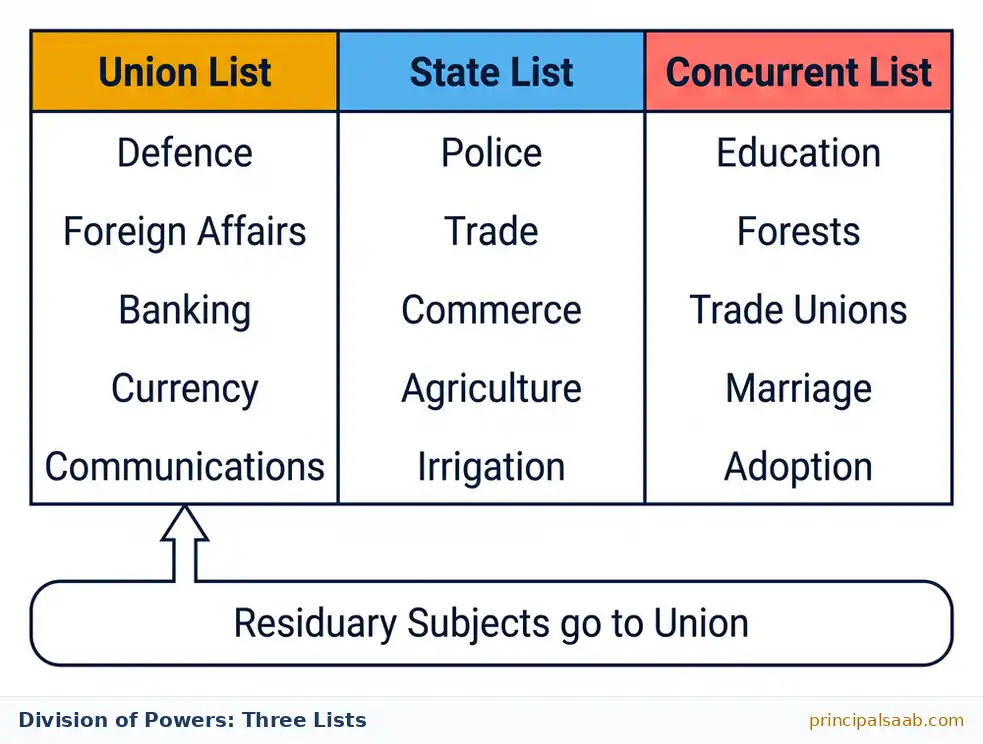
The sorting logic is simple. Ask: for this subject, does the whole country need one single uniform policy? If yes, it goes to the Union. Does it need to vary from place to place according to local conditions? If yes, it goes to the states. Does it need a national framework but also local adjustment? If yes, it goes to the Concurrent List, where both may legislate.
Test the logic on yourself. Should the country have one army or twenty-eight armies? Obviously one, so defence is a Union subject. Should the rules for local police stations be identical in a Himalayan district and in a coastal fishing town? Not necessarily, so police is a State subject. Should education have a national shape while still letting each state run its own schools? Yes, so education sits in the Concurrent List. You have just derived the whole scheme from common sense.
| List | Who Can Make Laws | Nature of Subjects | Example Subjects |
|---|---|---|---|
| Union List | Only the Union Government (Parliament). | Subjects of national importance, where the whole country needs one uniform policy. | Defence of the country, foreign affairs, banking, currency, communications. |
| State List | Only the State Governments (state legislatures). | Subjects of state and local importance, where conditions differ from place to place. | Police, trade, commerce, agriculture, irrigation. |
| Concurrent List | Both the Union and the State Governments. | Subjects of common interest to both levels. | Education, forests, trade unions, marriage, adoption, succession. |
| Residuary subjects | The Union Government. | Subjects that do not fall in any of the three lists, usually because they did not exist when the Constitution was written. | New technologies and inventions such as computer software. |
Two extra points complete the picture. First, on Concurrent List subjects, both levels may make laws, but if their laws contradict each other on the same subject, the law made by the Union Government prevails. That single rule is worth a mark on its own and students forget it constantly. Second, the residuary rule: the makers of the Constitution knew they could not imagine every future subject, so they laid down that anything not appearing in any list is a matter on which the Union Government has the power to legislate. That is why laws about the internet or software fall to the centre.
About the totals. Your textbook gives the number of subjects as roughly 98 in the Union List, 59 in the State List and 52 in the Concurrent List. Do not treat these numbers as sacred, because entries are occasionally added or moved by constitutional amendment, and different reference books therefore quote slightly different totals. If a question asks, write the figure your prescribed textbook gives. In a written answer it is always safer to say that the Union List contains the largest number of subjects, the State List fewer, and the Concurrent List the fewest of the three, because that relationship never changes.
On a Concurrent List subject, if the union law and the state law conflict, the union law prevails. And any subject not mentioned in any of the three lists is a residuary subject on which only the Union Government can legislate.
Memorise three example subjects per list, not ten. In a three-mark answer you will only ever be asked for two or three, and a short accurate list looks far more confident than a long uncertain one. My suggested set: Union, remember defence, foreign affairs, currency. State, remember police, agriculture, irrigation. Concurrent, remember education, forests, marriage.
Model answer. (i) The Union List contains subjects of national importance such as defence of the country, foreign affairs, banking and currency, on which only the Union Government can make laws, because the whole country needs a uniform policy on them. (ii) The State List contains subjects of state and local importance such as police, agriculture and irrigation, on which only the State Governments can make laws, because conditions differ from one state to another. (iii) The Concurrent List contains subjects of common interest to both levels, such as education, forests and marriage, on which both the Union and the State Governments can make laws, and if their laws conflict, the law made by the Union Government prevails.
Why this scores. Each point does three jobs in one sentence: names the list, gives examples, and states who may legislate. The conflict rule at the end of point three is a free extra that costs six words. Also notice that each point gives a reason, which converts a description into an explanation.
Q1. Under which list does the subject of education fall? (1 mark)
Q2. Whose law will prevail in this situation, and why? (1 mark)
Q3. Which institution will finally decide this dispute, and what does its role tell us about Indian federalism? (2 marks)
Model answers. A1. Education falls under the Concurrent List, on which both the Union and the State Governments can make laws. A2. The law made by the Union Government will prevail, because the Constitution provides that in the case of a conflict between a union law and a state law on a Concurrent List subject, the union law overrides the state law. A3. The judiciary, and finally the Supreme Court, will decide the dispute. This shows that in Indian federalism the courts act as an umpire between the two levels of government, interpreting the Constitution and giving a decision that is binding on both, so that disputes about power are settled by law rather than by force or political strength.
How to read a source like this. First, underline the subject matter in the passage, here school buildings, which is education. Second, place that subject in the correct list, because the whole case turns on it. Third, apply the rule that goes with that list. Fourth, if the passage mentions courts, protest or dispute, the examiner almost always wants the umpire role of the judiciary. Do not retell the story back to the examiner; the passage is given to be used, not summarised.
How Indian Federalism Has Worked in Practice
A constitution can look federal on paper and still be run like a unitary state. So the real question is not only what the Constitution says, but what actually happened. The textbook answers this through three stories: the making of linguistic states, the language policy, and centre-state relations. Learn them as three stories with a beginning and an end, and you will never blank out on them.
Story one: linguistic states. When India became independent, the boundaries of its provinces had been drawn by the British for administrative convenience, not for the people who lived inside them. From 1947 onwards, there were strong popular demands that states be redrawn so that people who spoke the same language and shared a culture would live in the same state. The first state formed on a linguistic basis was Andhra State in 1953, created after a sustained popular movement. A States Reorganisation Commission was then appointed under the chairmanship of Fazal Ali, and on its recommendations the States Reorganisation Act of 1956 redrew the map of the country largely along linguistic lines. Later states were carved out for other reasons too, including differences of culture, ethnicity or geography, which is how states such as Nagaland, Uttarakhand, Jharkhand and Chhattisgarh came into being.
Many leaders at the time were genuinely afraid that redrawing states by language would break the country apart. The opposite happened. Once people were confident that their language and culture had a home, the demand for separation faded. This is the single most important lesson of the section: accepting diversity did not weaken unity, it strengthened it.
Story two: the language policy. India did not adopt any one language as a national language. Hindi was identified as the official language of the Union, but Hindi is the mother tongue of only about two out of five Indians, so the Constitution took great care to protect the other languages. Besides Hindi, a list of languages in a schedule of the Constitution is recognised as scheduled languages, and this list today contains twenty-two languages. A candidate in a central government examination may take the examination in any of these languages, and states run their own administration and schooling in their own state language.
The original plan was that the use of English for official purposes would stop in 1965. That plan was not carried through, because many non-Hindi speaking states, most prominently Tamil Nadu, protested strongly against being required to work only in Hindi. The central government responded by continuing the use of English alongside Hindi for official purposes. That flexibility is itself an example of federal spirit: the centre gave way rather than insisting on uniformity.
Writing that Hindi is the national language of India. It is not. Hindi is the official language of the Union, and English continues to be used for official purposes alongside it. India has no national language. This is a one-mark trap that appears in objective questions almost every year.
Story three: centre-state relations. This story has two halves, a discouraging one and an encouraging one. For several decades after independence, one party held power both at the centre and in most states. Whenever a different party ruled a state, the central government could and sometimes did dismiss that state government, using constitutional provisions in a way that was widely criticised as a misuse of federal arrangements. In those years the states often behaved less like partners and more like subordinates.
The change came from two directions. Politically, from the late 1980s onwards no single party commanded a majority on its own in Parliament for a long stretch, and national government came to depend on coalitions that included strong regional parties. A central government that needs the support of regional parties to survive cannot casually dismiss state governments or ignore state opinion. Judicially, the Supreme Court laid down strict limits on the power to dismiss state governments, making arbitrary dismissals far more difficult. Together, the rise of coalition politics and the intervention of the courts turned Indian federalism from a paper arrangement into a working practice.
Indian federalism has succeeded because of three things working together: a constitutional design that divides power clearly, a political culture that came to respect the sharing of power, and an independent judiciary that enforced the rules. Remove any one of the three and the arrangement wobbles.
Model answer. (i) After independence the old provincial boundaries drawn by the British did not match the languages and cultures of the people, and there were strong popular demands for states in which people speaking the same language would live together. (ii) Andhra State was created in 1953 as the first linguistic state, and the States Reorganisation Act of 1956 redrew the map of the country largely along linguistic lines, so that each major language community received a state of its own. (iii) Although many leaders feared that this would break the country, it in fact made administration easier and reduced discontent, because people could be governed and educated in a language they understood. (iv) In the same spirit, no single language was imposed as a national language; Hindi was made the official language of the Union while a large number of other languages, twenty-two at present, were given constitutional recognition as scheduled languages. (v) When non-Hindi speaking states protested against the proposal to discontinue English in 1965, the central government agreed to continue the use of English alongside Hindi, and this willingness to accommodate prevented a serious conflict. Together these measures showed regional communities that their identity was safe within India, which strengthened rather than weakened national unity.
Why this scores. Five points, each carrying one distinct fact, and the closing line answers the actual question, which is about unity. A very common way to lose marks here is to narrate the history correctly but never say the word unity. Always land the plane.
Q1. What made it easy for the central government to dominate the states in the earlier period? (1 mark)
Q2. Name any two developments described in the passage that improved the position of the states. (2 marks)
Q3. What does this passage tell us about the relationship between the party system and federalism? (2 marks)
Model answers. A1. The same party ruled both at the centre and in most of the states, so there was no political resistance when the centre interfered in state matters. A2. First, the era of coalition governments from 1989 onwards, in which national governments depended on the support of regional parties and therefore had to respect state opinion. Second, the intervention of the highest court, which restricted the power of the centre to dismiss elected state governments arbitrarily. A3. It tells us that the constitutional division of power is not enough by itself; the way political parties are organised and how power is distributed among them decides whether federalism works in practice. When power is shared among many parties, the federal division of power is respected, and when one party dominates every level, it can be undermined.
How to read a source like this. Passages of this kind hide their answers in time markers. Notice the dates, 1950s to 1970s and after 1989; the examiner has put them there to signal a before-and-after contrast, and your answer should mirror that contrast. For the last part, which asks what the passage tells us, never repeat the passage. Step up one level and state the general principle it illustrates.
Decentralisation in India: Power to the Village and the Town
So far we have talked about two levels. Now comes the third, and it is the part of the chapter that students most often under-prepare and most often lose marks on. Give this section a full sitting.
Start with the idea itself. When power is taken away from the central and state governments and given to local government, that is called decentralisation. Why bother? Because a very large number of problems are best settled where they occur. Whether a village hand pump is broken, whether a street light works, whether the primary school has a teacher who actually attends, whether the drain is blocked before the monsoon: no minister in a capital city can know these things. The people of the locality know them, and they also have the best idea of what should be done and of how public money should be spent. Decentralisation also gives ordinary people direct experience of taking decisions, and that is the most practical training in democracy there is.
Return to the school analogy for a moment. The principal cannot possibly know which desk in class ten wobbles, or who is being left out of the group project. The class monitor knows within a day. A school that never lets the monitor decide anything is wasting the only person with the information.
India had local government bodies before 1992, but they were weak. Elections to them were not held regularly, they had almost no powers of their own, and they had no independent source of money, which meant they depended entirely on the state government for both survival and funds. A body that can be ignored, starved and left un-elected is not really a government at all.
The turning point came in 1992. Parliament passed two constitutional amendments that made local self-government a constitutional obligation rather than a state government’s choice. The 73rd Amendment deals with rural local government, that is, the panchayati raj institutions. The 74th Amendment deals with urban local government, that is, municipalities and municipal corporations. Both were passed in 1992 and came into force in 1993. Learn the pair together, and remember the split by a simple hook: 73 is for the village, 74 is for the town.
What did these amendments actually change? Five things, and they map neatly onto five marks.
- It is now constitutionally compulsory to hold regular elections to local government bodies, so a state government can no longer simply postpone them.
- Seats are reserved in the elected bodies and in the posts of chairperson for the Scheduled Castes, Scheduled Tribes and Other Backward Classes.
- At least one-third of all positions are reserved for women. Many states have since raised this share to one-half.
- An independent State Election Commission has to be created in each state to conduct the elections to the local bodies. This commission is not under the control of the state government, which is exactly the point.
- State governments must share some of their powers and revenue with the local bodies, and a State Finance Commission is appointed to review and recommend how money should be shared between the state and its local governments.
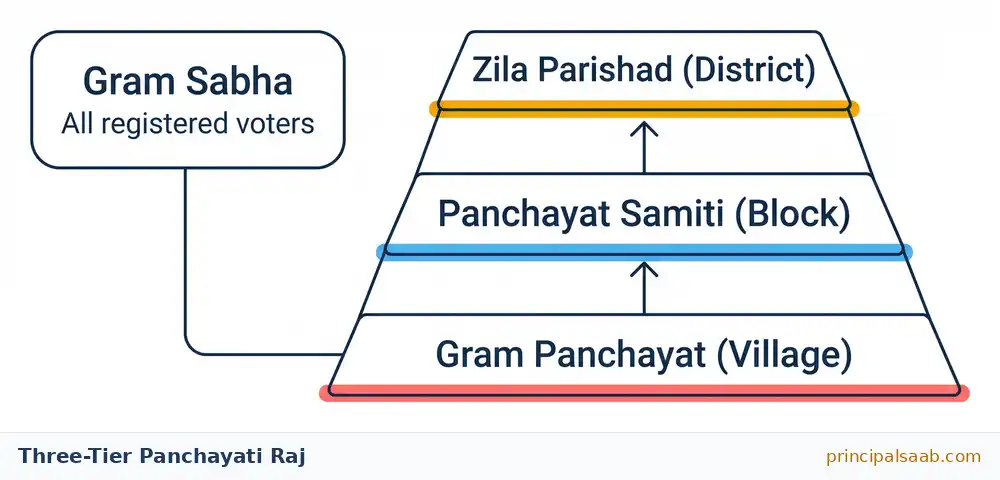
Now the structure, tier by tier. In rural areas the base unit is the gram panchayat, the council of a village or a group of villages. It has a few ward members, often called panch, and a president or sarpanch, all directly elected by the adult population of the village. The gram panchayat is the decision-making body, and it works under the supervision of the gram sabha, which is not a committee at all but the meeting of every single registered voter in the area covered by the panchayat. The gram sabha must approve the annual budget of the panchayat and it reviews the panchayat’s performance, which is the mechanism by which ordinary villagers keep their own elected representatives accountable.
Above the village, a few gram panchayats are grouped together to form a panchayat samiti, also called a block or a mandal in different states. Its members are elected by the members of the panchayats, not directly by the villagers. Above that, all the panchayat samitis in a district together form the zila parishad, most of whose members are elected, and which also includes the members of the Lok Sabha and the state legislature from that district. The zila parishad chairperson heads the district-level political body.
Urban areas have a parallel arrangement under the 74th Amendment. Towns have municipalities, and big cities have municipal corporations. A municipality is headed by a chairperson, while a municipal corporation is headed by a mayor. In both cases the elected councillors represent wards of the town or city.
| Tier | Rural Body | How Members Are Chosen | Head |
|---|---|---|---|
| Village level | Gram Panchayat, supervised by the Gram Sabha of all voters | Directly elected by all adult voters of the village | Sarpanch or panchayat president |
| Intermediate or block level | Panchayat Samiti, also called block or mandal | Elected by the members of the gram panchayats | Chairperson of the samiti |
| District level | Zila Parishad | Mostly elected, and includes MPs and MLAs of the district | Zila parishad chairperson |
| Urban, town | Municipality | Councillors elected from wards of the town | Municipal chairperson |
| Urban, big city | Municipal Corporation | Councillors elected from wards of the city | Mayor |
Confusing the gram sabha with the gram panchayat. The gram panchayat is the small elected council. The gram sabha is the general meeting of every registered voter in the village. The sabha elects and supervises the panchayat, approves its budget and reviews its work. If you swap the two in an answer, you lose the mark even though you knew the content.
Now the honest part. An answer that only praises decentralisation is an incomplete answer, and good examiners reward balance. The achievements are real: India today has a genuinely large number of elected local representatives, a very substantial share of whom are women, which is a scale of representation that few countries can match, and rural and urban local bodies now exist as a constitutionally protected third tier. But the limitations are real too. Many local bodies have very limited powers, because state governments have been slow to transfer real functions to them. Their finances are weak, since they raise little revenue of their own and depend heavily on grants, which limits what they can actually do. Elections are sometimes held without genuine transfer of authority, so the body exists but decides little. And in some places the gram sabha meets rarely and is not used seriously, which removes the very accountability the system was designed to create.
For any five-mark question on decentralisation, use the shape three plus two: three achievements, then two honest limitations, then a one-line conclusion saying that the system has created the structure of local democracy but still needs greater transfer of powers and funds to work fully. That conclusion sentence very often carries the fifth mark.
Model answer. (i) It became constitutionally compulsory to hold regular elections to local government bodies, so that state governments could no longer postpone them indefinitely. (ii) Seats were reserved in the elected bodies and in the posts of chairperson for the Scheduled Castes, Scheduled Tribes and Other Backward Classes, and at least one-third of all positions were reserved for women. (iii) An independent State Election Commission was to be created in every state to conduct elections to the local bodies, and state governments were required to share some of their powers and revenue with them, with a State Finance Commission appointed to recommend how the money should be shared.
Why this scores. Three points, and each one carries more than the minimum, so even if the examiner is strict about one clause the point still stands. Mentioning both the State Election Commission and the State Finance Commission in one point is efficient, because the two are often examined together.
Exam Strategy for This Chapter
You now know the content. This section is about converting knowledge into marks, which is a separate skill and a learnable one.
- Read the mark value before you read the question. One mark means one sentence. Three marks means three numbered points. Five marks means an opening line, five points and a closing line. Decide the shape of the answer before you write the first word.
- Number your points. Examiners mark point by point. A paragraph containing four ideas often gets credited for two because the marker cannot see where one point ends and the next begins.
- Every point needs a because. Naming a feature earns half; explaining why it matters earns the rest.
- Answer the question in the last line. If the question mentions unity, your final sentence must contain the word unity. If it mentions decentralisation, end on decentralisation. Markers look for the landing.
- Keep your terminology exact. Union List and not central list. Gram sabha and not village meeting. Official language and not national language. Municipal corporation for a big city and municipality for a town.
- Do not pad. Nobody has ever received an extra mark for length. Long answers cost you time you will need for the map and the economics section.
The high-frequency areas in this chapter, in rough order of how often they appear, are: the three lists and who legislates on what; the features of federalism; coming together versus holding together; the 1992 amendments and the structure of local government; linguistic states and the language policy. If you are short of time on the night before the paper, revise in that order.
Let us finish with two full-length walkthroughs at board difficulty, so that you see the whole process from question to marked answer.
Model answer. The constitutional amendments of 1992 created a genuine third tier of government in India, and its record since then has been one of solid achievement together with real unfinished business.
(i) Regular elections to rural and urban local bodies have become constitutionally compulsory, so local government now exists continuously rather than at the convenience of the state government.
(ii) Reservation of at least one-third of all positions for women, along with reservation for the Scheduled Castes, Scheduled Tribes and Other Backward Classes, has brought a very large number of people from groups previously excluded from public office into elected positions.
(iii) The creation of an independent State Election Commission in each state, and of a State Finance Commission to recommend the sharing of revenue, has given the local bodies institutional protection that they earlier lacked.
(iv) However, most local bodies still have limited powers, because many state governments have been reluctant to transfer real functions and staff to them, so elections take place but decisions continue to be taken above.
(v) Their financial position also remains weak, since they raise very little revenue of their own and depend heavily on grants, and in many places the gram sabha meets rarely, which weakens the accountability the system was designed to create.
On balance, decentralisation has successfully built the structure of local democracy in India, but the structure will only work fully when adequate powers and funds are actually transferred to it.
Why this scores. Evaluate is a two-sided command word. Notice the three plus two shape, the opening line that promises balance, and the closing line that delivers a judgement instead of trailing off. An answer with five achievements and no limitation would typically be capped below full marks, because it has not evaluated anything.
Q1. Name the body that is meeting in this passage. (1 mark)
Q2. Mention any two functions of this body as shown or implied in the passage. (2 marks)
Q3. The sarpanch has been elected from a reserved seat. Which constitutional provision made such reservation compulsory, and why was it introduced? (2 marks)
Model answers. A1. The gram sabha, which is the meeting of all the registered voters of the area covered by the gram panchayat. A2. First, it examines and approves the annual budget of the gram panchayat, as seen when the accounts and the plan are placed before it. Second, it reviews and controls the working of the panchayat, as seen when the residents question the proposed spending and force a change in the plan. A3. The constitutional amendment of 1992 relating to rural local government made it compulsory to reserve seats and posts of chairperson for the Scheduled Castes, Scheduled Tribes and Other Backward Classes, and to reserve at least one-third of all positions for women. It was introduced so that groups which had long been excluded from positions of power would have a guaranteed share in local decision-making, which makes local government more genuinely representative of the whole community.
How to read a source like this. Every detail in a case passage is a deliberate clue. The words all residents and approves the plan point to the gram sabha rather than the panchayat. The phrase reserved seat is the examiner handing you the reservation provision. Work through the passage and ask of each detail, which part of the chapter is this pointing at. Then answer using chapter vocabulary, quoting the passage only as evidence for the point you are making.
Practice Worksheet
Ten original questions. Cover the answers, write yours on paper first, and only then click a question to open the model answer. Comparing your version with the model is where the learning actually happens; simply reading the answers teaches you almost nothing.
Q1. Under which list would a law on the printing of currency notes fall, and who alone can make such a law? (1 mark)
Q2. What is meant by a residuary subject? Give one example. (1 mark)
Q3. Why is India not called a federation in the Constitution even though it is federal in nature? (1 mark)
Q4. Explain any three ways in which the Constitution guarantees that neither level of government can destroy the powers of the other. (3 marks)
Q5. Distinguish between the gram panchayat and the gram sabha on any three grounds. (3 marks)
Q6. Why did the central government continue the use of English for official purposes after 1965? Give three reasons. (3 marks)
Q7. How did the rise of coalition governments and the role of the Supreme Court change centre-state relations in India? (3 marks)
Q8. Why is decentralisation considered necessary in a country like India? Explain with five reasons. (5 marks)
Q9. Describe the structure of rural local government in India as it exists after the constitutional amendment of 1992. (5 marks)
Q10. Case-based. Two neighbouring states quarrel over the sharing of the water of a river that flows through both of them. Each state passes its own law on how the water is to be used. The dispute is taken to court, and meanwhile the Union Government is asked to intervene. (a) Which feature of federalism is illustrated by taking the dispute to court? (1 mark) (b) Why can a single state not decide this matter by itself? (2 marks) (c) What does this case tell us about the balance between unity and diversity in Indian federalism? (2 marks)
(b) A single state cannot decide the matter alone because the river flows through more than one state, so a decision made by one state directly affects the people of the other, and neither state has jurisdiction over territory outside its own boundaries. Each state government has authority only within the sphere and the area assigned to it by the Constitution, and a matter that crosses state boundaries therefore requires either agreement between the states or a decision by a neutral authority.
(c) It shows that Indian federalism must constantly balance the two aims it was built for. The diversity side is respected because each state has a genuine right to look after the interests of its own people and cannot simply be overruled. The unity side is protected because there are institutions above the states, the judiciary and the Union Government, that can settle such quarrels peacefully so that a disagreement between two parts of the country does not turn into a conflict that damages the whole. Federalism works precisely because both of these are available at the same time.
One last word before you close this page. You do not have to master this chapter today, and you certainly do not have to master it all at once. The kaizen way is quieter and far more powerful than a panic-driven all-nighter: aim for one more correct question than yesterday. One extra point remembered, one extra model answer written properly, one confusion cleared. Do that every day between now and the paper, and by the time you sit down in the examination hall, Federalism will feel less like a chapter you studied and more like something you simply know. You are doing better than you think.