
Let us begin with something honest. A lot of students open this chapter, see words like biodiversity, endemic, IUCN, unclassed forests, and quietly decide that Geography has turned into a vocabulary test they are going to fail. If that is roughly where you are sitting right now, take a breath. Nothing in this chapter is beyond you. Every single idea here is something you already half-know from the world around you, dressed up in a slightly formal word.
Think about the last time you walked past a big old peepal or banyan tree in your neighbourhood, the kind with a raised platform around it that nobody is allowed to cut. Somebody in your family probably told you it was special. That single tree contains almost the whole chapter: a living thing being protected, a community deciding it matters, a rule that everybody follows without a policeman standing there. Scale that up to a whole forest, add tigers and elephants and rivers and mines and railway lines and villages, and you have Forest and Wildlife Resources.
Here is the second honest thing. This chapter is not really about memorising lists of animals. It is about an argument. The argument is this: India is extraordinarily rich in living things, that richness is shrinking fast, and the reasons it is shrinking are mostly human decisions about land, money and power. Once you can hold that argument in your head, the animal names and the Act names stop being random facts and start being evidence. Evidence is much easier to remember than trivia, because it has a job to do.
We are going to go slowly. I will explain each idea in plain language first, then show you the exam word for it, then show you exactly how a marker wants that idea written on paper. There are worked answers throughout, and a full practice worksheet at the end with the answers hidden until you want them. Nobody is timing you. Read a section, sit with it, and only move on when it genuinely feels comfortable.
What You’ll Learn
- Biodiversity: What It Means and Why India Is Special
- Flora and Fauna in India: The Scale of the Variety and What Is Under Threat
- The IUCN Classification: Normal, Endangered, Vulnerable, Rare, Endemic, Extinct
- Why Are Species Disappearing? The Causes of Depletion
- Development Projects and Habitat Loss: Weighing the Trade-Off Fairly
- Conservation of Forest and Wildlife in India
- The Indian Wildlife (Protection) Act, 1972 and What It Set Up
- Project Tiger and Other Species-Focused Projects
- Types and Distribution of Forests: Reserved, Protected and Unclassed
- Community and Conservation: Sacred Groves, Chipko, Navdanya and JFM
- Sustainable Conservation: What a Balanced Answer Looks Like
- How to Write Answers That Actually Score in This Chapter
- Practice Worksheet with Hidden Answers
Exam Tip — read this one before anything else
You may have heard from an older sibling, a coaching sheet, or an internet post that “Forest and Wildlife Resources is not in the board exam” or that it is “only for internal assessment”. That advice is out of date. For CBSE Class X Social Science (Subject Code 087) in the 2026-27 session, this chapter is fully board-examinable — it is named explicitly in the Geography list in the Question Paper Design.
One useful detail: Geography carries 20 marks in total, made up of 17 marks of theory and 3 marks of map pointing, and this chapter has no map-pointing items. The Geography map questions are drawn from Resources and Development, Water Resources, Agriculture, Minerals and Energy Resources, Manufacturing Industries, and Lifelines of National Economy. So you do not need to memorise locations here — you need to be able to write well. Every mark from this chapter is a writing mark.
Your Game Plan
Please do not try to swallow this chapter in one sitting. Here is the order that works, and roughly how long each stage takes if you are honest with yourself.
- Read the first three sections slowly (about 30 minutes). Biodiversity, the scale of India’s flora and fauna, and the IUCN categories. These give you the vocabulary. Everything later depends on them.
- Build the “causes” spine (about 30 minutes). The causes of depletion is the single most examined idea in the chapter. Get a list of six to eight causes into your head, each with one real example. Do not move on until you can rattle them off without looking.
- Work through the government-response sections (about 30 minutes). The Wildlife Protection Act, Project Tiger, and the three forest types. These are the “what did the State do” half of the chapter.
- Then the community half (about 30 minutes). Sacred groves, Bishnois, Chipko, Beej Bachao Andolan, Navdanya, Joint Forest Management. This is the “what did ordinary people do” half, and it is where the best five-mark answers come from.
- Study the worked examples with a pen in hand. Do not just read them. Cover the model answer, attempt it yourself on paper, then compare. The gap between what you wrote and what is shown is exactly your revision list.
- Finally, do the worksheet cold. No notes open, no scrolling up. Then reveal the answers one by one.
If you follow that order, you are looking at roughly three focused hours, spread over two or three days, to own this chapter properly. That is a genuinely good return for a chapter that can hand you five or six marks in the board paper.
Biodiversity: What It Means and Why India Is Special
Start with the word itself. Bio means life. Diversity means variety. So biodiversity simply means the variety of life. That is genuinely all it means. When a Geography paper asks you to define it, you are not expected to produce something clever — you are expected to produce something precise.
But “variety of life” is doing more work than it looks. Imagine two patches of land, each one hectare. The first is a neat plantation of a single species of eucalyptus, planted in rows. The second is a scrappy patch of natural forest with maybe forty kinds of tree, a hundred kinds of insect, birds nesting at three different heights, fungi in the leaf litter, and a stream with fish in it. Both are green. Both would look like “forest” in a satellite photograph. Only one of them is biodiverse.
That distinction matters enormously for this chapter, and it is the single most common thing students miss. Forest cover can go up while forest quality and biodiversity go down, because a plantation counts as cover but does not function like a natural forest. Keep that in your pocket — it makes for a very grown-up sentence in a five-mark answer.
Key Idea — a definition you can write in the exam
Biodiversity is the variety of all living organisms — plants, animals, micro-organisms — found in a given area, together with the variety of ecosystems they form and the genetic variety within each species. These living forms are not independent of one another; they are woven into a single web in which each depends on the others for food, shelter, pollination, soil and clean water. Human beings are one strand of that web, not a separate thing standing outside it.
Notice the last sentence in that box. It is worth writing in almost any answer about why biodiversity should be protected, because it converts a “nature is nice” argument into a “we depend on this” argument, and markers reward the second one far more generously.
Why is India special? Three reasons, and you should be able to give all three.
- Enormous climatic range in one country. India runs from the freezing cold desert of Ladakh to the wet evergreen rainforest of the Western Ghats and the north-east, from the hot sandy Thar to the mangrove swamps of the Sundarbans, from coral reefs in the Gulf of Mannar to alpine meadows above the tree line. Each of those climates grows a completely different set of living things. A country with one climate has one kind of life. India has a dozen.
- A long, complicated geological history. The Indian landmass drifted north as an island for millions of years before colliding with Asia. That isolation let unique species evolve here and nowhere else, and the collision then let Asian species pour in. The result is an unusual mixture of very old, very local life forms and newer arrivals.
- Living traditions that protect species deliberately. India is one of the few places where large numbers of plants and animals have been protected for centuries by religious and cultural practice rather than by law — sacred groves, sacred trees, sacred animals, entire communities whose faith forbids harming certain species. We will spend a whole section on this later, because it is one of the chapter’s biggest arguments.
Together these make India what ecologists call a megadiverse country — one of a small group of nations that between them hold the majority of the world’s species. India is also home to internationally recognised biodiversity hotspots: regions that are exceptionally rich in species found nowhere else and exceptionally threatened. The Western Ghats and the Eastern Himalaya are the ones you should be able to name.
Example 1 — “Define biodiversity.” (1 mark)
How to think about it. A one-mark definition question wants one clean sentence, not a paragraph. Write the sentence, stop, move on. Do not waste four minutes here.
Model answer. Biodiversity is the variety of living organisms — plants, animals and micro-organisms — present in a particular area, along with the ecosystems they form and the interdependence among them.
What earns the mark. The words “variety” and “living organisms” together carry it. Adding “interdependence” costs you five extra seconds and protects you if the marker is strict.
Example 2 — “Why is India considered rich in biodiversity? Explain with three reasons.” (3 marks)
How to think about it. Three marks, three reasons — so the structure is decided for you. Write three separate points. Each point should be a short claim followed by a concrete example. Claim alone gets half; claim plus example gets the full mark. This point plus example pattern is the engine of the whole chapter.
Model answer.
(i) Wide range of climate and relief. India stretches from the cold desert of Ladakh to the equatorial-type evergreen forests of the Western Ghats and the north-east, and from the arid Thar to the tidal mangroves of the Sundarbans. Each of these physical settings supports a distinct community of plants and animals, so the country accumulates many kinds of life instead of one.
(ii) Long geological isolation followed by contact. Because the Indian plate drifted separately for a long period before joining Asia, many species evolved here alone and are found nowhere else, while later contact allowed species from other regions to enter. The result is an unusual mix of endemic and immigrant life forms.
(iii) Cultural protection of species. Many Indian communities have preserved patches of forest and particular species for generations as sacred, for example the sacred groves maintained by tribal communities and the protection of blackbuck and khejri trees by the Bishnois of Rajasthan. This has conserved biodiversity that law alone would not have saved.
Marker’s eye. Notice that each point names a place or a community. Three unsupported general sentences would score perhaps 1.5 out of 3. The examples are not decoration — they are where the marks live.
Flora and Fauna in India: The Scale of the Variety and What Is Under Threat
Now let us put some size on the claim. Two quick words first, because students mix them up in a hurry: flora means the plant life of a region, fauna means the animal life. A silly memory hook that works: flora and flower both start with “fl”.
India occupies a little over two per cent of the world’s land area, and yet it holds something in the region of eight per cent of all recorded species on Earth. Sit with that ratio for a second. Two per cent of the space, eight per cent of the life. That single comparison is one of the most quotable lines you can put in an answer, because it makes the point instantly.
Good to Know — the textbook figure versus the latest official figure
Your NCERT textbook gives round numbers of roughly 81,000 species of fauna and about 47,000 species of flora recorded in India. Those figures come from older survey editions and are perfectly acceptable in the exam — write them and you will not be marked wrong.
But the real numbers keep climbing, because new species are described every year. The Zoological Survey of India’s national collections were reported in 2024 to represent roughly 1,03,000 to 1,04,000 animal species, and ZSI and the Botanical Survey of India together announced several hundred new animal and plant records for India in a single year (around 683 faunal additions announced for 2024 alone).
The safe exam habit: quote the textbook number, then add a short clause such as “and more recent surveys by the Zoological Survey of India put the figure higher, since new species continue to be recorded every year.” That shows judgement and costs you nothing.
Now the uncomfortable half. A lot of that richness is in trouble. The textbook’s summary is that at least ten per cent of India’s recorded wild flora and about twenty per cent of its mammals appear on the threatened list, and that a number of these are already in the critical category — meaning they are on the edge of vanishing. Older editions also note that several species have already gone, and that many hundreds of plant species are endangered.
Why does one in five of India’s mammals being threatened matter so much? Because mammals are usually the best-studied group. The insects, fungi, freshwater fish and soil organisms are far less surveyed, and there is no reason to think they are doing better. When the best-monitored group is at twenty per cent, the honest reading is that the true picture across all life is at least as bad and probably worse. That is a mature line to be able to write.
Common Mistake — “forest cover went up, so everything is fine”
Students often read that India’s forest and tree cover has increased slightly and conclude the crisis is over. Be careful. The India State of Forest Report 2023 (published December 2024, by the Forest Survey of India) put the country’s forest and tree cover at about 8,27,357 sq km, roughly 25.17% of the geographical area — of which forest cover alone is about 7,15,343 sq km, roughly 21.76% — and reported a modest overall increase of around 1,445 sq km against the 2021 assessment. That is genuinely good news, but note two things: (a) a large part of the gain sits in tree cover, including plantations and orchards, not in dense natural forest; and (b) total area says nothing about the quality or biodiversity of what is standing. Cover and biodiversity are two different measurements. Never let one be used as proof of the other.
Example 3 — “India’s biological wealth is impressive but fragile.” Justify this statement. (3 marks)
How to think about it. The question has two halves — impressive and fragile — so your answer must have two halves too. A very common way to lose marks here is to write three paragraphs about how rich India is and forget the second half entirely. Underline both key words in the question before you start writing.
Model answer.
Impressive: India occupies only about two per cent of the world’s land surface but supports roughly eight per cent of all recorded species, because its climate ranges from cold desert to tropical rainforest to mangrove and coral habitats. The textbook records tens of thousands of faunal and floral species, and new species continue to be described every year.
Fragile: A significant share of this wealth is under threat. At least ten per cent of India’s recorded wild flora and about twenty per cent of its mammals are on the threatened list, and species such as the cheetah have already disappeared from the wild in India while others such as the Great Indian Bustard survive in very small numbers.
Link the halves: The fragility is not accidental — it follows directly from the same features that create the richness, since habitats that are highly specialised, such as the Western Ghats or the Sundarbans, are also the ones most easily destroyed by clearing, damming or pollution.
Marker’s eye. That final linking sentence is what separates a 2.5 from a 3. It shows you understood the sentence in the question rather than answering two unrelated questions stuck together.
The IUCN Classification: Normal, Endangered, Vulnerable, Rare, Endemic, Extinct
Here is the section students dread, and it really should not be dreaded. All we are doing is sorting species into buckets according to how much trouble they are in. Think of it like a hospital triage board: some patients are fine and waiting for a check-up, some are unwell, some are in intensive care, and sadly some are already gone. The IUCN — the International Union for Conservation of Nature — maintains exactly such a board for the world’s species, published as the Red List.
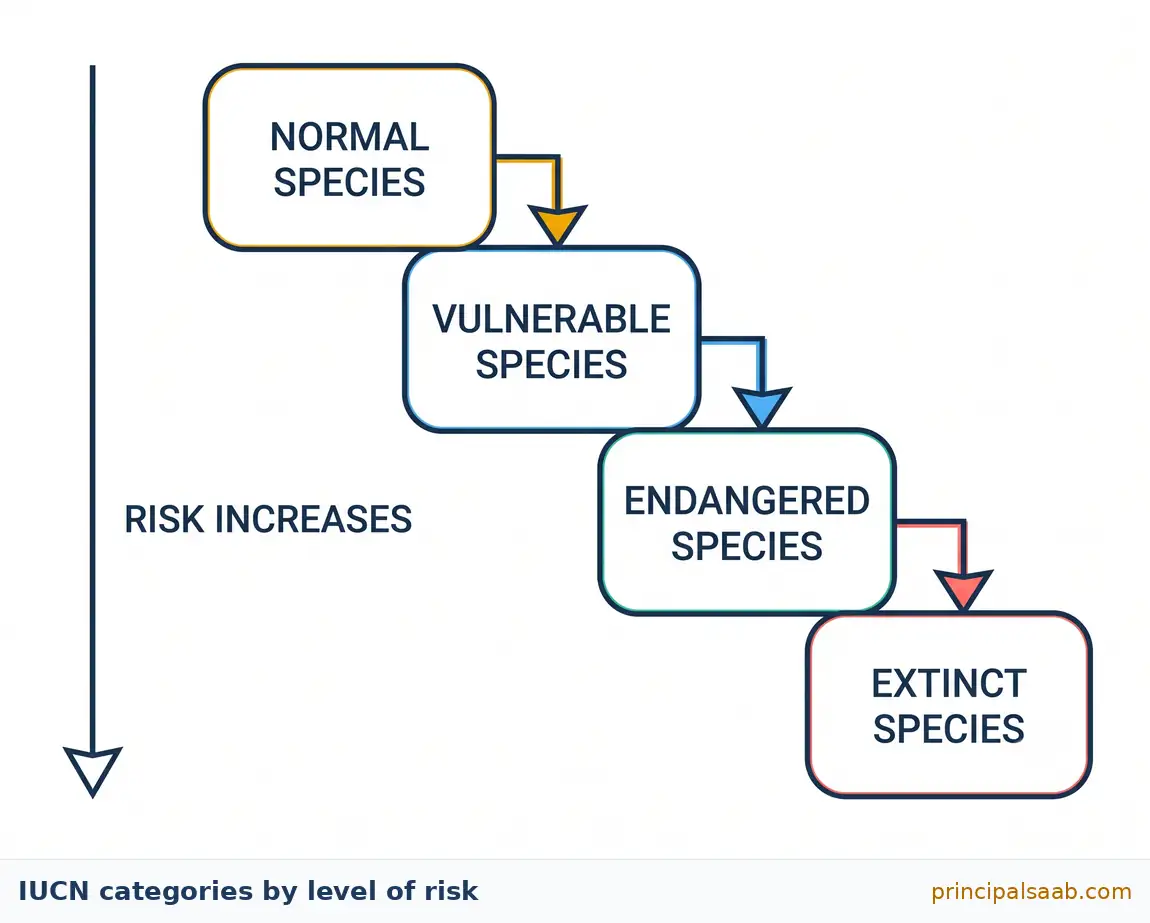
Your textbook uses a simplified set of categories that follows this logic. Let us take them one at a time, slowly, with an Indian example for each so the word attaches to a picture.
- Normal species. Populations are healthy enough that survival is not a worry — the ordinary, doing-fine majority. Cattle, sal, pine, rodents. If somebody asks “why is this category even here?”, the answer is that it gives you a baseline: everything else is defined by how far it has fallen from normal.
- Endangered species. Numbers have dropped to a level where the species is in real danger of disappearing, and it will very likely disappear if the pressures on it are not removed. The pressure is still operating. Examples usually given: the black buck, the Indian wild ass, the Indian rhino, the lion-tailed macaque, the sangai (the brow-antlered deer of Manipur), and the crocodile.
- Vulnerable species. Numbers have fallen to a level where the species could slide into the endangered bracket if the negative pressures continue. Vulnerable is one step earlier than endangered — a warning light rather than an alarm. Examples: the blue sheep, the Asiatic elephant, the Gangetic river dolphin.
- Rare species. Populations are small and scattered, so the species is not currently endangered or vulnerable, but a small population is inherently at risk — any single bad event could tip it over. Examples: the Himalayan brown bear, the wild Asiatic buffalo, the desert fox, the hornbill.
- Endemic species. Found naturally in one particular geographical area and nowhere else, usually because that area is isolated. Endemism is not a level of danger — it is a fact about distribution. But endemic species are automatically vulnerable, because if that one place is damaged there is no backup population anywhere on Earth. Examples: the Andaman teal, the Nicobar pigeon, the Andaman wild pig, the mithun of Arunachal Pradesh.
- Extinct species. No longer found anywhere, or no longer found in the particular habitat or region they once occupied. Note that careful “or” — a species can be extinct locally while surviving elsewhere. The Asiatic cheetah is the textbook example for India; the pink-headed duck is another.
| Category | What it means in one line | Indian examples |
|---|---|---|
| Normal | Population is at a level considered safe for survival. | Cattle, sal, pine, rodents |
| Endangered | In danger of disappearing; will likely be lost if the causes of decline continue to operate. | Black buck, Indian wild ass, Indian rhino, lion-tailed macaque, sangai (Manipur brow-antlered deer), crocodile |
| Vulnerable | Numbers have declined enough that the species is likely to move into the endangered category if the threats persist. | Blue sheep, Asiatic elephant, Gangetic dolphin |
| Rare | Small, scattered populations; not yet endangered or vulnerable, but at risk because the numbers are so few. | Himalayan brown bear, wild Asiatic buffalo, desert fox, hornbill |
| Endemic | Found only in one particular area, isolated by natural or political boundaries. A statement about range, not about danger. | Andaman teal, Nicobar pigeon, Andaman wild pig, mithun of Arunachal Pradesh |
| Extinct | No longer found at all, or no longer found in a habitat or region where it once lived. | Asiatic cheetah (lost from the wild in India), pink-headed duck |
Common Mistake — endangered vs vulnerable vs rare
These three get scrambled in exams more than anything else in the chapter. Fix them with a single mental sentence and you will never lose the mark again:
Rare = there were never very many, and there still are not. Small numbers, thinly spread.
Vulnerable = there used to be more; the fall is worrying and could get serious. Might become endangered.
Endangered = the fall is already serious; the species is close to being lost. Might become extinct.
Reading down that list, the danger increases: rare, then vulnerable, then endangered, then extinct. The other classic slip is treating endemic as a danger level. It is not — it describes where a species lives, not how badly it is doing. A species can be endemic and perfectly safe, or endemic and nearly gone.
Good to Know — the textbook list versus the live IUCN Red List
Two separate things are going on, and it is worth knowing the difference. Your textbook’s category list is a teaching simplification, and its species examples reflect the Indian situation at the time it was written. The actual IUCN Red List is a live, continuously revised global assessment with its own formal categories (Least Concern, Near Threatened, Vulnerable, Endangered, Critically Endangered, Extinct in the Wild, Extinct), and a species’ status there can and does change.
A few live examples, with years, so you can see how it moves. The snow leopard was reclassified by the IUCN from Endangered to Vulnerable in 2017. The greater one-horned rhino is currently assessed as Vulnerable globally, even though your textbook lists the Indian rhino under endangered. The Great Indian Bustard is assessed as Critically Endangered, with survivors numbering in the low hundreds at most. The Asiatic lion, meanwhile, has recovered substantially in Gujarat — the 16th Asiatic Lion Census, conducted in May 2025, counted about 891 lions, up from roughly 674 in the 2020 count.
What to do in the exam: answer with the textbook’s categories and examples, because that is what the paper is set from. If you want to add a live figure, attach the year to it (“as of the 2025 census…”). Never write a bare number with no year — that is how answers become wrong a year later.
Exam Tip — the cheetah, and a nuance worth one extra line
The Asiatic cheetah is the standard Indian example of an extinct species, and it remains correct to say the cheetah became extinct in the wild in India (officially declared so in the early 1950s) because of hunting and loss of its grassland habitat. Since September 2022, however, African cheetahs have been brought to Kuno National Park in Madhya Pradesh under Project Cheetah, in an attempt to re-establish a free-ranging population, and cubs have since been born in India. If you mention this, phrase it carefully: it is a reintroduction of a different cheetah population, still being monitored, and it does not undo the extinction of the original Asiatic cheetah in India. That nuance, written in one sentence, reads as genuine understanding rather than a memorised fact.
Example 4 — “Distinguish between endangered species and vulnerable species, with one example of each.” (2 marks)
How to think about it. A “distinguish between” question wants a genuine contrast, not two definitions sitting side by side pretending to be a comparison. The cleanest way to guarantee the contrast is visible is to write both statements on the same axis: how close is each one to being lost?
Model answer.
Endangered species are those whose numbers have fallen so low that they are in immediate danger of extinction, and which will not survive if the factors causing the decline keep operating. Example: the sangai or brow-antlered deer of Manipur.
Vulnerable species are those whose numbers have declined to a level from which they are likely to move into the endangered category if the adverse pressures continue. They are therefore one stage less critical than endangered species. Example: the Gangetic river dolphin.
Marker’s eye. The phrase “one stage less critical” is what proves you understand the relationship. Without it, an examiner reading quickly cannot tell whether you know which is worse.
Example 5 — “Explain any five categories used to classify species on the basis of their conservation status, giving one Indian example of each.” (5 marks)
How to think about it. Five marks, five categories, one mark each. So each category needs: the name, a one-line meaning, and an example. Three components, roughly two lines of writing. Do not write a paragraph on the first one and then run out of time and space — spread your effort evenly. Number your points; it makes the marker’s job easy, and an easy marker is a generous marker.
Model answer.
(i) Normal species: species whose population levels are considered normal for their survival. Example: cattle and sal.
(ii) Endangered species: species in danger of extinction, whose survival is unlikely if the causal factors continue to operate. Example: the Indian wild ass.
(iii) Vulnerable species: species whose population has declined to a level from which they are likely to move into the endangered category if the adverse factors continue. Example: the Asiatic elephant.
(iv) Rare species: species with small populations that may move into the endangered or vulnerable category if the negative factors affecting them continue. Example: the Himalayan brown bear.
(v) Endemic species: species found only in a particular area, isolated by natural or geographical barriers. Example: the Nicobar pigeon. (An alternative fifth point is extinct species — no longer found in the areas they once inhabited — with the Asiatic cheetah as the example.)
Marker’s eye. Two habits are doing the heavy lifting here. First, every point follows the identical shape, so nothing is accidentally left out under pressure. Second, the examples are all different species — repeating “tiger” for three categories signals that the examples were guessed.
Example 6 — “Why are endemic species particularly at risk, even when their numbers seem stable?” (3 marks)
How to think about it. This is a reasoning question, not a recall question. There is no list in the textbook to reproduce. The examiner wants to see whether you can take the definition of “endemic” and work out its consequences. Slow down and think it through in ordinary language before writing.
Model answer.
(i) No backup population. An endemic species lives naturally in only one area, so if that single habitat is destroyed, the species has nowhere else on Earth to survive. A species with a wide range can lose one forest and continue elsewhere; an endemic species cannot.
(ii) The habitats are usually small and specialised. Endemism typically arises on islands, isolated hill ranges or unusual local environments — such as the Andaman and Nicobar Islands or pockets of the Western Ghats. Such areas are limited in size, so a single road, plantation, mine or fire can affect a large share of the total habitat at once.
(iii) Narrow tolerance and low genetic variety. Having evolved in one setting, endemic species are often adapted to a narrow range of conditions and cannot adjust quickly to changes in climate, or to new predators, diseases and competing species introduced by humans.
Marker’s eye. Answers to “why” questions score best when each point is a mechanism, not a restatement. “Because they are found in only one place” is the definition; “because there is no backup population if that place is destroyed” is the reason. Always push one step past the definition.
Why Are Species Disappearing? The Causes of Depletion
This is the heart of the chapter. If you learn one section properly, make it this one — it feeds almost every three and five-mark question that gets set, and it also supplies the raw material for the case-study questions. So let us build it carefully.
Before the list, one framing idea that will make everything stick. Species rarely vanish because someone set out to destroy them. They vanish because of decisions taken for other reasons entirely — to grow more food, to move goods faster, to generate electricity, to extract a mineral, to earn foreign exchange. Wildlife is almost never the target. It is the thing standing in the way. Hold on to that, and the list below stops being eight random items and becomes eight versions of the same story.
Key Idea — the sentence that opens a top-grade answer
The depletion of India’s forests and wildlife is not mainly the result of natural processes. It is largely the outcome of human activity — of the way land, forests and resources have been used, distributed and consumed since colonial times — and its effects fall most heavily on the poor communities who depend on forests directly for their survival.
1. Colonial forestry, commercial plantations and the railways. Under colonial rule, forests came to be seen chiefly as a source of revenue and timber rather than as living systems or as the home of forest communities. Vast areas of natural, mixed forest were cleared and replaced with single-species commercial plantations — tea, coffee, rubber, and timber species chosen for the market. Enormous quantities of timber were felled for railway sleepers as the rail network expanded, and for shipbuilding.
Why does this matter so much? Two reasons. First, it converted diverse forest into monoculture, which is a straight biodiversity loss even where the land stays green. Second, it introduced a way of thinking about forests — as a resource to be scientifically managed for output — that outlived colonial rule and shaped Indian forest policy for decades afterwards. Colonial forestry is not just an old cause; it is the origin of the system.
2. Expansion of agriculture. The single largest historical cause of forest loss in India is simply the conversion of forest into farmland to feed a growing population. Between the late colonial period and recent decades, a very large share of the forest area lost was cleared for cultivation. This one is easy to underrate because it sounds unglamorous, but it dwarfs most of the others in sheer area — the land-use and soil-degradation background sits in Resources and Development — Class 10 Geography notes.
3. Shifting cultivation (jhum) — but be careful here. Shifting cultivation involves clearing and burning a patch of forest, cropping it for two or three seasons, then abandoning it to regenerate while moving on. When the fallow period was long — fifteen or twenty years — the forest recovered fully and the system was genuinely sustainable, which is exactly how it operated for centuries.
The problem arose when population pressure and shrinking land availability forced the cycle to shorten. With only three or four years of fallow, the forest never regrows, soil fertility collapses, and the land degrades permanently. So the honest statement is this: shortened shifting cultivation cycles cause degradation, not shifting cultivation itself. Writing it that way shows a level of care that markers notice, and it avoids repeating an unfair blanket criticism of tribal communities.
4. Large development projects. Since Independence, substantial areas of forest have been cleared for river valley projects, dams and reservoirs, roads, industry and townships (the multi-purpose project side of this story is covered in Water Resources — Class 10 Geography notes). A large dam does two things at once: it drowns forest under the reservoir, and it opens up the surrounding area to roads, settlement and further clearing. The Narmada Sagar project in Madhya Pradesh is the standard textbook illustration of a river valley project submerging large tracts of forest. We will look at the full trade-off in the next section.
5. Mining. Mining damages habitat in ways that go far beyond the size of the pit (for how and where India mines, see Minerals and Energy Resources — Class 10 Geography notes). It removes vegetation and topsoil, dumps waste rock over adjoining land, pollutes streams with silt and chemicals, brings heavy vehicle traffic, blasting and noise, and — crucially — cuts migration corridors. The textbook example is dolomite mining in and around the Buxa Tiger Reserve in West Bengal, which threatened the habitat of elephants and other species. Sariska Tiger Reserve in Rajasthan is another case where mining has been fought over for years.
6. Habitat fragmentation. This one is quieter than the others and much more damaging than students expect. When a road, canal, railway line, mine or plantation cuts through a forest, the total area lost may be small — but the forest is now in pieces. Large animals need to move across big ranges to find food, water and mates. Chop that range into fragments and populations become isolated; small isolated populations inbreed, lose genetic variety, and are wiped out easily by a disease or a fire. Elephants forced to cross highways and railway lines, resulting in deaths and in conflict with villagers, is the everyday face of fragmentation in India.
7. Unequal access, over-consumption and inequality of use. This is the most sophisticated cause in the chapter, and the one that separates strong answers from average ones. The pressure on forests is not spread evenly across society. The rich consume far more of everything — energy, timber, paper, land, meat — than the poor, so a small number of people account for a disproportionate share of the demand that drives forest loss. Meanwhile, it is the poor who lose most when a forest goes, because they depend directly on it for firewood, fodder, fruit, medicinal plants and building material.
There is a gendered dimension too. In many rural households it is women who fetch firewood, fodder and water. When forests recede, they walk further, spend longer on these tasks, and the health and schooling of the household suffer. The environmental problem is therefore also a social justice problem — the people who caused the least damage bear the most cost.
8. Hunting, poaching and the illegal wildlife trade. Hunting for sport during the colonial period, and organised poaching since — for tiger skins and bones, elephant ivory, rhino horn, deer antlers, snake skins and shahtoosh wool — has driven several species toward extinction. Poaching is not casual local hunting; it is run by well-financed international networks, which is why it is so hard to stop.
9. Pollution, forest fires and invasive species. Industrial effluent and pesticide run-off poison rivers and the fish and dolphins in them; air pollution and acid deposition damage vegetation; plastic and chemical waste enters food chains. Forest fires, many of them started by people, destroy regeneration. And introduced species with no natural checks — such as aggressive weeds like lantana in Indian forests — crowd out native plants and change the habitat for everything that lives on them.
Key Idea — a memory hook for the causes
If you need to recall the list under pressure, group it into three families instead of remembering nine separate items:
Land taken away — agriculture, colonial plantations, dams and development projects, mining, roads and fragmentation.
Living things taken away — hunting, poaching, over-extraction of forest produce, shortened shifting cultivation cycles.
The habitat spoiled where it stands — pollution, fires, invasive species, and the unequal, excessive consumption that drives all of it.
Common Mistake — blaming poor and tribal communities
A very common weak answer says something like “forests are destroyed because tribal people practise shifting cultivation and cut trees for firewood.” Be careful — this is both unfair and factually shaky, and this chapter is explicitly arguing the opposite. Forest-dependent communities generally take small quantities for direct use and have strong incentives to keep the forest alive, since their livelihood depends on it. The large-scale losses come from commercial logging, plantation agriculture, mining, big infrastructure, and consumption patterns driven mainly by wealthier, urban and industrial demand. If you write about shifting cultivation, always attach the reason the cycle shortened — population pressure and loss of land — rather than presenting it as carelessness.
Example 7 — “State any three causes of the depletion of forest resources in India.” (3 marks)
How to think about it. The command word is “state”, so the examiner wants three identified causes with a brief explanation each — not an essay. Pick three causes that are clearly different in kind from one another. Choosing “agriculture”, “plantations” and “shifting cultivation” would be three flavours of the same thing and looks thin. Spread across the three families.
Model answer.
(i) Expansion of agriculture. Large areas of natural forest have been cleared and converted into cropland to feed a growing population, making agricultural expansion the single largest historical cause of forest loss in India.
(ii) Large development projects and mining. River valley projects, roads, industries and mining have submerged or stripped substantial forest tracts — for instance, the Narmada Sagar project submerged extensive forest area in Madhya Pradesh, and dolomite mining has threatened the habitat of the Buxa Tiger Reserve in West Bengal.
(iii) Colonial commercial forestry. Under colonial rule, diverse natural forests were felled for railway sleepers, shipbuilding and timber revenue, and were replaced by single-species commercial plantations of tea, coffee and rubber, which reduced biodiversity even where tree cover remained.
Marker’s eye. Each point names a mechanism and a place. Three sentences of the form “trees are cut for various purposes” would score around one mark in total, however neatly written.
Example 8 — “Explain how habitat fragmentation threatens large animals, even when the total forest area lost is small.” (3 marks)
How to think about it. The question hands you a puzzle: small area lost, big damage. Your job is to resolve that apparent contradiction. Whenever a question contains a “even though” or “even when”, the answer is essentially an explanation of why the obvious expectation fails.
Model answer.
(i) Large animals need large ranges. Species such as elephants and tigers move over wide areas in search of food, water and mates. A road, canal or railway line may remove only a narrow strip of forest, but it divides the remaining habitat into separate blocks, each of which may be too small to support a viable population.
(ii) Isolated populations weaken genetically. Once animals cannot move between fragments, small groups breed only among themselves. This reduces genetic variety over generations and makes the population more vulnerable to disease, and a single fire, epidemic or drought can wipe out an entire isolated group.
(iii) Fragmentation increases conflict with humans. Animals attempting to cross between fragments enter roads, railway lines, farmland and settlements, leading to animal deaths and to crop damage and human injury. This conflict then generates local hostility toward the animals, which worsens the threat further.
Marker’s eye. Point (iii) is the one most students miss, and it is the most valuable — it turns an ecological answer into a human-geography answer, which is what a Social Science paper is really testing.
Example 9 — “The loss of forests affects the poor more severely than the rich.” Examine this statement. (5 marks)
How to think about it. “Examine” invites you to test the claim rather than simply agree with it — though here the evidence does support it, so you will end up agreeing, with reasons. Five marks means roughly five developed points, or four points plus a conclusion. Build it in two movements: first show why the poor lose more, then show who actually drives the demand. That contrast is the argument.
Model answer.
(i) Direct dependence for daily needs. Poor and forest-dwelling communities depend on forests directly for firewood, fodder for livestock, fruits and tubers, medicinal plants, house-building material and small forest produce that they sell. When the forest goes, these are not inconveniences — they are the loss of the household’s food, fuel and income at once. Better-off households buy these things in a market and are barely affected.
(ii) Loss of livelihood and displacement. When forests are cleared for dams, mines or industry, it is usually forest-dwelling and tribal communities who are displaced. Compensation is often inadequate or delayed, and people who possessed skills suited to a forest economy are pushed into unskilled wage labour in unfamiliar towns.
(iii) A heavier burden on women. In most rural households, collecting firewood, fodder and water is women’s work. As forests recede, women must walk much longer distances for the same load, which lengthens the working day, harms health, and often forces girls out of school to help.
(iv) The demand comes from elsewhere. The consumption that drives large-scale forest loss — timber, paper, minerals, electricity, land for commercial crops — is generated mainly by richer, urban and industrial users. The people who benefit most from the destruction are therefore not the people who bear its cost.
(v) Conclusion. The loss of forests is therefore not only an environmental problem but a question of social justice, because the burden of ecological damage falls hardest on those who contributed least to causing it and who have the fewest resources to cope with it.
Marker’s eye. Look at the shape: four points of evidence and then a conclusion that names the underlying idea (“social justice”). Five-mark answers that end with a genuine concluding sentence consistently read better than five-mark answers that just stop after the last bullet.
Development Projects and Habitat Loss: Weighing the Trade-Off Fairly
Let us slow right down here, because this section is where students most often write an answer that is emotionally satisfying and academically weak. The temptation is to write “dams are bad, mining is bad, development destroys nature.” An examiner reading that sees a slogan, not an analysis.
The truth is harder and more interesting. Development projects are built because they deliver things people genuinely need — irrigation for farmers, drinking water for towns, electricity for homes and factories, minerals for industry, roads for trade and for reaching a hospital. Nobody builds a dam out of malice. The conflict in this chapter is not between good people and bad people. It is between two legitimate goods that cannot both be fully satisfied on the same piece of land. Learning to write about that honestly is a skill that will serve you in Economics and Political Science too.
Key Idea — the three questions that unlock any trade-off answer
Whenever a question asks you to evaluate a development project against its environmental cost, run these three questions in order and you will never be short of material:
1. Who gains? Which people, in which places, get what benefit?
2. Who pays? Which people lose land, livelihood, habitat or health — and are they the same people who gain?
3. Could the same gain be achieved at a lower cost? Is there an alternative design, location, scale or technology?
Question 3 is where the best marks are, because it moves you from complaining to problem-solving.
The river valley project case. Consider a large multipurpose river valley project in a forested region — the Narmada Sagar project in Madhya Pradesh is the case your textbook points to, where a very large area of forest was submerged.
The development case, stated fairly. The reservoir stores monsoon water and releases it through the dry season, so farmers downstream can grow a second and sometimes third crop instead of depending on one uncertain monsoon. That is a direct, measurable increase in food production and rural income. The project generates hydroelectric power, which is renewable and does not burn coal. It supplies drinking water to towns that previously ran dry in summer, and it moderates floods. These benefits reach millions of people, many of them poor, and they are real.
The conservation and social case, stated fairly. The reservoir permanently drowns forest, and drowned forest does not come back. The habitat lost may be the only remaining stretch of a particular type of riverine forest. Animals do not simply relocate — the surrounding land is usually already occupied, so displaced wildlife dies or comes into conflict with villages. Forest-dwelling and tribal communities lose homes, farmland, grazing land and burial grounds; resettlement is often slow, and compensation frequently fails to replace a whole way of life. Dams also change the river itself downstream: less silt reaching the delta, changed flow patterns, and disruption to fish breeding and to species such as the Gangetic dolphin.
And now the awkward bit. The people who gain the irrigation and the electricity mostly live downstream or in cities. The people who lose their land and forest mostly live upstream in the submergence zone. That mismatch between beneficiary and payer is the real reason these projects generate such bitter conflict. It is not that anyone opposes electricity. It is that one group is being asked to pay for another group’s benefit.
The mining case. Mining raises the same structure with a sharper edge. Consider dolomite mining in the area of the Buxa Tiger Reserve in West Bengal, or the long-running dispute over mining around Sariska Tiger Reserve in Rajasthan.
The case for mining is straightforward: minerals are the raw material of steel, cement, construction and manufacturing; mines create employment in regions that often have few other opportunities; and mineral exports earn foreign exchange. The case against is that mining does not merely occupy land, it degrades a much larger surrounding area through waste dumping, siltation of streams, blasting, noise and constant heavy traffic — and, most seriously for wildlife, it severs the corridors that elephants and other wide-ranging animals use to move between forest patches. Once a corridor is broken, the damage extends far beyond the leased area.
What makes Sariska instructive is the response. Local villagers organised against mining in the area and pursued the matter through the courts, and mining was ordered to be stopped. Whatever the practical difficulties that followed, it demonstrates something important for this chapter: local communities are frequently the ones defending the forest, not the ones destroying it.
Exam Tip — the sentence that lifts a trade-off answer
If you have space for only one extra line in an answer about development versus conservation, make it this one: “The question is not whether development should happen, but who decides, who benefits, and who bears the cost.” It signals that you have understood the chapter’s argument rather than picked a side, and it works in dozens of questions across the Social Science paper.
Example 10 — Case-based question (4 marks)
Read the passage and answer the questions that follow.
A state government proposes a new multipurpose river valley project in a hilly, heavily forested district. The reservoir will submerge about 220 sq km, of which roughly 150 sq km is dense natural forest that includes a known elephant migration route. The project will provide assured irrigation to about 3,00,000 hectares of farmland in three downstream districts, generate hydroelectric power, and supply drinking water to two cities. About 11,000 people, most of them from forest-dwelling communities, will have to be resettled. Local organisations have objected, pointing out that the elephants which cross the valley each year will be cut off from their dry-season feeding grounds.
(a) Identify two benefits the project is expected to deliver. (1 mark)
Assured irrigation to about 3,00,000 hectares in three downstream districts, and generation of hydroelectric power along with drinking water supply to two cities.
(b) Explain two ways in which the project will damage wildlife in the district. (2 marks)
First, it will cause direct habitat loss: roughly 150 sq km of dense natural forest will be permanently submerged, and this habitat cannot be recreated elsewhere, so the species dependent on it will either die or be forced into already-occupied surrounding land. Second, it will cause habitat fragmentation by severing a known elephant migration route. Cut off from their dry-season feeding grounds, the elephants will either be confined to an area that cannot support them or will attempt to cross settled and cultivated land, leading to crop damage, human-elephant conflict and animal deaths.
(c) Suggest one measure by which the project’s environmental cost could be reduced without abandoning it. (1 mark)
A protected wildlife corridor could be secured and legally maintained around the reservoir, linking the remaining forest blocks to the elephants’ dry-season feeding grounds, so that migration continues around the submerged valley. (Other acceptable answers: reducing the reservoir height to lower the submerged area; compensatory afforestation with native mixed species rather than a single-species plantation; resettling affected communities on forest-fringe land with continued rights to forest produce.)
Marker’s eye — how to attack any case study. Three habits win these marks. One: lift the specific figures from the passage into your answer. Writing “150 sq km of dense forest” instead of “a lot of forest” proves you read the source, which is precisely what the question type is testing. Two: match the length to the marks — part (a) is one mark, so it gets one line, not a paragraph. Three: for the “suggest a measure” part, give a specific, workable measure. “The government should protect the environment” earns nothing; “maintain a legally protected corridor linking the remaining forest blocks” earns the full mark.
Example 11 — “Mining has caused severe damage to wildlife habitats in India.” Explain with examples. (3 marks)
How to think about it. The trap here is to describe mining in general terms — “mining cuts trees and pollutes” — which any student could write without studying. Push for the mechanisms that are specific to mining and that a casual answer would miss.
Model answer.
(i) Direct destruction and a much wider zone of damage. Mining strips vegetation and topsoil from the leased area, and the waste rock and debris dumped alongside degrade a considerably larger surrounding area, so the habitat actually lost is far greater than the size of the mine itself.
(ii) Breaking of migration corridors. Mines, together with their access roads and constant heavy traffic, cut the routes along which wide-ranging animals move between forest patches. Dolomite mining in the region of the Buxa Tiger Reserve in West Bengal has threatened habitat in this way and disturbed the movement of elephants and other species.
(iii) Pollution and disturbance. Silt, dust and chemical run-off from mining enter streams and contaminate the water on which forest wildlife depends, while blasting and machinery generate continuous noise and vibration that drive animals away from areas that are otherwise still forested. Long-running disputes over mining around the Sariska Tiger Reserve in Rajasthan illustrate the seriousness with which such damage is now treated, with local communities themselves taking the issue to court.
Marker’s eye. The phrase “far greater than the size of the mine itself” is the kind of precise observation that makes an examiner mark generously, because it could not have been guessed.
Example 12 — “Large development projects should never be built in forested areas.” Do you agree? Give arguments. (5 marks)
How to think about it. The word “never” is doing something sneaky. Any question containing an absolute word — never, always, only, entirely — is inviting you to challenge the absolute. A balanced answer here will outscore a one-sided one every time, whichever side you eventually land on. Structure it: arguments for, arguments against, then your position.
Model answer.
Arguments supporting the statement. (i) Forest destroyed by submergence or excavation is effectively permanent; unlike a factory, a mature forest ecosystem cannot be rebuilt within a human lifetime. (ii) Such projects fragment habitat and sever migration corridors, so their ecological effect extends well beyond the land actually taken. (iii) They displace forest-dwelling and tribal communities whose entire livelihood system is tied to that forest, and compensation rarely restores what is lost.
Arguments against the statement. (iv) The benefits are real and reach large numbers of people, many of them poor — irrigation that removes dependence on an uncertain monsoon, electricity, drinking water and flood control. (v) An absolute ban is impractical, since forested regions are frequently exactly where the rivers, the gradients and the mineral deposits are; such a rule would block development permanently in some of India’s poorest districts.
My position. A blanket prohibition is not the right answer, but neither is unrestricted clearance. What is needed is that every such project should be subject to a genuine environmental impact assessment, that the affected community should have a real voice in the decision and receive resettlement that restores their livelihood rather than merely a cash payment, that wildlife corridors should be legally secured around the project, and that smaller-scale or alternative designs should be seriously examined before the largest option is chosen. The question is not whether development should happen, but who decides, who benefits and who bears the cost.
Marker’s eye. Notice that taking a clear position at the end is essential — a fence-sitting answer that lists both sides and then stops looks indecisive. State a view, and justify it with conditions. That is what “evaluate” and “do you agree” questions are actually rewarding.
Conservation of Forest and Wildlife in India
So we have established the problem. Now, what is being done about it — and why bother at all?
Let us handle “why bother” first, because a surprising number of answers skip it and go straight to listing schemes. If a question asks why conservation is necessary, you need reasons, and the strongest reasons are not sentimental.
- Ecological services we cannot replace. Forests hold soil in place and prevent erosion, recharge groundwater, regulate the water cycle, moderate local climate, and absorb carbon dioxide. No engineering system provides these at anything like the same cost.
- Genetic diversity is a resource for the future. Wild relatives of crop plants carry genes for resistance to drought, pests and disease. Wild plants are the source of a great many medicines. Every species lost is an option permanently closed, and we usually do not know in advance which option we needed.
- Livelihoods depend on it directly. Millions of Indians rely on forests for fuel, fodder, food, medicine, and forest produce sold for cash. Conservation here is not a luxury; it is an anti-poverty measure.
- Ecosystems only work whole. Remove a top predator and herbivore numbers explode, vegetation is stripped and the whole system unravels. Remove pollinators and fruiting fails. Species are not a collection of items; they are a machine with interlocking parts.
- Cultural and ethical value. Many Indian communities regard particular species and groves as sacred, and there is a defensible ethical position that other species have a right to exist independent of their usefulness to us.
Now the critique that this chapter really wants you to understand. For a long time, Indian conservation was organised around charismatic large animals — above all the tiger, and also the lion, the elephant and the rhino. That approach achieved genuine things, and there is a good technical argument for it: protecting enough habitat for a tiger automatically protects everything else living in that habitat. Conservationists call such a species an “umbrella species”, and the logic is sound.
But it has a blind spot, and it is a big one. Species that are not large, not photogenic and not famous get very little attention — insects, amphibians, freshwater fish, fungi, grasses, and the vast unglamorous majority of life. Whole ecosystems that do not contain a flagship animal get neglected too: grasslands are dismissed as “wasteland” and handed over for plantations or industry, wetlands are drained, and the species that live only in those places have no famous protector to save them alongside. The Great Indian Bustard is the painful example — a grassland bird now reduced to a critically small population, precisely because grasslands were never treated as habitat worth defending.
This is why more recent policy has widened its scope. Protection has been extended to a much broader range of animals and plants, including insects and several plant species, and India has built a network of protected areas of different kinds rather than relying on a handful of famous reserves.
Good to Know — the scale of India’s protected area network (with years attached)
India maintains a large network of protected areas. Figures reported by the Ministry of Environment, Forest and Climate Change put it at roughly 1,000-plus protected areas, including about 106 national parks, around 573 wildlife sanctuaries, and over 100 conservation reserves and 200-plus community reserves (figures reported for 2023-25). India also has 18 biosphere reserves, and the number of tiger reserves reached 58 in March 2025 with the notification of Madhav Tiger Reserve in Madhya Pradesh.
These numbers change as new areas are notified, so always attach the year when you use one, or write “over 100 national parks” rather than a precise figure you are unsure of. An approximate statement with a year is safe; a precise figure with no year quietly becomes wrong.
Example 13 — “Why is the conservation of forests and wildlife necessary? Give any three reasons.” (3 marks)
How to think about it. Resist the pull of the emotional answer. “Animals are beautiful and we should love nature” is not wrong, but it is worth very little. Choose reasons that are functional — things that break if the forest goes. Ideally pick three from different families: ecological, economic, and genetic or cultural.
Model answer.
(i) Ecological balance and essential services. Forests maintain the quality of air, soil and water. They prevent soil erosion, help recharge groundwater, regulate rainfall and local climate, and absorb carbon dioxide. These services cannot be replaced by any artificial arrangement at comparable cost.
(ii) Preservation of genetic resources. Wild plants and animals hold genetic diversity that is essential for the future — the wild relatives of cultivated crops supply resistance to pests, disease and drought, and a large number of medicines are derived from wild plants. Each species lost removes a resource permanently.
(iii) Livelihood of forest-dependent communities. Millions of people, particularly tribal and forest-dwelling communities, depend directly on forests for firewood, fodder, food, medicine and forest produce. Conserving forests therefore protects the food and income security of some of India’s poorest people.
Marker’s eye. Reason (ii) is the one that most impresses examiners, because it is the least obvious and shows reading beyond the surface.
Example 14 — “Conservation in India has focused too heavily on a few large animals.” Discuss. (5 marks)
How to think about it. “Discuss” means present the case, present the counter-case, and reach a considered view. Crucially, do not dismiss the tiger-centred approach — it has a real justification, and an answer that acknowledges it before criticising it looks far more intelligent than one that does not.
Model answer.
The case for a species-focused approach. (i) Large animals such as the tiger require very extensive habitat, so protecting a viable tiger population necessarily protects the entire forest ecosystem within that range, including thousands of less noticed species. (ii) Well-known species attract public attention, political will and funding in a way that obscure species cannot, which is why Project Tiger succeeded in securing large protected areas at all.
The case against. (iii) Species that are small, non-charismatic or economically uninteresting — insects, amphibians, freshwater fish, fungi and most plants — have received far less protection despite being equally essential to ecosystem functioning. (iv) Entire habitat types that lack a flagship animal have been neglected. Grasslands have often been classified as wasteland and converted to plantations or industry, and wetlands have been drained, which is a major reason a grassland species such as the Great Indian Bustard has fallen to a critically small population. (v) A reserve-centred approach can also exclude local communities from forests they have used and protected for generations, creating hostility that undermines conservation itself.
Conclusion. The species-focused approach was a necessary starting point and produced real gains, but it is not sufficient on its own. Effective conservation now requires protecting whole ecosystems — including grasslands, wetlands and the less noticed species within them — and involving local communities as partners rather than treating them as intruders.
Marker’s eye. Point (iv) with the Great Indian Bustard is the single most valuable sentence in this answer. A named consequence turns an opinion into evidence.
The Indian Wildlife (Protection) Act, 1972 and What It Set Up
By the late 1960s the situation had become alarming enough that voluntary effort was clearly not going to be sufficient. Populations of several major species were collapsing, hunting was still widespread, and there was no strong national legal framework. The response was the Indian Wildlife (Protection) Act, 1972 — the single most important date in this chapter. If you remember nothing else, remember 1972.
Here is what the Act did, in plain terms. Take these one at a time; they are all quotable in an exam.
- It created an all-India legal framework for protecting wildlife habitat. Before this, protection varied from state to state and was weak. The Act gave the whole country one statutory basis.
- It published an all-India list of protected species. Species were placed in schedules according to how much protection they need, and the remaining hunting of listed species was banned.
- It provided for the establishment of national parks and wildlife sanctuaries, giving legal standing to protected areas so that habitat itself, not just individual animals, was defended.
- It restricted trade in wildlife and wildlife products and provided penalties, so that the commercial incentive behind poaching could be attacked directly rather than only guarding animals in the forest.
- It supported focused conservation projects for threatened species. Project Tiger followed in 1973, and later projects covered the one-horned rhino, the Kashmir stag or hangul, crocodiles, the Asiatic lion and the elephant.
In the years since, the scope has widened considerably. Protection was extended beyond large mammals to a much wider range of animals, including butterflies, moths, beetles and a dragonfly, and several plant species were brought under protection as well. Notice how that change tracks exactly the criticism we discussed in the previous section — the law itself moved away from being only about big animals.
Key Rule — national park versus wildlife sanctuary
A frequently asked one-marker. A national park has the stricter regime: it is set aside for the protection of an entire ecosystem, and human activity such as grazing, collection of forest produce and private landholding is generally not permitted inside it. A wildlife sanctuary is aimed primarily at protecting particular species, and certain regulated human activities may be permitted where they do not harm the wildlife. In short: a national park protects a whole habitat and is stricter; a sanctuary protects species and allows some regulated use. A biosphere reserve is broader still — a large area that combines a strictly protected core with buffer and transition zones where local communities live and work, so that conservation and human use are managed together.
Example 15 — “Describe the main provisions of the Indian Wildlife (Protection) Act, 1972.” (5 marks)
How to think about it. “Describe the main provisions” is a straight recall question, which means the marks are there for the taking if your list is organised. Five marks, five provisions. Start with the date and purpose in one opening line — it costs a sentence and frames everything after it.
Model answer.
The Indian Wildlife (Protection) Act was enacted in 1972 in response to a sharp decline in the populations of many wild species, in order to create a single national legal framework for their protection. Its main provisions were as follows.
(i) Legal protection of habitats. It provided an all-India legal basis for protecting wildlife habitat, replacing the weak and uneven arrangements that existed in different states.
(ii) An all-India list of protected species. Species were listed and classified according to the degree of protection required, and hunting of the listed species was banned.
(iii) Creation of protected areas. It provided for the setting up of national parks and wildlife sanctuaries, giving legal standing to areas reserved for wildlife.
(iv) Restriction on trade. Trade in wildlife and in wildlife products such as skins, horns and ivory was restricted, with penalties prescribed, in order to remove the commercial incentive behind poaching.
(v) Species-specific conservation projects. The Act supported focused projects for seriously threatened species — Project Tiger was launched in 1973, and later projects covered the one-horned rhino, the Kashmir stag (hangul), crocodiles, the Asiatic lion and the elephant. In subsequent years protection was extended well beyond large mammals to include insects such as butterflies, moths, beetles and a dragonfly, and several plant species.
Marker’s eye. The final sentence about insects and plants is a genuine differentiator. Most students stop at the big mammals, so an examiner who sees butterflies and plants named knows the chapter was actually read.
Project Tiger and Other Species-Focused Projects
The tiger is the story everyone knows, so let us make sure you know it properly rather than vaguely.
The crisis. Estimates suggest that at the beginning of the twentieth century India may have held something in the order of 55,000 tigers. By the early 1970s the count had collapsed to roughly 1,800. That is a fall of something like ninety-seven per cent in about seventy years. Take a moment with that number — it is not a gradual decline, it is a collapse.
Why did it happen? Four causes, and you should be able to give all four:
- Poaching for trade. Tiger skins and bones commanded high prices, the bones especially for use in traditional medicines in parts of East Asia. This was organised, well-funded international crime, not casual hunting.
- Shrinking habitat. Forests were cleared for agriculture, settlement, industry and infrastructure, so the area available to tigers steadily contracted.
- Depletion of prey. A tiger needs a large, healthy population of deer and wild pig. Hunting of prey species, and the conversion of forest to farmland, removed the food base — a tiger cannot survive in a protected forest with nothing to eat in it.
- Hunting for sport, and the shrinking gene pool. Large-scale hunting during the colonial and princely period killed tigers in enormous numbers, and as populations became small and isolated, genetic diversity fell, making the remaining groups less resilient.
The response. Project Tiger was launched in 1973, one of the best-known wildlife conservation programmes in the world. It began with a small number of tiger reserves and grew steadily. The core idea was not simply to guard tigers but to set aside and manage whole reserves, each with a strictly protected core area and a surrounding buffer, on the reasoning that a tiger population can only survive if the forest, the prey and the water survive with it.
Well-known tiger reserves you can name include Corbett in Uttarakhand, Sundarbans in West Bengal, Bandhavgarh in Madhya Pradesh, Sariska in Rajasthan, Manas in Assam and Periyar in Kerala. Naming two or three in an answer is a cheap and effective way to show specific knowledge.
Good to Know — tiger numbers, with the years attached
Tiger figures are quoted loosely all over the internet, so here is the careful version. India’s national tiger estimation is carried out roughly every four years by the National Tiger Conservation Authority with the Wildlife Institute of India. The 2022 All India Tiger Estimation reported a minimum of about 3,167 tigers from camera-trap evidence, with a wider modelled estimate that has been quoted in the range of roughly 3,600 to 3,900 depending on which figure from the report is used. The previous cycle, in 2018, gave about 2,967. The number of tiger reserves reached 58 in March 2025.
Exam habit: if your textbook edition quotes an older figure such as 1,411 for 2006 or 2,226 for 2014, that is not wrong — it is simply the count for that year. Always write the number with its census year. “About 3,167 tigers in the 2022 estimation” is safe and correct; “there are 3,167 tigers in India” will be out of date the moment the next census is published.
Successes — state these honestly. The tiger population, having bottomed out, has risen substantially since the mid-2000s. Large areas of forest have been protected as a direct result, which has benefited countless other species living in the same habitat. Anti-poaching enforcement and monitoring have improved considerably, including the use of camera traps and systematic patrolling. And India now holds a very large share of the world’s remaining wild tigers, which is a genuine international achievement.
Criticisms — state these honestly too. A balanced answer needs both halves.
- Local communities were often excluded. Creating strictly protected reserves sometimes meant relocating people or cutting off access to forests they had used for generations, which caused hardship and resentment and, in some places, actively undermined conservation by turning neighbours into opponents.
- Poaching was not eliminated. The most sobering case is Sariska, where tigers were found to have been wiped out entirely by poaching in the early 2000s despite it being a designated tiger reserve, after which tigers had to be relocated there from elsewhere. Protection on paper is not protection on the ground.
- Fragmentation and conflict continue. Reserves are increasingly islands surrounded by farmland, roads and settlement, so tigers dispersing in search of territory come into conflict with people and livestock.
- Uneven attention. The resources and prestige attached to tiger conservation have not been matched for grasslands, wetlands or less charismatic species, as we discussed earlier.
Other species-focused projects. Project Tiger was not alone. Project Elephant, launched in 1992, works to protect elephants, their habitat and — critically — their migration corridors, and to address the growing problem of human-elephant conflict. Focused conservation efforts have also covered the one-horned rhinoceros in Assam and West Bengal, the Asiatic lion in Gujarat, the Kashmir stag or hangul, crocodiles, and other threatened species. The Asiatic lion is a striking recovery story: the 16th Asiatic Lion Census in May 2025 counted about 891 lions in Gujarat, up from roughly 674 in the 2020 census.
Example 16 — “Why was Project Tiger launched? Assess its achievements and shortcomings.” (5 marks)
How to think about it. This question has three parts hidden inside it — why, achievements, shortcomings — so budget your marks: roughly 2 for the reasons, 1.5 for achievements, 1.5 for shortcomings. The word “assess” means the examiner expects criticism as well as praise. An answer that is pure celebration cannot reach full marks, no matter how well written.
Model answer.
Why it was launched. By the early 1970s India’s tiger population had collapsed from an estimated 55,000 at the start of the twentieth century to roughly 1,800. The causes were poaching for skins and bones for the international trade in wildlife products and traditional medicines, loss of habitat as forests were cleared, depletion of the prey base of deer and wild pig on which tigers depend, and large-scale hunting for sport, which together left small, isolated and genetically weakened populations. Project Tiger was therefore launched in 1973 as a focused programme to save the species and the habitat that supports it.
Achievements. A network of tiger reserves was established, each with a strictly protected core and a surrounding buffer, and this number reached 58 by March 2025. The tiger population, having reached its low point in the mid-2000s, has since risen substantially, with the 2022 national estimation reporting a minimum of about 3,167 tigers against roughly 2,967 in 2018. Because tigers require large territories, protecting them has simultaneously conserved extensive forest ecosystems and the many other species living in them.
Shortcomings. Protection has not always been effective on the ground — tigers were wiped out entirely by poaching in Sariska Tiger Reserve in the early 2000s and had to be reintroduced from elsewhere. The creation of strictly protected reserves has often excluded local and tribal communities from forests they had long used, causing hardship and resentment that can turn local people against conservation. Reserves are also becoming isolated islands surrounded by farmland and roads, which fragments habitat and increases human-wildlife conflict.
Conclusion. Project Tiger has been one of the world’s more successful species conservation programmes, but its record shows that protection succeeds only where enforcement is genuine and where local communities are treated as partners rather than as obstacles.
Marker’s eye. The Sariska example is worth remembering precisely because it is a failure. Most students only prepare success stories, so a well-placed failure is memorable and demonstrates real reading.
Types and Distribution of Forests: Reserved, Protected and Unclassed
Much of India’s forest is owned by the government and managed through the Forest Department. For administrative purposes these forests are divided into three classes. This is one of the most reliably examined bits of the chapter, and it is also one of the easiest to score on — provided you do not muddle the first two.
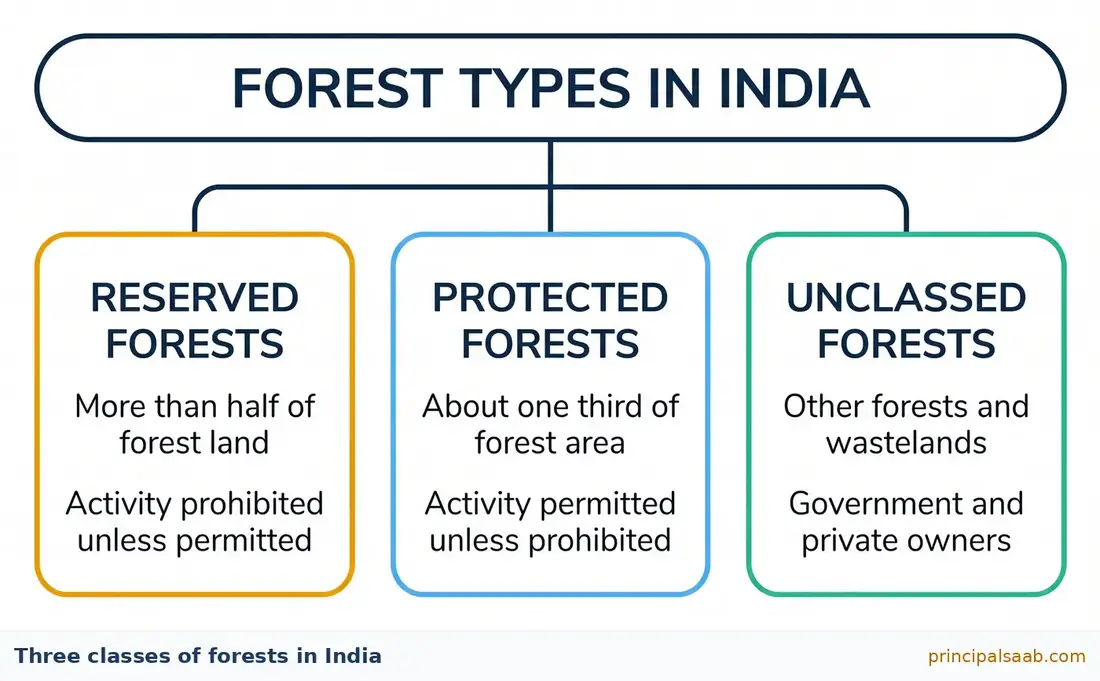
Reserved forests are the most valuable from the point of view of conservation of forest and wildlife. More than half of the total forest land in India has been declared reserved forest. The key idea is that in a reserved forest, activity is prohibited unless specifically permitted. This is the strictest of the three classes.
Protected forests make up close to one-third of the total forest area. These are protected from any further depletion. The key difference is that in a protected forest, activity is permitted unless specifically prohibited. So local people may generally graze cattle or collect firewood except where a particular activity has been banned. Less strict than reserved, but still protected.
Unclassed forests are other forests and wastelands belonging to both government and private individuals and communities. Their defining feature for this chapter is who actually manages them: in large parts of India, particularly the north-east, these forests are managed by local communities rather than by the Forest Department.
Key Rule — the one-line way to keep reserved and protected apart
Reserved forest: everything is forbidden unless it is expressly allowed. Strictest. Over half of India’s forest land.
Protected forest: everything is allowed unless it is expressly forbidden. Middle. Roughly one-third of forest area.
Unclassed forest: other forests and wastelands, government and privately or community owned; frequently managed by local communities.
Memory hook: Reserved is Restricted. Reserved and Restricted both start with R, and reserved is the stricter one. That single letter has rescued a great many exam marks.
| Type of forest | Share and control | Rule for use | States where this class is prominent |
|---|---|---|---|
| Reserved forest | More than half of total forest land; fully controlled by the Forest Department. Most valuable for conservation. | Activity prohibited unless specifically permitted. Strictest class. | Jammu and Kashmir, Andhra Pradesh, Uttarakhand, Kerala, Tamil Nadu, West Bengal and Maharashtra have large shares of their forest as permanent (reserved) forest. |
| Protected forest | Close to one-third of total forest area; protected from further depletion. | Activity permitted unless specifically prohibited. Regulated local use is generally allowed. | Punjab, Haryana, Himachal Pradesh, Odisha and Rajasthan have large proportions of their forest under this class. |
| Unclassed forest | Other forests and wastelands, belonging to government, private individuals and communities. | Frequently managed by local communities rather than by the Forest Department. | All the north-eastern states and parts of Gujarat have a very high proportion of forest as unclassed, much of it managed by local communities. |
Common Mistake — swapping reserved and protected
This is the single most frequently lost mark in the whole chapter. Students confidently write that “protected forests are the most strictly protected” — it sounds right, because the word protected is in the name. It is wrong. Reserved forests are the strictest and the most important for conservation, and they cover more than half of India’s forest land. Protected forests are the middle category at about one-third. Say “Reserved is Restricted” to yourself twice right now, and you will not lose this mark.
Example 17 — “Distinguish between reserved forests and protected forests.” (2 marks)
How to think about it. Two marks, so one clear distinction for each, ideally on the same axis (degree of restriction) so the contrast is unmistakable. Add the share of forest area if you can — it is a free extra detail that costs half a line.
Model answer.
Reserved forests are the forests regarded as most valuable for the conservation of forest and wildlife resources. They are the most strictly controlled category, in which activities are prohibited unless specifically permitted, and they account for more than half of India’s total forest land.
Protected forests are protected from any further depletion but are subject to a less strict regime, in which activities are generally permitted unless specifically prohibited, so regulated local use such as grazing may be allowed. They account for close to one-third of the total forest area.
Marker’s eye. The prohibited-unless-permitted versus permitted-unless-prohibited contrast is the cleanest possible way to express this, and it takes about eight words.
Example 18 — “Classify the forests of India on the basis of ownership and management, and give the distribution of each type.” (5 marks)
How to think about it. The question asks for two things about each type — what it is, and where it is found. Three types times two things is six components across five marks, so keep each one tight. Do not write two lines on definitions and then leave the distribution out; that is exactly half the question.
Model answer.
On the basis of ownership and management, India’s forests are classified into three types.
(i) Reserved forests. These are the most valuable forests for the conservation of forest and wildlife resources, and more than half of India’s total forest land has been declared reserved. Activities within them are prohibited unless specifically permitted. Jammu and Kashmir, Andhra Pradesh, Uttarakhand, Kerala, Tamil Nadu, West Bengal and Maharashtra have large proportions of their forest area under this permanent category.
(ii) Protected forests. These account for close to one-third of the total forest area and are protected from any further depletion, but the regime is less strict, with activities generally permitted unless specifically prohibited. Punjab, Haryana, Himachal Pradesh, Odisha and Rajasthan have large proportions of their forest under this class.
(iii) Unclassed forests. These are other forests and wastelands belonging to both government and private individuals and communities. In many areas they are managed by local communities rather than by the Forest Department. All the north-eastern states and parts of Gujarat have a very high percentage of their forests as unclassed forests managed by local communities.
Concluding line. Reserved and protected forests together are described as permanent forest estates, maintained for the production of timber and other forest produce and for their protective role.
Marker’s eye. Naming actual states is what converts this from a three-mark answer into a five-mark answer. If you can only remember a few, remember the north-east for unclassed — it is the most distinctive and the most likely to be asked about, because it connects straight to the community conservation section that follows.
Community and Conservation: Sacred Groves, Chipko, Navdanya and JFM
Everything so far has mostly been about what governments did. This section is about what ordinary people did, and it is, in my view, the most interesting part of the chapter — and the part that produces the best five-mark answers, because so few students prepare it properly.
The argument being made is a genuinely challenging one. It runs like this: for a long time conservation was assumed to require removing people from forests — fence it, guard it, keep humans out. But the evidence from across India suggests that where local communities have secure rights over a forest and depend on it for their living, they often protect it better and more cheaply than a distant Forest Department can. They are there every day. They know every path. They lose personally if the forest goes. And in many cases they have been doing it for centuries without any law telling them to.
Sacred groves — conservation without a law. In many parts of India, communities have preserved patches of forest as the homes of deities, where cutting trees or killing animals is forbidden by religious custom. These patches, often called sacred groves, are frequently the last remaining fragments of original vegetation in an otherwise cleared landscape, and botanists have found species in them that survive nowhere else nearby. No forest guard, no fine, no fence — and the forest is still standing.
The examples worth knowing: the Mundas and Santhals of the Chota Nagpur region revere the mahua and kadamba trees; communities of Odisha and Bihar worship the tamarind and mango trees during weddings; and the peepal and banyan are treated as sacred across large parts of India. Notice that these are not abstract beliefs but practices woven into everyday ritual, which is precisely why they have lasted.
The Bishnois of Rajasthan. Perhaps the most remarkable case. For the Bishnoi community, protecting animals and trees is a core religious duty. Herds of blackbuck (chinkara), nilgai and peacocks are treated as part of the community and are protected — animals that would be hunted elsewhere move freely among Bishnoi villages. The khejri tree is similarly sacred. This is a community that has, for centuries, treated harming wildlife as a religious offence, and the result is visible in the animal populations around their villages.
The Chipko movement. In the Himalayan region, villagers resisted commercial felling by physically embracing the trees, so that they could not be cut without harming the people. The word chipko means “to cling” or “to hug”, which is exactly what protesters did. The movement did more than stop particular loggings: it demonstrated that community afforestation with indigenous species can succeed, and it changed the national conversation about who forests are actually for. Women were central to it, which is not incidental — they were the ones walking further each year for fuel and fodder.
The Beej Bachao Andolan and Navdanya. These are about seeds and farming rather than about trees, and this is where students most often get confused, so read slowly. The Beej Bachao Andolan (“Save the Seeds Movement”) in Tehri, and the organisation Navdanya, have shown that agricultural diversity can be conserved and farming can remain economically viable without chemical inputs — that farmers can grow diverse traditional crop varieties, save their own seed, avoid expensive chemical fertilisers and pesticides, and still make a living. The point being made is that biodiversity is not only a wild-forest matter; the varieties of rice, millet and pulses that farmers have bred over generations are biodiversity too, and they are disappearing as monocultures spread.
Joint Forest Management (JFM). This is the formal, official version of the community idea. Under JFM, local village communities are involved in the management and restoration of degraded forests in partnership with the Forest Department. Village institutions undertake protection activities, mostly on degraded forest land managed by the department, and in return the community receives benefits — a share of the timber and non-timber forest produce from the forest they protect. Odisha passed the first resolution for joint forest management in 1988, and the approach spread from there.
Villagers protecting wildlife directly. Two cases are worth knowing because they show communities acting against the state’s own plans when those plans harmed them. In Sariska Tiger Reserve, Rajasthan, villagers fought against mining in the area, invoking the Wildlife Protection Act. In the Alwar district of Rajasthan, inhabitants of five villages declared 1,200 hectares of forest as the Bhairodev Dakav Sonchuri, announcing their own set of rules and regulations that prohibited hunting and protected the wildlife against outside encroachment. And around Bharatpur (Keoladeo) in Rajasthan, villagers protested against the expansion of the sanctuary because it threatened their grazing rights and livelihood — a reminder that community interests and official conservation do not always align, and that ignoring that tension is what creates conflict.
| Movement or practice | Where | What it protects | The point it proves |
|---|---|---|---|
| Sacred groves | Across India; Mundas and Santhals of Chota Nagpur (mahua, kadamba); Odisha and Bihar (tamarind, mango); peepal and banyan widely | Patches of original forest and the species within them | Religious and cultural belief can conserve forest without any law or enforcement |
| Bishnoi tradition | Rajasthan | Blackbuck (chinkara), nilgai, peacocks; khejri trees | A community can protect wild animals as a matter of faith for centuries |
| Chipko movement | Himalayan region | Trees, against commercial felling | Community resistance can stop deforestation, and community afforestation with indigenous species succeeds |
| Beej Bachao Andolan and Navdanya | Tehri and elsewhere | Traditional crop varieties and seeds — agricultural biodiversity | Diverse crop production without chemical inputs can remain economically viable |
| Joint Forest Management (JFM) | First resolution in Odisha, 1988; now widespread | Degraded forest land, restored in partnership with the Forest Department | Formal partnership works when communities get a real share of the produce |
| Bhairodev Dakav Sonchuri | Five villages in Alwar district, Rajasthan | 1,200 hectares of forest and its wildlife | Villagers can create and enforce their own conservation rules against outside encroachment |
Common Mistake — mixing up Chipko and Beej Bachao Andolan
These two get swapped constantly, and swapping them costs a whole mark because the examples become meaningless. Separate them by what is being saved:
Chipko = trees. “Chipko” means to hug, and people hugged trees. Himalayan region, resistance to commercial felling, community afforestation with indigenous species.
Beej Bachao Andolan = seeds. “Beej” literally means seed. Tehri region, and along with Navdanya it is about conserving traditional crop varieties and showing that diversified farming without chemicals can still be profitable.
One more slip to avoid: JFM is not a protest movement. Chipko and Beej Bachao Andolan were movements started by people. Joint Forest Management is an official government programme, formally begun with Odisha’s 1988 resolution, in which the Forest Department and village communities work together. Calling JFM a “movement” in an answer suggests you have not understood the difference between people organising themselves and the state creating a scheme.
Key Idea — the argument in one paragraph
Conservation that treats local people as intruders tends to fail, because it creates enemies out of the very people who live closest to the forest and who can watch over it every day. Conservation that gives communities secure rights and a genuine share in the benefits tends to succeed, because it makes protecting the forest the rational thing for those people to do. The lesson running through sacred groves, the Bishnois, Chipko and Joint Forest Management is the same one: forests survive best where the people who live with them have both the right and the reason to defend them.
Example 19 — “How have communities in India helped in the conservation of forests and wildlife? Explain with four examples.” (4 marks)
How to think about it. Four marks, four examples, one mark each. The way to lose marks here is to give four examples of the same kind — say, four different sacred groves. Choose four that are different in character: a religious tradition, a protest movement, an official partnership, and a self-declared community sanctuary. Variety itself demonstrates coverage.
Model answer.
(i) Sacred groves and sacred species. Many communities have preserved patches of forest as the abode of deities, where felling and hunting are forbidden by custom. The Mundas and Santhals of the Chota Nagpur region revere the mahua and kadamba trees, and communities in Odisha and Bihar worship tamarind and mango trees during weddings. These groves often survive as the last undisturbed vegetation in a cleared landscape.
(ii) The Bishnois of Rajasthan. For this community the protection of animals and trees is a religious duty, and herds of blackbuck, nilgai and peacocks live safely in and around their villages. This has conserved species that have been hunted heavily elsewhere.
(iii) The Chipko movement in the Himalayas. Villagers resisted commercial felling by clinging to the trees, successfully halting deforestation in their areas and demonstrating that community afforestation using indigenous species can succeed where commercial plantation had failed.
(iv) Villagers of Alwar district, Rajasthan. The inhabitants of five villages declared 1,200 hectares of forest as the Bhairodev Dakav Sonchuri, framing their own rules and regulations which prohibited hunting and protected the wildlife against outside encroachment. (Joint Forest Management, begun with Odisha’s resolution of 1988, is an equally acceptable fourth point.)
Marker’s eye. The figure “1,200 hectares” and the name “Bhairodev Dakav Sonchuri” are exactly the kind of specific detail that makes an examiner confident you know the material. If a name is hard to remember, at least keep the number and the district.
Example 20 — “What is Joint Forest Management? How does it benefit both the forest and the local community?” (3 marks)
How to think about it. The question has a definition part and a benefits part, and the benefits part has two audiences — forest and community. Make sure all three appear. A very common half-answer defines JFM correctly and then only talks about the forest.
Model answer.
What it is. Joint Forest Management is a programme under which local village communities are involved, in partnership with the state Forest Department, in the management and restoration of degraded forests. Village-level institutions undertake protection activities on forest land managed by the department. Odisha passed the first resolution for joint forest management in 1988.
Benefit to the forest. Degraded forest land is protected against grazing, illegal felling and fire by people who live beside it and can watch it continuously, which is far more effective than periodic patrolling by a department with limited staff, so regeneration actually takes place.
Benefit to the community. In return for their protection work, the participating communities receive intermediate benefits such as non-timber forest produce, and a share in the timber harvested from the successfully protected forest. This gives them a direct economic stake in the forest’s survival, so conservation becomes the profitable choice rather than a sacrifice.
Marker’s eye. That last clause — “conservation becomes the profitable choice rather than a sacrifice” — is the whole logic of JFM in nine words. If you understand why that sentence is true, you understand the section.
Example 21 — Case-based question (4 marks)
Read the passage and answer the questions that follow.
In a district of eastern India, a stretch of about 900 hectares of degraded forest had been almost stripped bare by unregulated felling and grazing. Repeated attempts by the Forest Department to protect it with a small staff of guards failed, since the area was too large to patrol and villagers had no reason to cooperate. In 1994 an agreement was reached with eleven surrounding villages. Each village formed a committee that took responsibility for a section of the forest, organising rotational patrols by its own members. In exchange, the villagers were assured of the right to collect fuelwood, fodder, fruit, honey and medicinal plants, and a share in the timber revenue when the forest matured. Within twelve years the tree cover had regenerated substantially, and species of birds absent for decades were recorded again. Grazing pressure had fallen because the committees themselves fixed and enforced limits.
(a) Name the approach to forest management described in the passage. (1 mark)
Joint Forest Management (JFM), in which local village communities protect and restore degraded forest in partnership with the Forest Department.
(b) Why had the Forest Department’s earlier efforts failed? (1 mark)
The department had too few guards to patrol so large an area effectively, and the surrounding villagers had no stake in the forest’s survival and therefore no reason to cooperate with its protection.
(c) Explain two reasons why the new arrangement succeeded. (2 marks)
First, the villagers were given a direct economic stake in the forest — assured rights to fuelwood, fodder, fruit, honey and medicinal plants, and a share in future timber revenue — so protecting the forest became in their own interest rather than a restriction imposed on them. Second, continuous local supervision proved far more effective than external policing: villagers live beside the forest and can watch it every day, and because the committees set the grazing limits themselves, those limits were accepted and enforced from within the community instead of being resisted as an outside imposition.
Marker’s eye. Part (c) rewards you for spotting the causal chain rather than repeating the passage. The passage says grazing pressure fell; the reason it fell is that the rule-makers and the rule-followers were the same people. Always look for the sentence in a source passage that explains why something worked, and put that mechanism into your own words.
Sustainable Conservation: What a Balanced Answer Looks Like
We are nearly at the end of the teaching, and this section pulls the whole chapter together. It is also the section that supplies the closing paragraph for almost any long answer you will write here, so it is worth reading twice.
The chapter has set up a tension. On one side: people need land, food, energy, minerals, jobs and roads, and a country with widespread poverty cannot simply stop developing. On the other side: forests and wildlife are being lost at a rate that damages the very systems — soil, water, climate, pollination — that all of that development ultimately rests on. Sustainable conservation is the attempt to answer that tension rather than to pick a side.
The underlying principle is straightforward to state and hard to do: use resources in a way that meets present needs without destroying the ability of future generations to meet theirs. In forest terms, that means taking from a forest no faster than the forest can regenerate, and not destroying the parts of it that cannot be regenerated at all.
What does that look like in practice? Here are the components of a genuinely balanced answer.
- Protect whole ecosystems, not just famous species. Grasslands, wetlands, mangroves and coastal habitats need protection as habitat types in their own right, not only where they happen to contain a flagship animal.
- Give local communities rights and a share. Where the people living beside a forest have secure rights and receive a real share of its produce, protection becomes rational self-interest instead of an imposed burden. This is the JFM lesson.
- Maintain corridors, not just islands. Protected areas connected by corridors allow animals to move, breed and recolonise. Isolated reserves slowly lose species even when they are well guarded.
- Assess projects honestly before approving them. Environmental impact assessment, genuine consultation with affected people, and serious examination of alternative designs, sites and scales before the largest option is chosen.
- Reduce demand, not only supply. Since a large share of the pressure comes from high consumption, reducing waste, recycling paper and wood, using energy efficiently and choosing sustainable materials attacks the problem at its source rather than only defending the last forests.
- Afforest with native, mixed species. Planting a single fast-growing commercial species creates cover but not habitat. Chipko’s demonstration that community afforestation with indigenous species works is the model here.
- Enforce the law properly, and fund the enforcement. Sariska showed that a reserve which exists on paper but is not genuinely patrolled and resourced can lose its entire tiger population.
Key Idea — the closing paragraph you can adapt to almost any long answer here
Conservation and development are not opposites. The real choice is not between protecting nature and improving people’s lives, but between a pattern of growth that destroys the ecological base on which those lives depend and one that does not. Sustainable conservation therefore requires protecting whole ecosystems rather than only famous species, securing the rights and the share of the communities who live with forests, assessing large projects honestly before approving them, and reducing the excessive consumption that drives much of the pressure in the first place.
Example 22 — “Suggest any five measures for the sustainable conservation of forests and wildlife in India.” (5 marks)
How to think about it. “Suggest measures” questions are generous, because there are many acceptable answers — but only if your measures are specific and actionable. “The government should do something about pollution” earns nothing. Each measure should name a concrete action and, ideally, say what it achieves. Aim for five measures that operate at different levels: law, community, habitat design, project approval, and consumption.
Model answer.
(i) Effective enforcement of protective law. The provisions of the Indian Wildlife (Protection) Act, 1972 must be backed by adequately staffed and funded patrolling, monitoring and anti-poaching work. The loss of the entire tiger population of Sariska Tiger Reserve to poaching in the early 2000s showed that legal designation alone does not protect a forest.
(ii) Involving local communities as partners. Communities living around forests should be given secure rights and a genuine share in forest produce through arrangements such as Joint Forest Management, so that protecting the forest is in their own economic interest. Sacred groves, the Bishnoi tradition and the Chipko movement all show that communities protect forests effectively when they have a stake in them.
(iii) Protecting whole ecosystems and maintaining corridors. Conservation should extend to grasslands, wetlands and mangroves, and not only to habitats containing large, well-known animals. Protected areas should be linked by legally secured wildlife corridors so that animals can move between them, since isolated reserves gradually lose species even when well guarded.
(iv) Honest assessment of development projects. Large dams, mines, roads and industrial projects in forest areas should undergo genuine environmental impact assessment, with consultation of affected communities, proper resettlement, and serious consideration of smaller or alternative designs before approval.
(v) Afforestation with native species, and reduced consumption. Replanting should use mixed indigenous species that restore habitat rather than single-species commercial plantations that produce cover without biodiversity. At the same time, reducing wasteful consumption of timber, paper and energy, and recycling wood and paper, reduces the demand that drives forest clearance in the first place.
Conclusion. Conservation and development are not opposites; the aim is a pattern of growth that does not destroy the ecological base on which development itself depends.
Marker’s eye. Every measure here is anchored to something from the chapter — Sariska, JFM, the bustard problem, Chipko. Anchored measures read as knowledge; unanchored ones read as common sense, and common sense is not what is being marked.
How to Write Answers That Actually Score in This Chapter
Before the worksheet, a short section on technique. Two students can know the same amount and score two marks apart purely because of how they write. Since this chapter is entirely a writing chapter — remember, no map items — technique matters more here than almost anywhere else in Geography.
Rule one: match the length to the marks. Roughly one developed point per mark. A one-mark question gets one sentence. A three-mark question gets three points, each about two lines. A five-mark question gets five points, or four points plus a conclusion. Writing a page for a one-mark question does not earn extra credit; it just steals time from the questions where the marks actually are.
Rule two: point, then explanation, then example. This three-beat rhythm is the single most reliable structure in Social Science. Start with a short bolded or underlined phrase naming the point, follow with a sentence explaining the mechanism, and close with a named example. Markers scanning quickly can find the point instantly, and the example proves you are not bluffing.
Rule three: number your points. Use (i), (ii), (iii). It takes no extra time and it guarantees the examiner can count your points. An unnumbered paragraph containing three good points sometimes gets marked as though it contained two, because the third one was buried mid-sentence.
Rule four: read the command word and obey it. “Define” wants a sentence. “Explain” wants mechanisms. “Distinguish” wants a genuine contrast on a shared axis. “Discuss” and “examine” want both sides plus your view. “Suggest” wants concrete actions. Answering an “explain” question with a definition is one of the commonest ways to lose marks while writing something perfectly true.
Rule five: attach a year to every statistic. Forest cover, tiger numbers, lion numbers, species counts — all of these change. “About 3,167 tigers in the 2022 estimation” is safe. “There are 3,167 tigers” is a hostage to fortune. This also applies in reverse: if your textbook gives an older figure, quoting it with its year is always correct.
Exam Tip — the five names that will carry you through this chapter
If you are short on revision time, make absolutely sure these five are secure, because between them they can be used in almost every question the chapter generates: 1972 (Wildlife Protection Act), 1973 (Project Tiger), 1988 (Odisha’s first JFM resolution), Sariska (mining protest, and the poaching failure), and Chipko (community resistance and indigenous-species afforestation). Add Bhairodev Dakav Sonchuri in Alwar if you can, because almost nobody remembers it and it is instantly impressive.
Example 23 — Turning a weak answer into a strong one (worked comparison)
The question. “Explain any three causes of the decline of wildlife in India.” (3 marks)
A weak answer (would score about 1 out of 3). “Wildlife is declining in India because of many reasons. People cut trees and destroy forests. Animals are hunted and killed by hunters. Pollution is also increasing everywhere which is very harmful for animals. If this continues, all animals will die and it will be very bad for our country. We should all save wildlife.”
What went wrong. Every sentence is true, and almost none of it is worth a mark. There are no mechanisms — why does cutting trees kill wildlife? There are no named examples, no places, no species. The last two sentences are pure sentiment and earn nothing. And the points are not numbered, so an examiner cannot easily count three of anything.
The same knowledge, rewritten (would score 3 out of 3).
(i) Habitat loss through clearing of forests. Forests have been cleared on a large scale for agriculture, settlement and industry, so the area available to wild species has steadily contracted and animals are confined to shrinking patches that cannot support viable populations.
(ii) Habitat fragmentation by development projects and mining. Dams, roads, railway lines and mines break large forests into isolated blocks and cut migration corridors. Dolomite mining near the Buxa Tiger Reserve in West Bengal has threatened habitat in this way, and elephants forced to cross roads and farmland come into conflict with people.
(iii) Poaching and the illegal wildlife trade. Organised poaching for skins, bones, ivory and horn has driven several species toward extinction; tigers were wiped out entirely from Sariska Tiger Reserve by poaching in the early 2000s despite its protected status.
The lesson. The second answer is not longer than the first by much, and it does not require knowing anything the first student did not know in outline. The difference is entirely mechanism plus named example plus numbering. Practise converting your own vague sentences this way and your marks in this chapter will move quickly.
Practice Worksheet with Hidden Answers
Right — this is the part that actually turns reading into marks. Ten original questions, mixed across one, three, four and five marks, in roughly the proportions a board paper uses. Please do them properly: paper out, pen in hand, notes closed, no scrolling up. Attempt the question first, then click to reveal the answer.
If you get one wrong, do not just read the correct answer and nod. Write down in one line what you missed — a mechanism, an example, a distinction — because that one line is your revision list, and it will be far shorter and far more useful than re-reading the whole chapter.
Q1 (1 mark). What is meant by an endemic species? Give one Indian example. — Show Answer
An endemic species is one that is found naturally in a particular geographical area alone and nowhere else, usually because that area is isolated by natural or political boundaries. Example: the Nicobar pigeon (the Andaman teal, the Andaman wild pig and the mithun of Arunachal Pradesh are equally acceptable).
Watch out: endemic describes where a species lives, not how endangered it is. Do not define it as “a species in danger of extinction” — that is the endangered category.
Q2 (1 mark). Name the Act that provides the main legal framework for wildlife protection in India, and state the year it was enacted. — Show Answer
The Indian Wildlife (Protection) Act, enacted in 1972. It provided an all-India legal framework for protecting wildlife habitats, published a list of protected species, banned hunting of listed species, provided for the creation of national parks and wildlife sanctuaries, and restricted trade in wildlife and wildlife products.
Q3 (3 marks). Distinguish between reserved forests, protected forests and unclassed forests. — Show Answer
(i) Reserved forests are those regarded as most valuable for the conservation of forest and wildlife resources. More than half of India’s total forest land has been declared reserved. They are the most strictly controlled category, in which activities are prohibited unless specifically permitted. States such as Jammu and Kashmir, Andhra Pradesh, Uttarakhand, Kerala, Tamil Nadu, West Bengal and Maharashtra have large shares of forest in this class.
(ii) Protected forests account for close to one-third of the total forest area and are protected from any further depletion, but the regime is less strict — activities are generally permitted unless specifically prohibited. Punjab, Haryana, Himachal Pradesh, Odisha and Rajasthan have large proportions of forest in this class.
(iii) Unclassed forests are other forests and wastelands belonging to both government and private individuals and communities, and in many regions they are managed by local communities rather than the Forest Department. All the north-eastern states and parts of Gujarat have a very high percentage of unclassed forest.
Watch out: reserved is stricter than protected, despite the names sounding the other way round. Remember: Reserved is Restricted.
Q4 (3 marks). Explain why the depletion of forests is described as a social problem and not only an environmental one. — Show Answer
(i) It destroys the livelihood of the poorest. Poor and forest-dwelling communities depend directly on forests for firewood, fodder, fruits and tubers, medicinal plants, building material and small forest produce sold for cash. When a forest is lost, these households lose fuel, food and income simultaneously, whereas wealthier households simply buy the same goods in a market.
(ii) The burden falls unequally, and especially on women. In most rural households it is women who collect firewood, fodder and water. As forests recede they must walk much greater distances, which lengthens their working day, damages their health, and often forces girls to leave school to help at home.
(iii) Those who benefit are not those who pay. The demand that drives large-scale forest loss — for timber, paper, minerals, electricity and land for commercial crops — comes mainly from richer, urban and industrial consumers, while the cost is borne by displaced forest communities. This mismatch between beneficiary and sufferer makes it a question of social justice.
Watch out: do not blame tribal or forest-dwelling communities for deforestation. This chapter argues the opposite, and the evidence supports it.
Q5 (3 marks). What is the difference between a national park, a wildlife sanctuary and a biosphere reserve? — Show Answer
(i) A national park is an area set aside for the protection of an entire ecosystem — its landscape, vegetation and wildlife together. It carries the strictest regime, and human activities such as grazing, collection of forest produce and private landholding are generally not permitted within it.
(ii) A wildlife sanctuary is aimed primarily at protecting particular species of wildlife. Its rules are somewhat less restrictive, and certain regulated human activities may be allowed where they do not harm the wildlife it exists to protect.
(iii) A biosphere reserve is a much larger area that combines conservation with human use. It has a strictly protected core zone, surrounded by buffer and transition zones in which local communities live, farm and carry out research and education, so that conservation and human activity are managed together rather than separated. India has 18 biosphere reserves.
Watch out: the ordering of strictness is national park (strictest) then wildlife sanctuary; the biosphere reserve is not “less strict” overall — it is zoned, with a strict core and permitted use outside it.
Q6 (3 marks). “Shifting cultivation is not in itself the cause of forest degradation.” Explain this statement. — Show Answer
(i) How the system traditionally worked. In shifting cultivation a patch of forest is cleared and burnt, cropped for two or three seasons, and then abandoned so that the forest can regenerate while the cultivators move to another patch. Where the fallow period was long — commonly fifteen to twenty years — the vegetation and soil fertility recovered fully before the patch was used again, so the system was sustainable and was practised for centuries without permanent damage.
(ii) What changed. Growing population and a shrinking area of land available to these communities forced the cycle to shorten drastically, sometimes to only three or four years of fallow. With so little time, the forest cannot regenerate, soil fertility is not restored, and the land degrades permanently.
(iii) The correct conclusion. The degradation therefore results from the shortening of the fallow cycle, which is caused by population pressure and loss of land to other uses, and not from the practice of shifting cultivation itself. Blaming the practice, and the communities who follow it, mistakes a symptom for the cause.
Q7 (4 marks). Source-based question. Read the passage and answer the questions that follow. — Show Answer
In a semi-arid district of western India lies a stretch of open grassland of roughly 400 sq km. Official land records classify it as “wasteland”. Over the past two decades a large part of it has been allotted for a solar power installation, a network of transmission lines, and plantations of a fast-growing exotic tree species intended to raise the district’s tree cover figures. The grassland is the last regular breeding ground in the state for a large ground-dwelling bird whose national population is now counted in the low hundreds. Field studies report that the birds, which fly low and have restricted forward vision, are frequently killed in collisions with the overhead transmission lines. Local pastoralist families, who have grazed livestock here for generations without displacing the birds, have lost access to much of the area.
(a) Which conservation category best describes the bird’s situation, and why? (1 mark)
It is critically endangered, since its national population has fallen to only a few hundred individuals and it is at immediate risk of extinction. (The Great Indian Bustard is the real-world species matching this description, and is assessed by the IUCN as Critically Endangered.)
(b) Explain how the official classification of the area as “wasteland” has contributed to the problem. (1 mark)
Because grasslands are recorded as wasteland rather than as a habitat type, they are treated as land with no ecological value that can be freely diverted to other uses. This classification allowed the breeding ground to be allotted for solar installations, transmission lines and plantations without being recognised as the destruction of a critical habitat.
(c) Identify two distinct threats to the bird described in the passage. (1 mark)
First, habitat loss and conversion — the breeding grassland is being taken over by solar installations and by plantations of an exotic tree species, which changes open grassland into a structure the bird cannot breed in. Second, direct mortality from infrastructure — the birds fly low with restricted forward vision and are frequently killed colliding with overhead transmission lines.
(d) Suggest one measure that would protect the bird while allowing renewable energy development to continue. (1 mark)
The transmission lines crossing the core breeding grassland could be laid underground, or rerouted around it, so that the collision risk is removed while the solar installation continues to generate power. (Also acceptable: legally notifying the grassland as a protected habitat and siting new installations outside it; restoring pastoralist grazing rights, since traditional grazing maintained the open grassland structure the bird needs.)
Marker’s note: part (d) rewards a measure that satisfies both aims stated in the question. An answer saying “the solar project should be cancelled” does not, because the question explicitly asks for development to continue.
Q8 (5 marks). Describe the major causes of the depletion of forest and wildlife resources in India. — Show Answer
(i) Expansion of agriculture. The conversion of forest into cropland to feed a growing population has been the single largest historical cause of forest loss in India, accounting for a very large share of the forest area lost since the colonial period.
(ii) Colonial and commercial forestry. Under colonial rule forests were treated as a source of timber and revenue. Diverse natural forests were felled for railway sleepers and shipbuilding and replaced by single-species commercial plantations of tea, coffee and rubber, which reduced biodiversity even where tree cover remained.
(iii) Large development projects and mining. River valley projects, dams, roads, industry and townships have submerged or cleared extensive forest tracts — the Narmada Sagar project in Madhya Pradesh submerged a large forest area — while mining strips vegetation, dumps waste over surrounding land, pollutes streams and severs migration corridors, as in the case of dolomite mining near the Buxa Tiger Reserve in West Bengal.
(iv) Habitat fragmentation, hunting and poaching. Roads, canals and railway lines divide forests into isolated blocks, so wide-ranging animals cannot move between them, populations become genetically weak and human-wildlife conflict rises. Alongside this, hunting for sport in the colonial period and organised poaching since — for skins, bones, ivory, horn and shahtoosh — has driven several species toward extinction.
(v) Unequal access, over-consumption and pollution. A disproportionate share of the demand for timber, minerals, energy and land comes from richer and industrial consumers, while shortened shifting-cultivation cycles caused by population pressure, industrial and agricultural pollution, forest fires and the spread of invasive species add further degradation.
Bonus line if you have space: “The depletion is therefore largely the outcome of human decisions about how land and resources are used and distributed, and its costs fall most heavily on the communities who depend on forests directly.”
Q9 (5 marks). “Local communities are often better guardians of forests than the state.” Discuss this statement with reference to examples from India. — Show Answer
Arguments supporting the statement.
(i) Continuous local supervision. Communities live beside the forest and can watch it every day, whereas a Forest Department with limited staff cannot patrol large areas effectively. Where villagers organise their own protection, illegal felling and uncontrolled grazing are detected immediately.
(ii) Direct self-interest. Households that depend on a forest for firewood, fodder, fruit and medicinal plants lose personally if it disappears, so they have a real reason to protect it. Under Joint Forest Management, first formalised by Odisha’s resolution of 1988, communities protect degraded forest in return for non-timber produce and a share of timber revenue, and regeneration has followed.
(iii) Long-standing cultural protection. Sacred groves preserved as the homes of deities are often the last patches of original vegetation in a cleared landscape, and the Bishnois of Rajasthan have protected blackbuck, nilgai, peacocks and khejri trees for centuries as a religious duty — conservation achieved without any law or enforcement at all.
(iv) Effective resistance and self-made rules. The Chipko movement in the Himalayas halted commercial felling and showed that community afforestation with indigenous species succeeds. Villagers at Sariska fought mining in the reserve through the courts, and in Alwar district the inhabitants of five villages declared 1,200 hectares as the Bhairodev Dakav Sonchuri with their own rules prohibiting hunting.
The qualification. (v) The statement should not be taken as absolute. Communities cannot on their own resist well-financed international poaching networks or large industrial projects, and community and conservation interests sometimes conflict — villagers around Bharatpur protested against the expansion of the sanctuary because it threatened their grazing and livelihood. State law, funding and enforcement remain necessary; the failure of protection at Sariska, where poaching wiped out the tigers in the early 2000s, showed what happens when official enforcement is weak.
Conclusion. The evidence suggests not that communities should replace the state but that conservation works best when the two act together — where the state provides law, funding and enforcement, and communities hold secure rights and a genuine share in the benefits, so that protecting the forest is in their own interest.
Q10 (5 marks). Explain the IUCN-based classification of species according to conservation status, and state why such a classification is useful. — Show Answer
The categories.
(i) Normal species — populations are at levels considered normal for their survival, such as cattle, sal, pine and rodents.
(ii) Endangered species — in danger of extinction, and unlikely to survive if the factors causing their decline continue to operate. Examples: the black buck, the Indian wild ass, the Indian rhino, the lion-tailed macaque and the sangai of Manipur.
(iii) Vulnerable species — populations have declined to a level from which they are likely to move into the endangered category if the adverse factors persist; one stage less critical than endangered. Examples: the blue sheep, the Asiatic elephant and the Gangetic dolphin.
(iv) Rare species — small populations, which may move into the endangered or vulnerable category if the negative factors affecting them continue. Examples: the Himalayan brown bear, the wild Asiatic buffalo, the desert fox and the hornbill.
(v) Endemic species — found only within a particular area, isolated by natural or political boundaries, such as the Andaman teal and the Nicobar pigeon; and extinct species — no longer found anywhere, or no longer found in the habitats they once occupied, such as the Asiatic cheetah in India.
Why the classification is useful. It converts a vague sense that “wildlife is in trouble” into a ranked assessment, so that limited conservation funds, staff and legal protection can be directed first to the species closest to being lost. It also allows change to be measured over time — a species moving from endangered to vulnerable shows that a conservation effort is working, as with the reclassification of the snow leopard from Endangered to Vulnerable by the IUCN in 2017 — and it provides the shared international standard on which trade restrictions and national protection lists are built.
Watch out: the second half of this question is where most students lose marks, because they list the categories and stop. Always answer the “why is it useful” part explicitly.
Before You Close This Page
If you worked through even half of that worksheet honestly, you now know this chapter better than most students who will sit the paper. Not because you memorised more, but because you practised writing it, and this chapter is entirely a writing chapter — remember, no map items, every mark earned on the page.
A quick self-check before you go. Can you, without looking: state what biodiversity means; name the six conservation categories with one Indian example each; give six causes of depletion; explain the difference between reserved and protected forests; say what Project Tiger achieved and where it fell short; and name four ways Indian communities have conserved forests? If any of those made you pause, go back to just that section. Not the whole chapter — just that one section. That is what efficient revision actually looks like.
And if it still feels like a lot, that is completely normal. Nobody absorbs this in one sitting, and you are not supposed to. Come back tomorrow, reread the two callout boxes you found hardest, and try three worksheet questions again.
Kaizen: aim for one more correct question than yesterday. Not ten more — one. Do that every day between now and the exam, and the arithmetic will look after itself.