
Let us begin with something honest. If you have opened your Maths book, seen a picture of an ice-cream cone or a circus tent sitting on a page full of formulas, and felt your stomach sink a little — you are completely normal. Almost every Class 10 student decides early on that this chapter has “too many formulas to remember”. Stay with me for the next hour, because I want to show you the opposite: Surface Areas and Volumes is one of the most forgiving chapters in the whole paper. It rewards neatness far more than cleverness. There is no trick to spot, no clever substitution to hunt for. There is only a shape, a few honest formulas, and careful arithmetic.
Here is the single idea the whole chapter rests on. Every “scary” solid you will meet in your board paper is really just two simple solids stuck together. A capsule is a cylinder with two hemispheres on its ends. An ice-cream cone is a cone with a hemisphere of ice cream on top. A circus tent is a cylinder with a cone as its roof. A test tube is a cylinder with a rounded hemispherical bottom. Once you learn to see the parts, the question stops being “what formula do I use?” and becomes “which two shapes am I looking at, and which of their surfaces can I actually see?” That second question you can always answer.
Take a breath. We are going to build this from absolute zero — starting with what a surface area even is, moving through the formula toolkit, then combinations, then cavities, then full board-level word problems, and finishing with a worksheet where every answer is worked out for you. Read slowly. Keep a pen in your hand. Do not move on from a section until it feels comfortable.
What You’ll Learn
- Why This Chapter Feels Hard (And Why It Isn’t)
- The Formula Toolkit You Must Own
- Surface Area vs Volume — Telling Them Apart
- Surface Area of a Combination of Solids
- Volume of a Combination of Solids
- Solids With a Cavity or Scooped-Out Part
- Board-Level Word Problems — Reading the Shape Out of the Sentence
- What Was Removed From This Chapter
- Practice Worksheet With Full Solutions
Your Game Plan
- Spend twenty minutes only on the formula table below. Copy it out by hand — do not photograph it. Your hand remembers what your eyes forget.
- Learn to draw a rough labelled diagram for every question, even a five-second one. Mark r, h and l on it before you touch a formula.
- Do the surface-area sections before the volume sections. Surface area is the harder half; once it clicks, volume feels like a reward.
- For every worked example, cover the solution with your hand, try it yourself, then compare. Reading a solution is not the same as being able to write one.
- Finish with the worksheet at the bottom. Attempt each question fully on paper before you click to reveal the answer.
Why This Chapter Feels Hard (And Why It Isn’t)
Let me guess what happened. You opened the chapter, saw six solids, each with two or three formulas attached, counted roughly fifteen formulas on one page, and your brain quietly said “I cannot hold all of this.” That reaction is about volume of information, not about difficulty. Nothing in this chapter is conceptually hard. There is no proof to construct, no case to argue. It is recognition plus arithmetic.
So here is the mental shift I want you to make right now. Stop thinking of a “toy in the shape of a cone mounted on a hemisphere” as a new object with its own new formula. There is no formula for it, and there never will be. It is a cone. Plus a hemisphere. You already know both. All the question is asking is: when you glue them together, which surfaces stay visible and which disappear inside the joint?
Try this small exercise before we go further. Look around your room and name the two solids in each of these: a medicine capsule, a pencil sharpened at one end, a badminton shuttlecock’s rubber base, a gas cylinder, a glass of water with a rounded bottom. You will find you can do it instantly. That instinct — “cylinder plus hemisphere”, “cylinder plus cone” — is the single most valuable skill in this chapter, and you already have it. We are just going to attach numbers to it.
Slow it down. The question mentions a cone, but read again — it only wants the dome. So ignore the cone completely. One shape, one formula.
Volume of a hemisphere = (2/3) × pi × r³
= (2/3) × (22/7) × 3.5 × 3.5 × 3.5
= (2/3) × (22/7) × 42.875
= (2/3) × 134.75
= 89.83 cm³ (rounded to 2 decimal places; exactly 539/6 cm³).
Why it works: a hemisphere is exactly half a sphere, and a sphere is (4/3)pi r³. Half of 4/3 is 2/3. You never have to memorise the hemisphere volume separately — just halve the sphere.
Think before you calculate. The flat circular face is pressed against the table. Nobody can see it. So we want only the curved dome.
Curved surface area of a hemisphere = 2 × pi × r²
= 2 × (22/7) × 7 × 7
= 2 × 22 × 7
= 308 cm²
Notice what we did not do: we did not use total surface area 3pi r² = 462 cm², because that would include the hidden flat circle. This one decision — “is this face visible or hidden?” — is what separates full marks from half marks in this chapter.
Why it works: surface area is literally the area of paint you would need. If paint cannot reach a face, that face does not belong in your answer.
The Formula Toolkit You Must Own
This is your one memorisation job for the chapter. Everything else is reasoning. Learn this table so well that you could write it on a blank page in three minutes with no prompting. I mean that literally — set a timer and try it tomorrow morning.
Before the table, three words you must not mix up. CSA (curved surface area) means only the round, bendy part. LSA (lateral surface area) is the same idea for flat-sided solids — the walls, not the floor and ceiling. TSA (total surface area) means every single face of the solid, flat ones included.
| Solid | CSA / LSA | Total Surface Area | Volume |
|---|---|---|---|
| Cuboid length l, breadth b, height h |
2h(l + b) | 2(lb + bh + hl) | l × b × h |
| Cube edge a |
4a² | 6a² | a³ |
| Right circular cylinder radius r, height h |
2 pi r h | 2 pi r (r + h) | pi r² h |
| Right circular cone radius r, height h, slant l |
pi r l | pi r (l + r) | (1/3) pi r² h |
| Sphere radius r |
4 pi r² | 4 pi r² (same — no flat face) | (4/3) pi r³ |
| Hemisphere radius r |
2 pi r² | 3 pi r² (dome + flat circle) | (2/3) pi r³ |
| Slant height link (cone only) |
l² = h² + r², so l = square root of (h² + r²) | ||
Let me help you with the one relation students get wrong most often: l² = h² + r² for a cone. Picture slicing a cone straight down the middle through its tip. You get a triangle. Its vertical side is the height h, its horizontal half-base is the radius r, and the sloping edge from tip to rim is the slant height l. That sloping edge is the hypotenuse of a right triangle, so the Pythagoras theorem you met in the Triangles chapter applies. The slant height is always the longest of the three. If you ever calculate an l that is smaller than h or r, you have made an arithmetic slip — go back.
Step 1 — slant height. l² = h² + r² = 12² + 5² = 144 + 25 = 169, so l = 13 cm. (5, 12, 13 is a triplet worth memorising.)
Step 2 — CSA. pi r l = (22/7) × 5 × 13 = 1430/7 = 204.29 cm² (2 d.p.).
Step 3 — TSA. TSA = CSA + base circle = pi r l + pi r² = pi r (l + r) = (22/7) × 5 × 18 = 1980/7 = 282.86 cm² (2 d.p.).
Step 4 — Volume. (1/3) pi r² h = (1/3) × (22/7) × 25 × 12 = (22/7) × 100 = 2200/7 = 314.29 cm³ (2 d.p.).
Why it works: notice the volume used h = 12 and the surface areas used l = 13. Same cone, two different heights, two different jobs. Never let them swap places.
(a) Lateral surface area = 2h(l + b) = 2 × 8 × (12 + 10) = 16 × 22 = 352 cm². These are the four vertical walls: two of size 12 × 8 and two of size 10 × 8. Add them yourself and check: 96 + 96 + 80 + 80 = 352. The formula is just a shortcut for that addition.
(b) Total surface area = 2(lb + bh + hl) = 2(120 + 80 + 96) = 2 × 296 = 592 cm². That is the 352 of walls plus the top and bottom, each 120 cm²: 352 + 240 = 592. It matches.
(c) Volume = l × b × h = 12 × 10 × 8 = 960 cm³.
Why it works: a cuboid has three pairs of identical faces. Every surface-area formula here is nothing more than “add the six rectangles”. If you ever forget the formula in an exam, draw the box and add the six rectangles by hand. You will still get full marks.
Sphere.
Surface area = 4 pi r² = 4 × (22/7) × 441 = 4 × 22 × 63 = 5544 cm².
Volume = (4/3) pi r³ = (4/3) × (22/7) × 9261 = (4/3) × 29106 = 38808 cm³.
Hemisphere.
Curved surface = 2 pi r² = 2 × (22/7) × 441 = 2772 cm² (exactly half the sphere, as expected).
Total surface = curved + flat circle = 2 pi r² + pi r² = 3 pi r² = 4158 cm².
Volume = (2/3) pi r³ = 19404 cm³ (exactly half of 38808).
Why it works: cutting a sphere in half halves the curved skin and halves the inside — but it also creates a brand new flat face that did not exist before. That extra pi r² is why the hemisphere’s total surface is 3 pi r² and not 2 pi r². This single sentence explains half the errors students make in this chapter.
Surface Area vs Volume — Telling Them Apart
I want to slow right down here, because a surprising number of marks are lost not to hard calculation but to answering the wrong question. Let me give you two everyday pictures that you will never forget.
Surface area is the wrapping paper. It is the skin. It is how much paint, canvas, tin sheet, gift wrap or polish you need to cover the outside. It is a two-dimensional quantity, so its units are squared: cm², m², mm².
Volume is what fits inside. It is the water the tank holds, the ice cream in the cone, the grain in the silo, the wood in the block. It is three-dimensional, so its units are cubed: cm³, m³, mm³, or litres.
| If the question says… | It wants | Units |
|---|---|---|
| paint / polish / canvas / tin sheet / cost per square metre | Surface area | cm², m² |
| capacity / holds / fills / how much water / litres | Volume | cm³, m³, litres |
| wood used / material in the solid / mass at a given density | Volume | cm³, m³ |
| wrapped / covered / outer area / label / decorated | Surface area | cm², m² |
There is one more distinction that matters more than any other in this chapter, and it is the reason surface area is harder than volume. When two solids are joined, the material inside simply adds up — nothing is lost. But some outside faces get pressed together and vanish from view. Volume is loyal; surface area is not. Hold on to that sentence.
Surface area = 6a² = 6 × 36 = 216 cm².
Volume = a³ = 6 × 6 × 6 = 216 cm³.
The digits match. Students see this and panic, or worse, they decide surface area and volume are “the same for a cube”. They are not. One of them is 216 square centimetres of cardboard skin. The other is 216 cubic centimetres of solid stuff inside. If you built this cube out of paper you would use 216 cm² of paper; if you filled it with water it would hold 216 mL.
Why it works: the coincidence happens only because a = 6 makes 6a² = a³. Try a = 5: surface 150 cm², volume 125 cm³ — nothing alike. The lesson is simply that units carry meaning. Never drop them, and never write cm² where cm³ belongs. Examiners deduct for it.
Before joining.
Each cube has surface 6 × 4² = 96 cm². Two separate cubes: 96 + 96 = 192 cm².
Each cube has volume 4³ = 64 cm³. Two cubes: 64 + 64 = 128 cm³.
After joining. The new solid is a cuboid of 8 cm × 4 cm × 4 cm.
Surface = 2(lb + bh + hl) = 2(8×4 + 4×4 + 4×8) = 2(32 + 16 + 32) = 2 × 80 = 160 cm².
Volume = 8 × 4 × 4 = 128 cm³.
The comparison. Volume: 128 before, 128 after — unchanged, exactly as promised. Surface area: 192 before, 160 after — a loss of 32 cm².
Why it works: where did 32 cm² go? Two square faces of 4 × 4 = 16 cm² each were pressed against each other and are now sealed inside the joint. 2 × 16 = 32. That is the entire mechanism of “add and subtract” that the next section is built on. Nothing was destroyed; it just stopped being outside.
Surface Area of a Combination of Solids
This is the heart of the chapter, and it is where most of your marks live. Let me give you a procedure that has never failed a student who followed it honestly. Do not improvise. Do these five steps in this order, every time.
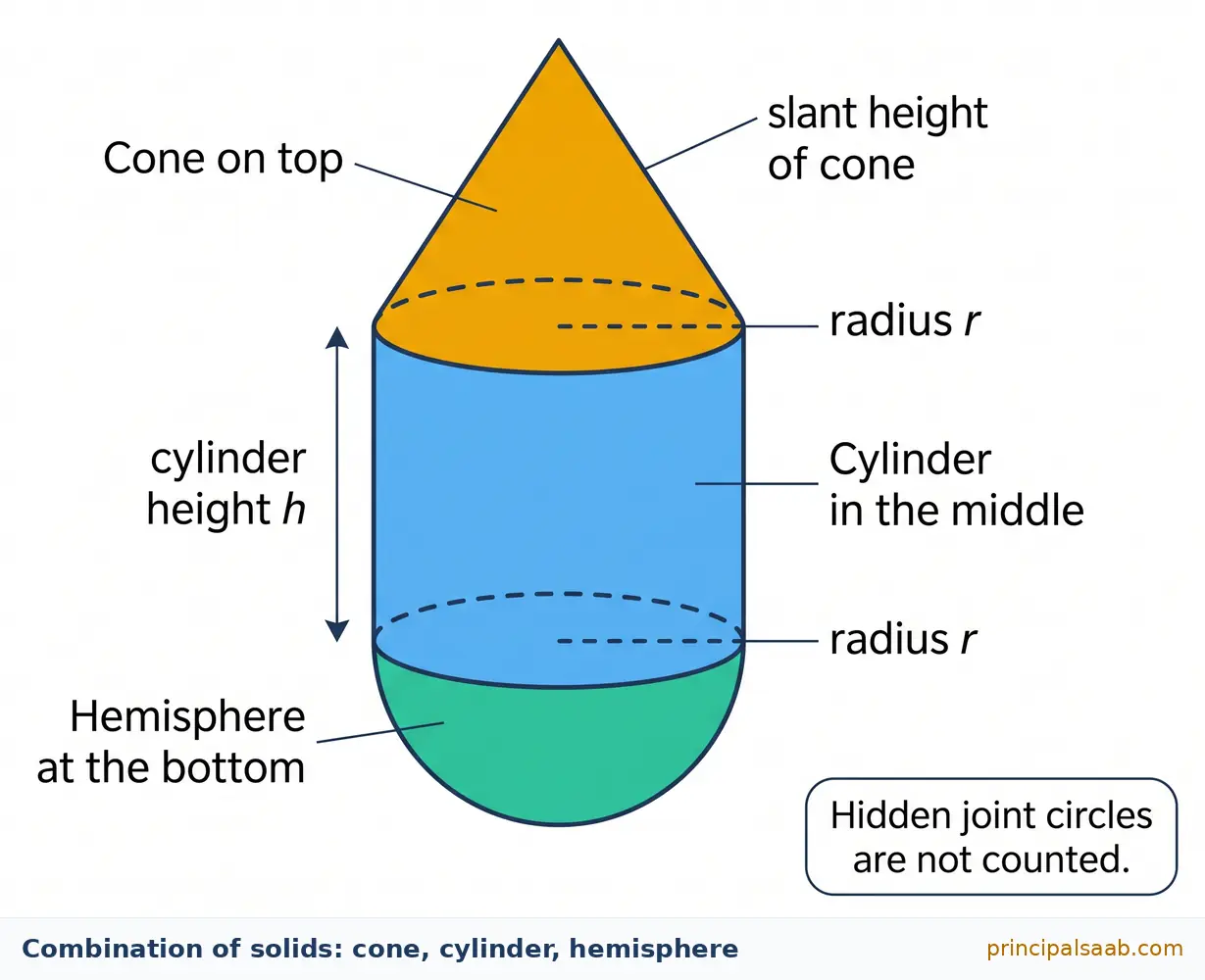
- Draw the solid and mark the joint with a dotted line. Label r, h and l where they belong.
- Name the two parts out loud: “cone on top, hemisphere below” or “cylinder with a cone roof”.
- List every surface the two parts have, including flat circles and bases.
- Cross out the hidden ones — anything sealed at the joint, and anything resting on the ground if the question implies you cannot see it.
- Add what is left, in one line, then substitute numbers. Never substitute before you have the full expression written.
One more habit that will save you: when two round solids are joined, they must share the same radius, otherwise there would be an ugly ledge sticking out. So if a question gives you a cone “mounted on” a hemisphere and tells you one radius, that radius belongs to both. Similarly, when a cone sits on a cylinder, the circular joint is the base of the cone and the top of the cylinder — both circles are hidden and both drop out of your calculation.
Step 1 — what can you see? The curved side of the cone, and the dome of the hemisphere. The cone’s flat circular base is glued to the hemisphere’s flat circular face — both are hidden. So we need cone CSA + hemisphere curved surface.
Step 2 — slant height. l² = h² + r² = 144 + 12.25 = 156.25, so l = 12.5 cm.
Step 3 — cone CSA. pi r l = (22/7) × 3.5 × 12.5 = 11 × 12.5 = 137.5 cm².
Step 4 — hemisphere curved surface. 2 pi r² = 2 × (22/7) × 12.25 = 2 × 38.5 = 77 cm².
Step 5 — total. 137.5 + 77 = 214.5 cm².
Why it works: if you had carelessly used the cone’s TSA (pi r l + pi r² = 175.5) and the hemisphere’s TSA (3 pi r² = 115.5) you would get 291 cm² — and you would be counting the sealed joint twice, once as the cone’s base and once as the hemisphere’s flat face. 291 − 2(38.5) = 214.5, the same correct answer. Both routes agree.
Step 1 — get the radius. Diameter 5 mm, so r = 2.5 mm. This radius is shared by the cylinder and both hemispheres.
Step 2 — get the cylinder height. This is the step students skip. The 14 mm is the whole capsule, and each hemispherical cap sticks out by one radius. So the cylinder alone is 14 − 2.5 − 2.5 = 9 mm tall.
Step 3 — list the visible surfaces. The curved wall of the cylinder, plus the two hemispherical domes. The cylinder’s two flat circular ends are both capped and therefore invisible, and so are the two hemispheres’ flat faces.
Step 4 — calculate.
Cylinder curved surface = 2 pi r h = 2 × (22/7) × 2.5 × 9
Two hemisphere domes = 2 × (2 pi r²) = 4 pi r² (which is, pleasingly, the surface of one whole sphere)
Total = 2 pi r (h + 2r) = 2 × (22/7) × 2.5 × (9 + 5) = 2 × (22/7) × 2.5 × 14 = 2 × 22 × 2.5 × 2 = 220 mm².
Why it works: two hemispheres of the same radius are one sphere in disguise. Spotting that lets you replace 2 × 2 pi r² with 4 pi r² and finish faster. Also notice how factoring out 2 pi r before substituting made the sevens cancel cleanly — always write the full algebraic expression first.
Step 1 — what is made of canvas? The cylindrical wall and the conical roof. The floor is the ground, not canvas, so no base circle. The joint circle between cylinder and cone is inside the fabric and is not a surface at all.
Step 2 — cylinder wall. 2 pi r h = 2 × (22/7) × 14 × 3 = 2 × 44 × 3 = 264 m².
Step 3 — conical roof. pi r l = (22/7) × 14 × 25 = 44 × 25 = 1100 m².
Step 4 — total canvas. 264 + 1100 = 1364 m².
Step 5 — cost. 1364 × 60 = Rs 81,840.
Why it works: the question already handed you the slant height, so no Pythagoras was needed — read carefully before you start hunting for h. Also notice how “the tent stands on the ground” quietly removed one whole circle from your working. Real-world wording is always telling you which faces to drop.
Step 1 — find the radius. The largest circle that fits inside a 7 cm square has diameter 7 cm, so r = 3.5 cm.
Step 2 — think about the top face carefully. The cube still has all six faces, but a circle of area pi r² on the top face is now covered by the hemisphere. In exchange, the hemisphere’s dome (2 pi r²) is added.
Step 3 — write one expression before substituting.
TSA = 6a² − pi r² + 2 pi r² = 6a² + pi r²
Step 4 — substitute.
6a² = 6 × 49 = 294 cm²
pi r² = (22/7) × 12.25 = 38.5 cm²
TSA = 294 + 38.5 = 332.5 cm²
Why it works: look at how the two pi r² terms collapsed. You subtracted one circle and added two half-spheres’ worth of dome, leaving a net “+ pi r²”. Doing that algebra before plugging in numbers saved you two calculations and removed two chances to slip. Make this a habit: simplify symbolically first, substitute last.
Volume of a Combination of Solids
Good news: this section is genuinely easier than the last one, and I want you to enjoy it. Here is the whole rule.
Why is volume so much kinder than surface area? Because the joint between two solids is a surface, and a surface has zero thickness. It has area but no volume. So it can hide surface area, but it cannot hide any material. This is exactly what we saw in Example 7: the two cubes lost 32 cm² of skin but not a single cubic centimetre of substance.
The one thing that still trips people is the same thing as before: splitting the given total height correctly between the two parts. Take your time on that step. Draw the dotted line at the joint and label each piece separately.
Cone part. (1/3) pi r² h = (1/3) × (22/7) × 12.25 × 12 = (22/7) × 12.25 × 4 = 38.5 × 4 = 154 cm³.
Hemisphere part. (2/3) pi r³ = (2/3) × (22/7) × 42.875 = (2/3) × 134.75 = 89.83 cm³ (exactly 539/6).
Total. 154 + 89.83 = 243.83 cm³, correct to two decimal places. (Exact value 1463/6 cm³.)
Why it works: no subtraction anywhere. The flat circle where the dome meets the cone’s rim is a surface, not a volume, so it takes nothing away. Notice also that I simplified (1/3) × 12 to 4 before multiplying — small moves like that keep your numbers small and your errors few.
Recall the split. r = 2.5 mm, cylinder height = 14 − 2(2.5) = 9 mm.
Cylinder. pi r² h = (22/7) × 6.25 × 9 = 1237.5/7 = 176.79 mm³ (2 d.p.).
Two hemispheres = one sphere. (4/3) pi r³ = (4/3) × (22/7) × 15.625 = 1375/21 = 65.48 mm³ (2 d.p.).
Total. Exactly 10175/42 mm³ = 242.26 mm³, correct to two decimal places.
Why it works: the numbers here are deliberately not “nice”, and that is on purpose — your board paper will sometimes do this to you. When it happens, keep exact fractions in your working for as long as you can and only convert to a decimal at the very end. If you round 176.7857 to 176.79 first and 65.4761 to 65.48 first, you can drift in the last digit. Round once, at the end, and state what you rounded to.
Step 1 — radius. Diameter 14 cm gives r = 7 cm.
Step 2 — the height split. Read this twice. The hemispherical bottom bulges downward by exactly one radius, that is 7 cm. So the straight cylindrical part is 13 − 7 = 6 cm tall. Students who use h = 13 here lose the whole question.
Step 3 — cylinder. pi r² h = (22/7) × 49 × 6 = 154 × 6 = 924 cm³.
Step 4 — hemisphere. (2/3) pi r³ = (2/3) × (22/7) × 343 = (2/3) × 1078 = 718.67 cm³ (exactly 2156/3).
Step 5 — capacity. 924 + 718.67 = 1642.67 cm³ (2 d.p.), which is about 1.64 litres since 1000 cm³ = 1 litre.
Why it works: the phrase “total height” is the examiner’s favourite trap in this chapter. A hemisphere of radius r adds exactly r to the height. A cone of height h adds exactly h. Always sketch, always label, always subtract before you compute.
(a) Volume. Cuboid = 15 × 10 × 8 = 1200 cm³. Cube = 5³ = 125 cm³. Total = 1325 cm³. Straight addition, no thinking required.
(b) Surface area. Now think.
Cuboid TSA = 2(15×10 + 10×8 + 8×15) = 2(150 + 80 + 120) = 700 cm².
The cube covers a 5 × 5 = 25 cm² patch of the cuboid’s top, so subtract 25.
The cube itself shows five faces (four sides and its top), so add 5 × 25 = 125 cm².
Total = 700 − 25 + 125 = 800 cm².
Why it works: compare part (a) with part (b) and let the difference sink in. The volumes just added; the surface areas needed a subtraction and an addition. This single example is the clearest summary of the whole chapter, so if you remember only one worked problem from this page, make it this one.
Solids With a Cavity or Scooped-Out Part
So far we have been sticking shapes together. Now we do the opposite: something gets carved out, drilled through, or hollowed. The wording to watch for is scooped out, hollowed out, a depression, drilled, a cavity, a hole made through. Do not let this section scare you — it uses the same thinking as before, just with the signs flipped for volume.
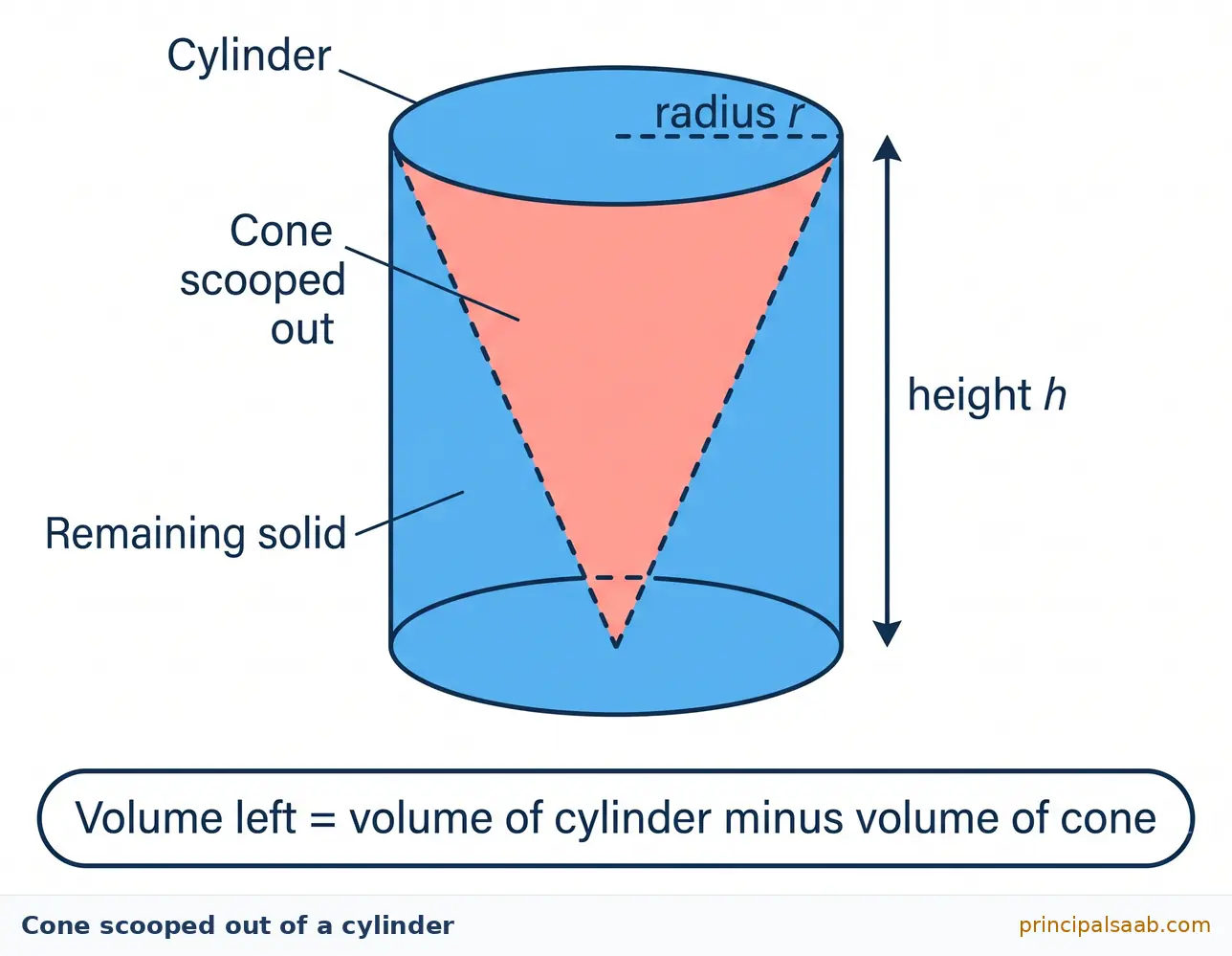
Surface area: take the big solid’s surface, remove the flat patch where the opening now is, and add the new inner wall that the cavity has exposed. So you subtract one thing and add another — do not do only one of the two.
Here is the picture I want in your head. Imagine pressing your thumb into a lump of clay. You took clay away, so the volume went down. But the outside skin did not simply shrink — you destroyed a flat circle of the old surface and created a new curved dent that is also a surface. Surface area can even go up when you scoop something out. That surprises almost everyone the first time.
Step 1 — radius. Largest hemisphere on a 7 cm face means diameter 7 cm, so r = 3.5 cm.
(a) Surface area.
Start with the whole cube: 6a² = 6 × 49 = 294 cm².
Remove the circular opening: − pi r² = −38.5 cm².
Add the inner curved dent: + 2 pi r² = +77 cm².
TSA = 294 − 38.5 + 77 = 294 + 38.5 = 332.5 cm².
(b) Volume.
Cube = 343 cm³. Hemisphere removed = (2/3) pi r³ = 89.83 cm³.
Remaining = 343 − 89.83 = 253.17 cm³ (2 d.p.; exactly 1519/6).
Why it works — and something lovely. Compare this 332.5 cm² with Example 11, where we mounted a hemisphere on top of the same cube and also got 332.5 cm². Identical! Both cases replace one flat circle (− pi r²) with one dome (+ 2 pi r²), giving a net + pi r² either way. The volumes, however, are completely different: 432.83 cm³ when you add the dome, 253.17 cm³ when you scoop it out. Surface area could not tell the two apart; volume could.
(a) Volume left.
Cylinder = pi r² h = (22/7) × 49 × 24 = 154 × 24 = 3696 cm³.
Cone = (1/3) pi r² h = (1/3) × 3696 = 1232 cm³.
Wood left = 3696 − 1232 = 2464 cm³.
Shortcut worth knowing: when a cone of the same radius and height is removed from a cylinder, exactly two-thirds of the wood survives, since the cone is one-third of the cylinder. (2/3) × 3696 = 2464. Same answer, one line.
(b) Surface area. Walk around the object.
Outer curved wall of cylinder: 2 pi r h = 2 × (22/7) × 7 × 24 = 1056 cm².
The solid flat bottom (the end that was not drilled): pi r² = 154 cm².
The open top: the entire circle there has become the mouth of the cone, so nothing flat remains — contribute 0.
The inner conical wall: pi r l, where l² = 24² + 7² = 576 + 49 = 625, so l = 25 cm. pi r l = (22/7) × 7 × 25 = 550 cm².
TSA = 1056 + 154 + 0 + 550 = 1760 cm².
Why it works: the outer curved surface was never touched by the drilling, so it stays whole. The top circle disappeared entirely because the cavity’s mouth is exactly as wide as the cylinder. And the cone’s slanted inner wall, invisible from outside, is still a real surface you could paint — so it counts.
Step 1 — how long is the hole? It goes through the 10 cm thickness, so the cylinder’s height is 10 cm.
(a) Volume.
Block = 20 × 15 × 10 = 3000 cm³.
Hole = pi r² h = (22/7) × 12.25 × 10 = 38.5 × 10 = 385 cm³.
Wood left = 3000 − 385 = 2615 cm³.
(b) Surface area.
Block TSA = 2(20×15 + 15×10 + 10×20) = 2(300 + 150 + 200) = 1300 cm².
Two circular mouths removed (one at each end): − 2 pi r² = −77 cm².
Inner tube wall added: 2 pi r h = 2 × (22/7) × 3.5 × 10 = 220 cm².
TSA = 1300 − 77 + 220 = 1443 cm².
Why it works: a hole that goes all the way through opens two mouths, so you subtract two circles, not one. Compare with Example 16 where the dent was in one face only and you subtracted a single circle. Count the openings by looking at your diagram — never by habit. Also notice the surface area went up from 1300 to 1443 even though wood was removed. That is the clay-and-thumb picture in action.
Board-Level Word Problems — Reading the Shape Out of the Sentence
By now the mathematics is under control. What remains is translation — turning a paragraph of English into a labelled diagram. Let me hand you the vocabulary key that examiners use over and over.
| Phrase in the question | What it is telling you |
|---|---|
| “surmounted by” / “mounted on” / “topped with” | Two solids joined; the joining faces are hidden |
| “total height” / “total length” | Split it — subtract r for each hemisphere cap, subtract the cone height for a cone top |
| “stands on the ground” / “placed on a table” | The base face is not visible; leave it out of surface area |
| “open at the top” / “open vessel” | Do not include the top circle |
| “capacity” / “how much it can hold” | Volume, usually to be converted to litres |
| “cost at Rs x per m²” | Find the area first, multiply last; check your units are m² and not cm² |
| “diameter” (not radius) | Halve it immediately, before anything else |
Step 1 — radius. Diameter 7 m, so r = 3.5 m. Both the cylinder and the cone share it.
Step 2 — slant height of the roof. l² = h² + r² = 1.44 + 12.25 = 13.69, so l = 3.7 m.
Step 3 — cylinder volume. pi r² h = (22/7) × 12.25 × 8 = 38.5 × 8 = 308 m³.
Step 4 — cone volume. (1/3) pi r² h = (1/3) × 38.5 × 1.2 = 38.5 × 0.4 = 15.4 m³.
Step 5 — total. 308 + 15.4 = 323.4 m³.
Why it works: notice that 8 m was given as the height of the cylindrical part, not the total height — so no splitting was needed. Read that clause carefully every time; sometimes the question is being kind to you. And notice the cone’s short 1.2 m roof contributes only about 5 percent of the storage, which is a sensible-looking answer. Always ask “does this number look reasonable?” before you move on.
Step 1 — radius. 2.8 / 2 = 1.4 m.
Step 2 — cylinder. pi r² h = (22/7) × 1.96 × 4 = 6.16 × 4 = 24.64 m³.
Step 3 — hemisphere. (2/3) pi r³ = (2/3) × (22/7) × 2.744 = (2/3) × 8.624 = 5.7493 m³.
Step 4 — total in cubic metres. 24.64 + 5.7493 = 30.3893 m³, which rounds to 30.39 m³ (2 d.p.).
Step 5 — convert. 1 m³ = 1000 litres, so the tank holds about 30,389 litres (to the nearest litre).
Why it works: the question said “the cylindrical part alone is 4 m tall”, which spared you the height split — but you should still have checked. Everything was done in metres throughout, so the volume came out in m³ and one clean conversion finished the job. Mixing centimetres and metres halfway through is one of the most expensive errors in this chapter; pick one unit at the start and stay there.
Step 1 — decide what is visible. The curved wall of the cylinder, plus the hemispherical dome. The bottom circle rests on the floor: not painted. The circle where the dome meets the cylinder: sealed inside: not painted.
Step 2 — write the expression first.
Painted area = 2 pi r h + 2 pi r² = 2 pi r (h + r)
Step 3 — substitute.
= 2 × (22/7) × 0.35 × (2.5 + 0.35)
= 2 × 1.1 × 2.85
= 6.27 m²
Step 4 — cost. 6.27 × 80 = Rs 501.60.
Why it works: factoring out 2 pi r turned a two-formula problem into one multiplication. That factoring habit is worth practising on every cylinder-plus-hemisphere question you meet, because the pairing appears constantly — pillars, tanks, test tubes, water bottles.
Do not panic at the absence of numbers. The formulas work exactly the same way with letters.
Cone volume = (1/3) pi r² h, and here h = r, so it is (1/3) pi r³.
Hemisphere volume = (2/3) pi r³.
Ratio = (1/3) pi r³ : (2/3) pi r³
The pi and the r³ cancel from both sides, leaving 1/3 : 2/3, that is 1 : 2.
Why it works: whenever a question asks for a ratio, expect everything messy to cancel. Write both volumes fully, put them in a ratio, then strike out every common factor. If nothing cancels, re-check your formulas — a ratio question that stays ugly usually means an error upstream. And a useful fact falls out for free: this solid is exactly one-third cone and two-thirds hemisphere by volume.
What Was Removed From This Chapter
If you have an older textbook, a second-hand guide, or a set of notes from a cousin who sat the exam a few years ago, you may find topics in this chapter that no longer belong here. I want to be straight with you about that, because studying material you will never be tested on is the most expensive way to waste your revision time.
1. Frustum of a cone. That is the shape you get when the pointed top of a cone is sliced off parallel to the base — think of a bucket or a lampshade. Its formulas (the ones with R and r together) are no longer examinable at Class 10 level.
2. Conversion of a solid from one shape to another. These are the classic “a metallic sphere is melted and recast into a cylinder” or “how many small cones can be made” problems. They have been dropped.
3. Problems involving combinations of more than two solids. Your questions will involve exactly two of: cube, cuboid, sphere, hemisphere, right circular cylinder, right circular cone.
Please confirm this against the current syllabus copy issued by your own school or board, since scope can be revised. If a frustum question does appear in a Class 10 Maths practice paper you have been given, treat it as enrichment, not as exam preparation.
So what is in scope? Exactly what this chapter has taught you: finding the surface area and the volume of an object made by combining any two of a cube, a cuboid, a sphere, a hemisphere, a right circular cylinder and a right circular cone. That is the whole territory. Everything in the eight sections above sits inside it, and nothing above goes beyond it. If you can do the twenty-two worked examples on this page comfortably, you have covered the chapter.
One gentle caution. Removed does not mean forbidden or useless. If you plan to take Maths further, the frustum reappears later and the melting-and-recasting idea is genuinely beautiful physics-adjacent reasoning. But for your board paper this year, put your energy where the marks are.
Practice Worksheet With Full Solutions
Here are ten original questions, arranged roughly from easy to board level. Work each one fully on paper — diagram, expression, substitution, answer with units — before you click to open the solution. Reading a solution you have not attempted teaches you almost nothing. Struggling for four minutes and then reading it teaches you a great deal. Unless a question says otherwise, use pi = 22/7.
Q1. A cone has base radius 6 cm and vertical height 8 cm. Find its slant height, curved surface area, total surface area and volume. — click for the full solution
CSA = pi r l = (22/7) × 6 × 10 = 1320/7 = 188.57 cm² (2 d.p.).
TSA = pi r (l + r) = (22/7) × 6 × 16 = 2112/7 = 301.71 cm² (2 d.p.).
Volume = (1/3) pi r² h = (1/3) × (22/7) × 36 × 8 = (22/7) × 96 = 2112/7 = 301.71 cm³ (2 d.p.).
Look at that: the TSA and the volume came out to the same digits. They are still completely different quantities — one is 301.71 square centimetres, the other 301.71 cubic centimetres. Keep your units attached and the coincidence cannot confuse you.
Q2. Two cubes, each of edge 6 cm, are joined face to face. Find the total surface area and the volume of the resulting cuboid, and state how much surface area was lost in joining. — click for the full solution
TSA = 2(lb + bh + hl) = 2(12×6 + 6×6 + 6×12) = 2(72 + 36 + 72) = 2 × 180 = 360 cm².
Volume = 12 × 6 × 6 = 432 cm³. (Check: 6³ + 6³ = 216 + 216 = 432. Volumes add, as always.)
Surface area lost: two separate cubes would have 2 × 6 × 6² = 2 × 216 = 432 cm². So the loss is 432 − 360 = 72 cm², which is exactly the two 6 × 6 = 36 cm² faces now sealed at the joint.
Q3. A toy is a cone mounted on a hemisphere. Both have radius 7 cm and the cone is 24 cm tall. Find (a) the total surface area of the toy and (b) its volume. — click for the full solution
(a) Surface area. Only the cone’s curved side and the hemisphere’s dome are visible; the joining circles are sealed.
Cone CSA = pi r l = (22/7) × 7 × 25 = 550 cm².
Hemisphere curved = 2 pi r² = 2 × (22/7) × 49 = 308 cm².
TSA = 550 + 308 = 858 cm².
(b) Volume.
Cone = (1/3) pi r² h = (1/3) × (22/7) × 49 × 24 = (1/3) × 154 × 24 = 1232 cm³.
Hemisphere = (2/3) pi r³ = (2/3) × (22/7) × 343 = (2/3) × 1078 = 718.67 cm³.
Total = 1232 + 718.67 = 1950.67 cm³ (2 d.p.; exactly 5852/3).
Q4. A capsule is 20 mm long and 6 mm in diameter, with hemispherical ends. Find its surface area and its volume. — click for the full solution
Surface area. Cylinder wall + two domes = 2 pi r h + 4 pi r² = 2 pi r (h + 2r)
= 2 × (22/7) × 3 × (14 + 6) = 2 × (22/7) × 3 × 20 = 2640/7 = 377.14 mm² (2 d.p.).
Volume. Cylinder + one whole sphere (two hemispheres) = pi r² h + (4/3) pi r³
= (22/7) × 9 × 14 + (4/3) × (22/7) × 27
= 396 + 2376/21
= 396 + 113.14 = 509.14 mm³ (2 d.p.; exactly 3564/7).
Q5. A cubical wooden block of edge 10 cm has a hemispherical depression of radius 3.5 cm carved into one face. Find the total surface area and the volume of the remaining block. — click for the full solution
Cube = 6a² = 6 × 100 = 600 cm².
Circle removed = pi r² = (22/7) × 12.25 = 38.5 cm².
Dent added = 2 pi r² = 77 cm².
TSA = 600 − 38.5 + 77 = 638.5 cm².
(Or in one move: 6a² + pi r² = 600 + 38.5.)
Volume. Cube = 10³ = 1000 cm³. Hemisphere removed = (2/3) pi r³ = (2/3) × (22/7) × 42.875 = 89.83 cm³.
Remaining = 1000 − 89.83 = 910.17 cm³ (2 d.p.; exactly 5461/6).
Notice: the surface area went up (600 to 638.5) even though wood was removed.
Q6. A circus tent has a cylindrical base of radius 21 m and height 5 m, with a conical roof of height 20 m. Find the canvas required and its cost at Rs 75 per square metre. — click for the full solution
Step 2 — cylindrical wall. 2 pi r h = 2 × (22/7) × 21 × 5 = 2 × 66 × 5 = 660 m².
Step 3 — conical roof. pi r l = (22/7) × 21 × 29 = 66 × 29 = 1914 m².
Step 4 — total canvas. 660 + 1914 = 2574 m². The floor is the ground, so no base circle is included.
Step 5 — cost. 2574 × 75 = Rs 1,93,050.
Q7. A vessel is a hollow cylinder of internal radius 6 cm and cylindrical height 10 cm, closed by a hemispherical bottom of the same radius. Find its capacity, taking pi = 3.14, and give the answer in litres. — click for the full solution
Cylinder. pi r² h = 3.14 × 36 × 10 = 1130.4 cm³.
Hemisphere. (2/3) pi r³ = (2/3) × 3.14 × 216 = 3.14 × 144 = 452.16 cm³.
Capacity. 1130.4 + 452.16 = 1582.56 cm³.
In litres. 1582.56 / 1000 = 1.58 litres (to 2 d.p.).
Note on rounding: with pi = 3.14 these figures are exact to the decimals shown, so the only rounding happened at the litre conversion.
Q8. A solid cylinder of radius 7 cm and height 20 cm has a cone of the same radius and of height 9 cm hollowed out from one end. Find the volume of the remaining solid. — click for the full solution
Cone removed. Careful — the cone’s height is 9 cm, not 20 cm. It does not reach all the way through.
(1/3) pi r² h = (1/3) × (22/7) × 49 × 9 = (1/3) × 154 × 9 = 154 × 3 = 462 cm³.
Remaining volume. 3080 − 462 = 2618 cm³.
Trap avoided: if you had assumed the cone shared the cylinder’s height of 20 cm you would have subtracted 1026.67 and got 2053.33 — a completely wrong answer from a single careless reading.
Q9. A solid sphere has diameter 21 cm. Find its surface area and its volume. — click for the full solution
Surface area = 4 pi r² = 4 × (22/7) × 110.25 = 4 × 346.5 = 1386 cm².
Volume = (4/3) pi r³ = (4/3) × (22/7) × 1157.625 = (4/3) × 3638.25 = 4851 cm³.
Both answers came out as whole numbers — a strong hint that you halved the diameter correctly. If a “nice” question is giving you an endless decimal, suspect a radius-versus-diameter slip first.
Q10. A cuboidal wooden base measures 24 cm × 12 cm × 8 cm, and a solid cube of edge 8 cm is fixed centrally on its top face. Find the total surface area and the volume of the combined solid. — click for the full solution
Surface area.
Cuboid TSA = 2(24×12 + 12×8 + 8×24) = 2(288 + 96 + 192) = 2 × 576 = 1152 cm².
The cube hides an 8 × 8 = 64 cm² patch of the cuboid’s top: subtract 64.
The cube shows five faces (four sides plus its top): add 5 × 64 = 320 cm².
TSA = 1152 − 64 + 320 = 1408 cm².
Sanity check: adding both solids’ full surface areas would give 1152 + 384 = 1536 cm². Subtracting the joint twice, 1536 − 2(64) = 1408 cm². The two routes agree, which is always worth a ten-second check in the exam.
Before You Close This Page
If some of that felt heavy, that is not a verdict on your ability — it is simply what a first pass feels like. Come back tomorrow and redo Examples 8, 15 and 17 from a blank page. Then redo the worksheet on the weekend. If you want more mensuration practice with 2D figures first, work through Areas Related to Circles — the sector and segment work there feeds straight into the curved surfaces here. You will be startled by how much easier it feels the second time, because your brain will have quietly filed the formulas away overnight.
And please do not try to master the whole chapter in one sitting. That is not how any of this works. Kaizen: aim for one more correct question than you managed yesterday. One extra question a day, every day, and by the time the board paper is in front of you this chapter will feel like an old friend rather than a threat. You have got this.