
Take a breath. Probability is one of the friendliest chapters in the whole Class 10 Maths syllabus, and I want you to know that before we start. There is no long theorem to prove, no construction to draw with a compass, no identity to memorise for three pages. There is essentially one formula, and the rest of the chapter is just learning to count carefully. If you can count, you can do this chapter. That is genuinely the whole secret.
Think about the coin toss before a cricket match. The captain calls “heads”, the coin spins in the air, and for one second nobody in the stadium knows what will happen. That tiny moment of not-knowing is exactly what probability studies. We cannot say what the coin will do. But we can say, with complete mathematical confidence, how likely each result is. That is a beautiful thing, and it is what you are about to learn to do.
I am going to walk you through this from absolute zero. We will build the vocabulary first, then the one formula, then we will practise it on coins, dice, playing cards, bags of marbles and lucky-draw tickets until it feels automatic. Take your time. Read slowly. Work every example on paper before you look at my solution. Ready?
Keep three useful companions nearby as you practise: use the Real Numbers notes when a probability fraction needs simplifying, revisit the Triangles notes when ratio language feels unfamiliar, and finish with the Class 10 Maths practice paper for mixed, timed revision.
- Probability in One Sentence — chance as a number between 0 and 1
- Experiment, Outcome, Event and Sample Space — the vocabulary that makes everything easy
- Equally Likely Outcomes — the assumption the whole chapter rests on
- The Classical Formula — favourable outcomes over total outcomes
- Sure Events, Impossible Events and the 0-to-1 Range
- Complementary Events — P(E) + P(not E) = 1 and when to use the shortcut
- Coins — one coin, two coins, three coins
- Dice — one die and two dice (the 36-outcome grid)
- A Deck of 52 Playing Cards — the structure you must memorise
- Bags, Balls, Marbles and Numbered Tickets
- Board-Style Word Problems and How to Set Them Up
- Practice Worksheet with Full Solutions
Your Game Plan
- Learn the four words: experiment, outcome, event, sample space. Twenty minutes, no more.
- Learn the one formula and write it at the top of every answer you ever give.
- Master counting the sample space for coins, dice and cards. This is where marks are actually won.
- Learn the complement shortcut for “at least” and “not” questions.
- Do the worksheet at the end without looking, then check. Redo anything you got wrong the next day.
1. Probability in One Sentence
Here it is, the whole chapter in one line: probability is a number that measures how likely something is, on a scale from 0 to 1.
That is it. In everyday life you already do this without numbers. You say “there is no chance it will rain today” or “she will definitely top the class” or “it is a fifty-fifty situation”. Probability just replaces those words with numbers so that everybody means exactly the same thing.
On this scale, 0 means “this will never happen”, 1 means “this will certainly happen”, and everything in between is a shade of maybe. A probability of 0.5 means it is as likely to happen as not. A probability of 0.9 means it is very likely. A probability of 0.02 means it is very unlikely but not impossible.
Let us look at two quick situations so the idea stops being abstract.
Think it through: the pointer can stop in any one of 8 equal sectors. Because the sectors are equal in size, no sector is more “attractive” to the pointer than another. Of those 8 sectors, 3 give you the prize.
Solution: P(winning) = 3/8.
That is a bit less than a half, so you would expect to lose slightly more often than you win. Notice how the answer already tells you something useful about the real world.
Think it through: “identical except colour” is the examiner quietly telling you that every single marble is equally likely to be the one your fingers close around. So count marbles, not colours. Total marbles = 5 + 7 = 12. Red marbles = 5.
Solution: P(red) = 5/12.
Why it works: you are not choosing between “red” and “blue” as two options — that would wrongly give 1/2. You are choosing between 12 individual marbles, and 5 of them happen to be red. Always count the physical objects.
Do not move on until Example 2 feels comfortable, because the mistake it warns about (counting colours instead of marbles) is the single most common error students make in this chapter.
2. Experiment, Outcome, Event and Sample Space
Four words. Learn them properly now and the rest of the chapter becomes reading comprehension instead of mathematics. I will define each one and immediately show you what it looks like in a real situation.
An experiment is any action whose result you cannot predict with certainty. Tossing a coin. Rolling a die. Drawing a card from a shuffled deck. Spinning a spinner. Reaching into a bag. In this chapter, “experiment” never means a science lab — it just means “the thing we are doing”.
An outcome is one single possible result of that experiment. If you roll a die, “4” is an outcome. If you toss a coin, “head” is an outcome. An outcome is indivisible — it is one specific thing that can happen, not a description of several things.
The sample space is the complete list of every possible outcome. We usually write it inside curly brackets and call it S. For one die, S = {1, 2, 3, 4, 5, 6}. The number of outcomes in the sample space is written n(S). Here n(S) = 6.
An event is the particular thing you are interested in — a chosen collection of outcomes. “Getting an even number” is an event. It is made up of the outcomes 2, 4 and 6, so we write E = {2, 4, 6} and n(E) = 3. An event can contain one outcome, several outcomes, all of them, or none of them.
Here is a habit that will save you marks all year. Before you write any fraction, physically write down the sample space, or at least write n(S) = something with a one-line reason. Examiners give marks for the sample space. Students who jump straight to a fraction and get it wrong score zero; students who list the sample space and then slip in the final step still collect partial credit.
Building the sample space: pair every coin result with every die result.
S = {(H,1), (H,2), (H,3), (H,4), (H,5), (H,6), (T,1), (T,2), (T,3), (T,4), (T,5), (T,6)}
So n(S) = 12. Notice 2 coin results multiplied by 6 die results = 12. That multiplying idea will keep coming back.
The event: head and even number. E = {(H,2), (H,4), (H,6)}, so n(E) = 3.
Solution: P(E) = 3/12 = 1/4.
Sample space: S = {1, 2, 3, 4, 5, 6, 7, 8, 9, 10}, so n(S) = 10.
Event: multiples of 3 that are 10 or less are 3, 6 and 9. So E = {3, 6, 9} and n(E) = 3. Be careful — 12 is a multiple of 3 but it is not in the box, so it does not count.
Solution: P(E) = 3/10. This one does not reduce, and that is perfectly fine. Not every answer simplifies.
3. Equally Likely Outcomes — The Assumption Everything Rests On
This section is short but it is the philosophical heart of the chapter, so please do not skim it.
Outcomes are called equally likely when there is no reason at all for one to happen more often than another. A fair coin has no reason to prefer heads. A fair die has no reason to prefer 5. Identical marbles give your fingers no reason to prefer one over another. Equal sectors on a spinner give the pointer no reason to stop in one rather than another.
The classical formula you are about to learn only works when the outcomes are equally likely. This is why exam questions are full of words like “fair”, “unbiased”, “identical”, “well-shuffled”, “at random” and “equal sectors”. Those words are not decoration. They are the examiner formally granting you permission to use the formula.
Now here is the subtlety that trips people up. Equally likely applies to the individual objects, not to the categories you are interested in.
The trap: there are two colours, so a careless student writes 1/2 for each. But the sweets are equally likely, not the colours.
Correct working: total sweets = 3 + 9 = 12, so n(S) = 12.
P(green) = 3/12 = 1/4
P(yellow) = 9/12 = 3/4
Check: 1/4 + 3/4 = 1. Since green and yellow are the only possibilities, their probabilities must add to 1. That check takes three seconds and catches a huge number of errors.
Think it through: the red region is bigger than the green region, so red and green are not equally likely. But the 12 small parts are equally likely, because they are equal in size. So count small parts.
P(red) = 6/12 = 1/2
P(blue) = 4/12 = 1/3
P(green) = 2/12 = 1/6
Check: 1/2 + 1/3 + 1/6 = 3/6 + 2/6 + 1/6 = 6/6 = 1. Perfect.
Why it works: whenever the outcomes you care about are not equally likely, break the situation into smaller pieces that are equally likely, then count those pieces. This one trick handles every unequal-spinner question you will ever meet.
4. The Classical Formula
Here is the formula the entire chapter is built on. Write it on a card and stick it above your desk.
P(E) = (number of outcomes favourable to E) / (total number of possible outcomes)
In symbols: P(E) = n(E) / n(S)
“Favourable” is an old-fashioned word and it confuses students, so let me be very clear about it. Favourable does not mean lucky, good or desirable. It simply means “counts as the event happening”. If the question asks for the probability of a bulb being defective, then the defective bulbs are the favourable outcomes — even though a defective bulb is bad news. Favourable means “matches what we are asking about”.
So every single probability question becomes a three-step routine:
- Count the total. How many equally likely outcomes are there altogether? That is n(S), the denominator.
- Count the favourable. How many of those match the event? That is n(E), the numerator.
- Divide and reduce to lowest terms.
Three steps. Every time. No exceptions in Class 10. Let me show you the routine on three questions of increasing difficulty.
Step 1 — total: S = {1, 2, 3, 4, 5, 6}, so n(S) = 6.
Step 2 — favourable: numbers greater than 4 are 5 and 6. So E = {5, 6} and n(E) = 2. Note that 4 itself is not greater than 4.
Step 3 — divide: P(E) = 2/6 = 1/3.
Step 1 — total: n(S) = 20.
Step 2 — favourable: multiples of 4 up to 20 are 4, 8, 12, 16, 20. That is 5 tickets, so n(E) = 5. Notice 20 is included, because 20 = 4 x 5.
Step 3 — divide: P(E) = 5/20 = 1/4.
Why it works: a quick way to count multiples of 4 up to 20 is 20 divided by 4 = 5. That shortcut works whenever you are counting multiples of a number up to some limit.
Step 1 — total: count the letters carefully, including repeats: P, R, I, N, C, I, P, A, L. That is 9 cards, so n(S) = 9. This is where students lose the mark — they count 7 because they only count different letters. Every card is a separate outcome, so repeats count.
(a) Vowels: the vowels present are I, I and A. That is 3 cards.
P(vowel) = 3/9 = 1/3
(b) Letter P: P appears twice, so n(E) = 2.
P(letter is P) = 2/9
Why it works: the cards are identical, so each of the 9 cards is equally likely — not each of the 7 distinct letters. Physical objects, always.
5. Sure Events, Impossible Events and the 0-to-1 Range
Now that you have the formula, the two ends of the scale become obvious rather than mysterious.
A sure event (also called a certain event) is one that must happen. Every single outcome in the sample space is favourable, so n(E) = n(S) and the fraction becomes n(S)/n(S) = 1. A sure event has probability exactly 1.
An impossible event is one that cannot happen. No outcome is favourable, so n(E) = 0 and the fraction becomes 0/n(S) = 0. An impossible event has probability exactly 0.
Everything else sits strictly between. Since n(E) can never be smaller than 0 and never bigger than n(S), the fraction n(E)/n(S) is always caught between 0 and 1.
(a) Every face of a die shows 1, 2, 3, 4, 5 or 6, and all of these are less than 7. So n(E) = 6 and n(S) = 6.
P = 6/6 = 1. This is a sure event.
(b) A standard die has no face showing 8. So n(E) = 0.
P = 0/6 = 0. This is an impossible event.
Why it works: the formula handles both extremes automatically. You never need a special rule — just count honestly and the answer comes out as 1 or 0 on its own.
Work through them one by one:
(i) 0.85 lies between 0 and 1. Yes.
(ii) -0.3 is negative. No — a count of favourable outcomes can never be negative.
(iii) 7/5 = 1.4, which is more than 1. No.
(iv) 3/8 = 0.375, comfortably inside the range. Yes.
(v) 1 is allowed — it is the sure event. Yes.
(vi) 105% = 1.05, more than 1. No.
A one-mark question like this appears very often. The trick is simply to convert everything to a decimal and check against 0 and 1.
6. Complementary Events — The Most Useful Shortcut in the Chapter
For any event E, the event “E does not happen” is called the complement of E. We write it as “not E” or with a bar over the letter. Together, E and not-E cover absolutely every possibility and never overlap. Either the thing happens or it does not — there is no third option.
Because they cover everything between them, their favourable counts must add up to the whole sample space: n(E) + n(not E) = n(S). Divide the whole line by n(S) and you get the rule.
which is usually more useful rearranged as
P(not E) = 1 – P(E)
Now, when should you actually reach for it? Here is the practical rule I want you to internalise: use the complement whenever the event you want is messy but its opposite is tidy. The classic signals are the words “not”, “at least one”, and “none”.
“At least one head” is messy — it means one head, or two heads, or three heads. Its opposite, “no heads at all”, is a single tidy case. So compute the tidy one and subtract from 1. That is the whole idea.
(a) n(S) = 60, n(defective) = 6.
P(defective) = 6/60 = 1/10
(b) Method 1 (direct): non-defective bulbs = 60 – 6 = 54. P = 54/60 = 9/10
Method 2 (complement): P(not defective) = 1 – 1/10 = 9/10
Both give the same answer, as they must. Method 2 is faster, and in a long question it saves you a whole line of arithmetic.
Total: each die has 6 faces, so n(S) = 6 x 6 = 36.
Doublets: (1,1), (2,2), (3,3), (4,4), (5,5), (6,6). That is 6 outcomes.
P(doublet) = 6/36 = 1/6
Complement: P(not a doublet) = 1 – 1/6 = 5/6
Imagine instead listing all 30 non-doublet pairs by hand. You would almost certainly miscount. The complement turns a 30-item counting job into a 6-item one.
Total: n(S) = 2 x 2 x 2 = 8.
The messy way: “at least one head” means exactly one head (3 ways), or exactly two heads (3 ways), or exactly three heads (1 way) — that is 7 ways, giving 7/8. Correct, but slow and easy to get wrong.
The clever way: the opposite of “at least one head” is “no heads at all”, which is the single outcome TTT.
P(no head) = 1/8
P(at least one head) = 1 – 1/8 = 7/8
Why it works: “at least one” always has exactly one opposite case — “none”. That is why the complement is so powerful here.
7. Coins — One Coin, Two Coins, Three Coins
Coin questions are the gentlest in the chapter, provided you write the sample space out properly instead of guessing. Let us build them up one coin at a time.
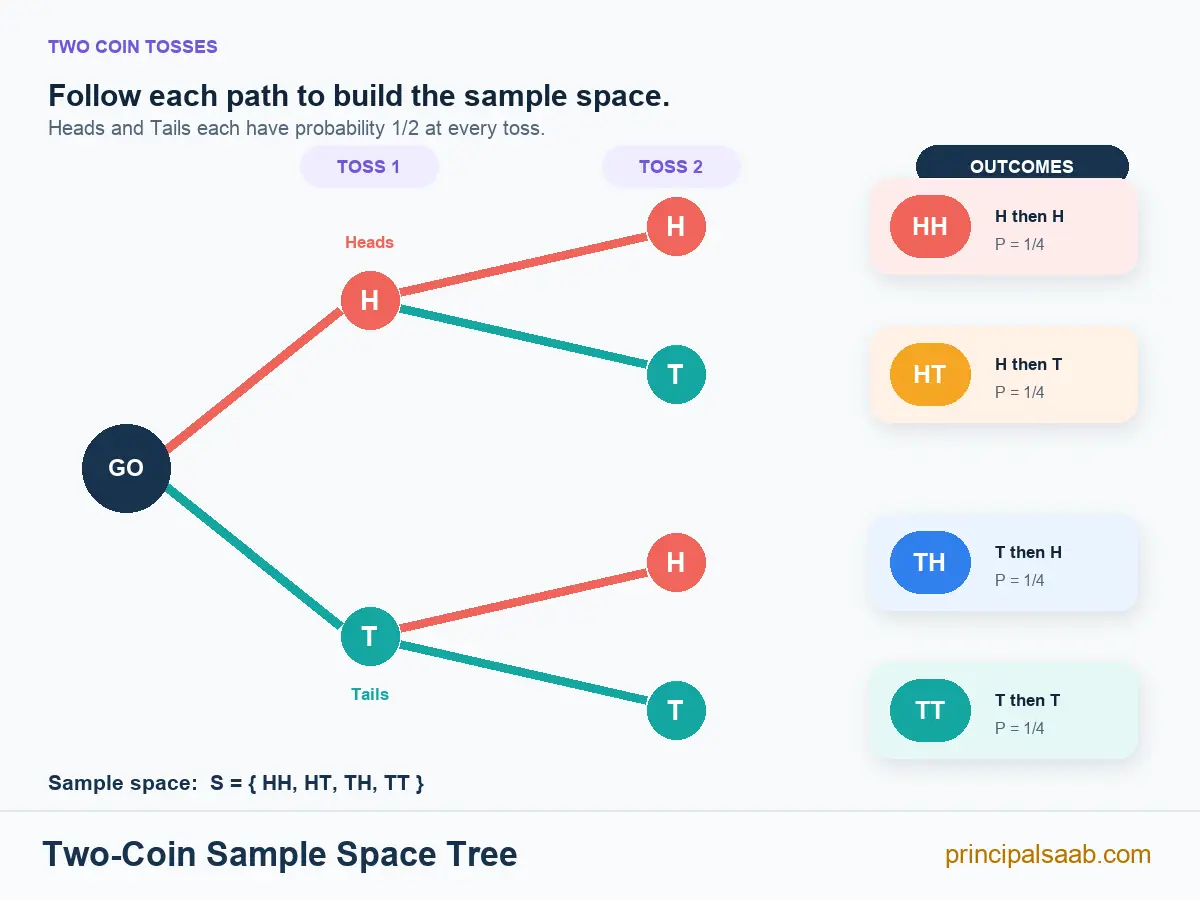
One coin. S = {H, T}, so n(S) = 2. P(head) = 1/2, P(tail) = 1/2. Nothing to discuss.
Two coins. S = {HH, HT, TH, TT}, so n(S) = 4. Read that list carefully. HT and TH are different outcomes: in HT the first coin is a head and the second is a tail, and in TH it is the other way round. Even if the two coins look identical, mathematically we treat them as first and second, so both orders count separately.
Three coins. S = {HHH, HHT, HTH, HTT, THH, THT, TTH, TTT}, so n(S) = 8. Write them in this systematic order every time: all the ones starting with H first, then all the ones starting with T. Do that and you will never miss one.
Sample space: {HH, HT, TH, TT}, n(S) = 4.
Favourable: exactly one head means one head and one tail — that is HT and TH. So n(E) = 2.
Solution: P = 2/4 = 1/2
If you had wrongly used 3 outcomes you would have answered 1/3, which is a very common wrong answer. This is exactly why we list.
Sample space: {HHH, HHT, HTH, HTT, THH, THT, TTH, TTT}, n(S) = 8.
Favourable: go through the list and pick out those with exactly two H’s — HHT, HTH, THH. Note that HHH has three heads, so it does not count as “exactly two”. n(E) = 3.
Solution: P = 3/8
Decode the phrase first: “at most one head” means one head or fewer, so it means zero heads or exactly one head.
Zero heads: TTT — that is 1 outcome.
Exactly one head: HTT, THT, TTH — that is 3 outcomes.
Total favourable: 1 + 3 = 4, so n(E) = 4.
Solution: P = 4/8 = 1/2
8. Dice — One Die and Two Dice
A quick note on language, because it confuses everybody at first: one die, two dice. “Die” is the singular. You will see both words in question papers, so get used to them.
One die is easy. S = {1, 2, 3, 4, 5, 6}, n(S) = 6. Every question is a matter of counting which of those six numbers fit the description.
Two dice is where the marks are. Each die independently shows one of 6 numbers, so together there are 6 x 6 = 36 outcomes, each written as an ordered pair (first die, second die). Please burn 36 into your memory — it is the denominator of almost every two-dice question you will ever answer.
The best way to see all 36 at once is a grid. Read it as (row, column): the row tells you the first die, the column tells you the second.
| Die 1 ↓ / Die 2 → | 1 | 2 | 3 | 4 | 5 | 6 |
|---|---|---|---|---|---|---|
| 1 | (1,1) | (1,2) | (1,3) | (1,4) | (1,5) | (1,6) |
| 2 | (2,1) | (2,2) | (2,3) | (2,4) | (2,5) | (2,6) |
| 3 | (3,1) | (3,2) | (3,3) | (3,4) | (3,5) | (3,6) |
| 4 | (4,1) | (4,2) | (4,3) | (4,4) | (4,5) | (4,6) |
| 5 | (5,1) | (5,2) | (5,3) | (5,4) | (5,5) | (5,6) |
| 6 | (6,1) | (6,2) | (6,3) | (6,4) | (6,5) | (6,6) |
Look at the grid for a moment. The doublets sit on the main diagonal. Any “sum” question is a diagonal stripe running from bottom-left to top-right. Once you can see those patterns, two-dice questions become almost visual.
Total: n(S) = 36.
Favourable: work systematically from the smallest first number. If the first die is 2 the second must be 6; if 3 then 5; if 4 then 4; if 5 then 3; if 6 then 2. A first die of 1 is impossible because the second would need to be 7.
So E = {(2,6), (3,5), (4,4), (5,3), (6,2)} and n(E) = 5.
Solution: P = 5/36
Why it works: going in order of the first die guarantees you neither miss a pair nor repeat one. Never list randomly.
Decode: “at most 4” means the sum is 2, 3 or 4.
Sum 2: (1,1) — 1 way
Sum 3: (1,2), (2,1) — 2 ways
Sum 4: (1,3), (2,2), (3,1) — 3 ways
Total favourable: 1 + 2 + 3 = 6.
Solution: P = 6/36 = 1/6
Notice this is the little triangle in the top-left corner of the grid.
Think it through: the odd faces are 1, 3 and 5 — that is 3 choices for the first die. Whatever the first die shows, the second die also has 3 odd choices. So the favourable outcomes number 3 x 3 = 9.
Listing them to be sure: (1,1), (1,3), (1,5), (3,1), (3,3), (3,5), (5,1), (5,3), (5,5). Yes, 9 outcomes.
Solution: P = 9/36 = 1/4
Favourable: which pairs from 1 to 6 multiply to 12? Work through the first die in order.
First die 2, second 6 — 2 x 6 = 12. Yes.
First die 3, second 4 — 12. Yes.
First die 4, second 3 — 12. Yes.
First die 6, second 2 — 12. Yes.
First die 1 would need 12 on the second die (impossible), and first die 5 would need 2.4 (impossible).
So n(E) = 4.
Solution: P = 4/36 = 1/9
Why it works: for product questions, list the factor pairs of the target number and then throw away any pair containing a number bigger than 6.
Before we leave dice, here is the reference table I want you to memorise. If you know these five numbers cold, you will never be stuck for a denominator.
| Experiment | Size of sample space n(S) | How you get it |
|---|---|---|
| Tossing 1 coin | 2 | H, T |
| Tossing 2 coins | 4 | 2 x 2 |
| Tossing 3 coins | 8 | 2 x 2 x 2 |
| Rolling 1 die | 6 | faces 1 to 6 |
| Rolling 2 dice | 36 | 6 x 6 |
| 1 coin and 1 die together | 12 | 2 x 6 |
| Drawing 1 card from a full deck | 52 | 4 suits x 13 cards |
9. A Deck of 52 Playing Cards
If you have never actually held a deck of cards, this section can feel like it is written in a foreign language. So let me describe the deck properly, from scratch, before we do any probability at all.
A standard deck has 52 cards. They are split into 4 suits: hearts, diamonds, spades and clubs. Each suit has exactly 13 cards, and 4 x 13 = 52.
Two of the suits are red (hearts and diamonds) and two are black (spades and clubs). So there are 26 red cards and 26 black cards — an exact half-and-half split.
Inside each suit, the 13 cards are: Ace, 2, 3, 4, 5, 6, 7, 8, 9, 10, Jack, Queen, King. The Jack, Queen and King are called face cards (or picture cards) because they have pictures of people on them. Three face cards per suit x 4 suits = 12 face cards in the deck.
There are 4 aces, one per suit. And the number cards are 2 through 10, which is 9 cards per suit, so 9 x 4 = 36 number cards altogether. Note that an ace is not counted as a number card and not as a face card — it sits in its own category.
| Feature of the deck | How many | Details |
|---|---|---|
| Total cards | 52 | 4 suits x 13 cards each |
| Suits | 4 | Hearts, Diamonds, Spades, Clubs — 13 cards in each |
| Red cards | 26 | Hearts (13) + Diamonds (13) |
| Black cards | 26 | Spades (13) + Clubs (13) |
| Face (picture) cards | 12 | Jack, Queen, King in each of the 4 suits — 6 red, 6 black |
| Aces | 4 | One per suit — 2 red, 2 black |
| Kings / Queens / Jacks | 4 each | 2 red and 2 black of each |
| Number cards (2 to 10) | 36 | 9 per suit x 4 suits; aces excluded |
Total: n(S) = 52.
Favourable: there are 4 kings, one in each suit. The red suits are hearts and diamonds, so the red kings are the king of hearts and the king of diamonds. n(E) = 2.
Solution: P = 2/52 = 1/26
(a) Face cards are J, Q, K in each of 4 suits: 3 x 4 = 12.
P(face card) = 12/52 = 3/13
(b) Number cards are 2 to 10 in each suit: 9 x 4 = 36.
P(number card) = 36/52 = 9/13
Sanity check: face cards (12) + number cards (36) + aces (4) = 52. Every card is accounted for exactly once. Do this check whenever a question splits the deck into categories.
Step 1 — fix the new total. This is the step students forget. Kings removed = 4, queens removed = 4, so 8 cards leave the deck.
New total = 52 – 8 = 44. The denominator is 44, not 52.
Step 2 — count favourable. Were any aces removed? No — only kings and queens were taken out. So all 4 aces are still there. n(E) = 4.
Solution: P(ace) = 4/44 = 1/11
Why it works: removing cards changes the sample space. Always recompute the denominator first, then ask separately whether the removal affected your favourable cards.
Step 1 — new total. Red face cards are the J, Q and K of hearts and of diamonds: 3 + 3 = 6 cards removed.
New total = 52 – 6 = 46.
(a) Red cards remaining: there were 26 red cards; 6 of them were removed. So 26 – 6 = 20 remain.
P(red) = 20/46 = 10/23
(b) Face cards remaining: there were 12 face cards; the 6 red ones went, leaving the 6 black ones.
P(face card) = 6/46 = 3/23
Compare this with Example 24. There, the removal missed our favourable cards entirely. Here it hits them. Reading carefully is the whole skill.
10. Bags, Balls, Marbles and Numbered Tickets
These are the bread-and-butter questions of the chapter, and they come in two flavours. In the first flavour you are told the contents and asked for a probability. In the second, harder flavour you are told a probability and asked to work backwards to find a missing number. Let us handle both.
For the straightforward kind, the routine never changes: add up every object in the bag to get the denominator, count the ones matching the description to get the numerator, reduce.
Total: 4 + 5 + 6 = 15, so n(S) = 15.
(a) P(red) = 4/15
(b) Method 1 (direct): “not blue” means red or green = 4 + 6 = 10 balls.
P(not blue) = 10/15 = 2/3
Method 2 (complement): P(blue) = 5/15 = 1/3, so P(not blue) = 1 – 1/3 = 2/3. Same answer.
Now the backwards kind. These look frightening but they are just a linear equation dressed in a bag. The method is always the same: call the unknown x, write the probability as a fraction in terms of x, set it equal to what the question gives you, and cross-multiply.
Step 1 — name the unknown. Let the number of blue balls be x.
Step 2 — write the total. Total balls = 5 + x.
Step 3 — write the probability. P(blue) = x / (5 + x)
Step 4 — set up the equation.
x / (5 + x) = 2/3
Step 5 — cross-multiply and solve.
3x = 2(5 + x)
3x = 10 + 2x
3x – 2x = 10
x = 10
Check it: with 10 blue balls the bag holds 5 + 10 = 15 balls, and P(blue) = 10/15 = 2/3. That matches, so the answer is right. Always check — it costs ten seconds and confirms the mark.
Total: n(S) = 50.
Favourable: list the perfect squares up to 50 in order — 1 (=1×1), 4 (=2×2), 9 (=3×3), 16 (=4×4), 25 (=5×5), 36 (=6×6), 49 (=7×7). The next one would be 64, which is beyond 50. So n(E) = 7.
Solution: P = 7/50
Why it works: squaring 1, 2, 3, … in order guarantees you catch every perfect square and stop at exactly the right place. Do not try to spot them by eye — 36 and 49 are the ones people forget.
11. Board-Style Word Problems and How to Set Them Up
In the exam the question will rarely say “here is the sample space”. It will tell you a little story about a fair, a shop, a lucky draw or a school. Your job is to translate the story into the two numbers you need. Here is the translation routine I want you to use every time.
- Underline the experiment. What single random thing is happening? Drawing one ticket? Rolling two dice?
- Find n(S). How many equally likely outcomes does that experiment have? Write it down before anything else.
- Underline the event. Circle the describing words — “not”, “at least”, “multiple of”, “two-digit”, “neither”.
- Count n(E) by listing, not by guessing.
- Write P(E) = n(E)/n(S), reduce, and check the answer lies between 0 and 1.
Experiment: drawing one ticket. n(S) = 90.
Event: the number has two digits, i.e. it is from 10 to 90.
Counting: the single-digit numbers are 1 to 9 — that is 9 tickets. Everything else has two digits.
Two-digit tickets = 90 – 9 = 81.
Solution: P = 81/90 = 9/10
Why it works: counting the small awkward group (the 9 single-digit tickets) and subtracting is far safer than trying to count 81 things directly. That is complementary thinking used as a counting tool.
Experiment: choosing one day. The seven days are Monday, Tuesday, Wednesday, Thursday, Friday, Saturday, Sunday. So n(S) = 7.
Event: names beginning with T are Tuesday and Thursday. n(E) = 2.
Solution: P = 2/7
Simple, but notice how easy it would be to say 1/7 by forgetting Thursday. Write the full list. Always write the full list.
Experiment: one roll. n(S) = 6.
Event: the factors of 6 are 1, 2, 3 and 6. All four of these appear on a die, so n(E) = 4. (Do not forget 1 and do not forget 6 itself — every number is a factor of itself.)
Solution: P = 4/6 = 2/3
Set it up by counting the cards you must throw away.
All 13 hearts are out.
The kings are out too — but the king of hearts has already been thrown away with the hearts, so only 3 more kings (spades, diamonds, clubs) need removing.
Cards thrown away = 13 + 3 = 16.
Cards remaining: 52 – 16 = 36.
Solution: P = 36/52 = 9/13
Why it works: the danger here is double-counting the king of hearts, which would give 13 + 4 = 17 and the wrong answer. When two descriptions overlap, physically ask yourself “is any card in both lists?” — and if so, count it only once.
Practice Worksheet — 10 Questions with Full Solutions
Here is where the learning actually happens. Work each question on paper first — properly, with the sample space written out — and only then click the question to open the solution. If you read the solutions without trying, you will feel like you understand and then freeze in the exam. Trying and getting it wrong teaches you far more than reading and nodding.
Q1. A spinner is divided into 10 equal sectors numbered 1 to 10. It is spun once. Find (a) P(the number is greater than 7) and (b) P(the number is odd).
(a) Numbers greater than 7 are 8, 9 and 10. Note 7 itself is not included. n(E) = 3.
P = 3/10
(b) Odd numbers from 1 to 10 are 1, 3, 5, 7, 9. n(E) = 5.
P = 5/10 = 1/2
Q2. Two fair coins are tossed together. Find the probability of getting at least one tail.
Method 1 (direct): outcomes with at least one tail are HT, TH and TT. n(E) = 3.
P = 3/4
Method 2 (complement): the opposite of “at least one tail” is “no tail at all”, which is only HH.
P(no tail) = 1/4, so P(at least one tail) = 1 – 1/4 = 3/4
Q3. Two fair dice are rolled together. Find the probability that the sum of the two numbers is 9.
Work through the first die in order. First die 3 needs second die 6. First die 4 needs 5. First die 5 needs 4. First die 6 needs 3. First die 1 or 2 would need a 8 or 7, which is impossible.
E = {(3,6), (4,5), (5,4), (6,3)}, so n(E) = 4.
P = 4/36 = 1/9
Q4. One card is drawn from a well-shuffled deck of 52 cards. Find the probability that the card is neither a spade nor a queen.
Count what must be discarded. All 13 spades go. Then the queens — but the queen of spades has already gone with the spades, so only 3 more queens (hearts, diamonds, clubs) need removing.
Discarded = 13 + 3 = 16.
Remaining = 52 – 16 = 36.
P = 36/52 = 9/13
Watch out: writing 13 + 4 = 17 double-counts the queen of spades and gives the wrong answer.
Q5. A bag contains 8 red, 12 white and 5 black balls, identical except for colour. One ball is drawn at random. Find (a) P(the ball is not white) and (b) P(the ball is black).
(a) Not white means red or black = 8 + 5 = 13.
P = 13/25
(Check by complement: P(white) = 12/25, so P(not white) = 1 – 12/25 = 13/25. Agrees.)
(b) Black balls = 5.
P = 5/25 = 1/5
Q6. Tickets numbered 1 to 100 are placed in a box and mixed. One is drawn at random. Find the probability that the number on it is divisible by 7.
Multiples of 7 up to 100: 7, 14, 21, 28, 35, 42, 49, 56, 63, 70, 77, 84, 91, 98. That is 14 numbers. (Quick check: 100 divided by 7 is 14 with a remainder, so there are 14 multiples.)
n(E) = 14.
P = 14/100 = 7/50
Q7. A box contains 15 red counters and some green counters. If the probability of drawing a green counter at random is 1/4, find the number of green counters.
Total counters = x + 15.
P(green) = x / (x + 15) = 1/4
Cross-multiply:
4x = x + 15
4x – x = 15
3x = 15
x = 5
Check: with 5 green counters the box has 5 + 15 = 20 counters, and P(green) = 5/20 = 1/4. Correct.
Q8. Three fair coins are tossed together. Find the probability of getting at least two heads.
“At least two heads” means exactly two heads or exactly three heads.
Exactly two: HHT, HTH, THH — 3 outcomes.
Exactly three: HHH — 1 outcome.
n(E) = 3 + 1 = 4.
P = 4/8 = 1/2
Q9. The letters of the word CLASSROOM are written on 9 identical cards, one letter per card. The cards are shuffled and one is drawn at random. Find (a) P(the letter is a vowel) and (b) P(the letter is S).
(a) The vowels present are A, O and O — that is 3 cards. (Count the O twice; both are separate cards.)
P = 3/9 = 1/3
(b) S appears twice, so n(E) = 2.
P = 2/9
Q10. Two fair dice are rolled together. Find (a) P(the product of the two numbers is odd) and (b) P(the two dice do not show the same number).
(a) A product is odd only when both numbers are odd — a single even number would make the product even. The odd faces are 1, 3, 5, so there are 3 choices for each die.
n(E) = 3 x 3 = 9.
P = 9/36 = 1/4
(b) “Same number on both” means a doublet: (1,1), (2,2), (3,3), (4,4), (5,5), (6,6) — 6 outcomes.
P(doublet) = 6/36 = 1/6
P(not the same) = 1 – 1/6 = 5/6
Wrapping Up
Look back at how far you have come. You started with a coin spinning in the air before a cricket match, and you now have a complete method for turning uncertainty into an exact number. One formula, three steps, and a handful of sample spaces you know by heart: 2, 4, 8, 6, 36, 52.
If any section still feels shaky, go back to it today rather than tomorrow — this chapter is short enough that a single focused hour genuinely fixes things. And if the counting is what trips you up, slow down and write the list. Every time. The students who score full marks in probability are not the fastest ones; they are the ones who wrote out the sample space while everyone else was guessing.