
Take a breath. If you have just opened this chapter and the words microsporangium, megasporogenesis and triple fusion made your stomach drop, that is completely normal. Almost every Class 12 student feels that on day one. Here is the good news, and I want you to actually believe it: this chapter is not hard. It is long, and long is a very different problem from hard. Long is solved by going slowly, in order, one small room at a time.
So let us set the scene properly. Think of a flower as a small, beautifully organised factory floor. It has a security wall (the sepals), a bright advertising hoarding out front (the petals), a department that manufactures and packages a product (the stamens, making pollen), and a department that receives deliveries and runs the assembly line (the pistil, holding the ovules). Everything in this chapter is either (a) how each department is built, (b) how the delivery gets from one department to the other, or (c) what the assembly line produces afterwards. That is the entire chapter. Three questions. Nothing more.
And it is worth the effort. Unit VI (Reproduction) carries 16 marks in the 70-mark theory paper, and this chapter is the most predictable, most repeat-friendly part of it. Examiners have asked the same handful of things — ploidy, the seven-celled embryo sac, double fertilisation, emasculation and bagging — for years. Once you own those, you own the marks. I will sit with you through every one of them.
- The Flower as the Reproductive Unit
- Pre-Fertilisation Structures and Events: The Road Map
- The Stamen, the Anther and the Microsporangium
- Microsporogenesis: How Microspores Are Made
- The Pollen Grain and the Male Gametophyte
- Pollen Viability, Pollen Storage and Pollen Allergy
- The Pistil and the Ovule (Megasporangium)
- Megasporogenesis: How Megaspores Are Made
- The Embryo Sac: Seven Cells and Eight Nuclei
- Pollination and Its Three Types
- Agents of Pollination and Floral Adaptations
- Outbreeding Devices: Why Plants Discourage Selfing
- Pollen–Pistil Interaction
- Artificial Hybridisation: Emasculation and Bagging
- Double Fertilisation: Syngamy and Triple Fusion
- Post-Fertilisation: Development of the Endosperm
- Development of the Embryo in Dicots and Monocots
- Seed Formation, Structure and Dormancy
- Fruit Formation, True and False Fruits, Parthenocarpy
- The Master Ploidy Table and Sequence Flows
- Apomixis, Polyembryony and Their Significance
- Significance of Seed Dispersal and Fruit Formation
- Practice Worksheet with Answers
Your Game Plan
Do not try to swallow this chapter in one sitting. Work through it in this order and it will click:
- Day 1 — Build the male side. Flower structure, anther, microsporogenesis, pollen grain. If the plant-body basics feel shaky, revise Class 10 Life Processes notes and practice alongside Day 1. Draw the anther T.S. from memory before you move on.
- Day 2 — Build the female side. Pistil, ovule, megasporogenesis, embryo sac. Draw the embryo sac and label all seven cells. This single diagram is worth a lot of marks. If labelling is where you keep dropping marks, read our guide on how to draw science diagrams that score full marks before you start.
- Day 3 — Connect them. Pollination types, agents, outbreeding devices, pollen–pistil interaction, emasculation and bagging.
- Day 4 — The main event and its aftermath. Double fertilisation, endosperm, embryo, seed, fruit, apomixis.
- Day 5 — Lock in ploidy. Memorise the master ploidy table until you can rebuild it on blank paper in under three minutes.
- Day 6 — Test yourself. Attempt the worksheet at the bottom with the answers hidden. Only then reveal them.
One promise from me: every time a section feels shaky, stop and reread it before going further. Understanding here is cumulative. Do not move on until this feels comfortable.
The Flower as the Reproductive Unit
Before anything else, we need to agree on what a flower actually is. A flower is not decoration. In an angiosperm, the flower is the reproductive unit — the whole apparatus for making gametes, getting them to meet, and turning the result into a seed. Everything pretty about it is advertising for that job.
A typical flower sits on a swollen tip of the stalk called the thalamus (receptacle), and carries four whorls arranged from outside inwards. Picture them as four concentric rings:
- Calyx — the outermost whorl, made of sepals. Usually green. This is the security wall: it protects the flower while it is still a bud.
- Corolla — made of petals. Usually the coloured, scented part. This is the advertising hoarding, aimed at pollinators.
- Androecium — the male whorl, made of stamens. Each stamen has a stalk (filament) and a head (anther). This is the manufacturing and packaging department.
- Gynoecium (also called the pistil or carpel whorl) — the female whorl. Each pistil has a stigma, a style and an ovary. This is the receiving department and the assembly line.
The first two whorls (calyx and corolla) are called accessory whorls because they help but do not themselves make gametes. The last two (androecium and gynoecium) are the essential whorls, because they do.
Why it works. Look at the ordering and it stops feeling arbitrary. The delicate gamete-producing parts are placed innermost, wrapped by the showy parts, wrapped by the tough parts. A flower is built like a parcel: fragile contents in the middle, packaging outside. Evolution did not design a flower to be beautiful — it designed it to protect gametes and buy a courier service, and beauty is simply what the advertisement looks like to us.
Two vocabulary words you will need constantly. A bisexual (perfect) flower has both androecium and gynoecium — mustard, pea, hibiscus. A unisexual (imperfect) flower has only one of them — the male and female flowers of maize, castor, cucumber, papaya. Which one a plant makes turns out to matter enormously later, when we discuss how plants avoid inbreeding.
Model answer: The androecium and the gynoecium. They are called essential because they are the gamete-producing whorls — the androecium produces pollen grains (bearing male gametes) and the gynoecium produces ovules (bearing the female gamete).
What earns the mark: For a 1-mark question the examiner wants the two names plus a reason in the same breath. Simply writing “androecium and gynoecium” with no reason risks a half mark. The keywords being scanned for are androecium, gynoecium and gamete-producing. Do not waste words describing sepals here — nothing extra is credited.
Pre-Fertilisation Structures and Events: The Road Map
This section is the one that saves you. Students get lost in this chapter not because any single step is difficult, but because they lose track of where they are. So let us build the map first, then fill in the detail.
Sexual reproduction in a flowering plant happens in three phases, and the whole chapter is organised along them:
- Pre-fertilisation events — everything that has to happen before the gametes meet. Making the male gametophyte, making the female gametophyte, and pollination.
- Fertilisation — the meeting itself. In flowering plants this is the famous double fertilisation.
- Post-fertilisation events — everything that follows. Endosperm, embryo, seed, fruit.
Inside phase 1, two production lines run in parallel — one in the anther, one in the ovule. They mirror each other almost perfectly, and that symmetry is your best memory aid. Here they are side by side:
| Stage | Male side (in the anther) | Female side (in the ovule) |
|---|---|---|
| Housing structure | Microsporangium (pollen sac) | Megasporangium (the ovule) |
| Diploid starting cell | Microspore mother cell / pollen mother cell (2n) | Megaspore mother cell (2n) |
| Reduction division | Microsporogenesis (meiosis) | Megasporogenesis (meiosis) |
| Immediate product | 4 microspores (n), all four survive | 4 megaspores (n), only one survives |
| Gametophyte | Pollen grain — 2-celled or 3-celled male gametophyte | Embryo sac — 7-celled, 8-nucleate female gametophyte |
| Gametes made | 2 male gametes (n each) | 1 egg cell (n) |
Why it works. Notice the one asymmetry: all four microspores survive, but only one megaspore does. That is not a quirk — it is economics. A plant needs to broadcast enormous numbers of pollen grains, because most of them will land somewhere useless. It needs only a small number of very well-provisioned egg cells, because each one that succeeds must be fed. So the male side maximises quantity; the female side pools all the resources of the sporangium into a single well-fed line. Cheap and many versus expensive and few. Hold on to that idea — it explains a dozen facts later in the chapter.
The Stamen, the Anther and the Microsporangium
Now we zoom into the male department. A stamen is a stalk plus a head: the slender filament holds up the anther, and the anther is where all the work happens. The base of the filament is attached to the thalamus or to the petal.
A typical angiosperm anther is bilobed and dithecous, and in cross-section it is tetrasporangiate — it contains four microsporangia, two in each lobe, sitting at the four corners. A longitudinal groove runs down the anther separating the two lobes. Those four microsporangia are the pollen sacs; they later develop into pollen chambers packed with pollen grains.
Take one microsporangium in transverse section. It looks roughly circular, and it has four wall layers. Learn them from outside in — a useful order to say out loud is “Every Excellent Micro Team”: Epidermis, Endothecium, Middle layers, Tapetum.
| Layer (outside → inside) | Description | Function |
|---|---|---|
| Epidermis | Single outermost protective layer | Protection |
| Endothecium | Layer beneath epidermis; develops fibrous thickenings | Protection and, crucially, dehiscence — it makes the anther split open |
| Middle layers | Usually one to three layers; often crushed as the anther matures | Protection |
| Tapetum | Innermost layer; dense cytoplasm, cells commonly with more than one nucleus | Nourishes the developing pollen grains |
The outer three layers together handle protection and help the anther dehisce (split) to release the pollen. The innermost layer, the tapetum, is the one examiners love, because it has a job unlike the others: it is the nurse tissue.
Why it works. Think of the tapetum as the kitchen staff of a hostel. Its cells are stuffed with cytoplasm and frequently carry more than one nucleus, because a single nucleus cannot direct enough protein synthesis to feed hundreds of developing pollen grains. More nuclei means more genetic “instruction copies” running at once, which means a much higher metabolic output. That is why multinucleate tapetal cells are the norm, and it is exactly the reasoning a 2-mark “why” question wants.
In a young anther, the centre of each microsporangium is filled with a compact, homogeneous mass of cells called the sporogenous tissue. These are the cells that will become microspore mother cells. So the sequence inside one pollen sac is: sporogenous tissue → microspore mother cells → meiosis → microspore tetrads → pollen grains.
Model answer: The innermost wall layer is the tapetum. Its cells have (i) dense cytoplasm and (ii) generally more than one nucleus per cell. Its function is to nourish the developing pollen grains.
How the two marks split: One mark for correctly naming the tapetum together with its two features; one mark for the nutritive function. Examiners routinely deduct if a student names the tapetum but then writes “protects the pollen” — protection is the job of the outer three layers, and mixing the two is the single commonest error in this question.
Microsporogenesis: How Microspores Are Made
Here is the definition, and I want you to write it exactly this way: microsporogenesis is the process of formation of haploid microspores from a diploid microspore mother cell through meiosis. That single sentence answers a 1-mark question completely.
Now the sequence, slowly. As the anther develops, the cells of the sporogenous tissue enlarge and become microspore mother cells (also called pollen mother cells, PMCs). Each one is diploid, 2n. Each PMC then undergoes meiosis — one reduction division producing four haploid nuclei, which are packaged into four cells. These four cells stay together in a cluster called a microspore tetrad.
As the anther matures and begins to lose water, the microspores of each tetrad dissociate from one another and each develops independently into a pollen grain. By the time the anther dehisces, the pollen chambers are packed with thousands of them.
Why it works. Why meiosis, and why here? Because gametes must be haploid. If the male and female contributions were both diploid, the chromosome number would double every generation and the species would collapse within a few generations. Meiosis is the halving step that keeps the chromosome number constant across generations, and it happens to be the same step that shuffles the parental chromosomes and creates variation. One process, two enormous benefits — that is why it sits right at the start of the reproductive line on both the male and the female side.
Worked answer:
Step 1 — each pollen mother cell (2n) undergoes meiosis and produces 4 haploid microspores.
1200 × 4 = 4800 microspores, which develop into 4800 pollen grains.
Step 2 — in each pollen grain the generative cell divides mitotically to form 2 male gametes.
4800 × 2 = 9600 male gametes.
Marking: One mark for 4800 pollen grains, one mark for 9600 male gametes. Always show the ×4 and ×2 steps — if your final number is wrong but the method is visible, examiners commonly award the method mark.
Worked answer:
Each meiotic division of one microspore mother cell yields 4 microspores, so number of mother cells = 640 ÷ 4 = 160 microspore mother cells.
Each of those cells underwent one meiotic event, so 160 meiotic divisions occurred.
Trap to avoid: Do not answer “320 divisions” because meiosis has two divisions (meiosis I and meiosis II). The question asks how many cells underwent meiosis, and meiosis I plus meiosis II together count as one meiotic event per cell. Read the wording carefully — this is a deliberate discriminator question.
The Pollen Grain and the Male Gametophyte
The single most useful image for this section: a pollen grain is a sealed courier packet. Inside is something precious and perishable (the male gametophyte). Outside is armour engineered for a journey that might involve wind, rain, heat, insect gut, and days of waiting. The design of the packet is all about surviving that trip.
Pollen grains are generally spherical and about 25–50 micrometres in diameter. The wall has two layers:
- Exine — the hard outer layer, made of sporopollenin. Sporopollenin is one of the most resistant organic materials known: it withstands high temperatures and strong acids and alkalis, and no enzyme that degrades sporopollenin is so far known. The exine may carry a striking pattern of ridges, spines or reticulations, and these patterns are species-specific.
- Intine — the thin, continuous inner layer, made of cellulose and pectin. Soft and living.
The exine is not complete all the way round. At certain places sporopollenin is absent, leaving apertures called germ pores. This is where the pollen tube will eventually emerge.
Why it works. Sporopollenin is also the reason pollen is a gift to science. Because nothing rots it, pollen grains survive in sediments and peat bogs for tens of thousands of years, and because exine patterns are species-specific, palaeobotanists can reconstruct the vegetation of ancient landscapes just by identifying fossil pollen. A protective adaptation for the plant became a time capsule for us. That is a lovely point to drop into a long-answer question about the significance of the exine.
Now, what is inside the packet? This is the male gametophyte, and it is remarkably small. When the microspore nucleus divides mitotically, it forms two unequal cells:
| Feature | Vegetative (tube) cell | Generative cell |
|---|---|---|
| Size | Larger | Smaller |
| Food reserve | Abundant | Scanty |
| Nucleus | Large and irregularly shaped | Compact, with dense cytoplasm |
| Shape / position | Occupies most of the grain | Spindle-shaped, floats in the cytoplasm of the vegetative cell |
| Fate | Forms and sustains the pollen tube | Divides mitotically to form the two male gametes |
A detail examiners like: in over 60 per cent of angiosperms, pollen grains are shed at the 2-celled stage (vegetative cell plus generative cell). In the remaining species, the generative cell divides before shedding, so the grain leaves the anther at the 3-celled stage (vegetative cell plus two male gametes).
Model answer, laid out the way an examiner wants it:
(a) Wall. The pollen grain has a two-layered wall. The outer exine is made of sporopollenin and often bears characteristic sculpturing; it is interrupted at the germ pores, where sporopollenin is absent. The inner intine is a thin, continuous layer of cellulose and pectin. (1 mark)
(b) Contents. Inside are the cells of the male gametophyte — a large vegetative cell with abundant food reserve and an irregular nucleus, and a small spindle-shaped generative cell floating in its cytoplasm. In over 60 per cent of angiosperms the grain is shed at this 2-celled stage; in the rest the generative cell has already divided, giving a 3-celled grain. (1 mark)
(c) Significance of sporopollenin. It is one of the most resistant organic materials known, withstanding high temperature and strong acids and alkalis, and no enzyme that degrades it is so far known. It therefore protects the delicate gametophyte during transport and allows pollen to be preserved as fossils for very long periods. (1 mark)
Examiner keywords: exine, sporopollenin, germ pore, intine, vegetative cell, generative cell, 2-celled stage. Underline them in your answer script — it genuinely helps a tired evaluator find them.
Pollen Viability, Pollen Storage and Pollen Allergy
A pollen grain, once released, is on a clock. Viability means how long it retains the ability to germinate and fertilise after being shed. And the clock runs at wildly different speeds in different plants.
- In some cereals such as rice and wheat, pollen grains lose viability within 30 minutes of release. That is astonishingly short.
- In several members of Rosaceae, Leguminosae (Fabaceae) and Solanaceae, pollen stays viable for months.
Pollen storage. Because pollen is the vehicle for a plant’s genes, breeders want to bank it the way we bank blood. Pollen of a large number of species can be stored for years in liquid nitrogen at −196 °C. Such stored pollen can be used later in crop breeding programmes, so a variety flowering in January can be crossed with one flowering in July. These collections are called pollen banks, exactly like seed banks.
Why it works. Cryopreservation works because biological decay is a set of chemical reactions, and chemical reactions slow down dramatically as temperature falls. At −196 °C metabolism is effectively frozen — the pollen is not dead, just paused. Combine that with the fact that mature pollen is already partly dehydrated (less water means fewer damaging ice crystals) and you have a cell that tolerates deep freezing far better than most.
Pollen allergy. Pollen grains of some species cause severe allergies and bronchial disorders in humans, often leading to chronic respiratory problems such as asthma and bronchitis. The classic Indian example is Parthenium (carrot grass), which entered India as a contaminant along with imported wheat and has since spread across the country, becoming a major cause of pollen allergy. Airborne pollen of grasses is another very common trigger, which is why allergy seasons track flowering seasons so closely.
One more small but examinable point: pollen grains are rich in nutrients, and pollen tablets are sold as food supplements. Their consumption has been claimed to increase the performance of athletes and race horses — note the wording, this is a claim reported in your textbook rather than a settled clinical result, so present it as such.
Worked answer:
Why it failed: Pollen grains of cereals such as wheat and rice lose their viability within about 30 minutes of being shed. Pollen that has travelled for three days at ordinary temperature would long since have lost the ability to germinate on the stigma, so no pollen tube formed and no fertilisation occurred. (1½ marks)
What he should have done: The imported pollen should have been cryopreserved and transported in liquid nitrogen at −196 °C, the standard method of maintaining a pollen bank. At that temperature metabolic activity is arrested and viability is retained for years, so the pollen would still have been functional on arrival. (1½ marks)
Why this is a good question to practise: case-based items are worth 4 marks each in two questions of the paper, and they almost always work like this — a real situation that fails, and you must name the underlying fact plus the fix. Train yourself to answer in two labelled halves.
The Pistil and the Ovule (Megasporangium)
Cross over now to the female department. The gynoecium is made of one or more pistils (carpels). A gynoecium with a single pistil is monocarpellary; with more than one it is multicarpellary, and those pistils may be free (apocarpous, as in lotus and rose) or fused (syncarpous, as in mustard and tomato).
Each pistil has three parts, top to bottom:
- Stigma — the landing platform for pollen grains. Often sticky or feathery.
- Style — the elongated slender neck below the stigma. The pollen tube must travel down through it.
- Ovary — the swollen base. Inside is a cavity, the ovarian cavity (locule), and a cushion of tissue called the placenta from which the ovules (megasporangia) arise.
The number of ovules per ovary varies enormously — one in wheat, paddy, mango; many in papaya, watermelon and orchids. Now zoom into a single ovule. Learn these seven labels, because the ovule diagram is one of the most reliably asked diagrams in the paper:
| Part of the ovule | What it is |
|---|---|
| Funicle | The stalk by which the ovule is attached to the placenta |
| Hilum | The junction between the ovule body and the funicle |
| Integuments | One or two protective envelopes that encircle the ovule; they later harden into the seed coat |
| Micropyle | The small opening at the tip where the integuments leave a gap — the pollen tube’s doorway |
| Chalaza | The basal region, at the end opposite the micropyle |
| Nucellus | The mass of cells enclosed by the integuments, packed with reserve food |
| Embryo sac | The female gametophyte, embedded within the nucellus |
Why it works. Compare the two departments and the design philosophy jumps out. The pollen grain is armoured on the outside because it must survive out in the world. The ovule has no armour of its own — it does not need any, because it is already sitting inside the ovary, inside the flower, inside the plant. Instead of armour it gets food: a nucellus stuffed with reserves. Mobile things get armour; stationary things get provisions. That contrast is worth stating in a comparison question.
Megasporogenesis: How Megaspores Are Made
Definition first, precisely: megasporogenesis is the process of formation of megaspores from the megaspore mother cell. It happens inside the nucellus, at the micropylar end of the ovule.
Here is the sequence:
- A single cell in the nucellus, towards the micropylar end, enlarges. It has dense cytoplasm and a prominent nucleus. This is the megaspore mother cell (MMC), and it is diploid (2n).
- The MMC undergoes meiosis, producing four haploid megaspores (n), usually arranged in a linear tetrad.
- Then the crucial twist: in most flowering plants, three of the four megaspores degenerate and only one remains functional — typically the one at the chalazal end.
- That single functional megaspore goes on to form the embryo sac.
Because the embryo sac develops from a single megaspore, this pattern is called monosporic development. That term is examinable and students forget it constantly. Mono = one; sporic = spore. One spore built this whole sac.
Why it works. Why throw away three perfectly good haploid cells? Because the ovule has a fixed budget of nutrients in its nucellus. Split that budget four ways and you get four underfed, feeble gametophytes, all competing inside the same small space. Give the whole budget to one and you get a single robust embryo sac with a well-provisioned egg. When the offspring will need heavy investment, the parent backs one candidate rather than four. This is the exact opposite of the strategy on the male side, and stating that contrast is a strong way to open a comparison answer.
Model answer, written as a two-column comparison:
Site: Microsporogenesis occurs inside the microsporangium of the anther; megasporogenesis occurs inside the nucellus of the ovule. (1 mark)
Fate of products: In microsporogenesis all four microspores of the tetrad survive and each develops into a pollen grain. In megasporogenesis three of the four megaspores degenerate and only one functional megaspore, usually the chalazal one, develops into the embryo sac. (1 mark)
Presentation tip: for any “distinguish between” question, draw a two-column table and put the basis of comparison in the left margin. It costs you thirty seconds and it makes both marks unmissable. A paragraph that mentions both facts jumbled together often loses one.
The Embryo Sac: Seven Cells and Eight Nuclei
This is the heart of the chapter. If you learn one diagram properly, learn this one. And here is the analogy that makes it stick: the embryo sac is a room with assigned seats. Eight nuclei walk in, and there are exactly seven seats, because two of them have to share a bench.
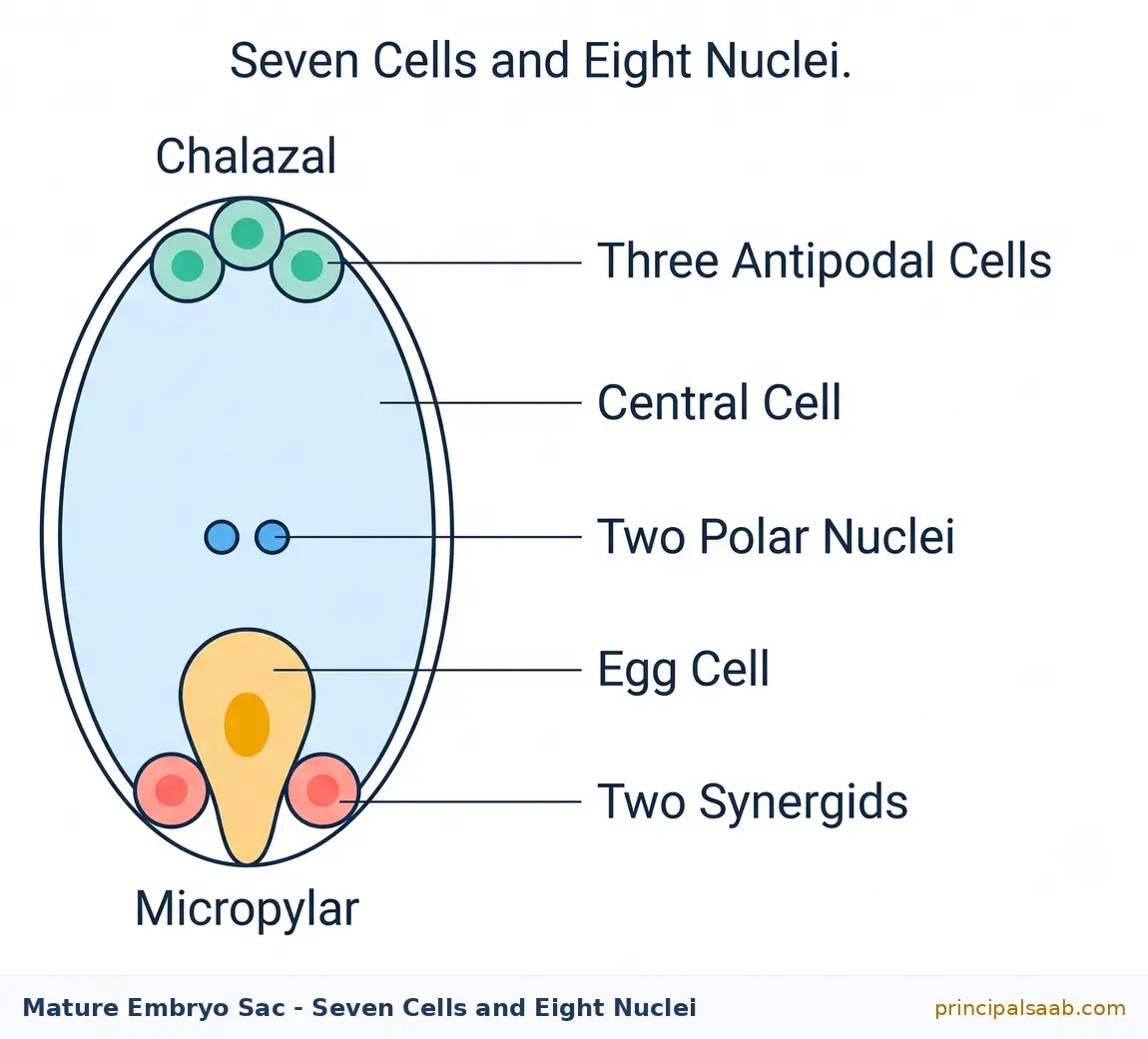
The development, step by step:
- The functional megaspore’s nucleus divides mitotically → 2 nuclei, which move to opposite poles: the 2-nucleate embryo sac.
- A second mitotic division at each pole → 4-nucleate stage.
- A third mitotic division → 8-nucleate stage.
- These divisions are strictly free-nuclear — nuclear divisions occur with no cell wall formation in between. Walls appear only after the 8-nucleate stage.
- Six of the eight nuclei then get surrounded by cell walls and become cells. The remaining two, the polar nuclei, stay together in the large central cell below the egg apparatus.
Three mitoses: 1 → 2 → 4 → 8. Now the seating plan of the finished room:
| Position | Cells | Number | Role |
|---|---|---|---|
| Micropylar end | Egg cell + 2 synergids (together: the egg apparatus) | 3 cells | Egg is the female gamete; synergids guide the pollen tube in |
| Chalazal end | Antipodal cells | 3 cells | Usually degenerate; role largely nutritive/vestigial |
| Centre | Central cell containing 2 polar nuclei | 1 cell (2 nuclei) | Fuses with the second male gamete to give the endosperm |
| Total | — | 7 cells, 8 nuclei | — |
Do the arithmetic yourself once and it will never leave you. Cells: 3 + 3 + 1 = 7. Nuclei: 3 + 3 + 2 = 8. The mismatch exists purely because the central cell is one cell holding two nuclei.
One more structure you must name: at the micropylar tip of each synergid there are special cellular thickenings called the filiform apparatus. This is the structure that guides the pollen tube into the synergid. It is a one-mark gift of a question and students miss it every year.
Model answer:
1. A single cell of the nucellus at the micropylar end enlarges to form the diploid megaspore mother cell, with dense cytoplasm and a prominent nucleus. (1)
2. The MMC undergoes meiosis to produce four haploid megaspores, usually in a linear tetrad. Three degenerate and one, generally the chalazal megaspore, remains functional. Because the embryo sac arises from this single megaspore, the development is termed monosporic. (1)
3. The nucleus of the functional megaspore divides mitotically three times to give 2, then 4, then 8 nuclei. These divisions are free-nuclear: no walls form between them. (1)
4. Cell walls then organise six of the eight nuclei into cells — three at the micropylar end forming the egg apparatus (one egg cell and two synergids, the synergids bearing a filiform apparatus) and three at the chalazal end forming the antipodal cells. (1)
5. The remaining two nuclei, the polar nuclei, lie in the large central cell. Hence the mature embryo sac has 3 + 3 + 1 = 7 cells but 3 + 3 + 2 = 8 nuclei, the difference arising because the single central cell contains two nuclei. (1)
Diagram note: add a labelled sketch of the mature embryo sac even if the question does not demand one. Marks for labelled diagrams are awarded within the same 5 marks and a clear diagram often rescues a sentence you phrased badly.
Pollination and Its Three Types
Pollination is the transfer of pollen grains from the anther to the stigma of a pistil. That is the whole definition. Note what it does not include: it is not fertilisation, and it does not guarantee fertilisation. Pollination is the delivery; fertilisation is what happens after the parcel is accepted.
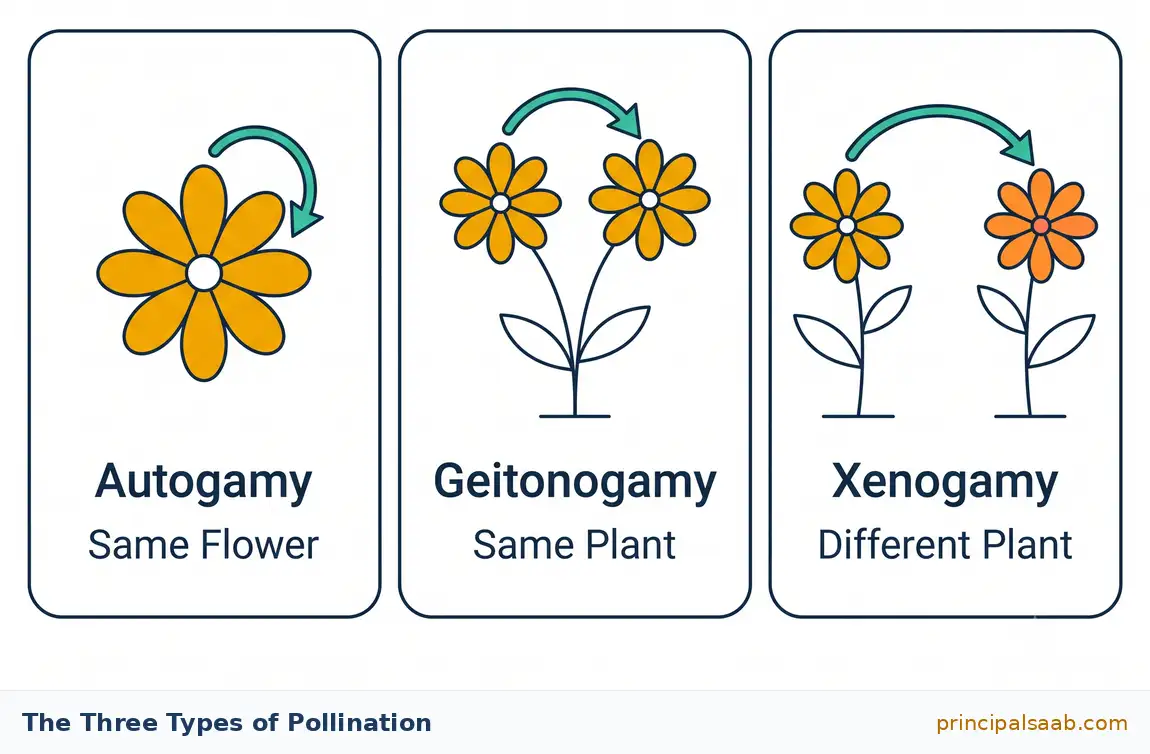
Plants cannot walk, so this delivery has to be outsourced. Depending on the source of the pollen, there are exactly three types:
| Basis | Autogamy | Geitonogamy | Xenogamy |
|---|---|---|---|
| Pollen travels from | Anther to stigma of the same flower | One flower to another flower of the same plant | One flower to a flower of a different plant of the same species |
| Pollinating agent needed? | Not required (or minimal) | Required | Required |
| Genetically it is | Self-pollination | Self-pollination (pollen is from the same plant) | Cross-pollination |
| Functionally it is | Self-pollination | Cross-pollination (an agent physically carries it) | Cross-pollination |
| Genetic variation produced | None | None | Yes — the only type that brings genetically different pollen |
Geitonogamy is the sneaky one, and it is exactly where examiners set traps. Physically it looks like cross-pollination — a bee flies from flower to flower. But genetically both flowers belong to the same plant, so the pollen is genetically identical to the recipient’s own. It has all the costs of cross-pollination (you must pay a pollinator) and none of the benefits (no new gene combinations). Remember it as: functionally cross, genetically self.
For autogamy to happen at all, two conditions must be met: the anthers and stigma must be close enough to each other, and the pollen release must be synchronised with stigma receptivity. Some plants guarantee this by never opening their flowers at all.
- Chasmogamous flowers — flowers that open normally, with exposed anthers and stigma. They can be cross-pollinated.
- Cleistogamous flowers — flowers that never open at all. The anthers dehisce inside the closed bud and the pollen falls directly on the stigma. Cleistogamous flowers are therefore invariably autogamous, since no foreign pollen can possibly reach the stigma.
The standard examples of plants producing both chasmogamous and cleistogamous flowers are Viola (common pansy), Oxalis and Commelina. Learn all three names together — they are asked as a set.
Why it works. Cleistogamy looks like a mistake — why would a plant deliberately give up all genetic variation? Because seed-set is guaranteed. In a bad season with no insects around, a chasmogamous flower may set no seed at all, while a cleistogamous flower always does. Plants like Viola hedge their bets: they run both systems, gambling on variation with the open flowers and buying insurance with the closed ones. It is a portfolio strategy, and that framing wins you the reasoning mark.
Worked answer:
Assured seed set: Cleistogamous flowers never open. The anthers dehisce within the closed flower bud so the pollen grains inevitably come into contact with the stigma of the same flower. Pollination therefore occurs without any dependence on an external pollinating agent, and seed set is guaranteed even when pollinators are absent. (1½)
No genetic variability: Because the flower never opens, there is no possibility of pollen from another plant landing on the stigma. Every cleistogamous flower is therefore compulsorily autogamous, and the offspring receive genetically identical male and female contributions from the same parent, producing no new gene combinations and hence no variability. (1)
Examples: Viola (common pansy) and Oxalis; Commelina is a third valid example. (½)
Keyword the examiner scans for: autogamy. If you explain the biology beautifully but never use that word, you can still drop a mark. Name the phenomenon, then explain it.
Agents of Pollination and Floral Adaptations
Agents split into abiotic (wind and water — non-living) and biotic (animals). The overwhelming majority of flowering plants use biotic agents. And here is the principle that unlocks the whole section: a plant using a stupid courier must send many parcels; a plant using an intelligent courier can send few. Wind and water cannot aim. Bees can.
| Feature | Anemophily (wind) | Hydrophily (water) | Entomophily (insects) |
|---|---|---|---|
| Flower appearance | Small, dull, no scent, no nectar | Small, inconspicuous, no scent or nectar | Large, brightly coloured, fragrant, nectar-rich |
| Pollen | Light, dry, non-sticky, produced in huge numbers | Often long and ribbon-like; in most species protected from wetting by a mucilaginous covering | Sticky or spiny, adheres to the insect body |
| Stamens | Well exposed, versatile | Not specially exposed | Usually enclosed within the flower |
| Stigma | Large, often feathery, well exposed | Sticky, often unwettable surface | Small, sticky |
| Ovules per ovary | Commonly a single ovule; many flowers packed into an inflorescence | Few | Variable, often many |
| Examples | Grasses; maize (the corn-cob tassels are the styles and stigmas) | Vallisneria, Hydrilla (freshwater); Zostera (marine sea-grass) | Most bright flowers; Amorphophallus, Yucca, Ficus |
Water pollination is genuinely rare. It is limited to about 30 genera, mostly monocotyledons. Two contrasting mechanisms are worth knowing precisely:
- Vallisneria (surface pollination). The female flower reaches the surface of the water on a long stalk. Male flowers or pollen grains are released and float on the surface, and are carried passively by water currents until some reach the female flowers.
- Zostera (submerged pollination). In these marine sea-grasses the female flowers remain submerged, and the pollen grains are long and ribbon-like, carried passively inside the water until some reach the stigma.
Why it works — the logic of hydrophilous pollen. Ask yourself what a pollen grain travelling through water is up against. First, it must not sink, or it will never reach a stigma — hence pollen that is light, and in Zostera long and ribbon-like so it drifts and wraps around a stigma rather than dropping straight down. Second, it must not absorb water, because a waterlogged grain bursts and its gametes die — hence the mucilaginous covering that keeps it unwettable. Third, there is no point in colour or scent, because water currents cannot see or smell — hence small, drab flowers with no nectar. Every single feature follows from the physics of the medium. If you can reason like that, you never need to memorise a features list again.
Biotic pollination and floral rewards. Insects are the commonest agents (entomophily); birds (ornithophily) and bats (chiropterophily) also pollinate. Flowers must pay their couriers, and the usual currency is nectar and pollen grains. But some plants pay in a stranger currency — a safe place to lay eggs:
- Amorphophallus — bearer of the tallest flower in the world, roughly six feet in height. It offers the flower itself as a site for egg-laying.
- Yucca and its moth. The moth lays eggs in the locule of the ovary and pollinates the flower while doing so. The moth larvae emerge as the seeds begin to develop and eat some of them. Neither species can complete its life cycle without the other — an obligate mutualism.
- Ficus (fig) and its wasp. The female wasp uses the fig as a site to lay eggs and the developing seeds nourish her larvae; in return she pollinates the fig inflorescence. Again, obligate on both sides.
Worked answer: The plant is almost certainly hydrophilous (water-pollinated), most likely resembling Zostera.
Reason 1 — small, colourless flowers. Bright colour, fragrance and nectar exist only to attract animal pollinators. Their complete absence indicates an abiotic agent, and in an aquatic plant that points to water. (1)
Reason 2 — elongated, mucilage-coated pollen. The mucilaginous covering protects the pollen from wetting, which would otherwise rupture the grain and kill the gametes; the elongated ribbon-like shape increases the chance of the grain drifting into and catching on a stigma rather than sinking. (1)
Reason 3 — unwettable sticky stigma. An unwettable surface allows the stigma to trap pollen out of the water without becoming waterlogged itself. (1)
Cross-check you should always run: being aquatic is not sufficient evidence — water lily is aquatic and insect-pollinated. It is the pollen and stigma features that clinch it, and saying so explicitly shows the analytical skill the paper rewards.
Outbreeding Devices: Why Plants Discourage Selfing
Start with the problem, not the list. Continued self-pollination causes inbreeding depression — harmful recessive alleles that were hidden in the heterozygous condition start pairing up, and the offspring become progressively weaker and less fertile. Variation also collapses, so the population loses its ability to cope with a new pest or a changed climate.
Plants cannot walk away from themselves, so evolution has built anti-selfing machinery into the flower. These are the outbreeding devices. There are four you must know:
| Device | How it works | Prevents |
|---|---|---|
| Dichogamy (timing separation) | Pollen release and stigma receptivity are not synchronised — pollen is shed before the stigma is receptive (protandry) or the stigma is receptive well before pollen is shed (protogyny) | Autogamy |
| Herkogamy (spatial separation) | Anther and stigma are placed at different positions so pollen cannot physically reach the stigma of the same flower | Autogamy |
| Self-incompatibility | A genetic mechanism: the pistil recognises pollen from the same plant and inhibits its germination on the stigma or the growth of its pollen tube in the style | Both autogamy and geitonogamy |
| Unisexual flowers | Male and female flowers are separate. If both occur on the same plant (monoecious, e.g. castor, maize) — if on different plants (dioecious, e.g. papaya) | Monoecious: autogamy only. Dioecious: both autogamy and geitonogamy |
Why it works. Notice the escalation. Dichogamy and herkogamy are cheap physical fixes and they only solve the within-flower problem. Self-incompatibility is expensive — it needs a molecular recognition system, essentially a self-versus-non-self immune check inside the pistil — but it solves the problem completely, because it works on the pollen’s genotype rather than its position. Dioecy is the most drastic solution of all: it makes half the population unable to produce seed, a huge reproductive cost, in exchange for guaranteed outcrossing. Evolution paid rising prices for rising certainty. Framing your answer as “cheap partial solutions versus expensive complete solutions” reads as genuine understanding.
Model answer:
Need (1 mark). Continued self-pollination leads to inbreeding depression — the accumulation of harmful recessive traits in homozygous condition and a loss of genetic variability, weakening the progeny. Flowering plants have therefore evolved devices to encourage cross-pollination.
Device 1 — asynchrony (1). Pollen release and stigma receptivity are not synchronised: either pollen is released before the stigma becomes receptive, or the stigma is receptive long before pollen is shed. Prevents autogamy.
Device 2 — different positions (1). The anther and the stigma are placed at different positions so that pollen cannot come into contact with the stigma of the same flower. Prevents autogamy.
Device 3 — self-incompatibility (1). A genetic mechanism in which the pistil inhibits germination of self-pollen on the stigma, or arrests the growth of the pollen tube in the style. Prevents both autogamy and geitonogamy.
Device 4 — unisexual flowers (1). Production of separate male and female flowers. In a monoecious plant such as castor or maize both sexes occur on the same plant, which prevents autogamy but not geitonogamy. In a dioecious plant such as papaya the sexes are on different plants, which prevents both.
Structure advice: the question says “indicating in each case”, so each device must carry its own verdict sentence. Students who describe four devices beautifully but forget the verdicts routinely score 3 out of 5. Answer every clause of the question.
Pollen–Pistil Interaction
Pollination delivers the parcel. Pollen–pistil interaction is security at the gate — the pistil deciding whether to accept it. Formally: pollen–pistil interaction covers all the events from the deposition of pollen on the stigma until the pollen tube enters the ovule.
All sorts of pollen land on a stigma — the right species, the wrong species, the plant’s own. The pistil has the ability to recognise which is which. This ability arises from a continuous chemical dialogue between the pollen grain and the pistil, in which chemical components of the pollen interact with those of the pistil.
- If the pollen is compatible, the pistil accepts it and promotes the post-pollination events that lead to fertilisation.
- If the pollen is incompatible, the pistil rejects it — either by preventing pollen germination on the stigma, or by arresting pollen tube growth in the style.
Following a compatible pollination, the sequence runs:
- The pollen grain germinates on the stigma, producing a pollen tube that emerges through one of the germ pores.
- The contents of the pollen grain move into the pollen tube.
- The tube grows through the tissues of the stigma and the style and reaches the ovary.
- If the grain was shed at the 2-celled stage, the generative cell divides during the tube’s growth through the stylar tissue to form the two male gametes. If it was shed at the 3-celled stage, the tube carries both male gametes from the very beginning.
- On reaching the ovary, the tube enters the ovule through the micropyle (this route is called porogamy), then enters one of the synergids through the filiform apparatus, which guides its entry.
Why it works. Think about what a stigma is actually risking. If it accepted pollen from any species that blew past, it would waste its single expensive embryo sac on a hybrid that could never develop. Rejection is not rudeness — it is quality control on a resource the plant cannot afford to squander. And notice that the same recognition machinery does double duty: it screens out foreign species and, in self-incompatible plants, screens out the plant’s own pollen. One system, two jobs.
Artificial Hybridisation: Emasculation and Bagging
Crop improvement depends on making crosses that nature would not make on its own. Artificial hybridisation is exactly that: the breeder decides who mates with whom. To do it, two things must be guaranteed — that only the desired pollen reaches the stigma, and that no unwanted pollen does.
The procedure splits depending on whether the female parent bears bisexual or unisexual flowers.
Case A — the female parent bears bisexual flowers (e.g. pea, tomato):
- Emasculation. Remove the anthers from the flower bud using a pair of forceps, before the anthers dehisce. This is the definition: the removal of anthers from a bisexual flower bud before dehiscence, without damaging the pistil. Timing is everything — do it late and the flower has already self-pollinated.
- Bagging. Cover the emasculated flower with a bag of suitable size, generally made of butter paper, to prevent contamination of its stigma with unwanted pollen.
- Pollination. When the stigma of the bagged flower attains receptivity, dust it with mature pollen grains collected from the anthers of the chosen male parent.
- Re-bagging. Cover the flower again and allow the fruit to develop.
Case B — the female parent bears unisexual flowers (e.g. maize, papaya): emasculation is not required, because there are no anthers in the female flower to remove. The female flower buds are simply bagged before the flowers open, pollinated with the desired pollen when the stigma becomes receptive, and re-bagged.
Worked answer:
Step 1 — Select and emasculate. Choose flower buds of variety A that have not yet opened. Using forceps, carefully remove all the anthers before the anthers dehisce, leaving the pistil undamaged. This is emasculation. (1)
Step 2 — Bag. Immediately cover each emasculated bud with a butter-paper bag of suitable size and tie it. This is bagging, and it prevents any foreign pollen from reaching the stigma. (1)
Step 3 — Collect pollen. Collect mature pollen from the dehisced anthers of variety B, the desired male parent, and store it appropriately until needed. (1)
Step 4 — Pollinate and re-bag. When the stigma of the bagged flower of A becomes receptive, dust variety B pollen onto it and immediately re-bag the flower. Allow the fruit to develop; the seeds obtained give the hybrid progeny. (1)
Step 5 — Consequences of skipping a step. If emasculation were skipped, A would self-pollinate and the seeds would simply be pure A, not a hybrid. If bagging were skipped, wind- or insect-borne pollen from unknown plants could fertilise the ovules and the parentage of the seed would be unreliable. If re-bagging were skipped, contamination could still occur after the deliberate pollination. (1)
Note the variation: had variety A borne unisexual flowers, Step 1 would be omitted entirely — you would bag the female buds before they opened and proceed from Step 2. Examiners love to switch this detail, so read whether the female parent is bisexual or unisexual before you start writing.
Double Fertilisation: Syngamy and Triple Fusion
This is the moment the whole chapter has been building towards, and it is the single most examined topic in it. It is also — genuinely — one of the most elegant things in biology, because flowering plants do something no other group does: they fertilise twice, in the same embryo sac, at the same time.
The sequence:
- The pollen tube enters the ovule through the micropyle and then enters one of the synergids through the filiform apparatus.
- It releases both male gametes into the cytoplasm of that synergid.
- Syngamy. One male gamete moves towards the egg cell and fuses with its nucleus. Result: a diploid zygote (2n).
- Triple fusion. The other male gamete moves towards the two polar nuclei in the central cell and fuses with them. Result: the triploid primary endosperm nucleus, PEN (3n).
- Because two fusion events occur in the same embryo sac, the phenomenon is called double fertilisation. It is unique to flowering plants.
- The central cell, now containing the PEN, is called the primary endosperm cell (PEC), and it develops into the endosperm.
| Basis | Syngamy | Triple fusion |
|---|---|---|
| Nuclei involved | 2 — one male gamete + egg nucleus | 3 — one male gamete + two polar nuclei |
| Site | Egg cell, at the micropylar end | Central cell |
| Product | Zygote | Primary endosperm nucleus (PEN) |
| Ploidy of product | 2n (diploid) | 3n (triploid) |
| Develops into | The embryo | The endosperm (nutritive tissue) |
Why it works. Here is the beautiful part. Why bother making a second, triploid nucleus at all? Because it acts as a commitment check. The endosperm is expensive food, and a plant would waste enormous resources if it built a food store for an embryo that never formed. By tying endosperm production to a fertilisation event that happens only when a viable pollen tube has actually arrived, the plant guarantees that food is only manufactured when there is a genuine embryo to feed. Compare this with a gymnosperm, which builds its nutritive tissue before fertilisation and often wastes it. Double fertilisation is a just-in-time supply chain, and that efficiency is one reason flowering plants came to dominate the land.
Model answer:
Definition (1). Double fertilisation is the phenomenon in which two fusion events — syngamy and triple fusion — occur within the same embryo sac of a flowering plant.
Entry (1). The pollen tube enters the ovule through the micropyle and then enters one of the synergids through its filiform apparatus, where it releases the two male gametes into the synergid cytoplasm.
Syngamy (1). One male gamete fuses with the nucleus of the egg cell. This is syngamy, and it produces the diploid zygote (2n), which develops into the embryo.
Triple fusion (1). The second male gamete fuses with the two polar nuclei of the central cell. This is triple fusion, involving three haploid nuclei, and it produces the triploid primary endosperm nucleus (3n). The central cell thereafter becomes the primary endosperm cell and develops into the endosperm.
Uniqueness (1). No other group of plants performs two fertilisations in one female gametophyte. In gymnosperms the nutritive tissue is haploid and forms before fertilisation, whereas in angiosperms the triploid endosperm forms only after a successful fertilisation, so nutritive tissue is produced only when an embryo actually exists.
Diagram: a labelled sketch showing the pollen tube entering a synergid, one gamete at the egg and the other at the polar nuclei, converts this into a very safe five.
Post-Fertilisation: Development of the Endosperm
The endosperm develops before the embryo does. That ordering is deliberate and it is examinable, so hold on to it: the kitchen opens before the guest arrives.
The primary endosperm nucleus divides repeatedly to form a triploid (3n) endosperm tissue, whose cells fill with reserve food materials used to nourish the developing embryo. The commonest pattern is the free-nuclear endosperm: the PEN undergoes successive nuclear divisions producing many free nuclei with no walls between them, and only later does cell wall formation occur, making the endosperm cellular. The number of free nuclei formed before cellularisation varies greatly between species.
The endosperm’s later fate splits seeds into two classes:
- Non-albuminous (ex-albuminous) seeds — the endosperm is completely consumed by the developing embryo before the seed matures. Examples: pea, groundnut, bean. The food is transferred into thick, swollen cotyledons instead.
- Albuminous (endospermic) seeds — the endosperm persists in the mature seed. Examples: wheat, maize, barley, castor, coconut, sunflower.
Why it works. Why should the endosperm form first? Because a zygote is a single cell with almost no reserves of its own and no roots to feed itself. If it started dividing immediately, it would exhaust itself within a few divisions. By waiting until a certain amount of endosperm has been laid down, the plant guarantees the embryo assured nutrition from its very first division — a rather elegant adaptation, and one CBSE explicitly asks about.
Development of the Embryo in Dicots and Monocots
Embryo development (embryogeny) begins at the micropylar end of the embryo sac, where the zygote sits. The zygote divides only after a certain amount of endosperm has been formed — the adaptation we just discussed.
The early stages are the same in dicots and monocots: zygote → proembryo → globular embryo → heart-shaped embryo → mature embryo. Learn that four-word flow; a 1-mark question sometimes just asks for the sequence.
| Feature | Dicot embryo (e.g. gram, pea) | Monocot embryo (grass family, e.g. maize) |
|---|---|---|
| Number of cotyledons | Two | One, called the scutellum |
| Position of cotyledon(s) | Attached on either side of the embryonal axis | Situated towards one side (lateral) of the embryonal axis |
| Above the cotyledon level | Epicotyl, ending in the plumule (shoot tip) | Epicotyl bearing the shoot apex and a few leaf primordia, enclosed in the hollow coleoptile |
| Below the cotyledon level | Hypocotyl, ending in the radicle (root tip) with a root cap | Radicle and root cap enclosed in an undifferentiated sheath, the coleorhiza |
| Protective sheaths | Absent | Present — coleoptile (shoot) and coleorhiza (root) |
Model answer, tabulated:
(i) Cotyledons. A dicot embryo has two cotyledons attached on either side of the embryonal axis; a monocot embryo has only one, the scutellum, placed laterally.
(ii) Shoot end. In a dicot, the epicotyl simply terminates in the plumule. In a monocot, the shoot apex and leaf primordia are enclosed within a hollow foliar sheath, the coleoptile.
(iii) Root end. In a dicot, the hypocotyl ends in the radicle with a root cap, unprotected. In a monocot, the radicle and root cap are enclosed in an undifferentiated sheath, the coleorhiza.
Marking: one mark per valid, clearly contrasted difference. The word “scutellum” alone can carry a mark, so never write “one cotyledon” without naming it.
Seed Formation, Structure and Dormancy
The headline equation of this section: a seed is a fertilised ovule. Everything that was in the ovule becomes something in the seed, part for part.
- Integuments harden into the tough protective seed coat(s).
- The micropyle persists as a small pore in the seed coat, and it is functional — it facilitates the entry of oxygen and water into the seed during germination.
- The zygote becomes the embryo; the PEN becomes the endosperm.
- In some seeds, remnants of the nucellus persist. This residual persistent nucellus is called the perisperm. Classic examples: black pepper and beet.
As a seed matures its water content falls sharply — a mature seed carries roughly 10–15 per cent moisture by mass. General metabolic activity slows almost to a halt, and the embryo may enter a state of inactivity called dormancy. If conditions are favourable instead, the seed germinates.
The record-holders are worth a mention, with appropriate care. A seed of Lupinus arcticus excavated from Arctic tundra is reported to have germinated and flowered after an estimated 10,000 years of dormancy, and a roughly 2,000-year-old Phoenix dactylifera (date palm) seed recovered near the Dead Sea was successfully germinated. These figures come from dating estimates and are periodically revised in the research literature, so quote them as reported claims rather than exact certainties.
Fruit Formation, True and False Fruits, Parthenocarpy
While the ovule is becoming a seed, the ovary is becoming the fruit. The wall of the ovary develops into the wall of the fruit, called the pericarp. Fruits may be fleshy (guava, orange, mango) or dry (groundnut, mustard).
| Basis | True fruit | False fruit (pseudocarp) |
|---|---|---|
| Develops from | The ovary alone | The ovary plus another floral part, usually the thalamus |
| Edible portion | Derived from the pericarp | Largely derived from the accessory tissue |
| Examples | Mango, tomato, guava, orange, pea pod | Apple, strawberry, cashew |
Look closely at the false-fruit examples and the pattern is clear. In strawberry, the juicy red mass you eat is the swollen thalamus; the little “seeds” dotted over its surface are the actual fruits. In cashew, the fleshy “cashew apple” is the swollen stalk region, while the nut hanging beneath it is the true fruit. In apple, the bulk of the flesh is contributed by tissue outside the ovary proper.
Parthenocarpy. Some fruits develop without fertilisation. Such a fruit is called a parthenocarpic fruit, and the classic example is the banana. Because no fertilisation occurred, no seeds form — parthenocarpic fruits are seedless. Parthenocarpy can also be induced artificially by the application of growth hormones, which is how several commercial seedless varieties are produced.
Worked answer — write it as a list, not a paragraph:
(a) Ovary → fruit (its wall becomes the pericarp)
(b) Ovule → seed
(c) Integuments → seed coat(s)
(d) Zygote → embryo
(e) Primary endosperm nucleus → endosperm
(f) Persistent nucellus → perisperm (as in black pepper and beet)
Why this question is a gift: it is pure recall with six independent items, and half marks are usually awarded per item. Even a student who is shaky on the rest of the chapter can bank all three marks here. Learn this list until it is automatic — it also underpins the ploidy table in the next section.
The Master Ploidy Table and Sequence Flows
This is the highest-yield page in the whole chapter. Ploidy questions are almost guaranteed, they are quick to answer, and they are impossible to bluff. Learn this table cold.
Before the table, the two rules that generate every entry:
- Anything that is part of the parent plant body is 2n. Nucellus, integuments, seed coat, ovary wall, pericarp, funicle, perisperm, tapetum — all maternal tissue, all diploid.
- Anything descended from a spore is n until a fertilisation event adds nuclei. Microspore, pollen grain, all eight embryo-sac nuclei — haploid.
| Structure | Ploidy | Reason |
|---|---|---|
| Microspore mother cell (pollen mother cell) | 2n | Sporophytic cell, before meiosis |
| Microspore / pollen grain | n | Product of meiosis |
| Vegetative cell, generative cell, male gamete | n | Formed from a haploid microspore by mitosis |
| Tapetum | 2n | Anther wall layer — parent tissue (often with several nuclei per cell) |
| Nucellus | 2n | Parent tissue of the ovule |
| Integuments → seed coat | 2n | Parent tissue |
| Megaspore mother cell | 2n | Sporophytic cell, before meiosis |
| Functional megaspore | n | Product of meiosis |
| Embryo sac (all cells) | n | Built from the haploid megaspore by mitosis only |
| Egg cell | n | Embryo sac cell |
| Synergids (2) | n each | Embryo sac cells |
| Antipodal cells (3) | n each | Embryo sac cells |
| Polar nuclei (2) | n each | Two separate haploid nuclei in one central cell |
| Zygote | 2n | Syngamy: n (male gamete) + n (egg) |
| Embryo | 2n | Mitotic descendant of the zygote |
| Primary endosperm nucleus (PEN) | 3n | Triple fusion: n + n + n |
| Endosperm | 3n | Mitotic descendant of the PEN |
| Perisperm | 2n | Residual persistent nucellus — parent tissue, never fertilised |
| Pericarp (fruit wall) | 2n | From the ovary wall — parent tissue |
| Funicle | 2n | Parent tissue |
Now the two sequence flows. Write these out on paper five times and they will come back to you automatically in the exam.
Male gamete (n) + 2 Polar nuclei (n + n) → PEN (3n) → Free-nuclear endosperm → Cellular endosperm (3n)
Worked answer. Somatic number 2n = 24, therefore n = 12.
(a) Megaspore mother cell — 24 (diploid, before meiosis)
(b) Functional megaspore — 12 (meiotic product)
(c) Synergid — 12
(d) Polar nucleus — 12 (each polar nucleus is haploid)
(e) Zygote — 24
(f) Primary endosperm nucleus — 36 (12 + 12 + 12)
(g) Endosperm cell — 36
(h) Perisperm — 24
(i) Pericarp — 24
(j) Male gamete — 12
Justification (as demanded): the primary endosperm nucleus has 36 chromosomes because triple fusion involves three haploid nuclei — one male gamete (12) and the two polar nuclei (12 + 12) — giving a triploid nucleus of 36.
The two traps: writing 24 for the polar nuclei together (they are two separate 12s, not one 24), and writing 36 for the perisperm. Both are avoidable if you go back to the master table.
Apomixis, Polyembryony and Their Significance
Apomixis is a form of asexual reproduction that mimics sexual reproduction — the production of seeds without fertilisation. The plant goes through all the outward motions of making a seed, but no gametes ever fuse. It is prevalent in several species of Asteraceae and in many grasses.
It can happen in more than one way. Two routes are prescribed:
- Route 1 — the diploid egg. In some species the egg cell is formed without reduction division, so it is diploid, and it develops into an embryo without being fertilised.
- Route 2 — nucellar embryony. In many varieties of Citrus and mango, some of the nucellar cells surrounding the embryo sac begin to divide, protrude into the embryo sac, and develop into embryos. Because these cells are maternal nucellus, the resulting embryos are genetically identical to the mother plant.
Route 2 leads directly to the next term. Polyembryony is the occurrence of more than one embryo in a seed. In Citrus and mango an ovule may contain many embryos — one formed by normal fertilisation and several nucellar ones. If you peel an orange seed and find several tiny plants inside, you have found polyembryony.
Worked answer:
Why the saved seed failed: Hybrid seed is produced by crossing two different parent lines. The hybrid plants are highly heterozygous, and when they reproduce sexually the characters segregate in the F2 generation. The seed the farmer saved therefore produced a genetically mixed population, most of which lacked the hybrid vigour of the parent crop. (1½)
Why apomixis would fix it: In an apomictic plant, seeds are formed without fertilisation — for example from nucellar cells, which are maternal tissue. The embryos are therefore genetically identical to the mother plant, so there is no segregation and every seed reproduces the hybrid exactly. (1)
Practical consequence: The farmer could save and re-sow his own seed indefinitely without buying fresh hybrid seed each year, greatly reducing cost. (½)
Keywords the examiner wants: segregation of characters, F2, without fertilisation, genetically identical to the parent. Get all four in and the marks are secure.
Significance of Seed Dispersal and Fruit Formation
The last section, and a short one. Why does any of this matter to the plant?
Why the seed is such a successful invention:
- Seeds are the product of sexual reproduction, so they carry new gene combinations — better adaptive potential than a vegetative offshoot.
- They carry a reserve food supply for the young seedling until it can photosynthesise for itself.
- The hard seed coat protects the embryo mechanically and against pathogens.
- Dehydration and dormancy allow survival through drought, cold and other unfavourable conditions, and make long-term storage possible.
Why dispersal matters: a seed that germinates directly beneath its parent must compete with that parent for light, water and minerals, and it will usually lose. Dispersal reduces competition with the parent, allows colonisation of new habitats, and spreads the offspring so that a single local disaster cannot destroy the entire next generation.
How fruits help: the fruit protects the developing seeds and then serves as the dispersal vehicle. Fleshy, brightly coloured fruits are eaten by animals which carry the seeds away and deposit them elsewhere; winged or hairy fruits are carried by wind; light, spongy fruits float and are carried by water. Notice the parallel with pollination — once again the plant is buying transport by offering a reward.
Finally, the human angle worth a line in any long answer: seeds are the basis of agriculture. Because dry seeds can be stored, food is available through the year and farmers have planting material for the next season. Almost the entire human food supply rests on this one structure.
Practice Worksheet with Answers
Ten original questions, ramped from 1-mark recall to full 5-mark board answers. When you can handle all ten, sit a full paper: the CBSE Class 12 Biology sample paper with marking scheme shows exactly how examiners award these marks. Do this properly: keep a sheet of paper next to you, write your answer first, and only then click to reveal. Reading answers without attempting them feels productive and teaches you almost nothing.
Q1. (1 mark) Name the structure present at the micropylar tip of the synergids and state its function.
Q2. (1 mark) Why are cleistogamous flowers described as invariably autogamous?
Q3. (2 marks) Distinguish between geitonogamy and xenogamy, and state which of the two brings about genetic variation.
Xenogamy is the transfer of pollen to the stigma of a flower on a different plant of the same species. It is true cross-pollination.
Only xenogamy brings genetically different pollen to the stigma and therefore produces genetic variation.
Q4. (2 marks) A student writes: “The perisperm is triploid because it is nutritive tissue.” Identify the error and give the correct explanation.
The perisperm is simply the residual persistent nucellus that remains in some mature seeds, such as black pepper and beet. The nucellus is maternal sporophytic tissue and is never involved in any fusion event, so it stays 2n. Being nutritive does not make a tissue triploid — the endosperm is triploid only because it arises from the primary endosperm nucleus formed by triple fusion (n + n + n).
Q5. (2 marks) An anther of a plant produced 2400 male gametes in total. How many microspore mother cells underwent meiosis? Show your reasoning.
Each microspore mother cell produces 4 microspores (and hence 4 pollen grains) on meiosis, so number of microspore mother cells = 1200 ÷ 4 = 300 microspore mother cells.
Therefore 300 cells underwent meiosis.
Q6. (3 marks) Explain three floral or pollen adaptations shown by water-pollinated plants, giving the reason for each.
(ii) Pollen protected from wetting by a mucilaginous covering. Water entering the grain would rupture it and destroy the male gametes, so in most water-pollinated species the grain carries a mucilage coat that keeps it unwettable.
(iii) Light and often long, ribbon-like pollen grains (as in Zostera). This shape resists sinking and increases the chance of the grain drifting against and catching on a stigma.
Water pollination is rare, being limited to about 30 genera, mostly monocotyledons. Examples: Vallisneria and Hydrilla in fresh water, Zostera among marine sea-grasses.
Q7. (3 marks) Differentiate between albuminous and non-albuminous seeds with two examples each, and explain what causes the difference.
Non-albuminous (ex-albuminous) seeds have no endosperm at maturity, because it is completely consumed by the developing embryo before the seed matures; the food reserve is instead stored in thick, swollen cotyledons. Examples: pea, groundnut (also bean).
The difference is therefore not in whether endosperm was ever formed — it always is, from the primary endosperm nucleus — but in whether the embryo used it up before seed maturity.
Q8. (3 marks) With reference to a plant such as papaya, explain how the dioecious condition prevents both autogamy and geitonogamy, and contrast this with maize.
Maize (monoecious). Male flowers (the tassel) and female flowers (the cob) occur on the same plant. Autogamy is prevented, because no single flower contains both anthers and stigma. However, geitonogamy is still possible — wind can easily carry pollen from the tassel down to the silks of the same plant.
Conclusion: the dioecious condition is a complete outbreeding device; the monoecious condition is only a partial one.
Q9. (5 marks) Trace the events from the arrival of a compatible pollen grain on the stigma to the formation of the endosperm and the embryo.
2. Growth through the style. The pollen tube grows through the tissues of the stigma and style towards the ovary. If the grain was shed at the 2-celled stage, the generative cell divides mitotically during this passage to form the two male gametes; if it was shed at the 3-celled stage, both gametes are already present.
3. Entry into the ovule. The tube enters the ovule through the micropyle and then enters one of the synergids through its filiform apparatus, releasing both male gametes into the synergid cytoplasm.
4. Syngamy. One male gamete (n) fuses with the nucleus of the egg cell (n) to form the diploid zygote (2n).
5. Triple fusion and after. The second male gamete (n) fuses with the two polar nuclei (n + n) of the central cell to form the triploid primary endosperm nucleus (3n). Since two fusions occur in the same embryo sac, the process is double fertilisation. The PEN divides repeatedly, usually forming a free-nuclear endosperm which later becomes cellular. Only after a certain amount of endosperm has formed does the zygote begin to divide, passing through proembryo, globular and heart-shaped stages to form the mature embryo (2n).
Q10. (5 marks) What is apomixis? Describe two ways in which it occurs, explain its relationship with polyembryony, and state its importance in agriculture.
Way 1 — diploid egg. In some species the egg cell is formed without reduction division, so it remains diploid, and it develops into an embryo without being fertilised.
Way 2 — nucellar embryony. In many varieties of Citrus and mango, some nucellar cells surrounding the embryo sac divide, protrude into the embryo sac and develop into embryos. Since the nucellus is maternal tissue, these embryos are genetically identical to the mother plant.
Link with polyembryony. Because several nucellar cells may do this at once, a single ovule can contain many embryos. The occurrence of more than one embryo in a seed is called polyembryony, and Citrus and mango are the standard examples.
Agricultural importance. Hybrid seed is expensive and must be bought fresh each season, because hybrid characters segregate in the F2 generation. If hybrids were made apomictic, the embryos would be genetically identical to the mother, there would be no segregation of characters, and farmers could save and re-sow their own seed year after year while keeping full hybrid vigour. This would substantially reduce the cost of cultivation.