
Hello, and welcome to what is honestly one of the friendliest chapters in your whole Class 10 Science book. Some chapters feel like climbing a rock face. Our Environment feels more like a walk through a park you already half know — you have seen food chains in cartoons, you have heard adults argue about plastic bags, you have read the words “ozone layer” on a school poster. Your job this year is simply to turn all that scattered familiarity into precise, exam-ready language.
Let me be straight with you about the marks, because knowing this changes how you study. In the official CBSE Class X Science (Code 086) syllabus for 2026-27, this chapter sits inside Unit V: Natural Resources, and that whole unit carries 5 marks. Five marks is small. But those five marks are among the cheapest in the paper, because nearly every question here is a definition, a reason, an example or one tiny numerical. Learn this chapter properly and you bank those marks in a fraction of the time other chapters demand. One more helpful note so you do not waste effort: Sustainable Management of Natural Resources was removed in the rationalised syllabus, so it is not examinable — you do not need to memorise Chipko dates or dam controversies for the board paper.
We are going to build everything from zero. I will assume you remember nothing, and I will keep checking in with you. If a sentence feels blurry, read it twice before you move on. This chapter rewards clarity far more than speed.
What You’ll Learn
- What Do We Actually Mean By “Our Environment”?
- Ecosystem — The Big Idea
- Biotic And Abiotic Components
- Producers, Consumers And Decomposers
- Food Chains And Trophic Levels
- Food Webs — Why Nature Is Not A Straight Line
- Flow Of Energy And The Ten Per Cent Law
- Biomagnification — The Poison That Climbs
- Biodegradable And Non-Biodegradable Substances
- Waste Generation And Waste Management
- The Ozone Layer — Formation And Why It Matters
- Ozone Depletion, CFCs And The Montreal Protocol
- Environmental Problems — The Bigger Picture
- How To Score All Five Marks
- Practice Worksheet — Test Yourself
Your Game Plan
- Read the first four sections in one sitting — ecosystem, components, the three roles, food chains. They are one connected story and they make no sense in pieces.
- Do the energy-flow numericals with a pen and paper. Actually write the zeros. The ten per cent law only becomes automatic once your hand has done it five or six times.
- Make yourself a two-column list of biodegradable and non-biodegradable things from your own home. Your own examples stick better than mine.
- Learn the ozone section as a small story: how ozone is made, what CFCs do to it, what the world did about it. Stories survive exam stress; loose facts do not.
- Finish with the worksheet at the bottom. Write your answer first, then open the reveal. Peeking early feels good and teaches nothing.
What Do We Actually Mean By “Our Environment”?
Start with the plainest possible definition. Your environment is everything that surrounds you and affects you — the air you are breathing right now, the water in your bottle, the soil under the building, the temperature of the room, and also every living thing nearby: the pigeon on the ledge, the neem tree outside, the bacteria on your fingertips that you cannot see.
Notice that the definition has two halves. There are things that are alive, and things that are not alive. That split is going to run through this entire chapter, so tuck it away now.
Here is the part students usually miss. The environment is not a passive backdrop, like a painted wall behind a stage. It is a working system. The tree gives out oxygen that the pigeon breathes. The pigeon drops waste that feeds the soil. The soil holds water that the tree pulls up. Nothing in that loop is sitting idle. Every part is doing a job for every other part, all day, without anyone supervising.
Working: Not alive — pond water, dissolved oxygen in it, mud at the bottom, sunlight, air temperature, the stones on the bank. Alive — algae floating on the surface, insects skimming the water, fish below, the buffalo that wades in every evening, decay bacteria in the mud.
Answer: All of these together form the frog’s environment. Why it works: we did not ask “what is in the picture” — we asked “what touches the frog’s life”. Temperature affects whether the frog is active; algae feed the insects the frog eats; bacteria recycle the dead insects. Everything listed genuinely reaches the frog.
Ecosystem — The Big Idea
Now we give that working system its proper name. An ecosystem is all the living organisms in an area together with all the non-living physical factors of that area, interacting as a unit.
Think of it like a school. A school is not just a building, and it is not just students. It is students plus teachers plus classrooms plus a timetable, all interlocking. Remove the timetable and it stops functioning as a school even though the building and the people are still there. An ecosystem is the same: it is the relationships that make it one unit, not just the ingredients.
Ecosystems come in two broad families, and you should be able to name examples of each without hesitating.
| Type | What it means | Examples |
|---|---|---|
| Natural | Formed on its own, runs without human help, usually self-sustaining and complex | Forest, ocean, river, grassland, desert, lake, mangrove swamp |
| Artificial (man-made) | Created and maintained by humans; needs constant input, otherwise it collapses | Crop field, garden, aquarium, park, fish pond in a farm |
Natural ecosystems are usually further split into terrestrial (on land — forest, grassland, desert) and aquatic (in water). Aquatic ones split again into freshwater (pond, lake, river) and marine (sea, ocean). If a question asks you to classify, that ladder — natural or artificial, then land or water, then fresh or salt — will always get you there.
An aquarium is an artificial and incomplete ecosystem. It contains very few decomposers, so the fish waste and uneaten food are not broken down and removed naturally — they accumulate and pollute the water. (1 mark)
A pond is a natural, self-sustaining ecosystem with a full set of producers, consumers and decomposers. Bacteria and fungi in the pond continuously decompose waste and dead matter, returning nutrients to the water, so cleaning happens on its own. (1 mark)
Why it works: the marks are for the two words incomplete and decomposers. A student who writes only “because the aquarium is small” has described the situation, not explained it, and picks up nothing.
Answer: Mustard field — artificial (man-made), terrestrial. Arabian Sea — natural, aquatic, marine. Hill stream — natural, aquatic, freshwater. Rooftop kitchen garden — artificial, terrestrial. Thorn-scrub desert — natural, terrestrial.
Why it works: the first question is always “would this exist and keep running if every human vanished tomorrow?” The field and the garden would not. That single test sorts natural from artificial every time.
Biotic And Abiotic Components
Every ecosystem, without exception, is built from two kinds of parts.
Biotic components are the living parts — plants, animals, fungi, bacteria. Anything that grows, respires, reproduces and eventually dies.
Abiotic components are the non-living parts — sunlight, air, water, soil, minerals, temperature, humidity, wind, pH. Anything physical or chemical that shapes conditions without being alive.
Here is the sentence I want you to really absorb: the abiotic components decide what the biotic components can be. A desert and a rainforest can sit on the same latitude, but one gets 20 cm of rain a year and the other gets 300 cm. That single abiotic difference produces cactus and camel on one side and orchid and jaguar on the other. Life does not choose its home freely; the non-living conditions hand out the invitations.
Answer — Biotic: rice plants, earthworms, frogs, mould, snails. Abiotic: standing water, dissolved nitrogen salts, sunlight, clay soil particles, air temperature.
Why it works: mould is the one that catches people out. It is a fungus — fully alive, and an important decomposer. Meanwhile nitrogen salts, even though plants desperately need them, are simple chemicals and never respired anything. Being needed by life does not make something alive.
Producers, Consumers And Decomposers
Now we sort the living things by job rather than by species. Every organism in an ecosystem does one of three jobs, and the whole chapter hangs on these three words.
1. Producers (autotrophs). These are the green plants, and in water, the algae and blue-green algae. They are the only members of the ecosystem that can make food out of non-food. Using sunlight, carbon dioxide and water, they run photosynthesis and lock solar energy into glucose. Everything else in the ecosystem is, sooner or later, eating sunlight that a plant captured first. This is why producers are always drawn at the bottom of every diagram — they are the entry door for energy.
2. Consumers (heterotrophs). These cannot make their own food, so they eat other organisms. They come in useful sub-types:
- Herbivores — eat only plants (deer, goat, grasshopper, cow).
- Carnivores — eat only other animals (lion, snake, frog, hawk).
- Omnivores — eat both plants and animals (crow, bear, human being).
- Parasites — live on or inside a host and feed from it without killing it immediately (tick, tapeworm, cuscuta on a hedge).
- Scavengers — feed on animals that are already dead (vulture, hyena, some beetles).
3. Decomposers (saprophytes). Bacteria and fungi. They feed on dead bodies and waste, breaking complex organic matter down into simple inorganic substances — carbon dioxide, water, nitrates, phosphates — which go back into the soil, water and air, ready for producers to use again.
I want to spend an extra moment on decomposers, because they are the least glamorous and the most examined. Imagine a forest where decomposers stopped working tonight. Every leaf that ever fell, every animal that ever died, would still be lying there. Within a few years the forest floor would be metres deep in undecayed matter — and, far worse, all the nitrogen, phosphorus and carbon locked inside those bodies would be permanently out of circulation. The plants would starve in a graveyard of nutrients they could not reach. Decomposers are what make nature a cycle instead of a one-way street.
Answer: Water hyacinth — producer. Tadpole eating algae — consumer, herbivore (primary consumer). Kingfisher — consumer, carnivore. Mushroom on a stump — decomposer. House crow — consumer, omnivore. Rhizopus — decomposer.
Why it works: notice the mushroom. It is not green, so it cannot photosynthesise; it is growing on dead wood and digesting it. Both clues point the same way. Always ask what the organism is feeding on, not what it looks like.
(i) Dead plants, dead animals and animal waste would no longer be broken down, so they would pile up and the environment would become filthy and disease-ridden. (1 mark)
(ii) The nutrients such as nitrogen, phosphorus and carbon locked inside dead bodies would not be released back into the soil, air and water. (1 mark)
(iii) Nutrient cycling would stop; producers would not get the minerals they need for growth, so plant productivity would fall and the whole ecosystem would eventually collapse. (1 mark)
Why it works: the answer moves from the visible consequence, to the chemical consequence, to the system-wide consequence. Examiners look for that third step. Stopping at “garbage would pile up” caps you at one mark.
Food Chains And Trophic Levels
A food chain is a series of organisms in which each one is eaten by the next, so that food — and the energy inside it — passes along in a line. We draw it with arrows, and here is the single most important thing about those arrows: the arrow points in the direction the energy travels, that is, from the eaten to the eater.
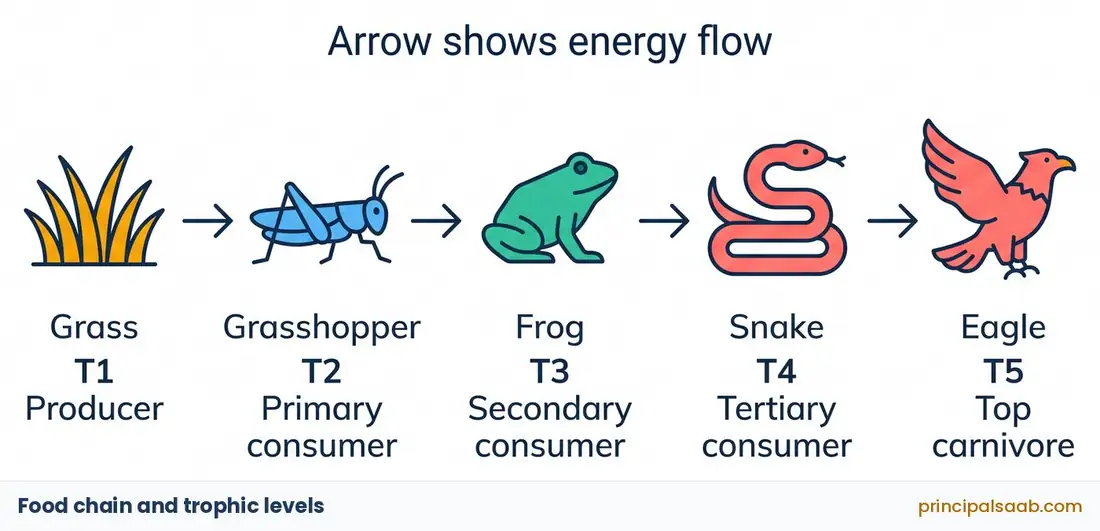
Grass → Grasshopper → Frog → Snake → Eagle
Read that as: grass is eaten by the grasshopper, which is eaten by the frog, and so on. The arrow is not saying “grass wants a grasshopper”. It is saying “energy stored in grass moves into the grasshopper”.
Each feeding step in the chain is called a trophic level (from the Greek word for nourishment). Numbering them is mechanical once you know the rule:
| Trophic level | Called | In our chain |
|---|---|---|
| First (T1) | Producer | Grass |
| Second (T2) | Primary consumer (herbivore) | Grasshopper |
| Third (T3) | Secondary consumer (small carnivore) | Frog |
| Fourth (T4) | Tertiary consumer (larger carnivore) | Snake |
| Fifth (T5) | Quaternary consumer / top carnivore | Eagle |
Producers are always the first trophic level. Always. Then just count upward. And notice the naming offset that trips everyone: a primary consumer sits at the second trophic level, because the producer already used up slot one.
Food chains in nature are short — usually three or four links, rarely more than five. There is a hard physical reason for this, and we will meet it in the very next section: so much energy is lost at every step that after four or five steps there is simply not enough left to support another animal.
Answer: Phytoplankton → Water beetle → Small fish → Heron.
Phytoplankton — producer, T1. Water beetle — primary consumer (herbivore), T2. Small fish — secondary consumer, T3. Heron — tertiary consumer and top carnivore, T4.
Why it works: we started by asking “which of these can make its own food?” Phytoplankton are microscopic algae, so they are producers and must go first. Everything after that is just ordering by who eats whom.
Only about 10 per cent of the energy at one trophic level is transferred to the next; the remaining 90 per cent is used in life processes and lost as heat. (1 mark)
Therefore the energy available becomes extremely small after three or four transfers, and there is not enough left to support a further trophic level. (1 mark)
Why it works: the marks are for the number 10 per cent and the phrase “lost as heat”. Vague answers about predators being rare get nothing.
Food Webs — Why Nature Is Not A Straight Line
A single food chain is a convenient lie. In real life a grasshopper is not eaten only by frogs — it is also taken by birds, lizards and spiders. And the frog does not eat only grasshoppers; it eats beetles, worms and mosquito larvae too.
When you draw all the possible food chains of an ecosystem on one page, the arrows criss-cross and you get a food web: a network of interconnected food chains in which one organism can occupy more than one trophic level and can be eaten by several different organisms.
Why does nature bother with this complexity? Stability. Imagine a grassland where the only chain is grass → rabbit → fox. One disease among rabbits and the foxes starve. Now imagine a web where the fox can also take mice, birds and beetles. A rabbit crash becomes an inconvenience instead of a catastrophe. A food web gives an ecosystem alternative routes, and alternative routes are what make it hard to break.
(a) Write two different food chains from this web. (b) At how many trophic levels does the sparrow feed?
Answer (a): Grass → Grasshopper → Lizard → Owl, and Grass → Mouse → Owl. (Grass → Grasshopper → Sparrow is also acceptable.)
Answer (b): The sparrow eats grasshoppers (making it a secondary consumer, T3) and mice (also a secondary consumer, T3). So in this particular web the sparrow feeds at one trophic level, T3, through two different chains.
Why it works: part (b) is the trap. Two different prey species does not automatically mean two different trophic levels — both the grasshopper and the mouse are herbivores at T2, so eating either puts the sparrow at T3.
(i) With lizards gone, grasshoppers lose one of their predators, so the grasshopper population rises sharply. (1 mark)
(ii) The increased number of grasshoppers eats far more grass, so the grass cover falls, which later reduces food for mice as well. (1 mark)
(iii) Owls lose lizards as a food source and must depend entirely on mice; if mice also decline, the owl population falls. The ecosystem becomes less stable because one link has been removed from the web. (1 mark)
Why it works: a good ecology answer always travels in both directions from the missing organism — downward to its prey and upward to its predator. Students who only go one way lose half the marks.
Flow Of Energy And The Ten Per Cent Law
This is the heart of the chapter, and the only place you will meet numbers. Take it slowly with me.
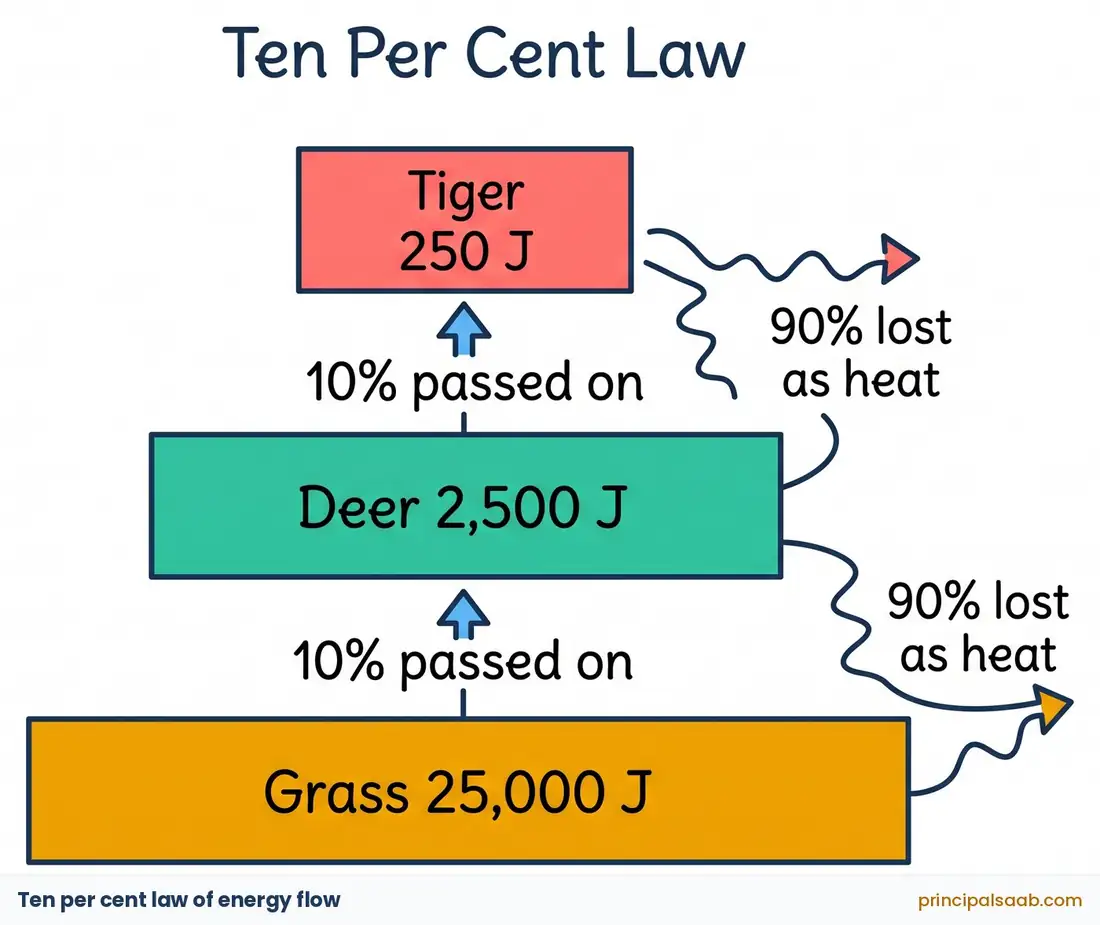
All the energy in an ecosystem starts as sunlight. Green plants capture a small slice of the sunlight falling on their leaves — only about 1 per cent of the light energy that reaches them — and convert it into chemical energy stored in food. That tiny 1 per cent is the entire energy budget of every forest, ocean and grassland on Earth.
Now the energy starts moving. A herbivore eats the plant. But does all the plant’s energy end up in the herbivore? Nowhere close. Think about what happens to the food you eat today:
- Some of it you never digest — it leaves as waste.
- A large part is burned in respiration to power your heartbeat, your breathing, your walking, your thinking. That energy leaves your body as heat.
- Only the small leftover is built into new body tissue — new muscle, new fat, new bone.
And it is only that last portion — the part built into your body — that is available to whatever eats you. This gives us the rule you must know cold.
Two consequences follow, and examiners love both:
Consequence 1 — energy flow is unidirectional. Energy moves sun → producer → herbivore → carnivore, and never back. The heat lost at each step radiates away and cannot be recaptured by any organism. This is why we say energy flows through an ecosystem while nutrients cycle within it.
Consequence 2 — chains must be short. Multiply by 0.1 four or five times and you are down to crumbs. Nature simply runs out of energy.
Working: Grass to deer is one arrow: 25,000 × 10/100 = 2,500 J.
Deer to tiger is one more arrow: 2,500 × 10/100 = 250 J.
Answer: Deer 2,500 J, tiger 250 J.
Why it works: two organisms above the grass, so exactly two divisions by 10. Nothing more complicated is happening.
Working: Energy lost = 25,000 − 2,500 = 22,500 J.
Percentage lost = (22,500 ÷ 25,000) × 100 = 90 per cent.
Answer: 22,500 J is lost, which is 90 per cent of the energy at the producer level.
Why it works: if 10 per cent is transferred then 90 per cent must be lost — the arithmetic simply confirms the rule. In the exam, state clearly where it went: used in respiration, movement, digestion and other life processes, and released as heat.
Working:
Phytoplankton = 10,000 J
Zooplankton = 10,000 ÷ 10 = 1,000 J
Small fish = 1,000 ÷ 10 = 100 J
Large fish = 100 ÷ 10 = 10 J
Percentage = (10 ÷ 10,000) × 100 = 0.1 per cent
Answer: 1,000 J, 100 J and 10 J; the large fish gets only 0.1 per cent of what the phytoplankton captured.
Why it works: three arrows, so we divide by 10 three times, i.e. by 1,000 overall. Sit with that 0.1 per cent for a second — it is the number that explains why top predators are always rare.
Working: Going down the chain we multiply by 10 for each arrow. There are three arrows.
Frogs = 4 × 10 = 40 J
Insects = 40 × 10 = 400 J
Plants = 400 × 10 = 4,000 J
Answer: 4,000 J.
Why it works: the ten per cent law runs both ways. Upward you divide, downward you multiply. Check it forward as a habit: 4,000 → 400 → 40 → 4. It closes perfectly, so the answer is safe.
Working (a):
Grasshopper = 2,000,000 ÷ 10 = 200,000 J
Frog = 200,000 ÷ 10 = 20,000 J
Snake = 20,000 ÷ 10 = 2,000 J
Eagle = 2,000 ÷ 10 = 200 J
Answer (a): 200 J, which is 0.01 per cent of the energy the grass captured.
Answer (b): (i) At each transfer about 90 per cent of the energy is used in life processes and lost as heat, so after four transfers only a minute amount remains. (ii) That remaining energy is far too small to meet the food requirement of another population of organisms, so the chain ends.
Why it works: four arrows means dividing by 10 four times, i.e. by 10,000. Confirm: 2,000,000 ÷ 10,000 = 200. The check takes three seconds and saves the whole question.
Biomagnification — The Poison That Climbs
Energy shrinks as it goes up a food chain. Some chemicals do the exact opposite — they concentrate. That mismatch is what makes biomagnification both surprising and dangerous.
Biomagnification is the progressive increase in the concentration of a harmful, non-biodegradable substance in the bodies of organisms at successively higher trophic levels of a food chain.
Let me walk you through the mechanism, because once you see it you will never forget it. Farmers spray pesticides on crops to control insects. Rain washes the chemical into the soil and into nearby water bodies. There it is absorbed by plants and by microscopic algae — in very small amounts.
Now here is the crucial property: these pesticides (organochlorines like DDT are the classic case) are not biodegradable and they dissolve in fat, not water. An organism cannot break them down and cannot flush them out in urine. So the chemical stays parked in body fat, accumulating over a lifetime.
A small fish eats hundreds of algae over weeks. It takes in the pesticide from every single one of them, and loses almost none. A bigger fish eats dozens of small fish, inheriting all of their stored pesticide. A fish-eating bird eats many big fish. At each step the energy available drops to a tenth, but the pesticide from an entire level piles into one body at the level above.
Because human beings sit at the top of many food chains — we eat the big fish, the chicken and the grain — the highest concentrations often end up in us. Studies of pesticide residues in Indian foodgrains, vegetables and even bottled milk have repeatedly shown measurable levels, which is exactly why washing produce thoroughly is more than a fussy habit.
(a) By what factor is the pesticide concentrated in the bird compared with the water? (b) Which organism is at greatest risk and why?
Working (a): 25 ÷ 0.00005 = 500,000 times.
Answer (b): The fish-eating bird, because it occupies the highest trophic level; it consumes many large fish and the non-biodegradable pesticide from all of them accumulates in its body.
Why it works: notice each step multiplies roughly, not adds — water to phytoplankton is a hundredfold jump, phytoplankton to small fish another hundredfold. Multiplication at every link is precisely why the final figure is so extreme.
Working: Insect = 0.02 × 10 = 0.2 ppm. Sparrow = 0.2 × 10 = 2 ppm. Hawk = 2 × 10 = 20 ppm.
Overall increase = 20 ÷ 0.02 = 1,000 times.
Answer: 20 ppm, a thousandfold increase over the crop.
Why it works: compare this with the energy calculations. Same chain, same three arrows — but energy was divided by 1,000 and the poison was multiplied by 1,000. Energy dwindles, toxins magnify. Write that sentence in your notes.
(i) Pesticides sprayed on crops are non-biodegradable, so they are not broken down by living organisms or by the environment. (1 mark)
(ii) They enter food chains through plants and water, and because organisms cannot excrete them, they accumulate in the body and increase in concentration at each successive trophic level. This is called biomagnification. (1 mark)
(iii) Human beings occupy the topmost trophic level in most food chains and consume food from many different chains, so the pesticide concentration reaching them is the highest. (1 mark)
Why it works: the word “non-biodegradable” must appear, and the phrase “topmost trophic level” must appear. Those are the two mark-carrying ideas.
Biodegradable And Non-Biodegradable Substances
This is the most guaranteed question in the whole unit, and it is pure marks if you are precise.
Biodegradable substances are substances that can be broken down into simpler, harmless substances by the action of microorganisms such as bacteria and fungi (and by physical processes like heat and sunlight helping along the way).
Non-biodegradable substances are substances that cannot be broken down by biological processes and therefore persist in the environment for a very long time, sometimes for centuries.
Why can microbes handle some things and not others? Because a microbe attacks with enzymes, and every enzyme is shaped for a particular kind of chemical bond. Bacteria and fungi have spent millions of years evolving enzymes for the natural materials they meet — cellulose, starch, protein, fat. Then in the last century we invented plastics, DDT and synthetic detergents: molecules with bonds and shapes that no enzyme on Earth has ever encountered. The microbes do not refuse to eat them; they simply have no tool that fits.
| Basis | Biodegradable | Non-biodegradable |
|---|---|---|
| Breakdown | Decomposed by microorganisms into simple substances | Not decomposed by microorganisms at all, or only over centuries |
| Time taken | Days to a few years | Decades, centuries or effectively never |
| Effect on ecosystem | Nutrients are returned to the soil; supports nutrient cycling | Accumulates, pollutes soil and water, blocks drains, enters food chains |
| Biomagnification | Does not occur — the substance is destroyed | Occurs readily if the substance is toxic and fat-soluble |
| Useful conversion | Can be turned into compost, manure or biogas | Can sometimes be recycled, but never composted |
| Examples | Vegetable peels, paper, cotton cloth, wood, cow dung, dead leaves, woollen and silk fabric, jute | Plastics, polythene bags, glass, aluminium foil and cans, DDT and similar pesticides, synthetic detergents, nylon and polyester, radioactive waste |
Answer — Biodegradable: banana peel, cotton shirt, used tea leaves, newspaper, cow dung.
Non-biodegradable: shampoo bottle (plastic), glass tumbler, aluminium foil, nylon rope, ballpoint refill (plastic and metal).
Why it works: the newspaper is the interesting one. Paper is made from wood pulp, which is cellulose, and bacteria have cellulase enzymes — so it rots. Its plastic-coated glossy cousin does not.
No. Biodegradable substances are broken down eventually, but if they are produced in very large quantities they cause serious short-term problems. (1 mark)
For example, heaps of rotting kitchen waste and untreated sewage release foul odours and greenhouse gases such as methane, breed flies and mosquitoes that spread disease, and when washed into a water body they cause excessive growth of algae which uses up dissolved oxygen and kills fish. (1 mark)
Why it works: the examiner is testing whether you think or recite. “Biodegradable is good, non-biodegradable is bad” is too crude — the real variable is quantity and the time the breakdown takes.
Waste Generation And Waste Management
Ask yourself an honest question: what leaves your house every morning in that bin? Two generations ago the answer was mostly vegetable peels and ash, and it went straight into a compost pit. Today it is peels plus polythene plus foil plus a broken charger plus a dead battery. The volume of waste has grown, but the far bigger change is in its nature — a rising share of it is now non-biodegradable.
Why waste generation has increased so much:
- Population growth — more people, more consumption, more discards.
- Urbanisation — dense cities produce concentrated waste with nowhere nearby to absorb it.
- Change in lifestyle — packaged food, bottled drinks, online deliveries, disposable cutlery.
- Industrialisation — factories generate chemical effluents, slag, fly ash and sludge.
- Modern agriculture — pesticide and fertiliser residues run off into soil and water.
- Electronic goods — phones and appliances are replaced every few years, creating e-waste containing lead, mercury and cadmium.
Types of waste you should be able to name: domestic (household) waste, industrial waste, agricultural waste, biomedical waste from hospitals, e-waste, and radioactive waste from nuclear installations. Biomedical and radioactive waste need special, separate handling — never let them appear in an answer about ordinary landfills.
Methods Of Waste Disposal And Management
| Method | How it works | Best for / limitation |
|---|---|---|
| Segregation at source | Separating wet (biodegradable) from dry (non-biodegradable) waste in two bins before it leaves the house | The single most effective step; mixed waste cannot be composted or recycled properly |
| Composting | Biodegradable waste is heaped in a pit and decomposed by microbes into nutrient-rich manure | Kitchen and garden waste; useless for plastic or metal |
| Vermicomposting | Earthworms (such as Eisenia species) are added to speed up decomposition and enrich the compost | Faster and higher quality than plain composting; worms are sensitive to plastics and chemicals |
| Sanitary landfill | Waste is dumped in a lined low-lying area in layers and covered with soil | Cheap and simple, but consumes land and can leak leachate into groundwater if unlined |
| Incineration | Waste is burnt at high temperature in a closed furnace, reducing it to ash | Essential for biomedical and hazardous waste; produces air pollutants unless properly filtered |
| Recycling | Used material is reprocessed into fresh raw material and new products | Paper, glass, metal, many plastics; needs clean segregated input |
| Sewage treatment | Liquid waste is treated physically and biologically before release into a water body | Prevents water pollution and disease; requires infrastructure and running cost |
| Biogas production | Organic waste and dung are digested by anaerobic bacteria to yield methane-rich fuel gas plus slurry manure | Turns a disposal problem into a fuel supply; needs a steady supply of wet organic waste |
Answer: (a) Incineration — biomedical waste is infectious and must be destroyed by high-temperature burning, not landfilled. (b) Composting or vermicomposting — it is biodegradable and gives manure for the school garden. (c) Recycling — both paper and glass are cleanly recyclable. (d) A biogas plant — the dung yields fuel gas and the leftover slurry is excellent manure.
Why it works: the method follows from the nature of the waste. Infectious means destroy; wet organic means decompose; dry recoverable means recycle. Never suggest composting for anything non-biodegradable.
(i) Plastic is non-biodegradable, so microorganisms cannot break it down and it remains in the environment for hundreds of years, accumulating in soil, drains and water bodies. (1 mark)
(ii) It chokes drains and causes waterlogging, is swallowed by stray cattle and marine animals and kills them, and when burnt in the open it releases toxic gases that pollute the air. (1 mark)
(iii) Solutions: refuse single-use plastic and carry cloth or jute bags; segregate dry waste so that plastic can be collected and recycled into new products or used in plastic-modified road construction. (1 mark)
Why it works: problem, consequence, solution — three distinct steps for three marks. When a question says “suggest two solutions”, write exactly two clear ones rather than a vague paragraph.
The Ozone Layer — Formation And Why It Matters
Ozone is simply oxygen wearing a different arrangement. Ordinary oxygen that you breathe is O₂ — two atoms joined. Ozone is O₃ — three atoms joined. Same element, different molecule, completely different behaviour.
At ground level ozone is a poison; it is a component of photochemical smog and it irritates lungs. High up in the stratosphere, roughly 15 to 35 km above the surface, the very same molecule forms a thin shield that makes life on land possible. This is worth pausing on: ozone is not “good” or “bad”. It is deadly in the wrong place and indispensable in the right one.
How Ozone Is Formed
The formation happens in two steps, both driven by ultraviolet radiation from the Sun.
Step 1 — splitting. High-energy UV radiation strikes an oxygen molecule and breaks it into two free oxygen atoms:
O₂ —(UV)→ O + O
Step 2 — joining. Each free, highly reactive oxygen atom immediately attacks another oxygen molecule to form ozone:
O + O₂ → O₃
There is something rather beautiful going on here. The ultraviolet radiation that ozone protects us from is the very same radiation that creates the ozone. Ozone is also constantly being destroyed by UV and re-formed — a natural balance that kept the layer steady for millions of years, until we interfered with it.
What UV radiation does if it gets through: skin cancer in human beings, cataracts and other damage to the eyes, weakening of the immune system, damage to the DNA of living cells, reduced growth and yield of crops, and destruction of phytoplankton in the surface layers of the ocean — which matters enormously, since phytoplankton are the producers at the base of nearly every marine food chain.
In the stratosphere, high-energy ultraviolet radiation from the Sun splits molecular oxygen into free oxygen atoms:
O₂ —(UV)→ O + O (½ mark)
These free oxygen atoms then combine with oxygen molecules to form ozone:
O + O₂ → O₃ (½ mark)
The ozone so formed collects as a layer about 15–35 km above the Earth and absorbs harmful UV radiation, protecting living organisms from its damaging effects. (1 mark)
Why it works: when a question says “write the equations”, the equations themselves carry marks. Write both, and label UV over the first arrow — without it the first equation is incomplete.
Ozone Depletion, CFCs And The Montreal Protocol
In the 1980s scientists measuring the atmosphere above Antarctica found something alarming: the ozone layer there had thinned dramatically each spring. The newspapers called it the ozone hole. Strictly speaking it is not a hole but a region of severely reduced ozone concentration — and knowing that distinction is worth a mark.
The culprit: chlorofluorocarbons (CFCs). These are synthetic compounds of carbon, chlorine and fluorine, once considered miracle chemicals because they are non-toxic, non-flammable and chemically stable. We used them as:
- refrigerants in refrigerators and air conditioners,
- propellants in aerosol sprays such as deodorants and paints,
- blowing agents for making foam and thermocol,
- solvents for cleaning electronic circuit boards.
Here is the cruel irony. The property that made CFCs so useful — their stability — is exactly what makes them so destructive. Because nothing at ground level reacts with them, they drift slowly upward for years until they reach the stratosphere, where intense UV finally breaks them apart and releases free chlorine atoms.
How the damage happens: a free chlorine atom attacks an ozone molecule, pulling one oxygen atom away to form chlorine monoxide and leaving ordinary oxygen behind:
Cl + O₃ → ClO + O₂
ClO + O → Cl + O₂
Look carefully at the second step. The chlorine atom comes back out, completely unchanged, ready to attack again. It acts as a catalyst — it destroys ozone without being consumed. This is why a single chlorine atom can destroy thousands upon thousands of ozone molecules before it is finally removed from the stratosphere, and why such small quantities of CFCs did such large damage.
The Montreal Protocol — The World Actually Fixing Something
Once the cause was clear, the response was unusually fast. The Montreal Protocol, agreed in 1987 under the United Nations Environment Programme and in force from 1989, committed the signing countries to freeze and then phase out the production and use of CFCs and other ozone-depleting substances. India is a party to it and has phased out CFC production.
The practical results are all around you. Refrigerators and air conditioners are now labelled “CFC-free” and use alternative refrigerants such as HFCs and hydrocarbons. Aerosol cans use different propellants. And measurements show the ozone layer has stopped getting worse and has begun a slow recovery expected to take decades — because those CFC molecules already up there will keep working for a very long time.
(i) CFCs are very stable synthetic compounds used in refrigerators, air conditioners, aerosol sprays and foam. Because they do not react at lower levels, they slowly rise into the stratosphere. (1 mark)
(ii) There, ultraviolet radiation breaks them down and releases free chlorine atoms. (1 mark)
(iii) A chlorine atom reacts with ozone: Cl + O₃ → ClO + O₂, converting ozone into ordinary oxygen. The chlorine is later regenerated (ClO + O → Cl + O₂), so it acts as a catalyst and a single atom destroys a very large number of ozone molecules. (1 mark)
(iv) The ozone layer therefore thins, allowing more harmful UV radiation to reach the Earth, causing skin cancer, cataracts, weakened immunity and damage to crops and phytoplankton. (1 mark)
(v) In 1987 the United Nations Environment Programme brought about the Montreal Protocol, under which member countries agreed to freeze and phase out the production and use of CFCs; today refrigerators and aerosols are manufactured CFC-free. (1 mark)
Why it works: five marks means five separate scoring points. Use of CFCs, release of chlorine, catalytic destruction, effects on life, international action. Number them in your answer sheet so the examiner cannot miss any.
Because the chlorine atom released from a CFC molecule destroys ozone catalytically — it is regenerated at the end of each reaction cycle and is not used up. (1 mark)
Hence one chlorine atom can go on destroying thousands of ozone molecules over many years, so even a very small quantity of CFC causes disproportionately large depletion. (1 mark)
Why it works: the whole answer rests on the word catalytic. If you find yourself writing a long answer here, you have missed the point — two crisp sentences earn full marks.
Environmental Problems — The Bigger Picture
The syllabus asks you to know environmental problems generally, not just ozone and waste. Here is a compact map you can revise in five minutes.
| Problem | Main cause | Main effect |
|---|---|---|
| Ozone depletion | CFCs and other ozone-depleting substances | More UV reaching Earth — skin cancer, cataracts, crop and plankton damage |
| Global warming | Greenhouse gases — CO₂, methane, nitrous oxide from fuel burning and agriculture | Rising average temperature, melting glaciers, sea-level rise, erratic monsoon |
| Air pollution | Vehicle exhaust, industry, stubble and waste burning | Respiratory disease, smog, acid rain, reduced visibility |
| Water pollution | Untreated sewage, industrial effluent, fertiliser and pesticide run-off | Waterborne disease, fish kills, algal blooms, loss of dissolved oxygen |
| Soil pollution and degradation | Excess chemical fertilisers, plastic waste, deforestation | Loss of fertility, erosion, reduced crop yield |
| Accumulation of non-biodegradable waste | Plastics, e-waste, packaging | Choked drains, animal deaths, biomagnification of toxins |
| Loss of biodiversity | Habitat destruction, pollution, over-exploitation | Simpler food webs, less stable ecosystems, species extinction |
Notice how often the same root cause appears: we make or use something the natural system has no way to break down or absorb, and we do it faster than the system can cope. Once you see that pattern, the solutions stop feeling like a random list — every one of them is either produce less of the problem or help the system cope.
(i) Place separate green and blue bins in every corridor and train students to segregate wet and dry waste at source. (1 mark)
(ii) Compost the canteen and garden waste in a pit on the campus and use the manure for the school garden, turning waste into a resource. (1 mark)
(iii) Ban single-use plastic on the campus — steel water bottles, cloth bags and reusable lunch boxes instead of disposable ones. (1 mark)
(iv) Collect used paper for recycling and switch off lights, fans and computers when a room is empty to cut electricity demand and the fuel burning behind it. (1 mark)
Why it works: each point is a specific, doable action, not a slogan. “We should save the environment” earns nothing. “Compost canteen waste on campus” earns a mark.
How To Score All Five Marks
Let us be practical. Unit V is worth 5 marks, and this chapter carries most of them. Here is where those marks usually sit.
- One-mark questions: pick the biodegradable substance from a list; name the trophic level of an organism; expand CFC; state which radiation the ozone layer absorbs; identify the producer in a given chain.
- Two-mark questions: two differences between biodegradable and non-biodegradable; why food chains are short; why an aquarium needs cleaning; a small ten per cent law calculation.
- Three-mark questions: biomagnification explained; effects of removing one organism from a food web; problems of plastic waste with solutions; formation and importance of ozone.
- Five-mark / case-based: a passage about a lake, a landfill or a refrigerator factory with four or five short questions hanging off it.
(a) Write a food chain from the lake. Algae → Small crustaceans → Fish → Stork.
(b) If the algae hold 60,000 J of energy, how much reaches the storks? Crustaceans = 60,000 ÷ 10 = 6,000 J; fish = 600 J; storks = 60 J.
(c) In which organism will the pesticide concentration be highest, and what is this phenomenon called? In the stork, as it is at the highest trophic level; the phenomenon is biomagnification.
(d) The household waste contains vegetable peels and polythene bags. How should the villagers deal with each? Vegetable peels are biodegradable and should be composted to make manure; polythene bags are non-biodegradable and should be collected separately, kept out of the lake and sent for recycling.
Why it works: one passage, four different skills — chain building, ten per cent arithmetic, biomagnification and waste classification. Check the numbers: three arrows, so 60,000 ÷ 1,000 = 60. It matches.
Practice Worksheet — Test Yourself
Ten questions, mixed difficulty, all original. Write your full answer on paper before you open the reveal — that is the whole point. If an answer is wrong, do not just read the correct one; find the exact sentence in the chapter where you went astray and re-read it.
Q1. From this list pick the non-biodegradable substances: mango peel, thermocol packing, jute sack, aluminium can, cow dung, polyester shirt, wooden ruler. (2 marks) — Show Answer
Biodegradable (for contrast): mango peel, jute sack, cow dung, wooden ruler.
Reason: thermocol and polyester are synthetic polymers and aluminium is a refined metal — no microorganism has enzymes able to break them down. Jute and wood are cellulose and cow dung and mango peel are organic matter, all of which decomposers digest easily.
Q2. In the food chain Paddy → Rat → Snake → Peacock, name the trophic level and the consumer category of the snake. (2 marks) — Show Answer
Paddy is the producer at T1, the rat is the primary consumer at T2, the snake is the secondary consumer at T3 and the peacock is the tertiary consumer at T4. Remember the offset: the secondary consumer always sits at the third trophic level because the producer occupies the first.
Q3. A producer level contains 500,000 J of energy. Calculate the energy available at the second and third trophic levels, and state how much energy is lost between the first and second. (3 marks) — Show Answer
Third trophic level = 50,000 × 10/100 = 5,000 J
Energy lost between the first and second levels = 500,000 − 50,000 = 450,000 J, which is 90 per cent of the producer’s energy.
This lost energy is used in the organisms’ life processes such as respiration, movement and digestion, and is finally released into the surroundings as heat, where it cannot be recovered by any organism.
Q4. In a chain of four organisms the topmost carnivore receives 8 J of energy. How much energy was fixed by the producer? (2 marks) — Show Answer
Third level = 8 × 10 = 80 J
Second level = 80 × 10 = 800 J
Producer = 800 × 10 = 8,000 J
Check forward: 8,000 → 800 → 80 → 8. Correct. Always count arrows, never organisms.
Q5. Why is a food web more useful to an ecosystem than a set of separate food chains? (3 marks) — Show Answer
(ii) The same organism can occupy more than one trophic level along different chains, which spreads the feeding pressure across many species instead of concentrating it on one.
(iii) Because of these alternative pathways, the removal or decline of a single species does not break the whole system. A food web therefore makes the ecosystem far more stable than a set of isolated linear chains would be.
Q6. Define biomagnification and explain why it affects top carnivores most severely. (3 marks) — Show Answer
(ii) These substances cannot be broken down or excreted, so they are stored in the body tissues of an organism throughout its life.
(iii) Each predator eats a large number of prey animals and takes in the stored chemical from every one of them. As the same total quantity of chemical becomes packed into fewer and smaller bodies at each higher level, its concentration rises steeply, so the top carnivore carries the highest concentration and suffers the greatest harm.
Q7. Ozone is described as harmful at ground level but essential in the stratosphere. Explain this apparent contradiction. (3 marks) — Show Answer
(ii) In the stratosphere, about 15–35 km above the Earth, ozone forms a layer that absorbs most of the Sun’s harmful ultraviolet radiation.
(iii) This absorption prevents UV from reaching the surface, protecting living organisms from skin cancer, cataracts, immune suppression and DNA damage. So the same molecule is a pollutant where we breathe it and a shield where it intercepts UV — the difference is location, not chemistry.
Q8. What is the Montreal Protocol? State the year it was adopted and one visible result of it. (3 marks) — Show Answer
(ii) It was adopted in 1987 and came into force in 1989; India is a party to it.
(iii) A visible result: refrigerators, air conditioners and aerosol sprays are now manufactured “CFC-free” using alternative refrigerants and propellants, and monitoring shows that ozone depletion has stopped worsening and the layer has begun a slow recovery.
Q9. A colony generates about 400 kg of waste daily, of which roughly 250 kg is kitchen and garden waste and 150 kg is plastic, glass and metal. Suggest a management plan and justify each step. (3 marks) — Show Answer
(ii) Compost or vermicompost the 250 kg of wet waste in pits within the colony. It is biodegradable, and the manure produced can be used for the colony’s own gardens, so a disposal cost becomes a resource. A biogas plant is an equally valid answer, with the gas used in a community kitchen.
(iii) Send the 150 kg of dry waste for recycling through registered recyclers, keeping e-waste separate for authorised handling. This keeps non-biodegradable material out of landfills and drains, where it would persist for centuries and harm animals.
Alongside these, reducing single-use plastic in the first place cuts the 150 kg itself — prevention beats disposal.
Q10. Assertion–Reason. A: The number of individuals generally decreases as we move to higher trophic levels. R: Only about 10 per cent of the energy of one trophic level is transferred to the next. Choose and justify. (1 mark + justification) — Show Answer
Justification: since only about a tenth of the energy passes from one trophic level to the next, the food energy available to support organisms shrinks sharply at every step. Less available energy can sustain a smaller total mass of organisms, so higher trophic levels generally contain fewer individuals. This is also why food chains rarely have more than four or five links, and why top carnivores such as tigers and eagles are naturally rare rather than merely unlucky.