
Let us start with something you already know, even if nobody has ever put a name to it. Somebody has told you that you have your mother’s eyes, or your father’s laugh, or your grandmother’s stubbornness. You did not choose any of those things. They arrived with you. That quiet, invisible handing-down of features from parents to children is called heredity, and this chapter is simply the science of how it happens.
Now, a lot of students open this chapter, see letters like TT, Tt and tt scattered across a page, see a grid full of symbols, and immediately decide that this is going to be hard. It is not. I promise you that. Every single thing in this chapter comes down to one idea: you carry two copies of each instruction, one from each parent, and when you have children you pass on only one of those copies, chosen at random. That is it. Everything else — the ratios, the squares, the vocabulary — is just careful bookkeeping built on top of that one sentence.
So we are going to go slowly. I will teach you the words before I use them. I will draw every grid out cell by cell. And when we reach the famous 3:1 and 9:3:3:1 ratios, you will not be memorising them — you will have counted them yourself and seen exactly where each number comes from. Take your time. There is no prize for rushing.
- Why Children Resemble Their Parents — Heredity in Everyday Life
- Variation — Why No Two People Are Identical
- Genes, Chromosomes and Alleles — The Vocabulary You Need First
- Mendel and His Pea Plants — Why He Got It Right When Others Didn’t
- The Monohybrid Cross — F1, F2, 3:1 and 1:2:1
- Dominant and Recessive, Genotype vs Phenotype, Homozygous vs Heterozygous
- The Dihybrid Cross — the 9:3:3:1 Ratio and What It Proves
- Mendel’s Laws — Dominance, Segregation and Independent Assortment
- How to Draw and Read a Punnett Square (Step by Step)
- Sex Determination in Human Beings — XX, XY and the Father’s Role
- What Was Removed From This Chapter (Evolution)
- Practice Worksheet — 10 Questions with Full Model Answers
Your Game Plan
If you follow these five steps in order, this chapter will take you one focused afternoon and it will stay learnt. Skipping ahead is the only way to make it confusing.
- Learn the five words first — gene, allele, chromosome, genotype, phenotype. Do not touch a single cross until these feel comfortable in your mouth.
- Master one gene before two. Do every monohybrid cross in this page by hand on paper. Only then move to the dihybrid.
- Practise the Punnett square as a mechanical routine — gametes on the edges, combine row and column, fill every cell. Speed comes from repetition, not cleverness.
- Say the ratios out loud with their meaning attached: “three tall to one dwarf in the F2” is worth remembering; a bare “3:1” is not.
- Finish with the worksheet at the bottom with the answers hidden. Write your answer first, then reveal. That gap between your answer and the model answer is exactly where the marks live.
Why Children Resemble Their Parents — Heredity in Everyday Life
Think about a family recipe. Your grandmother makes a particular dish a particular way. She teaches your mother, who teaches you. The recipe is not the food — the recipe is the instruction for making the food. The dish appears fresh on the table every time, but the instruction behind it has been passed down unchanged for three generations.
Heredity works exactly like that. Parents do not hand their children a nose or a hair colour. They hand over instructions. Those instructions are chemical, they sit inside the cells of the reproductive organs, and they travel into the next generation inside the gametes — the sperm from the father and the egg from the mother. When sperm and egg fuse, the two sets of instructions come together in one cell, and that single cell divides again and again to build a whole new individual who is running a mixture of both recipe books.
So the formal definition, the one you write in an exam, is this: heredity is the transmission of characters (traits) from parents to their offspring. The characters themselves are called inherited traits — height in a pea plant, flower colour, the shape of your earlobe, whether you can roll your tongue.
Notice what heredity is not. If your father learned to play the harmonium, that skill is not written into his gametes; you will not be born knowing it. If a person loses a finger in an accident, their children are born with ten. Changes that happen to a body during its own lifetime do not get copied back into the instructions. Only what is written in the instructions travels forward. That distinction — between what is in the recipe and what merely happened to one dish — is worth holding on to, because examiners like to test it with a trick example.
Model answer:
Heredity is the process by which characters or traits are passed on from parents to their offspring through the gametes. [1 mark — a definition that mentions parents, offspring and transmission]
Example: the shape of the earlobe, which may be free or attached, is an inherited trait in human beings. [1 mark — any correct inherited human trait, e.g. eye colour, tongue-rolling ability, blood group]
Why it works: the marker is looking for two things and two things only — the idea of transmission from parent to offspring, and one valid example. Do not waste time writing three examples; you get no extra mark and you lose time.
Model answer:
No, his children will not be born with unusually large arm muscles. [1 mark — a clear yes/no]
The large muscles are a change produced in the body cells during his own lifetime as a result of exercise. Such a change is not written into the genetic material present in his reproductive cells. [1 mark]
Only the information carried in the gametes is passed to the offspring, so a change acquired by the body during life is not inherited by the next generation. [1 mark]
Why it works: the answer separates body cells from reproductive cells. That single separation is the whole reason the answer is “no”, and stating it explicitly is what earns the middle mark.
Variation — Why No Two People Are Identical
Here is the interesting half of the story. If heredity were perfect copying, every child would be an exact duplicate of one parent. Clearly that does not happen. Two children of the same parents, raised in the same house, can look and behave quite differently. The differences between individuals of the same species are called variations.
Where do variations come from? Two main places, and both are easy to picture.
- Reshuffling during sexual reproduction. Each parent has two copies of every instruction and passes on only one, picked at random. Multiply that random choice across thousands of instructions and the number of possible combinations becomes astronomically large. Two children of the same couple simply draw different hands from the same deck.
- Small errors when the genetic material is copied. DNA copying is extremely accurate but not perfect. Occasional small changes creep in, and those changes become new variations that can be passed on.
Now the question that carries marks: why does variation matter? Think of a species as a group of people all writing the same exam. If every single one of them had prepared exactly one chapter, and the paper came from a different chapter, all of them would fail together. If instead they had prepared a spread of chapters, some would cope with whatever paper arrived. Variation is that spread.
Concretely: suppose a population of bacteria is living happily at a certain temperature and the water suddenly gets much hotter. If every bacterium were identical, the whole population would be wiped out. But if a few of them happen to vary in a way that lets them tolerate heat, those few survive and the species continues. Variation does not guarantee survival — it gives the species a chance. That is the honest way to state it, and it is what an examiner wants to read.
Model answer:
Variation means the differences that exist between individuals of the same species. [1 mark]
A particular variation may be of no use, or even a disadvantage, to the individual that carries it under present conditions; the individual gains nothing from it. [1 mark]
However, if conditions change — for example, if the temperature of the habitat rises sharply — the few individuals that happen to carry a variation allowing them to tolerate the new conditions will survive and reproduce, so the species as a whole is not wiped out. [1 mark]
Why it works: the answer holds both halves of the statement at once — no benefit now, possible benefit later — and anchors the “later” with a concrete change in conditions. Vague answers that only say “variation is good” score one mark at most.
Genes, Chromosomes and Alleles — The Vocabulary You Need First
Almost everyone who finds this chapter difficult is struggling with vocabulary, not with biology. So let us build the words carefully, from the outside in, using one image: a library.
Inside the nucleus of a cell there are thread-like structures called chromosomes. Think of each chromosome as a book. A chromosome is made of a very long molecule of DNA along with protein. DNA is the chemical in which the instructions are actually written.
A gene is a particular stretch of that DNA that carries the instruction for one character — one chapter in the book. There is a gene for the height of a pea plant, a gene for the colour of its flowers, and so on. A gene is a segment of DNA located at a definite position on a chromosome.
Now the word that trips people up. A gene can exist in more than one version. The height gene in a pea plant has a “tall” version and a “dwarf” version. These alternative forms of the same gene are called alleles. So allele is not a different thing from a gene — an allele is a variant of a gene. Same chapter, different editions.
Here is the part that makes the whole chapter work. In the body cells of an organism that reproduces sexually, chromosomes occur in pairs. One member of each pair came from the mother, the other from the father. Because the chromosomes are paired, the genes on them are paired too — which means you carry two alleles for every character. Picture two copies of the same house key: they may be identical, or one may be slightly different, but you are definitely carrying two.
In human beings there are 23 pairs of chromosomes in each body cell — that is 46 chromosomes in total. Of these 23 pairs, 22 pairs are autosomes (they carry instructions for ordinary body characters) and 1 pair is the sex chromosome pair, which decides whether the individual develops as male or female. Keep that split of 22 + 1 firmly in mind; we will use it directly when we reach sex determination.
And gametes? A gamete carries only one chromosome from each pair — so a human egg or sperm carries 23 chromosomes, not 46. This is essential, and it is common sense once you see it: if both the egg and the sperm carried 46, the child would have 92, the grandchild 184, and the number would double forever. Halving in the gametes and doubling at fertilisation keeps the number constant across generations.
| Term | What it means | Everyday picture |
|---|---|---|
| Chromosome | Thread-like structure in the nucleus, made of DNA and protein; occurs in pairs in body cells | A book on the shelf |
| DNA | The chemical molecule in which hereditary information is written | The printed text itself |
| Gene | A segment of DNA at a fixed position on a chromosome, controlling one character | One chapter of the book |
| Allele | One of the alternative forms of the same gene (e.g. tall T and dwarf t) | Two editions of the same chapter |
| Autosomes | The 22 pairs of chromosomes in humans that are not sex chromosomes | All the general-subject books |
| Sex chromosomes | The one pair that decides sex: XX in a human female, XY in a human male | The one special book |
| Gamete | Reproductive cell (egg or sperm) carrying only one chromosome of each pair | Half the library, packed for travel |
Model answer:
A gene is a segment of DNA situated at a fixed position on a chromosome which controls a particular character of an organism. [1 mark]
An allele is one of the two or more alternative forms in which the same gene can exist; for example, the gene for height in a pea plant has a tall allele (T) and a dwarf allele (t). [1 mark]
A human body cell contains 23 pairs of chromosomes, of which 22 pairs are autosomes and 1 pair is the sex chromosome pair. [1 mark]
Why it works: the second sentence gives an actual pair of alleles instead of only defining the word. When a question says “distinguish”, a concrete example is usually what separates a full mark from a half one.
Mendel and His Pea Plants — Why He Got It Right When Others Didn’t
Gregor Johann Mendel was a monk who worked in a monastery garden in the nineteenth century. He was not the first person to wonder how traits are inherited — people had been breeding animals and crops for thousands of years. He was the first to get a clear answer, and the reason is worth understanding, because it is really a lesson in how to do an experiment well.
Before Mendel, most people believed in blending inheritance — the idea that the characters of the two parents mix in the offspring the way two tins of paint mix, giving something in between, and that once mixed the original colours are gone forever. It sounds reasonable. It is also wrong, and Mendel’s experiments demolished it. In his crosses a character could disappear completely in one generation and then reappear unchanged in the next. Paint that has been mixed never un-mixes. So inheritance is not blending — the instructions stay separate and intact, even when one of them is hidden.
Mendel worked with the garden pea, Pisum sativum. This was not a lucky accident; it was a shrewd choice, and questions about “why the pea plant” are extremely common in exams. Here is the reasoning:
- It has clearly contrasting characters. A pea is tall or dwarf, its seeds are round or wrinkled — sharply either/or, with no confusing in-between. That makes counting possible.
- It normally self-pollinates. Left alone, a pea plant fertilises itself, which meant Mendel could easily obtain pure-breeding lines that gave the same character generation after generation.
- It can also be cross-pollinated by hand. He could remove the anthers from one flower and dust it with pollen he chose, so he controlled exactly which plant crossed with which.
- It has a short life cycle and gives many seeds. Several generations in a few years, and large numbers of offspring — and large numbers are what make a ratio trustworthy.
- It is easy to grow and takes little space. Practical, but genuinely part of the answer.
The other half of his genius was method. Mendel studied one character at a time instead of trying to track the whole plant at once, and he counted every offspring and applied mathematics to the numbers. Studying one variable at a time and counting carefully — that is why he succeeded where careful, intelligent people before him had failed.
He selected seven pairs of contrasting characters. You should be able to name at least three or four; the full set is here for reference.
| # | Character studied | Dominant form | Recessive form |
|---|---|---|---|
| 1 | Height of the plant | Tall | Dwarf |
| 2 | Shape of the seed | Round | Wrinkled |
| 3 | Colour of the seed (cotyledon) | Yellow | Green |
| 4 | Colour of the flower | Violet | White |
| 5 | Shape of the pod | Inflated (full) | Constricted |
| 6 | Colour of the pod | Green | Yellow |
| 7 | Position of the flower | Axial (along the stem) | Terminal (at the tip) |
Model answer: (any three of the following, one mark each)
(i) The garden pea shows several pairs of clearly contrasting characters, such as tall and dwarf plants or round and wrinkled seeds, which can be told apart without any doubt and therefore counted accurately. [1]
(ii) The plant is normally self-pollinating, so pure-breeding lines can be obtained easily; at the same time it can be cross-pollinated by hand, which allowed Mendel to control the parentage of every cross. [1]
(iii) It has a short life cycle and produces a large number of seeds, so several generations could be studied in a few years and the numbers were large enough for the ratios to be reliable. [1]
Why it works: each point is a reason, not just a fact — notice that every sentence ends by saying what the feature allowed him to do. “Pea plants are easy to grow” alone is a weak point; “easy to grow, so he could raise large numbers and trust the ratios” is a full mark.
Model answer:
According to blending inheritance, the characters of the two parents were believed to mix in the offspring to give an intermediate character, and the original characters were thought to be lost permanently. [1 mark]
When Mendel crossed a pure tall pea plant with a pure dwarf one, the F1 plants were all tall — not of medium height — so no blending had taken place. [1 mark]
When these F1 plants were self-pollinated, dwarf plants reappeared in the F2 generation in their original form. This showed that the dwarf factor had been present but hidden in the F1, and had not been destroyed or diluted. [1 mark]
Why it works: the argument needs both observations. The F1 alone only shows “no intermediate”. It is the reappearance in the F2 that proves the hidden factor survived intact.
The Monohybrid Cross — F1, F2, 3:1 Phenotypic and 1:2:1 Genotypic Ratio
A monohybrid cross is a cross in which we follow just one character. “Mono” for one. This is the experiment that built modern genetics, and we are going to walk through it twice — once for the first generation, once for the second — filling in every box.
First, the symbols. For height in a pea plant we use T for the tall allele and t for the dwarf allele. A pure-breeding (true-breeding) tall plant carries two tall alleles, so we write it TT. A pure-breeding dwarf plant carries two dwarf alleles: tt. The generations are labelled P (parent), F1 (first filial, the children) and F2 (second filial, the grandchildren).
Step 2 — Work out the gametes. Each parent puts only one allele into each gamete. TT can only give T (both copies are T). tt can only give t. So the gametes are T and t.
Step 3 — Build the Punnett square with one parent’s gametes across the top and the other’s down the side, then combine.
| Gametes | t | t |
|---|---|---|
| T | Tt | Tt |
| T | Tt | Tt |
Conclusion: the F1 generation is entirely tall and entirely heterozygous. The dwarf character has vanished from sight — but not from the plants.
Why it works: the dwarf allele t is sitting in every single F1 plant. It is simply not being expressed, because the dominant T is present alongside it and masks it. Nothing has been destroyed or diluted.
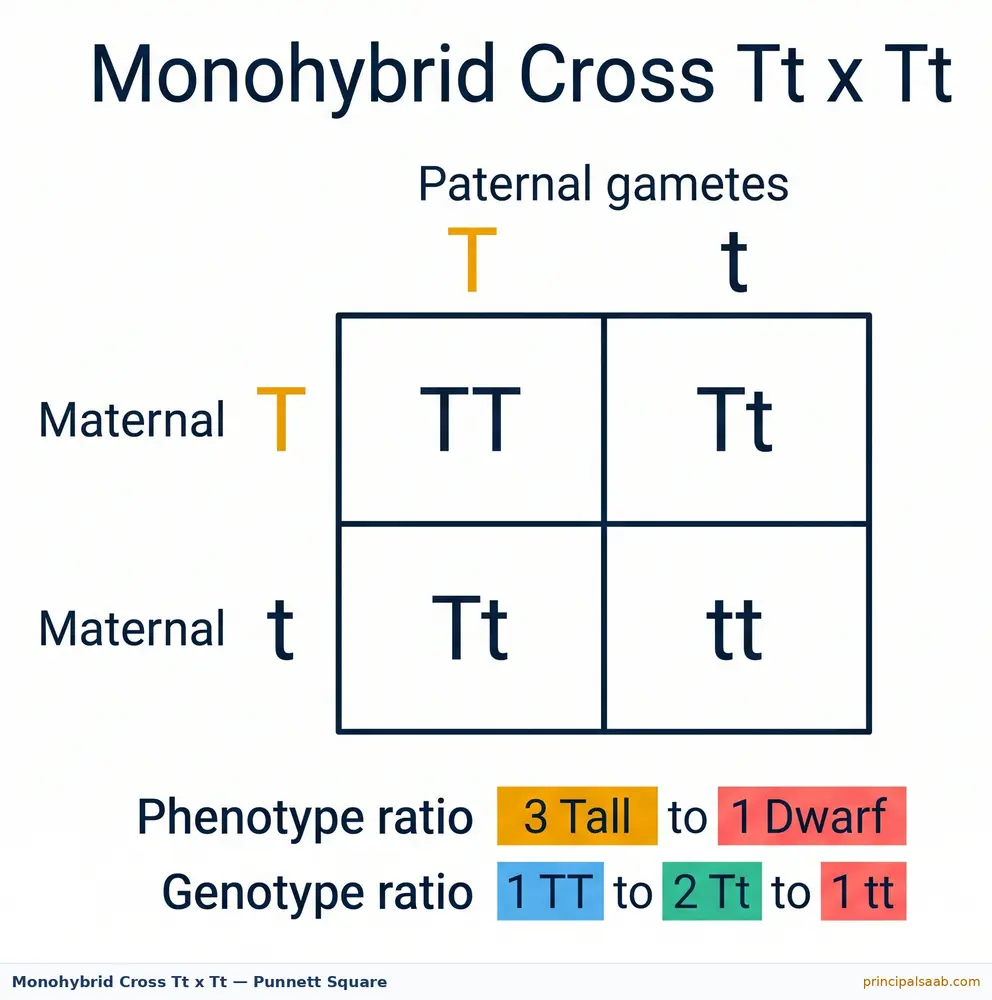
Now for the step that changed biology. Mendel allowed those F1 plants to self-pollinate, so Tt was effectively crossed with Tt.
Step 2 — Gametes. A Tt plant has two different alleles, so its pair separates and it produces two kinds of gamete in equal numbers: T and t. Same for the other parent.
Step 3 — Punnett square.
| Gametes | T | t |
|---|---|---|
| T | TT tall | Tt tall |
| t | Tt tall | tt dwarf |
→ Genotypic ratio = 1 TT : 2 Tt : 1 tt, that is 1:2:1.
Step 5 — Count the phenotypes. TT is tall, both Tt are tall, tt is dwarf. So three boxes look tall and one looks dwarf.
→ Phenotypic ratio = 3 tall : 1 dwarf, that is 3:1.
Conclusion: the dwarf character, completely absent in the F1, reappears in one quarter of the F2 plants — unchanged and fully dwarf.
Why it works: three of the four boxes contain at least one T, and one T is enough to make the plant tall. Only the single box with no T at all — tt — can show the dwarf character. That is the entire origin of the number 3.
One more idea belongs here: the test cross. Look at a tall pea plant in a field. Is it TT or Tt? You cannot tell by looking, because both are tall. So you cross it with a dwarf (tt) plant — the recessive one, which can only contribute t. The dwarf parent contributes nothing that could mask anything, so the offspring reveal what the unknown parent was carrying.
Step 2 — Gametes. Tt gives T and t. tt gives only t.
Step 3 — Punnett square.
| Gametes | t | t |
|---|---|---|
| T | Tt tall | Tt tall |
| t | tt dwarf | tt dwarf |
Step 5 — Interpret. Roughly half the offspring are dwarf, so the unknown parent must have been carrying a t. It was Tt (heterozygous).
The contrast: had the unknown parent been TT, its only gamete would be T, every box would read Tt, and all the offspring would be tall with no dwarf at all.
Why it works: the recessive tester is a blank sheet. Any recessive character appearing in the offspring can only have come from the unknown parent, so the offspring become a readout of the hidden genotype. Rule of thumb: any dwarf offspring at all → the tall parent was Tt; no dwarf offspring → it was TT.
Dominant and Recessive Traits, Genotype vs Phenotype, Homozygous vs Heterozygous
These three pairs of words are the grammar of genetics. Once they are secure, the crosses become mechanical.
Dominant and recessive. When an organism carries two different alleles, one of them may express itself fully and completely hide the other. The one that shows is the dominant allele; the one that stays hidden is recessive. In our pea plant, T (tall) is dominant and t (dwarf) is recessive, so a Tt plant is tall. The crucial point — and it is the point students most often miss — is that the recessive allele is not weak, damaged or absent. It is present, intact, and fully capable of being passed on. It is simply outvoted in that particular plant.
A recessive character can therefore only be seen when there is no dominant allele to hide it — that is, when both alleles are recessive. So a dwarf plant must be tt. It cannot be anything else. This gives you a handy shortcut: if you see the recessive character, you instantly know the full genotype. If you see the dominant character, you know only that at least one dominant allele is present, and the second allele remains unknown — which is exactly why the test cross exists.
Genotype and phenotype. The genotype is the genetic make-up — the actual pair of alleles, written as TT, Tt or tt. The phenotype is the observable character — tall or dwarf, what you would record standing in the field with a notebook. Think of genotype as the code in the recipe and phenotype as the dish you can taste.
| Basis | Genotype | Phenotype |
|---|---|---|
| Meaning | The genetic constitution — the pair of alleles an organism carries for a character | The observable, external appearance or character of the organism |
| How it is written | As allele symbols: TT, Tt, tt | In words: tall, dwarf |
| Can it be seen directly? | No — it must be worked out from crosses | Yes — by simple observation |
| One-to-one match? | Three genotypes exist for one gene with two alleles | Only two phenotypes — TT and Tt both look tall |
| F2 monohybrid ratio | 1 : 2 : 1 | 3 : 1 |
Homozygous and heterozygous. If the two alleles are the same (TT or tt), the organism is homozygous for that character — “homo” meaning same. Such a plant is also called pure-breeding, because selfing it gives offspring identical to itself, generation after generation. If the two alleles are different (Tt), the organism is heterozygous — “hetero” meaning different — also called a hybrid. TT is homozygous dominant; tt is homozygous recessive; Tt is heterozygous.
| Genotype | Name | Phenotype | Gametes it can make | Breeds true? |
|---|---|---|---|---|
| TT | Homozygous dominant (pure tall) | Tall | T only | Yes |
| Tt | Heterozygous (hybrid tall) | Tall | T and t, in equal numbers | No |
| tt | Homozygous recessive (pure dwarf) | Dwarf | t only | Yes |
Model answer:
Both parents must have been heterozygous tall, Tt. [1 mark]
Reasoning: a dwarf plant is homozygous recessive, tt, so it must have received one t allele from each parent. Since both parents are tall in appearance, each must have carried one T (making it tall) and one t (which it passed on). Therefore each parent is Tt. [1 mark]
Cross: Tt x Tt gives gametes T and t from each parent, producing offspring 1 TT : 2 Tt : 1 tt, that is 3 tall : 1 dwarf. The appearance of dwarf offspring is therefore fully explained. [1 mark]
Why it works: the answer starts from the dwarf offspring, because that is the only individual whose genotype is certain. Working backwards from the recessive phenotype is the standard technique for every “find the parents’ genotypes” question.
Model answer:
A homozygous organism carries two identical alleles for a character, such as TT or tt; a heterozygous organism carries two different alleles for the same character, such as Tt. [1 mark]
A homozygous organism produces only one type of gamete for that character, whereas a heterozygous organism produces two types of gamete in equal proportion. [1 mark]
TT and tt would breed true, because on self-pollination they can produce only offspring identical to themselves. Tt would not breed true — on selfing it gives tall and dwarf offspring in a 3:1 ratio. [1 mark]
Why it works: the middle sentence about gametes is what turns a definition into an explanation, and it is precisely the fact that makes the third sentence true.
The Dihybrid Cross — the 9:3:3:1 Ratio and What It Proves
Mendel then asked a sharper question: if I follow two characters at the same time, do they travel together as a package, or independently? A cross that follows two characters together is a dihybrid cross.
He used seed shape and seed colour. R = round (dominant), r = wrinkled; Y = yellow (dominant), y = green. He crossed a pure round-yellow plant (RRYY) with a pure wrinkled-green plant (rryy).
Combine. RY + ry = RrYy, and there is no other possibility.
F1 result: 100% RrYy — every plant round and yellow in appearance, and heterozygous for both characters.
Why it works: both parents are pure-breeding, so each makes only one kind of gamete. Every F1 plant therefore has the same genotype. The wrinkled and green characters are hidden but present, exactly as before — just now there are two of them hiding at once.
Now the important step. Each F1 plant is RrYy and must be selfed. What gametes can RrYy make? This is the one genuinely new skill in the chapter, so let us be very deliberate about it. The plant must put one allele of each gene into every gamete — one from the R/r pair and one from the Y/y pair. If the two genes are independent, all four combinations should occur, in equal numbers:
- RY — took R from the shape pair, Y from the colour pair
- Ry — took R and y
- rY — took r and Y
- ry — took r and y
Four kinds of gamete from one parent and four from the other means 4 x 4 = 16 boxes. That is where the 16 comes from — not from anything mysterious. Here is the complete grid.
| Gametes | RY | Ry | rY | ry |
|---|---|---|---|---|
| RY | RRYY | RRYy | RrYY | RrYy |
| Ry | RRYy | RRyy | RrYy | Rryy |
| rY | RrYY | RrYy | rrYY | rrYy |
| ry | RrYy | Rryy | rrYy | rryy |
• Round and yellow (at least one R and at least one Y) — 9 boxes (white cells)
• Round and green (at least one R, but yy) — 3 boxes (blue cells: RRyy, Rryy, Rryy)
• Wrinkled and yellow (rr, but at least one Y) — 3 boxes (amber cells: rrYY, rrYy, rrYy)
• Wrinkled and green (rr and yy) — 1 box (red cell: rryy)
Phenotypic ratio = 9 : 3 : 3 : 1. (9 + 3 + 3 + 1 = 16, so every box is accounted for.)
Step 2 — The genotypes, for completeness. Counting the 16 boxes gives 1 RRYY : 2 RRYy : 1 RRyy : 2 RrYY : 4 RrYy : 2 Rryy : 1 rrYY : 2 rrYy : 1 rryy — nine different genotypes in the ratio 1:2:1:2:4:2:1:2:1, again totalling 16.
Step 3 — What it proves. Look at the two middle groups: round-green and wrinkled-yellow. Neither combination existed in either grandparent — the grandparents were round-yellow and wrinkled-green. These are brand new combinations. Shape and colour have been reshuffled independently of each other.
Why it works: because the two genes assort independently, you can simply multiply the separate 3:1 ratios. Round:wrinkled is 3:1 and yellow:green is 3:1, so round-yellow is 3/4 x 3/4 = 9/16, round-green is 3/4 x 1/4 = 3/16, wrinkled-yellow is 1/4 x 3/4 = 3/16, and wrinkled-green is 1/4 x 1/4 = 1/16. That is 9:3:3:1 without drawing anything. Check the grid — it agrees exactly.
Combine each F1 gamete with ry:
• RY + ry → RrYy = round, yellow
• Ry + ry → Rryy = round, green
• rY + ry → rrYy = wrinkled, yellow
• ry + ry → rryy = wrinkled, green
Result: 1 : 1 : 1 : 1 — all four phenotypes in equal numbers.
Why it works: the tester contributes only recessive alleles, so it hides nothing. The offspring are therefore a direct, one-to-one readout of the gametes the RrYy parent made. Getting all four types in equal proportions is a second, cleaner proof that the two genes assorted independently — and it is the reason a test cross is such a powerful tool.
Mendel’s Laws — Dominance, Segregation and Independent Assortment
Everything you have just watched happen can be compressed into three statements. Do not memorise them as strings of words — attach each one to the experiment that produced it, and they become impossible to forget.
1. The Law of Dominance. When two organisms differing in a pair of contrasting characters are crossed, only one of the two characters appears in the F1 generation. The character that appears is dominant; the one that remains hidden is recessive.
Where you saw it: TT x tt gave an F1 that was entirely tall. The dwarf character did not appear at all.
2. The Law of Segregation. The two alleles of a pair separate (segregate) from each other during the formation of gametes, so that each gamete receives only one allele of the pair. The alleles do not blend or contaminate each other while they are together — they separate unchanged.
Where you saw it: the Tt plant produced T gametes and t gametes in equal numbers, which is why the dwarf character came back, perfectly intact, in one quarter of the F2. This is the law that is always true, for every cross, and it is sometimes called the law of purity of gametes because a gamete is always “pure” — it never carries both members of a pair.
3. The Law of Independent Assortment. When two or more pairs of contrasting characters are considered together, the alleles of one pair separate independently of the alleles of the other pair during gamete formation.
Where you saw it: the RrYy plant made RY, Ry, rY and ry gametes in equal numbers, giving the 9:3:3:1 F2 with two brand-new combinations. Shape did not care what colour was doing.
Model answer:
(a) Law of segregation: the two alleles of a character separate from each other during the formation of gametes, so that every gamete receives only one allele of the pair, and the alleles pass into the gametes unchanged. [1 mark]
(b) P generation: pure tall TT x pure dwarf tt. Gametes: T and t. All F1 offspring are Tt — tall. [1 mark]
(c) F1 selfed: Tt x Tt. Gametes from each parent: T and t.
| Gametes | T | t |
|---|---|---|
| T | TT | Tt |
| t | Tt | tt |
(d) F2 phenotypic ratio: 3 tall : 1 dwarf. [1 mark]
(e) F2 genotypic ratio: 1 TT : 2 Tt : 1 tt. [1 mark]
Why it works: five marks means five distinct pieces of credit. Notice how the answer is laid out in labelled parts — a marker awarding five separate marks should never have to hunt for them.
How to Draw and Read a Punnett Square (Step by Step)
A Punnett square is nothing more than a tidy way of listing every possible way one parent’s gamete can meet the other parent’s gamete. It is bookkeeping, not magic. Here is the routine — follow it in exactly this order, every single time, and you will not get a cross wrong.
- Write down both parent genotypes. If the question gives you words (“a heterozygous violet plant”), translate to symbols first (Vv) and write the key: V = violet, v = white.
- Work out the gametes of each parent separately. Split the pair. A homozygous parent (VV or vv) gives only one kind. A heterozygous parent (Vv) gives two kinds. For two genes, use the fixed order RY, Ry, rY, ry.
- Draw the grid. Number of columns = number of gamete types from parent 1. Number of rows = number of gamete types from parent 2. So 2 x 2 = 4 boxes for a monohybrid, 4 x 4 = 16 for a dihybrid.
- Label the edges with the gametes — never with the parent genotypes. This is the single most common error.
- Fill each box by combining the allele at the top of its column with the allele at the side of its row. Write the dominant (capital) letter first, so Tt not tT.
- Count the genotypes and write the genotypic ratio.
- Translate each box into a phenotype and count those to get the phenotypic ratio.
- Write a one-line conclusion in words answering the actual question asked. Marks are often reserved for this sentence.
1. Parents. Key: V = violet (dominant), v = white (recessive). Heterozygous violet = Vv. White flowers can only be homozygous recessive = vv.
2. Gametes. Vv → V and v. vv → v and v.
3-5. Grid, labelled with gametes, filled:
| Gametes | v | v |
|---|---|---|
| V | Vv — violet | Vv — violet |
| v | vv — white | vv — white |
7. Phenotypic ratio: 2 violet : 2 white = 1 violet : 1 white.
8. Conclusion in words: half of the offspring will bear violet flowers and half will bear white flowers.
Why it works: notice that here the genotypic and phenotypic ratios happen to be the same, 1:1. That is because there is no genotype hiding behind another appearance — Vv looks violet, vv looks white, one genotype per phenotype. Compare this with the Tt x Tt cross, where TT and Tt both looked tall and the two ratios came out different.
Sex Determination in Human Beings — XX, XY, and Why the Father Determines the Sex of the Child
This is a short topic with a large social importance, so let us get it exactly right.
Recall from earlier: a human body cell has 23 pairs of chromosomes. Twenty-two of those pairs are autosomes, identical in males and females. The twenty-third pair is the sex chromosome pair, and this is where males and females differ.
- A human female has two X chromosomes: XX.
- A human male has one X and one much smaller Y chromosome: XY.
Now think about the gametes, using the rule you already know: a gamete receives only one chromosome from each pair.
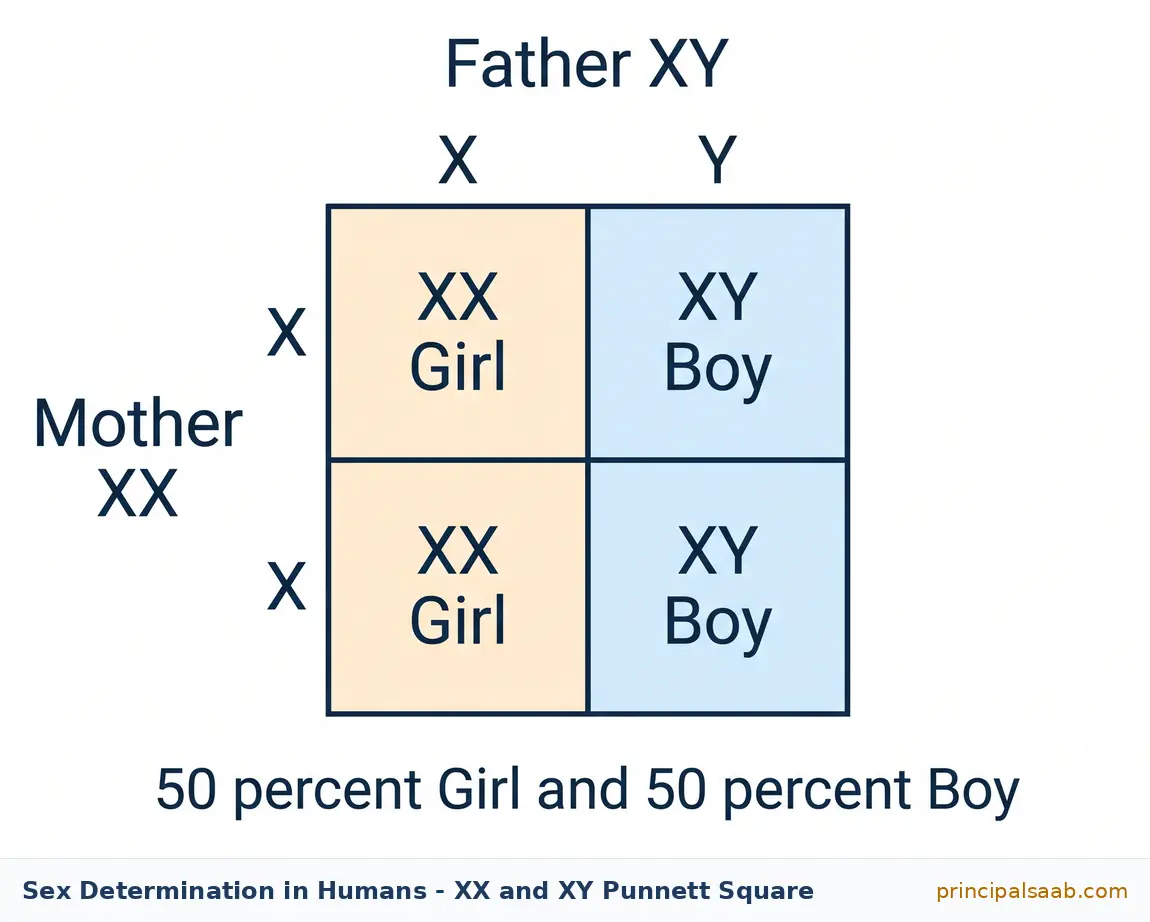
- The mother is XX. Whichever of her two sex chromosomes goes into an egg, it is an X. So every egg carries an X — she has no other option to give.
- The father is XY. His pair separates, so half his sperms carry an X and half carry a Y. He produces two kinds of sperm.
Look at what that means. The mother’s contribution is fixed and identical every time. The only thing that varies is which kind of sperm happens to reach the egg first. It is a coin toss, and the coin belongs entirely to the father.
Step 2 — Gametes. Mother: X and X (only one kind in effect). Father: X and Y (two kinds, in equal numbers).
Step 3 — Punnett square.
| Gametes | Sperm carrying X | Sperm carrying Y |
|---|---|---|
| Egg carrying X | XX girl | XY boy |
| Egg carrying X | XX girl | XY boy |
Step 5 — Conclusion. If the egg is fertilised by an X-carrying sperm, the child is a girl (XX). If it is fertilised by a Y-carrying sperm, the child is a boy (XY). Since the mother can supply only X, the sex of the child is decided by which sperm from the father fertilises the egg.
Why it works: the whole argument sits on one asymmetry. The mother has only one kind of gamete to offer with respect to sex; the father has two. A variable outcome must come from the variable input. The father does not choose anything — it is pure chance — but the deciding gamete is his.
Model answer:
(i) No, the statement is not scientifically correct. [1 mark]
(ii) Human beings have 23 pairs of chromosomes, of which 22 pairs are autosomes and one pair is the sex chromosome pair. A female has XX and a male has XY. [1 mark]
(iii) During gamete formation the mother, being XX, produces eggs that all carry an X chromosome. The father, being XY, produces two types of sperm in equal numbers — 50% carrying X and 50% carrying Y. [1 mark]
(iv) Cross: X (egg) + X (sperm) → XX, a female child; X (egg) + Y (sperm) → XY, a male child. Since the mother contributes only X, the sex of the child depends on the type of sperm contributed by the father. [1 mark]
(v) The probability of a male child at any conception is 50%, that is 1 in 2. [1 mark]
Why it works: the answer refuses the premise in the first line, then earns the remaining marks by supplying the mechanism. Note the exact numbers — 23 pairs, 22 autosome pairs, one sex pair, 50% — because vague answers lose marks here even when the idea is right.
What Was Removed From This Chapter (Evolution)
If you pick up an older textbook, a second-hand guide or an online video made a few years ago, you will find this chapter called “Heredity and Evolution” and running to roughly twice the length. That is not a mistake on their part — it is simply an older version of the course.
Two practical consequences for you. First, do not spend revision time on the evolution topics listed above for this board examination, and do not be alarmed when a video or an old sample paper covers them. Second — and this matters — please confirm this against your own current syllabus copy or with your subject teacher before you finally drop anything. Syllabus documents are revised from time to time, schools occasionally teach beyond the minimum, and the copy issued to your batch is always the authority. This page teaches only the heredity content that is in scope; the evolution topics are named here so you can recognise and set them aside, not so you can study them as examinable material.
One small clarification, since it causes confusion. Earlier in this chapter we distinguished a trait written in the genes from a change acquired by the body during its lifetime — the weightlifter and his muscles. That distinction is retained here because it belongs to heredity: it explains what can and cannot be inherited. What is no longer required is the further use of that idea as a stepping stone into theories of evolution.
Practice Worksheet — 10 Questions with Full Model Answers
Here is the part that actually moves your marks. Keep a sheet of paper next to you. Read the question, close your eyes for a moment, write your full answer, and only then click to open the model answer. Comparing your written attempt with the model is worth ten times more than reading the model first and nodding along. Where a cross is asked for, draw the square properly — do not do it in your head.
Q1. (1 mark) Define an allele, and give one pair of alleles from Mendel’s pea plant experiments.
Q2. (1 mark) How many pairs of chromosomes are present in a human body cell, and how are they classified? Give the sex chromosome composition of a human male and a human female.
Q3. (1 mark) A pea plant has the genotype Tt. State its phenotype and name the types of gametes it can produce.
Q4. (3 marks) Distinguish between genotype and phenotype, giving any three points of difference. Illustrate with the height of a pea plant.
(ii) How it is detected: the phenotype can be seen directly by observation, whereas the genotype cannot be seen and must be worked out from breeding experiments such as a test cross. [1]
(iii) Correspondence: different genotypes may give the same phenotype. For the height of a pea plant, the genotypes TT and Tt both give the phenotype “tall”, while only the genotype tt gives the phenotype “dwarf”. So there are three genotypes but only two phenotypes. [1]
Q5. (3 marks) Mendel is called the father of genetics. Give three features of his experimental method that made his conclusions reliable, where earlier workers had failed.
(ii) He began with pure-breeding parent plants whose ancestry he had established over several generations, so he knew exactly what he was starting with, and he controlled every cross by hand-pollination. [1]
(iii) He counted every offspring and analysed the numbers mathematically, working with large populations, so the ratios he obtained were statistically reliable rather than impressions. [1]
Also acceptable: his choice of an organism with sharply contrasting either/or characters, a short life cycle and many seeds per plant.
Q6. (3 marks) In a certain plant, violet flower colour (V) is dominant over white (v). A heterozygous violet-flowered plant is crossed with a white-flowered plant. Work out the cross and give the phenotypic and genotypic ratios of the offspring.
Gametes: Vv gives V and v; vv gives only v.
| Gametes | v | v |
|---|---|---|
| V | Vv (violet) | Vv (violet) |
| v | vv (white) | vv (white) |
Phenotypic ratio: 1 violet : 1 white. Genotypic ratio: 1 Vv : 1 vv. So half the offspring bear violet flowers and half bear white flowers. [1]
Note: this cross is a test cross, since the plant showing the dominant character has been crossed with the homozygous recessive.
Q7. (5 marks) A pure tall pea plant is crossed with a pure dwarf pea plant. (a) What will the F1 generation look like and why? (b) The F1 plants are then self-pollinated. Draw the Punnett square for the F2 and give both ratios. (c) If 800 F2 plants are obtained, how many would be expected to be dwarf?
(b) F1 selfed: Tt x Tt. Gametes from each parent: T and t.
| Gametes | T | t |
|---|---|---|
| T | TT (tall) | Tt (tall) |
| t | Tt (tall) | tt (dwarf) |
(c) Dwarf plants form one part out of four, that is one quarter of the F2. Expected number of dwarf plants = 800 x 1/4 = 200. (The remaining 600 would be expected to be tall.) [1]
Note: 200 is an expected number based on probability; the actual count in a real experiment would be close to but rarely exactly 200.
Q8. (5 marks) In pea plants, round seed shape (R) is dominant over wrinkled (r), and yellow seed colour (Y) is dominant over green (y). A plant with round yellow seeds, heterozygous for both characters, is self-pollinated. Work out the offspring and state the phenotypic ratio. Which law of Mendel does this cross illustrate, and how?
Gametes from each parent: RY, Ry, rY, ry — four types in equal numbers. [1]
| Gametes | RY | Ry | rY | ry |
|---|---|---|---|---|
| RY | RRYY | RRYy | RrYY | RrYy |
| Ry | RRYy | RRyy | RrYy | Rryy |
| rY | RrYY | RrYy | rrYY | rrYy |
| ry | RrYy | Rryy | rrYy | rryy |
Phenotypic ratio: 9 round yellow : 3 round green : 3 wrinkled yellow : 1 wrinkled green, that is 9 : 3 : 3 : 1. [1]
Law illustrated: the Law of Independent Assortment. The two new combinations — round green and wrinkled yellow — did not exist in the parent plant, which was round yellow. They could only arise because the alleles for seed shape separated into gametes independently of the alleles for seed colour, allowing the four gamete types RY, Ry, rY and ry to form. [1]
Q9. (3 marks) A couple already has three daughters. They are told that their fourth child is “sure to be a son”. Comment on this statement scientifically, explaining how the sex of a child is determined.
The mother has the sex chromosomes XX, so every egg she produces carries an X chromosome. The father has XY, so he produces two kinds of sperm in equal numbers, half carrying X and half carrying Y. If an X-carrying sperm fertilises the egg the child is XX, a girl; if a Y-carrying sperm fertilises it the child is XY, a boy. [1]
Each fertilisation is an independent event with a 50% chance of either outcome, and the sexes of previous children have no influence whatsoever on the next one. Therefore the fourth child is equally likely to be a son or a daughter; there is no certainty. [1]
Q10. (5 marks) (a) State Mendel’s law of dominance and his law of independent assortment. (b) A farmer has a tall pea plant but does not know whether it is TT or Tt. Describe an experiment he can perform to find out, and explain how he would interpret each possible result.
Law of independent assortment: when two pairs of contrasting characters are considered together, the alleles of one pair segregate into the gametes independently of the alleles of the other pair. [1]
(b) He should perform a test cross: cross the unknown tall plant with a dwarf plant (tt), which is necessarily homozygous recessive, and observe the offspring. [1]
Case 1 — the unknown plant is TT. It gives only T gametes; the dwarf parent gives only t. Every offspring is Tt and therefore tall. No dwarf offspring appear at all.
| Gametes | t | t |
|---|---|---|
| T | Tt (tall) | Tt (tall) |
| T | Tt (tall) | Tt (tall) |
Case 2 — the unknown plant is Tt. It gives T and t gametes in equal numbers, so the offspring are half Tt (tall) and half tt (dwarf), a ratio of 1 tall : 1 dwarf.
| Gametes | t | t |
|---|---|---|
| T | Tt (tall) | Tt (tall) |
| t | tt (dwarf) | tt (dwarf) |
Before You Close This Page
Look back at how far you have come. You started with the idea that children resemble their parents, and you now know the mechanism: two alleles per character, separated into gametes, recombined at fertilisation. You can draw a Punnett square, produce 3:1 and 1:2:1 and 9:3:3:1 from scratch rather than from memory, use a test cross to expose a hidden genotype, and explain — carefully and correctly — why a mother can never be responsible for the sex of her child.
If any one of those still feels shaky, go back to that section alone. Do not reread the whole page. Genetics rewards targeted repair far more than it rewards re-reading.