

Let me take one worry off your plate before we start. “Globalisation” sounds like a word for economists in suits at international conferences, and when a chapter opens with it most students quietly decide the whole thing is going to sit above their heads. It will not. You have been living inside globalisation your entire life. The phone in your hand, the shoes on your feet, the film you watched last weekend, the small shop near your house that suddenly began stocking three brands of biscuit instead of one — all of that is this chapter. We are not going to learn anything new about the world. We are only going to put proper names to things you have already noticed.
Here is the one picture I want you to carry through every page that follows. Somewhere in Tiruppur, in Tamil Nadu, there is a small unit where a few dozen people cut and stitch cotton T-shirts. One of those shirts may end up folded on a shelf in a shop in Europe, under a brand name nobody in that Tiruppur workshop has ever worn. The cotton might have come from a farm in Gujarat. The design was decided in an office thousands of kilometres away. The order arrived by email. The finished shirts travelled inside a steel container on a ship. And the price the Tiruppur unit was paid was not decided by the tailor at all — it was decided by a buyer who could just as easily have placed that same order in Bangladesh or Vietnam.
That one T-shirt contains almost every idea in this chapter: production spread across countries, multinational companies, foreign trade, the technology that makes it all possible, the government rules that permit or block it, the people who gain and the people who get squeezed. Whenever a definition starts feeling abstract and floaty, come back to the T-shirt. It will make the idea solid again.
One last reassurance. This is a theory chapter, so there is no arithmetic waiting to ambush you. What the examiner actually wants is three things: the correct term, a clean definition, and an Indian example that proves you understood rather than memorised. Three things. We are going to practise that shape so many times that writing it becomes automatic.
What You’ll Learn
Jump straight to any section — every link below lands on the exact heading.
- What Globalisation Actually Means
- Production Across Countries and the Rise of MNCs
- How MNCs Control and Spread Production
- Foreign Trade as a Connector of Markets
- What Has Enabled Globalisation: Technology, Transport and ICT
- Liberalisation of Foreign Trade and Foreign Investment
- The World Trade Organisation and the Fairness Debate
- The Impact of Globalisation on India — Winners
- The Impact of Globalisation on India — Those Left Behind
- The Struggle for Fair Globalisation
- How to Answer Globalisation Questions in the Board Exam
- Practice Worksheet with Answers
- One Last Thing Before You Go
Your Game Plan
Please do not try to eat this chapter in one sitting. It is long deliberately, because I would rather over-explain than leave you nodding along without really following. Here is the order I would use if I were sitting beside you at your table:
- Day 1 — get the vocabulary solid. Read the first three sections. Then, without looking, write down what globalisation, MNC and foreign investment mean, in your own words. If any one of them comes out fuzzy, go back. These three words appear in almost every question in this chapter.
- Day 2 — the machinery. Foreign trade, the enabling technologies, and liberalisation. Pay special attention to trade barriers, because “explain trade barriers with an example” is one of the most repeated questions in the whole unit.
- Day 3 — the arguments. The WTO fairness debate, winners, and those left behind. This is where 5-mark answers live. Notice that the chapter never says globalisation is simply good or simply bad, and neither should your answer.
- Day 4 — fair globalisation and the exam section. Learn the four things a government can do. Then read the board-exam section and see how a full answer is built line by line.
- Day 5 — the worksheet, closed book, timed. Then, and only then, mark yourself. Whatever you get wrong tells you exactly which section to reread. Nothing else on this page is as useful as that list of your own mistakes.
What Globalisation Actually Means
Start with the plain-English version and we will tighten it into a definition afterwards. Globalisation means that countries have stopped being separate boxes. Goods move between them, money moves between them, companies operate across them, people travel between them for work, and knowledge and technology spread between them. Every year, a little more of each. That is it. That is the whole idea.
Picture two neighbouring houses with a high wall between them. Nothing passes over. Now imagine the wall slowly coming down, brick by brick. Vegetables from one garden start appearing in the other kitchen. One family lends the other a ladder. A cousin from one house starts working in the other’s shop. The two households have not merged — they are still two households — but they have become connected, and now what happens in one affects the other. Countries have been doing exactly that for the last few decades, and the process has speeded up sharply since around 1991 in India’s case.
Why the Word Exists At All
Trade between countries is ancient. Spices left the Malabar coast for Europe centuries before anyone said “globalisation”. So what changed? Two things changed, and this is worth understanding rather than memorising.
First, the scale and speed changed. It used to take months for goods to cross an ocean; it now takes days, and information crosses in a second. Second, and more importantly, what crosses borders changed. Earlier, mostly finished goods crossed — a country made a thing and sold it abroad. Today the production process itself is split up and scattered. The design happens in one country, the components in three others, the assembly in a fifth, the customer support in a sixth. No single country makes the product. That splitting-up of production across countries is the genuinely new feature, and it is the reason the chapter spends so much time on multinational companies.
Sit with that for a moment. It means the question “where was this made?” often has no honest one-word answer any more. Don’t move on until that feels comfortable, because everything else in the chapter grows out of it.
Question (1 mark): What is meant by globalisation?
Model answer: Globalisation is the rapid integration of a country’s economy with the economies of other countries, mainly through foreign trade and foreign investment, along with the movement of people, technology and information across borders.
Why this scores: a 1-mark question gives you roughly one line, so every word has to work. The examiner is looking for the idea of integration or interconnection between countries and at least one route through which it happens. This answer supplies the idea and then names trade and investment. Writing only “globalisation means the world is becoming one” would be too vague to earn the mark — it names no mechanism.
Production Across Countries and the Rise of MNCs
Until about the middle of the last century, production largely stayed inside national borders. A factory bought its inputs nearby, made its goods, and sold them at home or exported the finished item. The whole chain sat in one country. What broke that pattern was a particular kind of company, and you need to be able to describe it precisely.
Why an MNC Bothers to Spread Production Around
A company does not scatter its factories across continents for the adventure of it. It does so to cut its costs and raise its profits, and it chooses each location for a reason. Learn these reasons as a list, because “why do MNCs set up production in particular locations?” is a standard 3-mark question.
- Cheaper labour. Wages differ enormously between countries. Work that is labour-intensive — stitching, assembling, packing — costs far less in India, Bangladesh or Vietnam than in Western Europe or North America.
- Other cheap inputs. Land, electricity, water and raw materials may cost less. A company that needs a lot of cotton has a reason to be near cotton.
- Available skills. Some places have exactly the skilled people a firm needs. India’s supply of engineers and English-speaking graduates is a large part of why global firms located software work and customer-service centres here.
- Closeness to the market. Producing inside a large market saves transport cost and import duty, and lets the firm adapt the product to local taste. This is a major reason global carmakers and appliance makers build plants in India.
- Government policy. If a government welcomes foreign investment, keeps rules simple and offers good roads, ports and power, firms come. If it does not, they go elsewhere.
Read that list once more and notice they are all versions of the same sentence: put each step of production wherever that step is cheapest and easiest to do well. That single sentence is the logic of the entire global production chain, and if you understand it you can reconstruct the list even if you forget the wording.
MNC and Domestic Company Side by Side
| Point of comparison | Multinational Company (MNC) | Domestic Company |
|---|---|---|
| Where production happens | Owns or controls production in more than one country | Production is located within one country only |
| Scale of capital | Usually very large; can invest heavily and absorb losses for years | Generally smaller; limited ability to fund long loss-making phases |
| Choice of location | Chooses each site by cost, skills, market and government policy, anywhere in the world | Chooses within the home country, with far fewer options |
| Technology | Often brings advanced technology and modern management practices with it | Usually depends on locally available or licensed technology |
| Market reach | Sells across many national markets simultaneously | Sells mainly at home, and may export finished goods |
| Bargaining power | Strong — can shift orders to another country if terms do not suit it | Weaker — tied to one country’s costs, rules and conditions |
Question (3 marks): Explain any three factors that a multinational company considers before setting up production in a particular country.
Model answer: (i) Cost of labour — MNCs prefer countries where wages are low, so that labour-intensive work such as garment stitching becomes cheaper; this is one reason global clothing brands source from Indian units. (ii) Availability of skilled workers — some work needs particular skills, and India’s large supply of engineers and English-speaking graduates attracted software and customer-service operations. (iii) Government policy — MNCs invest where the government permits foreign investment, keeps procedures simple and provides dependable infrastructure such as power, roads and ports.
Why this scores: three marks means three separate points, and the examiner is scanning for three named factors. Notice the structure of each point — name the factor in bold, explain it in one clause, then attach a concrete illustration. A paragraph that circles around “MNCs want profit” without naming distinct factors reads as one point repeated three times and would be marked as one point.
How MNCs Control and Spread Production
An MNC that wants to produce in India has to get in somehow. There are five main routes, and the examiner loves this list because it is easy to set a 5-mark question on it. I am going to explain each one with the same question in mind: how much does the MNC own, and how much does it merely control? That single question separates the five routes cleanly.
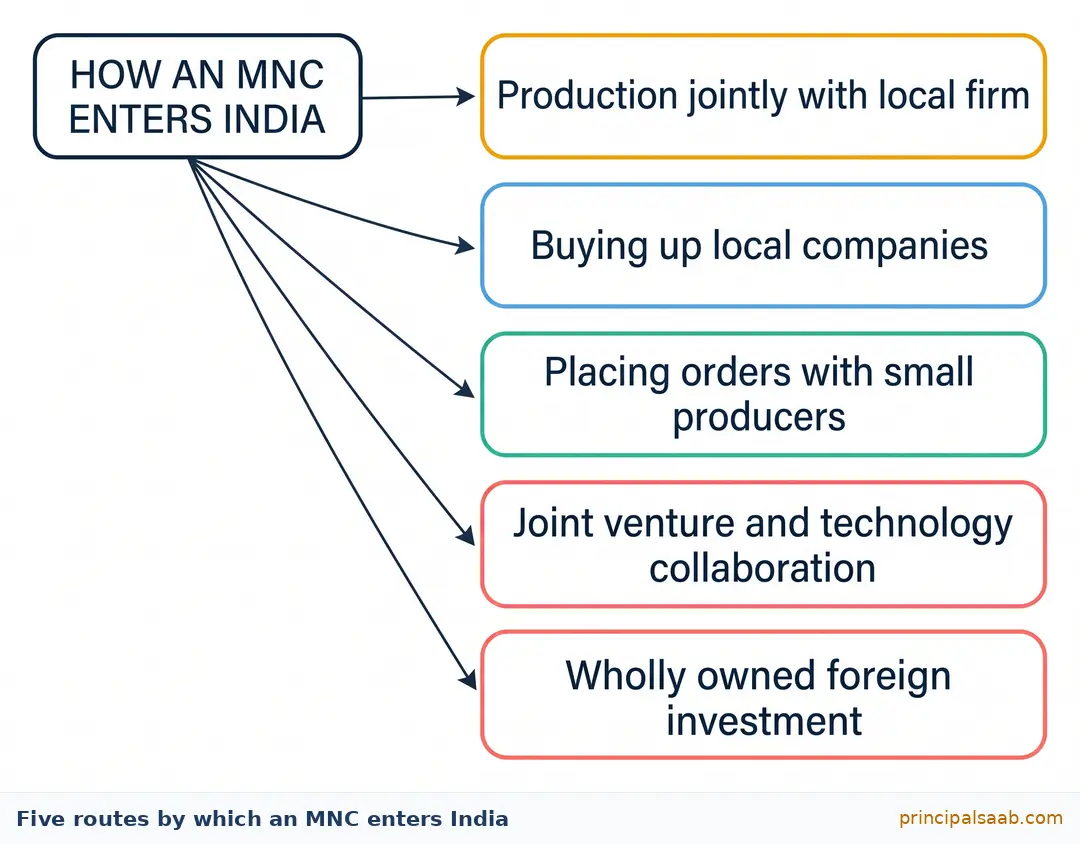
Route 1 — Setting Up Production Jointly With a Local Company
The MNC and an existing local firm put money in together and build the operation as partners. The local partner brings knowledge of the country — how the market behaves, where to find suppliers, how to deal with regulations. The MNC brings capital and, usually, better technology and production methods. Both sides gain something they could not have got alone. India’s early car-manufacturing partnerships between an Indian company and a Japanese carmaker are the classic illustration of this route.
Route 2 — Buying Up Local Companies
The blunt route. Because MNCs command enormous amounts of money, they can simply purchase a successful local company outright. Overnight the MNC owns the factories, the brands, the distribution network and the customer base that the local firm spent decades building. This is the fastest way to enter a market, and it explains why some products you have known all your life are now owned by a company headquartered on another continent, even though the packet still looks the same.
Route 3 — Placing Orders With Small Local Producers
This is the Tiruppur T-shirt route, and it is the most important one to understand properly. Here the MNC owns nothing in India. It does not buy the factory, does not employ the tailors, does not own the machines. It simply places a large order with small producers, specifying the design, the fabric, the quality standard, the delivery date and the price. The producers make the goods; the MNC sells them worldwide under its own brand.
So where is the control, if there is no ownership? The control sits in the size of the order. For a small unit in Tiruppur, that one buyer may account for most of the year’s work. Losing the order means idle machines and unpaid workers. So when the buyer asks for a lower price or a faster delivery, the unit usually has to agree. The MNC never gives an instruction it could not withdraw — it simply has the option of going to another country, and everyone in the room knows it. Garments, footwear and sports goods are the industries where this pattern is most visible.
Route 4 — Joint Ventures and Technology Collaborations
Close cousin of Route 1, but worth separating because the examiner sometimes wants both. In a joint venture, two companies keep their own identities but pool their strengths for a specific business — sometimes sharing a factory, sometimes sharing a brand, sometimes sharing research. In a technology collaboration, the MNC supplies the design and know-how and the Indian firm manufactures under licence. The Indian partner gains access to methods it would have taken years to develop; the MNC gains a market and a ready-made production base without carrying the whole cost alone.
Route 5 — Setting Up Wholly Owned Operations Through Foreign Investment
The MNC buys the land, builds the plant, installs the machines and hires the workers itself, owning the whole thing. This is the purest form of what the chapter calls foreign investment, and you need the term exactly right.
Question (5 marks): Describe the various ways in which multinational corporations spread their production across countries.
Model answer: (i) Jointly with local companies — the MNC and an Indian firm invest together; the MNC provides money and technology while the local partner provides market knowledge. (ii) By buying up local companies — because MNCs have very large funds, they can purchase established local firms and instantly acquire their factories, brands and distribution networks. (iii) By placing orders with small producers — common in garments, footwear and sports goods, where the MNC owns nothing locally but fixes the design, quality, price and delivery, and sells the output under its own brand. (iv) Through joint ventures and technology collaborations — both firms keep their identity but share technology, research or production facilities. (v) By setting up wholly owned production units through foreign direct investment — the MNC itself buys land, builds the plant and employs the workers, retaining full ownership and control.
Why this scores: five marks, five clearly separated points, one mark each. The examiner is looking for the name of each route plus one line showing you know how it works. Write them as numbered points, never as a flowing paragraph — in a paragraph, points blur together and markers award only what they can clearly identify. Also notice that route (iii) is the one students most often forget, precisely because it involves no ownership; make a special note of it.
Foreign Trade as a Connector of Markets
MNCs are one bridge between countries. Foreign trade is the older and, historically, the main one. Let us build the idea slowly, because the reasoning inside it is genuinely elegant and students often memorise the conclusion without ever seeing why it is true.
Suppose you produce steel utensils in Moradabad. Your only customers are in India. If Indian demand is weak this year, you are stuck. Now suppose you can also sell abroad. Suddenly your market is not one country but many, and a bad year at home need not be a bad year for your business. That is the first thing foreign trade does: it gives producers an opportunity to reach beyond the markets of their own country.
Now flip to the buyer’s side. Before trade, an Indian buyer could choose only among Indian-made utensils. After trade, imported utensils sit on the same shelf. The buyer now has more choice at possibly better quality or lower price. So both sides of the counter gain something.
The Part Students Find Genuinely Surprising
Here is where it gets interesting. Once trade opens between two countries, the prices of similar goods in the two markets tend to move towards each other. Follow the reasoning one step at a time.
- Suppose a certain kind of utensil sells much cheaper in China than in India.
- Indian traders notice the gap and start importing from China, because there is profit in buying cheap there and selling dear here.
- As those imports arrive, supply in India rises — and the Indian price starts falling.
- Meanwhile, the extra buying pushes demand up in China — and the Chinese price starts rising.
- The two prices converge until the gap is no longer worth the trouble of shipping.
Nobody planned this. No authority ordered prices to equalise. It happened because thousands of traders each chased their own advantage. And notice the third consequence hidden inside those five steps: producers in the two countries are now competing directly with each other, even though they have never met and are separated by an ocean. Foreign trade, in other words, does not merely connect countries — it connects markets.
Question (3 marks): “Foreign trade integrates the markets of two countries.” Explain this statement.
Model answer: When two countries trade, producers in each are no longer limited to selling at home and buyers are no longer limited to buying what is produced at home. If a good is cheaper in one country, traders import it into the other; the increased supply pulls the price down in the importing country while the increased demand pushes it up in the exporting country, so prices of similar goods in the two markets come closer together. As a result, producers in the two countries begin competing directly with each other, and the two markets start behaving as one connected market rather than two separate ones.
Why this scores: the examiner wants the word “integration” unpacked into a mechanism. This answer earns its three marks by naming three linked results — wider selling opportunity, price convergence, and direct competition — and by showing the causal chain (imports raise supply, supply lowers price) rather than merely asserting that prices become equal.
What Has Enabled Globalisation: Technology, Transport and ICT
Companies have always wanted cheaper production and bigger markets. That desire is not new. So why did global production chains appear only in recent decades? Because for most of history the desire was impossible to act on. Technology is what turned it from a wish into a working system.
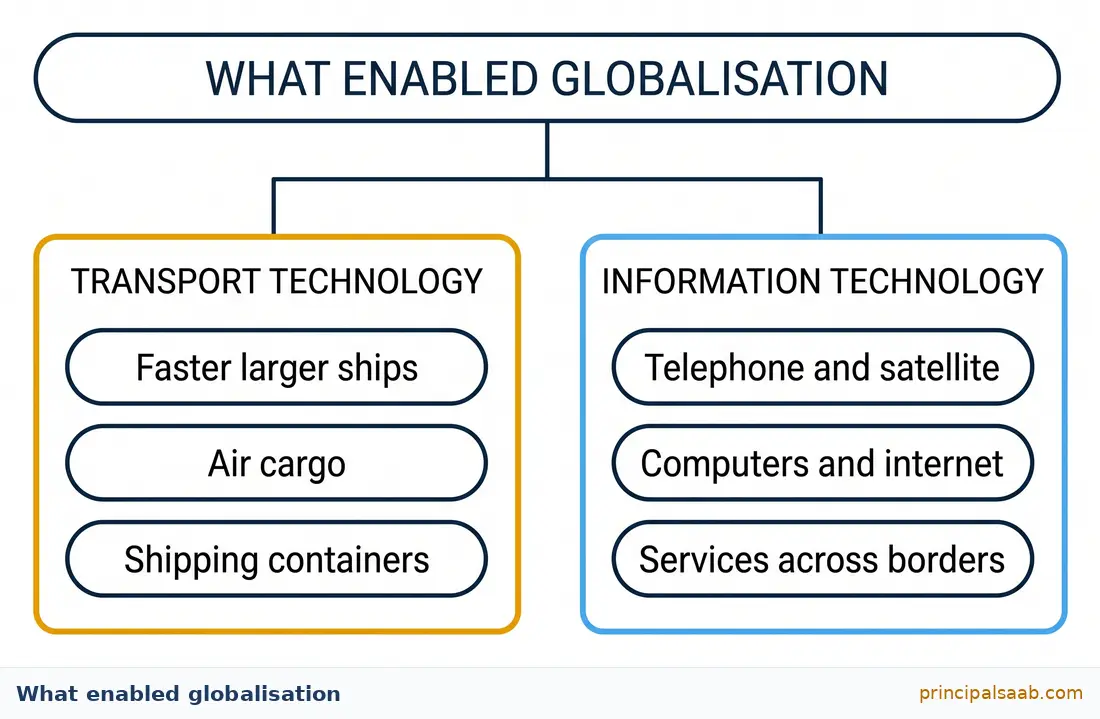
Transport Technology
Think about what it takes to make a global supply chain work. Parts made in three countries must reach an assembly plant in a fourth, on schedule, undamaged, and cheaply enough that the whole arrangement still beats making everything in one place. For centuries that was simply not possible — sea journeys took months, goods spoiled, cargo was handled and re-handled by hand at every port, and losses were routine.
Improvements in transport changed all of it. Faster and larger ships carry much more per voyage, which lowers cost per unit. Air cargo made it sensible to move light, valuable or perishable goods across the world in a day. And the humble shipping container — a standard steel box that can be lifted straight from a ship onto a truck without unpacking — slashed both the cost and the time of loading. When you next see a stack of those containers at a port or on a highway, you are looking at one of the most important pieces of infrastructure globalisation has.
Information and Communication Technology
Transport moves things. ICT moves instructions, and that turns out to matter just as much. Telecommunications, computers and the internet let a manager in one country monitor, coordinate and control production in another, in real time. Telephone, email and video calls have made distance almost irrelevant to communication, and satellite technology carries all of it around the planet at once.
Then there is the part that made ICT special for India. Some services do not need the provider and the customer to be in the same place at all. A software program can be written in Bengaluru and used in Berlin. Medical scan images can be examined by a specialist sitting in another country. A customer in London with a problem about a bill can be helped by a person in Gurugram, and neither of them need think about the distance.
The call centre deserves a paragraph of its own because it makes the point vividly. A company decides that answering customer calls is expensive at home. So it sets up, or hires, a centre in India, where wages are lower and there are many young people who speak English well. The customer dials a local-looking number. The call is routed thousands of kilometres. The problem is solved. The customer often has no idea where the help came from. Nothing physical crossed a border — but a service was produced in one country and consumed in another. That is globalisation with no ship involved at all.
Question (5 marks): “Technology has been the single biggest factor in stimulating the globalisation process.” Justify this statement with suitable examples.
Model answer: (i) Faster and larger transport — improvements in ships and air cargo have cut the cost and time of moving goods, making it practical to carry raw materials and finished products across continents. (ii) Containerisation — standardised steel containers can be transferred directly between ships, trains and trucks without unpacking, greatly reducing loading cost, handling damage and delay. (iii) Telecommunications — telephone, mobile networks and satellites allow managers to contact and coordinate distant production units instantly. (iv) Computers and the internet — designs, orders, payments and data can be sent across the world in seconds and at almost no cost, which is what makes a production process split across countries manageable. (v) Delivery of services at a distance — because ICT allows a service to be produced far from where it is consumed, work such as software development, data processing and customer-support call centres could be located in India for customers abroad.
Why this scores: a “justify this statement” question is still a list question in disguise. The examiner wants five distinct technological developments, each with its effect stated. Point (v) is the one that lifts a good answer to a full one, because it shows you understand that technology globalised services and not only goods — and services are where India’s biggest gains came from.
Liberalisation of Foreign Trade and Foreign Investment
We now come to the part of the chapter where government decisions enter the story. Technology made global production possible. But a government can still decide how much of it to allow through its borders, and for a long time India decided to allow rather little. Understanding why is genuinely interesting, so let us do it properly.
What a Trade Barrier Is
A trade barrier is any restriction a government places on foreign trade. It is called a barrier because it works exactly like a barrier on a road: it does not necessarily stop traffic altogether, but it slows it, makes it costlier, or lets only a limited amount through. Governments use trade barriers to increase, decrease or regulate the flow of goods across their borders.
The two you must know by name are the tax on imports and the quota.
| Point of comparison | Tax on imports (tariff) | Quota |
|---|---|---|
| What it does | Charges a tax on goods entering the country | Fixes a maximum quantity of a good that may be imported |
| How it discourages imports | Raises the price of the imported good in the domestic market, so buyers prefer local goods | Limits the amount available, no matter how cheap it is or how many people want it |
| Works through | Price | Quantity |
| Revenue for government | Yes — the tax is collected by the government | No direct revenue; it only caps the quantity |
| Effect on the buyer | The good is still available, but costs more | Choice is restricted; shortages can push prices up as well |
Why India Used Barriers After Independence
This is the bit students find puzzling. If trade brings choice and lower prices, why would a government deliberately keep goods out? The answer is the infant industry argument, and once you see it, it is hard to disagree with.
Imagine a school cricket team being made to play a professional side in its first match. The result is not in doubt, and the young team will probably be so thoroughly beaten that it never recovers its confidence. That is roughly the position Indian industry was in after Independence. Domestic producers were small, their technology was old, and their costs were high. If foreign goods made in large, modern, long-established factories had been allowed in freely, Indian producers would have been undercut immediately and many would have closed before they had any chance to grow.
So India put up barriers and kept imports tightly restricted, allowing in mainly the things the country genuinely could not do without — machinery, fertilisers, petroleum products. Behind that shelter, domestic industry was meant to grow, learn, improve and eventually stand on its own feet. This policy is called protection, and it was a considered choice, not an accident.
The Turn in 1991
Around 1991 India changed course substantially. The reasoning was that Indian producers had matured enough to face competition, and that competition itself would push them to raise quality — a firm that never has a rival has little reason to improve. Barriers on foreign trade and foreign investment were largely removed, so goods could be imported and exported far more freely and foreign companies could set up operations in India far more easily.
| Point of comparison | Before 1991 (protection) | After 1991 (liberalisation) |
|---|---|---|
| Attitude to imports | Heavily restricted; mainly essentials such as machinery, fertilisers and petroleum allowed | Largely free; businesses themselves decide what to import and export |
| Purpose of the policy | To protect young domestic producers from stronger foreign competition | To expose producers to competition so that quality and efficiency improve |
| Foreign investment | Tightly controlled; MNCs found entry difficult | Far easier; MNC investment rose sharply in many sectors |
| Choice for consumers | Limited range of mostly domestic goods | Wide range of Indian and imported goods and brands |
| Pressure on small producers | Sheltered from foreign competition | Exposed to it directly; many struggled and some closed |
Question (3 marks): What is a trade barrier? Why did the Indian government put barriers on foreign trade and foreign investment after Independence?
Model answer: A trade barrier is a restriction imposed by a government on foreign trade, such as a tax on imports or a quota fixing the maximum quantity that may be imported; governments use such barriers to increase, decrease or regulate the flow of goods across their borders. India imposed these barriers after Independence in order to protect domestic producers, who were then small and used older technology, from competition with large and well-established foreign producers. Only essential items such as machinery, fertilisers and petroleum were permitted to be imported freely, so that Indian industries could grow behind this protection.
Why this scores: this question has two parts, so the marks split roughly one for the definition, one for an example of a barrier, and one for the protection reason. The commonest way to lose a mark here is to define the barrier well and then forget to name a specific type. Always give tax on imports or quota by name — a definition without an instance reads as incomplete.
Question (3 marks): Distinguish between a tax on imports and a quota as instruments of trade policy.
Model answer: A tax on imports works through price: the government charges a tax on goods entering the country, which raises their price in the domestic market and therefore discourages buyers from choosing them over local goods. A quota works through quantity: the government fixes the maximum amount of a good that may be imported, so that no more than that quantity can enter however cheap it is. A tax on imports also earns revenue for the government, whereas a quota earns none and only caps the volume; but both have the same underlying purpose, which is to reduce the pressure of foreign competition on domestic producers.
Why this scores: “distinguish between” questions must be answered point against point, on the same criteria. This answer uses three shared criteria — mechanism, effect, revenue — and closes by noting the shared purpose, which shows understanding rather than rote contrast. Writing one paragraph about taxes followed by an unrelated paragraph about quotas would answer a different question, and markers penalise it.
The World Trade Organisation and the Fairness Debate
If countries are going to trade heavily with each other, somebody has to write the rules. Otherwise every dispute becomes a quarrel with no referee. That is the job of the World Trade Organisation (WTO).
The WTO is an international organisation whose stated aim is to liberalise international trade. It frames the rules for trade between countries, sees that those rules are followed, and provides a forum where member countries can settle disputes. It has over 160 member countries, India among them. It was started at the initiative of the developed countries — and that origin matters for the debate that follows.
The WTO’s basic principle is straightforward: countries should remove their trade barriers and allow free trade. In principle, this treats everyone alike. In practice, critics argue, it has not worked out evenly, and you need to be able to explain why with a concrete case rather than a vague complaint.
The Uneven Playing Field
Here is the criticism, built step by step so it makes sense rather than sounding like a slogan.
Developing countries were pressed hard to remove their trade barriers, and largely did so. But several developed countries have continued, in various ways, to shield their own producers — most visibly by paying large subsidies to their farmers. A subsidy is government money given to a producer, and it changes everything about a price comparison. A farmer receiving substantial government support can afford to sell crops at a very low price, because the support makes up the difference. That artificially low price then competes in world markets against a farmer in a developing country who receives nothing like the same support.
Think about what that does. The developing-country farmer is not losing because he farms badly. He is losing because his competitor’s price is being propped up from a government treasury. Meanwhile his own government has been told that supporting him would distort trade. That is the asymmetry critics point to: the rules were written by the stronger players, and they have been applied more strictly to the weaker ones.
Question (5 marks): What is the World Trade Organisation? Why do many people believe that the rules of international trade are not fair to developing countries?
Model answer: The World Trade Organisation is an international organisation, started at the initiative of the developed countries, whose declared aim is to liberalise international trade. It frames the rules regarding trade between countries, sees that these rules are obeyed, and provides a forum for settling trade disputes; more than 160 countries, including India, are members. Many people nevertheless regard its rules as unfair for the following reasons. (i) Developing countries have been required to remove their trade barriers, while several developed countries have found ways of continuing to protect their own producers. (ii) Developed countries pay large subsidies to their farmers, which allows their agricultural produce to be sold at artificially low prices in world markets. (iii) Farmers in developing countries, who do not receive comparable support, therefore face competition they cannot match on price, and their livelihoods suffer. (iv) Since the organisation was created largely at the initiative of the developed countries, critics argue that its rules reflect their interests more strongly than those of poorer members.
Why this scores: the question has two halves, so give both a proper share — roughly two marks for what the WTO is and three for the fairness argument. The examiner is looking for the words liberalise international trade, rules and disputes in the first half, and for the subsidy mechanism in the second. The commonest failure is to write four lines on the criticism and one hurried line on what the WTO actually does.
The Impact of Globalisation on India — Winners
Now for the assessment. I want you to notice something about how this chapter handles it, because it is a lesson in how to think as much as what to think. The chapter does not conclude that globalisation is good, and it does not conclude that it is bad. It asks a sharper question: good for whom? Different groups of Indians have had completely different experiences of the same process. Your job in the exam is to show that you know which group you are talking about.
Consumers, Especially Well-Off Urban Consumers
The clearest gain. There is a far greater choice of goods and services than there was a few decades ago, quality has generally improved, and prices in many categories have fallen. Cars, mobile phones, televisions, packaged foods and branded clothing are all bought by people today who could not have considered them earlier. For a household with money to spend, the standard of living has risen visibly.
Do add the qualifier, though. This gain has been strongest for the better-off in cities. A family whose income has not risen does not benefit much from a wider choice it cannot afford. Writing “consumers have benefited” is a good answer; writing “well-off urban consumers in particular have benefited” is a better one.
New Jobs and New Industries
MNC investment has grown considerably, particularly in industries such as mobile phones and telecommunications, automobiles, electronics, soft drinks, fast food and services like banking. These are labour-using industries, and their expansion has created employment.
There is a second, quieter gain hidden here. When an MNC sets up a plant, it buys from local suppliers — components, packaging, raw materials, transport, cleaning, catering. Local companies supplying those inputs have prospered alongside it. One large investment ripples outward into dozens of smaller businesses, and a good answer mentions that ripple.
Indian Companies That Rose to the Challenge
Competition did not destroy every Indian company. Several used the new technology and production methods to raise their own standards, and some have grown into multinationals in their own right, with operations in other countries. Indian firms in areas such as automobiles, information technology, pharmaceuticals and paints are the usual illustrations. This is the outcome the 1991 reforms hoped for: pressure producing improvement rather than collapse.
Services Delivered to the World
The most distinctive Indian gain. Because ICT allows a service to be produced far from where it is used, India became a major supplier of services to companies abroad — software development, data entry and processing, accounting and administrative work, and customer support through call centres. This created a large number of well-paid jobs for young educated Indians, in cities that grew rapidly around this work. When a question asks how globalisation benefited India, this is the point that most clearly separates India’s experience from that of other developing countries.
Question (5 marks): Explain how globalisation has benefited people and producers in India.
Model answer: (i) Greater choice for consumers — a much wider range of goods and services is now available, generally at better quality and lower prices, so the standard of living of many households, particularly well-off urban consumers, has risen. (ii) Increased investment and employment — MNCs have invested in industries such as mobile phones, automobiles, electronics, soft drinks, fast food and banking services, creating new jobs. (iii) Gains for local supplying firms — companies that supply raw materials, components and services to these large units have prospered along with them. (iv) Stronger Indian companies — some Indian firms responded to competition by adopting new technology and improved methods, and a few have themselves grown into multinationals with operations abroad. (v) Growth of services exports — information technology, data processing and call-centre services produced in India for customers overseas have created a large number of well-paid jobs for educated young people.
Why this scores: five marks, five distinct beneficiaries. The examiner is checking that you can name groups and not just repeat “the economy improved”. Note the qualifier in point (i) — adding “particularly well-off urban consumers” costs you four words and signals that you understand the gains were uneven, which sets up a strong answer if the question later asks about the losers.
The Impact of Globalisation on India — Those Left Behind
Now the other side of the ledger, and I want you to read this section slowly. It is the part of the chapter that carries the most moral weight, and it is also where the best 5-mark answers come from.
Small Producers Facing Competition They Could Not Match
Put yourself in the position of a man running a small unit making, say, plastic buckets or bicycle parts, with fifteen workers and machinery he has slowly paid off over twenty years. For decades, imports were restricted and he competed only with units like his own. Then the barriers came down.
Now his competition is a factory abroad producing on an enormous scale with newer machines. That factory’s cost per bucket is a fraction of his, not because its workers are better but because it makes a hundred times as many. He cannot buy such machines — he has neither the money nor a market large enough to justify them. He cuts his own price, then cuts it again, then reaches the point where he is selling below what it costs him to produce. Then he stops.
Several Indian industries with many small units felt this sharply after liberalisation — among them batteries, plastics, toys, tyres, capacitors, dairy products and vegetable oil. Many units shut down and their workers lost their jobs. Understand what a closure means for the people inside it: not a bad quarter on a balance sheet, but a household with no income next month, and skills that may not transfer to any other work available nearby.
The Squeeze Passed Down to Workers
Return to the Tiruppur T-shirt, because this is where the earlier idea about control without ownership pays off.
The MNC buyer wants the shirts cheaper and faster this season. The exporter cannot argue much, because the buyer can move the order to another country. So the exporter has to find the savings somewhere, and there are only so many places to look. Cotton has a market price. Electricity has a tariff. The rent is fixed. The one cost that can be squeezed is labour.
So workers are employed “flexibly” instead of permanently. This is the process the chapter calls the casualisation of labour, and it looks like this in practice: workers are hired on temporary or casual contracts rather than given permanent posts; they are taken on when orders are heavy and let go when orders fall; working hours become long, often with overtime during peak season; wages are low; and the benefits that come with permanent employment — job security, paid leave, provident fund, medical cover — are absent.
Trace the chain once and you will never forget it: competitive pressure on the buyer becomes pressure on the exporter, which becomes insecurity in a worker’s life. The person at the end of that chain has the least power in it and absorbs most of the cost.
Read the passage and answer the questions that follow.
Sabina works in a garment unit in a southern Indian town. The unit stitches shirts for a large foreign brand that places one big order every season. This year the buyer asked for a lower price per shirt and an earlier delivery date. The owner told the workers that the unit would take on extra hands only for the busy months, that everyone would work longer hours during that period, and that nobody would be made permanent. Sabina has worked there for six years and still has no letter of appointment, no paid leave and no provident fund.
(a) Identify the employment practice described in the passage. (1 mark)
The passage describes the casualisation of labour, in which workers are employed on a temporary or casual basis rather than being given permanent employment with its associated benefits.
(b) Why is the owner unable to refuse the buyer’s demand? (1 mark)
Because the buyer is a large multinational that places a very substantial share of the unit’s annual orders and could shift those orders to producers in another country, the owner has very weak bargaining power and must accept the terms offered.
(c) Explain how the pressure faced by the owner is passed on to Sabina. (2 marks)
The owner must reduce his costs in order to accept a lower price. Costs such as raw material, power and rent are largely fixed by the market, so the cost he can most easily reduce is labour. He therefore keeps wages low, hires workers only for the busy season, extends working hours, and avoids granting permanent status so that he need not provide job security or benefits. The competitive pressure on the buyer is thus converted into insecurity and longer hours in Sabina’s working life.
Why this scores: case-based questions are marked strictly on use of the passage. The examiner wants the technical term named in (a), the bargaining-power reason in (b), and an explicit causal chain in (c). Notice that every answer above points back at a detail actually given in the extract — the seasonal hiring, the absence of a provident fund, the single large buyer. General knowledge about garment factories, however correct, earns nothing if it is not tied to the passage.
The Struggle for Fair Globalisation
So what should be done? Notice first what the chapter does not propose. It does not suggest shutting the borders and going back to the 1970s. The argument is not against globalisation but against a version of it whose gains reach only some people. The goal is a fair globalisation: one that creates opportunities for all, and in which the benefits are shared better.
The government has the central role, because it is the only actor with the authority to set terms for everyone. Four things it can do:
- Make policies that protect the interests of all people, not only the powerful. Every trade and investment decision has winners and losers; the government’s job is to weigh both, rather than counting only the gains that are easiest to see.
- Ensure that labour laws are properly implemented and that workers get their rights. India does not lack labour laws; the difficulty has been enforcement, particularly for casual and contract workers who are least able to complain. A law that is not enforced protects nobody.
- Support small producers so that they can compete. Better roads, dependable power, affordable credit, help with technology and marketing — these lower a small producer’s costs and improve the odds. Once they are strong enough to compete, they may not need protection at all.
- Use trade and investment barriers where they are genuinely needed, and negotiate at the WTO for fairer rules. Barriers remain a legitimate tool where an industry needs time. And because a single developing country has limited weight in international negotiations, India can align with other developing countries facing the same disadvantage, since a group has far more bargaining power than a country arguing alone.
There is a fifth element, and it is not a government one. Ordinary people matter here too. Campaigns, worker organisations and citizens’ movements have pressed both companies and governments to improve wages and conditions, and consumers who ask how a product was made create commercial pressure of their own. The idea behind fair trade arrangements — paying producers a decent price and insisting on decent working conditions — grew out of exactly that pressure. The struggle for fair globalisation is not only conducted in ministries.
| Group affected | Benefit | Cost |
|---|---|---|
| Consumers | Much wider choice, better quality, often lower prices | Gains concentrated among better-off urban buyers |
| Large Indian companies | New technology, collaborations, some became MNCs themselves | Constant pressure to keep costs down to stay competitive |
| Small producers | Some gained export orders and access to bigger markets | Many could not match large-scale foreign costs; units closed |
| Workers | New jobs in MNC industries and in IT and BPO services | Casual and temporary contracts, low wages, long hours, no security |
| Farmers | Access to some export markets and to newer inputs | Competition from heavily subsidised produce of developed countries |
Question (5 marks): Suggest measures that the government of India could take to make globalisation fairer.
Model answer: (i) The government should frame its economic policies so that they protect the interests of all sections of people, and not merely those of large and powerful producers. (ii) It should ensure that labour laws are properly implemented so that workers, particularly casual and contract workers, actually receive their legal rights. (iii) It should support small producers with better infrastructure, cheaper credit, and help with technology and marketing, so that they become strong enough to compete rather than being driven out. (iv) It should continue to use trade and investment barriers wherever they are genuinely necessary, for example where an industry still needs time to develop. (v) It should negotiate at the WTO for fairer rules of international trade, and can strengthen its position by joining with other developing countries that face the same disadvantages, since a group of countries has far greater bargaining power than one country negotiating alone.
Why this scores: a “suggest measures” question is marked on the number of workable, distinct measures. Write each as an instruction beginning with a verb — ensure, support, negotiate — because that makes each point unmistakably separate to the marker. Point (v) is the one strong candidates include and weak ones miss: it shows you grasp that some causes of unfairness lie outside India’s borders and must be tackled internationally.
Question (5 marks): “Globalisation has not benefited all sections of Indian society equally.” Do you agree? Give arguments in support of your answer.
Model answer: Yes, I agree, because the same process has affected different groups very differently. Those who gained: (i) well-off urban consumers now enjoy a far wider choice of goods and services at better quality and often lower prices; (ii) educated young people found well-paid employment in information technology, data processing and call-centre services produced in India for overseas clients; (iii) several large Indian companies obtained new technology through collaborations and a few have themselves become multinationals. Those who lost: (iv) small producers in industries such as batteries, plastics, toys and vegetable oil could not match the low costs of large-scale foreign producers, and many units closed, leaving their workers without jobs; (v) workers in export industries have increasingly been employed on temporary and casual terms, with low wages, long hours and no job security or benefits. Globalisation has therefore raised living standards for some sections while increasing insecurity for others, which is why the demand for a fair globalisation has grown.
Why this scores: when a statement question invites agreement, take a clear position in the first line and then evidence it — markers look for a stated stand. The examiner is checking for both sides with named groups; an answer listing only losers reads as an opinion, while one listing both reads as analysis. The closing sentence, which links the imbalance to the demand for fair globalisation, is what turns a four-mark answer into a five-mark one.
How to Answer Globalisation Questions in the Board Exam
You now know the content. This short section is about the other half of the marks: getting what you know onto the page in the shape the marker is trained to reward. Students lose a startling number of marks in Social Science not because they did not know, but because of how they wrote it.
The 1-Mark Answer
One sentence, containing the technical term and its essential feature. Nothing else. If asked what an MNC is, write that it is a company that owns or controls production in more than one country — and stop. Do not add three sentences about how MNCs choose locations; they earn nothing here and they eat time you will need later in the paper.
The 3-Mark Answer
Three separate points, numbered (i), (ii), (iii). Each point should be two or three lines: name the idea, explain it, and where you can, attach an Indian example. Numbering is not decoration — a marker moving quickly through a bundle of scripts awards what is visible, and three numbered points are visible in a way that a dense paragraph is not.
The 5-Mark Answer
Five points, same discipline, plus one opening line that frames the answer and, ideally, one closing line that ties it back to the question. If the question invites a judgement, state your position in the first line rather than leaving the marker to infer it from your last paragraph.
The Case-Based Question
CBSE gives these real weight in Social Science, and they are the easiest marks on the paper once you know the trick: answer from the passage. Read the extract twice, underline the concrete details — who the buyer is, what changed, what the worker does or does not receive — and make sure every answer you write points at one of those details. Beautiful general knowledge that ignores the passage scores badly. A shorter answer anchored to the extract scores well.
Assertion (A): Foreign trade tends to bring the prices of similar goods in two countries closer together.
Reason (R): Traders import a good from wherever it is cheaper, which raises its supply in the importing country and its demand in the exporting country.
Options: (a) Both A and R are true, and R is the correct explanation of A. (b) Both A and R are true, but R is not the correct explanation of A. (c) A is true but R is false. (d) A is false but R is true.
Answer: (a). Both statements are correct, and the mechanism described in R is precisely the mechanism that produces the outcome in A.
Why this scores: assertion-reason items are not testing whether you can recall two facts — they test whether you can see a causal link. The method is fixed: first decide if A is true, then if R is true, and only then ask whether R explains A rather than merely sitting beside it. Students who skip that third step routinely choose (b) when the answer is (a).
Question (3 marks): How do multinational corporations exercise control over production even when they do not own the production units? Explain with an example.
Model answer: In industries such as garments, footwear and sports goods, multinational corporations place large orders with small local producers instead of owning factories there. Although the MNC owns nothing, it lays down the design, the quality standards, the delivery schedule and the price at which the goods must be supplied, and it sells the finished products worldwide under its own brand name. Because a single such buyer often accounts for a very large share of a small producer’s total orders, the producer has little bargaining power and must accept the terms offered, since the buyer can move the order to producers in another country. For example, a small garment unit in Tamil Nadu stitching shirts for a foreign brand must meet the buyer’s price and delivery terms even though the buyer has no ownership stake in that unit at all.
Why this scores: the examiner is testing one specific insight — that control can exist without ownership — so the answer must name the mechanism (large orders plus the threat of shifting them elsewhere), not just assert that MNCs are powerful. The three marks fall out naturally: the ordering arrangement, the source of the MNC’s leverage, and a concrete Indian illustration.
Practice Worksheet with Answers
Ten questions, mixed exactly the way a board paper mixes them. Every one of them is written fresh for you, so you cannot have seen these anywhere else — which means this is a genuine test of understanding rather than of memory.
Q1. (1 mark) Which one of the following is the clearest example of foreign direct investment in India?
- An Indian company exporting leather bags to Italy
- A foreign company buying land near Chennai and building its own car assembly plant
- An Indian student paying tuition fees to a university abroad
- A tourist from Japan spending money at a hotel in Jaipur
Answer: (b) A foreign company buying land near Chennai and building its own car assembly plant.
Reason: investment means buying assets such as land, buildings and machinery in order to produce; when a foreign company does this directly in another country it is foreign direct investment. Option (a) is export, which is trade and not investment. Options (c) and (d) are payments for services, not the purchase of productive assets.
Q2. (1 mark) Assertion (A): Indian producers of items such as toys and plastic goods faced serious difficulty after trade barriers were reduced.
Reason (R): Large foreign producers were able to supply similar goods at much lower cost because they produced on a far greater scale.
Choose the correct option: (a) Both A and R are true and R correctly explains A. (b) Both A and R are true but R does not explain A. (c) A is true, R is false. (d) A is false, R is true.
Answer: (a) Both A and R are true and R correctly explains A.
Reason: small Indian units could not match the per-unit cost of very large foreign plants, and once barriers came down those cheaper goods competed directly in the Indian market. The scale advantage described in R is exactly the cause of the difficulty described in A, so R is the correct explanation.
Q3. (1 mark) Define liberalisation.
Answer: Liberalisation means the removal of the barriers or restrictions placed by a government on foreign trade and foreign investment, so that businesses may decide for themselves what to import and export and foreign companies may set up operations more freely.
Q4. (3 marks) Explain any three ways in which the improvement in technology has helped the process of globalisation.
Answer:
(i) Improvements in transport — faster and larger ships and the use of air cargo have reduced the cost and the time taken to carry goods over long distances, making it practical to move raw materials and finished products between continents.
(ii) Containerisation — standardised steel containers can be shifted directly between ships, trains and trucks without unpacking, which cuts loading costs, handling damage and delays.
(iii) Information and communication technology — telephones, computers, the internet and satellites allow instant contact between distant places, so a company can coordinate production spread across several countries, and services such as software work and call-centre support can be produced in one country for customers in another.
Q5. (3 marks) “Trade barriers can be useful, but they can also be harmful.” Explain this statement.
Answer: A trade barrier is a restriction placed by the government on foreign trade, such as a tax on imports or a quota.
Useful: barriers can protect young domestic industries that are still small and use older technology, giving them time to grow before they face large and well-established foreign competitors. India used barriers after Independence for exactly this purpose, allowing in mainly essentials such as machinery, fertilisers and petroleum.
Harmful: if barriers are kept for too long, domestic producers face no competition and therefore have little pressure to improve quality or reduce costs, while consumers are left with limited choice and often pay higher prices. This was part of the reasoning behind India’s decision to remove most barriers from 1991 onwards.
Q6. (3 marks) How has globalisation affected the lives of workers employed in export-oriented industries in India?
Answer:
(i) Employment has become insecure. To keep costs low enough to retain foreign orders, employers hire workers on temporary or casual terms rather than making them permanent, so a worker can be let go whenever orders fall. This is described as the casualisation of labour.
(ii) Wages are low and hours are long. Since labour is the cost the employer can most easily reduce, wages are kept down and workers are required to work long hours, especially during peak production seasons.
(iii) Benefits are absent. Casual workers usually receive none of the protections associated with permanent employment, such as job security, paid leave, provident fund or medical cover, and many work without any formal letter of appointment.
Q7. (5 marks) Describe the main ways in which multinational corporations set up or control production in other countries.
Answer:
(i) Setting up production jointly with a local company — the MNC and an existing local firm invest together; the MNC contributes money and advanced technology while the local partner contributes knowledge of the market and of local conditions.
(ii) Buying up local companies — because MNCs command very large funds, they can purchase established local firms outright and immediately gain their factories, brands and distribution networks.
(iii) Placing orders with small producers — common in garments, footwear and sports goods; the MNC owns nothing locally but fixes the design, quality, delivery schedule and price, and sells the output worldwide under its own brand name.
(iv) Joint ventures and technology collaborations — two companies retain their separate identities while sharing technology, research or production facilities for a particular business.
(v) Setting up wholly owned units through foreign direct investment — the MNC itself buys land, builds the plant, installs machinery and employs workers, keeping complete ownership and control.
Q8. (5 marks) What is the World Trade Organisation? Explain, with an example, why its rules are often described as unfair to developing countries.
Answer: The World Trade Organisation is an international organisation, established at the initiative of the developed countries, whose declared aim is to liberalise international trade. It frames the rules governing trade between countries, ensures that member countries follow them, and provides a forum in which trade disputes can be settled. More than 160 countries, including India, are members.
Why the rules are criticised: (i) developing countries were required to remove their trade barriers, while a number of developed countries continued to protect their own producers in various ways; (ii) developed countries pay substantial subsidies to their farmers, and a subsidy allows produce to be sold at an artificially low price because the government makes up the difference; (iii) farmers in developing countries receive no comparable support and therefore cannot compete on price, even when they farm efficiently; (iv) since the organisation was created largely at the initiative of the developed countries, critics argue that its rules reflect the interests of the stronger members more than those of the weaker ones.
Example: heavily subsidised agricultural produce from a developed country can be sold cheaply in world markets, undercutting unsubsidised produce from a developing country and damaging the livelihood of its farmers.
Q9. (5 marks) “Globalisation has created opportunities as well as problems for India.” Examine this statement with suitable arguments for both sides.
Answer: The statement is correct, because globalisation has affected different sections of Indian society in very different ways.
Opportunities: (i) consumers, particularly well-off urban consumers, enjoy a much wider choice of goods and services, generally of better quality and often at lower prices; (ii) increased investment by MNCs in industries such as mobile phones, automobiles, electronics and banking services has created new employment, and local firms supplying these units have prospered along with them; (iii) India became a major supplier of services to the world through information technology, data processing and call-centre work, creating well-paid jobs for educated young people; (iv) several Indian companies gained access to new technology through collaboration, improved their standards, and a few have themselves become multinationals.
Problems: (v) many small producers in industries such as batteries, plastics, toys and vegetable oil could not match the low costs of large-scale foreign producers and were forced to close, leaving their workers unemployed; and workers in export industries have increasingly been employed on temporary terms with low wages, long hours and no job security. Globalisation has therefore raised living standards for some while increasing insecurity for others, which is why the demand for a fair globalisation has grown.
Q10. (4 marks) Case-based question. Read the passage and answer the questions that follow.
A company with its head office in another country decided to enter the Indian market for household appliances. Rather than building a plant of its own, it purchased a well-known Indian appliance manufacturer that already had three factories, a recognised brand and dealers in most states. Within a year the same products were on sale in the same shops, but the profits now went to the new owner. A few kilometres away, a small workshop that had made simple mixers for thirty years found that it could no longer match the prices of the larger company’s mass-produced models, and it closed the following season.
(a) Which route of entering a foreign market has the company used? (1)
(b) State one advantage this route offered the company over building a new plant. (1)
(c) Explain why the small workshop was unable to compete, and suggest one step the government could take to help producers like it. (2)
(a) It has used the route of buying up a local company, which is one of the ways multinational corporations spread their production into other countries.
(b) By purchasing an established firm, the company immediately obtained ready factories, a recognised brand and an existing network of dealers across the country, so it could begin selling at once instead of spending years building production and distribution from nothing.
(c) The workshop could not compete because it produced on a very small scale, so its cost per unit was far higher than that of a large company producing in bulk with modern machinery; it had neither the funds to buy such machinery nor a market large enough to justify it, and cutting its price further would have meant selling below cost. The government could help such producers by providing credit at affordable rates, together with better infrastructure and assistance with technology and marketing, so that small units become strong enough to compete rather than being driven out of business.
One Last Thing Before You Go
I want to close with something that has nothing to do with globalisation and everything to do with how you study.
There is a Japanese word, kaizen, which means an improvement so small that on the day it happens it hardly feels like an improvement at all — and then doing it again tomorrow, and the day after. Not a heroic all-night effort the week before the exam. Not “I will finish the whole Economics book on Sunday”. Just this: one more correct question today than yesterday.
Think about what that actually asks of you. If you got five of these ten right today, tomorrow is not about getting ten. Tomorrow is about six. That is one question. You can find that. And a week of finding one more question is a different student sitting in that exam hall, without a single dramatic night of studying anywhere in the story.
Globalisation, of all chapters, is a good place to practise this. It has no formulas to master in a burst — it is built out of eight or nine ideas that become clear one at a time, the way the T-shirt became clear once you had followed it from Tiruppur to a shelf abroad. Take one idea a day. Explain it out loud to somebody who has not read the chapter. If they follow you, you know it.
You have got this. One more than yesterday. That is the whole method, and it has never once failed a student who actually did it.