
Think about the last time you watched an ice cube melt in a glass of lemonade, or the last time your mother roasted papads on the stove until they puffed up and turned crisp. Both are examples of “change” — but they are not the same kind of change at all. The ice cube turns back into water and could, in theory, be frozen into ice again. The papad, once roasted, can never go back to being a soft, raw disc, no matter what you do to it. Every single day you see dozens of changes happening around you: milk turning into curd, a matchstick bursting into flame, wet clothes drying on a line, a rubber band stretching and springing back, or a nail slowly turning orange-brown with rust. Scientists sort every one of these changes into two big families — physical changes and chemical changes — and once you know how to tell them apart, you will start noticing this pattern everywhere: in your kitchen, in your garden, and even inside your own body.
What You’ll Learn
- What Is a Physical Change?
- What Is a Chemical Change?
- How to Spot a Chemical Change
- Reversible and Irreversible Changes
- Rusting of Iron — A Chemical Change You Can Prevent
- Chemical Changes Inside Your Own Body
- Physical and Chemical Changes in Daily Life
- Crystallisation — A Useful Physical Change
- Quick Comparison: Physical vs Chemical Change
- Textbook Questions ki Taiyari
- Extra Practice
- Self-Assessment
What Is a Physical Change?
A physical change is a change in which the size, shape, or state (solid, liquid, or gas) of a substance changes, but no new substance is formed. The material stays exactly what it was before — only its appearance is different. For example, if you tear a sheet of paper into small pieces, it is still paper. If you melt an ice cube, it is still water, just in liquid form instead of solid form. If you stretch a rubber band, the material remains rubber throughout.
Most physical changes are also easy to reverse. Melted ice can be frozen again into ice. Paper folded into a boat can be unfolded flat again. Salt dissolved in water can be recovered by evaporating the water, leaving the salt crystals behind. This is why physical changes are usually described as changes in form, not changes in substance.
What Is a Chemical Change?
A chemical change is a change in which one or more new substances are formed, and these new substances usually have completely different properties from the substance(s) you started with. When a matchstick burns, the wood and the chemicals on its head combine with oxygen from the air and turn into ash, carbon dioxide, and water vapour — none of which look, feel, or behave like the original matchstick. When milk turns into curd, the proteins in milk are chemically transformed by bacteria into a completely different substance with a different taste, texture, and smell.
Chemical changes happen because the tiny particles (atoms and molecules) that make up a substance rearrange themselves and join together in new combinations. This is why, unlike most physical changes, chemical changes are usually very difficult or impossible to reverse using simple physical methods. You cannot “un-burn” a matchstick or turn curd back into milk by melting or cooling it.
When a thin strip of magnesium ribbon is held in a flame (always under a teacher’s supervision, never done alone at home, and you should never stare directly at the burning ribbon because the intense white light it gives off can harm your eyes), it burns with a dazzling white light and turns into a soft white ash called magnesium oxide. Magnesium metal is shiny, grey, and flexible; magnesium oxide is a dull white powder with completely different properties. Since a new substance (magnesium oxide) has formed and the change cannot be reversed by simply cooling the ash, this is a chemical change.
How to Spot a Chemical Change
You do not always need a laboratory to know a chemical change has taken place. Scientists look out for a few common clues, and if you spot even one of these, a chemical change is very likely happening:
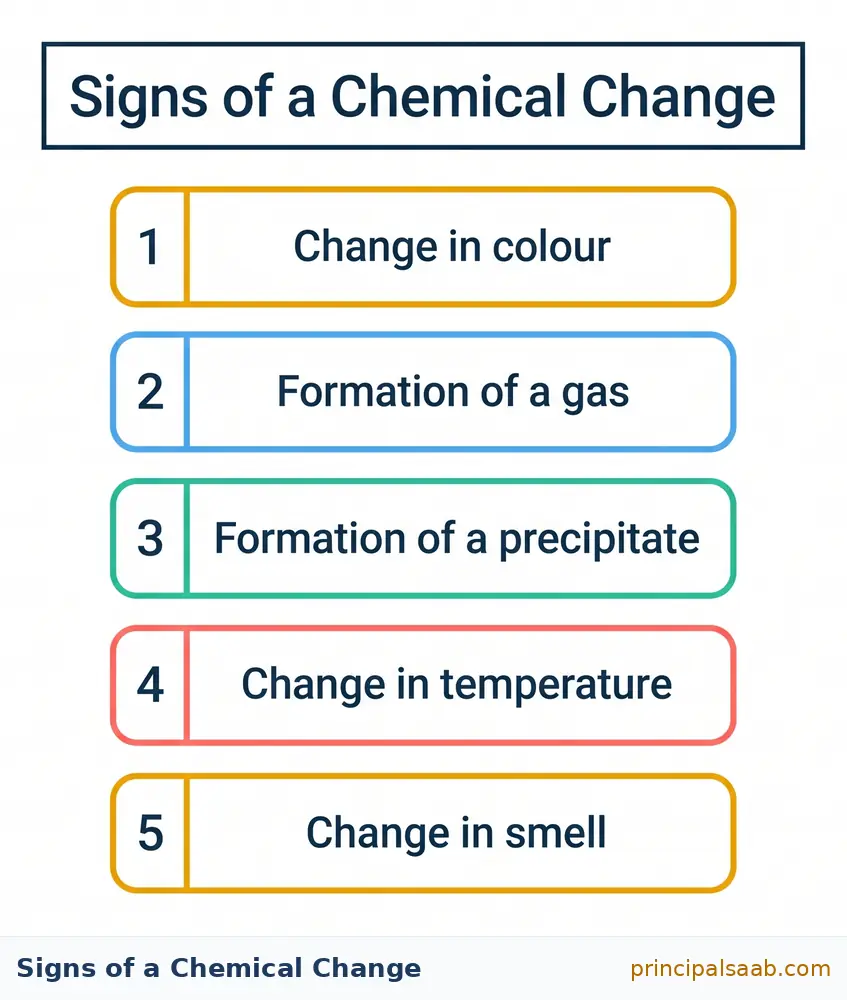
- Change in colour — for example, a cut apple turning brown after some time, or an iron nail turning orange-brown as it rusts.
- Formation of a gas — for example, bubbles rising when baking soda is mixed with vinegar, or the fizz in a soft drink bottle when it is opened.
- Formation of a precipitate — a solid that suddenly appears and settles at the bottom when two liquids are mixed, such as when certain salt solutions are combined in a science lab.
- Change in temperature — some chemical changes release heat and feel warm (these are called exothermic changes, as when quicklime reacts with water), while others absorb heat from their surroundings and feel cool (these are called endothermic changes).
- Change in smell — for example, the sharp, unpleasant smell that develops when food spoils or milk turns sour.
A useful habit is to check for more than one of these signs together, because a single sign on its own is not always proof. For example, ice melting also causes a slight change in temperature feel, but since no new substance forms, it remains a physical change.
Reversible and Irreversible Changes
Changes can also be grouped by whether they can be undone. A reversible change (reversible means “can be changed back to its original form”) is one where the substance can be brought back to its original state — melting and freezing water, stretching and releasing a rubber band, or dissolving and then evaporating salt water are all reversible. An irreversible change (irreversible means “cannot be changed back to its original form”) cannot be undone by ordinary means — baking a cake, burning wood, or the rusting of iron cannot be reversed simply by changing the temperature or pressure.
It is important to know that these two ways of grouping changes overlap but are not identical. Almost all chemical changes are irreversible, but not every physical change is reversible — for example, cutting a fruit into pieces is a physical change (no new substance forms), yet you cannot physically put the pieces back together to recreate the whole, uncut fruit.
Consider this list: (1) melting of butter in a hot pan, (2) frying an egg in that same butter, (3) freezing water into ice cubes, (4) burning of a candle wick and wax. Melting butter is a physical change (state changes from solid to liquid, and it can solidify again on cooling). Frying an egg is a chemical change (a new substance forms — the egg white and yolk change colour, texture, and taste permanently, and cannot turn raw again). Freezing water is a physical change (fully reversible by melting). Burning a candle is both — the wax near the flame first melts (physical) and then some of it burns to form soot, carbon dioxide and water vapour (chemical); this is why a burning candle is a favourite example teachers use to show both types of change happening together.
Rusting of Iron — A Chemical Change You Can Prevent
Rusting is one of the most common chemical changes you will see around your own home — on gates, grills, bicycle chains, and old tools. Rust forms when iron reacts slowly with both oxygen and moisture (water vapour) in the air over time, forming a reddish-brown substance called iron oxide. Since iron oxide is a completely new substance with different properties from iron (it is flaky, dull, and much weaker than solid iron), rusting is a chemical change, and once rust has formed, the iron cannot be recovered by simply scraping it — the rusted portion of the metal is genuinely lost.
Because both oxygen and moisture are needed for rusting, keeping either one away from the iron surface can prevent or slow it down. Some common methods used around us are painting iron gates and railings, applying a thin coat of oil or grease to tools, galvanising (coating iron with a thin layer of zinc, as is done for buckets and pipes), and chrome-plating (as is done for bicycle handlebars and car parts). Storing tools in a dry place also helps, since less moisture means slower rusting.
Chemical Changes Inside Your Own Body
You don’t have to look further than your own lunch to find one of the most important chemical changes of all: digestion. When you eat a chapati, the starch in it is broken down step by step by chemicals called enzymes, first in your saliva and then further along your digestive system, into simpler sugars that your body can absorb and use for energy. This is a genuine chemical change — the starch molecules are chemically split apart into different, smaller molecules, and there is no way to reverse this process and turn the digested food back into a chapati.
Your body relies on many such chemical changes every second: breathing involves a chemical reaction between the oxygen you inhale and the glucose in your cells to release energy (releasing carbon dioxide and water vapour as by-products, which is why you breathe both of these out), and even the healing of a small cut involves a chain of chemical reactions in your blood that cause it to clot. Recognising that your own body runs on chemistry, not just biology, is one of the most useful ideas to carry forward from this chapter into the ones that follow.
Physical and Chemical Changes in Daily Life
Once you start looking, your whole day is full of both kinds of change. Cooking rice, roasting papad, digesting your lunch, a firecracker bursting, curdling of milk into paneer, and the ripening of a raw mango into a sweet one are all chemical changes — in every case a genuinely new substance forms. Kneading dough, cutting vegetables, folding clothes, sharpening a pencil, dissolving sugar in tea, and stretching a spring are all physical changes — the substances involved are still fundamentally the same material, just rearranged in shape or state.
Even the weather around you is full of these two kinds of change. Water evaporating from a pond, turning into clouds, and later falling back as rain is a purely physical cycle — the water molecules keep changing state (liquid to vapour to liquid again) without ever becoming a new substance, which is exactly why the water cycle can repeat endlessly. Compare this with a forest fire, where wood, dry leaves, and other plant matter combine with oxygen to form ash, smoke, carbon dioxide, and water vapour — a chemical change on a huge scale that cannot be reversed by any natural process on a human timescale.
A good habit for revision is to build your own running list of ten changes you notice around your house in a single day, and sort each one using the “does a new substance form” test rather than guessing from memory — this is exactly the kind of reasoning your exam questions will expect from you.
Crystallisation — A Useful Physical Change
Some physical changes are so useful that entire methods of purification are built around them. Crystallisation is one such process — it is used to obtain a pure solid substance in the form of neat, well-shaped crystals from a solution. You may have watched salt being made from seawater in coastal areas: seawater is collected in shallow pans and left in the sun, and as the water slowly evaporates, salt crystals are left behind. The same basic idea is used at home when you make simple sugar crystals (mishri) by dissolving a large amount of sugar in hot water and then leaving the solution undisturbed for several days as it cools slowly.
Crystallisation is a physical change because the salt or sugar you end up with is chemically identical to the salt or sugar you started with — only its form has changed, from being dissolved in water to being an organised solid crystal. This is different from simply evaporating a solution quickly, which often gives a fine powder rather than large, well-formed crystals; slow, gentle cooling gives the particles enough time to arrange themselves neatly, which is why patience matters in this process.
Quick Comparison: Physical vs Chemical Change
Use this side-by-side summary as a fast revision tool before your test. It brings together every idea from this chapter into six quick comparison points.
- New substance formed? Physical change — no. Chemical change — yes, always.
- Usually reversible? Physical change — usually yes. Chemical change — usually no.
- Example Physical change — melting ice, tearing paper, dissolving salt. Chemical change — burning wood, rusting iron, digestion of food.
- Change in mass of the substance’s identity? Physical change — same substance throughout. Chemical change — original substance(s) used up, replaced by new substance(s).
- Common warning signs Physical change — change of state, shape, or size only. Chemical change — colour change, gas released, precipitate formed, smell change, or heat given out/absorbed.
- Everyday test you can apply Physical change — “can I get the original substance back using only physical steps?” Yes. Chemical change — No, the original substance is genuinely gone.
Textbook Questions ki Taiyari
Your Curiosity textbook exercises on this chapter revolve around a handful of recurring topics. Here is each topic explained fully in original words, so you understand the reasoning instead of memorising a line.
Topic 1: Classifying a Given List of Everyday Changes
When you are handed a list of changes and asked to classify each as physical or chemical, work through the “new substance” test one item at a time rather than relying on gut feeling. Ask yourself: could I, in principle, get the original substance back using only physical methods like heating, cooling, or filtering? If yes, it is almost certainly physical. If the substance now behaves, looks, or smells fundamentally differently and cannot be recovered this way, it is chemical.
Topic 2: Explaining Why Rusting Needs Both Air and Moisture
This kind of question wants you to connect the cause to the prevention method. Since rusting is caused by iron reacting with oxygen and water vapour together, any method that blocks one or both of these — painting, oiling, galvanising, or storing in dry conditions — will slow or stop rusting. Always explain both the “why” (which two substances iron is reacting with) and the “how” (which barrier is being used) in your answer for full marks.
Topic 3: Listing and Explaining the Signs That Indicate a Chemical Change Has Occurred
Questions here usually give you a scenario — such as a fruit turning brown, or a fizzing tablet in water — and ask what signs tell you it is a chemical change. Structure your answer around the actual clues present in that scenario (colour change, gas formation, smell, temperature change) rather than listing all five signs generically; examiners give more credit for answers that connect the clue to the specific example given.
Topic 4: Distinguishing Reversible Changes from Irreversible Changes with Examples
Remember that this classification is about whether the change can be undone, which is a slightly different question from whether it is physical or chemical. Give one physical-and-reversible example (melting wax, which resolidifies) and one chemical-and-irreversible example (burning wax) side by side to show you understand both the overlap and the difference clearly.
Topic 5: Explaining Why Burning a Candle Involves Both a Physical and a Chemical Change
This is a favourite exam scenario because it tests whether you can separate two changes happening in the same object at the same time. The melting of solid wax into liquid wax near the flame is physical (it can re-solidify). The burning of the wax vapour in the flame, which produces soot, carbon dioxide, and water vapour, is chemical (it cannot be reversed). A complete answer names both parts separately rather than calling the whole process just one type of change.
Topic 6: Describing How Crystallisation Is Used to Obtain Pure Salt or Sugar Crystals
When asked to describe crystallisation, structure your answer as a short sequence rather than a single line: first the substance is dissolved in a suitable liquid (usually water) to form a solution, the solution is then heated or left in sunlight so that some or most of the liquid evaporates, and finally the remaining concentrated solution is left undisturbed to cool slowly, allowing the dissolved substance to settle out as solid crystals. Mentioning “slow cooling” specifically is important, since it is what produces neat crystals rather than a fine powder.
Extra Practice
Question 1: Is the ripening of a mango from green and hard to yellow and soft a physical change or a chemical change? Explain.
It is a chemical change. As a mango ripens, starches inside it are chemically converted into sugars, and new pigments form that change its colour from green to yellow. Since new substances form and a ripe mango cannot be turned back into a raw one, this change is chemical and irreversible.
Question 2: A student dissolves sugar in a glass of water and later evaporates the water to recover the sugar. Was dissolving the sugar a chemical change? Why or why not?
No, dissolving sugar in water is a physical change. The sugar molecules spread out among the water molecules, but they remain sugar the whole time — no new substance is formed. This is proven by the fact that evaporating the water lets you recover the exact same sugar you started with.
Question 3: Why does an iron gate left out in the rain rust faster than one kept in a covered, dry shed?
Rusting needs both oxygen and moisture. A gate left out in the rain is constantly exposed to both air and water, speeding up the reaction between iron, oxygen, and water vapour. A gate in a dry, covered shed has much less moisture available, so the same chemical reaction happens far more slowly.
Question 4: Classify the following as physical or chemical changes: (a) boiling of water, (b) cooking of rice, (c) breaking of glass.
(a) Boiling of water is a physical change — the water turns to steam but is still water and condenses back on cooling. (b) Cooking of rice is a chemical change — the starch inside the rice grains is chemically altered by heat and water, and cooked rice cannot be turned back into raw rice. (c) Breaking of glass is a physical change — the glass is broken into smaller pieces, but it is still the same substance, glass.
Question 5: Why is it incorrect to say that every change involving heat is a chemical change?
Heat can cause purely physical changes too, such as melting ice or boiling water, where the substance changes state but not identity — no new substance forms and the change can usually be reversed by cooling. A change should only be called chemical if a genuinely new substance is formed, regardless of whether heat was involved.
Question 6: A shiny copper vessel left in humid air for many months develops a dull green coating. What kind of change is this, and why?
This is a chemical change. The green coating is a mixture of new substances (mainly copper carbonate, along with some copper hydroxide) formed when copper slowly reacts with oxygen, moisture, and carbon dioxide in the air. Since the original shiny copper cannot be recovered just by wiping the vessel, and a genuinely new compound has formed, this is chemical, not physical.
Question 7: Explain, with a reason, whether tearing a piece of paper and burning a piece of paper are the same type of change.
No, they are different. Tearing paper is a physical change — it is still paper, just in smaller pieces, and no new substance is formed. Burning paper is a chemical change — the paper reacts with oxygen to form ash, carbon dioxide, and water vapour, which are completely different substances from paper, and the change cannot be reversed.
Question 8: Why is galvanising (coating iron with zinc) an effective way to protect iron buckets from rusting?
Galvanising creates a thin protective layer of zinc over the iron surface, which stops oxygen and moisture in the air from directly reaching the iron underneath. Since rusting needs iron to be in contact with both oxygen and water vapour, blocking that contact with a zinc coating prevents the chemical reaction that forms rust.
Question 9: A balloon is inflated by blowing air into it, and later the air is let out. Is inflating and deflating the balloon a chemical change? Justify.
No, it is a physical change. The rubber of the balloon simply stretches when air is blown in and returns close to its original shape when the air is let out. The rubber remains rubber throughout, and no new substance is ever formed during inflation or deflation.
Question 10: A jeweller heats a gold ornament to melt it and then pours it into a new mould to make a different design. Is melting the gold a physical or chemical change?
It is a physical change. The gold changes state from solid to liquid and back to solid in the new mould, but throughout this process it remains gold — no new substance is formed, and the process could, in principle, be reversed by remelting it again.
Question 11: Explain why crystallisation is preferred over simple, fast evaporation when a science lab wants large, well-formed salt crystals rather than fine powder.
Fast evaporation removes water too quickly for the dissolved particles to arrange themselves neatly, so it usually leaves behind a fine, disorganised powder. Slow evaporation followed by gentle, undisturbed cooling gives the particles enough time to settle into an ordered, well-shaped crystal structure, which is why crystallisation specifically involves this slower, more controlled cooling step.
Self-Assessment
Try to answer each question yourself before opening the hidden answer.
Q1. Name the one test you should always apply to decide if a change is physical or chemical.
Check whether a new substance has been formed.
Q2. Name the reddish-brown substance formed when iron reacts with oxygen and moisture.
Rust (iron oxide).
Q3. Give one example of a change that is both reversible and physical.
Melting of ice (or any correct example such as stretching a rubber band, or dissolving salt in water).
Q4. Is the curdling of milk into paneer a physical change or a chemical change?
A chemical change — new substances (paneer and whey) form, and the change cannot be reversed.
Q5. Name two methods used to prevent iron objects from rusting.
Any two of: painting, oiling/greasing, galvanising, chrome-plating, or storing in dry conditions.
That’s a wrap on physical and chemical changes! Once you can look at any everyday event — from cooking to rusting to a fizzing tablet — and immediately ask “has a new substance formed?”, you have understood the real heart of this chapter, not just its definitions. Keep this question in your back pocket, because it will keep coming back throughout your science journey.
Continue Learning
Keep building your Class 7 Science foundation with these related chapters: