
Look around your kitchen for a minute. The spoon, the pressure cooker, the tap, the wire inside your table lamp — almost all of them are made of metal. Now look at the pencil in your bag: the “lead” inside it is actually a non-metal called graphite. The balloon a florist fills with helium, the matchstick head that has sulfur in it, the iodine your mother dabs on a cut — these are non-metals too. Every single object around you is built from a small set of elements, and the very first thing chemists do with any new material is ask one simple question: is it a metal, or is it a non-metal? This chapter (based on the Curiosity textbook, NCERT Class 7 Science, 2024 edition) will teach you how to answer that question yourself, using nothing more than your eyes, a magnet, and a little bit of careful observation.
What You’ll Learn
- What Makes Something a Metal?
- What Makes Something a Non-metal?
- Comparing Physical Properties
- How Metals React with Air
- How Metals React with Water
- How Metals React with Acids
- How Non-metals Behave with Air and Acids
- Alloys: When Metals Team Up
- Metals and Non-metals in Daily Life
- Textbook Questions ki Taiyari
- Extra Practice
- Self-Assessment
What Makes Something a Metal?
A metal is an element that is usually hard, shiny, and good at conducting heat and electricity. Iron, aluminium, copper, gold, silver, and zinc are all metals you meet every day. If you tap a metal spoon against a plate, it makes a clear ringing sound — this property is called being sonorous (sonorous means “producing a clear ringing sound when struck”). That is exactly why temple bells and musical cymbals are made of metal.
Metals can usually be hammered into thin sheets without breaking. This property is called malleability (malleability means “can be beaten into thin sheets”). Gold is so malleable that goldsmiths can beat it into sheets thinner than paper, used to decorate sweets and idols. Metals can also be drawn into thin wires, a property called ductility (ductility means “can be drawn into wires”). Copper is extremely ductile, which is why the wiring in your house is made of copper.
Not every metal behaves the same way, though. Mercury is a metal that is liquid at room temperature — you may have seen it in old thermometers. Sodium and potassium are so soft that a teacher can cut a small piece with an ordinary knife, and they are light enough to float on kerosene oil. So “metal” does not always mean “hard, heavy, and solid.” It means an element that generally shares most of these properties, even if a few metals are exceptions.
What Makes Something a Non-metal?
A non-metal is an element that usually looks dull (not shiny), is brittle if solid (it breaks instead of bending), and does not conduct heat or electricity well. Sulfur, phosphorus, carbon, oxygen, nitrogen, and iodine are common non-metals. If you try to hammer a piece of sulfur, it will crumble into powder instead of flattening into a sheet — that is brittleness.
Here too, there are exceptions worth remembering carefully, because exam questions love to test them. Graphite is a non-metal (a form of carbon) but it is shiny and it conducts electricity — that is why it is used inside dry cell batteries and as electrodes. Iodine is a non-metal but it has a shiny, metallic-looking surface. Non-metals can exist as solids (sulfur, carbon), liquids (bromine), or gases (oxygen, nitrogen, chlorine) at room temperature, while nearly all metals except mercury are solid at room temperature.
- Mercury is a metal, but it is liquid at room temperature.
- Sodium and potassium are metals, but they are soft enough to cut with a knife.
- Iodine is a non-metal, but it looks shiny like a metal.
- Graphite is a non-metal, but it conducts electricity.
Comparing Physical Properties
Here is a simple side-by-side comparison you can use whenever you are handed an unknown sample in a lab activity:
- Appearance: Metals usually have a shiny surface, called metallic lustre. Non-metals are usually dull (except iodine and graphite).
- Hardness: Most metals are hard. Non-metals are often soft or brittle when solid (except diamond, a form of carbon, which is the hardest natural substance known).
- Malleability and ductility: Metals can be hammered into sheets and drawn into wires. Non-metals cannot — they break instead.
- Conduction of heat and electricity: Metals are good conductors. Non-metals are poor conductors (except graphite).
- Sonorous nature: Metals produce a ringing sound when struck. Non-metals do not.
- Density and melting point: Metals generally have higher density and higher melting points than non-metals, though sodium and potassium are again exceptions — both float on water and melt at low temperatures.
A sample is dull grey, breaks into powder when hit with a hammer, and does not conduct electricity when tested with a simple bulb-and-battery circuit. Is it a metal or a non-metal?
Reasoning: Dull appearance rules out most metals. Breaking under a hammer means it is brittle, not malleable. Not conducting electricity is the strongest clue of all, since almost every metal conducts. Putting these three observations together, the sample is a non-metal — most likely something like sulfur.
Density is simply a measure of how much “stuff” (mass) is packed into a given space (volume). To calculate it, we always divide mass by volume. Let’s use this idea to test an unknown metal sample.
A student weighs a small metal block and finds its mass is 54 g. When she lowers it into a measuring cylinder, the water level rises by 20 cm³, so the block’s volume is 20 cm³. What is its density, and which metal could this be?
Solution: Density = mass ÷ volume = 54 g ÷ 20 cm³ = 2.7 g/cm³. This matches the known density of aluminium, so the block is very likely made of aluminium.
How Metals React with Air
Most metals react with oxygen in the air to form a coating called a metal oxide, and this reaction is called corrosion (corrosion means “slow damage to a metal caused by reaction with air or moisture”). Iron reacts with oxygen and moisture to form reddish-brown rust (iron oxide), which is why iron gates and railway tracks need regular painting. Aluminium also reacts with oxygen to form a thin, invisible protective layer of aluminium oxide on its surface. Unlike flaky rust, this layer sticks tightly and seals off the metal underneath, stopping any further damage — this is why aluminium window frames and utensils do not rust away like iron does, even though aluminium is actually a very reactive metal.
Gold, silver, and platinum barely react with air at all, which is exactly why they are called noble metals (noble metals means “metals that resist reaction with air and moisture”) and why gold jewellery kept for years still looks shiny.
How Metals React with Water
Different metals react with water at very different speeds, and this is one of the most important ideas in the whole chapter:
- Sodium and potassium react so violently with cold water that they can catch fire — this is why they are stored under kerosene oil in the lab, never touched with bare hands.
- Magnesium and calcium react gently with cold water, and more strongly with hot water or steam, releasing hydrogen gas.
- Iron reacts very slowly with water and air together, over weeks or months, forming rust.
- Copper, silver, and gold do not react with water at all, even after years, which is one reason old copper coins and gold ornaments can survive for centuries.
How Metals React with Acids
When a reactive metal is dropped into a dilute acid such as dilute hydrochloric acid, watch closely: you will usually see rapid bubbling forming on the metal’s surface — that fizzing is hydrogen gas escaping. Zinc, magnesium, and iron all react with dilute acids this way, faster or slower depending on the metal. Copper, silver, and gold do not react with dilute acids under normal classroom conditions, which is another sign of how unreactive they are.
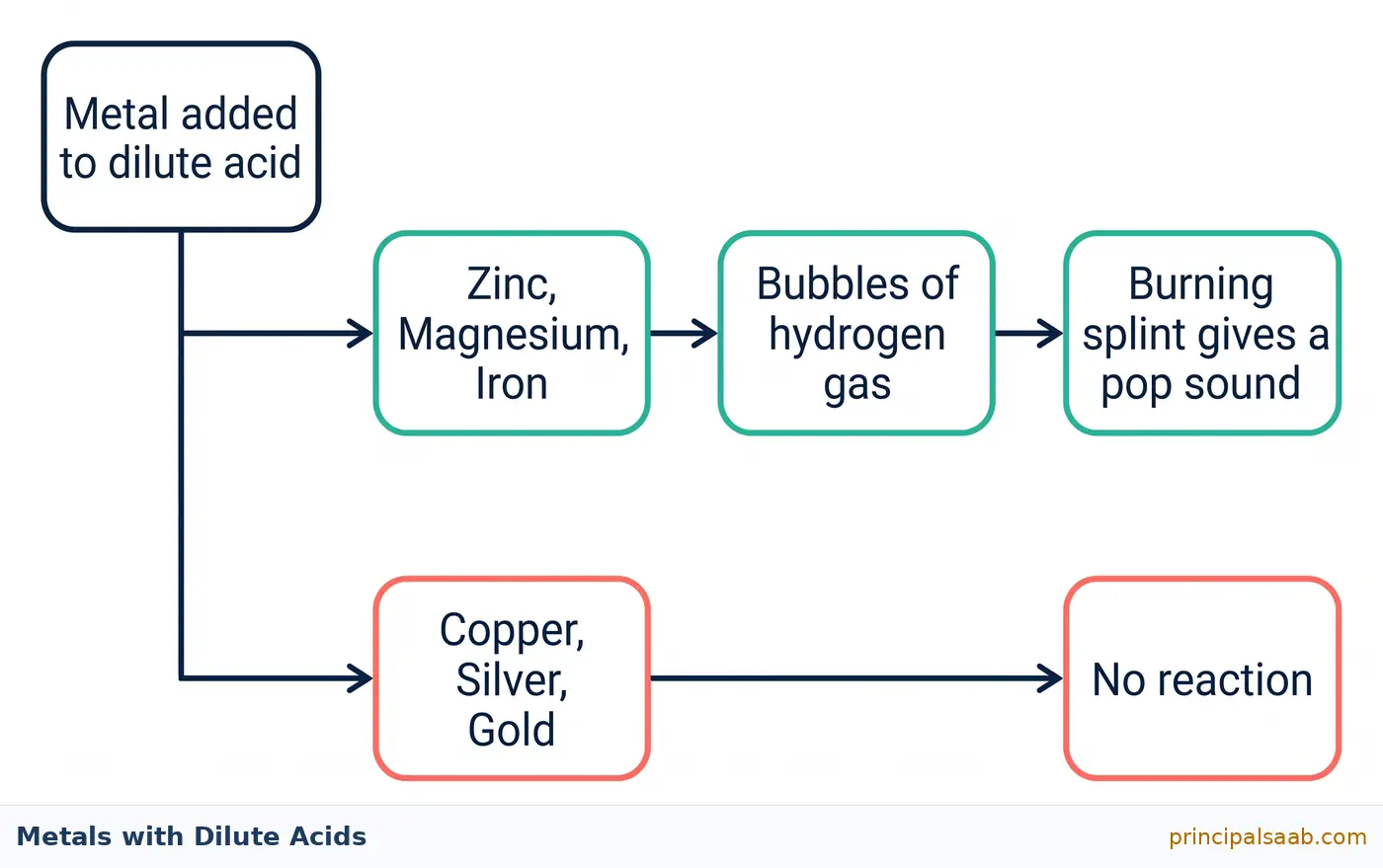
You can test for hydrogen gas safely in a school lab by bringing a burning matchstick near the mouth of the test tube: hydrogen burns with a characteristic “pop” sound.
How Non-metals Behave with Air and Acids
Non-metals also react with oxygen, but the oxide they form behaves very differently from a metal oxide. When carbon burns in air it forms carbon dioxide, and when sulfur burns it forms sulfur dioxide — both of these gases dissolve in water to form acidic solutions. That is the key rule to remember: metal oxides are generally basic, while non-metal oxides are generally acidic. This single idea explains why acid rain forms: when non-metals like sulfur and nitrogen burn in factory or vehicle smoke, their oxides float up into the clouds, mix with water vapour, and fall back down as slightly acidic rain.
Non-metals generally do not react with dilute acids to release hydrogen gas the way reactive metals do. They also do not conduct electricity to complete a circuit, with graphite being the famous exception you already met above.
Pure gold (24 karat) is too soft to hold its shape in fine jewellery, since it can be bent or scratched with just a fingernail. Jewellers mix pure gold with a small amount of copper or silver to make 22 karat gold. Why does this trick work?
Reasoning: Mixing a small amount of a harder metal like copper into gold increases the overall hardness of the mixture without taking away gold’s shine and resistance to corrosion. This kind of intentional metal mixture is called an alloy, which you’ll read about next.
Alloys: When Metals Team Up
An alloy (alloy means “a mixture of a metal with one or more other elements, usually another metal or carbon, made to improve its properties”) is created by melting two or more elements together and letting them cool as a single new material. Alloys are everywhere:
- Stainless steel (iron mixed with chromium and nickel) does not rust, which is why it is used for kitchen utensils and cutlery.
- Brass (copper mixed with zinc) is used for decorative items, taps, and musical instruments because it is stronger than pure copper and looks golden.
- Bronze (copper mixed with tin) is used for statues, medals, and bells because it is hard and resists corrosion.
- 22 karat gold (gold mixed with copper or silver) is used in jewellery for exactly the reason explained in Worked Example 3 above.
Metals and Non-metals in Daily Life
Metals show up wherever we need strength, electrical conductivity, or heat conductivity: iron and steel in buildings and bridges, copper and aluminium in electrical wires, aluminium in cooking foil and aeroplane bodies (because it is light in weight), and silver in mirror-backing and fine cutlery. Non-metals matter just as much in different ways: nitrogen makes up about four-fifths of the air we breathe and is also used to make fertilisers that help crops grow; oxygen is needed for breathing and burning fuels; carbon (as graphite) is used in pencils and battery electrodes, while carbon (as diamond) is used to cut and polish other hard materials; iodine is used as a antiseptic on wounds; and chlorine is used to purify drinking water and swimming pools.
Try This at Home (Safely)
With an adult’s permission, collect five safe household items — for example, a steel spoon, a rubber band, a pencil (graphite core), a plastic ruler, and a coin. For each item, note down three things: does it feel hard or does it bend/break easily, does it look shiny or dull, and does it feel cold to touch compared to a plastic object left in the same room (metals feel colder because they conduct heat away from your fingers faster). Sort your five items into “metal,” “non-metal,” or “not an element at all” (many household items like plastic and rubber are actually compounds or mixtures, not pure metals or non-metals). This activity trains your eye to notice the same clues real scientists use in a lab.
Quick Recap Table
| Property | Typical Metal Behaviour | Typical Non-metal Behaviour |
|---|---|---|
| Lustre | Shiny | Dull (iodine, graphite are exceptions) |
| State at room temperature | Solid (mercury is a liquid exception) | Solid, liquid, or gas |
| Malleability | Can be hammered into sheets | Breaks/crumbles instead |
| Ductility | Can be drawn into wires | Cannot be drawn into wires |
| Conduction of heat/electricity | Good conductor | Poor conductor (graphite is an exception) |
| Sound when struck | Sonorous (rings) | Does not ring |
| Oxide formed in air | Basic oxide | Acidic oxide |
| Reaction with dilute acid | Often releases hydrogen gas | Usually no reaction |
Keep this table handy while revising, but remember: a table is only a memory aid. In an actual exam question, you are usually expected to explain why a material behaves a certain way, not just recite the table from memory.
A Note on Everyday Safety
Because sodium and potassium react so strongly with water and air, and because acids used in school activities can irritate skin and eyes, always let your teacher handle these substances during a demonstration rather than touching them yourself. Good science is also about knowing when to observe carefully from a safe distance rather than experimenting on your own at home with anything beyond simple, adult-approved household items.
One more everyday pattern worth noticing: notice how many “non-metal” elements are actually gases that keep us alive and comfortable. The air you breathe is roughly four-fifths nitrogen and one-fifth oxygen, both non-metals. The carbon dioxide you breathe out, the ozone layer high above that blocks harmful sunlight, and the chlorine that keeps swimming pool water clean are all built from non-metal elements doing quiet, essential jobs that rarely get the same attention as shiny metals do. Chemistry is not really a contest between “useful metals” and “less useful non-metals” — both groups are equally essential, just in very different ways.
As you move into the next few chapters of this book, keep this classifying habit alive. Whenever you meet a new material — whether it is a rock, a liquid, or a gas released in a reaction — ask yourself the same questions you practised here: how does it look, how does it behave when hit or bent, does it conduct heat or electricity, and how does it react with air, water, and acid? These four questions form the backbone of how chemists sort the material world, and you now know how to use them.
Textbook Questions ki Taiyari
Your Curiosity textbook exercises on this chapter revolve around a handful of recurring topics. Here is each topic explained fully in original words, so you understand the reasoning instead of memorising a line.
Topic 1: Sorting a List of Materials into Metals and Non-metals
When you are given a mixed list — say, iron nail, sulfur powder, aluminium foil, a piece of coal, and a copper wire — work through each item using the property checklist from this chapter: does it shine, does it bend without breaking, does it conduct electricity, does it make a ringing sound? Iron nail, aluminium foil, and copper wire pass most of these tests and are metals. Sulfur powder and coal (a form of carbon) are dull, brittle, and do not conduct electricity, so they are non-metals.
Topic 2: Why Aluminium Does Not Rust Like Iron Even Though Both Are Reactive
This is a favourite reasoning-based question. The answer is not that aluminium refuses to react — in fact it reacts with oxygen very readily. The real reason is that the aluminium oxide layer that forms on the surface is thin, hard, and sticks tightly, sealing off the metal underneath from further contact with air. Iron oxide (rust), by contrast, is flaky and falls away, constantly exposing fresh iron to attack, so rusting keeps eating deeper into the metal.
Topic 3: Why Cooking Vessels Are Made of Metal, Not Non-metal
Cooking needs a material that conducts heat quickly and evenly from the flame to the food, and can be shaped into a vessel. Metals conduct heat far better than non-metals and can be hammered or moulded into pots and pans, so metals like aluminium, iron, and stainless steel are the natural choice.
Topic 4: Why Electrical Wires Use Copper, Not Iron
Both copper and iron conduct electricity, but copper is a noticeably better conductor and is also more ductile, meaning it can be drawn into very thin, flexible wires without snapping. Iron is also more prone to rusting over time, which would eventually break an electrical connection.
Topic 5: Planning a Simple Activity to Test Conductivity
A typical textbook activity asks you to build a simple circuit with a battery, a bulb, and two wires with their ends left bare, then touch the bare ends to different test materials one at a time. If the bulb lights up, the material conducts electricity (most likely a metal or graphite); if it does not light up, the material does not conduct (most likely a non-metal). Always record your observations in a table with columns for material name, whether the bulb lit up, and your conclusion.
Topic 6: Comparing How Fast Different Metals React with Dilute Acid
When small, equal-sized pieces of zinc, magnesium, and iron are each dropped into separate test tubes of dilute acid, you would expect to see the fastest bubbling with magnesium, moderately fast bubbling with zinc, and the slowest bubbling with iron — reflecting how reactive each metal is. Copper, placed in the same acid, would show no bubbles at all.
Topic 7: Explaining Why We Use Alloys Instead of Pure Metals
A typical textbook question asks you to explain, in your own words, why something like a bronze statue or a brass tap is not made of a pure metal. The reasoning to give is always the same shape: identify what pure metal lacks (for example, pure copper is a little too soft and can dent easily), then explain how mixing in a second element fixes exactly that weakness (adding tin to copper to make bronze increases hardness and improves resistance to corrosion), while keeping the useful properties of the original metal (bronze still conducts heat reasonably well and can be cast into detailed shapes).
Topic 8: Why Are Gold, Silver, and Platinum Called “Noble” Metals?
This term confuses many students because it sounds like it is about royalty. In chemistry, “noble” simply describes how unreactive an element is. Gold, silver, and platinum barely react with oxygen, water, or most acids, so objects made from them keep their shine for generations instead of corroding. This is also exactly why they are historically used for coins, jewellery, and trophies — items that are meant to last.
Topic 9: Using Density to Choose the Right Material for a Job
Some textbook questions describe a real engineering choice and ask you to explain it using density. For example, why are ship hulls made of steel (which is denser than water) able to float, while a solid steel ball sinks? The answer lies in shape, not just material: a ship’s hollow, wide shape displaces a large volume of water, so its average density (mass of the whole ship divided by the total volume it occupies, including the air-filled space inside) works out to be lower than the density of water, even though the steel itself is much denser than water. A solid steel ball has no hollow space, so its density stays high and it sinks.
Question 12: A cyclist’s helmet shell is often made from a strong plastic rather than metal, even though metal is stronger. Suggest one reason why.
Metal would make the helmet far heavier and would also conduct heat and cold uncomfortably against the head; a strong lightweight plastic protects the head well while staying light and comfortable to wear, showing that “strongest possible material” is not always the best engineering choice — weight and comfort matter too.
Extra Practice
Question 1: Why are sodium and potassium stored under kerosene oil in the laboratory?
Sodium and potassium react violently with the moisture and oxygen present in air, and even more violently with water, sometimes catching fire. Kerosene oil does not react with these metals, so storing them submerged in kerosene keeps air and water away and prevents an accident.
Question 2: A student says “graphite cannot be a non-metal because it conducts electricity.” Is the student correct?
No. Graphite is indeed a non-metal (a form of the element carbon), but it is one of the well-known exceptions to the rule that non-metals are poor conductors. Its unusual structure lets electric current pass through it, which is exactly why it is used inside dry cell batteries.
Question 3: Why does a copper vessel left in humid air slowly turn greenish?
Copper reacts very slowly with oxygen, moisture, and carbon dioxide in the air to form a greenish coating called copper carbonate, often seen on old copper statues and vessels. Unlike rust on iron, this greenish layer actually protects the copper underneath from further damage.
Question 4: Why is aluminium used to make aeroplane bodies instead of iron?
Aluminium has a much lower density than iron, so it is far lighter for the same size of part, which is essential for anything that needs to fly. It is also reasonably strong and resists corrosion well because of its protective oxide layer.
Question 5: Two unlabelled test tubes contain dilute acid. Metal A produces fast bubbling and Metal B produces no bubbling at all. Which metal is more reactive?
Metal A is more reactive. Fast bubbling means hydrogen gas is being released quickly as the metal reacts with the acid, while no bubbling from Metal B suggests it barely reacts with dilute acid at all, similar to how copper or silver would behave.
Question 6: Why do jewellers avoid making rings out of pure iron?
Pure iron reacts with moisture and oxygen in the air to form rust, which would make a ring look dull, flaky, and eventually damage its shape. Iron is also not as attractive or resistant to tarnishing as metals like gold, silver, or stainless steel alloys.
Question 7: What would you observe if you tried to hammer a small lump of sulfur, and what does that tell you about non-metals?
The sulfur would crack and crumble into powder rather than flattening into a sheet. This shows that non-metals are typically brittle rather than malleable, which is one of the standard tests used to tell metals and non-metals apart.
Question 8: Why is nitrogen gas, and not oxygen, used to fill packets of chips to keep them fresh?
Both nitrogen and oxygen are non-metal gases, but they behave very differently. Oxygen is a reactive non-metal that would react with the oils and fats in the food, making it turn stale and rancid faster. Nitrogen, on the other hand, is a largely unreactive non-metal under normal conditions, so filling the packet with nitrogen instead of air keeps the food fresh for longer by keeping the more reactive oxygen away from it.
Question 9: A shiny grey solid does not bend when hammered lightly and instead breaks into pieces. Is it more likely to be a metal or a non-metal, and why might its shine be misleading?
Even though it looks shiny, the fact that it breaks under a hammer rather than flattening tells you it is brittle, which points to a non-metal. This is a good reminder that a few non-metals, like iodine, do have a shiny appearance, so lustre alone should never be your only test.
Question 10: Why does a silver spoon sometimes turn slightly black or dull after being used to stir food containing eggs or sulfur-rich vegetables?
Silver reacts slowly with sulfur compounds present in some foods (and in the air) to form a thin black coating of silver sulfide on the surface. This is called tarnishing, and it can usually be polished off because it only affects the very top layer of the metal.
Question 11: Two metal rods of the same size are left outdoors for a month — one is iron, one is stainless steel. Predict and explain the difference you would see.
The iron rod would likely show visible reddish-brown rust, especially if it rained during the month, because iron reacts with oxygen and moisture. The stainless steel rod would look almost unchanged because the chromium in the alloy forms a thin protective oxide layer that resists rusting.
Question 13: If you had an unlabelled shiny grey powder, list the three quickest tests you could do in a school lab to check whether it is a metal or a non-metal.
First, try the hammer test on a small pinch pressed into a pellet — if it flattens rather than crumbling, that suggests a metal. Second, complete a simple battery-bulb circuit with the sample — if the bulb lights up, that strongly suggests a metal (or graphite). Third, drop a small amount into dilute acid and watch for bubbling — steady bubbling suggests a reactive metal, while no reaction at all could mean either a non-metal or an unreactive metal like gold or copper, so this test works best combined with the other two.
Self-Assessment
Try to answer each question yourself before opening the hidden answer.
Q1. Name one metal that is liquid at room temperature.
Mercury.
Q2. A metal block has a mass of 97 g and a volume of 100 cm³. Calculate its density, and state whether it would float or sink in water (water has a density of 1 g/cm³).
Density = 97 ÷ 100 = 0.97 g/cm³. Since this is less than the density of water (1 g/cm³), the metal would float — this matches the behaviour of sodium.
Q3. Do metal oxides behave as acidic or basic when dissolved in water? What about non-metal oxides?
Metal oxides are generally basic. Non-metal oxides are generally acidic.
Q4. Give one reason why stainless steel is preferred over plain iron for kitchen knives.
Stainless steel is an alloy of iron with chromium and nickel that resists rusting, unlike plain iron, so it stays hygienic and sharp-looking for far longer.
Q5. Why does dropping a piece of magnesium ribbon into dilute acid produce bubbles, but dropping a piece of copper does not?
Magnesium is a reactive metal and reacts with dilute acid to release hydrogen gas, seen as bubbles. Copper is far less reactive and does not react with dilute acid under normal classroom conditions, so no bubbles form.
That’s a wrap on metals and non-metals! Once you can sort any everyday object into “metal” or “non-metal” just by thinking through lustre, malleability, conductivity, and how it reacts with air, water, and acid, you’ve genuinely understood this chapter — not just memorised it. Carry this habit of careful observation into the next chapter, because it is exactly how real scientists work.
Continue Learning
Keep building your Class 7 Science foundation with these related chapters: