
Take a breath. If you have opened this page because “Money and Credit” felt like a wall of definitions that refused to stick, you are in exactly the right place. This chapter has a reputation for being dry, and I think that reputation is unfair. Underneath the vocabulary there is a genuinely interesting human story: how people stopped swapping goats for grain and started using little rectangles of printed paper, and how borrowing can either lift a family up or quietly pull it under. Once you see the story, the definitions arrange themselves.
We are going to go slowly. I am not going to assume you remember anything from earlier classes about banks or interest. If you have never held a cheque, never seen a passbook, never worked out a percentage of a large number without panicking a little — that is completely fine. We will build from the ground up, one small idea at a time, and I will stop at every point where students usually get lost and say plainly, “here is where people trip, and here is how not to.”
A quick word on where this sits in your year. “Money and Credit” is Chapter 3 of Understanding Economic Development, the Economics book in your Class 10 Social Science course. It follows straight on from Development — Class 10 Economics notes and Sectors of the Indian Economy — Class 10 Economics notes, and it sets up Globalisation and the Indian Economy — Class 10 Economics notes, so read those alongside this chapter if you want the full Economics unit in one go. As per the CBSE Class X Social Science curriculum 2026-27, the chapter is allotted 12 periods of teaching time, and the Economics unit as a whole carries 20 marks in your board paper. Twenty marks is a fifth of your theory paper coming from four short chapters. That is a very good return on effort — these chapters are short, the ideas repeat, and once you own them you own them.
One more thing before we begin, and I mean this sincerely. This chapter talks about loans, interest rates and moneylenders. It is a lesson in how the credit system works — it is not advice about what any real person should borrow or from whom. We are studying a mechanism, the way you would study how a pump works. Keep that frame and the chapter becomes much easier to think about calmly.
What You Will Learn
Every section of this chapter, in order. Click any line to jump straight there — and come back whenever you like.
- Money as a Medium of Exchange
- Double Coincidence of Wants and the Barter Problem
- Modern Forms of Money: Currency
- Deposits with Banks and Demand Deposits
- Loan Activities of Banks
- Two Different Credit Situations
- Terms of Credit
- Formal and Informal Sources of Credit
- Why Everyone Should Get Cheap Formal Credit
- Self-Help Groups for the Poor
- How to Answer Money and Credit Questions in the Board Exam
- Practice Worksheet with Answers
Your Game Plan
Do not try to swallow this page in one sitting. Here is the order I would follow if I were sitting next to you:
- Read the first two sections (money and double coincidence) properly, out loud if that helps. These two are the foundation. Everything later leans on them.
- Do the worked examples in each section with a pen. Reading a solved sum is not the same as solving it. Cover the answer, try it, then compare.
- Take a break after “Loan Activities of Banks”. That section has the arithmetic in it, and tired arithmetic is wrong arithmetic.
- Come back for the credit half — two credit situations, terms of credit, formal versus informal, cheap credit, self-help groups. This half is mostly reasoning, very little calculation.
- Read the board-answer section slowly. It tells you what an examiner is actually looking for, which is a different skill from knowing the content.
- Finally, do the worksheet with the answers hidden. Only then check. If you get one wrong, do not just read the answer — go back to the section it came from.
If a section feels shaky, stay there. There is no prize for finishing fast. Do not move on until the idea feels comfortable enough that you could explain it to a younger sibling.
Money as a Medium of Exchange
Let us start with a question that sounds childish but is actually the whole chapter: why does anybody accept a hundred-rupee note? You cannot eat it. You cannot wear it. You cannot use it to fix a leaking tap. It is a piece of printed paper. And yet a shopkeeper who has spent all morning stocking his shelves will happily hand you real, useful goods in exchange for it.
He does it for one reason only: he is confident that somebody else will accept that same note from him. The vegetable seller will take it. The bus conductor will take it. His landlord will take it. Money works because everyone expects everyone else to accept it. It is a chain of confidence, and each person is willing to be part of the chain because the next person is too.
That is what economists mean when they call money a medium of exchange. “Medium” here means something in the middle — a go-between. Instead of goods going directly from one person to another, money sits in between and makes the journey possible.
Read that “two separate halves” bit again, because it is the single most useful sentence in this section. Without money, an exchange is one event: I give you cloth, you give me rice, done, both at once. With money, that one event becomes two events that can be pulled apart in time and space. I sell my cloth to a stranger on Monday in one market and receive money. On Friday I walk into a completely different shop and use that money to buy rice. The stranger and the rice-seller never meet. They do not need to.
Here is an everyday analogy I like. Think of money as a token at a large food court. You do not carry your food to the counter and trade it. You pay once at a central counter, get tokens, and then any stall will serve you against a token — because every stall knows it can take those tokens back to the counter and get real cash. The token is not food. The token is a promise that food is available. Money is the token, and the whole economy is the food court.
Why this small idea removes so much friction
“Friction” is a word worth borrowing from physics here. Friction is the effort wasted just in making something move — heat, wear, noise. An economy has friction too: time spent searching for the right trading partner, goods spoiling while you search, deals falling through because the two sides do not quite match. Money attacks that friction directly.
- You no longer have to find a matching partner. You only need to find somebody who wants what you are selling. What you want to buy is now a completely separate problem, solved later, elsewhere.
- You can store your effort. A farmer’s tomatoes rot in a week. The money he gets for them does not. He can hold that value until the day he needs to pay school fees.
- You can compare unlike things. Is a bicycle worth more than three goats? Impossible to argue about directly. But if a bicycle costs ₹6,500 and a goat costs ₹4,000, the comparison becomes ordinary arithmetic.
- You can trade in tiny amounts. You cannot pay for a cup of tea with a fraction of a cow. You can pay with a ten-rupee coin.
- You can settle debts precisely. Owing “half a sack of grain plus two days of labour” is messy. Owing ₹1,200 is not.
Notice that every one of those advantages is really the same advantage wearing a different hat: money breaks a rigid, simultaneous, two-sided requirement into flexible, separate, one-sided transactions. If you understand only that, you understand the section.
Question (3 marks): What is meant by money as a medium of exchange? Explain with an example.
Model answer:
Money is called a medium of exchange because it is accepted by everyone as a common means of payment, so goods and services can be bought and sold through it instead of being swapped directly. [1 mark — the definition, stated cleanly]
Its main use is that it splits a single exchange into two independent transactions: a person first sells what he has for money, and later uses that money to buy what he needs. The two transactions need not involve the same person or the same day. [1 mark — the reasoning, which is where most students lose the mark]
For example, a weaver sells cloth in a town market and receives ₹3,000. Two weeks later he uses that money to buy medicines from a chemist who has no interest in cloth at all. The chemist accepts the money only because he knows his own suppliers will accept it from him. [1 mark — a concrete illustration]
Before you move on, try saying this out loud without looking: “Money is a medium of exchange because it lets a sale and a purchase happen separately.” If that sentence comes easily, you are ready. If not, read this section once more — it costs you four minutes and saves you the whole chapter.
Double Coincidence of Wants and the Barter Problem
Now let us look at the world before money, so you can feel the problem money solves rather than just memorising its name. A system where goods are exchanged directly for other goods, with no money in between, is called barter. It sounds simple and friendly. In practice it is exhausting.
Let me build you an original example and walk through it slowly. I want you to actually feel the frustration, because a student who has felt the frustration never forgets the term.
Bhola the potter has a very long day
Bhola makes clay pots. It is a Tuesday, there is no money in this imaginary village, and Bhola needs one thing: a pair of leather sandals, because his old pair has finally given up.
- He walks to Kalu the cobbler with four pots. Kalu looks at the pots and says, politely, “I already have six pots. What I actually need is rice.” Deal fails. Not because Bhola has nothing valuable — he has perfectly good pots — but because Kalu does not want pots.
- So Bhola thinks: fine, I will get rice first. He goes to Ramu the farmer, who has rice. Ramu looks at the pots and says, “I have plenty of pots too. I need a new blanket.” Deal fails again.
- Bhola goes to Meera the weaver, who makes blankets. Meera says, “Pots? Yes actually, I could use two pots.” Deal succeeds. Bhola gives two pots, gets a blanket.
- Back to Ramu with the blanket. Ramu accepts the blanket, gives Bhola a sack of rice.
- Back to Kalu with the sack of rice. Kalu accepts, and Bhola finally walks home in new sandals.
Count what that cost him: five journeys, three separate negotiations, an entire working day not spent making pots, and a chain that would have collapsed if Meera had happened to already own enough pots. And Bhola was lucky. The chain closed. Very often it simply does not.
The exact thing that kept failing has a name.
Pause on the word “coincidence”. A coincidence is something that happens to line up by chance. That is precisely the point — barter depends on luck. Money replaces luck with certainty. That single sentence is worth writing on the inside cover of your notebook.
What exactly goes wrong in barter
It is worth separating the problems, because a five-mark question may ask you to list them.
- The matching problem. Both sides must want each other’s goods simultaneously. Most of the time they do not.
- No common measure of value. How many pots equal one blanket? There is no agreed yardstick, so every single trade needs a fresh argument.
- Goods cannot be divided. If a blanket is worth three-and-a-half pots, what do you do with the half pot? Cut a goat in half and you have destroyed the goat.
- Value cannot be stored safely. Save your wealth as grain and it is eaten by pests; as livestock and it may fall ill. Wealth held as goods decays.
- Future payments are difficult. Lending “four pots, to be returned next year” is a mess: what if pots are worth much less by then, or the pots that come back are cracked?
- Transport is a burden. To buy something you must physically carry your goods to the market. Carrying a hundred rupees is rather easier than carrying a hundred rupees’ worth of pumpkins.
Suppose in a barter village a trader must meet, on average, 12 people before he finds one who both has what he wants and wants what he has. Each meeting — walking there, talking, bargaining — takes about 20 minutes. How much time does one single purchase cost him?
Working: total time = 12 meetings × 20 minutes = 240 minutes. Converting: 240 ÷ 60 = 4 hours.
What it means: four hours of a working day burned on finding a trade, before a single pot is made or a single field is ploughed. With money, he needs one visit to the buyer and one visit to the seller, and neither has to want anything from the other. This is exactly the “friction” we discussed. (Figures here are invented to illustrate the idea, not measured from any real village.)
Barter and money side by side
| Point of comparison | Barter system | Money-based exchange |
|---|---|---|
| What must match | Both sides must want each other’s goods — a double coincidence of wants | Only the seller’s goods must be wanted; the buyer just needs money |
| Number of steps | One combined transaction that often needs a long chain of intermediate swaps | Two clean transactions — a sale, then a purchase — independent of each other |
| Measuring value | No common unit; every pair of goods needs its own rate | One common unit (the rupee) prices everything |
| Small payments | Hard — most goods cannot be split without ruining them | Easy — notes and coins come in small denominations |
| Storing wealth | Goods rot, rust, die or need feeding | Money can be kept, or deposited in a bank where it may even earn interest |
| Lending and repaying | Awkward and disputed | Straightforward — a fixed sum with a fixed rate of interest |
| Overall effect | Trade stays small, local and slow | Trade widens, specialisation grows, the economy expands |
Modern Forms of Money: Currency
So society decided it needed a go-between. The obvious next question is: a go-between made of what? What should we use as money?
For most of history the answer was: something that is itself valuable. Grain, cattle, cowrie shells, and eventually metals — copper, silver, gold. Metal coins had real advantages. They did not rot, they could be divided into small pieces, they were easy to carry, and crucially the metal in the coin was worth something on its own. If you melted a silver coin you still had silver.
Modern money made a strange and rather bold leap away from that. Look carefully at a hundred-rupee note. The paper is worth a rupee or two at most. The ink, a few paise. If you melted it — well, you would just have ash. There is no valuable substance inside it at all. And yet it buys a hundred rupees of goods.
Why worthless paper works: legal tender
The reason is that the note is not a valuable thing. It is a valuable promise, backed by law. In India, currency notes and coins are declared by law to be money that must be accepted. This is what the phrase legal tender means: a form of payment that, by law, cannot be refused in settlement of a debt within the country.
Notice how carefully that sentence is phrased, because the board loves this exact point. The Reserve Bank of India (RBI) issues currency notes — but it does so on behalf of the central government. The RBI is the only body permitted to issue currency notes in India. Nobody else — no private bank, no state government, no company, no individual — may legally produce currency. That monopoly is deliberate: if just anyone could print money, the confidence chain we talked about in the first section would snap immediately.
Here is an analogy that helps students. Think of a school where the principal alone can issue merit cards, and every teacher is required to honour them. The card is just cardboard. It works because (a) only one trusted authority makes them, and (b) everyone is obliged to accept them. Remove either condition and the system dies. Currency is that merit card, at national scale.
Reading the two guarantees off a note
If you have a currency note nearby, look at it. You will find the Reserve Bank’s name, the Governor’s signature, and a printed promise to pay the bearer the stated sum. Those markings are not decoration — they are the visible evidence of the two things that make the note money:
- Authority. One central institution, the RBI, issues it. That makes it trustworthy and countable.
- Legal backing. The law makes it acceptable everywhere in the country. That makes refusal impossible.
Question (1 mark): Who issues currency notes in India?
Answer: The Reserve Bank of India, on behalf of the central government. [Note the second half — many one-mark answers are marked down for stopping at “RBI”. The phrase “on behalf of the central government” is the part being tested.]
Question (3 marks): “A currency note has no value of its own, yet everybody accepts it.” Explain why.
Model answer: A currency note is only paper and ink, so as a physical object it is nearly worthless. [1 mark — acknowledging the premise]
It is accepted because it is authorised by the government and issued by the Reserve Bank of India on the central government’s behalf, and because Indian law declares it legal tender, meaning no one within the country may refuse it as payment. [1 mark — the legal reason]
This legal backing creates general confidence: each person accepts a note because he is certain the next person will also accept it. Acceptance, not material, is the source of its value. [1 mark — the confidence reason, which turns a good answer into a full one]
If the leap from “money must be valuable” to “money is valuable because we agree it is” still feels uncomfortable — good. It is a strange idea. Sit with it for a minute. Every functioning currency in the world today rests on exactly this shared agreement, and it holds because almost nobody ever tests it.
Deposits with Banks and Demand Deposits
Currency is not the only form of modern money, and this is where a lot of students quietly get confused. Let us go carefully.
Suppose a family sells its harvest and receives ₹90,000 in cash. Keeping that much cash in a tin box at home is uncomfortable — it can be stolen, lost in a fire, or simply spent because it is sitting there being tempting. So the family walks into a bank and deposits it. The bank records the amount against their name, and hands back a passbook or a statement. The cash has physically left the family, but the claim to it has not.
Two things are now true, and both matter:
- The family can walk in on any working day and demand the money back. The bank must give it. There is no waiting period, no permission needed.
- Because the money can be withdrawn on demand, these are called demand deposits.
And here is the step that makes this section important: because a demand deposit can be turned into cash at any moment, and because payments can be made directly out of it without touching cash at all, demand deposits are counted as money. Money in a bank account is money, in every sense that matters.
What a cheque actually is
Students often think of a cheque as a kind of special money. It is not. A cheque is a written instruction. Nothing more.
When you write a cheque, you are writing a short, legally recognised note to your bank that says, in effect: “Bank, you are holding my money. Please take ₹7,500 out of my account and give it to this named person.” The paper itself is not valuable. It is a message. The money is, and always was, in the bank.
This is why a cheque from an account with no money in it bounces — the instruction is valid, but there is nothing to instruct the bank to move. And it is why writing a cheque does not create money out of thin air: it just moves an existing deposit from one name to another.
Digital payment methods work on exactly the same logic. When money is transferred through an online banking app or a mobile payment app, no notes are packed into a van and driven anywhere. Two numbers change in two ledgers: one account is reduced, another is increased. The instruction has simply become electronic and instantaneous instead of paper and slow.
Anita has ₹18,000 in her savings account. She buys a second-hand sewing machine from Farid for ₹7,500 and pays by cheque. Farid deposits the cheque into his own account at a different bank. Trace what happens to the money supply.
Step 1 — Anita’s account. ₹18,000 − ₹7,500 = ₹10,500 remaining.
Step 2 — Farid’s account. His balance rises by ₹7,500.
Step 3 — Total deposits in the banking system. Down ₹7,500 in one bank, up ₹7,500 in another. Net change = zero.
The point: not one rupee of currency moved, no cash was counted, and the total quantity of money did not change. A payment was completed purely by adjusting records. That is what it means to say demand deposits function as money.
Why people deposit money in the first place
- Safety. Cash at home can be stolen or destroyed. Deposits are recorded and protected.
- Interest. Banks pay a rate of interest on deposits, so idle money grows a little instead of merely sitting.
- Convenience of payment. Large payments can be made by cheque or digital transfer without carrying bundles of notes.
- A financial record. A bank statement is proof of income and of past transactions, which matters when someone later applies for a loan.
- Access to credit. A person known to the bank, with a history of deposits, is a person the bank is far more willing to lend to. Hold on to this point — it comes back powerfully in the section on formal and informal credit.
Take a moment here. Two forms of money — currency and demand deposits. One instruction that moves the second form around — the cheque, and its modern electronic cousins. That is the whole section. Do not move on until you could draw it as a small diagram from memory.
Loan Activities of Banks
Here is a question worth sitting with for a moment. A bank pays you interest on your savings. It gives you a passbook, a debit card, staff to serve you, an air-conditioned branch, and a security guard at the door. All of that costs money. So where does the bank’s money come from?
It does not come from charges alone. It comes from the fact that a bank does not keep your deposit sitting in a vault. It lends most of it out.
The insight banks are built on
Imagine a bank with ten thousand depositors. Every one of them has the right to withdraw everything, today. But do they? Of course not. On a normal day a small handful withdraw some money, a similar handful deposit some, and the vast bulk of the deposits simply sits there untouched.
Banks noticed this centuries ago, and built an entire industry on it. If only a small fraction of deposits is ever demanded back on any given day, then the bank only needs to keep that small fraction as cash. The rest can be put to work.
An analogy that helps: think of a large school library. It owns three thousand books, and every student has the right to borrow. But the library does not need three thousand books physically on the shelves at all times — most books are out with students, and only a modest number are ever requested on a given morning. The library keeps enough on hand to satisfy normal daily demand, and the rest are out doing useful work. A bank’s cash reserve is that shelf stock. Its loans are the books in circulation.
Where the profit comes from
Now the money part. The bank pays interest to depositors — a lower rate. It charges interest from borrowers — a higher rate. The gap between the two rates is called the spread, and it is the bank’s main source of income.
Let us make it concrete with a fully worked illustration. Every number below is invented for teaching purposes — real deposit and lending rates change over time and vary between banks, so treat these as illustrative figures, not as current market rates.
A bank holds total deposits of ₹500 crore. It keeps 15% of deposits as cash reserves and lends out the rest. It pays depositors 4% per year and charges borrowers 10% per year. Find (a) the cash reserve, (b) the amount lent, (c) interest received, (d) interest paid, (e) the difference.
(a) Cash reserve = 15% of ₹500 crore = 0.15 × 500 = ₹75 crore.
(b) Amount available to lend = ₹500 crore − ₹75 crore = ₹425 crore. (Check: 85% of 500 = 0.85 × 500 = 425. ✔)
(c) Interest received from borrowers = 10% of ₹425 crore = 0.10 × 425 = ₹42.5 crore.
(d) Interest paid to depositors = 4% of ₹500 crore = 0.04 × 500 = ₹20 crore. Careful here — the bank pays interest on all deposits, including the part it kept as reserve, not just on the part it lent. This is the single most common slip in this calculation.
(e) Difference = ₹42.5 crore − ₹20 crore = ₹22.5 crore.
That ₹22.5 crore is the bank’s gross income from its lending business. Out of it the bank must still pay salaries, rent, electricity and the cost of loans that are never repaid — so the final profit is smaller. But the mechanism is exactly this: borrow cheap from many, lend dear to some, live on the gap.
Same bank, same ₹500 crore of deposits, same 4% and 10% rates. But now the bank decides to be more cautious and keeps 20% as cash reserves instead of 15%. What happens to its income?
Amount lent = 80% of ₹500 crore = 0.80 × 500 = ₹400 crore.
Interest received = 10% of ₹400 crore = ₹40 crore.
Interest paid = 4% of ₹500 crore = ₹20 crore (unchanged — deposits have not changed).
Difference = ₹40 crore − ₹20 crore = ₹20 crore.
Compare: income fell from ₹22.5 crore to ₹20 crore, a drop of ₹2.5 crore. So a bank faces a genuine trade-off — holding more cash makes it safer but earns it less. Understanding this trade-off is what separates a three-mark answer from a five-mark one.
If a bank pays 4% on deposits and charges 10% on loans, the spread is 10% − 4% = 6 percentage points. On a single loan of ₹1,00,000, how much does that spread represent in a year?
Working: 6% of ₹1,00,000 = 0.06 × 1,00,000 = ₹6,000 per year.
Cross-check with the long route: interest received = 10% of ₹1,00,000 = ₹10,000. Interest the bank must pay on the ₹1,00,000 of deposits funding it = 4% of ₹1,00,000 = ₹4,000. Gap = ₹10,000 − ₹4,000 = ₹6,000. ✔ Same answer.
Word of caution: this shortcut works only when the loan is exactly matched by an equal amount of deposits. In Example 5 the bank paid interest on ₹500 crore but only lent ₹425 crore, so the shortcut would have given the wrong figure. Always ask yourself: interest is being paid on what, and charged on what?
Why this arrangement is useful for the whole economy
It would be easy to read the above and conclude that banks are simply clever profit machines. That misses the point. Look at what the arrangement achieves:
- Idle money is put to work. Savings sitting in a cupboard do nothing for anyone. Channelled through a bank, the same savings finance a workshop, a tractor, a shop’s stock.
- Savers and borrowers never have to meet. A retired teacher in one town funds a tailor in another, and neither knows the other exists. The bank does the matching — notice this is the same “matching” problem money solved in the first section, now solved one level up.
- Risk is spread. If the teacher lent directly to one tailor and that tailor failed, she would lose everything. A bank lends to thousands, so a few failures are absorbed.
- Production and employment grow. Loans finance activity that would not otherwise happen. This is the thread that leads into the rest of the chapter.
This section has the heaviest arithmetic in the chapter, and you have just got through it. If the percentages felt slippery, redo Example 5 on paper right now with the answers covered. It takes three minutes and it locks the method in.
Two Different Credit Situations
We now cross into the second half of the chapter. Take a short break if you need one — this half is about people rather than percentages, and it deserves a fresh head.
First, the word itself. Credit means a loan: an agreement in which a lender supplies money, goods or services to a borrower, and the borrower promises to repay later, usually with interest. That is all. Credit is not good or bad. It is a tool.
And like any tool, the outcome depends entirely on the circumstances in which it is used. The same loan, at the same rate, can rescue one family and ruin another. To see why, we need two stories. I have invented both, but the shape of them is the point.
Story one: Salma and the festival orders
Salma runs a small unit stitching cotton bags. She employs three women. In August she receives an unusually large order from a shop chain that wants 4,000 bags before the festival season. She is delighted — and immediately stuck. To make 4,000 bags she needs cloth, thread and zips worth ₹1,50,000 up front, and she does not have ₹1,50,000. Payment from the shop chain will come only after delivery.
She goes to a bank where she has held an account for four years. Because her deposits and past repayments are on record, the bank sanctions a working-capital loan of ₹1,50,000 at 12% per annum for six months.
Loan ₹1,50,000 at 12% per annum, simple interest, for 6 months. Raw material costs ₹1,50,000. Wages for the extra work come to ₹35,000. The shop chain pays her ₹2,40,000 on delivery. Work out her position.
Step 1 — Interest. Six months is half a year, so t = 0.5. Interest = P × R × T = 1,50,000 × 0.12 × 0.5 = ₹9,000.
Step 2 — Total amount she must repay the bank. ₹1,50,000 + ₹9,000 = ₹1,59,000.
Step 3 — All her costs. Raw material ₹1,50,000 + wages ₹35,000 + interest ₹9,000 = ₹1,94,000.
Step 4 — Her earnings. ₹2,40,000.
Step 5 — Profit. ₹2,40,000 − ₹1,94,000 = ₹46,000.
Reading the result: she repays the loan comfortably out of the sale proceeds and is ₹46,000 better off than she would have been. Without the loan she would have had to refuse the order entirely and earn nothing extra. The interest of ₹9,000 was not a loss — it was the price of an opportunity worth ₹46,000.
Look closely at why this worked, because the reason is not luck. Three conditions lined up: the loan financed production rather than consumption; the production had a buyer waiting, so income was reasonably certain; and the cost of credit was low enough that the profit comfortably exceeded it. Change any one of those and the story changes.
Story two: Ravi and the failed crop
Ravi farms a small plot. He borrows for the sowing season — seeds, fertiliser, a hired pair of bullocks. He has no bank account and no papers the bank would accept, so he borrows ₹25,000 from the village trader who also buys his harvest. The rate is 4% per month. He does not think much about that number; it sounds small.
The rains fail. The crop is poor. There is barely enough to feed the family, let alone a surplus to sell.
Principal ₹25,000 at 4% per month. One crop season = 6 months. Ravi cannot repay after season one, so the whole amount due is carried forward into season two.
First, translate the rate. 4% per month × 12 months = 48% per annum. Written that way it stops sounding small.
Season 1 interest = 25,000 × 0.04 × 6 = ₹6,000.
Amount due after season 1 = 25,000 + 6,000 = ₹31,000.
Season 2 interest (now charged on the whole ₹31,000) = 31,000 × 0.04 × 6 = ₹7,440.
Amount due after season 2 = 31,000 + 7,440 = ₹38,440.
Reading the result: in one year the debt has grown by ₹13,440 — it is now about 1.54 times the original sum — and Ravi has received no additional money at all. He may have to sell land, or take a fresh loan to service this one. This is the mechanism of a debt trap: the interest itself becomes the reason the next loan is needed. (All figures invented for teaching.)
The two stories side by side
| Factor | Salma — credit that helps | Ravi — credit that traps |
|---|---|---|
| Purpose of the loan | Working capital for a confirmed order | Crop inputs whose return depended on the weather |
| Source | Bank — a formal source | Village trader — an informal source |
| Rate of interest | 12% per annum | 4% per month, i.e. 48% per annum |
| Certainty of income | High — a buyer was already committed | Low — entirely dependent on rainfall |
| What happened | Order delivered, loan repaid, ₹46,000 profit | Crop failed, debt rose from ₹25,000 to ₹38,440 in a year |
| Position afterwards | Better off; more likely to get credit next time | Worse off; may need a new loan to repay the old one |
Now extract the general rule from the two columns, because this is what a case-study question really wants:
- Credit tends to help when it finances production, when the income it depends on is reasonably reliable, and when its cost is low relative to the returns.
- Credit tends to trap when the activity it funds fails, when the rate is very high, or when it is taken repeatedly to meet day-to-day consumption rather than to create income.
One last note, and I want to be clear about it. We are studying how a mechanism works. Nothing here is advice about what any real person should or should not borrow. If that distinction is firm in your mind, you will write about this chapter far more calmly and clearly than most candidates.
Terms of Credit
Every loan — from a bank, a cooperative, a moneylender, a relative — comes with conditions attached. Together these conditions are called the terms of credit. This is one of those topics that looks like a list to memorise, but is actually a set of five sensible questions any lender must answer. Let me take them one at a time, slowly.
1. Principal — how much?
The principal is the sum of money actually borrowed. If you borrow ₹40,000, then ₹40,000 is the principal. Everything else in the loan is calculated on top of this figure, so it is the starting point of every sum in this chapter. Keep it firmly separate in your head from the total you eventually repay.
2. Rate of interest — what does it cost?
The rate of interest is the extra amount, expressed as a percentage of the principal, that the borrower must pay for the use of the money. It is the price of borrowing. If you borrow ₹40,000 at 15% per annum, the interest for one year is 15% of ₹40,000.
The critical skill here is watching the time unit. “15% per annum” and “15% per month” are wildly different things, and informal lenders very often quote monthly rates precisely because a monthly figure sounds smaller. Always convert to a common basis before comparing.
A lender quotes “only 2.5% per month”. Another quotes “5% per month”. Express both as annual rates.
Simple annual rate = monthly rate × 12.
2.5% per month → 2.5 × 12 = 30% per annum.
5% per month → 5 × 12 = 60% per annum.
If the interest is added back each month (compounding), it is worse still: (1.025)12 − 1 = 0.3449, i.e. about 34.49% per annum; and (1.05)12 − 1 = 0.7959, i.e. about 79.59% per annum.
The lesson: “2.5% a month” sounds trivial and is in fact around 30% a year, or nearly 35% if it compounds. This single conversion explains most of what follows in this chapter about why informal credit is so costly. For the board exam, simple interest is normally sufficient unless compounding is explicitly mentioned.
3. Collateral — what if the borrower does not repay?
Collateral (also called security) is an asset owned by the borrower — land, a building, a vehicle, jewellery, livestock, a bank deposit — that he offers to the lender as a guarantee. If the loan is not repaid, the lender has the legal right to sell that asset and recover the money.
Think about why a lender wants this. The lender is handing over real money today for a promise about the future, and promises are sometimes broken. Collateral converts a promise into something enforceable. It reduces the lender’s risk, and because it reduces risk, it usually reduces the interest rate too.
Now hold that thought and notice the trap hidden inside it, because this is the moral centre of the whole chapter. Collateral is exactly what poor people do not have. A landless labourer has no field to pledge, no house deed, no gold. So the very institutions that lend cheaply are the institutions he cannot approach, and he is pushed towards lenders who do not ask for collateral but charge enormously for the privilege. Remember this when we reach self-help groups — that is the knot they are designed to untie.
4. Documentation — what paperwork is required?
Documentation means the papers a lender demands before sanctioning a loan: proof of identity and address, proof of income, land or property records, previous account statements, sometimes a guarantor’s signature.
Formal lenders require a good deal of documentation because they are regulated and must be able to justify every loan. Informal lenders require almost none — the village moneylender knows the borrower’s family, his fields and his reputation, and that personal knowledge substitutes for paperwork.
Do you see the uncomfortable consequence? The absence of paperwork is genuinely convenient for a borrower with no papers. That convenience is a large part of why informal lending survives despite costing so much more. A person who needs money urgently and has no documents will take the loan that is available over the loan that is cheap.
5. Mode of repayment — how and when is it paid back?
The mode of repayment is the agreed manner of returning the money: in monthly instalments, in one lump sum at the end, after the harvest, weekly, or in some cases through labour or a share of the produce. It also covers the loan’s duration.
This term is quietly powerful. A loan repayable in small monthly instalments is manageable for someone with a steady wage but impossible for a farmer whose income arrives twice a year. A loan repayable in a lump sum after the harvest fits the farmer perfectly — until the harvest fails, at which point he has nothing at all. Matching the repayment mode to the borrower’s income pattern is one of the most important things a good lender does.
A full cost-of-borrowing calculation
Devi borrows ₹80,000 for 2 years at 11% per annum simple interest. The lender also charges a processing fee of ₹800 and documentation charges of ₹400. Find the total cost of the loan, the total repayment, and the cost as a percentage of the principal.
Step 1 — Interest. I = P × R × T = 80,000 × 0.11 × 2 = ₹17,600.
Step 2 — Add the charges. Total cost of borrowing = 17,600 + 800 + 400 = ₹18,800.
Step 3 — Total outgo. 80,000 + 18,800 = ₹98,800.
Step 4 — Cost as a share of the principal. 18,800 ÷ 80,000 = 0.235 = 23.5% over the two years.
Step 5 — Per year. 23.5 ÷ 2 = 11.75% per annum — noticeably above the quoted 11%.
Reading the result: the advertised rate is not the whole story. Fees, charges and the value of collateral tied up all form part of the true cost of credit. Whenever a question says “terms of credit”, it is inviting you to look past the interest rate alone.
Three borrowers, three sets of terms
Now watch how the same ₹50,000, borrowed for one year by three different people, produces three very different bills. The figures are illustrative, chosen to show the pattern clearly.
| Term | Arun — bank loan | Bina — cooperative loan | Chandu — moneylender |
|---|---|---|---|
| Principal | ₹50,000 | ₹50,000 | ₹50,000 |
| Rate of interest | 12% per annum | 14% per annum | 3% per month = 36% per annum |
| Collateral | House papers pledged | Group guarantee by other members | None demanded formally, but standing crop is understood as security |
| Documentation | Heavy — identity, income proof, property records | Moderate — membership record and a simple application | Almost none — an oral agreement or a rough note |
| Mode of repayment | 12 monthly instalments | Half-yearly, matched to harvest | Lump sum on demand; may be recovered from the harvest itself |
| Interest for one year | ₹6,000 | ₹7,000 | ₹18,000 |
| Total repaid | ₹56,000 | ₹57,000 | ₹68,000 |
Arun: 12% of 50,000 = 0.12 × 50,000 = ₹6,000. Total = 50,000 + 6,000 = ₹56,000.
Bina: 14% of 50,000 = 0.14 × 50,000 = ₹7,000. Total = ₹57,000.
Chandu: first convert — 3% per month × 12 = 36% per annum. 36% of 50,000 = 0.36 × 50,000 = ₹18,000. Total = ₹68,000.
Extra paid by Chandu compared with Arun = 18,000 − 6,000 = ₹12,000, which is three times Arun’s interest bill for exactly the same principal and exactly the same period.
The uncomfortable part: Chandu is almost certainly the poorest of the three. He pays the most precisely because he has no collateral and no documents, so the cheap lenders are closed to him. Cost of credit runs opposite to ability to pay. That sentence is worth memorising — it is the hinge of the next two sections.
Formal and Informal Sources of Credit
We have been using the words “bank” and “moneylender” loosely. Time to sort every possible lender into two clean boxes, because the board will absolutely ask you to.
Formal sources: banks and cooperatives
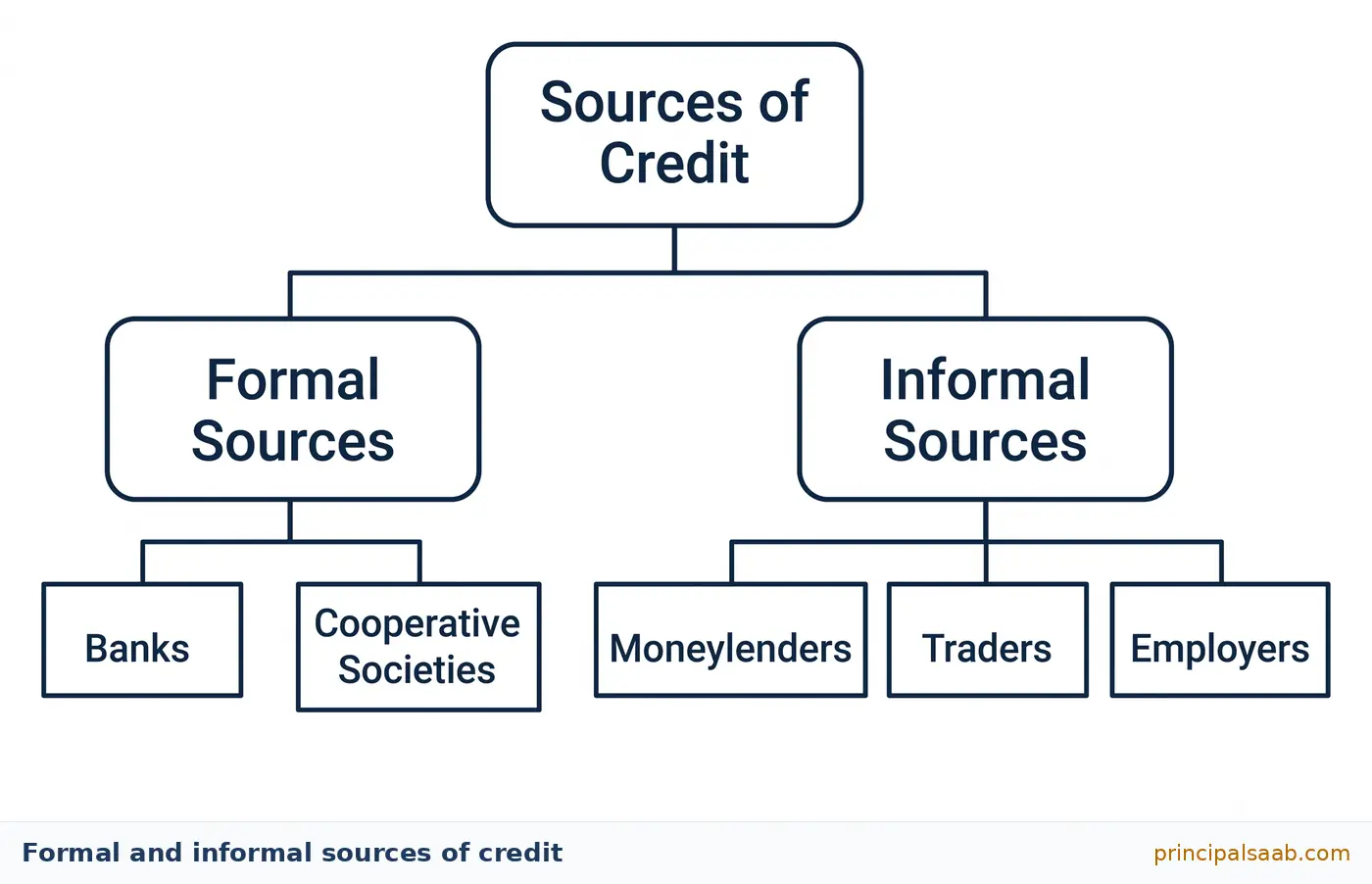
The two main formal lenders you must be able to name are banks and cooperative societies.
A cooperative society is worth a moment on its own, because students often skip it and it is easy marks. A cooperative is a group of people — farmers, weavers, small traders, industrial workers — who pool their own money as members. That pooled fund, sometimes topped up by a loan the cooperative itself takes from a bank, is then lent to members at reasonable rates. Members might borrow to buy seeds and fertiliser, to purchase implements, to build a storage shed, or for other cooperative activities. Because the members know one another, the cooperative can lend on gentler terms than a bank might offer to a stranger.
Now, the crucial bit. The RBI supervises formal lenders, and that supervision does specific things:
- Banks must maintain a minimum cash balance out of the deposits they hold, so that depositors can be paid when they ask.
- Banks must submit periodic reports showing how much they are lending, to whom, and at what interest rate.
- There is a check that banks are not lending only to profitable large businesses, and that small cultivators, small-scale industries and small borrowers are also getting credit.
- Interest rates are subject to oversight, so a formal lender cannot charge whatever it pleases.
Nobody performs any of these functions for the informal sector. There is no authority a borrower can complain to about a moneylender’s rate. There is no report anyone must file. This absence is not a small administrative detail — it is the entire reason informal credit behaves the way it does.
Informal sources: who they are
- Moneylenders — people who lend money as a business, typically at very high rates, usually without documentation.
- Traders — someone who supplies a farmer with seed and fertiliser on credit and is repaid at harvest, often by being sold the crop at a price he sets. Notice the double grip: he is both the lender and the buyer.
- Employers — advances given to workers, recovered from future wages. A worker who owes his employer money is not free to leave for a better job.
- Relatives and friends — often interest-free and kind, but limited in amount, unreliable in timing, and awkward when repayment is delayed.
- Landlords — who may lend to tenants against future produce or labour.
Why informal credit costs so much more
It is tempting to say informal lenders are simply greedy. That is not a full answer and will not earn full marks. Reason it out properly:
- No supervision. Nobody caps the rate, so the rate rises to whatever the borrower can be made to accept.
- Higher risk, and no legal recovery. There is no collateral and no paperwork, so if the borrower does not pay there is no court process to fall back on. Lenders price that risk in.
- Few alternatives for the borrower. A borrower with no documents and no assets cannot walk away to a bank. Where there is no competition, prices stay high.
- Urgency. Informal loans are often taken in emergencies — illness, a funeral, a wedding — when the borrower is in no position to negotiate.
- Small amounts, high handling cost. Lending ₹2,000 to fifty people involves far more effort per rupee than lending ₹1,00,000 to one, and that effort is charged for.
And then the consequences compound. High interest eats up a large part of the borrower’s earnings, leaving less to spend and less to invest. In some cases the amount to be repaid exceeds the borrower’s entire income, and the debt trap of Ravi’s story opens up.
| Basis | Formal sources | Informal sources |
|---|---|---|
| Who they are | Banks and cooperative societies | Moneylenders, traders, employers, landlords, relatives and friends |
| Supervision | Supervised by the Reserve Bank of India | No supervising authority at all |
| Rate of interest | Generally lower and subject to oversight | Generally much higher; set entirely by the lender |
| Collateral | Usually required | Often not required formally, but informal pressure is used instead |
| Documentation | Detailed papers needed | Little or none |
| Speed and ease | Slower; procedures take time | Very quick; money can be had the same day |
| Recovery methods | Legal and regulated | May involve coercion, seizure of produce or bonded labour |
| Effect on the borrower | Supports income and investment | Can push the borrower into a debt trap |
Meena needs ₹15,000 for 8 months. A moneylender offers it at 4% per month. A bank offers it at 13% per annum. How much interest would she pay in each case, and what is the difference?
Moneylender. Interest = 15,000 × 0.04 × 8 months = ₹4,800.
Bank. Eight months = 8/12 of a year. Interest = 15,000 × 0.13 × (8 ÷ 12) = 15,000 × 0.13 × 0.6667 = ₹1,300.
Difference = 4,800 − 1,300 = ₹3,500.
As a proportion: the moneylender’s interest is 4,800 ÷ 1,300 ≈ 3.7 times the bank’s.
Reading the result: ₹3,500 is a very large sum for a household living close to the margin — it might be a term’s school fees, or several weeks of food. And yet Meena may still take the moneylender’s loan, because the bank wants documents she does not have and a decision that takes three weeks she cannot wait. That is the real problem this chapter is describing, and it is not solved by telling people to be sensible. (Rates are illustrative.)
Illustrative data, invented for practice. In a small hamlet, households borrowed a total of ₹8,00,000 in one year. Of this, ₹3,00,000 came from formal sources and ₹5,00,000 from informal sources. Express each as a percentage of the total.
Check the total first: 3,00,000 + 5,00,000 = 8,00,000. ✔ The parts add to the whole, so the data is consistent.
Formal share = (3,00,000 ÷ 8,00,000) × 100 = 0.375 × 100 = 37.5%.
Informal share = (5,00,000 ÷ 8,00,000) × 100 = 0.625 × 100 = 62.5%.
Check: 37.5 + 62.5 = 100. ✔
Method note: for any share question the recipe is always the same — (part ÷ whole) × 100 — and you should always verify that your percentages add to 100. That check has rescued more marks than any formula.
Why Everyone Should Get Cheap Formal Credit
This section is short but it is the argument the whole chapter has been building towards. If you understand this, the five-mark questions almost write themselves.
Start with the chain of reasoning, one link at a time:
- Cheap credit means a lower interest burden. More of what the borrower earns stays with the borrower.
- Money that stays with the borrower gets spent or invested — better seeds, a second sewing machine, a small shop’s stock, a child’s schooling.
- That investment raises production and income.
- Higher income makes the next loan easier to repay and the next investment easier to make.
- Multiply that across millions of households and you have development.
Now run the same chain with expensive credit and watch it reverse. High interest takes a large slice of earnings. Less is left to invest. Production stagnates. Income does not rise. The next loan is harder to repay, so it is taken on even worse terms. The household ends up poorer than it started. This is not a moral failing on anybody’s part — it is simple arithmetic playing out over years.
Who is left out, and why
The people most dependent on informal sources are, unsurprisingly, the ones with the least. Small farmers, landless labourers, artisans, small traders, and poor urban households. Ask why, and the reasons are entirely practical rather than mysterious:
- No collateral. Banks want security. A person who owns nothing has nothing to pledge.
- No documents. Proof of regular income, land records, past statements — a casual labourer paid in cash has none of these.
- No branch nearby. If the nearest bank is a long journey away, the cost and lost wages of getting there can exceed the benefit of the cheaper loan.
- Procedures are slow and unfamiliar. Forms, queues, follow-up visits. For someone who cannot read easily, this alone is a barrier.
- Loans are needed urgently and in tiny amounts. Banks are not well suited to lending ₹3,000 by tomorrow morning; a moneylender is.
- Fear and unfamiliarity. Many households simply do not feel that a bank is a place for people like them. This is not irrational — it is a reaction to years of being turned away.
And here is the bitter irony to write down in your answer: the poorest borrowers, who can least afford it, end up paying the highest rates, while the well-off, who could comfortably pay more, borrow at the lowest. Credit flows to those who need it least. Reversing that is what the rest of this section is about.
What would actually help
- More formal lenders in rural and poorer areas, so that borrowers have a real alternative and lenders must compete.
- Simpler procedures and less documentation for small loans, so that the paperwork barrier falls.
- Lending arrangements that do not depend on physical collateral — group guarantees being the outstanding example, which is exactly the next section.
- Repayment schedules matched to how borrowers actually earn, rather than a uniform monthly instalment.
- Continued RBI oversight to make sure banks lend to small borrowers and not only to large, safe, profitable ones.
Question (5 marks): Why is it necessary that banks and cooperatives increase their lending, particularly in rural areas? Explain.
Model answer — five clear points, each with a sentence of explanation:
1. To reduce dependence on informal lenders. A large part of the credit used by rural households comes from moneylenders and traders who charge very high rates, and this can push borrowers into a debt trap. [1]
2. To make credit cheaper. Formal lenders charge lower rates because their lending is supervised by the Reserve Bank of India, so borrowers keep more of what they earn. [1]
3. To raise investment and income. Affordable loans allow farmers to buy better seeds and equipment and allow small businesses to expand, which increases production and earnings. [1]
4. To spread credit to those excluded from it. Poorer households are often refused formal loans for lack of collateral and documents; wider lending brings them into the system. [1]
5. Because cheap credit supports national development. When credit is affordable and widely available, more people invest, incomes rise across the economy, and growth becomes broader rather than being confined to a few. [1]
Technique note: five marks, five numbered points, each with a bolded lead phrase and one explaining sentence. An examiner scanning quickly can find every mark without hunting. Do not write five marks’ worth of material as one unbroken paragraph — the content may be there, but it will not be found.
Self-Help Groups for the Poor
We have arrived at a genuine puzzle. Poor households need credit. Banks have credit to give and would rather lend at 12% than see people pay 48%. So why does the money not flow?
Because of one obstacle above all others: collateral. A bank lends against security. A poor borrower has no security. Two parties who both want a deal cannot make it, because of a missing asset.
The Self-Help Group is an elegant answer to this. And I want you to notice how elegant it is, because a student who sees the cleverness of the idea will remember it far better than a student who memorises a definition.
How a Self-Help Group works, step by step
- Formation. A small group of people from the same neighbourhood — typically fifteen to twenty, and very often women — come together. They know each other; that matters enormously and we will see why.
- Regular saving. The members meet regularly and each contributes a small fixed amount to a common fund. The sums are deliberately small — an amount that a poor household can genuinely spare.
- Lending within the group. Once the pooled fund has grown, the group lends to its own members who need money — for seeds, for a small stock of goods, for a medical bill, for repaying an old high-interest debt. The group itself decides who gets a loan, how much, for what and at what rate.
- Building a record. Over a year or two the group builds a track record: regular savings, regular meetings, loans repaid on time.
- Bank linkage. On the strength of that record, a bank lends to the group — not to individuals. The bank has no collateral, but it has something arguably better: a group that has proved it can manage money and is collectively answerable for the loan.
- Onward lending. The group distributes the bank loan among members, and members repay the group, which repays the bank.
Turn it around and see it from the bank’s side, because that is the perspective board questions usually want. A bank refuses a poor individual because it cannot judge whether he will repay and has nothing to seize if he does not. Lending to an SHG solves both halves: the group knows each member’s real circumstances far better than any loan officer could, and the group’s collective responsibility makes default costly for everyone. The bank has effectively outsourced both the assessment and the enforcement to the people best placed to do them.
Why women’s groups in particular
A great many self-help groups are formed by women, and this is not incidental. Consider what the group does beyond lending:
- It gives women a source of credit in their own right, rather than through a husband, father or landlord.
- It creates a regular meeting. The group gathers, keeps accounts, takes decisions. Members who may never have spoken in a public setting learn to argue a case and count a balance.
- It becomes a platform for other issues. Groups routinely go on to discuss health, schooling, water, violence, and dealings with officials — matters that are hard to raise alone and much easier to raise as twenty.
- It builds organisational confidence. Members handle real money and real responsibility, and that changes how they are regarded at home and in the village.
So an SHG is best described as an organisation of rural poor people, especially women, into small groups — and its purpose is not only credit but the collective strength that comes with organising.
An SHG has 18 members. Each saves ₹40 every week. How much does the group accumulate in one week, and in one year (52 weeks)?
Weekly pool = 18 × ₹40 = ₹720.
In 52 weeks = ₹720 × 52 = ₹37,440.
Cross-check another way: each member saves 40 × 52 = ₹2,080 in a year; 18 members × ₹2,080 = ₹37,440. ✔ Same answer by a different route, which is always worth doing.
Reading the result: ₹40 a week is a sum most members would barely notice going out. Yet in a year the group controls over ₹37,000 of its own money — enough to fund several small loans without approaching anybody. This is the quiet power of pooling: individually negligible, collectively substantial. (Figures illustrative.)
A member borrows ₹10,000 for 5 months. Her group charges 2% per month. The local moneylender would have charged 5% per month. Compare.
From the group. Interest = 10,000 × 0.02 × 5 = ₹1,000. Total repaid = 10,000 + 1,000 = ₹11,000.
From the moneylender. Interest = 10,000 × 0.05 × 5 = ₹2,500. Total repaid = 10,000 + 2,500 = ₹12,500.
She saves = 2,500 − 1,000 = ₹1,500.
In annual terms: 2% per month = 24% per annum from the group; 5% per month = 60% per annum from the moneylender.
And notice the second effect: the ₹1,000 of interest she pays does not leave the village — it goes into her own group’s fund, which will finance the next member’s loan. Interest paid to a moneylender leaves the community; interest paid to an SHG circulates within it. (Rates illustrative.)
What SHGs achieve, in summary
- They allow the poor to save small amounts regularly, which is often impossible through a bank account alone.
- They provide loans without collateral and at reasonable interest.
- They give timely credit — decisions are taken by the group at its own meeting, not by a distant office.
- They help members escape the grip of moneylenders, sometimes by lending specifically to clear an old high-interest debt.
- They become the building block of organisation for the rural poor, and a route through which bank credit finally reaches households that banks would not lend to individually.
How to Answer Money and Credit Questions in the Board Exam
Knowing the content and scoring the marks are two different skills, and it is genuinely unfair how many students who understand this chapter still lose marks in it. This section is about the second skill.
The three-mark structure: Point → Explain → Example
A three-mark question wants three things, and the safest way to guarantee all three is to give one of each:
- Point — state the idea or definition in one clean sentence. No preamble.
- Explain — say why it is so, or how it works. This is the sentence most students omit, and it is usually the middle mark.
- Example — one short concrete illustration. Two lines is plenty.
Three short paragraphs, roughly sixty to eighty words in total. Do not write three hundred words for three marks — you will not get more, and you will lose time you need for the five-markers.
Question (3 marks): What is collateral? Why do lenders ask for it?
Weak answer: “Collateral is a thing given to the bank. Banks ask for it because they want safety. Poor people do not have it.” — probably 1 mark. It is not wrong, but nothing is defined precisely and nothing is explained.
Strong answer:
Collateral is an asset owned by a borrower — such as land, a building, a vehicle, livestock or a bank deposit — which is pledged to the lender as a guarantee until the loan is repaid. [Point — 1]
Lenders ask for collateral because it reduces their risk: if the borrower fails to repay, the lender has the legal right to sell the pledged asset and recover the money. Because the risk is lower, loans backed by collateral usually carry a lower rate of interest. [Explain — 1]
For example, a farmer may pledge his land to obtain a bank loan for a tube well. However, a landless labourer who owns no such asset cannot offer collateral and is therefore often refused a bank loan, which pushes him towards moneylenders. [Example — 1]
The five-mark structure: number your points
For five marks, give five separate points, each with a bolded or underlined lead phrase and one explaining sentence. That is it. The formula is unglamorous and it works, because it makes every mark visible to an examiner reading at speed.
Three habits that protect your marks here:
- Never write five marks as one paragraph. The content may all be present and still be missed.
- Front-load each point. Put the key phrase first, explanation second. An examiner should be able to grasp the point from the first four words.
- Count as you go. Five marks, five points. If you have written three and run out, think about what else the question implies rather than expanding what you already have.
The case-study question: a technique you can rely on
Case-study questions in this chapter almost always present a borrower in a situation and ask you to analyse it. They look intimidating and are in fact the most predictable questions on the paper, because they nearly always turn on the same four things.
2. Terms — what are the principal, rate, collateral, documentation and mode of repayment? Convert any monthly rate to an annual one immediately.
3. Purpose and risk — is the loan financing production or consumption? How certain is the income that will repay it?
4. Outcome — did the borrower end up better off (credit that helps) or worse off (a debt trap)? Say why, referring to points 1 to 3.
Run those four in order and you will have covered whatever the question actually asked, in the right sequence, with nothing important left out.
Passage: Kanta weaves mats. She borrowed ₹12,000 from a trader who supplies her reeds, at 3% per month, on the understanding that she would sell all her finished mats to him at the price he decides. She has no bank account. After eight months she has repaid nothing, because the trader deducted a little from every payment for the mats but the deductions were smaller than the interest accruing.
Question (4 marks): Analyse Kanta’s credit situation.
1. Source. The trader is an informal source of credit. His lending is not supervised by the Reserve Bank of India, so there is no limit on what he may charge and no authority Kanta can appeal to. [1]
2. Terms. The rate is 3% per month, which is 3 × 12 = 36% per annum — very high. Interest for 8 months = 12,000 × 0.03 × 8 = ₹2,880, so ₹14,880 is owed on a ₹12,000 loan. No collateral was taken and no documents were signed, but she is bound by an obligation to sell only to him. [1]
3. Purpose and risk. The loan finances production, which is favourable in itself. But the trader is both her lender and her only buyer, so he controls the price she receives. Her income is therefore not independent of her creditor, and the risk falls entirely on her. [1]
4. Outcome. This is a debt trap. The debt is growing faster than she can repay it, and because she cannot sell elsewhere she cannot earn her way out. Access to a formal source, or membership of a self-help group, would give her cheaper credit and free her to sell in the open market. [1]
Handling numericals under exam pressure
- Write the formula first. Interest = P × R × T. Writing it costs four seconds and often carries a mark even if the arithmetic later slips.
- Convert the time unit before anything else. Six months is 0.5 years; eight months is 8/12. Do this conversion on its own line.
- Convert monthly rates to annual before comparing. Always.
- Label every number. “Interest = ₹9,000” not a bare “9000”. An unlabelled number is an unmarked number.
- Sanity-check the answer. Interest for one year at 12% cannot be larger than the principal. If it is, you have slipped a decimal.
- Watch what the percentage applies to. Interest to depositors is on total deposits; interest from borrowers is on the amount lent. These are different bases.
Practice Worksheet with Answers
Ten original questions, arranged roughly in increasing difficulty and covering the whole chapter. Every answer is hidden behind a “Show Answer” button — please use them honestly. Write your attempt first, on paper, then reveal. A revealed answer that you have not attempted teaches you almost nothing; a revealed answer that you have attempted teaches you exactly where your gap is.
If a question defeats you, do not simply read the solution and move on. Note which section it came from, go back and reread that section, and then return to the question. That loop is where the actual learning happens.
Question 1 (1 mark) — MCQ
A weaver wants rice and has cloth to give. A rice seller wants a lamp and has rice to give. No exchange takes place between them. The situation described is a failure of:
(a) legal tender (b) double coincidence of wants (c) collateral (d) demand deposits
Show Answer
(b) double coincidence of wants.
Each person wants something, but not what the other is offering. In barter both sides must want each other’s goods at the same time; here that mutual matching fails, so no trade occurs. Money would solve it instantly — the weaver could sell cloth to anyone at all and use the money to buy rice.
Question 2 (1 mark) — MCQ
In India, currency notes are issued by:
(a) any commercial bank (b) the state governments (c) the Reserve Bank of India on behalf of the central government (d) cooperative societies
Show Answer
(c) the Reserve Bank of India on behalf of the central government.
The RBI alone is authorised to issue currency notes in India, and it does so on behalf of the central government. No other bank, government or organisation may do so. Because the notes are legal tender, no one within the country may refuse them as payment.
Question 3 (1 mark) — MCQ
Which of the following is a formal source of credit?
(a) a village moneylender (b) a cooperative society (c) the trader who supplies seeds (d) a relative
Show Answer
(b) a cooperative society.
The test for “formal” is not whether the lender is a bank, but whether its lending is supervised by the Reserve Bank of India. Banks and cooperative societies are supervised and are therefore formal. Moneylenders, traders, employers, landlords, relatives and friends are not supervised by anyone and are therefore informal.
Question 4 (3 marks)
Why are demand deposits considered a form of money? Explain.
Show Answer
1. They can be withdrawn on demand. Money deposited in a savings or current account can be taken back in cash at any time the depositor asks, without notice or permission. Because it can become currency instantly, it is as good as currency.
2. Payments can be made directly out of them. A depositor can settle a purchase by writing a cheque — an instruction to the bank to pay the named person from the account — or by making a digital transfer. No cash needs to be handled at all.
3. They are widely accepted. Sellers accept payment made in this form just as readily as notes and coins, so demand deposits perform money’s essential function of being a generally accepted means of payment.
Question 5 (3 marks) — Numerical
A bank holds total deposits of ₹250 crore. It keeps 16% of deposits as cash reserves and lends out the rest. It pays depositors 4.5% per annum and charges borrowers 10% per annum. Calculate (i) the amount it lends, (ii) the interest it receives, (iii) the interest it pays, and (iv) the difference between the two. (Rates are illustrative.)
Show Answer
(i) Amount lent. Cash reserve = 16% of ₹250 crore = 0.16 × 250 = ₹40 crore. Amount lent = 250 − 40 = ₹210 crore. (Check: 84% of 250 = 0.84 × 250 = 210 ✔)
(ii) Interest received = 10% of ₹210 crore = 0.10 × 210 = ₹21 crore.
(iii) Interest paid = 4.5% of ₹250 crore = 0.045 × 250 = ₹11.25 crore. Note carefully: interest is paid on all deposits, not only on the amount lent.
(iv) Difference = 21 − 11.25 = ₹9.75 crore.
This difference is the bank’s gross income from lending, out of which it must still meet salaries, running costs and loans that go unrepaid.
Question 6 (3 marks) — Numerical
Meena needs ₹15,000 for 8 months. A moneylender will lend at 4% per month; a bank will lend at 13% per annum. Calculate the interest in each case and state how much more the moneylender’s loan costs. (Rates are illustrative.)
Show Answer
Moneylender. Rate is per month, and the period is 8 months. Interest = 15,000 × 0.04 × 8 = ₹4,800. (In annual terms, 4% per month = 48% per annum.)
Bank. Rate is per annum, so convert the period: 8 months = 8/12 year. Interest = 15,000 × 0.13 × (8 ÷ 12) = ₹1,300.
Extra cost of the moneylender’s loan = 4,800 − 1,300 = ₹3,500, which is about 3.7 times the bank’s interest.
Marking note: the mark for method sits in the time conversion. Show “8 months = 8/12 year” as its own line.
Question 7 (3 marks)
List the terms of credit. Using them, calculate the total amount repayable on a loan of ₹60,000 taken at 14% per annum simple interest for 18 months.
Show Answer
Terms of credit are the conditions attached to a loan: principal (the sum borrowed), rate of interest (the price of borrowing), collateral (an asset pledged as security), documentation (the papers the lender requires) and mode of repayment (how and when the money is returned). These terms differ from lender to lender and from borrower to borrower.
Calculation. 18 months = 18 ÷ 12 = 1.5 years.
Interest = P × R × T = 60,000 × 0.14 × 1.5 = ₹12,600.
Total repayable = 60,000 + 12,600 = ₹72,600.
Question 8 (5 marks)
Distinguish between formal and informal sources of credit on any five bases, and state why the interest charged by informal lenders is generally higher.
Show Answer
1. Who they are. Formal sources are banks and cooperative societies. Informal sources are moneylenders, traders, employers, landlords, relatives and friends.
2. Supervision. The lending of formal sources is supervised by the Reserve Bank of India, which checks how much they lend, to whom and at what rate. No organisation supervises informal lenders at all.
3. Rate of interest. Formal sources charge lower rates, subject to oversight. Informal lenders set whatever rate they choose, and it is often very high.
4. Collateral and documentation. Formal lenders usually require collateral and detailed documents. Informal lenders usually require neither, which makes their loans easier to obtain but harder to escape.
5. Methods of recovery. Formal lenders recover through legal, regulated procedures. Informal lenders may use pressure, seize produce, or bind the borrower to sell only to them.
Why informal interest is higher: there is no supervision to restrain the rate; the lender has no collateral and no legal route to recovery, so the risk is greater; and borrowers who lack documents and assets have no alternative lender to turn to, which removes competition. High interest then absorbs a large part of the borrower’s income, leaving less to invest and sometimes leading to a debt trap.
Question 9 (5 marks)
What is a Self-Help Group? Explain how it helps poor households obtain credit, and why such groups are often formed by women.
Show Answer
Meaning. A Self-Help Group is a small organisation of rural poor people — usually fifteen to twenty members from the same neighbourhood, very often women — who meet regularly, save a small fixed sum each, and lend the pooled fund to members who need it.
1. It makes saving possible. The contributions are small enough for poor households to manage, so people who could never save a large sum accumulate one together.
2. It solves the collateral problem. Members are jointly responsible for repayment, so the group’s collective responsibility takes the place of physical security. On the strength of the group’s savings record a bank will lend to the group, even though it would refuse the same members individually.
3. It provides timely and reasonably priced credit. The group decides on loans at its own meeting, so money is available quickly and at a far lower rate than a moneylender charges. Because members see one another every week, repayment is closely followed up.
4. It frees members from moneylenders. Groups often lend specifically so that a member can clear an old high-interest debt, breaking the cycle of dependence.
5. Why women. Membership gives women credit in their own right rather than through a male relative, and the regular meetings become a forum for discussing health, schooling and other village matters. Handling the group’s money and decisions builds confidence and organisational skill, so the group becomes a means of collective strength as well as a source of loans.
Question 10 (4 marks) — Case study
Read the passage and answer the question.
Hariya works as a casual labourer and owns no land. For a family wedding he borrowed ₹18,000 from the village moneylender at 5% per month, agreeing to repay after six months. He has no bank account and was asked for no documents. His wages are irregular and, six months later, he has been unable to set anything aside.
Analyse Hariya’s credit situation, showing the interest due, and suggest what would have helped him.
Show Answer
1. Source. The moneylender is an informal source of credit. His lending is not supervised by the Reserve Bank of India, so there is no restraint on the rate he charges and no authority Hariya can appeal to.
2. Terms and the interest due. The rate is 5% per month, which is 5 × 12 = 60% per annum — extremely high. Interest for six months = 18,000 × 0.05 × 6 = ₹5,400, so the amount due is 18,000 + 5,400 = ₹23,400. No collateral was taken and no documents were signed, which is why the loan was easy to get and why it is so expensive.
3. Purpose and risk. The loan financed consumption — a wedding — not production. It therefore generates no income to repay itself. Combined with irregular wages, this makes repayment very unlikely, and the debt will keep growing.
4. Outcome and remedy. This is a debt trap: the amount owed is rising while Hariya’s capacity to repay is not, so he may have to borrow again merely to service this loan. Access to a formal source would have given far cheaper credit, but as he owns no collateral and has no documents a bank would probably refuse him. Membership of a self-help group would be the realistic remedy — the group’s collective responsibility substitutes for collateral, letting him borrow at a reasonable rate and, in time, obtain a bank loan through the group.
Marking note: the four marks map exactly onto source, terms, purpose/risk, outcome. The rate conversion to 60% per annum and the ₹5,400 calculation are the parts most often left out.
A Closing Word: One More Than Yesterday
If you have read this far, you have done something most students do not: you have gone through an entire chapter properly rather than skimming it the night before a test. That is worth acknowledging.
Here is the only study advice I really believe in. Do not aim to “finish Economics”. Do not aim to be brilliant by Sunday. Aim for something much smaller and much more reliable: get one more question right today than you got right yesterday. One. If you managed four of these ten yesterday, aim for five today. Tomorrow, six.
It sounds too modest to matter. It is not. A single extra correct answer each day, kept up quietly for a month, rebuilds a whole chapter — and unlike a burst of panic revision, it does not collapse the moment you are tired. Small, steady, repeated improvement beats heroic effort almost every time, because you can actually keep doing it.
So close this page, take a blank sheet, and try Question 5 again from memory. If you get it, try Question 10. If you do not, go back to the section it came from — that is not failure, that is exactly what studying looks like. One more than yesterday. That is the whole method.