

Hello, and welcome. Before we start, I want you to do one small thing: unclench your shoulders. This chapter has a reputation for being “the confusing one” in Civics, and I promise you that reputation is unfair. Students find it hard for a very specific reason, and once you see the reason, the difficulty mostly dissolves.
Here is the reason. In every other chapter of your Civics book, you learn what something is. What is power sharing. What is federalism. What are political parties. Those are definitions, and definitions feel safe, because you either know them or you don’t. But this chapter asks a completely different kind of question. It asks: is democracy actually working? And “is it working?” is a judgement question, not a definition question. There is no single sentence you can memorise that answers it.
That is why students freeze. They read the chapter, they understand every individual sentence, and then they close the book and think, “But what is the answer?” If that is you, you are not slow. You have actually noticed something real about the chapter. Let me now give you the way out of it.
Think about a report card. When your report card comes home, nobody just says “good” or “bad”. They go subject by subject. Maths, 82. Science, 74. Hindi, 91. And then they look at the pattern: strong in some places, weak in others, improving overall. Nobody expects a report card to be a single word.
This entire chapter is a report card for democracy. That is it. That is the whole idea. We list the subjects that democracy is supposed to be good at, and then we go through them one at a time and give an honest grade. Some grades are excellent. Some are frankly disappointing. And the chapter’s final conclusion is not “democracy is perfect” — it is something far more grown-up and far more interesting, which we will reach together at the end.
Once you hold on to the report-card picture, everything in this chapter clicks into place. Every section you are about to read is simply one subject on that report card. Accountability is one subject. Economic growth is another. Reducing inequality is another. Handling social diversity is another. Dignity and freedom is another. Five subjects, five honest grades, one thoughtful conclusion.
And here is the part that surprises most students: the examiner is not looking for you to praise democracy. The examiner is looking for you to be balanced. A student who writes “democracy is the best, it solves everything” scores lower than a student who writes “democracy has clearly succeeded here, has partly failed there, and here is why we still prefer it.” Honesty scores marks in this chapter. Cheerleading does not. Hold on to that — it will change how you write every answer.
This chapter sits in Unit IV of the Political Science section of the CBSE Class X Social Science curriculum 2026-27. The Political Science block carries twenty marks in your board paper, and this chapter is a favourite for both three-mark and five-mark questions, plus the occasional case-study passage. So the effort you put in here pays back reliably.
We are going to go slowly. I will explain each idea in ordinary language first, then show you why it works, then show you exactly how to write it in an exam. There is no rush. Read at whatever speed feels comfortable, and if a section feels foggy, stay with it — do not move on until it feels comfortable. Foggy sections do not fix themselves later; they just get foggier.
What You’ll Learn
Jump straight to any part of the chapter. Every link below lands on a full teaching section — read them in order the first time, then use this menu for quick revision later.
- How Do We Assess Democracy’s Outcomes?
- What Do We Expect Democracy to Deliver?
- Accountable, Responsive and Legitimate Government
- Economic Growth and Development
- Reduction of Inequality and Poverty
- Accommodation of Social Diversity
- Dignity and Freedom of the Citizens
- Democracy as an Ongoing Journey — Expectations Never End
- How to Answer Outcomes of Democracy Questions in the Board Exam
- Quick Revision Sheet — The Whole Chapter on One Page
- Practice Worksheet — Ten Original Questions with Answers
Your Game Plan
Here is exactly how I want you to work through this chapter. Follow the order — it is designed so that each step makes the next one easier.
- Read the first two sections properly. They set up the report-card idea and the list of five subjects. If you skip these, the rest of the chapter will feel like loose facts instead of a structure.
- Take the five outcome sections one at a time. Accountability, growth, inequality, diversity, dignity. Do not try to swallow all five in one sitting. One section, then a short break, then the next.
- For each outcome, learn three things: what democracy promised, what actually happened, and why we still choose democracy anyway. Three slots. If you can fill those three slots for all five outcomes, you have essentially finished the chapter.
- Do the worked examples as you go. Do not save them for later. Read the question, cover the answer with your hand, try it in your head, then read my version and see what you missed.
- Read the exam-technique section carefully. This chapter is graded on structure as much as content. That section is where the easy marks live.
- Do the worksheet at the end without looking. Write the answers on paper. Then reveal mine and compare. Comparing is where the learning actually happens.
- Come back after two days and re-read only the Quick Revision Sheet. If it all makes sense, you are done. If any line looks unfamiliar, jump back to that section.
How Do We Assess Democracy’s Outcomes?
Let us begin with the question the whole chapter rests on: how do you decide whether a system of government is doing a good job?
Start with something small and familiar. Suppose your school changes its lunch arrangement this year. How would you judge whether the new arrangement is better? You would not judge it against an imaginary perfect lunch that exists nowhere on earth. You would judge it against last year’s arrangement, and against what other schools nearby are doing. In other words, you judge a real thing by comparing it with other real things.
That is precisely how we must judge democracy. Not against a dream. Against the actual alternatives that human beings have actually tried.
And what are those alternatives? Rule by a king who inherited the throne. Rule by a general who seized power with the army. Rule by a single party that permits no rivals. Rule by a small group of nobles or wealthy families. These are not hypothetical — every one of them has been tried, in many countries, for long stretches of history. So when we ask “is democracy good?”, the honest form of the question is: compared to those, is democracy better?
Now, a fact that gives this discussion its weight. Democracy is no longer a rare experiment tried by a handful of countries. Today more than a hundred countries around the world describe themselves as democracies and run some form of democratic politics. That is a very large sample. It means we are no longer guessing about what democracy does — we have decades of real experience across dozens of societies, rich and poor, large and small, old democracies and brand-new ones.
And that large sample brings both good news and awkward news, which is exactly why this chapter is interesting.
The good news: on several counts democracy performs clearly better than its rivals. The awkward news: on some counts it does not perform obviously better at all, and on one or two counts the record is genuinely disappointing. A textbook that hid the awkward news would be lying to you. Your Civics book does not hide it, and neither will I.
Why People Feel Frustrated With Democracy
You have almost certainly heard an adult say something like, “Nothing ever changes, they are all the same.” That frustration is real and it is widespread — not just in India, but in democracies everywhere. Let us understand where it comes from, because understanding it is half of this chapter.
Democracy is slow. A decision that a dictator could take in an afternoon may take a democracy two years — discussion in Parliament, objections from the opposition, protests outside, committee reports, court cases, amendments. To someone who wants the road fixed now, that looks like pure waste.
Democracy is noisy. Politicians argue in public, newspapers criticise, people march in the street — the same power of print to stir public debate that you traced in Print Culture and the Modern World. A country under one-party rule looks calm and orderly by comparison. Calm looks like competence, even when it is only silence.
And democracy disappoints, because it promised so much. Nobody expects fairness from a dictator, so a dictator cannot disappoint you on fairness. Democracy promised you equality, dignity and a share in power. When delivery falls short of that promise, the gap hurts.
Now hold that thought carefully, because it contains the chapter’s most elegant idea, and we will return to it at the very end: the disappointment exists precisely because the promise exists. That is not a weakness of democracy. As you will see, it is evidence that democracy is doing its job.
Let me walk you through the thinking before I write the answer. A two-mark question wants two clean points, not a paragraph. So I ask myself: what are the two things the examiner needs to hear? One, that judging against perfection is unfair. Two, that comparison is how we test any real system.
Model answer. We compare democracy with other forms of government because no real system of government can ever be perfect, and judging democracy against an imaginary perfect government would be unfair and meaningless. [1 mark — the “compared to what” logic] Comparison with the realistic alternatives that societies have actually experienced — monarchy, military rule, one-party rule and dictatorship — allows us to see clearly whether democracy delivers better results than those systems on things such as accountability, dignity and the peaceful handling of disagreements. [1 mark — naming the alternatives and the basis of comparison]
What earned the marks: naming actual alternatives instead of saying “other systems”, and stating a reason rather than just an opinion.
Watch the trap here. The question is phrased to tempt you into agreeing. A weak student writes half a page attacking democracy and forgets to answer the actual question, which is “should we replace it?” A three-mark answer needs: concede the criticism, explain why the slowness happens, then refuse the conclusion.
Model answer. It is true that democratic decision-making is often slow, because every major decision passes through discussion, debate, opposition scrutiny and public criticism before it is taken. [1 — honest concession, examiners reward this] However, this delay is not wasted time. Because many people have examined the decision, mistakes are caught earlier, affected groups are consulted, and the final decision is more widely accepted and therefore easier to implement. [1 — the “why it works” reasoning] A dictatorship can decide quickly, but a wrong decision taken quickly cannot be questioned, corrected or reversed, and the people have no lawful way to remove the person who took it. Therefore democracy should not be replaced; its slowness is the price of its safety. [1 — comparison plus a clear verdict]
Notice the shape: concede → explain → compare → conclude. Reuse that shape whenever a question attacks democracy.
Do you see how the second answer never became defensive? It agreed with the criticism and then showed why the criticism does not lead to the conclusion the questioner wanted. That is the mark of a confident answer, and examiners notice it immediately. Sit with these two examples for a moment before moving on — the shape matters more than the words.
What Do We Expect Democracy to Deliver?
Before we can grade democracy, we have to agree on the syllabus. You cannot mark a paper without knowing what was supposed to be taught. So: what exactly is democracy promising to deliver?
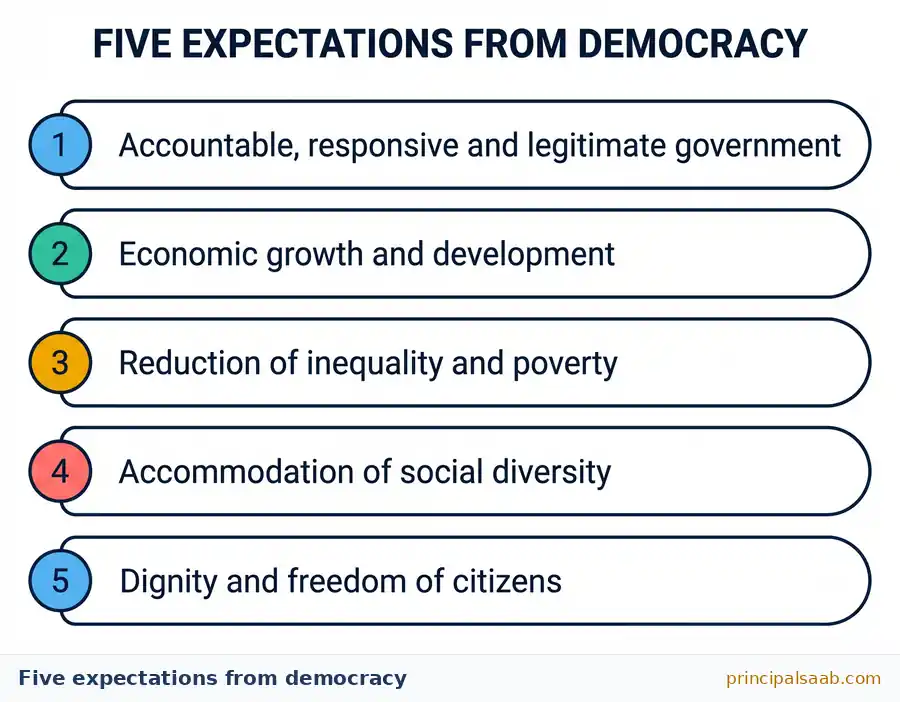
There are five expectations, and I want you to learn them as a set, because almost every question in this chapter is really asking about one of the five. Here they are in plain words.
- A government that answers to us. One that is accountable, responsive to what people need, and accepted by people as rightfully theirs.
- Economic growth and development. A country that becomes more prosperous over time.
- Less inequality and less poverty. Not just more wealth, but wealth that reaches ordinary people.
- Room for everyone’s differences. Different religions, languages, castes and regions living together without tearing the country apart.
- Dignity and freedom for every citizen. Every person treated as an equal human being, not as someone’s inferior.
Read that list twice. Notice how it climbs. It starts with the machinery of government, moves through money, and ends with something almost spiritual — the feeling of being respected. That climb is not accidental. It reflects what human beings actually want from the societies they live in.
Now here is the honest preview — the report card before we look at the working. I am showing it to you early on purpose, so that you read each section knowing where it is heading.
| Expected Outcome | What Democracy Actually Delivers | Honest Grade |
|---|---|---|
| Accountable, responsive and legitimate government | Strong on accountability and legitimacy through elections, debate and the right to information. Weaker on speed, and not clearly better at controlling corruption. | Clear success, with gaps |
| Economic growth and development | No clear advantage over non-democracies; growth depends on many other factors. Democracy neither guarantees nor prevents growth. | No clear advantage |
| Reduction of inequality and poverty | Political equality achieved through one-person-one-vote, but economic inequality often remains wide and in places has grown. | Disappointing |
| Accommodation of social diversity | Generally good at containing conflict peacefully — but only where majority rule is not turned into permanent domination by one community. | Good, but conditional |
| Dignity and freedom of citizens | The strongest area of all. Democracy gives every claim to equal dignity a legal and moral foundation that no other system offers. | Greatest strength |
Look at that table honestly. Two clear successes, one mixed result, one area of no advantage, and one genuine disappointment. That is a real report card, not a propaganda poster. And yet — this is the puzzle we will solve by the end — knowing all of this, thoughtful people around the world still overwhelmingly prefer democracy to the alternatives. Why? Keep reading.
This is the friendliest five-marker in the chapter, and students still lose marks on it. Why? Because they write five bare phrases. A five-mark question wants five points plus a sentence of explanation each. One mark per developed point. Never leave a point naked.
Model answer.
1. Accountable, responsive and legitimate government. Democracy is expected to produce a government that answers to the people through regular elections, responds to public needs, and is accepted by citizens as rightfully theirs.
2. Economic growth and development. Democracy is expected to raise the country’s production and income levels so that the standard of living of its people improves over time.
3. Reduction of inequality and poverty. Since every citizen has one equal vote, democracy is expected to reduce the gap between rich and poor and lift people out of poverty.
4. Accommodation of social diversity. Democracy is expected to allow people of different religions, languages, castes and regions to live together peacefully by settling their differences through discussion instead of violence.
5. Dignity and freedom of citizens. Democracy is expected to guarantee every individual equal respect and personal liberty, so that no one is treated as inferior on the basis of birth, gender or community.
Marking note: one mark for each named outcome with its explanatory sentence. The bold headings are not decoration — they let a tired examiner find your five points in three seconds. Always number and bold your points in a five-marker.
Accountable, Responsive and Legitimate Government
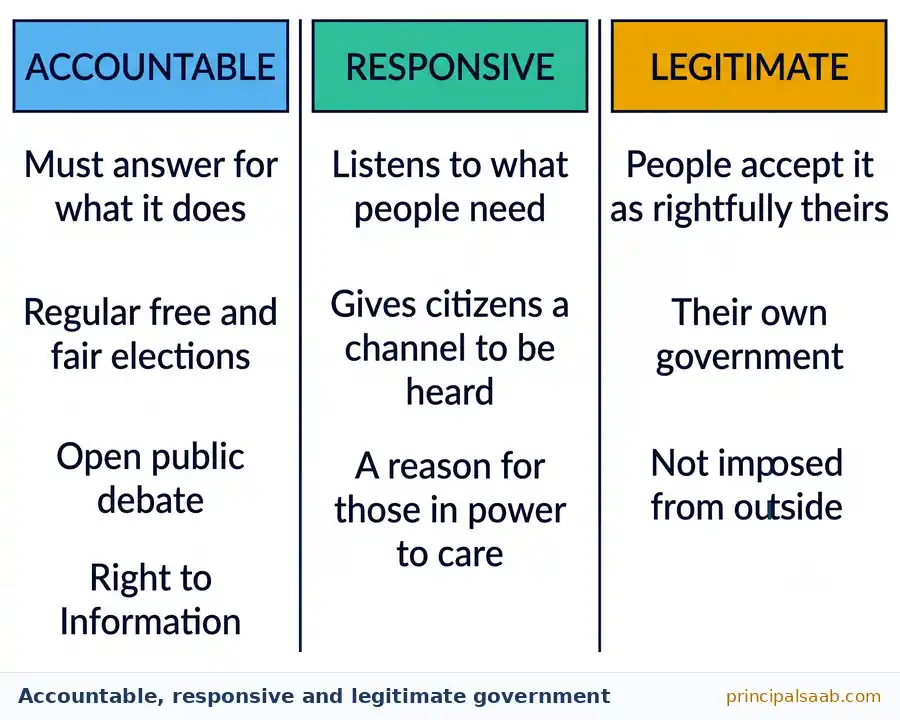
This is outcome number one, and it is the one where democracy performs most impressively. But there are three separate words in that heading, and students constantly blur them together. Let us pull them apart properly, because examiners often ask about just one of them.
Accountable — “You Will Have to Explain Yourself”
An accountable government is one that must answer for what it does. Not just do things — explain them, justify them, and face consequences if the explanation is bad.
Picture the difference this way. Imagine a shopkeeper who knows you can never go anywhere else — there is no other shop for fifty kilometres. Now imagine a shopkeeper on a street with six competing shops, where any customer can walk out and never return. The second shopkeeper behaves better. Not necessarily because he is a nicer person, but because he can be held to account. He knows there is a consequence.
A democratic government is the second shopkeeper. A dictatorship is the first.
What are the actual tools that make a government accountable? There are three, and you should be able to name all three without thinking.
- Regular, free and fair elections. Every few years the people get to decide whether the rulers stay or go. This is the big one. A ruler who knows an election is coming behaves very differently from a ruler who knows there will never be one.
- Open public debate on major policies and laws. Decisions are argued about in Parliament, in the press, on television and in the street before they become final. Bad ideas get exposed while they can still be changed.
- The citizen’s right to information. Ordinary people have a legal right to ask the government what it did, why, and with whose money — and to be given an answer. In India this is the Right to Information Act of 2005, which lets any citizen file an application asking for official records.
That third tool has a proper name in Civics: transparency. Transparency means citizens have both the right and the practical means to examine how a decision was taken and whether the correct procedure was followed. Think of a glass wall instead of a brick wall. You may not be inside the room, but you can see what is happening in it.
Responsive — “You Will Listen to What We Need”
A responsive government is one that acts on what people actually want and need. Accountability is about answering for the past; responsiveness is about attending to the present.
Here is the everyday version. Suppose the drinking-water supply in a locality fails. In a democracy, residents can complain to the ward councillor, hold a protest, contact a newspaper, or make it an election issue. Several doors are open, and someone in power has a reason to walk through one of them, because those residents vote. Where there is no democracy, the residents may complain to nobody with any obligation to listen — and complaining loudly may itself be dangerous.
Now I must be honest with you, because honesty is what earns marks here. Democracies are not always responsive. Governments ignore people all the time — especially people who are poor, scattered, or politically unorganised. What democracy guarantees is not a response; it guarantees a channel, and a reason for someone in power to care. That is a smaller promise than “your problem will be solved”, but it is a real and valuable one.
Legitimate — “We Accept That You Are Rightfully Ours”
This is the deepest of the three and the one students find hardest, so stay with me here. Do not move on until this feels comfortable.
A legitimate government is one that people accept as rightfully entitled to rule — their own government, not something imposed on them from outside or above.
Try this analogy. Two teachers each tell a class to stay silent. The first is your regular class teacher, appointed properly, known to everyone. The second is a stranger who walked in off the road. Both may be equally strict. But the class obeys the first one differently — with acceptance rather than with fear — because the class recognises that she has the right to give the instruction. That recognised right is legitimacy.
Why does democracy produce legitimacy so reliably? Because the people themselves chose the government. Even a citizen who voted for the losing side accepts the result, because he accepts the fairness of the process he took part in. He knows he will get another chance in five years. He can criticise the government freely in the meantime. So he does not need to pick up a weapon; he can pick up an argument instead.
Compare that with a government that came to power through a coup. It may control the army, the treasury and the broadcasting stations, and still it will never quite be accepted as the people’s own. It has power without legitimacy, which is why such governments are so often nervous, so often violent, and so often short-lived.
The Uncomfortable Bit — Democracy and Corruption
Now for the part your textbook does not sugar-coat, and neither should you in an exam.
You would expect that a government which must face elections, answer questions in Parliament and reply to information requests would be a fairly clean government. Sadly, the worldwide record does not clearly support that. Democracies have not proved to be markedly better than non-democracies at eliminating corruption. Corruption scandals occur in old democracies and new ones, in rich democracies and poor ones. On this specific count, democracy’s record is not impressive.
So does that demolish the case for democracy? No — and understanding why not is exactly what a top answer shows.
Two things to hold together. First, we cannot compare fairly with dictatorships in this area, because dictatorships suppress the reporting of their own corruption. A democracy’s corruption is visible precisely because journalists, opposition politicians and citizens are free to expose it. A silent country is not necessarily a clean country — it may simply be a country where nobody is allowed to speak. Second, and more importantly, democracy’s real achievement in this area lies elsewhere: it produces a legitimate government. Even a slow, imperfect, partly corrupt democratic government is the people’s own government, chosen by them, removable by them. No dictatorship, however efficient, can offer that.
That is why, when opinion is measured across the world, support for democracy as a form of government remains broad — including in countries where people are deeply unhappy with their particular government of the day. People distinguish between disliking the current rulers and rejecting the system. That distinction is the heart of this chapter.
| Point of Comparison | Democratic Government | Non-Democratic Government |
|---|---|---|
| How rulers are chosen | By the people, through regular free and fair elections | By birth, force, or the decision of a small group |
| How rulers are removed | Peacefully, by voting them out at the next election | Usually only by death, revolt or another seizure of power |
| Speed of decisions | Slower — discussion, debate and objection take time | Faster — one authority decides alone |
| Quality of decisions | More acceptable and easier to implement, because many views were considered | May be quick but cannot be questioned or corrected if wrong |
| Transparency | Citizens can examine how decisions were made; right to information exists | Decision-making is hidden; questioning it may be punished |
| Corruption | Present, but exposed by a free press and opposition | Present, and usually concealed from public view |
| Legitimacy | High — accepted by people as their own government | Low — rests on fear or force rather than consent |
Learn that final row above all others. If you remember nothing else from this section, remember that a democratic government may be slow, may be inefficient, may sometimes be unresponsive and even partly corrupt — but it is the people’s own government, and that is a quality no other system can manufacture.
Planning first. The question has two halves — “what is” and “why important”. Give roughly one mark to the definition and two to the importance. Never let a definition eat your whole answer.
Model answer. Transparency means that citizens have the right and the means to examine the process by which decisions of the government are taken, and not merely to learn the final result. [1 — clean definition] It is important because it allows people to check whether the correct procedure was followed and whether public money was properly used, which discourages arbitrary and dishonest decisions by those in power. [1 — function of transparency] In India this right is given practical shape by the Right to Information Act of 2005, under which any citizen may apply for official records and the department concerned is legally obliged to reply. [1 — concrete Indian example]
The lesson: a named example (RTI Act, 2005) turns a general answer into a confident one. Keep two or three such named examples ready for this chapter.
This is the single most frequently asked idea in the chapter. The trap is to define legitimacy and stop. The examiner wants you to link legitimacy to how democracy produces it, and to contrast it with the alternative.
Model answer. A legitimate government is one that the people accept as rightfully entitled to rule over them, because they themselves have chosen it. [1 — meaning] In a democracy the government is formed through regular, free and fair elections in which every adult citizen participates, so even those who voted against the winning side accept the result as fair and can express their disagreement openly and lawfully until the next election. [1 — the mechanism that creates legitimacy] A government that seizes power by force may command obedience through fear, but it can never be regarded by the people as their own; therefore a democratic government, even if it is slow or inefficient, possesses a legitimacy that no non-democratic government can claim. [1 — contrast and conclusion]
Phrase worth memorising: “it is the people’s own government.” Short, exact, and it signals to the examiner that you have understood the concept and not merely the word.
Let us apply the idea instead of just stating it. Suppose a municipal ward is sanctioned funds to install two hundred streetlights. A year later, only sixty have been installed, and the lanes where poorer families live remain dark. Residents suspect the money has gone elsewhere.
Step 1 — Which outcome of democracy is being tested here? Accountability, responsiveness and transparency. Recognising the slot is always your first move in a case question.
Step 2 — What can residents do because this is a democracy? They can file a right-to-information application asking how much money was released and how much was spent. They can raise the matter with their elected ward councillor, who needs their votes. They can approach a local newspaper. They can organise a peaceful protest. They can make it an issue at the next municipal election.
Step 3 — What would be different under a non-democratic government? There would be no legal right to demand the accounts, no elected representative who depends on those residents, no free newspaper willing to print the story, and protest itself might invite punishment. The lights would still be missing, and so would every route to complain.
Step 4 — Balanced conclusion. Democracy did not prevent the failure. What democracy provided was the machinery to detect the failure, publicise it, and impose a cost on those responsible. That distinction — between preventing problems and providing remedies — is the sharpest single point you can make in this chapter.
Economic Growth and Development
Here comes the section where students expect good news and get something more complicated. Take it slowly — this is the most commonly misunderstood part of the chapter, and understanding it properly will separate your answer from the crowd.
The expectation is simple enough. If a government is chosen by the people and must face them again in five years, surely it will work hard to make the country prosperous. Roads, factories, jobs, rising incomes — growth across all the sectors of the Indian economy you studied in Economics. Surely democracy delivers growth better than a dictator who answers to nobody?
And here is the honest answer: the evidence does not show a clear advantage for democracy on economic growth.
I know. Read it again. It surprises everyone the first time.
What the Comparison Actually Shows
Researchers have compared the economic growth rates of democratic and non-democratic countries over the second half of the twentieth century — a long stretch covering many countries and many kinds of economies. When you look at poorer countries in particular, the non-democratic regimes show, on average, a very slightly higher rate of economic growth than the democratic ones.
But — and this is the whole game — the difference between the two averages is tiny. We are talking about a gap of a fraction of a percentage point, not a gulf. It is the difference between two students scoring 84 and 85. You would never conclude from those two marks that one school is better than the other.
And when researchers hold other factors constant — when they compare like with like — even that small difference largely disappears.
Why the Form of Government Is Not the Main Driver
Think about why one shop earns more than another. Is it only the shopkeeper’s skill? No — it is also the location, the size of the market, what the neighbours are selling, the state of the roads, the cost of stock, what customers can afford. The shopkeeper matters, but he is one factor among many.
A country’s economy works the same way. Its growth rate depends on a whole cluster of things that have very little to do with whether elections are held.
- The size of the population. A country’s total output has to be shared among its people. Rapid population growth can hold down income per person even when total production is rising.
- The global economic situation. A worldwide recession, a collapse in the price of a commodity a country depends on, or a spike in oil prices can flatten growth regardless of who governs.
- Cooperation received from other countries. Access to markets, investment, technology and aid depends heavily on a country’s relations with the rest of the world.
- The economic priorities the country chooses. Whether it invests in heavy industry or agriculture, in exports or the domestic market, in schooling or in defence — these choices shape growth for decades.
- Historical starting point. A country that begins with almost no roads, schools or industry has a harder climb than one that starts with them, whatever its politics.
So when you see a dictatorship growing fast, the honest reading is not “dictatorship causes growth.” It is: that country had a set of favourable circumstances, and it also happened to be a dictatorship. Correlation is not the same thing as cause — a distinction worth carrying far beyond this exam.
Then Why Choose Democracy At All?
If democracy gives no growth advantage, a sharp student will ask the obvious question: why bother? Let me give you the answer, because it is one of the finest arguments in the whole subject.
Suppose two medicines cure a fever in almost exactly the same time. One has no side effects. The other sometimes causes serious harm and, once you have swallowed it, cannot be stopped. Which do you choose? Obviously the first. Equal benefit, far lower risk.
That is the situation exactly. Since the growth difference is negligible, we choose on everything else — and on everything else democracy is far ahead. It gives dignity. It gives freedom. It gives a peaceful way to remove bad rulers. It gives room for disagreement without danger. It gives every adult an equal say. When two options perform the same on one measure, you choose on all the other measures.
There is also the risk argument. A dictatorship is a gamble on one person’s character. If that person happens to be capable and well-intentioned, the country may do well for a while. If that person is incompetent or cruel, the country has no lawful way to escape. Democracy refuses that gamble. It accepts slightly slower, messier progress in exchange for the guarantee that no mistake is permanent.
Structure before writing: state the evidence honestly, explain why the form of government is not decisive, then give the balanced verdict. Three moves, three marks.
Model answer. Democracy has not shown a clear advantage over non-democratic regimes in promoting economic growth. Comparisons over the second half of the twentieth century indicate that among poor countries, non-democratic regimes recorded a marginally higher average growth rate, although the difference was very small. [1 — honest evidence] This is because economic growth depends on several factors other than the form of government, such as the size of the population, the global economic situation, cooperation received from other countries and the economic priorities adopted by the country itself. [1 — the explanatory factors, ideally name three or four] Since the difference in growth is negligible while democracy offers substantial advantages in accountability, dignity and freedom, democracy remains the preferable form of government even though it cannot claim a superior record on growth alone. [1 — balanced verdict]
Marks are lost by claiming democracy grows faster, and by forgetting to name the other factors. Those factors are the most reliably rewarded content in this section.
Assertion (A): Democracies do not have a clearly superior record in achieving economic growth compared to non-democratic regimes.
Reason (R): The rate of economic growth of a country depends on several factors such as population size, global economic conditions and the economic priorities chosen by that country.
Options: (a) Both A and R are true, and R correctly explains A. (b) Both A and R are true, but R does not explain A. (c) A is true, R is false. (d) A is false, R is true.
Correct answer: (a).
Reasoning walk-through. First check A on its own — true, the growth records are broadly comparable. Then check R on its own — true, growth genuinely depends on those factors. Now the crucial third step that students skip: does R explain why A is true? Yes. Precisely because so many non-political factors drive growth, the form of government cannot by itself produce a decisive difference. So R explains A, and the answer is (a). Always run those three checks separately; assertion-reason questions punish guessing.
Reduction of Inequality and Poverty
This is the section where democracy’s report card looks worst, and I am not going to pretend otherwise. But it is also, in my view, the most thought-provoking part of the chapter, so give it your full attention.
Start with the puzzle. In a democracy, every adult gets exactly one vote. The vote of the richest industrialist in the country counts exactly the same as the vote of a landless labourer. And here is the arithmetic that follows: poor people are far more numerous than rich people. In most countries the poor and the modestly-off together form the overwhelming majority of the electorate.
So logically, governments should be falling over themselves to serve the poor, because that is where the votes are. Poverty should be shrinking rapidly in every democracy on earth.
That is not what has happened. In many democracies, including India, a wide gap between rich and poor persists, and in a number of places the gap has grown wider rather than narrower. A small group at the very top holds a disproportionately large share of the country’s wealth and income, and their share has tended to rise. Meanwhile those at the bottom struggle for basic needs — food, housing, clean water, schooling, medical care — and their share of national income has not kept pace. In several poor democracies a very large proportion of the population continues to live below the poverty line.
So we have a genuine mystery. The poor have the votes. Why do they not have the outcomes?
Political Equality Is Not Economic Equality
Here is the single most important distinction in this section. Read it twice, and do not move on until it sits comfortably in your mind.
| Basis | Political Equality | Economic Equality |
|---|---|---|
| What it means | Every adult has one vote of equal value and equal rights before the law | Income, wealth and opportunities are fairly shared among citizens |
| How it is achieved | By law and by the constitution — it can be granted in a single stroke | Only through sustained policy over decades — land reform, education, employment, welfare |
| Record in democracies | Largely achieved — universal adult franchise is a real accomplishment | Largely unachieved — the rich-poor gap remains wide and in places has widened |
| Speed of change | Immediate once the law is passed | Slow, contested, and easily reversed |
Now look at that table and the lesson jumps out. Political equality can be declared. Economic equality has to be built. Giving every citizen a vote takes one line in a constitution. Giving every citizen a decent income takes fifty years of land policy, schooling, healthcare, jobs and honest administration — and every one of those steps is fought over by people who benefit from the present arrangement.
Why Do Governments Not Simply Serve the Majority?
Let us dig into the mystery properly, because a good answer explains rather than merely complains.
Reason one: the poor do not vote as a single bloc. “The poor” is a category made by economists, not a team with a captain. Poor voters divide along lines of caste, religion, language, region and local loyalty — just as everyone else does. So although they are numerically the majority, they rarely function as a united political force with one demand.
Reason two: influence is not distributed like votes. Votes are equal; resources are not. Wealthy individuals and organised business interests can fund campaigns, own or influence media, employ lobbyists, and get a hearing that an ordinary citizen cannot. So while everyone has an equal vote on election day, the pressure on a government between elections is wildly unequal.
Reason three: redistribution is genuinely hard. Reducing poverty is not a matter of goodwill. It requires money, administrative capacity, and the ability to override powerful resistance. Land reform means taking land from those who hold it. Better schooling requires teachers who actually attend. These are decades-long projects, and elected governments often think in five-year cycles.
Reason four: many poor countries are not economically independent. Countries with weak economies frequently depend on richer countries and international institutions for loans, investment and aid, and that dependence limits the range of economic choices a government can realistically make, whatever it promised its voters.
What Democracy Still Gives the Poor
Before we leave this gloomy section, let me offer some balance — and this balance is worth marks, because it shows judgement.
Democracy has not ended poverty. But consider what it does give a poor citizen that no other system does. It gives her a vote that a powerful person must come and ask for. It gives her the right to protest without being imprisoned for it. It gives her the ability to make her hunger into a news story, a court case, an election issue. It gives her the possibility that a government which ignores her will be thrown out.
Under a dictatorship, the same woman is poor and silent. Her poverty is not merely unaddressed — it is unmentionable. That is not a small difference. Poverty with a voice is not the same condition as poverty without one.
So the fair verdict is this: democracy has given the poor power without prosperity. That is an incomplete achievement, and we should say so honestly. But it is not nothing, and it is the foundation on which prosperity can eventually be demanded.
Plan the five marks before you write a word: (1) political equality achieved, (2) the expectation this creates, (3) the actual record, (4) reasons for the gap, (5) balanced conclusion. Five slots, five marks.
Model answer.
1. Political equality has been achieved. Every adult citizen in a democracy has one vote of equal value, and all citizens are equal before the law regardless of their wealth or social position.
2. This creates a strong expectation. Since the poor form the large majority of voters in most countries, it is reasonable to expect that governments elected by them would act vigorously to reduce poverty and inequality.
3. The actual record falls short. In many democracies a small section at the top holds a disproportionate share of wealth and income while a large section struggles to meet basic needs of food, shelter, education and health care, and in several countries this gap has widened rather than narrowed.
4. Reasons for the gap. The poor do not vote as a single united bloc but divide along caste, religious, regional and linguistic lines; wealthy and organised interests exercise far greater influence over policy between elections than ordinary voters do; genuine redistribution requires sustained effort over decades against powerful resistance; and many poor countries depend on richer countries and international lenders, which narrows their economic choices.
5. Balanced conclusion. Democracy therefore guarantees political equality but does not automatically produce economic equality. Reducing inequality remains democracy’s most serious unfinished task, though democracy at least gives the poor a lawful voice with which to demand change — something no non-democratic system provides.
Why this scores full marks: it is honest about the failure, it explains rather than merely reports, and it closes with judgement instead of despair.
Read the situation, then try each step before reading my version. In a village of about four hundred households, nearly every adult votes in every election, turnout is high, and candidates visit before every poll. Yet after three decades the village still has no reliable water supply, the school has two teachers for five classes, and most families remain landless labourers.
Step 1 — Name the contradiction. The villagers possess full political equality — their votes count exactly as much as anyone else’s — but they have gained very little economic equality. This is the political-versus-economic equality gap in miniature.
Step 2 — Explain why their votes have not translated into outcomes. Four hundred households are a small share of a large constituency, so they can be safely ignored by a candidate who secures votes elsewhere. The village may itself be divided by caste or community, so it does not vote as one bloc and loses its bargaining power. Its demands are for slow, expensive things — water infrastructure, teacher recruitment, land redistribution — rather than for quick visible gestures. And better-resourced groups press their claims on the administration continuously, not merely at election time.
Step 3 — Ask what democracy nevertheless makes possible. The villagers can file information requests about sanctioned school and water funds. They can approach the courts. They can attract press attention. They can combine with neighbouring villages so that their numbers become large enough to matter. They can vote out the sitting representative. None of these routes exists where power is not answerable to voters.
Step 4 — Write the verdict. Democracy has given this village a voice but not yet a fair share. The failure is real and should be stated plainly; but the remedy also exists within democracy, which is why the answer is to deepen democratic participation rather than to abandon democracy. That final sentence is the kind of line that lifts an answer from good to excellent.
Accommodation of Social Diversity
Now we come to something democracy is genuinely, impressively good at — with one large condition attached. Let us take the good news first.
Every country of any size contains differences. People follow different religions, speak different languages, belong to different castes and communities, come from regions with distinct histories and grievances. These differences do not disappear because a government wishes they would. They are permanent features of social life.
The real question is not whether a society will have conflicts. It will. The question is what happens when those conflicts arise. Do they get argued out, or fought out?
Here is an analogy I like. Think of two families living in the same building who both want to use the terrace. In one building there is a residents’ association with a booking register, a meeting every month, and a rule that complaints get heard. In the other building there is no such arrangement at all. Both buildings will have disputes about the terrace. But the first building’s dispute ends in a booking slot, and the second building’s dispute ends in a shouting match — or worse.
Democracy is the residents’ association. It does not remove the disagreement. It provides an agreed procedure for handling it, so that the disagreement can be settled without anyone getting hurt. That capacity to handle social differences, divisions and conflicts peacefully is one of the strongest points in democracy’s favour.
The Big Condition — Majority Rule Is Not Majority Domination
Now the condition, and this is where most marks are won or lost. Democracy handles diversity well only if two conditions are met. If they are not met, democracy can actually make things worse. Learn both conditions properly.
Condition one: majority and minority must not be permanent. Democracy is not simply the rule of whoever is in the majority today. The people who form the majority on one issue must not be the same people who form the majority on every issue forever. A group that is outvoted on schooling policy should be able to be part of the winning side on transport policy. Because majorities shift, everybody remains in the game, and everybody has a reason to keep playing by the rules.
This is also why a majority must work with the minority rather than simply overrule it — so that the government represents the general view of the country rather than the wishes of one permanent faction.
Condition two: rule by majority must not mean rule by one community. “Majority” in a democracy means whichever group of people happens to command more support on a given question at a given time. It does not mean the largest religious group, or the largest linguistic group, or the largest caste ruling permanently over the rest. The moment “majority rule” is redefined as “rule by the majority community”, democracy stops accommodating diversity and starts crushing it.
Two Countries, Two Choices — An Illustration
Let me show you these two conditions at work with a comparison drawn in my own words. Imagine two neighbouring countries, both created around the same time, both containing a large community and one or more smaller communities that speak a different language.
The first country chooses accommodation. It amends its constitution so that both languages have official status. It requires that the national cabinet contain ministers from both communities in fixed proportions. It gives regions substantial powers over their own schools and culture, so that each community can protect what matters to it. Decisions affecting a community’s core interests require its agreement rather than a bare numerical majority. The arrangement is complicated and often slow. But nobody feels permanently defeated, and there is no reason for anyone to take up arms.
The second country chooses domination. Its largest community is a clear majority of the population, and its leaders reason: we have the numbers, so we should have everything. The majority language alone is made official. Preference in government jobs and university admission goes to the majority community. The state formally favours the religion of the majority. Each individual measure is passed by a lawful vote in an elected legislature — this is important, because it looks entirely democratic on paper. But the smaller community discovers that it will lose every vote, on every issue, forever. It is not a minority on this question; it is a permanent minority on all questions.
What follows in the second country is grimly predictable. Peaceful demands for language rights are rejected. Political protest turns into agitation, agitation into confrontation, and confrontation eventually into armed conflict that costs the country decades of bloodshed and destroys far more than it ever protected.
Notice the lesson carefully, because it is subtle. The second country did hold elections. It did follow majority rule. Everything was procedurally correct. And it still failed catastrophically — because it treated majority rule as permission for one community to dominate the rest. Elections alone do not make a democracy that accommodates diversity. The spirit of accommodation must accompany the machinery of voting.
You will recognise this pattern from your earlier chapter on power sharing. That is not a coincidence — this chapter is where the point comes back to be assessed. If the earlier comparison of Belgium and Sri Lanka is fresh in your mind, use it as your illustration in the exam; if it is not, the reasoning above works on its own.
| Feature | Democracy That Accommodates Diversity | Majoritarian Rule That Suppresses Diversity |
|---|---|---|
| Meaning of majority | Shifting — different people form the majority on different issues | Fixed — the largest community is the majority on every issue, permanently |
| Treatment of minorities | Consulted, given a share in power and protection for core interests | Outvoted on everything; interests overridden by numbers |
| Handling of conflict | Through agreed procedures — negotiation, legislation, courts | Through numerical force; grievances build up unaddressed |
| Typical outcome | Slow, untidy compromises — but stability and unity are preserved | Alienation, agitation and in serious cases prolonged violent conflict |
The five-mark plan: the general ability, the procedure point, condition one, condition two, and an illustration with conclusion.
Model answer.
1. Democracies are best suited to handle social differences. No society is free of divisions of religion, language, caste or region, and the ability to manage these divisions without breaking apart is a major strength of democratic regimes.
2. They develop procedures to conduct competition. Rival groups compete through elections, debate, legislation and the courts rather than through force, which greatly reduces the possibility that social differences turn into violent confrontation.
3. First condition — majority and minority are not permanent. Democracy is not merely the rule of majority opinion. Those who form the majority on one issue may be in the minority on another, so no group is permanently excluded and the majority must work along with the minority so that government represents the general view.
4. Second condition — majority rule does not mean rule by the majority community. It does not mean that the largest religious, linguistic or racial group may rule over the rest. In every decision or election, different persons and groups may form a majority.
5. Illustration and conclusion. Where these conditions are respected — as when a country gives official status to more than one language and guarantees each community a share in government — diversity is accommodated peacefully. Where they are ignored and the largest community imposes its language, religion and privileges on others, resentment grows and may end in prolonged violent conflict. Democracy therefore accommodates diversity only when majority rule is exercised with restraint and respect for minorities.
Note: points 3 and 4 are the two conditions and are almost always the highest-value content in this question. Never omit them.
The word “simply” is the whole question. You must disagree, and you must explain what majority rule properly means. Start with a clear stand — examiners like a sentence that commits.
Model answer. No, I do not agree that democracy is simply rule by the majority. [clear stand] Majority rule in a democracy means that on any given question, whichever group commands greater support carries the decision — but the composition of that majority changes from issue to issue, so no group is permanently victorious and none permanently defeated. [1 — shifting majorities] It certainly does not mean that the largest religious, linguistic or caste community may impose its will on smaller communities, because such permanent domination leaves minorities with no stake in the system and drives them towards resentment and conflict. [1 — rejecting majoritarianism] Genuine democracy therefore requires the majority to work along with the minority so that the government reflects the general view of the society rather than the interest of one section alone. [1 — the positive principle]
Useful word: majoritarianism — the belief that the majority community should be able to rule as it wishes. Using the term correctly signals a strong grasp of the topic.
Dignity and Freedom of the Citizens
We now arrive at democracy’s finest achievement. If somebody asked me to defend democracy in one sentence, I would not talk about growth rates or efficiency. I would talk about this.
Begin with something you already know from your own life. Think of a time when somebody spoke to you as though you did not matter — cut you off, talked over you, treated you as invisible. Remember how that felt. Now think of a time when someone genuinely listened to your opinion and took it seriously. Remember that feeling too.
That second feeling is dignity. And here is the point: every human being wants it. Not merely food and shelter, but the sense of being regarded as an equal by other people. The desire for respect and the desire for freedom are not decorations added on top of human needs — they are among the deepest human needs there are. And they are the very foundation on which democracy is built.
This is why democracy stands far above every other form of government in promoting the dignity and freedom of the individual. Every other system rests, ultimately, on the idea that some people are naturally fit to rule and others are naturally fit to obey. Democracy rests on the opposite claim: that no adult human being is naturally the superior of another, and that each is entitled to an equal say in the decisions that govern their shared life.
The Dignity of Women
Let me make this concrete with the example your textbook uses, explained in my own way.
For most of recorded history, in most societies, women were not treated as the equals of men. They were denied property, denied education, denied the vote, denied a voice in their own marriages, and told that this arrangement was natural and permanent. Changing it required a long, difficult and often dangerous struggle by women themselves across many countries and many generations.
Democracies have now accepted the principle of equal treatment of women — at least in law and in principle. Constitutions guarantee it. Laws prohibit discrimination. Courts can be approached when it is violated.
Has this ended unequal treatment in practice? No, and it would be dishonest to claim otherwise. Discrimination against women persists in workplaces, in households and in public life throughout the democratic world.
But look closely at what has changed, because this is subtle and important. Where women are treated unequally today, that treatment is illegal and indefensible. It can be named as injustice. It can be challenged in court. It can be reported, campaigned against, made into a political issue. In a non-democratic setup, the claim to equal treatment would have no legal basis at all — a woman’s complaint would be not merely unheard but formally groundless.
Do you see the difference? Democracy has not finished the job. What democracy has done is give the job a legal foundation, so that it can be finished.
Caste and the Question of Dignity
The same reasoning applies to caste inequality in India, and it is worth working through carefully.
Caste-based discrimination and atrocities against people from disadvantaged communities have not disappeared. That is a painful fact and you should state it plainly rather than pretending otherwise.
But something fundamental has shifted. Such practices no longer possess any moral or legal foundation. Where once inequality of caste was openly defended as proper and religiously sanctioned, today nobody can make that argument in public and be respected for it. The Constitution forbids untouchability. Laws punish caste-based atrocities. And — this is perhaps the deepest change of all — people now see these practices as injustice, whereas earlier they were widely accepted as the natural order of things.
Changing what a society regards as acceptable is a slower and more profound achievement than changing a law. Democracy did that. It converted a social arrangement that was once taken for granted into something that must now be defended, and cannot be.
Five-mark plan: the principle, the legal guarantee, the women example, the caste example, and the honest conclusion.
Model answer.
1. Dignity and freedom form the very basis of democracy. Every individual desires to be respected by fellow human beings, and the passion for respect and freedom is the foundation on which democratic government rests. Democracy is therefore far superior to any other form of government in promoting the dignity of the individual.
2. It gives dignity a legal foundation. Democratic constitutions guarantee equality before the law and personal liberty, so that a citizen who is treated as inferior can challenge that treatment through the courts and the political process.
3. The dignity of women. After a long struggle by women in many countries, democracies have accepted the principle of equal treatment of women in law. Unequal treatment still occurs, but it is now unlawful and can be publicly named as injustice, whereas in a non-democratic system the claim to equality would have no legal basis whatsoever.
4. Caste and equal dignity. In India, caste-based inequalities and atrocities have not entirely ended, but they no longer carry any moral or legal foundation. People now recognise such practices as injustice rather than accepting them as the natural order, which is itself a profound change brought about by democratic values.
5. Conclusion. Democracies have achieved dignity and freedom in varying degrees in different countries, and the work is far from complete. But by establishing equal dignity as a legal and moral principle, democracy has given every citizen a firm ground from which to demand it — and that is its greatest single achievement.
Why this answer works: two concrete examples rather than abstract praise, and a conclusion that admits incompleteness without abandoning the argument.
Here is an application question of the kind that appears in case-based sections. Two women do identical work in two different countries. Each discovers that she is paid less than a male colleague doing the same job. The first lives in a democracy with a written constitution guaranteeing equality; the second lives under a government that permits no elections, no independent courts and no free press. What difference does the form of government make?
First, identify the outcome being tested: dignity and freedom of citizens, with an element of accountability.
The woman in the democracy can point to a constitutional guarantee of equality and to laws forbidding discrimination. She can complain to an authority that is obliged to respond. She can go to court. She can approach a journalist or a trade union. She can join others in the same position and press for the law to be enforced better. She may still lose — the process may be slow, expensive and exhausting — but every one of these doors exists.
The woman in the non-democracy has a grievance with nowhere to go. There is no independent court to hear her, no free newspaper to publish her story, no elected representative who needs her support, and possibly a real personal risk in complaining at all. Her unequal treatment is not merely unresolved; it is not even recognised as a wrong.
The conclusion to write: democracy did not guarantee the first woman justice. It guaranteed her standing — the recognised right to demand justice. That is the precise nature of democracy’s achievement on dignity, and stating it this precisely is what distinguishes a top-band answer from an average one.
Democracy as an Ongoing Journey — Expectations Never End
We have reached the idea that ties the whole chapter together. It is genuinely beautiful, it is the chapter’s favourite five-mark question, and once you understand it you will never forget it. Settle in.
Start with a question that sounds like a criticism. Why do people in democracies complain so much? Surveys everywhere find citizens dissatisfied with their governments. Newspapers are full of grievances. People say things are not working. If democracy is so good, why is everybody so unhappy with it?
Here is the answer, and I want you to read it slowly: the complaints are the proof that it is working.
Let me show you why with something from your own experience. When you first started learning to write, you were delighted to form a legible letter. Nobody expected neat margins. A few years later, forming letters is nothing — now you are frustrated that your handwriting is not fast enough, or that your essay is not sharp enough. Have you got worse? Obviously not. Your standards rose, because your ability rose. Rising dissatisfaction is a symptom of rising capability.
Societies work in exactly the same way. Once a democracy delivers the basic minimum, people do not stop and say “that will do.” They immediately want more, and better, and sooner. A country that has just secured the right to vote celebrates it; twenty years later its citizens complain that voting has not fixed the drainage. The complaint does not mean the vote was worthless. It means the vote is now taken for granted, and the demands have moved up a level.
From Subjects Into Citizens
This brings us to the single finest sentence in the chapter, and I want you to understand it fully rather than just memorise it. Democracy transforms people from the status of subjects into that of citizens.
What is the difference? A subject is someone who is ruled. Things are done to him. He may be treated well or badly, but either way he is on the receiving end. He hopes for kindness from those above him, because hoping is all he can do. Good government, for a subject, is a piece of luck.
A citizen is someone who takes part in ruling. He does not hope for good government; he demands it, because it is his by right. He can question, criticise, organise, vote, sue and protest. Good government, for a citizen, is an entitlement.
Now watch how everything connects. A subject does not complain, because complaining is pointless and possibly dangerous. A citizen complains constantly, because complaining is his right and it sometimes works. So when you hear people in a democracy grumbling about their government, you are hearing the sound of a population that has stopped being subjects. The public expression of dissatisfaction with democracy is itself a sign of the success of the democratic project.
And this is why democracy is best understood not as a finished building but as a journey. There is no point at which a country becomes “fully democratic” and stops. Each achievement raises the standard for the next generation, which is precisely what we should want. A democracy that had run out of complaints would be a democracy that had run out of ambition.
The plan: the outcome-and-expectation relationship, why expectations rise, what complaints reveal, the subjects-to-citizens transformation, and the conclusion.
1. Democracy is judged against very high expectations. Because democracy promises equality, dignity and a share in power, people naturally measure it against those promises, and any shortfall produces visible dissatisfaction. No such expectation exists of a dictatorship, which is why a dictatorship cannot disappoint anyone in the same way.
2. Expectations rise as achievements accumulate. Once the basic minimum is secured, people do not stop demanding — they immediately want more and better. Every success therefore generates a fresh set of complaints at a higher level.
3. Complaints show that citizens have become critical and aware. To complain about a government, a person must first believe that the government owes him something and that saying so is safe and legitimate. Both beliefs are products of democracy.
4. Democracy transforms subjects into citizens. A subject merely obeys and hopes for good treatment; a citizen participates and demands good government as a right. The willingness of ordinary people to criticise those in power publicly is proof that this transformation has taken place.
5. Conclusion. Therefore the widespread public expression of dissatisfaction with democracy is not evidence of its failure but of its success. Silence, not complaint, would be the real warning sign, because a society in which nobody dares criticise the government is not a satisfied society but a suppressed one.
Keywords the examiner is hunting for: expectations, testimony to success, critical and aware citizens, subjects into citizens. Get all four in and the marks follow.
How to Answer Outcomes of Democracy Questions in the Board Exam
You now know the content. This section is about converting that knowledge into marks, which is a separate skill. Students who understand this chapter perfectly still lose marks because of how they write. Let us fix that.
The Four-Move Skeleton
Almost every descriptive question from this chapter can be answered with the same four moves. Learn the skeleton and you can attempt questions you have never seen before.
- State the expectation. What was democracy supposed to deliver here? One sentence.
- Report the actual record honestly. Success, partial success, or failure — say which, without flattery and without despair.
- Give a concrete example or reason. The Right to Information Act; the dignity of women; the factors affecting growth; the two conditions for accommodating diversity.
- Deliver a balanced verdict. Why, on this measure, democracy remains preferable — or what remains to be done.
Expectation, record, example, verdict. Say it a few times. In the exam hall, write those four words in the margin before you begin a long answer and fill them in one by one. Your answer will never wander.
Matching Your Answer to the Marks
| Question Type | What to Write | Time to Spend |
|---|---|---|
| 1 mark — MCQ or assertion-reason | Just the option, or one precise sentence. No explanation unless asked. | Under a minute |
| 3 marks — short answer | Three developed points, roughly 60 to 80 words. One point per mark, each with a supporting sentence. | 4 to 5 minutes |
| 4 marks — case study | Answer the sub-parts separately and in order. Quote or refer to the passage in at least one sub-part. | 6 to 7 minutes |
| 5 marks — long answer | Five numbered points, roughly 100 to 120 words, each with a bold or underlined opening phrase. | 8 to 9 minutes |
Notice the pattern: one mark, one point. Five marks means five points, not one very long paragraph containing five ideas tangled together. Examiners work through a marking scheme point by point. Make their job easy and they will find every mark you have earned.
Handling the Case-Study Question
Case-based questions frighten students because the passage is unfamiliar. Here is a method that removes the fear entirely.
- Read the questions before the passage. Then you read the passage knowing what you are looking for. This alone saves two minutes and a great deal of anxiety.
- Identify which of the five outcomes the passage is about. Accountability? Inequality? Diversity? Dignity? Almost every passage maps onto one of the five, and once you have named it, all your prepared material becomes available.
- Use the passage, do not merely copy it. Refer to a detail from the passage, then add the concept from the chapter. Passage plus concept is what scores; passage alone does not.
- Keep the sub-answers separate. Label them clearly. Never write one continuous block that the examiner has to unpick.
Question (3 marks): Why is a democratic government called a responsive government?
A weak answer: “Democratic government is responsive because it listens to the people and works for them. It is elected by the people so it does good work for them. That is why it is responsive.”
What went wrong? Three sentences that all say the same thing. No mechanism, no example, and — fatally — no honesty about the limits. This scores about one mark out of three.
A strong answer: “A democratic government is called responsive because it is expected to attend to the needs and demands of its citizens rather than to the wishes of the rulers alone. [1] Since the government must face the electorate again at regular intervals, citizens can press their demands through elected representatives, public debate, the press and peaceful protest, and those in power have a strong reason to pay attention. [1] In practice democratic governments are not always responsive, particularly towards those who are poor or politically unorganised; what democracy guarantees is not a solution but a legitimate channel through which demands can be made and pressure applied. [1]“
The difference: the strong answer explains a mechanism, and its third sentence is honest about the limits. That honesty is not a weakness in your answer — it is what earns the third mark.
Passage. In a district of a democratic country, a group of residents noticed that a road sanctioned three years earlier had never been built, although the funds had been released. They obtained the official records under the information law, published the figures in a local newspaper, and raised the matter with their elected representative. An inquiry was ordered and construction finally began. Meanwhile, in a neighbouring country ruled by a military government, residents of a similar district who complained about an unbuilt road were warned by officials not to raise the matter again.
Q1 (1 mark). Which expected outcome of democracy does this passage mainly illustrate?
Answer: It mainly illustrates the outcome of an accountable, responsive and transparent government.
Q2 (1 mark). Name the democratic tool used by the residents to obtain the records.
Answer: They used their right to information, which allows citizens to demand official records from the government.
Q3 (2 marks). Compare the position of citizens in the two countries described.
Answer: In the democratic country, citizens possessed a legal right to examine how public money had been spent, a free press willing to publish the facts, and an elected representative who depended on their votes, so their complaint produced an inquiry and eventually action. [1] In the country under military rule, citizens had no legal means of obtaining the records, no independent press to publicise them and no representative accountable to them, and complaining itself carried a risk of punishment, so the same grievance could not even be voiced. [1]
Technique notes: each sub-answer is separate and labelled; the two-mark answer contains two distinct halves; and the passage is referred to rather than copied out. Notice also that the answer does not claim democracy prevented the failure — it shows that democracy provided the remedy.
Here is a gift. Many five-mark questions in this chapter end by asking, in some form, whether democracy is still worth preferring. Prepare one strong closing paragraph now and adapt it as needed.
Model closing. “Democracy is not a perfect form of government and it does not solve every problem. Its decisions are often slow, it has not eliminated corruption, and it has failed to remove wide economic inequality. However, it remains superior to every alternative because it produces a government that is accountable to the people and accepted by them as legitimately their own, it settles social conflicts through discussion rather than force, and above all it guarantees every citizen equal dignity and freedom. Its shortcomings are reasons to strengthen and deepen democracy, not to abandon it.”
How to use it: do not reproduce it word for word in every answer — adapt the middle to match the question asked. But the shape (concede the failures, list the strengths, close with “deepen it rather than abandon it”) is reliable and will serve you in almost any long answer from this chapter.
Quick Revision Sheet — The Whole Chapter on One Page
This is your night-before-the-exam page. If everything here makes sense, you are ready. If any line looks unfamiliar, go back to that section — you will find it quickly using the jump menu at the top.
The five expected outcomes — remember Government, Growth, Gap, Groups, Grace
- Accountable, responsive and legitimate government
- Economic growth and development
- Reduction of inequality and poverty
- Accommodation of social diversity
- Dignity and freedom of the citizens
- How we assess democracy: not against perfection, but against the realistic alternatives — monarchy, military rule, one-party rule. More than a hundred countries today practise some form of democratic politics, so we have plenty of real evidence to judge by.
- Accountable government: secured through regular free and fair elections, open public debate on major policies, and the citizen’s right to information.
- Transparency: citizens have the right and the means to examine the process by which decisions are taken. In India, given practical shape by the Right to Information Act, 2005.
- Responsive government: attends to people’s needs. Democracies are not always responsive; what is guaranteed is a channel, not a solution.
- Legitimate government: accepted by people as rightfully theirs because they chose it. This is democracy’s clearest triumph — it may be slow and imperfect, but it is the people’s own government.
- Corruption: democracy has no clearly superior record at eliminating it. What democracy does is make corruption visible and challengeable through a free press, an active opposition and the right to information.
- Economic growth: no clear democratic advantage; among poor countries non-democratic regimes showed a marginally higher average growth rate, but the difference is negligible. Growth depends on population size, the global economic situation, cooperation from other countries and the economic priorities a country adopts.
- Why still prefer democracy: when growth outcomes are roughly equal, we choose on everything else — dignity, freedom, accountability and the peaceful removal of bad rulers.
- Inequality: democracy delivers political equality (one person, one vote, one value) but not automatically economic equality. In many democracies a small group holds a disproportionate share of wealth while a large section lacks basic needs. This is democracy’s most serious unfinished task.
- Why the poor majority does not get its way: the poor do not vote as a single bloc; wealthy and organised interests hold far greater influence between elections; redistribution is slow and fiercely resisted; and poorer countries often depend economically on richer ones.
- Social diversity: democracies develop agreed procedures for conducting competition, which reduces the chance of differences turning violent. Democracy civilises conflict rather than abolishing it.
- Two conditions for accommodating diversity: (i) majority and minority must not be permanent — those in the majority on one issue may be in the minority on another, and the majority must work with the minority; (ii) rule by majority must not mean rule by the majority religious, linguistic or racial community.
- Majoritarianism: when the largest community treats majority rule as permission to dominate. It looks procedurally democratic but produces alienation, agitation and in serious cases prolonged violent conflict.
- Dignity and freedom: democracy’s greatest strength. The passion for respect and freedom is the very basis of democracy.
- Women: after a long struggle, democracies accept equal treatment of women in principle and in law. Discrimination persists, but it is now unlawful and can be named as injustice — a claim that would have no legal basis in a non-democratic system.
- Caste: caste-based inequalities and atrocities have not ended, but they no longer possess any moral or legal foundation, and people now recognise them as injustice rather than as the natural order.
- Expectations never end: once the basic minimum is achieved, demands rise. Complaints against democracy are a testimony to its success — they prove citizens have become critical and aware.
- The finest line in the chapter: democracy transforms people from the status of subjects into that of citizens. A subject obeys and hopes; a citizen participates and demands.
- Overall verdict: democracy is not perfect and has real failures, but it is better than every alternative. Its shortcomings are reasons to deepen democracy, not to abandon it.
Practice Worksheet — Ten Original Questions with Answers
Here is your practice set. Please do it properly — write the answers on paper before you reveal mine. Reading an answer feels like learning, but it is not; comparing your answer with a model answer is where the actual learning happens.
The mix follows the pattern of the board paper: three one-mark questions, three three-mark questions, one four-mark case study and three five-mark questions. That is twenty-two marks in total — roughly what this chapter can be worth in a full paper.
Question 1 (1 mark). Which of the following is not an expected outcome of democracy?
(a) A government accountable to the people
(b) Accommodation of social diversity
(c) Complete removal of all economic inequality within a fixed period
(d) Dignity and freedom of citizens
Show Answer
Question 2 (1 mark) — Assertion and Reason.
Assertion (A): Widespread public complaints about the government are a sign of the success of democracy.
Reason (R): Democracy transforms people from the status of subjects into that of citizens, who are able to judge those in power critically and to say so openly.
(a) Both A and R are true and R correctly explains A.
(b) Both A and R are true but R does not explain A.
(c) A is true but R is false.
(d) A is false but R is true.
Show Answer
Question 3 (1 mark). Complete the sentence: Transparency in a democracy means that citizens have the right and the means to examine __________.
Show Answer
Question 4 (3 marks). Explain any three factors, other than the form of government, on which the economic growth of a country depends.
Show Answer
1. Size of the population. A country’s total production has to be shared among all its people, so a rapidly growing population can hold down income per person even when total output is rising.
2. The global economic situation. A worldwide slowdown, a collapse in the price of a commodity on which a country depends, or a sharp rise in the cost of imported fuel can reduce growth regardless of which party is in power.
3. Economic priorities adopted by the country. The choices a country makes — whether to invest in agriculture or industry, in exports or the domestic market, in education or defence — shape its growth path over decades.
Any three of these, or cooperation received from other countries, would be accepted. One mark each. Always add the explanatory sentence; the bare phrase alone rarely earns the full mark.
Question 5 (3 marks). “Democracy has not been able to eliminate corruption, yet it is still preferred by people.” Justify this statement.
Show Answer
It is true that democracies have not shown a clearly superior record in eliminating corruption, and corruption scandals occur in old and new democracies alike. [1 — the honest concession]
However, democracy makes corruption visible and challengeable. A free press can expose it, an active opposition can raise it in the legislature, courts can hear cases against it, and citizens can demand official records under the right to information — none of which is possible where power is not answerable to the public. [1 — what democracy does instead]
Above all, democracy produces a legitimate government that people accept as rightfully their own and can remove peacefully at the next election. This is why, despite dissatisfaction with particular governments, people across the world continue to prefer democracy as a form of government. [1 — legitimacy and the verdict]
Question 6 (3 marks). Distinguish between political equality and economic equality with reference to democracy.
Show Answer
Meaning. Political equality means every adult citizen has one vote of equal value and stands equal before the law, whereas economic equality means income, wealth and opportunities are fairly shared among citizens. [1]
How each is achieved. Political equality can be established by law and constitution almost immediately, while economic equality can only be built over decades through education, employment, land reform and welfare measures, against considerable resistance. [1]
Record in democracies. Democracies have largely achieved political equality through universal adult franchise, but economic inequality remains wide and in several countries has increased, which shows that political equality does not automatically produce economic equality. [1]
Question 7 (4 marks) — Case study. Read the passage and answer the questions that follow.
A country gained independence with two large communities that spoke different languages. In its early years the elected legislature, dominated by the larger community, declared that community’s language the sole official language and reserved most government posts for its members. Every one of these laws was passed by a proper vote of elected representatives. The smaller community held peaceful demonstrations demanding recognition of its language; these were rejected on the ground that the majority had decided. Over the following years the demonstrations turned into agitation and eventually into an armed conflict that lasted decades. A neighbouring country with a similar mix of communities took a different path: it gave official status to both languages, required its central cabinet to include ministers from both communities, and allowed regional governments substantial control over schooling and culture. It has remained peaceful.
(i) Identify the practice followed by the first country and define it. (1)
(ii) The first country held elections and followed majority rule. Why then did its arrangement fail? (1)
(iii) Explain, with reference to the second country, the two conditions under which democracy accommodates social diversity. (2)
Show Answer
(i) The first country followed majoritarianism — the belief that the majority community should be able to rule the country in whatever way it wishes, disregarding the wishes and needs of minority communities. [1]
(ii) It failed because holding elections is not by itself enough. In that country the majority was permanent: the smaller community would lose every vote on every issue forever, so it had no stake in the system and no peaceful route to redress. Democracy accommodates diversity only when majority rule is exercised with restraint and respect for minorities, and that restraint was absent. [1]
(iii) First condition — majority and minority must not be permanent. Democracy is not merely rule by majority opinion; those who form the majority on one issue may be in the minority on another, and the majority must work along with the minority so that government represents the general view. The second country satisfied this by requiring its cabinet to include ministers from both communities, so neither could be permanently excluded from power. [1]
Second condition — rule by majority must not mean rule by the majority community. The largest religious or linguistic group may not impose its will on others merely because of its numbers. The second country satisfied this by giving official status to both languages and letting regions control their own schooling and culture, so no community’s identity was subordinated to another’s. [1]
Question 8 (5 marks). Describe the ways in which democracy produces an accountable, responsive and legitimate government.
Show Answer
1. Regular, free and fair elections. Rulers must return to the people at fixed intervals and can be removed peacefully if their performance is unsatisfactory, which forces them to remain answerable for their actions.
2. Open public debate on major policies. Important decisions and laws are discussed in the legislature, examined by the opposition, reported by a free press and argued over by citizens before they are finalised, so mistakes can be identified and corrected.
3. The right to information and transparency. Citizens have the right and the means to examine the process by which decisions are taken; in India the Right to Information Act, 2005 allows any citizen to obtain official records, which discourages arbitrary and dishonest conduct.
4. Responsiveness to people’s needs. Because those in power depend on public support, citizens can press their demands through representatives, protest and the media. Democracies are not always responsive, particularly towards the poor and unorganised, but the channels for making demands always exist.
5. Legitimacy. Above all, democracy produces a government that people accept as rightfully their own because they chose it themselves. Even those who voted against it accept the result as fair. A democratic government may be slower and less efficient than a dictatorship, but it is the people’s own government, and that is a quality no other system can provide.
Marking note: one mark per developed point. A candidate who also concedes that democracy has not eliminated corruption, while explaining that it makes corruption visible, demonstrates balance and secures the top band.
Question 9 (5 marks). “Democracy has failed to reduce economic inequality, yet it remains the most preferred form of government.” Examine this statement.
Show Answer
1. The failure is real and should be admitted. Despite giving every citizen an equal vote, many democracies have not reduced economic inequality. A small section at the top holds a disproportionate share of wealth and income while a large section struggles for basic needs, and in several countries this gap has widened.
2. Why the poor majority does not secure its demands. Poor voters do not act as a single united bloc but divide along caste, religious, regional and linguistic lines; wealthy and organised interests exert far greater influence on policy between elections; and real redistribution requires sustained effort over decades against powerful resistance. Many poorer countries are also economically dependent on richer ones, which narrows their choices.
3. Democracy nevertheless produces a legitimate and accountable government. It is the people’s own government, chosen by them and removable by them peacefully — something no dictatorship can offer however efficient it appears.
4. Democracy handles social diversity and protects dignity. It provides agreed procedures through which rival groups compete without violence, and it gives every citizen’s claim to equal dignity a legal and moral foundation, which is its single greatest achievement.
5. Conclusion. Democracy therefore has a genuine and serious failure on economic inequality, and this remains its most important unfinished task. But it also gives the poor a lawful voice with which to demand change. Its shortcomings are reasons to strengthen and deepen democracy rather than to abandon it in favour of systems that would take away the voice as well as the wealth.
Question 10 (5 marks). How far has democracy succeeded in promoting the dignity and freedom of citizens? Support your answer with examples.
Show Answer
1. This is democracy’s greatest success. Every human being desires respect from fellow human beings, and the passion for respect and freedom is the very basis of democracy. Democracy is therefore far superior to every other form of government in promoting the dignity and freedom of the individual, because every alternative rests on the idea that some people are naturally fit to rule others.
2. Dignity is given a legal foundation. Democratic constitutions guarantee equality before the law and personal liberty, so a citizen who is treated as inferior can challenge that treatment through the courts, the press and the political process.
3. Example — the dignity of women. After a long and difficult struggle by women across many countries, democracies have accepted the principle of equal treatment of women in law. Unequal treatment has not disappeared, but it is now unlawful and can be publicly named as injustice, whereas in a non-democratic setup the claim to equality would have no legal basis at all.
4. Example — caste in India. Caste-based inequalities and atrocities have not ended, but they no longer carry any moral or legal foundation. People now regard such practices as injustice rather than accepting them as the natural order of things, and changing what a society considers acceptable is a deeper achievement than changing a law.
5. Conclusion — success achieved in varying degrees. Democracies have realised dignity and freedom to different extents in different countries and the work is far from finished. But by establishing equal dignity as a legal and moral principle, democracy has given every citizen firm ground from which to demand it, and rising expectations in this area are a testimony to democracy’s success rather than to its failure.
One More Than Yesterday
You have reached the end, and I want to leave you with the same idea this chapter itself is built on.
Remember what we discovered about democracy: it is never finished. Every achievement raises the standard for the next one. Nobody arrives at a point where there is nothing left to improve — and that is not a flaw, it is the whole design.
Your preparation works exactly the same way. You do not need to be brilliant tomorrow. You do not need to finish the whole syllabus tonight. You need one thing only: get one more question right today than you got right yesterday. One more. That is the entire method.
If you managed four of the worksheet questions properly today, aim for five tomorrow. If a five-mark answer felt shapeless today, make tomorrow’s have five clear numbered points. If you forgot the two conditions for accommodating diversity this morning, recall them this evening. These improvements look far too small to matter. They are not. Small improvements repeated daily are how every difficult thing in the world gets done.
And if you have a bad day — a day when nothing sticks and the whole chapter feels like fog — that is genuinely fine. It happens to everyone who is learning anything real. Close the book, rest, and come back tomorrow to add your one more. The progress is in the returning, not in never stumbling.
You have just worked through one of the most thought-provoking chapters in your Civics course — one that asks you to judge honestly rather than to memorise obediently. That is a genuinely difficult skill, and you did it. Be a little proud of that, then go and get your one more.