
Take a breath before you start this one. Balance of Payments has a reputation for being scary, and honestly that reputation is undeserved. It looks frightening because it arrives wrapped in official-sounding vocabulary — autonomous transactions, accommodating items, managed floating — and because it mixes a bit of accounting with a bit of economics. But underneath all that language sits one very ordinary idea that you already understand from daily life: a country, like a household, keeps a record of the money coming in and the money going out. That is all the Balance of Payments is. A record. A statement. A tidy list.
Think about the bank statement that arrives for your family every month. It shows salary credited, rent paid, groceries paid, interest received, a loan instalment going out, some money a relative abroad sent in. Nobody finds that statement terrifying. You read down the column, you add the credits, you add the debits, and you see whether the month went well or badly. The Balance of Payments does exactly the same job — except the “household” is the whole of India, and the “outsiders” it is transacting with are everyone in the rest of the world. Once that picture is fixed in your head, every definition in this chapter becomes a label for something you can already see.
We are going to build this slowly. I will not throw the full BoP statement at you on page one. We will start with what the record is, then look at each drawer of the filing cabinet one at a time, then learn how to read whether the country had a good year or a bad one, and only then move to exchange rates. There is a lot of ground here, but it is gentle ground. Work through it in order and do not skip. Nothing in this chapter is hard — there is just a fair amount of it.
- What the Balance of Payments Actually Is
- The Structure of the BoP Account
- The Current Account and Its Components
- The Capital Account and Its Components
- Errors and Omissions, and Why the BoP Always Balances
- Autonomous Versus Accommodating Transactions
- Balance of Trade Versus Balance on Current Account
- BoP Surplus and Deficit: What It Really Means
- Foreign Exchange Rate: The Price of One Currency in Another
- Fixed, Flexible and Managed Floating Systems
- Determination of the Exchange Rate by Demand and Supply
- Merits and Demerits of Fixed and Flexible Systems
- Devaluation vs Depreciation, Revaluation vs Appreciation
- Effect of Exchange Rate Changes on Exports and Imports
- The Foreign Exchange Market: Spot, Forward, Hedging, Speculation, Arbitrage
- Practice Worksheet with Answers
Your Game Plan
Here is how I would like you to work through this chapter. Please actually follow the order — this chapter punishes jumping around, because the later ideas are built out of the earlier ones.
- Read the first four sections in one sitting (meaning, structure, current account, capital account). Do not stop halfway — the structure only makes sense as a whole.
- Copy the BoP skeleton onto one page of your notebook by hand. Current account items on the left, capital account items on the right. You will need to reproduce this from memory in the exam, and writing it once beats reading it five times.
- Do every worked example with your pen moving. Cover my answer, attempt it, then compare. The numericals in this chapter are pure addition and subtraction — the marks are lost on sign errors and on putting an item in the wrong account, never on the arithmetic.
- Learn the four comparison tables cold (current vs capital, autonomous vs accommodating, devaluation vs depreciation, fixed vs flexible). Between them they cover an enormous share of the questions actually asked from this unit.
- Only then move to exchange rates. Draw the demand and supply diagram at least three times until you can do it without thinking.
- Finish with the worksheet at the bottom, with the answers hidden. Reveal only after you have written something down.
What the Balance of Payments Actually Is
Let us build the definition from the ground up rather than memorising it.
India is not sealed off from the world. Every single day, money flows across our borders in both directions. A software firm in Pune bills a client in Chicago and dollars flow in. A family in Kochi buys a Korean television and rupees are converted into won and flow out. A nurse working in Dubai sends money home to her parents and that flows in. A German company builds a factory in Gujarat and that flows in. An Indian student pays tuition to a university in Melbourne and that flows out. Multiply all of that by a billion transactions a year, and you would like some way to keep score.
The Balance of Payments is that scorecard. Formally: the Balance of Payments is a systematic record of all economic transactions between the residents of a country and the residents of the rest of the world during a given period of time, usually one financial year.
Every word in that sentence is doing work, so let us walk through it slowly.
- “Systematic record” — it is not a rough estimate. It is a proper double-entry accounting statement, which is why it has the neat property we will meet later of always balancing.
- “All economic transactions” — not just goods. Services, income, gifts, loans, investments, everything.
- “Residents” — this is the word students trip over. It means people and institutions whose centre of economic interest lies in the country. It is about economic residence, not passports. A Japanese engineer who has been living and working in Bengaluru for four years is an Indian resident for BoP purposes even though he holds a Japanese passport. An Indian citizen who has settled in Toronto and works there is not an Indian resident for BoP purposes. Money he sends to his family in India is therefore a transaction with the rest of the world.
- “Rest of the world” — everyone who is not a resident, lumped together.
- “Given period, usually one financial year” — the BoP is a flow concept, measured over a stretch of time, not a stock measured on one date.
Why does this record work the way it does? Because international transactions involve two different currencies, and somebody has to keep track of whether the country is earning enough foreign currency to pay for what it buys. A household that spends more than it earns must either dip into savings or borrow. A country that pays out more foreign currency than it takes in must do exactly the same — run down its foreign exchange reserves, or borrow from abroad. The BoP is the statement that shows which of those is happening.
One more piece of vocabulary before we go further, and it is the piece that quietly decides most of your marks:
- A credit item (recorded with a plus sign) is any transaction that brings foreign exchange into the country — exports, money received from abroad, foreign investment coming in.
- A debit item (recorded with a minus sign) is any transaction that sends foreign exchange out of the country — imports, money sent abroad, our investment going out.
(a) An Indian pharmaceutical company exports medicines worth ₹40 crore to Nigeria.
Credit. Foreign exchange flows into India in payment for the goods.
(b) An Indian family takes a holiday in Thailand and spends ₹3 lakh there.
Debit. This is an import of tourism services; foreign exchange leaves India.
(c) An Indian working in Muscat sends ₹2 lakh to his mother in Kerala.
Credit. He is a non-resident, so this is a transfer received from abroad; foreign exchange comes in.
(d) An Indian bank pays ₹12 crore as interest on a loan it took from a bank in Singapore.
Debit. Income is being paid out to a non-resident; foreign exchange leaves.
(e) A French car maker invests ₹900 crore in a new plant near Chennai.
Credit. Foreign investment flows in, so foreign exchange enters India.
Notice that in every case we ignored who was “selling” and simply asked which way the money moved across the border. Do not move on until that test feels automatic.
The Structure of the BoP Account
Now that you know what the record is, let us open the filing cabinet. The Balance of Payments has three drawers, and almost every mark in this chapter comes from knowing which drawer a given item belongs in.
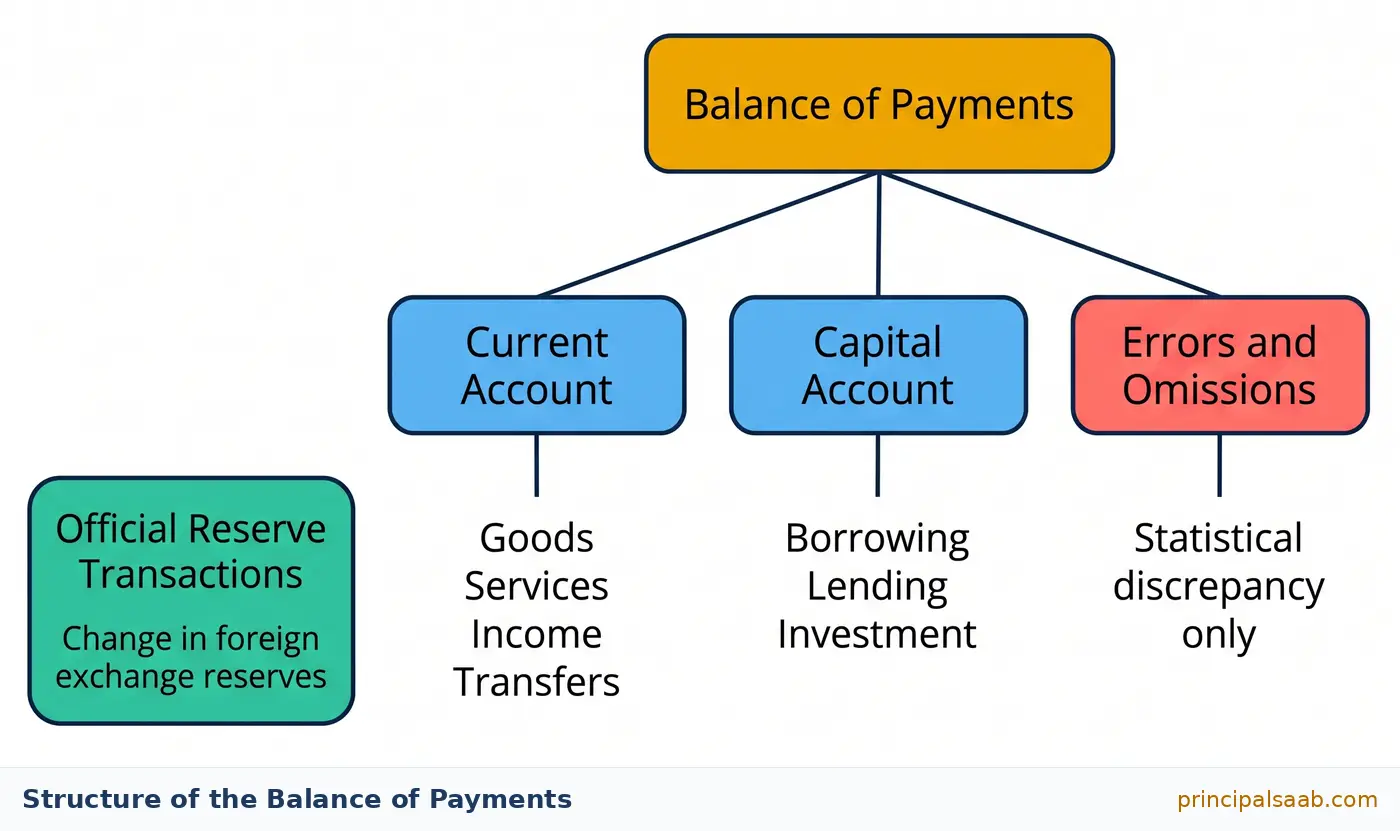
- The Current Account — records transactions in goods, services, income and transfers. In plain words: the country’s income and spending for the year.
- The Capital Account — records transactions that change the country’s assets and liabilities with the rest of the world. In plain words: the country’s borrowing, lending and investment.
- Errors and Omissions — a small balancing figure that mops up measurement mistakes, so that the two sides of the account reconcile. It is a statistical discrepancy and nothing more.
- Official reserve transactions — the change in the RBI’s foreign exchange reserves. Keep this separate in your head: reserves are the accommodating item that finances the overall balance, not part of Errors and Omissions.
Here is the analogy that makes this stick. Think of your family’s finances split into two notebooks. Notebook one records what the family earned and spent this year: salary in, groceries out, school fees out, rent from the upstairs tenant in, a gift from an aunt in. Notebook two records what the family did with assets and debts: took a car loan, repaid part of a housing loan, bought some shares, sold a plot of land.
Notebook one is the current account. Notebook two is the capital account. And notice the natural link between them: if notebook one shows the family spent more than it earned, notebook two must show where the extra money came from — a loan, a sale of assets, or savings drawn down. That link is the whole logic of the BoP, and if you hold onto it you will never be confused again.
| Basis | Current Account | Capital Account |
|---|---|---|
| What it records | Income earned and spending done with the rest of the world | Changes in foreign assets held and foreign liabilities owed |
| Main items | Exports and imports of goods; exports and imports of services; income; unilateral transfers | Foreign direct investment; portfolio investment; loans and borrowings; banking capital; change in reserves |
| Effect on assets/liabilities | Does not directly change them | Directly changes them |
| Nature | Reflects current standard of living and trade competitiveness | Reflects the financing side and future obligations |
| Household parallel | Salary earned, bills paid | Loans taken, investments made |
The Current Account and Its Components
The current account has four components. Learn them as a list of four and you will always be able to reconstruct the account under exam pressure.
- Exports and imports of goods (visible trade). Physical things you can load onto a ship — rice, steel, machinery, textiles, crude oil, phones. They are called visible because a customs officer can literally see them crossing the border. The difference between goods exported and goods imported is the balance of trade, and that same net-exports figure is what enters GDP when you compute national income by the expenditure method.
- Exports and imports of services (invisible trade). Nothing crosses the border in a crate, but value is still sold. Software services, tourism, shipping and insurance, banking services, education, consultancy. India happens to be a large net exporter of services, which matters a great deal when you interpret India’s numbers.
- Income. Payments for the use of factors of production across borders — wages earned by residents working abroad temporarily, and interest, profit and dividends flowing on investments. If an Indian holds shares in a US company and receives a dividend, that is income received (credit). If a foreign firm operating in India sends profits home, that is income paid (debit).
- Unilateral transfers. One-way payments, where something is given and nothing is received in return. Remittances sent home by Indians working abroad, gifts, donations, charitable aid, grants. These are “unrequited” — a one-sided flow.
One note so the textbook does not confuse you. Splitting income and unilateral transfers into their own heads is the cleaner classification and examiners accept it. The NCERT book, however, folds factor income and non-factor income together under the broad heading of invisibles alongside services. Same content, different packaging — read the question wording and answer in whichever grouping it uses.
Why is the current account so closely watched? Because it tells you whether the country is living within its means. A current account deficit means the nation as a whole is absorbing more from the rest of the world than it is supplying to it — which must be paid for by borrowing from abroad or by selling assets to foreigners. That is not automatically a disaster (a young, growing economy may sensibly borrow to build), but it is something a government watches carefully.
Exports of goods 850; imports of goods 920; exports of services 300; imports of services 180; net income from abroad (−) 40; net current transfers (+) 160.
Step 1 — Balance of trade (goods only).
BoT = 850 − 920 = (−) 70 crore. A trade deficit of ₹70 crore.
Step 2 — Net services.
300 − 180 = (+) 120 crore.
Step 3 — Add the remaining current account items.
Current account balance = (−70) + 120 + (−40) + 160
= −70 + 120 = 50; 50 − 40 = 10; 10 + 160 = (+) 170 crore.
Answer. Balance of trade = deficit of ₹70 crore. Balance on current account = surplus of ₹170 crore.
Read what just happened. The country bought more goods than it sold, yet its current account was comfortably in surplus — because services and transfers more than covered the goods gap. This is exactly why examiners love this question: it forces you to notice that a trade deficit and a current account deficit are not the same thing.
Exports of goods 2,150; imports of goods 2,680; exports of services 1,180; imports of services 640; income received 190; income paid 420; transfers received 760; transfers paid 95.
Step 1 — Balance of trade.
2,150 − 2,680 = (−) 530 crore.
Step 2 — Net services.
1,180 − 640 = (+) 540 crore.
Step 3 — Net income.
190 − 420 = (−) 230 crore.
Step 4 — Net transfers.
760 − 95 = (+) 665 crore.
Step 5 — Net invisibles = 540 + (−230) + 665 = (+) 975 crore.
Step 6 — Current account balance = Balance of trade + Net invisibles
= (−530) + 975 = (+) 445 crore, a current account surplus.
Check your working the smart way: add all the credits (2,150 + 1,180 + 190 + 760 = 4,280) and all the debits (2,680 + 640 + 420 + 95 = 3,835). Difference = 4,280 − 3,835 = 445. Same answer, arrived at from the other direction. Get into the habit of doing this cross-check — it takes fifteen seconds and it catches sign errors.
The Capital Account and Its Components
If the current account is the family’s income-and-spending notebook, the capital account is the notebook of loans, investments and assets. Formally: the capital account records all transactions that cause a change in the foreign assets owned by residents or in the foreign liabilities owed by them.
The credit-and-debit test is the same as before — did foreign exchange come in or go out — but here it helps to also think in terms of assets and liabilities:
- An increase in foreign liabilities (a foreigner lends to us or invests in us) brings money in, so it is a credit.
- An increase in foreign assets (we lend abroad or invest abroad) sends money out, so it is a debit.
- A decrease in foreign assets (we sell something we owned abroad) brings money in — a credit.
- A decrease in foreign liabilities (we repay a foreign loan) sends money out — a debit.
The main components you must be able to name are:
- Foreign Direct Investment (FDI). Investment made to acquire a lasting interest and a real say in the management of an enterprise abroad — building a factory, buying a controlling stake. It is long-term and relatively stable, because you cannot pack up a factory overnight.
- Portfolio Investment. Purchase of financial assets such as shares and bonds purely for returns, without control over management. Also called foreign institutional investment. It is short-term and volatile — it can leave as quickly as it arrived, which is why it is sometimes nicknamed “hot money”.
- Loans and borrowings. External commercial borrowings by firms, loans from foreign governments and international institutions, and repayments of such loans.
- Banking capital. Changes in the foreign currency holdings and deposits of commercial banks, including deposits held in India by non-residents.
- Change in official foreign exchange reserves. The stock of foreign currency, gold and reserve assets held by the central bank. Treated separately and with great care — we will come back to why in the section on autonomous and accommodating items.
FDI inflow into the country 500; FDI outflow by residents 120; portfolio investment inflow 240; portfolio investment outflow 90; external commercial borrowings received 300; repayment of foreign loans 260.
Step 1 — Net FDI. 500 − 120 = (+) 380
Step 2 — Net portfolio investment. 240 − 90 = (+) 150
Step 3 — Net loans. 300 − 260 = (+) 40
Step 4 — Capital account balance = 380 + 150 + 40 = (+) 570 crore, a capital account surplus.
What this means in words. More foreign money flowed in as investment and loans than flowed out. The country has, on balance, increased its liabilities to the rest of the world. That inflow of ₹570 crore is available to finance a shortfall elsewhere in the BoP — which is exactly the connection the next section builds on.
Errors and Omissions, and Why the BoP Always Balances
Here is a sentence that confuses almost every student the first time: the Balance of Payments always balances. And yet in the newspapers you constantly read about countries having a “BoP deficit”. How can both be true?
The resolution is simple once you see it, and it is worth real marks, so slow down here.
The BoP is kept by double-entry bookkeeping. Every transaction is entered twice — once as a credit and once as a matching debit. When an Indian exporter sells goods worth $1 million, the goods leaving is a credit in the current account, and the dollars arriving in an Indian bank account is a debit in the capital account (India has acquired a foreign asset). Two entries, equal and opposite. Do that for every transaction in the economy, and the grand total of all credits must equal the grand total of all debits. In the accounting sense, the sum of the whole statement is necessarily zero.
So what do people mean by a BoP deficit? They mean a deficit in one part of the statement — specifically in the transactions undertaken for their own sake, before the compensating financing entries are added. That is exactly the distinction we tackle in the next section. For now, hold this:
Errors and omissions exists because the real world is untidy. Data is collected from customs records, banks, surveys and company filings, each with its own timing and its own gaps. Smuggling goes unrecorded. Valuations differ. So the two sides of the statement, when actually measured, do not quite match — and a residual figure called errors and omissions (or “net errors and omissions”) is inserted to force the books to close. It is a statistical plug, nothing more. A small figure is normal; a persistently large one suggests significant unrecorded flows.
Step 1 — Add the transactions done for their own sake.
(−320) + (+260) + (−15)
= −320 + 260 = −60; −60 − 15 = (−) 75 crore.
Step 2 — Interpret it. There is an overall deficit of ₹75 crore. The country paid out ₹75 crore more foreign exchange than it received on these transactions.
Step 3 — How is it settled? The central bank must supply the missing foreign exchange out of its official reserves. So reserves fall by ₹75 crore, which is entered as a credit of (+) 75.
Step 4 — Check the books close.
(−75) + (+75) = 0. The statement balances exactly, as double entry guarantees it must.
The lesson. The deficit did not vanish — it was financed. Saying “the BoP balances” is like saying your monthly budget balanced because you withdrew ₹5,000 from savings. Technically true; economically, you overspent by ₹5,000.
Autonomous Versus Accommodating Transactions
This is the single most examined idea in the chapter, and it is also the one students most often half-know. Let us get it fully.
Autonomous transactions are transactions undertaken for their own sake — for profit, for gain, because somebody wanted to do them. They happen independently of what is going on in the rest of the BoP. An exporter ships goods because there is money in it. An investor buys Indian shares because she expects a return. Nobody consulted the balance of payments position before deciding. These are recorded above the line, and they are the transactions that cause a surplus or a deficit.
Accommodating transactions are transactions undertaken precisely because of the balance of payments position. They exist to cover the gap left by the autonomous items. When autonomous payments exceed autonomous receipts, the monetary authority steps in — drawing down foreign exchange reserves, or borrowing from the International Monetary Fund — to settle the difference. These are recorded below the line, and they are compensatory, not profit-driven.
The analogy that fixes this. Imagine you run a small tea stall. Through the month you buy milk and sugar and sell tea — all of that is autonomous, done for business reasons. At the end of the month you find you are ₹4,000 short of paying the rent, so you take ₹4,000 out of your savings tin. That withdrawal from the tin is accommodating. It happened only because of the shortfall. Nobody would look at the ₹4,000 and say “the stall broke even this month.” They would say the stall was ₹4,000 short and you covered it. That is precisely how economists read the BoP.
| Basis | Autonomous Transactions | Accommodating Transactions |
|---|---|---|
| Motive | Undertaken for their own sake — profit or economic gain | Undertaken to cover a deficit or absorb a surplus |
| Independence | Independent of the BoP position | Entirely determined by the BoP position |
| Placement | Above the line | Below the line |
| Who undertakes them | Ordinary firms, households and investors | Mainly the monetary authority (central bank / government) |
| Role in surplus/deficit | They create the surplus or deficit | They remove it by financing it |
| Example | Export of software services; foreign firm setting up a plant | Drawing down foreign exchange reserves; borrowing from the IMF |
Step 1 — Balance on autonomous transactions.
4,200 − 4,650 = (−) 450 crore.
Step 2 — Interpret. Autonomous payments exceed autonomous receipts, so the country has a BoP deficit of ₹450 crore.
Step 3 — The accommodating entry. The gap of ₹450 crore must be settled. The central bank draws ₹450 crore out of its official foreign exchange reserves (or borrows abroad). This is entered as an accommodating credit of (+) 450.
Step 4 — Verify. (−450) + (+450) = 0. The overall statement balances.
Answer. BoP deficit of ₹450 crore, financed by an accommodating item of ₹450 crore — a fall in official reserves of the same amount.
How the 4 marks are typically split: 1½ marks for each distinction developed properly, 1 mark for the two examples. Here is how to lay the answer out.
Model answer.
Autonomous transactions are those international economic transactions that are undertaken with the motive of earning profit or economic gain, independently of the country’s balance of payments position. They take place for their own sake and are therefore recorded above the line. Because they arise independently, it is these items that give rise to a surplus or a deficit in the balance of payments.
Example: the export of software services by an Indian firm to an American client.
Accommodating transactions are those transactions that are undertaken by the monetary authority specifically to cover the deficit or absorb the surplus arising from autonomous transactions. They are compensatory in nature, are governed entirely by the balance of payments position, and are recorded below the line.
Example: a drawing down of official foreign exchange reserves by the central bank to settle a deficit.
In short, autonomous items cause the imbalance while accommodating items finance it, which is why the balance of payments always balances in the accounting sense.
Why this scores full marks: it names both terms, gives motive and placement for each, supplies one clean example each, and closes with the linking sentence. Notice the answer is short — four or five sentences per term is plenty. Padding does not earn marks; the distinguishing points do.
Balance of Trade Versus Balance on Current Account
These two get mixed up constantly, and the fix takes about ninety seconds.
Balance of trade is the difference between the value of goods exported and the value of goods imported. Goods only. Nothing else. It is also called the balance of visible trade, or the merchandise balance. If exports of goods exceed imports of goods, there is a trade surplus (favourable balance of trade); if imports exceed exports, a trade deficit.
Balance on current account is much wider. It is the balance of trade plus net services plus net income plus net transfers. In other words, goods and everything else in the current account.
So the balance of trade is a part of the balance on current account. They can easily point in opposite directions, and for India they historically often have: a goods deficit offset by a large surplus in software services and remittances.
| Basis | Balance of Trade | Balance on Current Account |
|---|---|---|
| Coverage | Only exports and imports of goods (visibles) | Goods, services, income and transfers |
| Scope | Narrow — a component | Wide — includes the balance of trade within it |
| Formula | Exports of goods − Imports of goods | Balance of trade + Net invisibles |
| What it reveals | Competitiveness in merchandise trade alone | Whether the nation as a whole is living within its means |
| Reliability as an indicator | Partial and can mislead | More complete and more meaningful |
Model answer — three clean points, one mark each.
1. Meaning. Balance of trade is the difference between the value of exports and imports of goods only, whereas balance on current account is the difference between total receipts and total payments on account of goods, services, income and unilateral transfers.
2. Scope. Balance of trade covers only visible items, while balance on current account covers both visible and invisible items. The balance of trade is therefore one component of the balance on current account.
3. Significance. Balance of trade gives only a partial picture of a country’s external position, whereas balance on current account is a more comprehensive indicator, since it captures all current international dealings of the residents of a country.
Exam craft. For a 3-mark “distinguish between”, give exactly three separate bases, each stated for both terms. Do not write three sentences about the first term and one about the second — a distinction only earns the mark if both sides are stated.
BoP Surplus and Deficit: What It Really Means
We now have all the pieces, so this section is mostly about putting them together carefully.
- BoP surplus arises when autonomous receipts exceed autonomous payments. The country earns more foreign exchange than it spends on transactions done for their own sake. Official reserves rise.
- BoP deficit arises when autonomous payments exceed autonomous receipts. The country spends more foreign exchange than it earns. Official reserves fall, or the country borrows abroad.
Why a persistent deficit worries policymakers. A deficit in one year is unremarkable. A deficit every year for many years is a different matter, because it must be financed every year, and the ways of financing it all have costs. Reserves are finite and will eventually run out. Borrowing abroad builds up external debt, and the interest on that debt is itself a debit in future current accounts, which makes the following year harder. Selling assets to foreigners transfers future income streams out of the country. And a country visibly running out of reserves can find lenders suddenly unwilling to roll over its loans, which is how balance of payments crises begin.
Why a large surplus is not automatically wonderful either. A surplus means the country is supplying more real resources to the world than it takes back, and is accumulating claims on foreigners instead of using resources at home. Very large surpluses can also invite trade friction with partner countries and can complicate domestic monetary management.
(i) Current account balance.
= (−270) + 240 + (−95) + 310
= −270 + 240 = −30; −30 − 95 = −125; −125 + 310 = (+) 185 crore, a current account surplus.
(ii) Overall BoP position on autonomous transactions.
= Current account balance + autonomous capital account balance
= 185 + 180 = (+) 365 crore, a BoP surplus.
(iii) Change in official reserves.
A surplus of ₹365 crore means the country received that much more foreign exchange than it paid out. The central bank absorbs it, so official foreign exchange reserves rise by ₹365 crore. This is the accommodating entry of (−) 365, and (+365) + (−365) = 0, so the statement closes.
Watch the sign convention. A rise in reserves is a debit (money used up to acquire a foreign asset) and a fall in reserves is a credit. Students routinely get this backwards. Anchor it on the logic — buying an asset always sends money out — rather than trying to memorise the sign.
Foreign Exchange Rate: The Price of One Currency in Another
We now switch to the second half of the chapter. Take a short break if you need one, because this is a genuinely new idea rather than a continuation.
Start with something concrete. Picture a small currency exchange shop at an airport, with a board on the wall listing prices: US Dollar 83.40, Euro 90.10, Pound 105.60. What is that board actually telling you? It is telling you the price of one unit of foreign currency, expressed in rupees. Nothing more mysterious than that.
So: the foreign exchange rate is the rate at which one currency is exchanged for another — that is, the price of one unit of foreign currency in terms of the domestic currency. Two related terms come with it. Foreign exchange means all currencies other than the domestic currency held by residents. The foreign exchange market is the market in which currencies are bought and sold.
In India we conventionally quote it as rupees per unit of foreign currency: ₹83 per US dollar. This is worth pausing on because it is the source of endless confusion.
(a) Rise in the rupee price of the euro.
= (80 − 75) ÷ 75 × 100
= 5 ÷ 75 × 100 = 6.67 per cent (approximately). The euro has appreciated by about 6.67 per cent against the rupee.
(b) Fall in the value of the rupee measured in euros.
First flip the quotation. At ₹75 per euro, one rupee buys 1 ÷ 75 = 0.013333 euros. At ₹80 per euro, one rupee buys 1 ÷ 80 = 0.012500 euros.
Percentage change = (0.012500 − 0.013333) ÷ 0.013333 × 100
= (−0.000833) ÷ 0.013333 × 100 = (−) 6.25 per cent. The rupee has depreciated by 6.25 per cent.
Why are they different? Because a percentage always depends on what you divide by. The 6.67 per cent uses the old euro price as the base; the 6.25 per cent uses the old rupee value as the base. Both describe the same movement from two directions — exactly like a price rising 25 per cent from ₹80 to ₹100, which is the same event as a price falling 20 per cent from ₹100 to ₹80.
In the exam: unless the question specifically asks you to flip the quotation, the expected calculation is the straightforward one on the quoted rate. But knowing why the two numbers differ is exactly the kind of understanding that separates a good script from an average one.
Fixed, Flexible and Managed Floating Systems
Who decides what the number on that airport board should be? That depends on the exchange rate system the country has chosen. There are three.
1. Fixed exchange rate system. The rate is officially fixed by the government or the central bank and held there. Market forces are not allowed to move it. To hold the line, the authority must stand ready to buy or sell foreign exchange at the announced rate out of its reserves — if too many people want dollars at ₹80, it supplies them; if too few, it buys them up. Historically this operated through the gold standard and later the Bretton Woods system.
2. Flexible (floating) exchange rate system. The rate is determined entirely by the demand for and supply of foreign exchange in the open market, with no official intervention. It moves up and down freely, like the price of tomatoes, and it adjusts automatically to clear the market.
3. Managed floating exchange rate system. The middle path, and the one most countries including India actually operate. The rate is broadly left to market forces, but the central bank intervenes from time to time — buying or selling foreign currency — to smooth out excessive volatility and to keep the rate from moving in a disorderly way. It is sometimes called a “dirty float”, because the float is not entirely clean.
| Basis | Fixed Exchange Rate | Flexible Exchange Rate |
|---|---|---|
| Who determines it | The government or central bank, officially | Market forces of demand and supply |
| Stability | Stable and predictable | Fluctuates, sometimes sharply |
| Role of reserves | Large reserves needed to defend the rate | No reserves needed for this purpose |
| BoP adjustment | Must be corrected by policy measures | Corrects itself automatically through rate movement |
| Terms used for change | Devaluation and revaluation | Depreciation and appreciation |
| Effect on trade and investment | Encourages them by removing exchange risk | Uncertainty can discourage long-term commitments |
Determination of the Exchange Rate by Demand and Supply
This is the diagram question of the chapter, and once you understand where the two curves come from, drawing it becomes easy.
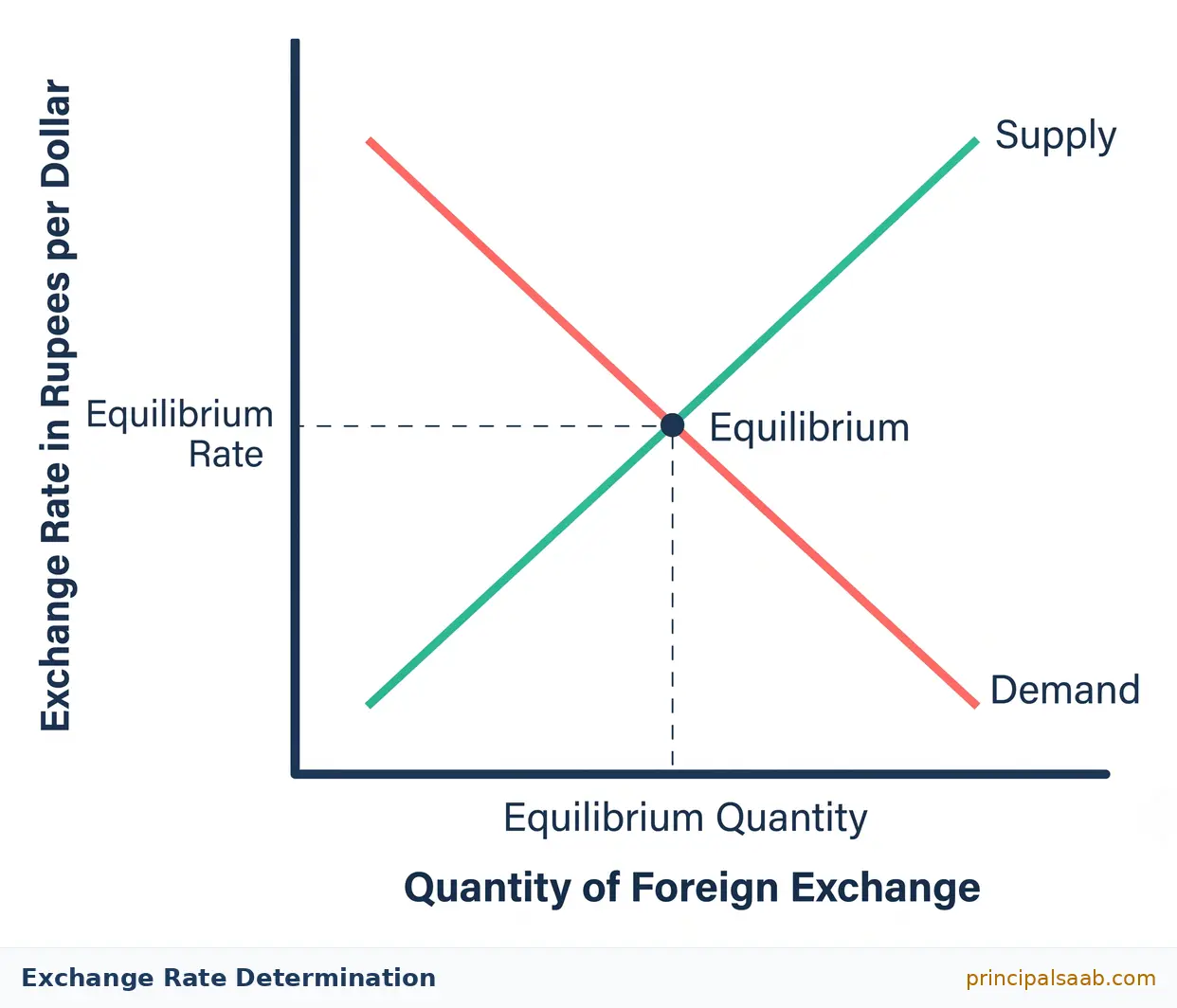
Treat foreign exchange — say, dollars — as an ordinary commodity being bought and sold. It has a price (the exchange rate, in rupees per dollar), a demand curve and a supply curve.
Where does the demand for foreign exchange come from? From everyone who needs to pay foreigners: importers buying goods and services from abroad, Indians travelling or studying overseas, residents investing abroad, people sending gifts or remittances out, and speculators who expect the foreign currency to become dearer.
Why does the demand curve slope downward? Because when the rupee price of the dollar falls, foreign goods become cheaper in rupee terms. A machine costing $10,000 costs ₹8,60,000 at ₹86 but only ₹8,00,000 at ₹80. Imports become more attractive, so more dollars are demanded. Lower price, higher quantity demanded — the ordinary law of demand, just applied to a currency.
Where does the supply of foreign exchange come from? From everyone receiving payments from foreigners: exporters, foreign tourists spending in India, foreign investors putting money into India, remittances flowing in, and foreign loans received.
Why does the supply curve slope upward? Because when the rupee price of the dollar rises, Indian goods become cheaper for foreign buyers. A shipment priced at ₹8,00,000 costs a foreign buyer $10,000 at ₹80 but only about $9,302 at ₹86. Our exports become more competitive, foreigners buy more, and more dollars flow in. Higher price, higher quantity supplied.
The equilibrium. The exchange rate settles where the demand for foreign exchange equals its supply. Above that rate there is an excess supply of foreign exchange, which pushes the rate down; below it there is an excess demand, which pushes the rate up. The market is driven back to equilibrium by ordinary competitive pressure, exactly as in any other market you have studied.
| Rate (₹ per $) | Demand for $ (crore) | Supply of $ (crore) | Demand − Supply |
|---|---|---|---|
| 78 | 700 | 460 | (+) 240 — excess demand |
| 80 | 640 | 520 | (+) 120 — excess demand |
| 82 | 580 | 580 | 0 — EQUILIBRIUM |
| 84 | 520 | 640 | (−) 120 — excess supply |
| 86 | 460 | 700 | (−) 240 — excess supply |
At ₹78: demand (700) exceeds supply (460) by 240 crore dollars. Dollars are scarce at this cheap price. Competition among buyers bids the price of the dollar up, and the rate rises towards ₹82. As it rises, imports become dearer so demand falls, and exports become more competitive so supply rises — the gap closes from both ends.
At ₹86: supply (700) exceeds demand (460) by 240 crore dollars. Sellers of dollars cannot find buyers, so they accept fewer rupees, and the rate falls towards ₹82. Again both curves move the market back.
Notice the self-correcting mechanism. Nobody had to instruct anyone. This automatic adjustment is precisely the merit that supporters of a flexible exchange rate system point to.
Merits and Demerits of Fixed and Flexible Systems
This is squarely a 4-mark or 6-mark question, so learn it as organised lists rather than as prose.
Merits of a fixed exchange rate system. It provides stability and certainty in international transactions, which encourages trade and long-term foreign investment because businesses know what they will receive or pay. It removes exchange risk from contracts. It discourages destabilising speculation, since there is little to gain from betting on a rate that does not move. And by removing the option of easy devaluation, it imposes discipline on domestic economic policy, discouraging inflationary spending.
Demerits of a fixed exchange rate system. Defending the rate requires holding large foreign exchange reserves, which is expensive since those reserves earn little. Monetary policy loses independence, because interest rates must often be set to protect the exchange rate rather than to serve domestic needs such as employment. The rate may be held at a level far from its true market value, distorting trade. And when the defence finally fails, the correction tends to arrive as a single, sudden and painful devaluation rather than as gradual adjustment.
Merits of a flexible exchange rate system. Adjustment is automatic — a deficit tends to weaken the currency, which makes exports cheaper and imports dearer, correcting the deficit without official action. There is no need to hold large reserves for defence. Monetary policy is freed to pursue domestic objectives. And the market rate reflects genuine underlying economic conditions rather than an administered guess.
Demerits of a flexible exchange rate system. Rates can fluctuate a great deal, creating uncertainty that discourages trade and long-term investment. It encourages speculation, which can amplify the swings rather than dampen them. Frequent depreciation raises the rupee cost of imports, and for a country importing essentials such as crude oil that feeds directly into domestic inflation. And volatility makes planning genuinely difficult for firms with long production cycles.
Devaluation vs Depreciation, Revaluation vs Appreciation
Four words, two pairs. Students lose easy marks here every single year, and the fix is one sentence long, so please do not be one of them.
All four words describe a change in the external value of a currency. What separates them is who caused the change.
- Devaluation — a deliberate official decision to reduce the value of the domestic currency, under a fixed exchange rate system. The government announces it.
- Depreciation — a fall in the value of the domestic currency brought about by market forces, under a flexible exchange rate system. Nobody announces it; it simply happens.
- Revaluation — a deliberate official decision to raise the value of the domestic currency, under a fixed system.
- Appreciation — a rise in the value of the domestic currency caused by market forces, under a flexible system.
| Basis | Devaluation | Depreciation |
|---|---|---|
| Meaning | Official lowering of the value of the domestic currency | Market-driven fall in the value of the domestic currency |
| System in which it occurs | Fixed exchange rate system | Flexible exchange rate system |
| Who brings it about | Government or central bank, by announcement | Forces of demand and supply in the market |
| Nature of change | Discrete, one-off, of a known size | Continuous, gradual, of no fixed size |
| Predictability | A conscious policy act, usually to correct a deficit | An automatic outcome, not a policy act |
| Opposite term | Revaluation | Appreciation |
(a) Percentage devaluation.
= (88 − 80) ÷ 80 × 100 = 8 ÷ 80 × 100 = 10 per cent.
(b) Exporter’s rupee earnings.
Before: 50,000 × 80 = ₹40,00,000
After: 50,000 × 88 = ₹44,00,000
Increase = 44,00,000 − 40,00,000 = ₹4,00,000.
Why the exporter gains. She still receives the same $50,000 from her buyer, but each of those dollars now converts into more rupees. Note carefully that this is devaluation, not depreciation, because it was an official act under a fixed system. Had the same movement happened on its own in a floating market, you would have to call it depreciation — and the examiner will be checking which word you used.
Effect of Exchange Rate Changes on Exports and Imports
Here is where the whole chapter finally clicks together, because this is where exchange rates feed back into the balance of payments.
When the rupee depreciates (say from ₹80 to ₹87 per dollar):
- Exports become cheaper for foreign buyers. An Indian product priced at ₹8,000 used to cost a foreign buyer $100; now it costs about $92. Indian goods look like a better deal abroad, so foreign demand for our exports rises. Exports increase.
- Imports become dearer for Indian buyers. A foreign product priced at $100 used to cost ₹8,000; now it costs ₹8,700. Indians buy less of it. Imports decrease.
- Effect on the current account. Exports up and imports down means the trade balance and the current account tend to improve. This is exactly why a country with a stubborn deficit might welcome, or even engineer, a weaker currency.
- The other side of it. Imported items become more expensive in rupees, so the domestic cost of crude oil, fertiliser, edible oil, electronics and machinery rises. That feeds into domestic inflation and raises input costs for Indian producers. Depreciation is not a free lunch.
When the rupee appreciates, every one of those effects runs in reverse: exports become dearer abroad and fall, imports become cheaper and rise, the current account tends to worsen, and imported inflation eases.
Step 1 — Receipts at the old rate. 25,000 × 83 = ₹20,75,000
Step 2 — Receipts at the new rate. 25,000 × 87 = ₹21,75,000
Step 3 — Gain. 21,75,000 − 20,75,000 = ₹1,00,000.
Step 4 — Percentage rise in the rupee price of the dollar. (87 − 83) ÷ 83 × 100 = 4 ÷ 83 × 100 = 4.82 per cent (approximately).
Answer. The exporter gains ₹1,00,000, an increase of about 4.82 per cent in her rupee receipts, purely from the currency movement — she sold nothing extra.
Step 1 — Cost at ₹82. 18,000 × 82 = ₹14,76,000
Step 2 — Cost at ₹86. 18,000 × 86 = ₹15,48,000
Step 3 — Additional cost. 15,48,000 − 14,76,000 = ₹72,000.
Step 4 — Percentage increase. 72,000 ÷ 14,76,000 × 100 = 4.88 per cent (approximately).
Sanity check worth doing. The rate itself rose by (86 − 82) ÷ 82 × 100 = 4.88 per cent. The cost increase matches the rate increase exactly — and it must, because the dollar amount did not change. If your two percentages do not match on a question like this, you have made an arithmetic slip somewhere.
Now put Examples 13 and 14 side by side. The same currency movement handed the exporter a gain and the importer a bill. That is the whole point of this section in one image.
How to allocate: roughly 1½ marks each for exporters, importers and the current account, and 1½ marks for the evaluative final part. Use sub-headings — examiners mark faster and more generously when they can find your points.
Model answer.
Meaning. Depreciation of the rupee means that more rupees are now required to purchase one US dollar, that is, the rupee has lost value against the dollar due to market forces of demand and supply.
Effect on Indian exporters. Indian goods become cheaper in dollar terms for foreign buyers, since the same rupee price now converts into fewer dollars. Foreign demand for Indian exports therefore rises, and exporters also receive more rupees for each dollar earned. Exporters gain on both counts, and export volumes tend to increase.
Effect on Indian importers. Imports become costlier in rupee terms, because each dollar of the invoice now costs more rupees. Importers face higher costs, and the quantity of goods imported tends to fall. Since India imports crude oil, fertilisers and capital goods in large volumes, input costs across the economy rise.
Effect on the current account. With exports rising and imports falling, the balance of trade tends to improve. Remittances from Indians abroad also convert into more rupees. The current account deficit therefore tends to narrow, other things being equal.
Is depreciation wholly beneficial? No. First, dearer imports of crude oil and other essentials raise domestic prices, causing imported inflation that hurts households. Second, higher input costs squeeze producers who depend on imported raw materials and machinery. Third, the rupee cost of servicing external debt denominated in dollars rises. Fourth, the export gain depends on foreign demand being sufficiently responsive to price, and on exporters having the capacity to supply more — if either fails, the improvement may not materialise. Depreciation therefore involves a genuine trade-off rather than a clear gain.
Notice the structure: define, then three effects with a reason each, then a balanced evaluation with at least three counter-points. Any 6-mark question in this unit can be answered on this template.
The Foreign Exchange Market: Spot, Forward, Hedging, Speculation, Arbitrage
Finally, a look at the market itself and what people actually do in it. A word of honesty before you read on: this section is beyond the rationalised NCERT text and is not board-exam material for 2026-27. Spot and forward rates, hedging, speculation and arbitrage are not named in the CBSE syllabus entry for this unit and you should not expect a board question on them. Read it once for general understanding and for entrance tests such as CUET — then spend your revision time on the sections above.
The three functions of the foreign exchange market are worth learning as a named list:
- Transfer function. Transferring purchasing power between countries, so that a buyer in one country can pay a seller in another.
- Credit function. Providing credit for foreign trade, since goods in transit must be financed for the weeks or months they are at sea.
- Hedging function. Protecting traders and investors against the risk of adverse movements in the exchange rate.
The two segments of the market:
- Spot market. Currencies are bought and sold for immediate delivery, at the spot rate — the rate prevailing today. Think of the airport counter: you hand over rupees, you walk away with dollars.
- Forward market. Currencies are bought and sold today for delivery on a specified future date, at a rate agreed now — the forward rate. Nothing changes hands until the future date, but the price is locked in.
The three activities you must be able to define:
- Hedging is the act of protecting oneself against the risk of loss from future exchange rate fluctuations, usually by entering a forward contract. The motive is safety, not profit. An importer who must pay in dollars in three months buys those dollars forward today so that his cost is known regardless of what the market does.
- Speculation is the deliberate buying or selling of foreign exchange in the hope of profiting from an expected future change in the rate. The motive is profit, and the speculator deliberately takes on risk rather than avoiding it. Someone who buys dollars today purely because he expects the rupee to weaken is speculating.
- Arbitrage is the simultaneous buying of a currency in one market where it is cheaper and selling it in another where it is dearer, in order to profit from the price difference. It is essentially risk-free, because both transactions happen at once at known prices. Arbitrage is useful to the system: by buying where a currency is cheap and selling where it is dear, arbitrageurs push the two prices together, so rates across different markets tend to converge.
Step 1 — Cost of buying in Mumbai. 1,00,000 × 83.20 = ₹83,20,000
Step 2 — Proceeds from selling in the other market. 1,00,000 × 83.60 = ₹83,60,000
Step 3 — Profit. 83,60,000 − 83,20,000 = ₹40,000.
(Equivalently: a gap of ₹0.40 per dollar × 1,00,000 dollars = ₹40,000.)
Effect on the rates. Buying dollars in Mumbai increases the demand there and pushes the Mumbai rate up from ₹83.20. Selling dollars in the other market increases supply there and pushes that rate down from ₹83.60. The two rates move towards each other until the gap disappears and the opportunity vanishes. This is why, in practice, exchange rates for the same currency pair are nearly identical across markets at any moment.
Step 1 — The locked-in cost. 40,000 × 84.50 = ₹33,80,000. This is what he will pay, whatever happens.
(a) If the spot rate rises to ₹87.00.
Unhedged cost would have been 40,000 × 87.00 = ₹34,80,000.
Saving = 34,80,000 − 33,80,000 = ₹1,00,000. The hedge protected him.
(b) If the spot rate is only ₹83.50.
Unhedged cost would have been 40,000 × 83.50 = ₹33,40,000.
He paid 33,80,000 − 33,40,000 = ₹40,000 more than he needed to.
The point of the example. Hedging is not about winning. In case (b) the hedge “cost” him ₹40,000 — but he did not know in advance which case would occur, and by hedging he converted an unknown future cost into a certain one. He bought certainty, and ₹40,000 was the price. That is exactly why hedging is described as risk avoidance rather than profit-seeking. A speculator, by contrast, would have taken the gamble deliberately, hoping for case (b).
Practice Worksheet with Answers
Eleven questions, arranged roughly easy to board level. Please write your attempt down before you click a question open — reading a worked answer feels like learning, but only writing actually is. Keep a pen and a rough sheet next to you.
Q1. From the following data (₹ crore), calculate the balance of trade, net invisibles and the balance on current account. Exports of goods 1,840; imports of goods 2,310; exports of services 980; imports of services 455; income received 210; income paid 395; transfers received 640; transfers paid 70.
Net services = 980 − 455 = (+) 525 crore.
Net income = 210 − 395 = (−) 185 crore.
Net transfers = 640 − 70 = (+) 570 crore.
Net invisibles = 525 + (−185) + 570 = (+) 910 crore.
Balance on current account = Balance of trade + Net invisibles = (−470) + 910 = (+) 440 crore, a current account surplus.
Cross-check the smart way: total credits = 1,840 + 980 + 210 + 640 = 3,670. Total debits = 2,310 + 455 + 395 + 70 = 3,230. Difference = 3,670 − 3,230 = 440. ✓ Same answer, reached from the other direction.
Comment: the country runs a goods deficit but a comfortable current account surplus, because its services exports and inward transfers are strong.
Q2. Calculate the balance on capital account (₹ crore): FDI inflow 780; FDI outflow 190; portfolio investment inflow 420; portfolio investment outflow 250; external borrowings received 560; repayment of foreign loans 410; net banking capital inflow 130.
Net portfolio investment = 420 − 250 = (+) 170
Net loans = 560 − 410 = (+) 150
Net banking capital = (+) 130
Capital account balance = 590 + 170 + 150 + 130 = (+) 1,040 crore, a capital account surplus.
Interpretation: the country’s foreign liabilities rose on balance by ₹1,040 crore. Foreigners invested in and lent to this country more than its residents invested and lent abroad. This inflow is available to finance any shortfall on the current account.
Q3. A country reports (₹ crore): current account balance (−) 620; capital account balance on autonomous account (+) 455; errors and omissions (−) 25. Find the overall balance of payments position and state the change in official foreign exchange reserves. Show that the statement closes to zero.
= (−620) + (+455) + (−25)
= −620 + 455 = −165; −165 − 25 = (−) 190 crore.
Step 2 — Position. Autonomous payments exceeded autonomous receipts, so there is a balance of payments deficit of ₹190 crore.
Step 3 — Change in reserves. The deficit must be settled by an accommodating transaction. The central bank draws down official foreign exchange reserves, so reserves fall by ₹190 crore. A fall in reserves is entered as a credit of (+) 190.
Step 4 — Closing the statement. (−190) + (+190) = 0. ✓
Key point to state in the exam: the balance of payments always balances in the accounting sense, but here the country is genuinely in deficit, because that balancing was achieved only by running down reserves.
Q4. Autonomous receipts of a country are ₹6,850 crore and autonomous payments are ₹7,240 crore. (a) Is the BoP in surplus or deficit, and by how much? (b) Name two accommodating transactions that could settle it. (c) Why is the deficit measured on autonomous items only?
(b) Two accommodating transactions:
(i) A drawing down of the country’s official foreign exchange reserves by the central bank.
(ii) Borrowing from the International Monetary Fund or from foreign monetary authorities specifically to settle the shortfall.
(c) Autonomous transactions are undertaken for their own sake — for profit or economic gain — independently of the balance of payments position, so it is they that create the imbalance. Accommodating transactions are undertaken only because that imbalance exists; they are compensatory financing. Counting them in would guarantee a total of zero every year and the measure would tell us nothing. Measuring the deficit on autonomous items alone is what makes it economically meaningful.
Q5. Distinguish between the current account and the capital account of the balance of payments. (3 marks)
2. Effect on assets and liabilities. Current account transactions do not directly alter a country’s stock of foreign assets and liabilities; capital account transactions alter them directly.
3. Components. The current account consists of visible trade in goods, invisible trade in services, income, and transfers. The capital account consists of foreign direct investment, portfolio investment, loans and borrowings, banking capital and changes in official reserves.
Presentation note: for a 3-mark distinguish question, write it as three numbered bases, each covering both accounts. A two-column table is equally acceptable and often faster.
Q6. From the schedule below, find the equilibrium exchange rate and explain, with reasons, what happens in the market at ₹80 and at ₹88 per dollar. Rates (₹ per $): 80, 82, 84, 86, 88. Demand for dollars (crore): 900, 820, 740, 660, 580. Supply of dollars (crore): 580, 660, 740, 820, 900.
At ₹80 per dollar. Demand is 900 crore and supply is 580 crore, so there is an excess demand of 320 crore dollars. The dollar is too cheap: imports look attractive so buyers want plenty of dollars, while exports are uncompetitive so few dollars are coming in. Competition among buyers bids the rupee price of the dollar up. As the rate rises, imports become dearer (demand falls) and exports become more competitive (supply rises), and the rate climbs to ₹84 where the gap closes.
At ₹88 per dollar. Demand is 580 crore and supply is 900 crore, so there is an excess supply of 320 crore dollars. The dollar is too dear: imports are expensive so few dollars are wanted, while exports are very competitive so dollars pour in. Sellers of dollars compete and accept fewer rupees, so the rate falls to ₹84.
Add to your answer: a labelled diagram with the exchange rate on the vertical axis, quantity of foreign exchange on the horizontal axis, downward-sloping DD, upward-sloping SS, and the equilibrium marked at ₹84 and 740 crore dollars.
Q7. An Indian software firm invoices an American client for $2,50,000. On the invoice date the rate is ₹83.40 per dollar; by the payment date it is ₹85.20. Calculate the firm’s rupee receipts on each date, the gain, and the percentage rise in the rupee price of the dollar. Has the rupee appreciated or depreciated?
Receipts at ₹85.20: 2,50,000 × 85.20 = ₹2,13,00,000
Gain = 2,13,00,000 − 2,08,50,000 = ₹4,50,000
Percentage rise in the rupee price of the dollar = (85.20 − 83.40) ÷ 83.40 × 100 = 1.80 ÷ 83.40 × 100 = 2.16 per cent (approximately).
The rupee has depreciated. More rupees are now needed to buy one dollar, so each rupee buys less foreign currency. The firm gained ₹4,50,000 purely from the currency movement, without exporting anything additional.
Warning: the rate number went up but the rupee got weaker. This is the single most common slip in the whole chapter — read the quotation as “rupees needed per dollar” and you will never make it.
Q8. The rupee moves from ₹86 per dollar to ₹82 per dollar. (a) Name this change. (b) An importer must pay $30,000 — find the change in his rupee cost. (c) Calculate the percentage appreciation of the rupee. (d) State one group that gains and one that loses.
(b) Importer’s cost.
At ₹86: 30,000 × 86 = ₹25,80,000
At ₹82: 30,000 × 82 = ₹24,60,000
Saving = ₹1,20,000.
(c) Percentage appreciation of the rupee.
At ₹86 per dollar, one rupee buys 1 ÷ 86 = 0.011628 dollars. At ₹82, one rupee buys 1 ÷ 82 = 0.012195 dollars.
Percentage change = (0.012195 − 0.011628) ÷ 0.011628 × 100 = 4.88 per cent appreciation (approximately).
(If the question instead asks for the percentage fall in the rupee price of the dollar, that is (82 − 86) ÷ 86 × 100 = −4.65 per cent. Read the wording carefully and state which base you have used.)
(d) Gainers: importers, and Indian students or travellers paying for education and travel abroad, since foreign currency is now cheaper in rupee terms. Losers: exporters, since each dollar earned now converts into fewer rupees and Indian goods become dearer for foreign buyers.
Q9. A country’s balance of trade shows a deficit of ₹410 crore while its net invisibles are (+) ₹530 crore. (a) Find the balance on current account. (b) “A country with a trade deficit must have a current account deficit.” Defend or refute. (4 marks)
(b) The statement is refuted.
The balance of trade records only the export and import of goods, that is, visible items. The balance on current account is wider: it is the balance of trade plus net invisibles, which comprise services, income and unilateral transfers. The balance of trade is therefore only one component of the current account, not the whole of it.
Consequently, a deficit on the goods account can be more than offset by a surplus on invisibles. In the data above, the goods deficit of ₹410 crore is outweighed by net invisibles of ₹530 crore, leaving a current account surplus of ₹120 crore. A country that exports software services on a large scale and receives substantial remittances from its citizens working abroad can comfortably run a goods deficit while its current account remains in surplus.
Conclusion: a trade deficit does not necessarily imply a current account deficit. The two coincide only when net invisibles are zero or are themselves negative.
Q10. Explain the merits and demerits of a flexible exchange rate system. (6 marks)
Merits (roughly 3 marks — give three developed points).
1. Automatic adjustment of the balance of payments. A deficit raises the demand for foreign exchange, which depreciates the domestic currency. Depreciation makes exports cheaper abroad and imports dearer at home, so exports rise and imports fall, and the deficit corrects itself without any policy action.
2. No need for large foreign exchange reserves. Since the authority is not defending any particular rate, it need not hold costly reserves for that purpose.
3. Independence of monetary policy. Interest rates and money supply can be directed at domestic goals such as controlling inflation or supporting employment, rather than being tied to defending the exchange rate.
Demerits (roughly 3 marks — give three developed points).
1. Uncertainty and instability. Rates may fluctuate sharply and unpredictably. Exporters and importers cannot be sure what a contract will be worth in domestic currency, which discourages foreign trade and long-term foreign investment.
2. Encouragement to speculation. Fluctuating rates create opportunities for speculators, and large-scale speculative buying and selling can amplify the swings instead of dampening them, making the currency still more unstable.
3. Risk of imported inflation. Persistent depreciation raises the domestic price of imports. For a country importing essentials such as crude oil, this raises production costs across the economy and feeds directly into domestic inflation.
Concluding line. Because of these drawbacks, most countries in practice adopt a managed floating system, allowing market forces to determine the rate while the central bank intervenes occasionally to moderate excessive volatility.
Q11. A trader buys $2,00,000 at ₹83.10 per dollar expecting the rupee to weaken. (a) Find his profit if he later sells at ₹85.40, and his loss if instead the rate falls to ₹82.30. (b) Name this activity and distinguish it from hedging.
If he sells at ₹85.40: proceeds = 2,00,000 × 85.40 = ₹1,70,80,000
Profit = 1,70,80,000 − 1,66,20,000 = ₹4,60,000
(Check: gain of ₹2.30 per dollar × 2,00,000 = ₹4,60,000. ✓)
If the rate falls to ₹82.30: proceeds = 2,00,000 × 82.30 = ₹1,64,60,000
Loss = 1,66,20,000 − 1,64,60,000 = ₹1,60,000
(Check: loss of ₹0.80 per dollar × 2,00,000 = ₹1,60,000. ✓)
(b) This is speculation. The trader has no underlying trade requirement for these dollars; he buys them solely in the expectation of profiting from a future change in the exchange rate, and he deliberately accepts the risk of being wrong.
Distinction from hedging. Hedging is undertaken by someone who already faces an unavoidable foreign exchange exposure — an importer with a bill to pay, or an exporter with a receipt due — and who enters a forward contract in order to eliminate the risk of adverse rate movements. Its motive is safety and certainty, not gain. Speculation, by contrast, creates an exposure that need not have existed, and its motive is profit. In short: the hedger seeks to avoid risk, while the speculator seeks to take it on.
Before You Close This Page
Look back at what you have just worked through. When you started, “autonomous and accommodating transactions” was probably a phrase that meant nothing at all. You can now not only define it but explain why the balance of payments balances and still shows a deficit — which is a genuinely subtle idea that many adults get wrong. That is real progress, and it happened in one sitting.
If parts of it still feel shaky, that is completely normal and it is not a sign that you are bad at economics. This chapter has a lot of moving parts. Go back to the two things that carry the most weight: the four components of the current account, and the direction rule for exchange rates. Almost everything else hangs off those two.
And please do not try to master it all tonight. The kaizen way is small and steady: aim for one more correct question than yesterday. One extra question a day, done properly and checked honestly, will carry you further by February than any single heroic all-nighter ever could. Close the page, rest, and come back tomorrow — the ideas settle while you sleep.