

Take a breath — this is one of the friendliest chapters in the whole Class 12 Maths book, and it is also one of the easiest places to drop marks by rushing. Relations and Functions sits right at the start of Unit I, and in the CBSE 2026-27 course structure that unit carries 8 marks in the 80-mark board paper. In practice that usually means one short question on types of relations and one longer proof — often 5 marks — asking you to show that a given relation is an equivalence relation, or that a given function is one-one and onto. Here is the good news: there is almost no heavy calculation in this chapter. Everything is about reading a definition carefully, testing it honestly against every case, and writing your reasoning in clean sentences. If you can do that, these marks are simply yours. We will begin from ordered pairs — genuinely from zero — and build up together to full board-level proofs. Go slowly. Nothing here needs to be memorised; it needs to be understood once, properly.
- Relations: A Gentle Warm-Up
- Empty and Universal Relations
- Reflexive, Symmetric and Transitive Relations
- Equivalence Relations and How to Prove One
- Equivalence Classes and Partitions
- Types of Functions: One-One, Onto and Bijective
- Checking Injectivity and Surjectivity Step by Step
- Functions Between Finite Sets
- Counting Functions and Relations
- Composition, Inverse and Binary Operations: Current Status
- Exam Strategy and Common Traps
- Practice Worksheet
Your Game Plan
You do not have to finish this chapter in one sitting. Work through it in this order and it will feel much lighter:
- Warm up on ordered pairs, Cartesian product, domain and range until listing a relation feels automatic.
- Learn the three test properties — reflexive, symmetric, transitive — one at a time, and practise them only on small three-element or four-element sets.
- Only then attempt equivalence relations on Z or on sets of ordered pairs. These are the 5-mark questions.
- Switch to functions. Get one-one and onto separately clear before you ever use the word bijective.
- Finish with the counting results. They are quick marks in MCQs and case-study questions.
- Do the worksheet at the end with a closed book. Whatever you get wrong, re-read only that one section.
Relations: A Gentle Warm-Up
Imagine a class photo. On the left you have a list of students, on the right a list of house names — Red, Blue, Green. Drawing a line from each student to their house is exactly what a relation is. Nothing more mysterious than that. Mathematics just insists we write those lines down as pairs.
An ordered pair (a, b) is two objects written in a fixed order. Order matters: (2, 5) and (5, 2) are different pairs, in the same way that “Riya is taller than Aman” is a different statement from “Aman is taller than Riya”.
The Cartesian product A × B is the set of every ordered pair whose first entry comes from A and second entry comes from B. If A has m elements and B has n elements, then A × B has mn elements — because each of the m choices for the first slot can be paired with each of the n choices for the second.
A relation R from A to B is simply a subset of A × B. That is the entire definition. When B is the same set as A, we say R is a relation on A. We write a R b as shorthand for (a, b) ∈ R.
Two more words and the warm-up is done. The domain of R is the set of all first entries that actually appear in R. The range of R is the set of all second entries that actually appear. The codomain is the whole target set B that we declared in advance, whether or not every element of it gets used. Range is what you got; codomain is what you were allowed to get.
Step 1 — the full product. A has 3 elements and B has 3, so A × B has 3 × 3 = 9 pairs:
(1,4), (1,5), (1,6), (2,4), (2,5), (2,6), (3,4), (3,5), (3,6).
Step 2 — apply the rule. Walk through all nine and keep only those where the second entry is three more than the first. 1 + 3 = 4 → keep (1,4). 2 + 3 = 5 → keep (2,5). 3 + 3 = 6 → keep (3,6). Everything else fails.
Answer. R = {(1,4), (2,5), (3,6)}. Domain = {1, 2, 3}, range = {4, 5, 6}, codomain = B = {4, 5, 6}. Here the range happens to equal the codomain — that will matter a great deal when we reach onto functions.
Working. Test each element of A as a first entry. If a = 1 then b = 2, and 2 ∈ A, so (1,2) is in. If a = 2 then b = 3 ∈ A, so (2,3) is in. If a = 3 then b = 4 ∈ A, so (3,4) is in. If a = 4 then b would have to be 5, but 5 ∉ A, so nothing is added.
Answer. R = {(1,2), (2,3), (3,4)}. Domain = {1, 2, 3}, range = {2, 3, 4}. Notice that here the domain is not all of A — that is perfectly allowed for a relation, though it will not be allowed for a function.
When a question gives you a relation by a rule on a small set, spend twenty seconds writing out every pair. Almost every mistake in this chapter comes from testing a property in your head instead of against a written list.
Why it works: a relation is just a filter applied to A × B. The Cartesian product gives you every possible connection; the rule tells you which connections to keep. Once you see it that way, phrases like “find the domain” stop being intimidating — you are only reading off a column from your list.
Empty and Universal Relations
Before the famous three properties, meet the two extreme relations. They are the “nothing” and the “everything” of this chapter, and examiners love them because a one-line question can catch out a student who has only memorised.
The empty relation on A is R = φ. No pair belongs to it at all. It happens whenever the defining condition can never be satisfied by elements of A.
The universal relation on A is R = A × A. Every possible pair belongs. It happens whenever the defining condition is automatically true for all elements of A.
Working. Every element of A is even, so a + b is a sum of two even numbers, which is always even. But 11 is odd. Therefore no pair can satisfy a + b = 11.
If you prefer to check by hand, the nine sums are 2+2 = 4, 2+4 = 6, 2+6 = 8, 4+2 = 6, 4+4 = 8, 4+6 = 10, 6+2 = 8, 6+4 = 10, 6+6 = 12. Not one of them is 11.
Answer. R = φ, the empty relation. Notice that it is vacuously symmetric and vacuously transitive (there are no pairs to break the rule), but it is not reflexive, because (2, 2) is missing.
Working. The smallest element of A is 2, so the smallest possible value of a + b is 2 + 2 = 4. Since 4 > 3, every single pair satisfies the condition.
Answer. S = A × A, which has 32 = 9 pairs. The universal relation is always reflexive, symmetric and transitive, so it is always an equivalence relation.
Students often write that the empty relation has none of the three properties. That is wrong. Symmetry and transitivity are statements of the form “if a pair is present, then something else must be present”. With no pairs present, the “if” never triggers, so both statements hold automatically. Only reflexivity fails, and only because A itself is non-empty.
Why it works: the two extremes are useful precisely because they are the boundaries. Any relation on A sits somewhere between φ and A × A. Keeping those endpoints in mind gives you a sanity check: if your listed relation has more pairs than A × A, you have made an error.
Reflexive, Symmetric and Transitive Relations
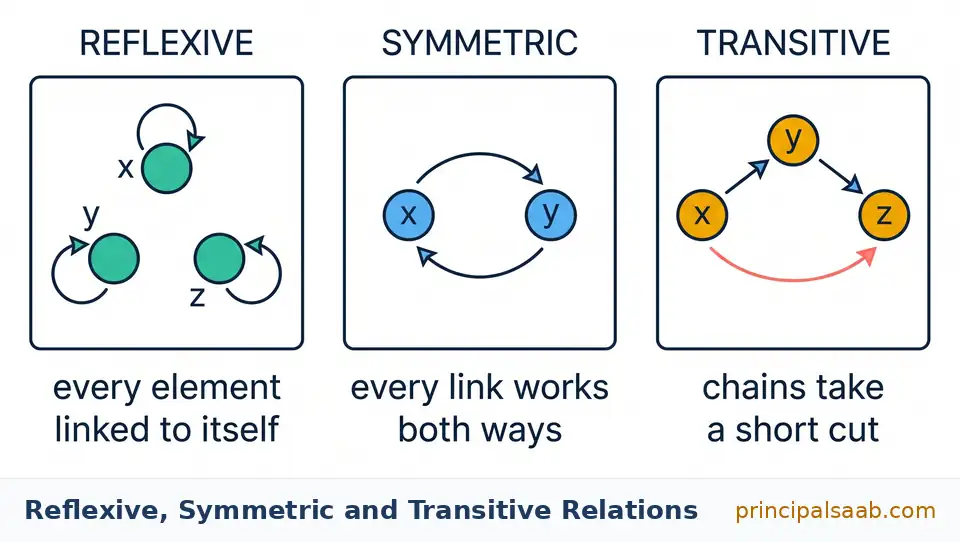
This is the heart of the chapter. Three properties, three separate tests. Do not try to check them all at once — check one, write your verdict, then move to the next. Let R be a relation on a set A.
| Property | Formal condition | Everyday reading | How to disprove it |
|---|---|---|---|
| Reflexive | (a, a) ∈ R ∀ a ∈ A | Everyone is related to themselves | Find one a with (a, a) ∉ R |
| Symmetric | (a, b) ∈ R ⇒ (b, a) ∈ R | The link works both ways | Find one pair whose reverse is missing |
| Transitive | (a, b) ∈ R and (b, c) ∈ R ⇒ (a, c) ∈ R | Chains can be short-cut | Find a chain a→b→c with (a, c) missing |
To prove a property you must argue for all elements. To disprove it you need only one counterexample, clearly stated. A single well-chosen counterexample is worth full marks; a vague sentence like “it is not transitive” with nothing to back it up is worth nothing.
Reflexive? We need (1,1), (2,2) and (3,3) all present. The first two are there, but (3,3) is missing. So R is not reflexive.
Symmetric? Take each pair and look for its reverse. (1,1) reversed is (1,1) — present. (2,2) reversed is (2,2) — present. (1,3) reversed is (3,1) — present. (3,1) reversed is (1,3) — present. Every reverse is there, so R is symmetric.
Transitive? Look for chains. We have (3,1) and (1,3), which chain to give the requirement (3,3). But (3,3) ∉ R. So R is not transitive.
Answer. Symmetric only. It is neither reflexive nor transitive.
(a) R is symmetric, since the only pairs are (1,2) and (2,1), and each is the reverse of the other. It is not reflexive: (1,1) is missing. Is it transitive? Chain (1,2) with (2,1): that demands (1,1) ∈ R, which is false. So R is symmetric but not transitive.
(b) S is not symmetric, because (1,2) ∈ S but (2,1) ∉ S. Is it transitive? The only chain available is (1,2) followed by (2,3), which demands (1,3) ∈ S — and it is there. No other chain exists. So S is transitive but not symmetric.
Answer. Symmetry and transitivity are independent properties. Having one tells you nothing about the other.
Step 1 — roster form. R = {(1,1), (1,2), (1,3), (2,2), (2,3), (3,3)} — six pairs.
Reflexive? (1,1), (2,2), (3,3) are all present, and indeed a ≤ a is true for every real number. Yes.
Symmetric? (1,2) ∈ R since 1 ≤ 2, but (2,1) ∉ R since 2 ≤ 1 is false. No.
Transitive? If a ≤ b and b ≤ c, then a ≤ c — this is a standard property of inequalities, so it holds for every chain. Yes.
Answer. Reflexive and transitive, but not symmetric. Hence not an equivalence relation.
Reflexive? All four pairs (1,1), (2,2), (3,3), (4,4) are present. Yes.
Symmetric? (1,2) has (2,1); (2,3) has (3,2); the four diagonal pairs are their own reverses. Yes.
Transitive? Chain (1,2) with (2,3). Transitivity would force (1,3) ∈ R. It is not there. No. (A second failure: (3,2) with (2,1) forces (3,1), also missing.)
Answer. R is reflexive and symmetric but not transitive, so it is not an equivalence relation. This exact pattern — a “chain of two links with the shortcut missing” — is the single most common way a board question hides a non-equivalence relation.
Why it works: think of the relation as arrows drawn between dots. Reflexive means every dot has a loop on itself. Symmetric means every arrow has a partner pointing back. Transitive means whenever you can walk two arrows in a row, there is already a direct arrow taking the short cut. Draw the picture for Example 8 and the missing arrow from 1 to 3 jumps out immediately.
Reflexivity and symmetry are quick scans. Transitivity is where marks are lost, because you must consider every chain, including chains that use a diagonal pair. Make a habit of listing the non-diagonal pairs and trying to link each one to every other.
Equivalence Relations and How to Prove One
A relation R on A is called an equivalence relation if it is reflexive, symmetric and transitive — all three, no exceptions. The idea it captures is “these two things count as the same for our present purpose”. Two students in the same house are equivalent when we are organising a house match, even though they are different people.
Board questions worth four or five marks nearly always ask you to prove a relation is an equivalence relation. There is a fixed template. Learn it once and reuse it every single time:
- Reflexive. Take an arbitrary a ∈ A. Substitute (a, a) into the defining condition and show it is satisfied.
- Symmetric. Assume (a, b) ∈ R, write out exactly what that means, then rearrange it into exactly what (b, a) ∈ R would mean.
- Transitive. Assume (a, b) ∈ R and (b, c) ∈ R, write out both meanings, then combine them (usually by adding) to get what (a, c) ∈ R requires.
- Conclude in one sentence: “Since R is reflexive, symmetric and transitive, R is an equivalence relation.”
Reflexive. Let a ∈ Z be arbitrary. Then a − a = 0 = 5 × 0, so a − a is divisible by 5. Hence (a, a) ∈ R for every integer a, and R is reflexive.
Symmetric. Suppose (a, b) ∈ R. Then a − b = 5k for some integer k. Multiplying by −1 gives b − a = 5(−k), and −k is also an integer. So b − a is divisible by 5, which means (b, a) ∈ R. Hence R is symmetric.
Transitive. Suppose (a, b) ∈ R and (b, c) ∈ R. Then a − b = 5k and b − c = 5m for some integers k and m. Adding these two equations, the b terms cancel and we get a − c = 5k + 5m = 5(k + m). Since k + m is an integer, a − c is divisible by 5, so (a, c) ∈ R. Hence R is transitive.
Conclusion. R is reflexive, symmetric and transitive, so R is an equivalence relation on Z.
Write “a − b = 5k for some integer k“, not just “a − b = 5k“. Naming the integer and confirming at the end that your new multiplier is still an integer is exactly what the marking scheme rewards.
Reflexive. For any a ∈ A, |a − a| = 0 = 4 × 0, a multiple of 4. So (a, a) ∈ R for all a ∈ A.
Symmetric. Suppose (a, b) ∈ R, so |a − b| is a multiple of 4. Since |b − a| = |a − b|, the quantity |b − a| is the very same number and is therefore also a multiple of 4. Hence (b, a) ∈ R.
Transitive. Suppose (a, b) ∈ R and (b, c) ∈ R. Then a − b = 4k and b − c = 4m for some integers k, m (dropping the modulus is safe here because a number is a multiple of 4 exactly when its absolute value is). Adding, a − c = 4(k + m), so |a − c| = 4|k + m|, a multiple of 4. Hence (a, c) ∈ R.
Conclusion. R is an equivalence relation on A. As a check, R turns out to contain exactly 43 ordered pairs out of the 169 in A × A.
Do not be put off by the fact that the elements are themselves pairs. The template is unchanged; only the notation is heavier.
Reflexive. Take any (a, b) ∈ N × N. The required condition is a + b = b + a, which is true because addition of natural numbers is commutative. Hence (a, b) R (a, b).
Symmetric. Suppose (a, b) R (c, d), that is a + d = b + c. Reading this equation from right to left gives b + c = a + d, and rewriting using commutativity gives c + b = d + a. That is precisely the statement (c, d) R (a, b). Hence R is symmetric.
Transitive. Suppose (a, b) R (c, d) and (c, d) R (e, f). Then
a + d = b + c …(i)
c + f = d + e …(ii)
Add (i) and (ii): a + d + c + f = b + c + d + e. The terms c and d appear on both sides, so cancel them: a + f = b + e. That is exactly (a, b) R (e, f). Hence R is transitive.
Conclusion. R is reflexive, symmetric and transitive, hence an equivalence relation on N × N.
Why it works: notice that in every proof above, symmetry came from a sign flip or a rearrangement, and transitivity came from adding two equations so that the middle term cancels. Once you spot that pattern, almost every equivalence-relation proof in this chapter writes itself.
Writing “(2,7) and (7,12) are related and so are (2,12), so R is transitive” proves nothing. One case is not all cases. Start with arbitrary letters and keep them as letters until the last line.
Equivalence Classes and Partitions
Once you know a relation is an equivalence relation, something rather beautiful happens: the set splits itself into tidy, non-overlapping groups. Each group is called an equivalence class.
For an equivalence relation R on A and an element a ∈ A, the equivalence class of a is
[a] = {x ∈ A : (a, x) ∈ R}
— that is, everything a is related to. Two classes are either identical or completely disjoint; they can never partly overlap. Together they cover the whole of A. Such a family of classes is called a partition of A.
The everyday picture is a school assembly. “Same house” is an equivalence relation on the set of students. The classes are the houses. No student belongs to two houses, no student belongs to none, and every house is a genuine group. That is a partition.
Working. Start with 0. Which elements x satisfy |0 − x| = x being a multiple of 4? Those are 0, 4, 8 and 12. So [0] = {0, 4, 8, 12}.
Now take the smallest element not yet used, namely 1. We need |1 − x| to be a multiple of 4, giving x = 1, 5, 9 (and 13, which is outside A). So [1] = {1, 5, 9}.
Repeat with 2: [2] = {2, 6, 10}. Repeat with 3: [3] = {3, 7, 11}. Every element of A has now been used, so we stop.
Answer. There are exactly four classes:
[0] = {0, 4, 8, 12}, [1] = {1, 5, 9}, [2] = {2, 6, 10}, [3] = {3, 7, 11}.
Check. Their sizes are 4 + 3 + 3 + 3 = 13, which is exactly the number of elements in A. No element appears twice. So the four classes form a partition of A. Note also that [0] = [4] = [8] = [12] — a class has many possible names, and any member of it can be used as the label.
Step 1 — rewrite the condition. The equation a + d = b + c can be rearranged as d − c = b − a. So two pairs are related exactly when they have the same difference (second entry minus first entry). That single observation makes the whole question easy.
Step 2 — use it. For (2, 5) the difference is 5 − 2 = 3. So (x, y) is related to (2, 5) exactly when y − x = 3, i.e. y = x + 3.
Answer. [(2, 5)] = {(x, y) ∈ N × N : y = x + 3} = {(1, 4), (2, 5), (3, 6), (4, 7), (5, 8), …}. It is an infinite class, and every pair in it lies on the line y = x + 3 in the first quadrant.
Understanding it. The classes here correspond to the possible values of y − x. This is genuinely how integers are built from natural numbers in higher mathematics — the class with difference 3 “is” the integer 3.
Why it works: transitivity is what stops classes from overlapping. If some element z were in both [a] and [b], then a R z and z R b (using symmetry), so transitivity forces a R b, and the two classes turn out to be the same class after all. Reflexivity is what guarantees no element is left out, since every a lies in its own class [a].
For “difference is a multiple of n” relations, the number of classes is always n, and the classes are grouped by remainder on division by n. Knowing this lets you write the answer straight down — but still show the reflexive, symmetric and transitive proof, because that is where most of the marks sit.
Types of Functions: One-One, Onto and Bijective
A function f : A → B is a special kind of relation with one extra promise: every element of A is used exactly once as a first entry. In picture terms, every dot on the left has exactly one arrow leaving it. Dots on the right, however, may receive many arrows, one arrow, or none at all — and classifying which of those happens is the entire content of this section.
| Type | Definition | Arrow picture | Range vs codomain |
|---|---|---|---|
| One-one (injective) | f(x1) = f(x2) ⇒ x1 = x2 | No dot on the right receives two arrows | Range may be smaller than codomain |
| Onto (surjective) | ∀ y ∈ B, ∃ x ∈ A with f(x) = y | Every dot on the right receives at least one arrow | Range = codomain |
| Bijective | Both of the above | Perfect pairing, one arrow into every right dot | Range = codomain, no repeats |
One-one? “Can two different inputs give the same output?” If yes, it is not one-one.
Onto? “Is there any element of the codomain that nothing maps to?” If yes, it is not onto.
The codomain is whatever the question declares it to be. Changing the codomain can turn a non-onto function into an onto one without changing the formula at all.
One-one. Let x1, x2 ∈ R and suppose f(x1) = f(x2). Then
4x1 − 7 = 4x2 − 7
Add 7 to both sides: 4x1 = 4x2. Divide by 4: x1 = x2. Since equal outputs force equal inputs, f is one-one.
Onto. Let y ∈ R be arbitrary. We must produce an x ∈ R with f(x) = y. Solving 4x − 7 = y gives x = (y + 7)/4. Since y is real, (y + 7)/4 is a perfectly good real number, so this x lies in the domain. Checking: f((y + 7)/4) = 4 × (y + 7)/4 − 7 = y + 7 − 7 = y. So every y in the codomain is achieved, and f is onto.
Conclusion. f is both one-one and onto, hence bijective.
(a) On R → R.
One-one? No. Take x1 = 2 and x2 = −2. These are different, yet f(2) = 4 + 1 = 5 and f(−2) = 4 + 1 = 5. Two different inputs, one output, so f is not one-one.
Onto? No. Take y = 0 in the codomain R. We would need x2 + 1 = 0, i.e. x2 = −1, which has no real solution. So 0 is never reached and f is not onto. (In fact the range is [1, ∞), which is strictly smaller than R.)
(b) On [0, ∞) → [1, ∞).
One-one? Yes. Suppose x1, x2 ≥ 0 and x12 + 1 = x22 + 1. Then x12 = x22, so x1 = ±x2. Because both are non-negative, the negative option is impossible unless both are 0, so in all cases x1 = x2.
Onto? Yes. Let y ≥ 1. Put x = √(y − 1), which is real and non-negative because y − 1 ≥ 0, so it lies in the domain. Then f(x) = (y − 1) + 1 = y.
Answer. (a) neither one-one nor onto; (b) bijective. Same formula — the domain and codomain did all the work.
“Is f(x) = x2 one-one?” is not a complete question. On R it is not; on [0, ∞) it is. Always copy the domain and codomain from the question into your answer before you start.
Why it works: “one-one” controls the left-to-right traffic (no collisions) and “onto” controls the right-hand coverage (no one left out). They are genuinely separate ideas, which is why a function can have either, both, or neither. Don’t move on until you can state both definitions from memory without hesitating.
Checking Injectivity and Surjectivity Step by Step
Here is the working method that handles almost every real-valued function the board can throw at you. Follow it in this order and you will not get stuck.
- To test one-one: set f(x1) = f(x2) and try to simplify honestly to x1 = x2. If instead you reach something like x1 = ±x2, that is a warning: hunt for a concrete counterexample.
- To test onto: set f(x) = y and solve for x in terms of y. Then ask the crucial question: does this x always exist and always lie in the given domain? If yes, onto. If some values of y break the formula, those are exactly the values that are not achieved.
- Always verify by substituting your expression for x back into f and confirming you get y.
One-one. Suppose f(x1) = f(x2), where x1, x2 ≠ 2. Then
(x1 − 3)(x2 − 2) = (x2 − 3)(x1 − 2)
Expanding the left side: x1x2 − 2x1 − 3x2 + 6.
Expanding the right side: x1x2 − 2x2 − 3x1 + 6.
Cancel x1x2 and 6 from both sides:
−2x1 − 3x2 = −2x2 − 3x1
Bring like terms together: 3x1 − 2x1 = 3x2 − 2x2, that is x1 = x2. So f is one-one.
Onto. Let y ∈ R − {1}. Solve (x − 3)/(x − 2) = y:
x − 3 = y(x − 2) = yx − 2y
x − yx = 3 − 2y
x(1 − y) = 3 − 2y, so x = (3 − 2y)/(1 − y) = (2y − 3)/(y − 1).
This is defined because y ≠ 1. We must also confirm this x lies in the domain, i.e. x ≠ 2. Suppose it did equal 2: then 2y − 3 = 2(y − 1) = 2y − 2, giving −3 = −2, which is false. So x is never 2, and x ∈ R − {2}. Substituting back confirms f(x) = y. Hence f is onto.
Conclusion. f is one-one and onto, so it is a bijection. As a spot check, y = 2 comes from x = 1, since f(1) = (1 − 3)/(1 − 2) = −2/−1 = 2, and the formula gives (4 − 3)/(2 − 1) = 1. The two agree.
Why 1 is excluded from the codomain. Setting (x − 3)/(x − 2) = 1 gives x − 3 = x − 2, i.e. −3 = −2, which is impossible. So 1 could never have been reached — that is exactly why the question removed it.
One-one. Suppose f(a) = f(b), i.e. a3 + 3a = b3 + 3b. Bring everything to one side:
(a3 − b3) + 3(a − b) = 0
(a − b)(a2 + ab + b2) + 3(a − b) = 0
(a − b)(a2 + ab + b2 + 3) = 0
Now look hard at the second bracket. Complete the square: a2 + ab + b2 + 3 = (a + b/2)2 + 3b2/4 + 3. Both squares are ≥ 0, so the whole bracket is at least 3, and in particular it can never be zero. Therefore the first factor must vanish: a − b = 0, i.e. a = b. Hence f is one-one.
Onto. Let y ∈ R. We need a real x with x3 + 3x − y = 0. This is a cubic equation in x with real coefficients, and every cubic with real coefficients has at least one real root (complex roots occur in conjugate pairs, so an odd-degree polynomial cannot have all its roots non-real). Hence such an x exists, and f is onto.
Conclusion. f is bijective. Sample values, for reassurance: f(−2) = −14, f(−1) = −4, f(0) = 0, f(1) = 4, f(2) = 14 — strictly increasing, exactly as a bijection on R should look.
See what it does first. f(1) = 2, f(2) = 1, f(3) = 4, f(4) = 3, f(5) = 6, f(6) = 5. The function simply swaps the members of each consecutive pair (1, 2), (3, 4), (5, 6), and so on.
One-one. Suppose f(m) = f(n). If m is odd then f(m) = m + 1 is even; if m is even then f(m) = m − 1 is odd. So the parity of f(m) tells us the parity of m. Since f(m) = f(n), the numbers m and n have the same parity. If both are odd, m + 1 = n + 1 gives m = n. If both are even, m − 1 = n − 1 gives m = n. Either way m = n, so f is one-one.
Onto. Take any y ∈ N. If y is even, then y − 1 is an odd natural number and f(y − 1) = (y − 1) + 1 = y. If y is odd, then y + 1 is an even natural number and f(y + 1) = (y + 1) − 1 = y. In both cases a pre-image exists, so f is onto.
Conclusion. f is a bijection. Notice the neat extra fact that f(f(n)) = n for every n — applying the swap twice puts everything back.
Why it works: injectivity proofs are algebraic simplifications; surjectivity proofs are “solve for x, then check the answer is legal”. Once you frame it that way, the only real skill left is careful algebra — and careful algebra is something you can practise.
Functions Between Finite Sets
When both sets are finite and small, you can settle every question by listing. That is not cheating — it is often the fastest and safest route, and it builds the intuition you need for the general results.
Let A have m elements and B have n elements, and let f : A → B.
• If m > n, no one-one function exists (pigeonhole principle — more pigeons than holes forces a shared hole).
• If m < n, no onto function exists (at most m elements of B can be hit, and m < n).
• If m = n, then one-one and onto are equivalent: a function on finite sets of equal size is one-one exactly when it is onto.
(i) Each of the three inputs can be sent to either of the two outputs, independently. That gives 2 × 2 × 2 = 23 = 8 functions. Writing each function as the ordered triple (f(1), f(2), f(3)), the eight are:
(p,p,p), (p,p,q), (p,q,p), (p,q,q), (q,p,p), (q,p,q), (q,q,p), (q,q,q).
(ii) A one-one function would need three distinct outputs, but B only has two elements. By the pigeonhole principle at least two of f(1), f(2), f(3) must coincide. So the answer is 0. Looking at the list above confirms it: no triple has three different letters.
(iii) A function is onto here exactly when both p and q appear. Only two of the eight triples fail that test, namely (p,p,p) and (q,q,q). So the number of onto functions is 8 − 2 = 6.
Answer. 8 functions in total, 0 one-one, 6 onto.
Counting Functions and Relations
These short formulas turn up constantly in multiple-choice and case-study questions, and they are quick marks if you know where each one comes from. Let |A| = m and |B| = n.
| What you are counting | Formula | Reason in one line |
|---|---|---|
| Relations from A to B | 2mn | Each of the mn pairs in A × B is either in or out |
| Relations on A | 2m2 | Same idea with B = A |
| Reflexive relations on A | 2m2 − m | The m diagonal pairs are forced in; the rest are free |
| Symmetric relations on A | 2m(m+1)/2 | Off-diagonal pairs must be chosen two at a time |
| Functions A → B | nm | Each of the m inputs independently picks one of n outputs |
| One-one functions A → B (m ≤ n) | n(n−1)…(n−m+1) | Outputs are used up one by one, so choices shrink |
(i) A × B has 3 × 4 = 12 pairs, and each pair is either included or excluded. Number of relations = 212 = 4096.
(ii) Each of the 3 elements of A chooses one of the 4 elements of B: 4 × 4 × 4 = 43 = 64.
(iii) The first element has 4 choices, the second only 3 (it must avoid the first), the third only 2. That gives 4 × 3 × 2 = 24.
(iv) A × A has 32 = 9 pairs, so the number of relations on A is 29 = 512.
(v) The three diagonal pairs (1,1), (2,2), (3,3) must be included, leaving 9 − 3 = 6 pairs free. Number of reflexive relations = 26 = 64.
Bonus fact worth remembering. Of those 512 relations on a 3-element set, exactly 5 are equivalence relations. They correspond to the five ways of partitioning {1, 2, 3}: all three separate; 1 with 2; 1 with 3; 2 with 3; all three together. For a 4-element set the count rises to 15.
There is no simple closed formula for the number of equivalence relations, so questions always use tiny sets. Do not try to enumerate relations. Instead list the ways of splitting the set into groups — each split gives exactly one equivalence relation, and that is far faster.
Why it works: every one of these formulas is the multiplication principle in disguise. Ask yourself “how many independent yes/no or which-one decisions am I making?” and multiply the number of options for each. If you can rebuild the formula that way, you never have to memorise it.
Composition, Inverse and Binary Operations: Current Status
If you are studying from an older textbook, a second-hand guide or a YouTube playlist recorded a few years ago, you will meet three extra topics inside this chapter: composition of functions (g ∘ f), invertible functions and inverse of a function (f−1), and binary operations with identity and inverse elements. It is worth being very clear about where these stand.
Binary operations were removed from the NCERT chapter in the earlier round of syllabus rationalisation, and composition of functions and inverse of a function were removed in the later rationalised NCERT edition. In the current CBSE curriculum for Class 12 Mathematics (Code 041), Unit I lists this chapter as: types of relations — reflexive, symmetric, transitive and equivalence relations; one-one and onto functions. Nothing more. Spending a week on g ∘ f and on a * b tables is a week you could have spent on Calculus.
So the honest advice is this. Do not treat composition, inverse functions or binary operations as examinable for your board paper. They are no longer part of the prescribed content for this chapter. That said, please do one small thing before you close the book on them:
Syllabus documents are re-issued every year and schools sometimes keep a topic for internal assessment even after CBSE drops it from the board paper. Open the official curriculum PDF for Mathematics (Code 041), Classes XI–XII, on cbseacademic.nic.in for your own session and read Unit I for yourself. It takes two minutes and it settles the question for good. Also check your school’s own internal test blueprint, which is not always identical to the board syllabus.
One useful idea does survive, and it is worth keeping in your head because it explains why bijections matter. A function can be “undone” precisely when it is one-one and onto. If it is not one-one, two inputs share an output and you cannot tell which one to go back to. If it is not onto, some target values were never produced, so there is nothing to go back from. That is the whole reason your syllabus still asks you to prove functions bijective — a bijection is a perfect, reversible matching. In Example 14 you found that y = 4x − 7 rearranges to x = (y + 7)/4; that rearrangement is the undoing, and you are allowed to use it as part of a surjectivity proof even though you will not be asked for it as a separate “find the inverse” question.
Exam Strategy and Common Traps
You now have all the mathematics. This last section is about not throwing marks away.
- Answer in three labelled paragraphs. Write the words “Reflexive:”, “Symmetric:”, “Transitive:” down the left of your page before you start writing the proof. Examiners award marks against those three headings.
- Never assert without evidence. “Clearly it is transitive” earns zero. One line of algebra earns the mark.
- Counterexamples must be concrete. Name the actual elements. “Not symmetric, because (1, 2) ∈ R but (2, 1) ∉ R” is a complete answer.
- Copy the domain and codomain. Half the function questions in this chapter hinge on them.
- Watch for the reflexive trap on subsets. If the set is, say, {1, 2, 3} and the relation is defined by a < b, it fails reflexivity immediately — strict inequalities are never reflexive.
- Do not confuse “not one-one” with “many-one”. They mean the same thing, but write the sentence that shows it: two named inputs with the same output.
- Time it. A 5-mark equivalence-relation proof should take you about six minutes once practised. If it is taking twelve, you are re-deriving the template instead of recalling it.
Reflexive is about every element and itself; symmetric is about reversing one pair; transitive is about short-cutting a chain of two; one-one is about no two inputs colliding; onto is about nothing in the codomain being left out.
Practice Worksheet
Ten questions, arranged roughly in increasing difficulty. Write your answer out fully on paper first — the marks in this chapter are for the sentences, not the final word — and only then open the solution. If a question defeats you, go back to the section it came from rather than reading the answer twice.
Show Answer
Symmetric: the four diagonal pairs are their own reverses; the only other pairs are (1,3) and (3,1), and each is the reverse of the other. So every pair has its reverse in R.
Transitive: the only chains that can be formed using a non-diagonal pair are (1,3) with (3,1), which needs (1,1) — present; and (3,1) with (1,3), which needs (3,3) — present. Chains involving only diagonal pairs are trivially fine. So R is transitive.
Hence R is an equivalence relation.
Classes: [1] = {1, 3}, [2] = {2}, [3] = {1, 3} = [1], [4] = {4}. So there are three distinct classes: {1, 3}, {2}, {4}. Their sizes are 2 + 1 + 1 = 4, matching |A| = 4, so they partition A.
Show Answer
Reflexive: for any a ∈ Z, a + a = 2a, which is even. So a R a.
Symmetric: if a + b is even then b + a is the same number, hence also even. So a R b ⇒ b R a.
Transitive: suppose a + b = 2k and b + c = 2m for integers k, m. Adding gives a + 2b + c = 2k + 2m, so a + c = 2k + 2m − 2b = 2(k + m − b). Since k + m − b is an integer, a + c is even, so a R c.
Hence R is an equivalence relation.
Classes: a + b is even exactly when a and b have the same parity. So there are exactly two classes: the set of all even integers and the set of all odd integers. Together they cover Z and do not overlap.
Show Answer
Not symmetric: take a = 1, b = 4. Then 1 ≤ 42 = 16 is true, so (1, 4) ∈ S. But 4 ≤ 12 = 1 is false, so (4, 1) ∉ S.
Not transitive: take a = 16, b = 4, c = 2. Then 16 ≤ 42 = 16 is true, so (16, 4) ∈ S; and 4 ≤ 22 = 4 is true, so (4, 2) ∈ S. But 16 ≤ 22 = 4 is false, so (16, 2) ∉ S. Transitivity fails.
Hence S has none of the three properties, and is certainly not an equivalence relation.
Show Answer
Onto: let y ∈ R. Solve 2 − 3x = y: we get 3x = 2 − y, so x = (2 − y)/3. This is a real number for every real y, so it lies in the domain. Checking: f((2 − y)/3) = 2 − 3 × (2 − y)/3 = 2 − (2 − y) = y. Every element of the codomain is attained, so f is onto.
Required value: x = (2 − y)/3. Since f is one-one and onto, it is a bijection.
Show Answer
Note: the same function on Z would not be one-one, because f(−3) = f(3) = 9. The restriction to N is doing real work here.
Onto: no. Take y = 2 in the codomain N. If x2 = 2 then x = √2, which is not a natural number. So 2 has no pre-image and f is not onto. The range of f is only the set of perfect squares {1, 4, 9, 16, …}, a proper subset of N.
Conclusion: f is one-one but not onto, so it is not a bijection.
Show Answer
(ii) For a one-one function the outputs must all be different. The first element of A has 4 choices, the second has 3 remaining, the third has 2 remaining. Total = 4 × 3 × 2 = 24.
(iii) An onto function would have to hit all 4 elements of B. But only 3 arrows leave A, so at most 3 elements of B can be reached, and at least one is always missed. Number of onto functions = 0.
General rule to remember: if |A| < |B| there are no onto functions; if |A| > |B| there are no one-one functions.
Show Answer
Reflexive: for any (a, b), the condition reads ab = ba, which is true by commutativity of multiplication. So (a, b) R (a, b).
Symmetric: suppose ad = bc. Reading the equation backwards and using commutativity, cb = da, which is exactly the condition for (c, d) R (a, b).
Transitive: suppose (a, b) R (c, d) and (c, d) R (e, f). Then ad = bc and cf = de. Dividing the first by bd gives a/b = c/d; dividing the second by df gives c/d = e/f. Therefore a/b = e/f, and multiplying up gives af = be, which is exactly (a, b) R (e, f).
Hence R is an equivalence relation.
Class of (1, 2): (a, b) R (1, 2) means a × 2 = b × 1, i.e. b = 2a. So
[(1, 2)] = {(a, 2a) : a ∈ N} = {(1, 2), (2, 4), (3, 6), (4, 8), (5, 10), …}
In words: all the pairs that represent the same fraction one-half.
Show Answer
Symmetric: |b − a| = |a − b|, the very same number, so if one is even so is the other.
Transitive: suppose a − b = 2k and b − c = 2m for integers k, m. Adding gives a − c = 2(k + m), so |a − c| = 2|k + m| is even. Hence (a, c) ∈ R.
So R is an equivalence relation.
Classes: |a − b| is even exactly when a and b have the same parity. So [1] = {1, 3, 5} and [2] = {2, 4}. These two classes are disjoint and their union is A.
Count: within {1, 3, 5} every one of the 3 × 3 = 9 ordered pairs is in R; within {2, 4} every one of the 2 × 2 = 4 ordered pairs is in R; no pair mixes the two classes. Total = 9 + 4 = 13 ordered pairs.
Show Answer
(Where does that pair come from? Notice f(1/x) = (1/x)/((1/x2) + 1) = x/(1 + x2) = f(x) for every non-zero x. So every reciprocal pair collides.)
Not onto. Take y = 1 in the codomain R. If x/(x2 + 1) = 1 then x = x2 + 1, i.e. x2 − x + 1 = 0. The discriminant is (−1)2 − 4(1)(1) = 1 − 4 = −3 < 0, so there is no real solution. Hence 1 has no pre-image and f is not onto.
Extra insight. Since (x − 1)2 ≥ 0 gives x2 + 1 ≥ 2x, and (x + 1)2 ≥ 0 gives x2 + 1 ≥ −2x, the value of f(x) always lies between −1/2 and 1/2. The range is exactly [−1/2, 1/2], so every real number outside that interval is missed.
Show Answer
Case 1 — partition {1, 2} and {3}. The relation is
R1 = {(1,1), (2,2), (3,3), (1,2), (2,1)}.
Check: reflexive (all three diagonal pairs present), symmetric ((1,2) and (2,1) both present), transitive (the only chain, (1,2) with (2,1), needs (1,1), which is there; similarly (2,1) with (1,2) needs (2,2), also there).
Case 2 — partition {1, 2, 3}. The relation is the universal relation
R2 = {1, 2, 3} × {1, 2, 3}, all nine pairs, which is always an equivalence relation.
No other option exists, because putting 1 and 2 together is forced, and 3 has only those two homes.
Answer: 2.
For context: without the restriction there are 5 equivalence relations on a 3-element set, one for each of the five partitions of {1, 2, 3}.
That is the whole chapter. If you got seven or more of those right on a first attempt with the book closed, you are in good shape for the board question. If not, that is completely fine — go back to the one section that tripped you and redo just those two examples tomorrow morning. Kaizen: aim for one more correct question than yesterday, every single day. Small, boring, daily improvement beats a heroic all-nighter every time, and this is exactly the kind of chapter where that habit pays for itself in full marks.