
A pair of linear equations is just two straight-line equations considered together, and “solving” them means finding the point where the two lines meet. Once you see it that way, the whole chapter falls into place. This page teaches the three methods in plain language, with a plan and an original practice set (with answers you can reveal) at the end.
The cross-multiplication method is no longer part of the current CBSE syllabus, so you can safely skip it — the focus is the graphical, substitution and elimination methods. Always cross-check your official syllabus.
What This Chapter Covers
- The graphical method
- The substitution method
- The elimination method
- Conditions for the number of solutions
Your Game Plan for This Chapter
- First — Understand the graphical method and what “consistent” and “inconsistent” mean.
- Next — Master substitution and elimination — these solve almost every question.
- Last — Learn the ratio conditions for the number of solutions, then attempt the practice set.
Study Notes
1. The Graphical Method
Plot both equations as straight lines on the same graph. Where they cross is the solution. If the lines intersect at one point, there is a unique solution (the pair is consistent). If they are parallel, there is no solution (inconsistent). If they are the same line (coincident), there are infinitely many solutions.
2. The Substitution Method
Make one variable the subject of one equation, then substitute that into the other equation to get a single-variable equation. For example, from x + y = 7 we get x = 7 − y; putting this into 2x − y = 8 gives 2(7 − y) − y = 8, which solves to y = 2 and then x = 5.
3. The Elimination Method
Multiply the equations so that one variable has the same coefficient in both, then add or subtract to eliminate it. For example, for 3x + 2y = 12 and 5x − 2y = 4, adding the two removes y (2y and −2y cancel) to give 8x = 16, so x = 2 and then y = 3.
Board papers almost always ask one word problem and one direct algebraic solution from this chapter. Pick either substitution or elimination — whichever is quicker for the numbers — and show clean steps.
4. Conditions for the Number of Solutions
For a pair $a_1x + b_1y + c_1 = 0$ and $a_2x + b_2y + c_2 = 0$, you can tell the number of solutions just by comparing the ratios of the coefficients — without solving:
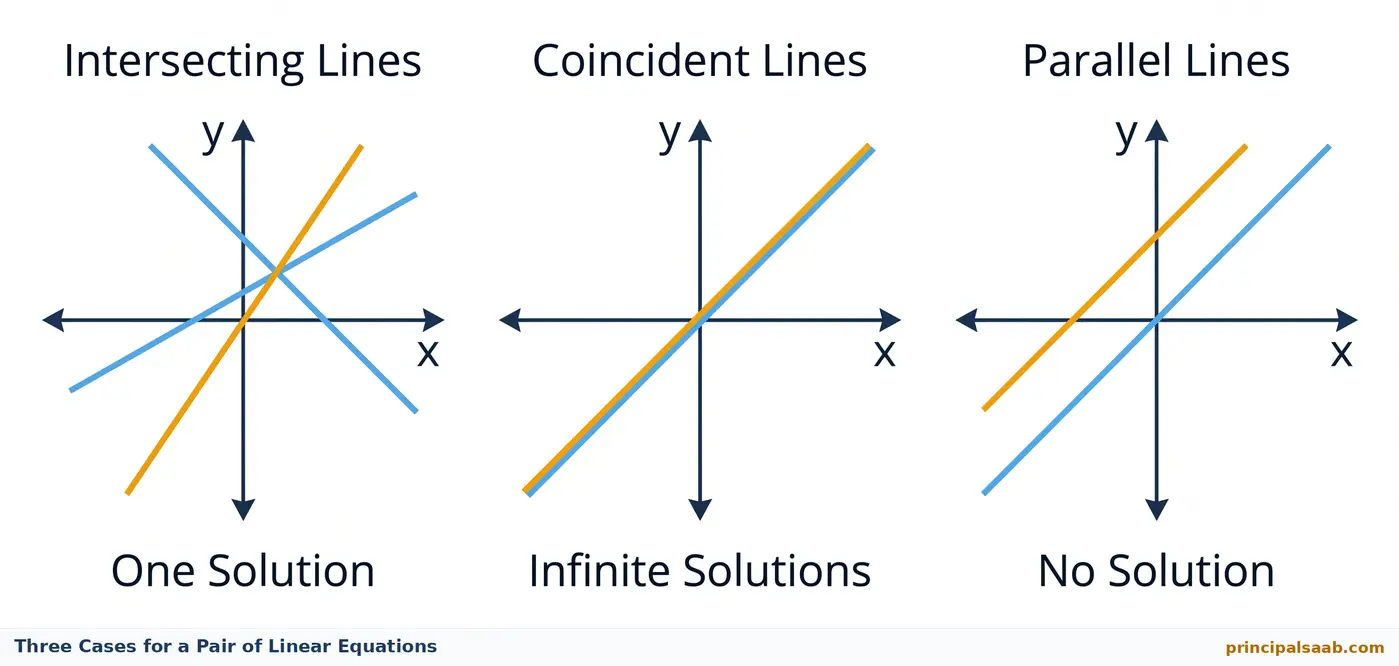
In elimination, watch the signs when you add or subtract — a wrong sign flips the whole answer. And remember: parallel lines ($\frac{a_1}{a_2} = \frac{b_1}{b_2} \ne \frac{c_1}{c_2}$) mean no solution, not infinite.
Practice Worksheet
Try each question fully on your own first, then click Show Answer to check yourself.
Q1. Solve by substitution: x + y = 7 and 2x − y = 8.
Show Answer
Q2. Solve by elimination: 3x + 2y = 12 and 5x − 2y = 4.
Show Answer
Q3. Without solving, how many solutions does 2x + 3y = 7, 4x + 6y = 14 have, and what kind of lines are they?
Show Answer
Q4. Do x + 2y = 4 and 2x + 4y = 12 have a solution?
Show Answer
Q5. The sum of two numbers is 20 and their difference is 4. Find the numbers.
Show Answer
Once these feel easy, you have genuinely finished this chapter. Do not aim for perfect on the first try — aim for one more correct question than yesterday.