
Take a breath, because this is one of the friendliest chapters in the whole Class 12 Economics course, and I am going to sit right next to you through every bit of it. Government Budget and the Economy is Unit 4 of Part A (Introductory Macroeconomics) and it usually carries about 6 marks out of the 40 marks for Part A. Six marks may not sound like a mountain, but here is the lovely part: they are among the easiest six marks in the paper. Almost everything in this chapter is either classification (deciding which box an item belongs in) or three small subtraction formulas. There is no graph you have to draw perfectly, no derivation you have to memorise. If you can sort items into the right boxes and subtract carefully, this unit turns into a guaranteed score. Let us build it from absolute zero, and please do not rush — understanding beats speed here.
- What A Government Budget Actually Is
- Objectives Of The Government Budget
- Components Of The Budget: Receipts And Expenditure
- Revenue Receipts: Tax And Non-Tax Revenue
- Direct Tax And Indirect Tax
- Capital Receipts: Borrowings, Recovery Of Loans, Disinvestment
- Revenue Expenditure And Capital Expenditure
- Balanced, Surplus And Deficit Budget
- Revenue Deficit
- Fiscal Deficit
- Primary Deficit
- The Three Deficits Compared
- How A Deficit Is Financed
- The Classification Drill: Reading A Budget Statement
- Syllabus Status And Obsolete Terms
- Practice Worksheet
Your Game Plan
- Read the first three sections slowly. They are pure meaning — no numbers — and everything later stands on them.
- Spend real time on the four boxes: revenue receipts, capital receipts, revenue expenditure, capital expenditure. Ninety per cent of your mistakes in this chapter will be a wrongly sorted item, not a wrong formula.
- Only then learn the three deficit formulas. Write each one on a card and say out loud what it means, not just what it looks like.
- Do every worked example with a pen in your hand, covering my solution first. Reading a solution feels like learning; it is not.
- Finish with the worksheet at the end. Ten questions, answers hidden until you tap. Be honest with yourself.
What A Government Budget Actually Is
Think about how a household plans a year. Suppose your family sits down in April and writes two columns on a page. On the left: money we expect to come in this year — salary, rent from the upstairs flat, interest from a fixed deposit, and maybe money we will borrow from the bank for a new scooter. On the right: money we expect to go out — groceries, school fees, electricity, EMIs, and the scooter itself. That single page is a household budget. It is not a record of what already happened; it is a plan for what is about to happen.
A government budget is exactly the same page, just enormous. It is a statement of the government’s estimated receipts and estimated expenditure for a coming financial year, which in India runs from 1 April to 31 March. In India the Union Budget is presented in Parliament by the Finance Minister, and every state government presents its own budget in its own legislature.
Three little words in that definition do a lot of work, and examiners love them:
- Estimated — these are forecasts, not final accounts. The actual figures are known only after the year ends.
- Financial year — one year, 1 April to 31 March. Not a calendar year, not five years.
- Receipts and expenditure — both sides. A budget that only lists spending is not a budget.
A government budget is an annual financial statement showing the estimated receipts and estimated expenditure of the government during a financial year. Write it exactly like that and the definition mark is yours.
Now, why does a budget matter at all? Because a government is not just a spender — it is the single largest player in the economy. When it decides to build a highway, that decision creates jobs. When it raises the tax on petrol, that decision changes what millions of families can afford. When it hands out a subsidy on fertiliser, it changes what a farmer plants. So the budget is not an accounting document sitting in a cupboard. It is a steering wheel. The rest of this chapter is really about learning to read that steering wheel.
(a) Goods and Services Tax collected from shops
(b) Salary paid to a government school teacher
(c) Money borrowed by the government from the Reserve Bank of India
(d) Subsidy given on cooking gas
(e) Money the government gets by selling part of its shareholding in a public sector company
How to think about it. Ask one simple question about each item: does money walk into the government treasury, or walk out of it? That is the whole test at this stage. Do not worry yet about which kind of receipt or expenditure it is.
Answer.
(a) Receipt — tax money comes in.
(b) Expenditure — salary goes out.
(c) Receipt — the borrowed money comes in. (Yes, even though it must be repaid later. Hold that thought; it becomes important in the very next sections.)
(d) Expenditure — the subsidy goes out.
(e) Receipt — sale proceeds come in.
Why it works. The budget is built on the direction of cash flow first, and only afterwards on the nature of that flow. Getting the direction right is step one, and it is genuinely this easy. Everything difficult in this chapter is step two.
The old Five Year Plans were long-term development documents. The budget is an annual financial statement. If a question says “annual financial statement of estimated receipts and expenditure”, the answer is government budget.
Objectives Of The Government Budget
Why does a government bother writing this document every single year? Because it wants to do five specific things with it. Learn these five as five different jobs the same tool can perform, the way one smartphone can be a torch, a camera, a map and an alarm clock.
| Objective | What the government is trying to do | Budget tool it uses |
|---|---|---|
| Reallocation of resources | Push resources towards goods society needs and away from goods that harm it, because a free market alone will not do this. | Subsidies and tax concessions to encourage; heavy taxes to discourage; direct government production. |
| Redistribution of income and wealth | Narrow the gap between rich and poor so that growth is shared. | Progressive taxes on high incomes; transfer payments, free rations, scholarships and subsidies for low-income households. |
| Economic stability | Keep the economy off the roller-coaster of runaway inflation and deep unemployment. | Cut spending and raise taxes when demand is too high; raise spending and cut taxes when demand is too low. |
| Economic growth | Raise the economy’s long-run capacity to produce. | Spending on roads, ports, power, schools and hospitals; tax reliefs that encourage saving and investment. |
| Management of public enterprises | Run enterprises the private sector would either neglect or monopolise, especially natural monopolies. | Budget allocations to public sector undertakings such as railways and power utilities. |
Notice a pattern: the government has essentially two levers — what it taxes and what it spends on — and it pulls those two levers in different combinations to achieve all five objectives. That is the whole of fiscal policy in one sentence.
Model answer, with the marks marked up.
[1 mark — the statement of the objective] One important objective of the government budget is the redistribution of income and wealth, that is, reducing the gap between high-income and low-income households.
[1 mark — the tax side, explained] On the receipts side the government uses a progressive tax structure, in which the rate of tax rises as income rises. A household earning a very high income therefore surrenders a larger proportion of that income than a household earning a modest one, which pulls down inequality in disposable income.
[1 mark — the expenditure side, explained with an example] On the expenditure side the government spends on transfer payments and subsidised services aimed at poorer households — for example, subsidised food grain, free treatment in government hospitals, and scholarships for students from low-income families. These raise the real standard of living of the poor without any matching contribution from them, so the gap narrows from the other end as well.
Why this earns full marks. Look at the shape: name the objective, explain the tax side, explain the expenditure side with one concrete example. Most students lose a mark here by writing only about taxes. Redistribution always has two arms. Whenever a 3-mark question asks you to “explain” something, aim for exactly this: one sentence of definition and two sentences of genuine explanation, at least one of which carries an example.
Model answer, with the marks marked up.
[1 mark — identify the problem] Excess demand means aggregate demand exceeds the level of aggregate supply corresponding to full employment. Output cannot rise further, so the excess spending only pushes the price level up, causing inflation. The budget is used here to pursue the objective of economic stability.
[1 mark — expenditure measure] The government reduces its own expenditure, for example by postponing non-essential construction projects and trimming subsidies. Since government spending is itself a component of aggregate demand, cutting it lowers aggregate demand directly.
[1 mark — tax measure] The government raises taxes. Higher direct taxes reduce households’ disposable income, so consumption spending falls; higher indirect taxes raise prices of goods and discourage purchases. Either way aggregate demand is pulled down.
[1 mark — link back to the outcome] Both measures together shift aggregate demand downwards until it matches full-employment output, and the inflationary gap is closed. This is called a contractionary or surplus-oriented fiscal stance.
Why this earns full marks. A 4-mark question almost always wants four distinct scoring points, not four sentences on the same point. Here the four are: define the problem, expenditure measure, tax measure, final outcome. Practise counting your own points before you finish writing — if you cannot count four, you have not written four.
Reallocation is about which goods get produced (more schools, fewer cigarettes). Redistribution is about who gets the income (less to the very rich, more to the very poor). Students swap these two constantly. A quick check: if the sentence is about a type of good, it is reallocation; if it is about a type of person, it is redistribution.
Components Of The Budget: Receipts And Expenditure
Here is the map of the entire chapter on one page. The budget splits into two halves, and each half splits into two more. Four boxes in total. Every single item you will ever be asked to classify lands in exactly one of those four boxes.
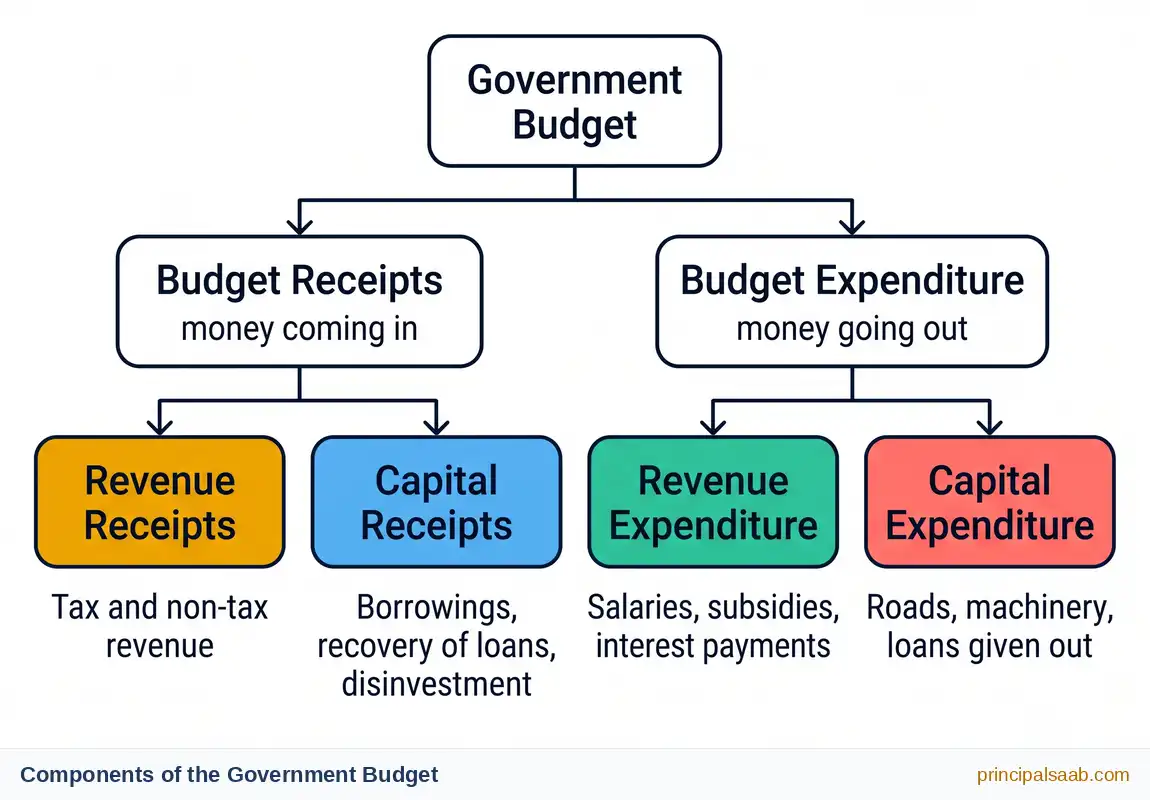
| Half of the budget | Box 1 | Box 2 |
|---|---|---|
| Budget Receipts (money coming in) | Revenue Receipts — tax revenue and non-tax revenue | Capital Receipts — borrowings, recovery of loans, disinvestment of public sector equity |
| Budget Expenditure (money going out) | Revenue Expenditure — salaries, subsidies, interest payments, grants | Capital Expenditure — roads, machinery, loans given out, repayment of loans |
Everything now depends on one question, and I want you to memorise it as a sentence you can whisper to yourself in the exam hall:
An item is capital if it does either of these two things:
(1) it creates or reduces a liability (a debt), or
(2) it creates or reduces an asset.
If it does neither — no change in liabilities and no change in assets — it is revenue.
Learn it as: “Does it touch the balance sheet? If yes, capital. If no, revenue.”
Let me show you why this test is so powerful. Take tax revenue. When the government collects income tax, does it owe you anything back? No. Has it lost an asset? No. So no liability, no asset — it is a revenue receipt. Now take borrowing. When the government borrows, does it owe money back? Yes, absolutely. A liability has been created. So borrowing is a capital receipt, even though it puts cash in the same treasury the same way a tax does.
The same test works on the spending side. A teacher’s salary buys nothing that lasts and repays no debt — revenue expenditure. Building a bridge creates an asset — capital expenditure. Repaying the principal on an old loan reduces a liability — capital expenditure. Take a moment with that. If this test clicks now, the rest of the chapter takes care of itself.
In the board exam, “capital receipt” alone often gets half a mark. “Capital receipt, because it creates a liability for the government” gets the full mark. The reason is worth as much as the label. Train yourself to always write both.
Revenue Receipts: Tax And Non-Tax Revenue
A revenue receipt is money that comes into the government treasury and (a) creates no liability, and (b) causes no reduction in assets. It is income the government simply gets to keep. Revenue receipts split neatly into two families.
Family one: tax revenue. A tax is a compulsory payment to the government for which the payer receives no direct, specific service in return. Read that phrase again — no direct return. When you pay income tax you do not get a personal receipt entitling you to a particular road. That is precisely what distinguishes a tax from a fee. Examples: income tax, corporation tax, Goods and Services Tax (GST), customs duty, excise duty on petroleum products.
Family two: non-tax revenue. This is everything else the government earns without borrowing and without selling an asset. The main kinds are:
- Fees — a payment for a specific service rendered, such as a passport fee or a court fee.
- Fines and penalties — money collected for breaking the law, such as a traffic challan.
- Interest receipts — interest earned on loans the government has given to state governments, to public enterprises or to other countries.
- Profits and dividends — the share of profits received from public sector undertakings and from the Reserve Bank of India.
- Escheat — property that falls to the government when a person dies leaving no legal heir and no will.
- Grants received — gifts and aid received from foreign governments or international bodies, typically during a natural disaster. These carry no repayment obligation, so they are revenue receipts.
- Special assessment — a charge on property owners whose land values rise because of a government project nearby.
Interest received by the government is a non-tax revenue receipt. Interest paid by the government is a revenue expenditure. Same word, opposite sides of the budget. Students routinely put one of them in the wrong column under exam pressure. Underline the direction word before you classify.
(i) Corporation tax — 620
(ii) Loans taken from the World Bank — 250
(iii) Fees collected for issuing passports — 45
(iv) Sale of shares of a public sector undertaking — 180
(v) Interest received on loans given to state governments — 70
(vi) Recovery of a loan from a state government — 130
(vii) Goods and Services Tax — 890
Step 1 — classify, with the reason written next to each item. This is the step almost everyone skips, and it is the step that earns the marks.
• Corporation tax 620 → revenue receipt. A tax; no liability created, no asset lost.
• Loans from World Bank 250 → capital receipt. Creates a liability.
• Passport fees 45 → revenue receipt. Non-tax revenue; no liability, no asset lost.
• Sale of PSU shares 180 → capital receipt. This is disinvestment; it reduces the government’s assets.
• Interest received 70 → revenue receipt. Non-tax revenue; the principal is untouched, so no asset is reduced.
• Recovery of loan 130 → capital receipt. The loan given out was an asset of the government; getting it back reduces that asset.
• GST 890 → revenue receipt. A tax.
Step 2 — add up each box.
Revenue receipts = 620 + 45 + 70 + 890 = ₹1,625 crore
Capital receipts = 250 + 180 + 130 = ₹560 crore
(Cross-check: total receipts = 1,625 + 560 = ₹2,185 crore, which equals the sum of all seven items. If your two boxes do not add back to the grand total, you have dropped an item.)
Why it works. Notice items (v) and (vi) sitting side by side deliberately. Interest received leaves the loan itself intact, so nothing on the asset side changes — revenue. Recovery of the loan hands back the principal, so the “loan given” asset shrinks — capital. Same borrower, same relationship, two different boxes. If you can explain that pair to a friend, you have understood revenue versus capital receipts.
Model answer, with the marks marked up.
[1 mark — the criterion] A receipt is classified as a revenue receipt only if it neither creates a liability for the government nor causes any reduction in the government’s assets. The direction of cash flow is not the test; the effect on liabilities and assets is.
[1 mark — apply it to borrowing] When the government borrows — from the public through bonds, from the Reserve Bank, or from abroad — it takes on an obligation to repay the principal along with interest. A liability is therefore created, which fails the test.
[1 mark — conclude and contrast] Borrowing is accordingly classified as a capital receipt. A tax, by contrast, creates no such obligation: the government owes the taxpayer nothing in return, so tax collections remain revenue receipts even though both bring in cash.
Why this earns full marks. The examiner is testing whether you know the criterion, not just the label. Any answer that begins “because borrowing has to be repaid” and stops there will get partial credit at best. Always state the general rule first, then apply it, then conclude. That three-move structure is worth practising on every “why” question in this chapter.
Direct Tax And Indirect Tax
Tax revenue itself splits into two types, and the dividing line is one idea: can the burden of the tax be passed on to somebody else? Economists call this “shifting the incidence”.
A direct tax is one where the person legally liable to pay the tax is also the person who actually bears its burden. The burden cannot be shifted. If you earn a salary and pay income tax on it, you cannot hand that bill to your grocer. Examples: income tax, corporation tax, and (historically) wealth tax and gift tax.
An indirect tax is one where the person who deposits the tax with the government and the person who finally bears it are different. The burden can be shifted. A shopkeeper deposits GST with the government, but she has already added it to the price on your bill, so the burden lands on you. Examples: GST, customs duty on imports, excise duty on petrol and diesel.
| Basis | Direct Tax | Indirect Tax |
|---|---|---|
| Shifting of burden | Cannot be shifted; impact and incidence fall on the same person. | Can be shifted; impact and incidence fall on different persons. |
| Levied on | Income, profits and wealth of a person or firm. | Goods and services, at the point of production, sale or import. |
| Effect on inequality | Usually progressive, so it reduces inequality. | Tends to be regressive, because rich and poor pay the same amount on the same item. |
| Examples | Income tax, corporation tax. | GST, customs duty, excise duty. |
Income tax 540; Goods and Services Tax 780; Corporation tax 610; Customs duty 260; Excise duty on petrol 150.
Step 1 — classify with the shifting test.
• Income tax 540 → direct. Levied on a person’s income; burden stays with that person.
• GST 780 → indirect. Deposited by the seller, borne by the buyer through a higher price.
• Corporation tax 610 → direct. Levied on a company’s profits; the company bears it.
• Customs duty 260 → indirect. Paid by the importer, passed on in the selling price.
• Excise duty on petrol 150 → indirect. Paid by the oil company, passed on at the pump.
Step 2 — total each group.
Direct tax revenue = 540 + 610 = ₹1,150 crore
Indirect tax revenue = 780 + 260 + 150 = ₹1,190 crore
Total tax revenue = 1,150 + 1,190 = ₹2,340 crore
Why it works. Every single item here is a revenue receipt — the direct-versus-indirect split is a division inside tax revenue, not a competitor to the revenue-versus-capital split. Keep the two classifications on separate shelves in your head and you will never muddle them.
Capital Receipts: Borrowings, Recovery Of Loans, Disinvestment
A capital receipt is money coming into the treasury that either creates a liability or reduces an asset. There are only three you need for the board exam, and it is worth learning them as a set of three, because a favourite exam question asks you to tell them apart.
- Borrowings. Money raised from the public (through bonds and small savings), from the Reserve Bank of India, or from foreign governments and institutions. Creates a liability. The government must repay.
- Recovery of loans. Money coming back from state governments, public enterprises or foreign governments to whom the central government had earlier lent. Reduces an asset — the “loans advanced” that stood on the government’s books shrink.
- Disinvestment. The government sells part or whole of its shareholding in a public sector undertaking. Reduces an asset — the government owns less of that company afterwards.
Of the three capital receipts, only borrowings create debt. Recovery of loans and disinvestment do not — they simply convert an asset into cash. Together these two are called non-debt capital receipts. Remember this phrase now: it is the single most important idea when you reach the fiscal deficit formula in a few sections’ time.
| Basis | Revenue Receipts | Capital Receipts |
|---|---|---|
| Effect on liabilities | Create no liability for the government. | May create a liability (borrowings do). |
| Effect on assets | Cause no reduction in government assets. | May reduce government assets (recovery of loans, disinvestment). |
| Nature | Regular and recurring; expected year after year. | Largely irregular and non-recurring. |
| Shown in | The revenue account of the budget. | The capital account of the budget. |
| Examples | Income tax, GST, passport fees, fines, interest received, dividends from PSUs, foreign grants received. | Market borrowings, loans from the RBI, external loans, recovery of loans, disinvestment proceeds. |
Model answer, with the marks marked up.
[1 mark — take a clear stand] No, I do not agree with the statement. A capital receipt is one that either creates a liability or causes a reduction in assets; it need not do both, and it need not create a liability at all.
[1 mark — the case that supports the statement] Borrowings are indeed a liability-creating capital receipt. When the government issues bonds or takes a loan from the Reserve Bank, it becomes obliged to repay the principal with interest, so its liabilities rise.
[1 mark — the first counter-example] Recovery of loans, however, creates no liability at all. The government had earlier lent money, which stood as an asset in its books; when the borrower repays, that asset simply falls and cash rises. Liabilities are untouched.
[1 mark — the second counter-example and conclusion] Disinvestment is the same story: by selling its shareholding in a public sector undertaking the government reduces its own assets and receives cash, without owing anyone anything. Since recovery of loans and disinvestment are capital receipts that do not increase liabilities, the statement is false. They are called non-debt capital receipts for exactly this reason.
Why this earns full marks. For a “do you agree” question, the marking scheme almost always wants: a clear verdict, the criterion, and at least one properly explained counter-example. Never begin with the explanation and leave the verdict to be guessed — put “No, I do not agree” as your very first words. And notice that a false statement is best demolished with a concrete counter-example, not with a general protest.
Disinvestment is not the government losing money. It is the government converting one asset (shares) into another (cash). It is a capital receipt because the asset side shrinks, not because anything bad happened.
Revenue Expenditure And Capital Expenditure
Flip the budget over and the same test applies to spending, just mirrored.
Revenue expenditure is spending that neither creates an asset for the government nor reduces any of its liabilities. It is the cost of simply running the country for a year. Salaries and pensions of government employees, interest paid on public debt, subsidies on food and fertiliser, defence running costs, and grants given to state governments that do not create assets — all revenue expenditure. Every rupee of it is gone by 31 March, with nothing on the books to show for it except a functioning country. That is not a criticism; it is simply what the category means.
Capital expenditure is spending that either creates an asset for the government or reduces a liability. Building a national highway, buying machinery for a government hospital, purchasing land for a new airport, giving a loan to a state government (which creates a “loan receivable” asset), and repaying the principal of an old loan (which reduces a liability) — all capital expenditure.
Interest paid on a loan is revenue expenditure: it changes nothing on the balance sheet, you still owe exactly the same principal afterwards. Repayment of the principal is capital expenditure: the liability actually shrinks. Two payments, made on the same day, to the same lender, in two different boxes. Examiners set this trap almost every year.
| Basis | Revenue Expenditure | Capital Expenditure |
|---|---|---|
| Effect on assets | Creates no asset for the government. | Either creates an asset or increases the value of one. |
| Effect on liabilities | Causes no reduction in liabilities. | May reduce a liability (repayment of loan principal). |
| Nature | Recurring; incurred year after year to keep services running. | Largely non-recurring; tied to specific projects or repayments. |
| Productive value | Maintains the existing capacity of the economy. | Adds to the future productive capacity of the economy. |
| Examples | Salaries, pensions, interest payments, subsidies, defence running costs, grants not creating assets. | Highways and bridges, machinery and equipment, purchase of land, loans given to states, repayment of loan principal. |
(i) Salaries of government employees — 820
(ii) Construction of a national highway — 640
(iii) Interest paid on public debt — 375
(iv) Purchase of machinery for a government hospital — 210
(v) Subsidy on fertilisers — 290
(vi) Loan given to a state government — 160
(vii) Grants given to state governments for flood relief (creating no asset) — 145
Step 1 — classify, with the reason.
• Salaries 820 → revenue. No asset created, no liability reduced.
• Highway 640 → capital. A physical asset is created.
• Interest paid 375 → revenue. The principal owed is unchanged, so no liability is reduced.
• Hospital machinery 210 → capital. An asset is created.
• Fertiliser subsidy 290 → revenue. Money transferred out, nothing owned in return.
• Loan given to a state 160 → capital. The government now owns a claim on that state — an asset.
• Relief grants 145 → revenue. The question tells you explicitly that no asset is created; obey that instruction.
Step 2 — total each box.
Revenue expenditure = 820 + 375 + 290 + 145 = ₹1,630 crore
Capital expenditure = 640 + 210 + 160 = ₹1,010 crore
Cross-check: total expenditure = 1,630 + 1,010 = ₹2,640 crore, matching the sum of all seven items.
Why it works. Item (vii) is the one to study. Grants to states are sometimes revenue expenditure and sometimes capital expenditure, and the deciding factor is whether an asset is created. Board questions always give you the extra phrase — “for creation of capital assets” or “not creating assets” — so read the item description to the very last word before you place it.
Paying a teacher’s salary is revenue expenditure; constructing a school building is capital expenditure. Both improve human capital in the long run, but the classification depends purely on whether a physical or financial asset appears on the government’s books. Do not let the word “productive” pull you off the rule.
Balanced, Surplus And Deficit Budget
Before we get to the three famous deficits, there is a simpler comparison to make: total estimated receipts against total estimated expenditure.
- Balanced budget: estimated receipts = estimated expenditure. The government neither adds to demand nor subtracts from it in a net sense.
- Surplus budget: estimated receipts > estimated expenditure. The government takes more out of the economy than it puts back, so aggregate demand falls. Useful during inflation.
- Deficit budget: estimated receipts < estimated expenditure. The government puts more into the economy than it takes out, so aggregate demand rises. Useful during a depression or recession, when unemployment is high.
In a developing economy with unused capacity and unemployment, a deficit budget is often deliberately chosen, because the extra government spending raises demand, output and employment. The real question is never “is there a deficit?” but “what is the borrowed money being spent on?” Borrowing to build a port is very different from borrowing to pay salaries.
Revenue Deficit
Now we arrive at the part everybody worries about, and I promise you it is far gentler than its reputation. A “deficit” here just means a shortfall — one number minus another number. The only thing that separates the three deficits is which two numbers you subtract.
Revenue deficit is the excess of the government’s revenue expenditure over its revenue receipts.
Revenue Deficit = Revenue Expenditure − Revenue Receipts
(It counts only if the answer is positive. If revenue receipts exceed revenue expenditure, you have a revenue surplus.)
What does it actually mean? Go back to the household. Revenue receipts are your salary; revenue expenditure is your groceries, rent and electricity. A revenue deficit means your monthly running costs exceed your monthly salary. To survive, you must either borrow or sell something you own. Neither is a disaster once, but as a permanent habit it is dangerous, because you are borrowing to consume, not to build anything that will earn later.
That is precisely the implication for a government. A revenue deficit signals that the government is not even meeting its day-to-day running costs from its regular income. It must therefore either borrow (raising future liabilities and future interest payments) or disinvest (selling public assets). Because the borrowed money is being consumed rather than invested, a high revenue deficit is generally treated as a warning light. It also means the government has less room left to spend on capital projects, so future growth suffers.
Tax revenue 1,450; Non-tax revenue 260; Revenue expenditure 2,090; Capital expenditure 900; Borrowings 700.
Step 1 — pick out only the revenue-side items. This is where the marks are won or lost. Capital expenditure and borrowings appear in the data purely as distractors; the revenue deficit formula does not touch them.
Revenue receipts = Tax revenue + Non-tax revenue = 1,450 + 260 = ₹1,710 crore
Revenue expenditure = ₹2,090 crore (given directly)
Step 2 — subtract.
Revenue Deficit = Revenue Expenditure − Revenue Receipts
= 2,090 − 1,710 = ₹380 crore
Step 3 — say what it means. The government’s day-to-day running expenses exceed its regular income by ₹380 crore. It must cover that gap by borrowing or by selling assets, and since the money is going into consumption rather than asset creation, it adds to future liabilities without adding to future earning power.
Why it works. Almost every board numerical on revenue deficit hands you at least one capital-side figure you must ignore. Train the habit: before touching your calculator, put a small “R” beside every revenue item and a “C” beside every capital item. Then use only the R items. That single habit removes most of the errors students make here.
Write the formula on its own line before substituting numbers. In CBSE marking schemes the correct formula usually carries a mark of its own, so even if you slip on the arithmetic, that mark is still yours.
Fiscal Deficit
This is the big one, and the one examiners love most. Fiscal deficit is the excess of the government’s total expenditure over its total receipts excluding borrowings.
(1) Fiscal Deficit = Total Expenditure − Total Receipts other than Borrowings
(2) Fiscal Deficit = Total Expenditure − (Revenue Receipts + Non-Debt Capital Receipts)
(3) Fiscal Deficit = Borrowings
All three give the same number. Form (2) is the one to use when a question lists items; form (3) is the one that tells you what the number means.
Why do we deliberately leave borrowings out of receipts? Because the whole point of the exercise is to find out how much the government needs to borrow. If you included borrowings on the receipts side, receipts and expenditure would always balance exactly and the deficit would always be zero — a perfectly useless number. Leaving borrowings out is what makes fiscal deficit meaningful: it is the government’s total borrowing requirement for the year.
The implications of a large fiscal deficit are worth learning as a short list, because 4- and 6-mark questions ask for them directly:
- Debt trap. Today’s borrowing becomes tomorrow’s interest payment, which pushes up tomorrow’s expenditure, which forces more borrowing. A government can circle in this loop for years.
- Inflationary pressure. If the deficit is financed by borrowing from the central bank, money supply expands, and if output cannot keep pace, prices rise.
- Crowding out. Heavy government borrowing from the market absorbs the pool of savings and can push interest rates up, leaving less and dearer finance for private investment.
- Burden on future generations. The principal and interest will be repaid out of taxes collected years from now, from people who had no say in today’s spending.
- Loss of external autonomy. Large borrowing from foreign lenders can come with conditions attached to domestic policy.
Tax revenue 1,200; Non-tax revenue 300; Recovery of loans 100; Disinvestment 120; Borrowings 730; Revenue expenditure 2,000; Capital expenditure 450; Interest payments 250.
Step 1 — classify every item before calculating anything.
• Tax revenue 1,200 → revenue receipt
• Non-tax revenue 300 → revenue receipt
• Recovery of loans 100 → capital receipt, non-debt
• Disinvestment 120 → capital receipt, non-debt
• Borrowings 730 → capital receipt, debt-creating
• Revenue expenditure 2,000 and Capital expenditure 450 → the two halves of total expenditure
• Interest payments 250 → note carefully: this is already inside revenue expenditure. It is given separately only because the primary deficit formula needs it. Never add it again.
Step 2 — the totals.
(i) Revenue receipts = 1,200 + 300 = ₹1,500 crore
(ii) Capital receipts = 100 + 120 + 730 = ₹950 crore
Total receipts = 1,500 + 950 = ₹2,450 crore
Total expenditure = 2,000 + 450 = ₹2,450 crore
Step 3 — revenue deficit.
= Revenue Expenditure − Revenue Receipts = 2,000 − 1,500 = ₹500 crore
Step 4 — fiscal deficit.
Non-debt capital receipts = Recovery of loans + Disinvestment = 100 + 120 = ₹220 crore
= Total Expenditure − (Revenue Receipts + Non-Debt Capital Receipts)
= 2,450 − (1,500 + 220) = 2,450 − 1,720 = ₹730 crore
Check: fiscal deficit should equal borrowings, and borrowings were given as 730. They match, so the working is sound. Always run this check — it is free marks insurance.
Step 5 — primary deficit.
= Fiscal Deficit − Interest Payments = 730 − 250 = ₹480 crore
Why it works. The fiscal deficit deliberately keeps recovery of loans and disinvestment on the receipts side, because those are real resources the government raised without borrowing. Only borrowings are excluded. Get that one distinction right and this entire question type becomes routine.
The trap. A careless student writes: fiscal deficit = 4,300 − (2,800 + 1,500) = 0, and concludes there is no deficit. That answer is wrong, and it is wrong for an instructive reason: the ₹1,500 crore of capital receipts already includes the borrowings, and the whole definition of fiscal deficit says borrowings must be taken out.
Step 1 — strip the borrowings out.
Non-debt capital receipts = Capital receipts − Borrowings = 1,500 − 1,100 = ₹400 crore
Step 2 — apply the formula.
Fiscal Deficit = Total Expenditure − (Revenue Receipts + Non-Debt Capital Receipts)
= 4,300 − (2,800 + 400) = 4,300 − 3,200 = ₹1,100 crore
Check: equal to borrowings of ₹1,100 crore. Correct.
Why it works. Whenever the words “of which borrowings are” appear in a question, a subtraction is being asked of you before the formula even starts. And notice what the first, wrong answer implied: that total receipts always equal total expenditure. They do, of course — that is exactly why we must exclude borrowings, or the fiscal deficit would be zero for every government on earth.
Primary Deficit
Here is the question that primary deficit answers. A government’s borrowing this year is partly caused by this year’s decisions and partly by past decisions — because a chunk of today’s spending is simply interest on loans taken by earlier governments. Nobody sitting in office today can undo that interest bill. So it is fair to ask: if we ignore the inherited interest burden, is this government still borrowing?
Primary Deficit = Fiscal Deficit − Interest Payments
Rearranged, this also gives you two exam-friendly forms:
Fiscal Deficit = Primary Deficit + Interest Payments
Interest Payments = Fiscal Deficit − Primary Deficit
Think of it as a family that took a home loan years ago. Their total borrowing need this year is the fiscal deficit. Strip out the EMI interest they must pay on that old loan, and whatever borrowing is still left is caused by their present lifestyle. That remainder is the primary deficit. It is therefore a measure of the government’s current fiscal discipline, cleaned of the past.
Two readings follow naturally, and both are worth memorising:
- Zero primary deficit means the government is borrowing only to meet its interest obligations. Its current spending is fully covered by its current resources; the entire borrowing is inherited.
- A negative primary deficit is called a primary surplus. It means the government’s current receipts more than cover its current spending, and part of the old interest bill is being paid out of current resources rather than fresh borrowing. That is a healthy sign.
(a) Fiscal deficit 6,400; Interest payments 4,900
(b) Fiscal deficit 1,400; Interest payments 1,400
(c) Fiscal deficit 1,200; Interest payments 1,400
(a) Primary Deficit = 6,400 − 4,900 = ₹1,500 crore.
Interpretation: of every rupee borrowed, a large part goes to servicing old debt, but ₹1,500 crore of the borrowing is still driven by current spending decisions. There is a genuine primary deficit.
(b) Primary Deficit = 1,400 − 1,400 = ₹0.
Interpretation: the government is borrowing purely to pay interest on past loans. Its own current expenditure is entirely financed from current receipts. This is the textbook case of a zero primary deficit.
(c) Primary Deficit = 1,200 − 1,400 = −₹200 crore, that is, a primary surplus of ₹200 crore.
Interpretation: the government’s current receipts exceed its current (non-interest) spending by ₹200 crore, so it is even chipping in towards the inherited interest bill out of its own resources. It is borrowing less than the interest it owes.
Why it works. In case (c) do not panic and flip the subtraction to get a positive number. A negative primary deficit is a real, correct, meaningful answer, and CBSE questions are set precisely to see whether you will report it honestly and name it a primary surplus. Write the minus sign and then write the sentence explaining it.
(i) Interest payments. Rearrange the primary deficit formula.
Interest Payments = Fiscal Deficit − Primary Deficit = 8,000 − 5,500 = ₹2,500 crore
(ii) Revenue expenditure. Rearrange the revenue deficit formula.
Revenue Expenditure = Revenue Deficit + Revenue Receipts = 3,000 + 20,000 = ₹23,000 crore
(iii) Total expenditure. Rearrange the fiscal deficit formula.
Fiscal Deficit = Total Expenditure − (Revenue Receipts + Non-Debt Capital Receipts)
so Total Expenditure = Fiscal Deficit + Revenue Receipts + Non-Debt Capital Receipts
= 8,000 + 20,000 + 1,200 = ₹29,200 crore
(iv) Capital expenditure. Total expenditure has only two parts.
Capital Expenditure = Total Expenditure − Revenue Expenditure = 29,200 − 23,000 = ₹6,200 crore
Why it works. Every formula in this chapter is a simple equation with three quantities, so knowing any two always gives you the third. Rather than memorising six rearranged versions, memorise the three original formulas and practise moving terms across the equals sign. That is one skill instead of six, and it never lets you down when a question is worded backwards.
When a question gives revenue expenditure and separately gives interest payments, the interest is already sitting inside that revenue expenditure figure. It is listed separately only so that you can compute the primary deficit. Adding it a second time inflates both your total expenditure and your fiscal deficit, and it costs several marks in one stroke.
The Three Deficits Compared
Put the three side by side and the logic becomes obvious. Each one asks a slightly different question about the same budget.
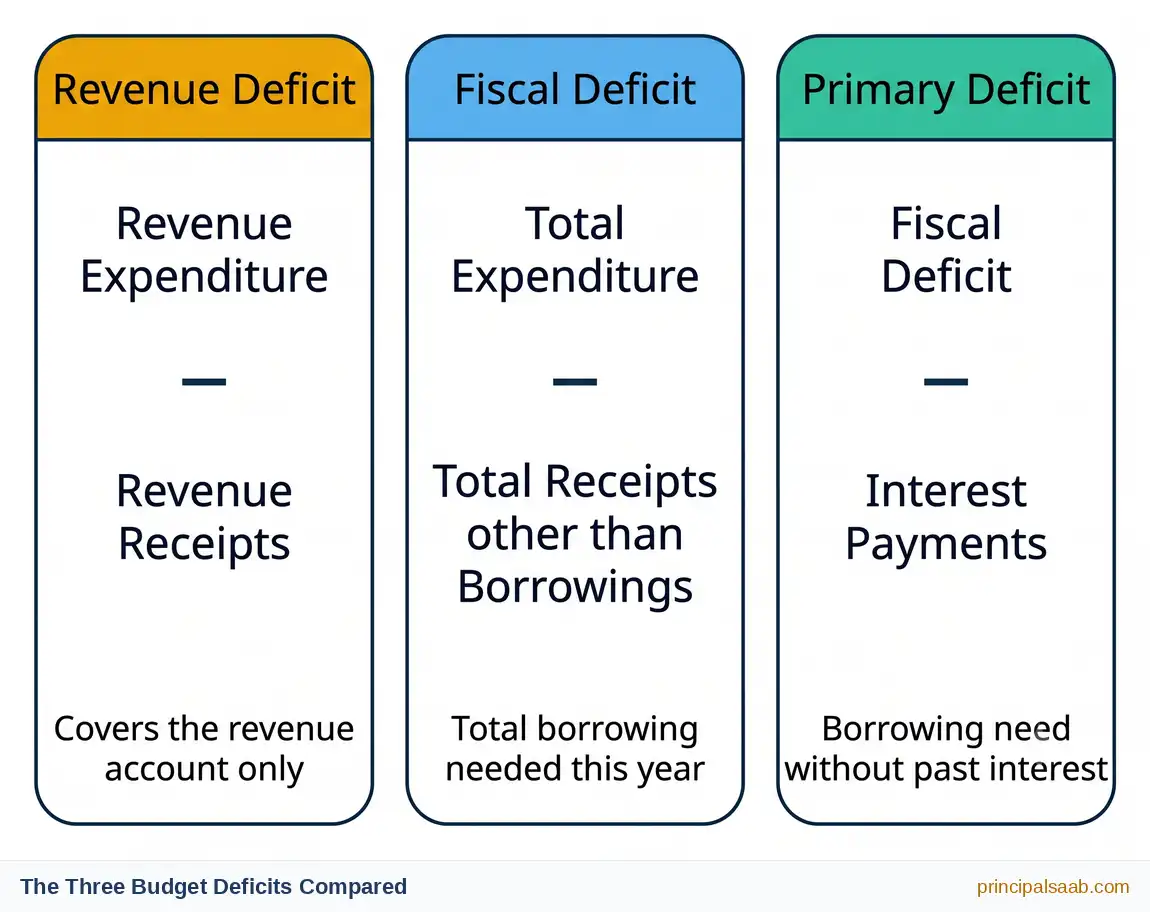
| Basis | Revenue Deficit | Fiscal Deficit | Primary Deficit |
|---|---|---|---|
| Formula | Revenue Expenditure − Revenue Receipts | Total Expenditure − Total Receipts other than Borrowings | Fiscal Deficit − Interest Payments |
| Question it answers | Can the government meet its day-to-day running costs from its regular income? | How much does the government need to borrow this year in total? | How much would it still need to borrow if the inherited interest bill did not exist? |
| Part of the budget covered | Revenue account only. | The whole budget, revenue plus capital. | The whole budget, minus past interest obligations. |
| What it signals | Borrowing is financing consumption; dissaving by the government. | Total borrowing requirement; risk of a debt trap, inflation and crowding out. | Current fiscal discipline of the government in office. |
| Relative size | Can be smaller or larger than primary deficit; depends on the data. | Always the largest of the three whenever interest payments are positive. | Always smaller than fiscal deficit; can be zero or negative. |
(a) Fiscal deficit as a percentage of GDP = (17,64,000 ÷ 3,60,00,000) × 100 = 4.9 per cent.
Why we do this: an absolute deficit figure means nothing on its own — a ₹1 lakh crore deficit is enormous for a small economy and modest for a large one. Expressing it as a share of GDP makes the number comparable across countries and across years. This ratio is the headline figure quoted every Budget day.
(b) Revenue deficit as a percentage of fiscal deficit = (500 ÷ 730) × 100 = 68.49 per cent (rounded to two decimals).
Primary deficit as a percentage of fiscal deficit = (480 ÷ 730) × 100 = 65.75 per cent.
Comment: roughly 68 paise of every rupee borrowed is going into revenue (consumption) spending rather than asset creation. That is the number a finance minister would be uncomfortable about, because borrowing for consumption builds liabilities without building capacity. The primary deficit at about 66 per cent of the fiscal deficit also tells us that only about a third of the borrowing is explained by inherited interest — the rest reflects current decisions.
Why it works. Ratios turn raw numbers into judgements. In case-based questions CBSE increasingly asks not just “calculate” but “what does this tell you”, and the ratio is usually the fastest route to a defensible answer.
Model answer, with the marks marked up.
[1 mark — definition] Fiscal deficit is the excess of the government’s total expenditure over its total receipts excluding borrowings. Symbolically, Fiscal Deficit = Total Expenditure − (Revenue Receipts + Non-Debt Capital Receipts). It therefore measures the total borrowing requirement of the government for the financial year.
[1 mark — why borrowings are excluded] Borrowings are deliberately left out of receipts because the very purpose of the measure is to reveal how much the government must borrow. Including them would make receipts equal expenditure by definition, and the deficit would always be zero.
[1 mark — implication: debt trap] A persistently large fiscal deficit builds up public debt. The interest on that debt swells future revenue expenditure, which forces still more borrowing. The economy can slip into a debt trap in which fresh loans are taken merely to service old ones.
[1 mark — implication: inflation] If the deficit is financed by borrowing from the central bank, fresh money enters circulation. When this rise in money supply is not matched by a rise in output, aggregate demand outruns aggregate supply and the general price level rises.
[1 mark — implication: crowding out] Heavy government borrowing from the domestic market absorbs a large share of available savings and can push interest rates upward. Private firms then find credit scarcer and costlier, so private investment is crowded out and long-run growth suffers.
[1 mark — implication: burden on the future and external dependence] Since the loans and the interest on them will be repaid from taxes collected in later years, the burden falls on a future generation that had no voice in today’s decisions. Where borrowing is external, repayment obligations in foreign currency can also reduce the country’s policy independence.
Why this earns full marks. A 6-mark question needs six distinct, developed points — not six sentences circling the same idea. Here the plan is: definition, one clarifying point, then four separate implications, each named and then explained in one further sentence. Write the name of each implication in the first three words of its point (debt trap, inflation, crowding out, future burden). Examiners scan for those keywords, and a well-signposted answer is a well-marked answer.
How A Deficit Is Financed
A deficit is not a wish; it is a gap that somebody must actually fill with real money by 31 March. There are three doors the government can walk through, and each has a different consequence.
- Borrowing from the public and from banks (market borrowing). The government issues bonds and treasury bills which households, banks, insurance companies and mutual funds buy. This does not create new money — existing savings simply change hands. The risk here is crowding out: the pool of savings available to private borrowers shrinks and interest rates can rise.
- Borrowing from the central bank (deficit financing, sometimes called monetisation). The Reserve Bank creates fresh money and lends it to the government. The mechanics of how the central bank creates and controls that money are covered in Money and Banking — Class 12 Economics notes. This is the quickest door and the most dangerous one, because new money enters circulation without any matching rise in output. Sustained use is straightforwardly inflationary.
- External borrowing. Loans from foreign governments and international institutions. This brings in foreign exchange and does not crowd out domestic savings, but repayment must be made in foreign currency, and conditions may be attached to the loan.
Alongside these, the government can also draw on non-debt capital receipts — disinvestment proceeds and recovery of loans. Strictly speaking these reduce the deficit rather than finance it, because they are counted on the receipts side of the fiscal deficit formula in the first place. But in practical budget-making they are the government’s way of narrowing the gap without adding to debt.
Real Indian budget documents also report an “effective revenue deficit”, which removes grants given to states for creating capital assets from the revenue deficit. It is not part of the Class 12 syllabus and you will not be asked to compute it, so do not spend time on it — just do not be startled if you see the phrase in a newspaper on Budget day.
The Classification Drill: Reading A Budget Statement
Everything so far comes together in one skill: being handed a page of budget figures and knowing exactly what to do. Here is the routine I want you to use every single time, in this order.
- Read every item and write RR, CR, RE or CE beside it (revenue receipt, capital receipt, revenue expenditure, capital expenditure). Mark borrowings with a small B as well, because they behave differently in the fiscal deficit formula.
- Add up the four boxes. Confirm that total receipts equal total expenditure — in a properly framed question they always will, because borrowings are the plug that makes the two sides balance.
- Revenue deficit first: RE − RR.
- Fiscal deficit next: Total Expenditure − (RR + non-debt CR). Then check it against borrowings.
- Primary deficit last: Fiscal Deficit − Interest Payments.
- Finish with one sentence of interpretation. Case-based questions reward it, and it costs you fifteen seconds.
Revenue receipts 4,20,000; Capital receipts 1,80,000, comprising borrowings 1,50,000, recovery of loans 20,000 and disinvestment 10,000; Revenue expenditure 4,60,000; Capital expenditure 1,40,000; of the revenue expenditure, interest payments are 55,000. The state’s GDP is estimated at ₹25,00,000 crore.
Question. (i) Is this a balanced, surplus or deficit budget? (ii) Calculate the revenue deficit, fiscal deficit and primary deficit. (iii) Express the fiscal deficit as a percentage of GDP and the revenue deficit as a percentage of the fiscal deficit. (iv) Comment on the quality of this budget in two sentences.
(i) Type of budget. Total receipts = 4,20,000 + 1,80,000 = ₹6,00,000 crore. Total expenditure = 4,60,000 + 1,40,000 = ₹6,00,000 crore. On the face of it the two sides are equal, but that equality is achieved only because borrowings of ₹1,50,000 crore have been counted as a receipt. Excluding borrowings, receipts of ₹4,50,000 crore fall short of expenditure of ₹6,00,000 crore. It is therefore a deficit budget.
(ii) The three deficits.
Revenue Deficit = Revenue Expenditure − Revenue Receipts = 4,60,000 − 4,20,000 = ₹40,000 crore
Non-debt capital receipts = 20,000 + 10,000 = ₹30,000 crore
Fiscal Deficit = Total Expenditure − (Revenue Receipts + Non-Debt Capital Receipts) = 6,00,000 − (4,20,000 + 30,000) = 6,00,000 − 4,50,000 = ₹1,50,000 crore
Check: equals borrowings of ₹1,50,000 crore.
Primary Deficit = Fiscal Deficit − Interest Payments = 1,50,000 − 55,000 = ₹95,000 crore
(iii) The ratios.
Fiscal deficit as a percentage of GDP = (1,50,000 ÷ 25,00,000) × 100 = 6 per cent
Revenue deficit as a percentage of fiscal deficit = (40,000 ÷ 1,50,000) × 100 = 26.67 per cent (rounded to two decimals)
(iv) Comment. The state is borrowing an amount equal to 6 per cent of its GDP, which is a heavy borrowing requirement and will add substantially to its debt and to future interest obligations. However, roughly 73 per cent of that borrowing is financing capital expenditure rather than day-to-day consumption, which is the healthier pattern — the borrowing is at least building assets that can raise the state’s future productive capacity.
Why it works. Part (i) is the trap. Students see receipts equal to expenditure and answer “balanced budget”. But once borrowings are treated as what they really are — a loan, not income — the gap appears. That is the single most important idea in the whole chapter, and this case study is built to make you meet it head-on.
Syllabus Status And Obsolete Terms
Syllabuses get rationalised, and older guidebooks do not always keep up. Here is an honest map of where this chapter stands, so you neither over-prepare nor skip something that still matters.
What the current CBSE course structure lists for this unit. Under Part A (Introductory Macroeconomics), the unit on Government Budget and the Economy covers: the meaning, objectives and components of the government budget; classification of receipts into revenue receipts and capital receipts; classification of expenditure into revenue expenditure and capital expenditure; and balanced, surplus and deficit budget together with measures of government deficit. That is the full official scope, and everything above sits inside it.
The course structure names the topic as “measures of government deficit” without listing the individual measures. In earlier versions of the syllabus the line explicitly read “revenue deficit, fiscal deficit and primary deficit — their meaning and implications”, and that explicit wording was trimmed during rationalisation. Because the umbrella phrase survives and because deficit questions have continued to appear in sample papers and board papers, this chapter teaches all three in full. Please cross-check the deficit measures against the syllabus circular and sample paper issued for your examination year, and against what your school is teaching, before deciding how deeply to drill primary deficit. Preparing all three is the safe choice; it costs you one extra formula.
Terms that are genuinely obsolete — do not learn them.
- Plan and non-plan expenditure. This classification was abandoned in the Union Budget from 2017-18 onwards, when the Planning Commission era ended and the distinction was replaced by the revenue-versus-capital classification you have learned here (supported in practice by a scheme versus non-scheme split). If an old guidebook asks you to distinguish plan from non-plan expenditure, that question belongs to a syllabus that no longer exists.
- A separate Railway Budget. The Railway Budget was merged into the Union Budget from 2017-18. There is now one budget, presented on 1 February.
- Budgetary deficit and monetised deficit as examinable measures. These older deficit concepts appear in some legacy material. The measures you are examined on are revenue deficit, fiscal deficit and primary deficit.
- Wealth tax and gift tax as live examples. Wealth tax was abolished in India in 2015. You may cite it as an illustration of a direct tax if you wish, but income tax and corporation tax are the safer examples to write.
The course structure issued by CBSE for your session, the CBSE sample question paper for your session, and your school’s own teaching plan. Coaching notes and older books are helpful, but they are not the authority. Check the CBSE academic website at the start of the year and again in December.
Practice Worksheet
Ten questions. Pen and paper out, calculator down for the easy ones. Attempt each one completely before you tap “Show Answer” — the moment you peek early, the question stops teaching you anything. If you get one wrong, do not just read the answer; redo the question from a blank page.
Show Answer
(b) Capital receipt. Disinvestment means selling the government’s shareholding, which reduces its assets.
(c) Capital receipt. Borrowing creates a liability that must be repaid with interest.
(d) Revenue receipt. A dividend is non-tax revenue; the shareholding itself is untouched, so no asset is reduced.
(e) Capital receipt. The loan given out was an asset of the government, and recovery reduces that asset.
Marking note: the label alone is usually worth half the mark. Always attach the reason, phrased in terms of liabilities and assets.
Show Answer
= 6,450 − 5,600 = ₹850 crore
Implication: the government’s regular income falls ₹850 crore short of its day-to-day running costs, so it must borrow or sell assets to finance consumption expenditure — adding to future liabilities without adding to future productive capacity.
Show Answer
Fiscal Deficit = Total Expenditure − (Revenue Receipts + Non-Debt Capital Receipts)
= 4,800 − (3,200 + 400)
= 4,800 − 3,600 = ₹1,200 crore
Meaning: the government must borrow ₹1,200 crore during the year to meet its planned expenditure.
Show Answer
= 1,200 − 430 = ₹770 crore
What it tells you: even if the government had inherited no debt at all and therefore owed no interest, it would still need to borrow ₹770 crore. So the bulk of this year’s borrowing requirement arises from current spending decisions rather than from past ones. Interest payments explain only ₹430 crore, a little over a third, of the total borrowing.
Show Answer
Revenue receipts = 2,400 + 500 = ₹2,900 crore
Capital receipts = 200 + 300 + 1,600 = ₹2,100 crore
Total receipts = 2,900 + 2,100 = ₹5,000 crore
Total expenditure = 3,900 + 1,100 = ₹5,000 crore
Revenue Deficit = 3,900 − 2,900 = ₹1,000 crore
Non-debt capital receipts = 200 + 300 = ₹500 crore
Fiscal Deficit = 5,000 − (2,900 + 500) = 5,000 − 3,400 = ₹1,600 crore (check: equals borrowings of 1,600 — correct)
Primary Deficit = 1,600 − 620 = ₹980 crore
Show Answer
so Interest Payments = Fiscal Deficit − Primary Deficit = 9,600 − 6,150 = ₹3,450 crore
(b) Revenue Deficit = Revenue Expenditure − Revenue Receipts
so Revenue Expenditure = Revenue Deficit + Revenue Receipts = 4,200 + 18,000 = ₹22,200 crore
Note: both parts are the same three-term formulas simply rearranged. Never memorise a separate “reverse” formula — move the terms.
Show Answer
[1 mark] Interest paid is a charge for the use of borrowed funds. After paying it, the government owns no new asset and still owes exactly the same principal as before, so neither condition is met. It is therefore revenue expenditure.
[1 mark] Repayment of the principal, by contrast, directly reduces the government’s outstanding liability. Since a liability falls, the second condition is satisfied and the payment is classified as capital expenditure.
Marking note: the examiner wants the criterion stated before it is applied. An answer that only says “interest is recurring and repayment is not” misses the point and scores poorly.
Show Answer
[1 mark — indirect tax] An indirect tax is one whose burden can be shifted: the person who deposits the tax with the government is different from the person who finally bears it. Its impact and incidence fall on different persons. Example: Goods and Services Tax.
[1 mark — which is regressive] An indirect tax is more likely to be regressive.
[1 mark — why] Because it is levied on the good rather than on the buyer’s income, a rich household and a poor household pay the same amount of tax on the same packet of goods. That amount is a much larger proportion of the poor household’s income, so the effective burden falls more heavily on the poor. A direct tax, being levied on income at progressive rates, works the opposite way.
Show Answer
[1] Left to itself, a market allocates resources towards whatever is most profitable, which is not always what society needs. Goods with wide social benefits tend to be under-produced and goods that harm society tend to be over-produced. Through the budget the government redirects resources towards the socially desirable pattern.
[1] It encourages desirable production by granting subsidies and tax concessions — for example, a subsidy that makes solar equipment cheaper to manufacture, which shifts producers towards clean energy.
[1] It discourages harmful production by imposing heavy taxes on goods such as tobacco, and where private producers will not enter at all — rural roads, public sanitation, basic research — the government simply produces the good itself out of budget funds.
Economic stability (3 marks)
[1] An economy tends to swing between inflation, when aggregate demand is too high, and recession with unemployment, when aggregate demand is too low. The budget is used to dampen these swings and keep output near the full-employment level.
[1] During inflation the government adopts a contractionary stance: it cuts its own expenditure and raises taxes, which lowers aggregate demand and eases the upward pressure on prices.
[1] During a recession it adopts an expansionary stance: it raises public expenditure on works and welfare and reduces taxes, which raises disposable income and aggregate demand, lifting output and employment.
Marking note: when a 6-mark question names two objectives, split your answer 3 and 3 and give each its own sub-heading. Examiners mark against the sub-parts, and an undivided essay makes it easy to lose points you have actually earned.
Show Answer
Revenue Deficit = 8,100 − 7,500 = ₹600 crore
Non-debt capital receipts = 400 + 200 = ₹600 crore
Fiscal Deficit = 11,000 − (7,500 + 600) = 11,000 − 8,100 = ₹2,900 crore (check: equals borrowings — correct)
Primary Deficit = 2,900 − 1,150 = ₹1,750 crore
(b) No, the student is wrong. Total receipts equal total expenditure only because borrowings of ₹2,900 crore have been included on the receipts side. Borrowings are not income; they are a liability. Once they are excluded, receipts of ₹8,100 crore fall short of expenditure of ₹11,000 crore, so this is a deficit budget with a borrowing requirement of ₹2,900 crore.
(c) Revenue deficit as a percentage of fiscal deficit = (600 ÷ 2,900) × 100 = 20.69 per cent (rounded to two decimals).
Comment: only about one-fifth of the borrowing is going into day-to-day consumption; the remaining four-fifths is financing capital expenditure that creates assets. That is a comparatively healthy composition, because the borrowed money is largely being used to build capacity that can generate returns in future years.
One Step Better Than Yesterday
You do not need to conquer this chapter today. Kaizen — small, steady improvement — wins here far more reliably than a heroic all-nighter. So set a very modest target: one more correct question than yesterday. If you sorted four items correctly today, aim for five tomorrow. If you got the fiscal deficit right but slipped on the primary deficit, redo just that one formula in the morning. Ten minutes a day on this chapter for a week will leave you more secure in it than three panicked hours the night before the paper.
And remember the one sentence that carries the whole unit: a receipt or expenditure is capital if it touches liabilities or assets, and revenue if it does not. Whisper that to yourself, sort the items calmly, subtract carefully, and these six marks are yours. You have got this.