
Coordinate Geometry is the chapter where algebra and geometry finally shake hands. Give a point two numbers and suddenly you can measure a distance, cut a line segment in any ratio, and prove a shape is a square — all without touching a ruler. This page explains the chapter in plain language, gives you a study plan, and ends with an original practice set whose answers you can reveal one at a time.
What This Chapter Covers
- Reading the Cartesian plane: quadrants, signs and axes
- The distance formula and what it actually measures
- Using distances to identify triangles and quadrilaterals
- Collinearity without the area formula
- The section formula for internal division
- The midpoint formula, trisection and parallelograms
- Area of a triangle: what changed in the current syllabus
Your Game Plan
- Spend the first sitting only on signs and quadrants. Most lost marks in this chapter are sign errors, not concept errors.
- Learn the distance formula and then immediately do five questions where you have to decide what to compare — sides of a triangle, sides of a quadrilateral, diagonals.
- Treat the section formula as one formula, not two. The midpoint formula is just the section formula with the ratio 1:1.
- Practise the k:1 trick until it is automatic. Any question that says “in what ratio” is asking for it.
- Write every answer with units and, for coordinates, with brackets. Examiners deduct for a bare number.
- Finish with the worksheet below. Attempt each question fully before opening the answer.
Every question in this chapter is really one of three questions: how far apart are these points, where exactly does this point sit on the segment, or do these points make the shape claimed. Identify which one you are being asked before you write anything.
Study Notes
Reading the Cartesian Plane: Quadrants, Signs and Axes
Two number lines crossing at right angles give you the plane. The horizontal one is the x-axis, the vertical one the y-axis, and they meet at the origin O(0, 0). A point is written (x, y): the first number, the abscissa, tells you how far to move along the x-axis; the second, the ordinate, how far along the y-axis.
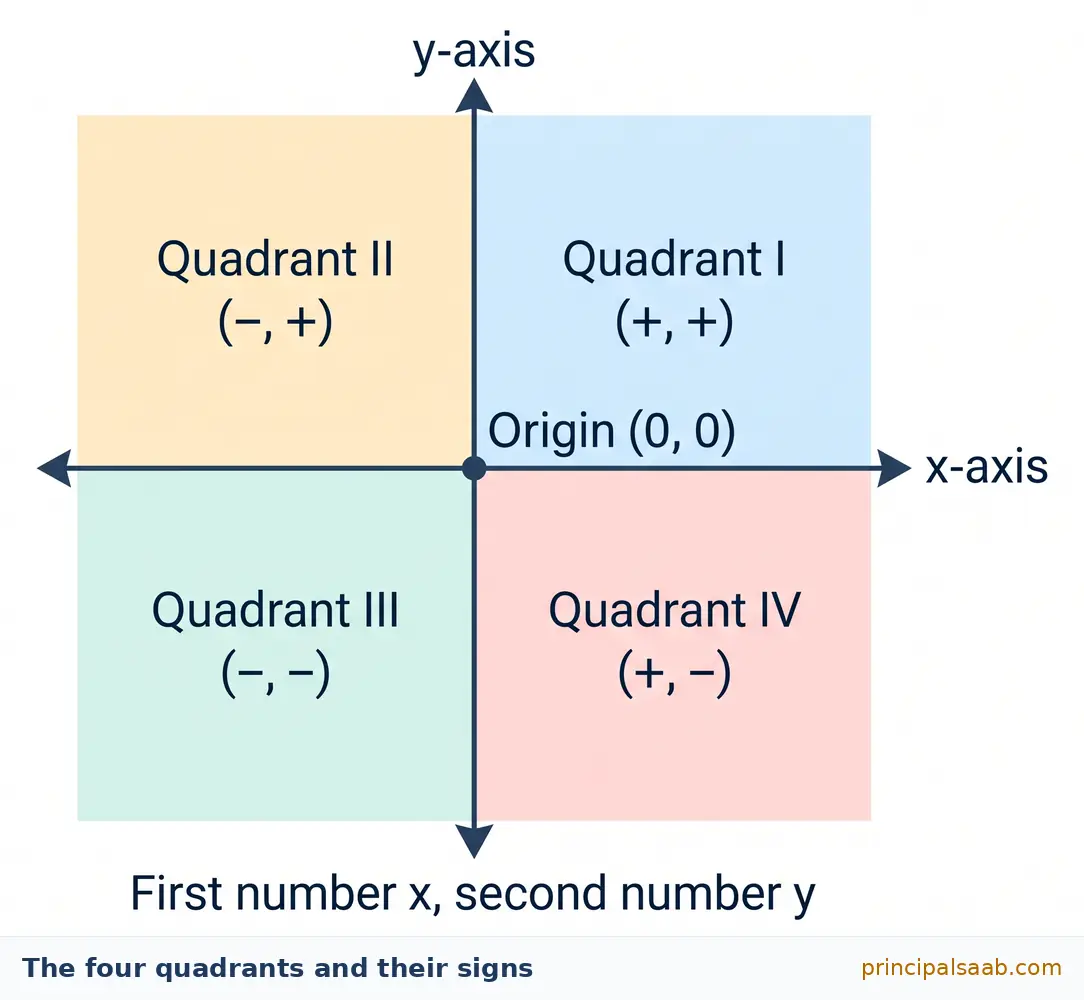
The perpendicular distance of P(x, y) from the x-axis is |y|, and from the y-axis is |x|. Its distance from the origin is $\sqrt{x^2 + y^2}$. Students routinely swap the first two — remember that you travel vertically to reach the x-axis, so it is the y-coordinate that measures the trip.
Worked example 1. In which quadrant does the point (−4, 7) lie, and how far is it from the y-axis?
The x-coordinate is negative and the y-coordinate is positive, so the point lies in Quadrant II. Its distance from the y-axis is |x| = |−4| = 4 units.
Worked example 2. A point P lies on the x-axis, on the negative side, at a distance of 5 units from the origin. Write its coordinates and its distance from the y-axis.
A point on the x-axis has y = 0. Being 5 units from the origin on the negative side gives x = −5, so P(−5, 0). Its distance from the y-axis is |−5| = 5 units.
The Distance Formula and What It Actually Measures
The distance between $A(x_1, y_1)$ and $B(x_2, y_2)$ is $AB = \sqrt{(x_2-x_1)^2 + (y_2-y_1)^2}$. It is nothing more than Pythagoras applied to the right triangle whose horizontal leg is the change in x and whose vertical leg is the change in y. Because both differences are squared, it does not matter which point you call first — the answer is the same.
Distance is always non-negative and always carries the word units. If your working produces a negative distance, you have squared something incorrectly.
Worked example 1. Find the distance between A(3, −2) and B(−1, 5).
Change in x = −1 − 3 = −4. Change in y = 5 − (−2) = 7.
$AB = \sqrt{(-4)^2 + 7^2} = \sqrt{16 + 49}$ $\sqrt{65}$ units.
Worked example 2. The distance between P(2, −3) and Q(10, y) is 10 units. Find y.
Change in x = 8, change in y = y − (−3) = y + 3.
$8^2 + (y + 3)^2 = 10^2 \Rightarrow 64 + (y + 3)^2 = 100 \Rightarrow (y + 3)^2 = 36 \Rightarrow y + 3 = \pm6$.
So y = 3 or y = −9. Both are valid — a distance condition normally gives two answers, and dropping one costs a mark.
Writing $\sqrt{65}$ as 8.06 and stopping there. Unless the question says “correct to two decimal places”, leave surds in exact form. Also, never simplify $\sqrt{16 + 49}$ to 4 + 7 — the square root of a sum is not the sum of the square roots.
Using Distances to Identify Triangles and Quadrilaterals
Once you can measure any side, you can classify any shape. The trick is knowing which lengths to compute. For a triangle you need three sides. For a quadrilateral named in order A, B, C, D you need the four sides AB, BC, CD, DA and both diagonals AC and BD — the diagonals are what separate a square from a rhombus, and a rectangle from a parallelogram.
Work with squared lengths throughout and only take the square root at the very end. Comparing 34 with 34 is faster and safer than comparing $\sqrt{34}$ with $\sqrt{34}$.
Worked example 1. Show that A(1, 2), B(5, 4) and C(3, 8) form an isosceles right triangle.
$AB^2 = (5-1)^2 + (4-2)^2 = 16 + 4 = 20$.
$BC^2 = (3-5)^2 + (8-4)^2 = 4 + 16 = 20$.
$AC^2 = (3-1)^2 + (8-2)^2 = 4 + 36 = 40$.
Since $AB^2 = BC^2$ the triangle is isosceles. Since $AB^2 + BC^2 = 20 + 20 = 40 = AC^2$ the converse of Pythagoras gives a right angle at B. Hence it is an isosceles right triangle, right-angled at B.
Worked example 2. Show that P(−1, −2), Q(1, 0), R(−1, 2) and S(−3, 0), taken in order, form a square.
$PQ^2 = 2^2 + 2^2 = 8$; $QR^2 = (-2)^2 + 2^2 = 8$; $RS^2 = (-2)^2 + (-2)^2 = 8$; $SP^2 = 2^2 + (-2)^2 = 8$. All four sides equal $\sqrt{8}$ units.
Diagonal $PR^2 = 0^2 + 4^2 = 16$; diagonal $QS^2 = (-4)^2 + 0^2 = 16$. Both diagonals equal 4 units.
Four equal sides and equal diagonals ⇒ PQRS is a square.
Collinearity Without the Area Formula
Three points are collinear when they lie on one straight line. In the current syllabus you test this with distances: compute all three lengths, and check whether the largest equals the sum of the other two. Geometrically that is obvious — if you can walk from A to C by passing through B without any detour, B is on the segment AC.
A, B and C are collinear if and only if one of AB + BC = AC, AB + AC = BC, or AC + BC = AB holds. You must test the largest length against the sum of the other two; testing the wrong pairing will make collinear points look non-collinear.
Worked example 1. Are A(1, 5), B(2, 3) and C(−2, 11) collinear?
$AB = \sqrt{1^2 + (-2)^2} = \sqrt{5}$.
$BC = \sqrt{(-4)^2 + 8^2} = \sqrt{80} = 4\sqrt{5}$.
$AC = \sqrt{(-3)^2 + 6^2} = \sqrt{45} = 3\sqrt{5}$.
The largest is $BC = 4\sqrt{5}$ and $AB + AC = \sqrt{5} + 3\sqrt{5} = 4\sqrt{5}$. Since these are equal, the points are collinear (with A lying between B and C).
Worked example 2. Find k so that A(2, 3), B(4, k) and C(6, −3) are collinear.
The x-coordinates 2, 4, 6 are evenly spaced, so if the points are collinear, B must be the midpoint of AC. Then k = (3 + (−3))/2 = 0.
Check: with $B(4, 0), AB = \sqrt{4 + 9} = \sqrt{13}, BC = \sqrt{4 + 9} = \sqrt{13}$ and $AC = \sqrt{16 + 36} = \sqrt{52} = 2\sqrt{13}$. Indeed $AB + BC = 2\sqrt{13} = AC$ so the points are collinear.
The Section Formula for Internal Division
If P divides the segment joining $A(x_1, y_1)$ and $B(x_2, y_2)$ internally in the ratio m : n, then
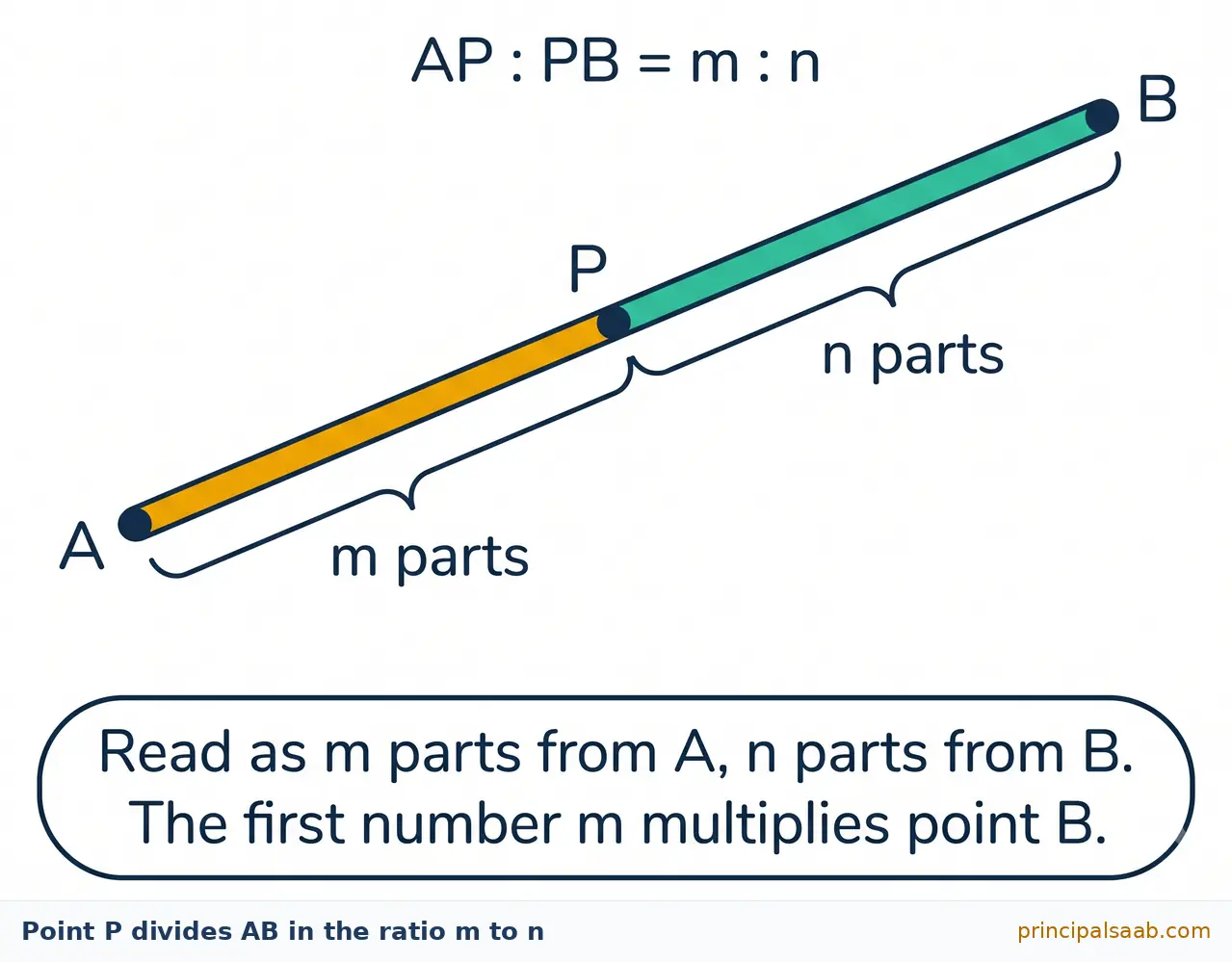
P = ( (mx₂ + nx₁) / (m + n) , (my₂ + ny₁) / (m + n) )
Read the ratio m : n as “m parts from A, n parts from B”. The number written first (m) multiplies the coordinates of the far point B. Getting this pairing backwards is the single most common error in the chapter.
Writing (mx₁ + nx₂)/(m + n). A quick sanity check: if m is much larger than n, P should sit close to B. Substitute a lopsided ratio like 9 : 1 into your formula and see whether the answer drifts towards B. If it drifts towards A, you have swapped them.
Worked example 1. Find the point that divides the segment joining A(−2, 3) and B(4, −5) internally in the ratio 1 : 3.
Here m = 1, n = 3, so m + n = 4.
x = (1 × 4 + 3 × (−2)) / 4 = (4 − 6)/4 = −1/2.
y = (1 × (−5) + 3 × 3) / 4 = (−5 + 9)/4 = 1.
The point is (−1/2, 1). Sensibly, it is nearer A than B, which matches a ratio of 1 : 3.
Worked example 2. In what ratio does P(−4, 6) divide the segment joining A(−6, 10) and B(3, −8)?
Let the ratio be k : 1. Using the x-coordinates:
(3k + (−6) × 1) / (k + 1) = −4 ⇒ 3k − 6 = −4k − 4 ⇒ 7k = 2 ⇒ k = 2/7.
The ratio is 2 : 7.
Verify with the y-coordinates: (−8 × 2/7 + 10)/(2/7 + 1) = (54/7) ÷ (9/7) = 6. ✓
Whenever a question asks “in what ratio”, set the ratio as k : 1 rather than m : n. One unknown instead of two, and the final answer is simply k : 1 rewritten with whole numbers. If k comes out negative, the division is external, which is outside the scope of this chapter — recheck your substitution.
The Midpoint Formula, Trisection and Parallelograms
Put m = n = 1 into the section formula and it collapses to the midpoint formula: the midpoint of $A(x_1, y_1)$ and $B(x_2, y_2)$ is $(\frac{x_1 + x_2}{2}, \frac{y_1 + y_2}{2})$ — simply the average of the coordinates. Two standard uses follow from it.
- Trisection points divide a segment into three equal parts, so they are the points dividing it in the ratios 1 : 2 and 2 : 1.
- Diagonals of a parallelogram bisect each other, so the midpoint of one diagonal equals the midpoint of the other. This single fact answers almost every “find the fourth vertex” question.
Worked example 1. Find the points of trisection of the segment joining A(2, −2) and B(−7, 4).
P divides AB in 1 : 2: x = (1 × (−7) + 2 × 2)/3 = (−7 + 4)/3 = −1; y = (1 × 4 + 2 × (−2))/3 = 0. So P(−1, 0).
Q divides AB in 2 : 1: x = (2 × (−7) + 1 × 2)/3 = (−14 + 2)/3 = −4; y = (2 × 4 + 1 × (−2))/3 = 6/3 = 2. So Q(−4, 2).
The points of trisection are (−1, 0) and (−4, 2).
Worked example 2. If (1, 2), (4, y), (x, 6) and (3, 5) are the vertices of a parallelogram taken in order, find x and y.
Taken in order, the diagonals join the 1st to the 3rd vertex and the 2nd to the 4th. Their midpoints must coincide.
Midpoint of the first diagonal: ((1 + x)/2, (2 + 6)/2) = ((1 + x)/2, 4).
Midpoint of the second: ((4 + 3)/2, (y + 5)/2) = (7/2, (y + 5)/2).
Equating: (1 + x)/2 = 7/2 ⇒ x = 6; and 4 = (y + 5)/2 ⇒ y = 3.
Pairing the wrong vertices as diagonals. When a question says “taken in order” for A, B, C, D, the sides are AB, BC, CD, DA and the diagonals are AC and BD. Pairing AB against CD instead will give a wrong answer that still looks tidy.
Area of a Triangle: What Changed in the Current Syllabus
Older textbooks and many YouTube playlists teach a formula for the area of a triangle from its vertices, and then use “area = 0” as the test for collinearity. In the rationalised Class 10 course, Area of a Triangle has been removed from this chapter. What remains is the distance formula and the section formula (internal division), and collinearity is examined using the distance method shown above.
If you meet a practice paper that asks for the area of a triangle from coordinates, it is almost certainly from an older edition. Solve it if you enjoy it — it does no harm — but do not spend revision time on it at the expense of the section formula, which is heavily examined. Syllabuses are revised annually, so confirm the current scope against the syllabus copy your school has issued for 2026-27.
Practice Worksheet
Eight original questions, ordered roughly by difficulty. Work each one on paper first, then reveal the answer.
Q1. Find the distance between P(−5, 7) and Q(−1, 3).
Show Answer
$PQ = \sqrt{4^2 + (-4)^2} = \sqrt{32}$ $4\sqrt{2}$ units.
Q2. Find the point on the y-axis that is equidistant from A(6, 5) and B(−4, 3).
Show Answer
$(0-6)^2 + (y-5)^2 = (0 + 4)^2 + (y-3)^2$
$36 + y^2-10y + 25 = 16 + y^2-6y + 9$
61 − 10y = 25 − 6y ⇒ 36 = 4y ⇒ y = 9.
The required point is (0, 9).
Q3. In what ratio does the x-axis divide the segment joining A(2, −3) and B(5, 6)? Also find the point of division.
Show Answer
(6k + (−3) × 1)/(k + 1) = 0 ⇒ 6k − 3 = 0 ⇒ k = 1/2.
The ratio is 1 : 2.
Then x = (5 × 1 + 2 × 2)/3 = 9/3 = 3, so the point of division is (3, 0).
Q4. Show that A(−2, 3), B(8, 3) and C(6, 7) are the vertices of a right-angled triangle, and name the right angle.
Show Answer
$BC^2 = (6-8)^2 + (7-3)^2 = 4 + 16 = 20$.
$AC^2 = (6 + 2)^2 + (7-3)^2 = 64 + 16 = 80$.
$BC^2 + AC^2 = 20 + 80 = 100 = AB^2$. By the converse of Pythagoras the triangle is right-angled, and since AB is the hypotenuse, the right angle is at C.
Q5. The midpoint of the segment joining A(3, 4) and B(k, 6) is (x, y), and x + y − 10 = 0. Find k.
Show Answer
Substituting into x + y − 10 = 0: x + 5 − 10 = 0 ⇒ x = 5.
So (3 + k)/2 = 5 ⇒ 3 + k = 10 ⇒ k = 7.
Q6. Find the coordinates of the point P on the segment joining A(−1, 7) and B(4, −3) such that AP : PB = 2 : 3.
Show Answer
x = (2 × 4 + 3 × (−1))/5 = (8 − 3)/5 = 1.
y = (2 × (−3) + 3 × 7)/5 = (−6 + 21)/5 = 3.
Hence P(1, 3).
Q7. Prove that A(1, 7), B(4, 2), C(−1, −1) and D(−4, 4) are the vertices of a square.
Show Answer
Diagonal $AC^2 = (-2)^2 + (-8)^2 = 68$; diagonal $BD^2 = (-8)^2 + 2^2 = 68$. Both diagonals equal $\sqrt{68}$ units.
Four equal sides together with equal diagonals prove ABCD is a square. (Equal sides alone would only give a rhombus.)
Q8. The centre of a circle is (2a, a − 7). The circle passes through P(11, −9) and its diameter is $10\sqrt{2}$ units. Find the value(s) of a.
Show Answer
$(11-2a)^2 + (-9-(a-7))^2 = 50$
$(11-2a)^2 + (-a-2)^2 = 50$
$(121-44a + 4a^2) + (a^2 + 4a + 4) = 50$
$5a^2-40a + 125 = 50 \Rightarrow 5a^2-40a + 75 = 0 \Rightarrow a^2-8a + 15 = 0$
(a − 3)(a − 5) = 0, so a = 3 or a = 5.
Kaizen — small, steady improvement. You do not need to master the whole chapter tonight. Aim for one more correct answer than yesterday, and come back tomorrow.