

An Arithmetic Progression is simply a list of numbers where you add the same amount each time — like 3, 7, 11, 15. Once you know two small formulas, this becomes one of the quickest chapters to score in. This page teaches it in plain language, with a plan and an original practice set (with answers you can reveal) at the end.
What This Chapter Covers
- What an arithmetic progression is
- The n-th term
- Sum of the first n terms
- Solving problems and word problems
Your Game Plan for This Chapter
- First — Understand the common difference and how to spot an AP.
- Next — Learn the n-th term and sum formulas — they solve almost everything.
- Last — Practise word problems, then attempt the practice set below.
Study Notes
1. What Is an Arithmetic Progression?
An AP is a sequence in which each term is obtained by adding a fixed number, called the common difference (d), to the previous term. Its general form is a, a + d, a + 2d, a + 3d, …, where a is the first term. You can always find d by subtracting any term from the one after it: $d = a_2-a_1$.
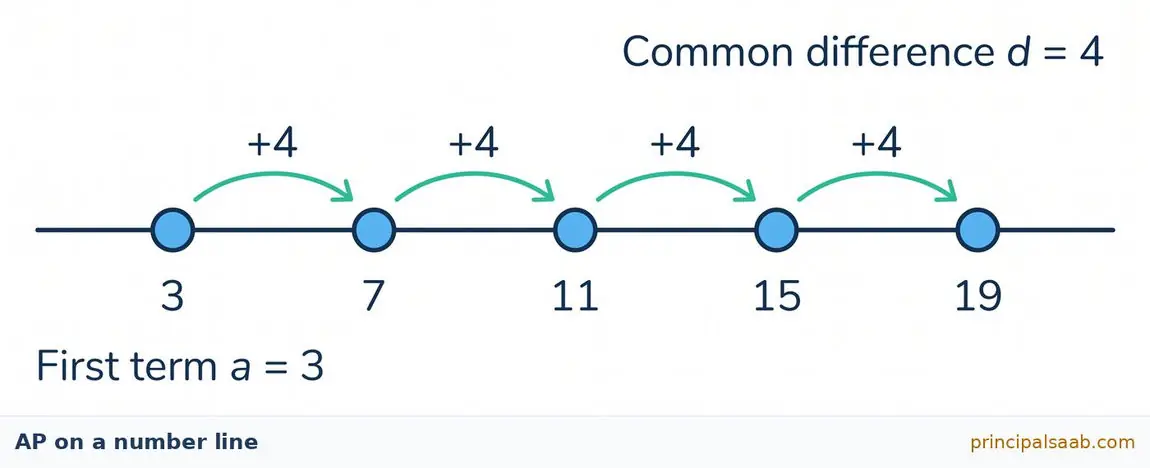
A sequence is an AP only if the difference between consecutive terms is the same throughout. Check two or three gaps — if they match, it is an AP.
2. The n-th Term
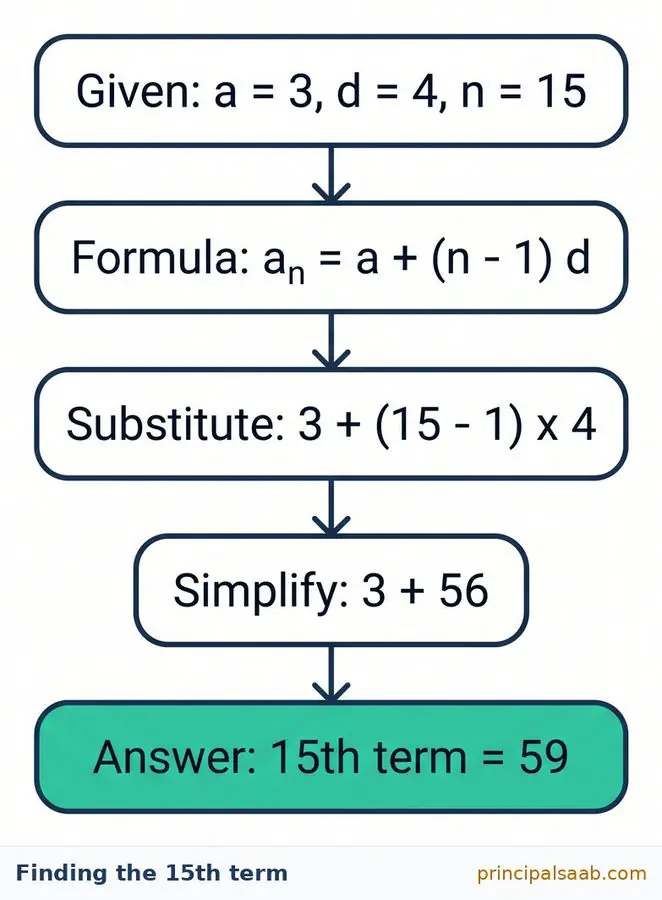
To jump straight to any term without listing them all, use the n-th term formula. For example, in 3, 7, 11, 15, … (a = 3, d = 4), the 15th term is $a_{15} = 3 + (15-1) \times 4 = 3 + 56 = 59$.
3. Sum of the First n Terms
To add up the first n terms, use the sum formula. These two formulas cover the whole chapter:
It is (n − 1)d, not n·d. Forgetting the “minus one” is the single most common error in this chapter — the 1st term uses (1 − 1)d = 0, so $a_1 = a$.
4. Solving Problems and Word Problems
Most questions give you some information and ask for a term, the number of terms, or a sum. Write down a, d and what is asked, choose the right formula, and solve. Word problems — savings that grow by a fixed amount, seats increasing row by row — are just APs in disguise; find a and d, then apply the same formulas.
Almost every AP question reduces to “find a and d, then use a formula.” Get those two values first, and the rest is a one-line calculation.
Practice Worksheet
Try each question fully on your own first, then click Show Answer to check yourself.
Q1. Find the 15th term of the AP: 3, 7, 11, 15, …
Show Answer
Q2. Which term of the AP 5, 8, 11, … is 68?
Show Answer
Q3. Find the sum of the first 20 terms of the AP: 2, 5, 8, …
Show Answer
Q4. The first term of an AP is 7 and its 13th term is 43. Find the common difference.
Show Answer
Q5. A person saves ₹100 in the first month and increases the saving by ₹50 each month. How much is saved in the 10th month, and in total over 10 months?
Show Answer
Once these feel easy, you have genuinely finished this chapter. Do not aim for perfect on the first try — aim for one more correct question than yesterday.