
Class 9 Maths’ new syllabus (2026-27, Ganita Manjari Part 1) introduces Chapter 2, ‘Introduction to Linear Polynomials’. This chapter is narrower and more focused than the larger ‘Polynomials’ chapter in the old syllabus — here the focus is only on degree-1 (linear) polynomials, approached through real-life rates of change (like auto fares or plant growth). Quadratic/cubic polynomials and the remainder/factor theorems are not part of this chapter — they belong to later chapters.
What This Chapter Covers
- Variables, coefficients and constants
- Degree of a polynomial
- Definition of a linear polynomial: p(x) = ax + b
- Zero (root) of a linear polynomial
- Real-life linear growth and decay (rates of change)
- Graphical visualisation on the coordinate plane
Your Game Plan for This Chapter
First — get the terms (variable, coefficient, constant, degree) clear. Next — practice finding the zero of p(x) = ax + b. Last — practice writing real-life situations (like fares or growth) as a linear polynomial and plotting them on a graph.
Study Notes
1. Variables, Coefficients, Constants and Degree
Variable: a symbol (usually x) whose value can change.
Coefficient: the number multiplied with the variable, like 3 in 3x.
Constant: a fixed number not attached to a variable, like 5 in 3x + 5.
Degree: the highest power of the variable. In a linear polynomial, the degree is always 1.
2. Definition of a Linear Polynomial
A polynomial with degree 1 is called a linear polynomial. It is usually written in this form:
p(x) = ax + b, where a and b are real numbers and a ≠ 0 (if a = 0, only the constant b remains, which is not degree 1).
Here a is the coefficient of x, and b is the constant term. Example: in p(x) = 3x − 12, a = 3, b = −12.
3. Zero (Root) of a Linear Polynomial
The zero of a polynomial p(x) is the value where p(x) = 0. For a linear polynomial p(x) = ax + b:
ax + b = 0 ⇒ ax = −b ⇒ x = −b/a.
Example: Find the zero of p(x) = 3x − 12. Here a = 3, b = −12. x = −(−12)/3 = 12/3 = 4. Check: p(4) = 3(4) − 12 = 12 − 12 = 0 ✓
4. Real-Life Linear Growth: Rates of Change
Many real-life situations can be modelled with a linear polynomial, where there is a fixed base value that changes at a constant rate. General form: y = (rate) × x + (base value).
Example (auto-rickshaw fare): An auto’s base fare is ₹25, plus ₹12 for every extra km. If x = distance (km) and y = total fare, then: y = 12x + 25.
- 6 km fare: y = 12(6) + 25 = 72 + 25 = ₹97.
- If the fare was ₹145, the distance: 145 = 12x + 25 ⇒ 12x = 120 ⇒ x = 10 km.
5. Graphical Visualisation
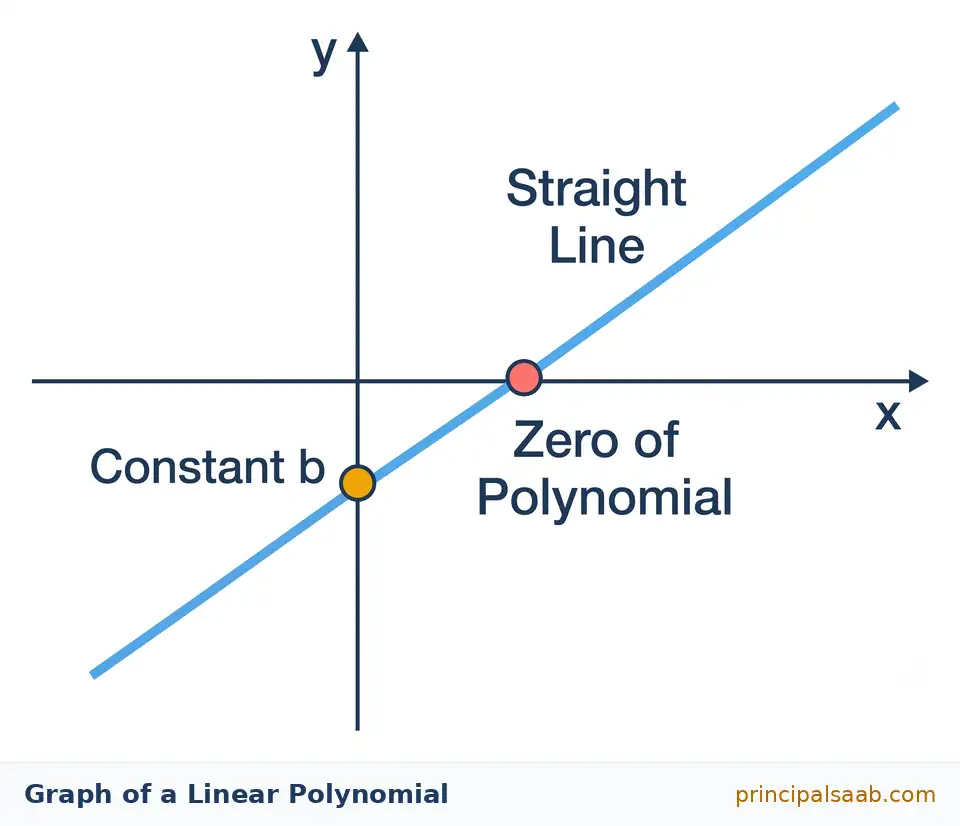
Plotting the linear polynomial y = ax + b on the coordinate plane (from Chapter 1) gives a straight line. The zero of the polynomial is the x-value where this line crosses the x-axis (the point where y = 0).
Practice Worksheet
Below are 5 original questions, with a verified answer key.
Q1. p(x) = −5x + 9. State the coefficient (a) and the constant (b).
Q2. Find the zero of p(x) = −2x + 7.
Q3. A plant is currently 8 cm tall and grows 1.5 cm every week. (i) Write a linear polynomial for the height y after x weeks. (ii) Find the height after 6 weeks.
Q4. If the zero of p(x) = kx − 6 is x = 3, find the value of k.
Q5. Is p(x) = 4x² + 3 a linear polynomial? Explain your reasoning.
Show Answer Key
Q1. Coefficient a = −5, constant b = 9.
Q2. x = −b/a = −7/(−2) = 7/2 = 3.5. Check: p(3.5) = −2(3.5)+7 = −7+7 = 0 ✓
Q3. (i) y = 1.5x + 8 (rate × weeks + base height). (ii) At x = 6: y = 1.5(6) + 8 = 9 + 8 = 17 cm.
Q4. At x = 3, p(x) = 0: k(3) − 6 = 0 ⇒ 3k = 6 ⇒ k = 2. Check: p(x) = 2x−6, p(3) = 6−6 = 0 ✓
Q5. No. Its highest power (degree) is 2 (because of the x² term), which makes it a quadratic polynomial, not linear. A linear polynomial must always have degree exactly 1.
Continue Learning
Revisit the previous chapter: Chapter 1 — Orienting Yourself: The Use of Coordinates. The coordinate-plotting skills from there will be used to draw graphs in this chapter.