
Class 9 Maths’ new syllabus (2026-27, Ganita Manjari Part 1) now opens with Coordinates as Chapter 1 — a change from the earlier syllabus, where the first chapter was Number Systems. We use coordinates every day: reading a map, finding a seat number, or pointing to a spot on a graph — the same idea sits behind all of these. This page teaches the whole chapter in plain language, with examples, plus an original practice set with a verified answer key.
What This Chapter Covers
- The Cartesian plane — x-axis, y-axis and the origin
- Coordinates of a point — abscissa and ordinate
- The four quadrants and their sign conventions
- Plotting points on the plane
- Reflection of a point across the axes
Your Game Plan for This Chapter
First — understand that two number lines crossing each other at right angles give an address to every point on the plane. Next — memorise the sign pattern for each quadrant, then practice plotting points. Last — practice the rules for reflection, since it is a very common exam question.
Study Notes
1. The Cartesian Plane
Take two number lines — one horizontal (called the x-axis) and one vertical (called the y-axis) — and cross them at a single point, at right angles (90°). The point where they meet is called the origin, written O, with coordinates (0, 0). This whole setup is called the Cartesian plane (named after René Descartes).
On the x-axis, the right side is positive and the left side is negative. On the y-axis, upward is positive and downward is negative.
2. Coordinates of a Point
Any point P on the plane is represented by a pair of numbers (x, y):
- x-coordinate (abscissa): the point’s horizontal distance from the y-axis
- y-coordinate (ordinate): the point’s vertical distance from the x-axis
Order matters — (3, 5) and (5, 3) are two completely different points. That is why this is called an ordered pair.
3. The Four Quadrants
The two axes divide the plane into 4 quadrants, numbered counter-clockwise (I to IV):
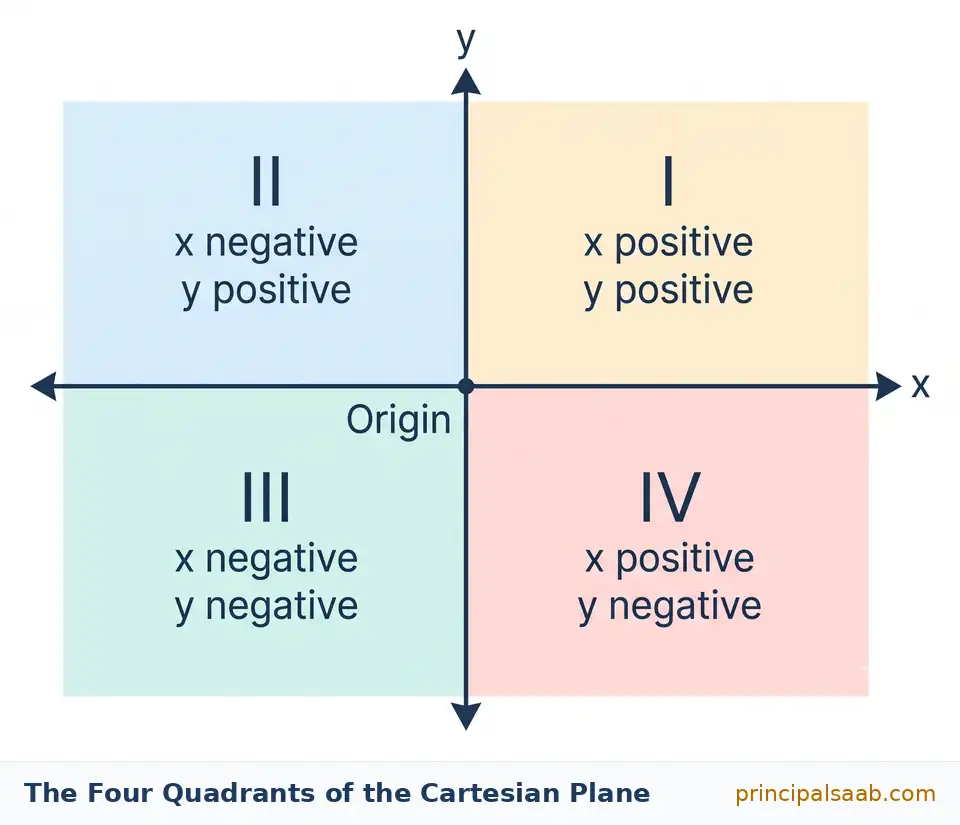
- Quadrant I: x > 0, y > 0 — both (x, y) positive
- Quadrant II: x < 0, y > 0 — (−x, y)
- Quadrant III: x < 0, y < 0 — (−x, −y)
- Quadrant IV: x > 0, y < 0 — (x, −y)
If a point lies on the x-axis, its y-coordinate is 0, like (4, 0). If it lies on the y-axis, its x-coordinate is 0, like (0, −2).
4. Plotting Points on the Plane
Steps to plot a point (a, b):
- Start at the origin.
- Move a units along the x-axis (right if a is positive, left if a is negative).
- From there, move b units parallel to the y-axis (up if b is positive, down if b is negative).
- Mark the point where you land — that is (a, b).
Example: To plot the point (−3, 4) — from the origin, go 3 units left, then 4 units up. This point will be in Quadrant II (x negative, y positive) — matching the sign convention.
5. Reflection of a Point Across the Axes
When a point is “mirrored” across the x-axis or y-axis, its coordinates follow a predictable pattern:
- Reflection across the x-axis: (x, y) → (x, −y) — x stays the same, the sign of y flips.
- Reflection across the y-axis: (x, y) → (−x, y) — y stays the same, the sign of x flips.
Example: Reflecting the point (5, −2) across the x-axis gives (5, 2). Reflecting the same point across the y-axis gives (−5, −2).
Practice Worksheet
Below are 6 original questions, with a verified answer key.
Q1. Which quadrant is the point (−7, 3) in?
Q2. Which quadrant is the point (6, −9) in?
Q3. Which axis does the point (0, −5) lie on?
Q4. Reflect the point (8, −3) across the x-axis.
Q5. Reflect the point (−4, −6) across the y-axis.
Q6. Point P has abscissa (2a − 3) and ordinate (a + 1). If P lies on the x-axis, find the value of a and the coordinates of P.
Show Answer Key
Q1. x = −7 (negative), y = 3 (positive) → Quadrant II.
Q2. x = 6 (positive), y = −9 (negative) → Quadrant IV.
Q3. The x-coordinate is 0, so this point lies on the y-axis.
Q4. Reflecting across the x-axis: (x, y) → (x, −y). So (8, −3) → (8, 3).
Q5. Reflecting across the y-axis: (x, y) → (−x, y). So (−4, −6) → (4, −6).
Q6. Lying on the x-axis means the ordinate (y) = 0. So a + 1 = 0 ⇒ a = −1. Now the abscissa = 2(−1) − 3 = −5. So P = (−5, 0). Check: with a = −1, the ordinate = −1 + 1 = 0 ✓, matching the condition of lying on the x-axis.
Continue Learning
Before moving ahead, revise this chapter — its concepts (plotting, sign conventions) will be used to draw graphs in Chapter 2 — Introduction to Linear Polynomials.