
Let us start with something reassuring. Almost everything you have touched today came out of the ground. The steel in your compass box, the aluminium foil around yesterday’s lunch, the copper hair-thin wire inside your phone charger, the cement in your school wall, the electricity humming through the fan above your head — every one of them began as a mineral or as an energy resource pulled out of the earth. So this chapter is not a list of strange names to be memorised. It is the story of how India feeds, builds and powers itself.
I will be honest with you about why students find this chapter heavy. It is not the ideas — the ideas are simple and often obvious once explained. It is the sheer number of proper nouns. Bailadila, Kudremukh, Panchpatmali, Ankaleshwar, Ramagundam. Fifteen or twenty unfamiliar place names arriving in one week feels like being handed a phone book and told to learn it. That is exactly the wrong way to approach it, and by the end of this page you will have a much kinder method: understand the geography first, and let the names attach themselves to that understanding like magnets to iron.
So take a breath. We are going to build this slowly, from zero. No prior knowledge assumed. Every new word will be explained the first time it appears. Every section ends with worked model answers so you can see exactly how an examiner awards marks — not just what the answer is, but why it earns what it earns. Work through it at your own pace, in short sittings, and do not move on from a section until it genuinely feels comfortable. That single habit is worth more than any amount of last-night cramming.
- Your Game Plan
- What A Mineral Is And Why Minerals Matter
- Mode Of Occurrence Of Minerals
- Classification Of Minerals: Metallic, Non-Metallic And Energy
- Ferrous Minerals: Iron Ore And The Four Major Belts
- Manganese: The Quiet Partner Of Steel
- Non-Ferrous Minerals: Copper And Bauxite
- Non-Metallic Minerals: Mica And Limestone
- Rock Minerals And Where They Are Used
- Conservation Of Minerals And The Hazards Of Mining
- Energy Resources: Conventional Versus Non-Conventional
- Coal: The Four Grades And India’s Coalfields
- Petroleum, Natural Gas And The HVJ Pipeline
- Electricity: Hydro Versus Thermal
- Non-Conventional Sources: Nuclear, Solar, Wind, Biogas, Tidal, Geothermal
- Conservation Of Energy Resources And Sustainable Use
- Map Skill: The Official 2026-27 List
- Practice Worksheet with Answers
- Kaizen: One More Than Yesterday
Your Game Plan
Before we begin, here is the order I want you to work in. This chapter rewards structure enormously, and students who wander through it randomly always feel lost. Follow these six steps and it will feel half the size.
- Get the vocabulary right first. Mineral, ore, vein, lode, placer, ferrous, non-ferrous, non-metallic. Six or seven words. Nail these on day one and the rest of the chapter reads like ordinary English.
- Learn the classification tree. Draw it once by hand on a blank page: minerals split into metallic, non-metallic and energy; metallic splits into ferrous and non-ferrous. If you can redraw that tree from memory, you already own a full mark in most papers.
- Do minerals before energy. They are two halves of one chapter and mixing them causes confusion. Finish iron, manganese, copper, bauxite, mica, limestone. Only then move to coal, oil, gas and electricity.
- Attach every name to a state, then to a map. Never learn a place name floating in space. Bailadila means nothing; “Bailadila, high-grade hematite, Bastar region, Chhattisgarh, exported through Visakhapatnam” is a fact you can actually use in an answer.
- Practise the map separately, with a pencil and a blank outline. Ten minutes a day for a week beats three hours the night before. The map carries real marks and it is the easiest section to make perfect.
- Answer in the examiner’s format. Count the marks, count the points. Three marks means three developed points, not one long paragraph. The worked examples below show you exactly what that looks like.
Every fact here answers one underlying question: what does India have, where does it have it, and how long will it last? If you keep that question in your head while reading, the place names stop feeling random and start feeling like evidence.
What A Mineral Is And Why Minerals Matter
Let us begin with the definition, because everything else in the chapter hangs off it. A mineral is a naturally occurring substance, with a definite chemical composition and an orderly internal arrangement of atoms. Read that slowly. Three conditions are doing the work: it must occur in nature by itself (not be manufactured in a factory), it must have a fixed recipe of elements, and its atoms must be stacked in a repeating, orderly pattern rather than jumbled at random.
An everyday analogy helps here. Think of common salt crystals under a magnifying glass. They are little cubes, and they are cubes because the sodium and chlorine atoms inside are arranged in a neat cubic scaffolding, over and over. That orderliness is not decoration; it is what makes the substance a mineral. Sugar you stir into tea is also crystalline, but it is produced from cane by a process, so it is not what a geographer calls a mineral in this sense.
Now a distinction students constantly blur: mineral versus ore. Iron exists in hundreds of rocks all over India in tiny traces. That does not help anybody. An ore is a mineral deposit in which the useful element occurs in a high enough concentration, and in a form easy enough to extract, that it is worth the money and effort of mining. So all ores are minerals, but only a small fraction of minerals qualify as ores. When a mine closes because the deposit has become “uneconomic”, nobody has removed the metal — it has simply become too dilute to be an ore any longer.
Geologists have identified well over two thousand distinct minerals, and yet only a few dozen of them form the bulk of the rocks around us. Rocks, in fact, are simply combinations of minerals — a rock is the cake and the minerals are the ingredients. Some rocks, like limestone, are essentially one mineral. Others, like granite, are a visible mixture of several: you can literally see the pale grains and the dark flecks with your naked eye.
Why does any of this matter for a nation? Because minerals are the material base of industry. A country cannot build railways without iron and steel. It cannot electrify villages without copper or aluminium for conductors. It cannot construct dams, flyovers and houses without limestone for cement. It cannot make fertiliser without a chemical industry that itself rests on petroleum. This is why the location of mineral belts explains the location of industrial cities. Jamshedpur, Bhilai, Rourkela and Durgapur are not where they are by accident; they sit close to iron ore, coal and limestone, because moving raw material is expensive and moving finished steel is comparatively easy.
There is also a hard truth to absorb early, because it drives the last section of this chapter. Minerals take an enormous span of geological time to form — hundreds of thousands to many millions of years — and we are consuming them within a couple of human lifetimes. On any timescale that matters to us, they are exhaustible and non-renewable. That single sentence is the reason conservation appears in the syllabus at all, and examiners love to see students connect the two.
A mineral is a naturally occurring, homogeneous substance with a definite chemical composition and an orderly internal atomic structure. An ore is a mineral from which a metal or useful substance can be extracted profitably.
Why it works. Two marks means two distinct ideas, and the examiner is looking for the word profitably or economically somewhere in the second half. Adding one named example costs you five extra words and immediately shows the difference is understood rather than memorised.
(ii) They enter daily life at every level. The utensils we cook in, the wires that carry electricity to our homes, the cement in our buildings and even the salt in our food are minerals or mineral products. (1 mark)
(iii) They are finite and non-renewable. Mineral deposits take millions of years to form but are being consumed within decades, and the richer, easier deposits are always mined first, so continued careless use will leave only low-grade and expensive reserves for future generations. (1 mark)
Why it works. Notice the shape: two points on importance, one on restraint. The question had two halves, so the answer has two halves. Students who write three points only on importance lose the third mark even though everything they wrote was true.
In three and five mark answers, start each point with a short bolded or underlined phrase, then explain it in a sentence. Examiners mark hundreds of scripts in a sitting; a clearly signposted answer is faster to award marks to, and nothing that is easy to mark gets marked harshly.
Coal and petroleum are described as mineral fuels or energy minerals in this chapter, but strictly speaking they are of organic origin and do not have the neat crystalline structure of, say, quartz. Use the syllabus term “energy minerals” for them, and reserve “ore” for deposits worth mining, such as hematite for iron or bauxite for aluminium.
Mode Of Occurrence Of Minerals
Minerals do not lie about the earth in tidy piles waiting to be collected. They occur in particular settings, and each setting is the fingerprint of the process that put them there. Once you understand the process, you can predict the setting — and that is far easier than memorising a list. Let us take the four main modes one at a time.
1. Veins and lodes — minerals in cracks. Igneous and metamorphic rocks are riddled with cracks, joints, faults and fissures. Deep inside the earth, molten material and hot mineral-rich fluids are under tremendous pressure, so they force their way upward into any crack they can find. As they rise they cool, and the dissolved minerals crystallise out and plaster themselves onto the walls of the crack. The result is a sheet of mineral filling an old fracture. When the filling is thin we call it a vein; when it is thick and substantial we call it a lode. That is the only real difference between the two words — scale.
Picture a cracked wall into which someone has injected filler, which then hardened. Tin, copper, zinc and lead are all typically found this way. And because they sit in narrow near-vertical sheets rather than broad flat layers, they are usually reached by sinking shafts and tunnels — that is, by deep underground mining, which is expensive and dangerous. The mode of occurrence quietly decides the mining method.
2. Beds and layers — minerals laid down in sheets. Sedimentary rocks form when material settles out of water or air and is compressed over long periods, layer upon layer. Any mineral that accumulated during that settling therefore occurs as a horizontal bed or seam, often extending over a wide area. Coal seams, iron ore beds, gypsum, potash salt and sodium salt are the classic examples. Some of these — gypsum, potash and common salt — were formed specifically by the evaporation of water in shallow basins, especially in arid regions, leaving the dissolved solids behind as a crust.
Because these deposits are flat and continuous, if they lie near the surface they can be worked by open-cast mining: you simply strip off the overlying soil and rock and scoop the mineral out. That is cheaper and safer than shaft mining, which is why so much of India’s coal and iron ore is produced from vast terraced pits rather than tunnels.
3. Residual deposits — what weathering leaves behind. Sometimes a mineral is not brought in; it is what remains after everything else has been taken away. Rain and heat over long periods decompose surface rocks, and the soluble constituents are dissolved and carried off by water. The insoluble, stubborn material stays put as a residual mass of weathered rock. Bauxite, the ore of aluminium, forms in exactly this way from aluminium-rich rocks in hot, heavily rained-on plateau regions — which is precisely why India’s bauxite is concentrated on plateau surfaces rather than in river valleys.
4. Placer deposits — the river as a sorting machine. Now the most beautifully logical one. Imagine a rock high in the hills containing scattered specks of gold. Weathering breaks the rock down and a stream carries the debris downhill. Water sorts material by weight: the light sand and silt stay suspended and travel far, while the very dense grains sink quickly and are dropped as soon as the current slackens — at the base of hills, on the inside of river bends, and in hollows on the valley floor. Over centuries, those heavy grains concentrate into an alluvial or placer deposit.
Here is the crucial second half, and it is the part most students miss. Placer minerals are almost always non-corrodible — gold, silver, platinum, tin. They have to be. A mineral that rusts or dissolves would be chemically destroyed during that long, wet journey down the river; only the chemically stubborn survive intact to be concentrated. So the property and the location are not two separate facts to learn — one causes the other. This is why old-fashioned gold panning happens in stream beds, not on hilltops.
5. Ocean waters and ocean beds. The oceans contain vast quantities of dissolved minerals, though most are too widely diffused to be worth extracting. The commercially significant ones are common salt, magnesium and bromine, largely recovered by evaporating seawater. The ocean bed is a different story: parts of the deep floor are scattered with manganese nodules, potato-sized lumps rich in manganese along with iron, nickel, copper and cobalt, built up extremely slowly around a tiny nucleus. They are a genuine future resource, though recovering them from several kilometres of water is still difficult and costly.
Veins and lodes belong to igneous and metamorphic rocks. Beds and layers belong to sedimentary rocks. Residual masses come from weathering in place. Placers come from moving water sorting heavy grains. If you can state the rock type or the process alongside the mode, a one-mark answer becomes a confident two-mark answer.
(ii) Examples. Gold, silver, tin and platinum are commonly obtained from such deposits. (1 mark)
(iii) Reason for non-corrodibility. The minerals are transported and repeatedly washed by water over very long periods; any mineral that reacted chemically with water or air would be dissolved or destroyed on the way, so only minerals that resist corrosion survive intact and become concentrated. (1 mark)
Why it works. The question is two questions joined by a full stop, and each half must be answered. Many candidates define placer deposits beautifully and then stop, losing a third of the marks. Train your eye to spot the second verb — here, “Why”.
Model answer. (i) This is a vein, or a lode if the sheet is thick; such deposits form when hot, mineral-rich molten material and fluids are forced upward into cracks, joints and faults in igneous or metamorphic rocks and cool there, depositing minerals on the crack walls. (1 mark)
(ii) Because the deposit is narrow and steeply inclined and continues to great depth, it cannot be worked from the surface; shafts and tunnels must be driven, that is, deep underground mining is required. (1 mark)
(iii) Copper is typically found in such veins and lodes; tin, zinc and lead also occur this way. (1 mark)
Why it works. This is the style of question that separates understanding from memorisation. Nothing here can be recalled directly — you have to reason from “narrow, vertical, in granite, very deep” to “vein or lode, therefore underground mining”. Notice that the mining method follows from the shape of the deposit, not from the metal itself.
Whenever you name a mode, add the mechanism in six words: veins and lodes (“hot fluids injected into cracks”), beds (“deposited in horizontal sedimentary layers”), residual (“insoluble material left after weathering”), placer (“heavy grains dropped by slowing water”). Examiners are marking for the process, and those six words are usually where the mark actually sits.
They are the same phenomenon at different scales: a thin filling in a crack is a vein, a thick and substantial one is a lode. Write “veins and lodes” together as one mode and describe the process once. Inventing an artificial difference wastes time and can cost you the mark if the invented difference is wrong.
Classification Of Minerals: Metallic, Non-Metallic And Energy
This is the skeleton of the whole chapter. Get it into your head as a shape rather than as a list, and every later section will simply hang off a branch you already know. Take a blank sheet of paper right now and draw along with me — the drawing takes ninety seconds and saves you an hour later.
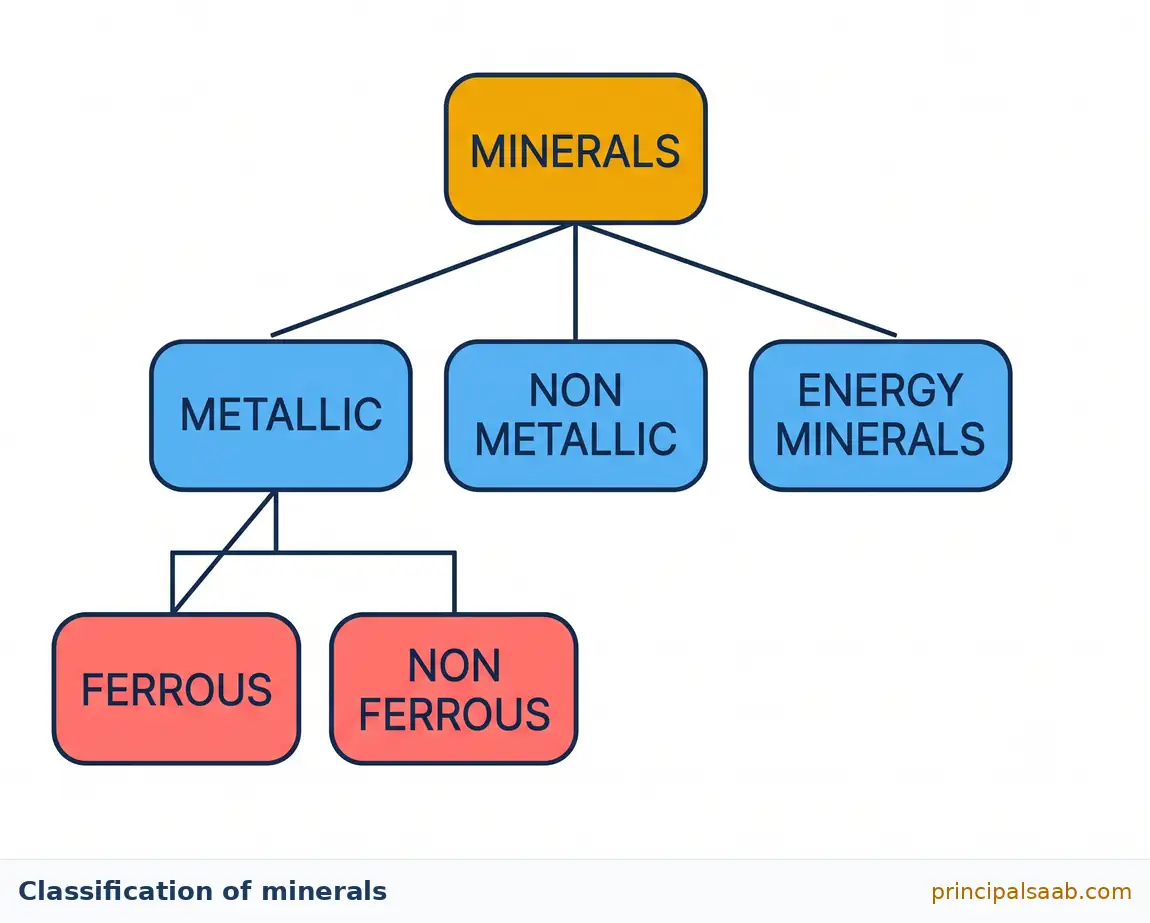
At the top write Minerals. Draw three branches down from it: Metallic, Non-Metallic and Energy Minerals. Then, from Metallic alone, draw two further branches: Ferrous and Non-Ferrous. That is the entire tree. Notice that only the metallic branch splits again — non-metallic and energy minerals have no sub-divisions in this classification, which is a small mercy.
Metallic minerals are those from which metals can be extracted. They are usually found in igneous and metamorphic rock formations, they are typically hard, and they have a characteristic shine or lustre. They split as follows.
Ferrous minerals contain iron. The word comes from the Latin ferrum, meaning iron — the same root that gives iron its chemical symbol Fe. Iron ore, manganese, nickel and cobalt are the members of this group you need. Together, ferrous minerals account for roughly three-quarters of the total value of India’s metallic mineral production, which tells you immediately where the country’s mineral wealth really lies. They are the backbone of the metallurgical industry, because they go into making iron and steel.
Non-ferrous minerals contain metals other than iron. Copper, bauxite (for aluminium), lead, zinc and gold sit here. India’s position in this group is far weaker than in ferrous minerals — reserves and production of copper in particular are limited relative to demand — and that shortage has real economic consequences, which we will come back to.
Non-metallic minerals yield no metal at all. Mica, limestone, gypsum, dolomite and salt belong here. Do not let the name fool you into thinking they are less important. Limestone is the foundation of the cement industry and is essential inside a blast furnace; mica is indispensable in electrical and electronic equipment. A country without limestone cannot build, no matter how much iron it has.
Energy minerals — also called mineral fuels or fossil fuels — are burned or converted to release energy. Coal, petroleum and natural gas are the three, and because they matter so much they get the entire second half of the chapter to themselves. Strictly speaking these are organic in origin, formed from buried plant and animal remains rather than crystallised from molten rock, but the syllabus groups them under minerals and you should follow that convention in your answers.
| Category | What defines it | Examples to quote | Main use in India |
|---|---|---|---|
| Metallic — Ferrous | Metallic minerals that contain iron; about three-fourths of the value of metallic mineral output | Iron ore, manganese, nickel, cobalt | Iron and steel, alloy steels, machinery, rails, construction |
| Metallic — Non-ferrous | Metallic minerals containing metals other than iron; India’s reserves here are comparatively limited | Copper, bauxite, lead, zinc, gold | Electrical wiring, electronics, aircraft and utensils, alloys |
| Non-metallic | Yield no metal; valued for physical or chemical properties rather than for a metal content | Mica, limestone, gypsum, dolomite, salt | Cement, blast-furnace flux, electrical insulation, chemicals |
| Energy minerals | Fossil fuels of organic origin, burned or processed to release energy | Coal, petroleum, natural gas | Thermal power, transport fuel, petrochemicals, fertilisers |
Hematite — metallic, ferrous. It is an ore of iron, and any metallic mineral containing iron belongs to the ferrous group. (1 mark)
Bauxite — metallic, non-ferrous. Aluminium is extracted from it, and aluminium is a metal other than iron. (1 mark)
Mica — non-metallic. No metal is obtained from it; it is valued for its insulating and dielectric properties in the electrical industry. (1 mark)
Lignite — energy mineral. It is a low-grade variety of coal, a fossil fuel burned to generate power. (1 mark)
Why it works. The instruction word is “justify”, so a bare label earns nothing. Each line here is label plus one-clause reason. Also notice the discipline of going to the deepest level available: writing merely “metallic” for hematite is an incomplete classification when a ferrous or non-ferrous sub-category exists.
(i) Composition and yield. Metallic minerals contain metal in raw form and a metal can be extracted from them; non-metallic minerals contain no metal and yield none. (1 mark)
(ii) Occurrence and physical character. Metallic minerals are generally associated with igneous and metamorphic rock formations and are usually hard with a distinct lustre; non-metallic minerals are frequently associated with sedimentary rocks and lack that metallic shine. (1 mark)
(iii) Examples. Iron ore, manganese, copper and bauxite are metallic; mica, limestone, gypsum and dolomite are non-metallic. (1 mark)
Why it works. A “distinguish” question is marked on paired contrasts. Each point above compares the same feature on both sides. If you write three sentences about metallic minerals and then three about non-metallic ones with no shared axis, you can lose marks even with correct content.
Manganese contains no iron ore in the everyday sense, yet it is classed as ferrous because of its role and association within the iron-and-steel group of minerals. The simple test that works for the exam: is this mineral part of the iron and steel family? If yes, ferrous.
Colour tells you nothing about classification. Bauxite gives aluminium; aluminium is not iron; therefore bauxite is non-ferrous. Always ask “which metal comes out of it?” rather than “what does it look like?”
Ferrous Minerals: Iron Ore And The Four Major Belts
Iron ore is the single most important mineral in this chapter, and India is comparatively well placed for it. The country has fairly abundant resources of good quality iron ore, and that endowment is the reason India has a large iron and steel industry at all. Everything you learn here connects forward to the industries chapter, so the effort is doubly worthwhile.
Why iron matters so much. Iron ore is described as the basic mineral and the backbone of industrial development, and that is not rhetoric. Steel — iron with a little carbon and other elements — is strong, cheap, mouldable and endlessly recyclable. Rails, bridges, ships, girders, machine tools, vehicle bodies, reinforcing bars in concrete: all steel. No modern economy has ever been built without it. India is also fortunate that its iron ore, coal and limestone deposits lie relatively close together in the north-eastern peninsular region, which is a large part of why the steel plants cluster there.
The two ores you must be able to compare. Iron does not come out of the ground as iron; it comes as an iron-bearing compound, and two of these matter for the exam.
Magnetite is the finest quality iron ore. Its iron content is very high — of the order of seventy per cent — and it has excellent magnetic properties, which is exactly where the name comes from and how it is often identified in the field. Because a magnet visibly attracts it, magnetite is also historically important in the electrical industry.
Hematite is the most important industrial iron ore in terms of the sheer quantity used. Its iron content is somewhat lower, generally in the range of about fifty to sixty per cent, but it is far more plentiful and is what the great majority of India’s mines actually produce.
Here is a subtlety worth having at your fingertips, because good students get caught out by it. Magnetite has the better quality; hematite is the more important in terms of quantity used by industry. “Best” and “most used” are different questions and examiners deliberately test whether you noticed. Keep the two words separate in your head: magnetite equals finest, hematite equals most used.
| Feature | Magnetite | Hematite |
|---|---|---|
| Quality | Finest quality iron ore | Good, but below magnetite in grade |
| Iron content | Very high, of the order of about 70 per cent | Roughly 50 to 60 per cent |
| Magnetic property | Excellent magnetic qualities; attracted strongly by a magnet | Weakly magnetic or non-magnetic in practical terms |
| Industrial significance | Valued especially in the electrical industry because of its magnetism | Most important industrial iron ore by quantity used |
| How to remember | Magnetite = magnet = finest | Hematite = heavy tonnage = most used |
The four major iron ore belts. Now the part that looks intimidating and is not. India’s iron ore is concentrated in four belts, all of them in the peninsular plateau, and each belt has one or two signature mines plus a signature port. Learn them as four stories, not as twenty names.
Belt 1 — The Odisha–Jharkhand belt. This is the north-eastern corner of the peninsula and it is the heartland. In Odisha, high-grade hematite is mined in the Badampahar area, in the districts of Mayurbhanj and Kendujhar. Just across in Jharkhand, the mines of Gua and Noamundi in the Singhbhum area work the same geological formations. This is the belt that feeds the steel plants of the Chota Nagpur region, and it is no coincidence that Jamshedpur grew up here.
Belt 2 — The Durg–Bastar–Chandrapur belt. This one runs through Chhattisgarh and into Maharashtra. Its star is the Bailadila range of hills in the Bastar region, which contains a series of deposits of exceptionally high-grade hematite, considered among the best in the country. Bailadila ore is exported to Japan and South Korea through the port of Visakhapatnam. Remember that pairing — Bailadila with Visakhapatnam — because “name the port” is a favourite one-mark question.
Belt 3 — The Ballari–Chitradurga–Chikkamagaluru–Tumakuru belt. A long name for a simple thing: this is the Karnataka belt, and it holds very large reserves. Its famous mine is Kudremukh, in the Western Ghats, which was developed as a hundred per cent export unit and whose deposits are among the largest known anywhere in the world. Kudremukh is worth remembering for one striking detail: because the mine sits in rugged, ecologically sensitive hill country, the ore was transported not by road or rail but as a slurry — finely ground ore mixed with water — pumped through a pipeline to a port near Mangaluru. If an examiner asks for an unusual method of mineral transport, that is your answer.
Belt 4 — The Maharashtra–Goa belt. This covers Goa and the Ratnagiri district of Maharashtra. Be careful with the wording here, because it contains a trap: the ore of this belt is not of very high quality, yet it is exploited very efficiently. Exports leave through Marmagao port in Goa. So the belt is significant not because of grade but because of efficient working and excellent port access — a lovely illustration of the fact that geography is about more than the rock itself.
| Iron ore belt | States covered | Key mines / areas | Distinguishing point | Export port |
|---|---|---|---|---|
| Odisha–Jharkhand | Odisha, Jharkhand | Badampahar (Mayurbhanj, Kendujhar); Gua and Noamundi (Singhbhum) | High-grade hematite; supplies the Chota Nagpur steel plants | Mainly domestic use; eastern ports |
| Durg–Bastar–Chandrapur | Chhattisgarh, Maharashtra | Bailadila hills (Bastar region), Durg | Very high-grade hematite, among the best in India | Visakhapatnam, for Japan and South Korea |
| Ballari–Chitradurga–Chikkamagaluru–Tumakuru | Karnataka | Kudremukh (Western Ghats), Ballari | Among the largest deposits in the world; ore moved as slurry through a pipeline | A port near Mangaluru |
| Maharashtra–Goa | Goa, Ratnagiri district of Maharashtra | Goan and Ratnagiri workings | Ore not of very high quality but efficiently exploited | Marmagao |
Odisha–Jharkhand = the industrial heartland. Durg–Bastar–Chandrapur = Bailadila and Visakhapatnam. Karnataka belt = Kudremukh, world-class size, slurry pipeline. Maharashtra–Goa = modest grade, efficient working, Marmagao. Four hooks are far easier to hold than twenty loose names, and each hook drags the details up with it.
(i) Grade. Magnetite is the finest quality of iron ore, whereas hematite is of somewhat lower grade. (1 mark)
(ii) Iron content. Magnetite contains a very high proportion of iron, of the order of about seventy per cent, while hematite generally contains around fifty to sixty per cent. (1 mark)
(iii) Magnetism and industrial use. Magnetite possesses excellent magnetic properties and is therefore valuable in the electrical industry; hematite is not significantly magnetic but is the most important industrial iron ore because of the very large quantities in which it is used. (1 mark)
Why it works. Three paired contrasts on three clear axes — grade, iron content, magnetism and use. The last point deliberately carries the “finest versus most used” nuance, which is where the strongest candidates separate themselves.
Opening line. India’s iron ore reserves are concentrated in four major belts within the peninsular plateau region. (this earns nothing by itself but frames the answer)
(i) Odisha–Jharkhand belt. High-grade hematite is mined at Badampahar in the Mayurbhanj and Kendujhar districts of Odisha, and at Gua and Noamundi in the Singhbhum area of Jharkhand. This belt supplies the major steel plants of eastern India. (2 marks)
(ii) Durg–Bastar–Chandrapur belt. Lying in Chhattisgarh and Maharashtra, it contains the Bailadila hills, which hold a series of deposits of very high-grade hematite regarded as among the best in the country. Ore from here is exported to Japan and South Korea through Visakhapatnam port. (2 marks)
(iii) Maharashtra–Goa belt. Covering Goa and the Ratnagiri district of Maharashtra, its ore is not of very high quality, but it is exploited efficiently and exported through Marmagao port. (1 mark)
Why it works. Each belt carries a location, at least one named mine or area, and one distinguishing feature. That triple — where, which mine, what is special — is the reliable template for every mineral question in this chapter. Use it and you will never stare at a blank page.
(i) Kudremukh lies in the Western Ghats of Karnataka and its deposits are known to be among the largest iron ore deposits in the world. (1 mark)
(ii) It was developed as a fully export-oriented unit rather than to feed domestic steel plants. (1 mark)
(iii) Because the mine lies in rugged, ecologically sensitive hill terrain, the ore is not carted out by road or rail but is ground fine, mixed with water to form a slurry and pumped through a pipeline to a port near Mangaluru. (1 mark)
Why it works. The third point is the one worth gold, because it links the physical geography of the Western Ghats to a specific technological choice. Whenever you can explain why a place did something differently, you are writing at the level the board rewards.
Iron ore questions very often carry a hidden mark for the export route. Bailadila with Visakhapatnam, Goan ore with Marmagao, Kudremukh with a port near Mangaluru. Adding four words at the end of a paragraph regularly converts a two out of three into a three out of three.
It does not. The ore there is not of very high quality; its importance comes from efficient exploitation and easy access to Marmagao port. Students assume that an exporting belt must have the best ore, and that assumption costs a mark almost every year.
Manganese: The Quiet Partner Of Steel
Manganese never gets the attention iron does, but without it modern steel would barely exist. It is the second ferrous mineral you need, and it is a short, high-yield topic — small enough to learn properly in fifteen minutes and frequent enough in papers to be worth those fifteen minutes.
What it does. Manganese is used mainly in the manufacture of steel and of ferro-manganese alloy. During steel making it acts as a cleaner and a hardener: it removes unwanted oxygen and sulphur from the molten metal and then stays behind to make the finished steel tougher and more resistant to wear. The figure you should know is that roughly ten kilograms of manganese is required to manufacture one tonne of steel. That single ratio is the most quotable fact in the whole sub-topic — it shows in one line why a steel-producing country must also secure manganese.
Its other uses. Beyond metallurgy, manganese compounds go into bleaching powder, insecticides, paints and certain batteries. So it straddles the metallurgical and chemical industries, which is a neat point to include if a question asks for the “uses” of manganese rather than just its role in steel.
Where it is found. India’s manganese comes overwhelmingly from the peninsular plateau states. Odisha is the leading producer, and the other significant producing states are Madhya Pradesh, Maharashtra, Karnataka and Andhra Pradesh. Notice how closely this overlaps with the iron ore map — the same ancient rock systems of the peninsula host both, which is one of the reasons the region is so central to Indian industry. If you can remember the iron belt states, you have most of the manganese states already.
One more connection worth holding on to: recall the manganese nodules scattered across parts of the deep ocean floor that we met under modes of occurrence. That is manganese too. If a question ever asks you to link ocean resources to a named mineral, manganese is the readiest example.
It scrubs impurities out of molten iron and hardens the product. About ten kilograms per tonne of steel. Odisha leads production, with Madhya Pradesh, Maharashtra, Karnataka and Andhra Pradesh following.
(i) It is essential to steel making. Manganese is used in the manufacture of steel and ferro-manganese alloy, where it removes impurities such as oxygen and sulphur from the molten metal and hardens the finished product. Approximately ten kilograms of manganese is needed to produce one tonne of steel, so a large steel industry cannot function without an assured supply. (1 mark)
(ii) It supports chemical industries. It is also used in manufacturing bleaching powder, insecticides and paints, giving it importance beyond metallurgy. (1 mark)
(iii) It is a domestic strength. India possesses substantial reserves in Odisha, Madhya Pradesh, Maharashtra, Karnataka and Andhra Pradesh, so the requirement can largely be met internally, which supports the steel industry and reduces dependence on imports. (1 mark)
Why it works. The question says “for the Indian economy”, so the third point deliberately turns from chemistry to economics. Reading the exact wording of the question and shaping at least one point to match it is the cheapest mark in the paper.
You do not need production statistics, which change every year and are easy to get wrong. You do need one memorable structural figure per mineral: about 10 kg of manganese per tonne of steel, magnetite about 70 per cent iron, hematite roughly 50 to 60 per cent. One reliable number is worth more than five shaky ones.
Non-Ferrous Minerals: Copper And Bauxite
Non-ferrous minerals are the metals other than iron, and India’s position here is noticeably weaker than in ferrous minerals. That contrast is itself an examinable point: rich in iron and manganese, comparatively poor in copper. Two members of this group carry the syllabus — copper and bauxite.
Copper. Start from the properties, because every use follows from them. Copper is malleable (it can be hammered into sheets without shattering), ductile (it can be drawn out into thin wire), and an excellent conductor of electricity and heat. Put those three together and you have the perfect material for electrical cables, and indeed that is where most copper goes. It is also heavily used in electronics and in the chemical industries, and copper alloys such as brass and bronze have been part of Indian craft for millennia.
India is critically deficient in copper reserves — that phrase is worth memorising exactly, because it is the standard way the point is expressed. Demand comfortably outstrips domestic supply, so India imports a great deal of copper, and that dependence has a cost in foreign exchange. The main producing areas are the Balaghat mines in Madhya Pradesh, the Khetri mines in Rajasthan, and the Singhbhum area of Jharkhand. Balaghat, Khetri, Singhbhum — three names, one for each of three states, which makes them easy to hold.
Bauxite. Bauxite is the ore from which aluminium is obtained. It is not a single mineral of fixed composition but a mixture of clay-like compounds formed by the decomposition of a wide variety of rocks rich in aluminium silicates. Recall the mechanism from the section on modes of occurrence: heavy tropical weathering dissolves and removes the soluble constituents of a rock and leaves the insoluble aluminium-rich residue behind. That is why bauxite is a residual deposit and why it caps plateau surfaces.
Why aluminium is so prized. It combines the strength of metals such as iron with an extreme lightness, and it also has good conductivity and great malleability. That combination — strong yet light — is why aluminium is used for aircraft bodies, for transmission cables strung across long spans, and for the foil and utensils in your kitchen. Aluminium is also highly recyclable, which becomes relevant when we discuss conservation.
Where bauxite occurs in India. The deposits are found mainly in the plateau regions: the Amarkantak plateau, the Maikal hills, and the plateau region of Bilaspur and Katni. Odisha is the largest bauxite-producing state, and its Panchpatmali deposits in the Koraput district are the most important reserves in the country. Note the shape of that list — every one of those is an upland or plateau surface, exactly as the residual-weathering explanation predicts. Cause and location fit together perfectly, which is the sign that you have genuinely understood rather than merely learnt.
Copper is ductile and conducting, so it goes into wires. Bauxite forms by weathering in place, so it sits on plateaus. If you can state the property or the process, you can reconstruct the use or the location even if the exact name has slipped your mind.
(i) Conductivity. Copper is an excellent conductor of electricity, so current passes through it with little loss, which makes it ideal for cables and wiring. (1 mark)
(ii) Ductility and malleability. It is highly ductile and can be drawn into very fine wires without breaking, and it is malleable enough to be shaped into sheets and components, so it suits both cabling and electronics manufacture. (1 mark)
(iii) Producing areas. The Balaghat mines of Madhya Pradesh and the Khetri mines of Rajasthan; the Singhbhum district of Jharkhand is a third. (1 mark)
Why it works. The question asks two things and the answer delivers two things. Also note that the property points are separated rather than merged: conductivity and ductility are genuinely different reasons, and splitting them gives the examiner two clean ticks instead of one crowded sentence.
(i) Formation. Bauxite is formed by the decomposition of a wide variety of rocks rich in aluminium silicates. Prolonged weathering in hot and wet conditions dissolves and removes the soluble constituents of the rock, leaving behind a residual mass of clay-like, aluminium-rich material. (2 marks)
(ii) Consequence for location. Because it is a residual deposit formed in place, bauxite is characteristically found capping plateau and upland surfaces, such as the Amarkantak plateau, the Maikal hills and the plateau region of Bilaspur and Katni; Odisha is the largest producer, with the important Panchpatmali deposits in Koraput district. (1 mark)
(iii) Properties of aluminium. Aluminium combines the strength of metals such as iron with extreme lightness, and it also possesses good conductivity and great malleability. (1 mark)
(iv) Uses following from those properties. Its strength-to-weight ratio makes it valuable in aircraft manufacture and transport equipment; its conductivity and lightness suit it to overhead transmission cables; and its malleability and resistance to corrosion make it common in utensils, foil and packaging. (1 mark)
Why it works. Look at the internal logic: formation leads to location, properties lead to uses. Nothing in this answer is a free-floating fact. That is the difference between five marks and three, and it is entirely a matter of ordering what you already know.
Fame is not abundance. India is critically deficient in copper reserves and depends significantly on imports. Khetri and Balaghat are the important mines precisely because there are so few of them. Getting this the wrong way round can lose you an entire point in a question on mineral distribution.
Odisha appears again and again in this chapter — iron ore at Badampahar, bauxite at Panchpatmali, coal at Talcher, and it leads in manganese too. If you are ever asked to name a mineral-rich state and justify it, Odisha lets you produce four different minerals from one state in a single sentence.
Non-Metallic Minerals: Mica And Limestone
Two minerals here, and they could hardly be more different in character. One is a delicate, glassy sheet used in the most sophisticated electronics; the other is a plain grey rock quarried by the million tonnes to build the country. Both are non-metallic, meaning no metal is extracted from either.
Mica — the mineral made of leaves. Mica is a mineral composed of a series of thin plates or leaves. Take a lump of it and you can split it, with a fingernail or a knife edge, into sheets so thin that they are transparent. It occurs in a range of colours — clear, black, green, red, yellow and brown. Physically it looks fragile and unimpressive. Electrically it is remarkable.
Mica has excellent dielectric strength, a low power loss factor, strong insulating properties and high resistance to high voltage. Translate that out of technical language: you can put a very large voltage across a thin sheet of mica and it will simply refuse to conduct, wasting almost no energy in the process, and it will not break down or catch fire. Very few natural materials do that. This is why mica is described as one of the most indispensable minerals in the electric and electronic industries — used in capacitors, in insulation for electrical machinery, and in high-temperature applications where plastics would melt.
Where India’s mica comes from. Three belts, and they are pleasantly easy to remember because each belongs to one region. The northern edge of the Chota Nagpur plateau carries the Koderma–Gaya–Hazaribagh belt of Jharkhand, which is the leading producer. In Rajasthan, the major mica-producing area lies around Ajmer. In the south, the Nellore mica belt of Andhra Pradesh is well known. Jharkhand, Rajasthan, Andhra Pradesh — north-east, west, south.
Limestone — the quiet giant. Limestone is found in association with rocks composed of calcium carbonates, or of calcium and magnesium carbonates, and it occurs in sedimentary rocks of most geological formations. It is the least glamorous mineral in this chapter and arguably the most consequential.
Its two great uses are worth stating precisely. First, limestone is the basic raw material for the cement industry — and cement is what holds every building, dam, bridge and road in the country together. Second, it is essential for smelting iron ore in the blast furnace. That second use deserves a sentence of explanation because it is so often written down without being understood. Iron ore carries earthy impurities. Limestone is added to the furnace as a flux: it chemically combines with those impurities to form a molten slag that floats on top of the liquid iron and can be drawn off, leaving cleaner metal behind. So limestone is not a fuel and not an ore; it is a cleaning agent, and without it the steel industry would grind to a halt.
This is the reason limestone quietly explains industrial geography. When you study the location of steel plants, you will find them near a triangle of iron ore, coal and limestone. It is also why cement factories cluster around limestone quarries rather than around cities — cement is made where the limestone is, then transported.
Mica: plates or leaves, excellent dielectric strength, low power loss, high voltage resistance, indispensable in electrical and electronic industries. Limestone: sedimentary, calcium carbonate, basic raw material of cement and essential flux in the blast furnace.
(i) Insulating and dielectric qualities. Mica possesses excellent dielectric strength and strong insulating properties, so it prevents the flow of current where insulation is required, making it valuable in capacitors and in the insulation of electrical machinery. (1 mark)
(ii) Low power loss. It has a low power loss factor, which means very little energy is wasted as heat when it is used in electrical equipment, improving efficiency. (1 mark)
(iii) Resistance to high voltage and its physical form. Mica can withstand high voltage without breaking down, and because it splits readily into very thin, transparent sheets it can be cut to shape and used in extremely compact components. (1 mark)
Why it works. Each point names a technical property and then immediately translates it into a use. Naming a property alone is half an answer; the examiner is checking whether you know what the property is for.
(i) Cement. Limestone is the basic raw material of the cement industry, and cement is required for virtually all construction — housing, roads, bridges, dams and industrial buildings — so the entire construction sector rests on it. (1 mark)
(ii) Iron and steel. It is essential for smelting iron ore in the blast furnace, where it acts as a flux, combining with the earthy impurities in the ore to form slag which is then removed, leaving purer molten iron. (1 mark)
(iii) Wide availability and other uses. Limestone occurs in sedimentary rocks of most geological formations across India, so it is widely accessible; it is also used in the chemical industry, in the manufacture of glass, and in agriculture for treating acidic soils. (1 mark)
Why it works. Point two goes beyond the textbook phrase by explaining what a flux actually does. That single extra clause is the sort of thing that turns a competent script into a top-band one, and it costs you fifteen words.
Jharkhand in the north-east of the peninsula (Koderma, Gaya, Hazaribagh, on the northern edge of the Chota Nagpur plateau), Rajasthan in the west (around Ajmer), Andhra Pradesh in the south (the Nellore belt). Three directions, three states. Learn the shape and the names follow.
Rock Minerals And Where They Are Used
This short section pulls together a set of minerals that are used chiefly as rock and stone rather than as a source of metal. They rarely get a full question to themselves, but they turn up as one point inside a larger answer, and knowing them makes your writing sound informed rather than thin.
Start with the idea. A rock is an aggregate of minerals. Some rocks are prized because of a metal locked inside them; others are prized for the rock itself — its hardness, its appearance, its chemical behaviour, or simply the fact that it is abundant and can be cut into blocks. The second group is what we mean by rock minerals or building and industrial minerals.
Limestone we have met: cement, blast-furnace flux, chemicals, glass, and agricultural lime for correcting acidic soils. Dolomite is closely related, a rock of calcium and magnesium carbonate, used as a refractory lining inside furnaces where ordinary brick would fail, and also in the iron and steel industry.
Gypsum is a soft mineral formed by evaporation in shallow basins, remembered from our beds-and-layers discussion. It goes into plaster of Paris, into wall plaster and boards, and it is added to cement to control how fast the cement sets. It is also used in fertiliser manufacture and in reclaiming alkaline soils. Granite and marble are dimension stones — cut, polished and used for flooring, cladding, monuments and kitchen counters, valued for hardness and appearance rather than chemistry.
Salt deserves a mention because it links three ideas at once. It is a non-metallic mineral; it is obtained both from underground rock salt deposits and by evaporating seawater along the coasts of Gujarat and Tamil Nadu; and it is simultaneously a food, a preservative and a raw material for the chemical industry, which uses it to make soda ash, caustic soda and chlorine. A single mineral that appears in your kitchen and in a chemical plant is a memorable illustration of why the mineral chapter matters at all.
Sand, gravel and ordinary building stone are the most-consumed mineral materials in the country by weight, and almost nobody thinks of them as minerals. Every cubic metre of concrete is mostly sand and aggregate. This is worth remembering because it shows that mineral extraction is not confined to a few dramatic mines in Odisha or Chhattisgarh — it happens in riverbeds and quarries in every district, which is precisely why unregulated sand mining has become such a serious environmental issue.
(i) Limestone — the basic raw material for the manufacture of cement, which is used in almost all modern construction. (1 mark)
(ii) Gypsum — used in making plaster of Paris and wall plaster, and added to cement to regulate its setting time. (1 mark)
(iii) Granite or marble — cut and polished as dimension stone for flooring, wall cladding and monuments, because of its hardness and appearance. (1 mark)
Why it works. Short, disciplined, one use per mineral, exactly as asked. Resist the urge to write three uses for the first mineral and then run out of time. The command “one use of each” is a promise about how the marks are split.
Limestone, dolomite, gypsum, granite, marble and salt are used for their hardness, appearance or chemical behaviour, not for a metal extracted from them. That is what places them firmly in the non-metallic group.
Conservation Of Minerals And The Hazards Of Mining
This is the section where the chapter grows a conscience, and it is also where the highest-mark questions tend to live. Do not skim it. Value-based and case-based questions almost always come from here, because there is genuine thinking to be done rather than names to be recalled.
Why conservation is not optional. Begin with the arithmetic of scarcity. The total volume of workable mineral deposits in the earth’s crust is a tiny fraction of one per cent of its total mass. Those deposits took millions of years to form and concentrate. We are consuming them at a rate measured in decades. And there is a further twist that many students miss: the rate of replenishment is infinitely small in comparison to the rate of consumption, so for practical purposes minerals are finite and non-renewable.
Worse, there is a built-in escalation. Human beings sensibly mine the richest, shallowest, most accessible deposits first. So as time passes, the remaining deposits are inevitably poorer in quality, deeper, and further from transport. Every year of mining therefore makes the next year’s mining more expensive and more energy-hungry. This is why “improved technologies allowing the use of low-grade ores at low cost” appears as a conservation measure — it is not a luxury, it is the future.
The measures you should be able to list.
- Planned and sustainable use. Minerals must be used in a planned and sustainable manner rather than extracted at whatever rate the market demands today.
- Improved technologies. Continuous development of better methods so that low-grade ores can be worked profitably, which stretches existing reserves enormously.
- Recycling of metals. Metals such as iron, copper and aluminium can be melted and reused almost indefinitely. Recycling aluminium in particular uses a small fraction of the energy needed to make it from bauxite.
- Use of scrap metals and substitutes. Feeding scrap back into furnaces reduces demand for fresh ore; substituting a plentiful material for a scarce one, where the job allows it, does the same.
- Reducing wastage in mining and processing. A large proportion of what is dug up is lost as fines, tailings and rejects. Cutting that loss is conservation without any sacrifice at all.
The hazards of mining — the human cost. Now the part that should make you pause. Mining is one of the most dangerous occupations there is, and the syllabus expects you to be able to describe why, concretely.
The miner in an underground mine works in near-total darkness, in a confined space, often with poor or no ventilation. The immediate physical dangers are the collapse of mine roofs, inundation when water breaks into workings, and fires — coal seams can burn underground for years. Beyond accidents, there is the slow damage: constant inhalation of fine mineral dust makes miners vulnerable to pulmonary diseases, that is, diseases of the lungs, which develop over years and are frequently irreversible. There is a real difference between a hazard that kills suddenly and a hazard that shortens a life quietly, and a good answer mentions both.
The environmental cost. The damage does not stay inside the mine.
- Water contamination. Water sources in the mining region become contaminated as drainage from workings and processing plants carries dissolved metals and chemicals into streams and groundwater. Communities downstream who had nothing to do with the mine bear the cost.
- Land degradation. The dumping of waste rock and slurry progressively degrades land and soil. Open-cast mining strips vegetation and topsoil over large areas, and the ground is often left unfit for cultivation for a very long time.
- Increased stream and river pollution. Fine sediment and slurry washed off dumps raises the silt load of rivers, harms aquatic life and reduces the capacity of channels and reservoirs.
- Air pollution and noise. Dust from blasting, crushing and haulage, along with continuous heavy machinery noise, affects settlements around the mine.
- Deforestation and loss of habitat. Many rich mineral belts lie under forest, so opening a mine frequently means clearing woodland that also supports wildlife and forest-dwelling communities.
Hold both halves of this in your mind at once, because that is what a mature answer looks like. India needs minerals in order to develop, and mining brings employment and income to regions that often have few alternatives. It also injures people and land. The resolution is not to stop mining but to regulate it properly, restore mined land, protect workers, treat effluent, and above all use less by recycling more. When an examiner asks for “your view”, that balanced position is what earns full marks.
Because the richest and most accessible deposits are always mined first, every remaining deposit is poorer, deeper and costlier than the last — so conservation today is what makes mining possible tomorrow.
(i) Recycling of metals. Metals such as iron, aluminium and copper can be melted down and reused repeatedly without significant loss of quality, so recycling directly reduces the quantity of fresh ore that must be mined and also saves a great deal of energy. (1 mark)
(ii) Use of substitutes and scrap. Scarce minerals can be replaced by cheaper and more plentiful substitutes wherever the function permits, and scrap metal can be fed back into production, both of which extend the life of existing reserves. (1 mark)
(iii) Improved technology for low-grade ores. Continuous improvement in extraction and processing technology allows ores of low grade, which were previously uneconomic, to be used at reasonable cost, greatly enlarging the usable reserve base. (1 mark)
Why it works. Each measure is stated and then justified with a consequence. “Recycling should be done” is a slogan; “recycling reduces the demand for fresh ore and saves energy” is an argument, and arguments are what get ticked.
Model answer.
(i) Occupational health hazard. The breathing difficulties among older miners reflect the well-documented risk of pulmonary disease. Miners inhale fine mineral dust continuously, often in poorly ventilated conditions, and the resulting lung damage builds up slowly over years. (1 mark)
(ii) Water contamination. The discoloured stream indicates that drainage and effluent from the mine and its processing area are entering the water source, contaminating water used by villages that receive none of the mine’s wages. (1 mark)
(iii) Land degradation. The fall in paddy yields near the dumps is consistent with the dumping of waste and slurry degrading the soil, along with the stripping of topsoil and vegetation that open-cast mining involves. (1 mark)
(iv) The development trade-off. These costs must be weighed against genuine gains — steady employment, higher incomes and infrastructure in a region that may have few other opportunities — so the answer is regulation rather than closure. (1 mark)
(v) Measures. Effluent should be treated before discharge; mined-out land should be levelled, re-soiled and replanted; workers need protective equipment, proper ventilation and regular health screening; and demand for fresh ore should be reduced through recycling of metals and use of scrap. (1 mark)
Why it works. The answer takes each detail in the case and names the hazard behind it, instead of reciting a general list. Case-based questions are marked on whether you engaged with this case. Quoting the discoloured stream and the falling paddy yields proves you did.
If a question asks about “hazards of mining” for five marks, give two or three points on the miner (darkness, roof collapse, inundation, fire, pulmonary disease) and two or three on the surroundings (water contamination, land degradation, river pollution, deforestation). That split gives the answer visible structure and guarantees you cover both halves.
An answer that demands the closure of all mines is not a strong answer; it is an unrealistic one. India cannot build housing, railways or power lines without minerals. The mark lies in proposing balance: regulate, restore, protect workers, recycle, and use low-grade ores efficiently. Examiners reward judgement, not indignation.
Energy Resources: Conventional Versus Non-Conventional
We now cross into the second half of the chapter. Take a short break if you need one — genuinely, close the page and come back in ten minutes, because starting the energy half with a tired head is how students end up confusing coalfields with oilfields.
Energy is required for every activity a society performs: cooking, lighting, heating, moving people and goods, running machines in factories, pumping water for irrigation. Historically this energy came from human and animal muscle. Today it comes overwhelmingly from fuels and from electricity, and a country’s energy supply is one of the truest measures of its development.
The classification. Energy resources are grouped into two families.
Conventional sources are those that have been in general use for a long time and on which we currently depend. They are firewood, cattle dung cake, coal, petroleum, natural gas and electricity. Notice that the first two are of a different character from the rest — they are traditional, non-commercial fuels gathered rather than bought, and they remain extremely important in rural India, where firewood and cattle dung cake still account for a very large share of household energy consumption. There is a hidden cost here that examiners like: burning dung cake destroys a valuable manure that should have gone back to the soil, and gathering firewood at scale contributes to deforestation. Cheap at the point of use, expensive to the land.
Non-conventional sources are the newer alternatives: solar, wind, tidal, geothermal, biogas and atomic or nuclear energy. Most of these are renewable, most are far cleaner, and most are locally available, which matters enormously for remote villages that a national grid may never economically reach.
A word of caution about the two labels. Conventional does not mean non-renewable, and non-conventional does not automatically mean renewable. Firewood is conventional but renewable if replanted. Nuclear energy is classified as non-conventional in this chapter, yet uranium is a finite mineral and nuclear power is certainly not renewable in the way sunlight is. The two classifications — conventional versus non-conventional, and renewable versus non-renewable — are different axes, and questions occasionally exploit exactly that overlap.
| Basis of comparison | Conventional sources | Non-conventional sources |
|---|---|---|
| Which sources | Firewood, cattle dung cake, coal, petroleum, natural gas, electricity | Solar, wind, tidal, geothermal, biogas, atomic energy |
| Length of use | In general use for a very long time; the current mainstay | Comparatively recent in large-scale use; still developing |
| Renewability | Fossil fuels are exhaustible and non-renewable | Mostly renewable and inexhaustible in human terms |
| Environmental effect | Burning fossil fuels pollutes air and contributes to greenhouse gases; dung burning wastes manure | Generally clean at the point of use; low or no routine emissions |
| Distribution and cost | Concentrated in particular regions; must be transported over long distances | Often locally available, suiting remote and rural areas; setting-up cost can be high |
| Reliability | Available on demand, largely independent of weather | Several are intermittent, depending on sunshine, wind or tides |
(i) Meaning and examples. Conventional sources are those in general use over a long period and on which we chiefly depend at present, such as firewood, cattle dung cake, coal, petroleum, natural gas and electricity. Non-conventional sources are the newer alternatives, such as solar, wind, tidal, geothermal, biogas and atomic energy. (1 mark)
(ii) Renewability. Most conventional sources, particularly the fossil fuels, are exhaustible and cannot be replaced once used, whereas most non-conventional sources are renewable and are continuously available. (1 mark)
(iii) Environmental impact. Burning coal and petroleum releases pollutants and greenhouse gases and burning dung cake destroys manure that the soil needs, while non-conventional sources are largely clean and cause little routine pollution. (1 mark)
(iv) Distribution. Conventional resources occur only in certain regions and have to be transported at considerable cost, whereas sunlight, wind and biomass are available locally in most parts of the country, which makes them particularly suitable for remote rural areas. (1 mark)
(v) Cost and reliability. Conventional supplies are dependable and available on demand, but their prices are rising as reserves deplete; non-conventional sources have a high initial installation cost and several are intermittent, although running costs afterwards are low. (1 mark)
Why it works. Five clean axes for five marks: meaning, renewability, environment, distribution, cost and reliability. When a distinguishing question is worth five marks, decide your five axes before you start writing. Two minutes of planning prevents a rambling answer that repeats itself.
Students list coal, petroleum, gas and electricity and stop. Firewood and cattle dung cake are explicitly part of the conventional group and remain the dominant household fuels in much of rural India. Including them shows you understand energy as most Indians actually experience it, not just as a power-station statistic.
Coal: The Four Grades And India’s Coalfields
Coal is the most abundantly available fossil fuel in India and it supplies a very large share of the country’s energy. It is used to generate thermal power, to provide the heat needed by industry, and in metallurgical form inside the blast furnace itself. If you learn only one energy resource thoroughly, make it coal.
How coal forms — the story behind the grades. Millions of years ago, dense vegetation growing in swamps died and was buried under layers of sediment and water. Cut off from oxygen, it could not rot away in the ordinary manner. As more material piled on top, the buried plant matter was subjected to steadily increasing pressure and temperature. Over immense spans of time this squeezed out the moisture and the volatile substances and progressively concentrated the carbon.
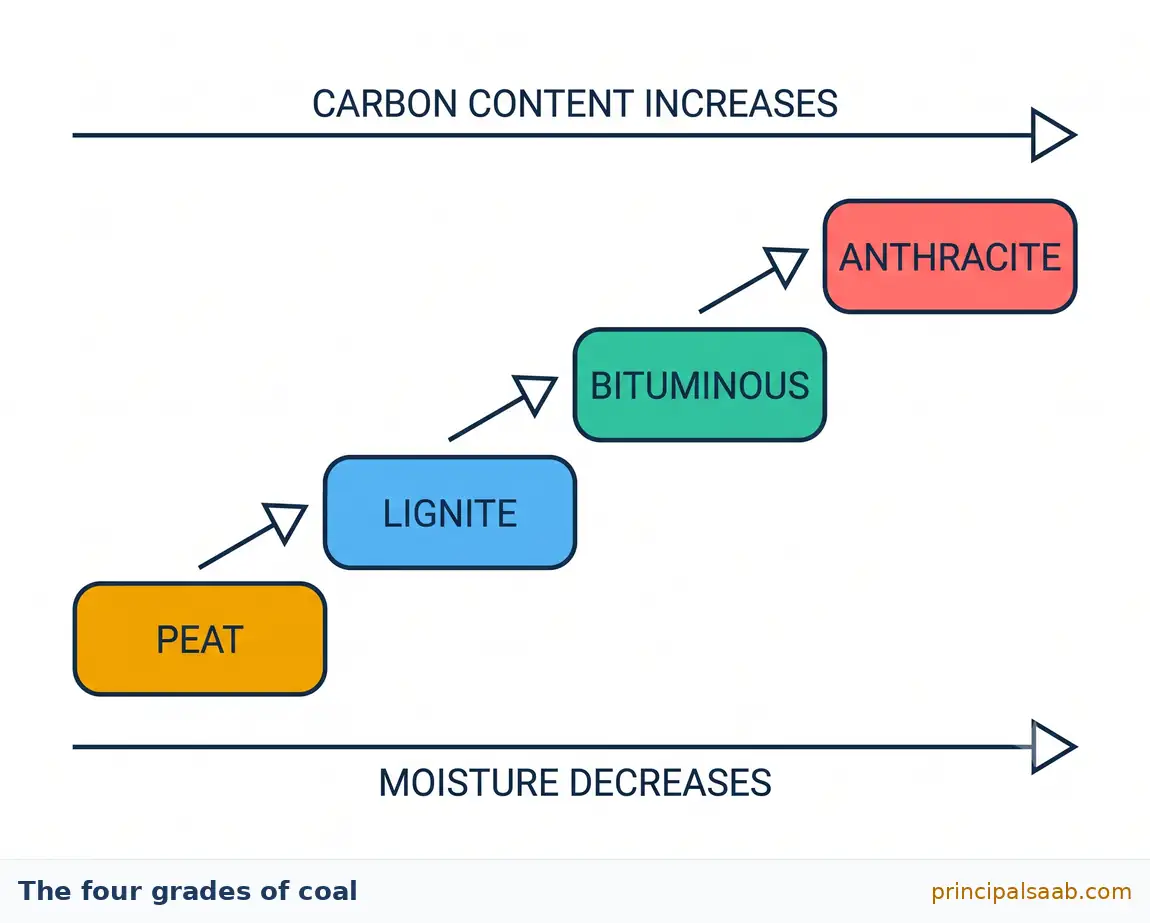
That single process explains everything about coal grades. The longer and deeper the burial, and the greater the heat and pressure applied, the more carbon is concentrated and the better the coal. So the four grades are not four separate things to memorise — they are four stages of one journey. Say that sentence to yourself once more, because it converts a memory task into an understanding task.
Peat is the first stage, barely transformed. Decaying plants in swamps produce peat; it has a low carbon content, high moisture, and consequently low heating capacity. Burn it and you get a smoky, feeble fire, because much of the energy goes into boiling off the water it contains.
Lignite is a low-grade brown coal, soft, with high moisture content. India’s principal lignite deposits are at Neyveli in Tamil Nadu, and they are used largely for the generation of electricity. Neyveli is one of the most heavily examined names in this chapter, and the association to fix is: Neyveli, Tamil Nadu, lignite, electricity generation.
Bituminous coal is coal that has been buried deep and subjected to increased temperatures. It is the most popular coal for commercial use, and it is the workhorse of Indian industry. Within bituminous coal, the high-grade variety used in the blast furnace for smelting iron is called metallurgical coal or coking coal, and it is far more valuable than ordinary steam coal precisely because relatively little of it exists.
Anthracite is the final stage: the highest quality hard coal, with the greatest carbon content, burning with a hot, clean and almost smokeless flame. It is also the rarest of the four in India.
| Grade | Stage of formation | Carbon and moisture | Heating value | Note for the exam |
|---|---|---|---|---|
| Peat | First stage; decaying plants in swamps, least altered | Low carbon, high moisture | Lowest | Little commercial value; smoky and inefficient |
| Lignite | Low-grade brown coal, soft | Higher carbon than peat, still high moisture | Low | Neyveli in Tamil Nadu; used mainly for electricity generation |
| Bituminous | Buried deep and subjected to increased temperature | High carbon, low moisture | High | Most popular for commercial use; its high-grade form, metallurgical coal, is used in blast furnaces |
| Anthracite | Final stage of the sequence | Highest carbon, lowest moisture | Highest | Highest quality hard coal; the scarcest grade in India |
Where India’s coal occurs — two ages, two regions. This is the part that finally makes the coalfield names stick, because there is a clean logic to it. India’s coal occurs in two main geological formations, and the age of the formation predicts the region.
Gondwana coal is the older of the two, laid down more than two hundred million years ago, and it makes up the great bulk of India’s coal reserves. It is found in the river valleys of the peninsula. The Damodar valley, lying along the West Bengal and Jharkhand border, is the most important of all, and it contains the famous fields of Jharia, Raniganj and Bokaro. Beyond the Damodar, Gondwana coal is worked in the Godavari, Mahanadi, Son and Wardha valleys. Talcher in Odisha belongs to this Mahanadi group.
Tertiary coal is much younger — of the order of fifty-five million years old — and it occurs in the north-eastern states: Meghalaya, Assam, Arunachal Pradesh and Nagaland. Because it is younger, it has had less time under pressure and is generally of lower grade, though it often has a high sulphur content.
So the memory hook is simply: older Gondwana coal in the peninsular river valleys, younger tertiary coal in the north-east. Two ages, two regions, and the names sort themselves into the right box.
The problem with coal, stated honestly. Coal is heavy and bulky in relation to the energy it contains, so transporting it long distances is expensive. That is why thermal power stations and heavy industry tend to be built close to the coalfields rather than the other way round, and why the Damodar valley became India’s industrial spine. It is also why moving coal by rail occupies such a large share of the country’s freight capacity. And of course burning coal releases carbon dioxide, sulphur compounds and particulate matter, which makes it the biggest single contributor to India’s energy-related air pollution. Coal is abundant, cheap and dirty, all at once — and any answer on India’s energy future has to hold those three facts together.
Peat, lignite, bituminous, anthracite: more time, more depth, more heat and pressure equals less moisture, more carbon, higher heating value. If you remember the process, you can rebuild the whole table under exam pressure without having memorised a word of it.
Opening. Coal is formed by the compression of plant material buried over millions of years, and its grade depends on the depth of burial and the temperature and pressure to which it has been subjected. (1 mark)
(i) Peat. Formed from decaying plants in swamps, it is the first stage of the sequence. It has a low carbon content, high moisture and therefore low heating capacity. (1 mark)
(ii) Lignite. A low-grade brown coal, soft and with high moisture content. Its principal Indian occurrence is at Neyveli in Tamil Nadu, where it is used largely for the generation of electricity. (1 mark)
(iii) Bituminous coal. Coal buried deep and subjected to increased temperatures, giving high carbon and low moisture. It is the most popular coal for commercial use, and its high-grade form, metallurgical coal, is especially valued for smelting iron in the blast furnace. (1 mark)
(iv) Anthracite. The highest quality hard coal, with the greatest carbon content and the highest heating value, burning with a clean, nearly smokeless flame. (1 mark)
Why it works. The opening sentence earns its place because the question says “on the basis of their formation” — stating the underlying process first frames every point that follows. Only lignite gets a place name here, because only lignite has one that the syllabus insists on.
(i) Gondwana coal. Over two hundred million years old, it forms the bulk of India’s reserves and is found in peninsular river valleys — most importantly the Damodar valley along the West Bengal and Jharkhand border, containing Jharia, Raniganj and Bokaro, and also the Godavari, Mahanadi, Son and Wardha valleys. (2 marks)
(ii) Tertiary coal. Around fifty-five million years old and therefore much younger, it occurs in the north-eastern states of Meghalaya, Assam, Arunachal Pradesh and Nagaland, and is generally of lower grade. (1 mark)
Why it works. The two-mark, one-mark split mirrors the relative importance of the two formations, and the answer gives named fields for Gondwana and named states for tertiary. Whenever you can attach an age to a formation, do it: it is one extra fact and it makes the distinction unmistakable.
(i) Weight loss in use. Coal is bulky and heavy relative to the energy it yields, and it is entirely consumed in the process, so transporting large tonnages of it over long distances adds greatly to cost. Locating the plant at the coalfield avoids that cost. (1 mark)
(ii) Electricity travels more easily than coal. Once generated, electricity can be carried through transmission lines far more cheaply than the equivalent coal could be carried by rail, so it makes economic sense to burn the coal where it is mined and transmit the power outward. (1 mark)
(iii) Proximity to other raw materials. In the Damodar valley and the Chota Nagpur region, coal occurs close to iron ore and limestone, which allowed integrated iron and steel plants to develop with all three raw materials within easy reach. (1 mark)
Why it works. This question rewards economic reasoning rather than recall, and the second point is the one that most candidates never think of. Comparing the cost of moving the input against the cost of moving the output is a genuinely geographical way of thinking, and it earns marks in industry questions too.
Neyveli is lignite, the soft brown low-grade coal, and it is used mainly to generate electricity. It is also the one southern coalfield in a chapter otherwise dominated by the east, which is exactly why it is asked about so often. Neyveli, Tamil Nadu, lignite — say it three times and it will stay.
All three sit in the Damodar valley on the West Bengal and Jharkhand side. If you are asked to name coalfields, naming all three plus their valley in a single clause demonstrates regional understanding rather than a scattergun list of names.
Petroleum, Natural Gas And The HVJ Pipeline
Petroleum is the next major energy source after coal, and it does three quite different jobs at once. It provides fuel for heat and lighting, it provides lubricants for machinery, and it provides raw materials for a whole family of manufacturing industries. That third role is the one students undervalue, so let us look at it properly.
Refineries as a nodal industry. Petroleum refineries are described as a nodal industry, and the word nodal is doing real work. A node is a junction — a point from which many lines radiate. A refinery does not simply produce petrol and diesel; it produces the feedstocks from which synthetic textiles, fertilisers, plastics, paints, detergents, pharmaceuticals and dozens of chemical products are made. So a refinery sits at the centre of an industrial web, and building one causes a cluster of other industries to grow around it. That is why refinery towns become chemical towns.
Where petroleum is found — the geology, explained simply. This part looks technical and is actually rather elegant. Most petroleum occurrences in India are associated with anticlines and fault traps in rock formations of the tertiary age.
Picture what happens underground. Rock layers that were originally flat get squeezed by earth movements and buckle into folds. An upfold — an arch — is called an anticline. Oil and gas formed from buried organic matter are lighter than the water in the surrounding rock, so they migrate slowly upward through porous rock such as sandstone or porous limestone. If they reach the underside of an impermeable, non-porous layer of rock arched over them, they can go no further. They collect and are trapped in the folded upper part of the anticline.
Then the contents sort themselves by density, which gives you the classic picture worth sketching in the margin of an answer: gas on top, oil in the middle, water below. Gas is lightest so it floats to the crest of the arch; oil sits beneath it; water, being heaviest, lies underneath. A fault trap works on the same principle — a fracture displaces the layers so that porous rock is sealed against non-porous rock, and the oil is caught against that seal.
So three things are needed for an oilfield: a porous reservoir rock to hold the oil, a non-porous cap rock to stop it escaping, and a trap-shaped structure such as an anticline or a fault to gather it into one place. Say those three conditions in an answer and you have essentially explained the geology of petroleum in three lines.
India’s oil-producing regions. Three areas carry almost all of India’s petroleum.
- Mumbai High — an offshore field in the Arabian Sea off the Maharashtra coast. It is by a wide margin the largest single contributor to India’s crude oil production, accounting for well over half the national output.
- Gujarat — the onshore fields of the Gujarat plain, of which Ankleshwar is the most important. Kalol is another significant Gujarat field, and both appear on the official map list.
- Assam — the oldest oil-producing state of India. Digboi is the historic field where Indian oil production began, and Naharkatiya and Moran or Moran-Hugrijan are the other important Assam fields.
Keep the shape rather than exact percentages: Mumbai High dominates, Gujarat comes second, Assam third but oldest. Those are safe, defensible statements. Precise production shares shift from year to year, so unless you are certain of a current figure, describe the ranking rather than quoting a number.
Natural gas. Natural gas is found alongside petroleum in oilfields, where it is called associated gas, and it is also found on its own in fields with no oil, where it is called free gas. It is an important clean energy resource, and it plays a double role: it is burned as a fuel, and it is used as an industrial raw material in the petrochemical industry, particularly for making fertilisers.
India has large reserves of natural gas. The Krishna–Godavari basin on the east coast holds very large reserves. Along the west coast, the Mumbai High and Bassein fields and the Gulf of Khambhat region are important, and there are reserves in the Andaman and Nicobar area as well. Note that Bassein appears on the official map list as an oil field and is also a major gas field; that dual role is worth a line in any answer about western offshore energy.
Why gas is called clean. Compared with coal and with liquid fuels, burning natural gas produces markedly less particulate matter, less sulphur and less carbon dioxide per unit of energy. It is not carbon-free, so calling it clean is a comparison rather than an absolute. In its compressed form, Compressed Natural Gas or CNG, it has been adopted as a vehicle fuel in Indian cities specifically to reduce urban air pollution, and Delhi’s conversion of its public transport fleet to CNG is the standard Indian example of this policy in action.
The HVJ pipeline — the piece of infrastructure you must know by name. Gas is only useful if it can reach the places that need it, and gas cannot be loaded into wagons like coal. It must travel by pipeline. The Hazira–Vijaipur–Jagdishpur pipeline, universally abbreviated to HVJ, is the answer to that problem.
Read the name as a route. It begins at Hazira in Gujarat, on the west coast near Surat, where gas from the offshore western fields comes ashore. It runs inland through Vijaipur in Madhya Pradesh, roughly the halfway point. It terminates at Jagdishpur in Uttar Pradesh. The line is about seventeen hundred kilometres long, and it links the Mumbai High and Bassein gas fields with fertiliser, power and industrial complexes across western and northern India.
Understand what that sentence actually means economically. Before the HVJ, gas produced offshore in the west had no way of reaching the fertiliser plants of the northern plains, and much associated gas was simply flared off and wasted at the wellhead. The pipeline converted a wasted by-product into an input for food production. Three states, three letters, one route: Gujarat, Madhya Pradesh, Uttar Pradesh — H, V, J.
Petroleum is trapped in the folded upper part of an anticline or against a fault, held in porous rock beneath a non-porous cap. The three fluids arrange themselves by density. Sketch that little arch in your answer if there is room; a clear diagram often secures a mark that words fumble.
(i) Rock age and structure. Most petroleum occurrences in India are associated with anticlines and fault traps in rock formations of the tertiary age, that is, in folded and faulted structures rather than in flat-lying undisturbed beds. (1 mark)
(ii) The reservoir and the seal. Oil accumulates in porous rocks such as sandstone and porous limestone, and is prevented from escaping upward by an overlying layer of non-porous, impermeable rock that seals the trap. (1 mark)
(iii) Arrangement within the trap. Oil collects in the folded upper part of the anticline, with natural gas trapped above it because gas is lighter, and water lying beneath the oil because water is heavier. (1 mark)
Why it works. Three sentences that together tell a complete physical story: the structure, the seal, the sorting. There are no place names in this answer at all, which is a useful reminder that “explain the conditions” is a question about process, not about location.
(i) What it is. HVJ stands for the Hazira–Vijaipur–Jagdishpur gas pipeline, running from Hazira in Gujarat through Vijaipur in Madhya Pradesh to Jagdishpur in Uttar Pradesh, a distance of roughly seventeen hundred kilometres. (1 mark)
(ii) What it connects. It links the Mumbai High and Bassein gas fields of the western offshore region with fertiliser, power and industrial complexes in western and northern India. (1 mark)
(iii) Why a pipeline at all. Natural gas cannot be transported in bulk by rail or road in the way that coal can, so a fixed pipeline is the only practical means of moving it in large quantities from producing fields to distant consuming centres. (1 mark)
(iv) Economic significance. It supplies gas as an industrial raw material for the manufacture of fertilisers and as a fuel for power generation, supporting both agricultural productivity and electricity supply across a wide region. (1 mark)
(v) Resource conservation. By carrying gas to markets, it makes commercial use of gas produced along with oil which would otherwise be flared and wasted at the wellhead, converting a by-product into a valuable resource. (1 mark)
Why it works. Points one and two are recall; points three, four and five are reasoning. A five-mark question almost never has five recall marks in it, so if your answer is entirely names and distances you are probably capping yourself at three.
(i) Meaning of nodal. A nodal industry is one that stands at the junction of many others, supplying materials on which a wide range of further industries depend. (1 mark)
(ii) The range of products. Refineries supply not only fuels and lubricants but also the raw materials for synthetic textiles, fertilisers, plastics, paints, detergents and numerous chemical products. (1 mark)
(iii) The clustering effect. Because these downstream industries need a reliable and nearby supply of feedstock, they tend to establish themselves close to refineries, so a refinery draws an entire industrial complex around it. (1 mark)
Why it works. The answer defines the term before applying it. Whenever a question contains an unusual word — nodal, ferrous, placer, flux — a one-line definition at the start is almost always worth a mark, and it never wastes more than fifteen seconds.
Hazira on the Gujarat coast, Vijaipur in central Madhya Pradesh, Jagdishpur in Uttar Pradesh. If you can say the three states in order, you can locate the line roughly on a blank map even without having memorised the towns, and you will never write the route backwards.
Order by density, always: gas at the very top of the arch, then oil, then water at the bottom. Students who rush this reverse the oil and water and lose a mark on an otherwise perfect answer. If you sketch it, label all three layers.
Electricity: Hydro Versus Thermal
Electricity deserves a moment of clear thinking before the details, because it is different in kind from everything else in this chapter. Coal, oil and gas are primary energy sources — you dig them up and burn them. Electricity is a secondary source: it does not exist in the ground; it has to be generated from something else. That is why electricity appears in the conventional list even though there is no such thing as an electricity mine.
Its usage is so central that per capita consumption of electricity is treated as an index of development. A country where every household has reliable power runs schools in the evening, refrigerates vaccines, pumps irrigation water and operates factories at night. A country where it fails does none of these things well.
Electricity in India is generated mainly in two ways.
Hydro electricity is generated by fast-flowing water, which is a renewable resource. Water stored behind a dam is released through turbines; the moving water spins the turbine, the turbine spins a generator, and electricity results. Nothing is consumed — the water flows on and the rain replaces it — which is why hydro power is renewable. India has a number of multi-purpose projects producing hydel power, and the ones worth naming are the Bhakra Nangal project, the Damodar Valley Corporation schemes, the Kopili Hydel Project and the Hirakud project.
Hydro power has real advantages: no fuel cost, no air pollution, very long plant life, and the ability to be switched on within minutes to meet a sudden surge in demand. It also has costs you should acknowledge: large dams submerge land and forest, displace people, silt up over decades, and depend on rainfall, so output falls in a drought year. If you have already studied the water resources chapter, you will recognise this argument — the two chapters overlap here, and cross-referencing them in an answer looks impressive.
Thermal electricity is generated by burning fuels — coal, petroleum and natural gas — to boil water, raise steam and drive turbines. India has a very large number of thermal power plants, running into the hundreds, and thermal generation supplies the greater part of the country’s electricity.
Here is the sentence that examiners are listening for: the fuels used in thermal plants are non-renewable fossil fuels. That is the fundamental difference from hydro. Thermal plants are also large emitters of carbon dioxide and particulates. Against that, they can be built almost anywhere fuel can be delivered, they are not dependent on rainfall or terrain, and they run steadily around the clock.
Three thermal plants appear on the official map list for this chapter and you should know their states: Namrup in Assam, which runs largely on natural gas from the Assam fields; Singrauli in Madhya Pradesh, in the coal belt of the Son valley region; and Ramagundam in Telangana, in the Godavari valley coalfield area. Notice the pattern — each sits on or beside its fuel. Namrup is next to gas, Singrauli and Ramagundam are next to coal. Once you see that, you never have to guess why a thermal plant is where it is.
Hydro electricity is generated from fast-flowing water and is renewable; thermal electricity is generated by burning coal, petroleum or natural gas, which are non-renewable fossil fuels. Everything else — cost, pollution, siting, reliability — follows from that single contrast.
(i) Source. Hydro electricity is generated by fast-flowing water turning turbines, whereas thermal electricity is generated by burning fuels such as coal, petroleum and natural gas to produce steam that drives turbines. (1 mark)
(ii) Renewability and pollution. Water is a renewable resource and hydro generation causes no air pollution, while thermal plants use non-renewable fossil fuels and release carbon dioxide and other pollutants into the atmosphere. (1 mark)
(iii) Location and reliability. Hydro plants must be sited where there is suitable relief and dependable river flow, and their output can fall in years of poor rainfall; thermal plants can be built wherever fuel can be delivered, most often near coalfields or gas fields, and generate steadily throughout the year. Examples of hydro projects include Bhakra Nangal and the Kopili Hydel Project, while Singrauli and Ramagundam are major thermal plants. (1 mark)
Why it works. Three paired contrasts, and examples folded into the last point rather than given a separate sentence. When space is tight, attaching examples to an existing point is more efficient than adding a fourth point that the mark scheme did not ask for.
Model answer.
(i) In favour of the hydel project. It would use a renewable resource with no fuel cost and no air pollution, it could serve as a multi-purpose project also providing irrigation and flood control, and once built it would run for many decades cheaply. (1 mark)
(ii) In favour of the thermal plant. Coal is already available at the site, so transport costs are minimal; generation would be steady and independent of rainfall; and construction would be quicker and would not require the submergence of land. (1 mark)
(iii) The deciding consideration. The decision should weigh the human and ecological cost of submerging forested valley land and displacing local communities against the long-term pollution and carbon emissions of burning coal, and should take into account how the state’s future demand is expected to grow. A balanced strategy would develop the hydel site only with proper resettlement and environmental safeguards, while progressively adding non-conventional capacity to reduce dependence on coal. (1 mark)
Why it works. Application questions have no single correct answer, and examiners know it. What they mark is whether you argued both sides with real geographical reasons and then reached a defensible judgement. Never leave the third part as “both are good in their own way” — commit to something and justify it.
If a question asks why electricity is classified differently from coal or petroleum, the phrase “electricity is a secondary source of energy because it must be generated from a primary source such as coal or flowing water” is a complete answer in one sentence. Short, exact answers to short questions save time for the long ones.
Non-Conventional Sources: Nuclear, Solar, Wind, Biogas, Tidal, Geothermal
Six sources here, which sounds like a lot until you notice that each one has a simple physical idea behind it, one or two Indian locations, and one distinctive advantage. Learn them in that shape — idea, place, advantage — and the section takes twenty minutes.
The reason this section exists at all is straightforward. India’s population and economy are growing, fossil fuel reserves are finite, imported oil costs foreign exchange, and burning coal pollutes the air and warms the climate. Non-conventional sources address all four problems at once, and many of them are locally available in exactly the remote areas that a national grid struggles to reach.
1. Nuclear or atomic energy. The idea is that altering the structure of atoms of certain heavy elements releases an enormous quantity of heat, which is then used to raise steam and drive turbines in the ordinary way. The two minerals that matter are uranium and thorium. Uranium is found in Jharkhand and in the Aravalli ranges of Rajasthan. Thorium is found principally in the monazite sands of Kerala — a lovely detail, because monazite sand is itself a placer deposit, concentrated on the beaches by wave action exactly as our placer discussion would predict. India’s thorium resources are among the largest in the world.
India’s nuclear power stations include Narora in Uttar Pradesh, Rawatbhata in Rajasthan, Kakrapara in Gujarat, Tarapur in Maharashtra, Kaiga in Karnataka and Kalpakkam in Tamil Nadu. Four of these — Narora, Kakrapara, Tarapur and Kalpakkam — appear on the official map list, so learn those four first. The advantage of nuclear power is that a very small quantity of fuel yields a very large amount of energy with no carbon dioxide released during generation; the drawbacks are the high cost of building the plants and the difficulty of safely handling radioactive waste.
2. Solar energy. India lies in the tropical zone and receives a great deal of solar radiation through the year, so the potential is enormous. The technology to know by name is photovoltaic technology, which converts sunlight directly into electricity — no boiling water, no turbine, no moving parts. There is also solar thermal technology, which uses mirrors to concentrate heat.
The largest solar plant of India mentioned in the syllabus is located at Madhapur near Bhuj in Gujarat, where solar energy is used to sterilise milk cans. Solar power is particularly valuable in rural India, where it can run lights, pumps and cookers in villages far from any transmission line. There is a second-order benefit worth mentioning in answers: widespread use of solar cookers and lighting reduces the demand for firewood and cattle dung cake, which in turn conserves forests and returns dung to the fields as manure. That is a chain of reasoning examiners genuinely like.
3. Wind energy. Moving air turns the blades of a turbine, which drives a generator. India is well placed for wind power, particularly along the western and southern coasts and in the arid west. The largest wind farm cluster in India extends from Nagarcoil to Madurai in Tamil Nadu. Other important areas are in Andhra Pradesh, Karnataka, Gujarat, Kerala, Maharashtra and Lakshadweep. Nagarcoil in Tamil Nadu and Jaisalmer in Rajasthan are the two names most often quoted — Nagarcoil for the coastal cluster, Jaisalmer for the desert. Wind is entirely free, endlessly renewable and non-polluting; its weakness is that it is intermittent, since a still day produces nothing.
4. Biogas. This is arguably the most quietly transformative technology in the list. Shrubs, farm waste, and animal and human waste are decomposed by bacteria in the absence of oxygen inside a sealed tank, producing a combustible gas. Plants using cattle dung are popularly known as gobar gas plants, and they are set up at municipal, cooperative and individual household level.
The exam point to hold on to is that biogas provides higher thermal efficiency than kerosene, dung cake and charcoal. But the deeper argument is better still. A gobar gas plant does not consume the dung — it digests it, and what comes out at the other end is an improved manure. So the farmer gets clean cooking gas and keeps the fertiliser value of the dung, instead of burning it and losing both. This solves the exact problem we identified when discussing cattle dung cake as a conventional fuel. Being able to close that loop in an answer shows real command of the chapter.
5. Tidal energy. Ocean tides can be harnessed to generate electricity. A floodgate dam is built across an inlet of the sea. During high tide, water flows into the inlet and is trapped when the gates close. Once the tide falls outside, the gates open and the trapped water rushes out through turbines, generating power. In India, the Gulf of Khambhat and the Gulf of Kachchh in Gujarat, and the Gangetic delta in the Sunderban region, offer ideal conditions, because these are places where the tidal range — the difference between high and low water — is exceptionally large. Tidal power has one advantage no other renewable can claim: tides are perfectly predictable, years in advance.
6. Geothermal energy. This is heat drawn from the interior of the earth. Where the temperature gradient is steep, groundwater is heated and rises as hot springs, or can be converted into steam that drives turbines. Two experimental projects in India are worth naming: one in the Parvati valley near Manikaran in Himachal Pradesh, and the other in the Puga valley in Ladakh. Both are in the Himalayan region, which is geologically young and active — again, the location follows from the physical geography rather than being an arbitrary fact.
Nuclear: uranium in Jharkhand and Rajasthan, thorium in Kerala’s monazite sands. Solar: photovoltaic technology, Madhapur near Bhuj. Wind: Nagarcoil to Madurai cluster, and Jaisalmer. Biogas: gobar gas plants, higher thermal efficiency, and the manure is preserved. Tidal: floodgate dams at the Gulfs of Khambhat and Kachchh and the Sunderban delta. Geothermal: Parvati valley at Manikaran, and Puga valley in Ladakh.
(i) The structure. A floodgate dam is constructed across an inlet of the sea, so that the inlet can be closed off from the open ocean. (1 mark)
(ii) The working. During high tide, seawater flows into the inlet and the gates are then closed, trapping the water inside. When the tide falls outside, the gates are opened and the trapped water rushes out through turbines placed in the dam, and the flow turns the turbines to generate electricity. (1 mark)
(iii) Suitable locations. The Gulf of Khambhat and the Gulf of Kachchh in Gujarat, and the Gangetic delta in the Sunderban region of West Bengal, all of which experience a large tidal range. (1 mark)
Why it works. The middle point walks through the cycle in the correct order — water in, gates shut, tide falls, gates open, water out through turbines. Process questions are marked on sequence. If your steps are in the wrong order, the mark goes even when every individual fact is correct.
(i) The raw material is already there. Biogas is produced by the decomposition of shrubs, farm waste, and animal and human waste, all of which are abundantly available in rural areas at no cost, so no fuel has to be purchased or transported. (1 mark)
(ii) Higher thermal efficiency. Biogas provides greater thermal efficiency than kerosene, dung cake and charcoal, so a given quantity of raw material yields more usable heat for cooking. (1 mark)
(iii) The manure is preserved. When dung is burnt as cake, its value as fertiliser is destroyed. In a gobar gas plant the dung is digested rather than burnt, and the residue left behind is an improved manure that can be returned to the fields, so the household gains fuel without losing soil nutrients. (1 mark)
(iv) Health and environmental gains. Burning firewood and dung cake indoors fills kitchens with smoke and harms the health of women and children, and gathering firewood contributes to deforestation. Biogas burns cleanly and reduces both problems. (1 mark)
(v) Suitable scale and decentralisation. Plants can be set up at individual household, cooperative or municipal level, so villages far from any transmission line can meet their own energy needs without waiting for grid connection. (1 mark)
Why it works. Point three is the heart of this answer and it is where most candidates stop short. Anyone can write that biogas is clean; explaining that it saves the manure as well as providing the fuel demonstrates that you understand why it is a genuine improvement rather than merely a modern one.
(i) Location in the tropical zone. India lies largely within the tropics and receives abundant and fairly reliable solar radiation through most of the year, giving it a very large solar resource compared with countries in higher latitudes. (1 mark)
(ii) Available technology. Photovoltaic technology converts sunlight directly into electricity, and installations such as the plant at Madhapur near Bhuj demonstrate practical large-scale use in the country. (1 mark)
(iii) Favourable wind regimes. India has a long coastline and extensive arid tracts with dependable winds, including the seasonal monsoon winds; the largest wind farm cluster stretches from Nagarcoil to Madurai in Tamil Nadu, and Jaisalmer in Rajasthan is another well-known site. (1 mark)
(iv) Wide regional spread. Wind power is also being developed in Andhra Pradesh, Karnataka, Gujarat, Kerala, Maharashtra and Lakshadweep, showing that the resource is not confined to one corner of the country. (1 mark)
(v) Strategic value. Both are renewable, non-polluting and locally available, so developing them reduces dependence on imported oil, lowers pollution, and can bring power to remote settlements that the grid does not economically reach. (1 mark)
Why it works. “Support this statement” means build a case. Points one to four supply the evidence and point five supplies the significance. Ending a support-the-statement answer with a “so what” sentence almost always secures the final mark.
This is a favourite one-mark question and it also lets you link back to placer deposits, since monazite is concentrated on Kerala’s beaches by wave action. Two chapters’ worth of understanding in one sentence is exactly the kind of connection that lifts a script.
Nuclear energy is classified as non-conventional, but uranium and thorium are minerals with finite reserves, so nuclear power is not renewable in the way that solar, wind and tidal energy are. If a question asks you to list renewable sources, leave nuclear out. If it asks for non-conventional sources, put it in.
Conservation Of Energy Resources And Sustainable Use
Here is the argument that the whole chapter has been building towards, and it is worth stating plainly because it is the natural closing paragraph for almost every long answer you will write on this topic.
Energy is an essential requirement for every sector of a national economy — agriculture, industry, transport, commerce and domestic life all consume it, and a country’s demand rises steadily as it develops. At the same time, the conventional sources that currently meet most of that demand are finite. Coal, petroleum and natural gas took millions of years to form and cannot be replaced within any human timescale. That mismatch is the entire problem: rising demand against a fixed and shrinking supply.
There is a second layer to the problem. Even if the fuels lasted forever, burning them on the present scale would still be unsustainable, because of what the combustion releases into the atmosphere. So conservation is not merely about making reserves last longer; it is also about limiting the damage of using them.
What sustainable use actually means. Sustainable development is often summarised as meeting the needs of the present without compromising the ability of future generations to meet their own needs. Applied to energy, that means promoting conservation alongside increased use of renewable resources — the two together, not one instead of the other. Building more solar farms while wasting electricity is not sustainability; it is just a bigger system with the same leak.
Practical measures, from the household upward.
- Use public transport instead of individual vehicles. One bus carrying fifty people uses far less fuel per passenger than fifty separate two-wheelers or cars, and it also reduces congestion and urban air pollution.
- Switch off electricity when not in use. Lights, fans and appliances left running in empty rooms represent pure waste. It sounds trivially small, and multiplied across hundreds of millions of households it is not small at all.
- Use power-saving devices. Efficient lighting and star-rated appliances deliver the same service for a fraction of the electricity, so consumption falls without anyone giving anything up.
- Use non-conventional sources of energy. Solar water heaters, solar cookers, rooftop photovoltaic panels and biogas plants replace fossil fuel and firewood at the point of use.
- Check power leakages and improve efficiency. Regular checking of electric equipment and reducing transmission and distribution losses saves energy that has already been generated at full environmental cost.
- Reduce waste in industry and construction. Recovering waste heat, insulating buildings properly and designing for natural light and ventilation cut demand permanently rather than temporarily.
Notice the quiet theme running through that list. Every measure is either using less for the same result or substituting a renewable for a finite source. Those two phrases are the entire logic of energy conservation, and if you understand them you can generate the measures yourself in the exam hall without having memorised the list.
Efficiency, which means getting the same service from less energy, and substitution, which means shifting from finite fossil fuels to renewable sources. Every recommended measure is one or the other, and a strong answer names both arms explicitly.
(i) Use public transport. Travelling by bus, train or shared transport instead of individual vehicles reduces fuel consumption per passenger considerably and also lowers urban air pollution. (1 mark)
(ii) Switch off electrical equipment when not in use. Lights, fans and appliances left on in unoccupied rooms waste electricity that has already been generated at a cost to fuel reserves and to the environment. (1 mark)
(iii) Use power-saving devices. Energy-efficient lighting and star-rated appliances provide the same service while consuming markedly less electricity, so demand falls without any loss of comfort. (1 mark)
(iv) Adopt non-conventional sources. Solar cookers and water heaters, rooftop solar panels and household biogas plants substitute renewable energy for coal, kerosene and firewood at the point of use. (1 mark)
(v) Check power leakages and equipment regularly. Servicing electrical equipment and reducing transmission and distribution losses ensures that energy already produced actually reaches its intended use rather than being lost on the way. (1 mark)
Why it works. Every measure is followed by its effect. A bare list of five instructions might earn three marks; five instructions with five reasons earns five. This is the single most reliable way to convert knowledge into marks in any “suggest measures” question, in any chapter.
(i) Rising demand against finite supply. Energy is required by agriculture, industry, transport, commerce and households, and demand grows steadily with development and population, while coal, petroleum and natural gas exist in fixed quantities that cannot be renewed within any human timescale. (1 mark)
(ii) Environmental damage. Burning fossil fuels on the present scale pollutes the air and releases greenhouse gases that contribute to climate change, so even if reserves were larger, continued dependence would remain harmful. (1 mark)
(iii) Obligation to the future and to self-reliance. Sustainable development means meeting present needs without compromising the ability of future generations to meet theirs, which requires promoting conservation together with increased use of renewable resources; it also reduces the heavy expenditure of foreign exchange on imported oil. (1 mark)
Why it works. Three distinct grounds — resource, environment, and intergenerational and economic responsibility. Students who write three variations of “resources are limited” find that only the first is credited. Before you write, check that your three points are genuinely three different arguments.
“Energy must be used in a manner that promotes conservation alongside increased use of renewable resources, so that present needs are met without compromising those of future generations.” That single sentence closes a long answer on minerals, on energy, on mining hazards or on non-conventional sources. Memorise it once, use it many times.
Map Skill: The Official 2026-27 List
Map work is the most winnable section in the entire Geography paper, and it is the one students most often leave until the night before. Please do not. The list is short, it is fixed, it is published in advance, and it does not change its mind on exam day. Ten minutes a day with a blank outline map for one week and this becomes free marks.
First, the distinction that everything depends on. The official map work for this chapter is split into two different tasks, and they are not the same job.
Identify. For these items, the feature is already marked on the map for you — usually with a letter or a number against a symbol. Your task is to recognise it and write its name in the space provided. You are not required to find it on a blank map yourself. What you need here is recognition: you must know roughly where each place sits so that when you see a marked point in eastern Odisha you can confidently say “that is Talcher” or “that is Mayurbhanj”.
Locate and label. For these items, the map is blank at that point. You must work out where the place is, mark it yourself with the correct symbol, and write its name beside the mark. This is the harder of the two tasks because it needs positional accuracy, not just recognition.
Why does this matter so much? Because it tells you exactly where to spend your practice time. The identify items need familiarity; the locate-and-label items need precision. For this chapter the split is very clear, and it is a kind one: all the mines and oil fields are identify items, while only the power plants — three thermal and four nuclear — must be located and labelled from scratch. That is just seven places you have to be able to place accurately on an empty map. Seven. That is entirely doable.
| Task | Category | Places on the official list | What you must do in the exam |
|---|---|---|---|
| Identify only | Iron ore mines | Mayurbhanj, Durg, Bailadila, Bellary, Kudremukh | The point is already marked. Recognise the marked feature and write its correct name. No marking or symbol drawing needed. |
| Coal mines | Raniganj, Bokaro, Talcher, Neyveli | ||
| Oil fields | Digboi, Naharkatia, Mumbai High, Bassien, Kalol, Ankaleshwar | ||
| Locate and label | Thermal power plants | Namrup, Singrauli, Ramagundam | The map is blank here. Find the correct position yourself, mark it clearly with a symbol, and write the name legibly beside it. |
| Nuclear power plants | Narora, Kakrapara, Tarapur, Kalpakkam |
Now let us attach every one of those places to a state. This is the step that makes the map learnable, because you are no longer memorising dots — you are memorising which state each name belongs to, and a state is something you already know how to find.
Iron ore mines. Mayurbhanj is in the north-eastern part of Odisha and belongs to the Odisha–Jharkhand belt with its Badampahar workings. Durg and Bailadila are both in Chhattisgarh — Durg in the centre-west of the state, Bailadila in the Bastar region to the south, and both belong to the Durg–Bastar–Chandrapur belt. Bellary, also spelt Ballari, and Kudremukh are both in Karnataka, Bellary in the eastern interior and Kudremukh westward in the Western Ghats, and both belong to the Karnataka belt.
Coal mines. Raniganj lies in West Bengal in the Damodar valley. Bokaro lies in Jharkhand, also in the Damodar valley, a little to the west of Raniganj. Talcher is in Odisha, in the Mahanadi valley coalfield. Neyveli is the odd one out in every sense — it is far south in Tamil Nadu and it produces lignite rather than the Gondwana coal of the other three. That very oddity is your memory aid: three in the east, one in the deep south.
Oil fields. Digboi and Naharkatia are both in the far north-east of Assam, close together in the upper Brahmaputra valley. Kalol and Ankaleshwar are both in Gujarat, Kalol in the north near Ahmedabad and Ankleshwar to the south near Bharuch. Mumbai High and Bassien, also written Bassein, are both offshore in the Arabian Sea off the Maharashtra coast, Mumbai High roughly north-west of Mumbai and Bassein to its south. The pattern is again pleasingly simple: two in Assam, two in Gujarat, two offshore in the Arabian Sea.
Thermal power plants, to be located and labelled. Namrup is in Assam, in the same upper Brahmaputra region as the Assam oil fields, and it runs largely on natural gas from those very fields. Singrauli is in Madhya Pradesh, in the east of the state in the Son valley coal region near the Uttar Pradesh boundary. Ramagundam is in Telangana, in the Godavari valley coalfield area. Every one of the three sits on its fuel supply, which is both the reason it is there and the way to remember it.
Nuclear power plants, to be located and labelled. Narora is in western Uttar Pradesh, on the Ganga. Kakrapara is in southern Gujarat, inland from Surat. Tarapur is in Maharashtra, on the coast north of Mumbai. Kalpakkam is in Tamil Nadu, on the Coromandel coast south of Chennai. Here too there is a pattern worth noticing: three of the four are close to the coast or to a major river, because a nuclear plant needs a large and reliable supply of cooling water. Narora sits on the Ganga for exactly that reason. Understanding why they are where they are makes it far harder to place them wrongly.
For this chapter, every mine and oil field is an identify item, while the seven power plants — Namrup, Singrauli and Ramagundam for thermal, and Narora, Kakrapara, Tarapur and Kalpakkam for nuclear — must be located and labelled on a blank map. Practise those seven hardest.
Model answer.
A — Bailadila, in Chhattisgarh. It is known for very high-grade hematite and its ore is exported through Visakhapatnam. (1 mark)
B — Raniganj, in West Bengal, part of the Damodar valley Gondwana coalfields. (1 mark)
C — Neyveli, in Tamil Nadu, India’s principal lignite deposit, used mainly for electricity generation. (1 mark)
Why it works. The name alone earns the mark, but adding the state and one identifying detail costs seconds and protects you if your handwriting is ambiguous. In map questions, an examiner who can see you clearly know the place is far more likely to give you the benefit of the doubt.
Model answer, with the reasoning you should use while placing them.
(i) Ramagundam — mark it in the north of Telangana, in the Godavari valley region. Reason to guide your placement: it is a coal-based thermal plant sited on the Godavari valley coalfield, so it must be inland in the north of that state, not near the coast. (1 mark)
(ii) Kalpakkam — mark it on the eastern coast of Tamil Nadu, on the Coromandel coast a short distance south of Chennai. Reason: nuclear plants need abundant cooling water, so a coastal position is expected. (1 mark)
(iii) Narora — mark it in western Uttar Pradesh on the river Ganga. Reason: again the cooling water requirement, met here by a major river rather than the sea. (1 mark)
Why it works. The reasoning is not written on the answer script, but it is what keeps your pencil honest. A student who knows that nuclear plants follow water will never put Kalpakkam in the middle of the Deccan, and a student who knows thermal plants follow coal will never put Ramagundam on the Konkan coast.
Mark the location with a small clear dot or the standard symbol, then write the name beside it with a short leader line if the area is crowded, never on top of the mark. Write in capitals if your ordinary handwriting is small. An examiner cannot award a mark for a name they cannot read.
The same regions host both the raw material and the industry, which is exactly why the industries were built there, but the map list for this chapter asks for the mines and fields. Read the question wording carefully: a coal mine and a steel plant in the same district are still two different answers.
Practice Worksheet with Answers
Ten original questions, mixed across one, three and five marks, with a map question at the end. Do this properly: write your answer on paper first, then open the panel and compare. Reading the answer without attempting the question feels productive and teaches almost nothing. Give yourself about forty minutes for the full set.
Q1 (1 mark). Which variety of iron ore has the highest iron content and excellent magnetic qualities?
Note. If the question had instead asked which iron ore is the most important in terms of quantity used by industry, the answer would be hematite. Read the wording before you write.
Q2 (1 mark). Name the pipeline that carries natural gas from the western offshore fields to northern India, and give its full form.
Q3 (3 marks). Explain how minerals occur in veins and lodes, and state why such deposits usually require underground mining.
(i) Formation. In igneous and metamorphic rocks, minerals may occur in the cracks, crevices, faults and joints of the rock. Molten and gaseous material, and hot mineral-bearing fluids, are forced upward through these openings from below and cool as they rise, depositing minerals on the walls of the fracture. (1 mark)
(ii) Vein and lode. When the resulting filling of the fracture is thin it is called a vein, and when it is thick and substantial it is called a lode; the two terms describe the same phenomenon at different scales. Tin, copper, zinc and lead commonly occur in this form. (1 mark)
(iii) Mining method. Because such deposits form narrow, often steeply inclined sheets that extend to considerable depth rather than broad flat layers near the surface, they cannot be worked by stripping the surface. Shafts and tunnels must be driven down to the deposit, which is why deep underground mining is required, making the operation costly and hazardous. (1 mark)
Q4 (3 marks). “The Odisha–Jharkhand belt and the Maharashtra–Goa belt are both important for iron ore, but for very different reasons.” Justify this statement.
(i) The Odisha–Jharkhand belt is important for the quality and quantity of its ore. It yields high-grade hematite from Badampahar in the Mayurbhanj and Kendujhar districts of Odisha and from Gua and Noamundi in the Singhbhum area of Jharkhand. (1 mark)
(ii) It is also important because of its industrial linkage. The ore occurs close to coal and limestone, which allowed major integrated iron and steel plants to develop in the region, so the belt feeds domestic industry directly. (1 mark)
(iii) The Maharashtra–Goa belt is important despite modest ore quality. Covering Goa and the Ratnagiri district of Maharashtra, its ore is not of very high quality, but it is exploited very efficiently and lies close to the coast, so it is exported readily through Marmagao port and earns valuable foreign exchange. (1 mark)
Why the marks fall this way. The question asks you to contrast two reasons for importance, so a strong answer names grade and industrial linkage for the first belt, and efficiency and port access for the second.
Q5 (3 marks). Why is India described as critically deficient in copper, and what are the consequences?
(i) Limited reserves. India’s reserves and production of copper are small, and the workable deposits are confined to a few areas — the Balaghat mines of Madhya Pradesh, the Khetri mines of Rajasthan and the Singhbhum district of Jharkhand — so domestic output cannot match national requirements. (1 mark)
(ii) High and growing demand. Copper is essential to the electrical and electronics industries because it is an excellent conductor and is highly ductile, and demand rises steadily as electrification and manufacturing expand. (1 mark)
(iii) Consequences. The gap must be met by imports, which consume foreign exchange and expose Indian industry to fluctuations in international prices and supply. This makes recycling of copper scrap and the search for substitutes especially important for the country. (1 mark)
Q6 (3 marks). Bauxite deposits in India are found on plateau surfaces rather than in river valleys. Explain why.
(i) Bauxite is a residual deposit. It is formed by the decomposition of a wide variety of rocks that are rich in aluminium silicates. It is not transported and deposited elsewhere; it forms where the parent rock lies. (1 mark)
(ii) The process requires stable, well-drained upland surfaces. Prolonged weathering in a hot and wet climate dissolves the soluble constituents of the rock and washes them away, leaving behind an insoluble, aluminium-rich residual mass. This concentration happens best on flat, elevated surfaces that have remained exposed for long periods and where water drains freely downward. (1 mark)
(iii) Hence the Indian distribution. India’s bauxite is accordingly found on plateau and upland surfaces such as the Amarkantak plateau, the Maikal hills and the plateau region of Bilaspur and Katni; Odisha is the largest producing state, with the important Panchpatmali deposits in Koraput district. (1 mark)
Q7 (5 marks). Describe the four grades of coal, and explain why India’s coalfields fall into two distinct regions.
(i) The basis of the grades. Coal forms from plant material buried and compressed over millions of years. The greater the depth of burial and the higher the temperature and pressure to which it has been subjected, the more moisture is driven off and the more carbon is concentrated, so the grade improves along the sequence. (1 mark)
(ii) Peat and lignite. Peat, formed from decaying plants in swamps, is the first stage, with low carbon content, high moisture and low heating capacity. Lignite is a low-grade brown coal, soft and with high moisture; India’s principal deposits are at Neyveli in Tamil Nadu and are used largely for generating electricity. (1 mark)
(iii) Bituminous and anthracite. Bituminous coal has been buried deep and subjected to increased temperature, giving high carbon and low moisture; it is the most popular coal for commercial use, and its high-grade metallurgical form is used for smelting iron in the blast furnace. Anthracite is the highest quality hard coal, with the greatest carbon content and the highest heating value. (1 mark)
(iv) Gondwana coalfields. India’s coal occurs in two geological formations. Gondwana coal is more than two hundred million years old and forms the bulk of the reserves. It is found in peninsular river valleys — most importantly the Damodar valley on the West Bengal and Jharkhand border, containing Jharia, Raniganj and Bokaro, and also the Godavari, Mahanadi, Son and Wardha valleys. (1 mark)
(v) Tertiary coalfields. Tertiary coal is far younger, of the order of fifty-five million years old, and is found in the north-eastern states of Meghalaya, Assam, Arunachal Pradesh and Nagaland. Because it has spent much less time under heat and pressure, it is generally of lower grade. The two regions are therefore distinct because they belong to two entirely different periods of geological history. (1 mark)
Q8 (5 marks). A village panchayat is deciding between extending the electricity grid and installing decentralised non-conventional energy systems. Evaluate the options and make a recommendation.
(i) The case for grid extension. Grid electricity is available on demand regardless of weather, can support heavy loads such as irrigation pumps and small workshops, and requires no maintenance skill within the village itself. (1 mark)
(ii) The difficulty with grid extension. Running transmission lines to remote or hilly settlements is expensive per household, transmission and distribution losses over long distances are significant, and the electricity delivered would in large part be thermal power generated by burning non-renewable fossil fuels, adding to pollution and greenhouse gas emissions. (1 mark)
(iii) The case for decentralised non-conventional systems. Solar photovoltaic panels, solar cookers and water heaters, and household or community biogas plants use resources that are locally and freely available; India lies in the tropical zone and receives abundant solar radiation, while farm and animal waste is plentiful in any village. They can be installed quickly without waiting for a transmission line. (1 mark)
(iv) The additional benefits of biogas in particular. A gobar gas plant provides fuel with higher thermal efficiency than kerosene, dung cake or charcoal, reduces indoor smoke that harms the health of women and children, lessens the cutting of firewood, and leaves behind an improved manure so that the fertiliser value of the dung is not lost. (1 mark)
(v) Recommendation. The two options are not mutually exclusive and the sensible course is a combination. Decentralised solar and biogas should be adopted immediately for lighting and cooking, since they are cheap to run, locally available and environmentally sound, while grid connection is pursued for the heavier loads that renewables cannot yet reliably meet. This promotes conservation alongside increased use of renewable resources, meeting present needs without compromising those of future generations. (1 mark)
Marking note. Any well-argued recommendation is acceptable, including choosing one option outright, provided both sides have been evaluated with genuine geographical reasons and the conclusion follows from the argument.
Q9 (5 marks). Describe the hazards of mining for the miner and for the environment, and suggest how these can be reduced.
(i) Immediate physical dangers to the miner. The miner works in darkness in a confined space, often with poor or no ventilation. There is a constant risk of the collapse of mine roofs, of inundation when water breaks into the workings, and of fires, which in coal seams can burn underground for long periods. (1 mark)
(ii) Long-term health damage. Continuous inhalation of fine mineral dust makes miners vulnerable to pulmonary disease, that is, disease of the lungs, which develops slowly over years of exposure and is frequently irreversible. (1 mark)
(iii) Water and land degradation. Drainage and effluent from mines and processing plants contaminate water sources in the mining region, harming communities downstream. The dumping of waste rock and slurry degrades land and soil, and open-cast working strips away vegetation and topsoil over large areas. (1 mark)
(iv) Wider environmental effects. Fine sediment washed from waste dumps increases the pollution and silt load of streams and rivers and damages aquatic life; dust and noise from blasting, crushing and haulage affect nearby settlements; and because many mineral belts lie beneath forest, opening a mine often means clearing woodland and displacing wildlife and forest communities. (1 mark)
(v) Measures to reduce the harm. Provide proper ventilation, protective equipment and regular health screening for workers; treat effluent before it is discharged; restore mined land by levelling, re-soiling and replanting it; regulate and monitor mining operations strictly; and above all reduce the demand for fresh ore by recycling metals, using scrap and substitutes, and developing technology that allows low-grade ores to be used at low cost. (1 mark)
Q10 (5 marks, map-based). On an outline map of India, locate and label the following, and in each case name the state: (a) Namrup thermal power plant (b) Singrauli thermal power plant (c) Ramagundam thermal power plant (d) Tarapur nuclear power plant (e) Kakrapara nuclear power plant. Then explain briefly why thermal and nuclear plants tend to be sited where they are.
(a) Namrup — Assam. Mark it in the upper Brahmaputra valley in the north-east of the state, in the same region as the Assam oil and gas fields. (1 mark)
(b) Singrauli — Madhya Pradesh. Mark it in the east of the state, in the Son valley coal region towards the Uttar Pradesh boundary. (1 mark)
(c) Ramagundam — Telangana. Mark it in the north of the state, in the Godavari valley coalfield area. (1 mark)
(d) Tarapur — Maharashtra. Mark it on the Arabian Sea coast a little north of Mumbai. (1 mark)
(e) Kakrapara — Gujarat. Mark it in the south of the state, inland from Surat. (1 mark)
Explanation of siting. Thermal plants are located close to their fuel, because coal is bulky and heavy in relation to the energy it yields and is entirely consumed in use, so it is cheaper to burn it at the coalfield and transmit the electricity outward than to carry the coal to distant consumers. Singrauli and Ramagundam accordingly sit on coalfields, while Namrup uses natural gas from the neighbouring Assam fields. Nuclear plants are located where a large and dependable supply of cooling water is available, which is why Tarapur and Kalpakkam are coastal and Narora stands on the Ganga.
Note. The five power plants above are all locate-and-label items on the official map list, so in the examination you must mark the position yourself with a clear symbol and write the name legibly beside it. Mines and oil fields such as Bailadila, Raniganj, Neyveli, Digboi and Ankaleshwar are identify items, where the point is already marked and you write the name.
Kaizen: One More Than Yesterday
Kaizen is a Japanese word meaning continuous improvement — not dramatic transformation, but small, steady, almost unnoticeable progress made every single day. It is the quiet opposite of the all-night cramming session, and it is far more powerful.
Apply it to this chapter and see how gentle it becomes. Today, learn the classification tree — four categories, ninety seconds, done. Tomorrow, the four iron ore belts with one mine and one port each. The day after, the four grades of coal, which you now understand as one process rather than four facts. Then the oil fields. Then seven power plants on a blank map. In under a fortnight, at fifteen minutes a day, you will have absorbed an entire chapter that felt overwhelming on the first reading — and you will still remember it in March, because material learned slowly is material that stays.
Notice, too, how much of this chapter you no longer have to memorise at all. You do not memorise that bauxite sits on plateaus; you understand that it forms by weathering in place, and the location follows. You do not memorise that thermal plants cluster near coalfields; you understand that coal is heavy and electricity travels easily, and the pattern follows. Every time you replace a remembered fact with an understood reason, you lighten the load you are carrying and you make yourself immune to the question you did not anticipate.
And on the days when it does not go well — when the names blur, when the map defeats you, when you get a practice answer completely wrong — remember that a wrong answer you have corrected is worth more than a right answer you guessed. Mistakes made now, on paper, in your own room, are the cheapest mistakes you will ever make. Mark them, understand them, move on.
Fifteen focused minutes a day for two weeks will teach you this chapter more thoroughly than six frantic hours the night before the exam, and unlike the six hours, it will still be there when you need it.
So do not try to conquer minerals and energy resources in one sitting. Do not measure yourself against anybody else in your class. Open your notebook tomorrow, pick up exactly where you stopped, and aim for one more correct question than you managed yesterday.