
Take a breath. If you have opened this chapter and thought, “This is just a long list of foreign names and dates I will never remember,” you are not alone — almost every student feels that on the first read. So let me tell you the secret straight away: Print Culture and the Modern World is not a list. It is one single story, told twice. Once in Europe, and once in India. Both times the story has the same shape — a slow, expensive, hand-copied world gets replaced by a fast, cheap, printed world, and the moment that happens, ordinary people start reading, arguing, disagreeing and demanding change. Every name in this chapter is just a person standing somewhere along that one story.
Think about your own phone for a second. Before it, if you wanted to tell two hundred people something, you had to find two hundred people. Now you press one button. That jump — from “one message, one person, lots of effort” to “one message, thousands of people, almost no effort” — is exactly what the printing press did in the 1400s. Everything else in this chapter is a consequence of that jump: the Church panicking, kings panicking, women reading in secret kitchens, mill workers building libraries, and a colonial government passing a law to gag Indian newspapers. Once you see it as cause and effect instead of a list, the chapter becomes genuinely easy.
I am going to walk you through it slowly, section by section, in the same order your textbook follows, and I will stop constantly to show you exactly how a board examiner wants these answers written. You will get more than twenty fully worked model answers and a ten-question worksheet at the end. Work through it in small sittings — this chapter rewards patience far more than speed.
- The First Printed Books: Print in China, Japan and Korea
- Print Comes to Europe: Marco Polo, Woodblock and the Manuscript Bottleneck
- Gutenberg and the Printing Press: How the Machine Actually Worked
- The Print Revolution and Its Impact: A New Reading Public
- Religious Debates and the Fear of Print
- The Reading Mania: Chapbooks, Almanacs and Periodicals
- Print Culture and the French Revolution
- The Nineteenth Century: Children, Women and Workers
- Further Innovations: Power Presses, Offset and Paperbacks
- India Before the Age of Print: The Manuscript World
- Print Comes to India: Missionaries, Hickey and the Bengal Gazette
- Religious Reform and Public Debates in India
- New Forms of Publication: Novels, Lithographs and Battala Books
- Women and Print in India
- Print and the Poor in India
- Print and Censorship: From Company Rule to the Nationalist Press
- Chapter Glossary: The Words That Trip Students Up
- The Whole Chapter as One Timeline
- Practice Worksheet with Full Answers
Your Game Plan For This Chapter
Do not read this in one long panic session the night before. Here is the order that actually works:
- Read the East Asia and Europe sections first (sittings 1 and 2). That is where the cause-and-effect chain is built. India makes almost no sense until you have understood why print frightened people in Europe.
- After every section, close the page and say the section back to yourself out loud in four sentences. If you cannot, you did not understand it — reread just that section, not the whole chapter.
- Attempt the worked example before reading the model answer. Write your version on paper, then compare. The gap between your answer and mine is exactly what you need to fix.
- Build your own one-page timeline (sitting 3). Copy the timeline table near the end of this page by hand. Writing dates once beats reading them ten times.
- Do the worksheet last, closed-book (sitting 4). Then mark yourself honestly against the answers.
- Revise using only the jump menu at the top. Click a heading, and before you read it, try to recall what is inside. That is retrieval practice, and it is the single most effective revision method there is.
The First Printed Books: Print In China, Japan And Korea
Here is the first thing that surprises most students: printing was not invented in Europe. It was already several hundred years old in East Asia before any European ever saw a printed page. China had been printing since roughly the sixth century of the Common Era, which means that when Gutenberg was born, Chinese printers had been at work for something like eight hundred years.
The Chinese method is called woodblock printing, and honestly the easiest way to picture it is a rubber stamp. Imagine you carve a whole page of writing — every character, in mirror image — into a flat block of wood. The parts you want to appear as ink are left standing up; everything else is scooped away. You brush ink over the raised surface, lay a sheet of thin paper on top, and rub the back of the paper with a soft brush. Lift the paper, and there is your page. Do it again, and again, and again. One carved block, hundreds of identical pages.
Because Chinese paper was thin and porous, ink soaked through, so you could only print on one side of a sheet. Printers solved that neatly: they printed a sheet, folded it with the printed side facing outwards, and stitched the folded edges together along one side. Open such a book and every visible surface has text; the blank sides are hidden inside the folds. Historians call this the accordion book, and it is genuinely elegant engineering.
That state monopoly did not last forever. By the sixteenth and seventeenth centuries, as trade and city life expanded, print spread outward into everyday commercial use. Merchants printed trade information. Ordinary readers bought fiction, poetry, plays, romances, autobiographies and collections of anecdotes. Rich women read and some wrote poetry; wives of scholar-officials published their work. By the nineteenth century, when Western printing technology and mechanical presses arrived in the port city of Shanghai, China already had a deep reading habit for the new machines to feed.
Japan. Printing reached Japan through Buddhist missionaries travelling from China, roughly in the late eighth century. Buddhist texts were the earliest printed material — which makes sense, because copying a sacred text was itself considered an act of merit, and a press let you earn that merit at scale. The oldest surviving dated printed book in the world is a copy of the Buddhist Diamond Sutra, dated 868 CE, and it belongs to exactly this East Asian Buddhist print world that linked China, Korea and Japan.
By the late eighteenth century, printing in Japan had become something much more worldly. In the flourishing city of Edo — the city we now call Tokyo — printers turned out illustrated books, guides to teahouses and restaurants, collections of paintings, poetry, and manuals on everything from etiquette to cooking to gardening. This visual print culture produced the famous style called ukiyo-e, literally “pictures of the floating world” — scenes of city pleasure, actors, courtesans, landscapes. The artist Kitagawa Utamaro, born in Edo in 1753, is the name your textbook gives for this tradition. Much later, when these prints reached Europe, they visibly influenced painters such as Manet, Monet and Van Gogh.
Korea. Korea deserves a mention because Korean printers were pioneers of metal movable type — individual reusable metal letters — well before Gutenberg. Movable type is the crucial upgrade over woodblock: instead of carving a whole page as one piece, you assemble a page out of separate reusable characters, then take it apart and reuse them. In East Asia this was harder to exploit fully, simply because Chinese and Japanese writing uses thousands of characters, so a full set of type was a huge investment. In Europe, with an alphabet of a few dozen letters, the same idea would explode.
| Country | Earliest print use | Who drove it | What it became |
|---|---|---|---|
| China | Woodblock printing from about the sixth century CE | The imperial state, printing textbooks for civil service examinations | By the 1600s a commercial trade in fiction, poetry, plays and manuals; mechanical presses arrive at Shanghai in the 1800s |
| Japan | Hand printing brought by Buddhist missionaries from China, late eighth century | Buddhist monasteries first; later urban publishers in Edo | A rich visual culture — illustrated books, city guides, and ukiyo-e prints associated with Kitagawa Utamaro |
| Korea | Early and pioneering use of metal movable type | Court and Buddhist establishments | Proof that movable type predates Gutenberg — though a script of thousands of characters limited its economic advantage |
How to think about it: Three marks means three clean, separate points. Do not write a story — write a process.
Model answer. (1) In woodblock printing, an entire page of text — and any illustration with it — was carved in reverse on to a single flat block of wood, with the portions meant to carry ink left raised. (2) Ink was then brushed over this raised surface, a thin sheet of paper was placed on top, and the back of the paper was rubbed gently so that the impression transferred to the sheet. (3) Because Chinese paper was thin and the ink seeped through, only one side could be printed; the sheets were therefore folded with the printed side outwards and stitched at the open edge, producing what is known as the accordion book.
Where the marks sit: one mark for carving the reversed block, one for inking and rubbing, one for the single-side printing and accordion binding. Notice that the answer names a technical term — accordion book — in the last line. Naming the correct term is what pushes an answer from “acceptable” to “confident”.
How to think about it: The question says “why”. Every point must be a reason, not a description.
Model answer. (1) China recruited its officials through a civil service examination system conducted by the imperial bureaucracy, and the state itself supplied the prescribed textbooks that candidates had to study. (2) As the number of examination candidates rose steadily over the centuries, the demand for these standard texts multiplied, and only the state had the resources and the authority to produce them on that scale. (3) Printing therefore stayed tied to official purposes — administration, scholarship and examinations — and it was only later, as urban commerce and city life expanded, that private commercial publishing grew large enough to rival the state.
Marking note: point 3 does the work most students miss. It closes the answer by explaining what changed, which shows the examiner you understand the timeline rather than just one fact.
Do not move on until the difference between woodblock and movable type feels obvious to you. Woodblock: one page, one carved block, useless for anything else. Movable type: a box of individual reusable letters that can be rearranged endlessly. If you can explain that difference to a friend in twenty seconds, you have got it.
Print Comes To Europe: Marco Polo, Woodblock And The Manuscript Bottleneck
Europe learned about printing late, and it learned about it through trade. The Italian traveller Marco Polo spent many years in China and returned to Italy in 1295, bringing back — among many other things — knowledge of woodblock printing. Italians began producing books with woodblocks, and the technique spread outward from there through the rest of Europe.
But to understand why this mattered so violently, you have to understand what Europe had before it. And the honest answer is: a bottleneck. A very expensive, very slow bottleneck.
European books were manuscripts — hand-copied, one at a time, by scribes. They were written on vellum, a fine writing surface made from treated animal skin. Think about what that sentence actually means economically. To make a single large book you needed the skins of a herd of animals, then months of a trained scribe’s labour, then a binder’s work. A manuscript was therefore closer in price to a small piece of property than to a modern paperback. Only monasteries, universities, aristocrats and wealthy merchants owned them.
And here is the crucial squeeze. In the fifteenth century, European universities were expanding and literacy was slowly spreading among merchants and students. Demand for books was rising fast. But supply could not rise, because supply was limited by how many human hands could hold a pen. Booksellers across Europe employed scribes, sometimes hundreds of them; there was simply no way to copy faster. Every extra copy needed an extra person and an extra month.
How to think about it: Five marks means five developed points. The trick with a five-marker is to give each point its own mini-structure: state it, explain it, then show the consequence.
Model answer.
(1) Copying was slow. Every manuscript had to be written out by hand by a scribe, letter by letter, so a single substantial book could take months of continuous labour. Output was limited by the number of trained hands available, not by demand.
(2) Manuscripts were extremely expensive. They were written on vellum, a costly surface prepared from animal skin, and had to be paid for in skilled labour as well as material. The result was that books remained the property of monasteries, universities and the rich, and were beyond ordinary readers entirely.
(3) They were fragile and awkward to handle. Being hand-written on delicate material, manuscripts could not be carried about or read casually without risk of damage, which restricted where and how they could be used.
(4) They were hard to read. Scribes wrote in a variety of individual hands, so the same text could look quite different from copy to copy, and each copy could introduce fresh errors. There was no guarantee that two manuscripts of the same work actually said the same thing.
(5) Demand had risen sharply. Universities were expanding and literacy was spreading among merchants and students, so booksellers needed to supply far more copies than scribes could physically produce. The gap between what readers wanted and what hand-copying could deliver made a faster and cheaper technology unavoidable.
Marking note: point 5 is the one that converts a list into an argument. A five-mark answer should always end by answering the unspoken “so what?”
Gutenberg And The Printing Press: How The Machine Actually Worked
Johann Gutenberg grew up in Germany, on a large agricultural estate, and this detail is not decorative — it is the whole explanation. As a boy he saw wine presses and olive presses at work. A press of that kind is simply a heavy flat plate driven downward on to something by turning a screw. Grapes go in, juice comes out, evenly, with enormous and controllable pressure.
Gutenberg’s genius was to look at that farm machine and see a book machine. If a screw press can squeeze juice out of grapes evenly across a whole surface, it can press a sheet of paper evenly on to a whole page of inked type. He also had experience of polishing stones, of goldsmithing, and of making lead moulds for trinkets — and that second body of skills gave him the other half of the answer.
Let me take you through the machine slowly, because if you can describe the process you can answer almost any question in this section.
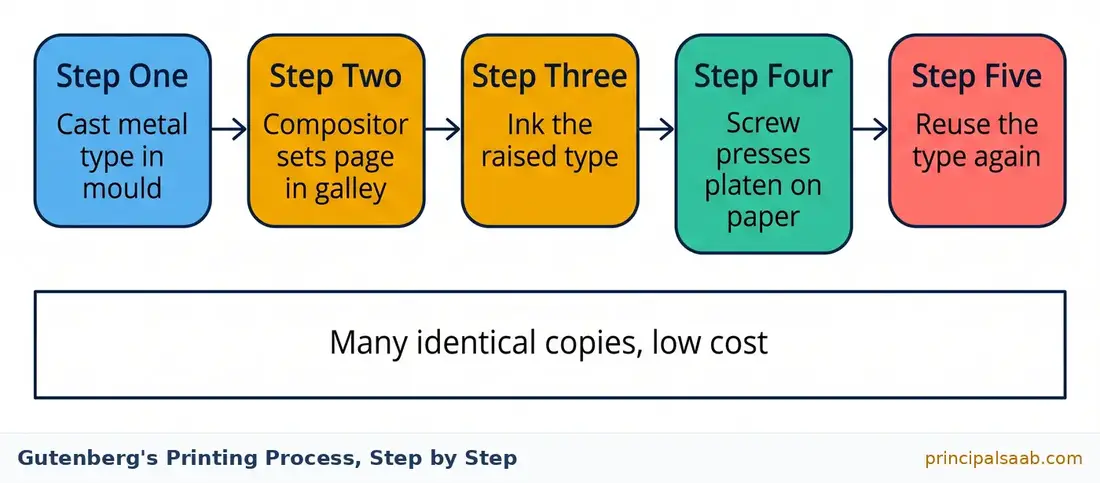
- Casting the type. Gutenberg developed a metal mould into which molten metal could be poured to cast the individual letters of the alphabet. Because it was a mould, he could cast the same letter over and over, identically, cheaply, in unlimited quantity. This is the crucial break from woodblock: the letters are manufactured, not carved one by one.
- Composing the page. A worker called a compositor picked the individual metal letters out of their case and arranged them, in order, in a frame — a shallow tray known as the galley — until a full page of text stood assembled. Spaces, punctuation and line breaks were all built by hand from separate pieces of metal.
- Inking. The assembled block of type was inked across its raised surface.
- Pressing. A sheet of dampened paper was laid over the type, and the platen — a flat board pressed down by the screw — was screwed down on to the back of the paper. Even, firm pressure across the whole page transferred the ink cleanly.
- Repeating and reusing. Lift the platen, take out the printed sheet, put in a fresh one, press again. When the print run was finished, the type was taken apart and the very same letters were used to compose an entirely different page. Nothing was wasted.
Why it works is worth stating plainly, because it is the deepest idea in the chapter. Gutenberg replaced a craft with a system. Copying a manuscript is a craft: the cost of the hundredth copy is the same as the cost of the first. Printing is a system: almost all the cost sits in setting up the type, and after that each extra copy is nearly free. The moment the cost of an extra copy collapses towards zero, books stop being treasures and start being commodities — and every social change described in the rest of this chapter follows from that single economic fact.
Gutenberg had a working press by around 1448, and the first book he printed with it was the Bible. About 180 copies were produced, and it took roughly three years to do it — which sounds slow until you realise that scribes would have needed a lifetime for the same output. Interestingly, the earliest printed books were designed to look exactly like manuscripts: borders were illuminated by hand, spaces were left for decorated initial letters, and rich buyers still had blank space customised by painters. New technology often disguises itself as the old thing at first — the first cars looked like carriages, the first web pages looked like printed pages. Print did the same.
| Point of comparison | Hand-written manuscript | Printed book |
|---|---|---|
| Speed of production | Months of a scribe’s labour for a single copy | Hundreds of copies once the type is composed |
| Cost per copy | Stays high — every copy costs as much as the first | Falls steeply — setup dominates, extra copies are cheap |
| Material | Vellum in Europe; palm leaf or handmade paper in India | Machine-supplied paper in growing quantities |
| Uniformity | Every copy differs; scribal errors creep in | Every copy identical, so texts can be quoted and checked |
| Who could own one | Monasteries, universities, aristocrats, rich merchants | Increasingly artisans, shopkeepers, students, eventually the poor |
| Control over content | Easy — few copies exist, they can be located and destroyed | Very hard — thousands of copies scatter beyond reach |
How to think about it: “Describe the innovations” wants the process, in order, with the technical vocabulary. Numbering your points makes an examiner’s job easy, and an examiner whose job is easy is generous.
Model answer.
(1) He adapted an existing machine. Gutenberg had grown up seeing wine and olive presses, and he took the screw-press principle — a flat plate driven down with even, controllable pressure — and applied it to printing, so that a whole page could be impressed at once instead of rubbed by hand.
(2) He developed a mould for casting metal type. Molten metal was poured into a mould to produce individual letters of the alphabet, which meant identical letters could be manufactured in unlimited numbers rather than carved individually.
(3) He made the type movable and reusable. A compositor arranged the separate metal letters in a frame called a galley to build up a full page; once the print run ended, the same letters were redistributed and used to set a completely different page.
(4) He used the platen to transfer the impression. The composed type was inked, a sheet of dampened paper was placed over it, and the platen — a flat board turned down by a screw — pressed the paper against the type to take a clean, even impression.
(5) He proved the system at scale. By about 1448 the press was working, and the first book printed on it was the Bible, of which roughly 180 copies were produced in about three years — an output no group of scribes could have matched, and the demonstration that convinced Europe.
Marking note: the words mould, movable type, compositor, galley and platen are the technical vocabulary of this section. Using them correctly signals mastery.
How to think about it: “Justify” means “give evidence for”. You are being asked to defend a claim, so every sentence should be a piece of supporting evidence.
Model answer. (1) The metal letters were deliberately cut to imitate the ornamental handwritten style that readers of the time were used to, so a printed page would look familiar rather than strange. (2) Borders were illuminated by hand after printing, and illustrations were painted in, so the finished object still carried handwork. (3) In books printed for wealthy buyers, blank spaces were left on the printed page where decorated initial letters and designs could be added later by a painter, allowing each copy to be personalised exactly as manuscripts had been.
Why this mattered: if you have space, close with a sentence of interpretation — “In its earliest years print did not advertise itself as new; it presented itself as a cheaper version of something people already trusted.” That kind of closing line reads as understanding rather than memorisation.
The Print Revolution And Its Impact: A New Reading Public
Historians use the phrase print revolution to mean something bigger than a new machine. It means the transformation that the machine caused: a change in how books were made, in who could get them, in how people related to information, and in how people thought about the world and about authority. Let us take those changes one at a time, because this section supplies more exam answers than almost any other.
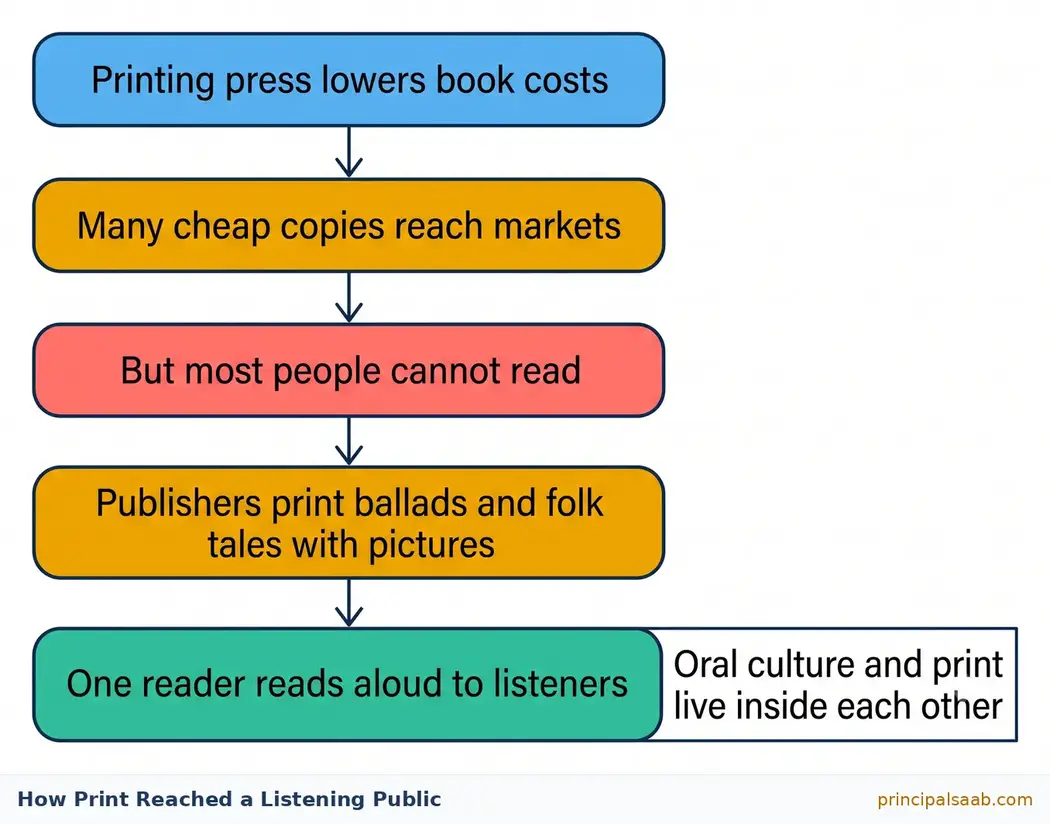
First, a new reading public came into being. Printing cut the cost of books sharply. The time and labour needed to produce each book fell, multiple copies poured into the market, and books reached ever-wider groups of people. Reading, which had been the privilege of a thin elite, became a possibility for a much broader public.
But here is the complication students usually miss. Cheap books are useless to people who cannot read — and most Europeans could not. Literacy rates in many European countries were very low right up to the twentieth century. So how did print reach them? The answer is that publishers deliberately adapted to a world that was still largely oral. This is one of the most interesting ideas in the chapter, so slow down here.
Publishers began printing popular ballads and folk tales, and issued them with pictures. These were then sung and recited at gatherings in villages, and in taverns in the towns. One literate person read aloud; a room full of illiterate people listened. The book was consumed collectively, by ear. The line between hearing and reading blurred — the oral culture entered print, and print was carried outward orally.
Second, print created a debating public. Once ideas circulated in thousands of identical copies, they could be argued with. A writer in one city could read, quote and refute a writer in another. Print encouraged the exchange of opinion, and people who had never been asked their view began to form and express one. New ideas about religion, about society, about politics were now discussed by people who had previously only received instruction. That, quite simply, is how a public in the modern sense comes into being.
Third — and this is the part everyone forgets — not everybody was delighted. Many people were genuinely frightened. Their fear had a real logic, and you should be able to state it sympathetically, because “explain why some people opposed print” is a favourite exam question.
The fear ran like this. If books are cheap and plentiful, then anybody can print anything. Valuable literature will be drowned in worthless and rebellious material. Ordinary readers, with no training and no guidance, will read texts they cannot properly interpret, form wrong conclusions, and begin to question authority — religious authority above all. Printed matter could not be controlled once it left the press: unlike a manuscript, you cannot round up ten thousand copies. To religious authorities, to monarchs, and even to many writers and artists, this looked less like enlightenment and more like the loss of all order.
The Latin scholar and Catholic reformer Erasmus put the anxiety memorably. He complained that the swarms of new books being produced were mostly foolish, slanderous or irreligious, and that their sheer number was doing harm to real scholarship. It is worth pausing on that: the person complaining was not an ignorant reactionary but one of the finest scholars of the age. The fear of print was intelligent, even if it turned out to be wrong.
How to think about it: The examiner wants a chain, not a list. Cost falls, therefore access widens, therefore new groups read, therefore publishers adapt, therefore reading habits change.
Model answer.
(1) Cost and labour fell sharply. The press removed the need to copy each book by hand, so the time and expense of producing every additional copy dropped steeply and books could be sold at prices ordinary buyers could reach.
(2) Books flooded the market. Multiple copies of the same title could be produced at once, so titles reached far more towns and far more people than a handful of manuscripts ever could.
(3) Access ceased to be a privilege. Where reading had belonged to the elite — the clergy, aristocrats, university men and rich merchants — printed books put texts within reach of artisans, shopkeepers, students and other common people.
(4) Publishers adapted to a barely literate society. Since literacy was still low, printers deliberately produced popular ballads, folk tales and illustrated stories that could be read aloud, sung and recited at village gatherings and in taverns, so that even those who could not read were drawn into the world of printed matter.
(5) Hearing and reading merged into a new culture. The line between the oral and the printed blurred: listening publics became reading publics over time, and a broad common readership emerged that had simply not existed before.
Marking note: point 4 is the one that separates a good answer from an average one. Most students stop at “books became cheap”. Explaining how print reached the illiterate shows you have read the section properly.
How to think about it: Present the fear as a reasoned position. Do not caricature the people who held it.
Model answer. (1) It was feared that if print could not be controlled, rebellious and irreligious writings would circulate freely, and the authority of religious and political institutions would be undermined among people who had previously accepted it without question. (2) There was anxiety that valuable and serious literature would be swamped by cheap, worthless and slanderous material, a criticism voiced forcefully by the scholar Erasmus, who held that the flood of new books was harming genuine scholarship. (3) Finally, it was feared that ordinary readers, lacking training and guidance, would misread texts, form their own unorthodox interpretations, and thus arrive at conclusions that established authorities regarded as dangerous.
Extra line if you have space: “Crucially, printed matter could not be recalled once released — unlike a manuscript, thousands of copies could not be gathered up and destroyed.” Adding the reason the fear was practical, not just moral, is a mark-earning refinement.
Religious Debates And The Fear Of Print
This is the section where the abstract fears of the last section turn into real history — real people, real conflict, real executions. Take it slowly; it is also the most dramatic part of the chapter.
In 1517, a German monk and theologian named Martin Luther wrote a document listing ninety-five criticisms of the practices of the Roman Catholic Church — the famous Ninety-Five Theses. He challenged, among other things, the sale of indulgences and various rituals, and he invited the Church to debate his objections. A printed copy was posted on a church door in the town of Wittenberg.
Now think carefully about what the press did to that document. A century earlier, a critical monk would have written out a few copies by hand, they would have circulated among a handful of scholars, and the Church could have contained the matter quietly. Instead, Luther’s theses were printed, reprinted and carried across German-speaking Europe within weeks. Thousands of people who had never met Luther could read what he had written, in identical words, and make up their own minds. The Church could argue with Luther; it could not argue with ten thousand copies.
The consequence was a division within the Church and the beginning of the Protestant Reformation — the sixteenth-century movement to reform the Roman-dominated Catholic Church, which permanently split Western Christianity. Luther also translated the New Testament into German, and the response was extraordinary: several thousand copies were sold within weeks, and a second edition followed within months. Luther himself was in no doubt about what had made this possible. He described printing as the greatest of God’s gifts.
Now the darker side. If print could spread Luther’s reading of scripture, it could spread anyone’s. And that is precisely what alarmed the Roman Catholic Church — because ordinary people, reading the Bible for themselves in their own language, sometimes arrived at conclusions the Church considered heretical (that is, beliefs that do not follow accepted Church teaching).
The case your textbook uses is unforgettable. In sixteenth-century Italy there lived a miller named Menocchio. He was not a scholar, not a priest, not an aristocrat — he ground grain for a living. But he could read, and he read the printed books that had begun to circulate in his region. Out of that reading he built his own interpretation of the Bible and his own account of God and the Creation, one that departed sharply from Church doctrine. He was hauled up before the Inquisition — the Roman Catholic court that identified and punished heretics — not once but twice. Menocchio would not abandon his views, and he was ultimately executed.
Sit with that for a moment, because it explains the whole chapter in one life. A miller in a village had read enough to construct his own theology, and the most powerful institution in Europe considered that dangerous enough to kill him for it. Print had handed interpretation to people who had never had it — and that shift of power was what the fear had always been about.
The Roman Church responded with systematic control. It troubled itself greatly over such popular readings and imposed severe measures on publishers and booksellers, and from 1558 it maintained an Index of Prohibited Books — an official list of texts Catholics were forbidden to read. This is censorship in a recognisably modern form: not the destruction of individual manuscripts, but the maintenance of a standing list against an entire industry.
How to think about it: Build it as a sequence: what Luther wrote, what print did to it, what followed, what the Church did in response. Sequence answers read as understanding.
Model answer.
(1) The criticism could be published. In 1517 Martin Luther wrote his Ninety-Five Theses, criticising many of the practices and rituals of the Roman Catholic Church, and a printed copy was posted on a church door at Wittenberg for public challenge and debate.
(2) Print gave the criticism reach. Because the theses were printed rather than hand-copied, they were reproduced and circulated widely and rapidly, so that thousands of people who would never have heard of Luther could read his exact words and form their own judgement.
(3) A movement, not a dispute, resulted. This mass circulation turned what might have remained a private quarrel between a monk and his Church into a public movement, leading to a division within the Church and the beginning of the Protestant Reformation.
(4) Scripture reached the people in their own language. Luther’s translation of the New Testament sold several thousand copies within weeks and required a second edition within months, allowing lay readers to approach the sacred text directly instead of through the clergy.
(5) The Church could no longer control interpretation. Printed copies could not be recalled or destroyed as manuscripts could, so the Church was forced into defensive measures — severe controls on publishers and booksellers, and from 1558 an Index of Prohibited Books — which is itself evidence of how powerful print had become.
Marking note: point 5 is a strong closer because it uses the Church’s own reaction as proof of the argument. Turning your opponent’s behaviour into your evidence is a genuinely advanced move in an answer.
Setting up: A case-study question will give you a short passage about Menocchio and then ask what it shows. Case-study questions are not testing recall — they are testing whether you can read a piece of evidence and draw a conclusion from it. Here is how to do that in three moves.
Move 1 — identify the person and why he is unusual. Menocchio was a miller in sixteenth-century Italy, an ordinary working man with no formal religious or scholarly training.
Move 2 — identify what he did and what made it possible. He read the printed books that had begun circulating in his locality and, on the basis of that private reading, formed his own interpretation of the Bible and his own account of God and Creation.
Move 3 — draw the conclusion the source is evidence for. His case shows that print had put the power of interpretation into the hands of common people for the first time, removing the clergy’s monopoly on reading and explaining sacred texts.
Move 4 — state the consequence. Because such independent readings threatened Church authority, Menocchio was summoned before the Inquisition twice, refused to give up his views, and was finally executed — showing both how seriously the Church took the danger and how far it was prepared to go to suppress it.
Marking note: in a case study, never simply retell the passage. The examiner already has the passage. You earn marks by adding the inference — the “this shows that…” sentence. Underline it if you like; make it impossible to miss.
The Reading Mania: Chapbooks, Almanacs And Periodicals
Through the seventeenth and eighteenth centuries, literacy rates in European countries climbed. Churches of different denominations set up schools in villages, taking peasants and artisans into literacy, and by the end of the eighteenth century, in some parts of Europe, literacy rates had reached as high as sixty to eighty per cent. As people learned to read, they wanted things to read — and the demand became so intense that historians describe this period as a reading mania.
Booksellers and printers responded exactly as any industry responds to a hungry market: they produced huge quantities of cheap, entertaining, disposable material. Let me introduce you to the main forms, because their names come up in exams.
- Chapbooks. Pocket-sized books, cheap enough for a labourer, sold by travelling pedlars known as chapmen who carried them from village to village. In England these were sold for a penny, so even the very poor could buy one. Note the model: cheap product, low margin, huge volume, distribution by foot.
- The Bibliotheque Bleue. In France, low-priced small books printed on poor-quality paper and bound in inexpensive blue covers — which is exactly what the name refers to. Their cheapness was visible in the object itself.
- Histories and romances. Short printed tales, some running to only four to six pages, along with books of ballads and folk tales — the light reading of the age.
- Almanacs. Annual publications giving astronomical information: the movements of the sun and moon, the timing of tides and eclipses, and a great deal else that mattered in daily agricultural and domestic life. For a farming family, an almanac was not entertainment but a practical instrument.
- Newspapers and periodicals. From the early eighteenth century the periodical press developed strongly in England, combining information about current affairs and trade with news of developments elsewhere in the world. This is the direct ancestor of the newspaper you know today.
| Form of print | Where | What made it accessible | Who read it |
|---|---|---|---|
| Chapbook | England | Pocket size, sold for a penny, carried door to door by chapmen | The poor, including labourers and villagers |
| Bibliotheque Bleue | France | Cheap paper, plain blue paper covers, low price | Ordinary town and village readers |
| Almanac | Across Europe | Short, annual, practically useful | Farming households and ordinary families |
| Periodical press | England, from the early 1700s | Regular, current, mixed news and commerce | Townspeople, traders, the educated middle class |
| Scientific and philosophical works | Across Europe | Printed, translated, compiled and popularised | A widening circle of educated readers beyond the universities |
Meanwhile, serious ideas were travelling too. The discoveries of scientists and philosophers now became accessible to a common readership. Ancient and medieval scientific texts were compiled and published, and maps and scientific diagrams were widely printed. When Isaac Newton published his Principia Mathematica in 1687, the work could begin to influence a far wider circle of readers than a manuscript ever could. The writings of thinkers such as Thomas Paine, Voltaire and Jean-Jacques Rousseau were printed and read extensively, and those who read them saw the world through new eyes — eyes that were enquiring, critical and rational.
Why this mattered. Notice what has happened by the end of the eighteenth century. A society that once received knowledge from a small number of authorities now has millions of people reading cheap books, weekly periodicals, almanacs and political philosophy — and forming judgements. That is the raw material of modern public opinion. The novelist Louise-Sebastien Mercier captured the mood when he declared that the printing press was the most powerful engine of progress, and that public opinion was the force that would sweep despotism away. Hold on to that sentence: it is the bridge into the next section.
How to think about it: A two-part question. Define first, in one sentence, then give the four features as separate labelled points. Never let the definition and the features run together into one paragraph.
Model answer.
Definition: The “reading mania” refers to the period from the seventeenth to the eighteenth century in Europe when rising literacy created such an intense hunger for reading material that books and periodicals of every kind were produced and consumed in unprecedented quantities.
(1) Literacy spread through schooling. Churches of different denominations set up schools in villages, bringing peasants and artisans into literacy, so that by the close of the eighteenth century some parts of Europe had literacy rates as high as sixty to eighty per cent.
(2) Cheap popular formats appeared. Pocket-sized penny chapbooks, sold by travelling pedlars called chapmen, and the French Bibliotheque Bleue — small books on poor paper in cheap blue covers — put reading within reach of very poor buyers.
(3) Practical and entertaining genres multiplied. Almanacs supplied astronomical and seasonal information useful in daily life, while histories, romances, ballads and folk tales, some only a few pages long, supplied entertainment.
(4) The periodical press emerged. From the early eighteenth century newspapers and journals developed in England, carrying current affairs, commercial information and news of the wider world to a regular readership.
Marking note: the figure of sixty to eighty per cent is worth including because it is concrete. Examiners reward specifics; they are hard to fake and easy to reward.
Model answer. (1) Scientific and philosophical works could now be printed in large numbers and sold cheaply, so ideas that had previously circulated only among a small number of scholars became available to a general educated readership. (2) Ancient and medieval scientific texts were compiled and republished, and maps and scientific diagrams were printed widely, spreading not only conclusions but the methods and evidence behind them. (3) Major works such as Isaac Newton’s Principia Mathematica, published in 1687, and the writings of thinkers such as Thomas Paine, Voltaire and Jean-Jacques Rousseau were read extensively, encouraging readers to view custom and authority through a critical and rational lens rather than accepting them without question.
Why this mattered: a habit of questioning, once printed, becomes contagious. Point 3 tells the examiner that you understand print changed not just what people knew but how they thought.
Print Culture And The French Revolution
Many historians have argued that print culture created the conditions in which the French Revolution of 1789 became possible. This is one of the most examinable sections in the chapter, and it has a beautifully clear structure: three arguments in favour, and then a caution against overstating them. Learn it in that shape and you can never lose your way.
Argument one: print popularised the ideas of the Enlightenment thinkers. Writers such as Voltaire and Rousseau were read widely, and their works attacked the twin pillars of the old order — the authority of the Church over people’s minds, and the despotic power of the state. Enlightenment writing did not just make different claims; it insisted that everything be judged by reason and rationality rather than by custom and tradition. Readers absorbed that habit. Once you have accepted that traditions must justify themselves, the sacred authority of a monarch or a Church becomes a question rather than a fact.
Argument two: print created a new culture of dialogue and debate. When ideas circulated in print, all values, norms and institutions could be re-evaluated and discussed by a public that had become aware of the power of reason. Readers were not simply told what to think; they read competing arguments, weighed them and formed positions. In the process, people began to question, to argue, and to imagine that social order could be changed rather than merely endured. That is a psychological revolution before it is a political one.
Argument three: by the 1780s, literature was mocking royalty and criticising its morality. A flood of writing ridiculed the monarchy and portrayed the court as sunk in immorality and indulgence, while raising questions about the existing social order. Cartoons and caricatures typically suggested that while the common people suffered hardship, the aristocracy lived in luxury. This kind of material eats away at something a monarchy cannot survive without: not obedience, but respect. A king who is feared may rule; a king who is laughed at is already in trouble.
Now the caution — and please do not skip this, because it is what separates a top answer from an ordinary one. Historians warn against assuming that print alone caused the Revolution, and they give solid reasons.
First, books do not compel a single response. People did not read only one kind of literature; they encountered the writings of Enlightenment thinkers alongside monarchical and Church propaganda, and they were exposed to both. Second — and this is the important point — readers do not simply accept what they read. They interpret. They accept some ideas, reject others, and reshape what they take in according to their own experience. Print opened up the possibility of thinking differently; it did not guarantee it. What print did was multiply the number of possible ways of seeing the world, and make the very idea of change thinkable.
| The case that print helped cause the Revolution | The historians’ caution |
|---|---|
| Print carried Enlightenment ideas, especially those of Voltaire and Rousseau, to a wide readership and taught readers to judge by reason rather than custom | Readers also encountered monarchical and Church propaganda in print; the same technology served both sides of the argument |
| Print created a public culture of dialogue and debate in which existing values and institutions could be openly re-examined | People do not accept everything they read; they interpret it, accepting some ideas and rejecting others |
| By the 1780s, cartoons, caricatures and satirical writing mocked the monarchy and contrasted aristocratic luxury with popular hardship, eroding respect for the social order | Print opened the possibility of thinking differently; it did not by itself determine what people would think or do |
How to think about it: The word examine is a signal. It means: give the case, then give the qualification. An answer that only argues one side has not examined anything. Aim for three points of support and two of caution.
Model answer.
(1) Print spread the ideas of the Enlightenment. The works of thinkers such as Voltaire and Rousseau were printed and widely read, and these writings attacked both the authority of the Church over people’s minds and the despotic power of the state, urging readers to judge every institution by reason rather than by tradition.
(2) Print created a culture of dialogue and debate. Because arguments now circulated publicly in printed form, all existing values, norms and institutions could be re-evaluated by a public that had become conscious of the power of reason, and people who had never been consulted began to form and express political opinions.
(3) Print eroded respect for the monarchy. By the 1780s a large literature mocked royalty and criticised its morality, while cartoons and caricatures contrasted the luxury of the aristocracy with the hardship of the common people, raising open questions about the justice of the existing social order.
(4) However, print carried opposing messages too. Readers did not consume only one kind of literature; alongside Enlightenment writing they were exposed to monarchical and Church propaganda, so print cannot be treated as a one-directional force.
(5) And readers interpret rather than absorb. People accept some ideas and reject others, reshaping what they read in the light of their own experience. Print therefore opened up the possibility of thinking differently and made change imaginable, but it did not by itself produce the Revolution.
Marking note: points 4 and 5 are where the top band lives. Many students write three strong paragraphs and stop. Adding the qualification demonstrates historical judgement, and it costs you only four or five lines.
How to think about it: This is the caution on its own. Resist the temptation to describe the three arguments again — the question is not asking for them.
Model answer. (1) People did not read only one kind of material: Enlightenment writings circulated alongside monarchical and Church propaganda, so print supplied arguments on every side of the debate rather than a single message. (2) Readers do not passively absorb what they read; they interpret it, accepting some ideas, rejecting others and reinterpreting the rest in the light of their own circumstances, so the effect of a text cannot be predicted from its contents. (3) What print did, therefore, was to multiply the range of ideas available and make it possible to imagine a different social order — creating conditions favourable to revolution rather than mechanically producing one.
Common trap: a question that begins “why do historians say that print did NOT…” is inviting you to argue against the obvious answer. Read such stems twice. Answering the opposite of what was asked is one of the cheapest ways to lose marks in the whole paper.
The Nineteenth Century: Children, Women And Workers As New Readers
In the nineteenth century, the reading public widened again — and this time it widened in a very specific direction. Three groups who had barely been considered readers before became major markets: children, women and workers. Keep those three words in your head as the skeleton of this section.
Children. As primary education became compulsory in several countries from the late nineteenth century, children became an important category of readers — and where there are readers, publishers follow. Books specifically for children were produced, and school textbooks became a major part of publishing. In France, a children’s press devoted exclusively to literature for children was set up in 1857, publishing new works as well as old fairy tales and folk tales.
There is a fascinating catch here, and I want you to notice it because it shows how print shapes as well as spreads. In Germany, the Grimm Brothers spent years gathering traditional folk tales from peasants, and published a collection in 1812. But as they compiled the tales they also edited them: stories that seemed unsuitable for children, or that did not conform to the standards of the educated middle class, were altered or dropped. Rural folk tales thus acquired a new, more respectable form once they entered print.
Women. Women became important as readers and as writers. Penny magazines were produced especially for women, as were manuals teaching proper behaviour and housekeeping — which tells you something about how the age imagined its female readers. But women were far more than a target market. Some of the most celebrated novelists of the nineteenth century were women: Jane Austen, Charlotte Bronte, whose Jane Eyre appeared in 1847, and George Eliot, author of The Mill on the Floss. Their writing gave shape to a new kind of woman — a person with will, strength of personality, determination and the power to think — and that idea, once printed, could not be unprinted.
Workers. Lending libraries had existed in England since the seventeenth century, but in the nineteenth century they became instruments of self-education for white-collar workers, artisans and lower-middle-class people. Sometimes self-educated working-class people wrote for themselves, particularly after the working day was shortened from the mid-nineteenth century, giving workers the two things reading requires: time and energy. Some of them wrote political tracts and autobiographies in large numbers.
| New reading group | What brought them to print | What was published for them | Names to quote |
|---|---|---|---|
| Children | Compulsory primary education from the late nineteenth century | School textbooks, fairy tales, folk tales; a children’s press in France from 1857 | The Grimm Brothers, whose collection appeared in 1812 |
| Women | Growing female education and a publishing industry that saw a market | Penny magazines, manuals on behaviour and housekeeping, and above all novels | Jane Austen; Charlotte Bronte (Jane Eyre, 1847); George Eliot (The Mill on the Floss) |
| Workers | Shorter working hours from the mid-nineteenth century and access to lending libraries | Self-education material, political tracts and autobiographies | Lending libraries, in England since the seventeenth century |
How to think about it: Three groups, five marks. Give each group a clear point, then use the remaining two marks for the strongest extra detail — usually the Grimm example and the women novelists.
Model answer.
(1) Children entered print through schooling. As primary education was made compulsory in several countries from the late nineteenth century, children became an important category of readers, and school textbooks became a central part of the publishing industry.
(2) A children’s publishing world was deliberately built. In France a press devoted entirely to children’s literature was established in 1857, bringing out new works alongside old fairy tales and folk tales; in Germany the Grimm Brothers compiled peasant folk tales and published them in 1812, editing out whatever they judged unsuitable for young middle-class readers.
(3) Women were courted as a market. Penny magazines were produced especially for women, together with manuals of proper behaviour and housekeeping, reflecting the roles the age expected them to occupy.
(4) Women also became major writers. Novelists such as Jane Austen, Charlotte Bronte, whose Jane Eyre was published in 1847, and George Eliot, author of The Mill on the Floss, portrayed women of will, determination and independent thought, giving print a new definition of womanhood.
(5) Workers used libraries to educate themselves. Lending libraries, present in England from the seventeenth century, now became instruments for educating white-collar workers, artisans and lower-middle-class people; and once the working day was shortened from the mid-nineteenth century, workers had the leisure to read and some of them wrote political tracts and autobiographies of their own.
How to think about it: This is an inference question wearing a factual disguise. Give the fact briefly, then spend most of your words on what it demonstrates.
Model answer. (1) The Grimm Brothers spent years gathering traditional tales from peasants in Germany and published a collection in 1812, but in compiling them they altered or omitted stories they considered unsuitable for children or inconsistent with the standards of the educated middle class. (2) This shows that print did not merely transmit existing culture unchanged; the act of publishing involved selection and editing, so oral rural traditions were reshaped into a form acceptable to a literate urban readership. (3) It therefore demonstrates that those who controlled the press also exercised a degree of control over what a whole society came to accept as its heritage — print carried culture, but it also filtered it.
Further Innovations: Power Presses, Offset And Cheap Paperbacks
Gutenberg’s wooden screw press served Europe for roughly three hundred years with only modest changes. Then, from the late eighteenth century onwards, the machine itself began to evolve rapidly. This section is really a list — but it is a list with a logic, so let me give you the logic first: every innovation here does one of two things — makes printing faster, or makes books more attractive to buy. Sort each item into one of those two boxes and the section becomes easy.
- The metal press. By the late eighteenth century, presses began to be made of metal rather than wood, giving greater strength, precision and durability.
- The power-driven cylindrical press. Through the nineteenth century a series of further improvements followed. Richard M. Hoe of New York perfected a power-driven cylindrical press by the middle of the century, capable of printing around 8,000 sheets per hour. This machine was especially useful for printing newspapers, where speed is everything — yesterday’s news is worthless.
- The offset press. Developed in the late nineteenth century, the offset press could print up to six colours at a time, transforming what a printed page could look like.
- Electrically operated presses. From the turn of the twentieth century, electric power accelerated printing operations further.
- A series of quieter improvements. Methods of feeding paper improved, the quality of printing plates got better, automatic paper reels came into use, and photoelectric controls of the colour register were introduced. None of these is glamorous, but together they made high-volume, high-quality printing routine.
Printers also became clever marketers — and this second half of the section is where students usually lose marks by forgetting it exists. Publishers had to keep buyers buying, so they invented strategies you will recognise instantly from the modern world:
- Serialisation. In the nineteenth century, periodicals serialised important novels — publishing a chapter at a time — which gave rise to a particular way of writing them. If you must end every instalment on a cliffhanger to make readers buy next month’s issue, that changes how you build a plot. This is the ancestor of the television series and the streaming episode drop.
- Cheap series. In the 1920s in England, popular works were sold in cheap series, of which the Shilling Series is the example your textbook names.
- The dust cover or book jacket. This is a twentieth-century innovation — the printed paper wrapper around a hardback, which both protects the book and, crucially, advertises it on a shop shelf.
- Cheap paperbacks. With the Great Depression of the 1930s, publishers feared a collapse in book buying, and so brought out cheap paperback editions to keep sales alive in hard times. Notice the pattern: in a crisis, the industry did not print less, it printed cheaper.
| Innovation | Roughly when | What problem it solved |
|---|---|---|
| Presses made of metal instead of wood | Late eighteenth century | Strength and durability; the wooden press had reached its limits |
| Hoe’s power-driven cylindrical press, about 8,000 sheets an hour | Mid-nineteenth century | Speed — above all for newspapers, where delay destroys value |
| Offset press, up to six colours at a time | Late nineteenth century | Colour and visual appeal in mass-produced print |
| Electrically operated presses; automatic paper reels; photoelectric colour controls | From the turn of the twentieth century | Continuous, automated, consistent high-volume production |
| Serialised novels in periodicals | Nineteenth century | Keeping readers returning issue after issue |
| The Shilling Series | 1920s, England | Selling popular works at a price ordinary readers would pay |
| Dust cover or book jacket | Twentieth century | Protection plus advertising on the shelf |
| Cheap paperback editions | 1930s, during the Great Depression | Sustaining sales when buyers had little money |
How to think about it: Go in chronological order. A chronological answer is self-organising, and the examiner can follow it without effort.
Model answer.
(1) Metal presses. By the late eighteenth century, printing presses began to be manufactured out of metal rather than wood, making them stronger, more precise and more durable than Gutenberg’s original design.
(2) The power-driven cylindrical press. By the middle of the nineteenth century Richard M. Hoe of New York had perfected a power-driven cylindrical press capable of printing about 8,000 sheets an hour, which was of particular value for printing newspapers, where speed of production determines the value of the product.
(3) The offset press. Developed in the late nineteenth century, the offset press could print as many as six colours at a time, greatly improving the visual quality and appeal of printed matter.
(4) Electrical power. From the turn of the twentieth century, electrically operated presses further accelerated printing, allowing continuous rather than intermittent production.
(5) Supporting refinements. Methods of feeding paper were improved, the quality of printing plates was raised, automatic paper reels were adopted, and photoelectric controls of the colour register were introduced, so that large volumes could be printed to a consistent standard.
How to think about it: This asks about selling, not machinery. Do not slip back into describing presses — that is the single commonest error on this question.
Model answer. (1) Publishers serialised important novels in periodicals, releasing them in instalments so that readers had a reason to buy each successive issue, a practice that also shaped the way such novels were written. (2) Popular works were issued in cheap series, such as the Shilling Series in England in the 1920s, bringing well-known titles within the reach of modest budgets; and the dust cover or book jacket, a twentieth-century innovation, was introduced both to protect books and to advertise them attractively. (3) When the Great Depression of the 1930s threatened book sales, publishers responded by bringing out cheap paperback editions, deliberately lowering prices to keep readers buying through a period of hardship.
That completes the European half of the story. Take a break here — genuinely, close the page and come back later. The India half is a fresh set of names, and you will absorb it far better with a rested head than by pushing through now.
India Before The Age Of Print: The Manuscript World
India had a magnificent manuscript tradition long before printing arrived — in Sanskrit, Arabic, Persian and the various vernacular languages. Manuscripts were copied on palm leaves or on handmade paper, and the pages were often beautifully illustrated. They were either pressed between wooden covers or sewn together to ensure preservation. Some of these objects are, quite simply, works of art.
But — and this is the “but” that drives the whole Indian half of the chapter — manuscripts had serious practical limits. Let me lay them out clearly, because they are worth marks in every exam.
- They were highly expensive. Copying demanded skilled labour and costly materials, so manuscripts were beyond the reach of ordinary people.
- They were fragile. Written on palm leaf or delicate handmade paper, they could not survive rough handling, and they were difficult to carry about.
- They were hard to read. Manuscripts were written in a wide variety of individual styles, so a reader competent in one hand might struggle badly with another.
- They were therefore not widely used in everyday education. Even in places where literacy existed, manuscripts could not be casually read and reread by students.
The consequence for teaching was striking. In pre-colonial Bengal, an extensive network of village primary schools — the pathshalas — had developed, and the number of literate people was not negligible. But students very often did not read the texts at all. They learned to write, while the teacher recited passages from memory and the pupils wrote them down. In this way, many students could become literate without ever having read a single printed or manuscript text. Sit with that for a second: literacy without books. That is what a world without cheap print actually looks like, and it is the strongest possible answer to any question about why print mattered in India.
How to think about it: Open with one line acknowledging that a rich manuscript tradition existed. Never begin a “limitations” answer as though the thing had no value — a balanced opening sentence reads as maturity.
Model answer.
Opening: India possessed a long and rich manuscript tradition in Sanskrit, Arabic, Persian and the vernacular languages, with texts copied on palm leaves and handmade paper and often beautifully illustrated; nevertheless these manuscripts suffered from several serious limitations.
(1) They were extremely expensive. Producing a manuscript required costly materials and long hours of skilled copying, placing them far beyond the means of ordinary readers.
(2) They were fragile. Palm leaf and handmade paper were delicate materials, so manuscripts could be damaged easily and had to be pressed between wooden covers or sewn together simply to survive.
(3) They could not be handled or carried freely. Their fragility meant they could not be read casually, moved about or used in the way a printed book can be.
(4) They were difficult to read. Manuscripts were written in a wide variety of individual styles and hands, so a reader familiar with one scribe’s script could find another almost unintelligible.
(5) They were therefore of limited educational use. Even in Bengal, where an extensive network of village pathshalas existed, students commonly learned only to write while the teacher recited from memory, so it was quite possible to become literate without ever reading a text at all.
Marking note: point 5 is the memorable one. Finishing with the pathshala detail proves you have read the section rather than reproducing a generic list.
Print Comes To India: Missionaries, Hickey And The Bengal Gazette
Print entered India from outside, and it entered for a specific purpose: religious conversion. That origin explains a great deal about what got printed first.
The printing press first came to Goa, brought by Portuguese missionaries in the middle of the sixteenth century. Jesuit priests learned Konkani and printed several tracts in it. By 1674, about fifty books had been printed in the Konkani and Kanara languages. Catholic priests printed the first Tamil book in 1579 at Cochin, and by 1710 Dutch Protestant missionaries had printed thirty-two texts in Tamil, many of them translations of older works. The first Malayalam book was printed in 1713.
Notice what is happening here. Missionaries were not printing in Latin or Portuguese for themselves — they were printing in Konkani, Tamil and Malayalam for Indians. Whatever their intentions, this had a lasting side effect: Indian languages acquired printed form, standardised spelling and a technical infrastructure of type and presses, decades before Indians themselves controlled those presses. Tools built for one purpose are very often turned to another, and that is exactly the story of print in India.
The English-language press. The English East India Company began importing presses from the late seventeenth century. The really interesting figure is James Augustus Hickey, who from 1780 edited the Bengal Gazette, a weekly magazine that described itself as a commercial paper open to all but influenced by none. Hickey was a private enterprise, fiercely proud of his independence from colonial authority, and he printed a great deal of advertisement — including advertisements about the import and sale of enslaved people — as well as a great deal of gossip about the Company’s senior officials in India.
Governor-General Warren Hastings was enraged, persecuted Hickey, and encouraged the publication of officially sanctioned newspapers that could counter the flow of unofficial information. Look closely at that sequence, because it is the template for the entire censorship section later in the chapter: independent press appears → it criticises officials → the state responds with persecution plus its own approved publications. The same pattern repeats for a hundred and fifty years.
Indians begin publishing. By the close of the eighteenth century a number of newspapers and journals had appeared in print, and Indians too began to bring out their own. Among the earliest was a weekly called the Bengal Gazette, brought out by Gangadhar Bhattacharya, who was close to Rammohun Roy.
How to think about it: This is a chronology question. Go strictly in date order and attach a name or a number to every point.
Model answer.
(1) Arrival in Goa. The printing press first reached India in the mid-sixteenth century, brought to Goa by Portuguese missionaries whose purpose was religious instruction and conversion.
(2) Printing in Indian languages. Jesuit priests learned Konkani and printed tracts in it, and by 1674 roughly fifty books had been printed in the Konkani and Kanara languages.
(3) Spread to the south. Catholic priests printed the first Tamil book at Cochin in 1579; by 1710 Dutch Protestant missionaries had printed thirty-two Tamil texts, many of them translations; and the first Malayalam book was printed in 1713.
(4) The English press arrives. The English East India Company began importing presses from the late seventeenth century, and from 1780 James Augustus Hickey edited the Bengal Gazette, a weekly which declared itself open to all but influenced by none, and which published so much gossip about senior Company officials that Governor-General Warren Hastings persecuted him and promoted officially sanctioned newspapers in reply.
(5) Indians enter print. By the end of the eighteenth century a number of newspapers and journals were in circulation, and Indians began publishing their own — among the earliest being the weekly Bengal Gazette brought out by Gangadhar Bhattacharya, who belonged to the circle around Rammohun Roy.
Marking note: dates such as 1579, 1674, 1713 and 1780 are exactly the kind of specific detail that lifts an answer. If you are unsure of a date, write “in the late seventeenth century” rather than guessing a number — a vague but correct statement scores; a confident wrong one does not.
Model answer. (1) Hickey’s Bengal Gazette, published from 1780, was a private venture that insisted on its independence from colonial authority, describing itself as open to all but influenced by none, and it therefore lay outside any official control. (2) It carried a great deal of gossip and criticism concerning the East India Company’s senior officials in India, exposing their conduct to a reading public and damaging their standing. (3) Because such criticism could reach the Company’s opponents in England and be used to attack its position, Governor-General Warren Hastings persecuted Hickey and simultaneously encouraged the publication of officially sanctioned newspapers, so that the government could put its own version of events into circulation.
Why this mattered: notice that the state’s response has two halves — suppress the critic and publish a rival. Almost every act of censorship in this chapter has both halves. Spotting the pattern lets you write intelligently about cases you have half-forgotten.
Religious Reform And Public Debates In India
From the early nineteenth century, India was full of intense argument about religious and social questions — the position of widows, idolatry, Brahmanical priesthood, the interpretation of scripture, the direction that a changing society ought to take. Different groups responded to colonial society in different ways. Some criticised existing practices and campaigned for reform; others countered the reformers and defended tradition.
What print changed was not the existence of these arguments but who could hear them and who could join in. Previously, a scholarly dispute stayed among scholars. Now printed tracts and newspapers carried the arguments into thousands of homes. Ideas that were new could be spread; the very shape of debate changed; and — this is the crucial phrase — a much wider public could now participate in a discussion from which it had earlier been excluded, and could express its own views. Print, in other words, made public opinion possible in India, exactly as it had in Europe.
Notice too that print worked in both directions. Reformers used it, and so did their opponents. Rammohun Roy published the Sambad Kaumudi from 1821; Hindu orthodoxy responded by commissioning the Samachar Chandrika to oppose his opinions. That pairing is the perfect illustration of the point: print is a weapon available to whoever picks it up.
| Publication | Language | From | Significance |
|---|---|---|---|
| Sambad Kaumudi | Bengali | 1821 | Published by Rammohun Roy to carry reformist argument to a wide readership |
| Samachar Chandrika | Bengali | Early 1820s | Commissioned by Hindu orthodoxy specifically to oppose Rammohun Roy’s views |
| Jam-i-Jahan Nama and Shamsul Akhbar | Persian | 1822 | Show that print debate was not confined to Bengali or to Hindu reform circles |
| Bombay Samachar | Gujarati | 1822 | Marks the spread of vernacular journalism to western India |
Among Muslims. In north India, the ulama — legal scholars of Islam and the sharia — were deeply anxious that colonial rule would encourage conversion and alter Muslim personal law. To counter this, they used cheap lithographic presses to publish Persian and Urdu translations of holy scriptures, along with religious newspapers and tracts. The Deoband Seminary, founded in 1867, published thousands upon thousands of fatwas — legal pronouncements on points of Islamic law — telling Muslim readers how to conduct themselves in their everyday lives and explaining doctrine.
Through the nineteenth century, a number of Muslim sects and seminaries appeared, each with a different interpretation of faith, each keen to enlarge its following and counter the influence of its opponents — and each using print to do it. Urdu print helped them conduct these battles in public.
Among Hindus. Printing of religious texts in vernacular languages developed strongly. The first printed edition of Tulsidas’s sixteenth-century Ramcharitmanas came out of Calcutta in 1810, and it sold extremely well. By the mid-nineteenth century the Naval Kishore Press at Lucknow and the Shri Venkateshwar Press in Bombay had published numerous religious texts in the vernaculars. In their printed and portable form, these could be read easily by a wide public, and they could also be read out to large groups of listeners — which, as in Europe, meant the illiterate were reached too.
How to think about it: The examiner wants evidence from more than one community. An answer built only on Rammohun Roy is a half answer. Cover Hindu reform, orthodox reaction, Muslim publishing and vernacular religious texts, then close with the interpretation.
Model answer.
(1) Debate moved into the public sphere. From the early nineteenth century, intense controversies arose over religious and social questions such as widowhood, idolatry and the interpretation of scripture, and because printed tracts and newspapers carried these arguments into ordinary homes, a far wider public could follow the debate and express its own opinions instead of leaving such matters to scholars.
(2) Reformers used print as their principal instrument. Rammohun Roy published the Sambad Kaumudi from 1821 to spread arguments for reform among Bengali readers.
(3) So did their opponents. Hindu orthodoxy commissioned the Samachar Chandrika specifically to counter Rammohun Roy’s views, showing that print served conservative as well as reformist causes.
(4) Muslim scholars used print to defend their tradition. Fearing that colonial rule would encourage conversion and alter Muslim personal law, the ulama used cheap lithographic presses to publish Persian and Urdu translations of scripture along with religious newspapers and tracts, and the Deoband Seminary, founded in 1867, issued thousands of fatwas guiding Muslims in daily conduct.
(5) Vernacular religious printing reached an enormous audience. The first printed edition of Tulsidas’s Ramcharitmanas appeared from Calcutta in 1810 and sold widely, while presses such as the Naval Kishore Press at Lucknow and the Shri Venkateshwar Press in Bombay published many vernacular religious texts that could be read easily and also read aloud to large groups, connecting scattered communities and at the same time sharpening the boundaries between them.
Marking note: the final clause of point 5 — unifying and dividing at once — is the kind of nuance that distinguishes an answer written by someone who understood the chapter from one written by someone who memorised it.
New Forms Of Publication: Novels, Lithographs And Battala Books
Print did not only carry old material to new readers; it created entirely new forms of writing and seeing. Three developments matter here.
First, the novel. The novel was a literary form that had developed in Europe, and it now found Indian readers and Indian writers. It quickly acquired distinctively Indian forms and styles, and — this is the point worth making in an answer — readers found in it a picture of their own lives and experience. Alongside the novel came other new forms: lyrics, short stories and essays about social and political matters. In their different ways, all of these reinforced a new emphasis on human lives and intimate feelings, and on the political and social rules that governed them. A novel does something a religious text cannot: it makes an ordinary private life worth writing about.
Second, a new visual culture. By the end of the nineteenth century, with printing presses multiplying, visual images could be reproduced cheaply in multiple copies. Painters such as Raja Ravi Varma produced images for mass circulation. At the other end of the market, poor wood engravers who carved the blocks set up their shops near the letterpresses and supplied cheap prints and calendars, which could be bought in the bazaar even by the poor and pasted on the walls of homes and workplaces. For the first time, ordinary people could own pictures.
By the 1870s, caricatures and cartoons were being published in journals and newspapers, commenting on social and political issues — mocking the educated Indian’s fascination with Western tastes, or ridiculing the colonial rulers. It is worth noticing the echo: cartoons had eaten away at royal authority in pre-revolutionary France, and now they were doing similar work in colonial India. A cartoon is a political argument that requires no literacy at all.
Third, cheap popular literature. In Bengal, an entire area of central Calcutta — Battala — was given over to printing popular books. There you could buy cheap editions of religious tracts and scriptures alongside literature that respectable opinion considered scandalous. By the late nineteenth century many of these were lavishly illustrated with woodcuts and coloured lithographs, and pedlars carried Battala publications into homes, so that women could read them in their leisure hours. Note the distribution model — it is the chapman of England all over again, adapted to Calcutta.
Model answer.
(1) The novel. Adopted from Europe, the novel quickly acquired distinctively Indian forms and styles, and readers were drawn to it because it reflected their own lives and experiences in a way that older literary forms had not.
(2) Other new literary forms. Lyrics, short stories and essays on social and political questions also appeared, and together with the novel they placed a new emphasis on individual lives, intimate feelings, and the social and political rules that shaped them.
(3) Mass-produced visual images. As printing presses multiplied towards the end of the century, images could be reproduced cheaply in large numbers; painters such as Raja Ravi Varma produced pictures for mass circulation, while poor wood engravers working near the letterpresses supplied cheap prints and calendars that even the poor could buy in the bazaar to decorate their homes and workplaces.
(4) Caricatures and cartoons. From the 1870s, journals and newspapers carried cartoons commenting on social and political issues, some ridiculing the enthusiasm of educated Indians for Western tastes and habits, others mocking the colonial rulers themselves.
(5) Cheap popular literature. In Calcutta, the Battala district specialised in inexpensive books — religious tracts and scriptures as well as material regarded as scandalous — often illustrated with woodcuts and coloured lithographs, and carried into homes by pedlars, which allowed women in particular to read them at leisure.
Women And Print In India
This is, I think, the most moving section of the chapter, and it is also one of the most heavily examined. Take your time with it.
Women’s reading increased enormously in middle-class homes during the nineteenth century. Liberal husbands and fathers began educating the women of their households at home, and sent them to school when women’s schools were set up in cities and towns after the middle of the century. The lives and feelings of women began to be written about in vivid and intense ways — often, for the first time, by women themselves.
But there was fierce resistance, and you must be able to state it accurately. Many conservative Hindus believed that a literate girl would be widowed, and many Muslims feared that educated women would be corrupted by reading Urdu romances. There are recorded instances of women being forbidden to read: of a girl in a conservative household whose books were snatched away and thrown into a fire, and of women having to read in secret.
Which brings us to Rashsundari Debi, and I want you to remember her name properly. She was a young married woman in a very orthodox household in East Bengal, forbidden the sort of learning that would have been unremarkable for a boy. She taught herself to read in the secrecy of her kitchen. Later in life she wrote her autobiography, Amar Jiban, published in 1876 — the first full-length autobiography published in the Bengali language.
Think about that for a moment before you memorise it. A woman who was not permitted to learn taught herself in the one room of the house that belonged to her, and ended up producing a landmark in the literary history of her language. The first full-length Bengali autobiography was written by a woman who had to hide in order to read. If you can hold that image, you will never forget this section — and if you can convey a little of that in an answer, an examiner will feel it.
Other women writers. From the 1860s, Bengali women such as Kailashbashini Debi wrote books describing the experiences of women — how they were confined to the home, kept in ignorance, forced into hard domestic labour and treated unjustly by the very people they served. In the 1880s, in present-day Maharashtra, Tarabai Shinde and Pandita Ramabai wrote with passionate anger about the miserable lives of upper-caste Hindu women, especially widows.
Hindi and Punjabi print. Hindi printing began seriously only from the 1870s, and a large part of it was soon devoted to the education of women. In the early twentieth century, journals written for women and sometimes edited by women became popular, discussing women’s education, widowhood, widow remarriage and the national movement — while some also offered household and fashion lessons. In Punjab, folk literature was widely printed from the early twentieth century, and Ram Chaddha published the fast-selling Istri Dharm Vichar to teach women how to be obedient wives; the Khalsa Tract Society published cheap booklets with a similar message.
How to think about it: Move in a deliberate arc — access, opposition, defiance, women’s writing, and the counter-current of conduct literature. That arc keeps you from producing an unstructured pile of names.
Model answer.
(1) Access widened. Women’s reading increased greatly in middle-class households as liberal fathers and husbands educated the women of their families at home and, after the mid-nineteenth century, sent them to the girls’ schools then being established in cities and towns.
(2) Opposition was strong. Conservative Hindus commonly held that a literate girl would be widowed, while many Muslims feared that educated women would be corrupted by reading Urdu romances, and there are recorded cases of women’s books being seized and destroyed.
(3) Some women defied the prohibition. Rashsundari Debi, a young married woman in a very orthodox East Bengal household, taught herself to read in the secrecy of her kitchen and later wrote her autobiography Amar Jiban, published in 1876, the first full-length autobiography to appear in the Bengali language.
(4) Women became authors of protest. From the 1860s writers such as Kailashbashini Debi described how women were confined to the home and kept in ignorance, and in the 1880s Tarabai Shinde and Pandita Ramabai in present-day Maharashtra wrote with great anger about the wretched condition of upper-caste Hindu women, particularly widows.
(5) But print also reinforced traditional roles. Hindi printing from the 1870s devoted much space to women’s education, and journals for women discussed education, widowhood and widow remarriage; yet in Punjab, Ram Chaddha’s fast-selling Istri Dharm Vichar and the cheap booklets of the Khalsa Tract Society taught women to be obedient wives. Print therefore served both those who sought to emancipate women and those who sought to confine them.
How to think about it: A short “who was” question still needs three distinct scoring points: who, what she did, why it matters. Never answer such a question in one sentence.
Model answer. (1) Rashsundari Debi was a woman of East Bengal, married young into a highly orthodox household in which women were not permitted to read. (2) Defying that prohibition, she taught herself to read in the secrecy of her kitchen, and in later life she wrote her autobiography Amar Jiban, which was published in 1876. (3) Her significance is twofold: Amar Jiban was the first full-length autobiography published in the Bengali language, and her life demonstrates both the severity of the restrictions placed on women’s reading and the determination with which some women overcame them once print had made books available.
Print And The Poor In India
The last group to reach print, and the one for whom it mattered most politically, was the poor — and within that, the communities that caste society had kept furthest from literacy.
Cheap books and public libraries. Very cheap small books were brought to markets in nineteenth-century Madras towns and sold at crossroads, so that poor people travelling to market could afford to buy them. Public libraries were set up from the early twentieth century, mostly in cities and towns and occasionally in prosperous villages, expanding access further. For wealthy local patrons, founding a library was also a way of acquiring prestige — which is a nice reminder that motives in history are usually mixed rather than pure.
Caste and print. From the late nineteenth century, issues of caste discrimination began to be written about in many printed tracts and essays. Jyotiba Phule, the Maratha pioneer of the movements of the so-called low castes, wrote about the injustices of the caste system in Gulamgiri, published in 1871. In the twentieth century, B. R. Ambedkar in Maharashtra and E. V. Ramaswamy Naicker, known as Periyar, in Madras wrote powerfully on caste, and their writings were read all over India. Local protest movements and religious sects also produced popular journals and tracts criticising ancient scriptures and setting out a vision of a new and just future.
Understand why this is such a big deal. Caste hierarchy had rested partly on control of sacred knowledge — on who was permitted to learn, recite and interpret. Cheap printing broke that control. A tract costing a few paise could argue, in a language the reader spoke, that the entire arrangement was unjust, and it could do so in ten thousand copies that no authority could gather up.
Workers and print. Factory workers were mostly too overworked and too poorly schooled to write much about their own lives, but there are important exceptions. Kashibaba, a Kanpur millworker, wrote and published Chhote Aur Bade Ka Sawal in 1938 to show how caste and class oppression were linked. Another Kanpur millworker, writing under the name Sudarshan Chakr between 1935 and 1955, produced poems that were later collected and published as Sacchi Kavitayen. By the 1930s, cotton mill workers in Bangalore had set up libraries to educate themselves, following the example of workers in Bombay. These libraries were sponsored by social reformers whose aims included restricting heavy drinking, spreading literacy and sometimes propagating the message of nationalism.
Model answer.
(1) Very cheap books were sold where the poor actually were. In nineteenth-century Madras towns, small inexpensive books were brought to the markets and sold at crossroads, so that poor people travelling in to trade could afford to buy them.
(2) Public libraries widened access. From the early twentieth century public libraries were established, mainly in cities and towns and sometimes in prosperous villages; for rich local patrons, founding one was also a means of gaining prestige.
(3) Caste injustice found a printed voice. From the late nineteenth century, tracts and essays attacked caste discrimination: Jyotiba Phule wrote on the injustices of caste in Gulamgiri in 1871, and in the twentieth century B. R. Ambedkar in Maharashtra and E. V. Ramaswamy Naicker, known as Periyar, in Madras wrote powerfully on the subject and were read throughout India.
(4) A few workers wrote for themselves. Though most factory workers were too overworked and too little educated to write, the Kanpur millworker Kashibaba published Chhote Aur Bade Ka Sawal in 1938 to expose the links between caste and class exploitation, and the poems of another Kanpur millworker writing as Sudarshan Chakr, composed between 1935 and 1955, were collected as Sacchi Kavitayen.
(5) Workers organised their own reading. By the 1930s cotton mill workers in Bangalore had set up libraries to educate themselves, following the example of Bombay workers; these were supported by social reformers who wished to spread literacy, discourage heavy drinking and, at times, carry the message of nationalism.
Print And Censorship: From Company Rule To The Nationalist Press
We finish where the chapter has been heading all along: the collision between a free press and a government that does not want one. Learn this section as a story with a turning point, not as a list of laws, and it will stay with you.
Stage one — before 1798: surprisingly relaxed, for a revealing reason. The colonial state under the East India Company was not particularly concerned with censorship at first. Its early efforts to control printed matter were aimed mainly at Englishmen in India who criticised Company misrule and attacked particular officials. And the motive was not high principle: the Company feared that such criticism might be picked up by its critics back in England and used to attack its trade monopoly in India. In other words, early censorship was about protecting profits, not about protecting Indians from ideas.
Stage two — the 1820s: formal regulation begins. By the 1820s the Calcutta Supreme Court had passed certain regulations to control press freedom, and the Company began encouraging the publication of newspapers that would celebrate British rule. Again: suppress the critic, and publish a rival.
Stage three — 1835: a liberal moment. Faced with urgent petitions from editors of both English and vernacular newspapers, Governor-General Bentinck agreed to revise the press laws. Thomas Macaulay, a liberal colonial official, formulated new rules that restored the earlier freedoms. It is important to know that this happened, because it shows the colonial state was not uniformly repressive — its policy swung with circumstances and with the people in charge.
Stage four — after 1857: the turning point. The revolt of 1857 changed everything. Attitudes towards press freedom hardened sharply; enraged Englishmen demanded a clampdown on what they called the “native” press. As vernacular newspapers became assertively nationalist, the colonial government began debating stringent measures of control.
Stage five — the Vernacular Press Act, 1878. In 1878 the Vernacular Press Act was passed, modelled on Irish press laws. Learn its provisions precisely, because “explain the provisions of the Vernacular Press Act” is one of the most predictable questions in this chapter:
- It gave the government extensive rights to censor reports and editorials in the vernacular press — note that it targeted Indian-language papers, not English ones.
- The government now kept regular track of vernacular newspapers published in the different provinces.
- If a report was judged seditious — that is, opposing the government — the newspaper was first warned.
- If the warning was ignored, the press could be seized and the printing machinery confiscated.
Stage six — repression produces the opposite of what it intends. Despite these measures, nationalist newspapers grew in number all over India. They reported on colonial misrule and encouraged nationalist activity. Attempts to strangle nationalist criticism provoked militant protest, which in turn provoked a renewed cycle of persecution and protest.
The clearest illustration is Balgangadhar Tilak. When Punjab revolutionaries were deported in 1907, Tilak wrote about them with great sympathy in his newspaper Kesari. This led to his imprisonment in 1908, which in turn provoked widespread protests across India. The colonial government had wanted to silence one editor; it created a nationalist cause instead.
| When | What happened | Why it happened |
|---|---|---|
| Before 1798 | Little concern with censorship; early controls aimed at Englishmen in India who criticised the Company | Fear that such criticism would reach critics in England and be used against the Company’s trade monopoly |
| 1780s | Warren Hastings persecutes Hickey and promotes officially sanctioned newspapers | Hickey’s Bengal Gazette published gossip and criticism about senior Company officials |
| By the 1820s | Calcutta Supreme Court regulations restrict press freedom; the Company backs papers that praise British rule | A growing press needed formal legal control, not merely ad hoc persecution |
| 1835 | Governor-General Bentinck revises press laws; Thomas Macaulay frames rules restoring earlier freedoms | Urgent petitions from English and vernacular newspaper editors, met by a liberal official |
| 1857 | The revolt hardens attitudes; demands for a clampdown on the “native” press | Colonial anxiety after the revolt, and the growing nationalist tone of vernacular papers |
| 1878 | Vernacular Press Act, modelled on Irish press laws: censorship powers, monitoring, warnings, seizure of presses | To suppress assertively nationalist writing in Indian languages reaching a mass readership |
| 1907 to 1908 | Tilak writes sympathetically in Kesari about the deported Punjab revolutionaries and is imprisoned in 1908 | Repression provoked protest, which provoked further repression — the cycle the chapter describes |
How to think about it: Two demands in one question — provisions AND reasons. Split your answer visibly into those two halves so the examiner can find both.
Model answer.
Reasons: (1) After the revolt of 1857 the colonial attitude towards press freedom hardened sharply, and angry sections of the English community in India demanded a clampdown on the Indian-language press. (2) Vernacular newspapers had become assertively nationalist, reporting on colonial misrule and encouraging nationalist activity among a mass readership that English-language papers never reached, and the government therefore began debating stringent measures of control.
Provisions: (3) The Act, passed in 1878 and modelled on Irish press laws, gave the government extensive powers to censor reports and editorials appearing in the vernacular press. (4) The government began keeping regular track of vernacular newspapers published in the various provinces, so that surveillance became systematic rather than occasional. (5) When a report was judged seditious, the newspaper concerned was first warned; and if the warning was disregarded, the press was liable to be seized and the printing machinery confiscated, destroying the paper’s ability to publish at all.
If you have room, add the outcome: “Despite the Act, nationalist newspapers multiplied across India, and attempts to silence them provoked militant protest, leading to a renewed cycle of persecution and resistance.” A one-line outcome shows the examiner you know the law failed.
Model answer. (1) Far from being silenced, nationalist newspapers grew in number in all parts of India after 1878, reporting on colonial misrule and actively encouraging nationalist activity. (2) Each attempt to throttle nationalist criticism provoked militant protest, which was met with fresh persecution, producing a repeating cycle of repression and resistance rather than the quiet the government had hoped for. (3) The case of Balgangadhar Tilak illustrates this exactly: when Punjab revolutionaries were deported in 1907 he wrote about them with great sympathy in Kesari, and his consequent imprisonment in 1908 provoked widespread protests across India — turning an act of censorship into a nationalist rallying point.
Why this mattered: the deep lesson of this section is that censorship advertises the very thing it suppresses. Saying so in one sentence at the end of your answer is a genuinely strong finish.
Chapter Glossary: The Words That Trip Students Up
Many marks in this chapter are lost not because a student does not know the history but because a term is used loosely. Learn these definitions in the exact words below and you will write with authority.
| Term | What it means |
|---|---|
| Manuscript | A book or document written by hand rather than printed |
| Vellum | A writing surface made from the treated skin of animals, used for European manuscripts |
| Compositor | The person who composes the text for printing by arranging individual pieces of type |
| Galley | The metal frame or tray in which the type is arranged to make up a page |
| Platen | The board pressed on to the back of the paper to take the impression from the type; originally wooden, later steel |
| Protestant Reformation | The sixteenth-century movement to reform the Catholic Church dominated by Rome; Martin Luther was one of its main figures |
| Heretical | Beliefs that do not follow the accepted teachings of the Church |
| Inquisition | A former Roman Catholic court for identifying and punishing heretics |
| Denominations | Sub-groups within a religion |
| Chapbook | A pocket-sized book sold by travelling pedlars called chapmen, popular after the sixteenth-century print revolution |
| Almanac | An annual publication giving astronomical data — movements of the sun and moon, tides, eclipses — and other information useful in daily life |
| Ballad | A historical account or folk tale in verse, usually sung or recited |
| Taverns | Places where people gathered to drink, eat, meet friends and exchange news |
| Despotism | A system of government in which absolute power is exercised by an individual, unregulated by legal or constitutional checks |
| Seditious | Action, speech or writing seen as opposing the government |
| Ulama | Legal scholars of Islam and of the sharia, the body of Islamic law |
| Fatwa | A legal pronouncement on Islamic law, usually given by a mufti, clarifying an issue on which the law is uncertain |
| Calligraphy | The art of beautiful and stylised handwriting |
| Ukiyo-e | Japanese prints of the “floating world” of urban pleasure, associated with artists such as Kitagawa Utamaro |
| Lithography | A printing method using a flat prepared surface rather than raised type; cheap lithographic presses were widely used in nineteenth-century India |
The Whole Chapter As One Timeline
Copy this out by hand once, on a single sheet. Do not read it repeatedly — write it. Writing a timeline once fixes it more firmly than reading it twenty times, because writing forces your brain to retrieve rather than merely recognise.
| Date | Event | Where |
|---|---|---|
| From about the sixth century CE | Woodblock hand printing in use | China |
| Late eighth century | Buddhist missionaries carry hand printing from China | Japan |
| 868 CE | The Buddhist Diamond Sutra, the oldest surviving dated printed book | East Asia |
| 1295 | Marco Polo returns from China with knowledge of woodblock printing | Italy |
| By about 1448 | Gutenberg perfects the printing press; the Bible is his first printed book, roughly 180 copies | Germany |
| 1450 to 1550 | Presses set up in most countries of Europe; about 20 million books by 1500 and some 200 million in the 1500s | Europe |
| 1517 | Martin Luther’s Ninety-Five Theses; the Protestant Reformation begins | Germany |
| Mid-sixteenth century | Portuguese missionaries bring the printing press to Goa | India |
| From 1558 | The Roman Church maintains an Index of Prohibited Books | Europe |
| 1579 | First Tamil book printed by Catholic priests at Cochin | India |
| Sixteenth century | Menocchio, a miller, is tried by the Inquisition for his own reading of the Bible and executed | Italy |
| 1674 | About fifty books printed in Konkani and Kanara languages | India |
| 1687 | Newton’s Principia Mathematica published, reaching a wide readership | England |
| 1713 | First Malayalam book printed | India |
| 1780 | James Augustus Hickey edits the Bengal Gazette; Warren Hastings retaliates | India |
| 1789 | The French Revolution, in a society reshaped by print culture | France |
| 1810 | First printed edition of Tulsidas’s Ramcharitmanas from Calcutta | India |
| 1812 | The Grimm Brothers publish their collection of folk tales, edited for middle-class readers | Germany |
| 1821 and after | Rammohun Roy’s Sambad Kaumudi; orthodoxy replies with the Samachar Chandrika | India |
| 1822 | Persian papers Jam-i-Jahan Nama and Shamsul Akhbar; the Gujarati Bombay Samachar | India |
| 1835 | Bentinck revises press laws; Macaulay frames rules restoring earlier freedoms | India |
| 1847 | Charlotte Bronte’s Jane Eyre published | England |
| 1857 | The revolt; colonial attitudes to press freedom harden | India |
| 1857 | A press devoted exclusively to children’s literature is set up | France |
| Mid-nineteenth century | Richard M. Hoe perfects the power-driven cylindrical press, about 8,000 sheets an hour | United States |
| 1867 | The Deoband Seminary is founded and publishes thousands of fatwas | India |
| 1871 | Jyotiba Phule publishes Gulamgiri on the injustices of caste | India |
| 1876 | Rashsundari Debi’s Amar Jiban, the first full-length Bengali autobiography | India |
| 1878 | The Vernacular Press Act, modelled on Irish press laws | India |
| Late nineteenth century | The offset press, capable of printing up to six colours at once | Europe |
| 1907 to 1908 | Tilak writes in Kesari about the deported Punjab revolutionaries and is imprisoned in 1908 | India |
| 1920s | The Shilling Series brings popular works to cheap editions | England |
| 1930s | Cheap paperbacks issued during the Great Depression; Bangalore mill workers build libraries | Europe and India |
| 1938 | Kashibaba, a Kanpur millworker, publishes Chhote Aur Bade Ka Sawal | India |
Practice Worksheet With Full Answers
Ten original questions, mixed across 1, 3 and 5 marks, ending with a source-based case study. Please do these closed-book, on paper, with a timer. Roughly one and a half minutes per mark is a realistic pace. Only after you have written your answer should you open the reveal. Reading the answer first feels productive and teaches you almost nothing.
Q1. Name the country where woodblock printing first developed, and state one use to which the imperial state put it. (1 mark)
Answer. Woodblock printing first developed in China. The imperial state used it to print the textbooks required by candidates preparing for the civil service examinations through which officials were recruited.
Tip: A one-mark question still deserves a complete sentence. Writing only “China” risks losing the mark if the question has two parts, as this one does.
Q2. What was the Bibliotheque Bleue, and what does its name tell us about it? (1 mark)
Answer. The Bibliotheque Bleue was a range of low-priced small books in France, printed on poor-quality paper and bound in cheap blue covers — and it is precisely those blue covers that gave the collection its name, advertising its cheapness in the appearance of the object itself.
Q3. Explain why the print revolution alarmed religious authorities in sixteenth-century Europe. (3 marks)
Answer.
(1) Printed books allowed ordinary people to read scripture and religious argument directly, without a priest to guide the interpretation, and readers who did so sometimes arrived at conclusions the Church regarded as heretical.
(2) Criticism of the Church could now spread with a speed and reach that no authority could match. Martin Luther’s Ninety-Five Theses of 1517 circulated so widely in printed form that a scholarly objection turned into a mass movement, producing a lasting division within the Church.
(3) Printed matter, unlike manuscripts, could not be recalled or destroyed once it had scattered into thousands of copies, so the Church was forced into systematic control — severe restrictions on publishers and booksellers, the Inquisition’s trials of readers such as the miller Menocchio, who was ultimately executed, and from 1558 an Index of Prohibited Books.
Marking note: three separate reasons, each with a piece of evidence attached. Evidence is what turns an assertion into a mark.
Q4. Compare hand-written manuscripts with printed books under any three heads. (3 marks)
Answer.
(1) Cost and speed. A manuscript had to be copied out by hand and could take months of skilled labour, so each copy remained expensive; a printed book required effort chiefly in composing the type, after which further copies could be produced quickly and cheaply.
(2) Uniformity and reliability. Every manuscript differed from every other, since scribes wrote in individual hands and introduced fresh errors with each copying; printed copies were identical, so a text could be quoted, checked and argued over with confidence.
(3) Reach and control. Manuscripts were confined to monasteries, universities, aristocrats and rich merchants, and being few in number they could be located and destroyed; printed books reached artisans, shopkeepers, students and eventually the poor, and once thousands of copies had dispersed no authority could gather them back.
Tip: in a comparison, always name the head of comparison in bold before you compare. It forces you to compare like with like, which is the single commonest failing in comparison answers.
Q5. “Print did not simply spread ideas; it also reshaped them.” Explain with reference to any two examples from the chapter. (3 marks)
Answer.
(1) The statement means that material passing into print was selected and altered by those who controlled the presses, so publication changed the content as well as the audience.
(2) First example — the Grimm Brothers. They spent years gathering traditional folk tales from German peasants and published a collection in 1812, but in compiling it they edited out or rewrote stories they considered unsuitable for children or inconsistent with educated middle-class standards. Rural oral tradition therefore entered print in a modified, respectable form.
(3) Second example — serialised novels. When nineteenth-century periodicals published novels in instalments, writers had to construct their stories so that each instalment held the reader’s interest until the next issue appeared, so the medium of publication directly shaped the way novels were written.
Alternative example you could use instead: conduct literature for women in Punjab, such as Ram Chaddha’s Istri Dharm Vichar, which used print to teach obedience rather than to open debate.
Q6. Describe the impact of print on the reading habits of ordinary people in Europe, including those who could not read. (5 marks)
Answer.
(1) Books became affordable. The press removed the need for hand copying, so the cost and labour of producing each additional copy fell steeply, and books passed out of the exclusive possession of monasteries, universities and the rich.
(2) A new reading public formed. Multiple copies flooded the market and reached artisans, shopkeepers, students and townspeople who had never owned a book, so reading ceased to be the privilege of an elite.
(3) Publishers adapted to low literacy. Since most Europeans still could not read, printers deliberately produced popular ballads, folk tales and illustrated stories, material chosen because it worked when heard rather than only when read.
(4) The illiterate were reached through the ear. These printed texts were sung and recited at village gatherings and in taverns, so a single literate reader could carry a book to a whole room of listeners, and the line between hearing and reading blurred.
(5) Reading spread further as literacy grew. Through the seventeenth and eighteenth centuries, churches of different denominations set up village schools, literacy climbed to as much as sixty to eighty per cent in parts of Europe, and the resulting hunger for reading material produced the flood of chapbooks, almanacs, histories and periodicals known as the reading mania.
Q7. Assess the argument that print culture prepared the ground for the French Revolution. (5 marks)
Answer.
(1) Enlightenment ideas reached a broad readership. The printed works of thinkers such as Voltaire and Rousseau attacked both the Church’s authority over people’s minds and the despotic power of the state, and insisted that every institution be judged by reason rather than by custom.
(2) A culture of debate developed. Because arguments circulated publicly, values, norms and institutions could be openly re-examined by a public conscious of the power of reason, and people who had never before been consulted began to form political opinions.
(3) Royal authority was ridiculed. By the 1780s a large body of writing mocked the monarchy and criticised its morality, while cartoons and caricatures set aristocratic luxury against popular hardship, eroding the respect on which monarchy depended.
(4) But print was not one-directional. People did not read only Enlightenment writing; monarchical and Church propaganda circulated in printed form alongside it, so the same technology served both sides of the argument.
(5) And readers interpret rather than obey. Individuals accept some ideas, reject others and reshape the rest according to their own experience. Print therefore widened the range of what could be thought and made an alternative social order imaginable, creating conditions favourable to revolution without mechanically causing it.
Marking note: the word “assess” requires both sides. Three supporting points plus two qualifying points is the safest shape for a five-mark answer of this type.
Q8. Explain how print culture in India both connected communities and sharpened divisions between them. (5 marks)
Answer.
(1) Print carried debate into ordinary homes. From the early nineteenth century, controversies over religious and social questions were conducted through printed tracts and newspapers, so a far wider public could follow them and take part rather than leaving such matters to scholars.
(2) Vernacular religious printing united scattered readers. The first printed Ramcharitmanas came out of Calcutta in 1810 and sold widely, and presses such as the Naval Kishore Press at Lucknow and the Shri Venkateshwar Press in Bombay issued many vernacular religious texts. Cheap and portable, these could be read privately or read aloud to large groups, connecting people across great distances into a shared community of readers.
(3) But each group’s press argued against the others. When Rammohun Roy published the Sambad Kaumudi from 1821, Hindu orthodoxy commissioned the Samachar Chandrika expressly to oppose his views, so print became the medium of confrontation as much as of connection.
(4) Communities defined themselves against one another in print. Fearing conversion and changes to Muslim personal law, the ulama used cheap lithographic presses for Persian and Urdu scripture translations, religious newspapers and tracts, and the Deoband Seminary, founded in 1867, issued thousands of fatwas guiding daily conduct, while various sects and seminaries competed in print for followers.
(5) The net effect was double-edged. Print gave people across regions a sense of belonging to a wider community than their own village, and at the same time hardened the boundaries between communities, since every group now had the means to state its distinctness in permanent, mass-produced form.
Q9. Why did the colonial government pass the Vernacular Press Act of 1878, and why did it fail to achieve its purpose? (5 marks)
Answer.
(1) The revolt of 1857 changed colonial attitudes. After the revolt, attitudes to press freedom hardened sharply and sections of the English community in India demanded a clampdown on the Indian-language press.
(2) The vernacular press had become nationalist. Indian-language newspapers were reporting colonial misrule and encouraging nationalist activity among a mass readership that English-language papers never touched, which the government found far more threatening.
(3) The Act armed the government with wide powers. Passed in 1878 and modelled on Irish press laws, it allowed extensive censorship of reports and editorials in the vernacular press, required regular official monitoring of vernacular newspapers province by province, provided for a warning when a report was judged seditious, and permitted seizure of the press and confiscation of the printing machinery if the warning was ignored.
(4) Yet nationalist newspapers multiplied. Despite these repressive measures the number of nationalist papers grew in every part of India, and they continued to report colonial misrule and to encourage nationalist activity.
(5) Repression created martyrs. Every attempt to throttle criticism provoked militant protest and a further round of persecution. When Balgangadhar Tilak wrote sympathetically in Kesari about the Punjab revolutionaries deported in 1907, his imprisonment in 1908 triggered protests across India — so censorship publicised the very grievance it was meant to silence.
Q10. Source-based case study — read the passage and answer the three questions that follow. (4 marks)
Source. In an orthodox household in East Bengal in the nineteenth century, a young married woman was not permitted the learning that would have been ordinary for a boy of her family. She taught herself to read alone in her kitchen, where nobody watched her, piecing out words in stolen moments between her duties. Many years later she wrote the story of her life, and it was published in 1876 under the title Amar Jiban. Around the same period, presses in Punjab were selling large numbers of cheap booklets instructing women in the duties of an obedient wife.
(a) Identify the woman described in the source and name the significance of her book. (1 mark)
Answer. She is Rashsundari Debi. Her autobiography Amar Jiban, published in 1876, was the first full-length autobiography to be published in the Bengali language.
(b) What does the first half of the source tell us about attitudes to women’s reading in nineteenth-century India? (1 mark)
Answer. It shows that reading by women met strong opposition in conservative households — conservative Hindus commonly believed that a literate girl would be widowed, and many Muslims feared educated women would be corrupted by reading romances — so that a woman who wished to read often had to do so in secret and in defiance of her family.
(c) The source mentions both an autobiography by a woman and cheap booklets teaching wifely obedience. What does this contrast reveal about the role of print? (2 marks)
Answer. It reveals that print was not inherently liberating or inherently conservative but was available to whoever controlled a press. On one side it gave women a voice: Rashsundari Debi published her own life story, Kailashbashini Debi wrote from the 1860s about how women were confined and kept in ignorance, and in the 1880s Tarabai Shinde and Pandita Ramabai wrote with anger about the condition of upper-caste widows. On the other side, publications such as Ram Chaddha’s fast-selling Istri Dharm Vichar and the cheap booklets of the Khalsa Tract Society used the same technology to teach women submission. Print therefore amplified whichever argument had access to it, which is why control of the press mattered so much to reformers and traditionalists alike.
How to attack any case study: read the questions before the passage, so that you read the passage looking for something. Then answer in the order asked, and make sure at least one sentence in each part begins with “This shows that…” — that is the inference the examiner is paying for.
One Last Word Before You Close This Page
If this chapter felt heavy when you started, look back at what you can now do. You can explain how a wine press became a book machine. You can say why a miller in Italy frightened the most powerful institution in Europe. You can describe why a woman in a Bengali kitchen taught herself to read, and what the colonial government was really afraid of when it wrote the word “vernacular” into a law in 1878. None of that was in your head this morning.
Do not try to master everything tonight. Kaizen — aim for one more correct question than yesterday. One extra worked example, one extra worksheet answer, one more date recalled without looking. Do that daily and by the exam you will not be revising this chapter; you will simply know it.