

Here is the kindest thing anyone can tell you before you open this chapter: there is not a single new formula in it. Not one. Sine, cosine, tangent, and their values at 30°, 45° and 60° — you already learned all of that in the previous chapter. What changes here is only the packaging. Instead of being handed a neat right triangle on the page, you are handed a short story about a tower, a ladder, a kite or a ship, and you have to build the triangle yourself.
That one skill — turning a sentence into a labelled right triangle — is the entire chapter. When students lose marks here it is almost never because they forgot that tan 60° is √3. It is because the diagram came out wrong, or the angle was written at the wrong corner. So that is exactly where we will spend our time together: reading the sentence slowly, sketching carefully, and only then doing the arithmetic.
Keep a pencil and a rough notebook beside you while you read this page. Do not read it like a story. Every time I describe a triangle in words, draw it on paper as well. That habit on its own is worth several marks in the board exam, and it is the single biggest difference between students who find this chapter easy and students who find it frightening.
- What This Chapter Is Really Asking You To Do
- Line of Sight and the Horizontal Line
- Angle of Elevation
- Angle of Depression
- The Only Three Angles You Will Ever Need
- How to Draw and Label the Diagram
- Choosing the Right Ratio in Three Seconds
- One-Triangle Problems
- Two-Triangle Problems
- When the Observer Has a Height
- Ladders, Kite Strings and Other Slanting Lines
- River Width, Two Ships and Objects on Two Sides
- Aeroplanes, Speed and Time
- Rationalising and Reporting √3 Answers
- A Word-Problem Strategy That Always Works
- Common Mistakes and a Quick Self-Check
Your Game Plan for This Chapter
- Before anything else, revise the 30°–45°–60° table until you can write it from memory in under a minute. Everything downstream depends on it.
- Read the sections on line of sight, elevation and depression slowly. These are definitions, and the whole chapter is built on them.
- Practise only the drawing for a while. Take ten word problems and just sketch and label them — no calculation at all. This feels strange but it works.
- Then do the one-triangle worked examples until they feel boring.
- Move to the two-triangle examples. Go slowly here; this is where board questions live.
- Finish with the worksheet at the bottom and mark yourself honestly.
Study Notes
1. What This Chapter Is Really Asking You To Do
Imagine you want to know how tall a mobile phone tower is. You cannot climb it with a measuring tape, and you certainly cannot lay a tape from the ground to the top. But you can do two easy things: you can walk a measured distance away from its base, and you can measure the angle at which you have to tilt your eyes to see the top.
Those two measurements are enough. The tower, the ground and your line of sight form a right triangle, and once you have one side and one acute angle of a right triangle, trigonometry hands you every other side. That is all “heights and distances” means: measuring things you cannot reach, using things you can.
Surveyors did this for centuries with an instrument called a theodolite, which is really just a telescope that also tells you the angle it is pointing at. The mathematics you are about to learn is the same mathematics that mapped mountain ranges and laid out railway lines. It is genuinely useful, not just an exam topic.
Now here is the reassurance I promised, and it comes straight from the official CBSE syllabus document for 2026–27. Under Unit V (Trigonometry), the sub-topic Heights and Distances carries two written restrictions:
- problems will not involve more than two right triangles, and
- the angles of elevation and depression will be only 30°, 45° and 60°.
Read that twice. It means no question in your board paper can throw 15° or 75° at you, and no question can ask you to chain three or four triangles together. The examiner is working inside a small, well-fenced field, and by the end of this page you will have walked over every part of it. That is a genuinely comforting thing to know before an exam.
2. Line of Sight and the Horizontal Line
Two phrases run through every question in this chapter, so let us make them completely solid before we go further.
The line of sight is the straight line from the eye of the observer to the object being looked at. Stand in your room and look at the corner where the wall meets the ceiling. That invisible straight line from your eye to that corner is a line of sight. It is always straight, and it is always drawn from the observer to the object — never the other way round when you are naming the angle.
The horizontal line is the level line through the observer’s eye. Hold your arm out perfectly flat, parallel to the floor. Your arm is now lying along the horizontal. In a diagram it is the line you draw parallel to the ground, passing through the eye.
Here is the picture in words. Draw a small dot for the eye. From that dot, draw a long line going right, parallel to the bottom of your page — that is the horizontal. From the same dot, draw a second line going up-and-right towards a treetop — that is the line of sight. The wedge of space between those two lines is the angle we are about to name.
Why does this matter so much? Because a huge number of lost marks come from students marking the angle between the line of sight and the tower instead of between the line of sight and the ground. Those two angles are complementary (they add to 90°), so marking the wrong one turns a 30° problem into a 60° problem and every number afterwards is wrong. Slow down at this step. Always.
3. Angle of Elevation
When the object is above the level of your eye, you have to raise your line of sight to see it. The angle between the horizontal and that raised line of sight is called the angle of elevation.
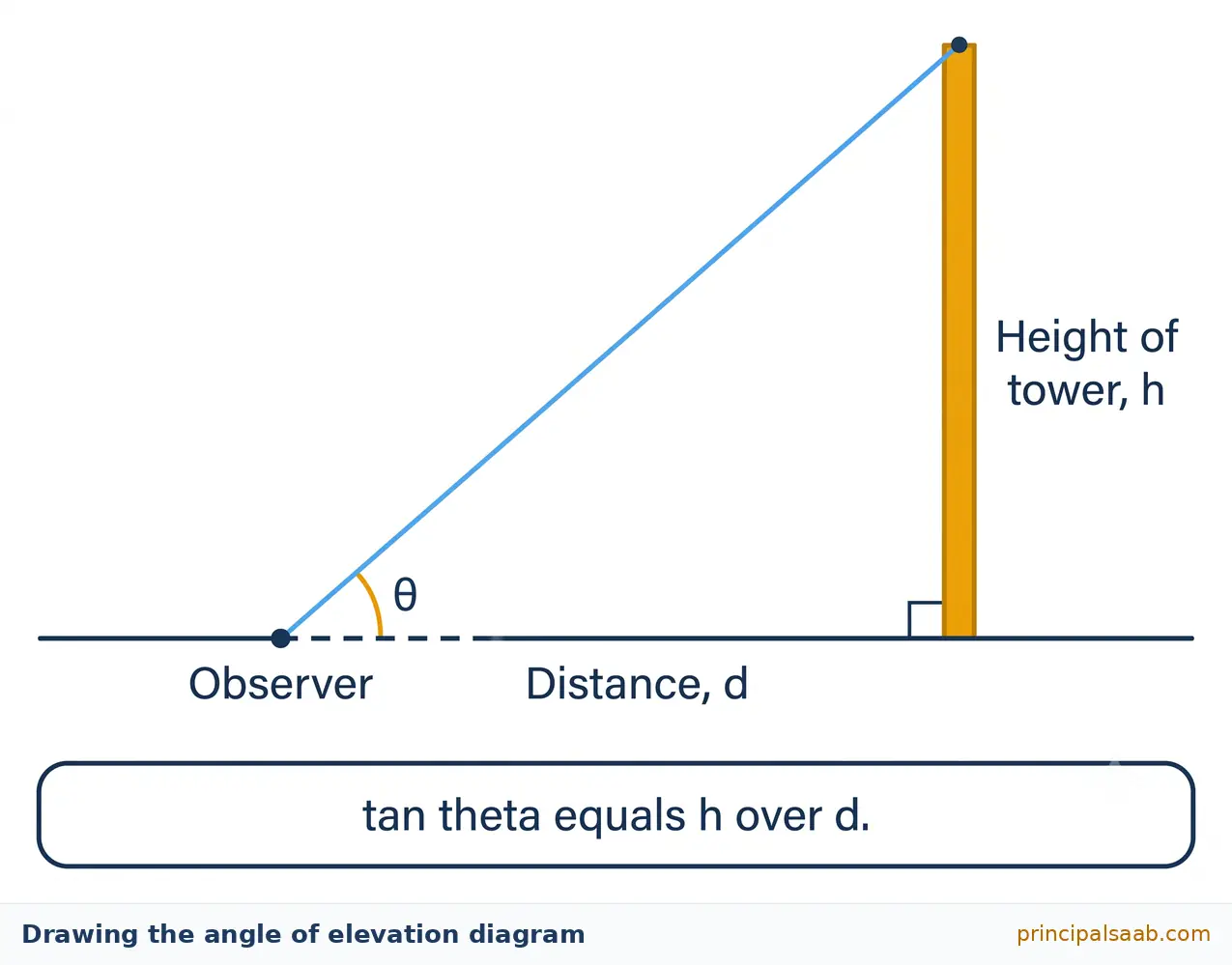
Think of it as the amount by which you lift your gaze. Looking at a friend standing on level ground: elevation is 0°, no lifting needed. Looking at the top of a lamp post twenty metres away: a small amount of lift. Standing right at the base of that lamp post and looking straight up: nearly 90°. Notice something useful in that sequence — the closer you stand, the larger the angle of elevation. Keep that instinct; it will let you sanity-check your answers.
In a diagram, the standard set-up looks like this. Let a tower stand vertically with its foot at a point B and its top at A. An observer stands on the ground at C, some distance away. Then:
- AB is the vertical height of the tower,
- BC is the horizontal distance from the observer to the foot of the tower,
- AC is the line of sight,
- the right angle is at B (the tower meets the ground vertically), and
- the angle of elevation is ∠ACB, sitting at the observer’s position C.
Because the right angle is at B, side AB is opposite to angle C, and side BC is adjacent to angle C. So the ratio that connects them is the tangent. That is why tan is the workhorse of this chapter — most problems give you a horizontal distance and want a vertical height, or the reverse.
Draw it. Vertical tower AB, foot at B. Student at C with BC = 30 m. Right angle at B. Angle of elevation at C is 60°.
Choose the ratio. We know the adjacent side (30 m) and want the opposite side (the height). Adjacent and opposite → tangent.
tan 60° = AB / BC
√3 = AB / 30
AB = 30√3 m
Answer: the tower is 30√3 m tall, which is about 51.96 m.
Why it works: tangent is defined as opposite over adjacent, and in this triangle the tower is opposite the 60° angle while the ground distance is adjacent to it. Nothing clever is happening — we simply named the sides correctly.
Same triangle, but now the height is known and the distance is unknown.
tan 45° = 15 / d
1 = 15 / d
d = 15 m
Answer: 15 m.
Why it works: at 45° the two legs of a right triangle are equal, because tan 45° = 1. So whenever you see 45° in this chapter, immediately think “height = base”. It is the friendliest angle on the list and it often lets you skip a line of algebra.
tan 30° = h / 45
1/√3 = h / 45
h = 45 / √3
Now rationalise: multiply top and bottom by √3.
h = 45√3 / 3 = 15√3 m
Answer: 15√3 m ≈ 25.98 m.
Sanity check: the observer is 45 m away but the tank is only about 26 m tall, so the line of sight is fairly shallow — which is exactly what a small angle like 30° should give. Compare with Example 1, where a 60° angle produced a height taller than the distance. Angles above 45° give height > distance; angles below 45° give height < distance. That check takes two seconds and catches most errors.
4. Angle of Depression
Now flip the situation. Suppose you are standing at the top of a building looking down at a car parked in the street. The object is below your eye level, so you have to lower your gaze. The angle between the horizontal line at your eye and your downward line of sight is called the angle of depression.
The word “depression” here just means “pressed down”. It has nothing to do with mood, and it does not mean the angle is negative. It is an ordinary positive acute angle, measured downwards from the horizontal.
Here is the detail that trips up almost everybody the first time. In the diagram, the angle of depression is at the top, between the horizontal drawn through the observer’s eye and the slanting line of sight going down. But the horizontal at the top and the ground at the bottom are parallel lines, and the line of sight cuts across both of them. So the angle of depression at the top and the angle of elevation at the bottom are alternate interior angles, which means they are equal.
That one-line justification is worth writing in the exam. Examiners like to see that you know why you moved the angle, not just that you moved it. It costs you eight words and it protects your method marks.
Practically, this means depression problems are elevation problems in disguise. Draw the tall object, mark the given angle at the top between the horizontal dashes and the line of sight, then copy that same value into the bottom corner of the triangle and carry on exactly as before.
Draw it. Vertical lighthouse PQ with P at the top, Q at the foot. Dashed horizontal from P going out to sea. Boat at R on the water. The 30° sits at P, between the dashed line and PR.
Transfer the angle. The dashed horizontal is parallel to the sea, so ∠PRQ = 30° as well (alternate angles).
Now in right triangle PQR, right-angled at Q:
tan 30° = PQ / QR
1/√3 = 60 / QR
QR = 60√3 m
Answer: 60√3 m ≈ 103.92 m.
Why it works: a small depression angle means a shallow, far-reaching line of sight, so the boat should be far away — and 104 m is comfortably more than the 60 m height. The answer passes the sanity check.
Transfer the 45° to the ground corner.
tan 45° = 24 / d
1 = 24 / d
d = 24 m
Answer: 24 m.
Why it works: 45° again gives the equal-legs shortcut. Whenever a question hands you 45°, expect the horizontal distance and the vertical height to come out the same. If they do not, re-check your diagram before re-checking your algebra.
tan 60° = 90 / d
√3 = 90 / d
d = 90 / √3 = 90√3 / 3 = 30√3 m
Answer: 30√3 m ≈ 51.96 m.
Compare with Example 4. Same idea, bigger angle, much shorter distance — about 52 m instead of 104 m. A steep downward look reaches something close to your feet; a shallow one reaches far out. Build that mental picture and you will rarely mis-assign an angle.
5. The Only Three Angles You Will Ever Need
Because the syllabus restricts elevation and depression to 30°, 45° and 60°, this small table is the entire numerical toolkit for the chapter. Learn it once, properly, and you never have to think about it again.
| Ratio | 30° | 45° | 60° |
|---|---|---|---|
| sin | 1/2 | 1/√2 | √3/2 |
| cos | √3/2 | 1/√2 | 1/2 |
| tan | 1/√3 | 1 | √3 |
Three facts about the tan row are worth memorising as sentences, because tan does most of the work here:
- tan 30° = 1/√3 ≈ 0.577 — a shallow look; the height comes out smaller than the base distance.
- tan 45° = 1 — height equals base distance exactly.
- tan 60° = √3 ≈ 1.732 — a steep look; the height comes out larger than the base distance.
Notice also that tan 30° and tan 60° are reciprocals of each other: 1/√3 × √3 = 1. That is not a coincidence — 30° and 60° are complementary, and tan of an angle equals cot of its complement. In practice this means that swapping 30° for 60° in a problem flips your answer upside down, which is a fast way to check a suspicious result.
The shadow lies along the ground, so it is the adjacent side; the pole is opposite. Use tan.
(a) At 30°:
tan 30° = 18 / s
1/√3 = 18 / s
s = 18√3 m ≈ 31.18 m
(b) At 60°:
tan 60° = 18 / s
√3 = 18 / s
s = 18/√3 = 6√3 m ≈ 10.39 m
Answer: about 31.18 m and about 10.39 m.
Why it works — and why it feels right: when the sun is low in the sky (small elevation), shadows stretch out long. When the sun is high (large elevation), shadows shrink. You have watched this happen every evening of your life. Notice too that 31.18 ÷ 10.39 = 3 exactly, which is the reciprocal relationship between tan 30° and tan 60° showing up in the numbers.
6. How to Draw and Label the Diagram
This is the section I most want you to take seriously. If your diagram is right, the sum is usually three lines long. If your diagram is wrong, no amount of algebra will save you.
Here is the routine I want you to follow every single time, until it becomes automatic:
- Draw the ground first. A long horizontal line across the bottom of your working space. Everything sits on this.
- Draw the vertical object next. Tower, pole, building, tree — straight up from the ground, and mark the right angle at the base with a small square. That little square is a mark-earner.
- Mark the observer. Put a dot on the ground line at the correct side, and label the distance to the base.
- Draw the line of sight. Join the observer’s eye to the point being observed. Make it a straight, slanting line.
- Place the angle. For elevation, at the observer’s dot, between the ground and the line of sight. For depression, at the top, between a dashed horizontal and the line of sight — and then transfer it to the bottom corner.
- Write the letters. Name every corner (A, B, C…) and every known length. Never leave a side unnamed; unnamed sides are where confusion breeds.
A word about scale: your diagram does not need to be to scale, but it should be roughly honest. If the angle is 60°, draw a steep-looking line of sight. If it is 30°, draw a shallow one. A diagram that looks approximately right helps your brain spot when an answer is absurd.
Draw and label. Ground line. Vertical wall PQ, right angle at the base Q. Ladder from the foot R on the ground up to P on the wall. RP = 12 m is the hypotenuse (the ladder is the slanting side). Angle at R is 60°.
(a) Distance of foot from wall = QR, the side adjacent to 60°. Adjacent and hypotenuse → cosine.
cos 60° = QR / 12
1/2 = QR / 12
QR = 6 m
(b) Height reached = PQ, the side opposite 60°. Opposite and hypotenuse → sine.
sin 60° = PQ / 12
√3/2 = PQ / 12
PQ = 6√3 m ≈ 10.39 m
Answer: the foot is 6 m from the wall; the ladder reaches 6√3 m ≈ 10.39 m up.
Why it works: the moment a slanting physical object (ladder, rope, wire, string) is given a length, that length is the hypotenuse — so sine and cosine take over from tangent. Recognising which side is the hypotenuse is the whole game.
7. Choosing the Right Ratio in Three Seconds
Once the diagram is labelled you have exactly three pieces of information in play: the angle, one known side, and one unknown side. The only decision left is which ratio links those two sides. Here is a decision table you can run in your head.
| The two sides involved | Ratio to use | Typical wording |
|---|---|---|
| Opposite and Adjacent (height and ground distance) | tan | “a point x m from the foot of the tower” |
| Opposite and Hypotenuse (height and slanting length) | sin | “the string of the kite is x m long” |
| Adjacent and Hypotenuse (ground distance and slanting length) | cos | “the foot of the ladder is x m from the wall” |
The practical trick is this: find the hypotenuse first. In every one of these diagrams, the hypotenuse is the line of sight or the slanting physical object — the ladder, the rope, the wire, the kite string, the slide. If that slanting length is neither given nor asked for, you can ignore sin and cos entirely and use tan. That single observation resolves maybe seventy per cent of the questions in this chapter.
The wire is the slanting side, so the wire is the hypotenuse.
(a) Height (opposite) with hypotenuse → sin.
sin 45° = h / 20
1/√2 = h / 20
h = 20/√2 = 10√2 m ≈ 14.14 m
(b) Ground distance (adjacent) with hypotenuse → cos.
cos 45° = d / 20
1/√2 = d / 20
d = 10√2 m ≈ 14.14 m
Answer: both are 10√2 m ≈ 14.14 m.
Why they are equal: at 45° the triangle is isosceles, so the vertical and horizontal legs must match. Seeing the two answers agree is itself a confirmation that you used the ratios correctly.
The sliding surface is the slanting side (hypotenuse); the 3 m height is opposite the 30° angle. Opposite and hypotenuse → sin.
sin 30° = 3 / L
1/2 = 3 / L
L = 6 m
Answer: 6 m.
Why it works: sin 30° = 1/2 means the height is always exactly half the slanting length at that angle. So a 30° slope doubles: whatever height you want, you need twice that much slide. This is why gentle ramps are so long — a useful bit of real-world sense.
8. One-Triangle Problems
These are the questions where the whole story lives inside a single right triangle. They carry two or three marks and they should feel almost mechanical by the time you finish this section. The pattern is always: draw, name, pick a ratio, solve, state the answer with units.
Two extra habits pay for themselves here. First, always write the units — metres, kilometres, seconds. A number without a unit can lose a mark. Second, answer the actual question. If the question asks for the height of the tree and you have found the height of the broken part, you have not finished.
The string is the slanting side, so it is the hypotenuse. We want the vertical height, which is opposite the 60° angle. Opposite and hypotenuse → sin.
sin 60° = h / 120
√3/2 = h / 120
h = 120 × √3/2 = 60√3 m
Answer: 60√3 m ≈ 103.92 m.
Why the phrase “assuming the string is straight” matters: a real kite string sags in a curve, and a curve is not the side of a triangle. The question adds that phrase so that the model is honest. Whenever you see it, read it as permission to draw a straight hypotenuse.
Picture it. The standing stump is vertical. The broken portion is now the slanting hypotenuse, leaning from the top of the stump down to the ground 8 m away. So we have one right triangle: vertical stump, horizontal 8 m, slanting broken piece, with 30° at the ground.
Step 1 — the stump (opposite, with adjacent known) → tan.
tan 30° = stump / 8
1/√3 = stump / 8
stump = 8/√3 = 8√3/3 m ≈ 4.62 m
Step 2 — the broken part (hypotenuse, with adjacent known) → cos.
cos 30° = 8 / L
√3/2 = 8 / L
L = 16/√3 = 16√3/3 m ≈ 9.24 m
Step 3 — the original height is stump + broken part, because before the storm the broken piece was standing on top of the stump.
Height = 8√3/3 + 16√3/3 = 24√3/3 = 8√3 m
Answer: 8√3 m ≈ 13.86 m.
Where students go wrong: they find one of the two pieces and stop. The tree’s original height is the sum. Read the final sentence of the question again before you write “Answer”.
Let the height be h. Then the shadow is √3 h. The height is opposite the sun’s elevation angle θ, the shadow is adjacent, so use tan.
tan θ = h / (√3 h) = 1/√3
From the standard table, tan 30° = 1/√3.
Answer: θ = 30°.
Why it works: notice that h cancelled completely. The ratio of shadow to height fixes the angle no matter how tall the tower is — which is exactly why every object in a park casts a shadow at the same angle at the same moment. Whenever a question gives you a relationship between two lengths rather than the lengths themselves, expect the unknown length to cancel and the answer to be an angle.
9. Two-Triangle Problems
Now we reach the heart of the chapter, and the place where four- and five-mark board questions come from. The syllabus caps you at two right triangles, so this is as complicated as it will ever get. That is worth repeating, because the fear of an endless chain of triangles is what makes students freeze.
Two triangles turn up when the story contains two angles, or two observation points, or two objects. The two triangles almost always share a common side, and that shared side is what glues the problem together.
1. Draw one figure containing both triangles; do not draw them separately.
2. Identify the side they share (usually the vertical height, sometimes the horizontal distance).
3. Call the unknown you want h (or x) and write one equation from each triangle.
4. You now have two equations. Eliminate the side you do not care about, and solve.
Step 3 is the one to practise. Do not try to jump to the answer. Write the two equations out fully, one under the other, and only then start combining them. Examiners award marks for those two equations even if your final arithmetic wobbles.
Draw one figure. Tower AB, foot at B. Far point C with ∠ACB = 30°. Near point D between C and B with ∠ADB = 60°. CD = 40 m. Let the height AB = h and let DB = x.
Triangle ABD (the near one):
tan 60° = h / x → √3 = h / x → x = h/√3
Triangle ABC (the far one):
tan 30° = h / (40 + x) → 1/√3 = h / (40 + x) → 40 + x = h√3
Combine. Substitute x = h/√3 into the second equation:
40 + h/√3 = h√3
40 = h√3 − h/√3
40 = (3h − h)/√3 = 2h/√3
h = 40√3 / 2 = 20√3 m
Answer: 20√3 m ≈ 34.64 m.
Why it works: the shared side here is the height h, and it appears in both equations. The distance x was never wanted, so we eliminated it. Note also the sanity check: the tower is about 34.6 m tall and the near point is x = 20√3/√3 = 20 m away, which with a 60° angle is exactly right (34.64 > 20, as it must be for an angle above 45°).
Draw one figure. Tower BT with B on the ground and T at the top. Flagstaff TF standing on T. Observer at P on the ground, with ∠TPB = 45° and ∠FPB = 60°. Let PB = d.
Triangle TPB (lower triangle):
tan 45° = 20 / d → 1 = 20 / d → d = 20 m
Triangle FPB (the whole thing):
tan 60° = FB / d → √3 = FB / 20 → FB = 20√3 m
FB is the height of the top of the flagstaff above the ground. The flagstaff itself is what is left over:
Flagstaff = FB − TB = 20√3 − 20 = 20(√3 − 1) m
Answer: 20(√3 − 1) m ≈ 14.64 m.
Why it works: here the shared side is the horizontal distance d, and it is the thing we find first. Then the two triangles give two different vertical heights measured from the same ground line, and subtracting them gives the piece between. Always subtract at the end — the taller triangle gives the total, not the flagstaff.
Draw one figure. Lighthouse LM, top at L, foot at M. Dashed horizontal through L extending both left and right. Ship A to the left with depression 30°; ship B to the right with depression 45°. Transfer both angles to the ground corners (alternate angles).
Triangle for ship A:
tan 30° = 100 / MA → 1/√3 = 100 / MA → MA = 100√3 m
Triangle for ship B:
tan 45° = 100 / MB → 1 = 100 / MB → MB = 100 m
Because the ships are on opposite sides, the distance between them is the sum:
AB = 100√3 + 100 = 100(√3 + 1) m
Answer: 100(√3 + 1) m ≈ 273.21 m.
The one thing to watch: opposite sides means add; the same side means subtract. Underline the words “opposite sides” or “same side” in the question paper the moment you read them. This single word decides your final operation, and it is the most common place to drop a whole answer.
10. When the Observer Has a Height
So far we have quietly pretended that the observer’s eye is on the ground. Sometimes a question refuses to let you pretend: “a boy 1.5 m tall”, “a girl whose eye level is 1.4 m above the ground”. When that happens, one small adjustment fixes everything.
Raise the horizontal line to the observer’s eye. The right triangle now sits above the observer’s eye level, not above the ground. So the height you calculate from the triangle is only the part of the object above eye level. To get the true height of the object, add the observer’s height back at the end.
A neat way to draw this: mark the observer as a short vertical segment standing on the ground. From the top of that segment draw the horizontal across to the tower. It will hit the tower part-way up, cutting the tower into a lower rectangle-side (equal to the observer’s height) and an upper triangle-side (the bit you calculate).
Let the part of the tower above his eye level be h.
tan 45° = h / 20 → 1 = h / 20 → h = 20 m
Total height = 20 + 1.5 = 21.5 m
Answer: 21.5 m.
Why it works: the 20 m from the triangle measures from his eyes upward, so the extra 1.5 m from the ground to his eyes must be added on. Forgetting it costs one mark every time.
tan 30° = h / 12
1/√3 = h / 12
h = 12/√3 = 4√3 m ≈ 6.93 m
Total height = 4√3 + 1.5 m ≈ 6.93 + 1.5 = 8.43 m
Answer: (4√3 + 1.5) m ≈ 8.43 m.
Presentation note: keep the exact form (4√3 + 1.5) on one line and give the decimal after it. Do not round 4√3 to 6.9 and then add — round only once, right at the end.
tan 60° = h / 15
√3 = h / 15
h = 15√3 m ≈ 25.98 m
Total height = 15√3 + 1.8 m ≈ 25.98 + 1.8 = 27.78 m
Answer: (15√3 + 1.8) m ≈ 27.78 m.
Sanity check: the observer’s 1.8 m is a tiny correction on a 26 m chimney — about 7%. If your “correction” ever changes the answer dramatically, you have added it in the wrong place.
11. Ladders, Kite Strings and Other Slanting Lines
Group all of these together in your mind: ladders, kite strings, guy wires, ropes, slides, cable-car cables, the sloping edge of a ramp. Every one of them is a hypotenuse. The instant you spot one, you know sine and cosine are in play.
The three quantities that appear are: the length of the slanting object, the vertical height it reaches, and the horizontal distance it covers along the ground. Given any one of them plus a standard angle, you can find the other two.
| You know | You want | Use |
|---|---|---|
| Slant length | Vertical height | height = slant × sin θ |
| Slant length | Ground distance | distance = slant × cos θ |
| Vertical height | Slant length | slant = height ÷ sin θ |
| Ground distance | Slant length | slant = distance ÷ cos θ |
Height = 8 × sin 60° = 8 × √3/2 = 4√3 m ≈ 6.93 m
Foot distance = 8 × cos 60° = 8 × 1/2 = 4 m
Answer: the window is 4√3 m ≈ 6.93 m above the ground; the foot of the ladder is 4 m from the wall.
Quick check with Pythagoras: 4² + (4√3)² = 16 + 48 = 64 = 8². The two answers are consistent with the ladder’s length. This check works in every ladder problem and takes ten seconds — use it.
Here the height is known and the slant is wanted, so slant = height ÷ sin θ.
sin 30° = 75 / L
1/2 = 75 / L
L = 150 m
Answer: 150 m.
Why it feels right: sin 30° = 1/2, so at that shallow angle you need twice as much string as the height you gain. Flying a kite low and far out eats string fast — the mathematics matches the experience.
12. River Width, Two Ships and Objects on Two Sides
This family of questions is really Example 16 wearing different clothes. Something tall stands between (or beside) two objects, and you are asked for the gap between them. Everything hinges on one word in the question.
Draw one figure. The observer at the top of a 5 m vertical, dashed horizontal both ways, one bank on each side. Transfer both depression angles down to the water line.
Left bank: tan 30° = 5 / d₁ → d₁ = 5√3 m ≈ 8.66 m
Right bank: tan 45° = 5 / d₂ → d₂ = 5 m
The banks are on opposite sides, so add:
Width = 5√3 + 5 = 5(√3 + 1) m
Answer: 5(√3 + 1) m ≈ 13.66 m.
Why it works: the two right triangles share the same 5 m vertical side. Each gives one horizontal piece, and the pieces lie on opposite sides of the foot of that vertical, so the total width is their sum.
Nearer ship (steeper angle, 60°): tan 60° = 45 / d → d = 45/√3 = 15√3 m ≈ 25.98 m
Farther ship (shallower angle, 45°): tan 45° = 45 / D → D = 45 m
Same side, so subtract:
Distance apart = 45 − 15√3 m ≈ 45 − 25.98 = 19.02 m
Answer: (45 − 15√3) m ≈ 19.02 m.
Which ship is nearer? The one with the larger depression angle. You look more steeply down at something close to you. Getting this the wrong way round produces a negative distance — and a negative distance is your signal to re-read the diagram, not to drop the minus sign.
13. Aeroplanes, Speed and Time
These questions combine this chapter with the speed formula you have known since primary school: speed = distance ÷ time. The trigonometry gives you the distance; the arithmetic finishes the job.
The set-up is always the same. An aeroplane flies horizontally at a constant height. At one instant its angle of elevation from a fixed point on the ground is measured; a few seconds later it is measured again and is smaller (because the plane has flown further away). The horizontal distance it covered in those seconds is the difference between the two ground distances.
First position (60°):
tan 60° = 1500√3 / d₁
√3 = 1500√3 / d₁ → d₁ = 1500 m
Second position (30°):
tan 30° = 1500√3 / d₂
1/√3 = 1500√3 / d₂ → d₂ = 1500√3 × √3 = 4500 m
Distance flown = 4500 − 1500 = 3000 m in 15 s
Speed = 3000 / 15 = 200 m/s
In km/h: 200 × 18/5 = 720 km/h
Answer: 720 km/h.
Sanity check: a passenger jet cruises at roughly 800–900 km/h, so 720 km/h is entirely believable. If your answer came out as 7.2 km/h or 72 000 km/h, you have slipped a conversion factor.
tan 60° = 3000 / d
√3 = 3000 / d
d = 3000/√3 = 3000√3/3 = 1000√3 m
Answer: 1000√3 m ≈ 1732.05 m, that is roughly 1.73 km.
Why it works: only one triangle is needed because only one moment is described. Not every aeroplane question is a speed question — read carefully before you start hunting for a second angle.
14. Rationalising and Reporting √3 Answers
Because tan 30° = 1/√3, surds land in the denominator constantly in this chapter. Leaving them there is not wrong, but tidying them up is standard practice and examiners expect it. Two techniques cover everything you will meet.
Technique 1 — a single surd in the denominator. Multiply the top and bottom by that surd.
50/√3 = (50 × √3) / (√3 × √3) = 50√3 / 3
Using √3 = 1.732: 50 × 1.732 = 86.6, and 86.6 ÷ 3 = 28.8666…
Answer: 50√3/3 ≈ 28.87.
Why bother: dividing by 3 is easy; dividing by 1.732 by hand is not. Rationalising is not a ritual — it genuinely makes the arithmetic simpler in a no-calculator exam.
Technique 2 — a sum or difference in the denominator. Multiply top and bottom by the conjugate: change the sign in the middle. This works because (a + b)(a − b) = a² − b², which clears the surd.
Multiply top and bottom by the conjugate (√3 − 1):
= 100(√3 − 1) / [(√3 + 1)(√3 − 1)]
= 100(√3 − 1) / (3 − 1)
= 100(√3 − 1) / 2
= 50(√3 − 1)
Using √3 = 1.732: 50 × 0.732 = 36.6.
Answer: 50(√3 − 1) ≈ 36.60.
Where this shows up: exactly in flagstaff-and-tower questions, where the answer naturally comes out as something divided by (√3 − 1) or (√3 + 1). Recognise the pattern and the last two lines write themselves.
15. A Word-Problem Strategy That Always Works
When a long question appears in the exam and your mind goes blank, run this six-step routine. It never fails, because every question in this chapter is built the same way.
- Read once for the story. Who is standing where, and what are they looking at? Do not write anything yet.
- Read again with a pencil. Underline every number, every angle, and the words “opposite sides”, “same side”, “from the top of”, “towards”.
- Draw and label. Ground line, verticals, dashed horizontals for depression, letters at every corner, right-angle squares.
- Name the unknown. Write “Let the height of the tower be h m” explicitly. This sentence carries marks.
- Write one equation per triangle. One triangle, one equation. Two triangles, two equations. Never more.
- Solve, then answer the question that was asked, with units and a two-decimal approximation where useful.
Step 1–2 — read and underline. Two angles, so two triangles. The observer is at the top of the building, 15 m up. One angle looks up at the tower’s top; the other looks down at the tower’s base.
Step 3 — draw. Building PQ, top at P, foot at Q. Tower RS on the same ground line, foot at S, top at R. Dashed horizontal from P across to the tower, meeting it at a point M. Note PM is horizontal and equals QS, the distance between the two structures. Also MS = PQ = 15 m, because PQMS is a rectangle.
Step 4 — name the unknowns. Let PM = d and let RM = x (the part of the tower above the observer’s eye level).
Step 5 — one equation per triangle.
Lower triangle (depression 45° to the foot S): the depression angle transfers, so in right triangle PMS, tan 45° = MS / PM = 15 / d → 1 = 15/d → d = 15 m.
Upper triangle (elevation 30° to the top R): tan 30° = RM / PM = x / 15 → 1/√3 = x/15 → x = 15/√3 = 5√3 m ≈ 8.66 m.
Step 6 — assemble the answer. The tower’s full height is the part below the observer’s eye plus the part above it:
RS = MS + RM = 15 + 5√3 m ≈ 15 + 8.66 = 23.66 m
Answer: (15 + 5√3) m ≈ 23.66 m.
The insight worth keeping: the horizontal dashed line splits the tower into two pieces — a lower piece exactly equal to the building’s height (because the two horizontals are parallel and the ground is level) and an upper piece found from the elevation triangle. Recognising the rectangle PQSM is what makes this question easy rather than hard.
16. Common Mistakes and a Quick Self-Check
Almost every mark lost in this chapter comes from one of the following. Read them the night before the exam.
1. Putting the angle of elevation at the top of the tower instead of at the observer.
2. Marking the depression angle inside the triangle rather than against the dashed horizontal.
3. Using tan when the slanting length is given (it should be sin or cos).
4. Forgetting to add the observer’s height at the end.
5. Adding when the objects are on the same side, or subtracting when they are on opposite sides.
6. Rounding √3 early and letting the error grow.
Here is a fast self-check to run on any answer before you move on:
- Does the angle test pass? If the angle is 60°, the height should be bigger than the ground distance. If 30°, smaller. If 45°, equal. Check in one glance.
- Is the answer a sensible size? A tower of 3 m or 3000 m is almost certainly wrong. A person of 15 m definitely is.
- Did you answer the actual question? Height of the tower, or length of the flagstaff? Distance from the foot, or distance between the ships?
- Are the units there? Metres, kilometres, m/s, km/h.
- Is the surd tidy? No √ left sitting in a denominator.
One last piece of encouragement before the worksheet. If a two-triangle problem still feels murky, that is completely normal and it is not a sign that you are bad at maths. It is a sign that you need three or four more of them on paper. Do not move on until the diagram step feels comfortable — everything after the diagram is arithmetic you already own.
Practice Worksheet
Ten questions, arranged roughly easiest first. Take √3 = 1.732 and √2 = 1.414 where a decimal is asked for. Work each one on paper with a diagram before you open the answer — opening it early feels efficient and teaches you nothing.
Show Answer
tan 60° = h / 12 → √3 = h / 12 → h = 12√3 m.
Height = 12√3 m ≈ 20.78 m.
Check: 60° is above 45°, so the height should exceed the shadow length — 20.78 > 12. Good.
Show Answer
tan 30° = 45 / d → 1/√3 = 45 / d → d = 45√3 m.
Distance = 45√3 m ≈ 77.94 m.
Show Answer
sin 45° = h / 14 → 1/√2 = h / 14 → h = 14/√2 = 7√2 m.
Height = 7√2 m ≈ 9.90 m.
(Using √2 = 1.414: 7 × 1.414 = 9.898, which rounds to 9.90.)
Show Answer
sin 30° = h / 180 → 1/2 = h / 180 → h = 90 m.
Height = 90 m.
At 30° the height is always exactly half the string length — a handy fact to carry.
Show Answer
From the standard table, tan 45° = 1.
Angle of elevation = 45°.
Whenever the height and the ground distance are equal, the answer is 45° — no calculation really needed once you spot it.
Show Answer
Near triangle: tan 60° = h / x → x = h/√3.
Far triangle: tan 30° = h / (60 + x) → 60 + x = h√3.
Substitute: 60 + h/√3 = h√3
60 = h√3 − h/√3 = (3h − h)/√3 = 2h/√3
h = 60√3 / 2 = 30√3 m.
Height = 30√3 m ≈ 51.96 m.
Show Answer
Lower triangle: tan 45° = h / d → d = h.
Whole triangle: tan 60° = (h + 12) / d = (h + 12) / h = √3.
So h + 12 = h√3 → 12 = h(√3 − 1) → h = 12/(√3 − 1).
Rationalise with the conjugate: h = 12(√3 + 1)/[(√3 − 1)(√3 + 1)] = 12(√3 + 1)/2 = 6(√3 + 1) m.
Tower height = 6(√3 + 1) m ≈ 16.39 m.
Show Answer
Ship at 45°: tan 45° = 30 / d₁ → d₁ = 30 m.
Ship at 60°: tan 60° = 30 / d₂ → d₂ = 30/√3 = 10√3 m ≈ 17.32 m.
Opposite sides, so add:
Distance = (30 + 10√3) m ≈ 47.32 m.
Show Answer
tan 30° = h / 18 → 1/√3 = h / 18 → h = 18/√3 = 6√3 m ≈ 10.39 m.
Now add the height of his eyes:
Tower height = 6√3 + 1.5 m ≈ 10.39 + 1.5.
Height = (6√3 + 1.5) m ≈ 11.89 m.
Show Answer
Second position: tan 30° = 2000√3 / d₂ → d₂ = 2000√3 × √3 = 6000 m.
Distance flown = 6000 − 2000 = 4000 m in 20 s.
Speed = 4000/20 = 200 m/s = 200 × 18/5 km/h.
Speed = 720 km/h.