

Take a breath before we start. If you have already flipped through this chapter and thought, “this is just history with a few numbers thrown in, and I will never remember any of it” — you are in very good company. Almost every student feels that on the first read. But here is the thing I want you to hold on to: this chapter is not really about memorising dates. It is about one single story, told from six or seven different angles. Once you understand the story, the numbers stop being random and start being evidence. And evidence is much easier to remember than trivia. So we are going to build that story together, slowly, from zero. I will not assume you know anything about colonial India, and I will not rush you.
- Why We Study The Colonial Economy At All
- The Low Level Of The Economy And Estimates Of National Income
- The Agricultural Sector: Stagnation And Its Causes
- The Industrial Sector: De-industrialisation And Limited Modern Industry
- Foreign Trade: An Export Surplus That Did Not Help India
- Demographic Condition: The Year Of The Great Divide
- Occupational Structure And Its Regional Variations
- Infrastructure Under The Raj: Intentions Versus Unintended Benefits
- The Balance Sheet: What Colonial Rule Gave And What It Took
- What All Of This Set Up For Planning After 1947
- Practice Worksheet With Full Model Answers
- One Last Word Before You Close The Page
Your Game Plan
Here is exactly how I would work through this chapter if I were sitting where you are. Do not skip steps, and do not try to finish it in one sitting — this chapter rewards two or three shorter passes far more than one long exhausted one.
- Read the story first, ignore the numbers. On your first pass, read every section for the argument only. Let your eyes slide right past the percentages. You are just trying to answer: what was the colonial economy for?
- Second pass — attach one number to each idea. Now go back and pick up the single most important figure per section. One number per idea is enough to score. Ten numbers with no idea attached scores nothing.
- Work every example box with your pen. Cover my answer, write your own, then compare. The gap between your answer and mine is your real syllabus.
- Learn the two-sided assessments. Infrastructure and foreign trade both need a “yes, but” answer. Board examiners love these. Practise saying both halves out loud.
- Finish with the worksheet. Attempt all of it in one go, timed, before you reveal a single answer.
Why We Study The Colonial Economy At All
Let me start with the question you are probably too polite to ask: why does an Economics syllabus open with history? Independence was in 1947. Why not just start with what India does today?
Here is the honest answer. When India became independent, its leaders had to make choices — how much to spend on factories versus farms, whether to trust private business or build government-owned industry, how hard to push exports. You cannot understand why they chose what they chose unless you know what they were starting from. A doctor does not prescribe medicine without first knowing the patient’s condition. This chapter is the diagnosis. Everything that comes later in your syllabus — the Five Year Plans, the 1991 reforms — is the treatment.
Now here is the analogy I want you to carry through the whole chapter, because it will do a lot of heavy lifting for you.
Sit with that image for a minute. Notice what it already explains: why agriculture stagnated even though most people farmed, why handicrafts died, why trade “surplus” did not enrich India, and why railways existed but literacy did not. If you can retell that little story in your own words, you have already got the spine of the chapter.
One more idea before we move on. Economists describe the colonial economy as exploitative and stagnant. “Exploitative” means the surplus produced in India was systematically transferred out of India. “Stagnant” means output per person barely grew for decades — the economy was not shrinking dramatically, but it was not going anywhere either. Learn those two adjectives. They are the two words most 6-mark answers in this chapter want to see.
Model answer: The primary objective was to use India as a supplier of cheap raw materials for British industry and as a captive market for British finished goods, so as to serve Britain’s own economic interests rather than India’s development.
Why this answer scores: A 1-mark question wants one sharp sentence, not a paragraph. Notice it contains both halves of the mechanism — raw materials out, finished goods in — plus the purpose clause at the end. Most students write only “to exploit India”, which is a claim without a mechanism, and examiners often cut it to half.
Model answer:
Yes, I agree, for the following reasons.
(i) It explains the starting point. India in 1947 inherited a stagnant economy with very low per capita income, so planners had to focus first on raising basic output rather than on refinements.
(ii) It explains the structural distortions. Because colonial policy had concentrated the workforce in low-productivity agriculture and left almost no capital goods industry, post-independence planning deliberately prioritised heavy and machine-making industries.
(iii) It explains policy attitudes. The memory of being an open market for British manufactures made independent India cautious about foreign trade and foreign investment, which shaped its protectionist and import-substituting stance for decades.
Why this answer scores: Three marks means three distinct reasons, each labelled. I have deliberately made them different in kind — one about levels, one about structure, one about attitudes — so no examiner can say two points overlap. Also note that each reason ends by connecting back to an actual post-1947 policy. That link is what turns a history statement into an economics answer.
The Low Level Of The Economy And Estimates Of National Income
Before we look at any one sector, let us get the overall size of the problem. How poor was India in 1947? And how do we even know, given that the colonial government did not publish proper national income accounts?
The answer is that a handful of individual scholars did the work themselves, one at a time, using whatever scraps of data existed — trade returns, tax records, crop reports. The names your textbook lists are Dadabhai Naoroji, William Digby, Findlay Shirras, V. K. R. V. Rao and R. C. Desai. You do not need their life stories. You need one fact about them as a group, and one name to single out. (How India measures GDP today is explained in our National Income and Related Aggregates — Class 12 notes.)
Now the headline numbers. In the first half of the twentieth century, India’s aggregate national income grew at roughly two per cent a year, and output per person grew at only about half a per cent a year. Textbooks usually put it as “less than two per cent” for total income and “half a per cent” per head.
Please do not just memorise “2 and 0.5”. Feel what they mean. Half a per cent a year is so slow that at that rate an average person’s income would take roughly 140 years to double. A child born in 1900 would die in old age with a standard of living barely distinguishable from the one their parents had. That is what the word stagnation actually feels like on the ground — not collapse, just a life that never improves.
Model answer:
(i) The gap between the two growth rates is accounted for mainly by population growth. Total output was rising, but the number of people sharing that output was rising almost as fast, so very little was left over per head.
(ii) It shows the economy was stagnant in welfare terms. Aggregate growth that does not translate into growth per person means the average Indian’s living standard was practically frozen across decades.
(iii) It confirms that colonial growth was not development. Some output expanded — mainly commercial crops and a few industries serving colonial needs — but it did not raise the general standard of living, which is the real test of development.
Why this answer scores: The question says “explain what this tells us”, so pure repetition of the figures earns nothing. Each of my three points is an inference. Point (i) supplies the arithmetic reason, (ii) supplies the human meaning, (iii) supplies the conceptual distinction between growth and development — that third one is exactly the kind of line that lifts an answer from average to full marks.
Model answer:
Who made them. There was no official system of national income accounting under colonial rule. Estimates were prepared privately by individual scholars such as Dadabhai Naoroji, William Digby, Findlay Shirras, V. K. R. V. Rao and R. C. Desai.
What they found. Broadly, they showed a very low level of income and extremely slow growth — aggregate national income rising at roughly 2% a year and per capita output at about half a per cent a year during the first half of the twentieth century.
Whose work stood out. V. K. R. V. Rao’s estimates are usually considered the most methodologically sound of the set.
Why they were unsatisfactory. (a) They were unofficial and voluntary, so there was no continuous, comparable series. (b) Different scholars adopted different definitions, coverage and methods, so their results conflicted with one another. (c) The underlying data — especially for the vast unorganised and subsistence sectors — was fragmentary, so large parts of economic activity were guessed at rather than measured.
Why this answer scores: A 4-mark question with two distinct demands (“discuss” and “why unsatisfactory”) should be split roughly 2 and 2. See how I used bold mini-headings? In a board answer sheet that costs you five seconds and makes the examiner’s job effortless — they can see all four components without hunting. Also note I gave three reasons for unsatisfactoriness when only two were strictly needed; a small safety margin is wise, but do not pad beyond that or you lose time.
The Agricultural Sector: Stagnation And Its Causes
This is the section where students lose the most marks, and it is almost always for the same reason: they can say “agriculture was backward” but they cannot say why in an organised way. So let us build the causes carefully, one at a time. Take this slowly.
Start with the puzzle. On the eve of independence, roughly seventy to seventy-five per cent of India’s people depended on agriculture for a living. If three out of every four workers are in one sector, you would expect that sector to be the strongest thing in the economy. It was the weakest. Output per acre was low, output per worker was lower still, and the sector was barely growing at all. Why?
Cause One: The Land Settlement Systems
This is the single biggest cause, and it is really a story about who had the incentive to improve the land.
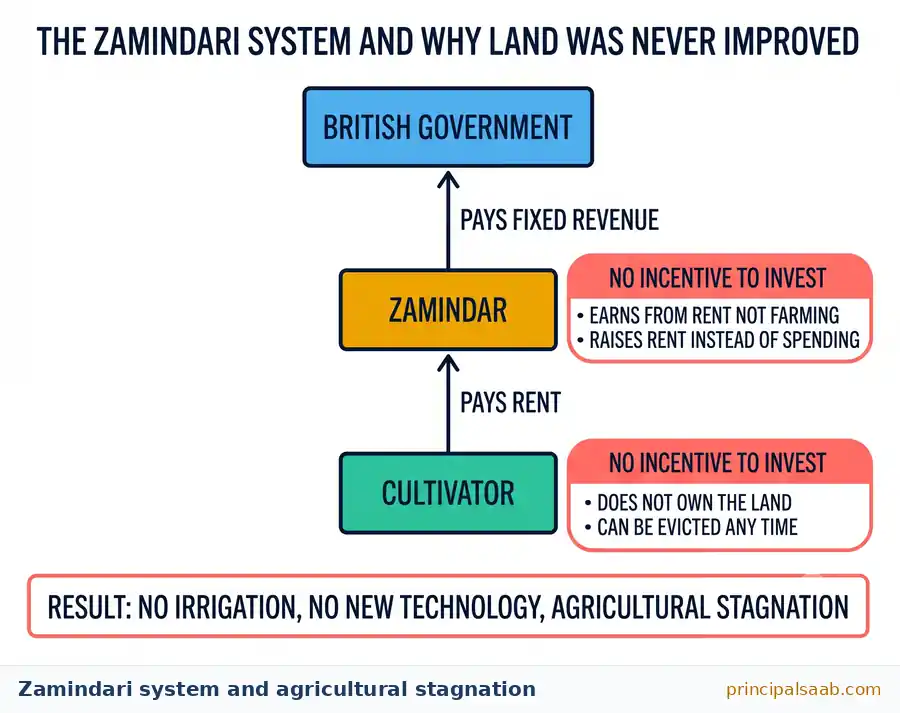
Under the zamindari system — most prominent in Bengal and the eastern regions — the British recognised intermediaries called zamindars as the parties responsible for paying land revenue to the government. The zamindars collected from the actual cultivators and passed a fixed sum up to the state, keeping the rest.
Now think about the incentives that creates, because this is the whole argument:
- The zamindar earned his income from collecting rent, not from farming. He could raise his income by squeezing tenants harder — which required no investment at all. So he had little reason to spend money on irrigation, better seed or drainage.
- The cultivator was the one who actually knew the soil and could improve it, but he did not own it and could often be evicted. Any improvement he financed might simply become a reason for his rent to rise. So he had little reason to invest either.
- The colonial state got its fixed revenue regardless of whether output rose or fell, so it had no strong financial motive to fund agricultural development.
Do you see it? Nobody in the chain had both the ability and the incentive to invest. That is the sentence to write in the exam. It is not that Indian farmers were lazy or ignorant — it is that the property system had been arranged so that improvement paid nobody. Make sure this feels comfortable before you go on, because every other cause is smaller than this one.
Model answer:
(i) Intermediaries had no incentive to invest. Under the zamindari system, zamindars derived income from collecting rent rather than from cultivation. Their earnings could be raised simply by increasing rent, so they had no reason to spend on irrigation, improved seeds or land improvement.
(ii) Cultivators had no capacity or security to invest. Tenants who actually worked the land held it insecurely and faced high rents, leaving them with neither surplus to invest nor confidence that they would enjoy the returns of any improvement.
(iii) The revenue demand was rigid. Revenue had to be paid in a fixed amount by a fixed date irrespective of harvest conditions, which forced cultivators into borrowing in bad years and into chronic indebtedness.
(iv) The net result was technological stagnation. With no party investing, agriculture continued to rely on traditional tools and rainfall, so productivity per hectare remained very low and the sector as a whole stagnated.
Why this answer scores: Look at the shape of this answer — three causes and then a consequence. That fourth point is doing important work: it explicitly closes the loop back to the word “stagnation” that the question used. Always finish a causal answer by naming the effect the question named. And notice I never wrote a vague sentence like “the British exploited farmers”. Every point identifies a specific actor and a specific incentive.
Cause Two: Commercialisation Of Agriculture
“Commercialisation” simply means shifting from growing food you eat to growing crops you sell — cotton, jute, indigo, tea, opium. In a healthy economy, that shift is usually a good thing: farmers specialise, sell for cash, and buy food with the proceeds. They end up better off.
So why is it listed as a problem here? Because in colonial India the shift happened under pressure rather than by choice, and the prices were not set in the farmer’s favour. Cultivators were pushed towards commercial crops that fed British industry — cotton for Lancashire mills, indigo for dye, jute for sacking. But the cash they received was often barely enough to cover the revenue demand, and it certainly was not enough to make up for the food they had stopped growing.
Here is the cruel arithmetic. A farmer who used to grow his family’s grain now grows cotton. His food must now be bought at market prices. If the cotton price falls, or the food price rises, he is instantly in trouble — and he has no buffer. Commercialisation therefore raised the amount of cash flowing through rural India while lowering the amount of food security in it. That combination is a large part of why famine remained a recurring horror in colonial India.
Model answer:
(i) It was not voluntary. Cultivators were pushed into commercial crops by revenue pressure and by the requirements of British industry, rather than choosing them because they were more profitable.
(ii) The terms were unfavourable. Prices for these crops were largely determined by the colonial buyer, so the cash returns to the cultivator were often too small to compensate for the loss of self-grown food.
(iii) It reduced food security. Diverting land from food grains to cash crops left rural households dependent on the market for food, so any crop failure or price movement translated directly into hunger, contributing to the recurrence of famines.
Why this answer scores: The question contains a trap — it invites you to argue against a correct general principle. The safe structure is to accept the principle and then explain why the conditions for it did not hold. “Not voluntary / unfavourable prices / lost food security” is a clean three-part frame you can reuse for any question on this topic.
Cause Three: Low Productivity, No Irrigation, No Technology
The third cause is the most physical and the easiest to picture. Indian agriculture on the eve of independence was overwhelmingly rain-dependent. The area under assured irrigation was small, chemical fertiliser was barely used, and the technology in the field was essentially the wooden plough and the bullock. There had been no equivalent of the mechanisation and scientific farming that had already transformed agriculture in other parts of the world.
Think about what depending on the monsoon really means. It means your entire year’s income is decided by weather you cannot predict or influence. A good monsoon, you eat; a failed one, you borrow. Economists call this a gamble in the monsoon, and that phrase is worth writing in your answers because it captures the whole condition in four words.
There is one more link to notice, and it is a link students often miss. Why was there no irrigation? Partly because irrigation is expensive, and we have just established that no party in the land system had the incentive to fund it. So cause three is not really independent of cause one — it is caused by cause one. If you can say that in an answer, you are reasoning like an economist rather than reciting a list.
Cause Four: The Blow Of Partition
And then, at the very last moment, came Partition in 1947 — which hit Indian agriculture in a particularly awkward way. The damage was not simply that India lost land. It was that the split separated raw materials from the factories that processed them.
- Jute. A large share of the fertile jute-growing tracts went to East Pakistan, while most of the jute mills that processed the fibre remained on the Indian side. India was suddenly a country with jute factories and not enough jute, and it had to import raw jute to keep its own mills running.
- Food grains. Some of the most productive wheat-growing and canal-irrigated tracts of the west went to Pakistan, worsening India’s food position at exactly the moment it could least afford it.
- People. Enormous displacement of population across the new border disrupted farming communities, land holdings and the labour supply on both sides.
Model answer:
Introduction. Although about three-quarters of India’s population depended on agriculture, the sector was marked by very low productivity and negligible growth. Several interlinked colonial factors were responsible.
(i) Land settlement systems. Under arrangements such as the zamindari system, intermediaries collected rent from cultivators and passed a fixed sum to the state. Zamindars profited without investing, and insecure tenants could not invest, so no party in the chain had both the means and the motive to improve the land.
(ii) Rigid revenue demand. Land revenue was payable in fixed amounts on fixed dates irrespective of the harvest, pushing cultivators into borrowing during bad years and into permanent indebtedness.
(iii) Forced commercialisation. Cultivators were driven towards commercial crops serving British industry. Because prices were unfavourable and food crops were displaced, this raised vulnerability rather than incomes.
(iv) Absence of irrigation and technology. Farming remained dependent on the monsoon, with minimal irrigation, negligible fertiliser use and traditional implements, so yields per hectare stayed extremely low.
(v) Lack of capital and credit. With no institutional credit available, cultivators depended on moneylenders charging exorbitant rates, so any surplus was absorbed by interest rather than reinvested.
(vi) Adverse effects of Partition. In 1947 fertile jute-growing and food-producing tracts went to Pakistan while the corresponding processing mills stayed in India, disrupting both raw material supply and food availability.
Conclusion. These causes reinforced one another: the land system removed the incentive to invest, the absence of investment kept technology primitive, and primitive technology kept incomes too low to generate investment. Indian agriculture was therefore trapped in a self-perpetuating cycle of stagnation at independence.
Why this answer scores: Six marks usually means six developed points, and here each one is a named cause plus its mechanism — never just a label. But the real mark-winner is the conclusion. Instead of restating the list, it identifies the circularity between the causes. Examiners are trained to reward exactly that kind of synthesis, and almost nobody writes it. If you take one habit from this chapter, take this one: end every 6-marker with a sentence that connects your points to each other.
Agriculture And Industry At A Glance
Before we leave farming behind, here is a compact comparison you can revise from the night before the exam.
| Feature | Agricultural Sector | Industrial Sector |
|---|---|---|
| Share of workforce | Very large — roughly 70–75% of workers depended on it | Very small — around a tenth of the workforce in manufacturing |
| Direction of change | Stagnant — output per hectare and per worker barely rose | De-industrialising in handicrafts, only thin growth in modern factories |
| Main obstacle | Land settlement removed the incentive to invest | Tariff and trade policy favoured British manufactures |
| Technology | Traditional implements, monsoon-dependent, little irrigation | Almost no capital goods industry to make machines domestically |
| Role of the state | Collected revenue; invested very little in the sector | Public sector confined to railways, power, ports and communications |
| Effect of Partition | Lost fertile jute and food-grain tracts | Retained jute mills but lost their raw material base |
The Industrial Sector: De-industrialisation And Limited Modern Industry
Now for a word that sounds intimidating and is actually very simple: de-industrialisation. It means a country losing industry it already had. Not failing to build new industry — losing existing industry. That distinction matters, so let me make it concrete.
Before colonial rule, India was known across the world for its handicrafts. Indian cotton and silk textiles, metalwork and precious-stone work were exported and admired far beyond the subcontinent. This was not a country that had never made things. It was a country that had made things famously well for centuries.
By 1947, that world-class handicraft sector had been hollowed out, and nothing of comparable strength had been put in its place. That double blow — the old destroyed and the new not built — is the exact phrase you want in your answer.
(1) To reduce India to an exporter of raw materials for the modern industries of Britain — cheap cotton, jute and other inputs flowing outward.
(2) To turn India into a market for finished British goods, so that British factories always had guaranteed buyers.
Handicrafts had to decline for both objectives to work — a thriving Indian weaving industry would have consumed the raw cotton Britain wanted and competed with the cloth Britain wanted to sell. Two objectives, one victim.
How exactly did handicrafts decline? Several forces at once, and you should be able to name at least three:
- Discriminatory tariff policy. Indian goods faced heavy duties entering Britain, while British manufactures entered India with little or no protection standing against them. The playing field was tilted by law.
- Cheap machine-made competition. British mills produced cloth in enormous volume at costs a hand-loom weaver could not match. The Indian craftsman was competing with a steam engine using his fingers.
- Loss of traditional patrons. Indian courts and princely states had been major customers for fine craft work. As their power and wealth were dismantled, that demand evaporated.
- No support of any kind. There was no policy of protection, credit or modernisation to help craftsmen adapt. They were left to face industrial competition alone.
And now think about the human consequence, because the exam asks for it. Millions of craftsmen lost their livelihood. Where did they go? Back to the land — the only sector that would absorb them. This is important: de-industrialisation is one of the reasons agriculture became so overcrowded. It pushed people out of a productive occupation into an already-overburdened one, which lowered output per worker still further. Sections three and four of this chapter are talking to each other.
Model answer:
Meaning. De-industrialisation refers to the systematic decline of a country’s existing industries — in India’s case, the world-renowned handicraft industries — without an adequate modern industrial base emerging to replace them.
The twofold motive.
(i) To make India a supplier of raw materials. Britain’s modern factories required cheap inputs such as raw cotton and jute. Suppressing Indian handicrafts ensured these materials were exported rather than consumed by Indian producers.
(ii) To make India a market for British finished goods. Once local craft production had shrunk, Indian consumers had little alternative to buying machine-made British manufactures, guaranteeing British industry a large captive market.
Consequence. The result was massive unemployment among artisans, who were forced back into agriculture, and a country that at independence had neither its old handicrafts nor a strong modern industry.
Why this answer scores: When a question has the shape “define X, then explain Y about X”, give it visible sections — the examiner is looking for both parts separately. The definition here is doing extra work: notice the clause “without an adequate modern industrial base emerging to replace them”. That clause is the concept. A definition that just says “decline of industry” is incomplete, because a country can lose industry and gain better industry — that would not be this phenomenon.
The Little Modern Industry That Did Emerge
To be fair and accurate — and the board rewards accuracy — some modern industry did appear in India in the second half of the nineteenth century and the first half of the twentieth. Let us be precise about what and where.
- Cotton textile mills, mainly in the western region — Maharashtra and Gujarat — and largely under Indian ownership.
- Jute mills, concentrated in Bengal and dominated by foreign ownership.
- Iron and steel. The Tata Iron and Steel Company (TISCO) was incorporated in 1907 — a genuinely significant landmark, since it made India one of the few colonised countries with a modern steel plant.
- From the interwar years onward, a scatter of other units — sugar, cement, paper — began to appear.
But now the crucial qualifier, and this is where the marks are. This growth was too little, too slow and structurally incomplete. Three limitations in particular:
- Almost no capital goods industry. India could not make the machines that make other things. Every mill had to import its machinery. A country that cannot produce its own capital goods cannot industrialise under its own power — it can only assemble what others sell it.
- A tiny contribution to national output and employment. The modern industrial sector’s share of GDP and of the workforce remained very small, so it could not pull the wider economy along.
- A narrow and reluctant public sector. The colonial government’s own economic activity was largely confined to railways, ports, power generation and communications — the arteries of extraction — rather than to building productive industrial capacity.
Model answer:
What did emerge.
(i) Cotton textile mills developed in the western region, largely under Indian ownership, and jute mills grew in Bengal, mainly under foreign ownership.
(ii) The Tata Iron and Steel Company was set up in 1907, giving India a modern iron and steel capability that few colonised economies possessed.
(iii) From the interwar period, other industries such as sugar, cement and paper began to appear.
Why this was still backwardness.
(iv) No capital goods industry. India had virtually no capacity to manufacture machinery and equipment, so industrial expansion remained dependent on imported machines — the country could not industrialise on its own strength.
(v) Negligible weight in the economy. The modern industrial sector accounted for a very small share of output and employment, leaving the overwhelming majority of workers in low-productivity agriculture.
(vi) A narrowly defined public sector. Government activity was restricted largely to railways, ports, power and communications, which served administrative and extractive needs rather than broad-based industrial development.
Conclusion. The correct verdict is not that no industry existed, but that industrial growth was too narrow to change the character of the economy. India entered independence with isolated islands of modern industry in a sea of stagnant agriculture — which is precisely why building a heavy and capital goods base became the central ambition of planning after 1947.
Why this answer scores: “Critically evaluate” is an instruction to argue both sides and then judge. If you write only the negatives you have not answered the question, however true your negatives are. Give three points each way, then a conclusion that decides. My closing image — islands in a sea — is not decoration; it compresses the whole argument into something the examiner remembers while marking.
Foreign Trade: An Export Surplus That Did Not Help India
This section contains the single most counter-intuitive idea in the whole chapter, so let us handle it gently. Here is the puzzle: (For how money, banks and credit work in today’s economy, see our Money and Banking — Class 12 Economics notes.)
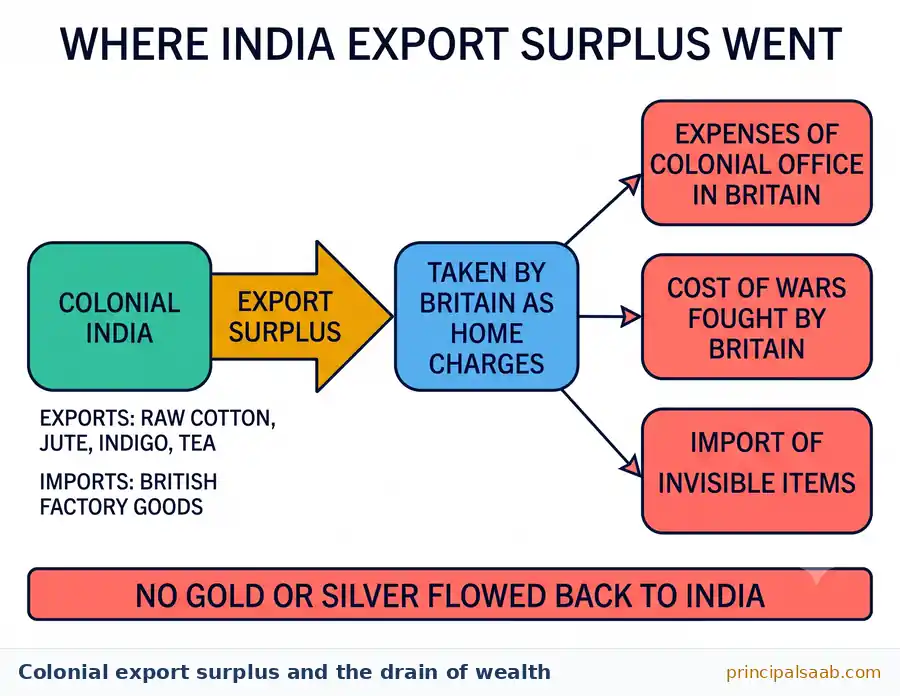
Throughout the colonial period India generated a large export surplus — it consistently sold more abroad than it bought. In any normal economics discussion, that sounds like good news. A country earning more from exports than it spends on imports is accumulating claims on the rest of the world. So why does your textbook treat India’s export surplus as a symptom of exploitation?
Because of one question: where did the surplus go?
Let us return to our farm analogy. The farm produces a huge crop and ships it out. On paper the farm is a net exporter. But the money never reaches the farm — it goes straight to paying the owner’s household bills, his lawyers and his wars. Meanwhile the workers on the farm are short of grain. The farm is “running a surplus” and starving at the same time. Once you see it in those terms, the paradox disappears completely.
The idea of the drain of wealth was argued most famously by Dadabhai Naoroji, in his work Poverty and Un-British Rule in India. He is often called the Grand Old Man of India. Different scholars have put very different money values on the size of the drain, and estimates vary enormously depending on the period and method used — so in an exam, describe the mechanism confidently and treat any dated rupee or pound figure as approximate.
Composition And Direction Of Trade
Two technical words that sound harder than they are:
- Composition of trade = what was traded.
- Direction of trade = with whom it was traded.
On composition, the pattern is exactly what our farm analogy predicts. India exported primary products — raw cotton, raw silk, jute, sugar, indigo, tea, wool — and imported finished consumer goods — cotton and silk cloth, woollen goods, light machinery and other manufactures made in British factories. Primary out, manufactured in. That is the classic colonial trade signature, and if you remember nothing else about composition, remember that four-word phrase.
On direction, Britain maintained a monopoly control. More than half of India’s foreign trade was with Britain alone; the remainder was permitted with only a short list of other countries such as China, Ceylon (present-day Sri Lanka) and Persia (present-day Iran). India was not trading with the world. It was trading with its ruler, plus a few neighbours.
And one date worth knowing: the opening of the Suez Canal in 1869. By dramatically shortening the sea route between India and Europe, it cut transport costs and journey times — which sounds neutral or even good. In practice it tightened Britain’s grip, because it made it cheaper and faster to move Indian raw materials to Britain and British manufactures back to India. A technological improvement in a colonial relationship deepens the colonial relationship. That is a genuinely sophisticated point and it scores well.
| Aspect Of Foreign Trade | Position On The Eve Of Independence | Why It Mattered |
|---|---|---|
| Balance of trade | Large and persistent export surplus | The surplus was not received as gold or goods; it financed colonial charges abroad |
| Composition of exports | Primary products — raw cotton, raw silk, jute, sugar, indigo, tea, wool | Low value added; India sold materials rather than manufactures |
| Composition of imports | Finished consumer goods — cotton and silk cloth, woollens, light machinery | Competed directly with and displaced Indian handicrafts |
| Direction of trade | More than half with Britain; the rest limited to a few countries such as China, Ceylon and Persia | Monopoly control meant India could not seek better terms elsewhere |
| Effect of the Suez Canal (1869) | Shortened the route and cut costs between India and Britain | Strengthened rather than loosened British command over Indian trade |
| Effect on domestic supply | Scarcity of essentials such as food grains, cloth and kerosene | The surplus was achieved partly by suppressing Indian consumption |
Model answer:
(i) The surplus did not return as purchasing power. India received no corresponding inflow of gold, silver or useful imports. The surplus was used to meet expenses imposed by the colonial administration, including the cost of maintaining a colonial government office in Britain, war expenditure met from Indian revenues, and salaries and pensions of British officials.
(ii) It was achieved by suppressing domestic consumption. Goods were exported while Indians faced shortages of essentials such as food grains, cloth and kerosene, so the surplus reflected forced scarcity at home rather than genuine surplus production.
(iii) The composition of trade was unfavourable. India exported low-value primary products and imported high-value manufactures, so even a large volume of exports generated little income and no industrial capability.
(iv) This constituted the drain of wealth. The net effect was a continuous one-way transfer of India’s resources to Britain, a phenomenon analysed by Dadabhai Naoroji in Poverty and Un-British Rule in India.
Why this answer scores: The magic word is “drain of wealth”, and I have deliberately kept it for the last point where it acts as the summing-up label. Also notice point (ii): most students give only the “money went abroad” reason. Adding the suppressed domestic consumption angle shows you understand that the surplus was manufactured, not earned. That is the mark that separates a 3 from a 4 here.
“In the ledger, the colony was always in credit. Ships left her ports heavy and returned light, and each year the accounts recorded a handsome balance in her favour. Yet in the villages behind those ports, cloth was scarce and grain was dear.”
(a) Identify the economic phenomenon described in the first sentence. (1)
(b) Explain the apparent contradiction between the two sentences. (3)
Model answer:
(a) The passage describes India’s persistent export surplus during the colonial period — a favourable balance of trade in recorded terms.
(b) There is no real contradiction, for three reasons.
(i) The surplus was never received by India in usable form; it was absorbed by colonial charges payable abroad, so the “credit” was an accounting entry rather than command over resources.
(ii) The surplus was partly created by exporting goods that Indians themselves needed, which is exactly why cloth was scarce and grain expensive in the villages.
(iii) Because exports were primary products and imports were finished manufactures, trade generated very little income or productive capacity within India even at high volumes.
Together these constitute the drain of wealth: a favourable trade balance coexisting with worsening domestic welfare.
Why this answer scores: Source-based questions look scary but are generous — the passage usually hands you the answer if you read it slowly. “Ships left heavy and returned light” is exports exceeding imports. “Cloth scarce, grain dear” is suppressed domestic consumption. Your job is to name the textbook concept behind each phrase. Always quote or paraphrase the source in your answer so the examiner can see you used it.
Demographic Condition: The Year Of The Great Divide
This is the most number-heavy section, which is exactly why students dread it. Let me take the fear out of it right now with one promise: you need about five numbers from this section, not fifty. I will tell you which five, give you a hook for each, and then show you how to use them.
First, where do the numbers come from? Population data in colonial India came from the census, conducted roughly every ten years, with the first complete census carried out in the 1880s. This decennial series is what lets us compare one decade to the next — and that comparison produces the most famous idea in this section.
1921 — The Year Of The Great Divide
1921 is described as the Year of the Great Divide in India’s demographic history. Here is why, and I want you to understand it rather than memorise it, because the reasoning is genuinely simple.
Before 1921, India’s population barely grew. It rose in some decades and actually fell in others. Why? Because births were very high — but deaths were almost as high. Famines, epidemics (the influenza pandemic around 1918 was devastating), poor sanitation and near-absent medical care killed people at a fearsome rate. High births minus high deaths equals almost no growth.
After 1921, something changed: the death rate began to fall, while the birth rate stayed high. Gradual improvements in controlling epidemics and in basic public health meant fewer people died, but nothing yet caused families to have fewer children. High births minus falling deaths equals rapid, sustained population growth. From 1921 onward India’s population grew steadily and never looked back.
Before 1921: high birth rate, high death rate, population stagnant or even falling — the “first stage” of demographic transition.
After 1921: high birth rate, falling death rate, population rising steadily — the “second stage”.
The year itself is only a marker; what you must be able to explain is the switch in the death rate. If an exam asks why 1921 is significant and you only write “population started growing”, you get partial credit. Write “because the death rate began to decline while the birth rate remained high” and you get it all.
On the actual birth and death rates before this turning point, textbooks commonly give figures of approximately 48 births and around 40 deaths per thousand people per year. Different sources and different decades give somewhat different numbers, so treat these as approximate textbook figures rather than precise constants. What is not in doubt is the pattern: both rates very high, the gap between them very small.
Literacy, Life Expectancy And Infant Mortality
Now the five numbers I promised. These are the ones examiners actually ask for.
- Overall literacy: below 16 per cent. Fewer than one in six Indians could read and write.
- Female literacy: about 7 per cent. Less than half the overall rate — a stark measure of gender inequality.
- Life expectancy at birth: about 32 years. Read that again slowly. The average Indian could expect to live about as long as a person in their early thirties today has already lived.
- Infant mortality rate: about 218 per thousand. Roughly one in every five babies born did not survive to the age of one.
- Workforce in agriculture: roughly 70–75 per cent (we met this one earlier; it belongs here too, because occupational structure is part of the demographic picture).
Please do not rush past what these numbers describe. Behind “life expectancy 32” is a society where losing children was an ordinary event and where most adults never learned to read. This was not a distant era — people alive today were born into it. Understanding that makes the chapter stop being dry, and honestly, it makes the figures much easier to retain.
| Demographic Indicator | Position On The Eve Of Independence | What It Signals |
|---|---|---|
| Overall literacy rate | Below 16% | Almost no investment in mass education; a workforce unable to absorb new technology |
| Female literacy rate | About 7% | Deep gender inequality layered on top of general deprivation |
| Life expectancy at birth | About 32 years | Severe undernutrition, disease burden and absence of health care |
| Infant mortality rate | About 218 per thousand live births | Roughly one infant in five died before age one; no maternal or child health system |
| Birth rate and death rate | Both very high — textbooks give roughly 48 and 40 per thousand | First stage of demographic transition; growth checked by mortality |
| Population growth turning point | 1921 — the Year of the Great Divide | Death rate began falling while birth rate stayed high, starting sustained growth |
| Extent of poverty | Mass, widespread and chronic | Very low per capita income combined with recurring famine |
Model answer:
(i) It marks a change of regime, not merely a date. Before 1921 India’s population was largely stagnant and in some decades even declined, because a very high birth rate was almost fully offset by an equally high death rate caused by famines, epidemics and the absence of health care.
(ii) After 1921 the death rate began to fall as epidemics were brought under greater control and basic public health improved, while the birth rate remained high.
(iii) The result was sustained population growth. From 1921 onwards India’s population increased steadily in every decade, so the year divides the demographic history into a stagnant phase before and a growing phase after — hence the name.
Why this answer scores: Three marks, three sentences, one each for before / the change / after. This is a question where students commonly write two lines and lose a mark. The examiner is looking for the mechanism (falling death rate with a still-high birth rate), so make sure that clause appears explicitly — do not let it be implied.
Model answer:
The condition.
(i) Population growth pattern. India was in the first stage of demographic transition, with both birth and death rates very high — textbooks give figures of roughly 48 and 40 per thousand respectively — so growth was slow and erratic until 1921, the Year of the Great Divide.
(ii) Literacy. Overall literacy was below 16%, and female literacy was only about 7%.
(iii) Health and survival. Life expectancy at birth was about 32 years, and the infant mortality rate was about 218 per thousand live births, meaning roughly one infant in five did not reach the age of one.
(iv) Poverty. Mass poverty was widespread and chronic, aggravated by recurring famines and by an absence of any public health or welfare provision.
What it revealed.
(v) Absence of investment in human capability. Indicators of education and health are the direct result of public spending. Their extremely low levels show that the colonial state spent almost nothing on the Indian population’s own capabilities.
(vi) Priorities lay elsewhere. The same administration financed railways, ports and telegraph lines efficiently. The contrast demonstrates that resources existed but were directed towards extraction and administration rather than towards Indian welfare — which is the defining feature of a colonial rather than a developmental state.
Why this answer scores: The question has two verbs — “describe” and “explain what it revealed” — so it needs two blocks. Anyone can do the describing. Points (v) and (vi) are where marks are won, and (vi) especially: it turns the statistics into an argument by contrasting what the state did fund with what it did not. Whenever a question asks what data “reveals” or “indicates”, your answer must move beyond the data to a judgement about causes.
Occupational Structure And Its Regional Variations
Occupational structure simply means the distribution of the working population across sectors — how many people work in agriculture, how many in manufacturing, how many in services. It sounds dull. It is actually one of the most revealing things you can know about an economy.
Here is why. In a developing economy, workers normally move out of agriculture and into industry and services over time, because productivity is higher there. Watching that shift happen is like watching a country grow up. So if the shift is not happening, something is badly wrong.
In colonial India, it was not happening. Approximate shares on the eve of independence:
- Agriculture: around 70–75 per cent of the workforce (textbooks commonly cite a figure of roughly 72–73 per cent).
- Manufacturing: around 10 per cent.
- Services: around 15–18 per cent (sources differ a little; treat this as approximate).
And the damning part: these proportions had barely moved for decades. Half a century of colonial rule and the shape of the workforce looked essentially the same at the end as at the beginning. An economy that does not change its occupational structure is an economy that is not developing. This is the cleanest single piece of evidence for stagnation in the entire chapter.
Regional Variations — The Detail Most Students Skip
Now here is a genuinely useful exam secret. The all-India averages hide something interesting, and the board likes asking about it because most students have not read that far.
The occupational structure did not stay frozen everywhere. It moved in opposite directions in different parts of the country, and the two movements cancelled out in the national average.
- A decline in agriculture’s share occurred in parts of the Madras Presidency, Bombay and Bengal. In these regions the share of workforce in manufacturing and services rose correspondingly. Notice what these places have in common: they were the port-and-mill regions, where the little modern industry that existed had taken root.
- An increase in agriculture’s share occurred in states including Orissa, Rajasthan and Punjab — meaning workers were becoming more dependent on the land, not less. This is development running backwards, and it reflects artisans displaced by de-industrialisation falling back onto agriculture with nowhere else to go.
Model answer:
(i) Overwhelming dependence on agriculture with no structural change. Roughly 70–75% of the workforce was engaged in agriculture, about 10% in manufacturing and the remainder in services. Crucially, this distribution had remained almost unchanged over the preceding half-century, showing that the economy was not undergoing the structural transformation typical of development.
(ii) Marked regional variation. The all-India picture concealed opposite movements. The share of the workforce in agriculture declined in parts of the Madras Presidency, Bombay and Bengal, where manufacturing and services grew; but it actually rose in states such as Orissa, Rajasthan and Punjab, where displaced artisans were pushed back onto the land.
Why this answer scores: The question asked for two features, so give exactly two — but make each one substantial. Feature (i) is not just “most people farmed”; it includes the numbers and the no-change point. Feature (ii) names specific regions on both sides. Specificity is what converts a generic answer into a full-marks answer, and region names are cheap marks that most candidates leave on the table.
Model answer:
(i) It destroyed non-agricultural employment. The decline of handicrafts under discriminatory tariffs, machine-made imports and the loss of traditional patronage threw millions of artisans and craftsmen out of work.
(ii) Modern industry could not absorb them. The limited modern industrial sector that emerged was too small, too narrow and too concentrated in a few regions to provide alternative employment on that scale.
(iii) Displaced workers fell back on agriculture. With no other option, artisans returned to the land, so the share of the workforce dependent on agriculture stayed extremely high and in some regions — such as Orissa, Rajasthan and Punjab — actually increased.
(iv) The consequence was disguised unemployment and lower productivity. More workers crowded onto the same limited land added very little to total output, so output per worker in agriculture fell further, deepening rural poverty.
Why this answer scores: This is a “chain of consequences” question, and the way to ace it is to make each point flow visibly into the next — destroyed jobs, no alternative, forced return, resulting overcrowding. Point (iv) introduces disguised unemployment, a term from later in your syllabus. Using a correct technical term from elsewhere in the course signals genuine understanding and examiners respond to it.
Infrastructure Under The Raj: Intentions Versus Unintended Benefits
This is the section where I most want you to be intellectually honest, because honesty is literally what is being marked. Questions here are almost always of the “critically assess” type, and a one-sided answer — however passionate — cannot score full marks.
The facts first. Under colonial rule India acquired real infrastructure: railways, ports, roads, water transport, the telegraph and a postal system. These were substantial engineering achievements. Nobody disputes that they were built.
The argument is about why they were built and whom they were designed to serve. And the honest answer has two halves.
The Railways — A Case Study In Two Halves
Railways came to India in the 1850s and eventually formed one of the largest networks in the world. Let us take both halves properly.
The genuine benefit. Railways broke the isolation of Indian life in a way nothing before ever had. Ordinary people could travel long distances for the first time — for work, for pilgrimage, for family. Ideas, newspapers and political movements travelled with them; it is not an exaggeration to say the railways helped knit together a national consciousness. Markets widened, and food could in principle be moved to regions of scarcity.
The colonial purpose. But look at where the lines went. They ran from the interior to the ports. That routing is not an accident of geography — it is the design brief. Railways were built to move raw materials out to the coast for shipment to Britain, and to carry British manufactures in to inland markets. They also allowed troops to be moved rapidly, which strengthened administrative and military control.
So the railway both widened the Indian market and made it easier for British goods to reach every corner of that market, hastening the death of local handicrafts. It commercialised agriculture and ensured the gains of commercialisation went abroad.
“Infrastructure under colonial rule was built to serve colonial interests; whatever benefit accrued to Indians was an unintended by-product rather than the objective.”
That phrase — unintended by-product — is the hinge of the entire debate. It lets you concede every genuine benefit without conceding the argument, because it separates effect from intention. Write it and you have shown the examiner you understand the distinction the topic is really testing.
The other pieces of infrastructure follow the same logic, and you should be able to say a line on each:
- Roads. Built primarily to move troops and to carry raw materials to railheads and ports. Rural India remained very poorly connected — most villages had no all-weather road, which is why famine relief so often failed to arrive.
- Ports and inland waterways. Developed to handle export and import traffic. Some inland waterway projects proved commercially unviable and were abandoned, leaving the investment stranded.
- The telegraph and postal system. The telegraph was introduced mainly to maintain law and order and administrative control across a vast territory. The postal service did render a useful public service, though it remained inadequate for the size of the population.
| Infrastructure | Benefit To India (Often Unintended) | Colonial Purpose Or Cost |
|---|---|---|
| Railways | Ended geographical isolation; enabled long-distance travel; widened markets; helped spread ideas and national feeling | Lines routed from interior to ports to export raw materials and distribute British goods; aided rapid troop movement |
| Roads | Improved connectivity along a few main arteries | Built for troop movement and to feed raw materials to railheads; villages left without all-weather roads, hampering famine relief |
| Ports and shipping | Created modern harbour capacity that independent India inherited | Designed around export-import traffic serving Britain rather than internal needs |
| Inland waterways | Some improvement in water transport where projects worked | Certain projects proved uneconomical and were abandoned, wasting resources |
| Telegraph | Fast communication that later served commerce and journalism | Introduced chiefly to maintain law, order and administrative control |
| Postal system | A genuinely useful public service for ordinary people | Coverage remained inadequate relative to the size and spread of the population |
Model answer:
Benefits that did accrue to India.
(i) End of isolation. The railways enabled ordinary Indians to travel long distances for the first time, breaking the geographical and cultural isolation of regions.
(ii) Wider markets. Producers could sell beyond their locality, and goods including food grains could in principle be moved between surplus and deficit regions.
(iii) Spread of ideas. Faster movement of people, newspapers and political workers contributed to the growth of a shared national consciousness — an outcome the colonial government certainly did not intend.
Why they were not built for India.
(iv) Routing reveals purpose. Lines were laid predominantly from resource-rich interiors towards the port cities, a design suited to exporting raw materials and importing British manufactures rather than to internal development.
(v) They accelerated de-industrialisation. By carrying cheap machine-made British goods into every inland market, the railways destroyed the local demand on which village handicrafts survived.
(vi) They served military and administrative control. Rapid troop movement across the subcontinent strengthened the colonial state’s grip, and the capital cost was ultimately borne by Indian revenues.
Conclusion. The statement is broadly correct. The railways were unquestionably a real asset, and independent India inherited a large network. But the benefits Indians derived were incidental to a design whose purpose was extraction and control — they were an unintended by-product rather than the objective. Both halves must be stated for the assessment to be honest.
Why this answer scores: This is the model for every “critically examine” question in the chapter. Three points for, three points against, and a conclusion that reconciles them rather than picking a side blindly. Point (iii) is my favourite kind of point — it grants the British a benefit while noting they did not want it, which is simultaneously fair and devastating. That is what critical evaluation actually looks like.
Model answer:
(i) Purpose. Roads were built mainly to move troops for administrative and military control, and to carry raw materials from producing areas to railheads and ports for export.
(ii) Neglect of rural India. The vast majority of villages lacked all-weather roads, so ordinary people remained cut off from markets, schools and medical help for much of the year.
(iii) Failure in emergencies. Because interior areas were unreachable during the rains, relief could not be delivered to famine-affected regions in time, so the road network failed the population precisely when it was most needed.
Why this answer scores: Notice the structure — purpose, coverage, consequence. Point (iii) is the one that lifts this answer, because it moves from an abstract complaint about coverage to a concrete, human failure. Whenever you can convert a structural criticism into a specific consequence, do it.
The Balance Sheet: What Colonial Rule Gave And What It Took
Let us now put the whole argument on one page. Think of it as a balance sheet — assets on one side, liabilities on the other — and then form a judgement about the net position.
| Positive Contributions (Mostly Unintended) | Costs Imposed On India |
|---|---|
| A large railway network that ended regional isolation and was inherited intact in 1947 | Systematic de-industrialisation destroyed world-famous handicraft industries |
| Modern ports, telegraph and postal systems | Stagnant agriculture with extremely low productivity and chronic rural indebtedness |
| A unified administrative structure, legal system and currency across the subcontinent | A continuous drain of wealth through an export surplus that financed colonial charges abroad |
| The beginnings of modern industry, including cotton mills, jute mills and TISCO from 1907 | Near-total absence of a capital goods industry, leaving India unable to make its own machines |
| Introduction of a modern education system and a common link language among the educated | Overall literacy below 16% and female literacy about 7% — mass education was never attempted |
| Commercialisation created cash markets and commercial links that later economies could build on | Life expectancy about 32 years, infant mortality about 218 per thousand, and recurring famines |
| Some modern financial and banking institutions took root | An occupational structure frozen for half a century, with roughly three-quarters of workers on the land |
Now look at the two columns side by side and notice something important about their character. The left column is mostly infrastructure and institutions — things built for administrative convenience that happened to survive. The right column is mostly people and productive capacity — livelihoods destroyed, health neglected, industry prevented. A country can inherit a railway. It cannot inherit the fifty years of education and health it never received.
That contrast is your conclusion for any “assess the overall impact” question. You do not need to shout. You just need to point out what kind of thing is on each side.
Model answer:
Contributions that India retained.
(i) A substantial railway network, along with ports, telegraph and postal systems, which independent India inherited and could build upon.
(ii) A unified administrative and legal framework and a common currency across the subcontinent, providing a base for governing a single national economy.
(iii) The beginnings of modern industry — cotton and jute mills and, from 1907, the Tata Iron and Steel Company — together with some modern financial institutions.
Costs that far outweighed them.
(iv) Destruction without replacement. Handicrafts were systematically de-industrialised while modern industry remained too small to absorb the displaced, so millions were pushed back into agriculture.
(v) Stagnation of livelihoods. National income grew at about 2% a year and per capita output at only about half a per cent, so living standards were effectively frozen; agriculture remained monsoon-dependent and desperately unproductive.
(vi) Human deprivation. Literacy below 16%, life expectancy of about 32 years and infant mortality of about 218 per thousand reveal a state that invested almost nothing in the capabilities of its people, while a continuous drain of wealth transferred India’s surplus abroad.
Conclusion. The impact was not entirely negative, and a good answer should not claim it was. But the two sides are not comparable in kind. What India gained was largely physical infrastructure created for colonial convenience, which Indians benefited from incidentally. What India lost was productive capacity, livelihoods and half a century of human development — losses that no railway network could offset. On balance, therefore, colonial rule left India an underdeveloped, stagnant and structurally distorted economy.
Why this answer scores: The question contains an invitation — “was it entirely negative?” — and the honest answer is no, not entirely. Say so. Then win the argument in the conclusion by comparing the kind of thing on each side rather than just the number of points. Students who write six angry paragraphs about exploitation typically score fewer marks than students who concede three points and then explain calmly why the concession does not change the verdict.
What All Of This Set Up For Planning After 1947
We have arrived at the point of the whole chapter. Everything you have read so far becomes a reason for something India did next. Let me line them up for you, because this mapping is the single most useful revision tool you can carry into the exam.
- Because agriculture was stagnant and the land system had killed the incentive to invest → independent India undertook land reforms, abolished intermediaries, and invested public money in irrigation and, later, in high-yielding varieties.
- Because there was no capital goods industry → planning placed heavy industry and machine-making at the centre of the strategy, so India could eventually produce its own means of production rather than importing them forever.
- Because the private sector was thin and starved of capital → the state took on a leading role, expanding the public sector well beyond the railways and communications the Raj had confined it to.
- Because foreign trade had been an instrument of extraction → India adopted protection and import substitution, deliberately reducing dependence on imported manufactures and on any single trading partner.
- Because literacy, life expectancy and infant survival were all catastrophic → education and public health became explicit national objectives rather than afterthoughts.
- Because Partition had separated raw materials from processing capacity → achieving self-sufficiency, especially in food, became an urgent early priority.
Model answer:
(i) Growth became the first objective because national income had been growing at only about 2% a year and per capita output at about half a per cent, leaving living standards effectively unchanged for decades.
(ii) Modernisation and the building of heavy industry were prioritised because colonial India had almost no capital goods sector and could not manufacture its own machinery, making self-sustaining industrial growth impossible.
(iii) Self-reliance became an objective because the colonial trade pattern — exporting primary products and importing British manufactures under monopoly control — had demonstrated the dangers of external dependence, a lesson sharpened by Partition’s disruption of raw material supply.
(iv) Equity and social development were adopted as goals because mass poverty, literacy below 16%, life expectancy of about 32 years and very high infant mortality showed that growth alone would not address the deprivation India had inherited.
Why this answer scores: This answer maps one inherited problem to one planning objective, four times, and it names the four standard objectives of Indian planning — growth, modernisation, self-reliance and equity. That vocabulary tells the examiner you can see the syllabus as a connected whole rather than as separate chapters. It is also a lovely way to end your revision of this chapter, because it hands you the opening of the next one.
Practice Worksheet With Full Model Answers
Right — pen down the phone, close the notes. Attempt all ten questions before you open a single answer. Give yourself about 45 minutes. Writing a wrong answer and then correcting it teaches you far more than reading a right answer ever will, so do not be afraid of getting things wrong here. That is what this page is for.
Q1 (1 mark, MCQ). The year 1921 is described as the “Year of the Great Divide” in India’s demographic history because:
(a) the birth rate began to decline sharply for the first time
(b) the death rate began to decline while the birth rate remained high
(c) India’s first population census was conducted in that year
(d) the total population fell below its level of the previous decade
Show Answer
Reasoning. Before 1921 a very high birth rate was almost entirely cancelled by an equally high death rate caused by famines, epidemics and the absence of health care, so population growth was negligible and in some decades negative. After 1921 improvements in epidemic control and basic public health reduced the death rate, while the birth rate remained high. This widening gap produced steady population growth in every subsequent decade — which is precisely what makes 1921 a dividing line.
Why the others fail. (a) reverses the mechanism; the birth rate stayed high for decades afterwards. (c) is wrong because census operations had begun well before 1921. (d) describes the pre-1921 pattern in some decades but is not what gives 1921 its special status.
Q2 (1 mark). Name the economist whose national income estimates for the colonial period are generally regarded as the most significant, and name the work in which the drain of wealth was famously argued.
Show Answer
Note for one-mark questions: answer exactly what is asked and stop. Do not add a paragraph explaining the drain of wealth — it earns nothing extra and costs you time you will want at the end of the paper.
Q3 (3 marks). Distinguish between the composition and the direction of India’s foreign trade during the colonial period.
Show Answer
Direction refers to with whom trade was conducted. Britain exercised monopoly control: more than half of India’s foreign trade was with Britain alone, and the remainder was permitted with only a small number of countries such as China, Ceylon and Persia.
Why both mattered. The composition ensured India gained little income and no industrial capability from trade, while the direction ensured India could not seek better terms elsewhere. Together they made trade an instrument of dependence rather than of development.
Q4 (3 marks). “The occupational structure of India remained unchanged for half a century before independence, yet it varied considerably across regions.” Explain this apparent contradiction.
Show Answer
(i) At the all-India level, the distribution of the workforce was almost frozen — roughly 70–75% in agriculture, about 10% in manufacturing and the rest in services — and these shares barely moved across five decades, showing an absence of structural transformation.
(ii) At the regional level, movements in opposite directions cancelled each other out in that national average. The share of workforce in agriculture declined in parts of the Madras Presidency, Bombay and Bengal, where some modern industry and port-based services developed. It rose in states such as Orissa, Rajasthan and Punjab, where displaced artisans were pushed back onto the land.
(iii) Conclusion. A stable national average can therefore conceal significant and opposing regional change. This makes the national figure less reassuring, not more — it means some regions were actually moving backwards.
Q5 (4 marks). Explain the twofold motive of the colonial government behind the systematic de-industrialisation of India, and state its consequences for Indian workers.
Show Answer
(i) To reduce India to a supplier of cheap raw materials — such as raw cotton and jute — for the modern industries of Britain. A thriving Indian handicraft sector would have consumed those same materials domestically.
(ii) To turn India into a captive market for British finished goods. With local craft production suppressed, Indian consumers had little alternative to machine-made British manufactures, guaranteeing British industry a large and secure market.
Consequences for Indian workers.
(iii) Mass unemployment among artisans. Millions of craftsmen and weavers lost their traditional livelihoods, and no modern industry existed on a scale capable of re-employing them.
(iv) Forced return to agriculture. Displaced workers fell back on the land as the only available occupation. This overcrowded an already low-productivity sector, reduced output per worker further and deepened rural poverty and indebtedness.
Q6 (4 marks, source-based). Read the passage and answer the questions that follow.
“The line was laid straight from the cotton district to the harbour. The planters cheered; the district’s weavers, who now found Manchester cloth in their own bazaar at a price they could not match, did not.”
(a) Identify the two economic processes referred to in the passage. (2)
(b) What does the routing of the line reveal about the purpose of railway construction in colonial India? (2)
Show Answer
(i) Commercialisation of agriculture — the reference to a “cotton district” whose produce is carried to a harbour indicates land being used for a commercial export crop rather than for food, with the planters benefiting from access to export markets.
(ii) De-industrialisation — the local weavers being undercut by cheap machine-made imported cloth arriving in their own bazaar describes the destruction of Indian handicrafts by British factory goods.
(b) What the routing reveals.
The line runs from the raw-material-producing interior directly to a port rather than connecting Indian towns and markets to one another. This shows that railway construction was designed to serve the colonial trade pattern — moving raw materials outward for export to Britain and carrying British manufactures inward to Indian markets. Any benefit to Indian travellers or Indian commerce was an unintended by-product of a network built for extraction and administrative control.
Q7 (4 marks). “India’s large export surplus during the colonial period was a sign of weakness, not strength.” Justify this statement.
Show Answer
(i) The surplus never returned to India in usable form. There was no corresponding inflow of gold, silver or valuable imports. The proceeds were absorbed by charges imposed by the colonial administration, including the expenses of a colonial government office maintained in Britain, war expenditure met from Indian revenues, and salaries and pensions of British officials.
(ii) It was produced by suppressing Indian consumption. Goods were exported while Indians experienced shortages of essentials such as food grains, cloth and kerosene. The surplus therefore measured forced scarcity at home rather than genuine abundance.
(iii) The composition of trade prevented any gain in capability. Because exports were low-value primary products and imports were high-value manufactures, even large trade volumes generated little income and built no industrial capacity within India.
(iv) India had no control over the proceeds. A modern export surplus builds reserves a sovereign country can deploy as it chooses; a colonial export surplus builds nothing, because the spending decisions belong to someone else. This one-way transfer of resources is what is meant by the drain of wealth.
Q8 (6 marks). Critically assess the state of the agricultural sector in India on the eve of independence.
Show Answer
(i) Land settlement systems removed the incentive to invest. Under arrangements such as the zamindari system, intermediaries earned from rent collection rather than cultivation, so they had no reason to improve the land; insecure tenants had neither the surplus nor the security to invest. Neither party had both the means and the motive.
(ii) The revenue demand was rigid. Fixed amounts payable on fixed dates regardless of harvest conditions forced cultivators to borrow in bad years, creating chronic indebtedness and frequent loss of land.
(iii) Commercialisation increased vulnerability. Cultivators were pushed towards commercial crops serving British industry on unfavourable terms, displacing food crops and eroding household food security.
(iv) Technology remained primitive. Farming depended on the monsoon, with minimal irrigation, negligible fertiliser use and traditional implements, keeping yields per hectare extremely low.
(v) Credit was exploitative. In the absence of institutional finance, cultivators borrowed from moneylenders at very high rates, so any surplus went into interest payments rather than investment.
(vi) Partition worsened the position. Fertile jute-growing and food-producing tracts went to Pakistan while the corresponding processing mills remained in India, disrupting both raw material supply and food availability at the moment of independence.
Conclusion. These factors were mutually reinforcing rather than independent: the land system prevented investment, the absence of investment kept technology primitive, and primitive technology kept incomes too low to generate investment. Indian agriculture was therefore locked in a self-perpetuating cycle of stagnation, which is why land reform and irrigation became urgent priorities after 1947.
Q9 (6 marks). “The British built infrastructure in India, but Indians were not the intended beneficiaries.” Critically examine.
Show Answer
(i) Railways ended isolation. Ordinary Indians could travel long distances for the first time, and the movement of people, newspapers and political workers helped foster a shared national consciousness — an outcome the colonial state never intended.
(ii) Markets widened. Producers could sell beyond their locality, and modern ports, telegraph and postal systems were created that independent India inherited.
(iii) Institutional inheritance. A unified administrative and legal structure and a common currency provided a usable base for governing a single national economy after 1947.
Why Indians were not the intended beneficiaries.
(iv) Routing reveals design. Railway lines ran from resource-rich interiors to port cities, suited to exporting raw materials and distributing British manufactures, rather than linking Indian centres of production to one another.
(v) Rural India was neglected. Roads were built for troop movement and to feed railheads; most villages had no all-weather road, so relief could not reach famine-affected areas in time.
(vi) Control was the priority. The telegraph was introduced chiefly to maintain law and order, railways enabled rapid troop movement, and the costs of construction were ultimately borne by Indian revenues while the profits often flowed to British investors.
Conclusion. The statement is broadly correct. The infrastructure was genuine and India retained it, but it was designed for extraction, trade and control, and the benefits Indians derived were unintended by-products rather than objectives. A balanced answer must concede the assets while maintaining the distinction between effect and intention.
Q10 (6 marks, statement-based). Consider the following statements about the Indian economy on the eve of independence and state whether each is true or false, giving a brief reason.
(a) India’s national income declined during the first half of the twentieth century.
(b) India had no modern industry at the time of independence.
(c) The opening of the Suez Canal weakened Britain’s control over Indian trade.
(d) Female literacy was lower than the overall literacy rate.
(e) Commercialisation of agriculture improved food security for Indian cultivators.
(f) The share of the workforce in agriculture rose in some Indian regions during colonial rule.
Show Answer
(b) False. Modern industry existed, though it was limited. Cotton mills developed in the west, jute mills in Bengal, and the Tata Iron and Steel Company was established in 1907. The accurate criticism is that industry was small, narrow and lacked a capital goods base — not that it was absent.
(c) False. The Suez Canal, opened in 1869, shortened the route and reduced transport costs between India and Britain, which strengthened rather than weakened British command over Indian foreign trade.
(d) True. Overall literacy was below 16%, while female literacy was only about 7% — less than half the overall rate, reflecting severe gender inequality in access to education.
(e) False. Commercialisation displaced food crops with cash crops grown under compulsion and on unfavourable terms, making rural households dependent on the market for food and therefore more vulnerable to price movements and crop failure.
(f) True. While agriculture’s share of the workforce fell in parts of the Madras Presidency, Bombay and Bengal, it actually rose in states such as Orissa, Rajasthan and Punjab, as artisans displaced by de-industrialisation were pushed back onto the land.
Technique note: in true/false questions, the reason carries most of the marks. Never write only “False” — always add the correction, because that is what is being assessed.
One Last Word Before You Close The Page
If some of this still feels blurry, that is completely fine and completely normal. Nobody absorbs a chapter like this in one sitting — the numbers need a few encounters before they stick, and the two-sided arguments need practice before they come out smoothly under exam pressure. Come back tomorrow, reread just the Key Idea boxes, and attempt three worksheet questions from cold.
And hold on to the four words when everything else slips away: stagnant, distorted, deprived, dependent. That is the economy India inherited, and everything you will study next is the story of undoing it.
You do not need to master this chapter today. You just need to be a little better at it than you were yesterday — one more correct question than yesterday, one more figure recalled without looking. Do that every day and by the time the board exam arrives you will wonder why you ever found this chapter frightening. Now go and get one question right. I will see you at the next chapter.