
Metals and Non-metals explains why iron rusts, why gold does not, and why we can pull copper into thin wires but not carbon. It carries good marks and connects to everyday life. This page teaches the whole chapter in plain language, with a plan and an original practice set (with answers you can reveal) at the end.
What This Chapter Covers
- Properties of metals and non-metals
- Chemical properties and the reactivity series
- How metals and non-metals react (ionic compounds)
- Extraction, corrosion and alloys
Your Game Plan for This Chapter
- First — Learn the physical and chemical properties, and the reactivity series.
- Next — Understand ionic bonding and the properties of ionic compounds.
- Last — Cover extraction, corrosion and alloys, then attempt the practice set.
Study Notes
1. Properties of Metals and Non-metals
Metals are usually shiny, hard, malleable (can be beaten into sheets), ductile (can be drawn into wires), sonorous, and good conductors of heat and electricity. Non-metals are generally dull, brittle and poor conductors. There are exceptions worth remembering: mercury is a liquid metal, sodium is soft, graphite (a non-metal) conducts electricity, and iodine (a non-metal) is lustrous.
2. Chemical Properties and the Reactivity Series
- Metal + oxygen → metal oxide (which is basic).
- Metal + water → metal hydroxide/oxide + hydrogen (reactivity varies a lot).
- Metal + dilute acid → salt + hydrogen gas.
- Displacement: a more reactive metal displaces a less reactive one from its salt solution.
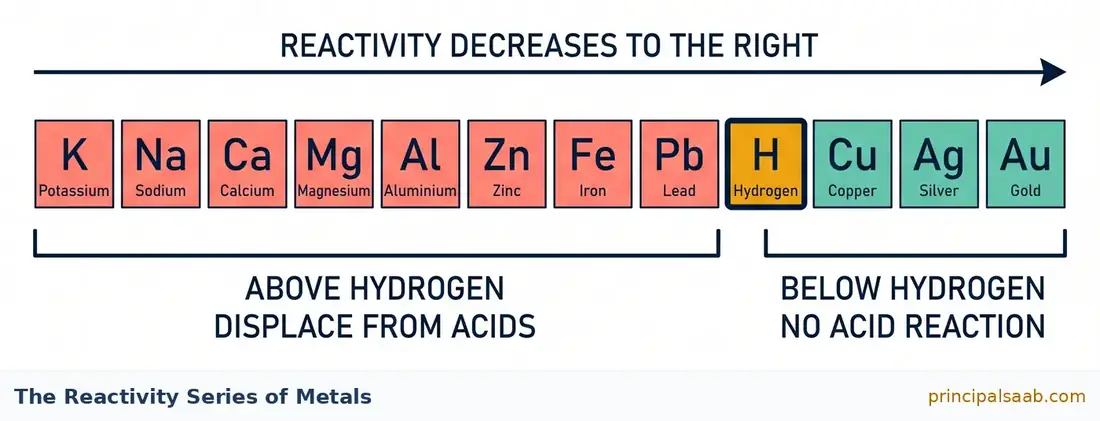
The reactivity series arranges metals in decreasing order of reactivity: K > Na > Ca > Mg > Al > Zn > Fe > Pb > (H) > Cu > Ag > Au. Metals above hydrogen displace it from acids; those below (like copper, silver, gold) do not.
3. How Metals and Non-metals React (Ionic Compounds)
Metals lose electrons to form positive ions (cations); non-metals gain electrons to form negative ions (anions). The strong attraction between these opposite charges is the ionic bond. Ionic compounds (like NaCl) are solids with high melting points, usually dissolve in water, and conduct electricity when molten or dissolved — but not when solid, because the ions are locked in place.
Metals give away electrons, non-metals take them. That single transfer of electrons is what creates ions, the ionic bond, and every property of ionic compounds.
4. Extraction, Corrosion and Alloys
Metals are usually found as ores and must be extracted. Two key steps convert an ore to the metal oxide: roasting (heating a sulphide ore strongly in air) and calcination (heating a carbonate ore in limited air). The oxide is then reduced to the metal and refined. Corrosion is the slow damage of a metal by air and moisture — rusting of iron is the common example — and it is prevented by painting, oiling, galvanising (a zinc coat) or alloying. Alloys are mixtures of metals (or a metal and a non-metal) with better properties, like stainless steel, brass and bronze.
Do not swap roasting and calcination. Roasting = sulphide ore heated in excess air; calcination = carbonate ore heated in limited air.
Practice Worksheet
Try each question fully on your own first, then click Show Answer to check yourself.
Q1. Why are metals good conductors of electricity while most non-metals are not?
Show Answer
Q2. Arrange Cu, Zn, Na and Fe in decreasing order of reactivity, and state which can displace copper from its salt.
Show Answer
Q3. What is the difference between roasting and calcination?
Show Answer
Q4. Why do ionic compounds conduct electricity when molten or dissolved but not when solid?
Show Answer
Q5. What is corrosion? Give two ways to prevent the rusting of iron.
Show Answer
Once these feel easy, you have genuinely finished this chapter. Do not aim for perfect on the first try — aim for one more correct question than yesterday.