

Chemical Reactions and Equations is the opening chapter of Class 10 Science, and it sets up ideas you will use all year. It looks heavy at first because of the symbols, but it is really just a few clear rules. This page teaches the whole chapter simply, with examples, a plan, and an original practice worksheet (with answers you can reveal) at the end. Go slowly through the examples — that is where it clicks.
What This Chapter Covers (2026-27 Syllabus)
- Writing and balancing chemical equations (the law of conservation of mass)
- The main types of reactions: combination, decomposition, displacement, double displacement, and oxidation–reduction (redox)
- Effects of oxidation in everyday life: corrosion and rancidity
Balancing equations is the single most repeated skill from this chapter in the board exam. Master just that, and you have already secured a good share of the marks.
Your Game Plan for This Chapter
Here is the simplest way to work through this chapter — about three short sittings:
- First — Practise balancing equations until it feels routine — this one skill carries the most marks.
- Next — Learn the five reaction types with one clear example each, and write those examples from memory.
- Last — Understand redox, corrosion and rancidity, and connect them to real life (rusting, spoiled food).
Then attempt the worksheet at the bottom without looking back. Now let us learn each part.
Study Notes
1. Writing and Balancing Equations
A chemical equation shows reactants on the left and products on the right, joined by an arrow. Because matter is never created or destroyed (the law of conservation of mass), the number of atoms of each element must be equal on both sides — that is what “balancing” means.
Example 1: Fe + H2O balances to 3Fe + 4H2O → Fe3O4 + 4H2.
Example 2: Mg + O2 balances to 2Mg + O2 → 2MgO.
Balance by changing the numbers in front of formulas (the coefficients). Adding state symbols — (s), (l), (g), (aq) — then makes the equation complete.
Never change the small numbers inside a formula (the subscripts) to balance. Writing H2O as H2O2 makes a completely different substance. Only adjust the coefficients in front.
2. Types of Reactions
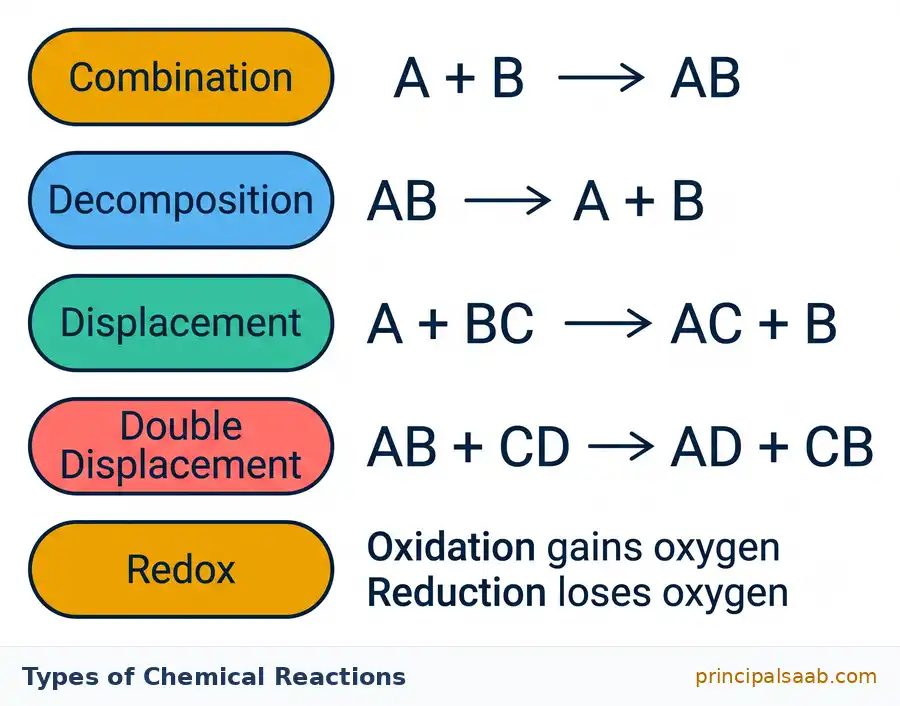
Oxidation is gain of oxygen (or loss of hydrogen); reduction is loss of oxygen (or gain of hydrogen). In CuO + H2 → Cu + H2O, CuO is reduced and H2 is oxidised — both happen together, which is why it is a redox reaction.
3. Effects of Oxidation in Daily Life
Corrosion is the slow eating away of a metal by air and moisture — the rusting of iron is the common example. It is slowed by painting, oiling, or galvanising (coating with zinc). Rancidity is the oxidation of the fats and oils in food, which gives an old packet of chips or oil a bad smell and taste. It is slowed by airtight packaging, antioxidants, refrigeration, or flushing packets with nitrogen gas.
Corrosion and rancidity are favourite one-mark questions. Remember one everyday example and one prevention method for each — that is usually all they ask.
Practice Worksheet
Try each question fully on your own first, then click Show Answer to check yourself.
Q1. Balance the equation: Fe + H2O → Fe3O4 + H2.
Show Answer
Q2. Name the type of each reaction: (a) CaO + H2O → Ca(OH)2; (b) 2Pb(NO3)2 → 2PbO + 4NO2 + O2; (c) Fe + CuSO4 → FeSO4 + Cu; (d) Pb(NO3)2 + 2KI → PbI2 + 2KNO3.
Show Answer
Q3. In the reaction ZnO + C → Zn + CO, which substance is oxidised and which is reduced?
Show Answer
Q4. An iron nail is dipped in blue copper sulphate solution. Why does a brown coating form on the nail and the blue colour fade?
Show Answer
Q5. Define corrosion and rancidity, giving one everyday example and one prevention method for each.
Show Answer
If you can balance equations and name reaction types confidently, you have finished this chapter. Keep going — every chapter you close makes the next one lighter.